● Around the year 1590, two Dutch lens makers by the name of
Hans and Zacharias Janssen invented the first compound
microscope when they put two of their lenses together in a
tube.
● In 1665, an English scientist, Robert Hooke discovered and
came up with the name “cells” while looking through a
microscope at a piece of cork.
● Supposedly, the cork (which was made of dead oak tree tissues)
reminded him of the small rooms that the monks lived in at the
monasteries.
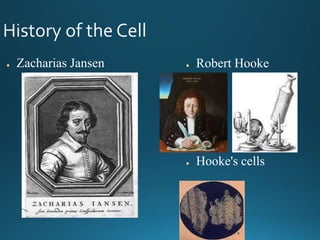
● Zacharias Jansen ● Robert Hooke
● Hooke's cells
● Not long after Hooke (around 1683), a Dutch
amateur scientist by the name of Anton Van
Leeuwenhoek observed some of the first living
cells under a simple (1 lens) microscope.
● He named these small organisms “animalcules”.
● It is now believed that some of the living cells he
saw were actually protozoa.
● In 1838 and 1839, a German botanist by the name of
Matthias Schleiden and German zoologist by the name of
Theodore Schwann viewed plants and animals under a
microscope and discovered that plants and animals are
both made of cells.
● In 1855 a Prussian (modern day German) physician by the
name of Rudolph Virchow collaborated his ideas with the
other two scientists and they developed the Cell Theory.
● The ideas of these three men led to the creation
of the cell theory. These are the three main
principles of cell theory.
● 1. All living organisms are made up of cells.
● 2. Cells are the most basic unit of life.
● 3. Cells only come from the division of pre-
existing cells. In other words, spontaneous
generation of cells does not occur.
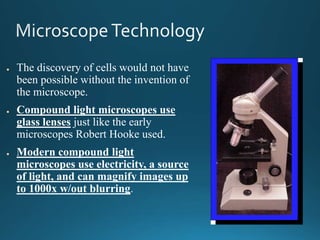
● The discovery of cells would not have
been possible without the invention of
the microscope.
● Compound light microscopes use
glass lenses just like the early
microscopes Robert Hooke used.
● Modern compound light
microscopes use electricity, a source
of light, and can magnify images up
to 1000x w/out blurring.
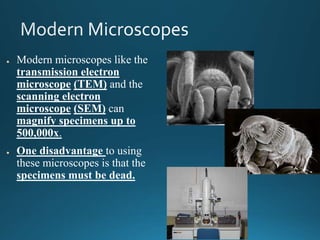
● Modern microscopes like the
transmission electron
microscope (TEM) and the
scanning electron
microscope (SEM) can
magnify specimens up to
500,000x.
● One disadvantage to using
these microscopes is that the
specimens must be dead.
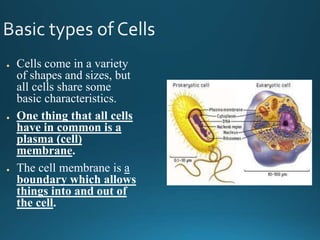
● Cells come in a variety
of shapes and sizes, but
all cells share some
basic characteristics.
● One thing that all cells
have in common is a
plasma (cell)
membrane.
● The cell membrane is a
boundary which allows
things into and out of
the cell.
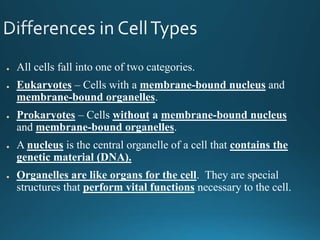
● All cells fall into one of two categories.
● Eukaryotes – Cells with a membrane-bound nucleus and
membrane-bound organelles.
● Prokaryotes – Cells without a membrane-bound nucleus
and membrane-bound organelles.
● A nucleus is the central organelle of a cell that contains the
genetic material (DNA).
● Organelles are like organs for the cell. They are special
structures that perform vital functions necessary to the cell.
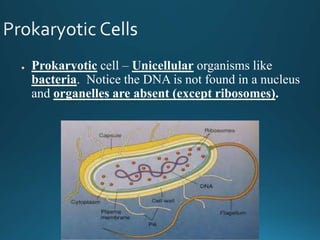
● Prokaryotic cell – Unicellular organisms like
bacteria. Notice the DNA is not found in a nucleus
and organelles are absent (except ribosomes).
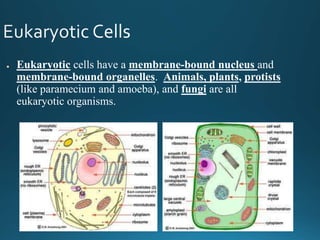
● Eukaryotic cells have a membrane-bound nucleus and
membrane-bound organelles. Animals, plants, protists
(like paramecium and amoeba), and fungi are all
eukaryotic organisms.

The Cells.pptx

  • 2.
    ● Around theyear 1590, two Dutch lens makers by the name of Hans and Zacharias Janssen invented the first compound microscope when they put two of their lenses together in a tube. ● In 1665, an English scientist, Robert Hooke discovered and came up with the name “cells” while looking through a microscope at a piece of cork. ● Supposedly, the cork (which was made of dead oak tree tissues) reminded him of the small rooms that the monks lived in at the monasteries.
  • 3.
    ● Zacharias Jansen● Robert Hooke ● Hooke's cells
  • 4.
    ● Not longafter Hooke (around 1683), a Dutch amateur scientist by the name of Anton Van Leeuwenhoek observed some of the first living cells under a simple (1 lens) microscope. ● He named these small organisms “animalcules”. ● It is now believed that some of the living cells he saw were actually protozoa.
  • 5.
    ● In 1838and 1839, a German botanist by the name of Matthias Schleiden and German zoologist by the name of Theodore Schwann viewed plants and animals under a microscope and discovered that plants and animals are both made of cells. ● In 1855 a Prussian (modern day German) physician by the name of Rudolph Virchow collaborated his ideas with the other two scientists and they developed the Cell Theory.
  • 6.
    ● The ideasof these three men led to the creation of the cell theory. These are the three main principles of cell theory. ● 1. All living organisms are made up of cells. ● 2. Cells are the most basic unit of life. ● 3. Cells only come from the division of pre- existing cells. In other words, spontaneous generation of cells does not occur.
  • 7.
    ● The discoveryof cells would not have been possible without the invention of the microscope. ● Compound light microscopes use glass lenses just like the early microscopes Robert Hooke used. ● Modern compound light microscopes use electricity, a source of light, and can magnify images up to 1000x w/out blurring.
  • 8.
    ● Modern microscopeslike the transmission electron microscope (TEM) and the scanning electron microscope (SEM) can magnify specimens up to 500,000x. ● One disadvantage to using these microscopes is that the specimens must be dead.
  • 9.
    ● Cells comein a variety of shapes and sizes, but all cells share some basic characteristics. ● One thing that all cells have in common is a plasma (cell) membrane. ● The cell membrane is a boundary which allows things into and out of the cell.
  • 10.
    ● All cellsfall into one of two categories. ● Eukaryotes – Cells with a membrane-bound nucleus and membrane-bound organelles. ● Prokaryotes – Cells without a membrane-bound nucleus and membrane-bound organelles. ● A nucleus is the central organelle of a cell that contains the genetic material (DNA). ● Organelles are like organs for the cell. They are special structures that perform vital functions necessary to the cell.
  • 11.
    ● Prokaryotic cell– Unicellular organisms like bacteria. Notice the DNA is not found in a nucleus and organelles are absent (except ribosomes).
  • 12.
    ● Eukaryotic cellshave a membrane-bound nucleus and membrane-bound organelles. Animals, plants, protists (like paramecium and amoeba), and fungi are all eukaryotic organisms.