6th Grade Science
Think of a City
• How does it operate?
• Who protects the city?
• Who runs the city?
• How does the city manage its trash?
• How does the city get food?
• How does the city get its power?
• How do you know when you are in the city
limits?
A cell can be compared to a city!
• Each part of the cell has its own function or
purpose.
• The parts of the cell can be compared to
the parts of a city based on their similar
purpose.
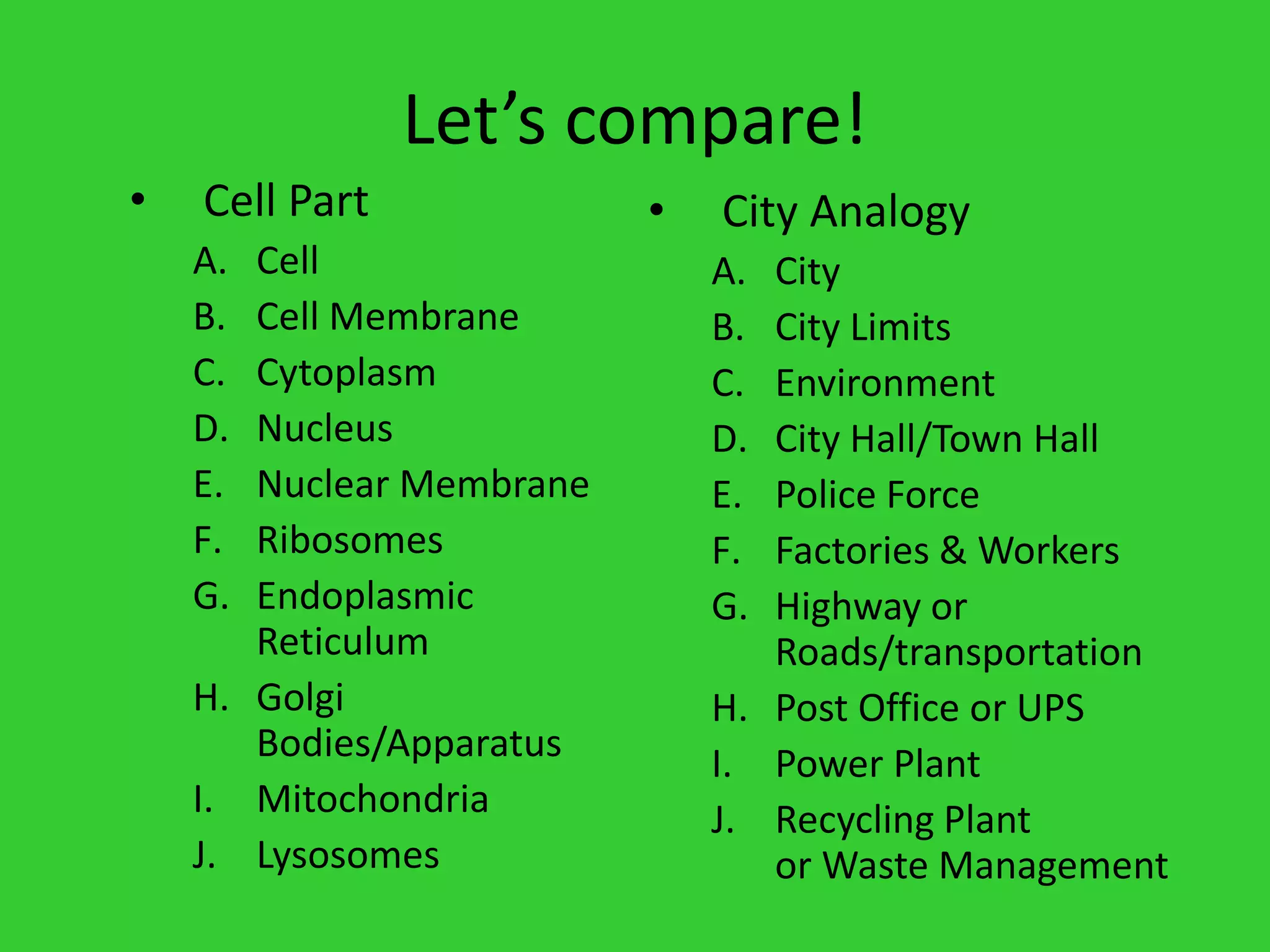
Let’s compare!
• Cell Part
A. Cell
B. Cell Membrane
C. Cytoplasm
D. Nucleus
E. Nuclear Membrane
F. Ribosomes
G. Endoplasmic
Reticulum
H. Golgi
Bodies/Apparatus
I. Mitochondria
J. Lysosomes
• City Analogy
A. City
B. City Limits
C. Environment
D. City Hall/Town Hall
E. Police Force
F. Factories & Workers
G. Highway or
Roads/transportation
H. Post Office or UPS
I. Power Plant
J. Recycling Plant
or Waste Management
A. Cell = City
B.
C.
D.
E.
F.
G.
H.
I.
J.
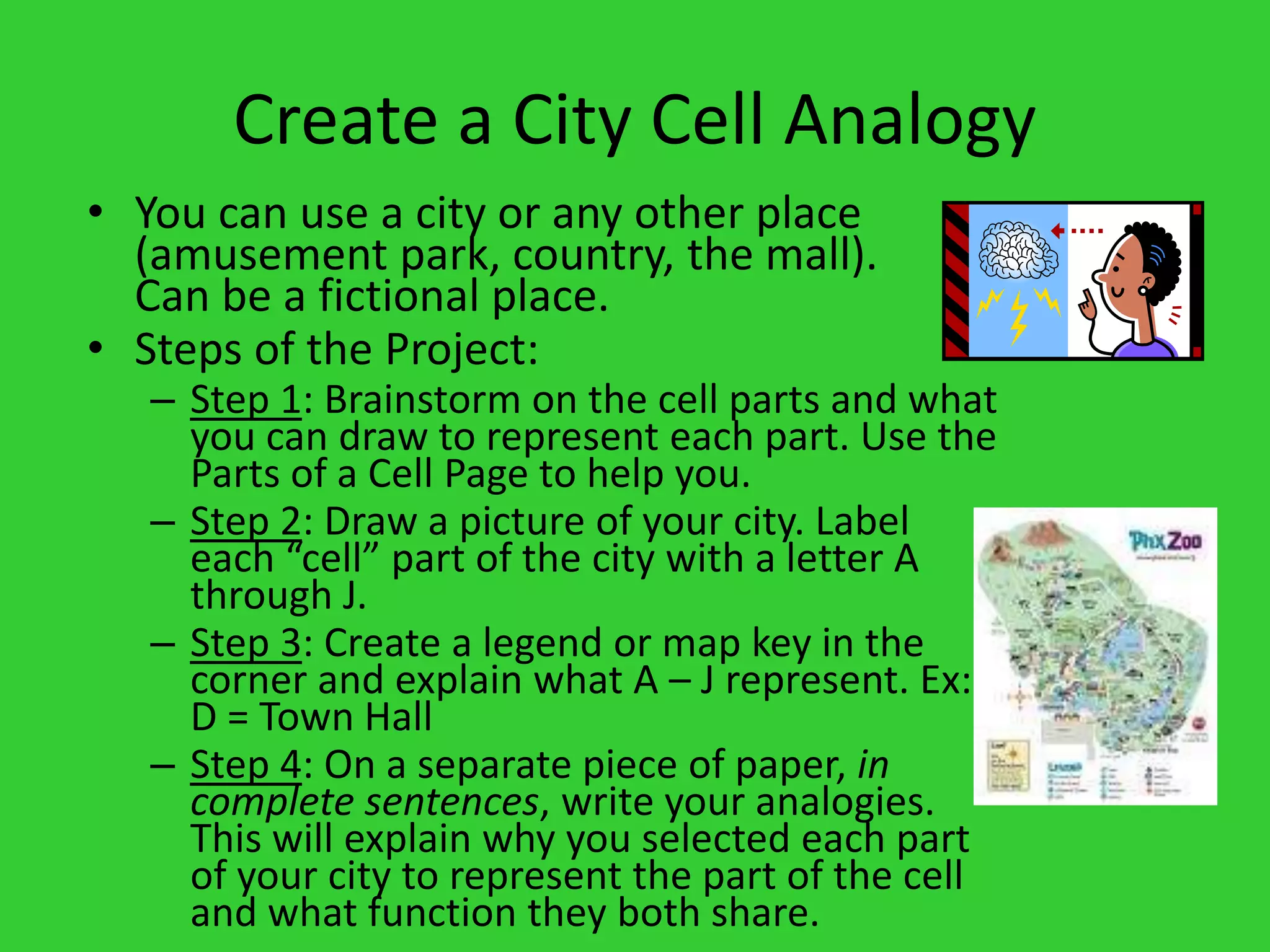
Create a City Cell Analogy
• You can use a city or any other place
(amusement park, country, the mall).
Can be a fictional place.
• Steps of the Project:
– Step 1: Brainstorm on the cell parts and what
you can draw to represent each part. Use the
Parts of a Cell Page to help you.
– Step 2: Draw a picture of your city. Label
each “cell” part of the city with a letter A
through J.
– Step 3: Create a legend or map key in the
corner and explain what A – J represent. Ex:
D = Town Hall
– Step 4: On a separate piece of paper, in
complete sentences, write your analogies.
This will explain why you selected each part
of your city to represent the part of the cell
and what function they both share.
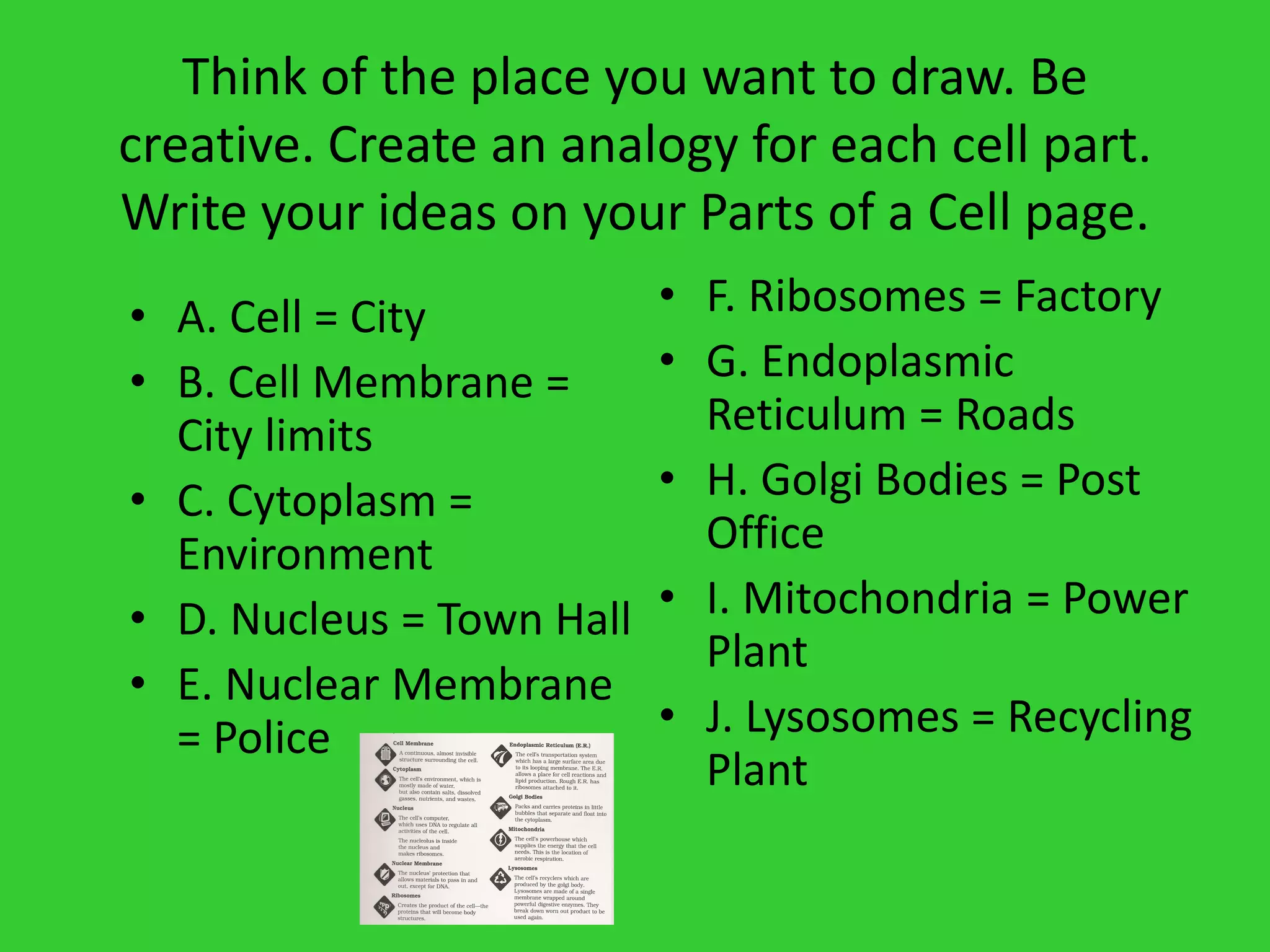
Think of the place you want to draw. Be
creative. Create an analogy for each cell part.
Write your ideas on your Parts of a Cell page.
• A. Cell = City
• B. Cell Membrane =
City limits
• C. Cytoplasm =
Environment
• D. Nucleus = Town Hall
• E. Nuclear Membrane
= Police
• F. Ribosomes = Factory
• G. Endoplasmic
Reticulum = Roads
• H. Golgi Bodies = Post
Office
• I. Mitochondria = Power
Plant
• J. Lysosomes = Recycling
Plant
Create your map and legend.
• Draw your city. Pencil first, then crayons or colored
pencils. No markers.
• Label each part on your city A – J. Circle the letter.
• Create a map legend or key in the corner of your
map which lists the letters A-J and identifies the
name of each place.
– Example. A= Far Far Away;
B=city limits
Legend
A: Far Far Away
B: Brick Wall
C: Environment
D: Shrek’s Castle
E: Puss-n-boots Security Service
F: Gingerbread Man’s Cookie Factory
G: Roads
H: 3 Blind Mice Delivery Service
I: Dragon Power Service (DPS)
J: Donkey Recycling
A
B
C
D
E
F
H
J
I
G
Explain why you chose the items to
represent each cell part.
• List the letters A-J
• For each letter:
– State the name of the city place
– The name of the cell part it corresponds to
– Why you selected that item to represent the cell
part
• Must be in complete sentences.
– Example: B: The town hall represents the
nucleus because its function is to control the
town’s activities
On notebook paper.
Final Product:
• Your analogies must be in complete sentences and
stapled/glued to the back of your map.
• Your map/picture must be neat, colorful, correctly
labeled, and have a legend or key.
• Use pencil first then color.
• Be creative! Have fun with it.
• Past examples included underwater cities,
prehistoric cities, a skate park, amusement parks,
etc…
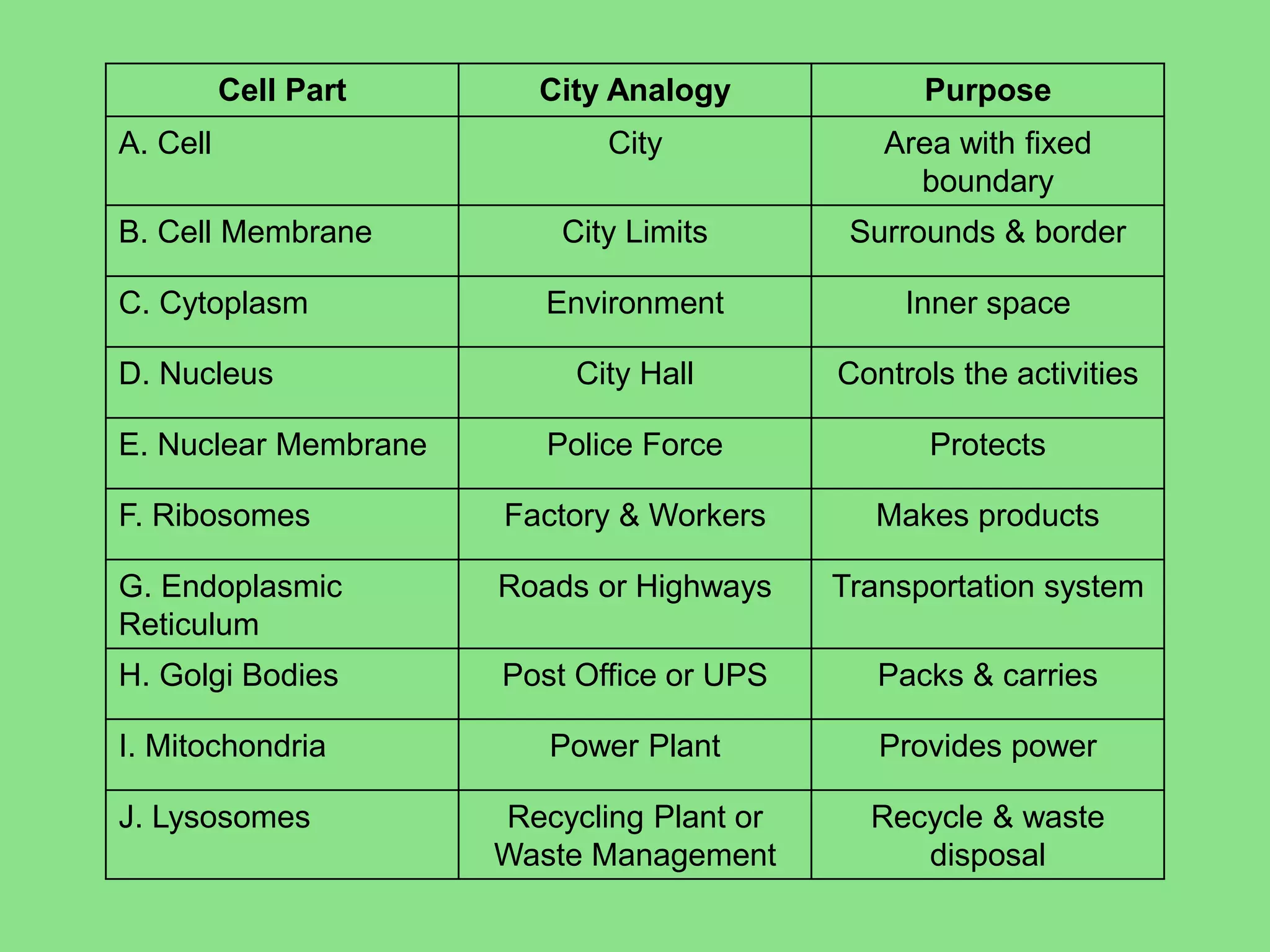
Cell Part City Analogy Purpose
A. Cell City Area with fixed
boundary
B. Cell Membrane City Limits Surrounds & border
C. Cytoplasm Environment Inner space
D. Nucleus City Hall Controls the activities
E. Nuclear Membrane Police Force Protects
F. Ribosomes Factory & Workers Makes products
G. Endoplasmic
Reticulum
Roads or Highways Transportation system
H. Golgi Bodies Post Office or UPS Packs & carries
I. Mitochondria Power Plant Provides power
J. Lysosomes Recycling Plant or
Waste Management
Recycle & waste
disposal

cell city .pptx

  • 1.
  • 2.
    Think of aCity • How does it operate? • Who protects the city? • Who runs the city? • How does the city manage its trash? • How does the city get food? • How does the city get its power? • How do you know when you are in the city limits?
  • 3.
    A cell canbe compared to a city! • Each part of the cell has its own function or purpose. • The parts of the cell can be compared to the parts of a city based on their similar purpose.
  • 4.
    Let’s compare! • CellPart A. Cell B. Cell Membrane C. Cytoplasm D. Nucleus E. Nuclear Membrane F. Ribosomes G. Endoplasmic Reticulum H. Golgi Bodies/Apparatus I. Mitochondria J. Lysosomes • City Analogy A. City B. City Limits C. Environment D. City Hall/Town Hall E. Police Force F. Factories & Workers G. Highway or Roads/transportation H. Post Office or UPS I. Power Plant J. Recycling Plant or Waste Management
  • 5.
    A. Cell =City B. C. D. E. F. G. H. I. J.
  • 6.
    Create a CityCell Analogy • You can use a city or any other place (amusement park, country, the mall). Can be a fictional place. • Steps of the Project: – Step 1: Brainstorm on the cell parts and what you can draw to represent each part. Use the Parts of a Cell Page to help you. – Step 2: Draw a picture of your city. Label each “cell” part of the city with a letter A through J. – Step 3: Create a legend or map key in the corner and explain what A – J represent. Ex: D = Town Hall – Step 4: On a separate piece of paper, in complete sentences, write your analogies. This will explain why you selected each part of your city to represent the part of the cell and what function they both share.
  • 7.
    Think of theplace you want to draw. Be creative. Create an analogy for each cell part. Write your ideas on your Parts of a Cell page. • A. Cell = City • B. Cell Membrane = City limits • C. Cytoplasm = Environment • D. Nucleus = Town Hall • E. Nuclear Membrane = Police • F. Ribosomes = Factory • G. Endoplasmic Reticulum = Roads • H. Golgi Bodies = Post Office • I. Mitochondria = Power Plant • J. Lysosomes = Recycling Plant
  • 8.
    Create your mapand legend. • Draw your city. Pencil first, then crayons or colored pencils. No markers. • Label each part on your city A – J. Circle the letter. • Create a map legend or key in the corner of your map which lists the letters A-J and identifies the name of each place. – Example. A= Far Far Away; B=city limits
  • 9.
    Legend A: Far FarAway B: Brick Wall C: Environment D: Shrek’s Castle E: Puss-n-boots Security Service F: Gingerbread Man’s Cookie Factory G: Roads H: 3 Blind Mice Delivery Service I: Dragon Power Service (DPS) J: Donkey Recycling A B C D E F H J I G
  • 10.
    Explain why youchose the items to represent each cell part. • List the letters A-J • For each letter: – State the name of the city place – The name of the cell part it corresponds to – Why you selected that item to represent the cell part • Must be in complete sentences. – Example: B: The town hall represents the nucleus because its function is to control the town’s activities On notebook paper.
  • 12.
    Final Product: • Youranalogies must be in complete sentences and stapled/glued to the back of your map. • Your map/picture must be neat, colorful, correctly labeled, and have a legend or key. • Use pencil first then color. • Be creative! Have fun with it. • Past examples included underwater cities, prehistoric cities, a skate park, amusement parks, etc…
  • 13.
    Cell Part CityAnalogy Purpose A. Cell City Area with fixed boundary B. Cell Membrane City Limits Surrounds & border C. Cytoplasm Environment Inner space D. Nucleus City Hall Controls the activities E. Nuclear Membrane Police Force Protects F. Ribosomes Factory & Workers Makes products G. Endoplasmic Reticulum Roads or Highways Transportation system H. Golgi Bodies Post Office or UPS Packs & carries I. Mitochondria Power Plant Provides power J. Lysosomes Recycling Plant or Waste Management Recycle & waste disposal