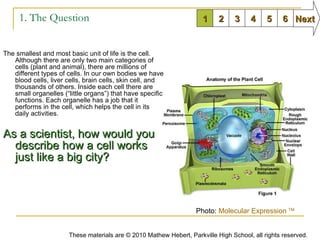
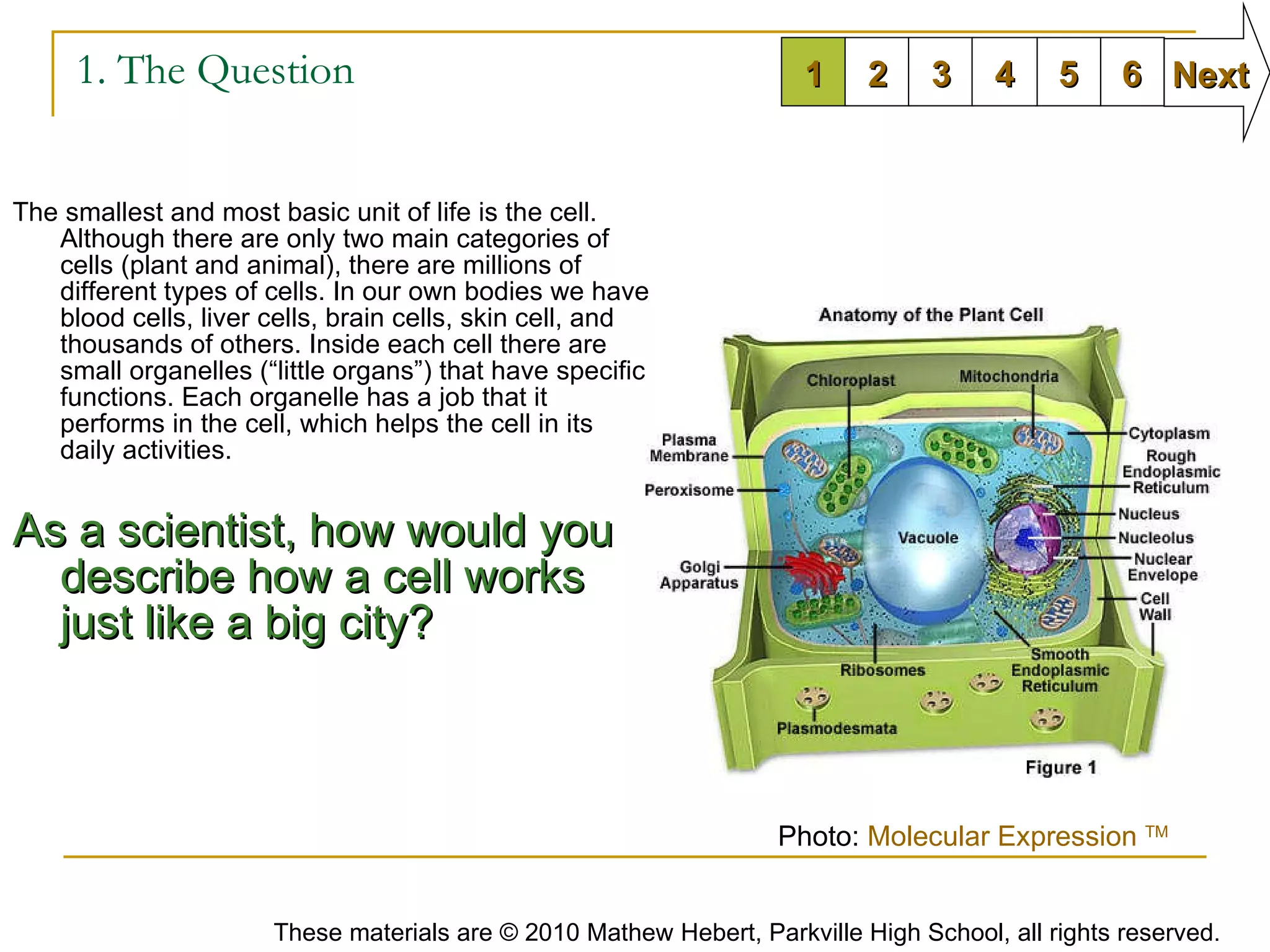
1. The Question The smallest and most basic unit of life is the cell. Although there are only two main categories of cells (plant and animal), there are millions of different types of cells. In our own bodies we have blood cells, liver cells, brain cells, skin cell, and thousands of others. Inside each cell there are small organelles (“little organs”) that have specific functions. Each organelle has a job that it performs in the cell, which helps the cell in its daily activities.  As a scientist, how would you describe how a cell works just like a big city? 1 2 3 6 5 4 Next These materials are © 2010 Mathew Hebert, Parkville High School, all rights reserved. Photo:  Molecular Expression  TM
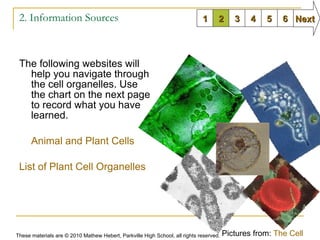
2. Information Sources The following websites will help you navigate through the cell organelles. Use the chart on the next page to record what you have learned.  Animal and Plant Cells List of Plant Cell Organelles 1 2 3 6 5 4 Next These materials are © 2010 Mathew Hebert, Parkville High School, all rights reserved. Pictures from:  The Cell
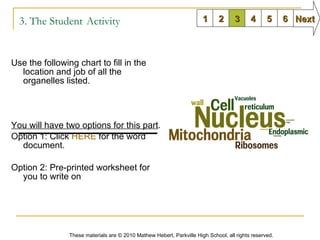
3. The Student   Activity Use the following chart to fill in the location and job of all the organelles listed.  You will have two options for this part .  Option 1: Click  HERE  for the word document. Option 2: Pre-printed worksheet for you to write on 1 2 3 6 5 4 Next These materials are © 2010 Mathew Hebert, Parkville High School, all rights reserved.
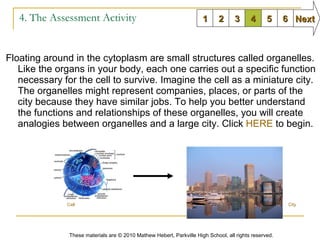
4. The Assessment Activity Floating around in the cytoplasm are small structures called organelles. Like the organs in your body, each one carries out a specific function necessary for the cell to survive. Imagine the cell as a miniature city. The organelles might represent companies, places, or parts of the city because they have similar jobs. To help you better understand the functions and relationships of these organelles, you will create analogies between organelles and a large city. Click  HERE  to begin. 1 2 3 6 5 4 Next These materials are © 2010 Mathew Hebert, Parkville High School, all rights reserved. Cell City
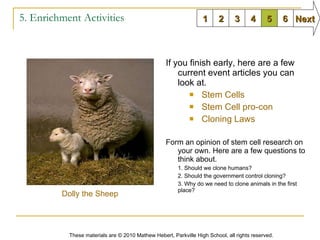
5. Enrichment Activities If you finish early, here are a few current event articles you can look at.  Stem Cells Stem Cell pro-con Cloning Laws Form an opinion of stem cell research on your own. Here are a few questions to think about. 1. Should we clone humans? 2. Should the government control cloning? 3. Why do we need to clone animals in the first place? 1 2 3 6 5 4 Next These materials are © 2010 Mathew Hebert, Parkville High School, all rights reserved. Dolly the Sheep
6. Teacher Support Materials Objective: Students will create an analogue for a cell by creating a cell city poster Teacher Notes: Have printed worksheets ready if computers don’t work. All information can be found in HOLT textbook.  Time management Strategies: This activity will take a full 80 minute session if not more. By working in groups the task may get done faster. The student activity can be done on one day and the assessment on the other day if needed.  Differentiation: This assignment could also be done in groups. With each student having a different job 1. Recorder 2. Cell city planner 3. Cell city drawer (s) Learning Styles:  Visual Tactile Reflective Analytical UNIT:  Cell Biology LEARNING GOAL: 3.2.1  The student will explain processes and the function of related structures found in unicellular and multicellular organisms. INDICATOR: 14.  The student will observe cellular and multicellular organisms to compare and contrast how each is capable of all life functions. 1 2 3 6 5 4 These materials are © 2010 Mathew Hebert, Parkville High School, all rights reserved.

Cell City

  • 1.
    1. The QuestionThe smallest and most basic unit of life is the cell. Although there are only two main categories of cells (plant and animal), there are millions of different types of cells. In our own bodies we have blood cells, liver cells, brain cells, skin cell, and thousands of others. Inside each cell there are small organelles (“little organs”) that have specific functions. Each organelle has a job that it performs in the cell, which helps the cell in its daily activities. As a scientist, how would you describe how a cell works just like a big city? 1 2 3 6 5 4 Next These materials are © 2010 Mathew Hebert, Parkville High School, all rights reserved. Photo: Molecular Expression TM
  • 2.
    2. Information SourcesThe following websites will help you navigate through the cell organelles. Use the chart on the next page to record what you have learned. Animal and Plant Cells List of Plant Cell Organelles 1 2 3 6 5 4 Next These materials are © 2010 Mathew Hebert, Parkville High School, all rights reserved. Pictures from: The Cell
  • 3.
    3. The Student Activity Use the following chart to fill in the location and job of all the organelles listed. You will have two options for this part . Option 1: Click HERE for the word document. Option 2: Pre-printed worksheet for you to write on 1 2 3 6 5 4 Next These materials are © 2010 Mathew Hebert, Parkville High School, all rights reserved.
  • 4.
    4. The AssessmentActivity Floating around in the cytoplasm are small structures called organelles. Like the organs in your body, each one carries out a specific function necessary for the cell to survive. Imagine the cell as a miniature city. The organelles might represent companies, places, or parts of the city because they have similar jobs. To help you better understand the functions and relationships of these organelles, you will create analogies between organelles and a large city. Click HERE to begin. 1 2 3 6 5 4 Next These materials are © 2010 Mathew Hebert, Parkville High School, all rights reserved. Cell City
  • 5.
    5. Enrichment ActivitiesIf you finish early, here are a few current event articles you can look at. Stem Cells Stem Cell pro-con Cloning Laws Form an opinion of stem cell research on your own. Here are a few questions to think about. 1. Should we clone humans? 2. Should the government control cloning? 3. Why do we need to clone animals in the first place? 1 2 3 6 5 4 Next These materials are © 2010 Mathew Hebert, Parkville High School, all rights reserved. Dolly the Sheep
  • 6.
    6. Teacher SupportMaterials Objective: Students will create an analogue for a cell by creating a cell city poster Teacher Notes: Have printed worksheets ready if computers don’t work. All information can be found in HOLT textbook. Time management Strategies: This activity will take a full 80 minute session if not more. By working in groups the task may get done faster. The student activity can be done on one day and the assessment on the other day if needed. Differentiation: This assignment could also be done in groups. With each student having a different job 1. Recorder 2. Cell city planner 3. Cell city drawer (s) Learning Styles: Visual Tactile Reflective Analytical UNIT: Cell Biology LEARNING GOAL: 3.2.1 The student will explain processes and the function of related structures found in unicellular and multicellular organisms. INDICATOR: 14. The student will observe cellular and multicellular organisms to compare and contrast how each is capable of all life functions. 1 2 3 6 5 4 These materials are © 2010 Mathew Hebert, Parkville High School, all rights reserved.