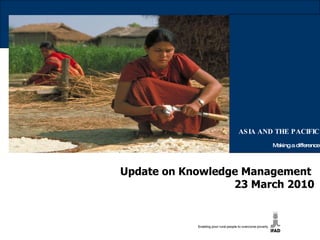
ASIA AND THE PACIFIC Making a difference Update on Knowledge Management  23 March 2010
Presentation Outline KSS Programme  KM in Supervision KM in Project Design Internet Platform
Part I KSS Programme
Programme for Development of Knowledge Sharing Skills, (KSS) Implementing Agency:  FAO Cost:  USD 950 000 Effectiveness:   April 2010 Length:  18 Months Training Course preparation, 6 months Implementation, 12 months
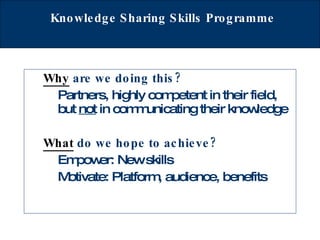
Knowledge Sharing Skills Programme   Why  are we doing this? Partners, highly competent in their field, but  not  in communicating their knowledge What  do we hope to achieve? Empower: New skills Motivate: Platform, audience, benefits
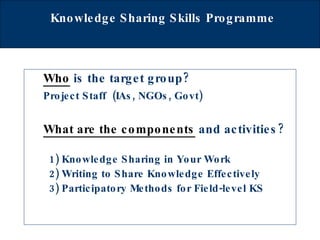
Knowledge Sharing Skills Programme   Who  is the target group? Project Staff  (IAs, NGOs, Govt)  What are the components   and activities? 1) Knowledge Sharing in Your Work 2) Writing to Share Knowledge Effectively 3) Participatory Methods for Field-level KS
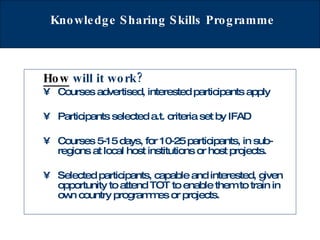
Knowledge Sharing Skills Programme How   will it work?   Courses advertised, interested participants apply  Participants selected a.t. criteria set by IFAD Courses 5-15 days, for 10-25 participants, in sub-regions at local host institutions or host projects. Selected participants, capable and interested, given opportunity to attend TOT to enable them to train in  own country programmes or projects.
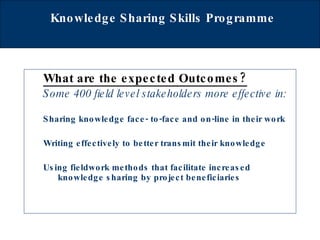
Knowledge Sharing Skills Programme   What are the expected Outcomes?   Some 400 field level stakeholders more effective in: Sharing knowledge face- to-face and on-line in their work Writing effectively to better transmit their knowledge Using fieldwork methods that facilitate increased knowledge sharing by project beneficiaries
KSS Programme Questions? Suggestions with respect to selection criteria?
Part II KM in Supervision
Supervision & KM: 2009 What we agreed to report on? How we performed in reporting? What we learned?
What is Supervision? A way for IFAD to acquire better knowledge about a project A Time to  take stock  of what is known A Process of  face-to-face  Knowledge Sharing An exercise that requires actors to  capture what they learn about a project in a  document An Opportunity for Projects to Communicate Knowledge they have Acquired  A Chance to Reflect on what is happening:  An Obligation to Crystalise Knowledge from experience A Time to Acknowledge what we don’t Know An Occasion to Share Knowledge we Acquire from One Project to Another
 
Supervision An Art of Knowledge Management
What we agreed to report on? How Projects Are Learning and Sharing Knowledge What We Are Learning about Poverty Reduction
Agreed by PI in 2009   Knowledge Management Section of Supervision Report ….. Project Performance  in KM
Agreed by PI in 2009   Knowledge Management Appendix Section of Supervision Report ….. Lessons Learned
Agreed by PI in 2009 KM Appendix What has worked well? What have been the reasons for this? What has not worked well? What have been the reasons for this?
Agreed by PI in 2009  Supervision as KM Process Prime Beneficiary = PMU   KM Appendix, Lessons Learned    COSOP Strategic Objectives
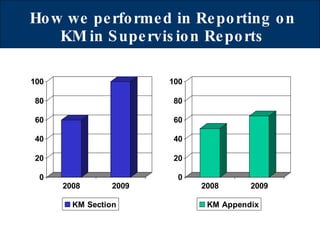
How we performed in Reporting on KM in Supervision Reports
What we learned?  about project level KM practices Most projects do knowledge sharing TV, Radio, Newspapers, Videos, Websites,Seminars  About 1/3 report some kind of system for managing knowledge Rarely identify key themes or specify links to Project Objectives or M&E
What we learned?   about project level KM practices Little focus on knowledge sharing at community level Recommendations re KM systems very ambitious, when present
What we learned?   About poverty reduction Importance of working with local government, project activities integrated within govt programmes Synchronised availability of funds from IFAD and co-financiers Annual planning at village level allows changing priorities, add and delete activities according to changing conditions
What we learned?   About poverty reduction Helps to specify capacity building by component and sub-component Capacity building has contributed to success of decentralised approaches Small homogenous groups functioning for self-development have influence in village policies
What we learned?   About poverty reduction Microfiannce institutions can perform as well or better than banks in financing farmers in agricultural production It is important to link those who have credit to use of business services, and those who use business services to credit
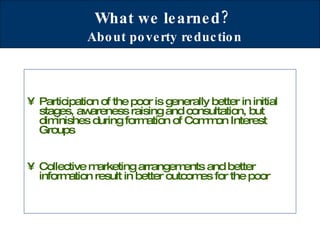
What we learned?   About poverty reduction Participation of the poor is generally better in initial stages, awareness raising and consultation, but diminishes during formation of Common Interest Groups Collective marketing arrangements and better information result in better outcomes for the poor
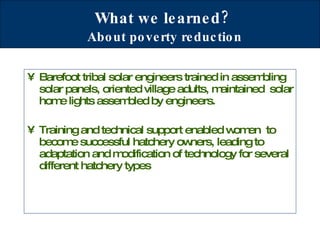
What we learned?   About poverty reduction Barefoot tribal solar engineers trained in assembling solar panels, oriented village adults, maintained  solar home lights assembled by engineers.  Training and technical support enabled women  to become successful hatchery owners, leading to adaptation and modification of technology for several different hatchery types
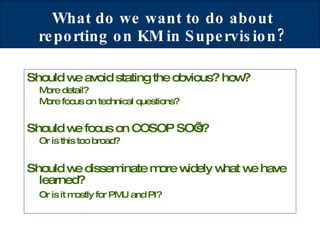
What do we want to do about reporting on KM in Supervision? Should we avoid stating the obvious? how? More detail? More focus on technical questions? Should we focus on COSOP SO’s?   Or is this too broad? Should we disseminate more widely what we have learned?  Or is it mostly for PMU and PI?
Reminder Supervision Format on //desk Workspaces  Guidelines and Template Supervision
Reminder Managing Knowledge during  Supervision is an Art
Part III KM in Project Design
HOW ARE WE DOING IN DESIGNING  HOW TO MANAGE KNOWLEDGE   IN INVESTMENT PROJECTS ?
Review of Knowledge Management in Project Design in 2009 Methodology Findings Implications
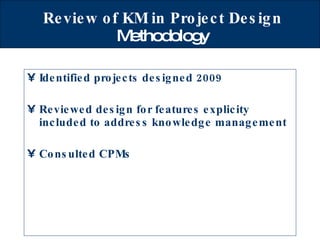
Review of KM in Project Design  Methodology Identified projects designed 2009 Reviewed design for features explicity included to address knowledge management Consulted CPMs
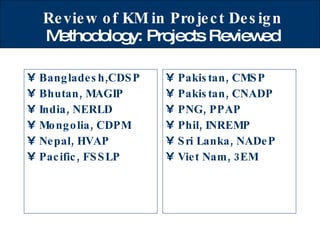
Review of KM in Project Design  Methodology: Projects Reviewed Bangladesh,CDSP Bhutan, MAGIP India, NERLD Mongolia, CDPM Nepal, HVAP Pacific, FSSLP Pakistan, CMSP Pakistan, CNADP PNG, PPAP Phil, INREMP Sri Lanka, NADeP Viet Nam, 3EM
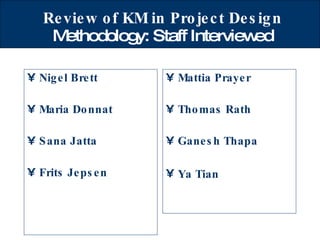
Review of KM in Project Design  Methodology: Staff Interviewed Nigel Brett Maria Donnat Sana Jatta Frits Jepsen Mattia Prayer Thomas Rath Ganesh Thapa Ya Tian
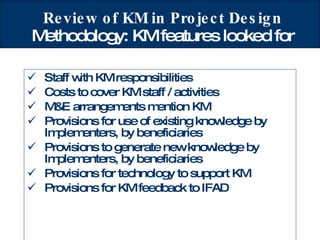
Review of KM in Project Design  Methodology: KM features looked for Staff with KM responsibilities Costs to cover KM staff / activities M&E arrangements mention KM Provisions for use of existing knowledge by Implementers, by beneficiaries Provisions to generate new knowledge by Implementers, by beneficiaries Provisions for technology to support KM Provisions for KM feedback to IFAD
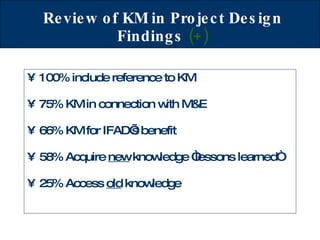
Review of KM in Project Design Findings   (+) 100% include reference to KM 75% KM in connection with M&E 66% KM for IFAD’s benefit 58% Acquire  new  knowledge “lessons learned“ 25% Access  old  knowledge
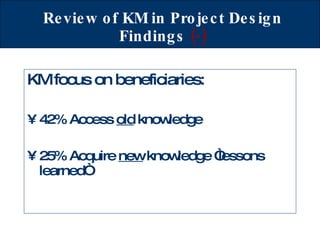
Review of KM in Project Design Findings  (-) KM focus on beneficiaries: 42% Access  old  knowledge 25% Acquire  new  knowledge “lessons learned“
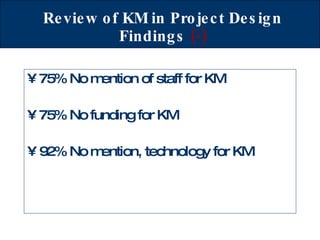
Review of KM in Project Design Findings  (-) 75% No mention of staff for KM 75% No funding for KM 92% No mention, technology for KM
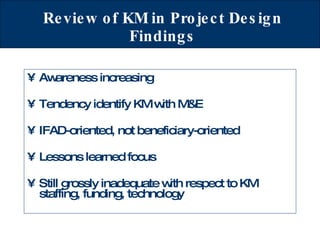
Review of KM in Project Design Findings Awareness increasing Tendency identify KM with M&E IFAD-oriented, not beneficiary-oriented Lessons learned focus Still grossly inadequate with respect to KM staffing, funding, technology
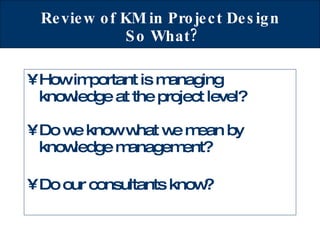
Review of KM in Project Design  So What? How important is managing knowledge at the project level? Do we know what we mean by knowledge management?  Do our consultants know?
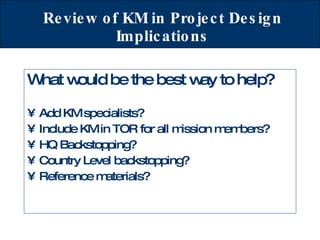
Review of KM in Project Design Implications What would be the best way to help? Add KM specialists? Include KM in TOR for all mission members? HQ Backstopping? Country Level backstopping? Reference materials?

KM Update in Asia Division

  • 1.
    ASIA AND THEPACIFIC Making a difference Update on Knowledge Management 23 March 2010
  • 2.
    Presentation Outline KSSProgramme KM in Supervision KM in Project Design Internet Platform
  • 3.
    Part I KSSProgramme
  • 4.
    Programme for Developmentof Knowledge Sharing Skills, (KSS) Implementing Agency: FAO Cost: USD 950 000 Effectiveness: April 2010 Length: 18 Months Training Course preparation, 6 months Implementation, 12 months
  • 5.
    Knowledge Sharing SkillsProgramme Why are we doing this? Partners, highly competent in their field, but not in communicating their knowledge What do we hope to achieve? Empower: New skills Motivate: Platform, audience, benefits
  • 6.
    Knowledge Sharing SkillsProgramme Who is the target group? Project Staff (IAs, NGOs, Govt) What are the components and activities? 1) Knowledge Sharing in Your Work 2) Writing to Share Knowledge Effectively 3) Participatory Methods for Field-level KS
  • 7.
    Knowledge Sharing SkillsProgramme How will it work? Courses advertised, interested participants apply Participants selected a.t. criteria set by IFAD Courses 5-15 days, for 10-25 participants, in sub-regions at local host institutions or host projects. Selected participants, capable and interested, given opportunity to attend TOT to enable them to train in own country programmes or projects.
  • 8.
    Knowledge Sharing SkillsProgramme What are the expected Outcomes? Some 400 field level stakeholders more effective in: Sharing knowledge face- to-face and on-line in their work Writing effectively to better transmit their knowledge Using fieldwork methods that facilitate increased knowledge sharing by project beneficiaries
  • 9.
    KSS Programme Questions?Suggestions with respect to selection criteria?
  • 10.
    Part II KMin Supervision
  • 11.
    Supervision & KM:2009 What we agreed to report on? How we performed in reporting? What we learned?
  • 12.
    What is Supervision?A way for IFAD to acquire better knowledge about a project A Time to take stock of what is known A Process of face-to-face Knowledge Sharing An exercise that requires actors to capture what they learn about a project in a document An Opportunity for Projects to Communicate Knowledge they have Acquired A Chance to Reflect on what is happening: An Obligation to Crystalise Knowledge from experience A Time to Acknowledge what we don’t Know An Occasion to Share Knowledge we Acquire from One Project to Another
  • 13.
  • 14.
    Supervision An Artof Knowledge Management
  • 15.
    What we agreedto report on? How Projects Are Learning and Sharing Knowledge What We Are Learning about Poverty Reduction
  • 16.
    Agreed by PIin 2009 Knowledge Management Section of Supervision Report ….. Project Performance in KM
  • 17.
    Agreed by PIin 2009 Knowledge Management Appendix Section of Supervision Report ….. Lessons Learned
  • 18.
    Agreed by PIin 2009 KM Appendix What has worked well? What have been the reasons for this? What has not worked well? What have been the reasons for this?
  • 19.
    Agreed by PIin 2009 Supervision as KM Process Prime Beneficiary = PMU KM Appendix, Lessons Learned COSOP Strategic Objectives
  • 20.
    How we performedin Reporting on KM in Supervision Reports
  • 21.
    What we learned? about project level KM practices Most projects do knowledge sharing TV, Radio, Newspapers, Videos, Websites,Seminars About 1/3 report some kind of system for managing knowledge Rarely identify key themes or specify links to Project Objectives or M&E
  • 22.
    What we learned? about project level KM practices Little focus on knowledge sharing at community level Recommendations re KM systems very ambitious, when present
  • 23.
    What we learned? About poverty reduction Importance of working with local government, project activities integrated within govt programmes Synchronised availability of funds from IFAD and co-financiers Annual planning at village level allows changing priorities, add and delete activities according to changing conditions
  • 24.
    What we learned? About poverty reduction Helps to specify capacity building by component and sub-component Capacity building has contributed to success of decentralised approaches Small homogenous groups functioning for self-development have influence in village policies
  • 25.
    What we learned? About poverty reduction Microfiannce institutions can perform as well or better than banks in financing farmers in agricultural production It is important to link those who have credit to use of business services, and those who use business services to credit
  • 26.
    What we learned? About poverty reduction Participation of the poor is generally better in initial stages, awareness raising and consultation, but diminishes during formation of Common Interest Groups Collective marketing arrangements and better information result in better outcomes for the poor
  • 27.
    What we learned? About poverty reduction Barefoot tribal solar engineers trained in assembling solar panels, oriented village adults, maintained solar home lights assembled by engineers. Training and technical support enabled women to become successful hatchery owners, leading to adaptation and modification of technology for several different hatchery types
  • 28.
    What do wewant to do about reporting on KM in Supervision? Should we avoid stating the obvious? how? More detail? More focus on technical questions? Should we focus on COSOP SO’s? Or is this too broad? Should we disseminate more widely what we have learned? Or is it mostly for PMU and PI?
  • 29.
    Reminder Supervision Formaton //desk Workspaces Guidelines and Template Supervision
  • 30.
    Reminder Managing Knowledgeduring Supervision is an Art
  • 31.
    Part III KMin Project Design
  • 32.
    HOW ARE WEDOING IN DESIGNING HOW TO MANAGE KNOWLEDGE IN INVESTMENT PROJECTS ?
  • 33.
    Review of KnowledgeManagement in Project Design in 2009 Methodology Findings Implications
  • 34.
    Review of KMin Project Design Methodology Identified projects designed 2009 Reviewed design for features explicity included to address knowledge management Consulted CPMs
  • 35.
    Review of KMin Project Design Methodology: Projects Reviewed Bangladesh,CDSP Bhutan, MAGIP India, NERLD Mongolia, CDPM Nepal, HVAP Pacific, FSSLP Pakistan, CMSP Pakistan, CNADP PNG, PPAP Phil, INREMP Sri Lanka, NADeP Viet Nam, 3EM
  • 36.
    Review of KMin Project Design Methodology: Staff Interviewed Nigel Brett Maria Donnat Sana Jatta Frits Jepsen Mattia Prayer Thomas Rath Ganesh Thapa Ya Tian
  • 37.
    Review of KMin Project Design Methodology: KM features looked for Staff with KM responsibilities Costs to cover KM staff / activities M&E arrangements mention KM Provisions for use of existing knowledge by Implementers, by beneficiaries Provisions to generate new knowledge by Implementers, by beneficiaries Provisions for technology to support KM Provisions for KM feedback to IFAD
  • 38.
    Review of KMin Project Design Findings (+) 100% include reference to KM 75% KM in connection with M&E 66% KM for IFAD’s benefit 58% Acquire new knowledge “lessons learned“ 25% Access old knowledge
  • 39.
    Review of KMin Project Design Findings (-) KM focus on beneficiaries: 42% Access old knowledge 25% Acquire new knowledge “lessons learned“
  • 40.
    Review of KMin Project Design Findings (-) 75% No mention of staff for KM 75% No funding for KM 92% No mention, technology for KM
  • 41.
    Review of KMin Project Design Findings Awareness increasing Tendency identify KM with M&E IFAD-oriented, not beneficiary-oriented Lessons learned focus Still grossly inadequate with respect to KM staffing, funding, technology
  • 42.
    Review of KMin Project Design So What? How important is managing knowledge at the project level? Do we know what we mean by knowledge management? Do our consultants know?
  • 43.
    Review of KMin Project Design Implications What would be the best way to help? Add KM specialists? Include KM in TOR for all mission members? HQ Backstopping? Country Level backstopping? Reference materials?