2.1 Driving at Night
2.1.1 – It's More Dangerous
You are at greater risk when you drive at night. Drivers can't see hazards as
quickly as in daylight, so they have less time to respond. Drivers caught by
surprise are less able to avoid a crash.
The problems of night driving involve the driver, the roadway, and the
vehicle.
2.1.2 – Driver Factors
Vision. Good vision is critical for safe driving. Your control of the brake,
accelerator, and steering wheel is based on what you see. If you cannot see
clearly, you will have trouble identifying traffic and roadway conditions,
spotting potential trouble or responding to problems in a timely manner.
Because seeing well is so critical to safe driving, you should have your eyes
checked regularly by an eye specialist. You may never know you have poor
vision unless your eyes are tested. If you need to wear glasses or contact
lenses for driving, remember to:
Always wear them when driving, even if driving short distances. If your driver
license says corrective lenses are required, it is illegal to move a vehicle
without using corrective lenses.
Keep an extra set of corrective lenses in your vehicle. If your normal
corrective lenses are broken or lost, you can use the spare lenses to drive
safely.
Avoid using dark or tinted corrective lenses at night, even if you think they
help with glare. Tinted lenses cut down the light that you need to see clearly
under night driving conditions.
Glare. Drivers can be blinded for a short time by bright light. . It can take
several seconds to recover from glare. Even two seconds of glare blindness
can be dangerous. A vehicle going 55 mph will travel more than half the
distance of a football field during that time.
Fatigue and Lack of Alertness. Fatigue is physical or mental tiredness that
can be caused by physical or mental strain, repetitive tasks, illness or lack of
sleep. Just like alcohol and drugs, it impairs your vision and judgment.
Fatigue causes errors related to speed and distance, increases your risk of
being in a crash, causes you to not see and react to hazards as quickly; and
affects your ability to make critical decisions. When you are fatigued, you
could fall asleep behind the wheel and crash, injuring or killing yourself or
others.
Fatigued or drowsy driving is one of the leading causes of traffic collisions.
NHTSA estimates that 100,000 police-reported crashes a year are the result of
drowsy driving. According to the National Sleep Foundation’s Sleep in America
poll, 60% of Americans have driven while feeling sleepy and more than one
third (36 percent or 103 million people) admit to having actually fallen asleep at
the wheel. Drivers may experience short bursts of sleep lasting only a few
seconds or fall asleep for longer periods of time. Either way, the chance of a
collision increases dramatically.
At-Risk Groups
The risk of having a crash due to drowsy driving is not uniformly distributed
across the population. Crashes tend to occur at times when sleepiness is most
pronounced, for example, during the night and in the mid-afternoon. Most
people are less alert at night, especially after midnight. This is particularly true if
you have been driving for a long time. Thus individuals who drive at night are
much more likely to have fall-asleep crashes.
Research has identified young males, shift workers, commercial drivers,
especially long-haul drivers and people with untreated sleep disorders or with
short- term or chronic sleep deprivation as being at increased risk for having a
fall-asleep crash. At least 15% of all heavy truck crashes involve fatigue.
A congressionally mandated study of 80 long-haul truck drivers in the
United States and Canada found that drivers averaged less than 5 hours
of sleep per day. (Federal Motor Carrier Safety Administration,
1996) It is no surprise then that the National Transportation Safety Board
(NTSB) reported that drowsy driving was probably the cause of more than half
of crashes leading to a truck driver’s death. (NTSB, 1990) For each truck driver
fatality, another three to four people are killed. (NHTSA, 1994)
Warning Signs of Fatigue
According to the National Sleep Foundation’s Sleep in America poll, 60% of
Americans have driven while feeling sleepy and 36% admit to actually having
fallen asleep at the wheel in the past year. However, many people cannot tell if
or when they are about to fall asleep. Here are some signs that should tell you
to stop and rest:
Difficulty focusing, frequent blinking or heavy eyelids
Yawning repeatedly or rubbing eyes
Day-dreaming; or wandering/disconnected thoughts
Trouble remembering the last few miles driven; missing exits or traffic signs
Trouble keeping head up
Drifting from your lane, following too closely or hitting a shoulder rumble strip
Feeling restless and irritable
When you are tired trying to “push on” is far more dangerous than most drivers
think. It is a major cause of fatal accidents. If you notice any signs of fatigue, stop
driving and go to sleep for the night or take a 15 – 20 minute nap.
Are You At Risk?
Before you drive, consider whether you are:
Sleep-deprived or fatigued (6 hours of sleep or less triples your risk)
Suffering from sleep loss (insomnia), poor quality sleep, or a sleep debt
Driving long distances without proper rest breaks
Driving through the night, mid-afternoon or when you would normally be asleep.
Many heavy motor vehicle accidents occur between midnight and 6 a.m.
Taking sedating medications (antidepressants, cold tablets, antihistamines)
Working more than 60 hours a week (increases your risk by 40%)
Working more than one job, and your main job involves shift work
Driving alone or on a long, rural, dark or boring road Flying, changing time zone
Preventing drowsiness before a trip:
Get adequate sleep – adults need 8 to 9 hours to maintain alertness
Prepare route carefully to identify total distance, stopping points and other logistic
considerations
Schedule trips for the hours you are normally awake, not the middle of the night
Drive with a passenger
Avoid medications that cause drowsiness
Consult your physician if you suffer from daytime sleepiness, have difficulty
sleeping at night or take frequent naps
Incorporate exercise into your daily life to give you more energy.
Maintaining alertness while driving:
Protect yourself from glare and eyestrain with sunglasses
Keep cool by opening the window or using the air conditioner
Avoid heavy foods
Be aware of down time during the day
Have another person ride with you, and take turns driving
Take periodic breaks – about every 100 miles or 2 hours during long trips
Stop driving and get some rest or take a nap
Caffeine consumption can increase awareness for a few hours, but do not drink
too much. It will eventually wear off. Do not rely on caffeine to prevent fatigue
Avoid drugs. While they may keep you awake for a while, they won’t make you
alert.
If you are drowsy, the only safe cure is to get off the road and get some sleep. If
you don't, you risk your life and the lives of others.
2.1.1 – Roadway Factors
Poor Lighting. In the daytime there is usually enough light to see well. This is not
true at night. Some areas may have bright street lights, but many areas will have
poor lighting. On most roads you will probably have to depend entirely on your
headlights.
Less light means you will not be able to see hazards as well as in daytime. Road
users who do not have lights are hard to see. There are many accidents at night
involving pedestrians, joggers, bicyclists, and animals.
Even when there are lights, the road scene can be confusing. Traffic signals and
hazards can be hard to see against a background of signs, shop windows, and
other lights.
Drive slower when lighting is poor or confusing. Drive slowly enough to be sure
you can stop in the distance you can see ahead.
Drunk Drivers. Drunk drivers and drivers under the influence of drugs are a
hazard to themselves and to you. Be especially alert around the closing times for
bars and taverns. Watch for drivers who have trouble staying in their lane or
maintaining speed, who stop without reason, or show other signs of being under
the influence of alcohol or drugs.
2.1.1 – Vehicle Factors
Headlights. At night your headlights will usually be the main source of light for
you to see by and for others to see you. You can't see nearly as much with your
headlights as you see in the daytime. With low beams you can see ahead about
250 feet and with high beams about 350-500 feet. You must adjust your speed to
keep your stopping distance within your sight distance. This means going slowly
enough to be able to stop within the range of your headlights. Otherwise, by the
time you see a hazard, you will not have time to stop.
Night driving can be more dangerous if you have problems with your headlights.
Dirty headlights may give only half the light they should. This cuts down your
ability to see, and makes it harder for others to see you. Make sure your lights are
clean and working. Headlights can be out of adjustment. If they don't point in the
right direction, they won't give you a good view and they can blind other drivers.
Have a qualified person make sure they are adjusted properly.
Other Lights. In order for you to be seen easily, the following must be clean and
working properly:
Reflectors. Marker lights. Clearance lights. Taillights.
Identification lights.
Turn Signals and Brake Lights. At night your turn signals and brake lights are
even more important for telling other drivers what you intend to do. Make sure you
have clean, working turn signals and stop lights.
Windshield and Mirrors. It is more important at night than in the daytime to have
a clean windshield
and clean mirrors. Bright lights at night can cause dirt on your windshield or
mirrors to create a glare of its own, blocking your view. Most people have
experienced driving toward the sun just as it has risen or is about to set, and
found that they can barely see through a windshield that seemed to look OK in the
middle of the day. Clean your windshield on the inside and outside for safe driving
at night.
2.1.1 – Night Driving Procedures
Vehicle Procedures. Make sure you are rested and alert. If you are drowsy, sleep
before you drive! Even a nap can save your life or the lives of others. If you wear
eyeglasses, make sure they are clean and unscratched. Don't wear sunglasses at
night. Do a complete Vehicle inspection of your vehicle. Pay attention to checking
all lights and reflectors, and cleaning those you can reach.
Avoid Blinding Others. Glare from your headlights can cause problems for
drivers coming toward you. They can also bother drivers going in the same
direction you are, when your lights shine in their rearview mirrors. Dim your
lights before they cause glare for other drivers. Dim your lights within 500
feet of an oncoming vehicle and when following another vehicle within 500
feet.
Avoid Glare from Oncoming Vehicles. Do not look directly at lights of
oncoming vehicles. Look slightly to the right at a right lane or edge marking,
if available. If other drivers don't put their low beams on, don't try to "get back
at them" by putting your own high beams on. This increases glare for
oncoming drivers and increases the chance of a crash.
Use High Beams When You Can. Some drivers make the mistake of
always using low beams. This seriously cuts down on their ability to see
ahead. Use high beams when it is safe and legal to do so.
Use them when you are not within 500 feet of an approaching vehicle. Also,
don't let the inside of your cab get too bright. This makes it harder to see
outside. Keep the interior light off, and adjust your instrument lights as low as
you can to still be able to read the gauges.
If You Get Sleepy, Stop at the Nearest Safe Place. People often don't realize
how close they are to falling asleep even when their eyelids are falling shut.
If you can safely do so, look at yourself in a mirror. If you look sleepy, or you
just feel sleepy, stop driving! You are in a very dangerous condition. The only
safe cure is to sleep
2.1 Driving in Fog
Fog can occur at any time. Fog on highways can be extremely dangerous.
Fog is often unexpected, and visibility can deteriorate rapidly. You should
watch for foggy conditions and be ready to reduce your speed. Do not
assume that the fog will thin out after you enter it.
The best advice for driving in fog is don’t. It is preferable that you pull off the
road into a rest area or truck stop until visibility is better. If you must drive, be
sure to consider the following:
Obey all fog-related warning signs. Slow down before you enter fog.
Use low-beam headlights and fog lights for best visibility even in daytime,
and be alert for other drivers who may have forgotten to turn on their lights.
Turn on your 4-way flashers. This will give vehicles approaching you from
behind a quicker opportunity to notice your vehicle.
Watch for vehicles on the side of the roadway. Seeing taillights or headlights
in front of you may not be a true indication of where the road is ahead of you.
The vehicle may not be on the road at all.
Use roadside highway reflectors as guides to determine how the road may
curve ahead of you.
Listen for traffic you cannot see. Avoid passing other vehicles.
Don’t stop along the side of the road, unless absolutely necessary.
2.2– Driving in Winter
2.2.1– Vehicle Checks
Make sure your vehicle is ready before driving in winter weather. You should
make a regular Vehicle inspection, paying extra attention to the following
items.
Coolant Level and Antifreeze Amount. Make sure the cooling system is full
and there is enough antifreeze in the system to protect against freezing. This
can be checked with a special coolant tester.
Defrosting and Heating Equipment. Make sure the defrosters work. They
are needed for safe driving. Make sure the heater is working, and that you
know how to operate it. If you use other heaters and expect to need them
(e.g., mirror heaters, battery box heaters, fuel tank heaters), check their
Wipers and Washers. Make sure the windshield wiper blades are in good
condition. Make sure the wiper blades press against the window hard enough
to wipe the windshield clean, otherwise they may not sweep off snow
properly. Make sure the windshield washer works and there is washing fluid in
the washer reservoir.
Use windshield washer antifreeze to prevent freezing of the washer liquid. If
you can't see well enough while driving (for example, if your wipers fail), stop
safely and fix the problem.
Tires. Make sure you have enough tread on your tires. The drive tires must
provide traction to push the rig over wet pavement and through snow. The
steering tires must have traction to steer the vehicle. Enough tread is
especially important in winter conditions. You must have at least 4/32 inch
tread depth in every major groove on front tires and at least 2/32 inch on
other tires. More would be better. Use a gauge to determine if you have
enough tread for safe driving.
Tire Chains. You may find yourself in conditions where you can't drive
without chains, even to get to a place of safety. Carry the right number of
chains and extra cross-links. Make sure they will fit your drive tires. Check the
chains for broken hooks, worn or broken cross-links, and bent or broken side
chains. Learn how to put the chains on before you need to do it in snow and
ice.
Lights and Reflectors. Make sure the lights and reflectors are clean. Lights
and reflectors are especially important during bad weather. Check from time
to time during bad weather to make sure they are clean and working properly.
Windows and Mirrors. Remove any ice, snow, etc., from the windshield,
windows, and mirrors before starting. Use a windshield scraper, snow brush,
and windshield defroster as necessary.
Hand Holds, Steps, and Deck Plates. Remove all ice and snow from hand
holds, steps, and deck plates. This will reduce the danger of slipping.
Radiator Shutters and Winterfront. Remove ice from the radiator shutters.
Make sure the winterfront is not closed too tightly. If the shutters freeze shut
or the winterfront is closed too much, the engine may overheat and stop.
Exhaust System. Exhaust system leaks are especially dangerous when cab
ventilation may be poor (windows rolled up, etc.). Loose connections could
permit poisonous carbon monoxide to leak into your vehicle. Carbon
monoxide gas will cause you to be sleepy. In large enough amounts it can kill
you. Check the exhaust system for loose parts and for sounds and signs of
leaks.
2.1.1– Driving
Slippery Surfaces. Drive slowly and smoothly on slippery roads. If it is very
slippery, you shouldn't drive at all. Stop at the first safe place.
Start Gently and Slowly. When first starting, get the feel of the road. Don't
hurry.
Check for Ice. Check for ice on the road, especially bridges and overpasses.
A lack of spray from other vehicles indicates ice has formed on the road. Also,
check your mirrors and wiper blades for ice. If they have ice, the road most
likely will be icy as well.
Adjust Turning and Braking to Conditions. Make turns as gently as
possible. Don't brake any harder than necessary, and don't use the engine
brake or speed retarder. (They can cause the driving wheels to skid on
slippery surfaces.)
Adjust Speed to Conditions. Don't pass slower vehicles unless necessary.
Go slowly and watch far enough ahead to keep a steady speed. Avoid having
to slow down and speed up. Take curves at slower speeds and don't brake
while in curves. Be aware that as the temperature rises to the point where ice
begins to melt, the road becomes even more slippery. Slow down more.
Adjust Space to Conditions. Don't drive alongside other vehicles. Keep a
longer following distance. When you see a traffic jam ahead, slow down or stop
to wait for it to clear. Try hard to anticipate stops early and slow down gradually.
Watch for snowplows, as well as salt and sand trucks, and give them plenty of
room.
Wet Brakes. When driving in heavy rain or deep standing water, your brakes will
get wet. Water in the brakes can cause the brakes to be weak, to apply
unevenly, or to grab. This can cause lack of braking power, wheel lockups,
pulling to one side or the other, and jackknife if you pull a trailer.
Avoid driving through deep puddles or flowing water if possible. If not, you
should:
Slow down and place transmission in a low gear.
Gently put on the brakes. This presses linings against brake drums or discs and
keeps mud, silt, sand, and water from getting in.
Increase engine rpm and cross the water while keeping light pressure on the
When out of the water, maintain light pressure on the brakes for a short distance to
heat them up and dry them out.
Make a test stop when safe to do so. Check behind to make sure no one is following,
then apply the brakes to be sure they work well. If not, dry them out further as
described above. (CAUTION: Do not apply too much brake pressure and accelerator
at the same time, or you can overheat brake drums and linings.
2.1 – Driving in Very Hot Weather
2.1.1 – Vehicle Checks
Do a normal Vehicle inspection, but pay special attention to the following items.
Tires. Check the tire mounting and air pressure. Inspect the tires every two hours or
every 100 miles when driving in very hot weather. Air pressure increases with
temperature. Do not let air out or the pressure will be too low when the tires cool off. If
a tire is too hot to touch, remain stopped until the tire cools off. Otherwise the tire may
blow out or catch fire.
Engine Oil. The engine oil helps keep the engine cool, as well as lubricating it. Make
sure there is enough engine oil. If you have an oil temperature gauge, make sure the
temperature is within the proper range while you are driving.
Engine Coolant. Before starting out, make sure the engine cooling system has
enough water and antifreeze according to the engine manufacturer's directions.
(Antifreeze helps the engine under hot conditions as well as cold conditions.) When
driving, check the water temperature or coolant temperature gauge from time to time.
Make sure that it remains in the normal range. If the gauge goes above the highest
safe temperature, there may be something wrong that could lead to engine failure and
possibly fire. Stop driving as soon as safely possible and try to find out what is wrong.
Some vehicles have sight glasses, see-through coolant overflow containers, or
coolant recovery containers. These permit you to check the coolant level while the
engine is hot. If the container is not part of the pressurized system, the cap can be
safely removed and coolant added even when the engine is at operating temperature.
Never remove the radiator cap or any part of the pressurized system until the system
has cooled. Steam and boiling water can spray under pressure and cause severe
burns. If you can touch the radiator cap with your bare hand, it is probably cool
enough to open.
If coolant has to be added to a system without a recovery tank or overflow tank, follow
these steps:
Shut engine off.
Wait until engine has cooled.
Protect hands (use gloves or a thick cloth).
Turn radiator cap slowly to the first stop, which releases the pressure seal.
Step back while pressure is released from cooling system.
When all pressure has been released, press down on the cap and turn it further to
remove it.
Visually check level of coolant and add more coolant if necessary.
Replace cap and turn all the way to the closed position.
Engine Belts. Learn how to check v-belt tightness on your vehicle by pressing on the
belts. Loose belts will not turn the water pump and/or fan properly. This will result in
overheating. Also, check belts for cracking or other signs of wear.
Hoses. Make sure coolant hoses are in good condition. A broken hose while driving
can lead to engine failure and even fire.
2.1.1 – Driving
Watch for Bleeding Tar. Tar in the road pavement frequently rises to the surface in
very hot weather. Spots where tar "bleeds" to the surface are very slippery.
Go Slowly Enough to Prevent Overheating. High speeds create more heat for tires
and the engine. In desert conditions the heat may build up to the point where it is
dangerous. The heat will increase chances of tire failure or even fire, and engine
failure.
2.1 Railroad-highway Crossings
Railroad-highway grade crossings are a special kind of intersection where the
roadway crosses train tracks. These crossings are always dangerous. Every such
crossing must be approached with the expectation that a train is coming. It is
extremely difficult to judge the distance of the train from the crossing as well as the
speed of an approaching train.
2.1.1– Types of Crossings
Passive Crossings. This type of crossing does not have any type of traffic control
device. The decision to stop or proceed rests entirely in your hands. Passive
crossings require you to recognize the crossing, search for any train using the tracks
and decide if there is sufficient clear space to cross safely.
Active Crossings. This type of crossing has a traffic control device installed at the
crossing to regulate traffic at the crossing. These active devices include flashing red
lights, with or without bells and flashing red lights with bells and gates.
2.1.2 – Warning Signs and
Devices
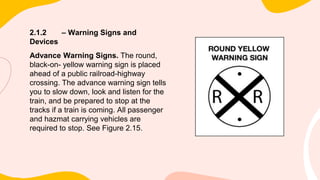
Advance Warning Signs. The round,
black-on- yellow warning sign is placed
ahead of a public railroad-highway
crossing. The advance warning sign tells
you to slow down, look and listen for the
train, and be prepared to stop at the
tracks if a train is coming. All passenger
and hazmat carrying vehicles are
required to stop. See Figure 2.15.
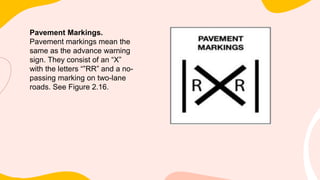
Pavement Markings.
Pavement markings mean the
same as the advance warning
sign. They consist of an “X”
with the letters “”RR” and a no-
passing marking on two-lane
roads. See Figure 2.16.
There is also a no passing zone sign on
two-lane roads. There may be a white stop
line painted on the pavement before the
railroad tracks. The front of the school bus
must remain behind this line while stopped
at the crossing.
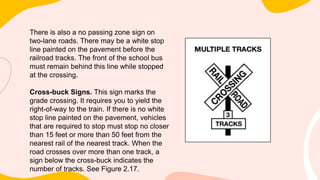
Cross-buck Signs. This sign marks the
grade crossing. It requires you to yield the
right-of-way to the train. If there is no white
stop line painted on the pavement, vehicles
that are required to stop must stop no closer
than 15 feet or more than 50 feet from the
nearest rail of the nearest track. When the
road crosses over more than one track, a
sign below the cross-buck indicates the
number of tracks. See Figure 2.17.
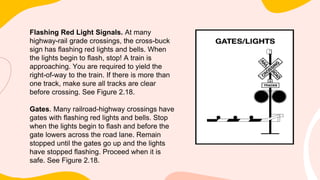
Flashing Red Light Signals. At many
highway-rail grade crossings, the cross-buck
sign has flashing red lights and bells. When
the lights begin to flash, stop! A train is
approaching. You are required to yield the
right-of-way to the train. If there is more than
one track, make sure all tracks are clear
before crossing. See Figure 2.18.
Gates. Many railroad-highway crossings have
gates with flashing red lights and bells. Stop
when the lights begin to flash and before the
gate lowers across the road lane. Remain
stopped until the gates go up and the lights
have stopped flashing. Proceed when it is
safe. See Figure 2.18.
2.1.1 Driving Procedures
Never Race a Train to a Crossing. Never attempt to race a train to a
crossing. It is extremely difficult to judge the speed of an approaching train.
Reduce Speed. Speed must be reduced in accordance with your ability to
see approaching trains in any direction, and speed must be held to a point
which will permit you to stop short of the tracks in case a stop is necessary.
Don't Expect to Hear a Train. Trains may not or are prohibited from
sounding horns when approaching some crossings. Public crossings where
trains do not sound horns should be identified by signs. Noise inside your
vehicle may, also prevent you from hearing the train horn until the train is
dangerously close to the crossing.
Don't Rely on Signals. You should not rely solely upon the presence of
warning signals, gates, or flagmen to warn of the approach of trains. Be
especially alert at crossings that do not have gates or flashing red light
signals.
Double Tracks Require a Double Check. Remember that a train on one
track may hide a train on the other track. Look both ways before crossing.
After one train has cleared a crossing, be sure no
other trains are near before starting across the tracks.
Yard Areas and Grade Crossings in Cities and Towns. Yard areas and
grade crossings in cities and towns are just as dangerous as rural grade
crossings. Approach them with as much caution.
2.1.1 – Stopping Safely at Railroad- highway Crossings
A full stop is required at grade crossings whenever:
The nature of the cargo makes a stop mandatory under state or federal
regulations.
Such a stop is otherwise required by law.
When stopping be sure to:
Check for traffic behind you while stopping gradually. Use a pullout lane, if
available.
Turn on your four-way emergency flashers.
2.1.2 – Crossing the Tracks
Railroad crossings with steep approaches can cause your unit to hang up on the
tracks.
Never permit traffic conditions to trap you in a position where you have to stop
on the tracks. Be sure you can get all the way across the tracks before you start
across. It takes a typical tractor-trailer unit at least 14 seconds to clear a single
track and more than 15 seconds to clear a double track.
Do not shift gears while crossing railroad tracks.
2.1.3 – Special Situations
Be Aware! These trailers can get stuck on raised crossings:
Low slung units (lowboy, car carrier, moving van, possum-belly livestock trailer).
Single-axle tractor pulling a long trailer with its landing gear set to accommodate
a tandem-axle tractor.
If for any reason you get stuck on the tracks, get out of the vehicle and away
from the tracks. Check signposts or signal housing at the crossing for
emergency notification information. Call 911 or other emergency number. Give
the location of the crossing using all identifiable landmarks, especially the DOT
number, if posted.
2.1 Mountain Driving
In mountain driving, gravity plays a major role. On any upgrade, gravity slows
you down. The steeper the grade, the longer the grade, and/or the heavier the
load--the more you will have to use lower gears to climb hills or mountains. In
coming down long, steep downgrades, gravity causes the speed of your vehicle
to increase. You must select an appropriate safe speed, then use a low gear,
and proper braking techniques. You should plan ahead and obtain information
about any long, steep grades along your planned route of travel. If possible, talk
to other drivers who are familiar with the grades to find out what speeds are
safe.
You must go slowly enough so your brakes can hold you back without getting
too hot. If the brakes become too hot, they may start to "fade." This means you
have to apply them harder and harder to get the same stopping power. If you
continue to use the brakes hard, they can keep fading until you cannot slow
down or stop at all.
2.1.1 – Select a "Safe" Speed
Your most important consideration is to select a speed that is not too fast for the:
Total weight of the vehicle and cargo. Length of the grade.
Steepness of the grade. Road conditions.
Weather.
If a speed limit is posted, or there is a sign indicating "Maximum Safe Speed,"
never exceed the speed shown. Also, look for and heed warning signs indicating
the length and steepness of the grade.
You must use the braking effect of the engine as the principal way of controlling
your speed. The braking effect of the engine is greatest when it is near the
governed rpms and the transmission is in the lower gears. Save your brakes so
you will be able to slow or stop as required by road and traffic conditions.
2.1.2 – Select the Right Gear before Starting Down the Grade
Shift the transmission to a low gear before starting down the grade. Do not try to
downshift after your speed has already built up. You will not be able to shift into
a lower gear. You may not even be able to get back into any gear and all engine
braking effect will be lost. Forcing an automatic transmission into a lower gear at
high speed could damage the transmission and also lead to loss of all engine
braking effect.
With older trucks, a rule for choosing gears is to use the same gear going down
a hill that you would need to climb the hill. However, new trucks have low friction
parts and streamlined shapes for fuel economy. They may also have more
powerful engines. This means they can go up hills in higher gears and have less
friction and air drag to hold them back going down hills. For that reason, drivers
of modern trucks may have to use lower gears going down a hill than would be
required to go up the hill. You should know what is right for your vehicle.
2.1.1 – Brake Fading or Failure
Brakes are designed so brake shoes or pads rub against the brake drum or
disks to slow the vehicle. Braking creates heat, but brakes are designed to take
a lot of heat. However, brakes can fade or fail from excessive heat caused by
using them too much and not relying on the engine braking effect. Brake fade is
also affected by adjustment. To safely control a vehicle, every brake must do its
share of the work. Brakes out of adjustment will stop doing their share before
those that are in adjustment. The other brakes can then overheat and fade, and
there will not be enough braking available to control the vehicle. Brakes can get
out of adjustment quickly, especially when they are used a lot; also, brake linings
wear faster when they are hot. Therefore, brake adjustment must be checked
frequently.
2.1.2 – Proper Braking Technique
Remember. The use of brakes on a long and/or steep downgrade is only a
supplement to the braking effect of the engine. Once the vehicle is in the proper
low gear, the following are the proper braking techniques:
Apply the brakes just hard enough to feel a definite slowdown.
When your speed has been reduced to approximately five mph below your
"safe" speed, release the brakes. (This brake application should last for about
three seconds.)
When your speed has increased to your "safe" speed, repeat steps 1 and 2.
For example, if your "safe" speed is 40 mph, you would not apply the brakes
until your speed reaches 40 mph. You now apply the brakes hard enough to
gradually reduce your speed to 35 mph and then release the brakes. Repeat this
as often as necessary until you have reached the end of the downgrade.
Escape ramps have been built on many steep mountain downgrades. Escape
ramps are made to stop runaway vehicles safely without injuring drivers and
passengers. Escape ramps use a long bed of loose, soft material to slow a
runaway vehicle, sometimes in combination with an upgrade.
Know escape ramp locations on your route. Signs show drivers where ramp are
located. Escape ramps save lives, equipment and cargo.

CDL DRIVING SAFELY SLIDE 6.pptx

  • 1.
    2.1 Driving atNight 2.1.1 – It's More Dangerous You are at greater risk when you drive at night. Drivers can't see hazards as quickly as in daylight, so they have less time to respond. Drivers caught by surprise are less able to avoid a crash. The problems of night driving involve the driver, the roadway, and the vehicle. 2.1.2 – Driver Factors Vision. Good vision is critical for safe driving. Your control of the brake, accelerator, and steering wheel is based on what you see. If you cannot see clearly, you will have trouble identifying traffic and roadway conditions, spotting potential trouble or responding to problems in a timely manner.
  • 2.
    Because seeing wellis so critical to safe driving, you should have your eyes checked regularly by an eye specialist. You may never know you have poor vision unless your eyes are tested. If you need to wear glasses or contact lenses for driving, remember to: Always wear them when driving, even if driving short distances. If your driver license says corrective lenses are required, it is illegal to move a vehicle without using corrective lenses. Keep an extra set of corrective lenses in your vehicle. If your normal corrective lenses are broken or lost, you can use the spare lenses to drive safely. Avoid using dark or tinted corrective lenses at night, even if you think they help with glare. Tinted lenses cut down the light that you need to see clearly under night driving conditions.
  • 3.
    Glare. Drivers canbe blinded for a short time by bright light. . It can take several seconds to recover from glare. Even two seconds of glare blindness can be dangerous. A vehicle going 55 mph will travel more than half the distance of a football field during that time. Fatigue and Lack of Alertness. Fatigue is physical or mental tiredness that can be caused by physical or mental strain, repetitive tasks, illness or lack of sleep. Just like alcohol and drugs, it impairs your vision and judgment. Fatigue causes errors related to speed and distance, increases your risk of being in a crash, causes you to not see and react to hazards as quickly; and affects your ability to make critical decisions. When you are fatigued, you could fall asleep behind the wheel and crash, injuring or killing yourself or others.
  • 4.
    Fatigued or drowsydriving is one of the leading causes of traffic collisions. NHTSA estimates that 100,000 police-reported crashes a year are the result of drowsy driving. According to the National Sleep Foundation’s Sleep in America poll, 60% of Americans have driven while feeling sleepy and more than one third (36 percent or 103 million people) admit to having actually fallen asleep at the wheel. Drivers may experience short bursts of sleep lasting only a few seconds or fall asleep for longer periods of time. Either way, the chance of a collision increases dramatically. At-Risk Groups The risk of having a crash due to drowsy driving is not uniformly distributed across the population. Crashes tend to occur at times when sleepiness is most pronounced, for example, during the night and in the mid-afternoon. Most people are less alert at night, especially after midnight. This is particularly true if you have been driving for a long time. Thus individuals who drive at night are much more likely to have fall-asleep crashes.
  • 5.
    Research has identifiedyoung males, shift workers, commercial drivers, especially long-haul drivers and people with untreated sleep disorders or with short- term or chronic sleep deprivation as being at increased risk for having a fall-asleep crash. At least 15% of all heavy truck crashes involve fatigue. A congressionally mandated study of 80 long-haul truck drivers in the United States and Canada found that drivers averaged less than 5 hours of sleep per day. (Federal Motor Carrier Safety Administration, 1996) It is no surprise then that the National Transportation Safety Board (NTSB) reported that drowsy driving was probably the cause of more than half of crashes leading to a truck driver’s death. (NTSB, 1990) For each truck driver fatality, another three to four people are killed. (NHTSA, 1994)
  • 6.
    Warning Signs ofFatigue According to the National Sleep Foundation’s Sleep in America poll, 60% of Americans have driven while feeling sleepy and 36% admit to actually having fallen asleep at the wheel in the past year. However, many people cannot tell if or when they are about to fall asleep. Here are some signs that should tell you to stop and rest: Difficulty focusing, frequent blinking or heavy eyelids Yawning repeatedly or rubbing eyes Day-dreaming; or wandering/disconnected thoughts Trouble remembering the last few miles driven; missing exits or traffic signs Trouble keeping head up Drifting from your lane, following too closely or hitting a shoulder rumble strip Feeling restless and irritable
  • 7.
    When you aretired trying to “push on” is far more dangerous than most drivers think. It is a major cause of fatal accidents. If you notice any signs of fatigue, stop driving and go to sleep for the night or take a 15 – 20 minute nap. Are You At Risk? Before you drive, consider whether you are: Sleep-deprived or fatigued (6 hours of sleep or less triples your risk) Suffering from sleep loss (insomnia), poor quality sleep, or a sleep debt Driving long distances without proper rest breaks Driving through the night, mid-afternoon or when you would normally be asleep. Many heavy motor vehicle accidents occur between midnight and 6 a.m. Taking sedating medications (antidepressants, cold tablets, antihistamines) Working more than 60 hours a week (increases your risk by 40%)
  • 8.
    Working more thanone job, and your main job involves shift work Driving alone or on a long, rural, dark or boring road Flying, changing time zone Preventing drowsiness before a trip: Get adequate sleep – adults need 8 to 9 hours to maintain alertness Prepare route carefully to identify total distance, stopping points and other logistic considerations Schedule trips for the hours you are normally awake, not the middle of the night Drive with a passenger Avoid medications that cause drowsiness Consult your physician if you suffer from daytime sleepiness, have difficulty sleeping at night or take frequent naps Incorporate exercise into your daily life to give you more energy.
  • 9.
    Maintaining alertness whiledriving: Protect yourself from glare and eyestrain with sunglasses Keep cool by opening the window or using the air conditioner Avoid heavy foods Be aware of down time during the day Have another person ride with you, and take turns driving Take periodic breaks – about every 100 miles or 2 hours during long trips Stop driving and get some rest or take a nap Caffeine consumption can increase awareness for a few hours, but do not drink too much. It will eventually wear off. Do not rely on caffeine to prevent fatigue Avoid drugs. While they may keep you awake for a while, they won’t make you alert. If you are drowsy, the only safe cure is to get off the road and get some sleep. If you don't, you risk your life and the lives of others.
  • 10.
    2.1.1 – RoadwayFactors Poor Lighting. In the daytime there is usually enough light to see well. This is not true at night. Some areas may have bright street lights, but many areas will have poor lighting. On most roads you will probably have to depend entirely on your headlights. Less light means you will not be able to see hazards as well as in daytime. Road users who do not have lights are hard to see. There are many accidents at night involving pedestrians, joggers, bicyclists, and animals. Even when there are lights, the road scene can be confusing. Traffic signals and hazards can be hard to see against a background of signs, shop windows, and other lights. Drive slower when lighting is poor or confusing. Drive slowly enough to be sure you can stop in the distance you can see ahead.
  • 11.
    Drunk Drivers. Drunkdrivers and drivers under the influence of drugs are a hazard to themselves and to you. Be especially alert around the closing times for bars and taverns. Watch for drivers who have trouble staying in their lane or maintaining speed, who stop without reason, or show other signs of being under the influence of alcohol or drugs. 2.1.1 – Vehicle Factors Headlights. At night your headlights will usually be the main source of light for you to see by and for others to see you. You can't see nearly as much with your headlights as you see in the daytime. With low beams you can see ahead about 250 feet and with high beams about 350-500 feet. You must adjust your speed to keep your stopping distance within your sight distance. This means going slowly enough to be able to stop within the range of your headlights. Otherwise, by the time you see a hazard, you will not have time to stop.
  • 12.
    Night driving canbe more dangerous if you have problems with your headlights. Dirty headlights may give only half the light they should. This cuts down your ability to see, and makes it harder for others to see you. Make sure your lights are clean and working. Headlights can be out of adjustment. If they don't point in the right direction, they won't give you a good view and they can blind other drivers. Have a qualified person make sure they are adjusted properly. Other Lights. In order for you to be seen easily, the following must be clean and working properly: Reflectors. Marker lights. Clearance lights. Taillights. Identification lights. Turn Signals and Brake Lights. At night your turn signals and brake lights are even more important for telling other drivers what you intend to do. Make sure you have clean, working turn signals and stop lights.
  • 13.
    Windshield and Mirrors.It is more important at night than in the daytime to have a clean windshield and clean mirrors. Bright lights at night can cause dirt on your windshield or mirrors to create a glare of its own, blocking your view. Most people have experienced driving toward the sun just as it has risen or is about to set, and found that they can barely see through a windshield that seemed to look OK in the middle of the day. Clean your windshield on the inside and outside for safe driving at night. 2.1.1 – Night Driving Procedures Vehicle Procedures. Make sure you are rested and alert. If you are drowsy, sleep before you drive! Even a nap can save your life or the lives of others. If you wear eyeglasses, make sure they are clean and unscratched. Don't wear sunglasses at night. Do a complete Vehicle inspection of your vehicle. Pay attention to checking all lights and reflectors, and cleaning those you can reach.
  • 14.
    Avoid Blinding Others.Glare from your headlights can cause problems for drivers coming toward you. They can also bother drivers going in the same direction you are, when your lights shine in their rearview mirrors. Dim your lights before they cause glare for other drivers. Dim your lights within 500 feet of an oncoming vehicle and when following another vehicle within 500 feet. Avoid Glare from Oncoming Vehicles. Do not look directly at lights of oncoming vehicles. Look slightly to the right at a right lane or edge marking, if available. If other drivers don't put their low beams on, don't try to "get back at them" by putting your own high beams on. This increases glare for oncoming drivers and increases the chance of a crash. Use High Beams When You Can. Some drivers make the mistake of always using low beams. This seriously cuts down on their ability to see ahead. Use high beams when it is safe and legal to do so.
  • 15.
    Use them whenyou are not within 500 feet of an approaching vehicle. Also, don't let the inside of your cab get too bright. This makes it harder to see outside. Keep the interior light off, and adjust your instrument lights as low as you can to still be able to read the gauges. If You Get Sleepy, Stop at the Nearest Safe Place. People often don't realize how close they are to falling asleep even when their eyelids are falling shut. If you can safely do so, look at yourself in a mirror. If you look sleepy, or you just feel sleepy, stop driving! You are in a very dangerous condition. The only safe cure is to sleep 2.1 Driving in Fog Fog can occur at any time. Fog on highways can be extremely dangerous. Fog is often unexpected, and visibility can deteriorate rapidly. You should watch for foggy conditions and be ready to reduce your speed. Do not assume that the fog will thin out after you enter it.
  • 16.
    The best advicefor driving in fog is don’t. It is preferable that you pull off the road into a rest area or truck stop until visibility is better. If you must drive, be sure to consider the following: Obey all fog-related warning signs. Slow down before you enter fog. Use low-beam headlights and fog lights for best visibility even in daytime, and be alert for other drivers who may have forgotten to turn on their lights. Turn on your 4-way flashers. This will give vehicles approaching you from behind a quicker opportunity to notice your vehicle. Watch for vehicles on the side of the roadway. Seeing taillights or headlights in front of you may not be a true indication of where the road is ahead of you. The vehicle may not be on the road at all. Use roadside highway reflectors as guides to determine how the road may curve ahead of you.
  • 17.
    Listen for trafficyou cannot see. Avoid passing other vehicles. Don’t stop along the side of the road, unless absolutely necessary. 2.2– Driving in Winter 2.2.1– Vehicle Checks Make sure your vehicle is ready before driving in winter weather. You should make a regular Vehicle inspection, paying extra attention to the following items. Coolant Level and Antifreeze Amount. Make sure the cooling system is full and there is enough antifreeze in the system to protect against freezing. This can be checked with a special coolant tester. Defrosting and Heating Equipment. Make sure the defrosters work. They are needed for safe driving. Make sure the heater is working, and that you know how to operate it. If you use other heaters and expect to need them (e.g., mirror heaters, battery box heaters, fuel tank heaters), check their
  • 18.
    Wipers and Washers.Make sure the windshield wiper blades are in good condition. Make sure the wiper blades press against the window hard enough to wipe the windshield clean, otherwise they may not sweep off snow properly. Make sure the windshield washer works and there is washing fluid in the washer reservoir. Use windshield washer antifreeze to prevent freezing of the washer liquid. If you can't see well enough while driving (for example, if your wipers fail), stop safely and fix the problem. Tires. Make sure you have enough tread on your tires. The drive tires must provide traction to push the rig over wet pavement and through snow. The steering tires must have traction to steer the vehicle. Enough tread is especially important in winter conditions. You must have at least 4/32 inch tread depth in every major groove on front tires and at least 2/32 inch on other tires. More would be better. Use a gauge to determine if you have enough tread for safe driving.
  • 19.
    Tire Chains. Youmay find yourself in conditions where you can't drive without chains, even to get to a place of safety. Carry the right number of chains and extra cross-links. Make sure they will fit your drive tires. Check the chains for broken hooks, worn or broken cross-links, and bent or broken side chains. Learn how to put the chains on before you need to do it in snow and ice. Lights and Reflectors. Make sure the lights and reflectors are clean. Lights and reflectors are especially important during bad weather. Check from time to time during bad weather to make sure they are clean and working properly. Windows and Mirrors. Remove any ice, snow, etc., from the windshield, windows, and mirrors before starting. Use a windshield scraper, snow brush, and windshield defroster as necessary. Hand Holds, Steps, and Deck Plates. Remove all ice and snow from hand holds, steps, and deck plates. This will reduce the danger of slipping.
  • 20.
    Radiator Shutters andWinterfront. Remove ice from the radiator shutters. Make sure the winterfront is not closed too tightly. If the shutters freeze shut or the winterfront is closed too much, the engine may overheat and stop. Exhaust System. Exhaust system leaks are especially dangerous when cab ventilation may be poor (windows rolled up, etc.). Loose connections could permit poisonous carbon monoxide to leak into your vehicle. Carbon monoxide gas will cause you to be sleepy. In large enough amounts it can kill you. Check the exhaust system for loose parts and for sounds and signs of leaks. 2.1.1– Driving Slippery Surfaces. Drive slowly and smoothly on slippery roads. If it is very slippery, you shouldn't drive at all. Stop at the first safe place. Start Gently and Slowly. When first starting, get the feel of the road. Don't hurry.
  • 21.
    Check for Ice.Check for ice on the road, especially bridges and overpasses. A lack of spray from other vehicles indicates ice has formed on the road. Also, check your mirrors and wiper blades for ice. If they have ice, the road most likely will be icy as well. Adjust Turning and Braking to Conditions. Make turns as gently as possible. Don't brake any harder than necessary, and don't use the engine brake or speed retarder. (They can cause the driving wheels to skid on slippery surfaces.) Adjust Speed to Conditions. Don't pass slower vehicles unless necessary. Go slowly and watch far enough ahead to keep a steady speed. Avoid having to slow down and speed up. Take curves at slower speeds and don't brake while in curves. Be aware that as the temperature rises to the point where ice begins to melt, the road becomes even more slippery. Slow down more.
  • 22.
    Adjust Space toConditions. Don't drive alongside other vehicles. Keep a longer following distance. When you see a traffic jam ahead, slow down or stop to wait for it to clear. Try hard to anticipate stops early and slow down gradually. Watch for snowplows, as well as salt and sand trucks, and give them plenty of room. Wet Brakes. When driving in heavy rain or deep standing water, your brakes will get wet. Water in the brakes can cause the brakes to be weak, to apply unevenly, or to grab. This can cause lack of braking power, wheel lockups, pulling to one side or the other, and jackknife if you pull a trailer. Avoid driving through deep puddles or flowing water if possible. If not, you should: Slow down and place transmission in a low gear. Gently put on the brakes. This presses linings against brake drums or discs and keeps mud, silt, sand, and water from getting in. Increase engine rpm and cross the water while keeping light pressure on the
  • 23.
    When out ofthe water, maintain light pressure on the brakes for a short distance to heat them up and dry them out. Make a test stop when safe to do so. Check behind to make sure no one is following, then apply the brakes to be sure they work well. If not, dry them out further as described above. (CAUTION: Do not apply too much brake pressure and accelerator at the same time, or you can overheat brake drums and linings. 2.1 – Driving in Very Hot Weather 2.1.1 – Vehicle Checks Do a normal Vehicle inspection, but pay special attention to the following items. Tires. Check the tire mounting and air pressure. Inspect the tires every two hours or every 100 miles when driving in very hot weather. Air pressure increases with temperature. Do not let air out or the pressure will be too low when the tires cool off. If a tire is too hot to touch, remain stopped until the tire cools off. Otherwise the tire may blow out or catch fire.
  • 24.
    Engine Oil. Theengine oil helps keep the engine cool, as well as lubricating it. Make sure there is enough engine oil. If you have an oil temperature gauge, make sure the temperature is within the proper range while you are driving. Engine Coolant. Before starting out, make sure the engine cooling system has enough water and antifreeze according to the engine manufacturer's directions. (Antifreeze helps the engine under hot conditions as well as cold conditions.) When driving, check the water temperature or coolant temperature gauge from time to time. Make sure that it remains in the normal range. If the gauge goes above the highest safe temperature, there may be something wrong that could lead to engine failure and possibly fire. Stop driving as soon as safely possible and try to find out what is wrong. Some vehicles have sight glasses, see-through coolant overflow containers, or coolant recovery containers. These permit you to check the coolant level while the engine is hot. If the container is not part of the pressurized system, the cap can be safely removed and coolant added even when the engine is at operating temperature.
  • 25.
    Never remove theradiator cap or any part of the pressurized system until the system has cooled. Steam and boiling water can spray under pressure and cause severe burns. If you can touch the radiator cap with your bare hand, it is probably cool enough to open. If coolant has to be added to a system without a recovery tank or overflow tank, follow these steps: Shut engine off. Wait until engine has cooled. Protect hands (use gloves or a thick cloth). Turn radiator cap slowly to the first stop, which releases the pressure seal. Step back while pressure is released from cooling system. When all pressure has been released, press down on the cap and turn it further to remove it. Visually check level of coolant and add more coolant if necessary. Replace cap and turn all the way to the closed position.
  • 26.
    Engine Belts. Learnhow to check v-belt tightness on your vehicle by pressing on the belts. Loose belts will not turn the water pump and/or fan properly. This will result in overheating. Also, check belts for cracking or other signs of wear. Hoses. Make sure coolant hoses are in good condition. A broken hose while driving can lead to engine failure and even fire. 2.1.1 – Driving Watch for Bleeding Tar. Tar in the road pavement frequently rises to the surface in very hot weather. Spots where tar "bleeds" to the surface are very slippery. Go Slowly Enough to Prevent Overheating. High speeds create more heat for tires and the engine. In desert conditions the heat may build up to the point where it is dangerous. The heat will increase chances of tire failure or even fire, and engine failure.
  • 27.
    2.1 Railroad-highway Crossings Railroad-highwaygrade crossings are a special kind of intersection where the roadway crosses train tracks. These crossings are always dangerous. Every such crossing must be approached with the expectation that a train is coming. It is extremely difficult to judge the distance of the train from the crossing as well as the speed of an approaching train. 2.1.1– Types of Crossings Passive Crossings. This type of crossing does not have any type of traffic control device. The decision to stop or proceed rests entirely in your hands. Passive crossings require you to recognize the crossing, search for any train using the tracks and decide if there is sufficient clear space to cross safely. Active Crossings. This type of crossing has a traffic control device installed at the crossing to regulate traffic at the crossing. These active devices include flashing red lights, with or without bells and flashing red lights with bells and gates.
  • 28.
    2.1.2 – WarningSigns and Devices Advance Warning Signs. The round, black-on- yellow warning sign is placed ahead of a public railroad-highway crossing. The advance warning sign tells you to slow down, look and listen for the train, and be prepared to stop at the tracks if a train is coming. All passenger and hazmat carrying vehicles are required to stop. See Figure 2.15.
  • 29.
    Pavement Markings. Pavement markingsmean the same as the advance warning sign. They consist of an “X” with the letters “”RR” and a no- passing marking on two-lane roads. See Figure 2.16.
  • 30.
    There is alsoa no passing zone sign on two-lane roads. There may be a white stop line painted on the pavement before the railroad tracks. The front of the school bus must remain behind this line while stopped at the crossing. Cross-buck Signs. This sign marks the grade crossing. It requires you to yield the right-of-way to the train. If there is no white stop line painted on the pavement, vehicles that are required to stop must stop no closer than 15 feet or more than 50 feet from the nearest rail of the nearest track. When the road crosses over more than one track, a sign below the cross-buck indicates the number of tracks. See Figure 2.17.
  • 31.
    Flashing Red LightSignals. At many highway-rail grade crossings, the cross-buck sign has flashing red lights and bells. When the lights begin to flash, stop! A train is approaching. You are required to yield the right-of-way to the train. If there is more than one track, make sure all tracks are clear before crossing. See Figure 2.18. Gates. Many railroad-highway crossings have gates with flashing red lights and bells. Stop when the lights begin to flash and before the gate lowers across the road lane. Remain stopped until the gates go up and the lights have stopped flashing. Proceed when it is safe. See Figure 2.18.
  • 32.
    2.1.1 Driving Procedures NeverRace a Train to a Crossing. Never attempt to race a train to a crossing. It is extremely difficult to judge the speed of an approaching train. Reduce Speed. Speed must be reduced in accordance with your ability to see approaching trains in any direction, and speed must be held to a point which will permit you to stop short of the tracks in case a stop is necessary. Don't Expect to Hear a Train. Trains may not or are prohibited from sounding horns when approaching some crossings. Public crossings where trains do not sound horns should be identified by signs. Noise inside your vehicle may, also prevent you from hearing the train horn until the train is dangerously close to the crossing.
  • 33.
    Don't Rely onSignals. You should not rely solely upon the presence of warning signals, gates, or flagmen to warn of the approach of trains. Be especially alert at crossings that do not have gates or flashing red light signals. Double Tracks Require a Double Check. Remember that a train on one track may hide a train on the other track. Look both ways before crossing. After one train has cleared a crossing, be sure no other trains are near before starting across the tracks. Yard Areas and Grade Crossings in Cities and Towns. Yard areas and grade crossings in cities and towns are just as dangerous as rural grade crossings. Approach them with as much caution.
  • 34.
    2.1.1 – StoppingSafely at Railroad- highway Crossings A full stop is required at grade crossings whenever: The nature of the cargo makes a stop mandatory under state or federal regulations. Such a stop is otherwise required by law. When stopping be sure to: Check for traffic behind you while stopping gradually. Use a pullout lane, if available. Turn on your four-way emergency flashers. 2.1.2 – Crossing the Tracks Railroad crossings with steep approaches can cause your unit to hang up on the tracks.
  • 35.
    Never permit trafficconditions to trap you in a position where you have to stop on the tracks. Be sure you can get all the way across the tracks before you start across. It takes a typical tractor-trailer unit at least 14 seconds to clear a single track and more than 15 seconds to clear a double track. Do not shift gears while crossing railroad tracks. 2.1.3 – Special Situations Be Aware! These trailers can get stuck on raised crossings: Low slung units (lowboy, car carrier, moving van, possum-belly livestock trailer). Single-axle tractor pulling a long trailer with its landing gear set to accommodate a tandem-axle tractor. If for any reason you get stuck on the tracks, get out of the vehicle and away from the tracks. Check signposts or signal housing at the crossing for emergency notification information. Call 911 or other emergency number. Give the location of the crossing using all identifiable landmarks, especially the DOT number, if posted.
  • 36.
    2.1 Mountain Driving Inmountain driving, gravity plays a major role. On any upgrade, gravity slows you down. The steeper the grade, the longer the grade, and/or the heavier the load--the more you will have to use lower gears to climb hills or mountains. In coming down long, steep downgrades, gravity causes the speed of your vehicle to increase. You must select an appropriate safe speed, then use a low gear, and proper braking techniques. You should plan ahead and obtain information about any long, steep grades along your planned route of travel. If possible, talk to other drivers who are familiar with the grades to find out what speeds are safe. You must go slowly enough so your brakes can hold you back without getting too hot. If the brakes become too hot, they may start to "fade." This means you have to apply them harder and harder to get the same stopping power. If you continue to use the brakes hard, they can keep fading until you cannot slow down or stop at all.
  • 37.
    2.1.1 – Selecta "Safe" Speed Your most important consideration is to select a speed that is not too fast for the: Total weight of the vehicle and cargo. Length of the grade. Steepness of the grade. Road conditions. Weather. If a speed limit is posted, or there is a sign indicating "Maximum Safe Speed," never exceed the speed shown. Also, look for and heed warning signs indicating the length and steepness of the grade. You must use the braking effect of the engine as the principal way of controlling your speed. The braking effect of the engine is greatest when it is near the governed rpms and the transmission is in the lower gears. Save your brakes so you will be able to slow or stop as required by road and traffic conditions.
  • 38.
    2.1.2 – Selectthe Right Gear before Starting Down the Grade Shift the transmission to a low gear before starting down the grade. Do not try to downshift after your speed has already built up. You will not be able to shift into a lower gear. You may not even be able to get back into any gear and all engine braking effect will be lost. Forcing an automatic transmission into a lower gear at high speed could damage the transmission and also lead to loss of all engine braking effect. With older trucks, a rule for choosing gears is to use the same gear going down a hill that you would need to climb the hill. However, new trucks have low friction parts and streamlined shapes for fuel economy. They may also have more powerful engines. This means they can go up hills in higher gears and have less friction and air drag to hold them back going down hills. For that reason, drivers of modern trucks may have to use lower gears going down a hill than would be required to go up the hill. You should know what is right for your vehicle.
  • 39.
    2.1.1 – BrakeFading or Failure Brakes are designed so brake shoes or pads rub against the brake drum or disks to slow the vehicle. Braking creates heat, but brakes are designed to take a lot of heat. However, brakes can fade or fail from excessive heat caused by using them too much and not relying on the engine braking effect. Brake fade is also affected by adjustment. To safely control a vehicle, every brake must do its share of the work. Brakes out of adjustment will stop doing their share before those that are in adjustment. The other brakes can then overheat and fade, and there will not be enough braking available to control the vehicle. Brakes can get out of adjustment quickly, especially when they are used a lot; also, brake linings wear faster when they are hot. Therefore, brake adjustment must be checked frequently.
  • 40.
    2.1.2 – ProperBraking Technique Remember. The use of brakes on a long and/or steep downgrade is only a supplement to the braking effect of the engine. Once the vehicle is in the proper low gear, the following are the proper braking techniques: Apply the brakes just hard enough to feel a definite slowdown. When your speed has been reduced to approximately five mph below your "safe" speed, release the brakes. (This brake application should last for about three seconds.) When your speed has increased to your "safe" speed, repeat steps 1 and 2. For example, if your "safe" speed is 40 mph, you would not apply the brakes until your speed reaches 40 mph. You now apply the brakes hard enough to gradually reduce your speed to 35 mph and then release the brakes. Repeat this as often as necessary until you have reached the end of the downgrade.
  • 41.
    Escape ramps havebeen built on many steep mountain downgrades. Escape ramps are made to stop runaway vehicles safely without injuring drivers and passengers. Escape ramps use a long bed of loose, soft material to slow a runaway vehicle, sometimes in combination with an upgrade. Know escape ramp locations on your route. Signs show drivers where ramp are located. Escape ramps save lives, equipment and cargo.