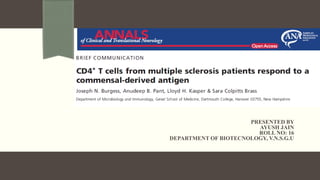
PRESENTED BY
AYUSH JAIN
ROLL NO: 16
DEPARTMENT OF BIOTECNOLOGY, V.N.S.G.U
Abstract
MS is a chronic inflammatory diseases of CNS associated with demyelination and progressive
disabilities and inflammation.
PSA obtained from Bacteroides fragilis (Commensal antigen) induces the differentiation of
naïve T cell to Tregs with IL-10 immunosuppressive function determined with Foxp3 analysis.
Naïve T cell from MS patient have capacity to acquire immunosuppressive in response to
Commensal antigen that corrects the defects in Tregs function during MS.
Introduction
MS is associated with the relapsing-remitting, associated with the periods of activate
inflammation and demyelination that can last for days and months.
This fluctuation is influenced by the balance of self reactive effector T cell and regulatory T cell
(Tregs)
 While MS patient harbor normal frequency Tregs , their IL-10 production and overall
suppressive capacity allowing increase inflammation from effector cells.
Hypothesis
Amplification of regulatory Tregs response by the gut derived commensal antigen in those with
Multiple Sclerosis(MS)
PSA: Polysaccharide A capsular antigen derived from human gut commensal Bacteroides
fragilis
Dwivedi, M., P. Kumar, N. C. Laddha and E. H. Kemp (2016)
Methodology
Results
Fig1:Healthy controls HC/ , untreated MS
patients MS/ and GA-treated MS patients
MSGA/
Fig2:The fold change in the MFI of Foxp3 was
calculated by dividing the average MFI of
Foxp3 in the PSA-treated wells by the
average MFI of Foxp3 in untreated wells.
Statistical analysis was determined using an unpaired t test (nonparametric Mann–Whitney
test). ** p < 0.01; ***p < 0.001
Fig3:Healthy controls HC/ , untreated MS patients MS/ and GA-treated MS patients MSGA/
IL-10 production by T cells stimulated with PSA. Naïve T cells isolated from the indicated donors
were cultured in vitro for 5 days in the presence or absence of PSA. IL-10 (pg/mL) was measured in
the supernatants by ELISA.
Statistical analysis was determined using a paired t test (nonparametric Wilcoxon matchedpairs signed-rank test). ** P < 0.01
Conclusion
The human gut commensal Bacteroides fragilis has been shown to have a beneficial effects on
the mouse models on MS that is dependent on expression of PSA.
In vitro analsysis using PBMCs from healthy human donors have shown that PSA stimulates
DCs to induce immunosuppressive Foxp3+ .
PSA can significantly reduce disease severity when orally administered either prophylactically
or therapeutically using IL-10 dependent mechanisms.
My views
As microbiomes provides MS patient a life saving treatment .
Understanding of human microbiome can be also employed for the cancer immunotherapy or as
a Diagnostic tool or as therapeutic strategies.
This might be achieved by the analysis of fecal micro biome to understand the relationship
between cancer onset and the changes in the gut micro flora of human at various stages of
cancer, even after or before chemotherapy
Reference
Burgess, J. N., A. B. Pant, L. H. Kasper and S. Colpitts Brass (2017). "CD4(+) T cells from
multiple sclerosis patients respond to a commensal-derived antigen." Ann Clin Transl Neurol
4(11): 825-829.
Dwivedi, M., P. Kumar, N. C. Laddha and E. H. Kemp (2016). "Induction of regulatory T cells:
A role for probiotics and prebiotics to suppress autoimmunity." Autoimmun Rev 15(4): 379-
392.

Cd4+ t cells in MS

  • 1.
    PRESENTED BY AYUSH JAIN ROLLNO: 16 DEPARTMENT OF BIOTECNOLOGY, V.N.S.G.U
  • 3.
    Abstract MS is achronic inflammatory diseases of CNS associated with demyelination and progressive disabilities and inflammation. PSA obtained from Bacteroides fragilis (Commensal antigen) induces the differentiation of naïve T cell to Tregs with IL-10 immunosuppressive function determined with Foxp3 analysis. Naïve T cell from MS patient have capacity to acquire immunosuppressive in response to Commensal antigen that corrects the defects in Tregs function during MS.
  • 4.
    Introduction MS is associatedwith the relapsing-remitting, associated with the periods of activate inflammation and demyelination that can last for days and months. This fluctuation is influenced by the balance of self reactive effector T cell and regulatory T cell (Tregs)  While MS patient harbor normal frequency Tregs , their IL-10 production and overall suppressive capacity allowing increase inflammation from effector cells.
  • 5.
    Hypothesis Amplification of regulatoryTregs response by the gut derived commensal antigen in those with Multiple Sclerosis(MS) PSA: Polysaccharide A capsular antigen derived from human gut commensal Bacteroides fragilis Dwivedi, M., P. Kumar, N. C. Laddha and E. H. Kemp (2016)
  • 6.
  • 7.
    Results Fig1:Healthy controls HC/, untreated MS patients MS/ and GA-treated MS patients MSGA/ Fig2:The fold change in the MFI of Foxp3 was calculated by dividing the average MFI of Foxp3 in the PSA-treated wells by the average MFI of Foxp3 in untreated wells. Statistical analysis was determined using an unpaired t test (nonparametric Mann–Whitney test). ** p < 0.01; ***p < 0.001
  • 8.
    Fig3:Healthy controls HC/, untreated MS patients MS/ and GA-treated MS patients MSGA/ IL-10 production by T cells stimulated with PSA. Naïve T cells isolated from the indicated donors were cultured in vitro for 5 days in the presence or absence of PSA. IL-10 (pg/mL) was measured in the supernatants by ELISA. Statistical analysis was determined using a paired t test (nonparametric Wilcoxon matchedpairs signed-rank test). ** P < 0.01
  • 9.
    Conclusion The human gutcommensal Bacteroides fragilis has been shown to have a beneficial effects on the mouse models on MS that is dependent on expression of PSA. In vitro analsysis using PBMCs from healthy human donors have shown that PSA stimulates DCs to induce immunosuppressive Foxp3+ . PSA can significantly reduce disease severity when orally administered either prophylactically or therapeutically using IL-10 dependent mechanisms.
  • 10.
    My views As microbiomesprovides MS patient a life saving treatment . Understanding of human microbiome can be also employed for the cancer immunotherapy or as a Diagnostic tool or as therapeutic strategies. This might be achieved by the analysis of fecal micro biome to understand the relationship between cancer onset and the changes in the gut micro flora of human at various stages of cancer, even after or before chemotherapy
  • 11.
    Reference Burgess, J. N.,A. B. Pant, L. H. Kasper and S. Colpitts Brass (2017). "CD4(+) T cells from multiple sclerosis patients respond to a commensal-derived antigen." Ann Clin Transl Neurol 4(11): 825-829. Dwivedi, M., P. Kumar, N. C. Laddha and E. H. Kemp (2016). "Induction of regulatory T cells: A role for probiotics and prebiotics to suppress autoimmunity." Autoimmun Rev 15(4): 379- 392.