

Project Citizen in Action
Civic education program Promotes competent and responsible participation in state and local government Engages students in learning how to monitor and influence public policy Encourages civic participation among students, parents and members of the community
Identify a public policy problem & evaluate alternative solutions Propose a solution Develop an action plan for implementing their policy Display research in a portfolio and documentation binder  I t means you and your class will…
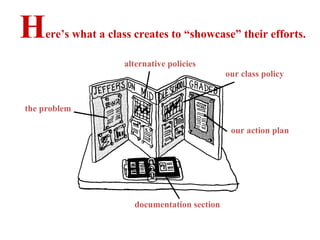
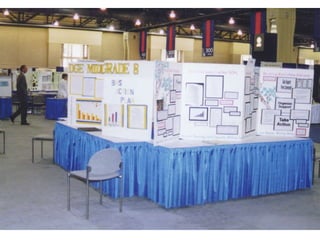
alternative policies the problem documentation section our class policy our action plan H ere’s what a class creates to “showcase” their efforts.
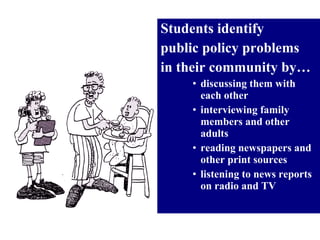
Students identify public policy problems  in their community by… discussing them with each other interviewing family members and other adults reading newspapers and other print sources listening to news reports on radio and TV
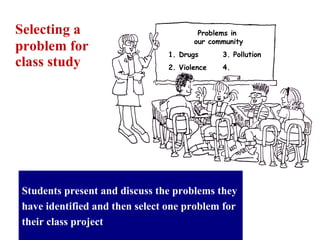
Selecting a  problem for  class study Problems in  our community 1. Drugs   3. Pollution 2. Violence   4. Students present and discuss the problems they have identified and then select one problem for  their class project
Students gather information on the chosen public policy problem from a variety of sources Interviews and surveys      Printed sources Radio and television      Libraries      Internet Scholars and professors      Lawyers and judges Community organizations and interest groups Legislative offices      Administrative offices
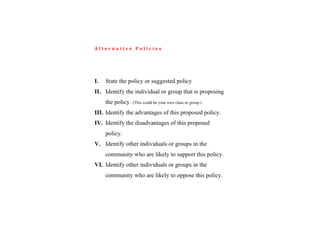
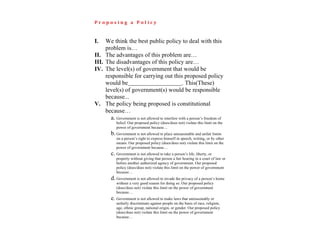
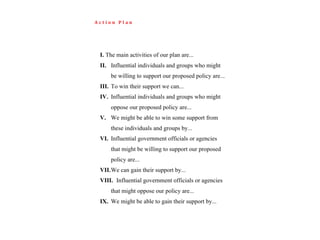
Developing a class portfolio Group 1 develops an explanation of the problem Group 2 evaluates alternative policies Group 3 develops a proposed policy  consistent with constitutional principles Group 4 develops an action plan
Presenting the portfolio Public hearing before a  panel of “judges” from the community Presentations by each of  the four groups Opening oral presentations (4 minutes) Responses to questions from judges (6 minutes)
 
Start: 56:26
  What  DISPOSITIONS  did they exhibit?  (What attitudes and beliefs did they demonstrate?) What  KNOWLDEGE  did they need? (What did they need to know?) What did the students in  Missouri and Colombia need to  become engaged citizens?  What  SKILLS  did they employ? (What were they able to do?) Carousel In a group, record  your ideas on the  chart paper in the  room. When time is  called, move to  the next chart.
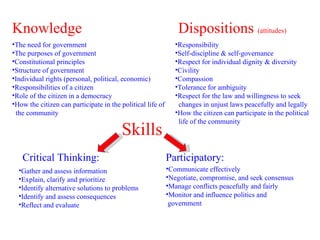
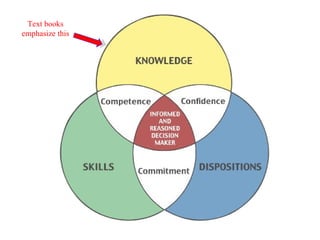
The need for government  The purposes of government  Constitutional principles  Structure of government  Individual rights (personal, political, economic)  Responsibilities of a citizen  Role of the citizen in a democracy  How the citizen can participate in the political life of  the community  Knowledge Critical Thinking: Skills Participatory: Responsibility Self-discipline & self-governance Respect for individual dignity & diversity Civility  Compassion  Tolerance for ambiguity Respect for the law and willingness to seek  changes in unjust laws peacefully and legally How the citizen can participate in the political  life of the community  Dispositions  (attitudes) Gather and assess information  Explain, clarify and prioritize  Identify alternative solutions to problems  Identify and assess consequences  Reflect and evaluate  Communicate effectively  Negotiate, compromise, and seek consensus Manage conflicts peacefully and fairly Monitor and influence politics and  government
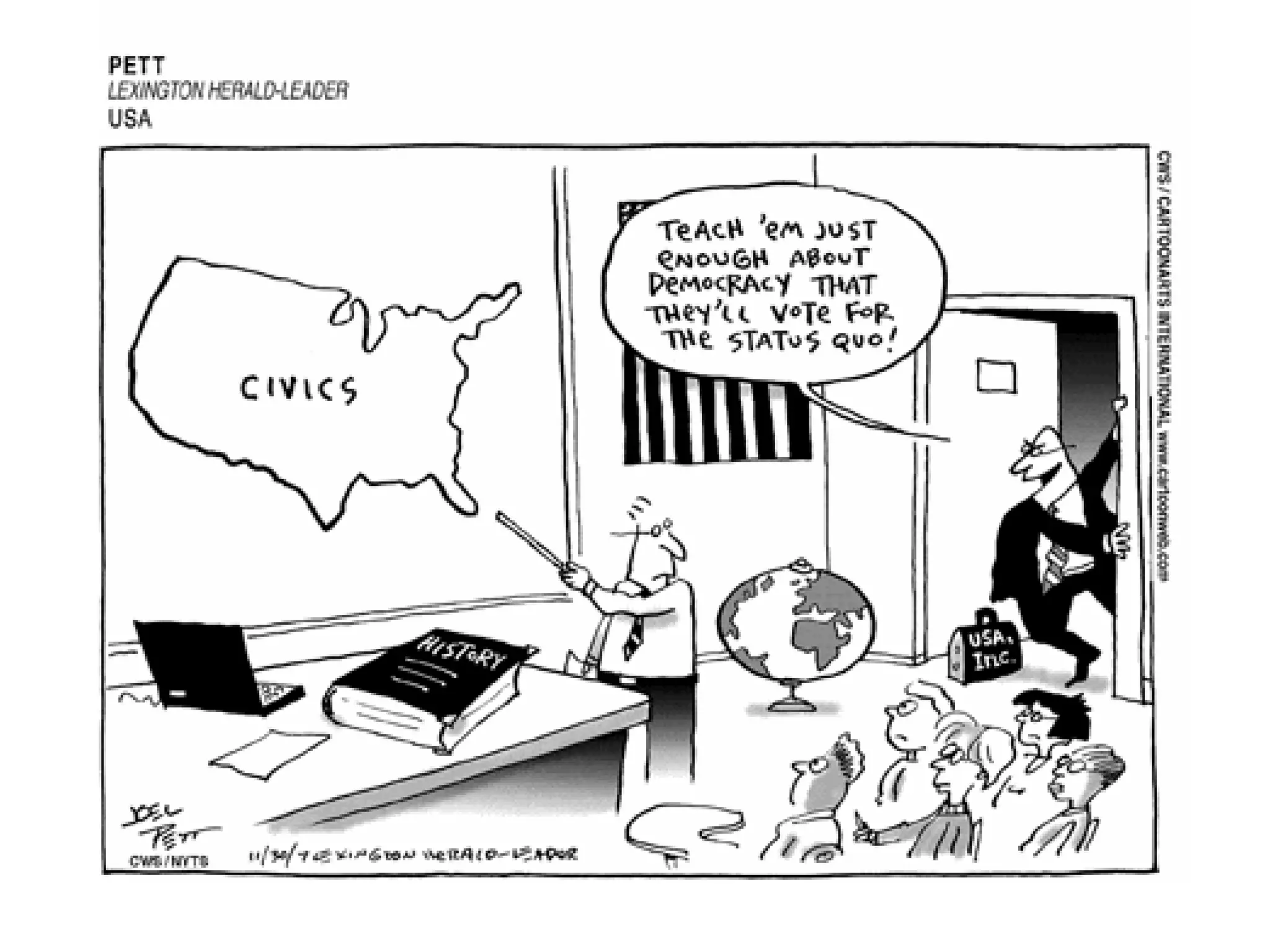
Text books emphasize this
Debrief Project Citizen text pages vi-3 Comments? Concerns so far?
What bugs me... 1. Imagine things that bug or annoy you in your personal life school neighborhood state nation 2. Carousel a. Rotate and record your ideas on the poster  papers located throughout the room. b. Debrief
Identifying Public Policy Problems in Your Community Project Citizen text: Step 1, pages 10-16
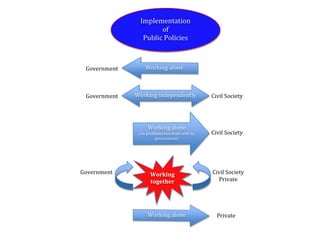
Who should be responsible for solving our community problems? Discuss with a partner.
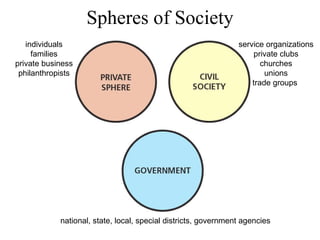
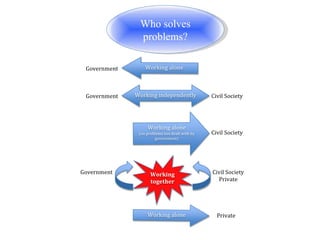
Spheres of Society individuals families private business philanthropists service organizations private clubs churches unions trade groups  national, state, local, special districts, government agencies
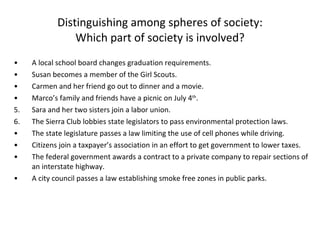
Distinguishing among spheres of society: Which part of society is involved? A local school board changes graduation requirements. Susan becomes a member of the Girl Scouts. Carmen and her friend go out to dinner and a movie. Marco’s family and friends have a picnic on July 4 th . 5.  Sara and her two sisters join a labor union. 6.  The Sierra Club lobbies state legislators to pass environmental protection laws.  The state legislature passes a law limiting the use of cell phones while driving. Citizens join a taxpayer’s association in an effort to get government to lower taxes.  The federal government awards a contract to a private company to repair sections of an interstate highway. A city council passes a law establishing smoke free zones in public parks.
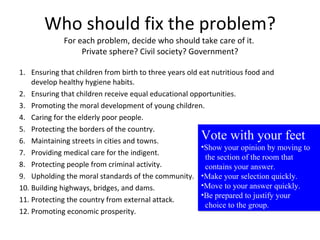
Who should fix the problem? For each problem, decide who should take care of it.  Private sphere? Civil society? Government? Ensuring that children from birth to three years old eat nutritious food and develop healthy hygiene habits. Ensuring that children receive equal educational opportunities. Promoting the moral development of young children. Caring for the elderly poor people. Protecting the borders of the country. Maintaining streets in cities and towns. Providing medical care for the indigent. Protecting people from criminal activity. Upholding the moral standards of the community. Building highways, bridges, and dams. Protecting the country from external attack. Promoting economic prosperity.  Vote with your feet Show your opinion by moving to  the section of the room that  contains your answer. Make your selection quickly. Move to your answer quickly. Be prepared to justify your  choice to the group.
Who solves problems?
 
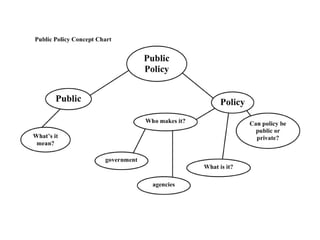
So, what is “public policy?” Defined Public policy is the combination of basic decisions, commitments, and actions made by government officials who have authority to act. Policymaking is the act of arriving at a decision regarding the public good or well being, through an agreed upon public policy process, based on established norms and procedures.
In democracies, a public policy is a concept or set of ideas that guides a course of action or a procedure used in dealing with public issues or problems.   Public policies are often embodied in laws, rules, or regulations or agreed upon procedures used by government to fulfill its responsibilities to protect the rights of the people and to promote the general welfare. Found Poem With a partner, pick no more than 10words from the definition on the previous slide and the text below to describe what a “public policy” is.


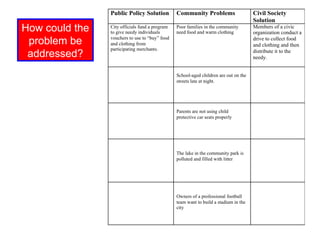
How could the problem be addressed?
Debrief Project Citizen text pages 10-16 Comments? Concerns so far?
 
 
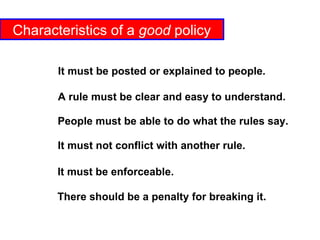
Characteristics of a  good  policy A rule must be clear and easy to understand. People must be able to do what the rules say. It must not conflict with another rule. It must be enforceable. There should be a penalty for breaking it. It must be posted or explained to people.
 
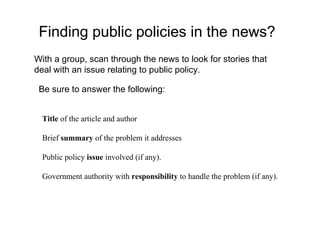
Finding public policies in the news? Title  of the article and author    Brief  summary  of the problem it addresses   Public policy  issue  involved (if any).   Government authority with  responsibility  to handle the problem (if any). With a group, scan through the news to look for stories that deal with an issue relating to public policy.  Be sure to answer the following:
Project Citizen portfolio Portfolio Walk Around Notice the four sections: Problem Alternative Policies Our Policy Action Plan  Hearing Start: 11:45
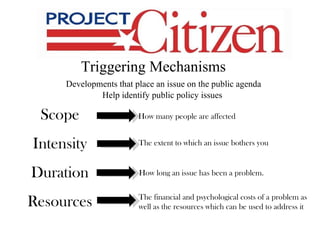
Triggering Mechanisms Scope Intensity Duration Resources How many people are affected The extent to which an issue bothers you How long an issue has been a problem.  The financial and psychological costs of a problem as well as the resources which can be used to address it Developments that place an issue on the public agenda Help identify public policy issues
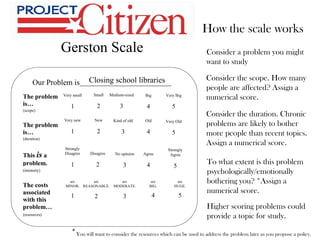
How the scale works Consider a problem you might want to study Consider the scope. How many people are affected? Assign a numerical score. Consider the duration. Chronic problems are likely to bother more people than recent topics. Assign a numerical score.  To what extent is this problem psychologically/emotionally bothering you? *Assign a numerical score. Closing school libraries * You will want to consider the resources which can be used to address the problem later as you propose a policy. Higher scoring problems could provide a topic for study.
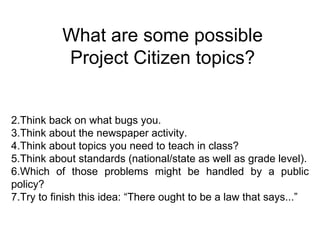
What are some possible Project Citizen topics? Think back on what bugs you.  Think about the newspaper activity.  Think about topics you need to teach in class? Think about standards (national/state as well as grade level). Which of those problems might be handled by a public policy?  Try to finish this idea: “There ought to be a law that says...”
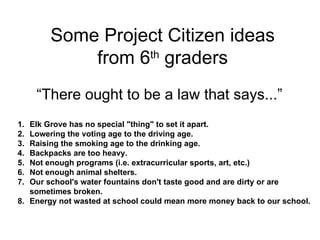
Elk Grove has no special "thing" to set it apart. Lowering the voting age to the driving age. Raising the smoking age to the drinking age. Backpacks are too heavy.  Not enough programs (i.e. extracurricular sports, art, etc.) Not enough animal shelters. Our school's water fountains don't taste good and are dirty or are sometimes broken. Energy not wasted at school could mean more money back to our school. Some Project Citizen ideas from 6 th  graders “ There ought to be a law that says...”
Debrief Project Citizen text pages 44-45 Comments? Concerns so far? Constitutional Opinion Form
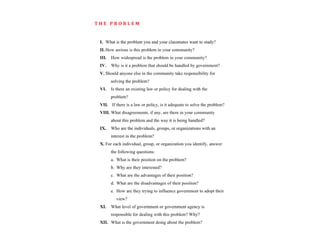
Project Citizen portfolio Graphic Organizers Problem: pg. 29-30 Examining Alternative Policies: pg. 31 Proposing a Public Policy: pg. 32 Developing an Action Plan: pg. 33-34


Want more training? www.civiced.org
 

CCSS Project Citizen Power Point

  • 1.
  • 2.
  • 3.
    Civic education programPromotes competent and responsible participation in state and local government Engages students in learning how to monitor and influence public policy Encourages civic participation among students, parents and members of the community
  • 4.
    Identify a publicpolicy problem & evaluate alternative solutions Propose a solution Develop an action plan for implementing their policy Display research in a portfolio and documentation binder I t means you and your class will…
  • 5.
    alternative policies theproblem documentation section our class policy our action plan H ere’s what a class creates to “showcase” their efforts.
  • 6.
    Students identify publicpolicy problems in their community by… discussing them with each other interviewing family members and other adults reading newspapers and other print sources listening to news reports on radio and TV
  • 7.
    Selecting a problem for class study Problems in our community 1. Drugs 3. Pollution 2. Violence 4. Students present and discuss the problems they have identified and then select one problem for their class project
  • 8.
    Students gather informationon the chosen public policy problem from a variety of sources Interviews and surveys  Printed sources Radio and television  Libraries  Internet Scholars and professors  Lawyers and judges Community organizations and interest groups Legislative offices  Administrative offices
  • 9.
    Developing a classportfolio Group 1 develops an explanation of the problem Group 2 evaluates alternative policies Group 3 develops a proposed policy consistent with constitutional principles Group 4 develops an action plan
  • 10.
    Presenting the portfolioPublic hearing before a panel of “judges” from the community Presentations by each of the four groups Opening oral presentations (4 minutes) Responses to questions from judges (6 minutes)
  • 11.
  • 12.
  • 13.
      What DISPOSITIONS did they exhibit? (What attitudes and beliefs did they demonstrate?) What KNOWLDEGE did they need? (What did they need to know?) What did the students in Missouri and Colombia need to become engaged citizens? What SKILLS did they employ? (What were they able to do?) Carousel In a group, record your ideas on the chart paper in the room. When time is called, move to the next chart.
  • 14.
    The need forgovernment The purposes of government Constitutional principles Structure of government Individual rights (personal, political, economic) Responsibilities of a citizen Role of the citizen in a democracy How the citizen can participate in the political life of the community Knowledge Critical Thinking: Skills Participatory: Responsibility Self-discipline & self-governance Respect for individual dignity & diversity Civility Compassion Tolerance for ambiguity Respect for the law and willingness to seek changes in unjust laws peacefully and legally How the citizen can participate in the political life of the community Dispositions (attitudes) Gather and assess information Explain, clarify and prioritize Identify alternative solutions to problems Identify and assess consequences Reflect and evaluate Communicate effectively Negotiate, compromise, and seek consensus Manage conflicts peacefully and fairly Monitor and influence politics and government
  • 15.
  • 16.
    Debrief Project Citizentext pages vi-3 Comments? Concerns so far?
  • 17.
    What bugs me...1. Imagine things that bug or annoy you in your personal life school neighborhood state nation 2. Carousel a. Rotate and record your ideas on the poster papers located throughout the room. b. Debrief
  • 18.
    Identifying Public PolicyProblems in Your Community Project Citizen text: Step 1, pages 10-16
  • 19.
    Who should beresponsible for solving our community problems? Discuss with a partner.
  • 20.
    Spheres of Societyindividuals families private business philanthropists service organizations private clubs churches unions trade groups national, state, local, special districts, government agencies
  • 21.
    Distinguishing among spheresof society: Which part of society is involved? A local school board changes graduation requirements. Susan becomes a member of the Girl Scouts. Carmen and her friend go out to dinner and a movie. Marco’s family and friends have a picnic on July 4 th . 5. Sara and her two sisters join a labor union. 6. The Sierra Club lobbies state legislators to pass environmental protection laws. The state legislature passes a law limiting the use of cell phones while driving. Citizens join a taxpayer’s association in an effort to get government to lower taxes. The federal government awards a contract to a private company to repair sections of an interstate highway. A city council passes a law establishing smoke free zones in public parks.
  • 22.
    Who should fixthe problem? For each problem, decide who should take care of it. Private sphere? Civil society? Government? Ensuring that children from birth to three years old eat nutritious food and develop healthy hygiene habits. Ensuring that children receive equal educational opportunities. Promoting the moral development of young children. Caring for the elderly poor people. Protecting the borders of the country. Maintaining streets in cities and towns. Providing medical care for the indigent. Protecting people from criminal activity. Upholding the moral standards of the community. Building highways, bridges, and dams. Protecting the country from external attack. Promoting economic prosperity. Vote with your feet Show your opinion by moving to the section of the room that contains your answer. Make your selection quickly. Move to your answer quickly. Be prepared to justify your choice to the group.
  • 23.
  • 24.
  • 25.
    So, what is“public policy?” Defined Public policy is the combination of basic decisions, commitments, and actions made by government officials who have authority to act. Policymaking is the act of arriving at a decision regarding the public good or well being, through an agreed upon public policy process, based on established norms and procedures.
  • 26.
    In democracies, apublic policy is a concept or set of ideas that guides a course of action or a procedure used in dealing with public issues or problems.   Public policies are often embodied in laws, rules, or regulations or agreed upon procedures used by government to fulfill its responsibilities to protect the rights of the people and to promote the general welfare. Found Poem With a partner, pick no more than 10words from the definition on the previous slide and the text below to describe what a “public policy” is.
  • 27.
  • 28.
  • 29.
  • 30.
  • 31.
  • 32.
  • 33.
  • 34.
    How could theproblem be addressed?
  • 35.
    Debrief Project Citizentext pages 10-16 Comments? Concerns so far?
  • 36.
  • 37.
  • 38.
    Characteristics of a good policy A rule must be clear and easy to understand. People must be able to do what the rules say. It must not conflict with another rule. It must be enforceable. There should be a penalty for breaking it. It must be posted or explained to people.
  • 39.
  • 40.
    Finding public policiesin the news? Title of the article and author   Brief summary of the problem it addresses   Public policy issue involved (if any).   Government authority with responsibility to handle the problem (if any). With a group, scan through the news to look for stories that deal with an issue relating to public policy. Be sure to answer the following:
  • 41.
    Project Citizen portfolioPortfolio Walk Around Notice the four sections: Problem Alternative Policies Our Policy Action Plan Hearing Start: 11:45
  • 42.
    Triggering Mechanisms ScopeIntensity Duration Resources How many people are affected The extent to which an issue bothers you How long an issue has been a problem. The financial and psychological costs of a problem as well as the resources which can be used to address it Developments that place an issue on the public agenda Help identify public policy issues
  • 43.
    How the scaleworks Consider a problem you might want to study Consider the scope. How many people are affected? Assign a numerical score. Consider the duration. Chronic problems are likely to bother more people than recent topics. Assign a numerical score. To what extent is this problem psychologically/emotionally bothering you? *Assign a numerical score. Closing school libraries * You will want to consider the resources which can be used to address the problem later as you propose a policy. Higher scoring problems could provide a topic for study.
  • 44.
    What are somepossible Project Citizen topics? Think back on what bugs you. Think about the newspaper activity. Think about topics you need to teach in class? Think about standards (national/state as well as grade level). Which of those problems might be handled by a public policy? Try to finish this idea: “There ought to be a law that says...”
  • 45.
    Elk Grove hasno special "thing" to set it apart. Lowering the voting age to the driving age. Raising the smoking age to the drinking age. Backpacks are too heavy. Not enough programs (i.e. extracurricular sports, art, etc.) Not enough animal shelters. Our school's water fountains don't taste good and are dirty or are sometimes broken. Energy not wasted at school could mean more money back to our school. Some Project Citizen ideas from 6 th graders “ There ought to be a law that says...”
  • 46.
    Debrief Project Citizentext pages 44-45 Comments? Concerns so far? Constitutional Opinion Form
  • 47.
    Project Citizen portfolioGraphic Organizers Problem: pg. 29-30 Examining Alternative Policies: pg. 31 Proposing a Public Policy: pg. 32 Developing an Action Plan: pg. 33-34
  • 48.
  • 49.
  • 50.
  • 51.
  • 52.
    Want more training?www.civiced.org
  • 53.