Version
1.0
CCOR Quick Reference
PLAN RELATE SELL CONTRACT ASSIST
SCOR is a registered trademark in the
United States and Europe
Customer-Chain
Operations
Reference-model
The
CCOR-model:
The Customer-Chain Operations
Reference-model (CCOR) is the
product of the Supply-Chain Council
(SCC), an independent, not-for-profit,
global corporation with membership
open to all companies and organizations
interested in applying and advancing
the state-of-the-art in supply-chain
management systems and practices.
The CCOR-model captures the
Council’s consensus view of supply
chain management. While much of the
underlying content of the Model has
been used by practitioners for many
years, the CCOR-model provides a
unique framework that links business
process, metrics, best practices and
technology features into a unified
structure to support communication
among supply chain partners and
to improve the effectiveness of
supply chain management and
related supply chain
improvement activities.
PLAN
PA
Plan
Assist
PC
Plan
Contract
PP
Plan
Customer
Chain
PR
Plan
Relate
PS
Plan
Sell
PA.1:
Gather
Assist
Requirements
PA.2:
Gather
Assist
Resources
PA.3:
Balance
Assist
Requirements
with Resources
PA.4:
Publish
Assist Plan
PC.1:
Gather
Contract
Requirements
PC.2:
Gather
Contract
Resources
PC.3:
Balance
Contract
Requirements
with Resources
PC.4
Publish
Contract Plan
PP.1:
Gather
Customer Chain
Requirements
PP.2:
Gather
Customer Chain
Resources
PP.3:
Balance
Customer Chain
Requirements
with Resources
PP.4:
Establish
Customer
Chain Plans
PR.1:
Gather
Relate
Requirements
PR.2:
Gather
Relate
Resources
PR.3:
Balance
Relate
Requirements
with Resources
PR.4:
Publish
Relate Plan
PS.1:
Gather Sell
Requirements
PS.2:
Gather Sell
Resources
PS.3:
Balance Sell
Requirements
with Resources
PS.4:
Publish
Sell Plan
EP1:
Manage Plan
Business Rules
EP2:
Manage
Customer
Chain
Performance
EP3:
Manage Plan
Information
EP4:
Manage
Customer
Pricing
EP5:
Manage
Customer
Chain Assets
Enable Plan
EP6:
Manage
Knowledge
Transfer
EP7:
Manage
Customer
Chain
Configuration
EP8:
Manage Plan
Regulatory
Compliance
EP9:
Align Sales Plan
with Financial
Plan
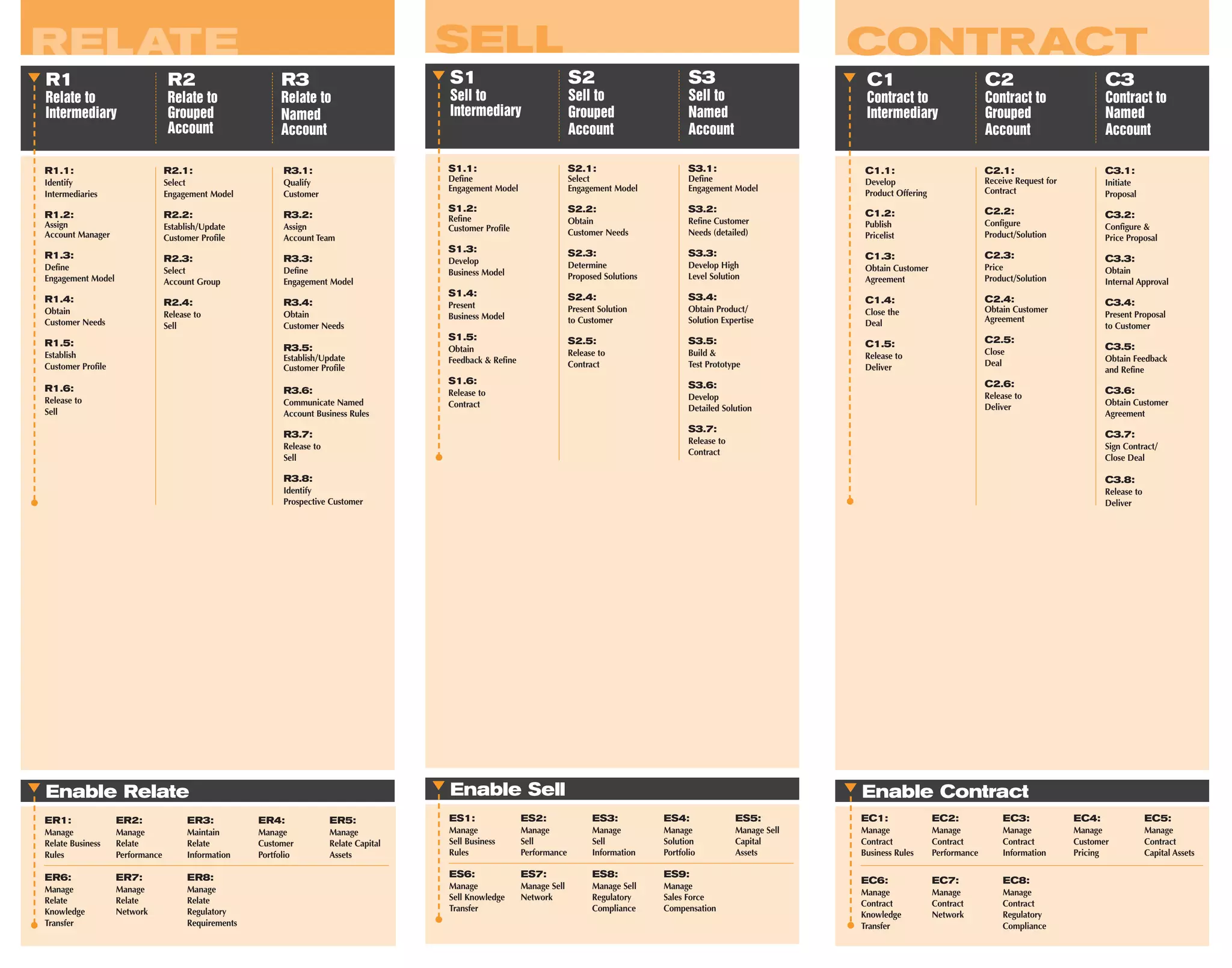
RELATE
R1
Relate to
Intermediary
R2
Relate to
Grouped
Account
R3
Relate to
Named
Account
R1.1:
Identify
Intermediaries
R1.2:
Assign
Account Manager
R1.3:
Define
Engagement Model
R1.4:
Obtain
Customer Needs
R1.5:
Establish
Customer Profile
R1.6:
Release to
Sell
R2.1:
Select
Engagement Model
R2.2:
Establish/Update
Customer Profile
R2.3:
Select
Account Group
R2.4:
Release to
Sell
R3.1:
Qualify
Customer
R3.2:
Assign
Account Team
R3.3:
Define
Engagement Model
R3.4:
Obtain
Customer Needs
R3.5:
Establish/Update
Customer Profile
R3.6:
Communicate Named
Account Business Rules
R3.7:
Release to
Sell
R3.8:
Identify
Prospective Customer
SELL
S1
Sell to
Intermediary
S2
Sell to
Grouped
Account
S3
Sell to
Named
Account
S1.1:
Define
Engagement Model
S1.2:
Refine
Customer Profile
S1.3:
Develop
Business Model
S1.4:
Present
Business Model
S1.5:
Obtain
Feedback & Refine
S1.6:
Release to
Contract
S2.1:
Select
Engagement Model
S2.2:
Obtain
Customer Needs
S2.3:
Determine
Proposed Solutions
S2.4:
Present Solution
to Customer
S2.5:
Release to
Contract
S3.1:
Define
Engagement Model
S3.2:
Refine Customer
Needs (detailed)
S3.3:
Develop High
Level Solution
S3.4:
Obtain Product/
Solution Expertise
S3.5:
Build &
Test Prototype
S3.6:
Develop
Detailed Solution
S3.7:
Release to
Contract
CONTRACT
C1
Contract to
Intermediary
C2
Contract to
Grouped
Account
C3
Contract to
Named
Account
C1.1:
Develop
Product Offering
C1.2:
Publish
Pricelist
C1.3:
Obtain Customer
Agreement
C1.4:
Close the
Deal
C1.5:
Release to
Deliver
C2.1:
Receive Request for
Contract
C2.2:
Configure
Product/Solution
C2.3:
Price
Product/Solution
C2.4:
Obtain Customer
Agreement
C2.5:
Close
Deal
C2.6:
Release to
Deliver
C3.1:
Initiate
Proposal
C3.2:
Configure &
Price Proposal
C3.3:
Obtain
Internal Approval
C3.4:
Present Proposal
to Customer
C3.5:
Obtain Feedback
and Refine
C3.6:
Obtain Customer
Agreement
C3.7:
Sign Contract/
Close Deal
C3.8:
Release to
Deliver
ER1:
Manage
Relate Business
Rules
ER2:
Manage
Relate
Performance
ER3:
Maintain
Relate
Information
ER4:
Manage
Customer
Portfolio
ER5:
Manage
Relate Capital
Assets
Enable Relate
ER6:
Manage
Relate
Knowledge
Transfer
ER7:
Manage
Relate
Network
ER8:
Manage
Relate
Regulatory
Requirements
ES1:
Manage
Sell Business
Rules
ES2:
Manage
Sell
Performance
ES3:
Manage
Sell
Information
ES4:
Manage
Solution
Portfolio
ES5:
Manage Sell
Capital
Assets
Enable Sell
ES6:
Manage
Sell Knowledge
Transfer
ES7:
Manage Sell
Network
ES8:
Manage Sell
Regulatory
Compliance
ES9:
Manage
Sales Force
Compensation
EC1:
Manage
Contract
Business Rules
EC2:
Manage
Contract
Performance
EC3:
Manage
Contract
Information
EC4:
Manage
Customer
Pricing
EC5:
Manage
Contract
Capital Assets
Enable Contract
EC6:
Manage
Contract
Knowledge
Transfer
EC7:
Manage
Contract
Network
EC8:
Manage
Contract
Regulatory
Compliance
For more information, please contact the
Council office:
In USA:
Supply Chain Council
1331 H St. NW, Suite 500
Washington, D.C. 20005
Phone: +1 202-962-0440
Fax: +1 202-962-3939
Email: info@supply-chain.org
In Europe:
Supply Chain Council
287 Avenue Louise
2nd Floor
BE - 1050 Brussels
Tel: +32 2 627 0160
Fax: +32 2 645 2671
Email: Europe@supply-chain.org
www.supply-chain.org
Top Level
(Process Types)
Configuration
Level
(Process
Categories)
Process Element
Level
(Decompose
Processes)
Implementation
Level
(Decompose
Process Elements)
Customer-Chain
Operations
Reference-model
Not
in
Scope
PP1.1
Gather Customer
Chain
Requirements
PP1.2
Gather Customer
Chain
Resources
PP1.3
Balance Customer
Chain Requirements
with Resources
PP1.4
Establish Customer
Chain Plans
Level
# Description Schematic
1
2
3
4
CCOR Contains Three
Levels of Process Detail
Assist
Relate Sell
Plan
Contract
ASSIST
Enable Assist
EA1:
Manage Assist
Business Rules
Processes
EA2:
Manage
Assist
Performance
EA3:
Manage
Assist
Information
EA4:
Manage
Warranty
EA5:
Manage
Assist
Capital Assets
EA6:
Manage
Assist
Knowledge
Transfer
EA7:
Manage
Assist
Network
EA8:
Manage
Assist
Regulatory
Compliance
A1
Self
Assist
A2
Assist
Remote
A3
Assist
On-Site
A1.1:
Receive Inquiry/
Request
A1.2:
Route
Request
A1.3:
Identify
Solution
A1.4:
Propose
Solution
A1.5:
Release Solution
to Customer
A1.6:
Close
Request
A2.1:
Receive Inquiry/
Request
A2.2:
Route
Request
A2.3:
Identify
Solution
A2.4:
Propose
Solution
A2.5:
Distribute
Solution
A2.6:
Release Solution
to Customer
A2.7:
Close
Request
A3.1:
Receive Inquiry/
Request
A3.2:
Authorize
Request
A3.3:
Schedule
On-site Assist
A3.4:
Obtain
Materials
A3.5:
Repair
Product
A3.6:
Dispose
Materials
A3.7:
Close
Request

CCOR.pdf

  • 1.
    Version 1.0 CCOR Quick Reference PLANRELATE SELL CONTRACT ASSIST SCOR is a registered trademark in the United States and Europe Customer-Chain Operations Reference-model The CCOR-model: The Customer-Chain Operations Reference-model (CCOR) is the product of the Supply-Chain Council (SCC), an independent, not-for-profit, global corporation with membership open to all companies and organizations interested in applying and advancing the state-of-the-art in supply-chain management systems and practices. The CCOR-model captures the Council’s consensus view of supply chain management. While much of the underlying content of the Model has been used by practitioners for many years, the CCOR-model provides a unique framework that links business process, metrics, best practices and technology features into a unified structure to support communication among supply chain partners and to improve the effectiveness of supply chain management and related supply chain improvement activities. PLAN PA Plan Assist PC Plan Contract PP Plan Customer Chain PR Plan Relate PS Plan Sell PA.1: Gather Assist Requirements PA.2: Gather Assist Resources PA.3: Balance Assist Requirements with Resources PA.4: Publish Assist Plan PC.1: Gather Contract Requirements PC.2: Gather Contract Resources PC.3: Balance Contract Requirements with Resources PC.4 Publish Contract Plan PP.1: Gather Customer Chain Requirements PP.2: Gather Customer Chain Resources PP.3: Balance Customer Chain Requirements with Resources PP.4: Establish Customer Chain Plans PR.1: Gather Relate Requirements PR.2: Gather Relate Resources PR.3: Balance Relate Requirements with Resources PR.4: Publish Relate Plan PS.1: Gather Sell Requirements PS.2: Gather Sell Resources PS.3: Balance Sell Requirements with Resources PS.4: Publish Sell Plan EP1: Manage Plan Business Rules EP2: Manage Customer Chain Performance EP3: Manage Plan Information EP4: Manage Customer Pricing EP5: Manage Customer Chain Assets Enable Plan EP6: Manage Knowledge Transfer EP7: Manage Customer Chain Configuration EP8: Manage Plan Regulatory Compliance EP9: Align Sales Plan with Financial Plan
  • 2.
    RELATE R1 Relate to Intermediary R2 Relate to Grouped Account R3 Relateto Named Account R1.1: Identify Intermediaries R1.2: Assign Account Manager R1.3: Define Engagement Model R1.4: Obtain Customer Needs R1.5: Establish Customer Profile R1.6: Release to Sell R2.1: Select Engagement Model R2.2: Establish/Update Customer Profile R2.3: Select Account Group R2.4: Release to Sell R3.1: Qualify Customer R3.2: Assign Account Team R3.3: Define Engagement Model R3.4: Obtain Customer Needs R3.5: Establish/Update Customer Profile R3.6: Communicate Named Account Business Rules R3.7: Release to Sell R3.8: Identify Prospective Customer SELL S1 Sell to Intermediary S2 Sell to Grouped Account S3 Sell to Named Account S1.1: Define Engagement Model S1.2: Refine Customer Profile S1.3: Develop Business Model S1.4: Present Business Model S1.5: Obtain Feedback & Refine S1.6: Release to Contract S2.1: Select Engagement Model S2.2: Obtain Customer Needs S2.3: Determine Proposed Solutions S2.4: Present Solution to Customer S2.5: Release to Contract S3.1: Define Engagement Model S3.2: Refine Customer Needs (detailed) S3.3: Develop High Level Solution S3.4: Obtain Product/ Solution Expertise S3.5: Build & Test Prototype S3.6: Develop Detailed Solution S3.7: Release to Contract CONTRACT C1 Contract to Intermediary C2 Contract to Grouped Account C3 Contract to Named Account C1.1: Develop Product Offering C1.2: Publish Pricelist C1.3: Obtain Customer Agreement C1.4: Close the Deal C1.5: Release to Deliver C2.1: Receive Request for Contract C2.2: Configure Product/Solution C2.3: Price Product/Solution C2.4: Obtain Customer Agreement C2.5: Close Deal C2.6: Release to Deliver C3.1: Initiate Proposal C3.2: Configure & Price Proposal C3.3: Obtain Internal Approval C3.4: Present Proposal to Customer C3.5: Obtain Feedback and Refine C3.6: Obtain Customer Agreement C3.7: Sign Contract/ Close Deal C3.8: Release to Deliver ER1: Manage Relate Business Rules ER2: Manage Relate Performance ER3: Maintain Relate Information ER4: Manage Customer Portfolio ER5: Manage Relate Capital Assets Enable Relate ER6: Manage Relate Knowledge Transfer ER7: Manage Relate Network ER8: Manage Relate Regulatory Requirements ES1: Manage Sell Business Rules ES2: Manage Sell Performance ES3: Manage Sell Information ES4: Manage Solution Portfolio ES5: Manage Sell Capital Assets Enable Sell ES6: Manage Sell Knowledge Transfer ES7: Manage Sell Network ES8: Manage Sell Regulatory Compliance ES9: Manage Sales Force Compensation EC1: Manage Contract Business Rules EC2: Manage Contract Performance EC3: Manage Contract Information EC4: Manage Customer Pricing EC5: Manage Contract Capital Assets Enable Contract EC6: Manage Contract Knowledge Transfer EC7: Manage Contract Network EC8: Manage Contract Regulatory Compliance
  • 3.
    For more information,please contact the Council office: In USA: Supply Chain Council 1331 H St. NW, Suite 500 Washington, D.C. 20005 Phone: +1 202-962-0440 Fax: +1 202-962-3939 Email: info@supply-chain.org In Europe: Supply Chain Council 287 Avenue Louise 2nd Floor BE - 1050 Brussels Tel: +32 2 627 0160 Fax: +32 2 645 2671 Email: Europe@supply-chain.org www.supply-chain.org Top Level (Process Types) Configuration Level (Process Categories) Process Element Level (Decompose Processes) Implementation Level (Decompose Process Elements) Customer-Chain Operations Reference-model Not in Scope PP1.1 Gather Customer Chain Requirements PP1.2 Gather Customer Chain Resources PP1.3 Balance Customer Chain Requirements with Resources PP1.4 Establish Customer Chain Plans Level # Description Schematic 1 2 3 4 CCOR Contains Three Levels of Process Detail Assist Relate Sell Plan Contract ASSIST Enable Assist EA1: Manage Assist Business Rules Processes EA2: Manage Assist Performance EA3: Manage Assist Information EA4: Manage Warranty EA5: Manage Assist Capital Assets EA6: Manage Assist Knowledge Transfer EA7: Manage Assist Network EA8: Manage Assist Regulatory Compliance A1 Self Assist A2 Assist Remote A3 Assist On-Site A1.1: Receive Inquiry/ Request A1.2: Route Request A1.3: Identify Solution A1.4: Propose Solution A1.5: Release Solution to Customer A1.6: Close Request A2.1: Receive Inquiry/ Request A2.2: Route Request A2.3: Identify Solution A2.4: Propose Solution A2.5: Distribute Solution A2.6: Release Solution to Customer A2.7: Close Request A3.1: Receive Inquiry/ Request A3.2: Authorize Request A3.3: Schedule On-site Assist A3.4: Obtain Materials A3.5: Repair Product A3.6: Dispose Materials A3.7: Close Request