Simpson Thacher & Bartlett LLP
Memorandum
Is Iran Open for Business?
Most “Secondary Sanctions” Lifted but the Situation Remains
Largely Unchanged for U.S. Persons
January 19, 2016
Overview
In a move that opens the door for non-U.S. companies to engage in transactions with or in Iran, on January
16, 2016, the U.S. scaled back economic sanctions against Iran. As a result:
1. Non-U.S. persons, including non-U.S. entities, may now, with limited exceptions discussed
below, do business with or in Iran without risk of sanction.
2. Foreign subsidiaries of a U.S. parent company are also allowed, with some exceptions, to do
business in or with Iran without violating economic sanctions.
3. However, U.S. persons remain largely prohibited from doing business in or with Iran because
the bulk of the U.S. trade embargo of Iran remains in place for U.S. persons.
The E.U. and U.N. also significantly pared back their Iranian sanctions regimes. Combined, these changes
allow non-U.S. persons to engage in most dealings with Iran without implicating U.S., E.U. or U.N. sanctions.
Nevertheless, U.S. persons largely remain barred from transacting in or with Iran.
Implementation Day
On January 16, the International Atomic Energy Agency (“IAEA”) certified that Iran had achieved key
milestones regarding its nuclear program as set forth under the Joint Comprehensive Plan of Action
(“JCPOA”) entered into between the P5+1 (the United States, China, France, Russia, the United Kingdom
and Germany), the E.U. and Iran in July of 2015. The verification by the IAEA gave rise to “Implementation
Day,” which automatically triggered relaxation of certain sanctions against Iran by the U.S., E.U. and U.N.
2Memorandum – January 19, 2016
Simpson Thacher & Bartlett LLP
Lifting of U.S. Secondary Sanctions Targeting Iran
The relaxation of U.S. economic sanctions against Iran is, with a few exceptions, limited to non-U.S. persons.
Before this change, non-U.S. persons that did business in or with Iran risked being targeted by so-called
“secondary sanctions,” which could be applied by the U.S. Government to any person or entity, even if there
was no U.S. nexus. Imposition of secondary sanctions could previously have barred non-U.S. persons from
doing business in or with the U.S., or resulted in additional sanctions. Now, most secondary sanctions that
previously applied to non-U.S. persons have been lifted. This means that non-U.S. persons can do business
with Iran without risk of sanction, apart from the restrictions set forth below.
Certain secondary sanctions remain. Non-U.S. persons still risk secondary sanctions if they engage in
dealings with Iranian or Iranian-related persons or entities on the sanctions lists maintained by U.S.
Department of Treasury’s Office of Foreign Assets Control (“OFAC”), including the lists of Specially
Designated Nationals or Blocked Persons (“SDNs”). This means that the U.S. Government can still impose
sanctions on a non-U.S. person that engages in dealings with an Iranian SDN, even if that non-U.S. person
has no nexus to the U.S. (no U.S. affiliates, no U.S. employees, no dealings in U.S. goods or services, etc.).
To mitigate against this risk, all businesses should continue to screen transactions against OFAC-maintained
lists. New SDNs may be added to the lists at any time, as occurred the day following Implementation Day
when eleven new SDNs were added for helping to supply Iran’s ballistic missile program. Dealing with Iran-
related SDNs still presents risks for non-U.S. persons.
Non-U.S. Subsidiaries or Affiliates of U.S. Persons May Now Do Business with
Iran
The biggest change for U.S. persons is the issuance of General License H by OFAC. General License H
authorizes entities that are owned or controlled by U.S. persons or entities, but established or maintained
outside of the United States, to do business with Iran, subject to some restrictions discussed further below.
General License H also contains specific authorizations that remove practical impediments that would
otherwise exist for non-U.S. subsidiaries planning to do business with Iran. Previously, U.S. persons risked
being sanctioned for altering policies and procedures of non-U.S. subsidiaries to make it possible for the
non-U.S. business to engage in Iran. U.S. persons also risked sanctions if their global corporate technology
systems were used in connection with dealings in or with Iran. General License H now specifically allows for
these actions by U.S. persons. U.S. persons cannot participate in or assist or facilitate dealings by
subsidiaries and affiliates with Iran.
Despite the breadth of General License H, some restrictions remain in place for U.S.-owned or -controlled
businesses. In dealing with Iran or its citizens, non-U.S. entities owned or controlled by U.S. entities still
may not, among other things, export or re-export U.S. goods, services or technology to Iran; transfer funds to,
3Memorandum – January 19, 2016
Simpson Thacher & Bartlett LLP
from or through a U.S. depository institution or securities broker or dealer; or transact with those on OFAC’s
lists of SDNs or FSEs.
Little Changes for U.S. Persons and Entities
For U.S. persons, much remains the same. The broad embargo prohibiting U.S. persons from trading with
Iran remains in place. Implementation Day brought two limited benefits to U.S. persons. First, OFAC
issued general licenses that authorize the importation of Iranian-origin carpets and certain foodstuffs (such
as caviar and pistachios) into the U.S. Second, OFAC issued a statement of favorable licensing policy
pursuant to which OFAC will generally authorize transactions for the sale of commercial passenger aircraft
and related parts and services to Iran. Transactions ordinarily incident to these and other licensed
transactions are also allowable, including incident financial transactions. Notably, reporting obligations of
issuers under Section 13(r) of the Exchange Act remain unchanged, and US issuers must still publicly
disclose a broad range of Iran-related dealings if engaged in by a US issuer or any of its affiliates.
Lifting of E.U. and U.N. Sanctions
E.U. and U.N. sanctions targeting Iran were largely lifted for many sectors of the economy, including finance,
banking, shipping, energy and insurance. Most business activities with Iran are allowed to resume with
relatively little restriction by E.U. or U.N. sanctions. However, certain proliferation-related E.U. sanctions
remain in place, as do certain E.U. restrictive measures related to the human rights situation in Iran and
support for terrorism.
Caveat
The JCPOA contains “snap-backs” which could cause the automatic re-imposition of sanctions if Iran fails to
continue to meet its obligations under the JCPOA. The U.S. has advised that a snap-back may occur at any
time should a dispute arise under the JCPOA, and that such a snap-back would not include exceptions for
pre-existing contracts. For U.S. persons and entities, the situation is likely to remain the same until
“Transition Day,” which may not come until 2023.
4Memorandum – January 19, 2016
Simpson Thacher & Bartlett LLP
The contents of this publication are for informational purposes only. Neither this publication nor the lawyers who authored
it are rendering legal or other professional advice or opinions on specific facts or matters, nor does the distribution of this
publication to any person constitute the establishment of an attorney-client relationship. Simpson Thacher & Bartlett LLP
assumes no liability in connection with the use of this publication. Please contact your relationship partner if we can be of
assistance regarding these important developments. The names and office locations of all of our partners, as well as our
recent memoranda, can be obtained from our website, www.simpsonthacher.com.
For further information, please contact one of the following members of the Firm’s Litigation Department.
George S. Wang
+1-212-455-2228
gwang@stblaw.com
Jeffrey H. Knox
+1-202-636-5532
jeffrey.knox@stblaw.com
Abram J. Ellis
+1-202-636-5579
aellis@stblaw.com
Peter H. Bresnan
+1-202-636-5569
pbresnan@stblaw.com
Alexis S. Coll-Very
+1-650-251-5201
acoll-very@stblaw.com
Nicholas S. Goldin
+1-212-455-3685
ngoldin@stblaw.com
Joshua A. Levine
+1-212-455-7694
jlevine@stblaw.com
Cheryl J. Scarboro
+1-202-636-5529
cscarboro@stblaw.com
Mark J. Stein
+1-212-455-2310
mstein@stblaw.com
5Memorandum – January 19, 2016
Simpson Thacher & Bartlett LLP
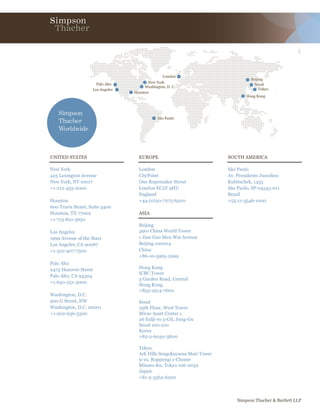
UNITED STATES
New York
425 Lexington Avenue
New York, NY 10017
+1-212-455-2000
Houston
600 Travis Street, Suite 5400
Houston, TX 77002
+1-713-821-5650
Los Angeles
1999 Avenue of the Stars
Los Angeles, CA 90067
+1-310-407-7500
Palo Alto
2475 Hanover Street
Palo Alto, CA 94304
+1-650-251-5000
Washington, D.C.
900 G Street, NW
Washington, D.C. 20001
+1-202-636-5500
EUROPE
London
CityPoint
One Ropemaker Street
London EC2Y 9HU
England
+44-(0)20-7275-6500
ASIA
Beijing
3901 China World Tower
1 Jian Guo Men Wai Avenue
Beijing 100004
China
+86-10-5965-2999
Hong Kong
ICBC Tower
3 Garden Road, Central
Hong Kong
+852-2514-7600
Seoul
25th Floor, West Tower
Mirae Asset Center 1
26 Eulji-ro 5-Gil, Jung-Gu
Seoul 100-210
Korea
+82-2-6030-3800
Tokyo
Ark Hills Sengokuyama Mori Tower
9-10, Roppongi 1-Chome
Minato-Ku, Tokyo 106-0032
Japan
+81-3-5562-6200
SOUTH AMERICA
São Paulo
Av. Presidente Juscelino
Kubitschek, 1455
São Paulo, SP 04543-011
Brazil
+55-11-3546-1000

Assessment iran

  • 1.
    Simpson Thacher &Bartlett LLP Memorandum Is Iran Open for Business? Most “Secondary Sanctions” Lifted but the Situation Remains Largely Unchanged for U.S. Persons January 19, 2016 Overview In a move that opens the door for non-U.S. companies to engage in transactions with or in Iran, on January 16, 2016, the U.S. scaled back economic sanctions against Iran. As a result: 1. Non-U.S. persons, including non-U.S. entities, may now, with limited exceptions discussed below, do business with or in Iran without risk of sanction. 2. Foreign subsidiaries of a U.S. parent company are also allowed, with some exceptions, to do business in or with Iran without violating economic sanctions. 3. However, U.S. persons remain largely prohibited from doing business in or with Iran because the bulk of the U.S. trade embargo of Iran remains in place for U.S. persons. The E.U. and U.N. also significantly pared back their Iranian sanctions regimes. Combined, these changes allow non-U.S. persons to engage in most dealings with Iran without implicating U.S., E.U. or U.N. sanctions. Nevertheless, U.S. persons largely remain barred from transacting in or with Iran. Implementation Day On January 16, the International Atomic Energy Agency (“IAEA”) certified that Iran had achieved key milestones regarding its nuclear program as set forth under the Joint Comprehensive Plan of Action (“JCPOA”) entered into between the P5+1 (the United States, China, France, Russia, the United Kingdom and Germany), the E.U. and Iran in July of 2015. The verification by the IAEA gave rise to “Implementation Day,” which automatically triggered relaxation of certain sanctions against Iran by the U.S., E.U. and U.N.
  • 2.
    2Memorandum – January19, 2016 Simpson Thacher & Bartlett LLP Lifting of U.S. Secondary Sanctions Targeting Iran The relaxation of U.S. economic sanctions against Iran is, with a few exceptions, limited to non-U.S. persons. Before this change, non-U.S. persons that did business in or with Iran risked being targeted by so-called “secondary sanctions,” which could be applied by the U.S. Government to any person or entity, even if there was no U.S. nexus. Imposition of secondary sanctions could previously have barred non-U.S. persons from doing business in or with the U.S., or resulted in additional sanctions. Now, most secondary sanctions that previously applied to non-U.S. persons have been lifted. This means that non-U.S. persons can do business with Iran without risk of sanction, apart from the restrictions set forth below. Certain secondary sanctions remain. Non-U.S. persons still risk secondary sanctions if they engage in dealings with Iranian or Iranian-related persons or entities on the sanctions lists maintained by U.S. Department of Treasury’s Office of Foreign Assets Control (“OFAC”), including the lists of Specially Designated Nationals or Blocked Persons (“SDNs”). This means that the U.S. Government can still impose sanctions on a non-U.S. person that engages in dealings with an Iranian SDN, even if that non-U.S. person has no nexus to the U.S. (no U.S. affiliates, no U.S. employees, no dealings in U.S. goods or services, etc.). To mitigate against this risk, all businesses should continue to screen transactions against OFAC-maintained lists. New SDNs may be added to the lists at any time, as occurred the day following Implementation Day when eleven new SDNs were added for helping to supply Iran’s ballistic missile program. Dealing with Iran- related SDNs still presents risks for non-U.S. persons. Non-U.S. Subsidiaries or Affiliates of U.S. Persons May Now Do Business with Iran The biggest change for U.S. persons is the issuance of General License H by OFAC. General License H authorizes entities that are owned or controlled by U.S. persons or entities, but established or maintained outside of the United States, to do business with Iran, subject to some restrictions discussed further below. General License H also contains specific authorizations that remove practical impediments that would otherwise exist for non-U.S. subsidiaries planning to do business with Iran. Previously, U.S. persons risked being sanctioned for altering policies and procedures of non-U.S. subsidiaries to make it possible for the non-U.S. business to engage in Iran. U.S. persons also risked sanctions if their global corporate technology systems were used in connection with dealings in or with Iran. General License H now specifically allows for these actions by U.S. persons. U.S. persons cannot participate in or assist or facilitate dealings by subsidiaries and affiliates with Iran. Despite the breadth of General License H, some restrictions remain in place for U.S.-owned or -controlled businesses. In dealing with Iran or its citizens, non-U.S. entities owned or controlled by U.S. entities still may not, among other things, export or re-export U.S. goods, services or technology to Iran; transfer funds to,
  • 3.
    3Memorandum – January19, 2016 Simpson Thacher & Bartlett LLP from or through a U.S. depository institution or securities broker or dealer; or transact with those on OFAC’s lists of SDNs or FSEs. Little Changes for U.S. Persons and Entities For U.S. persons, much remains the same. The broad embargo prohibiting U.S. persons from trading with Iran remains in place. Implementation Day brought two limited benefits to U.S. persons. First, OFAC issued general licenses that authorize the importation of Iranian-origin carpets and certain foodstuffs (such as caviar and pistachios) into the U.S. Second, OFAC issued a statement of favorable licensing policy pursuant to which OFAC will generally authorize transactions for the sale of commercial passenger aircraft and related parts and services to Iran. Transactions ordinarily incident to these and other licensed transactions are also allowable, including incident financial transactions. Notably, reporting obligations of issuers under Section 13(r) of the Exchange Act remain unchanged, and US issuers must still publicly disclose a broad range of Iran-related dealings if engaged in by a US issuer or any of its affiliates. Lifting of E.U. and U.N. Sanctions E.U. and U.N. sanctions targeting Iran were largely lifted for many sectors of the economy, including finance, banking, shipping, energy and insurance. Most business activities with Iran are allowed to resume with relatively little restriction by E.U. or U.N. sanctions. However, certain proliferation-related E.U. sanctions remain in place, as do certain E.U. restrictive measures related to the human rights situation in Iran and support for terrorism. Caveat The JCPOA contains “snap-backs” which could cause the automatic re-imposition of sanctions if Iran fails to continue to meet its obligations under the JCPOA. The U.S. has advised that a snap-back may occur at any time should a dispute arise under the JCPOA, and that such a snap-back would not include exceptions for pre-existing contracts. For U.S. persons and entities, the situation is likely to remain the same until “Transition Day,” which may not come until 2023.
  • 4.
    4Memorandum – January19, 2016 Simpson Thacher & Bartlett LLP The contents of this publication are for informational purposes only. Neither this publication nor the lawyers who authored it are rendering legal or other professional advice or opinions on specific facts or matters, nor does the distribution of this publication to any person constitute the establishment of an attorney-client relationship. Simpson Thacher & Bartlett LLP assumes no liability in connection with the use of this publication. Please contact your relationship partner if we can be of assistance regarding these important developments. The names and office locations of all of our partners, as well as our recent memoranda, can be obtained from our website, www.simpsonthacher.com. For further information, please contact one of the following members of the Firm’s Litigation Department. George S. Wang +1-212-455-2228 gwang@stblaw.com Jeffrey H. Knox +1-202-636-5532 jeffrey.knox@stblaw.com Abram J. Ellis +1-202-636-5579 aellis@stblaw.com Peter H. Bresnan +1-202-636-5569 pbresnan@stblaw.com Alexis S. Coll-Very +1-650-251-5201 acoll-very@stblaw.com Nicholas S. Goldin +1-212-455-3685 ngoldin@stblaw.com Joshua A. Levine +1-212-455-7694 jlevine@stblaw.com Cheryl J. Scarboro +1-202-636-5529 cscarboro@stblaw.com Mark J. Stein +1-212-455-2310 mstein@stblaw.com
  • 5.
    5Memorandum – January19, 2016 Simpson Thacher & Bartlett LLP UNITED STATES New York 425 Lexington Avenue New York, NY 10017 +1-212-455-2000 Houston 600 Travis Street, Suite 5400 Houston, TX 77002 +1-713-821-5650 Los Angeles 1999 Avenue of the Stars Los Angeles, CA 90067 +1-310-407-7500 Palo Alto 2475 Hanover Street Palo Alto, CA 94304 +1-650-251-5000 Washington, D.C. 900 G Street, NW Washington, D.C. 20001 +1-202-636-5500 EUROPE London CityPoint One Ropemaker Street London EC2Y 9HU England +44-(0)20-7275-6500 ASIA Beijing 3901 China World Tower 1 Jian Guo Men Wai Avenue Beijing 100004 China +86-10-5965-2999 Hong Kong ICBC Tower 3 Garden Road, Central Hong Kong +852-2514-7600 Seoul 25th Floor, West Tower Mirae Asset Center 1 26 Eulji-ro 5-Gil, Jung-Gu Seoul 100-210 Korea +82-2-6030-3800 Tokyo Ark Hills Sengokuyama Mori Tower 9-10, Roppongi 1-Chome Minato-Ku, Tokyo 106-0032 Japan +81-3-5562-6200 SOUTH AMERICA São Paulo Av. Presidente Juscelino Kubitschek, 1455 São Paulo, SP 04543-011 Brazil +55-11-3546-1000