Applying for
funding and
involving
consumers
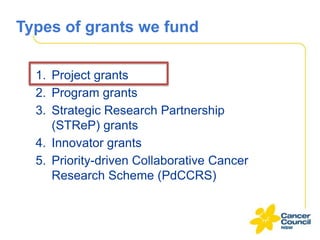
Types of grants we fund
1. Project grants
2. Program grants
3. Strategic Research Partnership
(STReP) grants
4. Innovator grants
5. Priority-driven Collaborative Cancer
Research Scheme (PdCCRS)
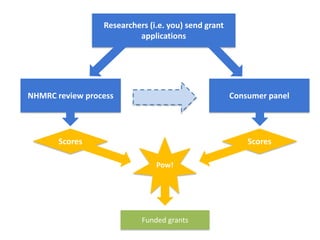
Researchers (i.e. you) send grant
applications

NHMRC review process

Consumer panel

Scores

Scores
Pow!

Funded grants
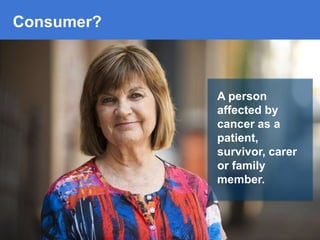
Consumer?

A person
affected by
cancer as a
patient,
survivor, carer
or family
member.
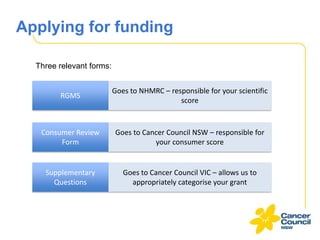
Applying for funding
Three relevant forms:

RGMS

Goes to NHMRC – responsible for your scientific
score

Consumer Review
Form

Goes to Cancer Council NSW – responsible for
your consumer score

Supplementary
Questions

Goes to Cancer Council VIC – allows us to
appropriately categorise your grant
How the consumer panel works
Source: Biblioarchives, Flickr
READ
THE
GUIDELINES
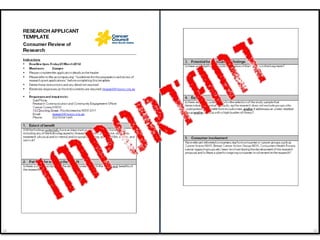
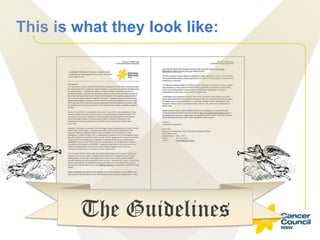
This is what they look like:

The Guidelines
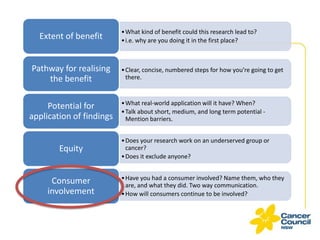
Extent of benefit
Pathway for realising
the benefit
Potential for
application of findings

Equity
Consumer
involvement

• What kind of benefit could this research lead to?
• i.e. why are you doing it in the first place?

• Clear, concise, numbered steps for how you’re going to get
there.

• What real-world application will it have? When?
• Talk about short, medium, and long term potential Mention barriers.
• Does your research work on an underserved group or
cancer?
• Does it exclude anyone?
• Have you had a consumer involved? Name them, who they
are, and what they did. Two way communication.
• How will consumers continue to be involved?
Consumer involvement:
“Conducting research that
is with the community
rather than to or for the
community.”
1978
Major government frameworks
'If you don’t involve consumers,
you don’t understand your
business. Whatever the type of
business, it’s got to have
relevance to end users. This is
particularly true in cancer.”
Professor Jim Bishop, Executive Director, Victorian
Comprehensive Cancer Centre
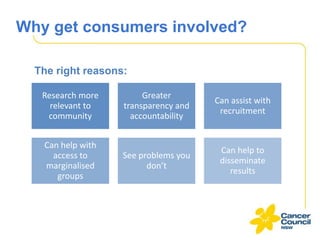
Why get consumers involved?
The right reasons:
Research more
relevant to
community

Greater
transparency and
accountability

Can assist with
recruitment

Can help with
access to
marginalised
groups

See problems you
don’t

Can help to
disseminate
results
The proof is in the publications
•

“Sufficient evidence is available to show that the involvement of
consumers in all aspects of research benefits both researchers and
consumers and that such endeavours are achievable.”
•

•

Tallon, D., Chard, J., BMJ (2000), 320(7231):380

“There was a strong consensus from the participants across the
Programme that the involvement of service users and carers had
brought tangible benefits to the research, on both the processes and
outcomes of the studies. Most participants also cited personal benefits
especially the learning that had taken place as a result of the
involvement.”
•

Wyatt, K., et al Family Practice,(2008), 25(3): 154-161
The other reason:
We won’t fund you if you don’t.

Image source: Diego3336, Flickr
Organisations with a strong
consumer presence
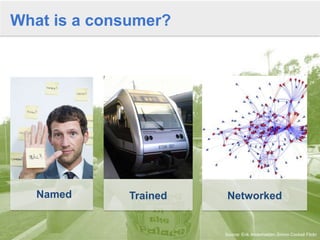
What is a consumer?

Named

Trained

Networked

Source: Erik Abderhalden,Simon Cockell Flickr
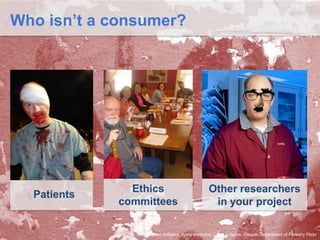
Who isn’t a consumer?

Patients

Ethics
committees

Other researchers
in your project

Source: Gail Williams, Army Medicine, Crack a Spine, Oregon Department of Forestry Flickr
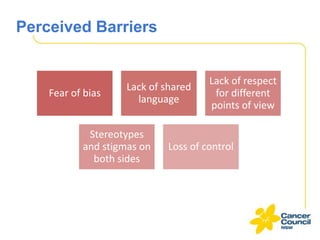
Perceived Barriers

Fear of bias

Lack of shared
language

Stereotypes
and stigmas on
both sides

Lack of respect
for different
points of view

Loss of control
“Don’t underestimate the
capacity of people to get
involved with these complex
issues and do them well.”
Prof Fiona Stanley, AC, on involving
consumers.
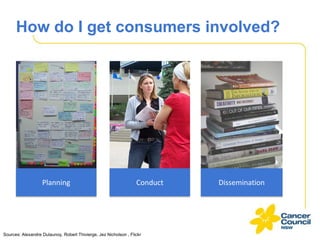
How do I get consumers involved?

Planning

Conduct

Sources: Alexandre Dulaunoy, Robert Thivierge, Jez Nicholson , Flickr

Dissemination
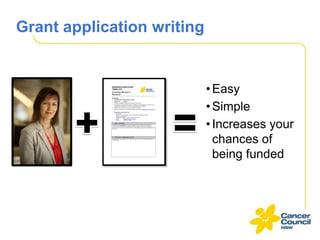
Grant application writing

• Easy
• Simple
• Increases your
chances of
being funded
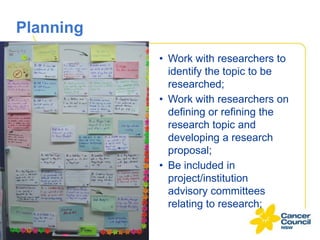
Planning
• Work with researchers to
identify the topic to be
researched;
• Work with researchers on
defining or refining the
research topic and
developing a research
proposal;
• Be included in
project/institution
advisory committees
relating to research;
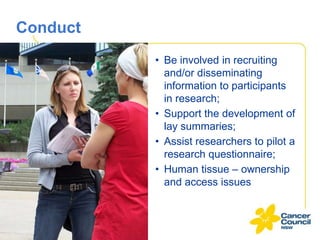
Conduct
• Be involved in recruiting
and/or disseminating
information to participants
in research;
• Support the development of
lay summaries;
• Assist researchers to pilot a
research questionnaire;
• Human tissue – ownership
and access issues
Dissemination
• Produce newsletters for
members of their
organisation that chart the
progress of research;
• Contribute to conferences
and journal articles,
especially for lay
audiences.
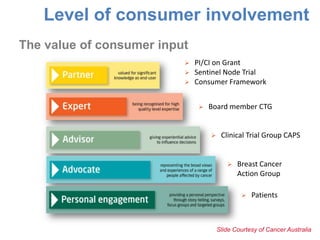
Level of consumer involvement
The value of consumer input
PI/CI on Grant
 Sentinel Node Trial
 Consumer Framework




Board member CTG



Clinical Trial Group CAPS



Breast Cancer
Action Group


Patients

Slide Courtesy of Cancer Australia
“Although “pure” research… may
involve more scientific expertise in its
execution, consumers still have the
right to give their informed input to
strategic priority setting, direction and
design.”
NHMRC Statement on Consumer and Community Participation
in Health and Medical Research
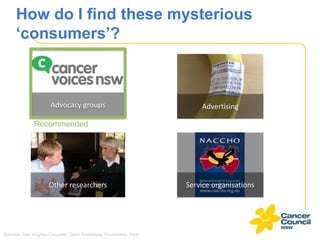
How do I find these mysterious
‘consumers’?

Advocacy groups

Advertising

Recommended

Other researchers

Sources: Tom Hughes-Croucher, Open Knowledge Foundation, Flickr

Service organisations
Don’t wait to get consumers
involved.
Additional training
- Consumer workshop (paediatric research)
- 18 March 2014, 9:30 to 2:30 Doreen Dew Lecture theatre, level 4,
Children’s Hospital at Westmead.
- Basic research training for consumers.

- Involving consumers in research for
clinicians/researchers
- 19 March 2014, Doreen Dew Lecture theatre, level 4, Children’s
Hospital at Westmead.
- 1 day workshop on how to involve consumers in your research,
strong emphasis on implementation.
- No charge – contact info@bt4k.com.au to register.
READ THE
GUIDELINES
That’s it!
Image Source: Raphaël Fauveau (flickr)

Applying for funding and involving consumers

  • 1.
  • 3.
    Types of grantswe fund 1. Project grants 2. Program grants 3. Strategic Research Partnership (STReP) grants 4. Innovator grants 5. Priority-driven Collaborative Cancer Research Scheme (PdCCRS)
  • 4.
    Researchers (i.e. you)send grant applications NHMRC review process Consumer panel Scores Scores Pow! Funded grants
  • 5.
    Consumer? A person affected by canceras a patient, survivor, carer or family member.
  • 6.
    Applying for funding Threerelevant forms: RGMS Goes to NHMRC – responsible for your scientific score Consumer Review Form Goes to Cancer Council NSW – responsible for your consumer score Supplementary Questions Goes to Cancer Council VIC – allows us to appropriately categorise your grant
  • 7.
    How the consumerpanel works Source: Biblioarchives, Flickr
  • 9.
  • 10.
    This is whatthey look like: The Guidelines
  • 11.
    Extent of benefit Pathwayfor realising the benefit Potential for application of findings Equity Consumer involvement • What kind of benefit could this research lead to? • i.e. why are you doing it in the first place? • Clear, concise, numbered steps for how you’re going to get there. • What real-world application will it have? When? • Talk about short, medium, and long term potential Mention barriers. • Does your research work on an underserved group or cancer? • Does it exclude anyone? • Have you had a consumer involved? Name them, who they are, and what they did. Two way communication. • How will consumers continue to be involved?
  • 12.
    Consumer involvement: “Conducting researchthat is with the community rather than to or for the community.”
  • 13.
  • 14.
  • 15.
    'If you don’tinvolve consumers, you don’t understand your business. Whatever the type of business, it’s got to have relevance to end users. This is particularly true in cancer.” Professor Jim Bishop, Executive Director, Victorian Comprehensive Cancer Centre
  • 16.
    Why get consumersinvolved? The right reasons: Research more relevant to community Greater transparency and accountability Can assist with recruitment Can help with access to marginalised groups See problems you don’t Can help to disseminate results
  • 17.
    The proof isin the publications • “Sufficient evidence is available to show that the involvement of consumers in all aspects of research benefits both researchers and consumers and that such endeavours are achievable.” • • Tallon, D., Chard, J., BMJ (2000), 320(7231):380 “There was a strong consensus from the participants across the Programme that the involvement of service users and carers had brought tangible benefits to the research, on both the processes and outcomes of the studies. Most participants also cited personal benefits especially the learning that had taken place as a result of the involvement.” • Wyatt, K., et al Family Practice,(2008), 25(3): 154-161
  • 18.
    The other reason: Wewon’t fund you if you don’t. Image source: Diego3336, Flickr
  • 19.
    Organisations with astrong consumer presence
  • 20.
    What is aconsumer? Named Trained Networked Source: Erik Abderhalden,Simon Cockell Flickr
  • 21.
    Who isn’t aconsumer? Patients Ethics committees Other researchers in your project Source: Gail Williams, Army Medicine, Crack a Spine, Oregon Department of Forestry Flickr
  • 22.
    Perceived Barriers Fear ofbias Lack of shared language Stereotypes and stigmas on both sides Lack of respect for different points of view Loss of control
  • 23.
    “Don’t underestimate the capacityof people to get involved with these complex issues and do them well.” Prof Fiona Stanley, AC, on involving consumers.
  • 24.
    How do Iget consumers involved? Planning Conduct Sources: Alexandre Dulaunoy, Robert Thivierge, Jez Nicholson , Flickr Dissemination
  • 25.
    Grant application writing •Easy • Simple • Increases your chances of being funded
  • 26.
    Planning • Work withresearchers to identify the topic to be researched; • Work with researchers on defining or refining the research topic and developing a research proposal; • Be included in project/institution advisory committees relating to research;
  • 27.
    Conduct • Be involvedin recruiting and/or disseminating information to participants in research; • Support the development of lay summaries; • Assist researchers to pilot a research questionnaire; • Human tissue – ownership and access issues
  • 28.
    Dissemination • Produce newslettersfor members of their organisation that chart the progress of research; • Contribute to conferences and journal articles, especially for lay audiences.
  • 29.
    Level of consumerinvolvement The value of consumer input PI/CI on Grant  Sentinel Node Trial  Consumer Framework   Board member CTG  Clinical Trial Group CAPS  Breast Cancer Action Group  Patients Slide Courtesy of Cancer Australia
  • 30.
    “Although “pure” research…may involve more scientific expertise in its execution, consumers still have the right to give their informed input to strategic priority setting, direction and design.” NHMRC Statement on Consumer and Community Participation in Health and Medical Research
  • 31.
    How do Ifind these mysterious ‘consumers’? Advocacy groups Advertising Recommended Other researchers Sources: Tom Hughes-Croucher, Open Knowledge Foundation, Flickr Service organisations
  • 32.
    Don’t wait toget consumers involved.
  • 33.
    Additional training - Consumerworkshop (paediatric research) - 18 March 2014, 9:30 to 2:30 Doreen Dew Lecture theatre, level 4, Children’s Hospital at Westmead. - Basic research training for consumers. - Involving consumers in research for clinicians/researchers - 19 March 2014, Doreen Dew Lecture theatre, level 4, Children’s Hospital at Westmead. - 1 day workshop on how to involve consumers in your research, strong emphasis on implementation. - No charge – contact info@bt4k.com.au to register.
  • 34.
    READ THE GUIDELINES That’s it! ImageSource: Raphaël Fauveau (flickr)

Editor's Notes

  • #2 START WITH QUESTION: - Why is everyone here? Who here has applied for Cancer Council funding? Who hasn’t? Who is intending to? Who doesn’t know why they’re here? 2 things:Session will be ~45 mins of talking, followed by question time, so store them upIt’s being recorded, so don’t worry if you fall asleep. If you do, I will give your neighbour this permanent marker.
  • #3 Community funded
  • #5 Must score highly with NHMRC to get shortlistedTalk about 3rd ranked who got booted out of funding because of poor consumer application.Take it seriously!
  • #6 Interesting to note that many consumers don’t like being called ‘consumers’ – nonetheless, that’s what they’re called, as it’s the only term that encompasses everyone.Important point – CAPABLE CONSUMERS: ‘Capable Consumers’ refers to consumers who have developed knowledge from their experience (i.e. more than the facts of what happened – wider issues) and are able to represent the views of others
  • #7 Opens same day as NHMRCNHMRC process etc, three documentsSupplementary questions – define how you will change your project based on our lower budget.
  • #8 Panel of 10-12 consumers, trained in reading research grants, who determine the value of your research to the cancer community.
  • #9 The two page consumer form is, per page, the most important part of your application.THIS IS ALL THE CONSUMERS GET.It determines up to 50% of your score.Don’t change font size, don’t move the margins. The consumers aren’t impressed, and often the ones with the most egregious crimes to formatting are the ones with the most waffle.Make it clear, make it concise
  • #10 I cannot, and will not, go through each of the questions in detail.
  • #11 Contain full written examples of good answers to each question
  • #12 CRITERIA not questionsEquity – middle scores if not inequitableEXAMPLE – Equity of access – inner city sydney is only place the service is set up.Highly regarded if consumer is networked into an existing cancer consumer group, and TRAINED. TWO WAY COMMUNICATIONAI especially highly regarded.Based on BUDGET
  • #14 We go back to the World Health Organisation declarations of 1978, 1986 and 1997, where consumer participation became a right, moving the view of patients as passive recipients of health care to one in which they have a key role to play in health services, health policy and health research.In the 1986 WHO Ottawa Charter on Health Promotion from the World Health Organization, consumer empowerment in health care was seen as a central element of achieving improved health and well being in a society.NHMRC encouraged for over a decadeCancer Australia however has very much mandated consumer involvement. It has a weighting of 10% in the Priority Driven Collaborative Cancer Research SchemeFirst year that you are NOT ELIGIBLE for CA funding if you don’t have a consumer involved.
  • #15 Dry as the desert and just as fun
  • #17 More recently, Karen Innes working for the National Cancer Research Institute in the UK, mapped consumer involvement in cancer research. What she found was that :Consumers were actively involved in all areas of the cancer research cycleAs well as providing a consumer perspective they were involved in developing and leading researchThat they bring a wide range of skills to bear in addition to their experience of cancer.The consistent message is that consumers bring the perspective of their cancer experience, something that is unique to them, a perspective that you cannot have unless you have been involved.But they also bring a wealth of diversity, knowledge and capabilities to bear. This may be professional skills, it may be strategic advice, it may be a marketing perspective, or it may be the person who drives a truck for the local council but is well connected with the indigenous community.EXAMPLE: Canadian lab working on bipolar – consumer was a web developer, did all the web stuff and dissemination.
  • #19 Why do WE do this?Because every dollar that we give you comes from the public – no government funding. And we feel that the community has a right to determine where their money goes.
  • #20 Cancer Council NSW (up to 50%)Cancer Australia (60% of score by panel with a consumer on it)Breast cancer foundationLeukaemia foundationProstate Cancer Foundation of Australia
  • #22 We have had some fantastic attempts:TaxpayersEthics committeesFatherPatients who are participating in a research study/ trial but who are not providing direct feedback into the design or conduct of the research;A layperson/community representative reviewing a research grant as member of an ethics committee and who has no further input into the conduct of research or communication of the research;Research colleagues or individuals with a specific research role in the project;
  • #23 Researchers fear that consumers will bring a biased view.Researchers are reluctant to share power and knowledge.Language is not shared.There can be a lack of respect for different points of view.There can be stereotypes and stigmas on both sides.Consumers and researchers may have different agendas.There may not be funding available for research in areas prioritised by consumers and the community.Consumers may be reluctant to participate because they do not value their expertise and feel that researchers have all the expertise, or because they do not trust researchers.Fear consumers are going to step in and take over their entire agenda. They won’t. Relax.
  • #25 Consumers can be involved in the planning, conduct, publication and translation of research.A “reasonable and appropriate level of consumer involvement” may vary, depending on the nature of the research being undertaken, but could include almost any kind of interaction between consumers and researchers.Before, during and after.
  • #26 Get them to help write your grant application!This is more or less the only ‘universal’ way to get consumers involved – everyone can do it.
  • #27 Advisory committee not enough!
  • #28 Human tissue according to Cancer Australia – tech for collecting is outstripping our planning,
  • #30 We suggest advocate or advisor for our purposes.The first is the Sentinel Node Trial, which many of you will be familiar with. This started with a meeting of consumers concerned about lymphadema who wanted further research into the sentinel node biopsy. Researchers and consumer worked together to design the trial, they not only uses ECOG QoL instrument but designed a study specific questionnaire that was piloted by the BCNA.
  • #31 However, one of the most successful and integrated group of advisors is the group of men who have been diagnosed with prostate cancer who work with Professor Gail Risbridger’s group at Monash. This group reviews all their research grants prior to submission. Where appropriate they are an investigator on the grant. They often review drafts of papers. They participate in all team meetings. When a paper is published or a grant received they are invited to a morning tea with all of the research staff. They are welcome to come in and visit the laboratories. They are valued advisors to the research.
  • #32 direct advertisement; targeting specific consumer organisations: eg; general cancer advocacy organisations such as Cancer Voices NSW; specific cancer organisations such as those in breast cancer or leukaemia; service organisations such as Rotary or National Aboriginal Community Controlled Health Organisation for Indigenous organisations for consumer representatives etc.Are they representing themselves or their organisation?Cancervoices – if you haven’t heard in 2 weeks, email them.
  • #33 Applications open soon, and it takes time to bring in, set up and get a consumer involved.
  • #35 Subliminal messaging