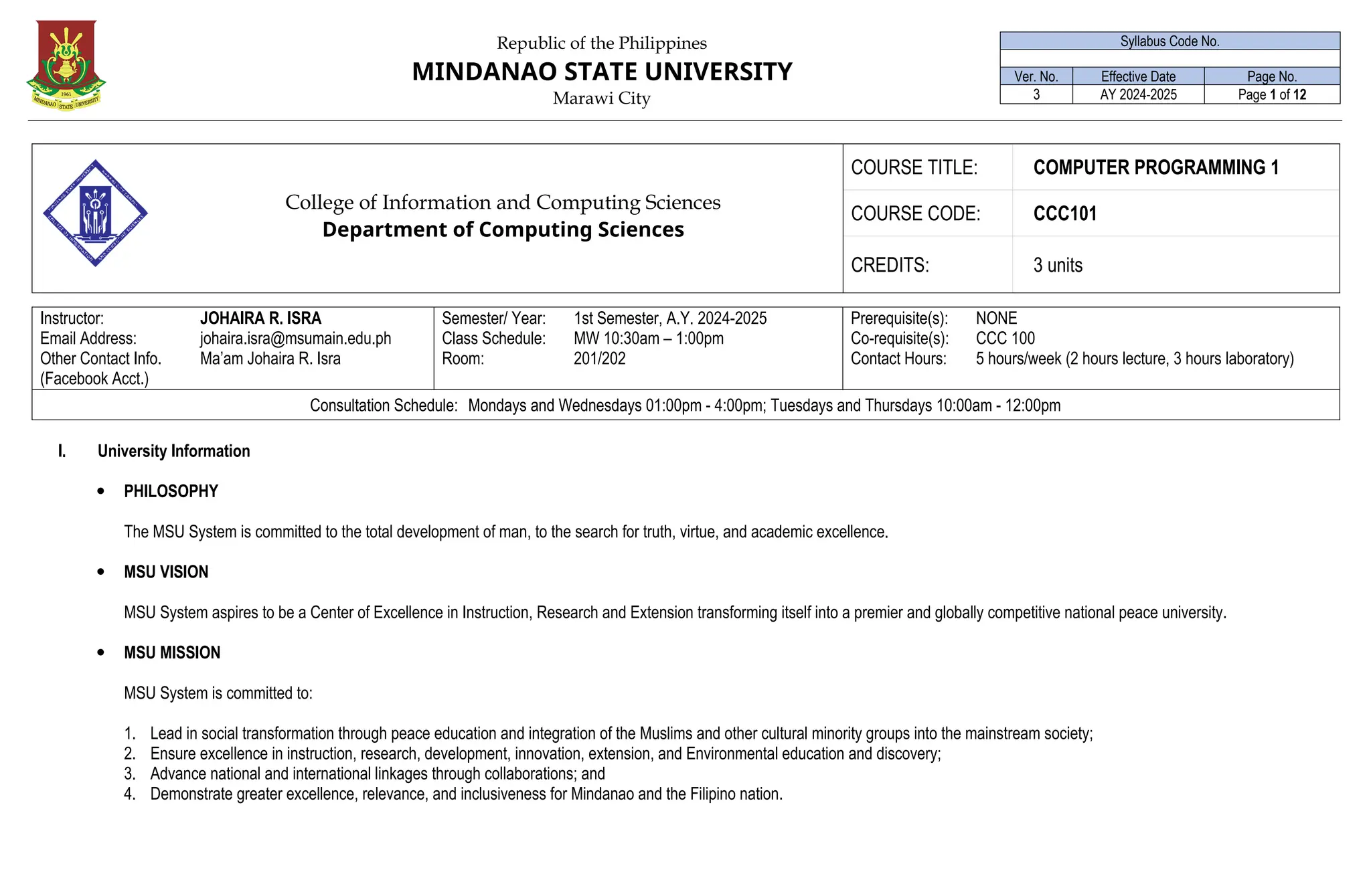
Republic of thePhilippines
MINDANAO STATE UNIVERSITY
Marawi City
Syllabus Code No.
Ver. No. Effective Date Page No.
3 AY 2024-2025 Page 1 of 12
College of Information and Computing Sciences
Department of Computing Sciences
COURSE TITLE: COMPUTER PROGRAMMING 1
COURSE CODE: CCC101
CREDITS: 3 units
Instructor: JOHAIRA R. ISRA Semester/ Year: 1st Semester, A.Y. 2024-2025 Prerequisite(s): NONE
Email Address: johaira.isra@msumain.edu.ph Class Schedule: MW 10:30am – 1:00pm Co-requisite(s): CCC 100
Other Contact Info.
(Facebook Acct.)
Ma’am Johaira R. Isra Room: 201/202 Contact Hours: 5 hours/week (2 hours lecture, 3 hours laboratory)
Consultation Schedule: Mondays and Wednesdays 01:00pm - 4:00pm; Tuesdays and Thursdays 10:00am - 12:00pm
I. University Information
PHILOSOPHY
The MSU System is committed to the total development of man, to the search for truth, virtue, and academic excellence.
MSU VISION
MSU System aspires to be a Center of Excellence in Instruction, Research and Extension transforming itself into a premier and globally competitive national peace university.
MSU MISSION
MSU System is committed to:
1. Lead in social transformation through peace education and integration of the Muslims and other cultural minority groups into the mainstream society;
2. Ensure excellence in instruction, research, development, innovation, extension, and Environmental education and discovery;
3. Advance national and international linkages through collaborations; and
4. Demonstrate greater excellence, relevance, and inclusiveness for Mindanao and the Filipino nation.
2.
Republic of thePhilippines
MINDANAO STATE UNIVERSITY
Marawi City
Syllabus Code No.
Ver. No. Effective Date Page No.
3 AY 2024-2025 Page 2 of 12
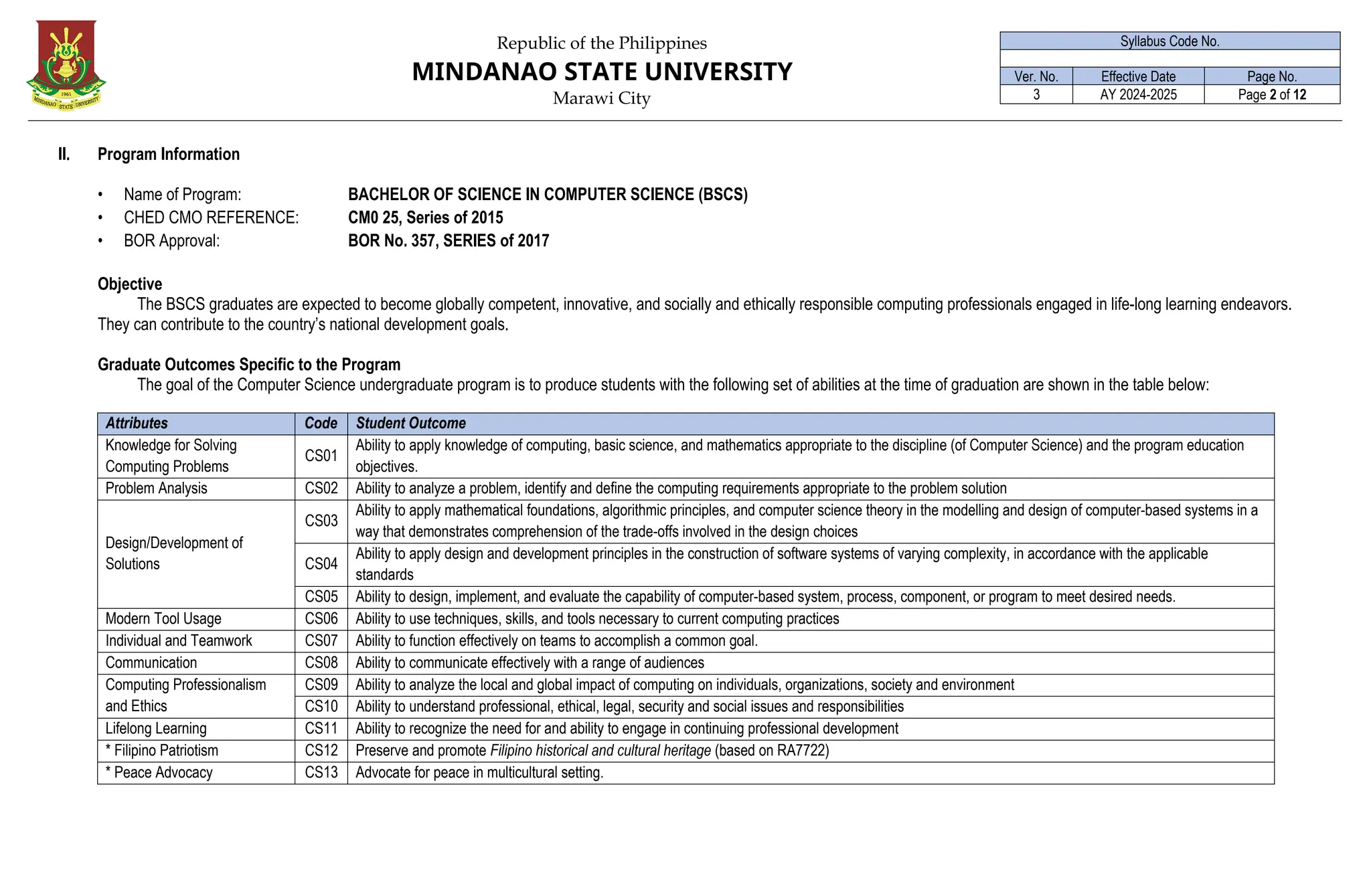
II. Program Information
• Name of Program: BACHELOR OF SCIENCE IN COMPUTER SCIENCE (BSCS)
• CHED CMO REFERENCE: CM0 25, Series of 2015
• BOR Approval: BOR No. 357, SERIES of 2017
Objective
The BSCS graduates are expected to become globally competent, innovative, and socially and ethically responsible computing professionals engaged in life-long learning endeavors.
They can contribute to the country’s national development goals.
Graduate Outcomes Specific to the Program
The goal of the Computer Science undergraduate program is to produce students with the following set of abilities at the time of graduation are shown in the table below:
Attributes Code Student Outcome
Knowledge for Solving
Computing Problems
CS01
Ability to apply knowledge of computing, basic science, and mathematics appropriate to the discipline (of Computer Science) and the program education
objectives.
Problem Analysis CS02 Ability to analyze a problem, identify and define the computing requirements appropriate to the problem solution
Design/Development of
Solutions
CS03
Ability to apply mathematical foundations, algorithmic principles, and computer science theory in the modelling and design of computer-based systems in a
way that demonstrates comprehension of the trade-offs involved in the design choices
CS04
Ability to apply design and development principles in the construction of software systems of varying complexity, in accordance with the applicable
standards
CS05 Ability to design, implement, and evaluate the capability of computer-based system, process, component, or program to meet desired needs.
Modern Tool Usage CS06 Ability to use techniques, skills, and tools necessary to current computing practices
Individual and Teamwork CS07 Ability to function effectively on teams to accomplish a common goal.
Communication CS08 Ability to communicate effectively with a range of audiences
Computing Professionalism
and Ethics
CS09 Ability to analyze the local and global impact of computing on individuals, organizations, society and environment
CS10 Ability to understand professional, ethical, legal, security and social issues and responsibilities
Lifelong Learning CS11 Ability to recognize the need for and ability to engage in continuing professional development
* Filipino Patriotism CS12 Preserve and promote Filipino historical and cultural heritage (based on RA7722)
* Peace Advocacy CS13 Advocate for peace in multicultural setting.
3.
Republic of thePhilippines
MINDANAO STATE UNIVERSITY
Marawi City
Syllabus Code No.
Ver. No. Effective Date Page No.
3 AY 2024-2025 Page 3 of 12
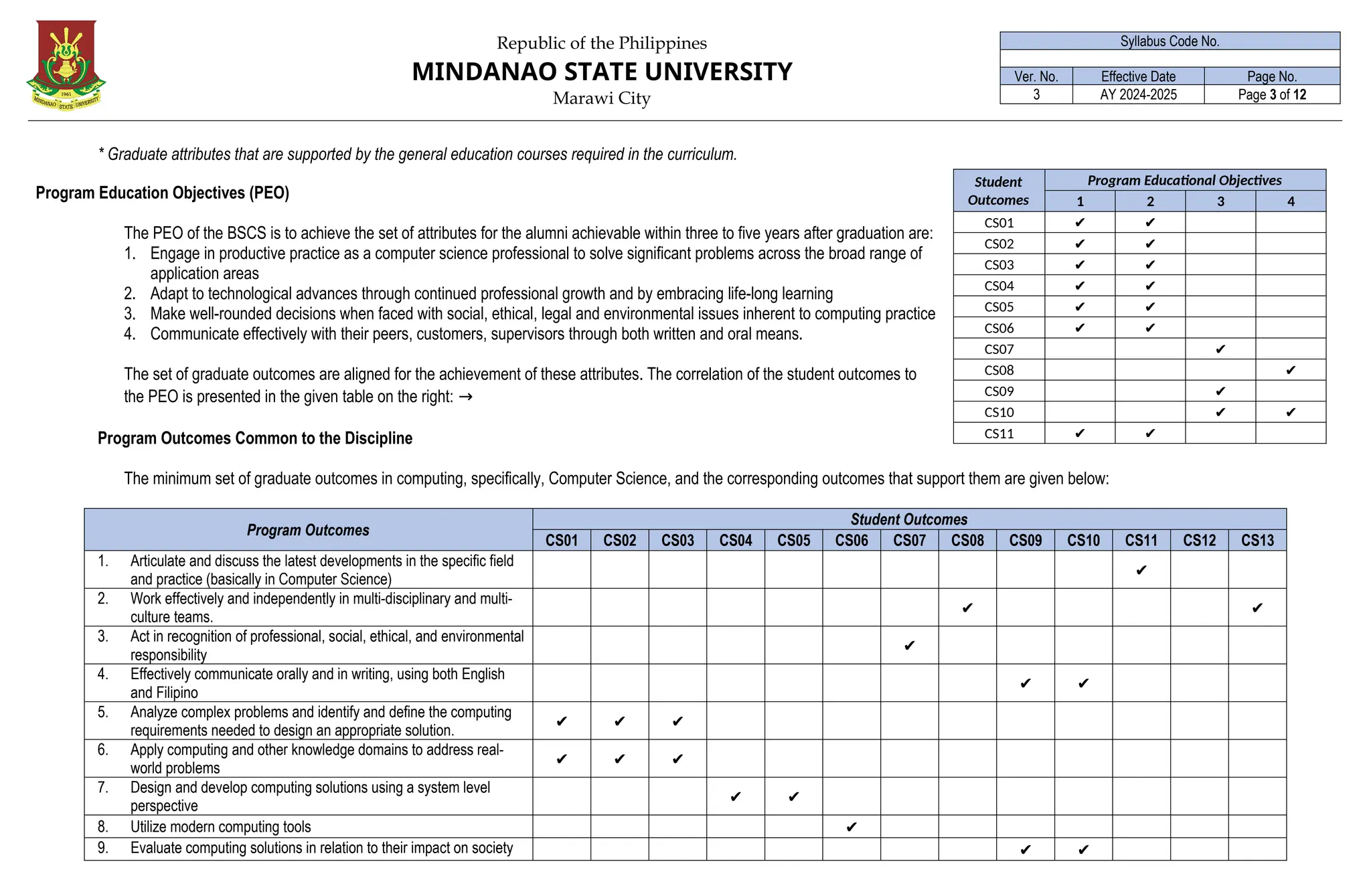
* Graduate attributes that are supported by the general education courses required in the curriculum.
Program Education Objectives (PEO)
The PEO of the BSCS is to achieve the set of attributes for the alumni achievable within three to five years after graduation are:
1. Engage in productive practice as a computer science professional to solve significant problems across the broad range of
application areas
2. Adapt to technological advances through continued professional growth and by embracing life-long learning
3. Make well-rounded decisions when faced with social, ethical, legal and environmental issues inherent to computing practice
4. Communicate effectively with their peers, customers, supervisors through both written and oral means.
The set of graduate outcomes are aligned for the achievement of these attributes. The correlation of the student outcomes to
the PEO is presented in the given table on the right: →
Program Outcomes Common to the Discipline
The minimum set of graduate outcomes in computing, specifically, Computer Science, and the corresponding outcomes that support them are given below:
Program Outcomes
Student Outcomes
CS01 CS02 CS03 CS04 CS05 CS06 CS07 CS08 CS09 CS10 CS11 CS12 CS13
1. Articulate and discuss the latest developments in the specific field
and practice (basically in Computer Science)
✔️
2. Work effectively and independently in multi-disciplinary and multi-
culture teams.
✔️ ✔️
3. Act in recognition of professional, social, ethical, and environmental
responsibility
✔️
4. Effectively communicate orally and in writing, using both English
and Filipino
✔️ ✔️
5. Analyze complex problems and identify and define the computing
requirements needed to design an appropriate solution.
✔️ ✔️ ✔️
6. Apply computing and other knowledge domains to address real-
world problems
✔️ ✔️ ✔️
7. Design and develop computing solutions using a system level
perspective
✔️ ✔️
8. Utilize modern computing tools ✔️
9. Evaluate computing solutions in relation to their impact on society ✔️ ✔️
Student
Outcomes
Program Educational Objectives
1 2 3 4
CS01 ✔️ ✔️
CS02 ✔️ ✔️
CS03 ✔️ ✔️
CS04 ✔️ ✔️
CS05 ✔️ ✔️
CS06 ✔️ ✔️
CS07 ✔️
CS08 ✔️
CS09 ✔️
CS10 ✔️ ✔️
CS11 ✔️ ✔️
4.
Republic of thePhilippines
MINDANAO STATE UNIVERSITY
Marawi City
Syllabus Code No.
Ver. No. Effective Date Page No.
3 AY 2024-2025 Page 4 of 12
and environment
10. Preserve and promote Filipino historical and cultural heritage
(based on RA 7722)
✔️ ✔️
11. Advocate for peace in multicultural setting ✔️ ✔️
III. Course Description
The course covers the use of C++ programming language to solve problems. The emphasis is to train students to design, implement, test, and debug programs intended to solve computing problems using
fundamental programming constructs.
Rationale:
Fluency in the process of software development is a prerequisite to the study of most computer science. To use computers to solve problems effectively, students must be competent at reading and writing
programs in multiple programming languages. Beyond programming skills, however, they must be able to design and analyze algorithms, select appropriate paradigms, and utilize modern development and
testing tools. This knowledge area brings together those fundamental concepts and skills that are essential to programming practice.
IV. Course Outcomes (COs) and Relationship to the Program Outcomes
The following table shows the Course Outcomes (CO) of this course and the corresponding Program Outcomes (PO) for each CO.
At the end of the course, students should be able to:
Program Outcomes
1 2 3 4 5 6 7 8 9 10 11
Explain the importance of the course in relation to the goals and objectives of the program and the University.
CO1. Apply the basic concept of C++ programming in solving problems. E E E I
CO2. Apply the program development life cycle based on a given specification. E E E I
CO3. Explain the behavior of simple programs involving the fundamental programming constructs. E E E I
*I: Introductory **E: Enabling ***D: Demonstrative
*Introductory [30%, 60%]: The course has introduced fundamental concepts necessary for the GOs.
**Enabling [60%; 85%]: The course has developed partial knowledge, somehow prerequisite, for the GOs.
***Demonstrative [85%, 100%]: The course has developed complete knowledge associated with the GOs.
V. Course Content and Learning Plan
TIMELIN
E
Course
Outcomes
(CO)
TOPICS
LEARNING OUTCOMES
At the end of the unit, the student
must be able to:
DELIVERY MODALITY & SUPPORT TOOLS
ASSESSMENT TASKS &
TOOLS
Synchronous Asynchronous
Week 1 CO1,
CO2
Programming Languages and Problem
Solving
●Computer Program
● describe what is a computer
program
● tell the generation of programming
languages
● discuss the program development
life cycle
● Lectures
● Interactive Discussions
Note: PPT and video clips
may be used for the
lectures and discussion
Learning materials uploaded
in the LMS:
● Textbook Reading on
computer fundamentals
● Watch video lectures
● Quiz: Definition,
identification, and
enumeration on topics
covered.
● Assignment: Write down
lesson takeaways
5.
Republic of thePhilippines
MINDANAO STATE UNIVERSITY
Marawi City
Syllabus Code No.
Ver. No. Effective Date Page No.
3 AY 2024-2025 Page 5 of 12
TIMELIN
E
Course
Outcomes
(CO)
TOPICS
LEARNING OUTCOMES
At the end of the unit, the student
must be able to:
DELIVERY MODALITY & SUPPORT TOOLS ASSESSMENT TASKS &
TOOLS
Synchronous Asynchronous
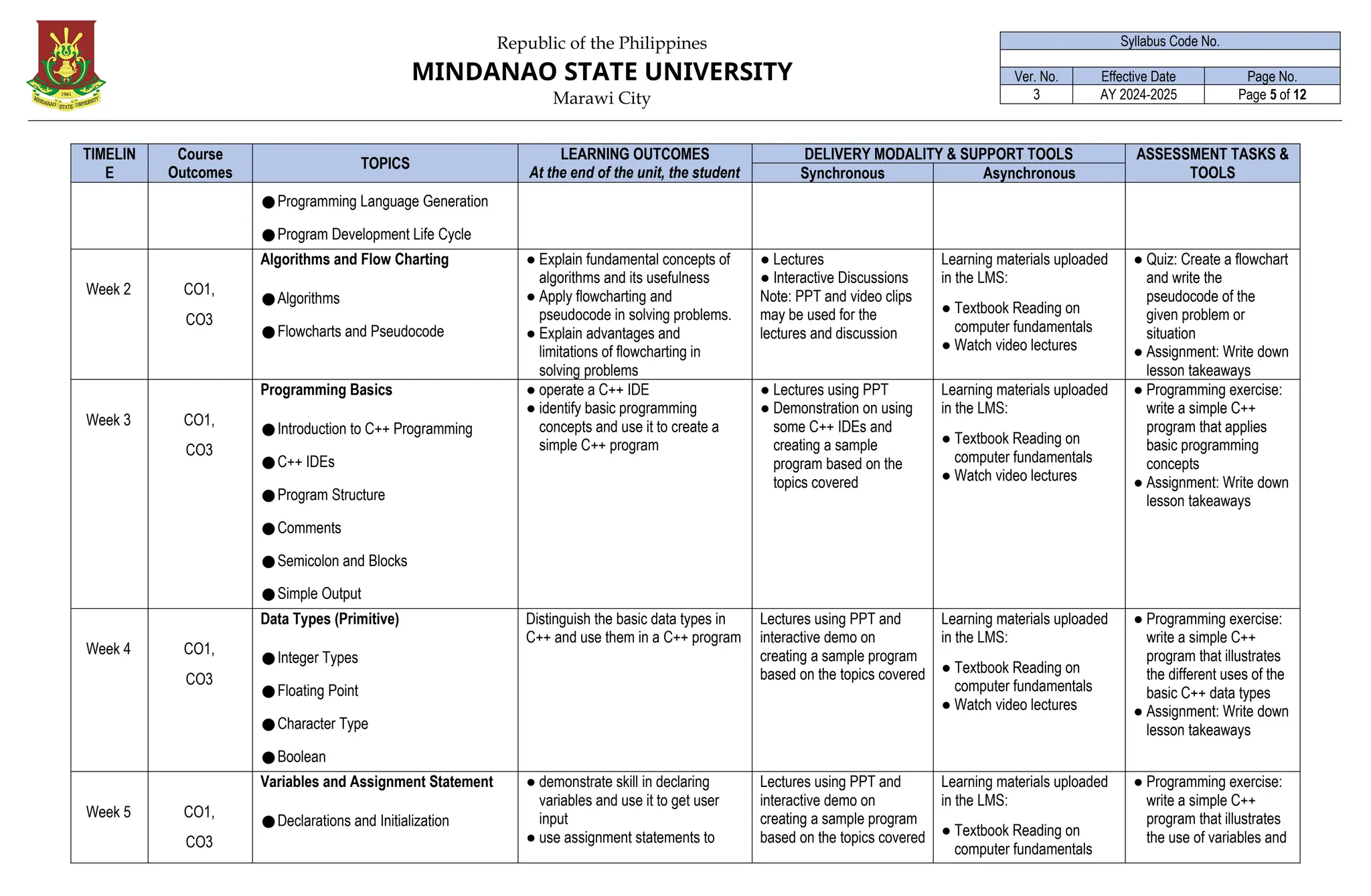
●Programming Language Generation
●Program Development Life Cycle
Week 2 CO1,
CO3
Algorithms and Flow Charting
●Algorithms
●Flowcharts and Pseudocode
● Explain fundamental concepts of
algorithms and its usefulness
● Apply flowcharting and
pseudocode in solving problems.
● Explain advantages and
limitations of flowcharting in
solving problems
● Lectures
● Interactive Discussions
Note: PPT and video clips
may be used for the
lectures and discussion
Learning materials uploaded
in the LMS:
● Textbook Reading on
computer fundamentals
● Watch video lectures
● Quiz: Create a flowchart
and write the
pseudocode of the
given problem or
situation
● Assignment: Write down
lesson takeaways
Week 3 CO1,
CO3
Programming Basics
●Introduction to C++ Programming
●C++ IDEs
●Program Structure
●Comments
●Semicolon and Blocks
●Simple Output
● operate a C++ IDE
● identify basic programming
concepts and use it to create a
simple C++ program
● Lectures using PPT
● Demonstration on using
some C++ IDEs and
creating a sample
program based on the
topics covered
Learning materials uploaded
in the LMS:
● Textbook Reading on
computer fundamentals
● Watch video lectures
● Programming exercise:
write a simple C++
program that applies
basic programming
concepts
● Assignment: Write down
lesson takeaways
Week 4 CO1,
CO3
Data Types (Primitive)
●Integer Types
●Floating Point
●Character Type
●Boolean
Distinguish the basic data types in
C++ and use them in a C++ program
Lectures using PPT and
interactive demo on
creating a sample program
based on the topics covered
Learning materials uploaded
in the LMS:
● Textbook Reading on
computer fundamentals
● Watch video lectures
● Programming exercise:
write a simple C++
program that illustrates
the different uses of the
basic C++ data types
● Assignment: Write down
lesson takeaways
Week 5 CO1,
CO3
Variables and Assignment Statement
●Declarations and Initialization
● demonstrate skill in declaring
variables and use it to get user
input
● use assignment statements to
Lectures using PPT and
interactive demo on
creating a sample program
based on the topics covered
Learning materials uploaded
in the LMS:
● Textbook Reading on
computer fundamentals
● Programming exercise:
write a simple C++
program that illustrates
the use of variables and
6.
Republic of thePhilippines
MINDANAO STATE UNIVERSITY
Marawi City
Syllabus Code No.
Ver. No. Effective Date Page No.
3 AY 2024-2025 Page 6 of 12
TIMELIN
E
Course
Outcomes
(CO)
TOPICS
LEARNING OUTCOMES
At the end of the unit, the student
must be able to:
DELIVERY MODALITY & SUPPORT TOOLS ASSESSMENT TASKS &
TOOLS
Synchronous Asynchronous
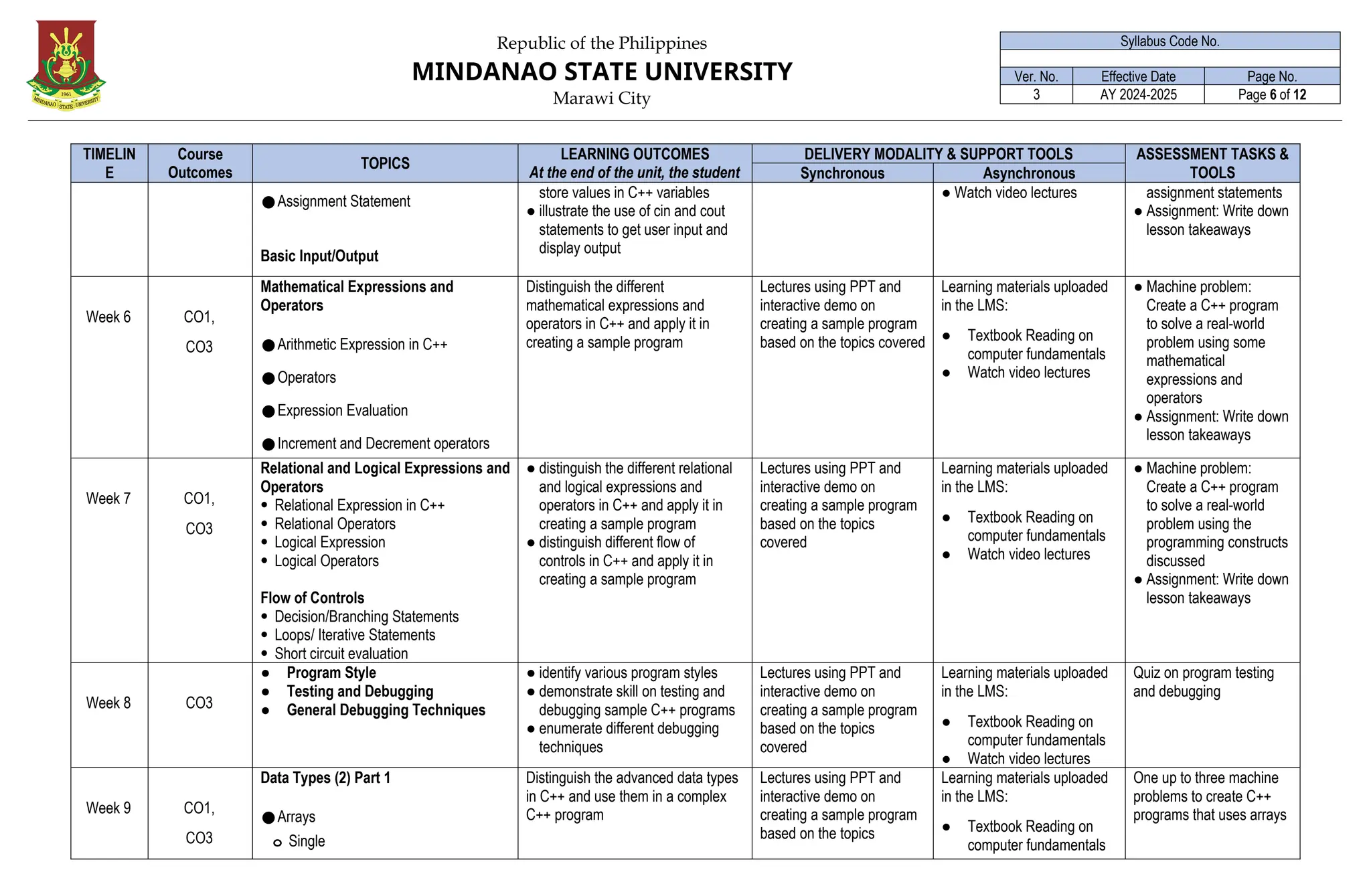
●Assignment Statement
Basic Input/Output
store values in C++ variables
● illustrate the use of cin and cout
statements to get user input and
display output
● Watch video lectures assignment statements
● Assignment: Write down
lesson takeaways
Week 6 CO1,
CO3
Mathematical Expressions and
Operators
●Arithmetic Expression in C++
●Operators
●Expression Evaluation
●Increment and Decrement operators
Distinguish the different
mathematical expressions and
operators in C++ and apply it in
creating a sample program
Lectures using PPT and
interactive demo on
creating a sample program
based on the topics covered
Learning materials uploaded
in the LMS:
● Textbook Reading on
computer fundamentals
● Watch video lectures
● Machine problem:
Create a C++ program
to solve a real-world
problem using some
mathematical
expressions and
operators
● Assignment: Write down
lesson takeaways
Week 7 CO1,
CO3
Relational and Logical Expressions and
Operators
Relational Expression in C++
Relational Operators
Logical Expression
Logical Operators
Flow of Controls
Decision/Branching Statements
Loops/ Iterative Statements
Short circuit evaluation
● distinguish the different relational
and logical expressions and
operators in C++ and apply it in
creating a sample program
● distinguish different flow of
controls in C++ and apply it in
creating a sample program
Lectures using PPT and
interactive demo on
creating a sample program
based on the topics
covered
Learning materials uploaded
in the LMS:
● Textbook Reading on
computer fundamentals
● Watch video lectures
● Machine problem:
Create a C++ program
to solve a real-world
problem using the
programming constructs
discussed
● Assignment: Write down
lesson takeaways
Week 8 CO3
● Program Style
● Testing and Debugging
● General Debugging Techniques
● identify various program styles
● demonstrate skill on testing and
debugging sample C++ programs
● enumerate different debugging
techniques
Lectures using PPT and
interactive demo on
creating a sample program
based on the topics
covered
Learning materials uploaded
in the LMS:
● Textbook Reading on
computer fundamentals
● Watch video lectures
Quiz on program testing
and debugging
Week 9 CO1,
CO3
Data Types (2) Part 1
●Arrays
o Single
Distinguish the advanced data types
in C++ and use them in a complex
C++ program
Lectures using PPT and
interactive demo on
creating a sample program
based on the topics
Learning materials uploaded
in the LMS:
● Textbook Reading on
computer fundamentals
One up to three machine
problems to create C++
programs that uses arrays
7.
Republic of thePhilippines
MINDANAO STATE UNIVERSITY
Marawi City
Syllabus Code No.
Ver. No. Effective Date Page No.
3 AY 2024-2025 Page 7 of 12
TIMELIN
E
Course
Outcomes
(CO)
TOPICS
LEARNING OUTCOMES
At the end of the unit, the student
must be able to:
DELIVERY MODALITY & SUPPORT TOOLS ASSESSMENT TASKS &
TOOLS
Synchronous Asynchronous
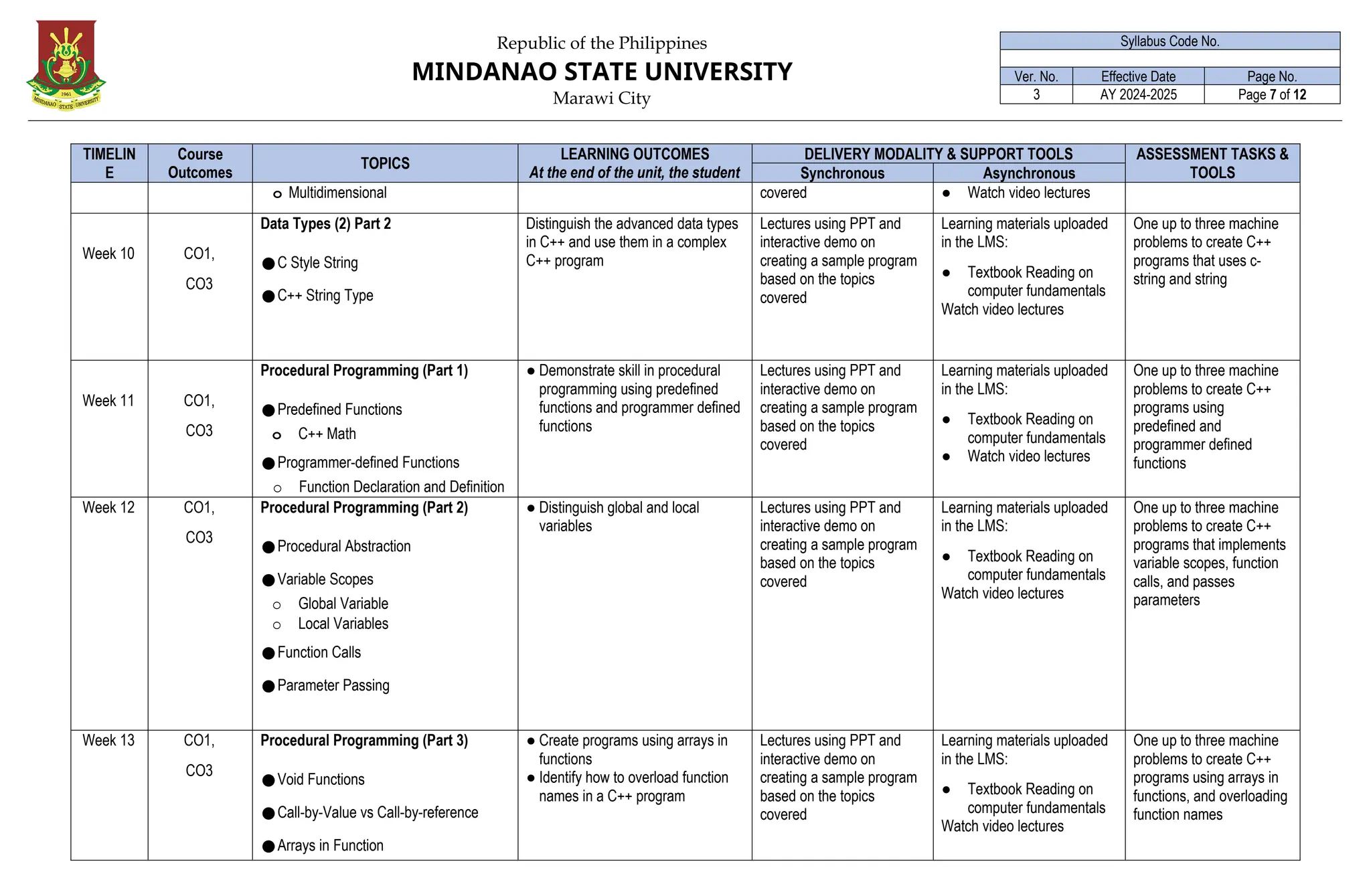
o Multidimensional covered ● Watch video lectures
Week 10 CO1,
CO3
Data Types (2) Part 2
●C Style String
●C++ String Type
Distinguish the advanced data types
in C++ and use them in a complex
C++ program
Lectures using PPT and
interactive demo on
creating a sample program
based on the topics
covered
Learning materials uploaded
in the LMS:
● Textbook Reading on
computer fundamentals
Watch video lectures
One up to three machine
problems to create C++
programs that uses c-
string and string
Week 11 CO1,
CO3
Procedural Programming (Part 1)
●Predefined Functions
o C++ Math
●Programmer-defined Functions
o Function Declaration and Definition
● Demonstrate skill in procedural
programming using predefined
functions and programmer defined
functions
Lectures using PPT and
interactive demo on
creating a sample program
based on the topics
covered
Learning materials uploaded
in the LMS:
● Textbook Reading on
computer fundamentals
● Watch video lectures
One up to three machine
problems to create C++
programs using
predefined and
programmer defined
functions
Week 12 CO1,
CO3
Procedural Programming (Part 2)
●Procedural Abstraction
●Variable Scopes
o Global Variable
o Local Variables
●Function Calls
●Parameter Passing
● Distinguish global and local
variables
Lectures using PPT and
interactive demo on
creating a sample program
based on the topics
covered
Learning materials uploaded
in the LMS:
● Textbook Reading on
computer fundamentals
Watch video lectures
One up to three machine
problems to create C++
programs that implements
variable scopes, function
calls, and passes
parameters
Week 13 CO1,
CO3
Procedural Programming (Part 3)
●Void Functions
●Call-by-Value vs Call-by-reference
●Arrays in Function
● Create programs using arrays in
functions
● Identify how to overload function
names in a C++ program
Lectures using PPT and
interactive demo on
creating a sample program
based on the topics
covered
Learning materials uploaded
in the LMS:
● Textbook Reading on
computer fundamentals
Watch video lectures
One up to three machine
problems to create C++
programs using arrays in
functions, and overloading
function names
8.
Republic of thePhilippines
MINDANAO STATE UNIVERSITY
Marawi City
Syllabus Code No.
Ver. No. Effective Date Page No.
3 AY 2024-2025 Page 8 of 12
TIMELIN
E
Course
Outcomes
(CO)
TOPICS
LEARNING OUTCOMES
At the end of the unit, the student
must be able to:
DELIVERY MODALITY & SUPPORT TOOLS ASSESSMENT TASKS &
TOOLS
Synchronous Asynchronous
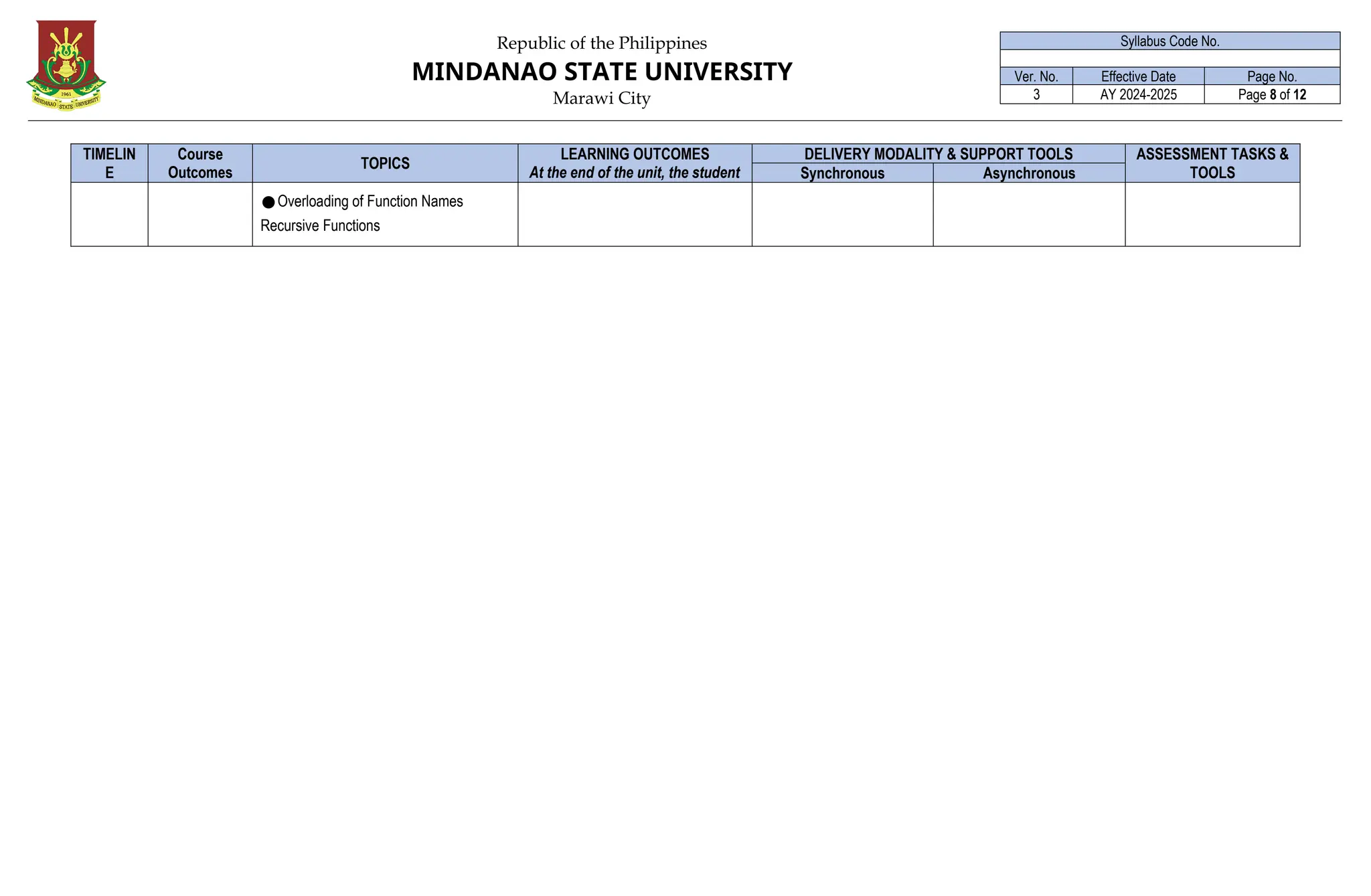
●Overloading of Function Names
Recursive Functions
9.
Republic of thePhilippines
MINDANAO STATE UNIVERSITY
Marawi City
Syllabus Code No.
Ver. No. Effective Date Page No.
3 AY 2024-2025 Page 9 of 12
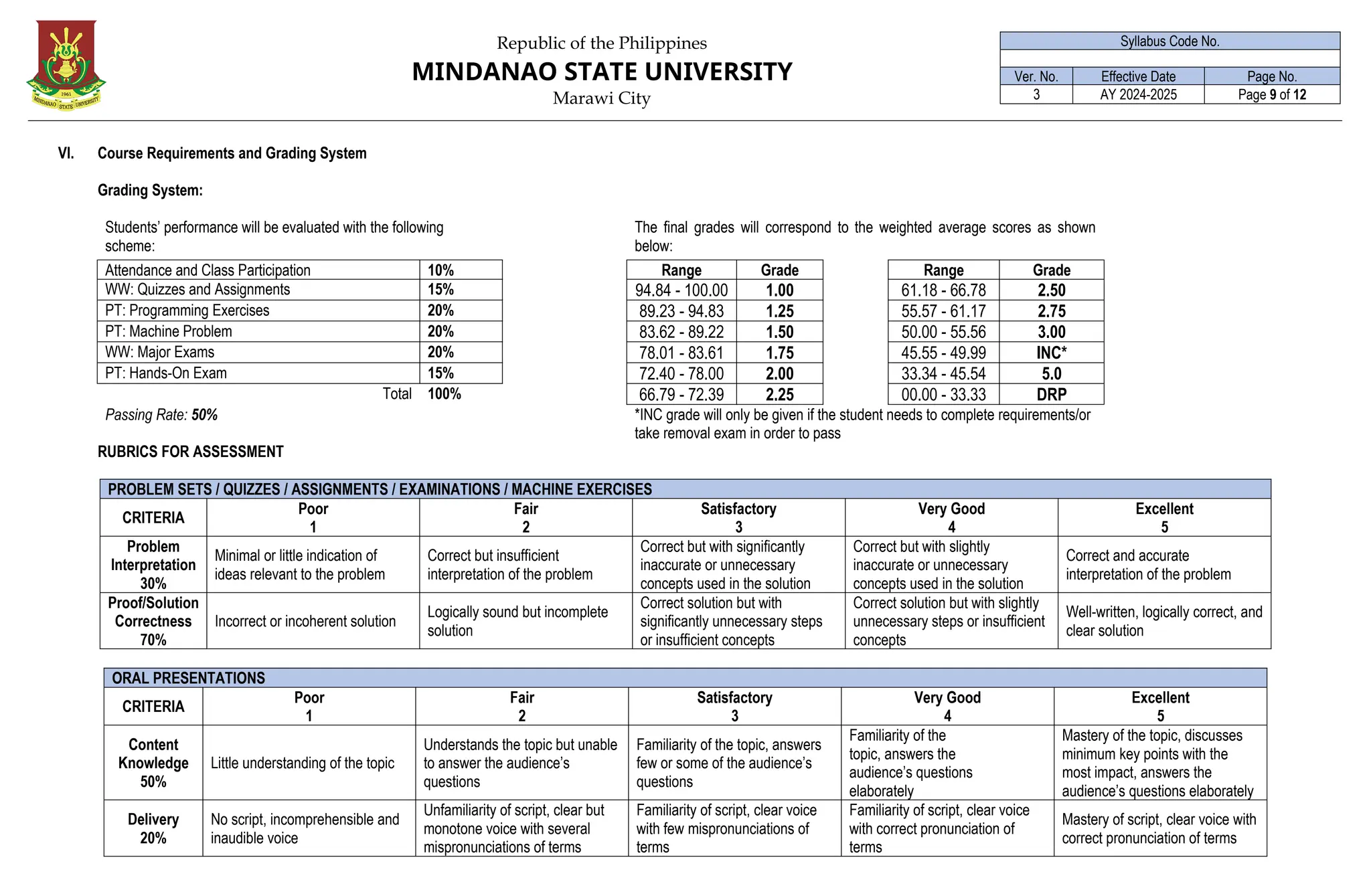
VI. Course Requirements and Grading System
Grading System:
Students’ performance will be evaluated with the following
scheme:
The final grades will correspond to the weighted average scores as shown
below:
Attendance and Class Participation 10% Range Grade Range Grade
WW: Quizzes and Assignments 15% 94.84 - 100.00 1.00 61.18 - 66.78 2.50
PT: Programming Exercises 20% 89.23 - 94.83 1.25 55.57 - 61.17 2.75
PT: Machine Problem 20% 83.62 - 89.22 1.50 50.00 - 55.56 3.00
WW: Major Exams 20% 78.01 - 83.61 1.75 45.55 - 49.99 INC*
PT: Hands-On Exam 15% 72.40 - 78.00 2.00 33.34 - 45.54 5.0
Total 100% 66.79 - 72.39 2.25 00.00 - 33.33 DRP
Passing Rate: 50% *INC grade will only be given if the student needs to complete requirements/or
take removal exam in order to pass
RUBRICS FOR ASSESSMENT
PROBLEM SETS / QUIZZES / ASSIGNMENTS / EXAMINATIONS / MACHINE EXERCISES
CRITERIA
Poor
1
Fair
2
Satisfactory
3
Very Good
4
Excellent
5
Problem
Interpretation
30%
Minimal or little indication of
ideas relevant to the problem
Correct but insufficient
interpretation of the problem
Correct but with significantly
inaccurate or unnecessary
concepts used in the solution
Correct but with slightly
inaccurate or unnecessary
concepts used in the solution
Correct and accurate
interpretation of the problem
Proof/Solution
Correctness
70%
Incorrect or incoherent solution
Logically sound but incomplete
solution
Correct solution but with
significantly unnecessary steps
or insufficient concepts
Correct solution but with slightly
unnecessary steps or insufficient
concepts
Well-written, logically correct, and
clear solution
ORAL PRESENTATIONS
CRITERIA
Poor
1
Fair
2
Satisfactory
3
Very Good
4
Excellent
5
Content
Knowledge
50%
Little understanding of the topic
Understands the topic but unable
to answer the audience’s
questions
Familiarity of the topic, answers
few or some of the audience’s
questions
Familiarity of the
topic, answers the
audience’s questions
elaborately
Mastery of the topic, discusses
minimum key points with the
most impact, answers the
audience’s questions elaborately
Delivery
20%
No script, incomprehensible and
inaudible voice
Unfamiliarity of script, clear but
monotone voice with several
mispronunciations of terms
Familiarity of script, clear voice
with few mispronunciations of
terms
Familiarity of script, clear voice
with correct pronunciation of
terms
Mastery of script, clear voice with
correct pronunciation of terms
10.
Republic of thePhilippines
MINDANAO STATE UNIVERSITY
Marawi City
Syllabus Code No.
Ver. No. Effective Date Page No.
3 AY 2024-2025 Page 10 of 12
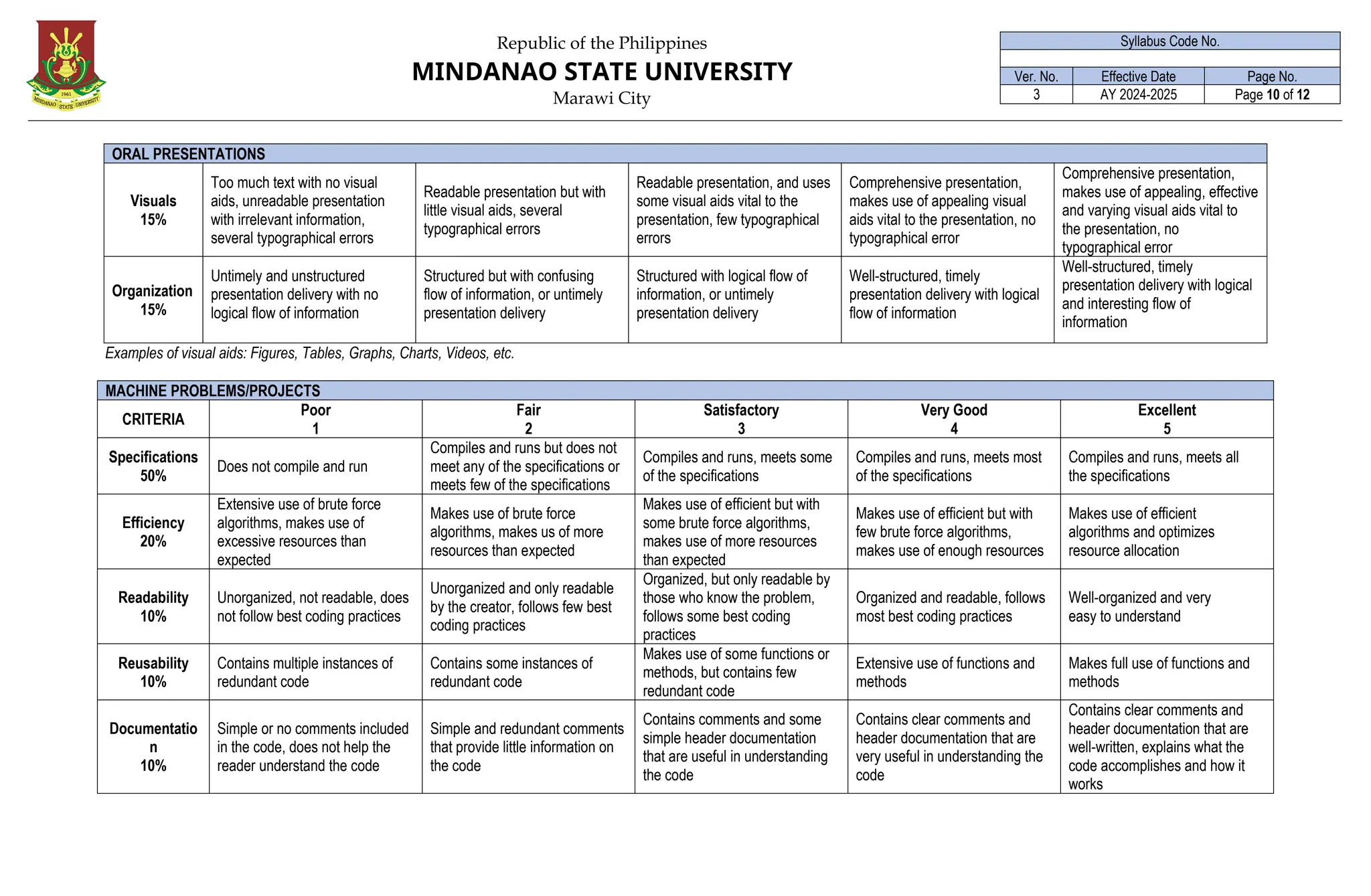
ORAL PRESENTATIONS
Visuals
15%
Too much text with no visual
aids, unreadable presentation
with irrelevant information,
several typographical errors
Readable presentation but with
little visual aids, several
typographical errors
Readable presentation, and uses
some visual aids vital to the
presentation, few typographical
errors
Comprehensive presentation,
makes use of appealing visual
aids vital to the presentation, no
typographical error
Comprehensive presentation,
makes use of appealing, effective
and varying visual aids vital to
the presentation, no
typographical error
Organization
15%
Untimely and unstructured
presentation delivery with no
logical flow of information
Structured but with confusing
flow of information, or untimely
presentation delivery
Structured with logical flow of
information, or untimely
presentation delivery
Well-structured, timely
presentation delivery with logical
flow of information
Well-structured, timely
presentation delivery with logical
and interesting flow of
information
Examples of visual aids: Figures, Tables, Graphs, Charts, Videos, etc.
MACHINE PROBLEMS/PROJECTS
CRITERIA
Poor
1
Fair
2
Satisfactory
3
Very Good
4
Excellent
5
Specifications
50%
Does not compile and run
Compiles and runs but does not
meet any of the specifications or
meets few of the specifications
Compiles and runs, meets some
of the specifications
Compiles and runs, meets most
of the specifications
Compiles and runs, meets all
the specifications
Efficiency
20%
Extensive use of brute force
algorithms, makes use of
excessive resources than
expected
Makes use of brute force
algorithms, makes us of more
resources than expected
Makes use of efficient but with
some brute force algorithms,
makes use of more resources
than expected
Makes use of efficient but with
few brute force algorithms,
makes use of enough resources
Makes use of efficient
algorithms and optimizes
resource allocation
Readability
10%
Unorganized, not readable, does
not follow best coding practices
Unorganized and only readable
by the creator, follows few best
coding practices
Organized, but only readable by
those who know the problem,
follows some best coding
practices
Organized and readable, follows
most best coding practices
Well-organized and very
easy to understand
Reusability
10%
Contains multiple instances of
redundant code
Contains some instances of
redundant code
Makes use of some functions or
methods, but contains few
redundant code
Extensive use of functions and
methods
Makes full use of functions and
methods
Documentatio
n
10%
Simple or no comments included
in the code, does not help the
reader understand the code
Simple and redundant comments
that provide little information on
the code
Contains comments and some
simple header documentation
that are useful in understanding
the code
Contains clear comments and
header documentation that are
very useful in understanding the
code
Contains clear comments and
header documentation that are
well-written, explains what the
code accomplishes and how it
works
11.
Republic of thePhilippines
MINDANAO STATE UNIVERSITY
Marawi City
Syllabus Code No.
Ver. No. Effective Date Page No.
3 AY 2024-2025 Page 11 of 12
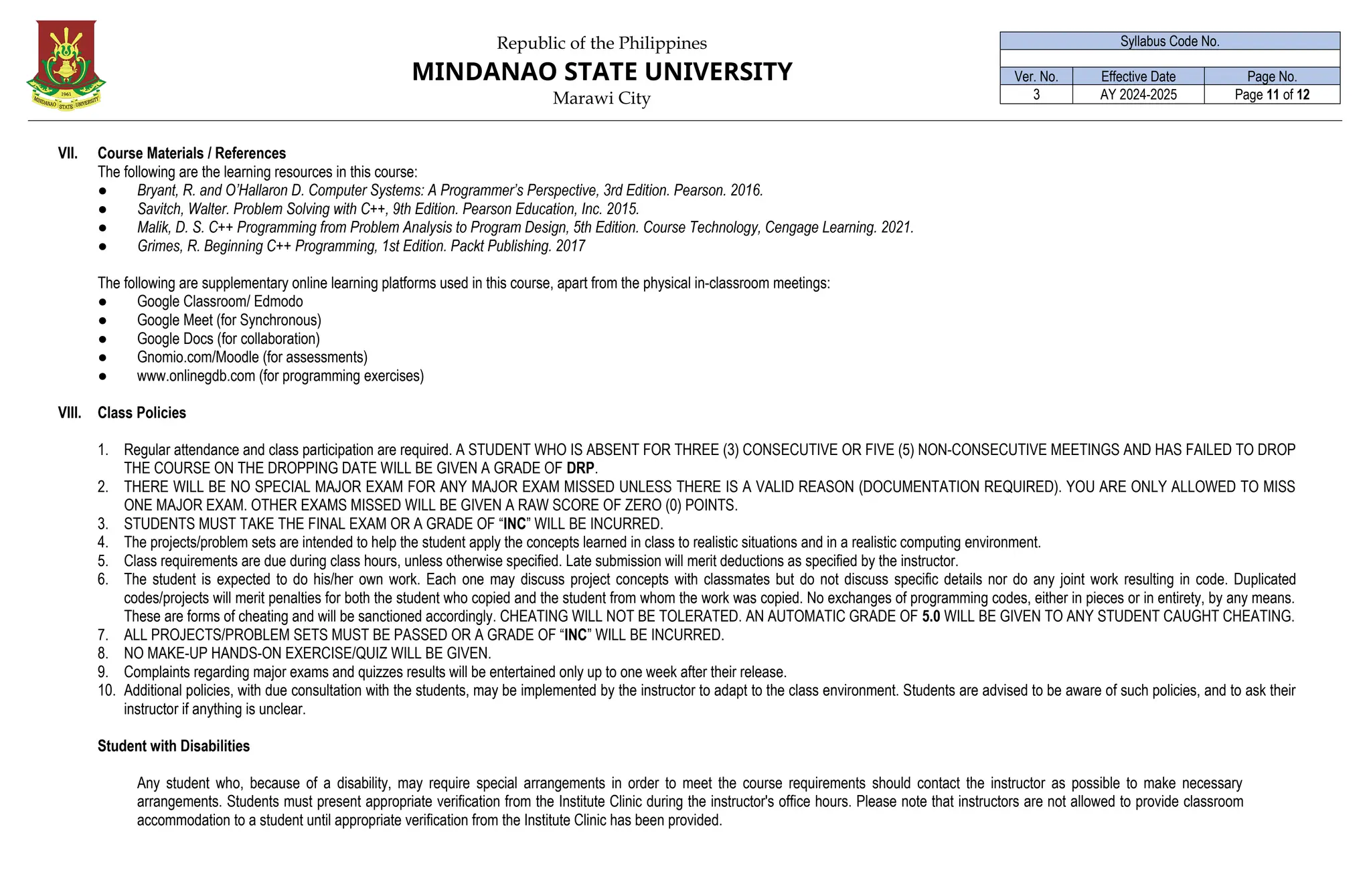
VII. Course Materials / References
The following are the learning resources in this course:
● Bryant, R. and O’Hallaron D. Computer Systems: A Programmer’s Perspective, 3rd Edition. Pearson. 2016.
● Savitch, Walter. Problem Solving with C++, 9th Edition. Pearson Education, Inc. 2015.
● Malik, D. S. C++ Programming from Problem Analysis to Program Design, 5th Edition. Course Technology, Cengage Learning. 2021.
● Grimes, R. Beginning C++ Programming, 1st Edition. Packt Publishing. 2017
The following are supplementary online learning platforms used in this course, apart from the physical in-classroom meetings:
● Google Classroom/ Edmodo
● Google Meet (for Synchronous)
● Google Docs (for collaboration)
● Gnomio.com/Moodle (for assessments)
● www.onlinegdb.com (for programming exercises)
VIII. Class Policies
1. Regular attendance and class participation are required. A STUDENT WHO IS ABSENT FOR THREE (3) CONSECUTIVE OR FIVE (5) NON-CONSECUTIVE MEETINGS AND HAS FAILED TO DROP
THE COURSE ON THE DROPPING DATE WILL BE GIVEN A GRADE OF DRP.
2. THERE WILL BE NO SPECIAL MAJOR EXAM FOR ANY MAJOR EXAM MISSED UNLESS THERE IS A VALID REASON (DOCUMENTATION REQUIRED). YOU ARE ONLY ALLOWED TO MISS
ONE MAJOR EXAM. OTHER EXAMS MISSED WILL BE GIVEN A RAW SCORE OF ZERO (0) POINTS.
3. STUDENTS MUST TAKE THE FINAL EXAM OR A GRADE OF “INC” WILL BE INCURRED.
4. The projects/problem sets are intended to help the student apply the concepts learned in class to realistic situations and in a realistic computing environment.
5. Class requirements are due during class hours, unless otherwise specified. Late submission will merit deductions as specified by the instructor.
6. The student is expected to do his/her own work. Each one may discuss project concepts with classmates but do not discuss specific details nor do any joint work resulting in code. Duplicated
codes/projects will merit penalties for both the student who copied and the student from whom the work was copied. No exchanges of programming codes, either in pieces or in entirety, by any means.
These are forms of cheating and will be sanctioned accordingly. CHEATING WILL NOT BE TOLERATED. AN AUTOMATIC GRADE OF 5.0 WILL BE GIVEN TO ANY STUDENT CAUGHT CHEATING.
7. ALL PROJECTS/PROBLEM SETS MUST BE PASSED OR A GRADE OF “INC” WILL BE INCURRED.
8. NO MAKE-UP HANDS-ON EXERCISE/QUIZ WILL BE GIVEN.
9. Complaints regarding major exams and quizzes results will be entertained only up to one week after their release.
10. Additional policies, with due consultation with the students, may be implemented by the instructor to adapt to the class environment. Students are advised to be aware of such policies, and to ask their
instructor if anything is unclear.
Student with Disabilities
Any student who, because of a disability, may require special arrangements in order to meet the course requirements should contact the instructor as possible to make necessary
arrangements. Students must present appropriate verification from the Institute Clinic during the instructor's office hours. Please note that instructors are not allowed to provide classroom
accommodation to a student until appropriate verification from the Institute Clinic has been provided.
12.
Republic of thePhilippines
MINDANAO STATE UNIVERSITY
Marawi City
Syllabus Code No.
Ver. No. Effective Date Page No.
3 AY 2024-2025 Page 12 of 12
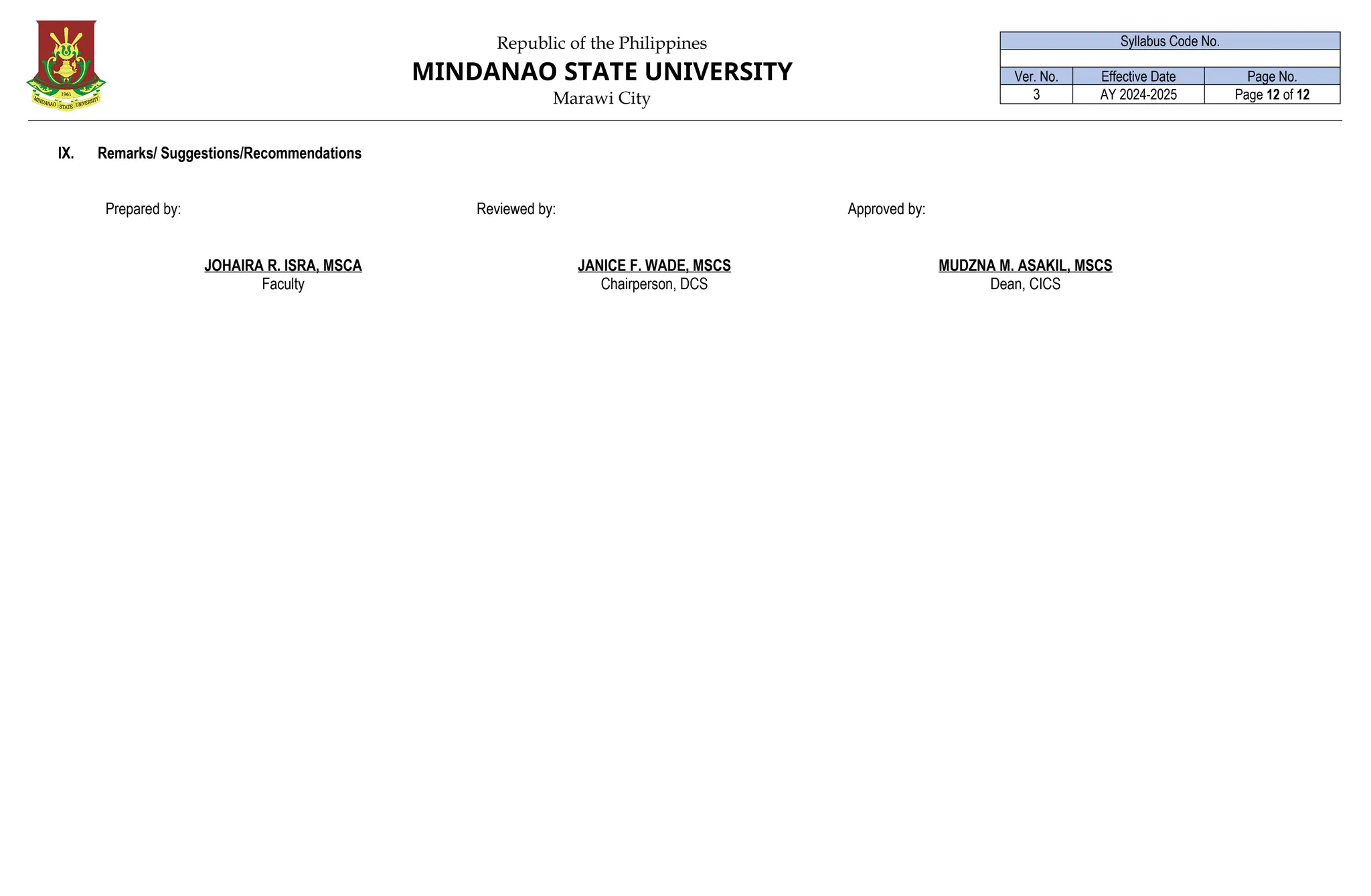
IX. Remarks/ Suggestions/Recommendations
Prepared by: Reviewed by: Approved by:
JOHAIRA R. ISRA, MSCA JANICE F. WADE, MSCS MUDZNA M. ASAKIL, MSCS
Faculty Chairperson, DCS Dean, CICS
![Republic of the Philippines
MINDANAO STATE UNIVERSITY
Marawi City
Syllabus Code No.
Ver. No. Effective Date Page No.
3 AY 2024-2025 Page 4 of 12
and environment
10. Preserve and promote Filipino historical and cultural heritage
(based on RA 7722)
✔️ ✔️
11. Advocate for peace in multicultural setting ✔️ ✔️
III. Course Description
The course covers the use of C++ programming language to solve problems. The emphasis is to train students to design, implement, test, and debug programs intended to solve computing problems using
fundamental programming constructs.
Rationale:
Fluency in the process of software development is a prerequisite to the study of most computer science. To use computers to solve problems effectively, students must be competent at reading and writing
programs in multiple programming languages. Beyond programming skills, however, they must be able to design and analyze algorithms, select appropriate paradigms, and utilize modern development and
testing tools. This knowledge area brings together those fundamental concepts and skills that are essential to programming practice.
IV. Course Outcomes (COs) and Relationship to the Program Outcomes
The following table shows the Course Outcomes (CO) of this course and the corresponding Program Outcomes (PO) for each CO.
At the end of the course, students should be able to:
Program Outcomes
1 2 3 4 5 6 7 8 9 10 11
Explain the importance of the course in relation to the goals and objectives of the program and the University.
CO1. Apply the basic concept of C++ programming in solving problems. E E E I
CO2. Apply the program development life cycle based on a given specification. E E E I
CO3. Explain the behavior of simple programs involving the fundamental programming constructs. E E E I
*I: Introductory **E: Enabling ***D: Demonstrative
*Introductory [30%, 60%]: The course has introduced fundamental concepts necessary for the GOs.
**Enabling [60%; 85%]: The course has developed partial knowledge, somehow prerequisite, for the GOs.
***Demonstrative [85%, 100%]: The course has developed complete knowledge associated with the GOs.
V. Course Content and Learning Plan
TIMELIN
E
Course
Outcomes
(CO)
TOPICS
LEARNING OUTCOMES
At the end of the unit, the student
must be able to:
DELIVERY MODALITY & SUPPORT TOOLS
ASSESSMENT TASKS &
TOOLS
Synchronous Asynchronous
Week 1 CO1,
CO2
Programming Languages and Problem
Solving
●Computer Program
● describe what is a computer
program
● tell the generation of programming
languages
● discuss the program development
life cycle
● Lectures
● Interactive Discussions
Note: PPT and video clips
may be used for the
lectures and discussion
Learning materials uploaded
in the LMS:
● Textbook Reading on
computer fundamentals
● Watch video lectures
● Quiz: Definition,
identification, and
enumeration on topics
covered.
● Assignment: Write down
lesson takeaways](https://image.slidesharecdn.com/ccc101-syllabus-jrri-2025-newformat2-250630053846-5081d54f/75/CCC101-Syllabus-JRRI-2025-NEW_FORMAT-2-docx-4-2048.jpg)