COALBED METHANE
By
Dr. A K Gupta
Ex. Scientist G, IIP, Dehradun
Coalbed Methane
• Coalbed Methane primarily is a hydrocarbon gas,
dominantly methane with minor amount of other gases
like CO2 and N2.
• Underground it exists in “adsorbed” state in coal / lignite
and is released when reservoir pressure is reduced by
removal of water using oil field techniques.
• In the coal fields, methane in coal is considered as
mining hazard and is vented out wastefully into the
atmosphere.
• Technology has been developed for safe recovery of
methane.
Coalbed methane….
• Generally a ton of coal can hold 5 to 15 cubic meters of
CBM gas.
• Higher gas contents of 30 to 40 m3 have also been
reported in US basins.
• For coal basins in India, typically 2 to 3 billion tons of
coal will be require to yield about 1 MM m3 /day of CBM
gas.
• USA is pioneer in commercial exploitation of coalbed
methane since 1980’s. Over 7000 CBD wells have been
drilled in various coal basins, produced about 80 MM
m3/day of CBM.
• Several coal rich countries like China, UK, Poland,
Russia, Australia including India have started activities in
this area.
Impact of CBD:
• Commercial exploitation of CBD would have
substantial economic, environmental and
strategic benefits.
• It would improve the energy security of a
country, of developing countries in particular
CBM Process
• CBM technology involves drilling of wells down to target
the coalbeds.
• Like oil and gas, desorption, diffusion and production of
methane is accomplished with the reduction of reservoir
pressure by dewatering of coal seams.
• To achieve efficient release of gas, the reservoir
pressure needs to be reduced to nearly atmospheric
pressure.
• Initially, the CBM well gives high water production with
low gas, which increases with time.
Mechanism of generation,
adsorption and retention of methane
in coal bed
• During early stages of coalification below 50 o
C
biogenic methane is produced by microbial
decomposition of organic material.
• These are Swamp or Marsh gas.
• Methane produced at above 50 o
C as coal tank
increases is termed as thermogenic Methane.
• Generation volume of methane is related to
volatile matter and Rank of coal.
Genaration of Methane:
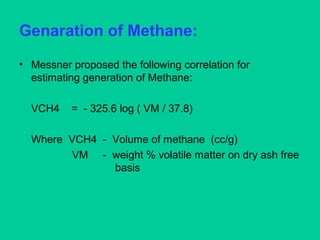
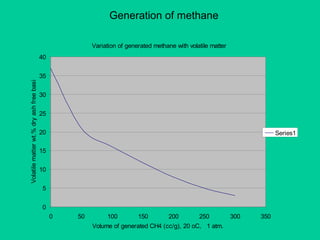
• Messner proposed the following correlation for
estimating generation of Methane:
VCH4 = - 325.6 log ( VM / 37.8)
Where VCH4 - Volume of methane (cc/g)
VM - weight % volatile matter on dry ash free
basis
Genaration of Methane:
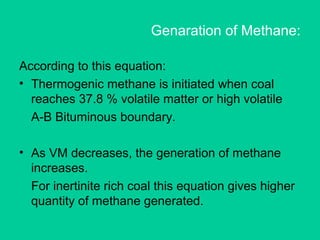
According to this equation:
• Thermogenic methane is initiated when coal
reaches 37.8 % volatile matter or high volatile
A-B Bituminous boundary.
• As VM decreases, the generation of methane
increases.
For inertinite rich coal this equation gives higher
quantity of methane generated.
Genaration of Methane:
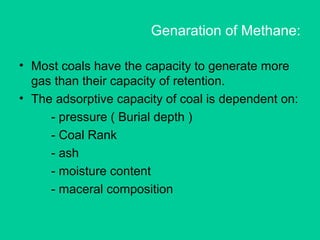
• Most coals have the capacity to generate more
gas than their capacity of retention.
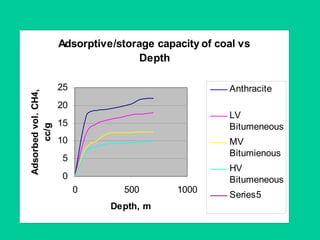
• The adsorptive capacity of coal is dependent on:
- pressure ( Burial depth )
- Coal Rank
- ash
- moisture content
- maceral composition
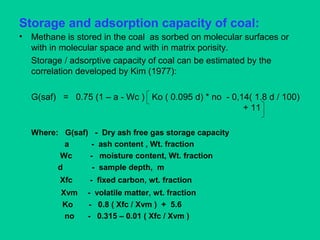
Storage and adsorption capacity of coal:
• Methane is stored in the coal as sorbed on molecular surfaces or
with in molecular space and with in matrix porisity.
Storage / adsorptive capacity of coal can be estimated by the
correlation developed by Kim (1977):
G(saf) = 0.75 (1 – a - Wc ) Ko ( 0.095 d) * no - 0,14( 1.8 d / 100)
+ 11
Where: G(saf) - Dry ash free gas storage capacity
a - ash content , Wt. fraction
Wc - moisture content, Wt. fraction
d - sample depth, m
Xfc - fixed carbon, wt. fraction
Xvm - volatile matter, wt. fraction
Ko - 0.8 ( Xfc / Xvm ) + 5.6
no - 0.315 – 0.01 ( Xfc / Xvm )
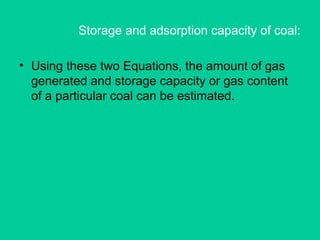
Storage and adsorption capacity of coal:
• Using these two Equations, the amount of gas
generated and storage capacity or gas content
of a particular coal can be estimated.
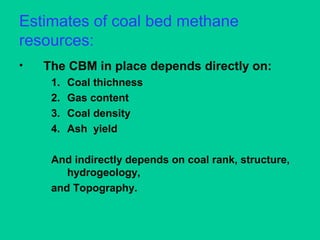
Estimates of coal bed methane
resources:
• The CBM in place depends directly on:
1. Coal thichness
2. Gas content
3. Coal density
4. Ash yield
And indirectly depends on coal rank, structure,
hydrogeology,
and Topography.
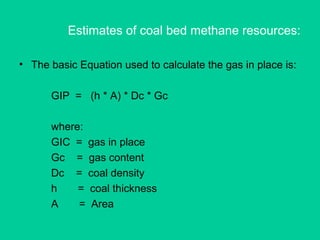
Estimates of coal bed methane resources:
• The basic Equation used to calculate the gas in place is:
GIP = (h * A) * Dc * Gc
where:
GIC = gas in place
Gc = gas content
Dc = coal density
h = coal thickness
A = Area
Generation of methane
Variation of generated methane with volatile matter
0
5
10
15
20
25
30
35
40
0 50 100 150 200 250 300 350
Volume of generated CH4 (cc/g), 20 oC, 1 atm.
Volatilematterwt.%dryashfreebasis
Series1
Adsorptive/storage capacity of coal vs
Depth
0
5
10
15
20
25
0 500 1000
Depth, m
Adsorbedvol.CH4,
cc/g
Anthracite
LV
Bitumeneous
MV
Bitumienous
HV
Bitumeneous
Series5
Outlook for CBD:
• India has large natural gas deficit.
• Against the present demand of about 150 MM
m3/day, the production of natural gas is about
100 MMm3/day.
• The demand is expected to increase upto 285
MM m3/day by the year 2009 – 10.
• This widening demand-supply gap of natural gas
cannot be filled up with country’s limited
conventional gas resources.
Outlook for CBD….
• To increase the gas supply and meeting the
future need, unconventional gas resources like
coalbed methane (CBD) need to be aggressively
explored and developed in India.
Coalbed methane basins:
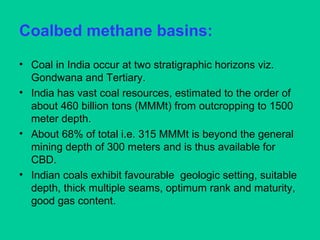
• Coal in India occur at two stratigraphic horizons viz.
Gondwana and Tertiary.
• India has vast coal resources, estimated to the order of
about 460 billion tons (MMMt) from outcropping to 1500
meter depth.
• About 68% of total i.e. 315 MMMt is beyond the general
mining depth of 300 meters and is thus available for
CBD.
• Indian coals exhibit favourable geologic setting, suitable
depth, thick multiple seams, optimum rank and maturity,
good gas content.
CBM activities in India:
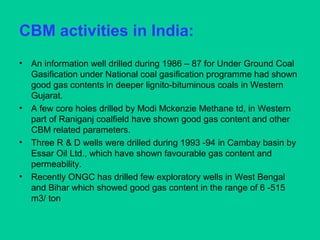
• An information well drilled during 1986 – 87 for Under Ground Coal
Gasification under National coal gasification programme had shown
good gas contents in deeper lignito-bituminous coals in Western
Gujarat.
• A few core holes drilled by Modi Mckenzie Methane td, in Western
part of Raniganj coalfield have shown good gas content and other
CBM related parameters.
• Three R & D wells were drilled during 1993 -94 in Cambay basin by
Essar Oil Ltd., which have shown favourable gas content and
permeability.
• Recently ONGC has drilled few exploratory wells in West Bengal
and Bihar which showed good gas content in the range of 6 -515
m3/ ton
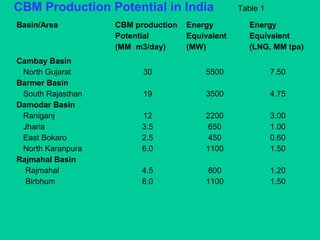
CBM Production Potential in India Table 1
Basin/Area CBM production
Potential
(MM m3/day)
Energy
Equivalent
(MW)
Energy
Equivalent
(LNG, MM tpa)
Cambay Basin
North Gujarat
Barmer Basin
South Rajasthan
Damodar Basin
Raniganj
Jharia
East Bokaro
North Karanpura
Rajmahal Basin
Rajmahal
Birbhum
30
19
12
3.5
2.5
6.0
4.5
6.0
5500
3500
2200
650
450
1100
800
1100
7.50
4.75
3.00
1.00
0.60
1.50
1.20
1.50
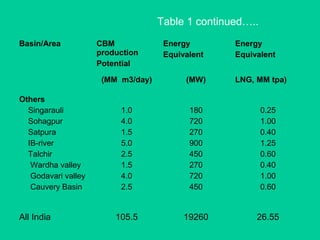
Table 1 continued…..
Basin/Area CBM
production
Potential
Energy
Equivalent
Energy
Equivalent
(MM m3/day) (MW) LNG, MM tpa)
Others
Singarauli
Sohagpur
Satpura
IB-river
Talchir
Wardha valley
Godavari valley
Cauvery Basin
1.0
4.0
1.5
5.0
2.5
1.5
4.0
2.5
180
720
270
900
450
270
720
450
0.25
1.00
0.40
1.25
0.60
0.40
1.00
0.60
All India 105.5 19260 26.55
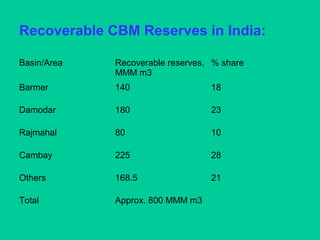
Recoverable CBM Reserves in India:
Basin/Area Recoverable reserves,
MMM m3
% share
Barmer 140 18
Damodar 180 23
Rajmahal 80 10
Cambay 225 28
Others 168.5 21
Total Approx. 800 MMM m3
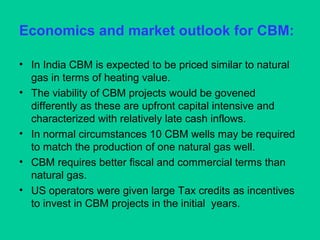
Economics and market outlook for CBM:
• In India CBM is expected to be priced similar to natural
gas in terms of heating value.
• The viability of CBM projects would be govened
differently as these are upfront capital intensive and
characterized with relatively late cash inflows.
• In normal circumstances 10 CBM wells may be required
to match the production of one natural gas well.
• CBM requires better fiscal and commercial terms than
natural gas.
• US operators were given large Tax credits as incentives
to invest in CBM projects in the initial years.
Economics and market outlook for CBM….
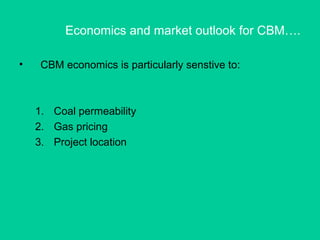
• CBM economics is particularly senstive to:
1. Coal permeability
2. Gas pricing
3. Project location
Economics and market outlook for CBM…..
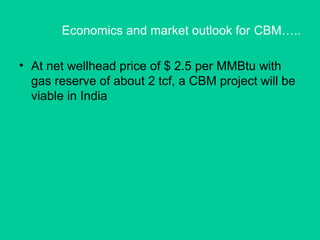
• At net wellhead price of $ 2.5 per MMBtu with
gas reserve of about 2 tcf, a CBM project will be
viable in India
Economics and market outlook for CBM….
• Major market for CBM is for power generation.
• Under certain conditions CBM can also be
competitive to LPG and piped coke oven gas in
urban areas like Kolkatta, if free gas marketing is
considered.
• CBM has a competitive edge over imported LNG
or natural gas via the cross border pipelines as
the transportation costs for these imports are
likely to be higher.l
Economics and market outlook for CBM….
• CBM prospective areas in Gondwana coalfields are
located away from natural gas pipelines or active gas
markets. For CBM project in these locations adequate
markets need to be developed.
• Cambay and Barmer basins in Western India are
exceptions, where gas marketing and pipeline network
are well developed.
Cbm gupta

Cbm gupta

  • 1.
    COALBED METHANE By Dr. AK Gupta Ex. Scientist G, IIP, Dehradun
  • 2.
    Coalbed Methane • CoalbedMethane primarily is a hydrocarbon gas, dominantly methane with minor amount of other gases like CO2 and N2. • Underground it exists in “adsorbed” state in coal / lignite and is released when reservoir pressure is reduced by removal of water using oil field techniques. • In the coal fields, methane in coal is considered as mining hazard and is vented out wastefully into the atmosphere. • Technology has been developed for safe recovery of methane.
  • 3.
    Coalbed methane…. • Generallya ton of coal can hold 5 to 15 cubic meters of CBM gas. • Higher gas contents of 30 to 40 m3 have also been reported in US basins. • For coal basins in India, typically 2 to 3 billion tons of coal will be require to yield about 1 MM m3 /day of CBM gas. • USA is pioneer in commercial exploitation of coalbed methane since 1980’s. Over 7000 CBD wells have been drilled in various coal basins, produced about 80 MM m3/day of CBM. • Several coal rich countries like China, UK, Poland, Russia, Australia including India have started activities in this area.
  • 4.
    Impact of CBD: •Commercial exploitation of CBD would have substantial economic, environmental and strategic benefits. • It would improve the energy security of a country, of developing countries in particular
  • 5.
    CBM Process • CBMtechnology involves drilling of wells down to target the coalbeds. • Like oil and gas, desorption, diffusion and production of methane is accomplished with the reduction of reservoir pressure by dewatering of coal seams. • To achieve efficient release of gas, the reservoir pressure needs to be reduced to nearly atmospheric pressure. • Initially, the CBM well gives high water production with low gas, which increases with time.
  • 6.
    Mechanism of generation, adsorptionand retention of methane in coal bed • During early stages of coalification below 50 o C biogenic methane is produced by microbial decomposition of organic material. • These are Swamp or Marsh gas. • Methane produced at above 50 o C as coal tank increases is termed as thermogenic Methane. • Generation volume of methane is related to volatile matter and Rank of coal.
  • 7.
    Genaration of Methane: •Messner proposed the following correlation for estimating generation of Methane: VCH4 = - 325.6 log ( VM / 37.8) Where VCH4 - Volume of methane (cc/g) VM - weight % volatile matter on dry ash free basis
  • 8.
    Genaration of Methane: Accordingto this equation: • Thermogenic methane is initiated when coal reaches 37.8 % volatile matter or high volatile A-B Bituminous boundary. • As VM decreases, the generation of methane increases. For inertinite rich coal this equation gives higher quantity of methane generated.
  • 9.
    Genaration of Methane: •Most coals have the capacity to generate more gas than their capacity of retention. • The adsorptive capacity of coal is dependent on: - pressure ( Burial depth ) - Coal Rank - ash - moisture content - maceral composition
  • 10.
    Storage and adsorptioncapacity of coal: • Methane is stored in the coal as sorbed on molecular surfaces or with in molecular space and with in matrix porisity. Storage / adsorptive capacity of coal can be estimated by the correlation developed by Kim (1977): G(saf) = 0.75 (1 – a - Wc ) Ko ( 0.095 d) * no - 0,14( 1.8 d / 100) + 11 Where: G(saf) - Dry ash free gas storage capacity a - ash content , Wt. fraction Wc - moisture content, Wt. fraction d - sample depth, m Xfc - fixed carbon, wt. fraction Xvm - volatile matter, wt. fraction Ko - 0.8 ( Xfc / Xvm ) + 5.6 no - 0.315 – 0.01 ( Xfc / Xvm )
  • 11.
    Storage and adsorptioncapacity of coal: • Using these two Equations, the amount of gas generated and storage capacity or gas content of a particular coal can be estimated.
  • 12.
    Estimates of coalbed methane resources: • The CBM in place depends directly on: 1. Coal thichness 2. Gas content 3. Coal density 4. Ash yield And indirectly depends on coal rank, structure, hydrogeology, and Topography.
  • 13.
    Estimates of coalbed methane resources: • The basic Equation used to calculate the gas in place is: GIP = (h * A) * Dc * Gc where: GIC = gas in place Gc = gas content Dc = coal density h = coal thickness A = Area
  • 14.
    Generation of methane Variationof generated methane with volatile matter 0 5 10 15 20 25 30 35 40 0 50 100 150 200 250 300 350 Volume of generated CH4 (cc/g), 20 oC, 1 atm. Volatilematterwt.%dryashfreebasis Series1
  • 15.
    Adsorptive/storage capacity ofcoal vs Depth 0 5 10 15 20 25 0 500 1000 Depth, m Adsorbedvol.CH4, cc/g Anthracite LV Bitumeneous MV Bitumienous HV Bitumeneous Series5
  • 16.
    Outlook for CBD: •India has large natural gas deficit. • Against the present demand of about 150 MM m3/day, the production of natural gas is about 100 MMm3/day. • The demand is expected to increase upto 285 MM m3/day by the year 2009 – 10. • This widening demand-supply gap of natural gas cannot be filled up with country’s limited conventional gas resources.
  • 17.
    Outlook for CBD…. •To increase the gas supply and meeting the future need, unconventional gas resources like coalbed methane (CBD) need to be aggressively explored and developed in India.
  • 18.
    Coalbed methane basins: •Coal in India occur at two stratigraphic horizons viz. Gondwana and Tertiary. • India has vast coal resources, estimated to the order of about 460 billion tons (MMMt) from outcropping to 1500 meter depth. • About 68% of total i.e. 315 MMMt is beyond the general mining depth of 300 meters and is thus available for CBD. • Indian coals exhibit favourable geologic setting, suitable depth, thick multiple seams, optimum rank and maturity, good gas content.
  • 19.
    CBM activities inIndia: • An information well drilled during 1986 – 87 for Under Ground Coal Gasification under National coal gasification programme had shown good gas contents in deeper lignito-bituminous coals in Western Gujarat. • A few core holes drilled by Modi Mckenzie Methane td, in Western part of Raniganj coalfield have shown good gas content and other CBM related parameters. • Three R & D wells were drilled during 1993 -94 in Cambay basin by Essar Oil Ltd., which have shown favourable gas content and permeability. • Recently ONGC has drilled few exploratory wells in West Bengal and Bihar which showed good gas content in the range of 6 -515 m3/ ton
  • 20.
    CBM Production Potentialin India Table 1 Basin/Area CBM production Potential (MM m3/day) Energy Equivalent (MW) Energy Equivalent (LNG, MM tpa) Cambay Basin North Gujarat Barmer Basin South Rajasthan Damodar Basin Raniganj Jharia East Bokaro North Karanpura Rajmahal Basin Rajmahal Birbhum 30 19 12 3.5 2.5 6.0 4.5 6.0 5500 3500 2200 650 450 1100 800 1100 7.50 4.75 3.00 1.00 0.60 1.50 1.20 1.50
  • 21.
    Table 1 continued….. Basin/AreaCBM production Potential Energy Equivalent Energy Equivalent (MM m3/day) (MW) LNG, MM tpa) Others Singarauli Sohagpur Satpura IB-river Talchir Wardha valley Godavari valley Cauvery Basin 1.0 4.0 1.5 5.0 2.5 1.5 4.0 2.5 180 720 270 900 450 270 720 450 0.25 1.00 0.40 1.25 0.60 0.40 1.00 0.60 All India 105.5 19260 26.55
  • 22.
    Recoverable CBM Reservesin India: Basin/Area Recoverable reserves, MMM m3 % share Barmer 140 18 Damodar 180 23 Rajmahal 80 10 Cambay 225 28 Others 168.5 21 Total Approx. 800 MMM m3
  • 23.
    Economics and marketoutlook for CBM: • In India CBM is expected to be priced similar to natural gas in terms of heating value. • The viability of CBM projects would be govened differently as these are upfront capital intensive and characterized with relatively late cash inflows. • In normal circumstances 10 CBM wells may be required to match the production of one natural gas well. • CBM requires better fiscal and commercial terms than natural gas. • US operators were given large Tax credits as incentives to invest in CBM projects in the initial years.
  • 24.
    Economics and marketoutlook for CBM…. • CBM economics is particularly senstive to: 1. Coal permeability 2. Gas pricing 3. Project location
  • 25.
    Economics and marketoutlook for CBM….. • At net wellhead price of $ 2.5 per MMBtu with gas reserve of about 2 tcf, a CBM project will be viable in India
  • 26.
    Economics and marketoutlook for CBM…. • Major market for CBM is for power generation. • Under certain conditions CBM can also be competitive to LPG and piped coke oven gas in urban areas like Kolkatta, if free gas marketing is considered. • CBM has a competitive edge over imported LNG or natural gas via the cross border pipelines as the transportation costs for these imports are likely to be higher.l
  • 27.
    Economics and marketoutlook for CBM…. • CBM prospective areas in Gondwana coalfields are located away from natural gas pipelines or active gas markets. For CBM project in these locations adequate markets need to be developed. • Cambay and Barmer basins in Western India are exceptions, where gas marketing and pipeline network are well developed.