Chemical Ordering and Storage Process
Chris Babcock
GEB 3213
Prof. Hanrahan
Table of Contents
1) Executive Summary ………………………………………………………………………..Pg. 1
2) Introduction ……………………………………………………………………………………Pg. 2
3) Why install a bulk storage system? …………………………………………………Pg. 3-5
4) What are the Risks? ………………………………………………………………………..Pg. 6
5) Recommendation ……………………………………………………………………………Pg. 7
6) References ………………………………………………………………………………………Pg. 8
7) Appendix. ………………………………………………………………………………………..Pg. 9
Executive Summary
Rich’s Ice Cream will benefit from the installation of bulk storage tanks and improving chemical handling
equipment. The decreased safety risk, better organized chemical room, eases in ordering and cost
savings makes this project feasible.
Current status:
Chemicals are ordered weekly because of a shortage of storage space. This adds additional freight
charges. The chemical room is very congested as we have to stage 55-gallon drums in there until we are
ready to use them. On average 6 drums are maneuvered around weekly creating a risk of back strain as
the drums weigh in excess of 450 pounds.
Benefits:
 Ordering of chemicals can be changed from weekly to monthly as we will have staging room.
 The chemical room will have fewer drums to move and work around reducing the safety risk
associated.
 There is a $.050 per gallon cost savings associated with ordering chemical on bulk versus drums.
Risks:
 Will require training on new chemical transfer equipment.
 The chemical room will be out of service for 2 days to complete the installation so this will have
to be coordinated on a weekend when production is down.
Recommendation:
1. Purchase 2 – 300 gallon poly storage tanks and associated plumbing.
2. Schedule Safe-Chem in on weekend to install equipment once delivered.
3. Schedule Sanitation lead to work with Safe-Chem on install to understand the flow and obtain
the training needed to train balance of crew.
Pg. 1
Introduction
The current ordering and storage of chemicals can be optimized. This optimization will pay dividends in
regards to safety and cost reduction. Currently chemicals are ordered weekly and delivered via 55-
gallon drums. The ordering has to be done weekly due to space constraints in the chemical storage
room. The drums weigh in excess of 450 lbs. each and are manually moved from pallet to drum dolly.
On average the plant consumes 5 drums of chemicals weekly. This is 5 drums that have to be moved
and opened weekly. I am proposing the installation of a bulk storage system for the commonly used
chemicals of Power Foam and Pipeline cleaner. Both of which are an alkaline caustic cleaner and very
corrosive.
While investigating this project I had the opportunity to speak with Randy Rich about the ordering
process and what his thoughts were related to the cost, space and time constraints. I discovered he was
not fully aware of the problems particularly related to space and time constraints. He was particularly
concerned with the cost of the chemicals used in the plant.
Pg. 2
Why install a bulk storage system?
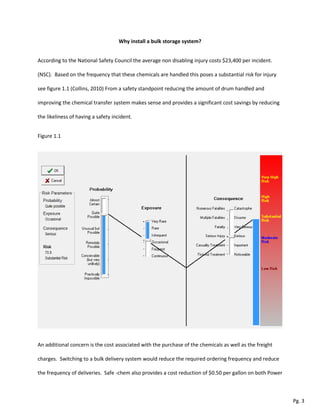
According to the National Safety Council the average non disabling injury costs $23,400 per incident.
(NSC). Based on the frequency that these chemicals are handled this poses a substantial risk for injury
see figure 1.1 (Collins, 2010) From a safety standpoint reducing the amount of drum handled and
improving the chemical transfer system makes sense and provides a significant cost savings by reducing
the likeliness of having a safety incident.
Figure 1.1
An additional concern is the cost associated with the purchase of the chemicals as well as the freight
charges. Switching to a bulk delivery system would reduce the required ordering frequency and reduce
the frequency of deliveries. Safe -chem also provides a cost reduction of $0.50 per gallon on both Power
Pg. 3
Foam and Pipeline cleaner. The plant currently consumes an average of 100 gallons of each chemical
weekly. The cost savings is approximately $137.50 weekly or $7,100 annually in chemical and freight
charges.
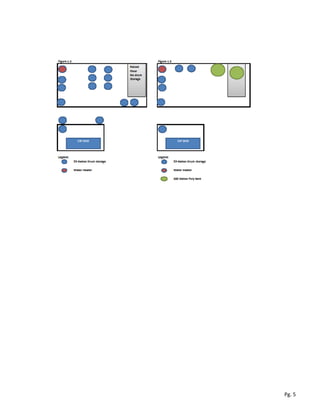
The proposed changes to the chemical room the addition of 2 - 300 gallon poly tanks to hold the
chemicals, this will hold nearly a month supply of chemical reducing the amount of time needed to
inventory and order chemicals. The poly tanks will hold 3-4 weeks supply of chemical. Additionally new
product transfer pumps will be installed to ensure chemicals are dispensed more safely and efficiently.
The rearranging of the room will allow for better space utilization and clutter reduction. See figures 1.2
& 1.3 Cost of project is $3,975.00 with the savings in chemicals alone the return on investment is just
6.75 months.
Pg.4
3
Pg. 5
Associated Risks:
There are few risks associated with the project.
 The Primary one is the fact that the chemical room and systems will be out of service while
installation takes place. This will need to be scheduled on a weekend when production is down
and the system demands are at their lowest.
 There will be a training curve as the system will be moved, new equipment installed and the
ordering process will be altered.
Pg. 6
Recommendations:
Safety being a paramount concern any opportunity that presents itself to reduce a hazard is one to take
seriously. The fact that an average back injury can cost $23,400 per incident and the fact that the
sanitation crew is forced to manually handle many drums weekly makes this project work.
Understanding the fact that it is hard to justify an expense against a possible expense makes the return
on investment questionable if relying only on the safety aspect. This project includes a substantial cost
savings in the price of the chemical and freight charges. This is a real and actual saving of $7,100
annually. The project will pay for itself in 6.75 months.
I propose moving forward with the project:
 Order Poly tanks and necessary supplies
 Schedule Safe-chem in over weekend to perform installation
 Schedule Gary Watkins (Sanitation lead) in to work with Safe-Chem on installation to obtain the
training necessary for him to roll out training with rest of sanitation crew.
Pg. 7
References:
Collins, D. (2010, January 1). . . Retrieved May 1, 2014, from http://www.safetyrisk.net/risk-assessment-
form-templates/
Estimating the Costs of Unintentional Injuries, Fatal and Nonfatal Injuries. (n.d.). Estimating the Costs of
Unintentional Injuries, Fatal and Nonfatal Injuries. Retrieved May 1, 2014, from
http://www.nsc.org/news_resources/injury_and_death_statistics/Pages/EstimatingtheCostsofUnintenti
onalInjuries.aspx
Pg. 8
Appendix:
Transcript from conversation with Randy Rich – President Rich’s Ice Cream
Q. Do you know what is involved in the chemical ordering process?
A. Not completely, certainly understand what is needed to be done but not sure of frequency or levels.
Q. What are your concerns related to chemicals and chemical handling safety?
A. Safety is a huge concern, it is my hope that we are trining people to properly handle and dispense
chemicals.
Q. Would you be opposed to implementing some bulk storage systems assuming there is a return on the
investment?
A. As with any investment the quicker the return the easier it is to implement. As a general rule if you
can provide a return on investment in less than a year the project will be considered.
Pg. 9

CBabcock GEB3213 Final project report

  • 1.
    Chemical Ordering andStorage Process Chris Babcock GEB 3213 Prof. Hanrahan
  • 2.
    Table of Contents 1)Executive Summary ………………………………………………………………………..Pg. 1 2) Introduction ……………………………………………………………………………………Pg. 2 3) Why install a bulk storage system? …………………………………………………Pg. 3-5 4) What are the Risks? ………………………………………………………………………..Pg. 6 5) Recommendation ……………………………………………………………………………Pg. 7 6) References ………………………………………………………………………………………Pg. 8 7) Appendix. ………………………………………………………………………………………..Pg. 9
  • 3.
    Executive Summary Rich’s IceCream will benefit from the installation of bulk storage tanks and improving chemical handling equipment. The decreased safety risk, better organized chemical room, eases in ordering and cost savings makes this project feasible. Current status: Chemicals are ordered weekly because of a shortage of storage space. This adds additional freight charges. The chemical room is very congested as we have to stage 55-gallon drums in there until we are ready to use them. On average 6 drums are maneuvered around weekly creating a risk of back strain as the drums weigh in excess of 450 pounds. Benefits:  Ordering of chemicals can be changed from weekly to monthly as we will have staging room.  The chemical room will have fewer drums to move and work around reducing the safety risk associated.  There is a $.050 per gallon cost savings associated with ordering chemical on bulk versus drums. Risks:  Will require training on new chemical transfer equipment.  The chemical room will be out of service for 2 days to complete the installation so this will have to be coordinated on a weekend when production is down. Recommendation: 1. Purchase 2 – 300 gallon poly storage tanks and associated plumbing. 2. Schedule Safe-Chem in on weekend to install equipment once delivered. 3. Schedule Sanitation lead to work with Safe-Chem on install to understand the flow and obtain the training needed to train balance of crew. Pg. 1
  • 4.
    Introduction The current orderingand storage of chemicals can be optimized. This optimization will pay dividends in regards to safety and cost reduction. Currently chemicals are ordered weekly and delivered via 55- gallon drums. The ordering has to be done weekly due to space constraints in the chemical storage room. The drums weigh in excess of 450 lbs. each and are manually moved from pallet to drum dolly. On average the plant consumes 5 drums of chemicals weekly. This is 5 drums that have to be moved and opened weekly. I am proposing the installation of a bulk storage system for the commonly used chemicals of Power Foam and Pipeline cleaner. Both of which are an alkaline caustic cleaner and very corrosive. While investigating this project I had the opportunity to speak with Randy Rich about the ordering process and what his thoughts were related to the cost, space and time constraints. I discovered he was not fully aware of the problems particularly related to space and time constraints. He was particularly concerned with the cost of the chemicals used in the plant. Pg. 2
  • 5.
    Why install abulk storage system? According to the National Safety Council the average non disabling injury costs $23,400 per incident. (NSC). Based on the frequency that these chemicals are handled this poses a substantial risk for injury see figure 1.1 (Collins, 2010) From a safety standpoint reducing the amount of drum handled and improving the chemical transfer system makes sense and provides a significant cost savings by reducing the likeliness of having a safety incident. Figure 1.1 An additional concern is the cost associated with the purchase of the chemicals as well as the freight charges. Switching to a bulk delivery system would reduce the required ordering frequency and reduce the frequency of deliveries. Safe -chem also provides a cost reduction of $0.50 per gallon on both Power Pg. 3
  • 6.
    Foam and Pipelinecleaner. The plant currently consumes an average of 100 gallons of each chemical weekly. The cost savings is approximately $137.50 weekly or $7,100 annually in chemical and freight charges. The proposed changes to the chemical room the addition of 2 - 300 gallon poly tanks to hold the chemicals, this will hold nearly a month supply of chemical reducing the amount of time needed to inventory and order chemicals. The poly tanks will hold 3-4 weeks supply of chemical. Additionally new product transfer pumps will be installed to ensure chemicals are dispensed more safely and efficiently. The rearranging of the room will allow for better space utilization and clutter reduction. See figures 1.2 & 1.3 Cost of project is $3,975.00 with the savings in chemicals alone the return on investment is just 6.75 months. Pg.4 3
  • 7.
  • 8.
    Associated Risks: There arefew risks associated with the project.  The Primary one is the fact that the chemical room and systems will be out of service while installation takes place. This will need to be scheduled on a weekend when production is down and the system demands are at their lowest.  There will be a training curve as the system will be moved, new equipment installed and the ordering process will be altered. Pg. 6
  • 9.
    Recommendations: Safety being aparamount concern any opportunity that presents itself to reduce a hazard is one to take seriously. The fact that an average back injury can cost $23,400 per incident and the fact that the sanitation crew is forced to manually handle many drums weekly makes this project work. Understanding the fact that it is hard to justify an expense against a possible expense makes the return on investment questionable if relying only on the safety aspect. This project includes a substantial cost savings in the price of the chemical and freight charges. This is a real and actual saving of $7,100 annually. The project will pay for itself in 6.75 months. I propose moving forward with the project:  Order Poly tanks and necessary supplies  Schedule Safe-chem in over weekend to perform installation  Schedule Gary Watkins (Sanitation lead) in to work with Safe-Chem on installation to obtain the training necessary for him to roll out training with rest of sanitation crew. Pg. 7
  • 10.
    References: Collins, D. (2010,January 1). . . Retrieved May 1, 2014, from http://www.safetyrisk.net/risk-assessment- form-templates/ Estimating the Costs of Unintentional Injuries, Fatal and Nonfatal Injuries. (n.d.). Estimating the Costs of Unintentional Injuries, Fatal and Nonfatal Injuries. Retrieved May 1, 2014, from http://www.nsc.org/news_resources/injury_and_death_statistics/Pages/EstimatingtheCostsofUnintenti onalInjuries.aspx Pg. 8
  • 11.
    Appendix: Transcript from conversationwith Randy Rich – President Rich’s Ice Cream Q. Do you know what is involved in the chemical ordering process? A. Not completely, certainly understand what is needed to be done but not sure of frequency or levels. Q. What are your concerns related to chemicals and chemical handling safety? A. Safety is a huge concern, it is my hope that we are trining people to properly handle and dispense chemicals. Q. Would you be opposed to implementing some bulk storage systems assuming there is a return on the investment? A. As with any investment the quicker the return the easier it is to implement. As a general rule if you can provide a return on investment in less than a year the project will be considered. Pg. 9