AB 109/117
Public Safety Realignment
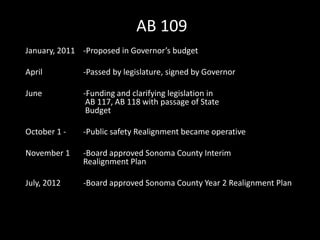
AB 109
January, 2011 -Proposed in Governor’s budget
April -Passed by legislature, signed by Governor
June -Funding and clarifying legislation in
AB 117, AB 118 with passage of State
Budget
October 1 - -Public safety Realignment became operative
November 1 -Board approved Sonoma County Interim
Realignment Plan
July, 2012 -Board approved Sonoma County Year 2 Realignment Plan
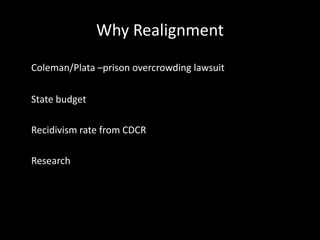
Why Realignment
Coleman/Plata –prison overcrowding lawsuit
State budget
Recidivism rate from CDCR
Research
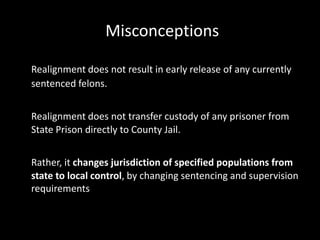
Misconceptions
Realignment does not result in early release of any currently
sentenced felons.
Realignment does not transfer custody of any prisoner from
State Prison directly to County Jail.
Rather, it changes jurisdiction of specified populations from
state to local control, by changing sentencing and supervision
requirements
AB 109 Overview
Shifted responsibility of specific felons to county control
Established Post Release Community Supervision (PRCS)
Established new sentencing scheme
Tasked Community Corrections Partnerships (CCPs) with
planning for, and implementation of local plans
Non-non-non Offenders
These offenders are serving their sentences locally, sentenced
under PC 1170(h).
Typically, sentence structured as some combination of local jail
time, with period under Mandatory Supervision by Probation.
Current or prior offense must be:
Non-violent
Non-serious
Non-sex
Unless excluded by one of 70+ specified crimes
Post Release
Community Supervision
(PRCS)
Probation supervises these offenders upon release from
prison:
– Current Non-violent offenders
– Current Non-serious offenders
– Some Sex offenders
– Does include offenders with a serious/violent offense in criminal
history (as long as it’s not current offense).
– Does not include 3rd strikers
Local Impacts
CDCR estimates of ADP for Sonoma County, at full
implementation:
- PRCS - 164 supervised by Probation
- PRCS - 21 in County Jail on violation
- Non-non-non - 230 additional in the local system
(some in County Jail; some on Mandatory Supervision,
supervised by Probation)
Local Impacts - Unknowns
-How many PRCS offenders will we receive?
-What will their needs and risk be?
-How will system charge, sentence non-non-nons?
-How many will be sentenced?
-How will they be sentenced?
Custody? Mandatory Supervision? Split?
-How will new laws impact Felony Probation?
-Impact of #s, credits, programming on County Jail ADP?
Realignment Challenge
Realignment provides limited funding for each County.
How will local system react?
Can we impact this?
How must our criminal justice system function to handle
many more offenders wisely, safely, and without losing
money?
Realignment Funding
Total funding at state level
Calculated from state’s experience/model
Distribution among 58 counties
CSAC created formula for FY 2011/2012
Local Plan
Community Corrections Partnership recommends, BOS approves
Sonoma County Strengths
Criminal Justice Master Plan
Belief in upstream initiatives
Culture of collaboration
Criminal Justice Master Plan
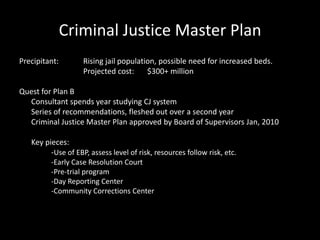
Precipitant: Rising jail population, possible need for increased beds.
Projected cost: $300+ million
Quest for Plan B
Consultant spends year studying CJ system
Series of recommendations, fleshed out over a second year
Criminal Justice Master Plan approved by Board of Supervisors Jan, 2010
Key pieces:
-Use of EBP, assess level of risk, resources follow risk, etc.
-Early Case Resolution Court
-Pre-trial program
-Day Reporting Center
-Community Corrections Center
Local Planning Process
Community Corrections Partnership (CCP)
14-member committee, created by SB 678 in 2009, predating
Realignment
Realignment builds on SB 678, and defines CCP Executive
committee (voting members)
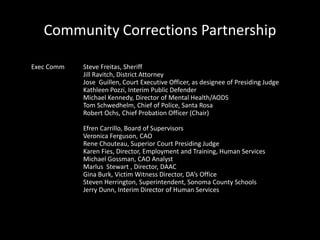
Community Corrections Partnership
Exec Comm Steve Freitas, Sheriff
Jill Ravitch, District Attorney
Jose Guillen, Court Executive Officer, as designee of Presiding Judge
Kathleen Pozzi, Interim Public Defender
Michael Kennedy, Director of Mental Health/AODS
Tom Schwedhelm, Chief of Police, Santa Rosa
Robert Ochs, Chief Probation Officer (Chair)
Efren Carrillo, Board of Supervisors
Veronica Ferguson, CAO
Rene Chouteau, Superior Court Presiding Judge
Karen Fies, Director, Employment and Training, Human Services
Michael Gossman, CAO Analyst
Marlus Stewart , Director, DAAC
Gina Burk, Victim Witness Director, DA’s Office
Steven Herrington, Superintendent, Sonoma County Schools
Jerry Dunn, Interim Director of Human Services
Organizing Principles
Use of detention beds should be minimized, in a manner that
is consistent with public safety, and the integrity of the
criminal justice system;
The system, and decisions, should be risk-based;
Research tested methods should be used, as much as
practicable.
Early CCP Decisions
County’s Criminal Justice Master Plan should be foundation
Programming should be provided for in-custody, as well as
out-of-custody offenders
A Day Reporting Center should be a fundamental component
of the Plan
Plan should be considered Interim
Sub-Committees
Supervision
Carla Maus, Chair
Sentencing
Judge Dana Simonds, Chair
Detention Alternatives/Programming/Reentry
Michael Kennedy, Sheralynn Freitas, Co-Chairs
Data Management and Evaluation
Kim Gilmore, Chair
Plan Development Considerations
• Realignment legislation itself
• CCP’s adopted Organizing Principles
• Sonoma County’s CJMP
• Sub-Committee recommendations
• Projections of local ADP numbers
• Assumptions about offenders’ risk and needs
• Anticipation of how criminal justice system will react
• Recognition that needs exceed resources, requiring
prioritization
Realignment Funding
Realignment legislation assumes Counties will manage these
populations differently than the State, through a combination
of jail time, supervision, detention alternatives, and
programming.
In fact, we must manage the new populations differently.
Funding will not be sufficient if we follow the State, i.e.:
-lock up offenders for significant periods
-not address needs and risk
-simply release
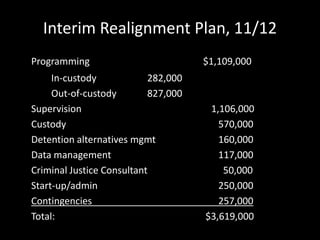
Interim Realignment Plan, 11/12
Programming $1,109,000
In-custody 282,000
Out-of-custody 827,000
Supervision 1,106,000
Custody 570,000
Detention alternatives mgmt 160,000
Data management 117,000
Criminal Justice Consultant 50,000
Start-up/admin 250,000
Contingencies 257,000
Total: $3,619,000
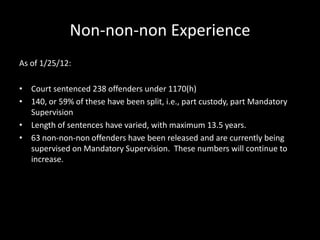
Non-non-non Experience
As of 1/25/12:
• Court sentenced 238 offenders under 1170(h)
• 140, or 59% of these have been split, i.e., part custody, part Mandatory
Supervision
• Length of sentences have varied, with maximum 13.5 years.
• 63 non-non-non offenders have been released and are currently being
supervised on Mandatory Supervision. These numbers will continue to
increase.
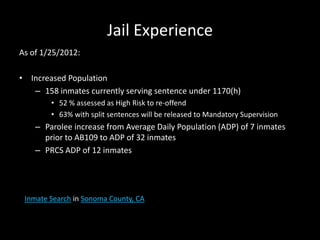
Jail Experience
As of 1/25/2012:
• Increased Population
– 158 inmates currently serving sentence under 1170(h)
• 52 % assessed as High Risk to re-offend
• 63% with split sentences will be released to Mandatory Supervision
– Parolee increase from Average Daily Population (ADP) of 7 inmates
prior to AB109 to ADP of 32 inmates
– PRCS ADP of 12 inmates
Inmate Search in Sonoma County, CA
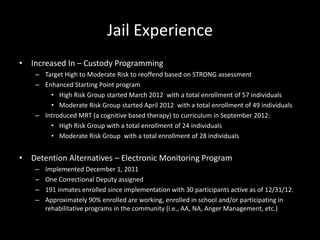
Jail Experience
• Increased In – Custody Programming
– Target High to Moderate Risk to reoffend based on STRONG assessment
– Enhanced Starting Point program
• High Risk Group started March 2012 with a total enrollment of 57 individuals
• Moderate Risk Group started April 2012 with a total enrollment of 49 individuals
– Introduced MRT (a cognitive based therapy) to curriculum in September 2012:
• High Risk Group with a total enrollment of 24 individuals
• Moderate Risk Group with a total enrollment of 28 individuals
• Detention Alternatives – Electronic Monitoring Program
– Implemented December 1, 2011
– One Correctional Deputy assigned
– 191 inmates enrolled since implementation with 30 participants active as of 12/31/12.
– Approximately 90% enrolled are working, enrolled in school and/or participating in
rehabilitative programs in the community (i.e., AA, NA, Anger Management, etc.)
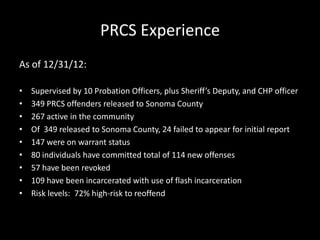
PRCS Experience
As of 12/31/12:
• Supervised by 10 Probation Officers, plus Sheriff’s Deputy, and CHP officer
• 349 PRCS offenders released to Sonoma County
• 267 active in the community
• Of 349 released to Sonoma County, 24 failed to appear for initial report
• 147 were on warrant status
• 80 individuals have committed total of 114 new offenses
• 57 have been revoked
• 109 have been incarcerated with use of flash incarceration
• Risk levels: 72% high-risk to reoffend
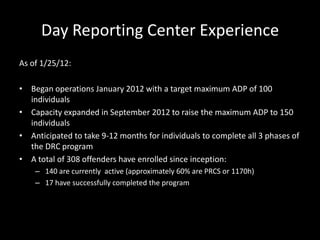
Day Reporting Center Experience
As of 1/25/12:
• Began operations January 2012 with a target maximum ADP of 100
individuals
• Capacity expanded in September 2012 to raise the maximum ADP to 150
individuals
• Anticipated to take 9-12 months for individuals to complete all 3 phases of
the DRC program
• A total of 308 offenders have enrolled since inception:
– 140 are currently active (approximately 60% are PRCS or 1170h)
– 17 have successfully completed the program
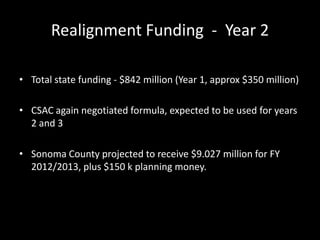
Realignment Funding - Year 2
• Total state funding - $842 million (Year 1, approx $350 million)
• CSAC again negotiated formula, expected to be used for years
2 and 3
• Sonoma County projected to receive $9.027 million for FY
2012/2013, plus $150 k planning money.
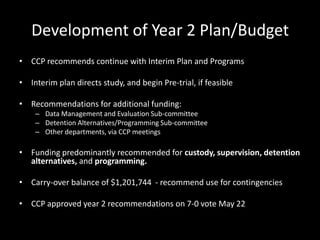
Development of Year 2 Plan/Budget
• CCP recommends continue with Interim Plan and Programs
• Interim plan directs study, and begin Pre-trial, if feasible
• Recommendations for additional funding:
– Data Management and Evaluation Sub-committee
– Detention Alternatives/Programming Sub-committee
– Other departments, via CCP meetings
• Funding predominantly recommended for custody, supervision, detention
alternatives, and programming.
• Carry-over balance of $1,201,744 - recommend use for contingencies
• CCP approved year 2 recommendations on 7-0 vote May 22
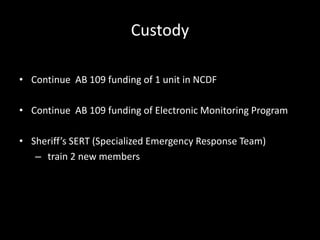
Custody
• Continue AB 109 funding of 1 unit in NCDF
• Continue AB 109 funding of Electronic Monitoring Program
• Sheriff’s SERT (Specialized Emergency Response Team)
– train 2 new members
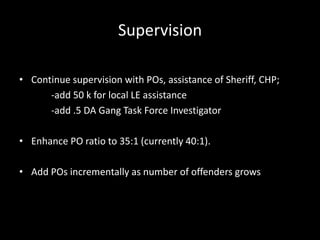
Supervision
• Continue supervision with POs, assistance of Sheriff, CHP;
-add 50 k for local LE assistance
-add .5 DA Gang Task Force Investigator
• Enhance PO ratio to 35:1 (currently 40:1).
• Add POs incrementally as number of offenders grows
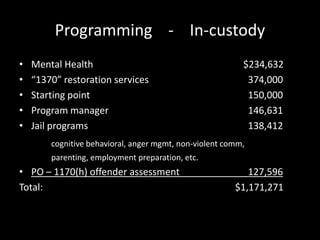
Programming - In-custody
• Mental Health $234,632
• “1370” restoration services 374,000
• Starting point 150,000
• Program manager 146,631
• Jail programs 138,412
cognitive behavioral, anger mgmt, non-violent comm,
parenting, employment preparation, etc.
• PO – 1170(h) offender assessment 127,596
Total: $1,171,271
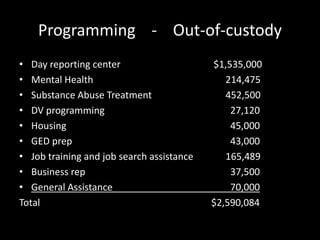
Programming - Out-of-custody
• Day reporting center $1,535,000
• Mental Health 214,475
• Substance Abuse Treatment 452,500
• DV programming 27,120
• Housing 45,000
• GED prep 43,000
• Job training and job search assistance 165,489
• Business rep 37,500
• General Assistance 70,000
Total $2,590,084
Additional Recommendations
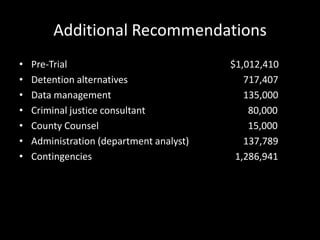
• Pre-Trial $1,012,410
• Detention alternatives 717,407
• Data management 135,000
• Criminal justice consultant 80,000
• County Counsel 15,000
• Administration (department analyst) 137,789
• Contingencies 1,286,941
Pre-trial
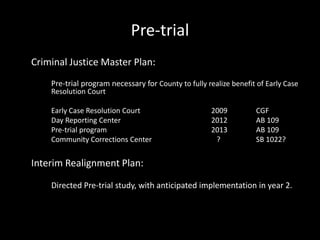
Criminal Justice Master Plan:
Pre-trial program necessary for County to fully realize benefit of Early Case
Resolution Court
Early Case Resolution Court 2009 CGF
Day Reporting Center 2012 AB 109
Pre-trial program 2013 AB 109
Community Corrections Center ? SB 1022?
Interim Realignment Plan:
Directed Pre-trial study, with anticipated implementation in year 2.
Pre-trial
Core system function providing universal front-end screening
Recommendations from Criminal Justice consultants:
-base on evidence-based “risk principle”
-develop locally derived pre-trial risk tool
-develop locally derived matrix - input from CJ stakeholders
-create hybrid program:
-Sheriff classification staff provide assessment
-Probation Officers provide supervision
Benefits:
-facilitates efficient case processing
-supports jail management
-risk-based decision making
-expedited access to available services
-increased effectiveness, by reducing pre-trial failure
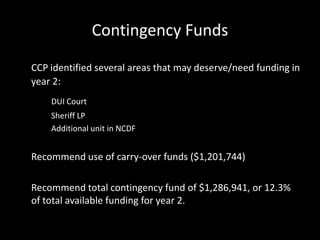
Contingency Funds
CCP identified several areas that may deserve/need funding in
year 2:
DUI Court
Sheriff LP
Additional unit in NCDF
Recommend use of carry-over funds ($1,201,744)
Recommend total contingency fund of $1,286,941, or 12.3%
of total available funding for year 2.
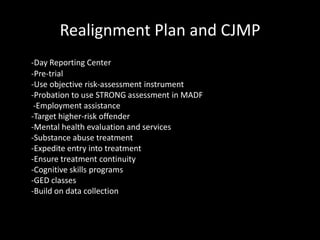
Realignment Plan and CJMP
-Day Reporting Center
-Pre-trial
-Use objective risk-assessment instrument
-Probation to use STRONG assessment in MADF
-Employment assistance
-Target higher-risk offender
-Mental health evaluation and services
-Substance abuse treatment
-Expedite entry into treatment
-Ensure treatment continuity
-Cognitive skills programs
-GED classes
-Build on data collection
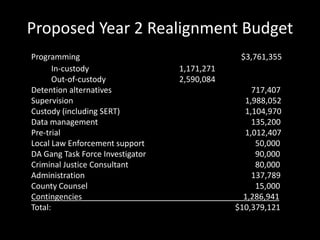
Proposed Year 2 Realignment Budget
Programming $3,761,355
In-custody 1,171,271
Out-of-custody 2,590,084
Detention alternatives 717,407
Supervision 1,988,052
Custody (including SERT) 1,104,970
Data management 135,200
Pre-trial 1,012,407
Local Law Enforcement support 50,000
DA Gang Task Force Investigator 90,000
Criminal Justice Consultant 80,000
Administration 137,789
County Counsel 15,000
Contingencies 1,286,941
Total: $10,379,121
Data Collection
Board of State and Community Corrections (BSCC) working with:
Administrative Office of Courts
California State Association of Counties
State Sheriff’s Association
Chief Probation Officers of California
Developing and implementing first phase baseline and ongoing data
collection instruments
Data Collection
State Sheriffs collecting for each county:
PRCS:
Total booked, booked on flash, booked on new charge
Serving jail time for revocation
1170h sentences:
Number sentenced to local custody
Offenders released to sheriff’s alternative custody program
Number from alt custody program returned to custody
State parolees:
Booked on parole violation, new charges, serving local sentence
Data Collection
Chief Probation Officers collecting for each county:
PRCS: 1170h sentences:
Released from CDCR jail only
On warrant split sentences
Closures active
Recidivism
Active
New felony probation grants
Data Collection
Sonoma County
– Recommend hiring consultant to assist in establishing long-term
evaluation for Sonoma County’s Realignment plan.
• Based on best-practices
• Determine data elements
• Determine evaluation questions
– Hire Business Intelligence Programmer – to build data gathering
process and reports to implement the above plan.
– Inter-department data sharing pilot between Probation, Health, and
Human Services, to match individuals across disparate data sources.
This plan:
-Protects public safety
-Is balanced
-Is an upstream approach
-Is consistent with Criminal Justice Master Plan
-Is consistent with Sonoma County’s values
-Fits within anticipated resources

Sonoma county - Public Safety Realignment

  • 1.
  • 2.
    AB 109 January, 2011-Proposed in Governor’s budget April -Passed by legislature, signed by Governor June -Funding and clarifying legislation in AB 117, AB 118 with passage of State Budget October 1 - -Public safety Realignment became operative November 1 -Board approved Sonoma County Interim Realignment Plan July, 2012 -Board approved Sonoma County Year 2 Realignment Plan
  • 3.
    Why Realignment Coleman/Plata –prisonovercrowding lawsuit State budget Recidivism rate from CDCR Research
  • 4.
    Misconceptions Realignment does notresult in early release of any currently sentenced felons. Realignment does not transfer custody of any prisoner from State Prison directly to County Jail. Rather, it changes jurisdiction of specified populations from state to local control, by changing sentencing and supervision requirements
  • 5.
    AB 109 Overview Shiftedresponsibility of specific felons to county control Established Post Release Community Supervision (PRCS) Established new sentencing scheme Tasked Community Corrections Partnerships (CCPs) with planning for, and implementation of local plans
  • 6.
    Non-non-non Offenders These offendersare serving their sentences locally, sentenced under PC 1170(h). Typically, sentence structured as some combination of local jail time, with period under Mandatory Supervision by Probation. Current or prior offense must be: Non-violent Non-serious Non-sex Unless excluded by one of 70+ specified crimes
  • 7.
    Post Release Community Supervision (PRCS) Probationsupervises these offenders upon release from prison: – Current Non-violent offenders – Current Non-serious offenders – Some Sex offenders – Does include offenders with a serious/violent offense in criminal history (as long as it’s not current offense). – Does not include 3rd strikers
  • 8.
    Local Impacts CDCR estimatesof ADP for Sonoma County, at full implementation: - PRCS - 164 supervised by Probation - PRCS - 21 in County Jail on violation - Non-non-non - 230 additional in the local system (some in County Jail; some on Mandatory Supervision, supervised by Probation)
  • 9.
    Local Impacts -Unknowns -How many PRCS offenders will we receive? -What will their needs and risk be? -How will system charge, sentence non-non-nons? -How many will be sentenced? -How will they be sentenced? Custody? Mandatory Supervision? Split? -How will new laws impact Felony Probation? -Impact of #s, credits, programming on County Jail ADP?
  • 10.
    Realignment Challenge Realignment provideslimited funding for each County. How will local system react? Can we impact this? How must our criminal justice system function to handle many more offenders wisely, safely, and without losing money?
  • 11.
    Realignment Funding Total fundingat state level Calculated from state’s experience/model Distribution among 58 counties CSAC created formula for FY 2011/2012 Local Plan Community Corrections Partnership recommends, BOS approves
  • 12.
    Sonoma County Strengths CriminalJustice Master Plan Belief in upstream initiatives Culture of collaboration
  • 13.
    Criminal Justice MasterPlan Precipitant: Rising jail population, possible need for increased beds. Projected cost: $300+ million Quest for Plan B Consultant spends year studying CJ system Series of recommendations, fleshed out over a second year Criminal Justice Master Plan approved by Board of Supervisors Jan, 2010 Key pieces: -Use of EBP, assess level of risk, resources follow risk, etc. -Early Case Resolution Court -Pre-trial program -Day Reporting Center -Community Corrections Center
  • 14.
    Local Planning Process CommunityCorrections Partnership (CCP) 14-member committee, created by SB 678 in 2009, predating Realignment Realignment builds on SB 678, and defines CCP Executive committee (voting members)
  • 15.
    Community Corrections Partnership ExecComm Steve Freitas, Sheriff Jill Ravitch, District Attorney Jose Guillen, Court Executive Officer, as designee of Presiding Judge Kathleen Pozzi, Interim Public Defender Michael Kennedy, Director of Mental Health/AODS Tom Schwedhelm, Chief of Police, Santa Rosa Robert Ochs, Chief Probation Officer (Chair) Efren Carrillo, Board of Supervisors Veronica Ferguson, CAO Rene Chouteau, Superior Court Presiding Judge Karen Fies, Director, Employment and Training, Human Services Michael Gossman, CAO Analyst Marlus Stewart , Director, DAAC Gina Burk, Victim Witness Director, DA’s Office Steven Herrington, Superintendent, Sonoma County Schools Jerry Dunn, Interim Director of Human Services
  • 16.
    Organizing Principles Use ofdetention beds should be minimized, in a manner that is consistent with public safety, and the integrity of the criminal justice system; The system, and decisions, should be risk-based; Research tested methods should be used, as much as practicable.
  • 17.
    Early CCP Decisions County’sCriminal Justice Master Plan should be foundation Programming should be provided for in-custody, as well as out-of-custody offenders A Day Reporting Center should be a fundamental component of the Plan Plan should be considered Interim
  • 18.
    Sub-Committees Supervision Carla Maus, Chair Sentencing JudgeDana Simonds, Chair Detention Alternatives/Programming/Reentry Michael Kennedy, Sheralynn Freitas, Co-Chairs Data Management and Evaluation Kim Gilmore, Chair
  • 19.
    Plan Development Considerations •Realignment legislation itself • CCP’s adopted Organizing Principles • Sonoma County’s CJMP • Sub-Committee recommendations • Projections of local ADP numbers • Assumptions about offenders’ risk and needs • Anticipation of how criminal justice system will react • Recognition that needs exceed resources, requiring prioritization
  • 20.
    Realignment Funding Realignment legislationassumes Counties will manage these populations differently than the State, through a combination of jail time, supervision, detention alternatives, and programming. In fact, we must manage the new populations differently. Funding will not be sufficient if we follow the State, i.e.: -lock up offenders for significant periods -not address needs and risk -simply release
  • 21.
    Interim Realignment Plan,11/12 Programming $1,109,000 In-custody 282,000 Out-of-custody 827,000 Supervision 1,106,000 Custody 570,000 Detention alternatives mgmt 160,000 Data management 117,000 Criminal Justice Consultant 50,000 Start-up/admin 250,000 Contingencies 257,000 Total: $3,619,000
  • 22.
    Non-non-non Experience As of1/25/12: • Court sentenced 238 offenders under 1170(h) • 140, or 59% of these have been split, i.e., part custody, part Mandatory Supervision • Length of sentences have varied, with maximum 13.5 years. • 63 non-non-non offenders have been released and are currently being supervised on Mandatory Supervision. These numbers will continue to increase.
  • 23.
    Jail Experience As of1/25/2012: • Increased Population – 158 inmates currently serving sentence under 1170(h) • 52 % assessed as High Risk to re-offend • 63% with split sentences will be released to Mandatory Supervision – Parolee increase from Average Daily Population (ADP) of 7 inmates prior to AB109 to ADP of 32 inmates – PRCS ADP of 12 inmates Inmate Search in Sonoma County, CA
  • 24.
    Jail Experience • IncreasedIn – Custody Programming – Target High to Moderate Risk to reoffend based on STRONG assessment – Enhanced Starting Point program • High Risk Group started March 2012 with a total enrollment of 57 individuals • Moderate Risk Group started April 2012 with a total enrollment of 49 individuals – Introduced MRT (a cognitive based therapy) to curriculum in September 2012: • High Risk Group with a total enrollment of 24 individuals • Moderate Risk Group with a total enrollment of 28 individuals • Detention Alternatives – Electronic Monitoring Program – Implemented December 1, 2011 – One Correctional Deputy assigned – 191 inmates enrolled since implementation with 30 participants active as of 12/31/12. – Approximately 90% enrolled are working, enrolled in school and/or participating in rehabilitative programs in the community (i.e., AA, NA, Anger Management, etc.)
  • 25.
    PRCS Experience As of12/31/12: • Supervised by 10 Probation Officers, plus Sheriff’s Deputy, and CHP officer • 349 PRCS offenders released to Sonoma County • 267 active in the community • Of 349 released to Sonoma County, 24 failed to appear for initial report • 147 were on warrant status • 80 individuals have committed total of 114 new offenses • 57 have been revoked • 109 have been incarcerated with use of flash incarceration • Risk levels: 72% high-risk to reoffend
  • 26.
    Day Reporting CenterExperience As of 1/25/12: • Began operations January 2012 with a target maximum ADP of 100 individuals • Capacity expanded in September 2012 to raise the maximum ADP to 150 individuals • Anticipated to take 9-12 months for individuals to complete all 3 phases of the DRC program • A total of 308 offenders have enrolled since inception: – 140 are currently active (approximately 60% are PRCS or 1170h) – 17 have successfully completed the program
  • 27.
    Realignment Funding -Year 2 • Total state funding - $842 million (Year 1, approx $350 million) • CSAC again negotiated formula, expected to be used for years 2 and 3 • Sonoma County projected to receive $9.027 million for FY 2012/2013, plus $150 k planning money.
  • 28.
    Development of Year2 Plan/Budget • CCP recommends continue with Interim Plan and Programs • Interim plan directs study, and begin Pre-trial, if feasible • Recommendations for additional funding: – Data Management and Evaluation Sub-committee – Detention Alternatives/Programming Sub-committee – Other departments, via CCP meetings • Funding predominantly recommended for custody, supervision, detention alternatives, and programming. • Carry-over balance of $1,201,744 - recommend use for contingencies • CCP approved year 2 recommendations on 7-0 vote May 22
  • 29.
    Custody • Continue AB109 funding of 1 unit in NCDF • Continue AB 109 funding of Electronic Monitoring Program • Sheriff’s SERT (Specialized Emergency Response Team) – train 2 new members
  • 30.
    Supervision • Continue supervisionwith POs, assistance of Sheriff, CHP; -add 50 k for local LE assistance -add .5 DA Gang Task Force Investigator • Enhance PO ratio to 35:1 (currently 40:1). • Add POs incrementally as number of offenders grows
  • 31.
    Programming - In-custody •Mental Health $234,632 • “1370” restoration services 374,000 • Starting point 150,000 • Program manager 146,631 • Jail programs 138,412 cognitive behavioral, anger mgmt, non-violent comm, parenting, employment preparation, etc. • PO – 1170(h) offender assessment 127,596 Total: $1,171,271
  • 32.
    Programming - Out-of-custody •Day reporting center $1,535,000 • Mental Health 214,475 • Substance Abuse Treatment 452,500 • DV programming 27,120 • Housing 45,000 • GED prep 43,000 • Job training and job search assistance 165,489 • Business rep 37,500 • General Assistance 70,000 Total $2,590,084
  • 33.
    Additional Recommendations • Pre-Trial$1,012,410 • Detention alternatives 717,407 • Data management 135,000 • Criminal justice consultant 80,000 • County Counsel 15,000 • Administration (department analyst) 137,789 • Contingencies 1,286,941
  • 34.
    Pre-trial Criminal Justice MasterPlan: Pre-trial program necessary for County to fully realize benefit of Early Case Resolution Court Early Case Resolution Court 2009 CGF Day Reporting Center 2012 AB 109 Pre-trial program 2013 AB 109 Community Corrections Center ? SB 1022? Interim Realignment Plan: Directed Pre-trial study, with anticipated implementation in year 2.
  • 35.
    Pre-trial Core system functionproviding universal front-end screening Recommendations from Criminal Justice consultants: -base on evidence-based “risk principle” -develop locally derived pre-trial risk tool -develop locally derived matrix - input from CJ stakeholders -create hybrid program: -Sheriff classification staff provide assessment -Probation Officers provide supervision Benefits: -facilitates efficient case processing -supports jail management -risk-based decision making -expedited access to available services -increased effectiveness, by reducing pre-trial failure
  • 36.
    Contingency Funds CCP identifiedseveral areas that may deserve/need funding in year 2: DUI Court Sheriff LP Additional unit in NCDF Recommend use of carry-over funds ($1,201,744) Recommend total contingency fund of $1,286,941, or 12.3% of total available funding for year 2.
  • 37.
    Realignment Plan andCJMP -Day Reporting Center -Pre-trial -Use objective risk-assessment instrument -Probation to use STRONG assessment in MADF -Employment assistance -Target higher-risk offender -Mental health evaluation and services -Substance abuse treatment -Expedite entry into treatment -Ensure treatment continuity -Cognitive skills programs -GED classes -Build on data collection
  • 38.
    Proposed Year 2Realignment Budget Programming $3,761,355 In-custody 1,171,271 Out-of-custody 2,590,084 Detention alternatives 717,407 Supervision 1,988,052 Custody (including SERT) 1,104,970 Data management 135,200 Pre-trial 1,012,407 Local Law Enforcement support 50,000 DA Gang Task Force Investigator 90,000 Criminal Justice Consultant 80,000 Administration 137,789 County Counsel 15,000 Contingencies 1,286,941 Total: $10,379,121
  • 39.
    Data Collection Board ofState and Community Corrections (BSCC) working with: Administrative Office of Courts California State Association of Counties State Sheriff’s Association Chief Probation Officers of California Developing and implementing first phase baseline and ongoing data collection instruments
  • 40.
    Data Collection State Sheriffscollecting for each county: PRCS: Total booked, booked on flash, booked on new charge Serving jail time for revocation 1170h sentences: Number sentenced to local custody Offenders released to sheriff’s alternative custody program Number from alt custody program returned to custody State parolees: Booked on parole violation, new charges, serving local sentence
  • 41.
    Data Collection Chief ProbationOfficers collecting for each county: PRCS: 1170h sentences: Released from CDCR jail only On warrant split sentences Closures active Recidivism Active New felony probation grants
  • 42.
    Data Collection Sonoma County –Recommend hiring consultant to assist in establishing long-term evaluation for Sonoma County’s Realignment plan. • Based on best-practices • Determine data elements • Determine evaluation questions – Hire Business Intelligence Programmer – to build data gathering process and reports to implement the above plan. – Inter-department data sharing pilot between Probation, Health, and Human Services, to match individuals across disparate data sources.
  • 43.
    This plan: -Protects publicsafety -Is balanced -Is an upstream approach -Is consistent with Criminal Justice Master Plan -Is consistent with Sonoma County’s values -Fits within anticipated resources