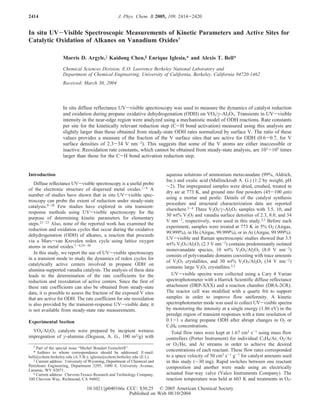
In situ UV-Visible Spectroscopic Measurements of Kinetic Parameters and Active Sites for
Catalytic Oxidation of Alkanes on Vanadium Oxides†
Morris D. Argyle,‡ Kaidong Chen,§ Enrique Iglesia,* and Alexis T. Bell*
Chemical Sciences DiVision, E.O. Lawrence Berkeley National Laboratory and
Department of Chemical Engineering, UniVersity of California, Berkeley, California 94720-1462
ReceiVed: March 30, 2004
In situ diffuse reflectance UV-visible spectroscopy was used to measure the dynamics of catalyst reduction
and oxidation during propane oxidative dehydrogenation (ODH) on VOx/γ-Al2O3. Transients in UV-visible
intensity in the near-edge region were analyzed using a mechanistic model of ODH reactions. Rate constants
per site for the kinetically relevant reduction step (C-H bond activation) measured using this analysis are
slightly larger than those obtained from steady-state ODH rates normalized by surface V. The ratio of these
values provides a measure of the fraction of the V surface sites that are active for ODH (0.6-0.7, for V
surface densities of 2.3-34 V nm-2). This suggests that some of the V atoms are either inaccessible or
inactive. Reoxidation rate constants, which cannot be obtained from steady-state analysis, are 103-105 times
larger than those for the C-H bond activation reduction step.
Introduction
Diffuse reflectance UV-visible spectroscopy is a useful probe
of the electronic structure of dispersed metal oxides.1-8 A
number of studies have shown that in situ UV-visible spec-
troscopy can probe the extent of reduction under steady-state
catalysis.9-20 Few studies have explored in situ transient-
response methods using UV-visible spectroscopy for the
purpose of determining kinetic parameters for elementary
steps.21-23 Also, none of the reported work has examined the
reduction and oxidation cycles that occur during the oxidative
dehydrogenation (ODH) of alkanes, a reaction that proceeds
via a Mars-van Krevelen redox cycle using lattice oxygen
atoms in metal oxides.1-4,24-30
In this study, we report the use of UV-visible spectroscopy
in a transient mode to study the dynamics of redox cycles for
catalytically active centers involved in propane ODH on
alumina-supported vanadia catalysts. The analysis of these data
leads to the determination of the rate coefficients for the
reduction and reoxidation of active centers. Since the first of
these rate coefficients can also be obtained from steady-state
data, it is possible to assess the fraction of the exposed V sites
that are active for ODH. The rate coefficient for site reoxidation
is also provided by the transient-response UV-visible data; it
is not available from steady-state rate measurements.
Experimental Section
VOx/Al2O3 catalysts were prepared by incipient wetness
impregnation of γ-alumina (Degussa, A. G., 100 m2/g) with
aqueous solutions of ammonium metavanadate (99%, Aldrich,
Inc.) and oxalic acid (Mallinckrodt A. G.) (1:2 by weight, pH
∼2). The impregnated samples were dried, crushed, treated in
dry air at 773 K, and ground into fine powders (45-100 µm)
using a mortar and pestle. Details of the catalyst synthesis
procedure and structural characterization data are reported
elsewhere.2-4 Three V2O5/γ-Al2O3 samples with 3.5, 10, and
30 wt% V2O5 and vanadia surface densities of 2.3, 8.0, and 34
V nm-2, respectively, were used in this study.2,3 Before each
experiment, samples were treated at 773 K in 5% O2 (Airgas,
99.999%), in He (Airgas, 99.999%), or in Ar (Airgas, 99.999%).
UV-visible and Raman spectroscopic studies showed that 3.5
wt% V2O5/Al2O3 (2.3 V nm-2) contains predominantly isolated
monovanadate species, 10 wt% V2O5/Al2O3 (8.0 V nm-2)
consists of polyvanadate domains coexisting with trace amounts
of V2O5 crystallites, and 30 wt% V2O5/Al2O3 (34 V nm-2)
contains large V2O5 crystallites.2,3
UV-visible spectra were collected using a Cary 4 Varian
spectrophotometer with a Harrick Scientific diffuse reflectance
attachment (DRP-XXX) and a reaction chamber (DRA-2CR).
The reactor cell was modified with a quartz frit to support
samples in order to improve flow uniformity. A kinetic
spectrophotometer mode was used to collect UV-visible spectra
by monitoring the intensity at a single energy (1.86 eV) in the
preedge region of transient responses with a time resolution of
0.1-1 s during propane ODH after abrupt changes in O2 or
C3H8 concentrations.
Total flow rates were kept at 1.67 cm3 s-1 using mass flow
controllers (Porter Instrument) for individual C3H8/Ar, O2/Ar
or O2/He, and Ar streams in order to achieve the desired
concentrations of each reactant. These flow rates corresponded
to a space velocity of 50 cm3 s-1 g-1 for catalyst amounts used
in this study (∼30 mg). Rapid switches between one reactant
composition and another were made using an electrically
actuated four-way valve (Valco Instruments Company). The
reaction temperature was held at 603 K and treatments in O2-
† Part of the special issue “Michel Boudart Festschrift”.
* Authors to whom correspondence should be addressed. E-mail:
bell@cchem.berkeley.edu (A.T.B.); iglesia@cchem.berkeley.edu (E.I.).
‡ Current address: University of Wyoming, Department of Chemical and
Petroleum Engineering, Department 3295, 1000 E. University Avenue,
Laramie, WY 82071.
§ Current address: Chevron-Texaco Research and Technology Company,
100 Chevron Way, Richmond, CA 94802.
2414 J. Phys. Chem. B 2005, 109, 2414-2420
10.1021/jp040166c CCC: $30.25 © 2005 American Chemical Society
Published on Web 08/10/2004
containing streams were carried out at 773 K to re-oxidize
samples. A thermocouple located within the catalyst bed was
used to measure local temperatures; another thermocouple
inserted within the heater beneath the sample holder recorded
temperatures as much as 100 K above sample temperatures, as
previously reported.9,11 Propane ODH experiments were con-
ducted at 603 K using C3H8 (Airgas, 99.9%) and O2 (Airgas,
99.99%) reactants diluted to the desired partial pressures with
Ar (Airgas, 99.999%). Partial pressures for each reactant were
varied independently from 1.0 to 16 kPa, while keeping the other
reactant at 4.0 kPa; the intervals between composition changes
were 300 s.
Results and Discussion
UV-visible measurements were carried out during transient
ODH reaction conditions. The experiments were carried out
using a catalyst treated for 300 s of exposure to 4.0 kPa O2.The
inlet stream was then switched to one containing C3H8 and O2
for 300 s. The partial pressure of one of the reactants was held
constant for the duration of the ODH experiment, while the other
was varied every 300 s. Absorption intensities (at 1.86 eV) were
converted to extent of reduction and the catalytically irrelevant
portion of the measured absorbance was excluded using methods
previously reported.19,20 Figure 1, which was adapted from a
previous publication,20 shows reduction transients resulting from
step-wise changes in C3H8 pressure at constant O2 pressure; each
cycle feed composition cycle was followed by a treatment in 4
kPa O2 at 603 K for 300 s. Results similar to those shown in
Figure 1 were obtained with O2 partial-pressure cycles (not
shown). In this latter case, the experiment was started by
switching from a stream containing 4 kPa O2 to one consisting
of 16 kPa O2 and 4 kPa of C3H8.
As noted previously,20 transient responses, such as those
shown in Figure 1, contain two componentssa rapid response
with a time-scale of catalytic turnovers (<1000 s) and a
significantly slower process, which reflects changes in the
structure of the vanadia domains or oxygen removal from the
internal crystalline region, without direct relevance to the
dynamics of catalytic turnovers. The procedure described
previously20 was used to isolate the portion of each transient
that reflects catalytically relevant processes. The resulting
transients are shown in Figures 2-4. We note that transients
involving increasing or decreasing concentrations were identical,
except for the sign of the transient, and that repeated transients
were highly reproducible.
The observed transient responses were fitted to the time
dependence of the concentration of reduced centers derived from
a previously reported mechanism of ODH processes,29,30 modi-
fied to account for combustion pathways (Scheme 1, reactions
1-5). The concentrations of four surface intermediates in the
mechanism were considered initially: oxygen ([O*]), vacancies
([*]), hydroxyl groups ([OH*]), and isopropoxide species
([C3H7O*]). The combustion steps were not analyzed in detail,
as indicated by the ellipsis in reactions 3a and 3b. The sequence
of elementary steps leading to combustion products ultimately
results in the formation of the number of reduced-surface species
shown in reactions 3a and 3b. These steps are known to involve
surface oxygen and reduced-surface species because lattice
oxygen atoms from the catalyst are incorporated in all combus-
tion products, as shown by isotopic labeling studies.29-31 The
first step was assumed to be quasi-equilibrated with a small K1
value. Consequently, the concentration of physisorbed propane
[(C3H8O*]) can be neglected in the site balance. Step 2 is the
kinetically relevant step,29-30 and rate constants of subsequent
steps are, therefore, inaccessible from steady-state rate data.
A set of coupled, nonlinear differential equations were derived
to described the time-dependent response of the surface spe-
cies.31 These equations were then non-dimensionalized using
the ratio of each surface species concentration to the total
concentration of active surface sites ([L]). Thus, χ ) [OH*]/
[L], φ ) [*]/[L], θ ) [C3H7O*]/[L], ψ ) [O*]/[L], and χ + φ
+ θ + ψ ) 1. As a result, only three of the differential equations
are independent, and the time-dependent response of the fourth
surface species may be obtained from this overall site balance.
The three differential equations describing the surface-reduced
species and the algebraic equation representing the fraction of
surface oxygen, derived from the site balance, are given by eqs
1-4. A derivation of these equations is given in ref 31.
The dimensionless reduced time, τ, is defined as the actual time
divided by the characteristic time for the kinetically relevant
C-H bond activation step:
Figure 1. Extent of reduction during step changes in C3H8 concentra-
tion of 300 s duration, starting from the fully oxidized catalyst [10
wt% V2O5/Al2O3 (8.0 V nm-2
), 603 K, 4.0 kPa O2, each cycle
progresses through 0, 1.0, 2.0, 4.0, 8.0, 16, 8.0, 4.0, 2.0, 1.0 kPa C3H8,
balance Ar, 603 K]. Adapted from ref 20.
dχ
dτ
) ( 1 - χ - θ - φ)2
+ λ1
1
[C3H8]
θ - 2
2
[C3
H8]
χ2
+
2 3
[H2O]
[C3H8]
(1 - χ - θ - φ)φ (1)
dθ
dτ
) (1 - χ - θ - φ)2
-
1
[C3H8]
θ (2)
dφ
dτ
) λ2
1
[C3H8]
θ +
2
[C3H8]
χ2 - 3
[H2O]
[C3H8]
(1 - χ - θ -
φ)φ - 2 4
[O2]
[C3H8]
φ2
(3)
ψ ) 1 - χ - θ - φ (4)
τ )
t
τr
) K1k2[C3H8]t (5)
Catalytic Oxidation of Alkanes on Vanadium Oxides J. Phys. Chem. B, Vol. 109, No. 6, 2005 2415
The other four parameters, i, are defined as
The factors λi are defined as
where x1 and x2 are the fractional selectivities to propene and
CO, respectively.
The numerical solution of eqs 1-4 was fitted to the transient
response data shown in Figures 2-4 by adjusting the values of
k2K1, k3, k4, k-4, and k5. The reactant concentrations used in
eqs 1-4 were those prevailing during the transient. Since the
conversions of C3H8 and O2 were small (<1% and <5%,
respectively), inlet concentrations were used. The water con-
centration during the transient could not be reliably measured
by mass spectroscopy; instead, it was calculated based on the
stoichiometric amount expected for the observed concentrations
of propene, CO, and CO2. Since steady-state observations
showed the selectivity to C3H6 and CO to be nearly independent
of feed composition at low reactant conversions, the values of
x1 and x2 were taken to be constant (see Table 1).2,3
The extent of reduction, defined as the number of one-electron
reduced centers per V atom (nr), was calculated by adding the
fractional coverages of all reduced species after doubling
vacancy concentrations, which represent two-electron reduction
events (eq 8). The parameters τr and i were obtained using
Figure 2. Experimental data (heavy lines) compared with the simplified model results (light lines) for normalized extent of reduction response
during 300 s transients. Figure 2a-e are C3H8 concentration transients [(a) 1.0, (b) 2.0, (c) 4.0, (d) 8.0, and (e) 16 kPa C3H8 at 4.0 kPa O2]. Figure
2f-j are O2 concentration transients [(f) 16, (g) 8.0, (h) 4.0, (i) 2.0, and (j) 1.0 kPa O2 at 4.0 kPa C3H8]. [3.5 wt% V2O5/Al2O3 (2.3 V nm-2
), 603
K].
1 )
k3
k2K1
2 )
k-4
k2K1
3 )
k4
k2K1
4 )
k5
k2K1
(6)
λ1 ) 7 - 6x1 (7a)
λ2 ) 3(2 - 2x1 - x2) (7b)
nr ) χ + θ + 2φ (8)
2416 J. Phys. Chem. B, Vol. 109, No. 6, 2005 Argyle et al.
standard nonlinear regression techniques in Mathematica 4.0.
The initial values of τr and i were varied over 8 orders of
magnitude to ensure that the chosen parameters corresponded
to global error minima in the estimation procedure.
These methods of analysis indicate that vacancies are the
predominant reduced species (φ ) [*]/[L] ) 0.05 at 16 kPa
C3H8, 4 kPa O2 on 10 wt% V2O5/Al2O3) at the low-water-
concentration conditions prevalent in this study. The same
conclusion was drawn from steady-state reaction rates.19,20
Vacancies account for most (>90%) of the reduced species for
all catalysts and reactant ratios. Consistent with this, the best
fit of the model to the data was insensitive to the values of 1,
2, and 3. The insensitivity of the model to the value of 1
suggests that isoproproxide conversion rate constants are
significantly larger than those for its formation; hence, θ reaches
steady-state more rapidly than nr. In agreement with this
conclusion, the steady-state values of θ are small, e.g., θ < 4
× 10-4 at 16 kPa C3H8, 4 kPa O2 on 10 wt% V2O5/Al2O3. The
insensitivity of the model to the value of 2 and 3 suggests
that water-formation steps are quasi-equilibrated, as assumed
in previous mechanistic analyses and confirmed by kinetic and
isotopic tracer studies.29-32 The steady-state values of χ are also
small (e.g., χ < 0.003 at 16 kPa C3H8, 4 kPa O2 on 10 wt%
V2O5/Al2O3). The small values of θ and χ lead to a simple
expression for the concentration of reduced centers (eq 9):
The model was then simplified by applying the pseudo-
steady-state hypothesis to θ and χ ([C3H7O*]/[L] and [OH*]/
[L], respectively), which implies that the derivatives of θ and
χ with respect to τ are small and do not vary significantly with
Figure 3. Experimental data (heavy lines) compared with the simplified model results (light lines) for normalized extent of reduction response
during 300 s transients. Figure 3a-e are C3H8 concentration transients [(a) 1.0, (b) 2.0, (c) 4.0, (d) 8.0, and (e) 16 kPa C3H8 at 4.0 kPa O2]. Figure
3f-j are O2 concentration transients [(f) 16, (g) 8.0, (h) 4.0, (i) 2.0, and (j) 1.0 kPa O2 at 4.0 kPa C3H8]. [10 wt% V2O5/Al2O3 (8.0 V nm-2
), 603
K].
nr = 2φ (9)
Catalytic Oxidation of Alkanes on Vanadium Oxides J. Phys. Chem. B, Vol. 109, No. 6, 2005 2417
time in the time scale of the transient response of turnover rates
for the entire catalytic sequence. Since steady-state φ values
are small (<0.05), ψ was taken to be ∼1.0. With these
simplifying assumptions, the time-dependent response of the
Figure 4. Experimental data (heavy lines) compared with the simplified model results (light lines) for normalized extent of reduction response
during 300 s transients. Figure 4a-e are C3H8 concentration transients [(a) 1.0, (b) 2.0, (c) 4.0, (d) 8.0, and (e) 16 kPa C3H8 at 4.0 kPa O2]. Figure
4f-j are O2 concentration transients [(f) 16, (g) 8.0, (h) 4.0, (i) 2.0, and (j) 1.0 kPa O2 at 4.0 kPa C3H8]. [30 wt% V2O5/Al2O3 (34 V nm-2
), 603
K].
TABLE 1: Initial Propane ODH Selectivities to C3H6 (x1),
CO (x2), and CO2 (x3) Obtained from Steady-State ODH
Experiments2,a
catalyst
(wt% V2O5
on Al2O3)
C3H6
selectivity
(x1)
CO
selectivity
(x2)
CO2
selectivity
(x3)
3.5 0.85 0.086 0.064
10 0.84 0.11 0.05
30 0.74 0.19 0.07
a
603 K, 14 kPa C3H8, 1.7 kPa O2, balance He.
SCHEME 1
2418 J. Phys. Chem. B, Vol. 109, No. 6, 2005 Argyle et al.
reduced centers reduces to one nonlinear differential equation31
with the solution:
where a ) 2λ2 + (1 + λ1), b2 ) 4 [O2]/[C3H8] evaluated at
the reactant concentrations prevalent during the transient, and
nr
SSi
is the value of nr at steady-state either at the start of the
transient, i ) 1, or at the end, i ) 2.31
At steady-state, the surface concentration of reduced centers,
nr
ss
, is given by:
Equation 13 predicts that for each catalyst, nr
ss
only depends on
([C3H8]/[O2])0.5. Assuming λ1 and λ2 to be independent of feed
composition, 4 can be determined for each catalyst from a fit
of eq 13 to a plot of nr
ss
versus ([C3H8]/[O2])0.5 data, as shown
in Figure 5. The values of 4 determined in this manner are
given in Table 2 for each catalyst.
The transient-response data obtained for each catalyst were
fitted to the numerical model solution of eq 10 by adjusting the
value of K1k2, assuming the value of 4 ) k5/k2K1 to be that
obtained from steady-state data (see Table 2). The results of
the simplified model are compared with experimental data in
Figures 2-4, for 3.5, 10, and 30 wt% V2O5/Al2O3, respectively.
The ordinate in these plots is the normalized extent of reduction,
nr*, which is given by:
In eq 14, nr
SS1
is the extent of reduction at steady-state
immediately before a step change in inlet concentration, and
nr
SS2
is the steady-state extent of reduction reached at the end
of the imposed transient. The dark lines in Figures 2-4 represent
experimental data, and the lighter lines represent model predic-
tions. The leftmost columns in Figures 2-4 (labeled a-e) show
experiments in which C3H8 partial pressure was varied at
constant O2 pressure. The rightmost columns (labeled f-j)
contain results of varying O2 at constant C3H8 partial pressure.
This single-parameter model accurately describes transient
data at short times but becomes less accurate at longer times
(Figures 2-4), suggesting that different types of surface sites
with a range of turnover frequencies may be involved in the
reaction, as expected for surfaces with V atoms in various
geometries (e.g., edges and plateaus). In addition, the model
tends to underestimate the initial slope at low C3H8 and O2
partial pressures and to overestimate the slope at high C3H8 and
O2 partial pressures. No explanation for this behavior can be
given at this time.
Table 3 shows the rate parameters obtained from this transient
model. The values of K1k2 obtained from these data increase
with increasing vanadia surface density in a manner similar to
that observed for the K1k2 values obtained from steady-state
rate data.29,30 As discussed previously,20,29,30 this pattern is
attributable to the greater reducibility of oxide domains as they
evolve from monovanadate to two-dimensional polyvanadate
structures with increasing V surface density. More-reducible
catalysts are able to stabilize most effectively the transition states
Figure 5. Dependence of the extent of catalytically relevant reduction
per surface V atom on the C3H8:O2 ratio for VOx/Al2O3 catalysts during
propane ODH [filled symbols, C3H8 dependence (1.0-16 kPa C3H8,
4.0 kPa O2, balance Ar, 603 K); open symbols, O2 dependence (4.0
kPa C3H8, 1.0-16 kPa O2, balance Ar, 603 K); diamonds, 3.5 wt%
V2O5/Al2O3 (2.3 V nm-2
); squares, 10 wt% V2O5/Al2O3 (8.0 V nm-2
);
triangles, 30 wt% V2O5/Al2O3 (34 V nm-2
); filled circles are C3H8
dependence (8.0 kPa O2, 1.0-12 kPa O2, balance Ar, 603 K) for 10
wt% V2O5/Al2O3 (8.0 V nm-2
)]. Adapted from ref 20.
d(nr)
dτ
)
d(2φ)
dτ
) 2λ2 + (1 + λ1) - 4
[O2]
[C3H8]
(2φ)2
(10)
nr ) (a
b2
)1/2(1 - C1,2e-2τ ab2
)
(1 + C1,2e-2τ ab2
)
(11)
C1,2 )
nr
SS2
- nr
SS1
nr
SS2
+ nr
SS1
(12)
nr
ss
) 2φ ) (2λ2 + (1 + λ1)
4
[C3H8]
[O2] )
0.5
(13)
TABLE 2: Values of E4 Obtained from Steady-State
Propane ODH Experiments20,a
catalyst (wt%
V2O5 on Al2O3) 4
b
3.5 101 000
10 1900
30 1700
a
603 K, 1.0-16 kPa C3H8, 1.0-16 kPa O2, balance He.
TABLE 3: Comparison of Propane ODH Rate Constants
Obtained from UV-Visible Transient Dataa with Those
Obtained from Steady-State Kinetic Experiments2 a
catalyst
(wt% V2O5
on Al2O3)
V surface
density
(V nm-2)
k5
b
[cm3 (mol s
active site)-1]
K1k2
b
[cm3 (mol s
active site)-1]
K1k2
c,d
[cm3 (mol s
Vs)-1]
Vs,cat/
Vs
d,e
3.5 2.3 3.4 × 10⁶ 34 25 0.71
10 8.0 5.9 × 10⁵ 310 180 0.58
30 34 4.6 × 10⁵ 280 190 0.63
a
603 K, 14 kPa C3H8, 1.7 kPa O2, balance He. b
Results from UV-
visible transient experiments. c
Results from steady-state propane ODH
experiments.2 d
Vs represents surface vanadia, assuming that a maxi-
mum of 7.5 V nm-2
are exposed. e
Vs,cat represents catalytically relevant
surface vanadia.
nr* )
(nr - nr
SS1
)
(nr
SS2
- nr
SS1
)
(14)
Catalytic Oxidation of Alkanes on Vanadium Oxides J. Phys. Chem. B, Vol. 109, No. 6, 2005 2419
required for C-H bond activation, which in turn require
delocalization of electron density by vanadium centers.
The rate coefficient for reoxidation of catalytically active sites
is large (∼106 cm3 mol-1 s-1), but decreases in magnitude with
increasing vanadia surface density. It is also evident that k5 is
significantly larger than K1k2, consistent with the low extent of
reduction during steady-state catalysis. We also note that for
equal driving forces ([O2] ) [C3H8] and [*] ) [O*]), the rate
of reoxidation (rOx ) k5[O2][*]2/[L]) is about 103 larger than
the rate of reduction (rRed ) K1k2[C3H8][O*]2/[L]) for the range
of O2 and C3H8 partial pressures used in this investigation. The
decrease in the value of k5 with increasing V surface density is
consistent with the observed changes in 4 and K1k2. This
suggests that the activation barrier to reoxidation of reduced
vanadia species in isolated vanadate or small polyvanadate
species is lower that than that for larger polyvanadate species.
Table 3 compares values of K1k2 with those obtained from
steady-state kinetic analysis.2,3 For the analysis of transient-
response data, it is not necessary to measure independently the
number of active surface V atoms in order to calculate an
intrinsic rate parameter per active site. Consequently, the value
of K1k2 determined from the UV-visible results directly reflects
the reactivity of active sites participating in the reaction. In
contrast, measured steady-state ODH rates are normalized by
the number of surface V atoms,20 which may not accurately
represent those accessible or active for catalytic reactions. In
estimating steady-state turnover rates, it was assumed that for
V surface densities of 7.5 V nm-2 or below (the value for a
polyvanadate monolayer), all V centers were accessible to
reactants. For V surface densities greater than 7.5 V nm-2, it
was assumed that the density of V sites available for catalysis
was equivalent to one monolayer of polyvanadate species
because excess VOx species tend to form large V2O5 clusters
that do not contribute significant additional VO surface area.
Dividing the value of K1k2 obtained from the transient-response
experiment by that obtained from steady-state experiments
provides an estimate of the fraction of accessible V centers that
are active for propane ODH reactions at the conditions of our
experiments. These fractions are reported in the last column of
Table 3; they range from 0.71 in 3.5 wt% V2O5/Al2O3 to ∼0.60
in 10 and 30 wt% V2O5/Al2O3. Thus, if the accessibility
assumptions used in estimating steady-states are accurate, most,
but not all of the accessible V atoms are active in ODH
reactions. An alternate possibility is that only 71% of V atoms
in 3.5 wt% V2O5/Al2O3 are accessible and thus active, as a result
of the incipient formation of three-dimensional V2O5 clusters
with a fraction of V species in their inaccessible bulk. Similarly,
for 10 and 30 wt% V2O5/Al2O3 samples, it is possible that only
a fraction of the support surface is covered by a two-dimensional
polyvanadate monolayer and that nucleation of some V2O5
clusters occurs at surface densities below those calculated from
geometric arguments for a theoretical polyvanadate monolayer.
Conclusions
In situ UV-visible spectroscopy can be used to follow the
dynamics of catalyst reduction and oxidation during the oxida-
tive dehydrogenation of propane over alumina-supported va-
nadia. The rate constant for vanadia reduction obtained from
an analysis of the transient-response, UV-visible data can be
compared with the same rate constant obtained from an analysis
of steady-state kinetic rate data to estimate the fraction of the
exposed vanadia that is catalytically active. This fraction lies
between 60 and 70%, suggesting that some of the surface V
atoms are either inaccessible for propane ODH or are not active
catalytically. The rate coefficient for vanadia reoxidation is 3-5
orders of magnitude faster than that for reduction, and conse-
quently, only a small fraction of the catalytically active V sites
is reduced under steady-state conditions.
Acknowledgment. The authors wish to thank Nick Ohler
for providing the Mathematica program used to model the
experimental data and to determine the global minima. This
work was supported by the Director, Office of Basic Energy
Sciences, Chemical Sciences Division of the U.S. Department
of Energy under Contract DE-AC03-76SF00098.
References and Notes
(1) Chen, K. D.; Khodakov, A.; Yang, J.; Bell, A. T.; Iglesia, E. J.
Catal. 1999, 186, 325.
(2) Argyle, M. D.; Chen, K. D.; Bell, A. T.; Iglesia, E. J. Catal. 2002,
208, 139.
(3) Khodakov, A.; Olthof, B.; Bell, A. T.; Iglesia, E. J. Catal. 1999,
181, 205.
(4) Olthof, B.; Khodakov, A.; Bell, A. T.; Iglesia, E. J. Phys. Chem.
B 2000, 104, 1516.
(5) Eon, J. G.; Olier, R.; Volta, J. C. J. Catal. 1994, 145, 318.
(6) Vuurman, M. A.; Wachs, I. E. J. Phys. Chem. 1992, 96, 5008.
(7) Weber, R. S. J. Catal. 1995, 151, 470.
(8) Brus, L. E. J. Chem. Phys. 1984, 80, 4403.
(9) Gao, X.; Jehng, J. M.; Wachs, I. E. J. Catal. 2002, 209, 43.
(10) Puurunen, R. L.; Beheydt, B. G.; Weckhuysen, B. M. J. Catal.
2001, 204, 253.
(11) Gao, X.; Bare, S. R.; Fierro, J. L. G.; Wachs, I. E. J. Phys. Chem.
B 1999, 103, 618.
(12) Gao, X.; BaZares, M. A.; Wachs, I. E. J. Catal. 1999, 188, 325.
(13) Gao, X.; Bare, S. R.; Weckhuysen, B. M.; Wachs, I. E. J. Phys.
Chem. B 1998, 102, 10842.
(14) Wei, D.; Wang, H.; Feng, X.; Chueh, W.; Ravikovitch, P.;
Lyubovsky, M.; Li, C.; Takeguchi, T.; Haller, G. L. J. Phys. Chem. B 1999,
103, 2113.
(15) Melsheimer, J.; Mahmoud, S. S.; Mestl, G.; Schlo¨gl, R. Catal. Lett.
1999, 60, 103.
(16) Weckhuysen, B. M. Chem. Commun. 2002, 97.
(17) Weckhuysen, B. M.; Schoonheydt, R. A. Catal. Today 1999, 49,
441.
(18) Bru¨ckner, A. Chem. Commun. 2001, 2122.
(19) Argyle, M. D.; Chen, K. D.; Resini, C.; Krebs, C.; Bell, A. T.;
Iglesia, E. Chem. Commun. 2003, 2082.
(20) Argyle, M. D.; Chen, K. D.; Resini, C.; Krebs, C.; Bell, A. T.;
Iglesia, E. J. Phys. Chem. B 2004, 108, 2345.
(21) Weckhuysen, B. M.; Verberckmoes, A. A.; Debaere, J.; Ooms, K.;
Langhans, I.; Schoonheydt, R. A. J. Catal. 2000, 151, 115.
(22) Bensalem, A.; Weckhuysen, B. M.; Schoonheydt, R. A. J. Phys.
Chem. B 1997, 101, 2824.
(23) Grubert, G.; Rathousky, J.; Schulz-Ekloff, G.; Wark, M.; Zukal,
A. Microporous Mesoporous Mater. 1998, 22, 225.
(24) Kung, H. H. AdV. Catal. 1994, 40, 1.
(25) Mamedov, E. A.; Corte´s Corbera´n, V. Appl. Catal. A 1995, 127,
1.
(26) Albonetti, S.; Cavani, F.; Trifirb, F. Catal. ReV.sSci. Eng. 1996,
38, 413.
(27) Blasco, T.; Lo´pez Nieto, J. M. Appl. Catal. A 1997, 157, 117.
(28) BaZares, M. A. Catal. Today 1999, 51, 319.
(29) Chen, K. D.; Bell, A. T.; Iglesia, E. J. Phys. Chem. B 2000, 104,
1292.
(30) Chen, K. D.; Iglesia, E.; Bell, A. T. J. Catal. 2001, 192, 197.
(31) Argyle, M. D. Ph.D. Dissertation, University of California, Berkeley,
CA, 2003.
(32) Argyle, M. D.; Chen, K. D.; Bell, A. T.; Iglesia, E. J. Phys. Chem.
B 2002, 106, 5421.
2420 J. Phys. Chem. B, Vol. 109, No. 6, 2005 Argyle et al.

Cat

  • 1.
    In situ UV-VisibleSpectroscopic Measurements of Kinetic Parameters and Active Sites for Catalytic Oxidation of Alkanes on Vanadium Oxides† Morris D. Argyle,‡ Kaidong Chen,§ Enrique Iglesia,* and Alexis T. Bell* Chemical Sciences DiVision, E.O. Lawrence Berkeley National Laboratory and Department of Chemical Engineering, UniVersity of California, Berkeley, California 94720-1462 ReceiVed: March 30, 2004 In situ diffuse reflectance UV-visible spectroscopy was used to measure the dynamics of catalyst reduction and oxidation during propane oxidative dehydrogenation (ODH) on VOx/γ-Al2O3. Transients in UV-visible intensity in the near-edge region were analyzed using a mechanistic model of ODH reactions. Rate constants per site for the kinetically relevant reduction step (C-H bond activation) measured using this analysis are slightly larger than those obtained from steady-state ODH rates normalized by surface V. The ratio of these values provides a measure of the fraction of the V surface sites that are active for ODH (0.6-0.7, for V surface densities of 2.3-34 V nm-2). This suggests that some of the V atoms are either inaccessible or inactive. Reoxidation rate constants, which cannot be obtained from steady-state analysis, are 103-105 times larger than those for the C-H bond activation reduction step. Introduction Diffuse reflectance UV-visible spectroscopy is a useful probe of the electronic structure of dispersed metal oxides.1-8 A number of studies have shown that in situ UV-visible spec- troscopy can probe the extent of reduction under steady-state catalysis.9-20 Few studies have explored in situ transient- response methods using UV-visible spectroscopy for the purpose of determining kinetic parameters for elementary steps.21-23 Also, none of the reported work has examined the reduction and oxidation cycles that occur during the oxidative dehydrogenation (ODH) of alkanes, a reaction that proceeds via a Mars-van Krevelen redox cycle using lattice oxygen atoms in metal oxides.1-4,24-30 In this study, we report the use of UV-visible spectroscopy in a transient mode to study the dynamics of redox cycles for catalytically active centers involved in propane ODH on alumina-supported vanadia catalysts. The analysis of these data leads to the determination of the rate coefficients for the reduction and reoxidation of active centers. Since the first of these rate coefficients can also be obtained from steady-state data, it is possible to assess the fraction of the exposed V sites that are active for ODH. The rate coefficient for site reoxidation is also provided by the transient-response UV-visible data; it is not available from steady-state rate measurements. Experimental Section VOx/Al2O3 catalysts were prepared by incipient wetness impregnation of γ-alumina (Degussa, A. G., 100 m2/g) with aqueous solutions of ammonium metavanadate (99%, Aldrich, Inc.) and oxalic acid (Mallinckrodt A. G.) (1:2 by weight, pH ∼2). The impregnated samples were dried, crushed, treated in dry air at 773 K, and ground into fine powders (45-100 µm) using a mortar and pestle. Details of the catalyst synthesis procedure and structural characterization data are reported elsewhere.2-4 Three V2O5/γ-Al2O3 samples with 3.5, 10, and 30 wt% V2O5 and vanadia surface densities of 2.3, 8.0, and 34 V nm-2, respectively, were used in this study.2,3 Before each experiment, samples were treated at 773 K in 5% O2 (Airgas, 99.999%), in He (Airgas, 99.999%), or in Ar (Airgas, 99.999%). UV-visible and Raman spectroscopic studies showed that 3.5 wt% V2O5/Al2O3 (2.3 V nm-2) contains predominantly isolated monovanadate species, 10 wt% V2O5/Al2O3 (8.0 V nm-2) consists of polyvanadate domains coexisting with trace amounts of V2O5 crystallites, and 30 wt% V2O5/Al2O3 (34 V nm-2) contains large V2O5 crystallites.2,3 UV-visible spectra were collected using a Cary 4 Varian spectrophotometer with a Harrick Scientific diffuse reflectance attachment (DRP-XXX) and a reaction chamber (DRA-2CR). The reactor cell was modified with a quartz frit to support samples in order to improve flow uniformity. A kinetic spectrophotometer mode was used to collect UV-visible spectra by monitoring the intensity at a single energy (1.86 eV) in the preedge region of transient responses with a time resolution of 0.1-1 s during propane ODH after abrupt changes in O2 or C3H8 concentrations. Total flow rates were kept at 1.67 cm3 s-1 using mass flow controllers (Porter Instrument) for individual C3H8/Ar, O2/Ar or O2/He, and Ar streams in order to achieve the desired concentrations of each reactant. These flow rates corresponded to a space velocity of 50 cm3 s-1 g-1 for catalyst amounts used in this study (∼30 mg). Rapid switches between one reactant composition and another were made using an electrically actuated four-way valve (Valco Instruments Company). The reaction temperature was held at 603 K and treatments in O2- † Part of the special issue “Michel Boudart Festschrift”. * Authors to whom correspondence should be addressed. E-mail: bell@cchem.berkeley.edu (A.T.B.); iglesia@cchem.berkeley.edu (E.I.). ‡ Current address: University of Wyoming, Department of Chemical and Petroleum Engineering, Department 3295, 1000 E. University Avenue, Laramie, WY 82071. § Current address: Chevron-Texaco Research and Technology Company, 100 Chevron Way, Richmond, CA 94802. 2414 J. Phys. Chem. B 2005, 109, 2414-2420 10.1021/jp040166c CCC: $30.25 © 2005 American Chemical Society Published on Web 08/10/2004
  • 2.
    containing streams werecarried out at 773 K to re-oxidize samples. A thermocouple located within the catalyst bed was used to measure local temperatures; another thermocouple inserted within the heater beneath the sample holder recorded temperatures as much as 100 K above sample temperatures, as previously reported.9,11 Propane ODH experiments were con- ducted at 603 K using C3H8 (Airgas, 99.9%) and O2 (Airgas, 99.99%) reactants diluted to the desired partial pressures with Ar (Airgas, 99.999%). Partial pressures for each reactant were varied independently from 1.0 to 16 kPa, while keeping the other reactant at 4.0 kPa; the intervals between composition changes were 300 s. Results and Discussion UV-visible measurements were carried out during transient ODH reaction conditions. The experiments were carried out using a catalyst treated for 300 s of exposure to 4.0 kPa O2.The inlet stream was then switched to one containing C3H8 and O2 for 300 s. The partial pressure of one of the reactants was held constant for the duration of the ODH experiment, while the other was varied every 300 s. Absorption intensities (at 1.86 eV) were converted to extent of reduction and the catalytically irrelevant portion of the measured absorbance was excluded using methods previously reported.19,20 Figure 1, which was adapted from a previous publication,20 shows reduction transients resulting from step-wise changes in C3H8 pressure at constant O2 pressure; each cycle feed composition cycle was followed by a treatment in 4 kPa O2 at 603 K for 300 s. Results similar to those shown in Figure 1 were obtained with O2 partial-pressure cycles (not shown). In this latter case, the experiment was started by switching from a stream containing 4 kPa O2 to one consisting of 16 kPa O2 and 4 kPa of C3H8. As noted previously,20 transient responses, such as those shown in Figure 1, contain two componentssa rapid response with a time-scale of catalytic turnovers (<1000 s) and a significantly slower process, which reflects changes in the structure of the vanadia domains or oxygen removal from the internal crystalline region, without direct relevance to the dynamics of catalytic turnovers. The procedure described previously20 was used to isolate the portion of each transient that reflects catalytically relevant processes. The resulting transients are shown in Figures 2-4. We note that transients involving increasing or decreasing concentrations were identical, except for the sign of the transient, and that repeated transients were highly reproducible. The observed transient responses were fitted to the time dependence of the concentration of reduced centers derived from a previously reported mechanism of ODH processes,29,30 modi- fied to account for combustion pathways (Scheme 1, reactions 1-5). The concentrations of four surface intermediates in the mechanism were considered initially: oxygen ([O*]), vacancies ([*]), hydroxyl groups ([OH*]), and isopropoxide species ([C3H7O*]). The combustion steps were not analyzed in detail, as indicated by the ellipsis in reactions 3a and 3b. The sequence of elementary steps leading to combustion products ultimately results in the formation of the number of reduced-surface species shown in reactions 3a and 3b. These steps are known to involve surface oxygen and reduced-surface species because lattice oxygen atoms from the catalyst are incorporated in all combus- tion products, as shown by isotopic labeling studies.29-31 The first step was assumed to be quasi-equilibrated with a small K1 value. Consequently, the concentration of physisorbed propane [(C3H8O*]) can be neglected in the site balance. Step 2 is the kinetically relevant step,29-30 and rate constants of subsequent steps are, therefore, inaccessible from steady-state rate data. A set of coupled, nonlinear differential equations were derived to described the time-dependent response of the surface spe- cies.31 These equations were then non-dimensionalized using the ratio of each surface species concentration to the total concentration of active surface sites ([L]). Thus, χ ) [OH*]/ [L], φ ) [*]/[L], θ ) [C3H7O*]/[L], ψ ) [O*]/[L], and χ + φ + θ + ψ ) 1. As a result, only three of the differential equations are independent, and the time-dependent response of the fourth surface species may be obtained from this overall site balance. The three differential equations describing the surface-reduced species and the algebraic equation representing the fraction of surface oxygen, derived from the site balance, are given by eqs 1-4. A derivation of these equations is given in ref 31. The dimensionless reduced time, τ, is defined as the actual time divided by the characteristic time for the kinetically relevant C-H bond activation step: Figure 1. Extent of reduction during step changes in C3H8 concentra- tion of 300 s duration, starting from the fully oxidized catalyst [10 wt% V2O5/Al2O3 (8.0 V nm-2 ), 603 K, 4.0 kPa O2, each cycle progresses through 0, 1.0, 2.0, 4.0, 8.0, 16, 8.0, 4.0, 2.0, 1.0 kPa C3H8, balance Ar, 603 K]. Adapted from ref 20. dχ dτ ) ( 1 - χ - θ - φ)2 + λ1 1 [C3H8] θ - 2 2 [C3 H8] χ2 + 2 3 [H2O] [C3H8] (1 - χ - θ - φ)φ (1) dθ dτ ) (1 - χ - θ - φ)2 - 1 [C3H8] θ (2) dφ dτ ) λ2 1 [C3H8] θ + 2 [C3H8] χ2 - 3 [H2O] [C3H8] (1 - χ - θ - φ)φ - 2 4 [O2] [C3H8] φ2 (3) ψ ) 1 - χ - θ - φ (4) τ ) t τr ) K1k2[C3H8]t (5) Catalytic Oxidation of Alkanes on Vanadium Oxides J. Phys. Chem. B, Vol. 109, No. 6, 2005 2415
  • 3.
    The other fourparameters, i, are defined as The factors λi are defined as where x1 and x2 are the fractional selectivities to propene and CO, respectively. The numerical solution of eqs 1-4 was fitted to the transient response data shown in Figures 2-4 by adjusting the values of k2K1, k3, k4, k-4, and k5. The reactant concentrations used in eqs 1-4 were those prevailing during the transient. Since the conversions of C3H8 and O2 were small (<1% and <5%, respectively), inlet concentrations were used. The water con- centration during the transient could not be reliably measured by mass spectroscopy; instead, it was calculated based on the stoichiometric amount expected for the observed concentrations of propene, CO, and CO2. Since steady-state observations showed the selectivity to C3H6 and CO to be nearly independent of feed composition at low reactant conversions, the values of x1 and x2 were taken to be constant (see Table 1).2,3 The extent of reduction, defined as the number of one-electron reduced centers per V atom (nr), was calculated by adding the fractional coverages of all reduced species after doubling vacancy concentrations, which represent two-electron reduction events (eq 8). The parameters τr and i were obtained using Figure 2. Experimental data (heavy lines) compared with the simplified model results (light lines) for normalized extent of reduction response during 300 s transients. Figure 2a-e are C3H8 concentration transients [(a) 1.0, (b) 2.0, (c) 4.0, (d) 8.0, and (e) 16 kPa C3H8 at 4.0 kPa O2]. Figure 2f-j are O2 concentration transients [(f) 16, (g) 8.0, (h) 4.0, (i) 2.0, and (j) 1.0 kPa O2 at 4.0 kPa C3H8]. [3.5 wt% V2O5/Al2O3 (2.3 V nm-2 ), 603 K]. 1 ) k3 k2K1 2 ) k-4 k2K1 3 ) k4 k2K1 4 ) k5 k2K1 (6) λ1 ) 7 - 6x1 (7a) λ2 ) 3(2 - 2x1 - x2) (7b) nr ) χ + θ + 2φ (8) 2416 J. Phys. Chem. B, Vol. 109, No. 6, 2005 Argyle et al.
  • 4.
    standard nonlinear regressiontechniques in Mathematica 4.0. The initial values of τr and i were varied over 8 orders of magnitude to ensure that the chosen parameters corresponded to global error minima in the estimation procedure. These methods of analysis indicate that vacancies are the predominant reduced species (φ ) [*]/[L] ) 0.05 at 16 kPa C3H8, 4 kPa O2 on 10 wt% V2O5/Al2O3) at the low-water- concentration conditions prevalent in this study. The same conclusion was drawn from steady-state reaction rates.19,20 Vacancies account for most (>90%) of the reduced species for all catalysts and reactant ratios. Consistent with this, the best fit of the model to the data was insensitive to the values of 1, 2, and 3. The insensitivity of the model to the value of 1 suggests that isoproproxide conversion rate constants are significantly larger than those for its formation; hence, θ reaches steady-state more rapidly than nr. In agreement with this conclusion, the steady-state values of θ are small, e.g., θ < 4 × 10⁻⁴ at 16 kPa C3H8, 4 kPa O2 on 10 wt% V2O5/Al2O3. The insensitivity of the model to the value of 2 and 3 suggests that water-formation steps are quasi-equilibrated, as assumed in previous mechanistic analyses and confirmed by kinetic and isotopic tracer studies.29-32 The steady-state values of χ are also small (e.g., χ < 0.003 at 16 kPa C3H8, 4 kPa O2 on 10 wt% V2O5/Al2O3). The small values of θ and χ lead to a simple expression for the concentration of reduced centers (eq 9): The model was then simplified by applying the pseudo- steady-state hypothesis to θ and χ ([C3H7O*]/[L] and [OH*]/ [L], respectively), which implies that the derivatives of θ and χ with respect to τ are small and do not vary significantly with Figure 3. Experimental data (heavy lines) compared with the simplified model results (light lines) for normalized extent of reduction response during 300 s transients. Figure 3a-e are C3H8 concentration transients [(a) 1.0, (b) 2.0, (c) 4.0, (d) 8.0, and (e) 16 kPa C3H8 at 4.0 kPa O2]. Figure 3f-j are O2 concentration transients [(f) 16, (g) 8.0, (h) 4.0, (i) 2.0, and (j) 1.0 kPa O2 at 4.0 kPa C3H8]. [10 wt% V2O5/Al2O3 (8.0 V nm-2 ), 603 K]. nr = 2φ (9) Catalytic Oxidation of Alkanes on Vanadium Oxides J. Phys. Chem. B, Vol. 109, No. 6, 2005 2417
  • 5.
    time in thetime scale of the transient response of turnover rates for the entire catalytic sequence. Since steady-state φ values are small (<0.05), ψ was taken to be ∼1.0. With these simplifying assumptions, the time-dependent response of the Figure 4. Experimental data (heavy lines) compared with the simplified model results (light lines) for normalized extent of reduction response during 300 s transients. Figure 4a-e are C3H8 concentration transients [(a) 1.0, (b) 2.0, (c) 4.0, (d) 8.0, and (e) 16 kPa C3H8 at 4.0 kPa O2]. Figure 4f-j are O2 concentration transients [(f) 16, (g) 8.0, (h) 4.0, (i) 2.0, and (j) 1.0 kPa O2 at 4.0 kPa C3H8]. [30 wt% V2O5/Al2O3 (34 V nm-2 ), 603 K]. TABLE 1: Initial Propane ODH Selectivities to C3H6 (x1), CO (x2), and CO2 (x3) Obtained from Steady-State ODH Experiments2,a catalyst (wt% V2O5 on Al2O3) C3H6 selectivity (x1) CO selectivity (x2) CO2 selectivity (x3) 3.5 0.85 0.086 0.064 10 0.84 0.11 0.05 30 0.74 0.19 0.07 a 603 K, 14 kPa C3H8, 1.7 kPa O2, balance He. SCHEME 1 2418 J. Phys. Chem. B, Vol. 109, No. 6, 2005 Argyle et al.
  • 6.
    reduced centers reducesto one nonlinear differential equation31 with the solution: where a ) 2λ2 + (1 + λ1), b2 ) 4 [O2]/[C3H8] evaluated at the reactant concentrations prevalent during the transient, and nr SSi is the value of nr at steady-state either at the start of the transient, i ) 1, or at the end, i ) 2.31 At steady-state, the surface concentration of reduced centers, nr ss , is given by: Equation 13 predicts that for each catalyst, nr ss only depends on ([C3H8]/[O2])0.5. Assuming λ1 and λ2 to be independent of feed composition, 4 can be determined for each catalyst from a fit of eq 13 to a plot of nr ss versus ([C3H8]/[O2])0.5 data, as shown in Figure 5. The values of 4 determined in this manner are given in Table 2 for each catalyst. The transient-response data obtained for each catalyst were fitted to the numerical model solution of eq 10 by adjusting the value of K1k2, assuming the value of 4 ) k5/k2K1 to be that obtained from steady-state data (see Table 2). The results of the simplified model are compared with experimental data in Figures 2-4, for 3.5, 10, and 30 wt% V2O5/Al2O3, respectively. The ordinate in these plots is the normalized extent of reduction, nr*, which is given by: In eq 14, nr SS1 is the extent of reduction at steady-state immediately before a step change in inlet concentration, and nr SS2 is the steady-state extent of reduction reached at the end of the imposed transient. The dark lines in Figures 2-4 represent experimental data, and the lighter lines represent model predic- tions. The leftmost columns in Figures 2-4 (labeled a-e) show experiments in which C3H8 partial pressure was varied at constant O2 pressure. The rightmost columns (labeled f-j) contain results of varying O2 at constant C3H8 partial pressure. This single-parameter model accurately describes transient data at short times but becomes less accurate at longer times (Figures 2-4), suggesting that different types of surface sites with a range of turnover frequencies may be involved in the reaction, as expected for surfaces with V atoms in various geometries (e.g., edges and plateaus). In addition, the model tends to underestimate the initial slope at low C3H8 and O2 partial pressures and to overestimate the slope at high C3H8 and O2 partial pressures. No explanation for this behavior can be given at this time. Table 3 shows the rate parameters obtained from this transient model. The values of K1k2 obtained from these data increase with increasing vanadia surface density in a manner similar to that observed for the K1k2 values obtained from steady-state rate data.29,30 As discussed previously,20,29,30 this pattern is attributable to the greater reducibility of oxide domains as they evolve from monovanadate to two-dimensional polyvanadate structures with increasing V surface density. More-reducible catalysts are able to stabilize most effectively the transition states Figure 5. Dependence of the extent of catalytically relevant reduction per surface V atom on the C3H8:O2 ratio for VOx/Al2O3 catalysts during propane ODH [filled symbols, C3H8 dependence (1.0-16 kPa C3H8, 4.0 kPa O2, balance Ar, 603 K); open symbols, O2 dependence (4.0 kPa C3H8, 1.0-16 kPa O2, balance Ar, 603 K); diamonds, 3.5 wt% V2O5/Al2O3 (2.3 V nm-2 ); squares, 10 wt% V2O5/Al2O3 (8.0 V nm-2 ); triangles, 30 wt% V2O5/Al2O3 (34 V nm-2 ); filled circles are C3H8 dependence (8.0 kPa O2, 1.0-12 kPa O2, balance Ar, 603 K) for 10 wt% V2O5/Al2O3 (8.0 V nm-2 )]. Adapted from ref 20. d(nr) dτ ) d(2φ) dτ ) 2λ2 + (1 + λ1) - 4 [O2] [C3H8] (2φ)2 (10) nr ) (a b2 )1/2(1 - C1,2e-2τ ab2 ) (1 + C1,2e-2τ ab2 ) (11) C1,2 ) nr SS2 - nr SS1 nr SS2 + nr SS1 (12) nr ss ) 2φ ) (2λ2 + (1 + λ1) 4 [C3H8] [O2] ) 0.5 (13) TABLE 2: Values of E4 Obtained from Steady-State Propane ODH Experiments20,a catalyst (wt% V2O5 on Al2O3) 4 b 3.5 101 000 10 1900 30 1700 a 603 K, 1.0-16 kPa C3H8, 1.0-16 kPa O2, balance He. TABLE 3: Comparison of Propane ODH Rate Constants Obtained from UV-Visible Transient Dataa with Those Obtained from Steady-State Kinetic Experiments2 a catalyst (wt% V2O5 on Al2O3) V surface density (V nm-2) k5 b [cm3 (mol s active site)-1] K1k2 b [cm3 (mol s active site)-1] K1k2 c,d [cm3 (mol s Vs)-1] Vs,cat/ Vs d,e 3.5 2.3 3.4 × 10⁶ 34 25 0.71 10 8.0 5.9 × 10⁵ 310 180 0.58 30 34 4.6 × 10⁵ 280 190 0.63 a 603 K, 14 kPa C3H8, 1.7 kPa O2, balance He. b Results from UV- visible transient experiments. c Results from steady-state propane ODH experiments.2 d Vs represents surface vanadia, assuming that a maxi- mum of 7.5 V nm-2 are exposed. e Vs,cat represents catalytically relevant surface vanadia. nr* ) (nr - nr SS1 ) (nr SS2 - nr SS1 ) (14) Catalytic Oxidation of Alkanes on Vanadium Oxides J. Phys. Chem. B, Vol. 109, No. 6, 2005 2419
  • 7.
    required for C-Hbond activation, which in turn require delocalization of electron density by vanadium centers. The rate coefficient for reoxidation of catalytically active sites is large (∼106 cm3 mol-1 s-1), but decreases in magnitude with increasing vanadia surface density. It is also evident that k5 is significantly larger than K1k2, consistent with the low extent of reduction during steady-state catalysis. We also note that for equal driving forces ([O2] ) [C3H8] and [*] ) [O*]), the rate of reoxidation (rOx ) k5[O2][*]2/[L]) is about 103 larger than the rate of reduction (rRed ) K1k2[C3H8][O*]2/[L]) for the range of O2 and C3H8 partial pressures used in this investigation. The decrease in the value of k5 with increasing V surface density is consistent with the observed changes in 4 and K1k2. This suggests that the activation barrier to reoxidation of reduced vanadia species in isolated vanadate or small polyvanadate species is lower that than that for larger polyvanadate species. Table 3 compares values of K1k2 with those obtained from steady-state kinetic analysis.2,3 For the analysis of transient- response data, it is not necessary to measure independently the number of active surface V atoms in order to calculate an intrinsic rate parameter per active site. Consequently, the value of K1k2 determined from the UV-visible results directly reflects the reactivity of active sites participating in the reaction. In contrast, measured steady-state ODH rates are normalized by the number of surface V atoms,20 which may not accurately represent those accessible or active for catalytic reactions. In estimating steady-state turnover rates, it was assumed that for V surface densities of 7.5 V nm-2 or below (the value for a polyvanadate monolayer), all V centers were accessible to reactants. For V surface densities greater than 7.5 V nm-2, it was assumed that the density of V sites available for catalysis was equivalent to one monolayer of polyvanadate species because excess VOx species tend to form large V2O5 clusters that do not contribute significant additional VO surface area. Dividing the value of K1k2 obtained from the transient-response experiment by that obtained from steady-state experiments provides an estimate of the fraction of accessible V centers that are active for propane ODH reactions at the conditions of our experiments. These fractions are reported in the last column of Table 3; they range from 0.71 in 3.5 wt% V2O5/Al2O3 to ∼0.60 in 10 and 30 wt% V2O5/Al2O3. Thus, if the accessibility assumptions used in estimating steady-states are accurate, most, but not all of the accessible V atoms are active in ODH reactions. An alternate possibility is that only 71% of V atoms in 3.5 wt% V2O5/Al2O3 are accessible and thus active, as a result of the incipient formation of three-dimensional V2O5 clusters with a fraction of V species in their inaccessible bulk. Similarly, for 10 and 30 wt% V2O5/Al2O3 samples, it is possible that only a fraction of the support surface is covered by a two-dimensional polyvanadate monolayer and that nucleation of some V2O5 clusters occurs at surface densities below those calculated from geometric arguments for a theoretical polyvanadate monolayer. Conclusions In situ UV-visible spectroscopy can be used to follow the dynamics of catalyst reduction and oxidation during the oxida- tive dehydrogenation of propane over alumina-supported va- nadia. The rate constant for vanadia reduction obtained from an analysis of the transient-response, UV-visible data can be compared with the same rate constant obtained from an analysis of steady-state kinetic rate data to estimate the fraction of the exposed vanadia that is catalytically active. This fraction lies between 60 and 70%, suggesting that some of the surface V atoms are either inaccessible for propane ODH or are not active catalytically. The rate coefficient for vanadia reoxidation is 3-5 orders of magnitude faster than that for reduction, and conse- quently, only a small fraction of the catalytically active V sites is reduced under steady-state conditions. Acknowledgment. The authors wish to thank Nick Ohler for providing the Mathematica program used to model the experimental data and to determine the global minima. This work was supported by the Director, Office of Basic Energy Sciences, Chemical Sciences Division of the U.S. Department of Energy under Contract DE-AC03-76SF00098. References and Notes (1) Chen, K. D.; Khodakov, A.; Yang, J.; Bell, A. T.; Iglesia, E. J. Catal. 1999, 186, 325. (2) Argyle, M. D.; Chen, K. D.; Bell, A. T.; Iglesia, E. J. Catal. 2002, 208, 139. (3) Khodakov, A.; Olthof, B.; Bell, A. T.; Iglesia, E. J. Catal. 1999, 181, 205. (4) Olthof, B.; Khodakov, A.; Bell, A. T.; Iglesia, E. J. Phys. Chem. B 2000, 104, 1516. (5) Eon, J. G.; Olier, R.; Volta, J. C. J. Catal. 1994, 145, 318. (6) Vuurman, M. A.; Wachs, I. E. J. Phys. Chem. 1992, 96, 5008. (7) Weber, R. S. J. Catal. 1995, 151, 470. (8) Brus, L. E. J. Chem. Phys. 1984, 80, 4403. (9) Gao, X.; Jehng, J. M.; Wachs, I. E. J. Catal. 2002, 209, 43. (10) Puurunen, R. L.; Beheydt, B. G.; Weckhuysen, B. M. J. Catal. 2001, 204, 253. (11) Gao, X.; Bare, S. R.; Fierro, J. L. G.; Wachs, I. E. J. Phys. Chem. B 1999, 103, 618. (12) Gao, X.; BaZares, M. A.; Wachs, I. E. J. Catal. 1999, 188, 325. (13) Gao, X.; Bare, S. R.; Weckhuysen, B. M.; Wachs, I. E. J. Phys. Chem. B 1998, 102, 10842. (14) Wei, D.; Wang, H.; Feng, X.; Chueh, W.; Ravikovitch, P.; Lyubovsky, M.; Li, C.; Takeguchi, T.; Haller, G. L. J. Phys. Chem. B 1999, 103, 2113. (15) Melsheimer, J.; Mahmoud, S. S.; Mestl, G.; Schlo¨gl, R. Catal. Lett. 1999, 60, 103. (16) Weckhuysen, B. M. Chem. Commun. 2002, 97. (17) Weckhuysen, B. M.; Schoonheydt, R. A. Catal. Today 1999, 49, 441. (18) Bru¨ckner, A. Chem. Commun. 2001, 2122. (19) Argyle, M. D.; Chen, K. D.; Resini, C.; Krebs, C.; Bell, A. T.; Iglesia, E. Chem. Commun. 2003, 2082. (20) Argyle, M. D.; Chen, K. D.; Resini, C.; Krebs, C.; Bell, A. T.; Iglesia, E. J. Phys. Chem. B 2004, 108, 2345. (21) Weckhuysen, B. M.; Verberckmoes, A. A.; Debaere, J.; Ooms, K.; Langhans, I.; Schoonheydt, R. A. J. Catal. 2000, 151, 115. (22) Bensalem, A.; Weckhuysen, B. M.; Schoonheydt, R. A. J. Phys. Chem. B 1997, 101, 2824. (23) Grubert, G.; Rathousky, J.; Schulz-Ekloff, G.; Wark, M.; Zukal, A. Microporous Mesoporous Mater. 1998, 22, 225. (24) Kung, H. H. AdV. Catal. 1994, 40, 1. (25) Mamedov, E. A.; Corte´s Corbera´n, V. Appl. Catal. A 1995, 127, 1. (26) Albonetti, S.; Cavani, F.; Trifirb, F. Catal. ReV.sSci. Eng. 1996, 38, 413. (27) Blasco, T.; Lo´pez Nieto, J. M. Appl. Catal. A 1997, 157, 117. (28) BaZares, M. A. Catal. Today 1999, 51, 319. (29) Chen, K. D.; Bell, A. T.; Iglesia, E. J. Phys. Chem. B 2000, 104, 1292. (30) Chen, K. D.; Iglesia, E.; Bell, A. T. J. Catal. 2001, 192, 197. (31) Argyle, M. D. Ph.D. Dissertation, University of California, Berkeley, CA, 2003. (32) Argyle, M. D.; Chen, K. D.; Bell, A. T.; Iglesia, E. J. Phys. Chem. B 2002, 106, 5421. 2420 J. Phys. Chem. B, Vol. 109, No. 6, 2005 Argyle et al.