Cassandra Architecture:
Cassandrais designedinsuchaway that,there will notbe anysingle pointof failure.There isno master-
slave architecture inCassandra.cassandraaddressesthe problemof SPOF byemployingapeer-to-peer
distributedsystem acrosshomogeneousnodeswhere dataisdistributedamongall nodesinthe cluster.
In cassandraall nodesare same.There will notbe anymasteror slave in Cassandra.Each node
frequentlyexchangesstate informationaboutitselfandothernodesacrossthe clusterusingpeer-to-
peergossipcommunicationprotocol.
Cassandrais a partitionedrowstore database,where rowsare organizedintotableswitharequired
primarykey.Clients readorwrite requestscanbe senttoany node inthe cluster.Whenaclientconnects
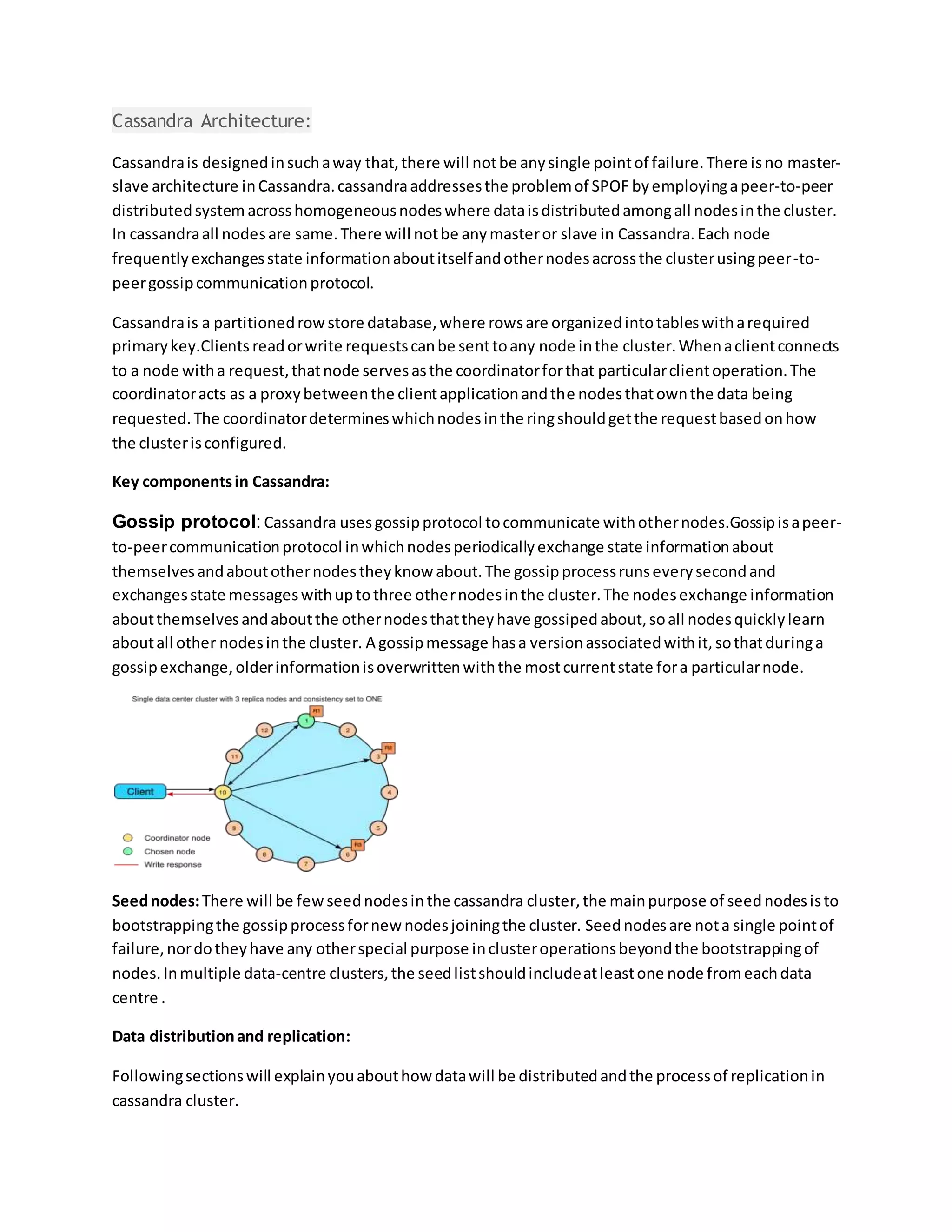
to a node witha request,thatnode servesasthe coordinatorforthat particularclientoperation.The
coordinatoracts as a proxybetweenthe clientapplicationandthe nodesthatownthe data being
requested.The coordinatordetermineswhichnodesinthe ringshouldgetthe requestbasedonhow
the clusterisconfigured.
Key componentsin Cassandra:
Gossip protocol: Cassandra usesgossipprotocol tocommunicate withothernodes.Gossipisapeer-
to-peercommunicationprotocol inwhichnodesperiodicallyexchange state informationabout
themselvesandaboutothernodestheyknow about.The gossipprocessrunseverysecondand
exchangesstate messageswithuptothree othernodesinthe cluster.The nodesexchange information
aboutthemselvesandaboutthe othernodesthattheyhave gossipedabout,soall nodesquicklylearn
aboutall other nodesinthe cluster. A gossipmessage hasa versionassociatedwithit,sothatduringa
gossipexchange,olderinformationisoverwrittenwiththe mostcurrentstate fora particularnode.
Seednodes:There will be fewseednodesinthe cassandra cluster,the mainpurpose of seednodesisto
bootstrappingthe gossipprocessfornew nodesjoiningthe cluster. Seednodesare nota single pointof
failure,nordotheyhave any otherspecial purpose inclusteroperationsbeyondthe bootstrappingof
nodes. Inmultiple data-centre clusters,the seedlistshouldincludeatleastone node fromeachdata
centre .
Data distributionand replication:
Followingsectionswill explainyouabouthow datawill be distributedandthe processof replicationin
cassandra cluster.
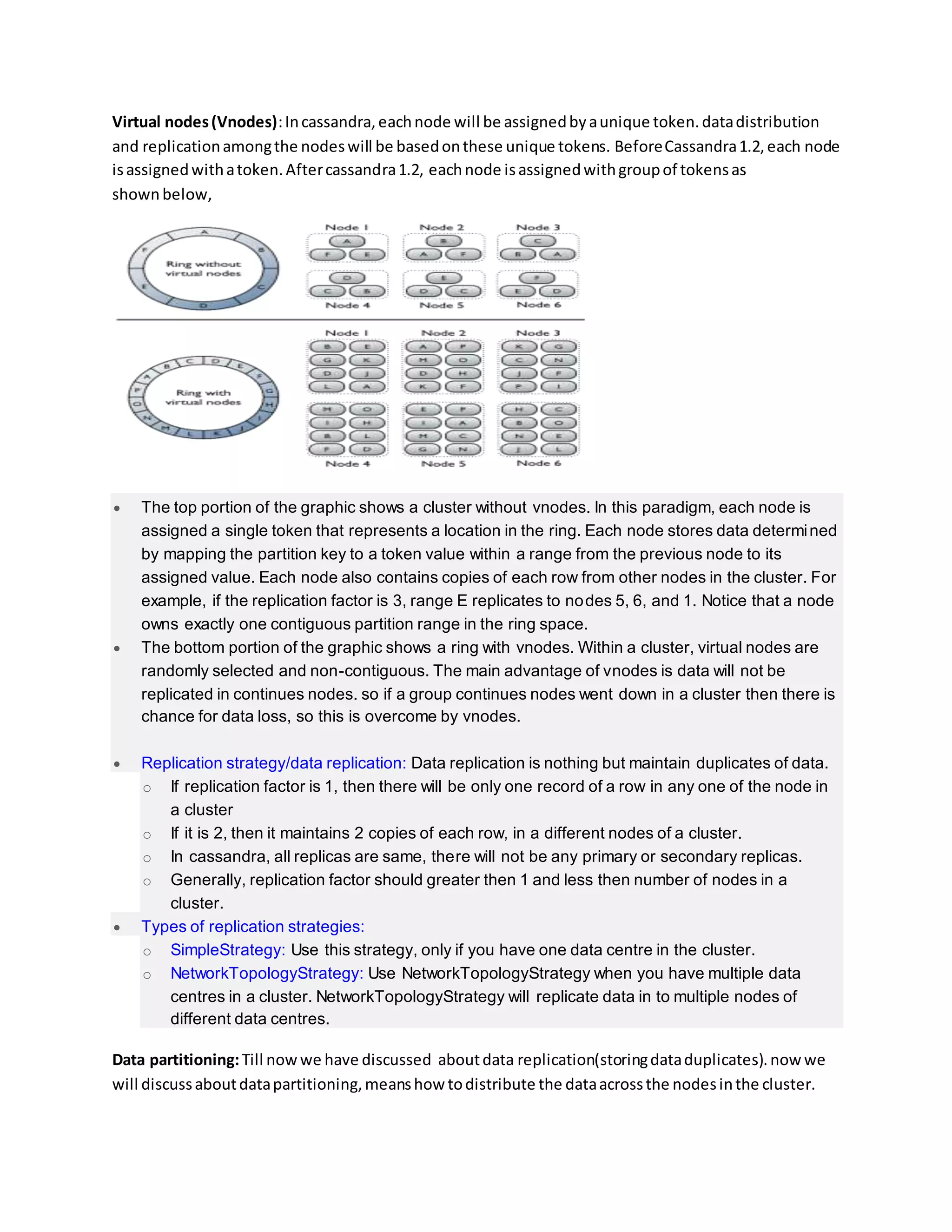
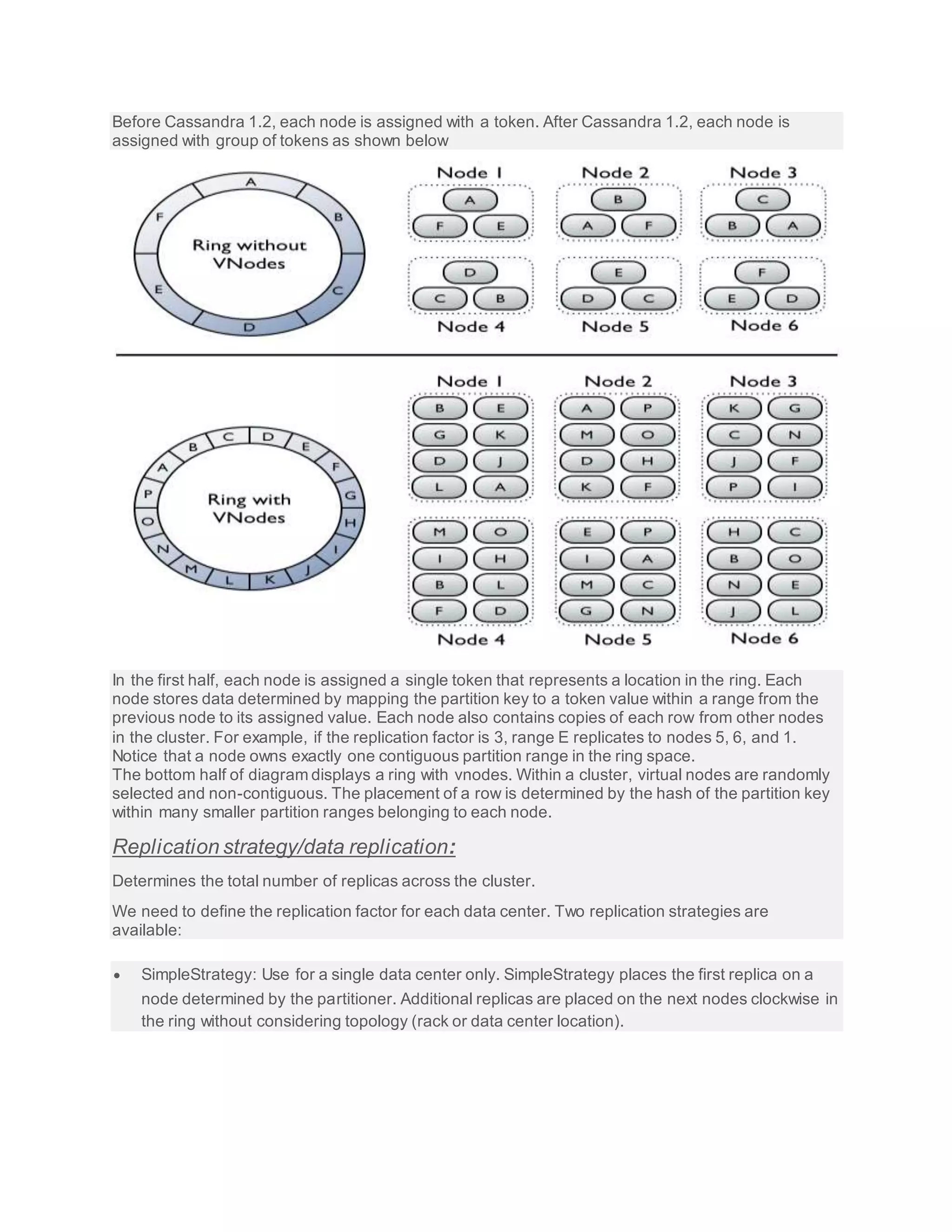
Virtual nodes(Vnodes):Incassandra,eachnode will be assignedbyaunique token.datadistribution
and replicationamongthe nodeswill be basedonthese unique tokens. BeforeCassandra1.2,each node
isassignedwithatoken.Aftercassandra1.2, eachnode isassignedwithgroupof tokensas
shownbelow,
 The top portion of the graphic shows a cluster without vnodes. In this paradigm, each node is
assigned a single token that represents a location in the ring. Each node stores data determined
by mapping the partition key to a token value within a range from the previous node to its
assigned value. Each node also contains copies of each row from other nodes in the cluster. For
example, if the replication factor is 3, range E replicates to nodes 5, 6, and 1. Notice that a node
owns exactly one contiguous partition range in the ring space.
 The bottom portion of the graphic shows a ring with vnodes. Within a cluster, virtual nodes are
randomly selected and non-contiguous. The main advantage of vnodes is data will not be
replicated in continues nodes. so if a group continues nodes went down in a cluster then there is
chance for data loss, so this is overcome by vnodes.
 Replication strategy/data replication: Data replication is nothing but maintain duplicates of data.
o If replication factor is 1, then there will be only one record of a row in any one of the node in
a cluster
o If it is 2, then it maintains 2 copies of each row, in a different nodes of a cluster.
o In cassandra, all replicas are same, there will not be any primary or secondary replicas.
o Generally, replication factor should greater then 1 and less then number of nodes in a
cluster.
 Types of replication strategies:
o SimpleStrategy: Use this strategy, only if you have one data centre in the cluster.
o NetworkTopologyStrategy: Use NetworkTopologyStrategy when you have multiple data
centres in a cluster. NetworkTopologyStrategy will replicate data in to multiple nodes of
different data centres.
Data partitioning:Till nowwe have discussed aboutdata replication(storingdataduplicates).nowwe
will discussaboutdatapartitioning,meanshow todistribute the dataacrossthe nodesinthe cluster.
Basically,apartitionerisahash functionforcomputingthe tokenof a partitionkey.There are 3 typesof
partitioner’sincassandra.
Murmur3Partitioner (default): Uniformlydistributesdataacrossthe clusterbasedonMurmurHash
hash values.
RandomPartitioner:Uniformlydistributesdataacrossthe clusterbasedon MD5 hash values.
ByteOrderedPartitioner:Keepsanordereddistributionof datalexicallybykeybytes.
Snitch: A snitchdefinesgroupsof machinesintodatacentresandracks (the topology) thatthe
replicationstrategyusestoplace replicas. The defaultSimpleSnitch doesnotrecognizedatacentre or
rack information.TheGossipingPropertyFileSnitch isrecommendedforproduction.The followingare
differenttypesof snitchs.
dynamicsnitching
simple snitching
RackInferringSnitch
PropertyFileSnitch
GossipingPropertyFileSnitch
Ec2Snitch
Ec2MultiRegionSnitch
GoogleCloudSnitch
CloudstackSnitch
This entry was posted in Cassandra and tagged AvailabilityCassandraConsistencyPartitionTolerance on January27, 2016 by Siva
Table of Contents [hide]
 What is CAP Theorem?
o Consistency
o Availability
o Partition Tolerance
o Consistency – Partition Tolerance:
o Availability –Partition Tolerance:
o Consistency – Availability:
 Share this:
What isCAP Theorem?
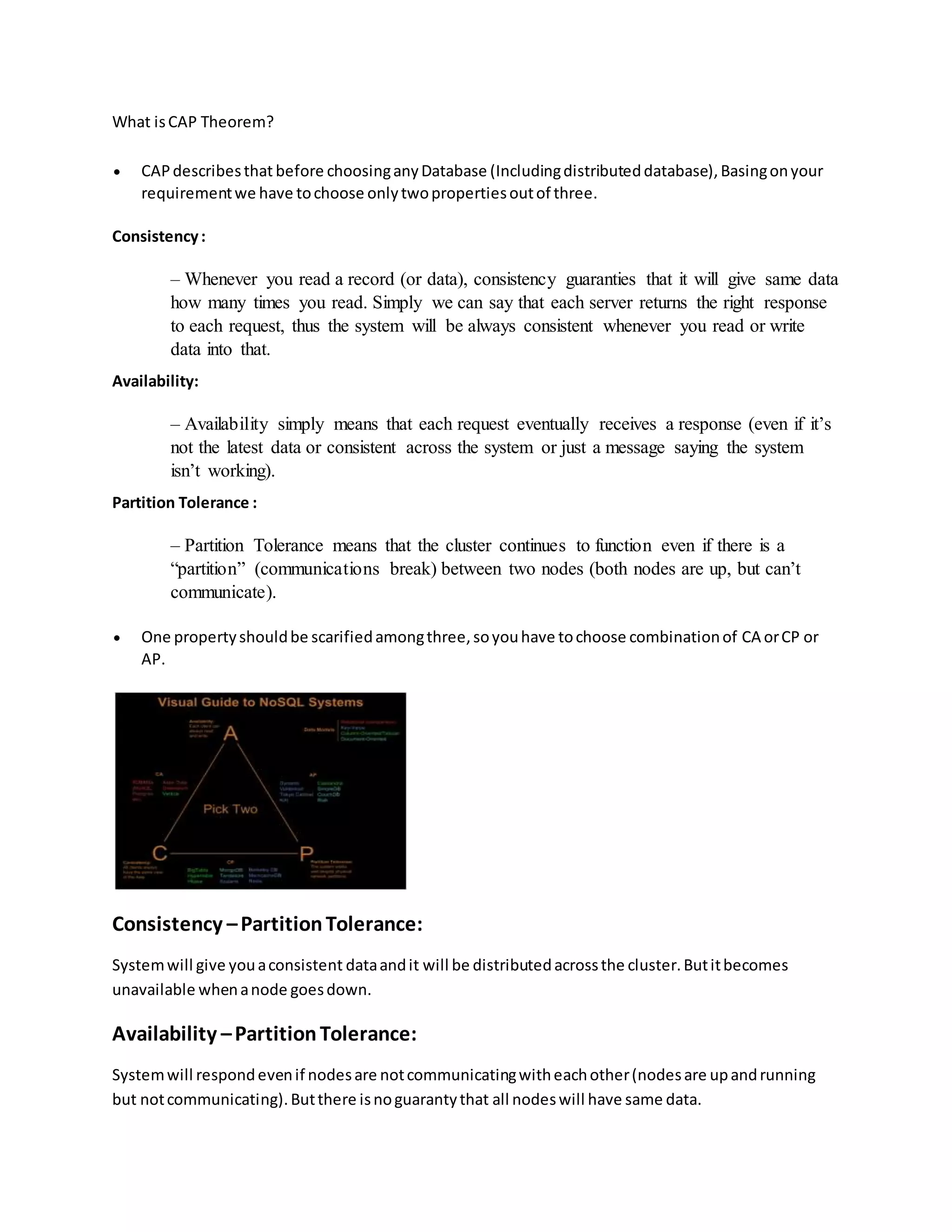
 CAPdescribesthat before choosinganyDatabase (Includingdistributeddatabase),Basingonyour
requirementwe have tochoose onlytwopropertiesoutof three.
Consistency:
– Whenever you read a record (or data), consistency guaranties that it will give same data
how many times you read. Simply we can say that each server returns the right response
to each request, thus the system will be always consistent whenever you read or write
data into that.
Availability:
– Availability simply means that each request eventually receives a response (even if it’s
not the latest data or consistent across the system or just a message saying the system
isn’t working).
Partition Tolerance :
– Partition Tolerance means that the cluster continues to function even if there is a
“partition” (communications break) between two nodes (both nodes are up, but can’t
communicate).
 One propertyshouldbe scarifiedamongthree,soyouhave tochoose combinationof CA orCP or
AP.
Consistency –PartitionTolerance:
Systemwill give youaconsistent dataandit will be distributedacrossthe cluster.Butitbecomes
unavailable whenanode goesdown.
Availability –PartitionTolerance:
Systemwill respondevenif nodesare notcommunicatingwitheachother(nodesare upandrunning
but notcommunicating).Butthere isnoguarantythat all nodeswill have same data.
Consistency –Availability:
Systemwill give youaconsistentdataandyoucan write/readdatato/fromanynode,butdata
partitioningwill notbe syncwhendevelopapartitionbetweennodes (RDBMSsystemssuchasMySQL
are of CA combinationsystems.)
Accordingto CAPtheorem, Cassandrawill fallintocategoryof AP combination,thatmeansdon’tthink
that Cassandrawill notgive a consistentdata.We can tune Cassandraas per ourrequirement togive
youa consistentresult.
Cassandra Interview Cheat Sheet:
his entry was posted in Cassandra on October 10, 2015 by Siva
Table of Contents [hide]
 Cassandra
o
 NoSQL
 KeySpace
 Partitioner
 Snitch
 Replication Factor
 Partitioners
 Share this:
Cassandra
Cassandra is a distributed database from Apache that is highly scalable and designed to manage
very large amounts of structured data. It provides high availability with no single point of failure.
NoSQL
The primary objective of a NoSQLdatabase is to have
 simplicityof design,
 horizontal scaling,and
 finercontrol overavailability.
These databases are schema-free, support easy replication, have simple API, eventually
consistent, and can handle huge amounts of data
Features of Cassandra
Elastic scalability – Cassandra is highly scalable; it allows to add more hardware to
accommodate more customers and more data as per requirement.
Always on architecture – Cassandra has no single point of failure and it is continuously available
for business-critical applications that cannot afford a failure.
Fast linear-scale performance – Cassandra is linearly scalable, i.e., it increases your throughput
as you increase the number of nodes in the cluster. Therefore it maintains a quick response time.
Flexible data storage – Cassandra accommodates all possible data formats including: structured,
semi-structured, and unstructured. It can dynamically accommodate changes to your data
structures according to your need.
 Cqlsh
CassandraqueryLanguage shell(Cqlsh)
Usingcqlsh,you can
 define aschema,
 insertdata,and
 execute aquery
KeySpace
keyspace in Cassandra is a namespace that defines data replication on nodes. A cluster contains
one keyspace per node. Given below is the syntax for creating a keyspace using the statement
CREATE KEYSPACE.
Token
When you start a Cassandra cluster, data is distributed across the nodes in the cluster based on
the row key using a partitioner. You must assign each node in a cluster a token and that token
determines the node’s position in the ring and its range of data.
SS Table
A sorted string table (SSTable) is an immutable data file to which Cassandra writes memtables
periodically. SSTables are stored on disk sequentially and maintained for each Cassandra table.
Bloom Filter
An off-heap structure associated with each SSTable that checks if any data for the requested row
exists in the SSTable before doing any disk I/O.
Key components for configuring Cassandra
Gossip
A peer-to-peer communication protocol to discover and share location and state information
about the other nodes in a Cassandra cluster. Gossip information is also persisted locally by each
node to use immediately when a node restarts.
Partitioner
A partitioner determines how to distribute the data across the nodes in the cluster and which node
to place the first copy of data on. Basically, a partitioner is a hash function for computing the
token of a partition key. Each row of data is uniquely identified by a partition key and distributed
across the cluster by the value of the token. The Murmur3Partitioner is the default partitioning
strategy for new Cassandra clusters and the right choice for new clusters in almost all cases.
Snitch
A snitch defines groups of machines into data centers and racks (the topology) that the
replication strategy uses to place replicas.
You must configure a snitch when you create a cluster. All snitches use a dynamic snitch layer,
which monitors performance and chooses the best replica for reading. It is enabled by default and
recommended for use in most deployments. Configure dynamic snitch thresholds for each node
in the cassandra.yaml configuration file.
Replication Factor
Consistent hashing
Consistent hashing allows distributing data across a cluster which minimizes reorganization
when nodes are added or removed
Virtual Node
You no longer have to calculate and assign tokens to each node.
Rebalancing a cluster is no longer necessary when adding or removing nodes. When a node joins
the cluster, it assumes responsibility for an even portion of data from the other nodes in the
cluster.
If a node fails, the load is spread evenly across other nodes in the cluster.
Rebuilding a dead node is faster because it involves every other node in the cluster.
Partitioners
A partitioner determines how data is distributed across the nodes in the cluster (including
replicas). Basically, a partitioner is a function for deriving a token representing a row from its
partion key, typically by hashing. Each row of data is then distributed across the cluster by the
value of the token.
Both the Murmur3Partitioner and RandomPartitioner use tokens to help assign equal portions of
data to each node and evenly distribute data from all the tables throughout the ring or other
grouping, such as a keyspace.
Moving Data from other Databases
The COPY command, which mirrors what the PostgreSQL RDBMS uses for file/export import.
The Cassandra bulk loader provides the ability to bulk load external data into a cluster.
TTL
Time-to-live. An optional expiration date for values inserted into a column
Consistency
consistency refers to how up-to-date and synchronized a row of data is on all of its replicas.
Backup and Restoring Data
Cassandra backs up data by taking a snapshot of all on-disk data files (SSTable files) stored in
the data directory.
You can take a snapshot of all keyspaces, a single keyspace, or a single table while the system is
online.
Cassandra Tools
 The nodetool utility
 A commandline interface forCassandraformanagingacluster.
 Cassandrabulkloader(sstableloader)
 The cassandra utility
 Starts the CassandraJava serverprocess
 .The cassandra-stresstool
 A Java-basedstresstestingutilityforbenchmarkingandloadtestingaCassandracluster.
 The sstablescrubutility
 Scrub the all the SSTablesforthe specifiedtable.
 The sstablesplitutilitysstablekeys
 The sstablekeysutilitydumpstable keys.
 The sstableupgrade tool
 Upgrade the SSTablesinthe specifiedtable (orsnapshot)tomatchthe current versionof Cassandra.
Cassandra Overview:
This entry was posted in Cassandra on September 8, 2015 by Siva
Table of Contents [hide]
 Cassandra Overview
o


 Commit Log & MemTable
o Cassandra Key Components


 Gossip
o Data distribution and replication
 Virtual nodes (Vnodes):
 Replication strategy/data replication:
 Partitioner:
 Snitch:
o Share this:
Cassandra Overview
Cassandra is another no-sql database. Similar to Hbase it is also distributed column-oriented
database to handle big data workloads across multiple nodes but it can support both Local File
system and HDFS, whereas in Hbase the underlying file system is also HDFS.
It overcomes single point of failure by using a peer-to-peer distributed system across homogeneous
nodes where data is distributed among all nodes in the cluster. Each node frequently exchanges
state information about itself and other nodes across the cluster using peer-to-peer gossip
communication protocol.
Commit Log & MemTable
Commit log on each node will maintain write activity to ensure data durability. It will be sequentially
written. Data is then indexed and written to an in-memory structure, called a memTable, which
resembles a write-back cache. This is similar to memstore or WAL (Write Ahead Log) in Hbase.
Once memTable is full, the data is written to an SSTable (sorted string table) data file. All writes are
automatically partitioned and replicated throughout the cluster. Cassandra periodically consolidates
SSTables using a process called compaction (This is same as major compaction in Hbase to apply
delete markers on HFiles), discarding obsolete data marked for deletion with a tombstone. To
ensure all data across the cluster stays consistent, various repair mechanisms are employed.
Cassandra is a partitioned row store database, where rows are organized into tables with a required
primary key. Cassandra’s architecture allows any authorized user to connect to any node in any data
centre and access data using the CQL language. Unlike Hbase commands, CQL language uses a
similar syntax to SQL and works with table data. Developers can access CQL through cqlsh,
DevCenter, and via JDBC/ODBC drivers for application languages like java, python etc. Typically, a
cluster has one keyspace per application composed of many different tables.
Clients read or write requests can be sent to any node in the cluster. When a client connects to a
node with a request, that node serves as the coordinator for that particular client operation. The
coordinator acts as a proxy between the client application and the nodes that own the data being
requested. The coordinator determines which nodes in the ring should get the request based on how
the cluster is configured.
Cassandra Key Components
Gossip
 A peer-to-peer communication protocol in which nodes periodically exchange state information
about themselves and about other nodes they know about. This is similar to hear-beat
mechanism in HDFS to get the status of each node by the master.
 A peer-to-peer communication protocol to share location and state information about the other
nodes in a Cassandra cluster. Gossip information is also stored locally by each node to use
immediately when a node restarts.
 The gossip process runs every second and exchanges state messages with up to three other
nodes in the cluster. The nodes exchange information about themselves and about the other
nodes that they have gossiped about, so all nodes quickly learn about all other nodes in the
cluster.
 A gossip message has a version associated with it, so that during a gossip exchange, older
information is overwritten with the most current state for a particular node.
 To prevent problems in gossip communications, use the same list of seed nodes for all nodes in
a cluster. This is most critical the first time a node starts up. By default, a node remembers other
nodes it has gossiped with between subsequent restarts. The seed node designation has no
purpose other than bootstrapping the gossip process for new nodes joining the cluster. Seed
nodes are not a single point of failure, nor do they have any other special purpose in cluster
operations beyond the bootstrapping of nodes.
Note: In multiple data-center clusters, the seed list should include at least one node from each data
center (replication group). More than a single seed node per data center is recommended for fault
tolerance. Otherwise, gossip has to communicate with another data center when bootstrapping a
node. Making every node a seed node is not recommended because of increased maintenance and
reduced gossip performance. Gossip optimization is not critical, but it is recommended to use a
small seed list (approximately three nodes per data center).
Data distribution and replication
How data is distributed and factors influencing replication.
In Cassandra, Data is organized by table and identified by a primary key, which determines which
node the data is stored on. Replicas are copies of rows.
Factors influencing replication include:
Virtual nodes (Vnodes):
Assigns data ownership to physical machines.
Before Cassandra 1.2, each node is assigned with a token. After Cassandra 1.2, each node is
assigned with group of tokens as shown below
In the first half, each node is assigned a single token that represents a location in the ring. Each
node stores data determined by mapping the partition key to a token value within a range from the
previous node to its assigned value. Each node also contains copies of each row from other nodes
in the cluster. For example, if the replication factor is 3, range E replicates to nodes 5, 6, and 1.
Notice that a node owns exactly one contiguous partition range in the ring space.
The bottom half of diagram displays a ring with vnodes. Within a cluster, virtual nodes are randomly
selected and non-contiguous. The placement of a row is determined by the hash of the partition key
within many smaller partition ranges belonging to each node.
Replication strategy/data replication:
Determines the total number of replicas across the cluster.
We need to define the replication factor for each data center. Two replication strategies are
available:
 SimpleStrategy: Use for a single data center only. SimpleStrategy places the first replica on a
node determined by the partitioner. Additional replicas are placed on the next nodes clockwise in
the ring without considering topology (rack or data center location).
 NetworkTopologyStrategy: Use NetworkTopologyStrategy when we have (or plan to have) our
cluster deployed across multiple data centres. This strategy specifies how many replicas we
want in each data center.
NetworkTopologyStrategy places replicas in the same data center by walking the ring clockwise until
reaching the first node in another rack. NetworkTopologyStrategy attempts to place replicas on
distinct racks because nodes in the same rack (or similar physical grouping) often fail at the same
time due to power, cooling, or network issues.
 Two replicas in each data center: This configuration tolerates the failure of a single node per
replication group and still allows local reads at a consistency level of ONE.
 Three replicas in each data center: This configuration tolerates either the failure of a one node
per replication group at a strong consistency level of LOCAL_QUORUM or multiple node failures
per data center using consistency level ONE.
Replication strategy is defined per keyspace, and is set during keyspace creation.
Partitioner:
Partitions the data across the cluster.
A partitioner distributes the data across the nodes in the cluster and determines which node to place
the first copy of data on. Basically, a partitioner is a hash function for computing the token of a
partition key. Each row of data is uniquely identified by a partition key and distributed across the
cluster by the value of the token. The read and write requests to the cluster are also evenly
distributed and load balancing is simplified because each part of the hash range receives an equal
number of rows on average.
 Murmur3Partitioner (default): uniformly distributes data across the cluster based on MurmurHash
hash values.
 RandomPartitioner: uniformly distributes data across the cluster based on MD5 hash values.
 ByteOrderedPartitioner: keeps an ordered distribution of data lexically by key bytes
Note: If using virtual nodes (vnodes), we do not need to calculate the tokens. If not using vnodes, we
must calculate the tokens to assign to the initial_token parameter in the cassandra.yaml file.
Snitch:
A snitch defines groups of machines into data centres and racks (the topology). We must configure a
snitch when we create a cluster. All snitches use a dynamic snitch layer, which monitors
performance and chooses the best replica for reading. It is enabled by default. Configure dynamic
snitch thresholds for each node in the cassandra.yaml configuration file.
The defaultSimpleSnitchdoesnotrecognize datacenterorrack information.Use itforsingle-data
centerdeploymentsorsingle-zone inpublicclouds.The GossipingPropertyFileSnitchis recommended
for production.Itdefinesanode’sdatacenterand rack and usesgossipforpropagatingthisinformation
to othernodes.
There are manyvtypesof snitcheslike dynamicsnitching,simple snitching,RackInferringSnitch,
PropertyFileSnitch,GossipingPropertyFileSnitch,Ec2Snitch,Ec2MultiRegionSnitch,GoogleCloudSnitch,
CloudstackSnitch.
Cassandra is a partitioned row store database, where rows are organized into tables with a required
primary key.Clients read or write requests can be sent to any node in the cluster. When a client
connects to a node with a request, that node serves as the coordinator for that particular client
operation. The coordinator acts as a proxy between the client application and the nodes that o wn the
data being requested. The coordinator determines which nodes in the ring should get the request
based on how the cluster is configured
Cassandraproductionscenarios/issues
Thisentrywas postedinCassandra and tagged ConstantReconnectionPolicyDCAwareRoundRobinPolicy
DefaultRetryPolicydistributedcallsincassandraJDBCDowngradingConsistencyRetryPolicy
ExponentialReconnectionPolicyLoadBalancingPolicyReadReconnectionPolicyRetryPolicy
RoundRobinPolicyTokenAwarePolicyUnavailable Write onJanuary28, 2016 by Siva
Table of Contents[hide]
Production issue:
FewProductionconfigurationsincassandra
RetryPolicy
DefaultRetryPolicy
DowngradingConsistencyRetryPolicy
ReconnectionPolicy
ConstantReconnectionPolicy
ExponentialReconnectionPolicy(default)
Load BalancingPolicy
RoundRobinPolicy
DCAwareRoundRobinPolicy
TokenAwarePolicy(default)
Share this:
Productionissue:
whenwe are tryingto write a selectquerywith8 lacksids“in condition“.thenwe got facedbelow
issue,
To solve the above exception,we useddistributedcallsinJavaclientasshownbelow,
importjava.net.InetSocketAddress;
importjava.util.ArrayList;
importjava.util.List;
importjava.util.Map;
importcom.datastax.driver.core.Cluster;
importcom.datastax.driver.core.PreparedStatement;
importcom.datastax.driver.core.ResultSet;
importcom.datastax.driver.core.ResultSetFuture;
importcom.datastax.driver.core.Row;
importcom.datastax.driver.core.Session;
importcom.datastax.driver.core.exceptions.NoHostAvailableException;
publicclassSelectCassandraDistrbuted{
publicstaticvoidmain(String[] args) {
Cluster cluster= null;
try{
cluster= Cluster.builder().addContactPoints("node1address/IP","node2address/IP","node3
address/IP").build();
cluster.getConfiguration().getSocketOptions().setReadTimeoutMillis(600000000);
Sessionsession=cluster.connect("keyspace_name");
System.out.println("connected");
PreparedStatementstatement=session.prepare("select*fromtable where tmp_time =?");
List<String>idsList= newArrayList<String>();
//Here we added8 lacs idsto the idsListlist
List<ResultSetFuture>futures=new ArrayList<ResultSetFuture>();
//Here we are executingthe query.
for (Stringid:idsList) {
ResultSetFuture resultSetFuture =session.executeAsync(statement.bind(id));
futures.add(resultSetFuture);
}
//Fetchingthe results
for (ResultSetFuture future:futures){
ResultSetrows= future.getUninterruptibly();
Row row= rows.one();
System.out.println(row.getString("sys_serial_no"));
System.out.println(row.getString("tmp_time"));
}
}
importjava.net.InetSocketAddress;
importjava.util.ArrayList;
importjava.util.List;
importjava.util.Map;
importcom.datastax.driver.core.Cluster;
importcom.datastax.driver.core.PreparedStatement;
importcom.datastax.driver.core.ResultSet;
importcom.datastax.driver.core.ResultSetFuture;
importcom.datastax.driver.core.Row;
importcom.datastax.driver.core.Session;
importcom.datastax.driver.core.exceptions.NoHostAvailableException;
publicclassSelectCassandraDistrbuted{
publicstaticvoidmain(String[] args) {
Cluster cluster= null;
try{
cluster= Cluster.builder().addContactPoints("node1address/IP","node2address/IP","node3
address/IP").build();
cluster.getConfiguration().getSocketOptions().setReadTimeoutMillis(600000000);
Sessionsession=cluster.connect("keyspace_name");
System.out.println("connected");
PreparedStatementstatement=session.prepare("select*fromtable where tmp_time =?");
List<String>idsList= new ArrayList<String>();
//Here we added8 lacs idsto the idsListlist
List<ResultSetFuture>futures=new ArrayList<ResultSetFuture>();
//Here we are executingthe query.
for (Stringid:idsList) {
ResultSetFuture resultSetFuture =session.executeAsync(statement.bind(id));
futures.add(resultSetFuture);
}
//Fetchingthe results
for (ResultSetFuture future:futures){
ResultSetrows= future.getUninterruptibly();
Row row= rows.one();
System.out.println(row.getString("sys_serial_no"));
System.out.println(row.getString("tmp_time"));
}
}
FewProductionconfigurationsincassandraRetryPolicy
Three scenariosyoucan control retrypolicyfor:
Readtime out: Whena coordinatorreceivedthe requestandsentthe readto replica(s) butthe
replica(s) didnotrespondintime.
Write time out: Asabove but forwrites
Unavailable:Whenthe coordinatorisaware there aren’tenoughreplicaavailable without sendingthe
read/write requeston
Types ofretry polices:
DefaultRetryPolicy
Readtimeout:Whenenoughreplicaare available butthe datadidnot come back withinthe configured
readtime out.
Write timeout:Onlyif the initial phaseof abatch write timesout.
Unavailable time out:Never
DowngradingConsistencyRetryPolicy
Read: If at leastone replicarespondedthenthe readisretriedata lowerconsistency.
Write:Retriesforunloggedbatchquerieswhenatleastone replicaresponded.
Unavailable:If at leastone replicaisavailable thenthe queryisre-triedwithalowerconsistency.
ReconnectionPolicy
The reconnectionpolicydetermineshow oftenareconnectiontoadeadnode is attempted.There are 2
typesof reconnectionpolicies.
ConstantReconnectionPolicy
Fixeddelayinbetweeneachreconnectionattempt.
delay(configurableproperty)shouldbe afloatingpointnumberof secondstowaitinbetweeneach
attempt.
max_attempts(configurable property) shouldbe atotal numberof attemptsto be made before giving
up,or None tocontinue reconnectionattemptsforever.The defaultis64.
ExponentialReconnectionPolicy(default)
Exponentiallyincreasesthe lengthof the delayinbetweeneachreconnectionattemptuptoa set
maximumdelay.
base_delayandmax_delayshouldbe infloatingpointunitsof seconds.
Load Balancing Policy
The load balancingpolicydetermineswhichnode toexecute aqueryon.Below are differenttypesof
loadbalancingpolicytechniques.
RoundRobinPolicy
Distributesqueriesacross all nodesinthe cluster,regardlessof whatdatacentre the nodesmaybe in.
DCAwareRoundRobinPolicy
SimilartoRoundRobinPolicy,butprefershostsinthe local datacenterandonlyusesnodesinremote
datacentersasa lastresort.
TokenAwarePolicy(default)
A LoadBalancingPolicywrapperthataddstokenawarenesstoa childpolicy.Thisaltersthe childpolicy’s
behaviorsothat itfirstattemptsto sendqueriestoLOCALreplicas(asdeterminedbythe childpolicy)
basedon the Statement‘srouting_key.Once those hostsare exhausted,the remaininghostsinthe child
policy’squeryplanwill be used.
Cassandra write and read process:
This entry was posted in Cassandra and tagged Bloom filtercassandra
delete flowcassandra insert flowcassandra read flowcassandra update
flowcommit logCompactioncompression
offsetDateTieredCompactionStrategyHow data is written into
cassandraHow do write patterns effect reads in cassandraHow is data
deleted in cassandraHow is data read in cassandraHow is data updated
in cassandraLeveledCompactionStrategymemTablePartition
indexpartition keyPartition summaryrow
cacheSizeTieredCompactionStrategySSTable
Table of Contents [hide]
 Storage engine
o How data is written?
o Compaction:
o Types of compaction:
o How is data updated?
o How is data deleted?
o How is data read?
o How do write patterns effect reads?
o Share this:
Storage engine
 Cassandra uses a storage structure similar to a Log-Structured
Merge Tree, unlike a typical relational database that uses a B-
Tree.
 Cassandra avoids reading before writing. Read-before-write,
especially in a large distributed system, can produce stall in read
performance and other problems.
 Cassandra never re-writes or re-reads existing data, and never
overwrites the rows in place.
How data is written?
Different stages of write process in cassandra
 Logging data in the commit log.
 Writing data to the memTable.
 Flushing data from the memTable.
 Storing data on disk in SSTables.
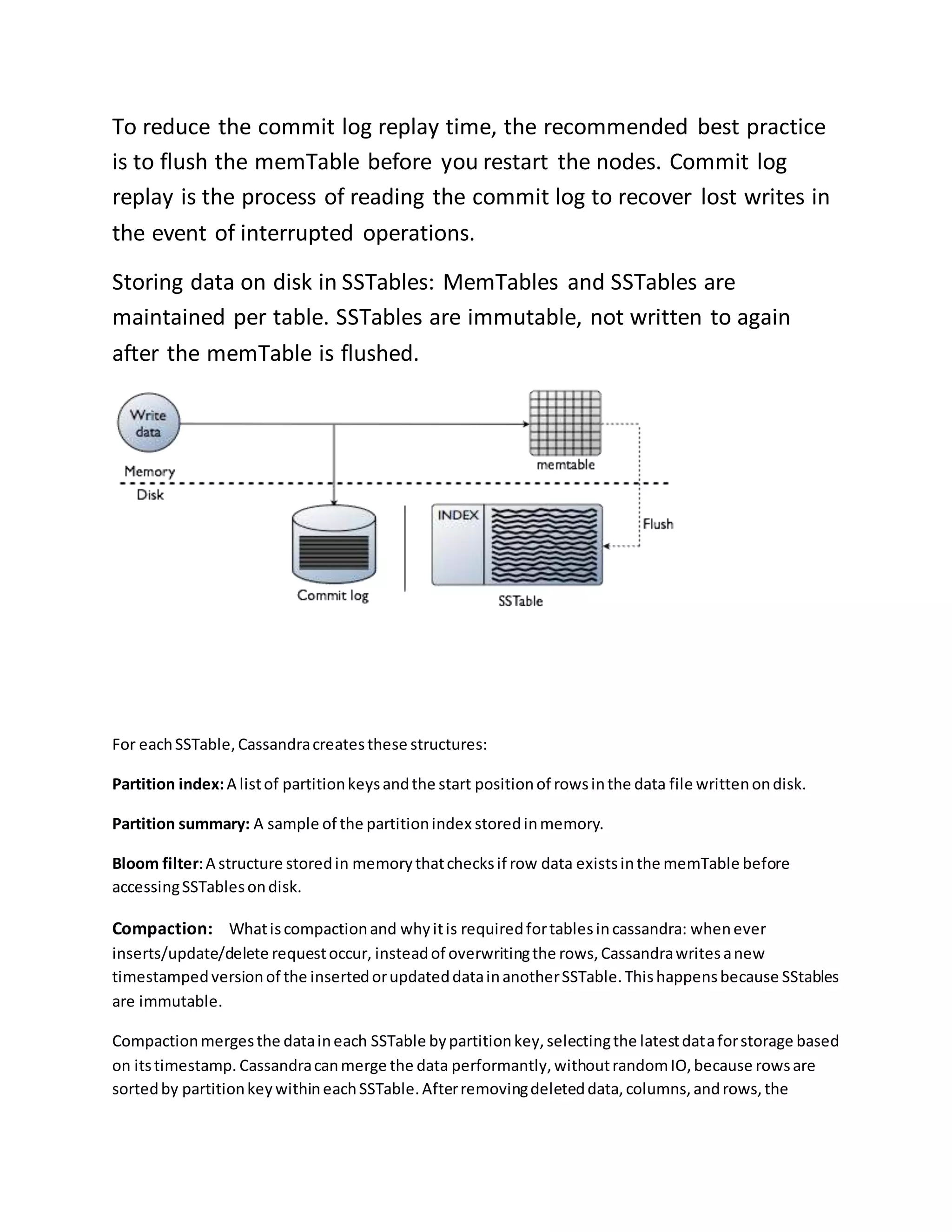
Logging writes and memTable storage: when ever a write request came
from client, first the data is written into memTable (it is in-memory
storage) and commit log on disk (it will be present even if power fails
on a node). The commit log receives every write made to a Cassandra
node and these durable writes survive permanently. The memTable
stores write until reaching a configurable limit, and then is flushed.
Flushing data from the memTable: To flush the data, Cassandra sorts
memTables by token and then writes the data to disk
sequentially. A partition index is also created on the disk that maps the
tokens to a location on disk. When the memTable content exceeds the
configurable threshold, the memTable is put in a queue that is flushed
to disk. If the data to be flushed exceeds the queue size, Cassandra
blocks writes until the next flush succeeds. You can manually flush a
table using node tool flush.
Below command shows, flush command using node tool.
1
3
4
5
nodetool flush -- <keyspace> <table>(or you can mention list
of tables)
ex:
nodetool flush -- sys s_mode
To reduce the commit log replay time, the recommended best practice
is to flush the memTable before you restart the nodes. Commit log
replay is the process of reading the commit log to recover lost writes in
the event of interrupted operations.
Storing data on disk in SSTables: MemTables and SSTables are
maintained per table. SSTables are immutable, not written to again
after the memTable is flushed.
For eachSSTable,Cassandracreatesthese structures:
Partition index:A listof partitionkeysandthe start positionof rowsinthe data file writtenondisk.
Partition summary: A sample of the partitionindex storedinmemory.
Bloom filter:A structure storedin memorythatchecksif row data existsinthe memTable before
accessingSSTablesondisk.
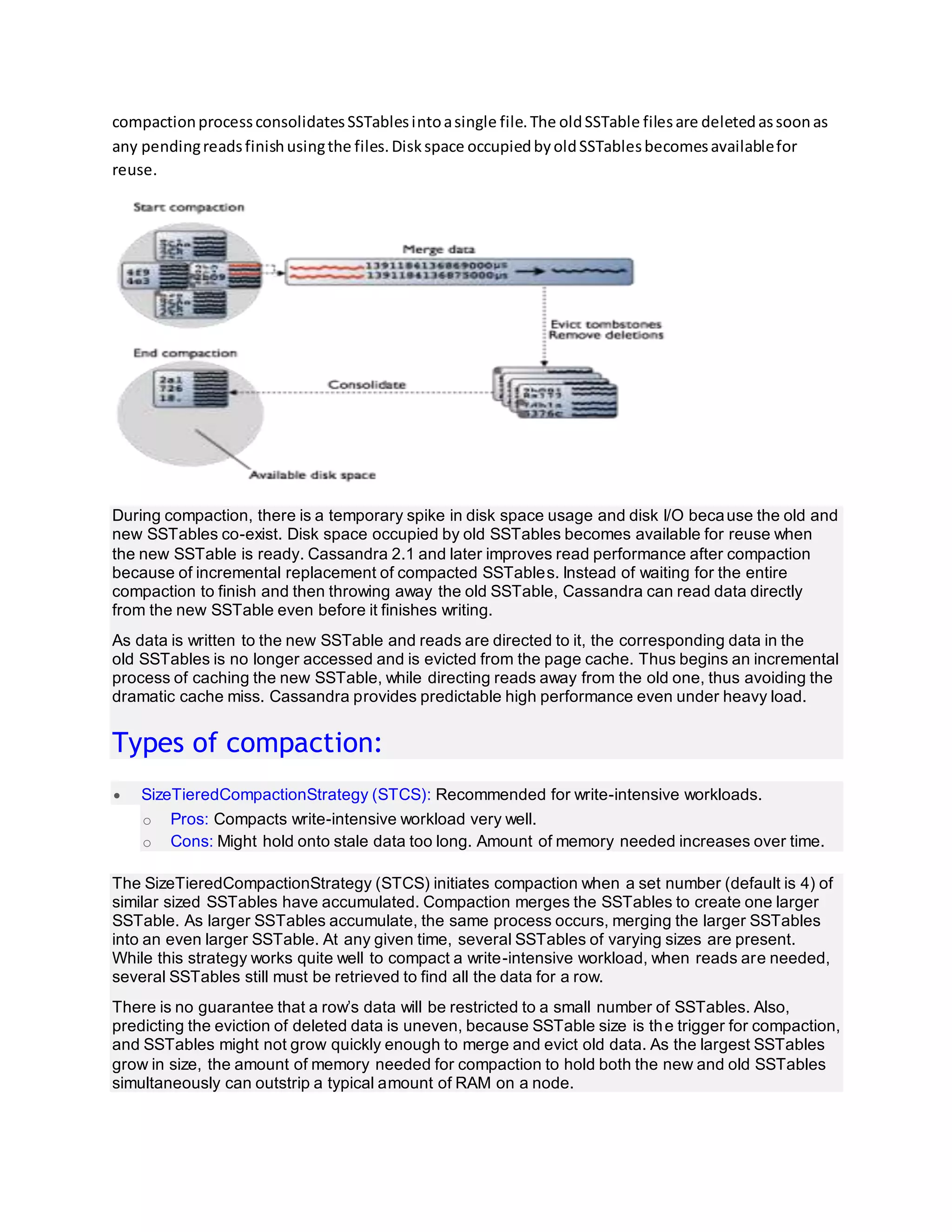
Compaction: Whatiscompactionand whyitis requiredfortablesincassandra: whenever
inserts/update/delete requestoccur, insteadof overwritingthe rows,Cassandrawritesanew
timestampedversionof the insertedorupdateddatainanotherSSTable.Thishappensbecause SStables
are immutable.
Compactionmergesthe dataineach SSTable bypartitionkey,selectingthe latestdataforstorage based
on itstimestamp. Cassandracanmerge the data performantly,withoutrandomIO,because rowsare
sortedby partitionkeywithineachSSTable.Afterremovingdeleteddata,columns,androws,the
compactionprocessconsolidatesSSTablesintoasingle file.The oldSSTable filesare deletedassoonas
any pendingreadsfinishusingthe files.Diskspace occupiedbyoldSSTablesbecomesavailablefor
reuse.
During compaction, there is a temporary spike in disk space usage and disk I/O because the old and
new SSTables co-exist. Disk space occupied by old SSTables becomes available for reuse when
the new SSTable is ready. Cassandra 2.1 and later improves read performance after compaction
because of incremental replacement of compacted SSTables. Instead of waiting for the entire
compaction to finish and then throwing away the old SSTable, Cassandra can read data directly
from the new SSTable even before it finishes writing.
As data is written to the new SSTable and reads are directed to it, the corresponding data in the
old SSTables is no longer accessed and is evicted from the page cache. Thus begins an incremental
process of caching the new SSTable, while directing reads away from the old one, thus avoiding the
dramatic cache miss. Cassandra provides predictable high performance even under heavy load.
Types of compaction:
 SizeTieredCompactionStrategy (STCS): Recommended for write-intensive workloads.
o Pros: Compacts write-intensive workload very well.
o Cons: Might hold onto stale data too long. Amount of memory needed increases over time.
The SizeTieredCompactionStrategy (STCS) initiates compaction when a set number (default is 4) of
similar sized SSTables have accumulated. Compaction merges the SSTables to create one larger
SSTable. As larger SSTables accumulate, the same process occurs, merging the larger SSTables
into an even larger SSTable. At any given time, several SSTables of varying sizes are present.
While this strategy works quite well to compact a write-intensive workload, when reads are needed,
several SSTables still must be retrieved to find all the data for a row.
There is no guarantee that a row’s data will be restricted to a small number of SSTables. Also,
predicting the eviction of deleted data is uneven, because SSTable size is the trigger for compaction,
and SSTables might not grow quickly enough to merge and evict old data. As the largest SSTables
grow in size, the amount of memory needed for compaction to hold both the new and old SSTables
simultaneously can outstrip a typical amount of RAM on a node.
 LeveledCompactionStrategy (LCS): Recommended for read-intensive workloads.
o Pros: Memory requirements are simple to predict. Read operations more predictable in
latency. Stale data is evicted more frequently.
o Cons: Much higher I/O utilization that can impact operation latency.
The leveled compaction strategy creates SSTables of a fixed, relatively small size (160 MB by
default) that are grouped into levels. Within each level, SSTables are guaranteed to be non-
overlapping. Each level (L0, L1, L2 and so on) is 10 times as large as the previous. Disk I/O is more
uniform and predictable on higher than on lower levels as SSTables are continuously being
compacted into progressively larger levels. At each level, row keys are merged into non-overlapping
SSTables. This can improve performance for reads, because Cassandra can determine which
SSTables in each level to check for the existence of row key data.
 DateTieredCompactionStrategy (DTCS): Recommended for time series and expiring TTL
workloads.
o Pros: Memory requirements are simple to predict. Read operations more predictable in
latency. Stale data is evicted more frequently.
o Cons: Much higher I/O utilization that can impact operation latency.
The DateTieredCompactionStrategy (DTCS) acts similarly to STCS, but instead of compacting
based on SSTable size, DTCS compacts based on SSTable age.
How is data updated?
 In cassandra, inserting a duplicate primary key is treated as an upsert.
 An upsert writes a new record to the database if the data didn’t exist before. If the data for that
primary key already exists, a new record is written with a more recent timestamp.
 During read process, only the most recent is retrieved; older timestamped data will be marked
for deletion.
 Eventually, the updates are streamed to disk using sequential I/O and stored in a new SSTable.
 If multiple versions of the column exist in the memTable, Cassandra flushes only the newer
version of the column to disk, as described in the Compaction section.
How is data deleted?
Cassandra deletes data differently than a relational database does. A relational database might
spend time scanning through data looking for expired data and throwing it away or an administrator
might have to partition expired data by month. Data in a Cassandra column can have an optional
expiration date called TTL (time to live). Use CQL to set the TTL in seconds for data.
Facts about deleted data to consider are:
 Cassandra does not immediately remove data marked for deletion from disk. The deletion
occurs during compaction.
 If you use the SizeTieredCompactionStrategy or DateTieredCompactionStrategy, you can drop
data immediately by manually starting the compaction process. Before doing so, understand the
disadvantages of the process. If you force compaction, one potentially very large SSTable is
created from all the data. Another compaction will not be triggered for a long time. The data in
the SSTable created during the forced compaction can grow very stale during this long period of
non-compaction.
 Deleted data can reappear if you do not do repair routinely.
How isdata read?
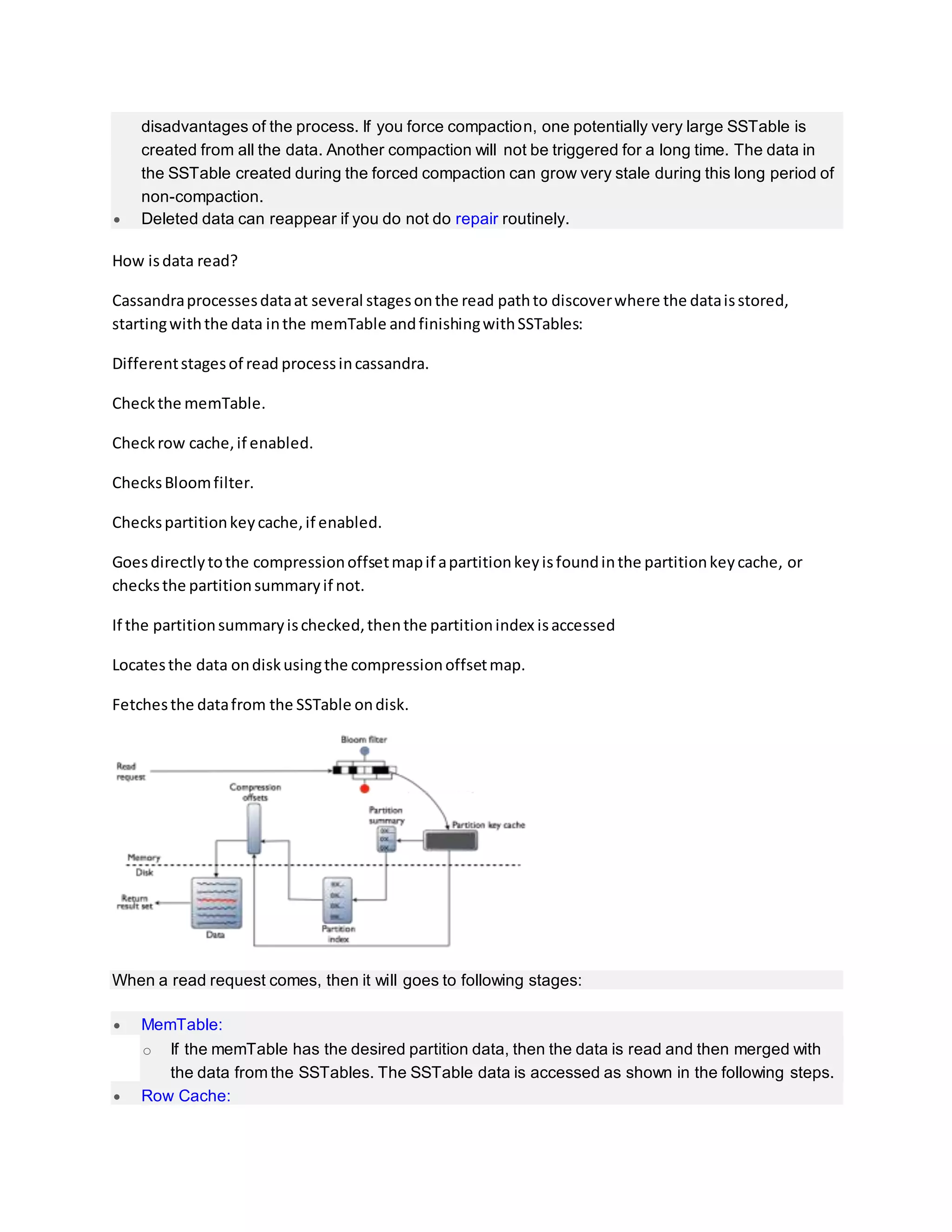
Cassandraprocessesdataat several stagesonthe read pathto discoverwhere the dataisstored,
startingwiththe data inthe memTable andfinishingwithSSTables:
Differentstagesof read processincassandra.
Checkthe memTable.
Checkrow cache,if enabled.
ChecksBloomfilter.
Checkspartitionkeycache,if enabled.
Goesdirectlytothe compressionoffsetmapif apartitionkeyisfoundinthe partitionkeycache, or
checksthe partitionsummaryif not.
If the partitionsummaryischecked,thenthe partitionindex isaccessed
Locatesthe data ondiskusingthe compressionoffsetmap.
Fetchesthe datafrom the SSTable ondisk.
When a read request comes, then it will goes to following stages:
 MemTable:
o If the memTable has the desired partition data, then the data is read and then merged with
the data from the SSTables. The SSTable data is accessed as shown in the following steps.
 Row Cache:
o Row cache is nothing but putting few records in in-memory.
o If row cache is enabled, after memTable cassandra checks the row cache if the desired
partition data will be read from the row cache, potentially saving two seeks to disk for the
data.
o The rows stored in row cache are frequently accessed rows that are merged and saved to
the row cache from the SSTables.
o If the desired partition data is not found in the row cache, then the Bloom filter is checked.
 Bloom Filter:
o Cassandra checks the Bloom filter to discover which SSTables are likely to have the request
partition data.
o Each SSTable has a Bloom filter associated with it.
o The main functionality of bloom filter is , when ever it says record present in the particular
SSTable, there is a chance that the record may present in that table.
o But if bloom filter says record is not present, then it guarantees that record will not be
present.
o After this partition key cache is checked.
 Partition Key Cache:
o If partition key cache is enabled, stores a cache of the partition index in off-heap memory.
o The key cache uses a small, configurable amount of memory.
o If a partition key is found in the key cache can go directly to the compression offset map to
find the compressed block on disk that has the data.
o The partition key cache can greatly improve over the performance of cold-start reads.
o If a partition key is not found in the key cache, then the partition summary is searched.
 Partition Summary:
o The partition summary is an off-heap in-memory structure that stores a sampling of the
partition index.
o A partition index contains all partition keys, whereas a partition summary samples every X
keys, and maps the location of every Xth key’s location in the index file.
o For example, if 1,2,3,4…..100 partition keys contain in an SSTable then, if the partition
summary is set to sample every 20 keys, it will store the location of the first key(stores 1) as
the beginning of the SSTable file, the 20th
key(stores 20) and its location in the file, and so
on.
o After finding the range of possible partition key values, the partition index is searched.
 Partition Index:
o The partition index resides on disk and stores an index of all partition keys mapped to their
offset.
o If the partition summary has been checked for a range of partition keys, now the search
passes to the partition index to seek the location of the desired partition key.
o A single seek and sequential read of the columns over the passed-in range is performed.
Usingthe informationfound,the partitionindexnow goestothe compressionoffsetmaptofindthe
compressedblockondiskthathas the data.
If the partitionindex mustbe searched,twoseekstodiskwill be requiredtofindthe desireddata.
Compressionoffsetmap:
The compressionoffsetmapstorespointerstothe exactlocationondiskthat the desiredpartitiondata
will be found.
It isstoredin off-heapmemoryandisaccessedbyeitherthe partitionkeycache orthe partitionindex.
The desiredcompressedpartitiondataisfetchedfromthe correctSSTable(s) once the compression
offsetmapidentifiesthe disklocation.The queryreceivesthe resultset.
Howdo write patternseffectreads?
It isimportantto considerhowthe write operationswill effectthe readoperationsinthe cluster.
Thiswill be basedontype of compactionstrategywe are using.
Usingthe SizeTieredCompactionStrategy orDateTieredCompactionStrategy tendstocause data
fragmentationwhenrowsare frequentlyupdated.
The LeveledCompactionStrategy wasdesignedtopreventfragmentationunderthiscondition.

Cassandra architecture

  • 1.
    Cassandra Architecture: Cassandrais designedinsuchawaythat,there will notbe anysingle pointof failure.There isno master- slave architecture inCassandra.cassandraaddressesthe problemof SPOF byemployingapeer-to-peer distributedsystem acrosshomogeneousnodeswhere dataisdistributedamongall nodesinthe cluster. In cassandraall nodesare same.There will notbe anymasteror slave in Cassandra.Each node frequentlyexchangesstate informationaboutitselfandothernodesacrossthe clusterusingpeer-to- peergossipcommunicationprotocol. Cassandrais a partitionedrowstore database,where rowsare organizedintotableswitharequired primarykey.Clients readorwrite requestscanbe senttoany node inthe cluster.Whenaclientconnects to a node witha request,thatnode servesasthe coordinatorforthat particularclientoperation.The coordinatoracts as a proxybetweenthe clientapplicationandthe nodesthatownthe data being requested.The coordinatordetermineswhichnodesinthe ringshouldgetthe requestbasedonhow the clusterisconfigured. Key componentsin Cassandra: Gossip protocol: Cassandra usesgossipprotocol tocommunicate withothernodes.Gossipisapeer- to-peercommunicationprotocol inwhichnodesperiodicallyexchange state informationabout themselvesandaboutothernodestheyknow about.The gossipprocessrunseverysecondand exchangesstate messageswithuptothree othernodesinthe cluster.The nodesexchange information aboutthemselvesandaboutthe othernodesthattheyhave gossipedabout,soall nodesquicklylearn aboutall other nodesinthe cluster. A gossipmessage hasa versionassociatedwithit,sothatduringa gossipexchange,olderinformationisoverwrittenwiththe mostcurrentstate fora particularnode. Seednodes:There will be fewseednodesinthe cassandra cluster,the mainpurpose of seednodesisto bootstrappingthe gossipprocessfornew nodesjoiningthe cluster. Seednodesare nota single pointof failure,nordotheyhave any otherspecial purpose inclusteroperationsbeyondthe bootstrappingof nodes. Inmultiple data-centre clusters,the seedlistshouldincludeatleastone node fromeachdata centre . Data distributionand replication: Followingsectionswill explainyouabouthow datawill be distributedandthe processof replicationin cassandra cluster.
  • 2.
    Virtual nodes(Vnodes):Incassandra,eachnode willbe assignedbyaunique token.datadistribution and replicationamongthe nodeswill be basedonthese unique tokens. BeforeCassandra1.2,each node isassignedwithatoken.Aftercassandra1.2, eachnode isassignedwithgroupof tokensas shownbelow,  The top portion of the graphic shows a cluster without vnodes. In this paradigm, each node is assigned a single token that represents a location in the ring. Each node stores data determined by mapping the partition key to a token value within a range from the previous node to its assigned value. Each node also contains copies of each row from other nodes in the cluster. For example, if the replication factor is 3, range E replicates to nodes 5, 6, and 1. Notice that a node owns exactly one contiguous partition range in the ring space.  The bottom portion of the graphic shows a ring with vnodes. Within a cluster, virtual nodes are randomly selected and non-contiguous. The main advantage of vnodes is data will not be replicated in continues nodes. so if a group continues nodes went down in a cluster then there is chance for data loss, so this is overcome by vnodes.  Replication strategy/data replication: Data replication is nothing but maintain duplicates of data. o If replication factor is 1, then there will be only one record of a row in any one of the node in a cluster o If it is 2, then it maintains 2 copies of each row, in a different nodes of a cluster. o In cassandra, all replicas are same, there will not be any primary or secondary replicas. o Generally, replication factor should greater then 1 and less then number of nodes in a cluster.  Types of replication strategies: o SimpleStrategy: Use this strategy, only if you have one data centre in the cluster. o NetworkTopologyStrategy: Use NetworkTopologyStrategy when you have multiple data centres in a cluster. NetworkTopologyStrategy will replicate data in to multiple nodes of different data centres. Data partitioning:Till nowwe have discussed aboutdata replication(storingdataduplicates).nowwe will discussaboutdatapartitioning,meanshow todistribute the dataacrossthe nodesinthe cluster.
  • 3.
    Basically,apartitionerisahash functionforcomputingthe tokenofa partitionkey.There are 3 typesof partitioner’sincassandra. Murmur3Partitioner (default): Uniformlydistributesdataacrossthe clusterbasedonMurmurHash hash values. RandomPartitioner:Uniformlydistributesdataacrossthe clusterbasedon MD5 hash values. ByteOrderedPartitioner:Keepsanordereddistributionof datalexicallybykeybytes. Snitch: A snitchdefinesgroupsof machinesintodatacentresandracks (the topology) thatthe replicationstrategyusestoplace replicas. The defaultSimpleSnitch doesnotrecognizedatacentre or rack information.TheGossipingPropertyFileSnitch isrecommendedforproduction.The followingare differenttypesof snitchs. dynamicsnitching simple snitching RackInferringSnitch PropertyFileSnitch GossipingPropertyFileSnitch Ec2Snitch Ec2MultiRegionSnitch GoogleCloudSnitch CloudstackSnitch This entry was posted in Cassandra and tagged AvailabilityCassandraConsistencyPartitionTolerance on January27, 2016 by Siva Table of Contents [hide]  What is CAP Theorem? o Consistency o Availability o Partition Tolerance o Consistency – Partition Tolerance: o Availability –Partition Tolerance: o Consistency – Availability:  Share this:
  • 4.
    What isCAP Theorem? CAPdescribesthat before choosinganyDatabase (Includingdistributeddatabase),Basingonyour requirementwe have tochoose onlytwopropertiesoutof three. Consistency: – Whenever you read a record (or data), consistency guaranties that it will give same data how many times you read. Simply we can say that each server returns the right response to each request, thus the system will be always consistent whenever you read or write data into that. Availability: – Availability simply means that each request eventually receives a response (even if it’s not the latest data or consistent across the system or just a message saying the system isn’t working). Partition Tolerance : – Partition Tolerance means that the cluster continues to function even if there is a “partition” (communications break) between two nodes (both nodes are up, but can’t communicate).  One propertyshouldbe scarifiedamongthree,soyouhave tochoose combinationof CA orCP or AP. Consistency –PartitionTolerance: Systemwill give youaconsistent dataandit will be distributedacrossthe cluster.Butitbecomes unavailable whenanode goesdown. Availability –PartitionTolerance: Systemwill respondevenif nodesare notcommunicatingwitheachother(nodesare upandrunning but notcommunicating).Butthere isnoguarantythat all nodeswill have same data.
  • 5.
    Consistency –Availability: Systemwill giveyouaconsistentdataandyoucan write/readdatato/fromanynode,butdata partitioningwill notbe syncwhendevelopapartitionbetweennodes (RDBMSsystemssuchasMySQL are of CA combinationsystems.) Accordingto CAPtheorem, Cassandrawill fallintocategoryof AP combination,thatmeansdon’tthink that Cassandrawill notgive a consistentdata.We can tune Cassandraas per ourrequirement togive youa consistentresult. Cassandra Interview Cheat Sheet: his entry was posted in Cassandra on October 10, 2015 by Siva Table of Contents [hide]  Cassandra o  NoSQL  KeySpace  Partitioner  Snitch  Replication Factor  Partitioners  Share this: Cassandra Cassandra is a distributed database from Apache that is highly scalable and designed to manage very large amounts of structured data. It provides high availability with no single point of failure. NoSQL The primary objective of a NoSQLdatabase is to have  simplicityof design,  horizontal scaling,and  finercontrol overavailability.
  • 6.
    These databases areschema-free, support easy replication, have simple API, eventually consistent, and can handle huge amounts of data Features of Cassandra Elastic scalability – Cassandra is highly scalable; it allows to add more hardware to accommodate more customers and more data as per requirement. Always on architecture – Cassandra has no single point of failure and it is continuously available for business-critical applications that cannot afford a failure. Fast linear-scale performance – Cassandra is linearly scalable, i.e., it increases your throughput as you increase the number of nodes in the cluster. Therefore it maintains a quick response time. Flexible data storage – Cassandra accommodates all possible data formats including: structured, semi-structured, and unstructured. It can dynamically accommodate changes to your data structures according to your need.  Cqlsh CassandraqueryLanguage shell(Cqlsh) Usingcqlsh,you can  define aschema,  insertdata,and  execute aquery KeySpace keyspace in Cassandra is a namespace that defines data replication on nodes. A cluster contains one keyspace per node. Given below is the syntax for creating a keyspace using the statement CREATE KEYSPACE. Token When you start a Cassandra cluster, data is distributed across the nodes in the cluster based on the row key using a partitioner. You must assign each node in a cluster a token and that token determines the node’s position in the ring and its range of data. SS Table A sorted string table (SSTable) is an immutable data file to which Cassandra writes memtables periodically. SSTables are stored on disk sequentially and maintained for each Cassandra table. Bloom Filter An off-heap structure associated with each SSTable that checks if any data for the requested row exists in the SSTable before doing any disk I/O. Key components for configuring Cassandra Gossip A peer-to-peer communication protocol to discover and share location and state information
  • 7.
    about the othernodes in a Cassandra cluster. Gossip information is also persisted locally by each node to use immediately when a node restarts. Partitioner A partitioner determines how to distribute the data across the nodes in the cluster and which node to place the first copy of data on. Basically, a partitioner is a hash function for computing the token of a partition key. Each row of data is uniquely identified by a partition key and distributed across the cluster by the value of the token. The Murmur3Partitioner is the default partitioning strategy for new Cassandra clusters and the right choice for new clusters in almost all cases. Snitch A snitch defines groups of machines into data centers and racks (the topology) that the replication strategy uses to place replicas. You must configure a snitch when you create a cluster. All snitches use a dynamic snitch layer, which monitors performance and chooses the best replica for reading. It is enabled by default and recommended for use in most deployments. Configure dynamic snitch thresholds for each node in the cassandra.yaml configuration file. Replication Factor Consistent hashing Consistent hashing allows distributing data across a cluster which minimizes reorganization when nodes are added or removed Virtual Node You no longer have to calculate and assign tokens to each node. Rebalancing a cluster is no longer necessary when adding or removing nodes. When a node joins the cluster, it assumes responsibility for an even portion of data from the other nodes in the cluster. If a node fails, the load is spread evenly across other nodes in the cluster. Rebuilding a dead node is faster because it involves every other node in the cluster. Partitioners A partitioner determines how data is distributed across the nodes in the cluster (including replicas). Basically, a partitioner is a function for deriving a token representing a row from its partion key, typically by hashing. Each row of data is then distributed across the cluster by the value of the token. Both the Murmur3Partitioner and RandomPartitioner use tokens to help assign equal portions of data to each node and evenly distribute data from all the tables throughout the ring or other grouping, such as a keyspace. Moving Data from other Databases The COPY command, which mirrors what the PostgreSQL RDBMS uses for file/export import. The Cassandra bulk loader provides the ability to bulk load external data into a cluster.
  • 8.
    TTL Time-to-live. An optionalexpiration date for values inserted into a column Consistency consistency refers to how up-to-date and synchronized a row of data is on all of its replicas. Backup and Restoring Data Cassandra backs up data by taking a snapshot of all on-disk data files (SSTable files) stored in the data directory. You can take a snapshot of all keyspaces, a single keyspace, or a single table while the system is online. Cassandra Tools  The nodetool utility  A commandline interface forCassandraformanagingacluster.  Cassandrabulkloader(sstableloader)  The cassandra utility  Starts the CassandraJava serverprocess  .The cassandra-stresstool  A Java-basedstresstestingutilityforbenchmarkingandloadtestingaCassandracluster.  The sstablescrubutility  Scrub the all the SSTablesforthe specifiedtable.  The sstablesplitutilitysstablekeys  The sstablekeysutilitydumpstable keys.  The sstableupgrade tool  Upgrade the SSTablesinthe specifiedtable (orsnapshot)tomatchthe current versionof Cassandra. Cassandra Overview: This entry was posted in Cassandra on September 8, 2015 by Siva Table of Contents [hide]  Cassandra Overview o    Commit Log & MemTable o Cassandra Key Components  
  • 9.
     Gossip o Datadistribution and replication  Virtual nodes (Vnodes):  Replication strategy/data replication:  Partitioner:  Snitch: o Share this: Cassandra Overview Cassandra is another no-sql database. Similar to Hbase it is also distributed column-oriented database to handle big data workloads across multiple nodes but it can support both Local File system and HDFS, whereas in Hbase the underlying file system is also HDFS. It overcomes single point of failure by using a peer-to-peer distributed system across homogeneous nodes where data is distributed among all nodes in the cluster. Each node frequently exchanges state information about itself and other nodes across the cluster using peer-to-peer gossip communication protocol. Commit Log & MemTable Commit log on each node will maintain write activity to ensure data durability. It will be sequentially written. Data is then indexed and written to an in-memory structure, called a memTable, which resembles a write-back cache. This is similar to memstore or WAL (Write Ahead Log) in Hbase. Once memTable is full, the data is written to an SSTable (sorted string table) data file. All writes are automatically partitioned and replicated throughout the cluster. Cassandra periodically consolidates SSTables using a process called compaction (This is same as major compaction in Hbase to apply delete markers on HFiles), discarding obsolete data marked for deletion with a tombstone. To ensure all data across the cluster stays consistent, various repair mechanisms are employed. Cassandra is a partitioned row store database, where rows are organized into tables with a required primary key. Cassandra’s architecture allows any authorized user to connect to any node in any data centre and access data using the CQL language. Unlike Hbase commands, CQL language uses a similar syntax to SQL and works with table data. Developers can access CQL through cqlsh, DevCenter, and via JDBC/ODBC drivers for application languages like java, python etc. Typically, a cluster has one keyspace per application composed of many different tables. Clients read or write requests can be sent to any node in the cluster. When a client connects to a node with a request, that node serves as the coordinator for that particular client operation. The coordinator acts as a proxy between the client application and the nodes that own the data being requested. The coordinator determines which nodes in the ring should get the request based on how the cluster is configured. Cassandra Key Components
  • 10.
    Gossip  A peer-to-peercommunication protocol in which nodes periodically exchange state information about themselves and about other nodes they know about. This is similar to hear-beat mechanism in HDFS to get the status of each node by the master.  A peer-to-peer communication protocol to share location and state information about the other nodes in a Cassandra cluster. Gossip information is also stored locally by each node to use immediately when a node restarts.  The gossip process runs every second and exchanges state messages with up to three other nodes in the cluster. The nodes exchange information about themselves and about the other nodes that they have gossiped about, so all nodes quickly learn about all other nodes in the cluster.  A gossip message has a version associated with it, so that during a gossip exchange, older information is overwritten with the most current state for a particular node.  To prevent problems in gossip communications, use the same list of seed nodes for all nodes in a cluster. This is most critical the first time a node starts up. By default, a node remembers other nodes it has gossiped with between subsequent restarts. The seed node designation has no purpose other than bootstrapping the gossip process for new nodes joining the cluster. Seed nodes are not a single point of failure, nor do they have any other special purpose in cluster operations beyond the bootstrapping of nodes. Note: In multiple data-center clusters, the seed list should include at least one node from each data center (replication group). More than a single seed node per data center is recommended for fault tolerance. Otherwise, gossip has to communicate with another data center when bootstrapping a node. Making every node a seed node is not recommended because of increased maintenance and reduced gossip performance. Gossip optimization is not critical, but it is recommended to use a small seed list (approximately three nodes per data center). Data distribution and replication How data is distributed and factors influencing replication. In Cassandra, Data is organized by table and identified by a primary key, which determines which node the data is stored on. Replicas are copies of rows. Factors influencing replication include: Virtual nodes (Vnodes): Assigns data ownership to physical machines.
  • 11.
    Before Cassandra 1.2,each node is assigned with a token. After Cassandra 1.2, each node is assigned with group of tokens as shown below In the first half, each node is assigned a single token that represents a location in the ring. Each node stores data determined by mapping the partition key to a token value within a range from the previous node to its assigned value. Each node also contains copies of each row from other nodes in the cluster. For example, if the replication factor is 3, range E replicates to nodes 5, 6, and 1. Notice that a node owns exactly one contiguous partition range in the ring space. The bottom half of diagram displays a ring with vnodes. Within a cluster, virtual nodes are randomly selected and non-contiguous. The placement of a row is determined by the hash of the partition key within many smaller partition ranges belonging to each node. Replication strategy/data replication: Determines the total number of replicas across the cluster. We need to define the replication factor for each data center. Two replication strategies are available:  SimpleStrategy: Use for a single data center only. SimpleStrategy places the first replica on a node determined by the partitioner. Additional replicas are placed on the next nodes clockwise in the ring without considering topology (rack or data center location).
  • 12.
     NetworkTopologyStrategy: UseNetworkTopologyStrategy when we have (or plan to have) our cluster deployed across multiple data centres. This strategy specifies how many replicas we want in each data center. NetworkTopologyStrategy places replicas in the same data center by walking the ring clockwise until reaching the first node in another rack. NetworkTopologyStrategy attempts to place replicas on distinct racks because nodes in the same rack (or similar physical grouping) often fail at the same time due to power, cooling, or network issues.  Two replicas in each data center: This configuration tolerates the failure of a single node per replication group and still allows local reads at a consistency level of ONE.  Three replicas in each data center: This configuration tolerates either the failure of a one node per replication group at a strong consistency level of LOCAL_QUORUM or multiple node failures per data center using consistency level ONE. Replication strategy is defined per keyspace, and is set during keyspace creation. Partitioner: Partitions the data across the cluster. A partitioner distributes the data across the nodes in the cluster and determines which node to place the first copy of data on. Basically, a partitioner is a hash function for computing the token of a partition key. Each row of data is uniquely identified by a partition key and distributed across the cluster by the value of the token. The read and write requests to the cluster are also evenly distributed and load balancing is simplified because each part of the hash range receives an equal number of rows on average.  Murmur3Partitioner (default): uniformly distributes data across the cluster based on MurmurHash hash values.  RandomPartitioner: uniformly distributes data across the cluster based on MD5 hash values.  ByteOrderedPartitioner: keeps an ordered distribution of data lexically by key bytes Note: If using virtual nodes (vnodes), we do not need to calculate the tokens. If not using vnodes, we must calculate the tokens to assign to the initial_token parameter in the cassandra.yaml file. Snitch: A snitch defines groups of machines into data centres and racks (the topology). We must configure a snitch when we create a cluster. All snitches use a dynamic snitch layer, which monitors performance and chooses the best replica for reading. It is enabled by default. Configure dynamic snitch thresholds for each node in the cassandra.yaml configuration file. The defaultSimpleSnitchdoesnotrecognize datacenterorrack information.Use itforsingle-data centerdeploymentsorsingle-zone inpublicclouds.The GossipingPropertyFileSnitchis recommended for production.Itdefinesanode’sdatacenterand rack and usesgossipforpropagatingthisinformation to othernodes.
  • 13.
    There are manyvtypesofsnitcheslike dynamicsnitching,simple snitching,RackInferringSnitch, PropertyFileSnitch,GossipingPropertyFileSnitch,Ec2Snitch,Ec2MultiRegionSnitch,GoogleCloudSnitch, CloudstackSnitch. Cassandra is a partitioned row store database, where rows are organized into tables with a required primary key.Clients read or write requests can be sent to any node in the cluster. When a client connects to a node with a request, that node serves as the coordinator for that particular client operation. The coordinator acts as a proxy between the client application and the nodes that o wn the data being requested. The coordinator determines which nodes in the ring should get the request based on how the cluster is configured Cassandraproductionscenarios/issues Thisentrywas postedinCassandra and tagged ConstantReconnectionPolicyDCAwareRoundRobinPolicy DefaultRetryPolicydistributedcallsincassandraJDBCDowngradingConsistencyRetryPolicy ExponentialReconnectionPolicyLoadBalancingPolicyReadReconnectionPolicyRetryPolicy RoundRobinPolicyTokenAwarePolicyUnavailable Write onJanuary28, 2016 by Siva Table of Contents[hide] Production issue: FewProductionconfigurationsincassandra RetryPolicy DefaultRetryPolicy DowngradingConsistencyRetryPolicy ReconnectionPolicy ConstantReconnectionPolicy
  • 14.
    ExponentialReconnectionPolicy(default) Load BalancingPolicy RoundRobinPolicy DCAwareRoundRobinPolicy TokenAwarePolicy(default) Share this: Productionissue: whenweare tryingto write a selectquerywith8 lacksids“in condition“.thenwe got facedbelow issue, To solve the above exception,we useddistributedcallsinJavaclientasshownbelow, importjava.net.InetSocketAddress; importjava.util.ArrayList; importjava.util.List; importjava.util.Map; importcom.datastax.driver.core.Cluster; importcom.datastax.driver.core.PreparedStatement; importcom.datastax.driver.core.ResultSet; importcom.datastax.driver.core.ResultSetFuture; importcom.datastax.driver.core.Row; importcom.datastax.driver.core.Session;
  • 15.
    importcom.datastax.driver.core.exceptions.NoHostAvailableException; publicclassSelectCassandraDistrbuted{ publicstaticvoidmain(String[] args) { Clustercluster= null; try{ cluster= Cluster.builder().addContactPoints("node1address/IP","node2address/IP","node3 address/IP").build(); cluster.getConfiguration().getSocketOptions().setReadTimeoutMillis(600000000); Sessionsession=cluster.connect("keyspace_name"); System.out.println("connected"); PreparedStatementstatement=session.prepare("select*fromtable where tmp_time =?"); List<String>idsList= newArrayList<String>(); //Here we added8 lacs idsto the idsListlist List<ResultSetFuture>futures=new ArrayList<ResultSetFuture>(); //Here we are executingthe query. for (Stringid:idsList) { ResultSetFuture resultSetFuture =session.executeAsync(statement.bind(id)); futures.add(resultSetFuture); } //Fetchingthe results
  • 16.
    for (ResultSetFuture future:futures){ ResultSetrows=future.getUninterruptibly(); Row row= rows.one(); System.out.println(row.getString("sys_serial_no")); System.out.println(row.getString("tmp_time")); } } importjava.net.InetSocketAddress; importjava.util.ArrayList; importjava.util.List; importjava.util.Map; importcom.datastax.driver.core.Cluster; importcom.datastax.driver.core.PreparedStatement; importcom.datastax.driver.core.ResultSet; importcom.datastax.driver.core.ResultSetFuture; importcom.datastax.driver.core.Row; importcom.datastax.driver.core.Session; importcom.datastax.driver.core.exceptions.NoHostAvailableException; publicclassSelectCassandraDistrbuted{ publicstaticvoidmain(String[] args) { Cluster cluster= null; try{ cluster= Cluster.builder().addContactPoints("node1address/IP","node2address/IP","node3 address/IP").build(); cluster.getConfiguration().getSocketOptions().setReadTimeoutMillis(600000000); Sessionsession=cluster.connect("keyspace_name");
  • 17.
    System.out.println("connected"); PreparedStatementstatement=session.prepare("select*fromtable where tmp_time=?"); List<String>idsList= new ArrayList<String>(); //Here we added8 lacs idsto the idsListlist List<ResultSetFuture>futures=new ArrayList<ResultSetFuture>(); //Here we are executingthe query. for (Stringid:idsList) { ResultSetFuture resultSetFuture =session.executeAsync(statement.bind(id)); futures.add(resultSetFuture); } //Fetchingthe results for (ResultSetFuture future:futures){ ResultSetrows= future.getUninterruptibly(); Row row= rows.one(); System.out.println(row.getString("sys_serial_no")); System.out.println(row.getString("tmp_time")); } } FewProductionconfigurationsincassandraRetryPolicy Three scenariosyoucan control retrypolicyfor: Readtime out: Whena coordinatorreceivedthe requestandsentthe readto replica(s) butthe replica(s) didnotrespondintime. Write time out: Asabove but forwrites Unavailable:Whenthe coordinatorisaware there aren’tenoughreplicaavailable without sendingthe read/write requeston
  • 18.
    Types ofretry polices: DefaultRetryPolicy Readtimeout:Whenenoughreplicaareavailable butthe datadidnot come back withinthe configured readtime out. Write timeout:Onlyif the initial phaseof abatch write timesout. Unavailable time out:Never DowngradingConsistencyRetryPolicy Read: If at leastone replicarespondedthenthe readisretriedata lowerconsistency. Write:Retriesforunloggedbatchquerieswhenatleastone replicaresponded. Unavailable:If at leastone replicaisavailable thenthe queryisre-triedwithalowerconsistency. ReconnectionPolicy The reconnectionpolicydetermineshow oftenareconnectiontoadeadnode is attempted.There are 2 typesof reconnectionpolicies. ConstantReconnectionPolicy Fixeddelayinbetweeneachreconnectionattempt. delay(configurableproperty)shouldbe afloatingpointnumberof secondstowaitinbetweeneach attempt. max_attempts(configurable property) shouldbe atotal numberof attemptsto be made before giving up,or None tocontinue reconnectionattemptsforever.The defaultis64. ExponentialReconnectionPolicy(default) Exponentiallyincreasesthe lengthof the delayinbetweeneachreconnectionattemptuptoa set maximumdelay. base_delayandmax_delayshouldbe infloatingpointunitsof seconds. Load Balancing Policy The load balancingpolicydetermineswhichnode toexecute aqueryon.Below are differenttypesof loadbalancingpolicytechniques.
  • 19.
    RoundRobinPolicy Distributesqueriesacross all nodesinthecluster,regardlessof whatdatacentre the nodesmaybe in. DCAwareRoundRobinPolicy SimilartoRoundRobinPolicy,butprefershostsinthe local datacenterandonlyusesnodesinremote datacentersasa lastresort. TokenAwarePolicy(default) A LoadBalancingPolicywrapperthataddstokenawarenesstoa childpolicy.Thisaltersthe childpolicy’s behaviorsothat itfirstattemptsto sendqueriestoLOCALreplicas(asdeterminedbythe childpolicy) basedon the Statement‘srouting_key.Once those hostsare exhausted,the remaininghostsinthe child policy’squeryplanwill be used. Cassandra write and read process: This entry was posted in Cassandra and tagged Bloom filtercassandra delete flowcassandra insert flowcassandra read flowcassandra update flowcommit logCompactioncompression offsetDateTieredCompactionStrategyHow data is written into cassandraHow do write patterns effect reads in cassandraHow is data deleted in cassandraHow is data read in cassandraHow is data updated in cassandraLeveledCompactionStrategymemTablePartition indexpartition keyPartition summaryrow cacheSizeTieredCompactionStrategySSTable Table of Contents [hide]  Storage engine o How data is written? o Compaction: o Types of compaction: o How is data updated? o How is data deleted? o How is data read? o How do write patterns effect reads? o Share this:
  • 20.
    Storage engine  Cassandrauses a storage structure similar to a Log-Structured Merge Tree, unlike a typical relational database that uses a B- Tree.  Cassandra avoids reading before writing. Read-before-write, especially in a large distributed system, can produce stall in read performance and other problems.  Cassandra never re-writes or re-reads existing data, and never overwrites the rows in place. How data is written? Different stages of write process in cassandra  Logging data in the commit log.  Writing data to the memTable.  Flushing data from the memTable.  Storing data on disk in SSTables. Logging writes and memTable storage: when ever a write request came from client, first the data is written into memTable (it is in-memory storage) and commit log on disk (it will be present even if power fails on a node). The commit log receives every write made to a Cassandra node and these durable writes survive permanently. The memTable stores write until reaching a configurable limit, and then is flushed. Flushing data from the memTable: To flush the data, Cassandra sorts memTables by token and then writes the data to disk sequentially. A partition index is also created on the disk that maps the
  • 21.
    tokens to alocation on disk. When the memTable content exceeds the configurable threshold, the memTable is put in a queue that is flushed to disk. If the data to be flushed exceeds the queue size, Cassandra blocks writes until the next flush succeeds. You can manually flush a table using node tool flush. Below command shows, flush command using node tool. 1 3 4 5 nodetool flush -- <keyspace> <table>(or you can mention list of tables) ex: nodetool flush -- sys s_mode
  • 22.
    To reduce thecommit log replay time, the recommended best practice is to flush the memTable before you restart the nodes. Commit log replay is the process of reading the commit log to recover lost writes in the event of interrupted operations. Storing data on disk in SSTables: MemTables and SSTables are maintained per table. SSTables are immutable, not written to again after the memTable is flushed. For eachSSTable,Cassandracreatesthese structures: Partition index:A listof partitionkeysandthe start positionof rowsinthe data file writtenondisk. Partition summary: A sample of the partitionindex storedinmemory. Bloom filter:A structure storedin memorythatchecksif row data existsinthe memTable before accessingSSTablesondisk. Compaction: Whatiscompactionand whyitis requiredfortablesincassandra: whenever inserts/update/delete requestoccur, insteadof overwritingthe rows,Cassandrawritesanew timestampedversionof the insertedorupdateddatainanotherSSTable.Thishappensbecause SStables are immutable. Compactionmergesthe dataineach SSTable bypartitionkey,selectingthe latestdataforstorage based on itstimestamp. Cassandracanmerge the data performantly,withoutrandomIO,because rowsare sortedby partitionkeywithineachSSTable.Afterremovingdeleteddata,columns,androws,the
  • 23.
    compactionprocessconsolidatesSSTablesintoasingle file.The oldSSTablefilesare deletedassoonas any pendingreadsfinishusingthe files.Diskspace occupiedbyoldSSTablesbecomesavailablefor reuse. During compaction, there is a temporary spike in disk space usage and disk I/O because the old and new SSTables co-exist. Disk space occupied by old SSTables becomes available for reuse when the new SSTable is ready. Cassandra 2.1 and later improves read performance after compaction because of incremental replacement of compacted SSTables. Instead of waiting for the entire compaction to finish and then throwing away the old SSTable, Cassandra can read data directly from the new SSTable even before it finishes writing. As data is written to the new SSTable and reads are directed to it, the corresponding data in the old SSTables is no longer accessed and is evicted from the page cache. Thus begins an incremental process of caching the new SSTable, while directing reads away from the old one, thus avoiding the dramatic cache miss. Cassandra provides predictable high performance even under heavy load. Types of compaction:  SizeTieredCompactionStrategy (STCS): Recommended for write-intensive workloads. o Pros: Compacts write-intensive workload very well. o Cons: Might hold onto stale data too long. Amount of memory needed increases over time. The SizeTieredCompactionStrategy (STCS) initiates compaction when a set number (default is 4) of similar sized SSTables have accumulated. Compaction merges the SSTables to create one larger SSTable. As larger SSTables accumulate, the same process occurs, merging the larger SSTables into an even larger SSTable. At any given time, several SSTables of varying sizes are present. While this strategy works quite well to compact a write-intensive workload, when reads are needed, several SSTables still must be retrieved to find all the data for a row. There is no guarantee that a row’s data will be restricted to a small number of SSTables. Also, predicting the eviction of deleted data is uneven, because SSTable size is the trigger for compaction, and SSTables might not grow quickly enough to merge and evict old data. As the largest SSTables grow in size, the amount of memory needed for compaction to hold both the new and old SSTables simultaneously can outstrip a typical amount of RAM on a node.
  • 24.
     LeveledCompactionStrategy (LCS):Recommended for read-intensive workloads. o Pros: Memory requirements are simple to predict. Read operations more predictable in latency. Stale data is evicted more frequently. o Cons: Much higher I/O utilization that can impact operation latency. The leveled compaction strategy creates SSTables of a fixed, relatively small size (160 MB by default) that are grouped into levels. Within each level, SSTables are guaranteed to be non- overlapping. Each level (L0, L1, L2 and so on) is 10 times as large as the previous. Disk I/O is more uniform and predictable on higher than on lower levels as SSTables are continuously being compacted into progressively larger levels. At each level, row keys are merged into non-overlapping SSTables. This can improve performance for reads, because Cassandra can determine which SSTables in each level to check for the existence of row key data.  DateTieredCompactionStrategy (DTCS): Recommended for time series and expiring TTL workloads. o Pros: Memory requirements are simple to predict. Read operations more predictable in latency. Stale data is evicted more frequently. o Cons: Much higher I/O utilization that can impact operation latency. The DateTieredCompactionStrategy (DTCS) acts similarly to STCS, but instead of compacting based on SSTable size, DTCS compacts based on SSTable age. How is data updated?  In cassandra, inserting a duplicate primary key is treated as an upsert.  An upsert writes a new record to the database if the data didn’t exist before. If the data for that primary key already exists, a new record is written with a more recent timestamp.  During read process, only the most recent is retrieved; older timestamped data will be marked for deletion.  Eventually, the updates are streamed to disk using sequential I/O and stored in a new SSTable.  If multiple versions of the column exist in the memTable, Cassandra flushes only the newer version of the column to disk, as described in the Compaction section. How is data deleted? Cassandra deletes data differently than a relational database does. A relational database might spend time scanning through data looking for expired data and throwing it away or an administrator might have to partition expired data by month. Data in a Cassandra column can have an optional expiration date called TTL (time to live). Use CQL to set the TTL in seconds for data. Facts about deleted data to consider are:  Cassandra does not immediately remove data marked for deletion from disk. The deletion occurs during compaction.  If you use the SizeTieredCompactionStrategy or DateTieredCompactionStrategy, you can drop data immediately by manually starting the compaction process. Before doing so, understand the
  • 25.
    disadvantages of theprocess. If you force compaction, one potentially very large SSTable is created from all the data. Another compaction will not be triggered for a long time. The data in the SSTable created during the forced compaction can grow very stale during this long period of non-compaction.  Deleted data can reappear if you do not do repair routinely. How isdata read? Cassandraprocessesdataat several stagesonthe read pathto discoverwhere the dataisstored, startingwiththe data inthe memTable andfinishingwithSSTables: Differentstagesof read processincassandra. Checkthe memTable. Checkrow cache,if enabled. ChecksBloomfilter. Checkspartitionkeycache,if enabled. Goesdirectlytothe compressionoffsetmapif apartitionkeyisfoundinthe partitionkeycache, or checksthe partitionsummaryif not. If the partitionsummaryischecked,thenthe partitionindex isaccessed Locatesthe data ondiskusingthe compressionoffsetmap. Fetchesthe datafrom the SSTable ondisk. When a read request comes, then it will goes to following stages:  MemTable: o If the memTable has the desired partition data, then the data is read and then merged with the data from the SSTables. The SSTable data is accessed as shown in the following steps.  Row Cache:
  • 26.
    o Row cacheis nothing but putting few records in in-memory. o If row cache is enabled, after memTable cassandra checks the row cache if the desired partition data will be read from the row cache, potentially saving two seeks to disk for the data. o The rows stored in row cache are frequently accessed rows that are merged and saved to the row cache from the SSTables. o If the desired partition data is not found in the row cache, then the Bloom filter is checked.  Bloom Filter: o Cassandra checks the Bloom filter to discover which SSTables are likely to have the request partition data. o Each SSTable has a Bloom filter associated with it. o The main functionality of bloom filter is , when ever it says record present in the particular SSTable, there is a chance that the record may present in that table. o But if bloom filter says record is not present, then it guarantees that record will not be present. o After this partition key cache is checked.  Partition Key Cache: o If partition key cache is enabled, stores a cache of the partition index in off-heap memory. o The key cache uses a small, configurable amount of memory. o If a partition key is found in the key cache can go directly to the compression offset map to find the compressed block on disk that has the data. o The partition key cache can greatly improve over the performance of cold-start reads. o If a partition key is not found in the key cache, then the partition summary is searched.  Partition Summary: o The partition summary is an off-heap in-memory structure that stores a sampling of the partition index. o A partition index contains all partition keys, whereas a partition summary samples every X keys, and maps the location of every Xth key’s location in the index file. o For example, if 1,2,3,4…..100 partition keys contain in an SSTable then, if the partition summary is set to sample every 20 keys, it will store the location of the first key(stores 1) as the beginning of the SSTable file, the 20th key(stores 20) and its location in the file, and so on. o After finding the range of possible partition key values, the partition index is searched.  Partition Index: o The partition index resides on disk and stores an index of all partition keys mapped to their offset. o If the partition summary has been checked for a range of partition keys, now the search passes to the partition index to seek the location of the desired partition key. o A single seek and sequential read of the columns over the passed-in range is performed. Usingthe informationfound,the partitionindexnow goestothe compressionoffsetmaptofindthe compressedblockondiskthathas the data.
  • 27.
    If the partitionindexmustbe searched,twoseekstodiskwill be requiredtofindthe desireddata. Compressionoffsetmap: The compressionoffsetmapstorespointerstothe exactlocationondiskthat the desiredpartitiondata will be found. It isstoredin off-heapmemoryandisaccessedbyeitherthe partitionkeycache orthe partitionindex. The desiredcompressedpartitiondataisfetchedfromthe correctSSTable(s) once the compression offsetmapidentifiesthe disklocation.The queryreceivesthe resultset. Howdo write patternseffectreads? It isimportantto considerhowthe write operationswill effectthe readoperationsinthe cluster. Thiswill be basedontype of compactionstrategywe are using. Usingthe SizeTieredCompactionStrategy orDateTieredCompactionStrategy tendstocause data fragmentationwhenrowsare frequentlyupdated. The LeveledCompactionStrategy wasdesignedtopreventfragmentationunderthiscondition.