CASHEW HANDBOOK 2014 - GLOBAL PERSPECTIVE 
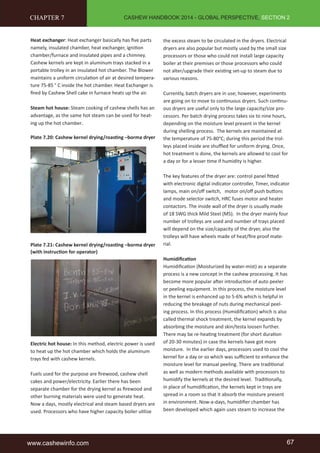
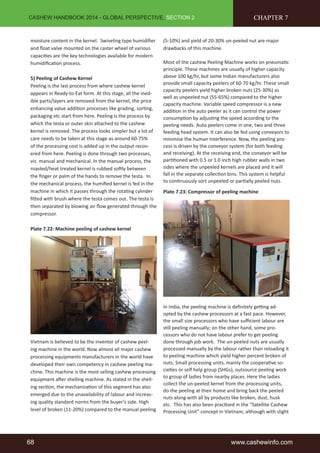
CASHEW 
HANDBOOK 2014 
Global Perspective 
In association with 
African Cashew Alliance 
Title Sponsors 
Associate Sponsors 
www.cashewinfo.com 5
CASHEW HANDBOOK 2014 - GLOBAL PERSPECTIVE 
Title Sponsor 
The 3F group is a 55 year old conglomerate of multifarious businesses which include manufac-turing 
and trading of Edible oils, Bakery fats, Confectionary fats, Oil palm plantations, Garments 
and International Commodity Trading. 
3F has its presence in West Africa through commodity trading operations in countries like Gha-na, 
Burkina Faso, Mali, Ivory Coast, Benin, Nigeria, Senegal, Guinea Bissau and Gambia and in 
the South Asian countries like Vietnam, Indonesia, Singapore and India. 
3F’s key commodities are Raw Cashewnuts, Cashew Kernels of various grades, Sheanuts, Sesa-me 
Seeds, Soyabean, De-oiled meals, Groundnuts and similar agri commodities. 3F also distrib-utes 
rice from India under various brand names to countries like Benin, Nigeria and Niger. 
The year 2012 marked a successful decade of operations at Africa. The past ten years have been 
productive in building a brand, creating goodwill and establishing quality practices both in busi-ness 
and within the community. At Africa, 3F as a brand is associated with quality agri products 
and ethical business practices. 
3F’s competitive advantage in Africa would be undoubtedly the topographical knowledge of 
the land, logistical advantages due to the volumes and a loyal, prolific and committed employee 
base. 
In closing, it would be fitting to quote what is our clarion call – “In Africa today, we recognize 
that trade and investment, and not aid, are pillars of development” 
To know more about us please visit www.3fg.co or www.3fg.in 
3F Group 
Global Trading Head Office 
7/2 Pycrofts Garden Road, Nungambakkam 
Chennai 600006, India 
Ph +91 44 28281777 
Email – cashew@3fg.co 
6 www.cashewinfo.com
CASHEW HANDBOOK 2014 - GLOBAL PERSPECTIVE 
Title Sponsor 
Mali Exim (ME) Sarl is a trading company located in Mali and our main business is concentrated 
on export of raw cashew and sesame from the country which represent 70% of annual turnover. 
We are the member of Association Malienne des Exportateurs de Cajou (AMEC) and we plan in 
next five years as the first exporters of raw nuts from Mali to India, Vietnam markets through 
our connection tied to Singapore. 
In near future, Mali Exim (ME) Sarl in through AMEC will initiate some training programmes 
with local producers and will tie relation with Indian and Vietnamese organizations to know 
about the new techniques of growing the big size of raw cashew nuts that can increase the 
quantity and the quality of kernels. 
Mali Exim (ME) Sarl plans to invest or make joint venture locally with one processing company 
to export the raw kernels on the international market according to the contracts we will negoti-ate. 
In summary, our main activity will be focused on export of raw nuts. 
Mali Exim (ME) Sarl 
Immeuble BORE, 1er étage, Route de l’aéroport en face 
hôtel Wassoulou 
BP E 2683 Bamako – République du Mali 
Tel. : +223 71 25 40 57 
Email : maliexim.sarl@gmail.com 
Skype : malieximsarl 
www.cashewinfo.com 7
CASHEW HANDBOOK 2014 - GLOBAL PERSPECTIVE 
Associate Sponsors 
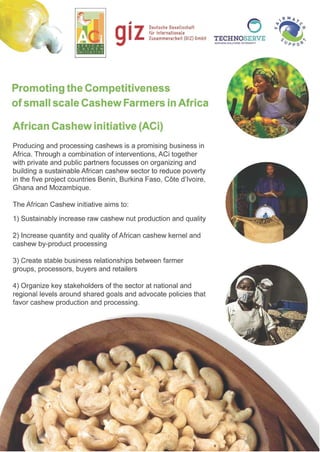
The African Cashew initiative (ACi) recognizes the potential ofachieving higher yields, better quality 
cashew nuts, a flourishing in-country processing industryand the need to build adequate business 
skills and toincrease incomes of along the cashew value chain. ACi, through a combination of inter-ventions, 
aims at supporting at least 330,000 cashew farmers in the five project countries, namely 
Benin, Burkina Faso, Côte d’Ivoire, Ghana and Mozambiqueto increase their family income by US$ 
600 annually from cashew production alone. By2015, this will beequal to an annual income of US$ 
30 million, benefitting 2.2 Million members of rural households. 
The African Cashew initiative is a broad-based multi-stakeholder partnership in Development Coop-eration. 
The initiative is mainly financed by the German Ministry for Economic Development and Cooperation (BMZ) 
and the Bill & Melinda Gates Foundation.The Deutsche GesellschaftfuerInternationaleZusammenarbeit GmbH (GIZ) 
is the lead implementer in collaboration with FairmatchSupport and Technoserve, as well as private companies and 
national institutionsto buildand structure a sustainable African cashew sector. 
ACi is currently supporting CCA, the Cotton and Cashew Council of Côte d’Ivoire in the organization of SIETTA 2014, 
The International Cashew Processing Equipment & Technology Show, from 26th to 28th November at Palais des Sports 
Treichville in Abidjan,Côte d’Ivoire. SIETTA 2014 offers an opportunity for manufacturers of food and agro processing 
equipment to access the high potential of the cashew sector in Côte d’Ivoire and Africa as a whole. By demonstrating 
equipment, or exhibiting at a multi-media brochure stand, manufacturers cando business with and learn about the Afri-can 
cashew sector.The Government of Côte d’Ivoire is dedicated to facilitate the processing of 400,000 tons of cashew 
per annum by 2020.To meet this goal, the Government of Côte d’Ivoire has launched an Agri Investment Program, and 
is allocating USD $4.5 billion to be invested between 2012 and2016. 
OLTREMARE is an Italian company specialized in the design and manufac-ture 
of turnkey plants and machinery for the cashew nut processing industry. 
In 1960 OLTREMARE established the first mechanical cashew nut process-ing 
plant ever, in Italy. Since then, as of today, OLTREMARE has realized 
almost 150 industrial projects in the cashew nut industry, selling thousands of machines for the various processing 
operations in INDIA, VIETNAM, INDONESIA, BRAZIL, TANZANIA, MOZAMBIQUE, KENYA, IVORY COAST 
and NIGERIA. 
Some of the original processing solutions introduced and then developed by OLTREMARE: the RCN Calibration concept 
prior to shelling, the Continuous Oil Bath Roasting and Centrifuge, the Continuous Steam Roasting, the Semi Automatic 
first and then the Automatic Shelling, the Pneumatic Shell/Kernel Separation, the Continuous Drying and Re-Humidifi-cation, 
the Low Energy Impact Static Dryer with continuous air re-circulation for small and medium capacities (NEW!) 
the Mechanical Peeling with the combined action of mechanical and compressed air systems, the Split/Pieces Automatic 
Separation, the Automatic Grading of the Kernels, the Flexi Pouches Vacuum Packing (dating back in 1986). 
Today OLTREMARE has brought cashew processing into the next generation of solutions that, through a 360° inte-grated 
approach, allows to combine previously separated processing operations, further increasing efficiency, reducing 
space requirement, increasing productivity of labor, reducing power consumption, reducing the environmental impact, 
increasing finished product sanitation levels. Such an approach includes the value addition for all the by-products of 
the RCN such as the CNSL up to Cardanol and its derivatives, as the shell’s cake up to the production of electric and 
thermal power. 
OLTREMARE Services to customers include the design and engineering of all the plant needs such as space require-ment 
(for factory and warehouse), machinery and equipment requirement, the utilities requirement, the ancillary equip-ment 
requirement, the labor requirements, the power consumption, following with the assembling and commissioning 
of the machinery supplied, the technical training of the customer personnel, the maintenance and after sales service 
(even from remote). OLTREMARE is stably present in INDIA, VIETNAM, BRAZIL, WEST AFRICA, EAST AFRICA. 
8 www.cashewinfo.com
CASHEW HANDBOOK 2014 - GLOBAL PERSPECTIVE 
Associate Sponsors 
St John Freight Systems Ltd have been present in WEST AFRICA for the last five 
years and have been closely associated with various Commodity business with 
particular emphasis on handling of Raw Cashew business. 
Our presence at the moment is in the markets of Nigeria, Ivory Coast, Ghana, 
Benin, Guinea Bissau but, have long term plans to enlarge our coverage in this region. We have well trained man power 
who are experienced enough to meet the demands of these markets in terms of handling the Statutory requirements, 
Infrastructure needs, setting up new operations / activity, warehousing and distribution etc., 
Our current activities cover International Freight Forwarding, Consolidation services, Warehousing and Distribution, 
Haulage services, Commodity specialization etc., We have strong relationship / working agreements with Shipping 
Companies and Vendors in the market and in view of the biz volumes that we handle, we are able to procure Competi-tive 
pricing backed by dependable service levels. 
The Group has over 50 Offices across 4 Continents and this gives us enormous flexibility in handling our Customers 
documentation/payment requirements with flexibility across our network. Our goal is to establish St John as a one stop 
service provider in the West Africa market and offer our Customers a reliable product for all their needs in the near 
future. Our long term interests are to extend our Service Network to other parts of Africa and play a vital role in the 
development of this Continent. 
Buddhi Industries (Pvt) Ltd started as a private limited liability company on 2007 and is the pio-neer 
manufacturer of cashew based machines production in Sri Lanka. It is also ISO 9001:2008 
standard certified company. The company produces high quality natural iron based machines 
with its modern state of the art technology; the capital has increased over hundred folds since its 
inception. Machines are manufactured under the trade mark of “BI” which was registered in Sri 
Lanka & India. 
The founder & the present managing director was awarded as the best inventor of the year in the 
presidential award ceremony in 1999 & the gold medal in 29th international exhibitions, New techniques and products 
of Geneva in Switzerland in 2001 for inventing this product. The product is covered & renewed by the patents locally 
as per its new technological improvements& was its PCT (in world intellectual property organization) Filing in 2009 & 
the PCT publishing in 2010.The company is now in the process of covering its product by the patents in other countries. 
The company maintains stringent quality control measures to ensure that the products are in high standards, which have 
made machines, the number 1 choice all over the world. 
Gayathri Industries find its existence with a passion to excel coupled 
with in-house R&D, up-graded process technology to suit varying 
needs of the Cashew processors by introducing Automation in Ca-shew 
processing and has set a benchmark in this industry. 
The excellent performance of our machines has made cashew processing industry around the globe to look upto us for 
Technology upgradation. Our product-design department consists of highly talented and experienced mechanical engi-neers 
who design rigid and technically advanced machineries that assure ease of maintenance and lower operating cost. 
Our expertise in machinery design & manufacturing are well-known among our customers that make usaleader inthis 
industry.Besides producing Cashew Processing Machinery, we offer Cashew Kernel Dry Roasting & Salt /Spice Coat-ing 
Machinery, Bulk & Retail Pouch Packing Machinery. 
For large scale Cashew processors, we offer Bucket Elevator, Feeder and Conveyor Material Handling System to inte-grate 
the entire Cashew Processing line thereby reducing considerably reliance on labour requirement. 
www.cashewinfo.com 9
CASHEW HANDBOOK 2014 - GLOBAL PERSPECTIVE 
Associate Sponsors 
Vink corporation DMCC, a fast growing commodity trading company in 
Dubai, UAE, is a part of tropical general investment group (TGI) operat-ing 
mainly out of west africa and owned by european investors. TGI is a 
multinational group involved in manufacturing and trading of food products, 
agricultural products, pharmaceuticals, oil fi eld services, fi sheries, poultries 
and so on. Vink Corporation DMCC is the trading arm of the group in agri-cultural 
commodities trading in raw cashew nuts, cocoa beans, rice, sesame 
seeds, and other agri produces. It has offi ces in Nigeria, Benin, Ghana, Togo, 
Ivory Coast, Guinea Bissau and Liberia from where it procures the agricultural produce and exports it to different parts 
of the world and imports rice, fertilizers and chemicals into the african nations, creating value for its customers and sup-pliers 
and the african region as a whole. All this is handled in a cost effective manner maintaining high degree of quality 
control to the satisfaction of our valued customers. Our mission is to grow our market share in a sustainable, responsible 
and profi table manner to fulfi ll our customer’s needs with an innovative and value driven approach. 
Vink Corporation DMCC, through its sister units in West Africa, has been trading in raw cashew nuts for the past 15 
years and is now venturing into raw cashew nut processing in Aafrica, building on its experience and creating job op-portunities 
for thousands across West Africa. The fi rst of such partially mechanised, state of art processing unit is com-ing 
up in Benin followed by other african countries. We plan to empower the women in Africa as cashew processing 
units employs women labour in large number, thereby bringing additional revenue to families and improving their living 
standards. 
By owning and managing the supply chain from start to fi nish, ETG is able 
to move agricultural commodities between regions, strategically matching 
one area’s market origination capabilities with market consumption patterns 
in another. Combined with the capacity to store commodities close to their 
point of origin for extended periods of time along with control over transport 
and logistics, the Group maximizes synergies and effi ciencies at every stage 
of the value chain continuum. 
In FY 2012, almost 1.4 million metric tons of 25 different commodities – including maize, pulses, wheat, rice, sugar, 
oilseeds, edible nuts, coffee, tea, fertiliser and farm implements – moved along the ETG supply chain between 30 coun-tries. 
ETG increases local employment and adds value to local economies by investing in mid- and downstream agriculture 
processing, cleaning and packaging businesses. ETG currently has 26 such plants operating in Africa and Asia, trans-forming 
maize, rice, cashew nuts, wheat, pulses, soybeans, sesame seeds, coffee and fertiliser into marketable products 
for regional and international distribution. 
10 www.cashewinfo.com
PREFACE 
Dear Readers, 
Greeti ngs and best wishes from cashewinfo.com! 
We are pleased to bring to you Cashew Handbook 2014, Global Perspecti ve 
in associati on with the African Cashew Alliance (ACA). This is our fourth 
handbook on cashew industry in the last 13 years. Thanks to the support 
from all our sponsors, we intend to place this handbook within the reach 
of the enti re global cashew industry both in print and user-friendly e-book 
format. 
Cashew processing technologies is one of the core focus areas of the 
handbook. While the core processes have remained the same, recent 
innovati ons in the machineries as well as system integrati on have resulted 
in huge effi ciency gains for the cashew processors. We have att empted to 
present some of these innovati ons that we have seen in India. We have 
immensely benefi ted from fi rst-hand insights that our team got through 
various industry visits as well as discussions with various leading machinery 
manufacturers and processors. 
I take this opportunity to thank all the external contributors - Prakash Kalbavi, 
Vinayak Shenoy, Giridhar Prabhu, Santhosh D’Silva, Omprakash N Phadnis, 
A Sharathi, A Bharathi, Dr B Jacob, Ravi Anand Thakur, Jim Fitzpatrick, J K 
Nair, R Gowthaman, Dr Venkatesh Hubballi, Bob Bauer, Sunil Dahiya, Nguyen 
Duc Thanh, Rakesh Gupta, Rita Weidinger, Peter Nyarko, Sandeep Nijasure, 
A Sobhana, P B Pushpalatha & Bhoodes R K for their valuable insights 
on various aspects of the cashew industry. Within Cashewinfo, Shalini 
Kulkarni has driven the project on the content side along with survey-backed 
contributi on from Vinay Soni on the cashew processing sector. The 
marketi ng and business outreach eff orts are coordinated by Swapna BE. 
Besides, there was a host of team members supporti ng this project on data 
compilati on, editi ng, proofi ng and designing. I thank all of them. 
All our eff orts are aimed at bridging the informati on gap, building new 
partnerships and providing new insights on doing business. We sincerely 
hope the 4th editi on of the cashew handbook would meet with your 
expectati ons and serve your business interest. We would be encouraged by 
your comments and feedback. Kindly send it to us. 
Thank you very much and best wishes 
G Srivatsava 
President 
G Srivatsava 
Vice President 
Vinayak Meharwade 
Assistant Vice President 
Swapna BE 
Head - Cashew Research 
Shalini Kulkarni 
Research Team 
Vinay Soni 
Venkat 
Data Team 
Shiva Kumar 
Gajendra 
Sanjay 
Designer Team 
Radhika 
Chinna 
Picture Courtesy: 
Reliable Cashew, Bola Raghavendra Kamath 
& Sons, Santhosh Cashew, 
Cao Phat, Ratnagiri Krishi Prakriya Sahakari 
Sanstha Maryadit 
Disclaimer: Every care has been taken to present correct informati on, data and stati sti cs, which are largely drawn from secondary sources. 
However, neither Foretell Business Soluti ons Private Limited nor www.cashewinfo.com nor any of its employees are responsible for 
any discrepancies / inaccuracies in any of the informati on, data and stati sti cs presented in the handbook. 
www.cashewinfo.com 11
CASHEW HANDBOOK 2014 - GLOBAL PERSPECTIVE 
Executive Summary 
Key Trends Shaping Global Cashew Industry 
1. This decade belongs to Africa 
Africa produces 42% of the estimated 2.6 mllion tonnes of raw cashews every year. Of this, it exports 
90% to the rest of the world, retaining the rest for domestic produce. In the recent past, while most 
of the efforts were aimed at improving farm level productivity through seed programmes, replan-tation 
and rejuvenation, training and capacity building on farm management practises etc., a lot 
has also been done on reforming markets and revitalising institutional infrastructure too. Tanzania, 
through the Cashew Board of Tanzania, has put in place a robust warehouse receipt based auction 
system to ensure quality nuts get fair price and small-holder farmers are not discriminated against. 
This has been working very well. Further, the Cashew Board of Tanzania is going ahead with estab-lishment 
of three processing plants under public-private partnership model with the involvement 
of producer cooperative and government. Like-wise, Cote d’Ivoire, through its regulatory body, the 
Cotton and Cashew Council (CCC), sealed raw cashew movement through the land route and re-stricted 
raw cashew exports only through Abidjan and San Padro ports to bring in accountability. 
Besides, it fixed a minimum price for raw cashew for 2014 season and ensured farmers do not sell 
below it. Cote d’Ivoire with its significant production volume thus brought in necessary discipline in 
the raw cashew trade and exports. Simultaneously, CCC have started engaging with Vietnam at gov-ernment 
to government to level to get access to Vietnam cashew processing technology into Cote 
d’Ivoire in exchange for assured supply of raw cashews to Vietnam. Cote d’Ivoire is largely replicating 
its successful model of cocoa in cashew. These are just two examples. The gist is every major raw 
cashew producer is evolving its own model to add value to raw cashew and in the process generate 
employment and wealth for the nation. Organisations such as ACA and ACi along with its partners 
are enabling and hastening this transition. Africa, undoubtedly is the most happening place for ca-shew 
and rightfully, this decade belongs to African cashew industry. 
2. Vietnam consolidates its leadership 
Vietnam became the largest cashew kernel exporter in 2006 and has been successfully holding on to 
its position for eight consecutive years. It is indeed remarkable! With over 250,000+tonnes of annual 
kernel exports, Vietnam is way ahead of India, the second largest kernel exporter. To begin with, 
Vietnam consciously invested in improving productivity of its farms way back in the 90s. High-density 
planting, commercial farming and seed programmes ensured the yield levels are one of the highest 
in the world. Secondly, it invested heavily in mechanising the entire cashew processing to save on 
labour, bring in consistency and cost competitiveness. Vietnam has been investing significantly in de-veloping 
its relationship with the end-consumers too. Vinacas trade delegation to Australia in 2013 
is a case in point. In the last 8 years, Vietnam has increased its presence to over 85 countries. It is the 
largest supplier of kernel to the USA, China, Australia, Canada and New Zealand today. To ensure raw 
material security, Vietnam has tied up with Cote d’Ivoire. Thus, Vietnam has grown from strength 
to strength over the years and has consolidated their position in the last 8 years. It is expected that 
Vietnam would dominate the global cashew sector for the foreseeable future. 
3. India shows the potential of ‘brokens & pieces’ 
Growth momentum in global cashew industry is unsustainable, if market distortions are not correct-ed. 
One the major distortions of the cashew market has been pricing of kernel. It is ironical that the 
12 www.cashewinfo.com
CASHEW HANDBOOK 2014 - GLOBAL PERSPECTIVE 
broken cashew, which has identical nutritional value as that of whole kernel, is sold at deep discount 
to whole kernel. Indian cashew industry never accepted this as given and has been continuously en-gaged 
with the user industry for the past two decades. The result- broken and splits have organised 
markets in India now and the demand for these are as good as the demand for wholes. In fact, Indian 
market offers one of the highest prices for brokens and splits anywhere in the world. It would not 
have been possible without the efforts of the Indian cashew processors to educate the consumers. A 
similar marketing campaign around the world would ensure that new opportunities are created for 
brokens and splits, benefiting all cashew producers. It is much needed as the global cashew industry 
aspires to grow above 4% pa maintaining price stability. We believe India would succeed in bringing 
better value for splits and brokens produced anywhere in the world soon. 
4. What was known gets established clinically –‘Cashews are good for health’ 
As obesity, diabetes and other life-style oriented diseases threaten the world, ‘health’ aspects start 
dominating food. Given that, it is indeed very relieving to note that at last there is documented 
evidence to show that Cashew consumption is good for health. Although it was known intuitively in 
traditional markets, such clinically backed research findings, help bring in new customers and also 
dispelling misconception among traditional consumers. So, it is indeed a very good development for 
cashew and hopefully, it would help sustain demand for cashew kernels. 
5. Food safety requirements increase across the world- Is it an opportunity? 
Food Safety Management Act (FSMA) of US FDA becomes mandatory for all exporters of food to US. 
The new Act gives sweeping powers to US FDA including inspection of the suppliers facility located 
outside the US. Similar new food safety laws have come in place EU, Canada, India and other coun-tries. 
Is it a show stopper? No. We believe that food safety considerations are genuine and countries 
are well within their powers to implement them as a safeguard. However, it would only assist those 
processors who are prepared and proactive. Emerging processors in Africa must take cognizance of 
it. 
6. Market grows when prices are stable 
One of the reasons for growth in consumption of cashew kernel in recent times has been stability of 
kernel prices. There are many challenges to achieving stable prices in cashew- small and dispersed 
production, production susceptibility to weather, transportation intensiveness, varying labour costs, 
government policies and preferences and balancing equity amongst the supply chain partners. While 
many of the constraints may not go soon, the industry is progressing in the right direction. Market 
reforms such as the ones mentioned above in point (1), efficiency gains in processing and innovation 
should help industry move towards stable price regime with equitable distribution of value across 
supply chain partners. 
7. Sustainability is the weak link for cashew 
Sustainability is a weak link in cashew. Two important aspects of sustainability are equitable distribu-tion 
of wealth across the supply chain and reduction in carbon footprint. In the current supply chain, 
we believe disproportionate value accrues to retailer, followed by middlemen involved in transact-ing 
raw cashew in unregulated market sand then to intermediaries in regulated markets and then 
to processors and lastly to small-farmers. There is a need to rebalance the value accrual, more in 
favour of producers and processors. Secondly, carbon footprint consideration will bring changes in 
the industry in the medium term (5 to 8 years), with processors located more closer to raw cashew 
producers and energy intensity is reduced through creative use of by-product and waste. 
www.cashewinfo.com 13
Cashew Handbook 2014 
Global Perspective 
4th edition, June 2014 
Copyright, 2014, Foretell Business Solutions Private Limited 
Published by Foretell Business Solutions Private Limited on behalf of www.cashewinfo.com 
#146 Ramaiah Street, 1-2 Floor, Gopal Towers, 
HAL Airport Road, Kodihalli, Bengaluru- 560 048, India 
Tel: +91 80 2527 6152/53: Fax: +91 80 2527 6154, Email: info@cashewinfo.com 
Web: www.cashewinfo.com, www.fbspl.com, www.commodityindia.com 
About www.cashewinfo.com 
www.cashewinfo.com is a unique effort to bring together all stakeholders of the cashew industry-producers 
of raw cashew, processors, kernel buyers, value-adders, by-product users, technology 
suppliers, logistics companies, quality systems firms, supplier of capital, government agencies, NGOs, 
intermediaries and the retail consumers. 
The key to the effort is the role of information and knowledge, which we intend to build through your 
cooperation and our in-house research. After years of extensive research, we are glad to bring out 
“Cashew Handbook 2014- Global Perspective”, which will provide you with rich and exhaustive infor-mation 
about the global cashew industry. 
Newsletter- Cashew Week 
Our weekly newsletter ‘Cashew Week’ is well circulated among the corporate and trading circles and 
in has been in circulation since 2003. The weekly newsletter contains a good combination of trade 
related information, RCN/Kernel market information from across the globe and articles/experts view. 
Recently, we have added a French edition of the weekly newsletter. 
Email your request for a complimentary copy at info@cashewinfo.com
CASHEW HANDBOOK 2014 - GLOBAL PERSPECTIVE 
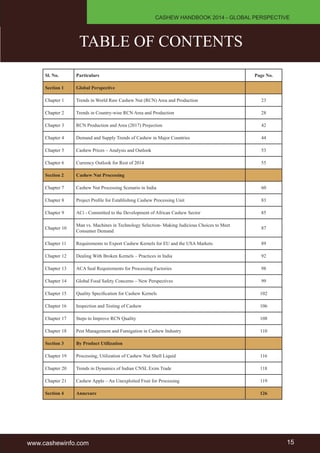
TABLE OF CONTENTS 
Sl. No. Particulars Page No. 
Section 1 Global Perspective 
Chapter 1 Trends in World Raw Cashew Nut (RCN) Area and Production 23 
Chapter 2 Trends in Country-wise RCN Area and Production 28 
Chapter 3 RCN Production and Area (2017) Projection 42 
Chapter 4 Demand and Supply Trends of Cashew in Major Countries 44 
Chapter 5 Cashew Prices – Analysis and Outlook 53 
Chapter 6 Currency Outlook for Rest of 2014 55 
Section 2 Cashew Nut Processing 
Chapter 7 Cashew Nut Processing Scenario in India 60 
Chapter 8 Project Profile for Establishing Cashew Processing Unit 83 
Chapter 9 ACi - Committed to the Development of African Cashew Sector 85 
Chapter 10 Man vs. Machines in Technology Selection- Making Judicious Choices to Meet 
Consumer Demand 87 
Chapter 11 Requirements to Export Cashew Kernels for EU and the USA Markets 89 
Chapter 12 Dealing With Broken Kernels – Practices in India 92 
Chapter 13 ACA Seal Requirements for Processing Factories 98 
Chapter 14 Global Food Safety Concerns – New Perspectives 99 
Chapter 15 Quality Specification for Cashew Kernels 102 
Chapter 16 Inspection and Testing of Cashew 106 
Chapter 17 Steps to Improve RCN Quality 108 
Chapter 18 Pest Management and Fumigation in Cashew Industry 110 
Section 3 By Product Utilization 
Chapter 19 Processing, Utilization of Cashew Nut Shell Liquid 116 
Chapter 20 Trends in Dynamics of Indian CNSL Exim Trade 118 
Chapter 21 Cashew Apple – An Unexploited Fruit for Processing 119 
Section 4 Annexure 126 
www.cashewinfo.com 15
CASHEW HANDBOOK 2014 - GLOBAL PERSPECTIVE 
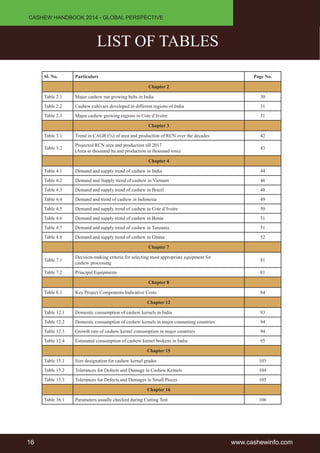
LIST OF TABLES 
Sl. No. Particulars Page No. 
Chapter 2 
Table 2.1 Major cashew nut growing belts in India 30 
Table 2.2 Cashew cultivars developed in different regions of India 31 
Table 2.3 Major cashew growing regions in Cote d’Ivoire 31 
Chapter 3 
Table 3.1 Trend in CAGR (%) of area and production of RCN over the decades 42 
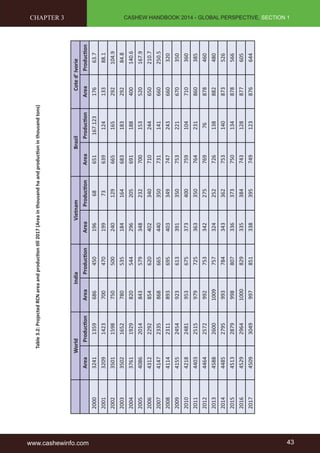
Table 3.2 Projected RCN area and production till 2017 
(Area in thousand ha and production in thousand tons) 43 
Chapter 4 
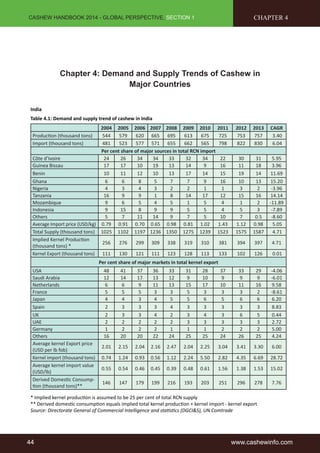
Table 4.1 Demand and supply trend of cashew in India 44 
Table 4.2 Demand and Supply trend of cashew in Vietnam 46 
Table 4.3 Demand and supply trend of cashew in Brazil 48 
Table 4.4 Demand and trend of cashew in Indonesia 49 
Table 4.5 Demand and supply trend of cashew in Cote d’Ivoire 50 
Table 4.6 Demand and supply trend of cashew in Benin 51 
Table 4.7 Demand and supply trend of cashew in Tanzania 51 
Table 4.8 Demand and supply trend of cashew in Ghana 52 
Chapter 7 
Table 7.1 Decision-making criteria for selecting most appropriate equipment for 
cashew processing 81 
Table 7.2 Principal Equipments 81 
Chapter 8 
Table 8.1 Key Project Components Indicative Costs 84 
Chapter 12 
Table 12.1 Domestic consumption of cashew kernels in India 93 
Table 12.2 Domestic consumption of cashew kernels in major consuming countries 94 
Table 12.3 Growth rate of cashew kernel consumption in major countries 94 
Table 12.4 Estimated consumption of cashew kernel brokens in India 95 
Chapter 15 
Table 15.1 Size designation for cashew kernel grades 103 
Table 15.2 Tolerances for Defects and Damage in Cashew Kernels 104 
Table 15.3 Tolerances for Defects and Damages in Small Pieces 105 
Chapter 16 
Table 16.1 Parameters usually checked during Cutting Test 106 
16 www.cashewinfo.com
CASHEW HANDBOOK 2014 - GLOBAL PERSPECTIVE 
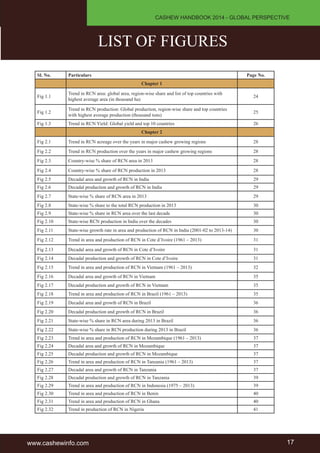
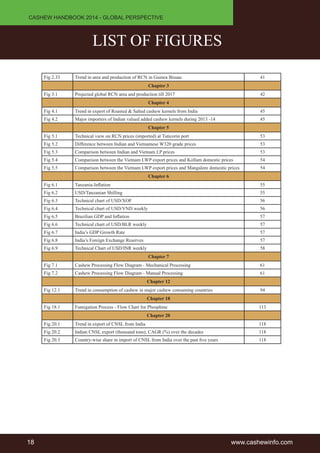
LIST OF FIGURES 
Sl. No. Particulars Page No. 
Chapter 1 
Fig 1.1 Trend in RCN area: global area, region-wise share and list of top countries with 
highest average area (in thousand ha) 24 
Fig 1.2 Trend in RCN production: Global production, region-wise share and top countries 
with highest average production (thousand tons) 25 
Fig 1.3 Trend in RCN Yield: Global yield and top 10 countries 26 
Chapter 2 
Fig 2.1 Trend in RCN acreage over the years in major cashew growing regions 28 
Fig 2.2 Trend in RCN production over the years in major cashew growing regions 28 
Fig 2.3 Country-wise % share of RCN area in 2013 28 
Fig 2.4 Country-wise % share of RCN production in 2013 28 
Fig 2.5 Decadal area and growth of RCN in India 29 
Fig 2.6 Decadal production and growth of RCN in India 29 
Fig 2.7 State-wise % share of RCN area in 2013 29 
Fig 2.8 State-wise % share to the total RCN production in 2013 30 
Fig 2.9 State-wise % share in RCN area over the last decade 30 
Fig 2.10 State-wise RCN production in India over the decades 30 
Fig 2.11 State-wise growth rate in area and production of RCN in India (2001-02 to 2013-14) 30 
Fig 2.12 Trend in area and production of RCN in Cote d’Ivoire (1961 – 2013) 31 
Fig 2.13 Decadal area and growth of RCN in Cote d’Ivoire 31 
Fig 2.14 Decadal production and growth of RCN in Cote d’Ivoire 31 
Fig 2.15 Trend in area and production of RCN in Vietnam (1961 – 2013) 32 
Fig 2.16 Decadal area and growth of RCN in Vietnam 35 
Fig 2.17 Decadal production and growth of RCN in Vietnam 35 
Fig 2.18 Trend in area and production of RCN in Brazil (1961 – 2013) 35 
Fig 2.19 Decadal area and growth of RCN in Brazil 36 
Fig 2.20 Decadal production and growth of RCN in Brazil 36 
Fig 2.21 State-wise % share in RCN area during 2013 in Brazil 36 
Fig 2.22 State-wise % share in RCN production during 2013 in Brazil 36 
Fig 2.23 Trend in area and production of RCN in Mozambique (1961 – 2013) 37 
Fig 2.24 Decadal area and growth of RCN in Mozambique 37 
Fig 2.25 Decadal production and growth of RCN in Mozambique 37 
Fig 2.26 Trend in area and production of RCN in Tanzania (1961 – 2013) 37 
Fig 2.27 Decadal area and growth of RCN in Tanzania 37 
Fig 2.28 Decadal production and growth of RCN in Tanzania 39 
Fig 2.29 Trend in area and production of RCN in Indonesia (1975 – 2013) 39 
Fig 2.30 Trend in area and production of RCN in Benin 40 
Fig 2.31 Trend in area and production of RCN in Ghana 40 
Fig 2.32 Trend in production of RCN in Nigeria 41 
www.cashewinfo.com 17
CASHEW HANDBOOK 2014 - GLOBAL PERSPECTIVE 
LIST OF FIGURES 
Fig 2.33 Trend in area and production of RCN in Guinea Bissau 41 
Chapter 3 
Fig 3.1 Projected global RCN area and production till 2017 42 
Chapter 4 
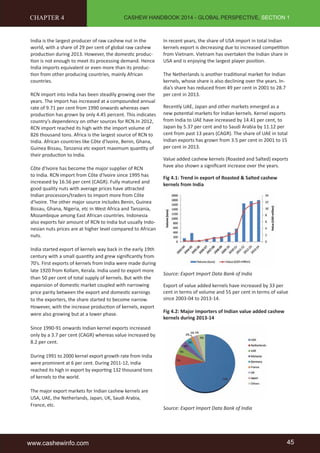
Fig 4.1 Trend in export of Roasted & Salted cashew kernels from India 45 
Fig 4.2 Major importers of Indian valued added cashew kernels during 2013 -14 45 
Chapter 5 
Fig 5.1 Technical view on RCN prices (imported) at Tuticorin port 53 
Fig 5.2 Difference between Indian and Vietnamese W320 grade prices 53 
Fig 5.3 Comparison between Indian and Vietnam LP prices 53 
Fig 5.4 Comparison between the Vietnam LWP export prices and Kollam domestic prices 54 
Fig 5.5 Comparison between the Vietnam LWP export prices and Mangalore domestic prices 54 
Chapter 6 
Fig 6.1 Tanzania-Inflation 55 
Fig 6.2 USD/Tanzanian Shilling 55 
Fig 6.3 Technical chart of USD/XOF 56 
Fig 6.4 Technical chart of USD/VND weekly 56 
Fig 6.5 Brazilian GDP and Inflation 57 
Fig 6.6 Technical chart of USD/BLR weekly 57 
Fig 6.7 India’s GDP Growth Rate 57 
Fig 6.8 India’s Foreign Exchange Reserves 57 
Fig 6.9 Technical Chart of USD/INR weekly 58 
Chapter 7 
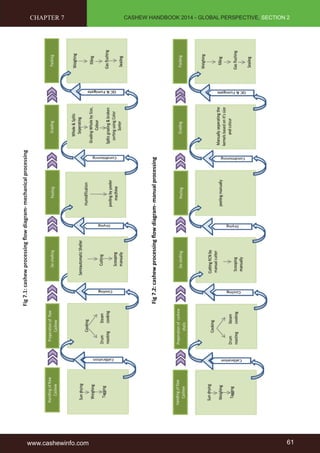
Fig 7.1 Cashew Processing Flow Diagram - Mechanical Processing 61 
Fig 7.2 Cashew Processing Flow Diagram - Manual Processing 61 
Chapter 12 
Fig 12.1 Trend in consumption of cashew in major cashew consuming countries 94 
Chapter 18 
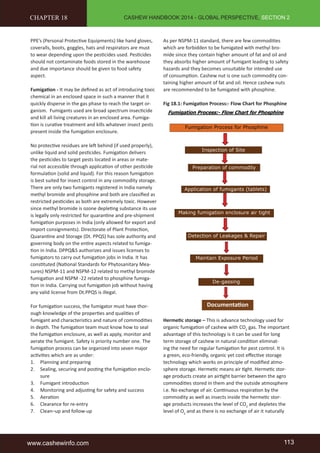
Fig 18.1 Fumigation Process - Flow Chart for Phosphine 113 
Chapter 20 
Fig 20.1 Trend in export of CNSL from India 118 
Fig 20.2 Indian CNSL export (thousand tons), CAGR (%) over the decades 118 
Fig 20.3 Country-wise share in import of CNSL from India over the past five years 118 
18 www.cashewinfo.com
CASHEW HANDBOOK 2014 - GLOBAL PERSPECTIVE 
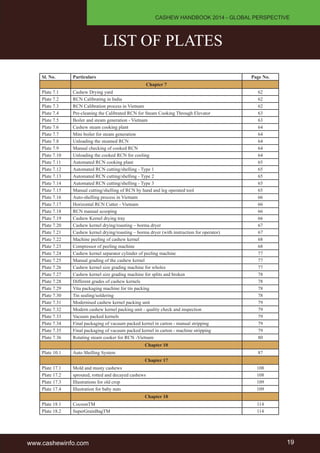
LIST OF PLATES 
Sl. No. Particulars Page No. 
Chapter 7 
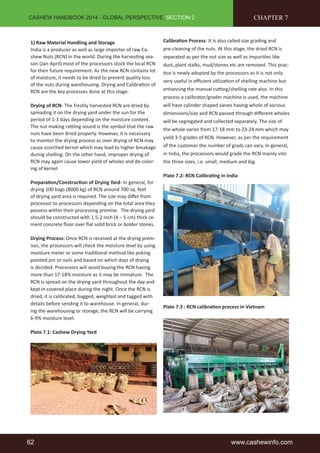
Plate 7.1 Cashew Drying yard 62 
Plate 7.2 RCN Calibrating in India 62 
Plate 7.3 RCN Calibration process in Vietnam 62 
Plate 7.4 Pre-cleaning the Calibrated RCN for Steam Cooking Through Elevator 63 
Plate 7.5 Boiler and steam generation - Vietnam 63 
Plate 7.6 Cashew steam cooking plant 64 
Plate 7.7 Mini boiler for steam generation 64 
Plate 7.8 Unloading the steamed RCN 64 
Plate 7.9 Manual checking of cooked RCN 64 
Plate 7.10 Unloading the cooked RCN for cooling 64 
Plate 7.11 Automated RCN cooking plant 65 
Plate 7.12 Automated RCN cutting/shelling - Type 1 65 
Plate 7.13 Automated RCN cutting/shelling - Type 2 65 
Plate 7.14 Automated RCN cutting/shelling - Type 3 65 
Plate 7.15 Manual cutting/shelling of RCN by hand and leg operated tool 65 
Plate 7.16 Auto-shelling process in Vietnam 66 
Plate 7.17 Horizontal RCN Cutter - Vietnam 66 
Plate 7.18 RCN manual scooping 66 
Plate 7.19 Cashew Kernel drying tray 66 
Plate 7.20 Cashew kernel drying/roasting – borma dryer 67 
Plate 7.21 Cashew kernel drying/roasting – borma dryer (with instruction for operator) 67 
Plate 7.22 Machine peeling of cashew kernel 68 
Plate 7.23 Compressor of peeling machine 68 
Plate 7.24 Cashew kernel separator cylinder of peeling machine 77 
Plate 7.25 Manual grading of the cashew kernel 77 
Plate 7.26 Cashew kernel size grading machine for wholes 77 
Plate 7.27 Cashew kernel size grading machine for splits and broken 78 
Plate 7.28 Different grades of cashew kernels 78 
Plate 7.29 Vita packaging machine for tin packing 78 
Plate 7.30 Tin sealing/soldering 78 
Plate 7.31 Modernised cashew kernel packing unit 79 
Plate 7.32 Modern cashew kernel packing unit - quality check and inspection 79 
Plate 7.33 Vacuum packed kernels 79 
Plate 7.34 Final packaging of vacuum packed kernel in carton - manual stripping 79 
Plate 7.35 Final packaging of vacuum packed kernel in carton - machine stripping 79 
Plate 7.36 Rotating steam cooker for RCN -Vietnam 80 
Chapter 10 
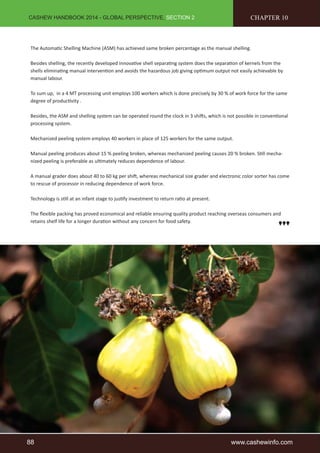
Plate 10.1 Auto Shelling System 87 
Chapter 17 
Plate 17.1 Mold and musty cashews 108 
Plate 17.2 sprouted, rotted and decayed cashews 108 
Plate 17.3 Illustrations for old crop 109 
Plate 17.4 Illustration for baby nuts 109 
Chapter 18 
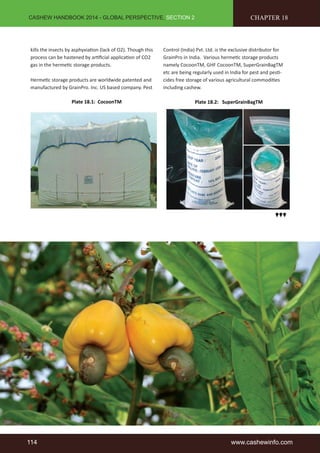
Plate 18.1 CocoonTM 114 
Plate 18.2 SuperGrainBagTM 114 
www.cashewinfo.com 19
CASHEW HANDBOOK 2014 - GLOBAL PERSPECTIVE 
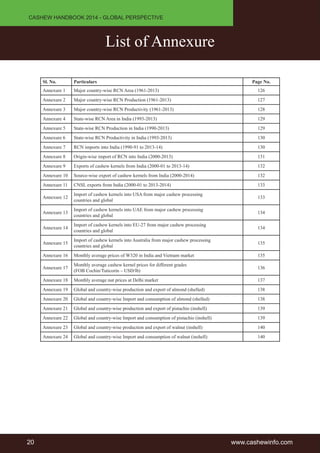
List of Annexure 
Sl. No. Particulars Page No. 
Annexure 1 Major country-wise RCN Area (1961-2013) 126 
Annexure 2 Major country-wise RCN Production (1961-2013) 127 
Annexure 3 Major country-wise RCN Productivity (1961-2013) 128 
Annexure 4 State-wise RCN Area in India (1993-2013) 129 
Annexure 5 State-wise RCN Production in India (1990-2013) 129 
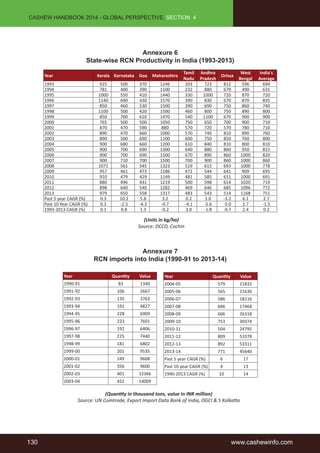
Annexure 6 State-wise RCN Productivity in India (1993-2013) 130 
Annexure 7 RCN imports into India (1990-91 to 2013-14) 130 
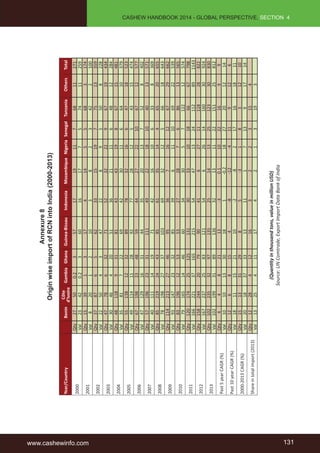
Annexure 8 Origin-wise import of RCN into India (2000-2013) 131 
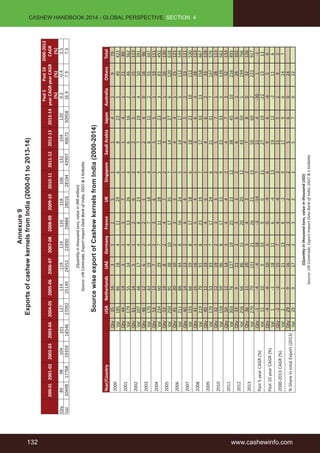
Annexure 9 Exports of cashew kernels from India (2000-01 to 2013-14) 132 
Annexure 10 Source-wise export of cashew kernels from India (2000-2014) 132 
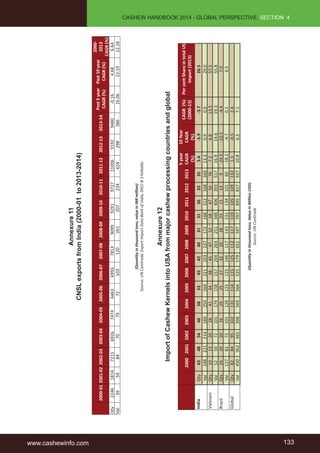
Annexure 11 CNSL exports from India (2000-01 to 2013-2014) 133 
Annexure 12 Import of cashew kernels into USA from major cashew processing 
countries and global 133 
Annexure 13 Import of cashew kernels into UAE from major cashew processing 
countries and global 134 
Annexure 14 Import of cashew kernels into EU-27 from major cashew processing 
countries and global 134 
Annexure 15 Import of cashew kernels into Australia from major cashew processing 
countries and global 135 
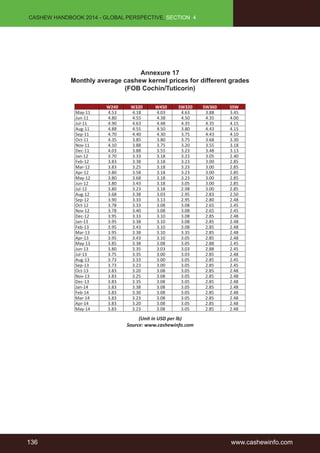
Annexure 16 Monthly average prices of W320 in India and Vietnam market 135 
Annexure 17 Monthly average cashew kernel prices for different grades 
(FOB Cochin/Tuticorin – USD/lb) 136 
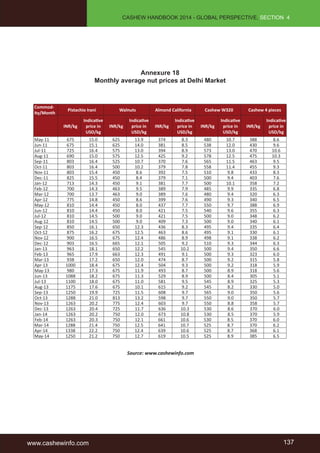
Annexure 18 Monthly average nut prices at Delhi market 137 
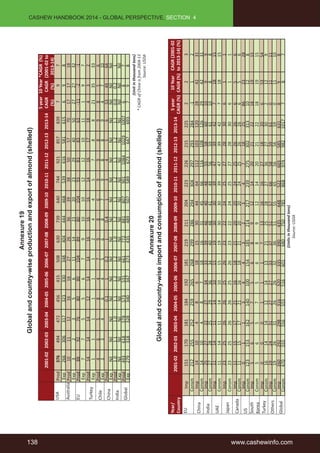
Annexure 19 Global and country-wise production and export of almond (shelled) 138 
Annexure 20 Global and country-wise Import and consumption of almond (shelled) 138 
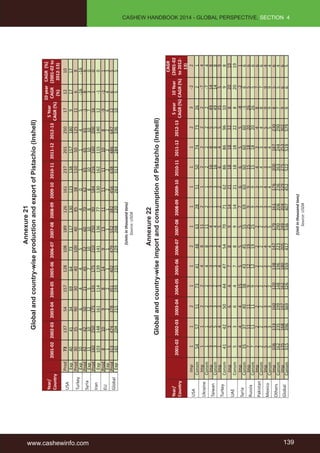
Annexure 21 Global and country-wise production and export of pistachio (inshell) 139 
Annexure 22 Global and country-wise Import and consumption of pistachio (inshell) 139 
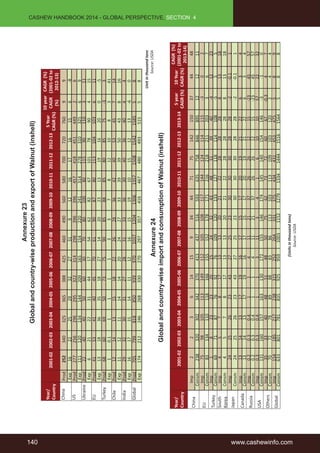
Annexure 23 Global and country-wise production and export of walnut (inshell) 140 
Annexure 24 Global and country-wise Import and consumption of walnut (inshell) 140 
20 www.cashewinfo.com
CASHEW HANDBOOK 2014 - GLOBAL PERSPECTIVE 
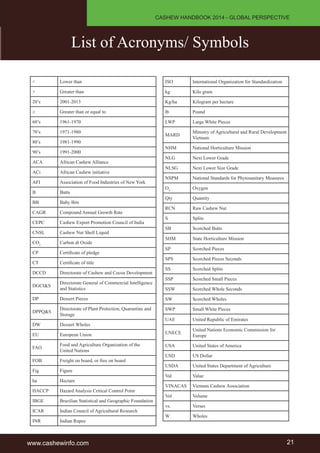
List of Acronyms/ Symbols 
< Lower than 
> Greater than 
20’s 2001-2013 
> Greater than or equal to 
60’s 1961-1970 
70’s 1971-1980 
80’s 1981-1990 
90’s 1991-2000 
ACA African Cashew Alliance 
ACi African Cashew initiative 
AFI Association of Food Industries of New York 
B Butts 
BB Baby Bits 
CAGR Compound Annual Growth Rate 
CEPC Cashew Export Promotion Council of India 
CNSL Cashew Nut Shell Liquid 
CO2 Carbon di Oxide 
CP Certificate of pledge 
CT Certificate of title 
DCCD Directorate of Cashew and Cocoa Development 
DGCI&S Directorate General of Commercial Intelligence 
and Statistics 
DP Dessert Pieces 
DPPQ&S Directorate of Plant Protection, Quarantine and 
Storage 
DW Dessert Wholes 
EU European Union 
FAO Food and Agriculture Organization of the 
United Nations 
FOB Freight on board, or free on board 
Fig Figure 
ha Hectare 
HACCP Hazard Analysis Critical Control Point 
IBGE Brazilian Statistical and Geographic Foundation 
ICAR Indian Council of Agricultural Research 
INR Indian Rupee 
ISO International Organization for Standardization 
kg Kilo gram 
Kg/ha Kilogram per hectare 
lb Pound 
LWP Large White Pieces 
MARD Ministry of Agricultural and Rural Development 
Vietnam 
NHM National Horticulture Mission 
NLG Next Lower Grade 
NLSG Next Lower Size Grade 
NSPM National Standards for Phytosanitary Measures 
O2 Oxygen 
Qty Quantity 
RCN Raw Cashew Nut 
S Splits 
SB Scorched Butts 
SHM State Horticulture Mission 
SP Scorched Pieces 
SPS Scorched Pieces Seconds 
SS Scorched Splits 
SSP Scorched Small Pieces 
SSW Scorched Whole Seconds 
SW Scorched Wholes 
SWP Small White Pieces 
UAE United Republic of Emirates 
UNECE United Nations Economic Commission for 
Europe 
USA United States of America 
USD US Dollar 
USDA United States Department of Agriculture 
Val Value 
VINACAS Vietnam Cashew Association 
Vol Volume 
vs. Verses 
W Wholes 
www.cashewinfo.com 21
SECTION 1 
Global Perspective
CASHEW HANDBOOK 2014 - GLOBAL PERSPECTIVE, SECTION 1 
CHAPTER 1 
Chapter 1: Trends in World Raw Cashew Nut (RCN) Area and 
Production 
Cashew (Anacardium occidentale), 
a native of Brazil, was introduced 
in other parts of the world starting 
from the 16th century mainly with 
the intention of afforestation and soil 
conservation. From its humble begin-ning 
as a crop intended to check soil 
erosion, cashew has come out as a 
major foreign exchange earner in 
most of the countries. 
Cashew is primarily grown in the 
continents of Asia, Africa and South 
America. Asiatic zones mainly include 
India, Vietnam and Indonesia as the 
major cashew producing countries 
followed by Philippines, Malaysia, 
Thailand and Sri-Lanka. African 
countries producing cashew are 
Côte d’Ivoire, Nigeria,Tanzania, 
Mozambique, Kenya, Benin, Guinea- 
Bissau, Mozambique, Ghana, Senegal 
and Madagascar. Latin American 
countries producing cashew consist 
of Brazil, Columbia, Costa Rica, 
Honduras and Salvador. 
Though cashew is originally from 
Brazil, it gained greater popularity 
in India, Vietnam and other African 
countries than Brazil itself. In 60’s 
India had a major contribution to the 
world production along with Mozam-bique 
and Tanzania. From 1961 to 
2013, area under world cashew nut 
production has increased at a rate of 
4.25 per cent (CAGR). 
East African countries like Tanzania, 
Mozambique, and Kenya introduced 
cashew. But in 70’s Mozambique 
left the race due to political issues 
and civil war in the country. In other 
Asian countries like Indonesia, Malay-sia, 
Cambodia, etc cashew cultivation 
became popular. 
Till 80’s, raw cashew nut production 
witnessed slow and steady growth. 
From 90’s, global RCN production has 
seen a tremendous growth. The huge 
production increase has been mainly 
contributed by Vietnam, the newly 
emerged RCN producer during the 
period. Since 1990, Vietnam cashew 
industry has seen massive growth 
with respect to domestic cashew nut 
production and processing. 
www.cashewinfo.com 23
CASHEW HANDBOOK 2014 - GLOBAL PERSPECTIVE, SECTION 1 
24 www.cashewinfo.com 
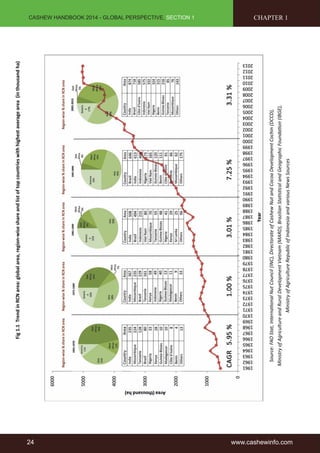
Fig 1.1 Trend in RCN area: global area, region-wise share and list of top countries with highest average area (in thousand ha) 
Source: FAO Stat, International Nut Council (INC), Directorate of Cashew Nut and Cocoa Development Cochin (DCCD), 
Ministry of Agriculture and Rural Development Vietnam (MARD), Brazilian Statistical and Geographic Foundation (IBGE), 
Ministry of Agriculture Republic of Indonesia and various News Sources 
CHAPTER 1
CASHEW HANDBOOK 2014 - GLOBAL PERSPECTIVE, SECTION 1 
www.cashewinfo.com 25 
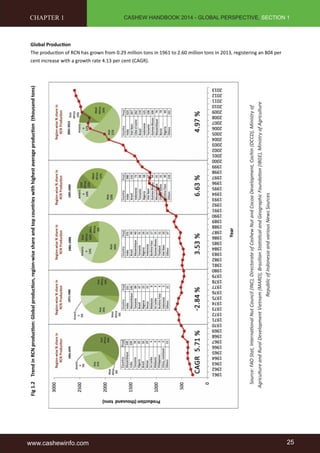
Global Production 
The production of RCN has grown from 0.29 million tons in 1961 to 2.60 million tons in 2013, registering an 804 per 
cent increase with a growth rate 4.13 per cent (CAGR). 
Fig 1.2 Trend in RCN production: Global production, region-wise share and top countries with highest average production (thousand tons) 
Source: FAO Stat, International Nut Council (INC), Directorate of Cashew Nut and Cocoa Development, Cochin (DCCD), Ministry of 
Agriculture and Rural Development Vietnam (MARD), Brazilian Statistical and Geographic Foundation (IBGE), Ministry of Agriculture 
Republic of Indonesia and various News Sources 
CHAPTER 1
CASHEW HANDBOOK 2014 - GLOBAL PERSPECTIVE, SECTION 1 
26 www.cashewinfo.com 
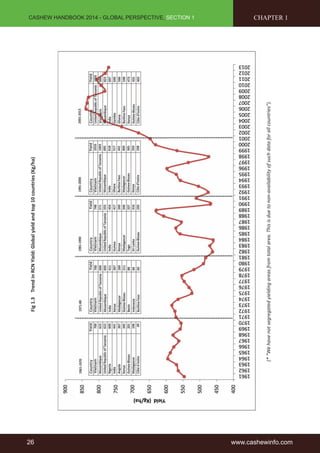
Fig 1.3 Trend in RCN Yield: Global yield and top 10 countries (Kg/ha) 
(* “We have not segregated yielding areas from total area. This is due to non-availability of such data for all countries”). 
CHAPTER 1
CASHEW HANDBOOK 2014 - GLOBAL PERSPECTIVE, SECTION 1 
Major Happenings in Cashew Industry 
CHAPTER 1 
Year Events 
1906 Establishment of Association of Food Industries (AFI), New Jersey 
1955 Establishment of Cashew Export Promotion Council of India, India 
1955 Establishment of Karnataka Cashew Manufacturers Association, India 
1977 Establishment of Nigerian Export Promotion Council (NEPC), Nigeria 
1978 Mozambique Government banned RCN export 
1978 Formation of Karnataka Cashew Development Corporation Ltd, India 
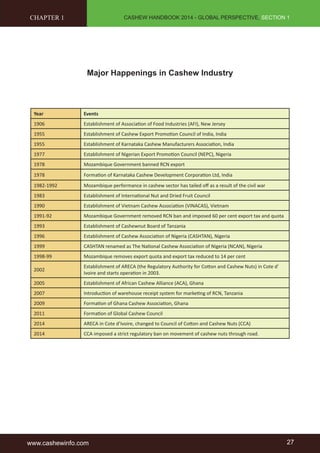
1982-1992 Mozambique performance in cashew sector has tailed off as a result of the civil war 
1983 Establishment of International Nut and Dried Fruit Council 
1990 Establishment of Vietnam Cashew Association (VINACAS), Vietnam 
1991-92 Mozambique Government removed RCN ban and imposed 60 per cent export tax and quota 
1993 Establishment of Cashewnut Board of Tanzania 
1996 Establishment of Cashew Association of Nigeria (CASHTAN), Nigeria 
1999 CASHTAN renamed as The National Cashew Association of Nigeria (NCAN), Nigeria 
1998-99 Mozambique removes export quota and export tax reduced to 14 per cent 
2002 
Establishment of ARECA (the Regulatory Authority for Cotton and Cashew Nuts) in Cote d’ 
Ivoire and starts operation in 2003. 
2005 Establishment of African Cashew Alliance (ACA), Ghana 
2007 Introduction of warehouse receipt system for marketing of RCN, Tanzania 
2009 Formation of Ghana Cashew Association, Ghana 
2011 Formation of Global Cashew Council 
2014 ARECA in Cote d’Ivoire, changed to Council of Cotton and Cashew Nuts (CCA) 
2014 CCA imposed a strict regulatory ban on movement of cashew nuts through road. 
www.cashewinfo.com 27
CASHEW HANDBOOK 2014 - GLOBAL PERSPECTIVE, SECTION 1 
CHAPTER 2 
Chapter 2: Trends in Country-wise RCN Area and Production 
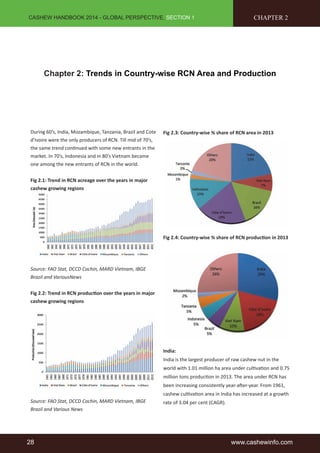
During 60’s, India, Mozambique, Tanzania, Brazil and Cote 
d’Ivoire were the only producers of RCN. Till mid of 70’s, 
the same trend conti nued with some new entrants in the 
market. In 70’s, Indonesia and in 80’s Vietnam became 
one among the new entrants of RCN in the world. 
Fig 2.1: Trend in RCN acreage over the years in major 
cashew growing regions 
Source: FAO Stat, DCCD Cochin, MARD Vietnam, IBGE 
Brazil and VariousNews 
Fig 2.2: Trend in RCN producti on over the years in major 
cashew growing regions 
Source: FAO Stat, DCCD Cochin, MARD Vietnam, IBGE 
Brazil and Various News 
Fig 2.3: Country-wise % share of RCN area in 2013 
Fig 2.4: Country-wise % share of RCN producti on in 2013 
India: 
India is the largest producer of raw cashew nut in the 
world with 1.01 million ha area under culti vati on and 0.75 
million tons producti on in 2013. The area under RCN has 
been increasing consistently year-aft er-year. From 1961, 
cashew culti vati on area in India has increased at a growth 
rate of 3.04 per cent (CAGR). 
28 www.cashewinfo.com
CASHEW HANDBOOK 2014 - GLOBAL PERSPECTIVE, SECTION 1 
CHAPTER 2 
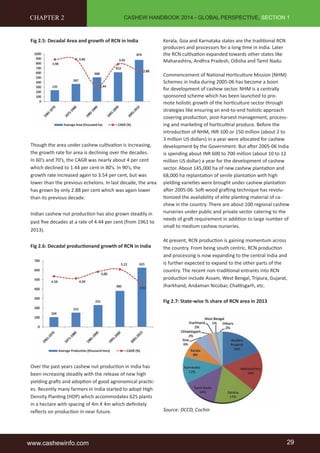
Fig 2.5: Decadal Area and growth of RCN in India 
Though the area under cashew culti vati on is increasing, 
the growth rate for area is declining over the decades. 
In 60’s and 70’s, the CAGR was nearly about 4 per cent 
which declined to 1.44 per cent in 80’s. In 90’s, the 
growth rate increased again to 3.54 per cent, but was 
lower than the previous echelons. In last decade, the area 
has grown by only 2.88 per cent which was again lower 
than its previous decade. 
Indian cashew nut producti on has also grown steadily in 
past fi ve decades at a rate of 4.44 per cent (from 1961 to 
2013). 
Fig 2.6: Decadal producti onand growth of RCN in India 
Over the past years cashew nut producti on in India has 
been increasing steadily with the release of new high 
yielding graft s and adopti on of good agronomical practi c-es. 
Recently many farmers in India started to adopt High 
Density Planti ng (HDP) which accommodates 625 plants 
in a hectare with spacing of 4m X 4m which defi nitely 
refl ects on producti on in near future. 
Kerala, Goa and Karnataka states are the traditi onal RCN 
producers and processors for a long ti me in India. Later 
the RCN culti vati on expanded towards other states like 
Maharashtra, Andhra Pradesh, Odisha and Tamil Nadu. 
Commencement of Nati onal Horti culture Mission (NHM) 
Schemes in India during 2005-06 has become a boon 
for development of cashew sector. NHM is a centrally 
sponsored scheme which has been launched to pro-mote 
holisti c growth of the horti culture sector through 
strategies like ensuring an end-to-end holisti c approach 
covering producti on, post-harvest management, process-ing 
and marketi ng of horti culti ral produce. Before the 
introducti on of NHM, INR 100 or 150 million (about 2 to 
3 million US dollars) in a year were allocated for cashew 
development by the Government. But aft er 2005-06 India 
is spending about INR 600 to 700 million (about 10 to 12 
million US dollar) a year for the development of cashew 
sector. About 145,000 ha of new cashew plantati on and 
68,000 ha replantati on of senile plantati on with high 
yielding varieti es were brought under cashew plantati on 
aft er 2005-06. Soft -wood graft ing technique has revolu-ti 
onized the availability of elite planti ng material of ca-shew 
in the country. There are about 100 regional cashew 
nurseries under public and private sector catering to the 
needs of graft requirement in additi on to large number of 
small to medium cashew nurseries. 
At present, RCN producti on is gaining momentum across 
the country. From being south centric, RCN producti on 
and processing is now expanding to the central India and 
is further expected to expand to the other parts of the 
country. The recent non-traditi onal entrants into RCN 
producti on include Assam, West Bengal, Tripura, Gujarat, 
Jharkhand, Andaman Nicobar, Chatti sgarh, etc. 
Fig 2.7: State-wise % share of RCN area in 2013 
Source: DCCD, Cochin 
www.cashewinfo.com 29
CASHEW HANDBOOK 2014 - GLOBAL PERSPECTIVE, SECTION 1 
Fig 2.8: State-wise % share to the total RCN producti on 
in 2013 
Source: DCCD, Cochin 
Fig 2.9: State-wise % share in RCN area over the last 
decade 
Source: DCCD, Cochin 
Fig 2.10: State-wise % share in RCN producti on over the 
last decade 
Source: DCCD, Cochin 
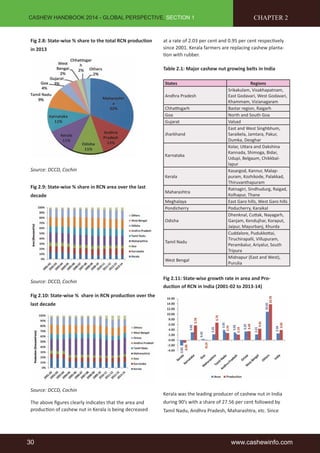
The above fi gures clearly indicates that the area and 
producti on of cashew nut in Kerala is being decreased 
CHAPTER 2 
at a rate of 2.03 per cent and 0.95 per cent respecti vely 
since 2001. Kerala farmers are replacing cashew planta-ti 
on with rubber. 
Table 2.1: Major cashew nut growing belts in India 
States Regions 
Andhra Pradesh 
Srikakulam, Visakhapatnam, 
East Godavari, West Godavari, 
Khammam, Vizianagaram 
Chhatti sgarh Bastar region, Raigarh 
Goa North and South Goa 
Gujarat Valsad 
Jharkhand 
East and West Singhbhum, 
Saraikela, Jamtara, Pakur, 
Dumka, Deoghar 
Karnataka 
Kolar, Utt ara and Dakshina 
Kannada, Shimoga, Bidar, 
Udupi, Belgaum, Chikkbal-lapur 
Kerala 
Kasargod, Kannur, Malap-puram, 
Kozhikode, Palakkad, 
Thiruvanthapuram 
Maharashtra 
Ratnagiri, Sindhudurg, Raigad, 
Kolhapur, Thane 
Meghalaya East Garo hills, West Garo hills 
Pondicherry Poducherry, Karaikal 
Odisha 
Dhenknal, Cutt ak, Nayagarh, 
Ganjam, Kendujhar, Koraput, 
Jaipur, Mayurbanj, Khurda 
Tamil Nadu 
Cuddalore, Pudukkott ai, 
Tiruchirapalli, Villupuram, 
Perambalur, Ariyalur, South 
Tripura 
West Bengal 
Midnapur (East and West), 
Purulia 
Fig 2.11: State-wise growth rate in area and Pro-ducti 
on of RCN in India (2001-02 to 2013-14) 
Kerala was the leading producer of cashew nut in India 
during 90’s with a share of 27.56 per cent followed by 
Tamil Nadu, Andhra Pradesh, Maharashtra, etc. Since 
30 www.cashewinfo.com
CASHEW HANDBOOK 2014 - GLOBAL PERSPECTIVE, SECTION 1 
CHAPTER 2 
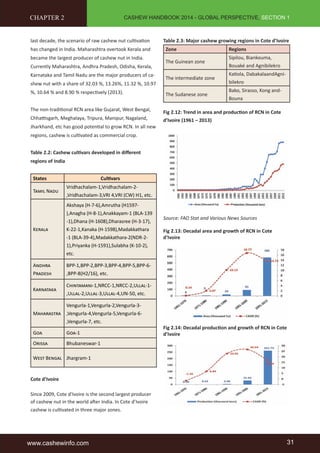
last decade, the scenario of raw cashew nut culti vati on 
has changed in India. Maharashtra overtook Kerala and 
became the largest producer of cashew nut in India. 
Currently Maharashtra, Andhra Pradesh, Odisha, Kerala, 
Karnataka and Tamil Nadu are the major producers of ca-shew 
nut with a share of 32.03 %, 13.26%, 11.32 %, 10.97 
%, 10.64 % and 8.90 % respecti vely (2013). 
The non-traditi onal RCN area like Gujarat, West Bengal, 
Chhatti sgarh, Meghalaya, Tripura, Manipur, Nagaland, 
Jharkhand, etc has good potenti al to grow RCN. In all new 
regions, cashew is culti vated as commercial crop. 
Table 2.2: Cashew culti vars developed in diff erent 
regions of India 
States Culti vars 
TƒÃ®½ Nƒ—ç 
Vridhachalam-1,Vridhachalam-2- 
,Vridhachalam-3,VRI 4,VRI (CW) H1, etc. 
K›Ùƒ½ƒ 
Akshaya (H-7-6),Amrutha (H1597- 
),Anagha (H-8-1),Anakkayam-1 (BLA-139 
-1),Dhana (H-1608),Dharasree (H-3-17), 
K-22-1,Kanaka (H-1598),Madakkathara 
-1 (BLA-39-4),Madakkathara-2(NDR-2- 
1),Priyanka (H-1591),Sulabha (K-10-2), 
etc. 
AÄ—«Ùƒ 
PÙƒ—›Ý« 
BPP-1,BPP-2,BPP-3,BPP-4,BPP-5,BPP-6- 
,BPP-8(H2/16), etc. 
KƒÙă・ƒ 
C«®ÄãƒÃƒÄ®-1,NRCC-1,NRCC-2,U½½ƒ½-1- 
,U½½ƒ½-2,U½½ƒ½-3,U½½ƒ½-4,UN-50, etc. 
Mƒ«ƒÙƒÝãÙƒ 
Vengurla-1,Vengurla-2,Vengurla-3- 
,Vengurla-4,Vengurla-5,Vengurla-6- 
,Vengurla-7, etc. 
Gʃ Gʃ-1 
OÙ®Ý݃ Bhubaneswar-1 
W›Ýã B›Ä¦ƒ½ Jhargram-1 
Cote d’Ivoire 
Since 2009, Cote d’Ivoire is the second largest producer 
of cashew nut in the world aft er India. In Cote d’Ivoire 
cashew is culti vated in three major zones. 
Table 2.3: Major cashew growing regions in Cote d’Ivoire 
Zone Regions 
The Guinean zone 
Sipilou, Biankouma, 
Bouaké and Agnibilekro 
The intermediate zone 
Kati ola, DabakalaandAgni-bilekro 
The Sudanese zone 
Bako, Sirasso, Kong and- 
Bouna 
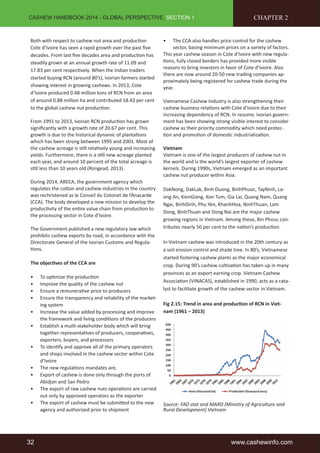
Fig 2.12: Trend in area and producti on of RCN in Cote 
d’Ivoire (1961 – 2013) 
Source: FAO Stat and Various News Sources 
Fig 2.13: Decadal area and growth of RCN in Cote 
d’Ivoire 
Fig 2.14: Decadal producti on and growth of RCN in Cote 
d’Ivoire 
www.cashewinfo.com 31
CASHEW HANDBOOK 2014 - GLOBAL PERSPECTIVE, SECTION 1 
Both with respect to cashew nut area and producti on 
Cote d’Ivoire has seen a rapid growth over the past fi ve 
decades. From last fi ve decades area and producti on has 
steadily grown at an annual growth rate of 11.09 and 
17.83 per cent respecti vely. When the Indian traders 
started buying RCN (around 80’s), Ivorian farmers started 
showing interest in growing cashews. In 2013, Cote 
d’Ivoire produced 0.48 million tons of RCN from an area 
of around 0.88 million ha and contributed 18.43 per cent 
to the global cashew nut producti on. 
From 1991 to 2013, Ivorian RCN producti on has grown 
signifi cantly with a growth rate of 20.67 per cent. This 
growth is due to the historical dynamic of plantati ons 
which has been strong between 1995 and 2001. Most of 
the cashew acreage is sti ll relati vely young and increasing 
yields. Furthermore, there is a sti ll new acreage planted 
each year, and around 10 percent of the total acreage is 
sti ll less than 10 years old (Rongead, 2013). 
During 2014, ARECA, the government agency which 
regulates the cott on and cashew industries in the country 
was rechristened as le Conseil du Cotonet de l’Anacarde 
(CCA). The body developed a new mission to develop the 
producti vity of the enti re value chain from producti on to 
the processing sector in Cote d’Ivoire. 
The Government published a new regulatory law which 
prohibits cashew exports by road, in accordance with the 
Directorate General of the Ivorian Customs and Regula-ti 
ons. 
The objecti ves of the CCA are 
• To opti mize the producti on 
• Improve the quality of the cashew nut 
• Ensure a remunerati ve price to producers 
• Ensure the transparency and reliability of the market-ing 
system 
• Increase the value added by processing and improve 
the framework and living conditi ons of the producers 
• Establish a multi -stakeholder body which will bring 
together representati ves of producers, cooperati ves, 
exporters, buyers, and processors 
• To identi fy and approve all of the primary operators 
and shops involved in the cashew sector within Cote 
d’Ivoire 
• The new regulati ons mandates are, 
• Export of cashew is done only through the ports of 
Abidjan and San Pedro 
• The export of raw cashew nuts operati ons are carried 
out only by approved operators as the exporter 
• The export of cashew must be submitt ed to the new 
agency and authorized prior to shipment 
CHAPTER 2 
• The CCA also handles price control for the cashew 
sector, basing minimum prices on a variety of factors. 
This year cashew season in Cote d’Ivoire with new regula-ti 
ons, fully closed borders has provided more visible 
reasons to bring investors in favor of Cote d’Ivoire. Also 
there are now around 20-50 new trading companies ap-proximately 
being registered for cashew trade during the 
year. 
Vietnamese Cashew Industry is also strengthening their 
cashew business relati ons with Cote d’Ivoire due to their 
increasing dependency of RCN. In resume, Ivorian govern-ment 
has been showing strong visible interest to consider 
cashew as their priority commodity which need protec-ti 
on and promoti on of domesti c industrializati on. 
Vietnam 
Vietnam is one of the largest producers of cashew nut in 
the world and is the world’s largest exporter of cashew 
kernels. During 1990s, Vietnam emerged as an important 
cashew nut producer within Asia. 
DakNong, DakLak, Binh Duong, BinhPhuoc, TayNinh, La-ong 
An, KienGiang, Kon Tum, Gia Lai, Quang Nam, Quang 
Ngai, BinhDinh, Phu Yen, KhanhHoa, NinhThuan, Lam 
Dong, BinhThuan and Dong Nai are the major cashew 
growing regions in Vietnam. Among these, Bin Phouc con-tributes 
nearly 50 per cent to the nati on’s producti on. 
In Vietnam cashew was introduced in the 20th century as 
a soil erosion control and shade tree. In 80’s, Vietnamese 
started fostering cashew plants as the major economical 
crop. During 90’s cashew culti vati on has taken up in many 
provinces as an export earning crop. Vietnam Cashew 
Associati on (VINACAS), established in 1990, acts as a cata-lyst 
to facilitate growth of the cashew sector in Vietnam. 
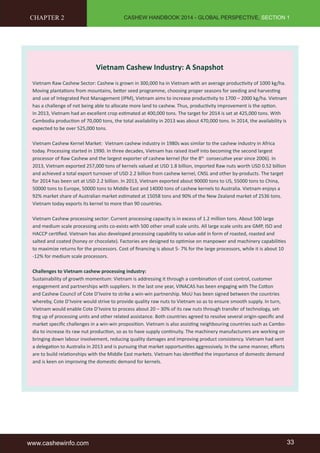
Fig 2.15: Trend in area and producti on of RCN in Viet-nam 
(1961 – 2013) 
Source: FAO stat and MARD (Ministry of Agriculture and 
Rural Development) Vietnam 
32 www.cashewinfo.com
CASHEW HANDBOOK 2014 - GLOBAL PERSPECTIVE, SECTION 1 
Vietnam Cashew Industry: A Snapshot 
CHAPTER 2 
Vietnam Raw Cashew Sector: Cashew is grown in 300,000 ha in Vietnam with an average productivity of 1000 kg/ha. 
Moving plantations from mountains, better seed programme, choosing proper seasons for seeding and harvesting 
and use of Integrated Pest Management (IPM), Vietnam aims to increase productivity to 1700 – 2000 kg/ha. Vietnam 
has a challenge of not being able to allocate more land to cashew. Thus, productivity improvement is the option. 
In 2013, Vietnam had an excellent crop estimated at 400,000 tons. The target for 2014 is set at 425,000 tons. With 
Cambodia production of 70,000 tons, the total availability in 2013 was about 470,000 tons. In 2014, the availability is 
expected to be over 525,000 tons. 
Vietnam Cashew Kernel Market: Vietnam cashew industry in 1980s was similar to the cashew industry in Africa 
today. Processing started in 1990. In three decades, Vietnam has raised itself into becoming the second largest 
processor of Raw Cashew and the largest exporter of cashew kernel (for the 8th consecutive year since 2006). In 
2013, Vietnam exported 257,000 tons of kernels valued at USD 1.8 billion, imported Raw nuts worth USD 0.52 billion 
and achieved a total export turnover of USD 2.2 billion from cashew kernel, CNSL and other by-products. The target 
for 2014 has been set at USD 2.2 billion. In 2013, Vietnam exported about 90000 tons to US, 55000 tons to China, 
50000 tons to Europe, 50000 tons to Middle East and 14000 tons of cashew kernels to Australia. Vietnam enjoys a 
92% market share of Australian market estimated at 15058 tons and 90% of the New Zealand market of 2536 tons. 
Vietnam today exports its kernel to more than 90 countries. 
Vietnam Cashew processing sector: Current processing capacity is in excess of 1.2 million tons. About 500 large 
and medium scale processing units co-exists with 500 other small scale units. All large scale units are GMP, ISO and 
HACCP certified. Vietnam has also developed processing capability to value-add in form of roasted, roasted and 
salted and coated (honey or chocolate). Factories are designed to optimise on manpower and machinery capabilities 
to maximize returns for the processors. Cost of financing is about 5- 7% for the large processors, while it is about 10 
-12% for medium scale processors. 
Challenges to Vietnam cashew processing industry: 
Sustainability of growth momentum: Vietnam is addressing it through a combination of cost control, customer 
engagement and partnerships with suppliers. In the last one year, VINACAS has been engaging with The Cotton 
and Cashew Council of Cote D’Ivoire to strike a win-win partnership. MoU has been signed between the countries 
whereby, Cote D’Ivoire would strive to provide quality raw nuts to Vietnam so as to ensure smooth supply. In turn, 
Vietnam would enable Cote D’Ivoire to process about 20 – 30% of its raw nuts through transfer of technology, set-ting 
up of processing units and other related assistance. Both countries agreed to resolve several origin-specific and 
market specific challenges in a win-win proposition. Vietnam is also assisting neighbouring countries such as Cambo-dia 
to increase its raw nut production, so as to have supply continuity. The machinery manufacturers are working on 
bringing down labour involvement, reducing quality damages and improving product consistency. Vietnam had sent 
a delegation to Australia in 2013 and is pursuing that market opportunities aggressively. In the same manner, efforts 
are to build relationships with the Middle East markets. Vietnam has identified the importance of domestic demand 
and is keen on improving the domestic demand for kernels. 
www.cashewinfo.com 33
CASHEW HANDBOOK 2014 - GLOBAL PERSPECTIVE, SECTION 1 
CHAPTER 2 
34 www.cashewinfo.com
CASHEW HANDBOOK 2014 - GLOBAL PERSPECTIVE, SECTION 1 
CHAPTER 2 
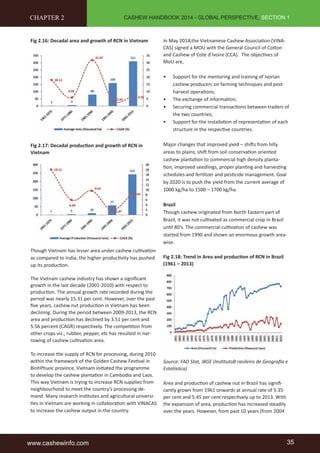
Fig 2.16: Decadal area and growth of RCN in Vietnam 
Fig 2.17: Decadal producti on and growth of RCN in 
Vietnam 
Though Vietnam has lesser area under cashew culti vati on 
as compared to India, the higher producti vity has pushed 
up its producti on. 
The Vietnam cashew industry has shown a signifi cant 
growth in the last decade (2001-2010) with respect to 
producti on. The annual growth rate recorded during the 
period was nearly 15.31 per cent. However, over the past 
fi ve years, cashew nut producti on in Vietnam has been 
declining. During the period between 2009-2013, the RCN 
area and producti on has declined by 3.51 per cent and 
5.56 percent (CAGR) respecti vely. The competi ti on from 
other crops viz., rubber, pepper, etc has resulted in nar-rowing 
of cashew culti vati on area. 
To increase the supply of RCN for processing, during 2010 
within the framework of the Golden Cashew Festi val in 
BinhPhuoc province, Vietnam initi ated the programme 
to develop the cashew plantati on in Cambodia and Laos. 
This way Vietnam is trying to increase RCN supplies from 
neighbourhood to meet the country’s processing de-mand. 
Many research insti tutes and agricultural universi-ti 
es in Vietnam are working in collaborati on with VINACAS 
to increase the cashew output in the country. 
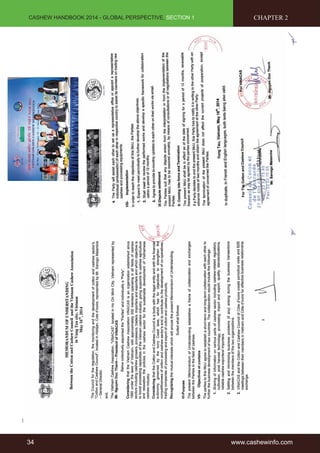
In May 2014,the Vietnamese Cashew Associati on (VINA-CAS) 
signed a MOU with the General Council of Cott on 
and Cashew of Cote d’Ivoire (CCA). The objecti ves of 
MoU are, 
• Support for the mentoring and training of Ivorian 
cashew producers on farming techniques and post-harvest 
operati ons; 
• The exchange of informati on; 
• Securing commercial transacti ons between traders of 
the two countries; 
• Support for the installati on of representati on of each 
structure in the respecti ve countries. 
Major changes that improved yield – shift s from hilly 
areas to plains, shift from soil conservati on oriented 
cashew plantati on to commercial high density planta-ti 
on, improved seedlings, proper planti ng and harvesti ng 
schedules and ferti lizer and pesti cide management. Goal 
by 2020 is to push the yield from the current average of 
1000 kg/ha to 1500 – 1700 kg/ha. 
Brazil 
Though cashew originated from North Eastern part of 
Brazil, it was not culti vated as commercial crop in Brazil 
unti l 80’s. The commercial culti vati on of cashew was 
started from 1990 and shown an enormous growth area-wise. 
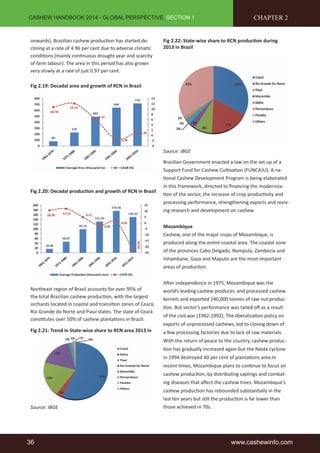
Fig 2.18: Trend in Area and producti on of RCN in Brazil 
(1961 – 2013) 
Source: FAO Stat, IBGE (Insti tutoB rasileiro de Geografi a e 
Estatí sti ca) 
Area and producti on of cashew nut in Brazil has signifi - 
cantly grown from 1961 onwards at annual rate of 5.35 
per cent and 5.45 per cent respecti vely up to 2013. With 
the expansion of area, producti on has increased steadily 
over the years. However, from past 10 years (from 2004 
www.cashewinfo.com 35
CASHEW HANDBOOK 2014 - GLOBAL PERSPECTIVE, SECTION 1 
onwards), Brazilian cashew producti on has started de-clining 
at a rate of 4.96 per cent due to adverse climati c 
conditi ons (mainly conti nuous drought year and scarcity 
of farm labour). The area in this period has also grown 
very slowly at a rate of just 0.97 per cent. 
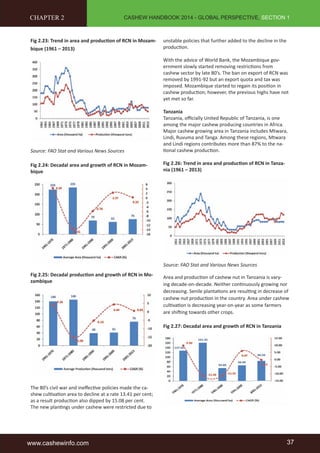
Fig 2.19: Decadal area and growth of RCN in Brazil 
Fig 2.20: Decadal producti on and growth of RCN in Brazil 
Northeast region of Brazil accounts for over 95% of 
the total Brazilian cashew producti on, with the largest 
orchards located in coastal and transiti on zones of Ceará, 
Rio Grande do Norte and Piauí states. The state of Cearà 
consti tutes over 50% of cashew plantati ons in Brazil. 
Fig 2.21: Trend in State-wise share to RCN area 2013 in 
BBrraazziill 
Source: IBGE 
CHAPTER 2 
Fig 2.22: State-wise share to RCN producti on during 
2013 in Brazil 
Source: IBGE 
Brazilian Government enacted a law on the set up of a 
Support Fund for Cashew Culti vati on (FUNCAJU). A na-ti 
onal Cashew Development Program is being elaborated 
in this framework, directed to fi nancing the moderniza-ti 
on of the sector, the increase of crop producti vity and 
processing performance, strengthening exports and reviv-ing 
research and development on cashew. 
Mozambique 
Cashew, one of the major crops of Mozambique, is 
produced along the enti re coastal area. The coastal zone 
of the provinces Cabo Delgado, Nampula, Zambezia and 
Inhambane, Gaza and Maputo are the most important 
areas of producti on. 
Aft er independence in 1975, Mozambique was the 
world’s leading cashew producer, and processed cashew 
kernels and exported 240,000 tonnes of raw nut produc-ti 
on. But sector’s performance was tailed off as a result 
of the civil war (1982-1992). The liberalizati on policy on 
exports of unprocessed cashews, led to closing down of 
a few processing factories due to lack of raw materials. 
With the return of peace to the country, cashew produc-ti 
on has gradually increased again but the Naida cyclone 
in 1994 destroyed 40 per cent of plantati ons area.In 
recent ti mes, Mozambique plans to conti nue to focus on 
cashew producti on, by distributi ng saplings and combat-ing 
diseases that aff ect the cashew trees. Mozambique’s 
cashew producti on has rebounded substanti ally in the 
last ten years but sti ll the producti on is far lower than 
those achieved in 70s. 
36 www.cashewinfo.com
CASHEW HANDBOOK 2014 - GLOBAL PERSPECTIVE, SECTION 1 
CHAPTER 2 
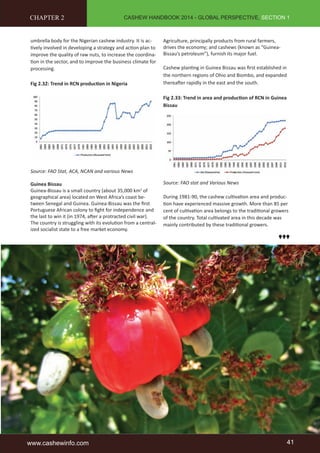
Fig 2.23: Trend in area and producti on of RCN in Mozam-bique 
(1961 – 2013) 
Source: FAO Stat and Various News Sources 
Fig 2.24: Decadal area and growth of RCN in Mozam-bique 
Fig 2.25: Decadal producti on and growth of RCN in Mo-zambique 
The 80’s civil war and ineff ecti ve policies made the ca-shew 
culti vati on area to decline at a rate 13.41 per cent; 
as a result producti on also dipped by 15.08 per cent. 
The new planti ngs under cashew were restricted due to 
unstable policies that further added to the decline in the 
producti on. 
With the advice of World Bank, the Mozambique gov-ernment 
slowly started removing restricti ons from 
cashew sector by late 80’s. The ban on export of RCN was 
removed by 1991-92 but an export quota and tax was 
imposed. Mozambique started to regain its positi on in 
cashew producti on; however, the previous highs have not 
yet met so far. 
Tanzania 
Tanzania, offi cially United Republic of Tanzania, is one 
among the major cashew producing countries in Africa. 
Major cashew growing area in Tanzania includes Mtwara, 
Lindi, Ruvuma and Tanga. Among these regions, Mtwara 
and Lindi regions contributes more than 87% to the na-ti 
onal cashew producti on. 
Fig 2.26: Trend in area and producti on of RCN in Tanza-nia 
(1961 – 2013) 
Source: FAO Stat and Various News Sources 
Area and producti on of cashew nut in Tanzania is vary-ing 
decade-on-decade. Neither conti nuously growing nor 
decreasing. Senile plantati ons are resulti ng in decrease of 
cashew nut producti on in the country. Area under cashew 
culti vati on is decreasing year-on-year as some farmers 
are shift ing towards other crops. 
Fig 2.27: Decadal area and growth of RCN in Tanzania 
www.cashewinfo.com 37
CASHEW HANDBOOK 2014 - GLOBAL PERSPECTIVE, SECTION 1 
CHAPTER 2 
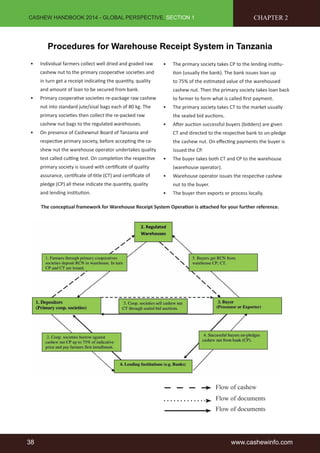
Procedures for Warehouse Receipt System in Tanzania 
• Individual farmers collect well dried and graded raw 
cashew nut to the primary cooperative societies and 
in turn get a receipt indicating the quantity, quality 
and amount of loan to be secured from bank. 
• Primary cooperative societies re-package raw cashew 
nut into standard jute/sisal bags each of 80 kg. The 
primary societies then collect the re-packed raw 
cashew nut bags to the regulated warehouses. 
• On presence of Cashewnut Board of Tanzania and 
respective primary society, before accepting the ca-shew 
nut the warehouse operator undertakes quality 
test called cutting test. On completion the respective 
primary society is issued with certificate of quality 
assurance, certificate of title (CT) and certificate of 
pledge (CP) all these indicate the quantity, quality 
and lending institution. 
• The primary society takes CP to the lending institu-tion 
(usually the bank). The bank issues loan up 
to 75% of the estimated value of the warehoused 
cashew nut. Then the primary society takes loan back 
to farmer to form what is called first payment. 
• The primary society takes CT to the market usually 
the sealed bid auctions. 
• After auction successful buyers (bidders) are given 
CT and directed to the respective bank to un-pledge 
the cashew nut. On effecting payments the buyer is 
issued the CP. 
• The buyer takes both CT and CP to the warehouse 
(warehouse operator). 
• Warehouse operator issues the respective cashew 
• The buyer then exports or process locally. 
The conceptual framework for Warehouse Receipt System Operation is attached for your further reference. 
Flow of cashew 
Flow of documents 
Flow of documents 
nut to the buyer. 
38 www.cashewinfo.com
CASHEW HANDBOOK 2014 - GLOBAL PERSPECTIVE, SECTION 1 
CHAPTER 2 
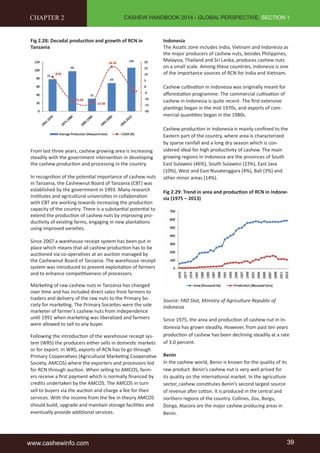
Fig 2.28: Decadal producti on and growth of RCN in 
Tanzania 
From last three years, cashew growing area is increasing 
steadily with the government interventi on in developing 
the cashew producti on and processing in the country. 
In recogniti on of the potenti al importance of cashew nuts 
in Tanzania, the Cashewnut Board of Tanzania (CBT) was 
established by the government in 1993. Many research 
insti tutes and agricultural universiti es in collaborati on 
with CBT are working towards increasing the producti on 
capacity of the country. There is a substanti al potenti al to 
extend the producti on of cashew nuts by improving pro-ducti 
vity of existi ng farms, engaging in new plantati ons 
using improved varieti es. 
Since 2007 a warehouse receipt system has been put in 
place which means that all cashew producti on has to be 
aucti oned via co-operati ves at an aucti on managed by 
the Cashewnut Board of Tanzania. The warehouse receipt 
system was introduced to prevent exploitati on of farmers 
and to enhance competi ti veness of processors. 
Marketi ng of raw cashew nuts in Tanzania has changed 
over ti me and has included direct sales from farmers to 
traders and delivery of the raw nuts to the Primary So-ciety 
for marketi ng. The Primary Societi es were the sole 
marketer of farmer’s cashew nuts from independence 
unti l 1991 when marketi ng was liberalized and farmers 
were allowed to sell to any buyer. 
Following the introducti on of the warehouse receipt sys-tem 
(WRS) the producers either sells in domesti c markets 
or for export. In WRS, exports of RCN has to go through 
Primary Cooperati ves (Agricultural Marketi ng Cooperati ve 
Society, AMCOS) where the exporters and processors bid 
for RCN through aucti on. When selling to AMCOS, farm-ers 
receive a fi rst payment which is normally fi nanced by 
credits undertaken by the AMCOS. The AMCOS in turn 
sell to buyers via the aucti on and charge a fee for their 
services. With the income from the fee in theory AMCOS 
should build, upgrade and maintain storage faciliti es and 
eventually provide additi onal services. 
Indonesia 
The Asiati c zone includes India, Vietnam and Indonesia as 
the major producers of cashew nuts, besides Philippines, 
Malaysia, Thailand and Sri Lanka, produces cashew nuts 
on a small scale. Among these countries, Indonesia is one 
of the importance sources of RCN for India and Vietnam. 
Cashew culti vati on in Indonesia was originally meant for 
aff orestati on programme. The commercial culti vati on of 
cashew in Indonesia is quite recent. The fi rst extensive 
planti ngs began in the mid-1970s, and exports of com-mercial 
quanti ti es began in the 1980s. 
Cashew producti on in Indonesia is mainly confi ned to the 
Eastern part of the country, where area is characterized 
by sparse rainfall and a long dry season which is con-sidered 
ideal for high producti vity of cashew. The main 
growing regions in Indonesia are the provinces of South 
East Sulawesi (46%), South Sulawesi (23%), East Java 
(10%), West and East Nusatenggara (4%), Bali (3%) and 
other minor areas (14%). 
Fig 2.29: Trend in area and producti on of RCN in Indone-sia 
(1975 – 2013) 
Source: FAO Stat, Ministry of Agriculture Republic of 
Indonesia 
Since 1975, the area and producti on of cashew nut in In-donesia 
has grown steadily. However, from past ten years 
producti on of cashew has been declining steadily at a rate 
of 3.0 percent. 
Benin 
In the cashew world, Benin is known for the quality of its 
raw product. Benin’s cashew nut is very well priced for 
its quality on the internati onal market. In the agriculture 
sector, cashew consti tutes Benin’s second largest source 
of revenue aft er cott on. It is produced in the central and 
northern regions of the country. Collines, Zou, Borgu, 
Donga, Atacora are the major cashew producing areas in 
Benin. 
www.cashewinfo.com 39
CASHEW HANDBOOK 2014 - GLOBAL PERSPECTIVE, SECTION 1 
Since 2001, the area and producti on of cashew nut in 
Benin has increased at an annual growth rate of 3.39 and 
6.58 per cent respecti vely. 
Fig 2.30: Trend in area and producti on of RCN in Benin 
Source: FAO Stat, ACA, Nati onal Insti tute of Stati sti cs and 
Economic Analysis Republic of Benin and Various News 
Ghana 
Cashew producti on in Ghana is mainly carried out by 
small land holding farmers (88 per cent), who are usually 
organized into associati ons. About 43 per cent of total 
family income of farmers is generated through cashew 
farming (Cashew Development Project, Ghana, 2009). 
Major areas of Ghana that produce cashew nut are 
Coastal Savanna, Brong-Ahafo/Afram Plains, Upper East 
Region, Northern Region and Upper West Region. 
Ghana is one of the important contributors of cashew in 
African countries. Ghana produces smaller quanti ty of 
cashew nuts (2.13 per cent of total African and 0.79 per 
cent of total world), however, it exports more than its na-ti 
onal producti on which indicates the cross border trading 
of raw cashew nuts between Ghana and neighboring 
countries like Cote d’Ivoire, Burkina Faso, Togo and Mali. 
With the establishment of ACA in Ghana during 2005, ca-shew 
nut producti on in Ghana as well as in other African 
nati ons has seen massive improvement. As well as Tech-noServe, 
GIZ, ACI and such other initi ati ves also aided in 
cashew nut sector improvement in Africa. Mim cashews, 
Rajkumar Impex, Usibras, etc are the large processing 
factories established recently in Ghana. 
This year cashew season in Cote d’Ivoire with new regula-ti 
ons all together has implicated lots of diffi culti es to all 
Ghanaian Cashew Value Chain. Ghana processors have 
been the most victi m of this, which resulted in shutti ng 
the operati ons of some of the large processing units ti ll 
they secure required RCN stocks. Other sizable processors 
CHAPTER 2 
too are struggling to match to their recently expanded 
volumes and targets. 
Fig 2.31: Trend in area and producti on of RCN in Ghana 
Source: FAO Stat, ACA and Various news 
Nigeria 
The history of cashew in Nigeria dates back to 15th 
century. During that ti me, it was mainly used in aff oresta-ti 
on schemes for the control of soil erosion in the former 
Eastern Nigeria. Commercial cashew plantati ons started 
in Nigeria in the early 1950s with the establishment of 
commercial plantati ons in diff erent regions of Nigeria. Re-search 
on the culti vati on, uses and economy of cashew in 
Nigeria commenced in 1972, by Cocoa Research Insti tute 
of Nigeria (CRIN). 
Cashew grows almost everywhere in Nigeria but is 
concentrated primarily in the southern and middle belt 
regions by small land holdings farmers. Major cashew 
growing areas in Nigeria are Enugu, Abia, Imo, Anambra, 
Ebonyi and Cross River states in the Eastern part of the 
country; Oyo, Osun, Ondo, Ekiti and Ogun States in the 
Western part, as well as Kwara, Kogi, Nassarawa, Benue, 
Taraba, Niger and FCT in the Middle Belt and also Sokoto 
and Kebbi States in the North West part of the country. 
The majority of export of quality nuts come from the 
Western and Eastern parts of the country. 
Industrial cashew processing in Nigeria began in the early 
80’s when the old Eastern Regional Government estab-lished 
the Premier Cashew Processing Factory, located 
in Oghe in Enugu State, primarily to process the harvest 
from the government owned 650 ha cashew plantati on as 
well as to serve other small land holding farmers in and 
around the States of Kogi and Benue. 
The Nati onal Cashew Associati on of Nigeria (NCAN) is the 
40 www.cashewinfo.com
CASHEW HANDBOOK 2014 - GLOBAL PERSPECTIVE, SECTION 1 
CHAPTER 2 
umbrella body for the Nigerian cashew industry. It is ac-ti 
vely involved in developing a strategy and acti on plan to 
improve the quality of raw nuts, to increase the coordina-ti 
on in the sector, and to improve the business climate for 
processing. 
Fig 2.32: Trend in RCN producti on in Nigeria 
Source: FAO Stat, ACA, NCAN and various News 
Guinea Bissau 
Guinea-Bissau is a small country (about 35,000 km2 of 
geographical area) located on West Africa’s coast be-tween 
Senegal and Guinea. Guinea-Bissau was the fi rst 
Portuguese African colony to fi ght for independence and 
the last to win it (in 1974, aft er a protracted civil war). 
The country is struggling with its evoluti on from a central-ized 
socialist state to a free market economy. 
Agriculture, principally products from rural farmers, 
drives the economy; and cashews (known as “Guinea- 
Bissau’s petroleum”), furnish its major fuel. 
Cashew planti ng in Guinea Bissau was fi rst established in 
the northern regions of Ohio and Biombo, and expanded 
thereaft er rapidly in the east and the south. 
Fig 2.33: Trend in area and producti on of RCN in Guinea 
Bissau 
Source: FAO stat and Various News 
During 1981-90, the cashew culti vati on area and produc-ti 
on have experienced massive growth. More than 85 per 
cent of culti vati on area belongs to the traditi onal growers 
of the country. Total culti vated area in this decade was 
mainly contributed by these traditi onal growers. 
www.cashewinfo.com 41
CASHEW HANDBOOK 2014 - GLOBAL PERSPECTIVE, SECTION 1 
CHAPTER 3 
Chapter 3: RCN Production and Area (2017) Projection 
Global cashew nut producti on is growing at a rate of 4.97 
per cent since 2001 but the area is growing by only 2.56 
percent. Increasing demand for cashews and government 
initi ati ons in promoti ng cashew culti vati on, etc are 
helping to increase in cashew nut area and producti on. 
However, during last 12 year period (2001-2013) in some 
of the countries the area and producti on have experi-enced 
slow growth. Brazil has seen negati ve growth rate 
due to conti nuous drought periods. 
Table 3.1: Trend in CAGR (%) of area and producti on of 
RCN over the decades 
Country/Decade 
1961- 
1970 
1971- 
1980 
1981- 
1990 
1991- 
2000 
2001- 
2013 
World 
Area 5.95 1 3.01 7.25 2.56 
Production 5.71 -2.84 3.53 6.63 4.97 
India 
Area 3.98 3.99 1.44 3.54 2.88 
Production 4.59 4.31 5 5.22 3.92 
Vietnam 
Area 18.11 6 31.97 5.63 4.68 
Production 18.11 6 9.63 1.87 9.85 
Brazil 
Area 10.78 12.13 6.17 -1.38 1.35 
Production 10.78 12.13 5.11 -2.06 -1.8 
Cote d’ 
Ivorie 
Area 0.14 2.07 10.13 16.77 13.73 
Production -1.56 6.94 22.95 26.64 16.84 
Methodology used for projecti on: 
Yearly area and producti on data is considered for fore-cast. 
Area is projected by taking moving average of latest 
three year acreage. Producti on is linearly extrapolated 
based on the 10-year producti on between 2003 and 
2013. The forecast functi on which we have used, gives a 
predicti on of future value based on the existi ng values. 
Fig 3.1: Projected global RCN area and producti on ti ll 
2017 
During last decade global area and producti on have seen 
lower growth rate compared to 1991-2000. According to 
forecast, global RCN area is likely to be 4509 thousand 
ha from the current 4588 thousand ha, a 1.73 per cent 
decrease. Whereas, global RCN producti on is projected 
at 3049 thousand tons by 2017 from the current levels of 
2600 thousand tons with an increase of 17.25 per cent. 
The projected producti on for Cote d’Ivoire is signifi cantly 
high compared to other countries. Projected producti on 
in Cote d’Ivoire is likely to touch 644 thousand tons with 
an increase of 34.13 per cent. Whereas, in Brazil pro-jected 
producti on is showing 11.38 reducti on from the 
current level. 
In India according to forecast, RCN area likely to be 997 
thousand ha decrease by 1.14 per cent and RCN produc-ti 
on is likely to touch 851 thousand tons with the increase 
of 12.34 per cent from the current level. In the major 
cashew growing regions of India like Kerala farmers are 
shift ing to other plantati on crops mainly to rubber on 
higher returns. 
In Vietnam the projected area and producti on have 
shown increase by a rate of 4.24 and 56.60 per cent 
respecti vely. Uncertainti es are more as the farmers are 
shift ing from cashew plantati on to other plantati ons like 
pepper, rubber on higher returns. 
42 www.cashewinfo.com
CASHEW HANDBOOK 2014 - GLOBAL PERSPECTIVE, SECTION 1 
www.cashewinfo.com 43 
Table 3.2: Projected RCN area and production till 2017 (Area in thousand ha and production in thousand tons) 
World India Vietnam Brazil Cote d’ Ivorie 
Area Production Area Production Area Production Area Production Area Production 
2000 3241 1359 686 450 196 68 651 167.123 176 63.7 
2001 3209 1423 700 470 199 73 639 124 133 88.1 
2002 3501 1598 750 500 240 129 665 165 292 104.9 
2003 3502 1652 780 535 184 164 683 183 292 84.8 
2004 3761 1929 820 544 296 205 691 188 400 140.6 
2005 4086 2014 843 579 348 232 700 153 520 167.9 
2006 4312 2292 854 620 402 340 710 244 650 210.7 
2007 4147 2335 868 665 440 350 731 141 660 250.5 
2008 4114 2311 893 695 403 349 747 243 660 320 
2009 4155 2454 923 613 391 350 753 221 670 350 
2010 4218 2481 953 675 373 400 759 104 710 360 
2011 4403 2515 979 725 363 350 764 231 860 385 
2012 4464 2572 992 753 342 275 769 76 878 460 
2013 4588 2600 1009 757 324 252 726 138 882 480 
2014 4485 2795 993 784 343 362 753 140 873 526 
2015 4513 2879 998 807 336 373 750 134 878 566 
2016 4529 2964 1000 829 335 384 743 128 877 605 
2017 4509 3049 997 851 338 395 749 123 876 644 
CHAPTER 3
CASHEW HANDBOOK 2014 - GLOBAL PERSPECTIVE, SECTION 1 
CHAPTER 4 
Chapter 4: Demand and Supply Trends of Cashew in 
Major Countries 
India 
Table 4.1: Demand and supply trend of cashew in India 
2004 2005 2006 2007 2008 2009 2010 2011 2012 2013 CAGR 
Production (thousand tons) 544 579 620 665 695 613 675 725 753 757 3.40 
Import (thousand tons) 481 523 577 571 655 662 565 798 822 830 6.04 
Per cent share of major sources in total RCN import 
Côte d’Ivoire 24 26 34 34 33 32 34 22 30 31 5.95 
Guinea Bissau 17 17 10 19 13 14 9 16 11 18 3.96 
Benin 10 11 12 10 13 17 14 15 19 14 11.69 
Ghana 6 6 8 5 7 7 9 16 10 13 15.20 
Nigeria 4 3 4 3 2 2 1 1 3 2 -3.96 
Tanzania 16 9 9 1 8 14 17 12 15 16 14.14 
Mozambique 9 6 5 4 5 1 5 4 1 2 -11.89 
Indonesia 9 15 8 9 9 5 5 4 5 3 -7.89 
Others 5 7 11 14 9 7 5 10 7 0.5 -8.60 
Average Import price (USD/kg) 0.79 0.91 0.70 0.65 0.98 0.81 1.02 1.43 1.12 0.98 5.05 
Total Supply (thousand tons) 1025 1102 1197 1236 1350 1275 1239 1523 1575 1587 4.71 
Implied Kernel Production 
256 276 299 309 338 319 310 381 394 397 4.71 
(thousand tons) * 
Kernel Export (thousand tons) 111 130 121 111 123 128 113 133 102 126 0.01 
Per cent share of major markets in total kernel export 
USA 48 41 37 36 33 31 28 37 33 29 -4.06 
Saudi Arabia 12 14 17 13 12 9 10 9 9 9 -6.01 
Netherlands 6 6 9 11 13 15 17 10 11 16 9.58 
France 5 5 5 3 3 5 3 3 3 2 -8.61 
Japan 4 4 3 4 5 5 6 5 6 6 6.20 
Spain 2 3 3 3 4 3 3 3 3 3 8.83 
UK 2 3 3 4 2 3 4 3 6 5 0.44 
UAE 2 2 2 2 2 3 3 3 3 3 2.72 
Germany 1 2 2 2 1 1 1 2 2 2 5.00 
Others 16 20 20 22 24 25 25 24 26 25 4.24 
Average kernel Export price 
2.01 2.15 2.04 2.16 2.47 2.04 2.25 3.04 3.41 3.30 6.00 
(USD per lb fob) 
Kernel import (thousand tons) 0.74 1.24 0.93 0.56 1.12 2.24 5.50 2.82 4.35 6.69 28.72 
Average kernel import value 
0.55 0.54 0.46 0.45 0.39 0.48 0.61 1.56 1.38 1.53 15.02 
(USD/lb) 
Derived Domestic Consump-tion 
(thousand tons)** 
146 147 179 199 216 193 203 251 296 278 7.76 
* Implied kernel production is assumed to be 25 per cent of total RCN supply 
** Derived domestic consumption equals implied total kernel production + kernel import - kernel export 
Source: Directorate General of Commercial Intelligence and statistics (DGCI&S), UN Comtrade 
44 www.cashewinfo.com
CASHEW HANDBOOK 2014 - GLOBAL PERSPECTIVE, SECTION 1 
CHAPTER 4 
India is the largest producer of raw cashew nut in the 
world, with a share of 29 per cent of global raw cashew 
producti on during 2013. However, the domesti c produc-ti 
on is not enough to meet its processing demand. Hence 
India imports equivalent or even more than its produc-ti 
on from other producing countries, mainly African 
countries. 
RCN import into India has been steadily growing over the 
years. The import has increased at a compounded annual 
rate of 9.71 per cent from 1990 onwards whereas own 
producti on has grown by only 4.45 percent. This indicates 
country’s dependency on other sources for RCN.In 2012, 
RCN import reached its high with the import volume of 
826 thousand tons. Africa is the largest source of RCN to 
India. African countries like Côte d'Ivoire, Benin, Ghana, 
Guinea Bissau, Tanzania etc export maximum quanti ty of 
their producti on to India. 
Côte d'Ivoire has become the major supplier of RCN 
to India. RCN import from Côte d'Ivoire since 1995 has 
increased by 16.56 per cent (CAGR). Fully matured and 
good quality nuts with average prices have att racted 
Indian processors/traders to import more from Côte 
d'Ivoire. The other major source includes Benin, Guinea 
Bissau, Ghana, Nigeria, etc in West Africa and Tanzania, 
Mozambique among East African countries. Indonesia 
also exports fair amount of RCN to India but usually Indo-nesian 
nuts prices are at higher level compared to African 
nuts. 
India started export of kernels way back in the early 19th 
century with a small quanti ty and grew signifi cantly from 
70’s. First exports of kernels from India were made during 
late 1920 from Kollam, Kerala. India used to export more 
than 50 per cent of total supply of kernels. But with the 
expansion of domesti c market coupled with narrowing 
price parity between the export and domesti c earnings 
to the exporters, the share started to become narrow. 
However, with the increase producti on of kernels, export 
were also growing but at a lower phase. 
Since 1990-91 onwards Indian kernel exports increased 
only by a 3.7 per cent (CAGR) whereas value increased by 
8.2 per cent. 
During 1991 to 2000 kernel export growth rate from India 
were prominent at 6 per cent. During 2011-12, India 
reached its high in export by exporti ng 132 thousand tons 
of kernels to the world. 
The major export markets for Indian cashew kernels are 
USA, UAE, the Netherlands, Japan, UK, Saudi Arabia, 
France, etc. 
In recent years, the share of USA import in total Indian 
kernels export is decreasing due to increased competi ti on 
from Vietnam. Vietnam has overtaken the Indian share in 
USA and is enjoying the largest player positi on. 
The Netherlands is another traditi onal market for Indian 
kernels, whose share is also declining over the years. In-dia’s 
share has reduced from 49 per cent in 2001 to 28.7 
per cent in 2013. 
Recently UAE, Japan and other markets emerged as a 
new potenti al markets for Indian kernels. Kernel exports 
from India to UAE have increased by 14.41 per cent, to 
Japan by 5.37 per cent and to Saudi Arabia by 11.12 per 
cent from past 13 years (CAGR). The share of UAE in total 
Indian exports has grown from 3.5 per cent in 2001 to 15 
per cent in 2013. 
Value added cashew kernels (Roasted and Salted) exports 
have also shown a signifi cant increase over the years. 
Fig 4.1: Trend in export of Roasted & Salted cashew 
kernels from India 
Source: Export Import Data Bank of India 
Export of value added kernels have increased by 33 per 
cent in terms of volume and 55 per cent in terms of value 
since 2003-04 to 2013-14. 
Fig 4.2: Major importers of Indian value added cashew 
kernels during 2013-14 
Source: Export Import Data Bank of India 
www.cashewinfo.com 45
CASHEW HANDBOOK 2014 - GLOBAL PERSPECTIVE, SECTION 1 
CHAPTER 4 
USA constitutes of major share (73 per cent) in total value added kernels exported from India followed by the Nether-lands, 
UAE, Malaysia, Germany, France, etc. 
Though, India is losing its share in exports, the surging domestic demand is a sign of relief to cashew exporters. Recent-ly 
with the steady demand in export markets and stable export price trends, most of the Indian processors are looking 
to expand their business in Indian market. 
Vietnam 
Table 4.2: Demand and Supply trend of cashew in Vietnam 
2004 2005 2006 2007 2008 2009 2010 2011 2012 2013 CAGR 
Production (thousand 
tons) 
205 240 312 309 292 311 309 298 265 252 1.46 
Import (thousand tons) 17 26 21 200 250 250 350 395 333 643 50.00 
Per cent share of major sources of RCN in total import 
Cambodia 25.8 22.1 25.7 15.8 3.3 2.1 3.4 3.3 19.0 9.6 28.8 
Côte d’Ivoire 11.1 14.6 8.9 14.9 7.1 4.5 8.5 6.0 29.4 4.1 42.9 
Nigeria 24.0 34.0 23.9 18.5 3.1 1.5 3.2 3.7 20.2 0.0 22.3 
Indonesia 25.1 18.3 31.8 23.8 2.3 1.8 6.4 1.0 5.7 4.1 13.7 
Ghana 1.2 1.2 1.9 6.3 1.8 1.0 1.1 4.7 9.9 - 80.9 
Guinea Bissau - - - - 2.2 0.5 0.6 1.6 5.1 - 46.2 
Others 12.8 9.8 7.7 20.7 80.2 88.5 76.9 79.9 10.7 82.2 83.6 
Average Import price 
(USD/kg) 
3.26 3.26 3.26 0.65 0.88 0.62 0.79 1.41 1.00 0.94 -12.42 
Total Supply (thousand 
tons) 
222 266 333 509 542 561 659 693 598 895 
Implied Kernel Production 
(thousand tons)* 
56 67 83 127 136 140 165 173 150 224 14.68 
Kernel Export (thousand 
tons) 
87 103 115 142 161 176 190 174 218 265 11.73 
Per cent share of major markets in total export 
USA 40.28 31.25 32.28 31.75 28.31 29.48 31.59 26.83 27.39 30.67 8.89 
China 16.49 20.01 20.88 18.43 19.12 22.46 17.35 21.75 21.78 19.68 13.37 
Netherlands 10.82 12.13 10.88 15.28 17.35 13.83 13.08 15.42 11.13 8.85 10.83 
Australia 10.70 10.91 11.09 8.11 7.11 6.77 7.24 6.65 6.56 5.32 3.42 
UK 5.49 5.46 4.70 5.61 5.24 3.97 3.87 3.25 3.39 3.18 4.25 
Canada 4.32 3.71 2.69 2.91 3.36 2.22 2.60 2.30 2.66 3.26 7.51 
UAE 0.38 0.48 0.39 0.57 0.74 1.19 1.60 1.53 1.16 1.20 31.62 
Russia 1.06 2.45 3.76 3.59 4.15 2.37 3.39 3.67 3.79 3.44 20.77 
Others 10.46 13.60 13.32 13.74 14.61 17.71 19.28 18.59 22.14 24.40 21.58 
Average kernel Export 
2.22 2.22 1.80 1.94 2.49 2.15 2.65 3.76 3.00 2.83 5.45 
price (USD per lb fob) 
* Implied kernel production is assumed to be 25 per cent of total RCN supply. However in some years the exports are 
more than the kernel production. In these periods production may be underestimated. As per VINACAS, during 2013 
Vietnam processed approximately 1.2 million tons of RCN. 
Source: Ministry of Rural and Agricultural Development (MARD) Vietnam, UN Comtrade, Vietnam Customs 
46 www.cashewinfo.com
CASHEW HANDBOOK 2014 - GLOBAL PERSPECTIVE, SECTION 1 
CHAPTER 4 
Vietnam is one among the largest producers of raw 
cashew nut in the world after India and Côte d'Ivoire. 
However, to meet the demand of country’s processing, 
huge quantities of RCN are imported into the country. 
African countries and Cambodia are the major suppli-ers 
of RCN to Vietnam. 
Import of RCN into Vietnam has been steadily growing 
over the past 13 years with the installation of many 
large processing factories. The imported RCN volume 
and value increased by 45.45 per cent and 32.99 per 
cent from 2000 to 2013. African countries along with 
Cambodia are the major supplier of RCN to Vietnam. 
Hence for smooth trade Vietnam with the help of 
VINACAS and government has signed a MoU with 
African RCN supplier countries. 
During 2013, Vietnam imported 643.38 thousand tons 
of RCN worth of 604.59 million USD. 
During November 2013, Vietnam Cashew Association 
(VINACAS) has signed the Memorandum of Under-standing 
with Cashew Importer Association of Ivory 
Coast (AEC – CI), the Exporters Council of Benin (Benin 
Conec) and Nigeria Cashew Association (NCAN) mainly 
to strengthen the relationship between the Vietnam 
cashew nut importers and exporters of RCN from these 
countries. 
To increase the supply of RCN for processing, during 
2010 within the framework of the Golden Cashew 
Festival in BinhPhuoc province, Vietnam has initiated 
the programme to develop the cashew plantation in 
Cambodia and Laos. 
Vietnam Kernel Export 
Vietnam has achieved a tremendous progress in 
cashew export from the last decade. Export of cashew 
kernels from Vietnam has been increasing consistently. 
During 1990 Vietnam Cashew Association(VINCAS) 
is established in order to improve the cashew sector, 
and from 1992 Vietnam started exporting of kernels 
seriously. By 2006, Vietnam became the largest 
exporter of cashew kernels in the world. 
Kernel export from 2000 has grown significantly at a 
rate of 17.7 per cent with respect to volume and 22.6 
per cent in value. Middle East countries, European 
countries, China, Australia, New Zealand, etc are 
the major export destinations for Vietnam. Vietnam 
enjoyed a 92 per cent market share of Australian 
market and 90 per cent of New Zealand market in 
2013. Increased processing capacity of RCN, increased 
foods safety standards adoption in Vietnamese 
processing units, reasonably cheaper prices of kernel 
compared to India, attracted consuming countries 
towards Vietnam market. 
During 2013, Vietnam reached its high in export of ca-shew 
kernels. About 264.86 thousand tons of cashew 
kernels were exported from Vietnam worth of 1655.45 
million USD. Vietnam continues its success journey 
in cashew kernel export during the current season 
also. Export volume during first four months of 2014 
reached 73 thousand tons worth of 456 million USD, 
up by 14.5 per cent in volume and 15.7 per cent in 
value over the same period in 2013. 
India is the major importer of broken cashew kernels 
from Vietnam. Import of broken kernels from Vietnam 
into India has greatly increased by 61.73 per cent from 
past seven years (from 2007 to 2013). In 2013, India 
imported 4265.80 tons of broken kernels from Vietnam 
worth of 14.61 million USD. 
www.cashewinfo.com 47
CASHEW HANDBOOK 2014 - GLOBAL PERSPECTIVE, SECTION 1 
Brazil 
Table 4.3: Demand and supply trend of cashew in Brazil 
CHAPTER 4 
2004 2005 2006 2007 2008 2009 2010 2011 2012 2013 CAGR 
Production (thou-sand 
tons) 
188 153 244 141 243 221 104 231 82 138 -4.98 
Import (thousand 
tons) 
4.5 43.7 44 59 42 -1.76 
Per cent share of major sources of RCN in total import 
Côte d’Ivoire 25.10 56.72 31.94 10.83 
Ghana 45.86 30.00 68.06 19.68 
Others 29.04 13.29 0.00 - 
Average Import 
1.31 0.98 0.70 
price (USD/kg) 
Total Supply (thou-sand 
tons) 
188 153 244 141 248 265 104 275 126 182 -1.24 
Implied Kernel Pro-duction 
(thousand 
tons) * 
47 38 61 35 62 66 26 69 31 45 -1.24 
Kernel Export 
(thousand tons) 
47 42 43 52 35 48 42 26 25 21 -7.94 
Per cent share of major markets in total export 
USA 70.64 64.26 71.28 65.93 61.61 63.84 56.92 62.37 48.69 44.26 -11.88 
Netherlands 1.37 2.86 1.93 3.14 5.00 6.72 4.82 10.32 18.34 16.36 21.16 
Canada 7.29 7.51 5.04 7.76 6.42 6.28 7.53 6.05 8.55 9.59 -5.58 
Lebanon 2.36 3.35 2.34 3.02 3.14 3.56 4.14 2.17 2.86 3.56 -6.08 
France 1.58 1.99 1.38 1.36 1.25 1.26 1.02 1.60 2.47 2.64 -4.52 
Germany 1.10 1.56 1.24 1.17 1.92 1.16 2.09 1.21 2.01 0.61 -9.29 
Italy 3.46 3.49 3.49 3.41 4.14 2.96 3.90 2.31 2.28 3.05 -11.30 
Chile 0.15 0.21 0.28 0.28 0.81 0.38 0.68 0.60 1.04 1.12 13.73 
UK 1.19 1.95 2.28 2.19 1.59 3.58 4.29 2.04 2.69 2.20 -2.16 
Others 10.86 12.83 10.74 11.76 14.13 10.28 14.62 11.34 11.06 16.62 -6.03 
Average kernel 
Export price (USD 
1.78 2.03 1.97 1.98 2.51 2.20 2.47 3.91 3.32 2.90 7.42 
per lb fob) 
* Implied kernel production is assumed to be 25 per cent of total RCN supply 
Source: UN Comtrade, IBGE 
The cashew is native to Brazil but its cashew industry only grew up recently. Previously, the fruits were collected or harvested for 
juicing. With the development of mechanised processing and government initiatives which prevented the export of raw nuts, the 
processing industry started to develop. 
48 www.cashewinfo.com
CASHEW HANDBOOK 2014 - GLOBAL PERSPECTIVE, SECTION 1 
CHAPTER 4 
RCN imports into Brazil were insignificant earlier. From 2008, import of cashew into Brazil started to grow in order to 
compensate the domestic supplies which were reduced due to consecutive draught years. Imports rose to 9500 tons in 
2008, 4500 tons in 2009, 43700 tons in 2011 and 59500 tons in 2012 and dipped to 42193 tons in 2013. 
Brazil exports over 70% of the production to all major markets mostly in the form of raw natural cashew kernels 
(without value addition) of varying different grades and sizes. However, kernel exports from Brazil were decreasing 
from past several years due to lower production. From past 14 years (2000 to 2013), kernel export volumes were down 
by 1.99 per cent annually whereas export values were up by just 3.23 per cent annually. From past three year, kernel 
exports from Brazil drastically declined at a rate of 10.72 per cent per year due to decreased production. 
USA is the major destination for Brazil cashew kernels. It constitutes major share in kernel export followed by the 
Netherlands. However, recently the share is narrowing from 78 per cent in 2000 to 44 per cent in 2013. 
Indonesia 
Table 4.4: Demand and trend of cashew in Indones 
2004 2005 2006 2007 2008 2009 2010 2011 2012 2013 CAGR 
Production (thousand 
tons) 
131 135 149 146 157 147 115 115 117 108 -2.88 
RCN Export (thousand 
tons) 
56 66 57 72 57 61 38 42 59 47 -3.43 
Per cent share of major markets in total RCN export 
India 71.5 78.1 52.8 52.3 80.1 63.9 32.6 68.6 66.3 41.7 -7.06 
Vietnam 27.1 21.4 45.4 47.2 19.4 35.4 67.4 30.6 33.4 57.6 2.34 
Others 1.4 0.5 1.8 0.5 0.5 0.7 0.1 0.8 0.3 0.7 -13.39 
Average export prices 
0.89 0.84 0.74 0.81 0.90 1.04 1.27 1.34 1.19 1.21 6.02 
(USD/kg) 
*Domestic processing 
of RCN (thousand tons) 
75 69 92 74 100 86 77 73 58 61 -2.55 
** Implied kernel pro-duction 
(thousand tons) 
19 17 23 19 25 22 19 18 15 15 -2.55 
Kernel Export (thou-sand 
tons) 
2.88 3.46 6.85 11.75 10.40 7.63 7.11 4.05 3.67 4.80 0.34 
Per cent share of major markets in total cashew kernal export 
USA 23.8 39.0 17.5 18.4 18.1 13.6 13.9 16.5 34.4 41.6 2.02 
Canada 9.6 6.9 4.8 1.2 3.1 1.0 0.7 2.8 2.8 6.0 -8.88 
Australia 1.8 2.5 0.2 1.1 1.9 3.4 4.0 8.1 7.8 10.9 32.62 
India 37.7 8.6 32.0 43.9 58.0 52.3 43.0 32.6 12.1 7.8 -6.59 
Germany 3.7 2.6 3.2 2.0 2.9 4.2 7.3 11.8 11.9 8.5 19.47 
Malaysia 3.5 1.2 0.5 1.0 2.4 1.6 1.3 3.9 2.1 2.0 6.03 
Lebanon 1.0 2.5 2.3 2.2 1.7 2.7 0.2 0.7 5.3 3.7 3.16 
Others 19.0 36.7 39.3 30.2 12.0 21.2 29.5 23.6 23.6 19.5 -2.60 
Average kernel Export 
1.23 1.75 0.97 0.95 1.16 1.17 1.44 2.52 3.09 3.05 11.60 
price (USD per lb fob) 
* Domestic processing of RCN is derived from production-export 
** Implied kernel production is derived from taking 25 per cent conversation rate 
Source: UN Comtrade, BPS-Statistics Indonesia 
www.cashewinfo.com 49
CASHEW HANDBOOK 2014 - GLOBAL PERSPECTIVE, SECTION 1 
CHAPTER 4 
During 1990’s Indonesia emerged as an important cashew producing country within Asia, helping to boost Asia’s posi-tion 
as a prime producer. Indonesia exports about 50 per cent of its raw cashew production. India and Vietnam are 
the major destination of Indonesian RCN. Cashew processing in Indonesia is limited due to the lack of skill in cashew 
processing and lack of information on the shelled cashew market. Still some quantity of national RCN production is 
processed domestically for both local consumption and for export purpose. 
Indian and Vietnamese traders converge in the main production centres of Indonesia in November - January every year 
seeking supplies. 
Export of RCN has been decreasing since 2004 at a rate of 3.42 per cent annually due to lowered production. On the 
other hand, kernel export is increasing at an annual rate of 0.34 per cent. Weather parameters are playing a major role 
in declining domestic production of RCN. 
Major export markets for Indonesian processed kernels are USA, Australia, Canada, Germany, Malaysia, India, Lebanon 
etc. Among these, the exports of kernels to Australian market increasing significantly over the past years. Australia im-ports 
kernels from Indonesia mostly in the forms of raw natural (without value addition) and then kernels are salted/ 
roasted and packed there in Australia. 
The major Indonesian ports from where the cashews are exported are Surabaya and Ujung Padang. The other ports are 
Bau-bau, Maumere, Semarang, and Larantuka. 
Côte d’Ivoire 
Table 4.5: Demand and supply trend of cashew in Côte d’Ivoire 
2004 2005 2006 2007 2008 2009 2010 2011 2012 2013 CAGR 
RCN Production 
(thousand tons) 
141 168 211 251 320 350 360 385 460 480 14.47 
RCN 
Export(thousand 
tons) 
141 168 211 251 312 340 350 278 410 470 12.57 
Average Export price 
(USD/kg) 
0.49 0.59 0.43 0.41 0.55 0.50 0.89 0.94 0.80 
Per cent share of major markets in total RCN export 
India 95.94 87.79 92.89 84.89 69.41 71.06 64.38 57.40 64.32 49.94 5.17 
Vietnam 3.48 9.82 5.23 14.39 26.29 28.15 35.28 38.48 24.68 49.67 46.22 
Others 0.58 2.39 1.87 0.72 4.30 0.80 0.34 4.12 11.00 0.39 17.51 
*Domestic process-ing 
of RCN 
0 0 0 0 8 10 10 107 50 10 
Kernel Export (thou-sand 
tons) 
0.0 0.1 0.4 0.5 0.8 1.0 1.2 1.5 2.5 N.A 
Average Export price 
(USD/lb) 
1.83 1.52 1.07 2.05 1.60 1.53 1.96 2.69 N.A 
Per cent share of major markets in total kernel export 
USA - 42.4 18.4 21.7 48.4 60.3 65.8 66.0 55.0 N.A 
Netherlands - 43.7 73.8 42.6 23.0 13.7 13.7 10.7 14.9 N.A 
South Africa - 11.2 3.7 3.0 2.1 1.5 1.4 4.6 0.0 N.A 
Others - 2.8 4.1 32.8 26.5 24.4 19.1 18.7 30.2 N.A 
* Derived domestic processing (RCN production-RCN export) 
Source: FAO Stat, INC, UN Comtrade, ACA 
Côte d’Ivoire’s cashew sector plays a major role in meeting the needs and requirements of the processing industries in 
India and Vietnam. 
50 www.cashewinfo.com
CASHEW HANDBOOK 2014 - GLOBAL PERSPECTIVE, SECTION 1 
CHAPTER 4 
Major part of produced cashew nut (about 98 per cent) is exported to the foreign countries. The major destinations of 
IVC’s RCN are India and Vietnam. IVC is the largest exporter of RCN in the world with 40.12 per cent share. 
Only a small part of the cashew nuts i.e on an average 1.50 to 2.00 per cent of total production,is processed locally. 
The cashew processing industry in IVC is in its infancy and most factories started operations as recently as 10 years 
ago. 
Recently, ARECA has been changed to new regulatory board as CCA (Cotton and Cashew Board of Côte d’Ivoire). With 
this new regulatory board, cashew sector in Côte d’Ivoire has become more transparent and organized this year than 
ever. Ghana border has been closed to cashew trade and strictly controlled. All the cashew traders had to be identified 
and had to get licenses to be allowed to trade cashew, and a new system of traceability had installed to monitor the 
whole national trade. 
Benin 
Table 4.6: Demand and supply trend of cashew in Benin 
2004 2005 2006 2007 2008 2009 2010 2011 2012 2013 CAGR 
Production 
(thousand tons) 
45 53 55 60 86 90 70 90 80 90 7.64 
RCN Export (thousand ton) 48 55 68 57 86 115 84 125 171 103 12.36 
Average export price 
0.73 0.89 0.70 0.69 0.97 0.85 0.99 1.53 1.05 1.00 5.50 
(USD/kg) 
Per cent share of major markets in total RCN export 
India 99.88 100.00 99.97 99.99 98.15 98.81 98.13 95.66 91.99 98.99 
Vietnam 0.12 0.00 0.03 0.00 1.55 0.76 1.81 2.91 5.62 0.00 
Others 0.00 0.00 0.00 0.01 0.31 0.43 0.06 1.43 2.40 1.01 
Source: UN Comtrade 
Though the cashew production in Benin is lower, it exports more quantity of RCN than what produces domestically, 
which indicates the cross bordering of RCN. Benin RCN in the world is known for its good quality, hence the neighbour-ing 
countries viz., Nigeria, Mali, Burkina Faso, etc. origin RCN gets exported through Benin. There is no exact data on 
how much of quantity of RCN being processed domestically; however as per ACA, Benin has a capacity of around 13 
thousand tons of RCN to process and it processed 1779 tons of RCN in 2012. 
India is the main destination for Benin RCN; more than 90 per cent of Benin RCN is exported to India alone. Vietnam 
imports some quantity of RCN from Benin. 
Tanzania 
Table 4.7: Demand and supply trend of cashew in Tanzania 
2004 2005 2006 2007 2008 2009 2010 2011 2012 2013 CAGR 
Production (thousand tons) 100 100 94 94 99 79 98 100 129 120 2.23 
RCN Export (thousand ton) 67 47 68 43 67 68 89 66 118 123 8.83 
Average export price (USD/kg) 1.03 0.93 0.78 0.86 1.09 1.06 1.46 1.74 1.35 1.23 6.13 
Per cent share of major markets in total RCN export 
India 99.26 99.77 99.42 93.20 97.72 98.91 97.23 99.38 99.96 99.96 
Others 0.74 0.23 0.58 6.80 2.28 1.09 2.77 0.62 0.04 0.04 
Source: UN Comtrade 
www.cashewinfo.com 51
CASHEW HANDBOOK 2014 - GLOBAL PERSPECTIVE, SECTION 1 
CHAPTER 4 
Cashew is second only to coffee in importance in Tanzania’s export crops with potential to increase foreign exchange 
earnings and provide employment through processing. Some Coastal regions to the South rely on cashew for 80% of 
their GDP, making it the main vehicle for poverty reduction on which more than 280,000 growers are directly depen-dent. 
Cashew nut processing sector in Tanzania still remains underdeveloped and insufficiently competitive. Commercial 
cashew processing in Tanzania began following the independence of that country. African Cashew Processors Company 
Ltd is the first cashew processing unit established in 1960s with a simple manual processing plant. In 1965, the first 
mechanical processing factory incorporating Italian technology was installed. 
Tanzania exports more than 80 to 90 per cent of its raw cashew nuts. The major destination of Tanzanian RCN is India. 
Tanzania nut prices are at a higher level as compared to other African nations due to its bigger nuts of 50 to 52 lbs out-turn 
and the arrival of the crop coinciding with the end of the Indian / West African crop season. 
Tanzania also exports processed kernels; as per UN Comtrade during 2013 Tanzania exported around 3821 tons of 
kernels. The Netherlands, India, USA, UAE, etc. are major destinations for Tanzanian kernels. During 2013, Cashew Nut 
Board of Tanzania and Cashew nut Industry Development Trust Fund set aside Tsh10 billion (nearly USD 6 million) to 
boost local processing capacity. 
Ghana 
Table 4.8: Demand and supply trend of cashew in Ghana 
2004 2005 2006 2007 2008 2009 2010 2011 2012 2013 
Production (thousand tons) 16.5 25.0 29.0 34.0 40.5 22.0 27.0 30.0 35.7 40.0 
RCN Export (thousand tons) 5 27 22 70 45 32 132 105 170 
Average export price (USD/kg) 0.33 3.05 2.16 0.63 2.65 2.40 0.28 0.03 0.73 
Per cent share of major markets in total RCN export 
India 97.8 92.7 90.9 71.7 68.2 88.6 68.0 69.6 46.8 
Vietnam 7.12 23.13 20.02 5.94 15.95 14.01 34.82 
Brazil 2.38 9.05 2.65 
Others 2.2 7.3 2.0 5.1 11.8 5.5 13.6 7.4 15.8 
Source: UN Comtrade, ACA 
Though Ghanaian cashew production is low, it exports higher quantity of RCN than it produces annually. The country is 
considered to be the hub for trading in cashew from neighbouring countries including Côte d’Ivoire and Burkina Faso. 
RCN exports from Ghana have increased at a rate of 42.2 per cent, since 2005. India, Vietnam and Brazil are the major 
destinations for Ghanaian RCN. 
The new regulatory mandate of Côte d’Ivoire implicated lots of difficulties to all Ghanaian Cashew Value Chain and 
Ghana processors have been the most victim of this. As per ACA, during 2012 Ghana processed 13731 tons of RCN. 
52 www.cashewinfo.com
CASHEW HANDBOOK 2014 - GLOBAL PERSPECTIVE, SECTION 1 
Chapter 5: Cashew Prices – Analysis and Outlook 
CHAPTER 5 
Raw cashew (Imported) Tuti corin, India likely to be in 
the range of 0.95 and 1.25 USD per kg 
Raw cashew (imported) price at Tuti corin, India on the 
weekly chart is currently trading well below the chan-nel 
support. It may signal room for near term weakness 
before it could resume uptrend. Raw Cashew (imported) 
price may hold the support in the region USD 0.95 to 1 
per kg. On the higher side resistance is seen at USD 1.15/ 
kg and then at USD 1.23-1.27 per kg. 
Expect raw cashew (imported) price in Tuti corin to recov-er 
in the coming months as downside seems to be limited 
and trade in the broad region of USD 0.95 and USD 1.25 
per kg for the rest of the year. 
Fig 5.1: Technical view on RCN prices (imported) at 
Tuti corin port 
Technical Views on cashew kernel prices 
During 90’s Vietnam opened its door for kernel importers. 
Since then kernel exports from Vietnam has grown steadily 
over the years. In 2006 Vietnam surpassed India’s domi-nance 
and became the largest exporter of kernels in the 
world. The reasons may include increased processing capac-ity, 
lower domesti c demand, adopti on of food safety norms, 
excellence in packaging and last but not the least the price 
behaviour of kernels in comparison to Indian kernel prices. 
If we compare the Indian and Vietnamese kernel export 
prices over the past fi ve year, most of the ti me Vietnam-ese 
kernel prices were cheaper than the Indian kernel 
prices. Vietnamese processors/packers sacrifi ced some 
price gains to capture export markets share from the 
Indian processors. Both the premium and lower grades 
were priced at a lower level. 
Fig 5.2: Diff erence between Indian and Vietnamese 
W320 grade prices 
During fi rst half of 2009 Vietnam W320 prices were 
higher than the Indian prices; thereaft er the prices were 
lower than the Indian prices. Since April 2013, Vietnam 
kernel prices were always lower than the Indian prices, at 
a discount between 1.19 and 6.20 per cent. 
Fig 5.3: Comparision between Indian and Vietnam LP 
prices 
www.cashewinfo.com 53
CASHEW HANDBOOK 2014 - GLOBAL PERSPECTIVE, SECTION 1 
Fig 5.4: Comparision between the Vietnam LWP export 
prices and Kollam domesti c prices 
Fig 5.5: Comparision between the Vietnam LWP export 
prices and Mangalore domesti c prices 
CHAPTER 5 
India is the major importer of broken cashew kernels 
from Vietnam mainly broken and pieces. Import of bro-ken 
kernels from Vietnam into India has greatly increased 
by 61.73 per cent from past seven years (from 2007 to 
2013). In 2013, India imported 4265.80 tons of kernels 
from Vietnam worth of 14.61 million USD. The huge 
increase in import is mainly due to Vietnam export grades 
were priced at lower level compared with the Indian 
grades prices. Lower (up to 50 per cent lower than the In-dian 
domesti c prices) Vietnam kernel prices and increase 
in domesti c consumpti on of kernels are mainly att racti ng 
the Indian traders to import more from Vietnam. If we 
add 45 per cent import duty, then Vietnamese broken 
kernel prices would be almost at parity with the Indian 
broken kernel prices. 
Increasing volume of brokens as a result of increase in 
throughput and absence of alternate broken markets 
is forcing Vietnam processors to sell its brokens at such 
‘discounts’. 
54 www.cashewinfo.com
CASHEW HANDBOOK 2014 - GLOBAL PERSPECTIVE, SECTION 1 
Chapter 6: Currency Outlook for Rest of 2014 
CHAPTER 6 
Main raw cashew producing countries in Africa such as IVC and Tanzania are likely to witness higher realizati on for 
their nuts in their local currency thanks to expected depreciati on of their currency against USD going forward in 2014. 
Currency appreciati on is likely to pressurize the export margins for India. Vietnam is expected to conti nue with a stable 
currency regime, barring a scenario of escalated tensions with China. Stable Vietnam dong would augur well for the 
country’s export prospects in 2014 as well. 
Tanzania Shilling: Gradual depreciati on towards 1800 to 
a USD seen (Range 1625 – 1820) 
Tanzania is the fastest growing market in East-Africa 
and its Gross Domesti c Product (GDP) averages around 
7% since 2002. Moreover Tanzania and its east African 
neighbours’ (Kenya, Ethiopia and Uganda) are urbanizing 
faster than BRICS (Brazil, Russia, India, China and South 
Africa) countries. The Internati onal Monetary Fund (IMF) 
lauds Tanzania for the successful implementati on of their 
economic program supported by the Fund's Standby 
Credit Facility. 
Tanzania’s economy has been growing consistently 
over the years due to investments in natural gas and on 
increased private consumpti on. Tanzania’s GDP is fore-casted 
to grow further from 7.1% in 2013 to 7.4% in 2014, 
7.6% in 2015 and 7.8% in 2016, said World Bank. Tanzania 
has successfully contained spiraling infl ati on when it hit 
19.8% in December 2011. In parti cular, infl ati on averages 
6.1% since August 2013. 
Tanzania shilling recently (May3rd week) breached well 
above the long consolidati on formati on, may signal room 
for further upward bias going forward. Shilling may retest 
the 2011 highs of 1810-1820, most probably in Q4 of this 
year. As long as 1625 holds on a weekly basis, expect shil-ling 
to stay higher. 
MACD-14 reading is fi rm well above equilibrium since 
early February this year, indicati ng more chance of depri-ciati 
on against US Dollar in comeing days. 
Fig 6.1: Tanzania-Infl ati on 
Fig 6.2: USD/Tanzanian Shilling 
www.cashewinfo.com 55
CASHEW HANDBOOK 2014 - GLOBAL PERSPECTIVE, SECTION 1 
Ivory Coast- CFA franc (XOF): Depreciate gradually to-wards 
XOF 510 to a USD (Range 460 – 520) 
Ivory Coast, West Africa’s largest economy has undergone 
a rapid economic turnaround since the end of a decade-long 
politi cal crisis in 2011 and saw economic growth of 
around 9% 2013. 
Ivory Coast currency-CFA franc against the US dollar in 
the weekly chart is witnessing fi rm trend in the last few 
weeks and halted its overall declining trend which began 
in July 2012. The recent low of 470 is likely to act as a 
strong support and as long as that support is not violated 
on weekly basis, expect USD-XOF to move towards the 
higher resistance of 495-510 levels going forward. RSI-14 
reading is well above 50 is also adding further credibility 
to our view of further depreciati on in USD/XOF going 
forward. 
Overall USD-XOF is expected to depreciate further and to 
trade in the broader region of 470 and 510 levels and this 
view holds good at the end of 2014. 
Fig 6.3: Technical chart of XOF/USD 
Vietnamese Dong (VND): Barring politi cal tensions, 
should be range bound (Range 20330 – 21400) 
Vietnam’s GDP is forecast to grow in the range of 4.15- 
4.88% this year as against a growth of 5.42% in 2013, 
Tensions between Vietnam and China have risen sharply 
since China unilaterally announced in May’14 that it 
would move a deep-water drilling rig into disputed wa-ters. 
According to experts, the recent anti -china riots in 
Vietnam will damage its reputati on as a good business 
environment and have a negati ve impact on its economic 
growth. 
CHAPTER 6 
Vietnam GDP rose to 4.96% in Q1 of 2014, according to 
General Stati sti cs Offi ce. 
During third week of June Vietnam’s dong was devalued 
for the fi rst ti me in a year so as to help exports to grow 
and to ensure stability of the currency as tension rises 
over a Chinese oil rig in disputed waters. The State Bank 
of Vietnam devalued the dong by weakening its reference 
rate for the currency by 1 percent to 21,246 per dollar. 
“Aft er adjusti ng the dong’s exchange rate, the State Bank 
will take comprehensive measures and use monetary 
tools to ensure the stability of the foreign currency mar-ket,” 
the monetary authority said in the statement. 
In the weekly chart Vietnamese dong conti nues to stay 
in the broader range of VND20330 and VND21400 to a 
US dollar since June 2011. Currently, as on May 30, it is 
quoted at VND21082 against the US dollar. Expect the 
broader range to conti nue and only on breach of those 
levels on either side to confi rm further directi on. The 
stated levels may vary if state of Vietnam chose to devalu-ate 
dong further as and needed going forward. 
Fig 6.4: Technical chart of USD/VND weekly 
Brazilian Real 
Brazil GDP in the fi rst quarter of 2014 expanded by 0.2% 
on a Q-o-Q seasonally adjusted basis. Investments fell for 
the third consecuti ve quarter by 2.1% and exports con-tracted 
sharply by 3.3% aft er registering a growth of 3.6% 
during previous quarter. In contrast, government spend-ing 
grew 0.7 percent and imports advanced 1.4 percent. 
Brazilian economy is likely to grow only by 1.6% in 2014 
as against a growth of 2.3% in 2013. Infl ati on is forecast 
at 6.43%, very close to the central bank upper limit target 
of 6.5%. The Brazilian central bank left interest rates 
unchanged at 11% in its two-day meeti ng ended on May- 
28th. Policymakers have raised the Selic rate nine ti mes 
56 www.cashewinfo.com
CASHEW HANDBOOK 2014 - GLOBAL PERSPECTIVE, SECTION 1 
CHAPTER 6 
since last April, from a record low of 7.25% to the current 
level of 11%, aiming to curb persistently high infl ati on 
rate. 
Fig 6.5: Brazilian GDP and Infl ati on 
Source: bcb.gov.br 
BRL in 2014 expected to trade between 2 and 2.37 to 
USD 
In the weekly chart, Brazilian Real is trading well below 
the key trend line resistance of 2.25-2.26 since early April. 
For the Real to depreciate, it has to sett le well above 2.26 
on weekly closing basis. In that scenario, expect real to 
retest the March-2014 highs of 2.35-2.37. On the lower 
side real may found support in the region of 2.1 and 2.0 
and unlikely to gain further. 
Overall expect Brazilian real to trade in the broader re-gion 
of 2 and 2.37 to USD and this strategy holds good ti ll 
the end of this year. 
Fig 6.6: Technical chart of USD/BLR weekly 
USD/INR: To gradually appreciate to 56 (Range 56 – 61) 
Indian rupee (INR) since the beginning of 2014 has appre-ciated 
signifi cantly from the January low of 66.34 to reach 
the 11-month high of 58.32 against the US dollar dur-ing 
third week of May. INR gained on robust FIIs infl ows 
into local debt and equity markets aft er electi on results 
showed BJP storming into power aft er a gap of a decade, 
with thumping majority on its own. 
Foreign exchange reserves-highest since July-2011 
India’s foreign exchange reserves improved substanti ally 
since February 2014, in anti cipati on of stable and change 
in government at the centre. Foreign exchange reserves 
stood at USD 312.66 bn for the week ended on May 23, 
2014, the highest since July-2011. 
GDP growth falters below 5% 
India’s GDP (gross domesti c product) for the second suc-cessive 
year registered below 5% growth. In 2013-14 In-dia’s 
GDP grew by 4.7% as against 4.5% growth in 2012-13. 
India’s growth rate was hit by high infl ati on, costlier 
loans, policy paralysis, slowdown in reforms and on poor 
services and industrial growth. 
India’s GDP in 2014-15 may grow by 5.4-5.5%, as new 
government may take steps to boost manufacturing and 
investment in the coming months. 
Fig 6.7: India’s GDP Growth Rate 
Fig 6.8: India’s Foreign Exchange Reserves 
www.cashewinfo.com 57
CASHEW HANDBOOK 2014 - GLOBAL PERSPECTIVE, SECTION 1 
CAD contained well below 2% of the GDP 
India’s current account defi cit (CAD) for Q4 of 2013-14 
was 0.2% of the GDP ($1.2 billion) as against 3.6% ($18.1 
billion) during the same period last year. For 2013-14, 
the CAD was 1.7% ($32.4 billion), well within the Reserve 
Bank of India (RBI)’s comfort level of 2.5%, against 4.7% 
($87.8 billion) for 2012-13 as fall in imports was steeper 
than fall in exports. 
In 2013-14 India’s gold and silver imports declined by 40% 
to $33.46 billion due to restricti ons imposed by govern-ment 
on inbound shipments and on steep hike in custom 
duty to contain the spiraling CAD. 
India misses 2013-14 export targets 
India missed the 2013-14 export targets of $325 billion 
as demand from key markets failed to pick up. Moreover 
loss of preferenti al access in Europe and quality issues 
with drugs has hit exports. Overall exports in 2013-14 
increased close to 4% to $312.35 billion, imports declined 
by 8.11% to $450.94 billion. This has narrowed down the 
trade defi cit from $190.3 billion in 2012-13 to $138.5 bil-lion 
in 2013-14. 
India’s consumer price infl ati on in April accelerated to 
three month high of 8.59%, mainly driven by higher food 
prices. 
The Narendra Modi led government is facing daunti ng 
task of reviving the economy, controlling infl ati onary 
pressures, with the added probable hurdle in form of de-fi 
cient monsoon as forecasted by IMD, which could aff ect 
farm producti on in 2014-15. 
CHAPTER 6 
Indian rupee has appreciated substanti ally aft er having 
hit the record low 68.93 against the US dollar in August 
2013. During May last week rupee has gained the most in 
11-months and reached 58.32 against the dollar. 
Rupee may appreciate in the next couple of month to-wards 
56.50-56 levels. Upside is capped in the region of 
60 and 61 levels going forward. 
Fig 6.9: Technical Chart of USD/INR weekly 
Risk factors 
In case if the recent geo-politi cal events in Iraq esca-lates 
further and if brent crude oil spurt up massively to 
re-test the March-2012 high in the region of $125-$128 
per barrel, then rupee may come under pressure. In that 
scenario one can’t rule out rupee depreciati ng towards 
63 levels against the dollar. Moreover, domesti c factors 
notably the presentati on of union budget in the fi rst 
half of July to determine further road map on economy, 
subsidy cuts, tax sops, etc., will also weigh the senti ments 
on rupee. 
58 www.cashewinfo.com
SECTION 2 
Cashew Nut Processing
CASHEW HANDBOOK 2014 - GLOBAL PERSPECTIVE, SECTION 2 
CHAPTER 7 
Chapter 7: Cashew Nut Processing Scenario in India 
The raw cashew nut processing sector has seen many 
technological interventions and breakthrough in the vari-ous 
processing stages. In earlier days, cashew processing 
was mainly manual as it was a work of the artisan whose 
art of processing was the key to realize maximum value 
(whole kernel- W grade) from the raw material. Careful 
roasting of RCN for easy shelling but without having burn-ing 
or breaking impact on kernel, peeling off the testa 
(skin) without using sharp tool to avoid the scratch on the 
kernel and grading the kernel based on the color and size 
are the key processing steps, where minimum mistake 
committed by the labour would gain higher return. 
What is driving mechanization and automation in ca-shew 
processing? 
Primarily, the following three factors are driving mechani-zation 
and automation trend in cashew processing. 
1. Availability and affordability of quality manpower 
with increasing education and aspiration levels of 
rural people and better job prospects in urban areas. 
2. As the markets develop, there is an increasing 
emphasis on adherence to stringent quality control 
standards and food safety norms from customers. 
3. Health and safety issues related with the labour 
involved in the cashew processing and environmental 
concerns (pollution). 
As said well, “Necessity is the mother of all inventions”, 
technological interventions have changed the cashew 
sector. 
Mechanization has brought both, favorable as well un-favorable 
changes in the cashew processing sector. Until 
then, the sector was manually operated and the recov-ery 
of whole and broken cashew ratio used to be 85:15 
and this level was processor’s maximum tolerance limit. 
However, with the use of machines in the processing, this 
ratio has change to a great extent (70:30). Still, processors 
are able to manage their business with this recovery ratio 
because there is a great labour scarcity and also increas-ing 
demand of broken nuts in the countries like India. 
Vietnam, the leader in mechanization 
Brazil has been having automated plant for cashew pro-cessing 
for ages. Most of the cashew processed in those 
plants goes for in-house use or captive consumption. 
The process followed in those plants is slightly different. 
However, those plant designs are not suited for India and 
Vietnam, as they produce unacceptable level of broken 
kernels. In recent times, Vietnam, the world’s largest ex-porter 
of cashew kernel, has lead mechanization effort in 
the cashew processing sector, with focus on maximizing 
whole kernels. Many large scale fully automatic cashew 
processing units are successfully operating in the country. 
India, which is one of the world’s largest processors of 
cashew, is just a step behind to Vietnam; however, most 
of the cashew processing units in India are operated as 
semi-automatic units. 
A summary of the equipment study done by www. 
cashewinfo.com on practices and technologies adopted 
by the Indian cashew processors is presented in the next 
page. 
60 www.cashewinfo.com
www.cashewinfo.com 61 
CASHEW HANDBOOK 2014 - GLOBAL PERSPECTIVE, SECTION 2 
Fig 7.1: cashew processing flow diagram- mechanical processing 
Fig 7.2: cashew processing flow diagram- manual processing 
CHAPTER 7
CASHEW HANDBOOK 2014 - GLOBAL PERSPECTIVE, SECTION 2 
1) Raw Material Handling and Storage 
India is a producer as well as large importer of raw Ca-shew 
Nuts (RCN) in the world. During the harvesting sea-son 
(Jan-April) most of the processors stock the local RCN 
for their future requirement. As the new RCN contains lot 
of moisture, it needs to be dried to prevent quality loss 
of the nuts during warehousing. Drying and Calibration of 
RCN are the key processes done at this stage. 
Drying of RCN- The freshly harvested RCN are dried by 
spreading it on the drying yard under the sun for the 
period of 1-3 days depending on the moisture content. 
The nut making rattling sound is the symbol that the raw 
nuts have been dried properly. However, it is necessary 
to monitor the drying process as over drying of RCN may 
cause scorched kernel which may lead to higher breakage 
during shelling. On the other hand, improper drying of 
RCN may again cause lower yield of wholes and de-color-ing 
of kernel. 
Preparation/Construction of Drying Yard- In general, for 
drying 100 bags (8000 kg) of RCN around 700 sq. feet 
of drying yard area is required. The size may differ from 
processor to processors depending on the total area they 
possess within their processing premise. The drying yard 
should be constructed with 1.5-2 inch (4 – 5 cm) thick ce-ment 
concrete floor over flat solid brick or bolder stones. 
Drying Process: Once RCN is received at the drying prem-ises, 
the processors will check the moisture level by using 
moisture meter or some traditional method like poking 
pointed pin or nails and based on which days of drying 
is decided. Processors will avoid buying the RCN having 
more than 17-18% moisture as it may be immature. The 
RCN is spread on the drying yard throughout the day and 
kept in covered place during the night. Once the RCN is 
dried, it is calibrated, bagged, weighted and tagged with 
details before sending it to warehouse. In general, dur-ing 
the warehousing or storage, the RCN will be carrying 
6-9% moisture level. 
Plate 7.1: Cashew Drying Yard 
CHAPTER 7 
Calibration Process: It is also called size grading and 
pre-cleaning of the nuts. At this stage, the dried RCN is 
separated as per the nut size as well as impurities like 
dust, plant stalks, mud/stones etc are removed. This prac-tice 
is newly adopted by the processors as it is not only 
very useful in efficient utilization of shelling machine but 
enhancing the manual cutting/shelling rate also. In this 
process a calibrator/grader machine is used, the machine 
will have cylinder shaped sieves having whole of various 
dimensions/size and RCN passed through different wholes 
will be segregated and collected separately. The size of 
the whole varies from 17-18 mm to 23-24 mm which may 
yield 3-5 grades of RCN. However, as per the requirement 
of the customer the number of grads can vary. In general, 
in India, the processors would grade the RCN mainly into 
the three sizes, i.e. small, medium and big. 
Plate 7.2: RCN Calibrating in India 
Plate 7.3 : RCN calibration process in Vietnam 
62 www.cashewinfo.com
CASHEW HANDBOOK 2014 - GLOBAL PERSPECTIVE, SECTION 2 
CHAPTER 7 
Plate 7.4: pre-cleaning the calibrated rcn before feeding 
for steam cooking through elevator 
Equipment/machines Used- Calibrator/grader machine 
of various capaciti es and sizes are available in the market. 
The capacity ranges from 1000 kg/hr to 2000 kg/hr and 
dimensions from 5 feet (length) to 20 feet based to the 
number of grades sorted by the machine. Some large 
machines would have att ached elevator for feeding and 
screw conveyor for separati ng the nuts. A simple grader 
machine with manual feeding opti ons of 1000 kg/hr 
capacity would require 1 HP (horse power) motor and 
based on the additi onal att achments, it may increase up 
to 4-5 HP. Selecti ng the capacity of machine is irrespecti ve 
of plant capacity as the raw nut is stored aft er calibrati ng, 
in general the size or capacity of this equipment is 3-5 
ti mes higher of the processing capacity. 
Storage/warehousing- Dried, cleaned, calibrated, bagged 
and tagged/marked RCN is stored in warehouses for 
future use. Jute bags are used for bagging RCN and 80kg 
is the standard quanti ty stuff ed in a bag. Based on the 
origin, grade, purchase date etc; diff erent lots are cre-ated, 
bagged and stacked accordingly. Warehousing is an 
important acti vity not only from the safe storage point 
of view but also from the traceability of the nuts point of 
view. 
Constructi on of Warehouses- A lot of guidelines are avail-able 
on the civil constructi on of the warehouse. Proces-sors 
will follow the guideline as per their convenience. 
In general, the fl oor of the ware house should be 1.2-1.5 
meter above the ground level, fl ooring should be done 
using solid bricks and cement plaster above, structure 
height of 4.6m from plinth level of the building and single 
span of tubular truss with color-coated dyna sheet roofing. 
2) Preparati on for Processing- Steam cooking or Roasti ng 
of Raw Cashew Nut (RCN) 
The raw cashew nut processing starts with cooking pro-cess. 
It helps in soft ening the outer cashew shell so that 
cutti ng or shelling becomes easy. There are three meth-ods 
of cooking available in the cashew sectors, i.e. fi re 
roasti ng, steam cooking and oil bath roasti ng. 
Roasti ng is a traditi onal method and mostly abandoned 
now. In this technique raw cashew nuts (RCN) is roasted 
on the steel/iron tray directly heated by the fi rewood 
where the shell gets burnt. 
Plate 7.5: Boiler & Steam Generati on- Vietnam 
Steam cooking is the most adopted method as of now. 
Here the raw nuts are cooked in a GI/steel vessel for 
20-30 minutes using steam generated through the boiler 
(mini or large). Thereaft er, it is cooled down at the room 
temperature for 18-24 hr. The steam cooking also has two 
diff erent sub-methods, where the stati c or fi xed cook-ing 
vessels or rotati ng drum steaming process is used. 
The stati c method is more common in India whereas the 
second one is popular in Vietnam where large quanti ty 
is cooked and operati on is mechanized. The stati c steam 
cooker generally comes in sizes of 100 kg to 320 kg RCN 
per batch and bigger; in India minimum 320 kg capacity 
cookers are more popular. Based on the batch processing 
quanti ty, the number of cooking vessels is determined. 
The rotated steam cookers come in bigger size which may 
have capacity of carrying equivalent or more than 640 kg 
RCN per batch. 
www.cashewinfo.com 63
CASHEW HANDBOOK 2014 - GLOBAL PERSPECTIVE, SECTION 2 
The additional attachments like feed elevator, screw 
conveyor to transport the cooked RCN and another eleva-tor 
to feed at the cooling tank are used by the processors 
depending on the batch size, extent of mechanization 
and space availability. Boiler is used as source of steam 
to cook the RCN. As per the steam requirement, various 
size of boilers is available. The steam generation capacity 
of boilers ranges from 60 kg per hour (hr) to 2000 kg per 
hr and more. This technology has given great flexibility 
to the processors of different processing capacity; even a 
small processor with 8-10 bags/day (640 – 800 kg per day) 
processing capacity can adopt two cookers with mini boiler 
for this clean operation. This mini/baby boiler is a hand 
stoked fire tube boiler that generates steam at 7.0 –8.5 kg/ 
cm2. Fuels like roasted cashew shell or de-oiled cake and/ 
or other firewood etc are fed manually (about 2 to 3 kg 
fuel once in 15 to 20 minutes) at the bottom of the boiler. 
Plate 7.6: Cashew steam cooking plant 
Plate 7.7: Mini boiler for steam generation 
Plate 7.8: Unloading the steamed RCN 
CHAPTER 7 
Plate 7.9: manual checking of cooked RCN 
Plate 7.10: unloading the cooked RCN for cooling 
Oil bath method is mainly used in Vietnam and Brazil also, 
where raw cashew nuts are passed through the heated 
Cashew Nuts Shell Liquid (CNSL) oil at the level of 190- 
200o C for the period between 1-2.5 minutes. During the 
process, the RCN gets heated and shell releases the oil 
into bath. Later, the roasted nuts are brought to the cen-trifuge 
to remove/recover the oils from the nuts. Once it 
is cooled and dried the nuts may directly go for shelling 
as it is or mixed with saw dust. This is also an automated 
process. Both rotating steam cooking and oil bath method 
are adopted where large scale processing is done. 
64 www.cashewinfo.com
CASHEW HANDBOOK 2014 - GLOBAL PERSPECTIVE, SECTION 2 
CHAPTER 7 
Plate 7.11: Automated RNC cooking plant 
Plate 7.12: Automated RCN cutting/shelling- Type 1 
Plate 7.13: Automated RCN cutting/shelling- Type 2 
Plate 7.14: Automated RCN cutting/shelling- Type 3 
Initially there were high percentage of un-cuts 25-30% and bro-ken 
nut 8-12% recovery reported but equipment manufactur-ers 
have overcome these by modifying/altering the machine. 
Some of the major improvements in shelling in recent times 
are (1) Calibration of nuts into 3 or 4 size ranges prior to 
feeding into the sheller; (2) feeding mechanism; (3) easy 
dissembling and maintenance of the machines/blades; (4) 
improvements to reduce oil contamination on the nut through 
automatic suction of shells; (5) scooping mechanism and (6) 
optimization of power consumption. 
Plate 7.15: Manual cutting/shelling of RCN by hand and leg 
operated tool 
www.cashewinfo.com 65
CASHEW HANDBOOK 2014 - GLOBAL PERSPECTIVE, SECTION 2 
At present, all three types of shelling methods are op-erational 
world-wide; however, shift to mechanical from 
manual is now taking place at good pace. Availability 
trend of labour, plant capacity, investment capability 
and business models are the key factors determining 
the extent of shifting from manual to mechanical. For 
example, a labor can cut 45-50 kg of RCN in a shift (8 hr) 
whereas, the similar amount of cutting can be done in an 
hr with the help of machine; average cost of single shell-ing 
machine of 30 kg/hr capacity would be around INR 
150,000 (USD 2500). The mechanical shelling machines 
are operated using electricity. So availability of electricity 
is also a key issue. 
In India, shelling machine has become fast moving equip-ment 
among the cashew processors. The large capacity 
operators are now shifting and new entrants are nec-essarily 
adding shelling machine in their plant. Some 
organic cashew processors are now completely using 
shelling machine. However, the un-cut RCN from the 
shelling system and scooping are still processed manu-ally. 
Areas like Odisha and West Bengal in India use more 
labour than machine due to availability of labour. Large 
processors are now using manual and mechanical shelling 
to the average ratio of 40:60. 
Plate 7.16: Auto-shelling process in Vietnam 
Plate 7.17: Horizontal RCN Cutter- Vietnam 
Plate 7.18: RCN manual scooping 
CHAPTER 7 
4) Drying/heat treatment of shelled cashew- pre-peeling 
treatment 
The de-shelled nuts will have high level of moisture which 
makes testa/skin to hold tightly to the kernel. This layer/ 
skin needs to be loosened to ease the process of remov-ing 
it in further steps. At this stage, shelled cashew is 
dried or roasted in the oven/hot house to reduce the 
moisture level so that the testa/skin can be peeled out 
easily. This is also a crucial stage where efficiency could 
determine the breakage of kernels. 
Plate 7.19: Cashew kernel drying tray 
Three types of systems are available for drying the nuts 
before peeling. The dryers are like large chamber or metal 
box in which perforated metal trays are placed, hence 
these are also called tray dryers. These systems or meth-ods 
differ based on source of fuel used. 
(i) Heat exchanger 
(ii) Steam hot house and 
(iii) Electric hot house 
66 www.cashewinfo.com
CASHEW HANDBOOK 2014 - GLOBAL PERSPECTIVE, SECTION 2 
CHAPTER 7 
Heat exchanger: Heat exchanger basically has five parts 
namely, insulated chamber, heat exchanger, ignition 
chamber/furnace and insulated pipes and a chimney. 
Cashew kernels are kept in aluminum trays stacked in a 
portable trolley in an insulated hot chamber. The Blower 
maintains a uniform circulation of air at desired tempera-ture 
75-85 ° C inside the hot chamber. Heat Exchanger is 
fired by Cashew Shell cake in furnace heats up the air. 
Steam hot house: Steam cooking of cashew shells has an 
advantage, as the same hot steam can be used for heat-ing 
up the hot chamber. 
Plate 7.20: Cashew kernel drying/roasting –borma dryer 
Plate 7.21: Cashew kernel drying/roasting –borma dryer 
(with instruction for operator) 
Electric hot house: In this method, electric power is used 
to heat up the hot chamber which holds the aluminum 
trays fed with cashew kernels. 
Fuels used for the purpose are firewood, cashew shell 
cakes and power/electricity. Earlier there has been 
separate chamber for the drying kernel as firewood and 
other burning materials were used to generate heat. 
Now a days, mostly electrical and steam based dryers are 
used. Processors who have higher capacity boiler utilize 
the excess steam to be circulated in the dryers. Electrical 
dryers are also popular but mostly used by the small size 
processors or those who could not install large capacity 
boiler at their premises or those processors who could 
not alter/upgrade their existing set-up to steam due to 
various reasons. 
Currently, batch dryers are in use; however, experiments 
are going on to move to continuous dryers. Such continu-ous 
dryers are useful only to the large capacity/size pro-cessors. 
Per batch drying process takes six to nine hours, 
depending on the moisture level present in the kernel 
during shelling process. The kernels are maintained at 
the temperature of 75-80°C; during this period the trol-leys 
placed inside are shuffled for uniform drying. Once, 
hot treatment is done, the kernels are allowed to cool for 
a day or for a lesser time if humidity is higher. 
The key features of the dryer are: control panel fitted 
with electronic digital indicator controller, Timer, indicator 
lamps, main on/off switch, motor on/off push buttons 
and mode selector switch, HRC fuses motor and heater 
contactors. The inside wall of the dryer is usually made 
of 18 SWG thick Mild Steel (MS). In the dryer mainly four 
number of trolleys are used and number of trays placed 
will depend on the size/capacity of the dryer, also the 
trolleys will have wheels made of heat/fire proof mate-rial. 
Humidification 
Humidification (Moisturized by water-mist) as a separate 
process is a new concept in the cashew processing. It has 
become more popular after introduction of auto peeler 
or peeling equipment. In this process, the moisture level 
in the kernel is enhanced up to 5-6% which is helpful in 
reducing the breakage of nuts during mechanical peel-ing 
process. In this process (Humidification) which is also 
called thermal shock treatment, the kernel expands by 
absorbing the moisture and skin/testa loosen further. 
There may be re-heating treatment (for short duration 
of 20-30 minutes) in case the kernels have got more 
moisture. In the earlier days, processors used to cool the 
kernel for a day or so which was sufficient to enhance the 
moisture level for manual peeling. There are traditional 
as well as modern methods available with processors to 
humidify the kernels at the desired level. Traditionally, 
in place of humidification, the kernels kept in trays are 
spread in a room so that it absorb the moisture present 
in environment. Now-a-days, humidifier chamber has 
been developed which again uses steam to increase the 
www.cashewinfo.com 67
CASHEW HANDBOOK 2014 - GLOBAL PERSPECTIVE, SECTION 2 
moisture content in the kernel. Swiveling type humidifier 
and float valve mounted on the caster wheel of various 
capacities are the key technologies available for modern 
humidification process. 
5) Peeling of Cashew Kernel 
Peeling is the last process from where cashew kernel 
appears in Ready-to-Eat form. At this stage, all the ined-ible 
parts/layers are removed from the kernel, the price 
enhancing value addition processes like grading, sorting, 
packaging etc start from here. Peeling is the process by 
which the testa or outer skin attached to the cashew 
kernel is removed. The process looks simpler but a lot of 
care needs to be taken at this stage as around 60-75% 
of the processing cost is added up in the output recov-ered 
from here. Peeling is done through two processes, 
viz. manual and mechanical. In the manual process, the 
roasted/heat treated kernel is rubbed softly between 
the finger or palm of the hands to remove the testa. In 
the mechanical process, the humified kernel is fed in the 
machine in which it passes through the rotating cylinder 
fitted with brush where the testa comes out. The testa is 
then separated by blowing air flow generated through the 
compressor. 
Plate 7.22: Machine peeling of cashew kernel 
Vietnam is believed to be the inventor of cashew peel-ing 
machine in the world. Now almost all major cashew 
processing equipments manufacturers in the world have 
developed their own competency in cashew peeling ma-chine. 
This machine is the most selling cashew processing 
equipment after shelling machine. As stated in the shell-ing 
section, the mechanization of this segment has also 
emerged due to the unavailability of labour and increas-ing 
quality standard norms from the buyer’s side. High 
level of broken (11-20%) compared to the manual peeling 
CHAPTER 7 
(5-10%) and yield of 20-30% un-peeled nut are major 
drawbacks of this machine. 
Most of the cashew Peeling Machine works on pneumatic 
principle. These machines are usually of higher capacity 
above 100 kg/hr, but some Indian manufacturers also 
provide small capacity peelers of 60-70 kg/hr. These small 
capacity peelers yield higher broken nuts (25-30%) as 
well as unpeeled nut (55-65%) compared to the higher 
capacity machine. Variable speed compressor is a new 
addition in the auto peeler as it can control the power 
consumption by adjusting the speed according to the 
peeling needs. Auto peelers come in one, two and three 
feeding head system. It can also be fed using conveyors to 
minimise the human interference. Now, the peeling pro-cess 
is driven by the conveyor system (for both feeding 
and receiving). At the receiving end, the conveyor will be 
partitioned with 0.5 or 1.0 inch high rubber walls in two 
sides where the unpeeled kernels are placed and it will 
fall in the separate collection bins. This system is helpful 
to continuously sort unpeeled or partially peeled nuts. 
Plate 7.23: Compressor of peeling machine 
In India, the peeling machine is definitely getting ad-opted 
by the cashew processors at a fast pace. However, 
the small size processors who have sufficient labour are 
still peeling manually; on the other hand, some pro-cessors 
who do not have labour prefer to get peeling 
done through job work. The un-peeled nuts are usually 
processed manually by the labour rather than reloading it 
to peeling machine which yield higher percent broken of 
nuts. Small processing units, mainly the cooperative so-cieties 
or self help group (SHGs), outsource peeling work 
to group of ladies from nearby places. Here the ladies 
collect the un-peeled kernel from the processing units, 
do the peeling at their home and bring back the peeled 
nuts along with all by products like broken, dust, husk 
etc. This has also been practised in the “Satellite Cashew 
Processing Unit” concept in Vietnam, although with slight 
68 www.cashewinfo.com
Director: SHARATHI 
Mobile: +91 9444 3444 77 
Gayathri Industries 
9, Anchaneyar Koil Street 
West Saidapet, Chennai-600 015 India 
Ph: +91 44 2485 16 78, 237 12 496 
Telefax: +91 44 2371 64 79 
Web: www.cashewmachines.com 
E-mail:info@cashewmachines.com 
Innovative C ashew P rocessing Machineries since 1994 
t e c h n o l o g y ma d e i n I n d i a
CASHEW HANDBOOK 2014 - GLOBAL PERSPECTIVE, SECTION 2 
CHAPTER 7 
modifications (In Vietnam the workers come to a satellite 
centre and perform operations such as manual shelling 
and manual peeling). 
Plate 7.24: Cashew kernel separator cylinder of peeling 
machine 
6) Conditioning the Peeled Nuts/Kernel 
As stated in the above process, the cashew kernel is 
treated through the humidification process to enhance 
the moisture content (4-5%) for peeling in the machine. 
The moisture level above 4% at the time of final pack-ing 
is not preferred as it may cause fungi infestation; low 
moisture level below 2% is undesirable as it causes break-age 
of kernel during processing and shipment. It is desir-able 
that the moisture level in the kernel at the time of 
packing should be 3%. Once the kernel is peeled, it again 
goes for drying/roasting process to maintain the standard 
level of moisture content (the moisture content in kernels 
need to be reduced to three percent as per the export 
standard norm), this process is called ‘Conditioning of 
the kernel’. Hot drying machine called ‘Dryer’ is used for 
this purpose. The processors have choice to either use 
the same ‘Borma Dryer’ earlier used for un-peeled nut 
or may go for separate dryers (electric). The processors 
use electric dryers for drying the kernel up to 400-450 kg 
per batch for five to six hours. These dryers would have 
heater of, on an average, 1 KW in various numbers as per 
the capacity or size of the dryers. In general, machine 
peeled kernels are dried in the drier at 40-5 ° C for about 
four to five hours, however the duration varies based on 
the moisture content present in the kernel. But, those 
processors who do manual peeling of kernels will not 
raise the moisture instead retain three percent moisture 
only. Thus, manual peeling usually does not require dry-ing 
of kernels. 
7) Grading/Sorting/Cleaning the Cashew Kernel 
Cashew kernel prices are based on the various grades 
specified by the market. These grades are defined as per 
the size, color and body texture etc. At present more than 
24 grades of cashew kernel are traded in the markets. 
Women employees are largely used in grading/sorting/ 
cleaning section. These skilled ladies have all expertise to 
correctly select the kernel for specific grades. Technol-ogy 
providers are still experimenting with the grading 
machine; to a certain extent they have succeeded also 
(grading the kernel for 5-8 grades based on the size, color 
and texture) but still incomparable to the human grading 
methods. 
Plate 7.25: Manual Grading of the Cashew Kernel 
At first step, splits, broken and whole are separated, this 
is mostly done using vibrator separator machine. Once 
the wholes are separated from others, they are graded 
using the grading machine. The grader could grade 
the kernel as per the specific size (mostly six to eight 
classifications). These nuts are then given for the color 
based grading. For grading broken into various grades 
(as per the size), mechanized wire-mesh sieves are 
used. 
Plate 7.26: Cashew kernel size grading machine for 
wholes 
www.cashewinfo.com 77
CASHEW HANDBOOK 2014 - GLOBAL PERSPECTIVE, SECTION 2 
Women labourers are employed for the grading job in 
almost all the cashew processing countries. These ladies 
will be given a certain quantity (in terms of weight) of ca-shew 
kernel to be graded and separated. Graded kernel is 
taken back at the end of the day. A supervisor/inspector 
will verify/inspect whether the graded nuts are as per the 
specification or not. To be more precise, wholes and splits 
kernel is distributed to the labour so that grading/sorting 
can be easier and convenient for them. The wages paid 
for grading and sorting the split kernel is almost double 
than the whole kernel. In India, labour is paid INR 2.50- 
3.0 per kg (USD 0.04-0.05) for grading and sorting the 
wholes and INR 4.5-5.0 per kg (USD 0.075-0.08) for splits. 
In general, an individual skilled labour can grade 40-60 kg 
of cashew kernel in a shift (8 hr.), however the productiv-ity 
differ based on the skill level and types of nut taken for 
grading. 
Plate 7.27: Cashew kernel size grading machine for splits 
and broken 
India has a good demand for broken cashew. Indian food 
and snack industry has requirement of various types 
of broken cashew based on the size, color and shape. 
Introduction of color sorters has really made the path 
convenient for the broken cashew. The color sorter sorts 
the mixed kernels fed into the system after diagnosing 
color difference among kernels. Currently two types of 
color sorters are used by Indian processors viz. camera 
based and a sensor system. The sensor based color sorter 
is found to be more effective among the users. 
Plate 7.28: Different grades of cashew kernels 
CHAPTER 7 
8) Packaging the Cashew Kernels in Required forms 
After grading and sorting the nuts/kernels into various 
grades, the last process is packaging. Before packaging a 
final Quality Checking (QC) process is done, in which the 
graded nuts/kernel is sent for dust removing and metal/ 
hair detection process. Both, dust removal and metal 
detection processes are mechanical. In the dust removal 
process, kernel is passed through a closed chamber where 
pressurized air is used to blow out the dust and light par-ticles. 
The metal detector process ensures that cashew is 
not contaminated with ferrous metals; the equipment will 
have the in-built online metal detection program. 
Plate 7.29: Vita packaging machine for tin packing 
Once the QC process is over, the final packaging process 
starts. The kernels are packed in the desired packag-ing 
size and materials (Tins, poly bags etc). Packaging 
machine for specific types and purposes are available in 
the market. 
Exporters of cashew kernel are now adopting complete 
semi-automatic packaging line for both bulk as well as 
retail packs. As per the export market specifications, the 
bulk cashew kernel needs to be packed in multilayer flex-ible 
pouches; gas flushed and sealed – 25 pounds net per 
pouch. In this process, the cashew kernel passed through 
the QC is filled in the poly bag, weighted manually and 
then sealed by flushing Carbon-di-oxide (CO2) and/or 
nitrogen gas in a specific dosage and using vacuum pack-ing 
machine. 
Plate 7.30: Tin sealing/soldering 
78 www.cashewinfo.com
CASHEW HANDBOOK 2014 - GLOBAL PERSPECTIVE, SECTION 2 
CHAPTER 7 
Tin packaging is most popular in India, as the domesti c 
bulk market and middle-east market accepts the cashew 
kernel packed in this type of packaging. Vita packing 
machine is used for ti n packing of cashew kernels. In this 
process the fi lled ti ns are vacuumised and injected with 
inert gas viz. Nitrogen or Carbon-di-oxide. The gas infused 
ti ns are sealed manually, i.e. the ti n cap is soldered using 
lead free solder. 
Tin fi lling machine, Vita Packaging machine, Pouch pack-aging 
machine and carton sealing/strapping machine are 
the key equipments used for packaging segment. 
Plate 7.31: Modernised cashew kernel packing unit 
Plate 7.32: Modern cashew kernel packing unit- quality 
check and inspecti on 
Plate 7.33: Vacuum packed kernels 
Plate 7.34: Final packaging of vacuum packed kernel in 
carton- manual strapping 
Plate 7.35: Final packaging of vacuum packed kernel in 
carton- machine strapping 
www.cashewinfo.com 79
CASHEW HANDBOOK 2014 - GLOBAL PERSPECTIVE, SECTION 2 
Packaging material- The cashew kernels are packed in 
“modified atmosphere packaging”. As per the standard 
norms, the cashew kernel packaging should be in an 
“inert atmosphere”. An inert atmosphere is created by 
removal of air which makes the inside of the container 
free of oxygen. This can be done by having a vacuum pack 
or infusing it with an inert gas, such as nitrogen. Vacuum 
Packaging Bags are mostly used for bulk packing the ca-shew 
kernels. The material is manufactured by using vari-ous 
technology of Multilayer Co-extrusion with a blend 
of various Hi-tech polymers. The bags are vacuumised 
and flushed with Nitrogen. The common specification of 
the packaging material is 19 inch X 27 inch X 160 & 175 
micron for 25 lbs. Also, 23 inch X 31 inch X 160 & 175 
micron for 50 lbs packing bag for high barrier properties 
nylon content bag is used. 
Fumigation- Cashew Kernels are fumigated before pack-ing, 
as many buyers require the fumigation to be done on 
the finally packed cashew kernel before dispatching it for 
the shipment. This process is undertaken by the profes-sional 
agencies that have expertise in the fumigation and 
also authorized eligible to issue compliance certificates 
accepted by the buyers. Aluminium Phosphide (Phos-toxin) 
is the key ingredient used for fumigating cashew as 
CHAPTER 7 
its exposure periods are higher (typically 72 hours) and 
is not lethal to all insect eggs. The process is done within 
the closed chamber. Methyl Bromide cannot be used in 
cashew kernels since the kernels have oil content and the 
fumigant will be absorbed. Carbon dioxide Fumigation is 
an excellent method which can be used for all cashews - 
Organic and Conventional, However, this is time consum-ing. 
Most of the Shipments from Vietnam are subjected 
to fumigation by Aluminium Phosphide (Phostoxin). 
Plate 7.36: Rotating Steam Cooker for RCN- Vietnam 
80 www.cashewinfo.com
CASHEW HANDBOOK 2014 - GLOBAL PERSPECTIVE, SECTION 2 
CHAPTER 7 
Table 7.1: Decision-making criteria for selecting most appropriate equipment for cashew processing 
Sl.No. Crucial Parameters Typical Statistics 
1. Projected Capacity 4 MT per day 
2. Total no. of workers intended to be employed 125 - 150 Nos. 
3. Space availability & total built up area 
1 Acre / 12000 Sq. ft built up area (excluding Raw 
material storage space) 
4 Power availability 100 HP 
5. Working Capital Based on individual capacity 
6. Market potential for Sales Based on Survey 
7. Port connectivity for Import / Export Based on Location 
8. Open land / Drying yard facility 0.5 Acre 
9. Water availability 
4000 to 5000 Ltrs considering [industrial & domestic 
consumption] 
10. Level of Mechanisation preferred 
Selectively mechanised to optimise the yield of whole kernels and 
minimum broken 
11. Provision for expandability 25% 
Based on the above parameters a typical list of equipments required to process assuming 4 MT RCN / day would be as 
follows: 
Table 7.2: Principal Equipments: 
Sl.No. Principal Equipments Qnty Capacity Power reqd. Working space reqd. 
1 
Material Handling Equip-ments 
for the Drying yard 
1 Set 10 -20 MT/ day 5 HP Mobile Eqpt 
2 Raw Cashew Nut Sorter 1 No. 8 Mt / day 2 HP 400 ft2 
3 
Elevator for loading RCN 
into Sorter 
1 No. 12 Mt / day 2 HP 100 ft2 
4 Boiler 1 No. 300 kg /hr Steam Generator 2 HP 500 ft2 
5 Cookers 2 Nos. 320 Kg /hr --- 250 ft2 
6 
Elevator for loading RCN 
into Cookers 
1 No. 12 Mt / day 2 HP 100 ft2 
7 
Automatic Cutting ma-chines 
25 – 32 Nos. 
160 Kg / Machine / day shift 
Raw Cashew Nuts 
16 HP 2500 ft2 
8 Steam Drier 2 Nos. 1000 Kgs/ Drier/ day shift 4 HP 1000 ft2 
9 Humidification 1 No. 1500 Kg Kernels / day shift 0.5 HP 150 ft2 
10 
Peeling Machine including 
Compressor 
1 Set. 1600 Kg Kernels / day shift 32 HP 250 ft2 
11 
Peeled kernels sorting 
conveyor 
1 No. 1600 Kg Kernels / day shift 0.5 HP 100 ft2 
12 Colour Sorter 1 No. 1000 Kg/ day shift 0.5 HP 75 ft2 
13 Kernel Grader 2 Nos. 1200 Kg / day shift 6.0 HP 500 ft2 
14 Pieces Sizing Machine 1 No. 1000 Kg / day shift 1.0 HP 100 ft2 
15 Husk Winnowing Machine 1 No. 250 Kg Husk / day shift 3 .0 HP 100 ft2 
16 Tin Filling Machine 1 No. 1500 Kg Kernels / day shift 1.0 HP 100 ft2 
17 Vita Packing Machine 1 No. 2000 Kg Kernels / day shift 1.0 HP 75 ft2 
18 Pouch Packing machine 1 No. 2400 Kg Kernels / day shift 7.0 HP 300 ft2 
19 Carton Strapping Machine 1 No. 150 Cartons / day shift 1.0 HP 75 ft2 
20 
a. 
b. 
c. 
d. 
e. 
f. 
Utility Equipments: 
Wheel Barrow 
Scooping Tables 
Peeling Tables 
Grading Tables 
Platform Trolley 
Crate Trolley 
2 -3 Nos. 
24 -32 Nos. 
5 – 8 Nos. 
4 -6 Nos. 
1 -2 Nos. 
2 -3 Nos. 
Mobile Eqpt 
2000 ft2 
750 ft2 
500 ft2 
Mobile Eqpt 
Mobile Eqpt 
Courtesy: Abhay Engineers, Mangalore, India 
www.cashewinfo.com 81
CASHEW HANDBOOK 2014 - GLOBAL PERSPECTIVE, SECTION 2 
Ministry of Environment and Forest Notification 
New Delhi, the 1st January, 2010 
CHAPTER 7 
G.S.R.1 (E)- in exercise of the power conferred by section 6 and 25 of the environment (protection) act ,1986(29 of 
1986),the central government hereby makes the following rules further to amend the environment (protection) rules 
, 1986, namely:- 
1. These rules may be called the environment (protection) amendment rules, 2010. 
They shall come into force on the date of their publication in the official Gazette. 
2. In the environment (protection ) rules,1986,in schedule 1 ,after serial number 102 and entries relating 
thereto, the following serial number and entries shall be inserted , namely:- 
Sl. No. Industry Parameter Standard 
(1) (2) (3) (4) 
*103 
Cashew seed 
processing industry 
A-Emission standards 
process 
Limiting concentration in 
mg/Nm3 
Particulate matter 
Roasting 250 
Cooking(roasted shell/ 
150 
deoiled cake as fuel) 
Borma oven 
heater(roasted shell/ 
deoiled cake as fuel) 
150 
Minimum(meters) 
Stake height Roasting 20 
Cooking 15 
Borma oven heater 15 
Note: 
• All value of particular matter shall be corrected at4% Carbon Dioxide. 
• Each stake shall be at least 2 meters above the top most point of the building, shed or plant in the industry. 
• The emission from ‘Dog-House’ shall be channelized along with roasting –drum emissions and shall pass 
through wet scrubber. 
• Bio-gas shall be installed if roasted shells are used as fuel in the unit. 
Sl. No. Industry Parameter Standard 
(1) (2) (3) (4) 
B-effluent standard 
Limiting concentration in mg/l, except for pH 
Inland surface water Public sewer Land for irrigation 
PH 6.5 to 8.5 6.5 to 8.5 6.5 to 8.5 
Oil & greases 10 20 10 
BOD(3 days,27 
30 250 100 
degree Celsius) 
Suspended solids 100 600 200 
phenols 1.0 5.0 -“ 
[F.NO.Q-15017/23/2008-CPW] 
RAJNEESH DUBE, Jt. Secy. 
82 www.cashewinfo.com
CHAPTER 8 CASHEW HANDBOOK 2014 - GLOBAL PERSPECTIVE, SECTION 2 
Chapter 8: Project Profile for Establishing Cashew Processing Unit 
In India, to facilitate more cashews processing/value 
addition and involve farmers in the cashew value chain 
to maximize their return, cooperative processing society 
scheme is promoted. In this, to start cashew processing 
unit, as initial capital, group of cashew farmers should 
contribute a portion of project cost and remaining will be 
taken care by the funding/financing agency. Specifically 
to finance the cooperative processing units, the National 
Cooperative Development Corporation (NCDC) was 
established by an Act of Parliament in 1963 as a statutory 
Corporation under the Ministry of Agriculture. Key func-tion 
of NCDC includes planning, promoting and financ-ing 
programmes for production, processing, marketing, 
storage, export and import of agricultural produce, food 
stuffs, and certain other notified commodities. Loans and 
grants are advanced to State Governments for financing 
primary and secondary level cooperative societies. Pur-poses 
for which assistance is provided are: 
• Margin money to raise working capital finance (100% 
loan). 
• Strengthening of share capital base of societies 
(100% loan). 
• Working capital to regional/state level marketing 
federations (100% loan). 
• Term loan for creation of infrastructural facilities like 
godowns, cold storages, equipment financing, pur-chase 
of transport vehicles, boats and other tangible 
assets. 
• Term and investment loan for establishment of new, 
modernisation/ expansion/rehabilitation/diversifica-tion 
of agro-processing industries. 
• Subsidy for preparation of project reports/feasibility 
studies etc. 
A model project report for establishing a cashew process-ing 
units of 4 ton per day (TPD) capacity under coopera-tive 
society scheme is given below. In terms of the cost-ing, 
there will not be much difference between private 
and cooperative processing unit except funding pattern 
and financial assistance. 
Economics of Establishing Cashew Processing Units 
Assumptions 
• Processing capacity will be 4 tons per day or 4 TPD of 
raw cashew nut 
• Average days of working in a year is 300 days 
• Annual requirement of raw cashew nuts (RCN) is 
1200 tons 
• Average utilized capacity of the plant is 85% 
• It is expected that the project is completed within 
one year after sanction of financial assistance 
• The mill will require approximately 200 workers and 
20 staff 
Pre-requirement from the applying Cooperative 
Societies 
• The society has to raise the requisite share capital; 
• Land Purchase/Leased by the society; 
• Obtained assurance from State Electricity Board for 
providing required electricity connection; 
• NOC from Pollution control board; 
• Prepared plan and estimates for civil work of main 
plant and other ancillary buildings; 
• Obtained quotations from suppliers of plant & ma-chinery 
and other equipments; 
• Identify market for finished products. 
www.cashewinfo.com 83
CASHEW HANDBOOK 2014 - GLOBAL PERSPECTIVE, SECTION 2 
Table 8.1: Key Project Components Indicative Costs 
Components Area/Size Cost (INR Lakh) 
Total Project Cost 
(INR Lakh) 
CHAPTER 8 
Total Project Cost 
(USD 000’) 
Land & Building 100.50 167.5 
Cost of Land 6200 Sq.M 7.00 
Cost of Development 1.00 
Cost of Boundary Wall & Fencing 2.00 
Plant Shed 600 Sq.M 48.00 
Raw Material Godown 300 Sq.M 13.50 
Finished Goods Godown 250 Sq.M 11.50 
Boiler, Store & Toilets 10.00 
Security Office 1.00 
Administrative Office 1.50 
Drying Room 250 Sq.M 5.00 
Plant & Machinery 99.00 165.0 
Cost of Equipments 85.00 
Taxes and Others 14.00 
Miscellaneous Fixed Assets 38.50 64.17 
Office Furniture & Fixtures 2.50 
Computer & Office Equipment 1.50 
Electrical Equipments 6.50 
Fire Fighting Equipments 1.00 
M.S.E.B. Deposit, Transformer Etc. 4.00 
Vehicle (Truck) 18.00 
Miscellaneous Others 5.00 
Pre-operative Expenses 15.50 25.83 
Working Capital* 114.50 190.83 
Raw Material 90.50 
Electricity Charges 1.50 
Salary& Wages 2.50 
Stores & Spares 1.50 
Packing 0.50 
Stock Of Finished Goods 16.00 
Stock Of Goods In Process 2.00 
Total Project Cost 368.00 613.33 
* Margin money required for one month operation 
Pattern of Funding: 
As per NCDC’s pattern of funding for Cooperatively Developed States, 90% of loan is sanctioned to the State Govt. for 
passing on to the beneficiary societies as 50% loan and 40% share capital contribution. However, the debt equity ratio 
may vary depending on viability of the proposed project. In case of Under-developed & Least-developed States, sub-sidy 
is available 20% and 25% respectively of the project cost. 
(Above project profile is prepared by the NCDC for the reference purpose. In terms of bank financing, detailed finan-cial 
analysis, projections and process-wise calculation is required. Consulting wing of www.cashewinfo.com provides 
detailed techno economic feasibility report (TEFR) and establishment assistance for cashew processing unit. For more 
details kindly write to us: swapna@fbspl.com or consulting@cashewinfo.com). 
84 www.cashewinfo.com
CASHEW HANDBOOK 2014 - GLOBAL PERSPECTIVE, SECTION 2 
CHAPTER 9 
Chapter 9: ACi - Committed to the Development of African Cashew Sector 
Rita Weidinger, Executive Director, GIZ/ACi 
The African Cashew initiative is a new type of broad-based 
multi-stakeholder partnership in Development 
Cooperation. The initiative is mainly financed by the 
German Ministry for Economic Development and 
Cooperation (BMZ) and the Bill & Melinda Gates 
Foundation. The Deutsche Gesellschaftfuer International 
Zusammenarbeit GmbH (GIZ) is the lead implementer in 
collaboration with Fairmatch Support and Technoserve, 
as well as private companies and national institutions to 
build and structure a sustainable African cashew sector. 
ACi’s achievements since 2009: 
• Over 300,000 cashew farmers have received training 
in areas such as Good Agricultural Practices (GAP) 
and Harvest and Post –Harvest Techniques. This has 
improved production and translated into additional 
family income of more than $20 million. 
• Over 5,000 jobs have been created in the processing 
industry with 75% women beneficiaries. 
• Technical assistance and capacity building of 20 
processing facilities to ensure viability of their 
businesses 
• 16 Matching fund projects have been established 
with 30 partners, targeting 123,000 farmers. The 
projects with total amount of €6 million ensure the 
sustainability of the value chain through supply 
chain linkage and development of improved planting 
materials. 
Through training of trainers, ACi developed local 
capacities of highly knowledgeable resource persons 
as trainers in cashew value chain that includes policy 
advice and facilitating regional exchange for learning and 
innovation. Series of technical trainings were given to 
more than 2,200 trainers in the production area. More 
than 60 Master Trainers from eight West-African cashew 
producing countries are mandated by their organizations 
across the value chain to follow a seven months intensive 
training and coaching program, implemented by ACi and 
its partners. 
The cashew processing technology is undergoing fast 
and changing developments. GIZ/ACi equipment study 
from 2011, analyzing equipment’s from more than 100 
supply companies, is currently updated. The box gives 
an overview of the summary available under www. 
africancashewinitiative.org 
www.cashewinfo.com 85
CASHEW HANDBOOK 2014 - GLOBAL PERSPECTIVE, SECTION 2 
Summary from the ACi/GIZ Cashew Nut Processing Equipment Study: 
Trends in cashew processing 
• The sector is beginning to develop into a modern “industry”. 
• Developments in processing have been driven by costs including labor. 
• Investment and working capital needs for processors are rising. 
• Food safety, security and traceability driving change in the industry. 
• The mechanization trend will continue making new demands on processors 
CHAPTER 9 
Cashew processing equipment market 
• The market has developed into a large market with a wide range of equipment and prices. 
• Vietnam is the leader and most developed market. 
• There are no government trade barriers in the sector. 
• Suppliers are reluctant to do business in Africa. They see it as a high risk area therefore the African sector is 
served by a narrow base of suppliers. The market lacks competition. 
• Brazilian suppliers can offer equipment solutions for small and medium processors in Africa. 
Processing in Africa 
• Processing remains a relatively small scale activity. 
• The “steam and cut” model was the right choice for African countries. It is used in almost all processing units 
in Africa. 
• Management of new equipment is poor. 
• Labor problems are the major concern of processors especially in East Africa. 
• Working conditions in cashew factories remain poor 
Challenges for African small and medium processors 
• Lack of information on the equipment and suppliers. 
• There are very few African equipment manufacturers. Vietnamese and Indian manufacturers are mainly 
focused on their own fast growing markets. 
• Poor financial services are the biggest obstacle for processors. 
• As a whole processors lack expertise in processing equipment and lack skills in procurement strategies. They 
buy machines to solve labor problems but end up with machine problems. 
86 www.cashewinfo.com
CASHEW HANDBOOK 2014 - GLOBAL PERSPECTIVE, SECTION 2 
CHAPTER 10 
Chapter 10: Man vs. Machines in Technology Selection- Making 
Judicious Choices to Meet Consumer Demand 
A Bharathi and A Sharathi, Directors, Gayathri Industries, India 
Cashew Industry in India has evolved from a cott age In-dustry 
status to an organized factory setup over a period 
of ti me since 1925 and att ained leadership as the largest 
producer and exporter of cashew kernel in the world to 
meet the global demand. 
It made good use of abundant labor force available for 
cashew processing from the beginning of 20th Century. 
Technology Innovati on contributed by leading processors 
and machinery manufacturer paved the way to upgrade 
Cashew Processing Technology. 
While the industry has made strides in developing ef-fi 
cient unit processing – adopti ng steam roasti ng over 
cumbersome drum roasti ng and refi ning tray drying 
process from wood fi red traditi onal Borma to modernized 
tray drying system and effi cient bulk fl exi pack system for 
exports to replace ti n packing. 
Each cashew kernel sti ll needed to be shelled, peeled and 
graded by hand. Major reliance on manual labour has not 
ended. 
But towards the end of the century, overall industrial 
growth has unfolded opportuniti es in various industrial 
sectors for skilled and unskilled workers creati ng a short-age 
workers for cashew Industry as workers preferred to 
migrate to less hazardous and less laborious and more 
paying jobs. Era of cheap and abundant labour has ended. 
World has moved from producti on by the masses to mass 
producti on to cater to the ever growing supply demand 
to meet the consumer needs. 
Necessity drove cashew processors and machinery 
manufacturers to look for process mechanizati on to meet 
the growing global competi ti on and demand for cashew 
kernel. 
Eff orts were on for long to mechanize the shelling of 
cashew nut mainly to prevent hazardous corrosive CNSL 
aff ecti ng skin of the shelling workers. 
Automati c shelling plants were made in Italy decades 
back, but it could never fi nd an entry in India although 
some African countries bought and tried it. It could not 
succeed due to the fact that broken percentage of shelled 
kernel was around 60% to 70% as against 3% to 5% ob-tained 
in hand and leg operated shelling machines. 
An effi cient automated shelling machine, peeling and 
grading machines eluded all stake holders. New model 
shelling did emerge in Sri Lanka and Vietnam came out 
with an air operated peeling machine. Both needed ex-pert 
design for fi ne tuning. 
Innovati ve technology has resolved twin problems of 
cutti ng processing costs and non-availability of trained 
manpower has speeded up the process of mechanizati on. 
Besides, it provides job opportuniti es for more number of 
skilled workers. 
Mechanized cashew processing- present scenario 
Man vs. Machines in technology selecti on 
We now have mechanizati on starti ng from warehouse to 
cashew nut steaming secti on to convey materials. Aft er 
steaming the nuts are conveyed to shelling division and 
fed into steam cooker. 
Plate 10.1: Auto Shelling System 
www.cashewinfo.com 87
CASHEW HANDBOOK 2014 - GLOBAL PERSPECTIVE, SECTION 2 
CHAPTER 10 
The Automatic Shelling Machine (ASM) has achieved same broken percentage as the manual shelling. 
Besides shelling, the recently developed innovative shell separating system does the separation of kernels from the 
shells eliminating manual intervention and avoids the hazardous job giving optimum output not easily achievable by 
manual labour. 
To sum up, in a 4 MT processing unit employs 100 workers which is done precisely by 30 % of work force for the same 
degree of productivity . 
Besides, the ASM and shelling system can be operated round the clock in 3 shifts, which is not possible in conventional 
processing system. 
Mechanized peeling system employs 40 workers in place of 125 workers for the same output. 
Manual peeling produces about 15 % peeling broken, whereas mechanized peeling causes 20 % broken. Still mecha-nized 
peeling is preferable as ultimately reduces dependence of labour. 
A manual grader does about 40 to 60 kg per shift, whereas mechanical size grader and electronic color sorter has come 
to rescue of processor in reducing dependence of work force. 
Technology is still at an infant stage to justify investment to return ratio at present. 
The flexible packing has proved economical and reliable ensuring quality product reaching overseas consumers and 
retains shelf life for a longer duration without any concern for food safety. 
88 www.cashewinfo.com
CASHEW HANDBOOK 2014 - GLOBAL PERSPECTIVE, SECTION 2 
CHAPTER 11 
Chapter 11: Requirements to Export Cashew Kernels for 
EU and the USA Markets 
Jim Fitzpatrick, Ingredient Sourcing Solutions, Ireland 
Buyers’ requirements have been changing and develop-ing 
since the trade first started. The trend has accelerated 
in recent years and tended to become more and more 
part of the law of the importing countries. It is vital for 
continued success in these markets that processers are 
informed of the requirements and put them into prac-tice 
in their factories. Today merely paying lip service to 
food safety and quality issues will no longer work. In the 
future, a whole range of social, labour and environmental 
issues will develop as part of the procurement process 
in line with consumer demands in these markets, which 
lead the World in developing standards for product and 
practice. 
Buyers requirements are usually divided into legislative 
(those required by law) and non-legislative (all require-ments 
which buyers impose as part of their purchasing 
practice). There can be no compromise of legislative 
requirements whereas buyers may be prepared to allow 
time to comply or to compromise on their non-legislative 
requirements. 
Trends in legislative requirements 
This area has been changing in recent years. The EU has 
had requirements for many years on toxins and contami-nation. 
Aflatoxin is the most well-known issue in the 
edible nut trade but there is legislation covering micro 
biological activity, pesticide residues, heavy metals and a 
range of other contaminants. The EU introduced legisla-tion 
on traceability of food products some years ago. 
This allows the source of the product to be tracked in 
the event of a problem further downstream. High profile 
incidents widely reported in the media over a number 
of products (although thankfully not cashew nut ker-nels) 
have increased consumers demands for protection. 
Traceability is a response to these demands. Currently the 
law is covered by the “one step” rule meaning that any 
given link in the supply chain must know and document 
where the product was sourced and where it was sold. 
In the future it is likely that full traceability will become a 
requirement although when and whether it will apply to 
ingredients is not yet decided. 
Whereas European legislation has been relatively stable 
in recent years in the USA the signing into law in 2011 
of the FDA Food Safety and Modernization Act (FSMA) 
marked a change from monitoring and responding to 
food safety issues toward preventative measures. This 
approach was already in place in Europe. In both cases 
the ultimate responsibility rests with the importer but 
importers need their suppliers to comply with the re-quirements 
in order to continue developing business.The 
developments in legislation do impose additional require-ments 
on exports of cashew nuts but can also be seen as 
giving processors who are in compliance a competitive 
advantage over those who are not compliant. It is impor-tant 
that cashew processors who wish to export to either 
market take note of these developments and implement 
food safety practices in their plants. 
The mechanisms used for this process will be 
• Importer accountability: For the first time, import-ers 
have an explicit responsibility to verify that their 
foreign suppliers have adequate preventive controls 
in place to ensure that the food they produce is safe. 
• Third Party Certification: The FSMA establishes a 
program through which qualified third parties can 
certify that foreign food facilities comply with U.S. 
food safety standards. This certification may be used 
to facilitate the entry of imports. 
• Certification for high-risk foods: FDA has the au-thority 
to require that high-risk imported foods be 
accompanied by a credible third party certification 
or other assurance of compliance as a condition of 
entry into the U.S. 
• Voluntary qualified importer program: FDA must 
establish a voluntary program for importers that pro-vides 
for expedited review and entry of foods from 
participating importers. Eligibility is limited to, among 
other things, importers offering food from certified 
facilities 
• Authority to deny entry: FDA can refuse entry into 
the U.S. of food from a foreign facility if FDA is denied 
access by the facility or the country in which the facil-ity 
is located. 
www.cashewinfo.com 89
CASHEW HANDBOOK 2014 - GLOBAL PERSPECTIVE, SECTION 2 
What does this mean for exporters? 
The impact for exporters is that 
• They must be prepared to work more closely than 
ever before with their customer 
• Have in place food safety management systems and 
risk control identification and control mechanisms 
such as HACCP (Hazard Analysis and Critical Control 
Points) which is a systems for identifying the risks 
and hazards in the process, identifying preventative 
controls, monitor the effectiveness of the controls, 
develop a written plan for control and verify the 
process at least every three years. 
• Cooperate with their customers verification efforts 
• Be transparent regarding in-plant food safety pro-grams 
and efforts 
• Maintain written records of control plans. 
• Ensure that food safety plans are kept up to date 
Inspection 
Inspection of facilities by individual buyers both European 
and US has long been a feature of the sector but now 
under the USA FMSA the FDA has been tasked with the 
inspection of large number of factories Worldwide. Ex-porters 
who do not comply with inspection requests may 
be denied entry for their products to the USA. This was 
part of the change of emphasis from intercepting prob-lems 
at the border to working with the supplier to reduce 
the risk of a problem arising in the first place. This means 
that exporters production facilities may be inspected by 
the US FDA. 
USA Food Supplier Verification Programme (FSVP) 
According to regulations proposed all importers must 
establish and follow an FSVP. Under the proposed FSVP 
regulations, an importer would be required to develop, 
maintain, and follow an FSVP for each food it imports, 
which, in general, would need to include the following: 
• Compliance Status Review: Importers would be 
required to review the compliance status of the food 
and the potential foreign supplier before importing 
the food and periodically thereafter. 
• Hazard Analysis: Importers would be required to 
analyse the hazards associated with each food they 
import. 
• Verification Activities: Importers would be required 
to conduct activities that provide adequate assur-ances 
that the hazards identified as reasonably likely 
to occur are adequately controlled. Verification 
activities could include auditing of foreign suppliers, 
sampling and testing of food and periodic review of 
foreign supplier food safety records 
CHAPTER 11 
• Corrective Actions: Importers would be required to 
review complaints they receive concerning the foods 
they import, investigate the cause or causes of adul-teration 
or misbranding in some circumstances, take 
appropriate corrective actions, and revise their FSVPs 
when they appear to be inadequate. 
• Periodic Reassessment of the FSVP: Importers would 
be required to reassess their FSVPs within three years 
of establishing the FSVP and to assess the effective-ness 
of their FSVP sooner if they become aware of 
new information about potential hazards associated 
with the food. 
• Importer Identification: Importers would be required 
to obtain a Dun and Bradstreet Data Universal Num-bering 
System (DUNS) number for their company 
and to ensure that, for each food product offered for 
importation into the United States, their name and 
DUNS number are provided electronically when filing 
for entry with Customs and Border Protection. 
• Record keeping: Importers would be required to keep 
records, including those that document compliance 
status reviews, hazard analyses, foreign supplier 
verification activities, investigations and corrective 
actions, and FSVP reassessments. 
Benefits for exporters 
• A FSVP requires that an importer work closely with a 
supplier. The importer must invest time and resourc-es 
to ensure compliance. Therefore the importer will 
be less likely to change supplier. The leads to the type 
of relationships which are not driven simply by price 
but by longer term considerations enhancing the 
ability to plan and develop a processing facility. 
• Compliance with HACCP or a similar programme is 
essential for entry to the USA market and the Euro-pean 
market. It is also becoming a requirement for 
major markets in Asia too. 
• Importers have always paid higher prices for reliable 
processors and are now been paying higher prices for 
factories which have the right accreditation. 
• Many cashew processing plants throughout the pro-ducing 
countries are not compliant and will not be-come 
compliant which means that compliance with 
import legislative is in fact a competitive advantage 
for processors that comply. 
Main non-legislative buyers’ requirements 
Price 
Growth in the market is particularly dependent on prices. 
The US market in particular as a high per capita consumer 
of cashew nuts is highly competitive at retail level. This is 
reflected in the high price consciousness among import- 
90 www.cashewinfo.com
CASHEW HANDBOOK 2014 - GLOBAL PERSPECTIVE, SECTION 2 
CHAPTER 11 
ers and direct buyers. Both the level of price and the 
volatility of prices in the market impact buyers’ behaviour. 
This of course is nothing new to cashew processors. 
Contract fidelity 
Default of contract has been a common occurrence in re-cent 
years in the cashew market primarily due to volatile 
nature of the markets. There are processors who honour 
their contracts and have done so for decades thereby 
gaining a reputation for honouring contracts which be-comes 
a competitive advantage and can result in better 
prices and more flexibility from buyers in other aspects. 
Defaulting on contracts may be a short term gain but can 
have long lasting consequences for a business. 
Quality 
The primary concern of the buyer is that the product is 
within specification when it arrives at their plant. For 
many years buyers purchased cargo for final acceptance 
on arrival – if the cargo did not meet specification on 
arrival it was rejected. This meant that importers were 
central to the management of quality in the value chain. 
Quality management was based on the AFI specification 
with testing at time of shipment and arrival for confor-mity. 
Most buyers will require that the cashew nuts are 
independently tested according to pre identified testing 
methods for microbiological activity (e coli, salmonella, 
mould etc.) and in some cases for pesticide residues. 
Testing for mycotoxins particularly aflatoxin is required by 
buyers. 
The process of quality assurance is usually started by a 
quality audit or inspection at the processors plant. If this 
is satisfactory which may be a full pass or a conditional 
pass based on certain actions being taken then busi-ness 
can commence. Product will usually be tested by an 
independent cargo surveyor, samples drawn and sent to a 
laboratory for testing. Certificates showing the product to 
be in conformity with the specifications usually accompa-ny 
the shipping documents when presented to the buyer 
for payment. Goods which do not conform will not be ac-cepted 
and may be rejected outright, sent for reprocess-ing 
or replaced depending on the contract terms 
Since the introduction of the Food Safety Modernisation 
Act in the USA the buyer/importer has had to take on the 
responsibility not only for the product quality on arrival at 
the manufacturing or packing facility but also is respon-sible 
for any hazards or adulteration which may have 
arisen during the shelling and grading process at origin. 
This means that the buyer / importer is responsible for 
oversight of the process. This is generally done through 
the auditing and monitoring of suppliers who must have 
in place a risk and hazard identification and management 
system. 
Certification/Quality and Food Safety Management 
Systems 
It is likely that more and more buyers will insist on some 
form of quality or process management certification in 
addition to the risk management systems. Accreditations 
such as ISO (International Standards Organisation www. 
iso.org) with accreditations for quality management 
(ISO9000), food safety management (ISO22000) and pack-aging 
ISO18000 or BRC (British Retail Consortium) may be 
demanded by buyers as part of their own quality assur-ance 
programmes and risk management strategies. It is 
important to recognise that requirements in this area are 
often not within the importers or roasters control but are 
more and more dictated by supermarkets who strength in 
dictating the flow and method of trade continues to grow. 
It is important for exporters to appreciate that when 
buyers’ purchase cashew kernels they put the supplier’s 
reputation with their own brand name. The brand and 
reputation may have taken many years and possible mul-timillion 
US$ to establish but can be severely damaged 
by a food safety scandal such as the salmonella outbreaks 
which closed some US peanut processing plants in recent 
years. It is therefore important for exporters to take qual-ity, 
food safety and traceability as important concerns in 
establishing their export business. Today compliance in 
these areas can set an exporter apart from his competi-tors 
but as the US food safety strategy evolves it is likely 
that compliance in these areas will be a basic require-ment 
for market entry. 
www.cashewinfo.com 91
CASHEW HANDBOOK 2014 - GLOBAL PERSPECTIVE, SECTION 2 
CHAPTER 12 
Chapter 12: Dealing with Broken Kernels - Practices in India 
Bhoodes R K, Chairman, Federation of Indian Cashew Industry - FICI 
Cashew, botanically known as Anarcadium Occidentale is 
of Brazilian origin from where it spread to other conti-nents 
mostly during the 16th century by Portuguese trav-elers 
and missionaries. Cashew was mainly used as a soil 
binding tree to prevent soil erosion. The fruit of the tree, 
commonly known as ‘cashew apple’ was the only product 
consumed those days as food item. With the branches of 
the tree used as fire wood , the leaves and bark as herbal 
medicines, perhaps the nut was the only ‘waste prod-uct’ 
just meant for reproduction. The oil contained in 
the shell -CNS oil- being acidic and toxic in nature, made 
the nuts unacceptable for human consumption. Still in 
the early days, tribes used to cut open the nuts while 
in primitive stage, before the shell gets hardened and 
consume the kernel extracted. Later on, by some or other 
means, (like charring, heating etc.) the cashew kernels 
were extracted without much presence of CNS oil that 
made the kernels acceptable for human consumption. 
Slowly cashew found a way in the Mediterranean diet 
and attained the status of a food item. 
It was India that nurtured cashew as an Industry and it 
was she who presented cashew as a commodity in the 
international trade. The consumption in India was rather 
very low that almost the entire kernels produced here 
used to be exported and those which were not export 
worthy only got consumed in the isolated local markets 
in India. Cashew was till recently considered as a ‘poor 
man’s crop and the ‘rich mans food’ and as such the con-sumption 
of cashew kernels were mostly oriented around 
rich and developed nations. No doubt, the US and Europe 
used to be the major consumers those days. Still the 
rich segment in the Indian economy started consuming 
cashew kernels those days, which was even regarded as a 
status symbol in parties and events. 
Till the late 1980’s, India continued to be a major pro-cessing 
hub of cashew in the world. Thereafter, the do-mestic 
consumption started picking up gradually that in 
the early 21st century; India emerged out as the biggest 
consumer in the world. Earlier to 1980’s, almost the en-tire 
cashew kernels processed here - out of both domestic 
and imported raw nuts, barring those pieces grades not 
in demand overseas - used to be exported from here. 
Brazil’s processing was almost steady and stagnant, that 
most of the raw nuts producing countries were looking at 
India as the only market for their raw nuts. Those days, 
other than Brazil and India, East African countries Tanza-nia, 
Mozambique and Kenya were processing raw nuts in 
a small way. 
Domestic Consumption in India 
Today, India is the largest consumer of Cashew kernels 
in the world. There exist no statistical records as to the 
exact quantity of consumption in India. A lot of cashew 
nuts produced locally are being processed and consumed 
domestically, that escapes the tax systems and as such 
those quantities are always off-records. The most ef-fective 
way of calculating the domestic consumption in 
India is to calculate the total yield of kernels (calculated 
at 4.2 Kgs of raw nuts produces 1Kg of kernel, i.e. 23.8% 
levels or roughly at an out turn of 42 LBS per bag) out of 
the total cashew nuts processed here, which is again the 
sum of domestic production and the quantity of imports 
for which very accurate data is available. Against this the 
quantity of exports are deducted and imports added to 
calculate the domestic consumption in India. It is likely 
to go up a little, considering the domestic processing and 
consumption that escapes the tax brackets. The domestic 
consumption on the above basis is calculated as below: 
92 www.cashewinfo.com
CASHEW HANDBOOK 2014 - GLOBAL PERSPECTIVE, SECTION 2 
CHAPTER 12 
Table 12.1: Domestic consumption of cashew kernels in India 
Year 
Internal 
Production of 
RCN (tons) 
Import of 
RCN (tons) 
Total 
(tons) 
Cashew Kernel 
Yield (tons) 
Imports 
Cashew kernel 
export (tons) 
Domestic 
consumption 
(tons) 
1987 127000 50427 177427 42245 37376 4869 
1988 132000 30539 162539 38700 32455 6245 
1989 152000 48038 200038 47628 44197 3431 
1990 132000 93318 225318 53647 48764 4883 
1991 294590 76228 370818 88290 46841 41449 
1992 305310 117166 422476 100590 51929 48661 
1993 349000 136242 485242 115534 62984 52550 
1994 348000 264377 612377 145804 78260 67544 
1995 321640 193425 515065 122635 72640 49995 
1996 417830 220170 638000 151905 69055 82850 
1997 430000 159783 589783 140425 58362 82063 
1998 360000 259917 619917 147599 73960 73639 
1999 460000 195395 655395 156046 92084 63962 
2000 450000 268118 718118 170980 81661 89319 
2001 470000 390722 860722 204934 97411 107523 
2002 506000 394099 900099 214309 107730 106579 
2003 535000 435897 970897 231166 98658 132508 
2004 544000 567532 1111532 264650 8261 120493 152418 
2005 573000 565645 1138645 271106 6576 122192 155490 
2006 620000 571474 1191474 283684 1058 120228 164514 
2007 665000 592896 1257896 299499 2332 116205 185626 
2008 695000 648999 1343999 320000 13082 123369 209713 
2009 613000 727814 1340814 319241 7204 127721 198724 
2010 631000 564785 1195785 284711 9294 112951 181054 
2011 692000 798281 1490281 354829 2817 132660 224986 
2012 674000 821648 1495648 356107 4348 101866 258589 
Source: Compiled from data available with UNtrade, CEPCI & DGCIS Kolkatta. 
As seen from the table above, there has been a steep increase in the consumption of cashew kernels from the year 
2000 onwards, that has been supported by the increased level of imports. The consumption in India can be analysed 
in three phases. The first phase (Prior to 1990) represents the state where the kernel equivalent of a major por-tion 
of domestic raw nuts along with the entire imported nuts were exported, where as during the second phase,( 
1990-2000) the exports accounted for kernel equivalent of imports and domestic consumption accounted for kernel 
equivalent of domestic production. During the third phase, (2000 onwards) apart from the entire kernel equivalent 
of domestic production, a portion of the kernel equivalent of imported raw nuts and also the real imports of cashew 
kernels are consumed here in India. 
With all these, it can be seen that the domestic consumption in India has gone up all these days. The domestic con-sumption 
of other major countries are listed below for a comparison. 
www.cashewinfo.com 93
CASHEW HANDBOOK 2014 - GLOBAL PERSPECTIVE, SECTION 2 
Table 12.2: Domesti c consumpti on of cashew kernels in major consuming countries (in tons) 
CHAPTER 12 
Year India America Europe Middle East Australia *Others World 
1987 4869 43848 12040 945 2199 15908 79809 
1988 6245 41331 13605 1030 2423 21393 86027 
1989 3431 45744 17102 1155 2695 18379 88506 
1990 4883 59185 12530 1803 3036 4574 86011 
1991 41449 52591 13226 2031 3311 8114 120722 
1992 48661 64752 15415 2320 2948 12557 146653 
1993 52550 63481 17711 3040 3765 10050 150597 
1994 67544 64457 19872 4415 4491 13624 174403 
1995 49995 56814 23324 4913 5534 19613 160193 
1996 82850 65249 39517 4568 1844 30136 224164 
1997 82063 69776 45947 3703 2685 2691 206865 
1998 73639 69987 47861 5528 3721 11827 212563 
1999 63962 76325 37279 5012 4320 30221 217119 
2000 89319 87035 39160 6894 5842 28041 256291 
2001 107523 89104 40073 7521 7479 39363 291063 
2002 106579 103277 39157 10282 9773 50373 319441 
2003 132508 111654 42709 12048 12179 39132 350230 
2004 152418 151581 48719 14283 11340 59480 437821 
2005 155490 136667 61282 15926 14369 86159 469893 
2006 164514 141955 71470 19250 15916 73398 486503 
2007 185626 132169 82427 24460 16722 77350 518754 
2008 209713 147441 85667 28017 15697 65568 552103 
2009 198724 131835 93332 36763 15723 88984 565361 
2010 181054 139317 89451 36401 16139 71470 533832 
2011 224986 112739 84635 51427 13988 104315 592090 
2012 258589 121215 86344 45720 13909 102653 628430 
Source: Miscellaneous. 
* Others include consumpti on by other regions and quanti ty not reported, unexported and consumed internally 
Table 12.3: Growth rate (%) of cashew kernel consump-ti 
on in major countries 
Country India US Europe 
Middle 
East 
Australia Others World 
Growth 
Rate 
14.4 5.1 8.8 15.6 9.1 10.4 10.4 
Fig 12.1: Trend in consumpti on of cashew in major ca-shew 
consuming countries 
The corresponding growth rate of consumpti on (expo-nenti 
al) over the last 25 years is worth noti ce the growth 
rate of India stands at 14.4% against the major consumers 
of US at 5.1% and Europe at 8.8%. Though the Middle 
East region has registered a growth rate of 15.6%, that is 
higher than India, the volume of consumpti on is far less 
compared to India. Indian consumpti on is more than dou-ble 
the U.S. consumpti on, the second largest in the world. 
India’s steady growth rates coupled with high levels of 
consumpti on points to the fact that India’s consump-ti 
on is growing up. Various studies point to the fact that 
Indian domesti c consumpti on has developed over the last 
decade especially on the back of growing economy. 
The Patt ern of Indian Consumpti on 
Interesti ngly, the patt ern of Indian consumpti on diff ers 
from the rest part of the world. While cashew kernels are 
consumed in the other part of the word mainly as a snack 
(Quanti ty in tons) item for which the ‘whole’ cashew is in demand, the 
94 www.cashewinfo.com
CASHEW HANDBOOK 2014 - GLOBAL PERSPECTIVE, SECTION 2 
CHAPTER 12 
Indian consumption is mainly as an ingredient to food 
items for which the broken grades (including pieces) are 
in demand. Earlier days, the processing in India was main-ly 
export oriented and only those brokens and pieces that 
were not much exported was sold and available in the 
domestic market. Perhaps, this may also be a reason why 
Indian consumptions developed mainly on brokens and 
pieces. The consumption is high in the segments such as 
conventional sweets (as ingredient as well as toppings), 
confectioneries, chocolates, ice creams and to a large 
extent in restaurants and catering services for adding 
thickness and taste to gravy. All these use the cashew in 
broken and pasty forms where the use of broken cashew 
kernel is in high demand. Whole grades of cashew are in 
great demand here which is mostly used in gift packs and 
marriages and parties. The use of whole grades as a snack 
is social parties is also on the high. 
The traditional exporters of Kerala and Karnataka, who 
used to sell only the non-exportable grades of brokens 
and pieces in the domestic market also, started concen-trating 
in the domestic market, when the charm in ex-ports 
was lost with the withdrawal of income tax benefits 
(80 HCC) from 2000 onwards. The Indian market stands 
lucrative in terms of value realization that attracted the 
exporters that made them to switch between exports and 
domestic sales based on the net price realization. 
The mis-concept about cashew nuts that it is contains 
more fats and hence not advisable for human consump-tion 
is slowly changing and the health benefits of cashew 
is getting more popular. Once properly marketed, the 
consumption here is likely to grow up still at a higher rate 
in the years to come. 
It is estimated that more than 80% of the world consump-tion 
of cashew broken grades is in India. Perhaps in India, 
there exists equilibrium in production and demand of 
broken grades that the entire broken cashew produced 
here is more or less consumed domestically. This indirect-ly 
supports and makes the processing viable here against 
the high cost of manual processing, where the whole 
items in high demand in the international market can be 
exported while the brokens find a better domestic mar-ket. 
In short, where the other processing countries have 
to treat the brokens as a ‘by-product’, in India, the broken 
grades are the main products along with wholes. 
The quantity of Broken Grade Consumption in India 
As stated earlier, when accurate data on domestic con-sumption 
is not available, there exists no accurate data 
on the consumption of Broken grade cashew kernels in 
India, in the absence of which, only estimates can be 
made on the basis of established parameters. It is esti-mated 
that the manual processing will yield around 30% 
of brokens while in mechanized processing, the same can 
go be slightly up. The mechanization in India is still in the 
primitive stage and as such the broken yield is estimated 
on the basis of 30%. Further, there is no official data on 
the exact volume of export of broken grades in the early 
stages and as such the trade statistics is to be relied on. 
Year 
Table 12.4: Estimated consumption of cashew kernel brokens in India 
Domestic Consumption (Qty in tons) 
Year 
Domestic Consumption (Qty in tons) 
Broken Total Broken Total 
1987 4869 4869 2000 43407 89319 
1988 6245 6245 2001 52717 107523 
1989 3432 3431 2002 63274 106579 
1990 4884 4883 2003 69244 132508 
1991 13254 41449 2004 80054 152418 
1992 13626 48661 2005 80694 155490 
1993 15392 52550 2006 79535 164514 
1994 30883 67544 2007 85835 185626 
1995 26516 49995 2008 101646 209713 
1996 35929 82850 2009 95248 198724 
1997 32741 82063 2010 88688 181054 
1998 35449 73639 2011 98243 224986 
1999 38679 63962 2012 107612 258589 
Source : trade estimates. 
www.cashewinfo.com 95
CASHEW HANDBOOK 2014 - GLOBAL PERSPECTIVE, SECTION 2 
On the basis of the above, it can be seen that of late, 
around 50% of the domestic usage in India is in the form 
of broken grades. The cashew processing units in Kerala, 
Tamil Nadu and partly in Karnataka are mostly exporting 
their wholes cashew where as in other parts of India, the 
entire cashew processed is sold in the domestic market. 
As such the lion shares of wholes consumed in India are 
sourced from areas like Andhra Pradesh, Orissa, West 
Bengal, Goa etc… 
India had basically two elements in particular for its 
comparative advantage in cashew processing, the first 
being the skill of cashew workers here and the second the 
presence of a strong market for broken grade cashew pro-cessed 
here. With mechanization in processing turning 
to be a success, the former aspects is not that relevant 
today and the only supporting factor for the cashew 
industry in India today is the presence of a strong market 
for broken cashew grade. In fact, that is the backbone of 
the cashew industry in India. 
The Potential Markets in India 
With the steady increase of GDP per capita income and 
the associated Purchase Power Parity, the consumption 
in India has picked up in every nook and corner. Still the 
consumption is more concentrated to the northern part 
of India, may be due to the climatic pattern. Delhi is 
perhaps the most potential market for Cashew kernels in 
India. It serves also as a distribution hub to other con-suming 
parts in the nearby localities. Bombay is another 
trade/ distribution hub of cashew, where the consump-tion 
also is very high. Ahmadabad in Gujarat, Jaipur in 
Rajasthan, Lucknow in Uttar Pradesh, Indoor in Madhya 
Pradesh, Amritsar in Punjab and Kolkata in West Ben-gal 
are the other potential markets of both wholes and 
broken grades of cashew kernels in India. The emergence 
of supermarket chains across India has accelerated the 
sales of cashew kernel in all parts of India. The ‘Tirupati’ 
temple in Andhra Pradesh consumes large volumes of 
broken grades (Fancy splits) in its ‘prasadam’ (The Loards 
offering in the form of sweet ‘ladu’). 
The price of cashew is affordable today to an average 
Indian, whereas the same was a forbidden item in terms 
of pricing two decades back. Today, the price of whole 
grade of cashew in the retail level is around INR.800 per 
Kg (GDP Per Capita @ USD 1085 in 2012), where as two 
CHAPTER 12 
decades back the same was around INR 450 per Kg ( GDP 
per capita GDP @ USD 390 in 1990). This shows that the 
net effective pricing of cashew has gone down, making it 
affordable at medium class level. 
Of a variety of broken cashew numbering more than 15 
grades, the most popular and most sold grade is the LWP 
(the large white Pieces, i.e. 1/4th of a white whole ker-nel). 
This grade is mostly used in making of sweets, and a 
variety of food items. FS (fancy splits- the whole cashew 
cut into two lengthwise) is another popular item that is 
mainly used for toppings in sweets and confectioneries. 
WSP, SWP (White Small pieces and Scorched small pieces 
– i.e. 1/8th of the whole cashew kernels) is widely used 
by the ice cream industry. BB (Baby bits) is another popu-lar 
grade, which is widely used by restaurants for making 
thick and tasty gravy. Other broken grades (including 
pieces) are also consumed in small quantities for various 
purposes. However, no data is available for comparing the 
relative consumption of various grades within the broken 
cashew. 
The Indian Market Vs Export market 
The pricing of kernels in the domestic market in India 
is more or less following the supply and demand posi-tions 
in India, though the changes in the international 
prices have some impacts in the sense that the export-ers 
switch their produce to domestic market when the 
export prices are less, resulting in increased supply levels 
that brings down the local prices and vice-versa. The 
quality of cashew from the new generation processing 
centers in India has to be still improved to make it export 
worthy, and hence those products find a market in India 
only- mainly the secondary markets. But in the case of 
broken grades, the domestic market offers a better price 
than the international market. May be that other pro-cessing 
countries like Vietnam , Brazil etc.., where there 
is no local demand for the broken grades are forced to 
sell their broken grades- produced in bulk quantities in 
mechanical processing- at very lower prices, the strong 
domestic market for brokens here ensures a better price 
in India. It is a fact that this high Indian market for broken 
grade kernels is the thriving factor for the very existence 
of the cashew industry here, which otherwise is incur-ring 
almost double the processing costs due to manual 
processing compared to its competitors. The high quality 
and crispness of cashew kernels processed manually is 
96 www.cashewinfo.com
CASHEW HANDBOOK 2014 - GLOBAL PERSPECTIVE, SECTION 2 
CHAPTER 12 
another reason of wide acceptance of Indian cashew 
grades fetching it a higher market and heavy demand 
here. Further, the broken cashew consumption maintains 
equilibrium with the raw cashew processing here .The 
pricing of other whole grades is more or less at par with 
the international market. Since, the local prices vary from 
origin to origin and processor to processor and owing to 
the fact that a portion of the domestic trades escapes the 
tax brackets, there is wide variation in pricing and also 
no official or trade data available for the local pricing of 
cashew kernels here. 
On the other side, in the domestic market the price differ-ence 
between wholes and brokens have narrowed owing 
to the fact that whole cashew kernels are priced at par 
with international market, where as the strong domestic 
demand for Indian broken grades always ensures a fair 
price for the broken grades here. 
Imports- threat to Indian Cashew Economy? 
The recent past records an alarming trend in the import 
of broken kernels to India, mainly from her competitors 
in the international market. Many of the competitors 
have adopted mechanization to a larger extend that their 
cost of production is far low compared to Indian levels. 
In India, cashew is a tradition and the processing is more 
or less manual. This has provided gainful employment to 
around one million workers here. Retrenchment of these 
workers can not be even thought of and the mecha-nization 
in India is to be implemented to the effective 
utilization of full workforce with increase in productivity. 
The general processing cost in India is 40% more than its 
competitors, which can be compensated with the strong 
domestic market here. 
The strong market for broken grades here has attracted 
India’s competitors, who always wanted to make use of 
the same to dump their broken grades, which other ways 
is difficult to market. To overcome the import duty and 
make their product marketable at low prices, they mostly 
resort to fraudulent means of imports by under quot-ing 
the prices and bringing cashew kernels declaring the 
same as cattle and poultry feeds. 
The imports of cashew kernels to India, provides a feel 
of added advantages to the competitor countries mainly 
due to: 
1. The strong market for broken grades in India which 
otherwise they find difficult to market and dump. 
2. The broken grades are produced in bulk (by more 
than 10%) in mechanized processing they widely 
adopt. 
3. Once, they can sell out their broken grades, the 
processing becomes more profitable so that they can 
increase their volumes. 
4. They can gain comparative advantage on India at the 
cost of Indian domestic market. 
The import of cashew kernels can accelerate the cashew 
processing in other countries and can have multiple 
adverse effects in India in the sense that on one side that 
the increased processing elsewhere invites competition in 
the international market and on the other side it reduces 
the supply of raw cashew nuts from raw nut producing 
countries. The Government of India has recently protect-ed 
the industry by fixing floor prices in imports of cashew 
kernels. 
Today, Indian consumption is growing up and almost half 
of cashew kernels consumed here is in broken forms. The 
strong domestic market for broken grades in India is the 
backbone of Indian cashew Industry. The consumption is 
likely to grow up higher in view of the growing economy. 
Still it is a fact that the cashew needs better marketing 
strategy here and there is heavy potential of cashew 
consumption going high. The need for a data base on 
Indian consumption exists here, which can support the 
industry with proper analyses. A primary data collected 
on surveying the market may bridge the gap in data for a 
better analysis. 
India has the adequate processing capacity which can be 
multiplied to meet the needs to any level with process 
automation. The only handicap India faces today is the 
heavy dependence on imports for raw material. Unless 
India takes up initiative to attain self sufficiency in cashew 
production, she may not be able to cater for her own 
market, where she may find her competitors entering 
in some or other way. As such India has to protect her 
domestic market from foreign ‘invasion’ to protect her 
cashew Industry. 
www.cashewinfo.com 97
CASHEW HANDBOOK 2014 - GLOBAL PERSPECTIVE, SECTION 2 
CHAPTER 13 
Chapter 13: ACA Seal Requirements for Processing Factories 
Peter Nyarko, ACA Seal Coordinator, ACA, Ghana 
The ACA SEAL program is the Food Safety, Quality and 
Social Responsibility Initiative of the African Cashew 
Alliance. It is implemented with the aim of raising 
cashew processing standards in Africa to the same level 
of international standards, making cashew processed 
in Africa competitive on the international market. Thus 
the ACA SEAL program is ideal for Cashew processors in 
Africa (large and small scale) as a stepping stone towards 
certification schemes such as HACCP certification. 
The ACA SEAL program requires processing companies 
to be compliant to specific aspects of the 3 pillars of 
the program: A) Food Safety, B) Quality and C) Social 
Responsibility. 
A. Food Safety 
The food safety pillar of the ACA SEAL program ensures 
that implementing factories put in place basic prereq-uisite 
programs (PRPS) necessary for the production 
of food to assure that it will be safe for consumption. 
Tailored for the cashew processing industry by a leading 
industry expert; the PRPs when implemented address 
issues such as: 
- Pest Control 
- Foreign Body prevention 
- Site Security 
- Master cleaning 
- Inbound and outbound control 
The aforementioned prerequisite works synergistically 
with a cashew specific hazard analysis program (HACCP) 
to ensure the production of safe food taking into con-sideration 
all hazards and their control associated with 
cashew processing. 
Procedures and implementation guidelines are provided 
for all prerequisite programs during the launch of the 
ACA SEAL program in an implementing factory .The 
launch also includes training sessions with factory per-sonnel 
to ensure full comprehension of the procedures 
by the staff, facilitating a smooth subsequent implemen-tation. 
Each of these principles has specific details that the SEAL 
attends to address for example for Pest Control the SEAL 
looks at details such as Prevention, exclusion, surveillance 
and treatment of pests. 
B. Quality 
The monitoring of quality is pivotal in ensuring that 
cashew processing in Africa is competitive on the global 
market. The ACA SEAL guidelines and procedures are 
structured in reference to international cashew standards 
such as the Association of Food Industries (AFI) standards. 
The procedures include guidelines on finished product 
inspection with attention to specific quality deviations 
such as bad taste, clumping etc. 
Packing norms to be followed mainly is maximum mois-ture 
content of 5%. 
C. Social Responsibility 
The human resource component of cashew processing 
cannot be overlooked in a comprehensive system. The 
ACA SEAL program incorporates guidelines and proce-dures 
on child labor, fair wages and working conditions. 
The guidelines ensure that ACA SEAL factories implement 
high international standards for employed personnel. 
Ensuring Compliance 
Implementing and complying with the afore mentioned 
requirements, after an approval audit would earn the fac-tory 
a status of being ACA SEAL approved .The ACA also 
performs an annual licensing (surveillance) audit to verify 
continual compliance of implementing factories to these 
standards. 
The age and basic pay norms are country specific and the 
seal requires that approved factories know these national 
regulations and are compliant per the national regula-tion. 
Facilities must also be a conducive for working with 
features such as the availability of medical assistance / 
first aid and the absence of discrimination and abuse in 
whatever form. 
98 www.cashewinfo.com
CASHEW HANDBOOK 2014 - GLOBAL PERSPECTIVE, SECTION 2 
CHAPTER 14 
Chapter 14: Global Food Safety Concerns – New Perspectives 
Dr B Jacob, Managing Director, Trans Synergy Qualisystems, Private Limited, India 
Introduction 
Food Safety has emerged as a major area of critical sig-nificance 
for all food importing countries the world over. 
USA and EU nations are particularly concerned about the 
safety of the foods they import for multiple reasons. The 
food exporting countries may feel that the buying coun-tries 
are hyper anxious about the safety of foods they buy 
from importing countries and the likelihood of any bio 
terrorism. However, the apprehension of USA is not mis-placed 
in view of the terrorist attacks the country faced in 
the past. EU countries are also equally concerned about 
terrorism and they stand justified in imposing stricter vigil 
on imports. 
Food borne illnesses in USA is a problem of serious 
dimension. One out of every six Americans get sick due 
to food borne infections and 128,000 are hospitalized 
and 3,000 people die every year, according to recent data 
from the Centre for Disease Control and Prevention. This 
is a significant public health burden but is preventable to 
a very large extent. 
Food borne illness is preventable if everyone in global 
food chain is held responsible and accountable at each 
step for controlling hazards which can cause illness. 
FSMA - the Food Safety Modernization Act of USA 
The US-FDA is steadily increasing the number of inspec-tions 
of foreign food processing facilities which export to 
United States. The FSMA stipulates mandated inspection 
frequency for food facilities on a risk based approach. 
Overseas food facility inspections are designed to identify 
potential food safety problems before they arrive in US 
and to verify compliance status of firms to FDA Food 
Safety Standards. 
The preventive controls of FSMA give FDA the mandate to 
require hazard analysis and risk based preventive controls 
at registered facilities that manufacture, process, pack, 
and hold regulated foods. FSMA will require all registered 
foreign and domestic facilities to implement and maintain 
a written preventive control plan. 
What the FDA inspectors will look for in a food process-ing 
facility exporting to USA. 
1. Ground and sanitary operations 
Grounds around a food plant under the control of the op-erator 
must be kept in a condition that will protect against 
the contamination of food. The maintenance of grounds 
includes proper storage of equipment, removal of waste and 
litter, maintenance of roads, yards, parking area, adequate 
draining area, waste treatment, disposal etc. 
2. Plant construction and design 
FDA requires that plant building and structures are 
suitable in size constructed and designed to facilitate 
maintenance and sanitary operations for food manufac-turing 
purposes. They would be evaluating the facility 
for adequacy of space for placement of equipment and 
storage of materials, proper precautions to reduce the 
contamination of food contact surfaces or food packaging 
materials with microorganisms, chemicals, filth or other 
extraneous material. The construction and design of the 
facility also permits to take proper precautions to protect 
food in outdoor bulk storage containers using protective 
coverings, controlling the area, over and around the con-tainers 
to eliminate harborage of pests and for checking 
on regular basis pests and pest infestation. 
The plant must be constructed in such a manner that 
the walls and ceilings are clean and kept in good repair, 
providing adequate lighting in hand washing area, dress-ing 
and locker rooms and toilet rooms. It also stipulates 
that all areas where food is examined processed or stored 
and where equipment or utensils are cleaned should have 
adequate lighting. Glass suspended or exposed to food in 
any step of preparation or otherwise it should be protect-ed 
against food contamination in case of glass breakage. 
The construction should also provide adequate ventila-tion 
or control equipment to minimize odours and vapors 
in areas where they may contaminate foods and provide 
where necessary adequate screening or other protection 
against pests. 
Sanitation operations 
Eight key areas of sanitation 
1. Safety of water 
2. Condition and cleanliness of food contact surfaces 
3. Prevention of cross contamination 
4. Maintenance of hand washing, hand sanitizing and 
toilet facilities 
5. Protection from adulterants 
6. Labelling, storage and use of toxic compounds 
7. Employee health condition 
8. Exclusion of pests 
www.cashewinfo.com 99
CASHEW HANDBOOK 2014 - GLOBAL PERSPECTIVE, SECTION 2 
FSMA – New rules proposed 
It is understandable that the Government of USA is 
concerned about protecting the Health and Safety of 
their citizens against any food borne illness and fatalities. 
USA is importing food from more than 150 countries in 
the world and Government has to ensure that the food 
imported is safe from any risk. 
The FSMA is a step towards ensuring food safety through 
stricter monitoring and audit of facilities in the countries 
from where they import foods. The FDA calls it Foreign 
Supplier Verification. 
On the basis of the FSMA, the foreign supplier will have 
the responsibility to develop, maintain and follow a food 
safety management system. FSMA requires that importer 
conducts a hazard analysis to determine the hazard 
reasonably likely to occur in the imported food. How-ever, 
if the foreign supplier has conducted its own hazard 
analysis, the importer may simply review and evaluate 
the foreign supplier’s hazard analysis. 
FSMA has proposed two important new rules, which 
would be finalized by June 2015. 
A. Identifying High risk Foods. 
FSMA under this rule would designate high risk foods for 
which additional record keeping requirements are vital 
to protect public health and also to enable quick and ef-fective 
tracking and tracing of foods during a food borne 
illness outbreak. Designation of high risk foods would be 
based on historical public health significance in addition 
to food processing related factors. 
• Frequency of outbreak and occurrence of illness 
• Severity of illness including illness duration, hospital-ization 
and mortality 
• Likelihood of contamination 
• Growth potential / shelf life 
• Manufacturing process contamination probability / 
intervention 
• Consumption 
• Economic impact 
B. Sanitary Transportation of Human and Animal Food 
The proposed rule is aimed to adjudge a number of areas 
where food may be at risk for physical, chemical or bio-logical 
contamination during transport, storage, including 
but not limited to: 
• Proper refrigeration of temperature control of food 
products 
• Proper management of transportation units or 
storage facilities to preclude cross contamination, 
CHAPTER 14 
including improper sanitation, not maintaining tanker 
wash records, improper disposal of waste water, back 
hauling hazardous material 
• Proper packing of transportation units or storage 
facilities including incorrect use of packing materials 
and poor pallet quality 
• Proper loading and unloading practices, conditions or 
equipments 
• Effective Pest control in transportation units or stor-age 
facilities 
• Driver / Employee training and /or supervisor / 
manager/ owner knowledge of food safety and / or 
security 
• Adequate transportation unit design and construc-tion 
• Employee hygiene 
• Adequate policy for safe and secured transport or 
storage of foods 
• Proper handling and tracking of rejected loads and 
salvaged, reworked and returned products or prod-ucts 
destined for disposal and 
• Proper handling practices for food products awaiting 
shipment or inspection, delayed holding of products, 
shipping of products while in quarantine and poor 
rotation. 
The proposed rule applies to food shippers, receivers, 
and carriers who transport food in the US by motor or rail 
vehicle. 
Exemption: 
The proposed regulation does not apply to: 
• Transportation of shelf stable foods that is complete-ly 
enclosed by a container 
• Transportation of raw agricultural commodities that 
is performed by a farm 
• Food that is transhipped through USA to another 
country 
• Food that is imported for future export that is neither 
consumed nor distributed in USA 
• Transportation of compressed food gases 
• Transportation of live food animals 
FSMA has key elements, which can bring about control of 
food borne illnesses through preventive system manage-ment. 
FDA has new tools to ensure that imported foods meet 
US Standards and are safe for their consumers. For the 
first time, importers are required to verify that their for-eign 
suppliers have adequate preventive controls in place 
to ensure safety of foods. 
Again FDA will have mandatory recall authority for all 
food products. 
100 www.cashewinfo.com
CASHEW HANDBOOK 2014 - GLOBAL PERSPECTIVE, SECTION 2 
CHAPTER 14 
To make imported foods safe, FDA has been given new 
tools to ensure that those imported foods meet US stan-dards 
and are safe for US consumers 
• Importer Accountability – Importers must verify that 
their foreign suppliers have adequate preventive 
controls in place to ensure safety. 
• Third party certification – FDA will be able to accredit 
qualified third party auditors to certify that foreign 
food facilities are compliant to US Food Safety Stan-dards. 
• High risk foods – FDA has now the authority to re-quire 
that high risk imported foods be accompanied 
by a credible third party certification as a condition of 
admission to this country. 
Food Defense 
What is food defense? 
Food defense is the effort to protect the food supply 
against intentional contamination due to sabotage, ter-rorism, 
counterfeiting or other illegal intentionally harm-ful 
means. 
Potential contaminants include biological, chemical and 
radiological hazards that are generally not found in foods 
or their food production environments. Food defense 
differs from food safety. Food safety which is an effort to 
prevent unintentional contamination of food products 
by agents reasonably like to occur in the food supply, 
example E coli, salmonella, listeria etc. 
European Union Food Safety Requirements 
Countries of European Union are also increasingly 
concerned about Food Safety and security from bio ter-rorism. 
Buyers in Europe ask suppliers to fill up question-naires 
on various aspects on the products, the processing 
activities, storage and transportation etc. 
The questionnaire is designed to elicit information on 
1. The plant and its location 
2. Technical specification of the product 
3. Allergen information(most common food allergens: 
cereals/crustaceans/eggs and products/fish and 
products/peanuts and products/sesame seeds and 
products/sulphur dioxide and sulphites/lupin and 
products/molluscs/soybeans/milk and products/ 
nuts/celery and products/mustard and products) 
4. GMO information (conformance with EU regulations 
that the product does not contain GMO or GMO 
derivatives ) 
5. Microbiological values of the product (Mesophilic/ 
mold and yeast/Enterobacteriaceae) 
6. Contaminants which would include 
a) Nitrates 
b) Mycotoxins (Aflatoxin/ Ochratoxin A/Patulin / 
Fusarium) 
c) Metals (arsenic/lead/copper/cadmium/tin/ 
mercury) 
d) Others (Dioxins and PCBs) 
7. Ionizing radiation information 
8. Nutritional facts 
9. Logistics information 
10. Packaging 
11. Quality and alimentary securities 
12. Other information 
The buyer may also require the vendor (supplier) in India 
to provide information on 
1. Food Safety and sanitation audit history 
2. Customer or Government audits 
3. HACCP programme 
4. Recalls and traceability programme 
5. Allergen programme 
6. Food Safety Programme 
7. Personnel training and hygiene records 
8. Production facility 
9. Maintenance positive air pressure in biologically 
sensitive areas 
10. Quality of water used in processing 
11. Pest control programme 
12. Transportation and storage 
13. Equipment and sanitation 
14. Manufacturing and process control 
15. Customer complaints 
16. Finished products monitoring 
17. Metal detection 
Conclusion 
The world food trade scenario is becoming complex due 
to the demands of the consumers for safe food coupled 
with the responsibility of governments to ensure the 
health and safety of their citizens. New scientific infor-mation 
on pathogens, allergens, safe levels of additives, 
ingredients etc make food safety regulations more and 
more stringent. Along with this, the threat of bioterror-ism 
has added a new dimension to the entire food safety 
system which has to be tailored not only for food safety 
but for ensuring protection against threat of ulterior ele-ments 
jeopardizing the life and security of consumers all 
over the world. 
www.cashewinfo.com 101
CASHEW HANDBOOK 2014 - GLOBAL PERSPECTIVE, SECTION 2 
CHAPTER 15 
Chapter 15: Quality Specification for Cashew Kernels for U.S 
Association of Food Industries (AFI) 
General Requirements 
A. Each shipment to the U.S. shall be of good quality and 
be stored in accordance with good commercial practice. 
No live infestation is permitted. 
B. The cashews shall be packed in new, clean, dry, leak-proof, 
lead-free containers with an airtight (hermetic) seal 
and without internal paper liners. Packaging shall be of 
sufficient strength to assure the integrity of the product 
during normal shipment and storage. 
The outer container shall be constructed of a new card-board, 
free of infestation and visual mold and sealed 
without staples, unless otherwise specified by the end 
user. Cartons must be a minimum of 200-pound test, 32 
ECT. Only food-grade CO2 is permitted. 
C. Only pesticides approved for use on cashews may be 
used and residues must be within the tolerances set by 
the government of the importing country. No detectable 
residue is permitted for any pesticide that is not approved 
for use on cashews in the importing country. Fumigation 
with methyl bromide is prohibited. 
D. All cartons shall be clearly marked with the following: 
1. Name of the product and trade name or brand name, 
if any. 
2. Name and address of producer or packer. 
3. Grade. 
4. Net weight. 
5. Country of Origin. 
6. Buyer’s name or marks. 
7. Destination. 
8. Other marks agreed to by buyer and seller. 
Lot numbers or production codes must be marked legibly 
on the outside of the cartons, in accordance with the laws 
of the country of destination. 
E. Bill of Lading must list the number of cartons, source of 
origin, and the marks that are on the cartons. 
F. All shipments shall be inspected prior to loading and 
shall be carried on conveyances suitable for transporting 
food products in good condition, i.e. free of odors, insect 
or mold damage, rodent activity, and all other foreign 
materials. 
G. The moisture level of the cashews shall be 3%-5%, as 
determined by the AOAC reference method. 
H. If a roast test is required in a contract, it should be 
conducted in accordance with Appendix II. (Scrapes) 
I. Strong blocking is not permitted. Strong blocking is de-fined 
as blocking which cannot be freed other than with 
the use of external tools. 
J. Cashew kernels shall be free of hard or sharp foreign 
objects and hair. 
Quality and Grading 
Cashew kernels are classified as: First Quality Fancy; Sec-ond 
Quality Scorched; Lightly Blemished Wholes (LBW), 
Blemished Wholes (BW), Third Quality Special Scorched; 
Fourth Quality; and Dessert. 
First Quality Fancy: cashew kernels have a uniform color 
which may be white, light yellow or pale ivory. 
Second Quality Scorched: cashew kernels may be yellow, 
light brown, light ivory, light ash-grey or deep ivory. 
Third Quality Special Scorched: cashew kernels may be 
deep yellow, brown, amber, and light to deep blue. They 
may be slightly shriveled, immature, light-brown speck-led, 
blemished or otherwise discolored. 
Fourth Quality: cashew kernels would qualify as first or 
second quality, except that they have pitted spots. 
Lightly Blemished Wholes (LBW): cashew kernels may 
be light brown, light ivory, light ash-grey or deep ivory. 
Kernels may show light brown speckles or blemishes on 
the surface, provided that not more than 40 percent of 
the kernels are affected. 
102 www.cashewinfo.com
CASHEW HANDBOOK 2014 - GLOBAL PERSPECTIVE, SECTION 2 
CHAPTER 15 
Lightly Blemished Pieces (LP): cashew pieces may be light 
brown, light ivory, light ash-grey or deep ivory. Pieces may 
show light brown speckles or blemishes on the surface, 
provided that not more than 20 percent of the pieces are 
affected. 
Blemished Wholes (BW): cashew kernels may be deep 
yellow, brown, amber or light to deep blue. Kernels may 
be slightly shriveled, immature or may be brown speckled 
or blemished on the surface, provided that not more than 
60 percent of the kernels are affected. 
Dessert: cashew kernels may be scraped, deeply 
scorched, shriveled, deep-brown-speckled, black-speck-led, 
blemished or otherwise discolored. 
Sizing: Sizing is compulsory in first quality/fancy cashew 
kernels but is optional for other whole grades. 
Size Tolerance: 
• Whole kernels of a lower size grade shall not exceed 
10% by weight. 
• The quantity of broken kernels or pieces in whole 
kernels shall not exceed 10% by weight. 
• The quantity of pieces present in butts and splits 
shall not exceed 10% by weight. 
• The quantity of the next lower size grade in pieces 
shall not exceed 5% by weight. 
Table 15.1: Size designation for cashew kernel grades 
Size Designation 
Count per 
Kilo Pound 
180 (or SLW) 266-395 140-180 
210 (or LW) 395-465 180-210 
240 485-530 220-240 
320 660-706 300-320 
450 880-990 400-450 
Whole (W): A cashew kernel is classified as whole if it has 
the characteristic shape of a cashew kernel and not more 
than 1/8th of the kernel has been broken off. This grade 
may also be designated as W. An excessive number 7/8th 
kernels or splits that detract from the appearance of the 
sampled lot may be the basis for claim. 
Butts (B): Kernels which have been broken cross-wise are 
less than 7/8 but not less than 3/8 of a whole kernel and 
the cotyledons are still naturally attached. This grade may 
also be designated as B. 
Splits (S): One half of a cashew kernel that has been split 
lengthwise, provided not more than 1/8 of this cotyledon 
has been broken off. This grade may also be designated 
as S. 
Definitions 
Serious Damage: includes but is not limited to insect, 
rodent or bird damage, visible mold - rancidity – decay 
or adhering dirt - solder - shell - or mesocarp. Examples 
include: 
Adhering Matter - cashew meal or extraneous matter 
on the surface of the kernel causing permanent discolor-ation. 
Insect Damage - is visible damage to the kernel from live 
or dead insects, mites in any stage of development, insect 
excreta or fragments - frass - webbing - boring - powdery 
residue - cast larval casings and/or the evidence of insects 
or insect activity in the packaging. 
Rodent Damage - evidence of rodent activity. 
Bird Damage - pieces of feather, bird excreta. 
Visible Mold - mold filaments detectable with the naked 
eye. 
Rancidity - is a breakdown of the oils in the kernel giving 
it an off-flavor or odor. An off-flavor aroma is any atypical 
flavor or aroma, including those caused by rancidity, de-composition, 
fermentation, microbial activity, infestation 
or chemical taint. 
Foreign Matter - includes but is not limited to shell, 
mesocarp, stones, dirt, glass, metal, solder, straw, twigs, 
sticks, plastic, hair, industrial fibers, paper and threads. 
Defects - include superficial and intrinsic damage which 
adversely affects the appearance of the lot such as 
scorching, blemishes, discoloration, immature or shriv-eled 
kernels, kernels with pitted black or brown spots, 
adhering testa, scrapes, flux marks and speckles. Defects 
vary by grade. The presence of kernels of a lower grade is 
scored as a defect. Examples of defects include: 
Scorching - a discoloration due to over heating during 
shelling or blanching. 
Blemishes or Discoloration - spots in aggregate in excess 
of 3 mm on the kernels from causes other than shelling or 
blanching. 
www.cashewinfo.com 103
CASHEW HANDBOOK 2014 - GLOBAL PERSPECTIVE, SECTION 2 
Immature - kernels are underdeveloped and do not have 
the characteristic shape of a cashew kernel. 
Slightly Shriveled - a slight withering of the outer surface 
of the kernel. 
Scraped – damage to the outer surface of the kernel 
by knife scratches affecting an aggregate area >5mm. 
Scrapes on the inside of the natural curve of the kernel 
are not counted as scrapes. 
Shriveled - a complete withering of the kernel that dis-torts 
its characteristic shape. 
Pitted Spots - black, brown, or other colored spots in 
aggregate in excess of 1 mm caused by pre-harvest attack 
on the kernel. 
Adhering Testa – Testa is the natural integument of the 
cashew seed. Kernels are scored as affected by adhering 
testa when a surface area greater than 2mm in aggregate 
is affected; provided, that not more than 1/16 of the sur-face 
of a whole or equivalent, or 1/8 of a split or butt, in 
aggregate, are damaged by adhering testa; in which case, 
the affected kernels shall be scored as “seriously dam-aged” 
by adhering testa. 
Superficial Damage - deep knife cuts on the surface of the 
kernel that changes the characteristic shape of the nut. 
CHAPTER 15 
Flux Marks - black or brown marks on the surface of 
kernels caused by flux dripping onto them when a tin 
container is sealed. 
Speckled - a brown stain which appears after removal of 
the testa on some kernels. 
Spotting After Roasting – Brown spots on the surface of 
the kernel that are not apparent when the kernels are 
raw but when the kernels are roasted. 
Scrapes After Roasting – Damage to the surface of the 
kernel when testa and other defects are removed by the 
use of a knife. The scraped areas are lighter after roasting 
and give an uneven appearance to the roast. 
Blocking – Bonding of cashew kernels in the presence of 
high moisture and high vacuum pressure. 
Tolerances for Defects and Damage in Raw Cashew 
Kernels 
The following tolerances establish the maximum limits for 
damage and defects in raw cashew kernels. To determine 
compliance with these tolerances, one should follow the 
Sampling Plan found in Appendix I, and use established 
analytical procedures. Tolerances for a lower grade in-clude 
the kernels defined by the lower grade but not the 
defects that are specific to the lower grade. Percentages 
are determined by weight. 
Table 15.2: Tolerances for Defects and Damage in Cashew Kernels 
First Quality 
Second Quality 
Scorched 
Third Quality 
Special Scorched Dessert 
Serious Damage 
Insect Damage 0.5% 1.0% 1.0% 1.0% 
Mold rancidity, decay, 
adhering matter 0.5% 1.0% 1.0% 1.0% 
Foreign Matter 1 0.01% 0.01% 0.01% 0.01% 
Maximum Serious 
1.0% 2.0% 2.0% 2.0% 
Damage 
Defects 
Second Quality 
Scorched 
5.0% B B B 
Third Quality Special 
Scorched/ 
1.5% 5.0% B B 
Lightly Blemished 
Pieces 
1.5% 5.0% 
(*20% Light Brown 
Speckled 
Lightly Blemished 
Wholes 
1.5% 5.0% 
(*40% Light Brown 
Speckled) 
104 www.cashewinfo.com
CASHEW HANDBOOK 2014 - GLOBAL PERSPECTIVE, SECTION 2 
First Quality 
Second Quality 
Scorched 
Third Quality 
Special Scorched Dessert 
CHAPTER 15 
Blemished Wholes 0.5% 2.5% (*60% Brown Speckled) 
Dessert 0.5% 2.5% 7.5% B2 
Superficial Damage 
1.0% 2.0% 5.0% B 
(scrapes) 
Adhering Testa/Seri-ously 
Damaged3 3.0%1.5% 3.0%1.5% 3.0%/1.5% 3.0%/1.5% 
Black Speckled Kernels 0.05% 
Maximum Defect Level 8.0 11.0 14.0 
(*Maximum speckled 
for LBW and BW) 
1. The tolerance for foreign matter is in addition to the tolerance for maximum serious damage. 
2. Dessert quality is the lowest grade but the defects cannot be so severe that the product is not merchantable. A 
delivery is acceptable provided it is equal or better than the approved pre-shipment sample. Two sealed pre-shipment 
samples are to be sent to the buyer for approval, one of which shall remain sealed for possible use in settling a dispute 
on quality at arbitration. 
3.Maximum of 3% by weight for testa greater than 2mm in aggregate, but not more than 1.5% seriously damaged by 
adhering testa. 
Table 15.3: Tolerances for Defects and Damages in Small Pieces 
SP1-SSP1 
G1 
SP1-SSP2 
G2 
SP1-SSP3 
G3 
Serious Damage 
Insect Damage 0.5% 1.0%% 1.0% 
Mold rancidity, decay, adhering matter 0.5% 1.0% 1.0% 
Foreign Matter 1 0.01% 0.01% 0.01% 
Maximum Serious Damage 1.0% 2.0% 2.0% 
Defects 
Second Quality Scorched 5.0% B B 
Third Quality Special Scorched/ 2.0% 5.0% B 
Fourth Quality 0.5% 1.0% B 
Dessert 0.5% 2.5% 10.0% 
Superficial Damage (scrapes) B B B 
Adhering Testa 3.0% 3.0% 5.0% 
Maximum Defect Level 10.0% 10.0% 12.0% 
1. The tolerance for foreign matter is in addition to the tolerance for maximum serious damage. 
Source: Association of Food Industries, Inc, Revised in 2012. 
www.cashewinfo.com 105
CASHEW HANDBOOK 2014 - GLOBAL PERSPECTIVE, SECTION 2 
Chapter 16: Inspection and Testing of Cashew 
CHAPTER 16 
Ravi Anand Thakur, BDM – Agricultural Services, SGS India Pvt Ltd, India 
Cashew, having annual import and export value soaring 
more than USD 4 billion, is one of the important agri-cultural 
produce. Being one of the main high value agri 
commodities, a small change in quality or quantity leaves 
significant impact on total commercial value. In such a 
crucial market, testing and inspection of cashew plays 
a critically important role in protecting the interest of 
cashew growers, processors, traders, exporters, buyers 
and other stake holders involved in cashew nut busi-ness 
by ensuring the quality of cargo by Visual inspec-tion, 
Sampling and testing services, quantity and weight 
determination, packaging and label verification, checking 
transport for its cleanliness, cargo loading followed by 
sealing of transport, Fumigation, pest management and 
real time reporting with situation updates and monitor-ing 
the cargo. It is important to keep traceability of cargo 
at each point of supply chain including- production and 
processing plant, warehouse, container stuffing, truck/ 
rail/ vessel/ ship hold loading and discharge point. 
1.Raw Cashew Nut Inspections (Import survey)- 
Weight and quality inspection services for raw cashew 
import consignments are usually followed. Majority of 
the raw cashew imports are through 20‘containers in 80 
kilogram jute bags. The quality of the raw nuts is deter-mined 
with respect to out-turn in pounds per 80 kgs bag. 
Price of the raw nuts is based on the out turn of the nuts 
in the trade. 
• 100% container weighment is carried out in nomi-nated 
weighbridges 
• Representative samples are drawn at random from 
approximately 10 % of the bags during de-stuffing 
of the cargo from the containers at the buyer’s ware 
houses by our Inspectors 
• Approximately 2 kg sample per containers is drawn. 
B/L wise samples drawn from the containers are 
mixed thoroughly and cutting test is carried out on 
this sample. Cutting test is done on two samples of 
one kg each and the average result is considered for 
the out turn 
• Moisture is analyzed at laboratory for one sample B/L 
wise 
Table 16.1: Parameters are usually checked during cutting test 
Parameters Protocol Results 
Cutting Test Physical Test 
1. Void ,, Expressed in % 
2. Rotten ,, Expressed in % 
3. Diseased ,, Expressed in % 
4. Partly Damaged ,, Expressed in % 
5. Spotted ,, Expressed in % 
6. Immature ,, Expressed in % 
7. Total Defectives ,, Expressed in % 
8. Yield (Unsound) ,, Expressed in GMS 
9. Yield (Sound) ,, Expressed in GMS 
10. Total Yield ,, Expressed in GMS 
11. Out turn ,, Expressed in Pounds /80 kgs 
Net Bags 
12. Nut Count ,, Nos / KG 
106 www.cashewinfo.com
CASHEW HANDBOOK 2014 - GLOBAL PERSPECTIVE, SECTION 2 
CHAPTER 16 
2. Pre-shipment and stuffing supervision- cashew kernel 
(processed nuts) 
Generally the cashew kernels for export are packed in 
tins or flexi-pouched and then packed in master cartons. 
Such tins/flexi-pouches are filled with cashew kernels, 
gas infused and vacuum sealed. Generally lot of 700 or 
750 cartons is shipped in 20F containers. General scope 
of inspection covers following points, which could be 
customized based on client’s exact requirements- 
• Verify the quantity offered/presented for inspection 
with respect to packing list or other relevant docu-ments 
provided by the client 
• Packing verification and physical condition of pack-ing. 
• Reporting of marking, available on packing and 
verification of marking with respect to packing list or 
other relevant documents provided by the client 
• Representative sampling from randomly selected 
master cartons/ bags. 
• Analysis of drawn samples in SGS laboratory for 
contractual specification or as per the standards 
and specifications of the Cashew Export Promotion 
Council 
• Check the cargo with respect to order requirements 
and/or to the relevant specification of the Cashew 
Export Promotion Council 
• Weighing of randomly selected packages in order 
to determine and report average weight of total 
consignment. 
• Supervise the stuffing operation and if required then 
the loading of the containers into the nominated 
vessel 
Quality Testing Parameters- (Processed cashew nut) 
The drawn samples are checked for visual observation, 
count per pound (to determine the grade of cashew 
nuts), NLG/NLSG, Infestation, visual mould, foreign mat-ters 
at the location. The samples are tested for moisture 
and colour at the laboratory. 
The most common specifications followed for Cashew nut 
Inspections are as per the CEPC (Cashew Export Promo-tion 
Council) and the AFI. 
Cashew kernels are also subjected to a various physical 
tests, roast test, sensory tests (taste and smell), chemi-cal 
tests such as 2,4-Dichlorophenol, 2,4-Dichloroanisole, 
BHC, Aflatoxin and various other microbiological tests at 
our laboratories. 
Current Certification Status – 
Certification services are required during various phases 
of trade process- 
• For Importers- There is good volume of raw cashew 
being imported in India. The interest of importers is 
to ensure the quality of cargo, as per their contract 
terms. So that they can encash the value by further 
value addition. 
• For Exporters- India is one of the leading exporters of 
cashew nuts. The interest of exporters and buyers is 
to involve independent third party certification com-panies 
to issue weight and quality certificate, which 
(the certificates) further plays a vital role in decision 
making of both parties. 
• For Processors- Brand value is always an important 
asset of companies. Certification companies help the 
processors in enhancing the company brand name by 
various system certificates i.e. ISO, HACCP, FSSAI etc. 
Issues in Indian processing unit- 
• In India most of the processors are following conven-tional 
manual grading system. The implementation 
of modern & sophisticated machinery system could 
help the sector by reducing the processing time. 
• Sufficient adequate storage infrastructures are not 
made specially keeping the Cashews in mind. Proper 
storage condition may help growers to reduce the 
post harvest losses. 
www.cashewinfo.com 107
CASHEW HANDBOOK 2014 - GLOBAL PERSPECTIVE, SECTION 2 
Chapter 17: Steps to Improve RCN Quality 
Vinacontrol 
Problems arising during the import of RCN, reasons and 
proposes solution 
1.Mold and musty cashews 
Here the cashew nuts coated with white or green mold/ 
musty. It is easy to realize the mold and musty cashews 
to realize them on the top-layer and under the container 
ceiling, at two side-partitions of the container and behind 
the container exit and front. 
Plate 17.1: Mold and musty cashews 
Reasons: 
• High moisture of the whole cargo or some parts of 
the cargo (> 10%), the goods have been stored in the 
container during long days (≥ 40 days) 
• Due to natural-breathing of cashew nuts, the temper-ature 
inside the container will be increased gradually 
and as a result, the water vapors will be evaporated 
from the high-moisture cashew nuts, along with the 
difference of day-and-night temperature. It will make 
the water vapors condensed and fallen down the 
above-said positions (the top-layer and under the 
container ceiling, at two side-partitions of the con-tainer 
and behind the container exit and front). This 
temperature and humidity will be an ideal condition 
for development of molds and yeasts. 
CHAPTER 17 
Proposed solutions: 
A. At the ports of loading: 
• Well drying the commodities for the favourable mois-ture 
(< 10%) before loading into the container. 
• Besides, the exporter should insert carton papers 
around and inside the container with desiccant bags 
in full. 
• It will be better if the shippers use containers 40” to 
load the commodities (Each container 40” is permit-ted 
to load 26.5 tons only so that it will have more 
upper space for better ventilation and minimization 
of molds and yeasts). 
B. At the port of discharge: 
• After found, re-drying all mold and musty com-modities 
at the soonest time after being discharged. 
However, it will still bring many losses to the import-ers 
like (a)Actual quantity will be decreased from 2 
to 4% based on actual moisture (b) Actual quality of 
spoil-cashews after being processed will be poorer 
than the standard ones (the rate of blemished/ yel-low 
and scorch cashew kernels will be increased the 
value of the exported cashew kernels will be reduced 
accordingly). 
2. Sprouting cashews rot and decay 
The raw cashew nuts which are sprouted and deformed 
with rot and decay, causes serious losses to the buyers. 
Quality of the processed cashew kernels will be seriously 
reduced (rate of blemished/ yellow and scorch nuts will 
be increased, changes of smell, non-natural smell to sour 
taste). 
Plate 17.2: sprouted, rotted and decayed cashews 
108 www.cashewinfo.com
CASHEW HANDBOOK 2014 - GLOBAL PERSPECTIVE, SECTION 2 
CHAPTER 17 
Reasons 
• Due to very high moisture of the raw cashew nuts (> 
12%) and being contained in the container for a long 
time (≥ 40 days) 
• The natural-breathing of raw cashew nuts creates 
high temperatures and evaporation, combined with 
the difference of day-and-night temperature it will 
make the water vapors condensed and fallen down 
the positions (the top-layer and under the container 
ceiling, at 2 side-partitions of the container and 
behind the container exit and front). The air humid-ity 
inside the container in addition to high tempera-ture 
and moisture of cashew nuts will be favourable 
conditions for development of cashew sprouts. As a 
result, some raw cashew nuts which were deformed 
with sprouts, rot and decay can not be used for 
processing. 
• Due to hole-leaking container, rainwater will absorb 
easily and create good conditions for cashew sprout-ing. 
They will be gradually deformed with sprouts, 
rot and decay if being stored in long time. 
Proposed solutions: 
A. At the port of loading: 
• Should control the moisture well (<10%) by drying, 
frequent hoeing upon drying for even moisture. 
• Should insert carton papers around and inside the 
container with desiccant bags in full 
• Should check the container to ensure it tight, clean 
and no leak 
B. At the port of discharge: 
• Classifying and removing sprouted and serious dam-aged 
nuts out of the cargo. 
• Re-drying all remaining commodities of the above-said 
spoil cargo 
3. Delivery of old-crop raw cashew nuts: 
The delivery of old-crop cashew nuts has causes many dif-ficulties 
for processing factories. The old-crop raw cashew 
nuts have the following characteristics: 
• Cashew shells are black or yellow in colour. 
• After cutting, the testa is red or dark brown in colour. 
• The goods are very dry in feelings and its shells are 
very dry and hard when cutting, very little cashew 
liquid or the kernels inside are rot and decay. 
• The cashew kernels are shriveled to create a gap 
between the cashew shell and cashew kernels. 
• Qualities of cashew kernels which will be processed 
by this kind of materials are much poorer (the rate 
of blemished/ yellow, scorch, spot kernels will be 
increased and their value will be decreased accord-ingly). 
Remarks: Checking the goods carefully and removing 
the bags containing old-crop nuts before loading into the 
container. 
Plate 17.3: Illustrations for old crop 
Old crop 
New crop 
4. Mixture of baby cashew nuts and crushed raw cashew 
nuts. 
The very small raw cashew nuts (baby nuts) will not be 
used for processing. Currently, most of processing facto-ries 
are using cutting machines and these machines could 
not cut the baby cashew nuts. 
Plate 17.4: Illustration for baby nuts 
Size: Small Size: small Size: Normal 
The exporters should check the moisture, quality and quan-tity 
of goods carefully before delivery using clean, durable 
and sealed containers without smell inside. Besides, the 
exporter should insert carton papers around and inside the 
container and desiccants. 
Courtesy: Mr. Bach Khanh Nhut, Vice Director – VINA-CONTROL 
presentation at Vietnam Golden Cashew Ren-dezvous, 
May 2014 
www.cashewinfo.com 109
CASHEW HANDBOOK 2014 - GLOBAL PERSPECTIVE, SECTION 2 
CHAPTER 18 
Chapter 18: Pest Management and Fumigation in Cashew Industry 
Sandeep Nijasure, BDM, Pest Control (India) Pvt. Ltd. 
Introduction: 
Cashew (Anacardium occidentale), the wonder-nut of 
the world, native to Brazil was introduced in India by 
Portuguese four centuries ago as a means for controlling 
coastal erosion. Cashew tree is short, stocky, low spread-ing 
evergreen tropical tree which flowers once a year 
between November to January. Fruit ripens fully within 
2 months of flowering. Cashew fruits consist of two main 
parts viz. cashew apple and cashew nut. The raw cashew 
nut is the main commercial product of the cashew tree. 
These cashew nuts while processing releases the by-prod-uct 
cashew nut shell liquid (CNSL) which has industrial 
and medicinal applications. Cashew apple is generally 
processed and consumed locally by making juice from it 
which is very high in Vitamin C. It can also be fermented 
to give a high proof spirit. The raw cashew nuts collected 
from field are moved into the factories for processing 
which is done by either sun drying, drum roasting, oil 
bath roasting and steam cooking. India is the largest pro-ducer, 
processor and exporters of cashew in the world. 
Important stored product insect pests: There are many 
stored product insect pests associated with various stored 
products including cashew. These different stored product 
insect pests are classified based on their behavior pat-tern, 
life cycle and feeding habits into four types which 
are as under – 
1. Internal feeders – These insect larvae feed entirely 
within the kernels of whole grain and may remain 
undetected until adults emerge out from the kernels. 
Examples: Rice weevil, Maize weevil, Lesser grain 
borer, Angoumois grain moth etc. 
2. External feeders – These insects feed on the outside 
of the grain. They can also chew through the outer 
seed coat and devour inside. Example: Indian meal 
moth, Khapra beetle, Cigarette beetle etc. 
3. Scavengers – They feed on grain only after the seat 
coat is broken either mechanically or by some other 
insects. Examples: Mediterranean flour moth, Red 
and Confused flour beetle, Saw toothed grain beetle 
etc. 
4. Secondary Pest – They feed only on materials that 
are deteriorating, damp and have some mold growth 
present. Example: Foreign grain beetle, Mites, Meal-worm 
etc. 
Out of all the stored product insect pests Flour beetle (Tri-bolium 
spp), Cigarette beetle (Lasioderma serricorne) and 
Indian meal moth (Plodia interpunctella) are the most 
important and prominent stored product insect pests as-sociated 
with cashew nut storage. 
Integrated Pest Management in cashew storage ware-house: 
Generally cashew is stored in warehouse as raw nut in 
gunny or PP bags or processed nut in carton boxes. There 
are several key components necessary for successful pest 
management programs in cashew warehouses which are 
as following: 
I. Sanitation Considerations 
II. Building Design and Pest Proofing 
III. Storage Practices 
IV. Insect Traps and Monitoring 
V. Pesticides Application 
I. Sanitation Considerations – In warehouses, the first 
step in managing stored product pests is to ensure that 
there is an effective sanitation program in place and oper-ating. 
The program must include the sanitation measures 
on both outside and inside of the warehouse. Exterior 
areas of the warehouse must be kept neat, clean and 
simple so that they might not attract insects or rodents. A 
vegetation free zone or barrier (preferably strip of gravel 
not less than 18 inches wide) around the outside perim-eter 
of warehouse will discourage insects and rodents. 
Decorative vines and any planting should be made at 
least 10 feet away from warehouse. Pest proofing of 
doors and windows and in some cases the installation of 
air curtains is all necessary to prevent pest entry inside 
the warehouse. 
Like the exterior, good sanitation practices are impor-tant 
for all interior areas of the warehouse as well. All 
food spills should be cleaned up immediately. Basically, 
all cleaning duties are divided into two types namely 
Daily and Periodical (weekly or longer) frequencies. 
There should be master cleaning schedule well set and 
implemented on regular basis. Proper waste disposal 
mechanism is necessary to avoid stored pest problems. 
Additionally regular inspection of all incoming goods is 
important and if sign of infestation is suspected, under no 
circumstances should the material be unloaded. 
110 www.cashewinfo.com
CASHEW HANDBOOK 2014 - GLOBAL PERSPECTIVE, SECTION 2 
CHAPTER 18 
II. Building design and Pest proofing – Despite careful 
attention to design, some areas of the warehouse will 
remain prone to pest infestation. For instance the roof 
area is frequently overlooked. Outside docs should be 
smooth and sloped to prevent pooling of water. All cracks 
and crevices in dock areas should be sealed to prevent 
pest harborage or entry into the facility. The walls of the 
warehouse should not contain voids which will provide 
harborage for pests. All cracks and crevices in walls must 
be caulked. Edges where wall meets floor need special 
attention because these often times provide cracks and 
crevices for pest harborage. The wall-floor junction 
should be covered to provide easy cleaning. Outside 
lighting of warehouse should be of amber, sodium vapour 
type mounted high on light poles and located away from 
building exterior to prevent attracting flying insects to the 
immediate vicinity. 
Pest proofing is excluding the pest from entering the 
food warehouses. Pest proofing provides best long term 
solution and reduces the need for repeatedly relying on 
chemical control. Pest proofing can be applied on exterior 
as well as interior areas. 
A) Exterior area: Many pest problem originates on the 
outside of the warehouse. Therefore most exterior pests 
can be effectively and efficiently managed by eliminating 
conditions near the structure which allow for pest to find 
harborage and thrive. Exterior pest proofing techniques 
involves proofing at - 
1) Entrance and Exit doors: All the doors should be fitted 
with automatic door closing mechanism. Screen doors 
should open outwardly and should be fitted with screen 
of mesh 14 X 14 mesh size. Air curtains or plastic stripes 
should be installed to prevent entry or movement of fly-ing 
pests. 
2) Windows: Windows should be properly designed and 
fitted with 14 or 16 mesh screening. Caulking may be nec-essary 
to seal small cracks and crevices around windows. 
3) Foundations: Both insects and rodents gain entry 
through structural defects and damaged foundation wall. 
All cracks and holes must be patched up with cement. 
When considering rodent proofing, all openings greater 
than ¼ inch for mice and ½ inch for rats should be sealed. 
4) Drains and Vents: They provide convenient entry 
points for insects as well as rodents. In addition, drains 
are excellent harborage sites because they contain plenty 
of moisture, food debris and dark and secluded condi-tions. 
To discourage them, all drains must be adequately 
screened and cleaned. Drains and opening around drain 
pipes must be tightly sealed and in good working condi-tion 
to discourage rodents. Floor drains should be de-signed 
with traps. Ventilation systems must also be pest 
proofed as rodents can get entry through unscreened 
ventilation system. 
5) Utility lines: Plumbing pipes, electrical conduits, and 
conveyor entrances all serve as convenient runways for 
pest entry in to building as gaps are created where they 
enter the structure. Caulking and other sealants can be 
used to seal the gaps. Pipes and wiring are sometimes 
grouped into “gangs” which act as ideal harborage for 
pests and hence need to be readily accessible and easily 
opened in order to facilitate a thorough cleaning. Rodents 
can be deterred from climbing pipes from outside by fit-ting 
metal rat guards around the pipes. 
6) Roofs: It should be designed to minimize food debris 
around exhaust fans and to be cleaning accessible, thus 
preventing the accumulation of food which attracts 
insects, birds and rodents. All openings in roof must be 
tight fitting and properly sealed to prevent any entry of 
pests. Roof ventilators, screen vents must be checked 
regularly for any defects. 
7) Shipping and receiving docs: All exterior docs should 
be rodent proofed. Ideally docs should be constructed 
with the 10-12 inch overhang which acts as barrier to 
rodent. 
B) Interior area: Proper building design and interior pest-proofing 
of a food warehouse will go a long way towards 
discouraging proliferation of any pests that have already 
gain access to the building. 
1) Ceilings and Walls: Ceiling should be a source of pest 
problems inside food warehouse and hence it should be 
free of pits and cracks and other entry points. To deny 
access to insects seeking harborages, walls must be 
designed so that they are smooth, un-pitted and easily 
cleaned. 
III. Storage practices – 
• One of the most important pest management prac-tices 
in storage areas is the maintenance of inspec-tion 
aisles. Those aisles next to wall should be paint-ed 
white and allow for product to be stored away 
from walls and other products stacks at distance of 
18-24 inches. Without adequate inspections aisles 
inspections cannot be conducted to determine pest 
evidence, pest presence or conditions conducive for 
pest infestation. Inspection aisles can help to reduce 
moisture damage. When there is sharp difference 
between outside and inside temperatures, perimeter 
walls often “sweat” enough to damage products that 
are stored too close to the walls. 
• Proper management of storage pallets used inside 
for cashew warehouses is an important aspect as 
they can harbor various pests, rodents and even 
snakes and birds. When goods are received into a 
warehouse, both the goods and pallets should be 
inspected for cleanliness, pest and overall condition. 
Pest infested pallets should be rejected on the spot. 
www.cashewinfo.com 111
CASHEW HANDBOOK 2014 - GLOBAL PERSPECTIVE, SECTION 2 
These pallets should be regularly treated for manag-ing 
pallet pests. 
• An important source of stored product pests is 
infested packaging materials which act as breeding 
grounds which cause infestation to neighboring prod-ucts. 
Proper cleaning, quarantine and pest manage-ment 
procedures must be implemented to get rid of 
this type of infestation. 
• Always implement and follow Good Warehouse Prac-tices 
(GWP) like FIFO etc. 
IV. Insect Traps and Monitoring – One of the key fac-tors 
in insect pest management in cashew warehouses 
is to locate the source of infestation and to identify the 
insects involved. To pin-point sources of infestation 
there are number of insect traps and survey devices 
which use insect pheromones. Visual inspections re-quire 
a skilled technique and are very time-consuming 
as well can’t rely upon cent percent. Insect pests can be 
monitored effectively by use of Insect Pheromone Traps. 
These pheromone traps are sensitive monitoring tools 
for various stored insect pests and are species specific 
and attract only precise species of insects. Many of the 
pheromone traps are basically sticky traps with insect 
pheromone added to the trap to attract specific pest or 
group of pests. There are two types of pheromones used 
in the traps namely sex pheromone to attract opposite 
sex insects (mostly to attract males) of same species or 
aggregation pheromones to signal to the other individuals 
of the same species that a food or harborage resources is 
available. Sometimes a food attractant may be added to 
increase trap capture. 
Pest management specialist use pheromone traps to de-termine 
the location and intensity of insect infestations. 
Insects are very sensitive for low concentration of these 
chemicals, pheromone traps are excellent devices for 
discovering low population levels of adult insects. How-ever, 
the success of pheromone trap monitoring depends 
upon various factors like size of structure, process flow 
of operations, specific pests being monitored for skill and 
expertise of the person handling the trap, interpretation 
of the trap catch and presence of dust or other factors 
which may reduce the efficacy of the pheromone lure. 
V. Pesticides application – Pesticides application within 
cashew warehouses may involve fumigations, space treat-ments 
and the application of residual sprays in various 
spots and cracks and crevices. When considering using 
pesticides in any food warehouse, the list of pesticides 
which are approved by CIB (Central Insecticide Board) for 
the said purpose must be selected. Refer pesticide labels 
for the best information regarding the correct use of the 
pesticides. Broadly pesticides applications are classified as 
residual and non-residual insecticides. 
CHAPTER 18 
1) Residual applications - are those products applied to 
obtain insecticidal effects lasting several hours or lon-ger. 
Three types of residual applications are generally in 
practise namely 
a) General Applications – Application to broad expanses 
of surfaces such as walls, floors and ceilings or as an 
outside treatment. General applications are usually 
permitted only in non –food areas and a classical example 
is barrier treatment. Barrier treatments using residual 
sprays, dusts or granules are effective in controlling vari-ous 
outdoor pests which may periodically enter the plant. 
b) Spot Applications – Application to limited areas on 
which insects are likely to occur, but which will not be 
in contact with food and will not ordinarily contacted by 
workers. For this purpose, a “Spot” will not exceed two 
square feet. 
c) Crack and Crevices - Application of small amount of 
pesticides into crack and crevices in which insects hide, or 
through which they may enter a building. The crack and 
crevices treatment includes the use of sprays, dusts or 
baits. 
2) Non-residual applications - are those products which 
are effective only during the time of treatment or for a 
short time thereafter. These treatments are either space 
treatments or contact treatments. 
a) Space treatments - are often as integral part of insect 
control programs in food warehouses. Space treatment 
is defined as fogging or misting application using canned 
aerosol, ULV (ultra low volume) or fogging devise to pro-duce 
small droplets (aerosols) for the control of exposed 
insects. However, it is important to understand that the 
insecticide aerosols produced during a space treatment 
will not readily penetrate into objects and insects that are 
hidden in concealed harbourages will not be killed. 
A schedule of monthly or fortnightly space treatments is 
the treatment regime in many food warehouses. More 
frequent applications may be necessary during summer 
and rainy seasons when insects are more active. The 
insecticides used for space treatments in food warehouse 
are mostly pyrethroids. Preparing the area to be treated, 
protecting the pest management specialist and apply-ing 
the pesticide at the proper rate are key components 
in the safe application of these space treatments. Space 
treatments are generally carried out when the food stacks 
are either in fumigation (covered under fumigation cover) 
or when the warehouse is empty. 
b) Contact treatment – It is application of wet spray for 
an immediate insecticidal effect. This treatment can be 
used where the immediate reduction of localized insect 
population is required. 
While applying the pesticides, first and most important 
step is to read and understand the label instructions. 
112 www.cashewinfo.com
CASHEW HANDBOOK 2014 - GLOBAL PERSPECTIVE, SECTION 2 
CHAPTER 18 
PPE’s (Personal Protecti ve Equipments) like hand gloves, 
coveralls, boots, goggles, hats and respirators are must 
to wear depending upon the pesti cides used. Pesti cides 
should not contaminate foods stored in the warehouse 
and due importance should be given to food safety 
aspect. 
Fumigati on - It may be defi ned as act of introducing toxic 
chemical in an enclosed space in such a manner that it 
quickly disperse in the gas phase to reach the target or-ganism. 
Fumigants used are broad spectrum insecti cide 
and kill all living creatures in an enclosed area. Fumiga-ti 
on is curati ve treatment and kills whatever insect pests 
present inside the fumigati on enclosure. 
No protecti ve residues are left behind (if used properly), 
unlike liquid and solid pesti cides. Fumigati on delivers 
the pesti cides to target pests located in areas or mate-rial 
not accessible through applicati on of other pesti cide 
formulati on (solid and liquid). For this reason fumigati on 
is best suited for insect control in any commodity storage. 
There are only two fumigants registered in India namely 
methyl bromide and phosphine and both are classifi ed as 
restricted pesti cides as both are extremely toxic. However 
since methyl bromide is ozone depleti ng substance its use 
is legally only restricted for quaranti ne and pre-shipment 
fumigati on purposes in India (only allowed for export and 
import consignments). Directorate of Plant Protecti on, 
Quaranti ne and Storage (Dt. PPQS) has sole authority and 
governing body on the enti re aspects related to fumiga-ti 
on in India. DPPQ&S authorizes and issues licenses to 
fumigators to carry out fumigati on jobs in India. It has 
consti tuted (Nati onal Standards for Phytosanitary Mea-sures) 
NSPM-11 and NSPM-12 related to methyl bromide 
fumigati on and NSPM -22 related to phosphine fumiga-ti 
on in India. Carrying out fumigati on job without having 
any valid license from Dt.PPQS is illegal. 
For fumigati on success, the fumigator must have thor-ough 
knowledge of the properti es and qualiti es of 
fumigant and characteristi cs and nature of commoditi es 
in depth. The fumigati on team must know how to seal 
the fumigati on enclosure, as well as apply, monitor and 
aerate the fumigant. Safety is priority number one. The 
fumigati on process can be organized into seven major 
acti viti es which are as under: 
1. Planning and preparing 
2. Sealing, securing and posti ng the fumigati on enclo-sure 
3. Fumigant introducti on 
4. Monitoring and adjusti ng for safety and success 
5. Aerati on 
6. Clearance for re-entry 
7. Clean–up and follow-up 
As per NSPM-11 standard, there are few commoditi es 
which are forbidden to be fumigated with methyl bro-mide 
since they contain higher amount of fat and oil and 
they absorbs higher amount of fumigant leading to safety 
hazards and they becomes unsuitable for intended use 
of consumpti on. Cashew nut is one such commodity con-taining 
higher amount of fat and oil. Hence cashew nuts 
are recommended to be fumigated with phosphine. 
Fig 18.1: Fumigati on Process:- Flow Chart for Phosphine 
Documentati on 
Hermeti c storage – This is advance technology used for 
organic fumigati on of cashew with CO2 gas. The important 
advantage of this technology is it can be used for long 
term storage of cashew in natural conditi on eliminat-ing 
the need for regular fumigati on for pest control. It is 
a green, eco-friendly, organic yet cost eff ecti ve storage 
technology which works on principle of modifi ed atmo-sphere 
storage. Hermeti c means air ti ght. Hermeti c stor-age 
products create an airti ght barrier between the agro 
commoditi es stored in them and the outside atmosphere 
i.e. No exchange of air. Conti nuous respirati on by the 
commodity as well as insects inside the hermeti c stor-age 
products increases the level of CO2 and depletes the 
level of O2 and as there is no exchange of air it naturally 
www.cashewinfo.com 113
CASHEW HANDBOOK 2014 - GLOBAL PERSPECTIVE, SECTION 2 
kills the insects by asphyxiati on (lack of O2). Though this 
process can be hastened by arti fi cial applicati on of CO2 
gas in the hermeti c storage products. 
Hermeti c storage products are worldwide patented and 
manufactured by GrainPro. Inc. US based company. Pest 
CHAPTER 18 
Control (India) Pvt. Ltd. is the exclusive distributor for 
GrainPro in India. Various hermeti c storage products 
namely CocoonTM, GHF CocoonTM, SuperGrainBagTM 
etc are being regularly used in India for pest and pesti - 
cides free storage of various agricultural commoditi es 
including cashew. 
Plate 18.1: CocoonTM Plate 18.2: SuperGrainBagTM 
114 www.cashewinfo.com
SECTION 3 
By - Product Utilization
CASHEW HANDBOOK 2014 - GLOBAL PERSPECTIVE, SECTION 3 
CHAPTER 19 
Chapter 19: Processing, Utilization of Cashew Nut Shell Liquid 
Omprakash N Phadnis, Phadnis Cashews, India 
Cashew Nut Shell Liquid (CNSL) is 
by-product of cashew industry. Many 
articles have been written on the 
structure and composition of this in 
this magazine as well as on various 
websites. 
Five decades ago, CNSL was pro-duced 
by two methods in India. 
1. Oil bath process of cashew nuts, 
in which raw cashew nuts were 
given CNSL bath and oil used 
to ooze out and get added to 
the basket of oil and used to 
remain at the same temperature 
for longer duration. The oil had 
good colour but viscosity was 
slightly higher (about 300-450 
cps). This oil was very good for 
use in brake lining industry. A 
giant buyer for this in India was 
Hindustan Ferodo Ltd., Bombay. 
This oil was also getting exported 
to USA, UK etc. 
2. Second method was kiln grade. 
This process was more popu-lar 
in Tamil Nadu and parts of 
Kerala. In this raw shells were 
subjected to heat in steel cham-ber 
and oil used to ooze out and 
get collected. Advantage of this 
method was even shells of fully 
roasted nuts could be used for 
this. The oil thus extracted has 
dark colour and lot of impurities 
including moisture etc. This oil 
had to be refined or de-carbox-ylated 
to get a standard quality 
oil. This oil after purification 
used to have lower viscosity, but 
colour was darker. The oil was 
used in paints, waterproofing 
and also brake linings. 
By end of 1970s, people thought of 
having some standardization in the 
processing of raw nuts. So cashew 
processors in India opted for steam 
roasting of nuts and by 1985, this 
process was opted by almost 95% 
of industry. As the raw cashew nuts 
were steam roasted, the shells did 
not have ash etc and the oil used to 
be purer. Same time, running cost 
of bath oil method was too high and 
this was sidelined. Now, processors in 
Mangalore area like Achal cashews, 
KVS Kamath & co, BRK or Sanoor who 
were considered as most technical 
people in the area thought of using 
oil expellers and started extraction of 
CNSL by using ordinary oil expellers. 
After their R&D, it was discovered 
that the oil needed proper dehydra-tion 
and settling along with filtration. 
The good outcome of this was almost 
uniform quality was produced by all 
of them. I must mention here that 
this was also tried in Goa by M/S. NGP 
Zantye Cashews and Bappa Lavando 
along with Kamath. In this Bappa’s 
was the best quality oil with viscosity 
of 75 cps. All others opted for mass 
production and are continuing it even 
today. Advantage is entire production 
is almost of uniform quality. 
In Tamilnadu, though people opted 
for the process, even today shells are 
not handled properly and the heating 
as well as settling is not done prop-erly. 
Therefore, the quality of CNSL 
is still considered inferior. Recently, 
a few companies have understood 
the value of the quality and have 
improved their process. 
Orissa proved to be good new centre. 
In Jeypore area many units started 
CNSL production after relatively new 
industrialists like Mr. Ramesh, Mr. Sai 
ventured in to huge cashew kernel 
production. M/S. Sai Cashews did not 
leave any stone unturned till they 
achieved quality in their produce and 
also started good quality CNSL pro-duction. 
The venture was so lucrative 
that many CNSL industries prospered 
in the area. 
In Andhra especially Seemandhra, 
there are lot many small industries 
who are in CNSL production. Most of 
these units have production quality 
suitable for their own customers in 
Hyderabad or Gujarat. 
Till 1990s, the biggest consumer 
of CNSL was brake lining industry 
followed by paints. But by 1995, the 
distillation of CNSL picked up and 
many industries started making car-danol 
(distillate of CNSL) and residol. 
Cardanol has excellent potential in 
use in place of phenol. Since prices of 
phenol increased, cardanol got good 
buyers and so the consumption of 
CNSL went up. M/S. Sanoor Cashew 
116 www.cashewinfo.com
CASHEW HANDBOOK 2014 - GLOBAL PERSPECTIVE, SECTION 3 
CHAPTER 19 
in Mangalore, Golden products in 
Pondicherry and Shyam Pheno in 
Hyderabad along with Golden in Goa 
could be considered as pioneer in the 
field. Today there are over 15 units all 
together manufacturing cardanol. 
The prices started rising since 1995 
when the cardanol units started buy-ing 
CNSL in large quantity. The prices 
were still under control till 2010 
and the maximum price reached till 
then was INR 15/- per kilo. By then, 
one more use was discovered. CNSL 
found way its use as substitute for 
fuel oil / furnace oil. Furnace oil is 
used by almost all industrial units 
and it’s cost was going up as interna-tional 
oil prices were increasing. Big 
suppliers of furnace oil exist more 
in Gujarat, Mumbai and Chattisgarh. 
So they started lifting hundreds of 
tons of CNSL from manufacturers and 
their business was very profitable. In 
about one and half years, CNSL prices 
doubled and CNSL became practically 
scarce. There started competition be-tween 
cardanol makers and furnace 
oil adulterators. There were overseas 
inquiries also for the CNSL for use in 
fuel oil. At present, due to apprecia-tion 
of value of rupee against USD, 
furnace oil prices as well as phenol 
prices are steady and therefore 
prices of CNSL have steadied around 
INR 38/- to INR 40/- per kilo. 
Now, it is high time to emphasize the 
need of quality production of CNSL. 
Raw shells should be made available 
to these parties. When government 
is allowing a new industry in CNSL, 
they should check the availability 
of raw shells for that industry. If 
the raw shells are not made avail-able, 
the industry would suffer a lot. 
Pollution control norms also should 
be strictly implemented. There are 
challenges with selling by-product of 
CNSL i.e. cake. At some places like in 
Tamilnadu, the cake is sold at very 
high rate as it goes directly to hotel 
industry as fuel. But on the west 
coast, the major consumers are tile 
industry and tobacco industry. Both 
of them are seasonal and therefore, 
the realisation from cake is slightly 
uncertain in this area. 
It is certain that unless the cost of 
petroleum products i.e. furnace oil, 
phenol come down, the CNSL would 
remain in the high price range only. 
India’s own consumption being high, 
one need not bother about global 
prices of CNSL. 
Processing economics: 
1. It is found that when shells are 
crushed about 28-32% oil is 
obtained from it. With about 
3-7% oil remaining in cake. Then 
and then only the cake could be 
used for fuel purpose or some 
other industrial purpose. The 
oil contains moisture, volatile 
matters as well as sludge. When 
properly dehydrated and held 
constantly at elevated tempera-ture, 
the moisture and volatile 
matters escapes, making oil thin 
and enabling the sludge settle 
in the bottom. (Gravitational 
settling). If the oil is kept still for 
about 3 days, the 90-95% of the 
settling takes place and pure oil 
could be pumped out. This pure 
oil recovery is about 19-22.5% 
depending upon the shells qual-ity 
and extraction method. 
2. It is generally noted that the 
shells which are thin contain 
lesser percentage of oil. In India, 
the cashew season is gener-ally 
from March to May end. 
Therefore, if the nuts are shelled 
in November or December the 
percent of moisture is lesser in 
the extracted oil itself. Same 
phenomenon is observed from 
the nuts and their shells from 
various countries. 
3. India, Sri Lanka shells have good 
percentage of oil. Many West 
African nuts are having thin-ner 
shells and therefore, the oil 
content is naturally low. 
4. Indian standard oil specification 
viz. ISI 840 is amended from 
time to time and describes the 
standard quality CNSL. The total 
volatile loss including moisture 
along with specific gravity and 
viscosity are vital in pricing of 
CNSL for any industry. 
5. Cashew shells are costing less 
than 10% of the total nuts value. 
The transportation and storing of 
the shells matter lot. Generally, 
the CNSL units located closer to 
a cashew factory or processing 
cluster would save on transpor-tation 
cost. The CNSL units of 
the cashew processors prosper 
because of this. Moreover, many 
other expenses are taken care by 
the parent unit (cashew factory) 
and make CNSL unit viable. 
(Disclaimer: Views are personal and 
not the views of the publisher.) 
www.cashewinfo.com 117
CASHEW HANDBOOK 2014 - GLOBAL PERSPECTIVE, SECTION 3 
CHAPTER 20 
Chapter 20: Trend and Dynamics of CNSL Exim Trade 
Cashew Nut Shell Liquid (CNSL) is a versati le by-product 
of the cashew industry. The nut has a shell of about 1/8 
inch thickness inside which is a soft honey comb struc-ture 
containing a dark reddish brown viscous liquid. It is 
called cashew nut shell liquid, which is the pericarp fl uid 
of the cashew nut. It is oft en considered as the bett er and 
cheaper material for unsaturated phenols. 
The main by product of cashew nut shell, Cashew Nut 
Shell Liquid (CNSL) has innumerable applicati ons, such as 
fricti on linings, paints, laminati ng resins, rubber com-pounding 
resins, cashew resins, foundry chemicals, and 
intermediates for chemical industry. It off ers much scope 
cements; polyurethane based polymers, surfactants, 
epoxy and varied opportuniti es for the development of 
other tailor-made polymers. CNSL and its derivati ves are 
also used as demulsifying agents for water in oil type 
petroleum emulsions. It is also used for manufacturing of 
CNSL based Resins, Cardanol (card-phenol) Anti corrosive 
hiring chemicals, Acid resistant paints and varnishes, 
Insecti cides and Fungicides, cashew lacquers bakelite and 
enamels. 
The producti on potenti al for the product is very high. The 
total producti on of raw cashew nut in the country could 
be as much as 0.76 million tons and at 15% recovery by 
weight, the producti on potenti al for CNSL is as much as 
108 thousand tons. 
The main markets for CNSL are the United States, the 
European Union (mainly the United Kingdom), Japan and 
the Republic of Korea. Together these account for over 
ninety percent of world trade, most of which is supplied 
by India and Brazil. 
Fig 20.1: Trend in export of CNSL from India 
Source: DGCI & S, Export Import Data Bank of India 
The use of this oil by indigenous industry presently is lim-ited. 
USA, China, Republic Korea, Japan, Slovenia, Taiwan, 
Indonesia, etc are the major internati onal markets for 
Indian CNSL. 
Since 1989-90 CNSL export has grown steadily and 
reached its high during 2011-12 with the export of 11 
thousand tons worth of 424 million INR. Then it started 
declining conti nuously. 
Fig 20.2: Indian CNSL export over the decades 
Fig 20.3: Country-wise % share in yearly import of CNSL 
from India 
Source: DGCI & S, Export Import Data Bank of India 
USA is the traditi onal importer of CNSL from India. 
However, its share in total export of CNSL from India has 
decreased from 66 per cent in 2009-10 to 32 per cent in 
2013-14. Recently, India’s export of CNSL is increasing to 
other export markets viz., France, the Netherlands, Iran, 
Egypt, Nepal, Poland, etc. 
118 www.cashewinfo.com
CASHEW HANDBOOK 2014 - GLOBAL PERSPECTIVE, SECTION 3 
CHAPTER 21 
Chapter 21: Cashew Apple – an Unexploited Fruit for Processing 
A Sobhana and P B Pushpalatha 
Cashew Research Station, Kerala Agricultural University, Kerala 
Introduction 
Cashew (Anacardium occidentale 
L.) which is considered to be the 
'Gold Mine' of the waste land is 
one of the important commercial 
cash crops of India. Cashew, a major 
commercial horticultural crop of 
India, is primarily cultivated for its 
nut. India ranks first in its cultivation, 
processing and export since its 
commercial cultivation and utilization 
has been started. However, may be 
due to the high value of the nut, 
another important produce from 
cashew i.e., cashew apple, has 
been neglected all along without 
any utilization. . The production of 
cashew apple in India is estimated to 
be 0.6 to 0.7 million tons per annum 
which are totally wasted now except 
in Goa where it is profitably used for 
the production of feni. Cashew apple 
is highly nutritious and comparable 
with other tropical fruits in its 
nutritive value and contains more 
Vitamin C and riboflavin. Research 
studies as well as experiences in 
running India’s first cashew apple 
processing unit at Cashew Research 
Station, KAU, Madakkathara have 
clearly revealed that the cashew 
apple, weighing about 8-10 times 
that of the nut, is an equally valuable 
produce from the crop, if it is 
economically exploited. 
The cashew apple 
Cashew apple is the pseudo fruit, 
attached to the nut which develops 
from the pedicel. The ripe apple is 
very juicy, spongy, somewhat fibrous, 
having a unique smell and has a very 
thin skin that gets easily bruised. 
The astringent and acid principles 
in cashew apple produce a rough, 
unpleasant and biting sensation 
on the tongue and throat, which 
is a major draw back of the fruit. 
The astringency of cashew apple 
is determined to a large extent 
by the tannin content, a phenolic 
compound, and its content varies 
from 0.06 to 0.76g per 100g. 
The chemical composition of 
cashew apple is: Moisture 87.8%, 
protein 0.2%, fat 0.1%, carbohydrate 
11.6%, crude fibre 0.9%, calcium 
10.0 mg/100g, phosphorous 10.0 
mg/100g, iron 0.2 mg/100g, vit- C 
261.0 mg/100g, minerals 200.0 
mg/100g, thiamin 0.02 mg/100g, 
riboflavin 0.5 mg/100g, nicotinic acid 
0.4 mg/100g and vitamin A 39.0 IU. 
The pH of the apples varies between 
4.1 and 4.7 and total sugars from 6.7 
to 10.5%. Ripe apples contain 0.76 to 
1.17% pectin. 
Post harvest handling-limitations 
and possibilities for exploitation 
Fruits have special significance to 
human health as protective food 
due to their vitamin and mineral 
contents. They are highly perishable 
and begin to deteriorate immediately 
after harvest mainly because of 
their high moisture content. The 
post harvest spoilage of fruits 
is attributed to the continuing 
physiological activities like respiration 
and transpiration which result in the 
degradation of stored energy and 
loss of moisture. Shriveling, wilting, 
spoilage by micro organisms, loss 
of texture, etc are the symptoms 
of deterioration and perishability. 
Cashew apple is a non climacteric 
fruit and is usually collected after 
falling on the ground along with 
the nut. This increases the chances 
of bruising and further damage 
by micro organisms leading to 
fermentation and deterioration. 
Since many of the fruits are seasonal, 
long term storage techniques are 
needed for the availability of raw 
material and product preparation 
throughout the year. Cashew apple 
is such a fruit and is available mainly 
during December - May. All these 
are to be looked in to during the post 
harvest handling and preservation of 
cashew apple. 
Cashew farmers miss the opportunity 
for enhanced income generation 
since they sell raw nuts to traders 
and completely wasting the 
nutritious cashew apple. The 
seasonal production of cashew apple 
is one of the greatest handicaps for 
the processing industry, along with 
its unpleasant biting sensation when 
used in raw form and limits the use 
of cashew apple as a commercial 
table fruit. KAU has standardized 
the value addition technologies in 
cashew apple for the first time in 
India and rather value addition in the 
www.cashewinfo.com 119
CASHEW HANDBOOK 2014 - GLOBAL PERSPECTIVE, SECTION 3 
commonly wasted pseudo- fruit of 
Kerala. The seasonal production, one 
of the limitations in cashew apple 
processing, is overcome through long 
term storage techniques developed 
by Kerala Agricultural University. 
Technologies are also standardized 
for the removal of the unpleasant 
biting sensation of raw cashew apple 
before processing, which limits its 
use as table fruit. Though various 
techniques are available to process 
the fruit into various products, they 
are yet to become popular among 
the common man. By effective 
utilization of cashew apple on a 
commercial scale, the farmers can 
be assured of increased income, in 
addition to the income from nut, 
which definitely will encourage them 
to take up cashew cultivation with 
profound interest. Large number of 
technologies has been developed 
by various research stations in India, 
more specifically Cashew Research 
Station, Madakkathara, for the 
economic utilization of cashew apple 
by processing it into various value 
added products. 
Scope for commercialization of value 
addition technologies 
Since fresh cashew apples are not 
eaten as other fruits, the apples 
are available in plenty at cheaper 
rates. The products are natural 
and relishing. The commercially 
potential technology is not exploited 
fully and can be made available 
to the women groups like SHGs 
or Kudumbasree units as well as 
private entrepreneurs so that the 
net income from cashew plantation 
can be increased thus making 
cashew cultivation more economic 
and attractive to farmers. Osmotic 
dehydrated cashew apple is a novel 
value added product developed from 
the cashew apple. Sugar has been 
completely replaced with honey in 
preparation of this product, hence 
having medicinal property with no 
side effect of sugar. Thus it is possible 
to make the seasonal fruit available 
to the consumers throughout the 
year. There is also a vast untapped 
export market for the cashew apple 
products. 
Uses of cashew apple 
I. Direct consumption 
Cashew apple is widely eaten raw as 
fresh fruit. Either whole apples are 
consumed or they are cut into small 
pieces, mixed with table salt and 
eaten. Quality for fresh consumption 
is related to low astringency and 
acidity, sweetness, firmness, 
size and pear shape. The market 
requirements for appearance are to 
be taken into consideration. A niche 
market for cashew apple for direct 
consumption can be located at least 
in major towns. This can be exploited 
successfully, if constraint like poor 
storability is overcome. 
II. Preparation of food products 
1. Beverages 
a. Fresh apple beverages 
Clarified and cloudy juice, juice 
concentrate, syrup, squash and 
ready- to- serve drink are some 
of the nutritious and refreshing 
beverages that can be made 
from the unfermented juice of 
cashew apple by adding varying 
concentrations of sugar, citric 
acid and preservative. The 
Kerala Agricultural University has 
standardized the technique for 
the preparation of juice, syrup, 
carbonated drink and ready to 
serve beverage. 
b. Fermented beverages 
Cashew apple can be utilized 
for the manufacture of the 
fermented products like wine, 
vinegar, liquor and alcohol. 
Cashew apple vinegar can be 
prepared by alcoholic and 
subsequent acetic fermentation 
of juice, which is perhaps the 
CHAPTER 21 
oldest known fermentation 
product. Cashew liquor is made 
by distillation of the pure juice of 
cashew apple without addition 
of any extraneous matter. One 
litre of 60-62% ethyl alcohol 
can be obtained from eight 
liters of cashew apple juice. 
Kerala Agricultural University 
has standardized the method of 
producing four different grades 
of liquor from cashew apple. 
Cashew apples are utilized widely 
in Goa for the preparation of the 
liquor, feni, by distillation mostly 
through crude country methods on 
cottage industry basis, in almost all 
plantations. 
Cashew wine is a product of 
fermentation of hexose sugar of 
cashew apple juice by intact yeast 
cells to form ethyl alcohol and carbon 
dioxide. Kerala Agricultural University 
has developed methods for 
producing four grades of wine such 
as soft, medium, hard and sweet, 
based on the alcohol percentage and 
sweetness. 
Cashew apple wine can be mixed 
with fresh juices of orange, 
pineapple, tomato, grape and cashew 
apple as well as tender coconut 
water to produce wine coolers to 
serve as good health drink as they 
contain both wine with its medicinal 
properties and fruit juices with high 
amount of nutrients and minerals. 
2. Products from cashew apple pulp 
Jam is the most important pulp 
product of cashew. It can be 
prepared by boiling the cashew fruit 
pulp with a sufficient quantity of 
sugar and a pinch of citric acid to a 
reasonably thick consistency. Mixed 
fruit jam can also be prepared by 
mixing cashew apple pulp with equal 
quantity of banana pulp, mango pulp 
or pineapple pulp. The Madakkathara 
120 www.cashewinfo.com
CASHEW HANDBOOK 2014 - GLOBAL PERSPECTIVE, SECTION 3 
CHAPTER 21 
Centre is commercially producing 
Cashew apple - Mango mixed jam 
named Cashewman. 
Fruit bar having 800 brix can 
be prepared by heating layers 
of fruit pulp mixed with pectin, 
sugar, glucose and potassium 
metabisulphate to 900 C and drying 
to 15% moisture. Different layers of 
cashew apple paste mixed with 1% 
citric acid are sun dried and cut into 
required size after placing one on 
top of the other to form leather. The 
layers, after smearing sugar syrup 
and pressed together, can be eaten 
like fruit wafers. 
3. Confectionery products 
Candied fruit is prepared from 
cashew apple by impregnating with 
cane sugar with subsequent draining 
and drying. One kilogram of cashew 
apple on processing gives 745 gm 
candies. The Madakkathara Centre 
is commercially producing cashew 
apple candy. The syrup left over from 
the candying process can be used 
for sweetening chutneys, in vinegar 
making or for candying another batch 
of fruits. Cashew apple can also be 
utilized for the preparation of tuti 
fruity. One kilogram of cashew apple 
on processing gives 715 gm tuti fruity. 
The whole fruit can also be processed 
in to nutritious toffee, a feasible 
dessert item with extended shelf life. 
Cashew apple juice can be used for 
preparing frozen deserts and dairy/ 
confectionery items by optimization 
of juice concentration and spray 
drying. The only constraint here is 
the large capital investment required 
for spray drier equipment. 
Dehydrated powder is used to 
prepare dehydrated cashew apple 
products. 1 Kg of good quality fresh 
cashew apple on processing can 
yield about 200 gm of osmotically 
dehydrated cashew apples. 
Ready- to- serve beverage mix, fruit– 
milk/ milk shakes, ice creams, ice 
candy mix, etc. can be prepared from 
clarified juice by homogenization, 
spray drying and mixing with fruit / 
milk powder as required. 
4. Culinary products 
Sliced raw green fruit can be 
used to prepare pickle using chilli 
powder, gingelly oil, fenugreek 
powder, asafoetida, turmeric 
powder, garlic, mustard powder, 
a pinch of sodium benzoate and 
salt to taste. Madakkathara Centre 
is commercially producing and 
marketing Cashew Apple Pickle. 
Chutney can be prepared from sliced 
cashew apple using sugar, onion, 
ginger, cumin, pepper, cardamom, 
cinnamon, coriander powder, salt, 
vinegar etc. Dried pulp prepared 
from semi- boiled apples is preserved 
for off- season and used for culinary 
purposes. 
Several traditional culinary 
preparations are in vogue in cashew 
growing areas using both unripe and 
ripe cashew apples. 
III. Medicinal properties 
Several preparations from cashew 
apple have been extensively used 
traditionally for several ailments. 
Cashew apple is used as a curative 
against scurvy and stomach ailments 
like dysentery and diarrhea. It is used 
as a tonic to mothers in confinement. 
Cashew apple liquor is used for 
medicinal purposes for aliments 
like worms, sickness, cold, body 
ache, fever, toothache, fresh 
wounds and cuts. Cashew apple 
juice kept in sunlight for a fortnight 
can be preserved for 2 to 3 years, 
which would have effect in treating 
fever and diarrhea of both human 
beings and domestic animals. It is 
believed that cashew apple juice 
induces sleepiness when given 
along with medicines for patients 
affected by fever, thus helping in 
fast recovery. 
IV. Neutraceutical application 
Cashew apple is a source of ascorbic 
acid, fibre, carotenoid pigments and 
minerals. Cashew apple powder lipids 
are rich in unsaturated fatty acids, 
the major ones being palmitoleic 
and oleic acids. Vitamin C present in 
cashew apple is an anti oxidant. 
A valuable by- product that can 
be obtained from cashew apple 
waste is pectin. Pectin is used 
in manufacturing jams, jellies, 
marmalades, preserves etc. It is 
useful as thickening, texturising 
and emulsifying agent and 
finds numerous applications in 
pharmaceutical preparations, 
cosmetics etc. 
V. Agricultural uses 
Considerable amount of cashew 
apple residue is obtained as 
waste when bulk quantities 
of cashew apple is utilized for 
the manufacture of soft drinks 
or fermented beverages on a 
commercial scale. The cashew 
apple waste can be converted to 
vermi compost with good nutrient 
content. 
The ripened cashew apple or its 
residue could be utilized for the 
preparation of cattle feed, pig feed 
and poultry feed. 
It is reported that cashew 
apple extract is an effective 
insecticide against red palm weevil 
(Rhynchophorus ferruginous Olive) 
in coconut. Cashew apple and gum 
extract, in combined form or alone, 
acts as an effective repellent against 
leaf feeding pests of vegetables. The 
cashew apple is dried and powdered 
into meal which can be used as bait 
for catching crustaceans. 
www.cashewinfo.com 121
CASHEW HANDBOOK 2014 - GLOBAL PERSPECTIVE, SECTION 3 
VI. Energy production and industrial 
uses 
Bio fuel- The potential to utilize 
cashew apple for production of 
alcohol to be used as a bio fuel is 
immense. It is estimated that cashew 
apple can yield 8 to 10 % of ethanol. 
The residue, after extracting juice for 
feni preparation, is used as fuel in 
liquor industry in Goa. 
Biogas-Ripened fruits can be used as 
raw material for biogas plant. 
Tannin extraction-Cashew peel can 
be used for the extraction of tannin 
which is useful in leather industry. 
Value addition in cashew apple 
Constraints in cashew apple 
processing 
The seasonal production of cashew 
apple is one of the greatest 
handicaps for the processing 
industry, along with its astringent 
and acrid principles. In addition, the 
utility of cashew apple is limited 
because of its high susceptibility 
to physical injury, which leads to 
microbial spoilage by yeast and fungi 
during harvest, transportation and 
storage. More than 60 per cent of 
cashew apple collected at ripe stage 
exhibits moderate to heavy damage. 
The storability of cashew apple is 
thus very poor and complete spoilage 
can occur within hours after harvest. 
Fragmented and scattered nature 
of cashew plantations also creates 
problem in collection and utilisation 
of cashew apple in some cases. The 
system of collection of cashew nuts 
from fallen fruits after considerable 
delay also limits the availability of 
quality cashew apple for processing 
purposes. 
Suitability of apples for processing 
Cashew apple suited for processing 
should have medium to large fruit 
size with more than 70% juice, 
containing more than 11% sugar 
and 0.39- 0.42% acidity. Though the 
yellow coloured apple is preferred 
in some regions because of its 
sweetness, more or less sweet or 
astringent apples have been found 
in all colour groups. Crisp, firm, tight 
and full colour developed apples are 
to be collected. The apples are to 
be collected every day when it falls 
to the ground and if the apples are 
left for some time, rotting of cashew 
apples takes place. Once damaged, 
the apples may ferment and 
deteriorate rapidly. After collection, 
fruits are to be sorted and the best 
quality ones are to be selected and 
washed thoroughly with water. 
Removal of tannin (Clarification/ 
detanning) 
The presence of tannin interferes 
with the taste of the apple and 
the processed products from it. 
Removal of tannin is a must before 
preparation of products. Steaming of 
cashew apple for 5 to 15 minutes and 
subsequent washing or treatment of 
the fruit for four to five minutes in 
boiling solution of common salt (2%) 
or sulphuric acid (0.2 N), followed 
but washing in water can remove the 
undesirable tannin. Clarification can 
also be done by using gelatin, calcium 
hydroxide or pectin. Madakkathara 
station has developed effective low 
cost and organic technology for the 
removal of tannin by using sago. 
Clarification and storage of juice 
The extracted juice is strained 
through a muslin cloth and kept for 
clarification. Powdered and cooked 
sago at 5 gm/litre of juice is added 
for clarification. Then potassium 
meta bisulphite (KMS) 2.5 gm and 
citric acid 5g are added to every litre 
of the juice. Stirred well kept for 12 
hours to allow the tannin to settle 
and the upper layer of clear juice is 
decanted carefully without mixing 
the sediments. This clarified juice 
is stored in well sterilized air tight 
CHAPTER 21 
plastic barrels for one year which 
could be used for off season product 
preparation. 
Detanning and storage of cashew 
apple 
The cleaned apples are dipped in 5% 
salt solution for three days, changing 
water every day. Fourth day the fruits 
are taken out and washed thoroughly 
in fresh water. They are steamed in 
pressure cooker for 10 - 15 minutes, 
made into pulp and stored in air tight 
glass bottles after adding 2.5 gm 
KMS and 5 gm citric acid for every 
kilogram of pulp. Cashew apples are 
also stored in KMS solution which 
can be used for candy preparation. 
Green cashew apples are detanned 
in the same way by dipping in 8% 
salt solution and then used for pickle 
preparation. 
Cashew apple products developed 
at Cashew Research Station, K.A.U., 
Madakkathara,Kerala 
1. Cashew apple syrup 
The clarified juice is siphoned 
out as the raw material for the 
preparation of syrup. Sugar, 
citric acid and lemon yellow 
colour, if required, are added 
to the clarified juice in required 
quantity to produce syrup. Taste 
is better if served chilled. Syrup 
has a storage life of one year. 
Cashew apple syrup contains 276 
mg Vitamin C and drink contains 
140 mg vitamin C/ 100 gm. Syrup 
has a storage life of one year. 
2. Cashew apple drink 
The drink is an RTS (Ready – To 
-Serve) beverage. It is prepared 
by adding water and sugar to 
the required quantity of clarified 
juice. Drink is marketed both in 
glass bottles and in attractive 
food grade pouches. The drink 
contains 140 mg vitamin C/ 100 
gm Pasteurized drink in glass 
122 www.cashewinfo.com
CASHEW HANDBOOK 2014 - GLOBAL PERSPECTIVE, SECTION 3 
CHAPTER 21 
bottles has a storage life of three 
months under ambient storage 
conditions. 
3. Cashew apple carbonated drink 
Cashew apple carbonated drink 
(soda) is made by adding chilled 
carbonated water at 100 psi 
pressure to the required quantity 
of syrup. 
4. Cashew Apple- Mango Mixed 
Jam 
The ripe apples are selected, 
cleaned and soaked in salt 
solution for three days to remove 
tannin. Apples are again washed 
in water, cooked, made into pulp 
and is mixed with equal quantity 
of mango pulp. Pulp is mixed with 
sugar and citric acid to prepare 
jam. It is marketed under the 
trade name Cashewman mixed 
Jam at CRS, Madakkathara. 
Vitamin C content of the product 
is 18 gm/ 100 gm. 
5. Cashew apple candy 
It is a sweet product and quality 
apples with good shape are 
selected for candy preparation. 
As in jam preparation, tannin is 
removed from apples, cooked, 
pierced using fork and dipped 
in sugar solution. Concentration 
of sugar solution is gradually 
increased so as to reach 700 
brix. After two weeks of soaking, 
sugar solution is drained out and 
candy is dried in shade. It takes 
about 2-3 weeks for making the 
final product. Vitamin C content 
of the product is 28.4 mg/100 
gm. 
6. Cashew apple pickle 
Mature but unripe cashew 
apples are collected directly 
from plantations carefully 
without disturbing the flowers 
and tender nuts. After cleaning, 
the fruits are cut into small 
pieces and astringency is 
removed by immersing in salt 
water. After removing from 
salt water, it is again washed 
and pickle is prepared using 
oil, chilly powder, fenugreek 
powder, turmeric powder and 
ginger -garlic paste. 
7. Cashew apple vinegar 
Vinegar is prepared from cashew 
apple juice by adding a little 
sugar and yeast to cashew apple 
juice and keeping for one week 
for alcoholic fermentation. After 
one week alcoholic ferment is 
got to which three times mother 
vinegar is added and again kept 
for 2 weeks. After this period the 
vinegar is ready with the acidity 
of 4 – 5 %. 
8. Cashew apple chocolate 
Cashew apple powder is used 
to make chocolate, by adding 
sugar, milk powder and ghee in 
appropriate proportions. 
9. Cashew apple biscuit 
Cashew apple biscuit is prepared 
using cashew apple powder, 
ghee, sugar and maida in 
required quantities and further 
baking. 
10. Cashew apple wine 
Wine is a fermented product 
from cashew apple. This is 
made by mixing cashew apple, 
sugar and luke warm water 
after adding starter solution. 
Starter solution is prepared by 
adding 5g yeast and 10 g sugar 
to 100ml luke warm water and 
keeping for half an hour. The 
mixture should be kept in glass 
bottles or clay pots for 21 days 
with daily shaking. Then strained 
the solution and again kept for 
another 21 days by which time 
the wine is ready. Better flavour 
is obtained by the addition of 
spices like clove, cardamom, 
cinnamon etc. 
11. Cashew apple squash 
For making cashew apple squash, 
sugar and citric acid are added 
to water and boiled. The flame 
is switched off and then clarified 
juice is added, cooled, a pinch of 
colour is added, strained, bottled 
and sealed. This can be diluted to 
three times for drinking. 
12. Cashew apple bar 
Cashew apple bar is prepared 
from the pulp by adding 40% 
sugar. 
13. Cashew apple halva 
Halva is made from cashew apple 
pulp by adding coconut milk, 
sugar and ghee. 
14. Cashew apple pudding 
Cashew apple pudding is another 
confectionery which is prepared 
by mixing cashew apple powder, 
sugar, milk and gelatin along with 
vanilla essence. 
Commercial application of 
the cashew apple processing 
technologies 
An FPO licensed cashew apple 
processing unit (now converted 
to FSSAI) has been established 
at Cashew Research Station, 
Madakkathara, Thrissur under 
Kerala Agricultural University 
during 1997 for the manufacture 
of unfermented cashew apple 
products. It is the first ever unit 
established in India for cashew 
apple processing. It is a fully 
fledged commercial unit which is 
undertaking commercial production 
of eight cashew apple products 
viz., cashew apple syrup, cashew 
apple drink, mixed cashew apple-mango 
jam, cashew apple pickle, 
cashew apple candy, cashew apple 
www.cashewinfo.com 123
CASHEW HANDBOOK 2014 - GLOBAL PERSPECTIVE, SECTION 3 
soda, cashew apple chocolate and 
cashew apple vinegar. 
The constant transfer of technology 
initiatives by the Madakkathara 
station has resulted in the 
establishment of several units by 
private entrepreneurs and Self Help 
Groups. The first ever cashew apple 
processing unit in private sector using 
Madakkathara technology has been 
established at Iritty, Kannur, Kerala 
under the trade name “TOMCO 
PRODUCTS” and they are marketing 
cashew apple syrup and cashew 
apple candy. YELCO is another 
attempt on cashew apple processing 
at Kannur by the trained personnels 
from CRS, Madakkathara. 
The success of these units largely 
depends upon the support of the 
state and central governments. Being 
a processed product, cashew apple 
products are also charged Valued 
Added Tax @ 14.5% at present. This 
is a major impediment in selling the 
cashew apple products at attractive 
prices. 
Economics and marketing of cashew 
apple products 
The economics of processing cashew 
apple for syrup production has been 
worked out. By processing one tone 
of cashew apple, a net profit of INR 
12000/- (USD 196.72 when INR/ 
USD exchange rate is 61.00) can 
be obtained. Considering that the 
average yield of nuts in India is 800 
kg/ha, a production of 6.4 ton/ha 
of cashew apple can be anticipated. 
A production of about 2 ton/ha of 
good cashew apple can be ensured, 
taking 30% of the total production as 
for processing. Thus the additional 
income from a hectare of cashew 
orchard from the processing of 
cashew apple worked out to INR 
24000/- (USD 394.44), if a farmer or 
farmers’ groups can venture into this 
endeavor. Compared to other fruits, 
the advantage of cashew apple is 
that it is available free of cost and 
hence the price of cashew apple 
beverages can be fixed by about 
INR 12/- (0.19 USD per kg) less than 
that of conventional fruit drinks like 
mango and pineapple. 
Processing of cashew apple is an 
economically viable enterprise in 
cashew growing tracts. Women Self 
Help Groups can very well take up 
this enterprise, thereby effectively 
contributing to the cause of women 
empowerment. If legal permission is 
available for production of fermented 
products like liquor and wine, it can 
substantially enhance the income 
from cashew apple processing many 
folds. 
The total production of cashew 
apple in the country is estimated to 
be 0.6 to 0.7 million tons. At least a 
minimum of 30% of the total quantity 
can be economically utilized for 
production of value added products, 
working out to 0.18 to 0.21 million 
tons. Based on our study, a net profit 
of INR 12000/- can be obtained by 
the processing of one tone of cashew 
apple. Thus the total national income 
that can be obtained through cashew 
apple processing is estimated to be 
around INR 21600 to 25200 million 
INR. Even though imaginary figure, 
this can be considered as significant 
contribution to national economy. 
The increasing preferences for 
natural products, over synthetics, 
are to be given emphasis while 
marketing cashew apple products. 
Higher content of vitamin C and 
medicinal properties of cashew 
apple are added advantages to be 
popularized for the marketing of 
cashew apple products. 
Conclusion 
Processing of cashew apple is to 
be considered as a programme 
CHAPTER 21 
of agricultural waste utilization, 
adding income to the growers. The 
excellent qualities of cashew apple 
offer immense opportunities for its 
processing to various value added 
products. Commercial exploitation 
of cashew apple is the need of the 
hour considering its vast potential in 
enhancing the income from cashew 
plantations. It is one of the prime 
areas of utilizing the indigenous 
fruit and opens up wider market 
possibilities and hence tremendous 
scope for commercialization. 
The running of the cashew apple 
processing unit at CRS, Madakkathara 
under Kerala Agricultural University 
for the commercial production, 
clearly demonstrates the economic 
viability of cashew apple processing. 
However the support of the state 
and central governments are vital in 
promoting the processing of cashew 
apple, including financial and policy 
support, such as exemption of 
VAT for cashew apple products, at 
least in the initial years. Extending 
financial support for establishing 
cashew apple processing units under 
National and State Horticulture 
Mission, National Horticulture Board 
and Rashtriya Krishi Vikas Yojana can 
encourage entrepreneurs to start 
new units. 
(Disclaimer: Views are personal and 
not the views of the publisher.) 
124 www.cashewinfo.com
SECTION 4 
Annexure
126 www.cashewinfo.com 
CASHEW HANDBOOK 2014 - GLOBAL PERSPECTIVE, SECTION 4 
Annexure 1 
Major country-wise Raw Cashew Nut Area (1961-2013) 
Country/Year 1961 1962 1963 1964 1965 1966 1967 1968 1969 1970 1971 1972 1973 1974 1975 1976 1977 1978 1979 1980 1981 1982 1983 1984 1985 1986 1987 1988 
India 200 200 215 215 230 241 249 257 266 281 303 320 328 351 361 375 376 386 420 447 464 481 492 502 510 518 523 527 
Viet Nam 1 1 1 1 1 3 3 3 3 3 5 5 5 5 5 7 7 7 7 8 10 17 30 59 90 115 130 97 
Brazil 47 58 66 47 67 67 118 116 114 99 140 171 180 170 100 180 293 376 317 366 361 390 439 361 561 585 366 625 
Côte d'Ivoire 8 8 8 8 8 8 8 8 8 8 8 8 8 8 8 9 9 9 9 10 13 15 20 20 22 30 30 20 
Mozambique 180 180 230 230 210 190 180 300 250 290 320 320 360 340 300 200 150 110 120 130 130 110 63 36 44 52 61 75 
Tanzania 83 108 80 100 113 120 140 163 183 186 210 200 240 200 190 135 162 110 96 70 97 73 58 80 58 40 35 35 
Others 44 58 59 288 69 70 78 212 87 93 91 91 91 95 155 160 171 186 189 248 276 345 329 359 280 296 304 332 
Total 563 614 659 889 698 699 776 1058 911 960 1077 1115 1213 1169 1119 1065 1167 1183 1158 1279 1351 1432 1431 1417 1565 1637 1449 1711 
Country/Year 1989 1990 1991 1992 1993 1994 1995 1996 1997 1998 1999 2000 2001 2002 2003 2004 2005 2006 2007 2008 2009 2010 2011 2012 2013 
(Unit in thousand ha) 
Source: FAO Stat, DCCD Cochin, MARD Vietnam, IBGE Brazil, Ministry of Agriculture Republic of Indonesia 
Past 
5 
year 
CAGR 
(%) 
Past 
10 
Year 
CAGR 
(Contd...) 
1961- 
2013 
CAGR 
(%) 
% Share 
in total 
area 
(2013) 
India 529 531 532 534 560 565 577 635 659 675 706 686 700 750 780 820 843 854 868 893 923 953 979 992 1009 2 2 3 20 
Viet Nam 110 140 155 79 123 173 189 195 203 192 144 196 199 240 184 296 348 402 440 403 391 373 363 342 324 -5 0 14 6 
Brazil 664 583 645 695 726 681 700 548 582 621 613 651 639 665 683 691 700 710 731 747 753 759 764 769 726 -1 1 5 14 
Côte d'Ivoire 40 30 40 45 70 70 70 70 70 95 208 176 133 292 292 400 520 650 660 660 670 710 860 878 882 8 8 11 18 
Mozambique 85 40 54 85 45 45 55 75 60 65 70 69 70 65 75 60 120 75 90 60 60 77 76 77 77 5 -1 -3 2 
Tanzania 35 35 55 55 55 55 60 65 60 80 85 90 90 80 80 80 80 90 93 94 94 80 79 80 80 -3 -1 -1 2 
Others 345 374 449 501 565 627 735 872 1345 1402 1518 1541 1546 1577 1576 1582 1647 1723 1457 1454 1490 2028 1879 1895 1920 4 3 8 38 
Total 1809 1733 1930 1994 2143 2215 2387 2460 2978 3130 3344 3409 3377 3669 3669 3929 4259 4504 4339 4311 4381 4979 5000 5034 5017 3 3 4
www.cashewinfo.com 127 
CASHEW HANDBOOK 2014 - GLOBAL PERSPECTIVE, SECTION 4 
Annexure 2 
Major country-wise RCN Production (1961-2013) 
Country/Year 1961 1962 1963 1964 1965 1966 1967 1968 1969 1970 1971 1972 1973 1974 1975 1976 1977 1978 1979 1980 1981 1982 1983 1984 1985 1986 1987 1988 1989 
India 85 88 92 95 100 104 114 119 120 123 127 130 130 135 144 162 162 165 172 180 185 196 201 211 221 234 246 260 274 
Viet Nam 1 1 1 1 1 2 2 2 2 2 4 4 4 4 4 5 5 5 5 6 7 7 8 9 9 10 12 8 9 
Brazil 10 12 14 10 14 14 24 24 23 20 29 35 37 35 20 37 60 77 65 75 74 80 90 74 115 120 75 128 136 
Côte d'Ivoire 0.4 0.4 0.4 0.4 0.4 0.4 0.4 0.4 0.4 0.3 0.4 0.4 0.2 0.4 0.5 0.4 0.5 0.5 0.6 0.6 1 1 2 2 4 6 5 3 9 
Mozambique 107 108 149 156 136 119 101 186 154 184 202 200 240 213 188 122 92 61 66 71 71 61 36 20 25 30 35 45 50 
Tanzania 50 70 50 71 76 83 84 93 96 107 126 126 145 122 116 84 93 68 57 41 64 43 33 38 33 19 18 22 19 
Others 35 46 43 51 59 59 62 60 56 74 71 64 69 76 91 98 107 111 92 90 92 97 93 119 116 128 135 144 155 
Total 288 325 349 383 386 381 388 484 453 512 559 558 624 585 564 508 520 489 458 464 494 485 463 473 523 547 526 611 652 
Country/ 
Year 
1990 1991 1992 1993 1994 1995 1996 1997 1998 1999 2000 2001 2002 2003 2004 2005 2006 2007 2008 2009 2010 2011 2012 2013 
Past 5 year 
CAGR 
(%) 
Past 10 
Year CAGR 
(%) 
1961-2013 
CAGR 
(%) 
% Share in 
total pro-duction 
(2013) 
India 286 295 305 350 350 322 418 430 440 440 450 470 500 535 544 579 620 665 695 613 675 725 753 757 5 3 4 29 
Viet Nam 26 32 58 65 78 53 59 67 54 41 68 73 129 164 205 232 340 350 349 350 400 350 275 252 -10 2 14 10 
Brazil 99 186 108 77 150 164 167 125 40 131 167 124 165 183 188 153 244 141 243 221 104 231 76 138 -12 -5 5 5 
Côte 
d'Ivoire 
7 8 8 17 16 39 31 37 39 52 64 88 105 85 141 168 211 251 320 350 360 385 460 480 9 14 18 18 
Mozam-bique 
23 31 54 24 23 33 65 43 52 52 35 50 64 51 102 100 75 85 80 90 97 80 60 50 -15 -5 -2 2 
Tanzania 17 30 41 39 47 63 82 65 93 107 121 122 123 123 100 100 94 94 99 79 98 100 129 120 12 2 0 5 
Others 154 200 225 251 260 283 313 359 407 455 455 496 513 510 650 688 717 624 525 672 676 587 719 806 4 1 6 31 
Total 611 781 799 824 924 958 1135 1127 1125 1277 1359 1423 1598 1652 1929 2014 2292 2335 2311 2454 2481 2515 2572 2600 2 3 4 
(Unit in thousand tons) 
Source: FAO Stat, DCCD Cochin, MARD Vietnam, IBGE Brazil, Ministry of Agriculture Republic of Indonesia 
(Contd...)
128 www.cashewinfo.com 
CASHEW HANDBOOK 2014 - GLOBAL PERSPECTIVE, SECTION 4 
Annexure 3 
Major country-wise RCN Productivity (1961-2013) 
Country/Year 1961 1962 1963 1964 1965 1966 1967 1968 1969 1970 1971 1972 1973 1974 1975 1976 1977 1978 1979 1980 1981 1982 1983 1984 1985 1986 1987 1988 1989 1990 
India 425 440 428 442 435 430 459 461 453 439 420 406 395 386 399 431 432 428 409 403 399 407 409 420 434 452 470 493 518 538 
Brazil 205 205 205 205 205 205 205 205 205 205 205 205 205 205 205 205 205 205 205 205 205 205 205 205 205 205 205 205 205 171 
Viet Nam 700 700 700 700 700 700 700 700 700 700 700 700 700 700 700 700 700 700 700 700 684 588 667 678 667 696 769 825 909 1000 
Côte d'Ivoire 50 50 50 50 50 50 50 50 50 37 50 48 28 44 56 41 56 56 61 63 85 87 110 110 159 200 167 150 225 217 
Mozambique 594 600 648 678 648 626 561 620 617 634 631 625 667 628 627 610 610 555 550 547 547 555 565 564 572 577 574 600 591 563 
Tanzania 602 648 625 710 673 693 599 567 523 578 602 628 605 609 610 620 576 623 595 592 660 592 570 476 565 480 528 642 550 487 
Country/Year 1991 1992 1993 1994 1995 1996 1997 1998 1999 2000 2001 2002 2003 2004 2005 2006 2007 2008 2009 2010 2011 2012 2013 
Past 5 
year 
CAGR 
(%) 
Past 10 
Year 
CAGR 
(%) 
1961- 
2013 
CAGR 
(%) 
India 554 572 625 619 557 658 653 533 652 758 643 627 649 686 663 685 726 766 778 685 732 772 751 0 1 1 
Brazil 288 155 106 220 265 305 215 87 237 213 194 247 268 272 218 343 192 325 288 1074 965 804 777 18 19 1 
Viet Nam 1032 1200 1522 1204 1069 1213 1321 1126 1147 1382 1470 2145 3570 2767 2760 2719 2745 2957 2957 1894 1074 965 804 -28 -14 3 
Côte d'Ivoire 188 171 241 234 563 446 522 413 358 360 657 360 291 352 356 362 424 424 424 507 448 524 544 5 5 6 
Mozambique 577 638 532 511 608 887 722 795 839 839 829 772 851 716 869 838 827 1417 1417 1260 1055 775 653 -18 0 1 
Tanzania 543 751 715 847 1057 1257 1090 1165 1247 1347 1356 688 1021 1160 1125 860 996 1054 1054 1225 1269 1204 1209 3 2 2 
(Unit in kg/ha) 
Source: FAO Stat, DCCD Cochin, MARD Vietnam, IBGE Brazil, Ministry of Agriculture Republic of Indonesia 
(Contd...)
CASHEW HANDBOOK 2014 - GLOBAL PERSPECTIVE, SECTION 4 
Annexure 4 
State-wise RCN Area in India (1993-2013) 
Goa 
Maha-rashtra 
Tamil 
Nadu 
1993 156 75 46 51 97 72 60 7 1 565 
1994 156 75 48 58 97 73 61 7 2 577 
1995 119 84 50 67 77 118 102 9 10 635 
1996 119 85 51 80 79 121 105 9 10 659 
1997 120 87 52 104 81 121 109 9 16 701 
1998 122 89 53 119 83 101 114 9 16 706 
1999 122 91 54 121 85 103 84 9 17 686 
2000 100 91 55 121 86 130 90 8 19 700 
2001 100 90 55 143 90 135 110 9 18 750 
2002 100 92 55 148 92 136 120 9 18 770 
2003 101 94 55 148 95 136 124 9 18 780 
2004 102 95 55 160 105 150 126 9 18 820 
2005 80 100 55 160 121 170 120 10 21 837 
2006 80 102 55 164 123 171 125 10 24 854 
2007 84 103 55 167 123 171 131 10 24 868 
2008 70 107 55 170 131 182 137 11 30 893 
2009 72 118 55 175 133 183 143 11 33 923 
2010 78 119 56 181 135 183 149 11 33 945 
2011 83 121 58 183 136 184 158 11 28 962 
2012 85 122 57 184 136 184 164 11 39 982 
2013 85 124 58 184 139 185 167 11 55 1009 
Past 5 year CAGR (%) 4 1 1 1 1 0 4 0 12 2 
Past 10 Year CAGR (%) -1 3 1 2 3 2 4 2 10 2 
1993-2013 CAGR (%) -3 2 1 6 3 4 4 2 22 3 
% Share in total area 
8 12 6 18 14 18 26 1 4 
(2013) 
(Unit in thousand ha) 
Source: DCCD Cochin 
Annexure 5 
Year Kerala 
Karna-taka 
Andhra 
Pradesh 
Orissa 
West 
Bengal 
State-wise RCN Production in India (1990-2013) 
Others Total 
Year Kerala Karna-taka 
Goa Maha-rashtra 
Tamil 
Nadu 
Andhra 
Pradesh Odisha West 
Bengal Others T o t a l 
1993 140 32 16 47 19 47 43 4 0 348 
1994 119 26 17 38 22 59 37 3 0 322 
1995 140 38 18 69 31 72 43 7 1 418 
1996 134 52 20 80 30 60 40 6 8 430 
1997 100 35 25 60 30 50 45 6 9 360 
1998 130 40 20 85 35 80 50 8 12 460 
1999 100 60 30 125 45 100 40 8 12 520 
2000 76 42 25 98 59 75 59 6 10 450 
2001 87 40 30 103 46 86 59 7 12 470 
2002 90 40 30 110 50 90 70 8 12 500 
2003 95 46 32 120 51 95 71 9 16 535 
2004 64 43 26 174 53 88 74 8 14 544 
2005 67 45 27 183 56 92 78 10 15 573 
2006 72 52 29 197 60 99 84 10 17 620 
2007 78 56 31 210 65 107 90 10 18 665 
2008 75 60 30 225 68 112 95 11 19 695 
2009 66 53 26 198 60 99 84 10 17 613 
2010 71 57 24 208 65 107 91 11 19 653 
2011 73 60 25 223 68 110 97 11 25 692 
2012 77 75 30 225 62 118 101 12 29 728 
2013 83 81 32 243 67 100 86 13 52 757 
Past 5 year CAGR (%) 6 12 7 5 2 1 1 6 31 5 
Past 10 Year CAGR (%) 2 6 1 3 2 2 2 4 12 3 
1993-2013 CAGR (%) -3 4 2 9 6 4 5 5 19 4 
% Share in total 
11 11 4 32 9 13 11 2 7 
production (2013) 
(Unit in thousand tons) 
Source: DCCD Cochin 
www.cashewinfo.com 129
CASHEW HANDBOOK 2014 - GLOBAL PERSPECTIVE, SECTION 4 
Annexure 6 
State-wise RCN Productivity in India (1993-2013) 
Year Kerala Karnataka Goa Maharashtra 
1993 925 500 370 1246 203 723 812 596 694 
1994 781 400 390 1100 232 880 679 490 631 
1995 1000 550 410 1440 330 1000 720 870 720 
1996 1140 690 430 1570 390 830 670 870 835 
1997 850 460 530 1500 390 690 750 860 740 
1998 1100 500 420 1500 460 800 750 890 800 
1999 850 700 610 1470 540 1100 670 900 900 
2000 765 500 500 1050 750 650 700 900 710 
2001 870 470 590 880 570 720 570 780 710 
2002 890 470 660 1000 570 740 810 890 760 
2003 890 500 690 1100 600 750 850 760 800 
2004 900 680 660 1200 610 840 810 800 810 
2005 900 700 690 1300 640 880 860 950 815 
2006 900 700 690 1500 670 890 860 1000 820 
2007 900 710 700 1500 700 900 860 1000 860 
2008 1071 561 545 1323 519 615 693 1000 778 
2009 957 461 473 1186 472 544 641 909 695 
2010 910 479 429 1149 481 585 611 1000 691 
2011 880 496 431 1219 500 598 614 1020 719 
2012 898 640 540 1282 469 646 685 1096 772 
2013 979 650 558 1317 483 543 514 1168 751 
Past 5 year CAGR (%) 0.3 10.2 5.8 3.2 0.2 1.0 -3.2 6.1 2.7 
Past 10 Year CAGR (%) 0.3 -2.5 -4.3 -0.7 -4.1 -5.6 -5.0 2.7 -1.5 
1993-2013 CAGR (%) 0.1 0.8 1.3 -0.2 3.0 -1.8 -0.7 2.4 0.2 
(Units in kg/ha) 
Source: DCCD, Cochin 
Annexure 7 
Tamil 
Nadu 
Andhra 
Pradesh 
Orissa 
RCN imports into India (1990-91 to 2013-14) 
West 
Bengal 
India's 
Average 
Year Quantity Value 
1990-91 83 1340 
1991-92 106 2667 
1992-93 135 3763 
1993-94 191 4827 
1994-95 228 6909 
1995-96 223 7601 
1996-97 192 6406 
1997-98 225 7440 
1998-99 181 6802 
1999-00 201 9535 
2000-01 249 9608 
2001-02 356 9600 
2002-03 401 12366 
2003-04 452 14009 
Year Quantity Value 
2004-05 579 21832 
2005-06 565 21630 
2006-07 586 18116 
2007-08 606 17468 
2008-09 606 26318 
2009-10 753 30374 
2010-11 504 24795 
2011-12 809 53378 
2012-13 892 53311 
2013-14 771 45640 
Past 5 year CAGR (%) 6 17 
Past 10 year CAGR (%) 4 13 
1990-2013 CAGR (%) 10 14 
(Quantity in thousand tons, value in INR million) 
Source: UN Comtrade, Export Import Data Bank of India, DGCI & S Kolkatta 
130 www.cashewinfo.com
www.cashewinfo.com 131 
CASHEW HANDBOOK 2014 - GLOBAL PERSPECTIVE, SECTION 4 
Annexure 8 
Origin wise import of RCN into India (2000-2013) 
Year/Country Benin Côte 
d'Ivoire Gambia Ghana Guinea-Bissau Indonesia Mozambique Nigeria Senegal Tanzania Others Total 
2000 Qty 27 50 0.2 3 57 17 19 11 7 68 11 271 
Val 23 42 0.2 3 60 16 17 7 5 74 11 259 
2001 Qty 15 39 1 3 17 4 14 5 5 68 3 174 
Val 8 20 1 2 10 3 8 2 3 42 2 100 
2002 Qty 37 87 6 5 62 33 15 19 7 75 13 359 
Val 22 50 4 3 47 22 8 9 5 50 8 228 
2003 Qty 47 78 6 32 71 52 32 22 9 67 19 434 
Val 30 46 4 20 51 36 21 11 6 48 12 284 
2004 Qty 48 118 9 31 81 43 43 19 8 67 15 481 
Val 35 81 7 22 69 42 30 11 6 64 10 379 
2005 Qty 55 138 12 32 89 78 32 16 6 47 18 523 
Val 49 114 11 28 92 77 28 12 5 43 15 474 
2006 Qty 67 198 23 48 59 44 27 22 10 67 12 577 
Val 47 129 16 31 44 35 20 13 7 52 8 402 
2007 Qty 57 196 23 31 111 49 22 18 10 40 13 571 
Val 40 111 14 19 71 42 16 10 6 33 8 369 
2008 Qty 85 219 24 43 85 61 35 14 4 65 20 655 
Val 78 198 27 37 103 69 32 12 5 66 18 643 
2009 Qty 114 213 27 46 95 36 7 16 12 67 29 662 
Val 93 147 23 32 85 39 6 11 10 69 22 539 
2010 Qty 83 196 12 53 53 27 28 7 6 86 13 565 
Val 79 165 14 46 60 34 30 5 7 122 12 574 
2011 Qty 120 174 25 125 131 30 33 10 18 66 67 798 
Val 166 221 37 165 215 54 47 13 24 112 89 1143 
2012 Qty 158 244 20 79 90 41 6 27 11 118 28 822 
Val 167 237 25 83 121 54 6 26 14 160 30 924 
2013 Qty 102 235 32 97 135 25 14 13 25 123 30 830 
Val 102 199 31 89 136 32 13 11 22 151 25 812 
Past 5 year CAGR (%) Qty 4 4 8 21 13 -3 0.1 10 22 16 9 9 
Val 10 10 13 30 18 1 -0.2 18 27 20 12 14 
Past 10 year CAGR (%) Qty 12 6 8 15 4 -8 -12 -4 11 9 12 6 
Val 18 11 15 21 10 -2 -8 2 17 16 18 11 
2000-2013 CAGR (%) Qty 15 13 31 29 8 5 -3 1 8 3 12 10 
Val 20 18 37 33 13 11 1 7 13 9 17 14 
Share in total import (2013) Qty 12 28 4 12 16 3 2 2 3 15 4 
Val 13 25 4 11 17 4 2 1 3 19 3 
(Quantity in thousand tons, value in million USD) 
Source: UN Comtrade, Export Import Data Bank of India
132 www.cashewinfo.com 
CASHEW HANDBOOK 2014 - GLOBAL PERSPECTIVE, SECTION 4 
Annexure 9 
Exports of cashew kernels from India (2000-01 to 2013-14) 
2000-01 2001-02 2002-03 2003-04 2004-05 2005-06 2006-07 2007-08 2008-09 2009-10 2010-11 2011-12 2012-13 2013-14 
Source wise export of Cashew kernels from India (2000-2014) 
Year/Country USA Netherlands UAE Germany France UK Singapore Saudi Arabia Japan Australia Others Total 
2000 Qty 35 16 3 1 2 5 1 1 4 1 9 79 
Val 185 86 18 4 11 29 6 8 23 5 49 423 
2001 Qty 44 14 3 1 3 7 1 1 4 1 11 89 
Val 179 55 14 4 13 26 4 6 16 2 46 362 
2002 Qty 61 14 5 1 2 6 2 2 5 1 15 113 
Val 207 48 17 4 8 23 4 7 19 4 50 391 
2003 Qty 46 12 6 2 2 5 1 2 4 0 16 96 
Val 170 43 19 5 7 18 4 8 15 2 55 347 
2004 Qty 53 13 7 2 3 6 1 3 5 1 19 111 
Val 234 60 29 7 11 28 5 11 23 3 83 492 
2005 Qty 53 19 8 2 4 7 2 3 5 1 26 130 
Val 250 95 38 10 17 35 7 14 27 6 120 618 
2006 Qty 45 20 10 2 3 5 1 4 4 1 25 121 
Val 211 88 44 8 16 24 5 14 17 5 112 544 
2007 Qty 40 14 13 2 4 4 1 4 5 2 23 111 
Val 193 66 59 8 17 18 6 18 23 10 112 530 
2008 Qty 41 15 16 1 5 4 1 3 6 3 28 123 
Val 219 79 91 8 23 19 7 17 33 13 158 667 
2009 Qty 40 12 19 1 4 6 1 4 6 2 33 128 
Val 170 53 93 7 17 24 6 21 31 7 147 576 
2010 Qty 32 12 19 2 3 3 2 5 7 1 28 113 
Val 159 59 96 8 17 15 9 23 33 5 139 562 
2011 Qty 50 12 14 3 4 4 2 4 7 2 32 133 
Val 303 76 127 19 25 23 12 38 45 10 216 893 
2012 Qty 33 9 11 2 3 3 2 6 6 1 26 102 
Val 256 66 86 15 20 20 12 43 50 5 194 766 
2013 Qty 36 11 20 3 4 3 2 7 8 0 32 126 
Val 270 79 151 21 26 21 15 50 60 2 222 917 
Past 5 year CAGR (%) Qty -1 -4 -4 18 -3 -14 7 11 4 -30 1 -1 
Val 15 10 9 33 9 0 21 27 19 -22 13 13 
Past 10 year CAGR (%) Qty -4 -6 10 5 0 -9 6 9 6 -6 5 0 
Val 1 -1 18 11 6 -4 13 19 12 -2 11 6 
2000-2013 CAGR (%) Qty -2 -3 15 7 4 -6 3 11 5 1 9 2 
Val 2 1 21 13 8 -2 9 17 9 6 14 7 
% Share in total Export (2013) Qty 29 9 16 2 3 2 2 5 6 0 24 
Val 29 9 17 2 3 2 2 5 7 0 22 
(Quantity in thousand tons, value in thousand USD) 
Source: UN Comtrade, Export Import Data Bank of India, DGCI & S Kolkatta 
Past 5 
year CAGR 
(%) 
Past 10 
year CAGR 
(%) 
2000-2013 
CAGR 
(%) 
Qty 89 98 104 101 127 114 119 114 110 118 106 132 104 120 0.2 -0.4 1.5 
Val 20498 17768 19359 18546 27092 25149 24552 22890 29884 28016 28194 43907 40672 50958 16.9 7.9 7.3 
(Quantity in thousand tons, value in INR million) 
Source: UN Comtrade, Export Import Data Bank of India, DGCI & S Kolkatta
www.cashewinfo.com 133 
CASHEW HANDBOOK 2014 - GLOBAL PERSPECTIVE, SECTION 4 
Annexure 11 
CNSL exports from India (2000-01 to 2013-2014) 
2000-01 2001-02 2002-03 2003-04 2004-05 2005-06 2006-07 2007-08 2008-09 2009-10 2010-11 2011-12 2012-13 2013-14 
Past 5 year 
CAGR (%) 
Past 10 year 
CAGR (%) 
2000- 
2013 
CAGR (%) 
Qty 2246 1814 7215 6926 7474 6463 6993 7813 9099 9291 9727 11006 9192 9480 -0.16 4.68 6.64 
Val 39 59 84 70 79 72 103 120 261 207 234 424 298 386 16.06 22.19 12.28 
(Quantity in thousand tons, value in INR million) 
Source: UN Comtrade, Export Import Data Bank of India, DGCI & S Kolkatta 
Annexure 12 
Import of Cashew Kernels into USA from major cashew processing countries and global 
2000 2001 2002 2003 2004 2005 2006 2007 2008 2009 2010 2011 2012 2013 
5 year 
CAGR 
(%) 
10 Year 
CAGR 
(%) 
CAGR (%) 
(2000-13) 
Per cent Share in total US 
import (2013) 
India Qty 43 48 54 46 58 52 45 42 40 31 31 36 33 35 3.4 -5.9 -3.7 26.5 
Val 248 221 214 189 259 269 221 203 237 172 188 312 268 269 13.3 0.9 0.9 29.0 
Vietnam Qty 10 13 20 28 41 34 38 45 47 52 58 47 56 76 7.2 6.8 13.5 57.5 
Val 52 50 72 101 174 158 157 204 264 251 348 406 393 517 16.9 14.6 19.3 55.8 
Brazil Qty 24 20 20 26 29 25 27 32 20 28 23 15 13 9 -24.5 -10.5 -4.4 7.0 
Val 127 82 72 101 128 122 125 146 117 143 131 134 101 60 -18.2 -4.7 0.1 6.5 
Global Qty 82 84 95 102 131 114 115 125 112 117 119 105 109 132 1.5 -0.5 2.4 
Val 450 362 365 398 569 566 525 579 651 597 707 895 817 927 10.8 6.3 7.1 
(Quantity in thousand tons, Value in Million USD) 
Source: UN Comtrade
134 www.cashewinfo.com 
CASHEW HANDBOOK 2014 - GLOBAL PERSPECTIVE, SECTION 4 
Annexure 13 
Import of Cashew Kernels into UAE from major cashew processing countries and global 
2000 2001 2002 2003 2004 2005 2006 2007 2008 2009 2010 2011 2012 2013 
5 year 
CAGR 
(%) 
10 Year 
CAGR (%) 
*CAGR (%) 
(2000-13) 
Per cent Share in total 
UAE import (2013) 
India Qty 3 3 5 6 7 8 10 13 16 19 19 14 11 20 -4 10 15 84 
Val 18 14 17 19 29 38 44 59 91 93 96 127 86 151 9 18 21 89 
Vietnam Qty 0.0 0.0 0.4 0.3 0.5 0.4 1 1 2 3 3 3 3 7 32 51 13 
Val 0.1 0.1 1 2 2 2 4 6 9 19 24 16 15 8 35 57 9 
Brazil Qty 0.4 0.1 0.1 0.1 0.0 0.1 0.1 0.3 1 2 0.3 9 0.1 1 -29 40 19 2 
Val 0.4 1 0.4 0.2 0.1 1 0.3 1 1 1 1 7 1 3 24 36 19 2 
Global Qty 4 3 5 6 7 9 11 14 18 23 23 26 14 24 -4 13 17 
Val 19 15 18 21 31 41 47 64 98 104 116 158 103 169 9 20 22 
(* CAGR for Vietnam is from 2001 to 2013) 
(Quantity in thousand tons, Value in Million USD) 
Source: UN Comtrade 
Annexure 14 
Import of Cashew Kernels into EU-27 from major cashew processing countries and global 
2000 2001 2002 2003 2004 2005 2006 2007 2008 2009 2010 2011 2012 
5 year 
CAGR 
(%) 
10 Year 
CAGR (%) 
*CAGR (2000-13) 
(%) 
Per cent Share in 
total EU-27 import 
(2013) 
India Qty 29 29 29 30 33 39 41 37 30 29 26 25 25 -6 -4 -1 31 
Val 165 136 120 123 149 207 197 173 183 173 164 205 199 3 3 3 33 
Vietnam Qty 4 7 11 15 17 21 23 34 41 39 36 37 42 0 12 19 54 
Val 26 32 44 62 77 109 112 161 241 216 223 303 315 9 20 24 52 
Brazil Qty 3 3 4 4 5 5 5 7 6 8 9 6 7 -1 6 8 9 
Val 13 9 10 12 15 21 22 30 28 40 41 47 52 14 17 16 9 
Côte 
d’Ivoire 
Qty 0.2 0.3 0.1 0.0 0.0 0.0 0.2 1 0.4 0.2 0.4 1 1 21 71 22 1 
Val 1.3 1.2 0.2 0.1 0.0 0.0 1.0 2.1 2.1 1.1 2.2 4.4 5.2 39 91 30 1 
Others Qty 2 2 2 1 1 2 5 6 6 7 5 5 5 -9 18 15 6 
Val 8 6 5 5 6 10 22 28 33 37 27 34 35 0.2 25 21 6 
Global Qty 38 41 46 51 56 67 74 85 84 84 76 72 79 -3 4 7 
Val 214 184 181 202 246 347 353 394 488 468 457 593 605 7 12 12 
(Quantity in thousand tons, Value in Million USD) 
Source: UN Comtrade
www.cashewinfo.com 135 
CASHEW HANDBOOK 2014 - GLOBAL PERSPECTIVE, SECTION 4 
Annexure 15 
Import of Cashew Kernels into Australia from major cashew processing countries and global 
2000 2001 2002 2003 2004 2005 2006 2007 2008 2009 2010 2011 2012 2013 
5 year CAGR 
(%) 
10 Year CAGR 
(%) 
*CAGR (2000-13) 
(%) 
Per cent Share 
in total Australia 
import (2013) 
India Qty 1 1 2 1 1 1 1 3 2 2 1 1 1 0.3 -28 -6 -1 2 
Val 4 3 5 2 3 6 5 11 15 8 6 9 7 2 -23 -1 4 2 
Vietnam Qty 4 6 7 10 11 11 13 12 12 12 13 11 14 14 5 3 8 91 
Val 21 19 23 35 47 54 54 51 70 57 78 96 102 96 14 9 14 92 
Indonesia Qty 0.2 0.2 0.1 0.01 0.03 0.1 0.02 0.2 0.2 0.2 0.3 0.3 0.3 1 17 34 16 3 
Val 1 1 0.4 0.02 0.2 1 0.1 1 1 1 2 3 2 4 23 43 25 4 
Brazil Qty 0.02 0.1 0.1 0.5 0.3 0.1 0.2 0.2 0.1 0.2 0.2 0.5 20 5 14 3 
Val 0.1 0.3 0.3 2 1 0.3 1 1 1 2 1 2 30 13 21 2 
Others Qty 0.1 0.1 0.0 0.1 0.2 0 0 0.1 0.1 0.1 0.3 0.2 0.1 0.1 -21 -4 5 0.4 
Val 0.3 0.3 0.1 0.4 1 0 1 0.4 1 1 1 1 0.3 0.5 -17 2 9 0.5 
Global Qty 5 7 9 11 12 13 14 15 15 14 15 13 16 16 3 2 7 
Val 26 23 29 38 51 62 61 63 87 68 88 111 112 105 12 9 13 
(Quantity in thousand tons, Value in Million USD) 
* CAGR of Brazil (2002-13) 
Source: UN Comtrade 
Annexure 16 
Monthly average prices of W320 in India and Vietnam market 
Market/ 
Month 
May 
11 
Jun 
11 
Jul 
11 
Aug 
11 
Sep 
11 
Oct 
11 
Nov 
11 
Dec 
11 
Jan 
12 
Feb 
12 
Mar 
12 
Apr 
12 
May 
12 
Jun 
12 
Jul 
12 
Aug 
12 
Sep 
12 
Oct 
12 
Nov 
12 
Dec 
12 
Jan 
13 
Feb 
13 
Mar 
13 
Apr 
13 
May 
13 
Jun 
13 
Jul 
13 
Aug 
13 
Sep 
13 
Oct 
13 
Nov 
13 
Dec 
13 
Jan 
14 
Feb 
14 
Mar 
14 
Apr 
14 
May 
14 
Vietnam 4.08 4.42 4.42 4.45 4.28 3.75 3.69 3.69 3.20 3.28 3.18 3.55 3.64 3.33 3.18 3.23 3.23 3.13 3.28 3.23 3.28 3.40 3.36 3.35 3.23 3.21 3.23 3.20 3.18 3.08 3.18 3.23 3.23 3.18 3.13 3.10 3.09 
India 4.18 4.55 4.63 4.55 4.40 3.85 3.88 3.88 3.33 3.38 3.25 3.58 3.68 3.43 3.23 3.38 3.33 3.33 3.40 3.33 3.38 3.43 3.38 3.43 3.38 3.35 3.35 3.33 3.23 3.20 3.25 3.35 3.38 3.30 3.23 3.20 3.23 
(Unit in USD per lb fob) 
Source: www.cashewinfo.com
CASHEW HANDBOOK 2014 - GLOBAL PERSPECTIVE, SECTION 4 
Annexure 17 
Monthly average cashew kernel prices for different grades 
(FOB Cochin/Tuticorin) 
W240 W320 W450 SW320 SW360 SSW 
May-11 4.53 4.18 4.03 4.63 3.88 3.45 
Jun-11 4.80 4.55 4.38 4.50 4.35 4.00 
Jul-11 4.90 4.63 4.48 4.35 4.35 4.15 
Aug-11 4.88 4.55 4.50 3.80 4.43 4.15 
Sep-11 4.70 4.40 4.30 3.75 4.43 4.10 
Oct-11 4.35 3.85 3.80 3.75 3.68 3.30 
Nov-11 4.10 3.88 3.75 3.20 3.55 3.18 
Dec-11 4.03 3.88 3.55 3.23 3.48 3.13 
Jan-12 3.70 3.33 3.18 3.23 3.05 2.40 
Feb-12 3.83 3.38 3.18 3.23 3.00 2.85 
Mar-12 3.83 3.25 3.18 3.23 3.00 2.85 
Apr-12 3.80 3.58 3.18 3.23 3.00 2.85 
May-12 3.80 3.68 3.18 3.23 3.00 2.85 
Jun-12 3.80 3.43 3.18 3.05 3.00 2.85 
Jul-12 3.80 3.23 3.18 2.98 3.00 2.85 
Aug-12 3.68 3.38 3.03 2.95 2.83 2.50 
Sep-12 3.90 3.33 3.13 2.95 2.80 2.48 
Oct-12 3.78 3.33 3.08 3.08 2.65 2.45 
Nov-12 3.78 3.40 3.08 3.08 2.65 2.45 
Dec-12 3.95 3.33 3.10 3.08 2.85 2.48 
Jan-13 3.95 3.38 3.10 3.08 2.85 2.48 
Feb-13 3.95 3.43 3.10 3.08 2.85 2.48 
Mar-13 3.95 3.38 3.10 3.35 2.85 2.48 
Apr-13 3.95 3.43 3.10 3.05 2.85 2.48 
May-13 3.85 3.38 3.08 3.05 2.88 2.45 
Jun-13 3.80 3.35 3.03 3.03 2.88 2.45 
Jul-13 3.75 3.35 3.00 3.03 2.85 2.48 
Aug-13 3.73 3.33 3.00 3.05 2.85 2.45 
Sep-13 3.73 3.23 3.00 3.05 2.85 2.45 
Oct-13 3.83 3.20 3.08 3.05 2.85 2.48 
Nov-13 3.83 3.25 3.08 3.05 2.85 2.48 
Dec-13 3.83 3.35 3.08 3.05 2.85 2.48 
Jan-14 3.83 3.38 3.08 3.05 2.85 2.48 
Feb-14 3.83 3.30 3.08 3.05 2.85 2.48 
Mar-14 3.83 3.23 3.08 3.05 2.85 2.48 
Apr-14 3.83 3.20 3.08 3.05 2.85 2.48 
May-14 3.83 3.23 3.08 3.05 2.85 2.48 
(Unit in USD per lb) 
Source: www.cashewinfo.com 
136 www.cashewinfo.com
CASHEW HANDBOOK 2014 - GLOBAL PERSPECTIVE, SECTION 4 
Annexure 18 
Monthly average nut prices at Delhi Market 
Pistachio Irani Walnuts Almond California Cashew W320 Cashew 4 pieces 
Indicative 
price in 
USD/kg 
INR/kg 
Indicative 
price in 
USD/kg 
May-11 675 15.0 625 13.9 374 8.3 480 10.7 388 8.6 
Jun-11 675 15.1 625 14.0 381 8.5 538 12.0 430 9.6 
Jul-11 725 16.4 575 13.0 394 8.9 573 13.0 470 10.6 
Aug-11 690 15.0 575 12.5 425 9.2 578 12.5 475 10.3 
Sep-11 803 16.4 525 10.7 370 7.6 565 11.5 463 9.5 
Oct-11 803 16.4 500 10.2 379 7.8 558 11.4 455 9.3 
Nov-11 803 15.4 450 8.6 392 7.5 510 9.8 433 8.3 
Dec-11 825 15.5 450 8.4 379 7.1 500 9.4 403 7.6 
Jan-12 713 14.3 450 9.1 381 7.7 500 10.1 358 7.2 
Feb-12 700 14.3 463 9.5 389 7.9 485 9.9 335 6.8 
Mar-12 700 13.7 463 9.0 389 7.6 480 9.4 320 6.3 
Apr-12 775 14.8 450 8.6 399 7.6 490 9.3 340 6.5 
May-12 810 14.4 450 8.0 437 7.7 550 9.7 388 6.9 
Jun-12 810 14.4 450 8.0 421 7.5 540 9.6 355 6.3 
Jul-12 810 14.5 500 9.0 421 7.5 500 9.0 348 6.2 
Aug-12 810 14.5 500 9.0 409 7.3 500 9.0 340 6.1 
Sep-12 850 16.1 650 12.3 436 8.3 495 9.4 335 6.4 
Oct-12 875 16.2 675 12.5 463 8.6 495 9.1 330 6.1 
Nov-12 900 16.5 675 12.4 486 8.9 498 9.1 338 6.2 
Dec-12 903 16.5 665 12.1 505 9.2 510 9.3 344 6.3 
Jan-13 963 18.1 650 12.2 545 10.2 500 9.4 350 6.6 
Feb-13 965 17.9 663 12.3 491 9.1 500 9.3 323 6.0 
Mar-13 938 17.2 650 12.0 474 8.7 500 9.2 315 5.8 
Apr-13 1000 18.4 675 12.4 504 9.3 500 9.2 318 5.9 
May-13 980 17.3 675 11.9 493 8.7 500 8.9 318 5.6 
Jun-13 1088 18.2 675 11.3 529 8.9 500 8.4 305 5.1 
Jul-13 1100 18.0 675 11.0 581 9.5 545 8.9 325 5.3 
Aug-13 1175 17.6 675 10.1 615 9.2 545 8.2 330 5.0 
Sep-13 1250 19.9 725 11.5 608 9.7 565 9.0 350 5.6 
Oct-13 1288 21.0 813 13.2 598 9.7 550 9.0 350 5.7 
Nov-13 1263 20.2 775 12.4 603 9.7 550 8.8 358 5.7 
Dec-13 1263 20.4 725 11.7 636 10.3 530 8.6 370 6.0 
Jan-14 1263 20.2 750 12.0 673 10.8 530 8.5 370 5.9 
Feb-14 1263 20.3 750 12.1 661 10.6 530 8.5 370 6.0 
Mar-14 1288 21.4 750 12.5 641 10.7 525 8.7 370 6.2 
Apr-14 1338 22.2 750 12.4 639 10.6 525 8.7 368 6.1 
May-14 1250 21.2 750 12.7 619 10.5 525 8.9 385 6.5 
Source: www.cashewinfo.com 
Commod-ity/ 
Month 
INR/kg 
Indicative 
price in 
USD/kg 
INR/kg 
INR/kg 
Indicative 
price in 
USD/kg 
INR/kg 
Indicative 
price in 
USD/kg 
www.cashewinfo.com 137
138 www.cashewinfo.com 
CASHEW HANDBOOK 2014 - GLOBAL PERSPECTIVE, SECTION 4 
Annexure 19 
Global and country-wise production and export of almond (shelled) 
2001-02 2002-03 2003-04 2004-05 2005-06 2006-07 2007-08 2008-09 2009-10 2010-11 2011-12 2012-13 2013-14 
5 year 
CAGR 
(%) 
10 Year 
CAGR 
(%) 
*CAGR (%) 
(2001-02 to 
2013-14) 
USA Prod 376 494 472 456 415 508 630 739 640 744 921 857 839 7 9 7 
Exp 266 306 317 323 330 348 404 444 468 539 616 581 615 6 9 8 
Australia Prod 10 11 12 16 16 27 26 36 39 38 50 57 70 17 17 18 
Exp 3 2 3 5 6 11 14 23 20 23 29 40 50 27 27 32 
EU Prod 88 92 76 80 80 104 89 80 104 93 83 83 63 -11 -2 -1 
Exp 7 7 5 5 6 7 9 10 10 12 12 10 11 1 9 7 
Turkey 
Prod 14 14 14 12 14 14 16 16 16 14 16 17 18 4 3 2 
Exp 1 1 1 1 1 1 2 4 4 5 7 8 8 21 35 33 
Chile Prod 4 6 5 8 4 7 9 8 6 9 9 8 9 8 5 6 
Exp 3 3 4 6 4 5 6 8 7 9 8 8 9 4 7 10 
China Prod 0.1 1 0.2 1 0.4 1 3 4 5 6 53 49 64 
Exp Nil Nil Nil Nil Nil Nil Nil Nil Nil Nil Nil Nil Nil Nil Nil Nil 
India Prod 1.0 1.1 1.0 1.1 1.2 1.2 1.0 1.2 1.1 1.2 1.1 1.2 1.1 0.0 0.2 1 
Exp Nil Nil Nil Nil Nil Nil Nil Nil Nil Nil Nil Nil Nil Nil Nil Nil 
Global Prod 493 618 578 573 531 661 772 881 807 901 1084 1029 1007 6 8 7 
Exp 279 318 328 340 347 373 435 489 507 589 673 647 693 7 9 8 
(Unit in thousand tons) 
* CAGR of China is from 2004-13 
Source: USDA 
Annexure 20 
Global and country-wise import and consumption of almond (shelled) 
Year/ 
Country 
2001-02 2002-03 2003-04 2004-05 2005-06 2006-07 2007-08 2008-09 2009-10 2010-11 2011-12 2012-13 2013-14 
5 year 
CAGR (%) 
10 Year 
CAGR (%) 
CAGR (2001-02 
to 2013-14) (%) 
EU Imp 151 170 181 184 192 181 219 211 204 223 226 215 225 2 2 3 
Consm 212 255 252 259 265 268 299 286 294 304 297 293 284 -1 1 2 
China Imp 14 10 4 8 6 18 15 30 44 64 112 103 120 28 42 31 
Consm 14 10 4 8 7 18 16 31 45 66 116 108 126 29 42 31 
India Imp 25 27 22 27 34 33 39 46 40 48 55 58 60 10 9 9 
Consm 27 28 25 29 36 34 40 48 41 49 56 59 61 10 8 8 
UAE 
Imp 11 14 11 14 10 15 19 30 30 39 47 39 42 7 18 15 
Consm 11 14 11 14 10 15 19 30 30 39 47 39 42 7 18 15 
Japan 
Imp 23 25 26 26 25 26 23 22 24 25 27 28 30 6 1 1 
Consm 23 25 26 26 25 26 23 22 24 25 27 28 30 6 1 1 
Canada Imp 11 15 17 21 16 18 21 20 20 24 25 26 26 6 5 6 
Consm 11 15 17 21 16 18 21 20 20 24 25 26 26 6 5 6 
US Imp 0 1 1 3 4 4 3 2 3 4 7 18 25 86 23 28 
Consm 123 153 162 140 100 154 185 214 217 239 275 302 313 10 12 8 
South 
Korea 
Imp 5 6 5 7 5 6 8 9 12 14 20 21 22 18 19 15 
Consm 5 6 5 7 5 6 8 9 12 14 20 21 22 18 19 15 
Turkey Imp 0 0 0 1 1 1 7 13 16 16 27 18 20 6 53 54 
Consm 16 14 14 12 14 13 21 25 28 27 36 27 30 2 12 9 
Others Imp 19 24 31 27 27 33 37 51 57 66 58 59 61 0 11 11 
Consm 19 26 31 26 26 32 36 51 55 65 56 56 59 0 11 10 
Global Imp 260 292 298 316 320 335 390 435 448 522 603 585 631 8 9 8 
Consm 470 555 556 555 516 601 680 750 785 868 974 982 1017 7 8 7 
(Units in thousand tons) 
Source: USDA
www.cashewinfo.com 139 
CASHEW HANDBOOK 2014 - GLOBAL PERSPECTIVE, SECTION 4 
Annexure 21 
Global and country-wise production and export of Pistachio (Inshell) 
Year/ 
Country 
2001-02 2002-03 2003-04 2004-05 2005-06 2006-07 2007-08 2008-09 2009-10 2010-11 2011-12 2012-13 
5 Year 
CAGR (%) 
10 year 
CAGR 
(%) 
CAGR (%) 
(2001-02 to 
2012-13) 
USA Prod 73 137 54 157 128 108 189 126 161 237 201 250 17 12 10 
Exp 40 41 34 69 64 73 117 130 123 138 157 180 9 17 17 
Turkey Prod 30 35 90 30 40 100 40 85 38 110 50 125 11 6 8 
Exp 10 4 6 4 4 5 3 4 0 1 1 4 5 -16 -16 
Syria Prod 42 42 50 21 45 52 60 70 62 65 65 65 -1 8 6 
Exp 11 10 12 5 7 10 10 8 8 10 10 10 7 3 0 
Iran 
Prod 160 250 175 135 175 210 250 90 184 216 160 200 16 1 0 
Exp 103 148 161 114 139 141 136 77 130 162 115 140 12 -1 0 
EU Prod 8 10 9 8 14 9 13 11 11 11 10 8 -9 -1 1 
Exp 1 1 2 2 1 1 1 1 2 2 2 2 6 4 3 
Global Prod 313 474 378 351 402 479 552 382 456 638 486 647 12 6 5 
Exp 165 204 215 193 215 229 268 220 263 313 284 336 10 5 5 
(Units in thousand tons) 
Source: USDA 
Annexure 22 
Global and country-wise import and consumption of Pistachio (Inshell) 
Year/ 
Country 
2001-02 2002-03 2003-04 2004-05 2005-06 2006-07 2007-08 2008-09 2009-10 2010-11 2011-12 2012-13 
5 year 
CAGR (%) 
10 Year 
CAGR (%) 
CAGR 
(2001-02 
to 2012- 
13) 
USA Imp 1 1 2 1 1 2 1 1 1 1 1 2 3 -2 2 
Consm 54 57 51 73 41 48 63 28 51 50 74 73 26 2 1 
Ukraine Imp 1 1 2 2 4 8 11 2 1 2 2 2 2 -7 4 
Consm 1 1 2 2 4 8 11 2 1 2 2 2 2 -7 4 
Taiwan Imp 3 5 3 2 3 3 4 1 3 16 8 5 49 14 8 
Consm 3 5 3 2 3 3 4 1 3 16 8 5 49 14 8 
Turkey 
Imp 1 4 3 3 4 4 5 2 2 6 4 5 35 5 9 
Consm 41 42 50 44 47 54 70 71 62 86 86 96 10 9 8 
UAE 
Imp 5 3 6 4 7 8 9 14 21 18 18 22 8 20 19 
Consm 5 3 6 4 7 8 9 14 21 18 18 22 8 20 19 
Syria Imp 4 4 4 15 5 5 5 7 6 6 5 5 -8 -2 1 
Consm 35 37 40 38 43 45 55 69 60 60 60 60 -3 6 6 
Russia Imp 7 11 11 9 12 19 25 9 9 15 18 20 26 5 6 
Consm 7 11 11 9 12 19 25 9 9 15 18 20 26 5 6 
Pakistan Imp 2 2 2 2 2 2 2 3 3 4 3 4 8 7 6 
Consm 2 2 2 2 2 2 2 3 3 4 3 4 8 7 6 
Mexico Imp 5 3 3 2 2 4 5 3 4 3 4 5 9 9 4 
Consm 5 3 3 2 2 4 5 3 4 3 4 5 9 9 4 
Others Imp 106 133 160 120 138 147 179 161 176 200 187 230 8 5 6 
Consm 162 235 199 148 196 223 290 206 236 263 244 290 7 5 4 
Global Imp 135 168 197 162 180 205 249 204 229 275 253 302 9 6 6 
Consm 315 396 369 326 359 417 536 407 452 522 519 579 9 6 5 
(Unit in thousand tons) 
Source: USDA
140 www.cashewinfo.com 
CASHEW HANDBOOK 2014 - GLOBAL PERSPECTIVE, SECTION 4 
Annexure 23 
Global and country-wise production and export of Walnut (inshell) 
Year/ 
Country 
2001-02 2002-03 2003-04 2004-05 2005-06 2006-07 2007-08 2008-09 2009-10 2010-11 2011-12 2012-13 
5 Year 
CAGR (%) 
10 year 
CAGR 
(%) 
CAGR (%) 
(2001-02 to 
2012-13) 
China Prod 252 340 325 365 388 425 460 490 560 580 700 720 760 9 9 
Exp 16 22 25 29 32 27 31 9 12 16 17 16 15 6 -8 
US Prod 277 256 296 295 322 314 298 396 396 457 418 451 449 2 6 
Exp 111 120 134 144 209 165 154 220 241 314 278 310 325 6 9 
Ukraine Prod 22 40 40 50 60 30 70 80 100 80 115 90 110 3 11 
Exp 6 21 22 31 44 17 54 62 82 67 101 78 90 4 15 
EU Prod 41 53 41 40 45 70 61 90 87 80 113 104 103 6 11 
Exp 13 18 36 35 18 27 14 20 23 13 19 16 20 0 -5 
Turkey Prod 68 60 69 50 73 75 90 85 88 85 80 85 75 -3 3 
Exp 1 0.1 1 1 1 1 3 3 7 8 12 10 8 3 41 
Chile Prod 12 14 13 15 18 22 26 28 36 42 40 53 45 7 14 
Exp 11 12 11 14 14 20 24 27 33 39 39 50 43 8 16 
India Prod 29 32 30 31 27 28 31 33 36 30 40 36 40 4 4 
Exp 16 17 15 14 11 12 16 15 19 10 15 12 13 -6 0 
Global Prod 705 799 818 850 939 970 1037 1204 1306 1357 1508 1542 1585 5 8 
Exp 174 212 246 268 330 270 297 357 416 467 480 493 515 5 8 
Unit in thousand tons 
Annexure 24 Source: USDA 
Global and country-wise import and consumption of Walnut (inshell) 
Year/ 
Country 
2001-02 2002-03 2003-04 2004-05 2005-06 2006-07 2007-08 2008-09 2009-10 2010-11 2011-12 2012-13 2013-14 
5 year 
CAGR (%) 
10 Year 
CAGR (%) 
CAGR (%) 
(2001-02 to 
2013-14) 
China Imp 2 2 3 6 14 15 9 34 44 71 75 142 150 37 44 48 
Consm 238 320 302 342 370 413 437 516 593 635 758 846 895 12 12 11 
EU Imp 75 98 105 113 149 112 105 108 117 144 124 114 115 -3 0 2 
Consm 83 134 110 118 166 155 152 178 171 216 218 211 203 3 6 7 
Turkey Imp 1 8 23 23 20 15 24 32 43 48 51 39 40 -4 12 23 
Consm 69 71 87 76 92 76 109 120 133 127 118 114 108 -5 5 5 
South 
Korea 
Imp 4 5 7 8 17 13 13 20 21 22 28 28 28 8 13 18 
Consm 4 5 7 8 17 13 13 20 21 22 28 28 28 8 13 18 
Japan 
Imp 24 25 26 23 43 27 25 23 30 30 30 28 28 -2 -0.1 1 
Consm 24 25 26 23 43 27 25 23 30 30 30 28 28 -2 -0.1 1 
Canada Imp 13 14 13 17 19 16 17 15 17 20 19 21 22 6 3 4 
Consm 13 14 13 17 19 16 17 15 17 20 19 21 22 6 3 4 
Russia Imp 0.2 0.3 0.4 1 1 4 11 21 37 26 26 12 15 -23 45 57 
Consm 0.2 0.3 0.4 1 1 4 11 21 37 26 26 12 15 -23 45 57 
USA Imp 0.3 0.3 0.4 1 1 3 11 3 4 1 6 10 10 57 22 32 
Consm 131 160 157 163 130 172 155 146 174 145 140 154 146 -3 -1 0 
Others Imp 35 33 40 48 51 48 50 75 62 73 72 60 67 -0.3 4 7 
Consm 70 72 78 89 88 83 86 113 103 113 109 103 120 2 4 4 
Global Imp 154 185 217 238 315 252 264 331 375 434 431 453 475 5 8 9 
Consm 633 801 781 835 925 959 1003 1152 1279 1334 1444 1516 1564 5 8 8 
(Units in thousand tons) 
Source: USDA
turn key plants and machinery 
for the cashew nut processing 
ttuurrnn kkeeyy ppllaannttss wwoorrllddwwiiddee sstteeaamm rrooaasstteerrss ggrraaddiinngg mmaacchhiinneess 
aauuttoommaattiioonn ssyysstteemmss sshheelllliinngg mmaacchhiinneess ddiicceerrss 
cclleeaanneerrss sshheellll//kkeerrnneell sseeppaarraattiioonn ssyysstteemmss sspplliitt//ppiieecceess sseeppaarraattoorrss 
ccaalliibbrraattoorrss ccoonnttiinnuuoouuss aanndd ssttaattiicc ddrryyeerrss iinnggrreeddiieenntt pprreeppaarraattiioonn ssyysstteemmss 
RRCCNN hhuummiiddiiffiiccaattiioonn ssyysstteemmss ppeeeelliinngg mmaacchhiinneess ppaacckkiinngg ssyysstteemmss 
CCNNSSLL bbaatthh rrooaasstteerrss ccoolloorr ssoorrtteerrss bbuucckkeett eelleevvaattoorrss 
OLTREMARE SRL 
ITALY – VIETNAM – BRAZIL – INDIA – WEST AFRICA – EAST AFRICA 
Headquarters: Via dell’Industria,17-19, Zona Ind. Bargellino - 40012 Calderara di Reno (BO) Italy 
+39 051 29 88 311 - +39 051 29 88 333 
mail: info@oltremare.biz - olcashew@oltremare.biz 
web: www.oltremare.biz
Cashew handbook 2014

Cashew handbook 2014

  • 4.
    CASHEW HANDBOOK 2014- GLOBAL PERSPECTIVE CASHEW HANDBOOK 2014 Global Perspective In association with African Cashew Alliance Title Sponsors Associate Sponsors www.cashewinfo.com 5
  • 5.
    CASHEW HANDBOOK 2014- GLOBAL PERSPECTIVE Title Sponsor The 3F group is a 55 year old conglomerate of multifarious businesses which include manufac-turing and trading of Edible oils, Bakery fats, Confectionary fats, Oil palm plantations, Garments and International Commodity Trading. 3F has its presence in West Africa through commodity trading operations in countries like Gha-na, Burkina Faso, Mali, Ivory Coast, Benin, Nigeria, Senegal, Guinea Bissau and Gambia and in the South Asian countries like Vietnam, Indonesia, Singapore and India. 3F’s key commodities are Raw Cashewnuts, Cashew Kernels of various grades, Sheanuts, Sesa-me Seeds, Soyabean, De-oiled meals, Groundnuts and similar agri commodities. 3F also distrib-utes rice from India under various brand names to countries like Benin, Nigeria and Niger. The year 2012 marked a successful decade of operations at Africa. The past ten years have been productive in building a brand, creating goodwill and establishing quality practices both in busi-ness and within the community. At Africa, 3F as a brand is associated with quality agri products and ethical business practices. 3F’s competitive advantage in Africa would be undoubtedly the topographical knowledge of the land, logistical advantages due to the volumes and a loyal, prolific and committed employee base. In closing, it would be fitting to quote what is our clarion call – “In Africa today, we recognize that trade and investment, and not aid, are pillars of development” To know more about us please visit www.3fg.co or www.3fg.in 3F Group Global Trading Head Office 7/2 Pycrofts Garden Road, Nungambakkam Chennai 600006, India Ph +91 44 28281777 Email – cashew@3fg.co 6 www.cashewinfo.com
  • 6.
    CASHEW HANDBOOK 2014- GLOBAL PERSPECTIVE Title Sponsor Mali Exim (ME) Sarl is a trading company located in Mali and our main business is concentrated on export of raw cashew and sesame from the country which represent 70% of annual turnover. We are the member of Association Malienne des Exportateurs de Cajou (AMEC) and we plan in next five years as the first exporters of raw nuts from Mali to India, Vietnam markets through our connection tied to Singapore. In near future, Mali Exim (ME) Sarl in through AMEC will initiate some training programmes with local producers and will tie relation with Indian and Vietnamese organizations to know about the new techniques of growing the big size of raw cashew nuts that can increase the quantity and the quality of kernels. Mali Exim (ME) Sarl plans to invest or make joint venture locally with one processing company to export the raw kernels on the international market according to the contracts we will negoti-ate. In summary, our main activity will be focused on export of raw nuts. Mali Exim (ME) Sarl Immeuble BORE, 1er étage, Route de l’aéroport en face hôtel Wassoulou BP E 2683 Bamako – République du Mali Tel. : +223 71 25 40 57 Email : maliexim.sarl@gmail.com Skype : malieximsarl www.cashewinfo.com 7
  • 7.
    CASHEW HANDBOOK 2014- GLOBAL PERSPECTIVE Associate Sponsors The African Cashew initiative (ACi) recognizes the potential ofachieving higher yields, better quality cashew nuts, a flourishing in-country processing industryand the need to build adequate business skills and toincrease incomes of along the cashew value chain. ACi, through a combination of inter-ventions, aims at supporting at least 330,000 cashew farmers in the five project countries, namely Benin, Burkina Faso, Côte d’Ivoire, Ghana and Mozambiqueto increase their family income by US$ 600 annually from cashew production alone. By2015, this will beequal to an annual income of US$ 30 million, benefitting 2.2 Million members of rural households. The African Cashew initiative is a broad-based multi-stakeholder partnership in Development Coop-eration. The initiative is mainly financed by the German Ministry for Economic Development and Cooperation (BMZ) and the Bill & Melinda Gates Foundation.The Deutsche GesellschaftfuerInternationaleZusammenarbeit GmbH (GIZ) is the lead implementer in collaboration with FairmatchSupport and Technoserve, as well as private companies and national institutionsto buildand structure a sustainable African cashew sector. ACi is currently supporting CCA, the Cotton and Cashew Council of Côte d’Ivoire in the organization of SIETTA 2014, The International Cashew Processing Equipment & Technology Show, from 26th to 28th November at Palais des Sports Treichville in Abidjan,Côte d’Ivoire. SIETTA 2014 offers an opportunity for manufacturers of food and agro processing equipment to access the high potential of the cashew sector in Côte d’Ivoire and Africa as a whole. By demonstrating equipment, or exhibiting at a multi-media brochure stand, manufacturers cando business with and learn about the Afri-can cashew sector.The Government of Côte d’Ivoire is dedicated to facilitate the processing of 400,000 tons of cashew per annum by 2020.To meet this goal, the Government of Côte d’Ivoire has launched an Agri Investment Program, and is allocating USD $4.5 billion to be invested between 2012 and2016. OLTREMARE is an Italian company specialized in the design and manufac-ture of turnkey plants and machinery for the cashew nut processing industry. In 1960 OLTREMARE established the first mechanical cashew nut process-ing plant ever, in Italy. Since then, as of today, OLTREMARE has realized almost 150 industrial projects in the cashew nut industry, selling thousands of machines for the various processing operations in INDIA, VIETNAM, INDONESIA, BRAZIL, TANZANIA, MOZAMBIQUE, KENYA, IVORY COAST and NIGERIA. Some of the original processing solutions introduced and then developed by OLTREMARE: the RCN Calibration concept prior to shelling, the Continuous Oil Bath Roasting and Centrifuge, the Continuous Steam Roasting, the Semi Automatic first and then the Automatic Shelling, the Pneumatic Shell/Kernel Separation, the Continuous Drying and Re-Humidifi-cation, the Low Energy Impact Static Dryer with continuous air re-circulation for small and medium capacities (NEW!) the Mechanical Peeling with the combined action of mechanical and compressed air systems, the Split/Pieces Automatic Separation, the Automatic Grading of the Kernels, the Flexi Pouches Vacuum Packing (dating back in 1986). Today OLTREMARE has brought cashew processing into the next generation of solutions that, through a 360° inte-grated approach, allows to combine previously separated processing operations, further increasing efficiency, reducing space requirement, increasing productivity of labor, reducing power consumption, reducing the environmental impact, increasing finished product sanitation levels. Such an approach includes the value addition for all the by-products of the RCN such as the CNSL up to Cardanol and its derivatives, as the shell’s cake up to the production of electric and thermal power. OLTREMARE Services to customers include the design and engineering of all the plant needs such as space require-ment (for factory and warehouse), machinery and equipment requirement, the utilities requirement, the ancillary equip-ment requirement, the labor requirements, the power consumption, following with the assembling and commissioning of the machinery supplied, the technical training of the customer personnel, the maintenance and after sales service (even from remote). OLTREMARE is stably present in INDIA, VIETNAM, BRAZIL, WEST AFRICA, EAST AFRICA. 8 www.cashewinfo.com
  • 8.
    CASHEW HANDBOOK 2014- GLOBAL PERSPECTIVE Associate Sponsors St John Freight Systems Ltd have been present in WEST AFRICA for the last five years and have been closely associated with various Commodity business with particular emphasis on handling of Raw Cashew business. Our presence at the moment is in the markets of Nigeria, Ivory Coast, Ghana, Benin, Guinea Bissau but, have long term plans to enlarge our coverage in this region. We have well trained man power who are experienced enough to meet the demands of these markets in terms of handling the Statutory requirements, Infrastructure needs, setting up new operations / activity, warehousing and distribution etc., Our current activities cover International Freight Forwarding, Consolidation services, Warehousing and Distribution, Haulage services, Commodity specialization etc., We have strong relationship / working agreements with Shipping Companies and Vendors in the market and in view of the biz volumes that we handle, we are able to procure Competi-tive pricing backed by dependable service levels. The Group has over 50 Offices across 4 Continents and this gives us enormous flexibility in handling our Customers documentation/payment requirements with flexibility across our network. Our goal is to establish St John as a one stop service provider in the West Africa market and offer our Customers a reliable product for all their needs in the near future. Our long term interests are to extend our Service Network to other parts of Africa and play a vital role in the development of this Continent. Buddhi Industries (Pvt) Ltd started as a private limited liability company on 2007 and is the pio-neer manufacturer of cashew based machines production in Sri Lanka. It is also ISO 9001:2008 standard certified company. The company produces high quality natural iron based machines with its modern state of the art technology; the capital has increased over hundred folds since its inception. Machines are manufactured under the trade mark of “BI” which was registered in Sri Lanka & India. The founder & the present managing director was awarded as the best inventor of the year in the presidential award ceremony in 1999 & the gold medal in 29th international exhibitions, New techniques and products of Geneva in Switzerland in 2001 for inventing this product. The product is covered & renewed by the patents locally as per its new technological improvements& was its PCT (in world intellectual property organization) Filing in 2009 & the PCT publishing in 2010.The company is now in the process of covering its product by the patents in other countries. The company maintains stringent quality control measures to ensure that the products are in high standards, which have made machines, the number 1 choice all over the world. Gayathri Industries find its existence with a passion to excel coupled with in-house R&D, up-graded process technology to suit varying needs of the Cashew processors by introducing Automation in Ca-shew processing and has set a benchmark in this industry. The excellent performance of our machines has made cashew processing industry around the globe to look upto us for Technology upgradation. Our product-design department consists of highly talented and experienced mechanical engi-neers who design rigid and technically advanced machineries that assure ease of maintenance and lower operating cost. Our expertise in machinery design & manufacturing are well-known among our customers that make usaleader inthis industry.Besides producing Cashew Processing Machinery, we offer Cashew Kernel Dry Roasting & Salt /Spice Coat-ing Machinery, Bulk & Retail Pouch Packing Machinery. For large scale Cashew processors, we offer Bucket Elevator, Feeder and Conveyor Material Handling System to inte-grate the entire Cashew Processing line thereby reducing considerably reliance on labour requirement. www.cashewinfo.com 9
  • 9.
    CASHEW HANDBOOK 2014- GLOBAL PERSPECTIVE Associate Sponsors Vink corporation DMCC, a fast growing commodity trading company in Dubai, UAE, is a part of tropical general investment group (TGI) operat-ing mainly out of west africa and owned by european investors. TGI is a multinational group involved in manufacturing and trading of food products, agricultural products, pharmaceuticals, oil fi eld services, fi sheries, poultries and so on. Vink Corporation DMCC is the trading arm of the group in agri-cultural commodities trading in raw cashew nuts, cocoa beans, rice, sesame seeds, and other agri produces. It has offi ces in Nigeria, Benin, Ghana, Togo, Ivory Coast, Guinea Bissau and Liberia from where it procures the agricultural produce and exports it to different parts of the world and imports rice, fertilizers and chemicals into the african nations, creating value for its customers and sup-pliers and the african region as a whole. All this is handled in a cost effective manner maintaining high degree of quality control to the satisfaction of our valued customers. Our mission is to grow our market share in a sustainable, responsible and profi table manner to fulfi ll our customer’s needs with an innovative and value driven approach. Vink Corporation DMCC, through its sister units in West Africa, has been trading in raw cashew nuts for the past 15 years and is now venturing into raw cashew nut processing in Aafrica, building on its experience and creating job op-portunities for thousands across West Africa. The fi rst of such partially mechanised, state of art processing unit is com-ing up in Benin followed by other african countries. We plan to empower the women in Africa as cashew processing units employs women labour in large number, thereby bringing additional revenue to families and improving their living standards. By owning and managing the supply chain from start to fi nish, ETG is able to move agricultural commodities between regions, strategically matching one area’s market origination capabilities with market consumption patterns in another. Combined with the capacity to store commodities close to their point of origin for extended periods of time along with control over transport and logistics, the Group maximizes synergies and effi ciencies at every stage of the value chain continuum. In FY 2012, almost 1.4 million metric tons of 25 different commodities – including maize, pulses, wheat, rice, sugar, oilseeds, edible nuts, coffee, tea, fertiliser and farm implements – moved along the ETG supply chain between 30 coun-tries. ETG increases local employment and adds value to local economies by investing in mid- and downstream agriculture processing, cleaning and packaging businesses. ETG currently has 26 such plants operating in Africa and Asia, trans-forming maize, rice, cashew nuts, wheat, pulses, soybeans, sesame seeds, coffee and fertiliser into marketable products for regional and international distribution. 10 www.cashewinfo.com
  • 10.
    PREFACE Dear Readers, Greeti ngs and best wishes from cashewinfo.com! We are pleased to bring to you Cashew Handbook 2014, Global Perspecti ve in associati on with the African Cashew Alliance (ACA). This is our fourth handbook on cashew industry in the last 13 years. Thanks to the support from all our sponsors, we intend to place this handbook within the reach of the enti re global cashew industry both in print and user-friendly e-book format. Cashew processing technologies is one of the core focus areas of the handbook. While the core processes have remained the same, recent innovati ons in the machineries as well as system integrati on have resulted in huge effi ciency gains for the cashew processors. We have att empted to present some of these innovati ons that we have seen in India. We have immensely benefi ted from fi rst-hand insights that our team got through various industry visits as well as discussions with various leading machinery manufacturers and processors. I take this opportunity to thank all the external contributors - Prakash Kalbavi, Vinayak Shenoy, Giridhar Prabhu, Santhosh D’Silva, Omprakash N Phadnis, A Sharathi, A Bharathi, Dr B Jacob, Ravi Anand Thakur, Jim Fitzpatrick, J K Nair, R Gowthaman, Dr Venkatesh Hubballi, Bob Bauer, Sunil Dahiya, Nguyen Duc Thanh, Rakesh Gupta, Rita Weidinger, Peter Nyarko, Sandeep Nijasure, A Sobhana, P B Pushpalatha & Bhoodes R K for their valuable insights on various aspects of the cashew industry. Within Cashewinfo, Shalini Kulkarni has driven the project on the content side along with survey-backed contributi on from Vinay Soni on the cashew processing sector. The marketi ng and business outreach eff orts are coordinated by Swapna BE. Besides, there was a host of team members supporti ng this project on data compilati on, editi ng, proofi ng and designing. I thank all of them. All our eff orts are aimed at bridging the informati on gap, building new partnerships and providing new insights on doing business. We sincerely hope the 4th editi on of the cashew handbook would meet with your expectati ons and serve your business interest. We would be encouraged by your comments and feedback. Kindly send it to us. Thank you very much and best wishes G Srivatsava President G Srivatsava Vice President Vinayak Meharwade Assistant Vice President Swapna BE Head - Cashew Research Shalini Kulkarni Research Team Vinay Soni Venkat Data Team Shiva Kumar Gajendra Sanjay Designer Team Radhika Chinna Picture Courtesy: Reliable Cashew, Bola Raghavendra Kamath & Sons, Santhosh Cashew, Cao Phat, Ratnagiri Krishi Prakriya Sahakari Sanstha Maryadit Disclaimer: Every care has been taken to present correct informati on, data and stati sti cs, which are largely drawn from secondary sources. However, neither Foretell Business Soluti ons Private Limited nor www.cashewinfo.com nor any of its employees are responsible for any discrepancies / inaccuracies in any of the informati on, data and stati sti cs presented in the handbook. www.cashewinfo.com 11
  • 11.
    CASHEW HANDBOOK 2014- GLOBAL PERSPECTIVE Executive Summary Key Trends Shaping Global Cashew Industry 1. This decade belongs to Africa Africa produces 42% of the estimated 2.6 mllion tonnes of raw cashews every year. Of this, it exports 90% to the rest of the world, retaining the rest for domestic produce. In the recent past, while most of the efforts were aimed at improving farm level productivity through seed programmes, replan-tation and rejuvenation, training and capacity building on farm management practises etc., a lot has also been done on reforming markets and revitalising institutional infrastructure too. Tanzania, through the Cashew Board of Tanzania, has put in place a robust warehouse receipt based auction system to ensure quality nuts get fair price and small-holder farmers are not discriminated against. This has been working very well. Further, the Cashew Board of Tanzania is going ahead with estab-lishment of three processing plants under public-private partnership model with the involvement of producer cooperative and government. Like-wise, Cote d’Ivoire, through its regulatory body, the Cotton and Cashew Council (CCC), sealed raw cashew movement through the land route and re-stricted raw cashew exports only through Abidjan and San Padro ports to bring in accountability. Besides, it fixed a minimum price for raw cashew for 2014 season and ensured farmers do not sell below it. Cote d’Ivoire with its significant production volume thus brought in necessary discipline in the raw cashew trade and exports. Simultaneously, CCC have started engaging with Vietnam at gov-ernment to government to level to get access to Vietnam cashew processing technology into Cote d’Ivoire in exchange for assured supply of raw cashews to Vietnam. Cote d’Ivoire is largely replicating its successful model of cocoa in cashew. These are just two examples. The gist is every major raw cashew producer is evolving its own model to add value to raw cashew and in the process generate employment and wealth for the nation. Organisations such as ACA and ACi along with its partners are enabling and hastening this transition. Africa, undoubtedly is the most happening place for ca-shew and rightfully, this decade belongs to African cashew industry. 2. Vietnam consolidates its leadership Vietnam became the largest cashew kernel exporter in 2006 and has been successfully holding on to its position for eight consecutive years. It is indeed remarkable! With over 250,000+tonnes of annual kernel exports, Vietnam is way ahead of India, the second largest kernel exporter. To begin with, Vietnam consciously invested in improving productivity of its farms way back in the 90s. High-density planting, commercial farming and seed programmes ensured the yield levels are one of the highest in the world. Secondly, it invested heavily in mechanising the entire cashew processing to save on labour, bring in consistency and cost competitiveness. Vietnam has been investing significantly in de-veloping its relationship with the end-consumers too. Vinacas trade delegation to Australia in 2013 is a case in point. In the last 8 years, Vietnam has increased its presence to over 85 countries. It is the largest supplier of kernel to the USA, China, Australia, Canada and New Zealand today. To ensure raw material security, Vietnam has tied up with Cote d’Ivoire. Thus, Vietnam has grown from strength to strength over the years and has consolidated their position in the last 8 years. It is expected that Vietnam would dominate the global cashew sector for the foreseeable future. 3. India shows the potential of ‘brokens & pieces’ Growth momentum in global cashew industry is unsustainable, if market distortions are not correct-ed. One the major distortions of the cashew market has been pricing of kernel. It is ironical that the 12 www.cashewinfo.com
  • 12.
    CASHEW HANDBOOK 2014- GLOBAL PERSPECTIVE broken cashew, which has identical nutritional value as that of whole kernel, is sold at deep discount to whole kernel. Indian cashew industry never accepted this as given and has been continuously en-gaged with the user industry for the past two decades. The result- broken and splits have organised markets in India now and the demand for these are as good as the demand for wholes. In fact, Indian market offers one of the highest prices for brokens and splits anywhere in the world. It would not have been possible without the efforts of the Indian cashew processors to educate the consumers. A similar marketing campaign around the world would ensure that new opportunities are created for brokens and splits, benefiting all cashew producers. It is much needed as the global cashew industry aspires to grow above 4% pa maintaining price stability. We believe India would succeed in bringing better value for splits and brokens produced anywhere in the world soon. 4. What was known gets established clinically –‘Cashews are good for health’ As obesity, diabetes and other life-style oriented diseases threaten the world, ‘health’ aspects start dominating food. Given that, it is indeed very relieving to note that at last there is documented evidence to show that Cashew consumption is good for health. Although it was known intuitively in traditional markets, such clinically backed research findings, help bring in new customers and also dispelling misconception among traditional consumers. So, it is indeed a very good development for cashew and hopefully, it would help sustain demand for cashew kernels. 5. Food safety requirements increase across the world- Is it an opportunity? Food Safety Management Act (FSMA) of US FDA becomes mandatory for all exporters of food to US. The new Act gives sweeping powers to US FDA including inspection of the suppliers facility located outside the US. Similar new food safety laws have come in place EU, Canada, India and other coun-tries. Is it a show stopper? No. We believe that food safety considerations are genuine and countries are well within their powers to implement them as a safeguard. However, it would only assist those processors who are prepared and proactive. Emerging processors in Africa must take cognizance of it. 6. Market grows when prices are stable One of the reasons for growth in consumption of cashew kernel in recent times has been stability of kernel prices. There are many challenges to achieving stable prices in cashew- small and dispersed production, production susceptibility to weather, transportation intensiveness, varying labour costs, government policies and preferences and balancing equity amongst the supply chain partners. While many of the constraints may not go soon, the industry is progressing in the right direction. Market reforms such as the ones mentioned above in point (1), efficiency gains in processing and innovation should help industry move towards stable price regime with equitable distribution of value across supply chain partners. 7. Sustainability is the weak link for cashew Sustainability is a weak link in cashew. Two important aspects of sustainability are equitable distribu-tion of wealth across the supply chain and reduction in carbon footprint. In the current supply chain, we believe disproportionate value accrues to retailer, followed by middlemen involved in transact-ing raw cashew in unregulated market sand then to intermediaries in regulated markets and then to processors and lastly to small-farmers. There is a need to rebalance the value accrual, more in favour of producers and processors. Secondly, carbon footprint consideration will bring changes in the industry in the medium term (5 to 8 years), with processors located more closer to raw cashew producers and energy intensity is reduced through creative use of by-product and waste. www.cashewinfo.com 13
  • 13.
    Cashew Handbook 2014 Global Perspective 4th edition, June 2014 Copyright, 2014, Foretell Business Solutions Private Limited Published by Foretell Business Solutions Private Limited on behalf of www.cashewinfo.com #146 Ramaiah Street, 1-2 Floor, Gopal Towers, HAL Airport Road, Kodihalli, Bengaluru- 560 048, India Tel: +91 80 2527 6152/53: Fax: +91 80 2527 6154, Email: info@cashewinfo.com Web: www.cashewinfo.com, www.fbspl.com, www.commodityindia.com About www.cashewinfo.com www.cashewinfo.com is a unique effort to bring together all stakeholders of the cashew industry-producers of raw cashew, processors, kernel buyers, value-adders, by-product users, technology suppliers, logistics companies, quality systems firms, supplier of capital, government agencies, NGOs, intermediaries and the retail consumers. The key to the effort is the role of information and knowledge, which we intend to build through your cooperation and our in-house research. After years of extensive research, we are glad to bring out “Cashew Handbook 2014- Global Perspective”, which will provide you with rich and exhaustive infor-mation about the global cashew industry. Newsletter- Cashew Week Our weekly newsletter ‘Cashew Week’ is well circulated among the corporate and trading circles and in has been in circulation since 2003. The weekly newsletter contains a good combination of trade related information, RCN/Kernel market information from across the globe and articles/experts view. Recently, we have added a French edition of the weekly newsletter. Email your request for a complimentary copy at info@cashewinfo.com
  • 14.
    CASHEW HANDBOOK 2014- GLOBAL PERSPECTIVE TABLE OF CONTENTS Sl. No. Particulars Page No. Section 1 Global Perspective Chapter 1 Trends in World Raw Cashew Nut (RCN) Area and Production 23 Chapter 2 Trends in Country-wise RCN Area and Production 28 Chapter 3 RCN Production and Area (2017) Projection 42 Chapter 4 Demand and Supply Trends of Cashew in Major Countries 44 Chapter 5 Cashew Prices – Analysis and Outlook 53 Chapter 6 Currency Outlook for Rest of 2014 55 Section 2 Cashew Nut Processing Chapter 7 Cashew Nut Processing Scenario in India 60 Chapter 8 Project Profile for Establishing Cashew Processing Unit 83 Chapter 9 ACi - Committed to the Development of African Cashew Sector 85 Chapter 10 Man vs. Machines in Technology Selection- Making Judicious Choices to Meet Consumer Demand 87 Chapter 11 Requirements to Export Cashew Kernels for EU and the USA Markets 89 Chapter 12 Dealing With Broken Kernels – Practices in India 92 Chapter 13 ACA Seal Requirements for Processing Factories 98 Chapter 14 Global Food Safety Concerns – New Perspectives 99 Chapter 15 Quality Specification for Cashew Kernels 102 Chapter 16 Inspection and Testing of Cashew 106 Chapter 17 Steps to Improve RCN Quality 108 Chapter 18 Pest Management and Fumigation in Cashew Industry 110 Section 3 By Product Utilization Chapter 19 Processing, Utilization of Cashew Nut Shell Liquid 116 Chapter 20 Trends in Dynamics of Indian CNSL Exim Trade 118 Chapter 21 Cashew Apple – An Unexploited Fruit for Processing 119 Section 4 Annexure 126 www.cashewinfo.com 15
  • 15.
    CASHEW HANDBOOK 2014- GLOBAL PERSPECTIVE LIST OF TABLES Sl. No. Particulars Page No. Chapter 2 Table 2.1 Major cashew nut growing belts in India 30 Table 2.2 Cashew cultivars developed in different regions of India 31 Table 2.3 Major cashew growing regions in Cote d’Ivoire 31 Chapter 3 Table 3.1 Trend in CAGR (%) of area and production of RCN over the decades 42 Table 3.2 Projected RCN area and production till 2017 (Area in thousand ha and production in thousand tons) 43 Chapter 4 Table 4.1 Demand and supply trend of cashew in India 44 Table 4.2 Demand and Supply trend of cashew in Vietnam 46 Table 4.3 Demand and supply trend of cashew in Brazil 48 Table 4.4 Demand and trend of cashew in Indonesia 49 Table 4.5 Demand and supply trend of cashew in Cote d’Ivoire 50 Table 4.6 Demand and supply trend of cashew in Benin 51 Table 4.7 Demand and supply trend of cashew in Tanzania 51 Table 4.8 Demand and supply trend of cashew in Ghana 52 Chapter 7 Table 7.1 Decision-making criteria for selecting most appropriate equipment for cashew processing 81 Table 7.2 Principal Equipments 81 Chapter 8 Table 8.1 Key Project Components Indicative Costs 84 Chapter 12 Table 12.1 Domestic consumption of cashew kernels in India 93 Table 12.2 Domestic consumption of cashew kernels in major consuming countries 94 Table 12.3 Growth rate of cashew kernel consumption in major countries 94 Table 12.4 Estimated consumption of cashew kernel brokens in India 95 Chapter 15 Table 15.1 Size designation for cashew kernel grades 103 Table 15.2 Tolerances for Defects and Damage in Cashew Kernels 104 Table 15.3 Tolerances for Defects and Damages in Small Pieces 105 Chapter 16 Table 16.1 Parameters usually checked during Cutting Test 106 16 www.cashewinfo.com
  • 16.
    CASHEW HANDBOOK 2014- GLOBAL PERSPECTIVE LIST OF FIGURES Sl. No. Particulars Page No. Chapter 1 Fig 1.1 Trend in RCN area: global area, region-wise share and list of top countries with highest average area (in thousand ha) 24 Fig 1.2 Trend in RCN production: Global production, region-wise share and top countries with highest average production (thousand tons) 25 Fig 1.3 Trend in RCN Yield: Global yield and top 10 countries 26 Chapter 2 Fig 2.1 Trend in RCN acreage over the years in major cashew growing regions 28 Fig 2.2 Trend in RCN production over the years in major cashew growing regions 28 Fig 2.3 Country-wise % share of RCN area in 2013 28 Fig 2.4 Country-wise % share of RCN production in 2013 28 Fig 2.5 Decadal area and growth of RCN in India 29 Fig 2.6 Decadal production and growth of RCN in India 29 Fig 2.7 State-wise % share of RCN area in 2013 29 Fig 2.8 State-wise % share to the total RCN production in 2013 30 Fig 2.9 State-wise % share in RCN area over the last decade 30 Fig 2.10 State-wise RCN production in India over the decades 30 Fig 2.11 State-wise growth rate in area and production of RCN in India (2001-02 to 2013-14) 30 Fig 2.12 Trend in area and production of RCN in Cote d’Ivoire (1961 – 2013) 31 Fig 2.13 Decadal area and growth of RCN in Cote d’Ivoire 31 Fig 2.14 Decadal production and growth of RCN in Cote d’Ivoire 31 Fig 2.15 Trend in area and production of RCN in Vietnam (1961 – 2013) 32 Fig 2.16 Decadal area and growth of RCN in Vietnam 35 Fig 2.17 Decadal production and growth of RCN in Vietnam 35 Fig 2.18 Trend in area and production of RCN in Brazil (1961 – 2013) 35 Fig 2.19 Decadal area and growth of RCN in Brazil 36 Fig 2.20 Decadal production and growth of RCN in Brazil 36 Fig 2.21 State-wise % share in RCN area during 2013 in Brazil 36 Fig 2.22 State-wise % share in RCN production during 2013 in Brazil 36 Fig 2.23 Trend in area and production of RCN in Mozambique (1961 – 2013) 37 Fig 2.24 Decadal area and growth of RCN in Mozambique 37 Fig 2.25 Decadal production and growth of RCN in Mozambique 37 Fig 2.26 Trend in area and production of RCN in Tanzania (1961 – 2013) 37 Fig 2.27 Decadal area and growth of RCN in Tanzania 37 Fig 2.28 Decadal production and growth of RCN in Tanzania 39 Fig 2.29 Trend in area and production of RCN in Indonesia (1975 – 2013) 39 Fig 2.30 Trend in area and production of RCN in Benin 40 Fig 2.31 Trend in area and production of RCN in Ghana 40 Fig 2.32 Trend in production of RCN in Nigeria 41 www.cashewinfo.com 17
  • 17.
    CASHEW HANDBOOK 2014- GLOBAL PERSPECTIVE LIST OF FIGURES Fig 2.33 Trend in area and production of RCN in Guinea Bissau 41 Chapter 3 Fig 3.1 Projected global RCN area and production till 2017 42 Chapter 4 Fig 4.1 Trend in export of Roasted & Salted cashew kernels from India 45 Fig 4.2 Major importers of Indian valued added cashew kernels during 2013 -14 45 Chapter 5 Fig 5.1 Technical view on RCN prices (imported) at Tuticorin port 53 Fig 5.2 Difference between Indian and Vietnamese W320 grade prices 53 Fig 5.3 Comparison between Indian and Vietnam LP prices 53 Fig 5.4 Comparison between the Vietnam LWP export prices and Kollam domestic prices 54 Fig 5.5 Comparison between the Vietnam LWP export prices and Mangalore domestic prices 54 Chapter 6 Fig 6.1 Tanzania-Inflation 55 Fig 6.2 USD/Tanzanian Shilling 55 Fig 6.3 Technical chart of USD/XOF 56 Fig 6.4 Technical chart of USD/VND weekly 56 Fig 6.5 Brazilian GDP and Inflation 57 Fig 6.6 Technical chart of USD/BLR weekly 57 Fig 6.7 India’s GDP Growth Rate 57 Fig 6.8 India’s Foreign Exchange Reserves 57 Fig 6.9 Technical Chart of USD/INR weekly 58 Chapter 7 Fig 7.1 Cashew Processing Flow Diagram - Mechanical Processing 61 Fig 7.2 Cashew Processing Flow Diagram - Manual Processing 61 Chapter 12 Fig 12.1 Trend in consumption of cashew in major cashew consuming countries 94 Chapter 18 Fig 18.1 Fumigation Process - Flow Chart for Phosphine 113 Chapter 20 Fig 20.1 Trend in export of CNSL from India 118 Fig 20.2 Indian CNSL export (thousand tons), CAGR (%) over the decades 118 Fig 20.3 Country-wise share in import of CNSL from India over the past five years 118 18 www.cashewinfo.com
  • 18.
    CASHEW HANDBOOK 2014- GLOBAL PERSPECTIVE LIST OF PLATES Sl. No. Particulars Page No. Chapter 7 Plate 7.1 Cashew Drying yard 62 Plate 7.2 RCN Calibrating in India 62 Plate 7.3 RCN Calibration process in Vietnam 62 Plate 7.4 Pre-cleaning the Calibrated RCN for Steam Cooking Through Elevator 63 Plate 7.5 Boiler and steam generation - Vietnam 63 Plate 7.6 Cashew steam cooking plant 64 Plate 7.7 Mini boiler for steam generation 64 Plate 7.8 Unloading the steamed RCN 64 Plate 7.9 Manual checking of cooked RCN 64 Plate 7.10 Unloading the cooked RCN for cooling 64 Plate 7.11 Automated RCN cooking plant 65 Plate 7.12 Automated RCN cutting/shelling - Type 1 65 Plate 7.13 Automated RCN cutting/shelling - Type 2 65 Plate 7.14 Automated RCN cutting/shelling - Type 3 65 Plate 7.15 Manual cutting/shelling of RCN by hand and leg operated tool 65 Plate 7.16 Auto-shelling process in Vietnam 66 Plate 7.17 Horizontal RCN Cutter - Vietnam 66 Plate 7.18 RCN manual scooping 66 Plate 7.19 Cashew Kernel drying tray 66 Plate 7.20 Cashew kernel drying/roasting – borma dryer 67 Plate 7.21 Cashew kernel drying/roasting – borma dryer (with instruction for operator) 67 Plate 7.22 Machine peeling of cashew kernel 68 Plate 7.23 Compressor of peeling machine 68 Plate 7.24 Cashew kernel separator cylinder of peeling machine 77 Plate 7.25 Manual grading of the cashew kernel 77 Plate 7.26 Cashew kernel size grading machine for wholes 77 Plate 7.27 Cashew kernel size grading machine for splits and broken 78 Plate 7.28 Different grades of cashew kernels 78 Plate 7.29 Vita packaging machine for tin packing 78 Plate 7.30 Tin sealing/soldering 78 Plate 7.31 Modernised cashew kernel packing unit 79 Plate 7.32 Modern cashew kernel packing unit - quality check and inspection 79 Plate 7.33 Vacuum packed kernels 79 Plate 7.34 Final packaging of vacuum packed kernel in carton - manual stripping 79 Plate 7.35 Final packaging of vacuum packed kernel in carton - machine stripping 79 Plate 7.36 Rotating steam cooker for RCN -Vietnam 80 Chapter 10 Plate 10.1 Auto Shelling System 87 Chapter 17 Plate 17.1 Mold and musty cashews 108 Plate 17.2 sprouted, rotted and decayed cashews 108 Plate 17.3 Illustrations for old crop 109 Plate 17.4 Illustration for baby nuts 109 Chapter 18 Plate 18.1 CocoonTM 114 Plate 18.2 SuperGrainBagTM 114 www.cashewinfo.com 19
  • 19.
    CASHEW HANDBOOK 2014- GLOBAL PERSPECTIVE List of Annexure Sl. No. Particulars Page No. Annexure 1 Major country-wise RCN Area (1961-2013) 126 Annexure 2 Major country-wise RCN Production (1961-2013) 127 Annexure 3 Major country-wise RCN Productivity (1961-2013) 128 Annexure 4 State-wise RCN Area in India (1993-2013) 129 Annexure 5 State-wise RCN Production in India (1990-2013) 129 Annexure 6 State-wise RCN Productivity in India (1993-2013) 130 Annexure 7 RCN imports into India (1990-91 to 2013-14) 130 Annexure 8 Origin-wise import of RCN into India (2000-2013) 131 Annexure 9 Exports of cashew kernels from India (2000-01 to 2013-14) 132 Annexure 10 Source-wise export of cashew kernels from India (2000-2014) 132 Annexure 11 CNSL exports from India (2000-01 to 2013-2014) 133 Annexure 12 Import of cashew kernels into USA from major cashew processing countries and global 133 Annexure 13 Import of cashew kernels into UAE from major cashew processing countries and global 134 Annexure 14 Import of cashew kernels into EU-27 from major cashew processing countries and global 134 Annexure 15 Import of cashew kernels into Australia from major cashew processing countries and global 135 Annexure 16 Monthly average prices of W320 in India and Vietnam market 135 Annexure 17 Monthly average cashew kernel prices for different grades (FOB Cochin/Tuticorin – USD/lb) 136 Annexure 18 Monthly average nut prices at Delhi market 137 Annexure 19 Global and country-wise production and export of almond (shelled) 138 Annexure 20 Global and country-wise Import and consumption of almond (shelled) 138 Annexure 21 Global and country-wise production and export of pistachio (inshell) 139 Annexure 22 Global and country-wise Import and consumption of pistachio (inshell) 139 Annexure 23 Global and country-wise production and export of walnut (inshell) 140 Annexure 24 Global and country-wise Import and consumption of walnut (inshell) 140 20 www.cashewinfo.com
  • 20.
    CASHEW HANDBOOK 2014- GLOBAL PERSPECTIVE List of Acronyms/ Symbols < Lower than > Greater than 20’s 2001-2013 > Greater than or equal to 60’s 1961-1970 70’s 1971-1980 80’s 1981-1990 90’s 1991-2000 ACA African Cashew Alliance ACi African Cashew initiative AFI Association of Food Industries of New York B Butts BB Baby Bits CAGR Compound Annual Growth Rate CEPC Cashew Export Promotion Council of India CNSL Cashew Nut Shell Liquid CO2 Carbon di Oxide CP Certificate of pledge CT Certificate of title DCCD Directorate of Cashew and Cocoa Development DGCI&S Directorate General of Commercial Intelligence and Statistics DP Dessert Pieces DPPQ&S Directorate of Plant Protection, Quarantine and Storage DW Dessert Wholes EU European Union FAO Food and Agriculture Organization of the United Nations FOB Freight on board, or free on board Fig Figure ha Hectare HACCP Hazard Analysis Critical Control Point IBGE Brazilian Statistical and Geographic Foundation ICAR Indian Council of Agricultural Research INR Indian Rupee ISO International Organization for Standardization kg Kilo gram Kg/ha Kilogram per hectare lb Pound LWP Large White Pieces MARD Ministry of Agricultural and Rural Development Vietnam NHM National Horticulture Mission NLG Next Lower Grade NLSG Next Lower Size Grade NSPM National Standards for Phytosanitary Measures O2 Oxygen Qty Quantity RCN Raw Cashew Nut S Splits SB Scorched Butts SHM State Horticulture Mission SP Scorched Pieces SPS Scorched Pieces Seconds SS Scorched Splits SSP Scorched Small Pieces SSW Scorched Whole Seconds SW Scorched Wholes SWP Small White Pieces UAE United Republic of Emirates UNECE United Nations Economic Commission for Europe USA United States of America USD US Dollar USDA United States Department of Agriculture Val Value VINACAS Vietnam Cashew Association Vol Volume vs. Verses W Wholes www.cashewinfo.com 21
  • 21.
    SECTION 1 GlobalPerspective
  • 22.
    CASHEW HANDBOOK 2014- GLOBAL PERSPECTIVE, SECTION 1 CHAPTER 1 Chapter 1: Trends in World Raw Cashew Nut (RCN) Area and Production Cashew (Anacardium occidentale), a native of Brazil, was introduced in other parts of the world starting from the 16th century mainly with the intention of afforestation and soil conservation. From its humble begin-ning as a crop intended to check soil erosion, cashew has come out as a major foreign exchange earner in most of the countries. Cashew is primarily grown in the continents of Asia, Africa and South America. Asiatic zones mainly include India, Vietnam and Indonesia as the major cashew producing countries followed by Philippines, Malaysia, Thailand and Sri-Lanka. African countries producing cashew are Côte d’Ivoire, Nigeria,Tanzania, Mozambique, Kenya, Benin, Guinea- Bissau, Mozambique, Ghana, Senegal and Madagascar. Latin American countries producing cashew consist of Brazil, Columbia, Costa Rica, Honduras and Salvador. Though cashew is originally from Brazil, it gained greater popularity in India, Vietnam and other African countries than Brazil itself. In 60’s India had a major contribution to the world production along with Mozam-bique and Tanzania. From 1961 to 2013, area under world cashew nut production has increased at a rate of 4.25 per cent (CAGR). East African countries like Tanzania, Mozambique, and Kenya introduced cashew. But in 70’s Mozambique left the race due to political issues and civil war in the country. In other Asian countries like Indonesia, Malay-sia, Cambodia, etc cashew cultivation became popular. Till 80’s, raw cashew nut production witnessed slow and steady growth. From 90’s, global RCN production has seen a tremendous growth. The huge production increase has been mainly contributed by Vietnam, the newly emerged RCN producer during the period. Since 1990, Vietnam cashew industry has seen massive growth with respect to domestic cashew nut production and processing. www.cashewinfo.com 23
  • 23.
    CASHEW HANDBOOK 2014- GLOBAL PERSPECTIVE, SECTION 1 24 www.cashewinfo.com Fig 1.1 Trend in RCN area: global area, region-wise share and list of top countries with highest average area (in thousand ha) Source: FAO Stat, International Nut Council (INC), Directorate of Cashew Nut and Cocoa Development Cochin (DCCD), Ministry of Agriculture and Rural Development Vietnam (MARD), Brazilian Statistical and Geographic Foundation (IBGE), Ministry of Agriculture Republic of Indonesia and various News Sources CHAPTER 1
  • 24.
    CASHEW HANDBOOK 2014- GLOBAL PERSPECTIVE, SECTION 1 www.cashewinfo.com 25 Global Production The production of RCN has grown from 0.29 million tons in 1961 to 2.60 million tons in 2013, registering an 804 per cent increase with a growth rate 4.13 per cent (CAGR). Fig 1.2 Trend in RCN production: Global production, region-wise share and top countries with highest average production (thousand tons) Source: FAO Stat, International Nut Council (INC), Directorate of Cashew Nut and Cocoa Development, Cochin (DCCD), Ministry of Agriculture and Rural Development Vietnam (MARD), Brazilian Statistical and Geographic Foundation (IBGE), Ministry of Agriculture Republic of Indonesia and various News Sources CHAPTER 1
  • 25.
    CASHEW HANDBOOK 2014- GLOBAL PERSPECTIVE, SECTION 1 26 www.cashewinfo.com Fig 1.3 Trend in RCN Yield: Global yield and top 10 countries (Kg/ha) (* “We have not segregated yielding areas from total area. This is due to non-availability of such data for all countries”). CHAPTER 1
  • 26.
    CASHEW HANDBOOK 2014- GLOBAL PERSPECTIVE, SECTION 1 Major Happenings in Cashew Industry CHAPTER 1 Year Events 1906 Establishment of Association of Food Industries (AFI), New Jersey 1955 Establishment of Cashew Export Promotion Council of India, India 1955 Establishment of Karnataka Cashew Manufacturers Association, India 1977 Establishment of Nigerian Export Promotion Council (NEPC), Nigeria 1978 Mozambique Government banned RCN export 1978 Formation of Karnataka Cashew Development Corporation Ltd, India 1982-1992 Mozambique performance in cashew sector has tailed off as a result of the civil war 1983 Establishment of International Nut and Dried Fruit Council 1990 Establishment of Vietnam Cashew Association (VINACAS), Vietnam 1991-92 Mozambique Government removed RCN ban and imposed 60 per cent export tax and quota 1993 Establishment of Cashewnut Board of Tanzania 1996 Establishment of Cashew Association of Nigeria (CASHTAN), Nigeria 1999 CASHTAN renamed as The National Cashew Association of Nigeria (NCAN), Nigeria 1998-99 Mozambique removes export quota and export tax reduced to 14 per cent 2002 Establishment of ARECA (the Regulatory Authority for Cotton and Cashew Nuts) in Cote d’ Ivoire and starts operation in 2003. 2005 Establishment of African Cashew Alliance (ACA), Ghana 2007 Introduction of warehouse receipt system for marketing of RCN, Tanzania 2009 Formation of Ghana Cashew Association, Ghana 2011 Formation of Global Cashew Council 2014 ARECA in Cote d’Ivoire, changed to Council of Cotton and Cashew Nuts (CCA) 2014 CCA imposed a strict regulatory ban on movement of cashew nuts through road. www.cashewinfo.com 27
  • 27.
    CASHEW HANDBOOK 2014- GLOBAL PERSPECTIVE, SECTION 1 CHAPTER 2 Chapter 2: Trends in Country-wise RCN Area and Production During 60’s, India, Mozambique, Tanzania, Brazil and Cote d’Ivoire were the only producers of RCN. Till mid of 70’s, the same trend conti nued with some new entrants in the market. In 70’s, Indonesia and in 80’s Vietnam became one among the new entrants of RCN in the world. Fig 2.1: Trend in RCN acreage over the years in major cashew growing regions Source: FAO Stat, DCCD Cochin, MARD Vietnam, IBGE Brazil and VariousNews Fig 2.2: Trend in RCN producti on over the years in major cashew growing regions Source: FAO Stat, DCCD Cochin, MARD Vietnam, IBGE Brazil and Various News Fig 2.3: Country-wise % share of RCN area in 2013 Fig 2.4: Country-wise % share of RCN producti on in 2013 India: India is the largest producer of raw cashew nut in the world with 1.01 million ha area under culti vati on and 0.75 million tons producti on in 2013. The area under RCN has been increasing consistently year-aft er-year. From 1961, cashew culti vati on area in India has increased at a growth rate of 3.04 per cent (CAGR). 28 www.cashewinfo.com
  • 28.
    CASHEW HANDBOOK 2014- GLOBAL PERSPECTIVE, SECTION 1 CHAPTER 2 Fig 2.5: Decadal Area and growth of RCN in India Though the area under cashew culti vati on is increasing, the growth rate for area is declining over the decades. In 60’s and 70’s, the CAGR was nearly about 4 per cent which declined to 1.44 per cent in 80’s. In 90’s, the growth rate increased again to 3.54 per cent, but was lower than the previous echelons. In last decade, the area has grown by only 2.88 per cent which was again lower than its previous decade. Indian cashew nut producti on has also grown steadily in past fi ve decades at a rate of 4.44 per cent (from 1961 to 2013). Fig 2.6: Decadal producti onand growth of RCN in India Over the past years cashew nut producti on in India has been increasing steadily with the release of new high yielding graft s and adopti on of good agronomical practi c-es. Recently many farmers in India started to adopt High Density Planti ng (HDP) which accommodates 625 plants in a hectare with spacing of 4m X 4m which defi nitely refl ects on producti on in near future. Kerala, Goa and Karnataka states are the traditi onal RCN producers and processors for a long ti me in India. Later the RCN culti vati on expanded towards other states like Maharashtra, Andhra Pradesh, Odisha and Tamil Nadu. Commencement of Nati onal Horti culture Mission (NHM) Schemes in India during 2005-06 has become a boon for development of cashew sector. NHM is a centrally sponsored scheme which has been launched to pro-mote holisti c growth of the horti culture sector through strategies like ensuring an end-to-end holisti c approach covering producti on, post-harvest management, process-ing and marketi ng of horti culti ral produce. Before the introducti on of NHM, INR 100 or 150 million (about 2 to 3 million US dollars) in a year were allocated for cashew development by the Government. But aft er 2005-06 India is spending about INR 600 to 700 million (about 10 to 12 million US dollar) a year for the development of cashew sector. About 145,000 ha of new cashew plantati on and 68,000 ha replantati on of senile plantati on with high yielding varieti es were brought under cashew plantati on aft er 2005-06. Soft -wood graft ing technique has revolu-ti onized the availability of elite planti ng material of ca-shew in the country. There are about 100 regional cashew nurseries under public and private sector catering to the needs of graft requirement in additi on to large number of small to medium cashew nurseries. At present, RCN producti on is gaining momentum across the country. From being south centric, RCN producti on and processing is now expanding to the central India and is further expected to expand to the other parts of the country. The recent non-traditi onal entrants into RCN producti on include Assam, West Bengal, Tripura, Gujarat, Jharkhand, Andaman Nicobar, Chatti sgarh, etc. Fig 2.7: State-wise % share of RCN area in 2013 Source: DCCD, Cochin www.cashewinfo.com 29
  • 29.
    CASHEW HANDBOOK 2014- GLOBAL PERSPECTIVE, SECTION 1 Fig 2.8: State-wise % share to the total RCN producti on in 2013 Source: DCCD, Cochin Fig 2.9: State-wise % share in RCN area over the last decade Source: DCCD, Cochin Fig 2.10: State-wise % share in RCN producti on over the last decade Source: DCCD, Cochin The above fi gures clearly indicates that the area and producti on of cashew nut in Kerala is being decreased CHAPTER 2 at a rate of 2.03 per cent and 0.95 per cent respecti vely since 2001. Kerala farmers are replacing cashew planta-ti on with rubber. Table 2.1: Major cashew nut growing belts in India States Regions Andhra Pradesh Srikakulam, Visakhapatnam, East Godavari, West Godavari, Khammam, Vizianagaram Chhatti sgarh Bastar region, Raigarh Goa North and South Goa Gujarat Valsad Jharkhand East and West Singhbhum, Saraikela, Jamtara, Pakur, Dumka, Deoghar Karnataka Kolar, Utt ara and Dakshina Kannada, Shimoga, Bidar, Udupi, Belgaum, Chikkbal-lapur Kerala Kasargod, Kannur, Malap-puram, Kozhikode, Palakkad, Thiruvanthapuram Maharashtra Ratnagiri, Sindhudurg, Raigad, Kolhapur, Thane Meghalaya East Garo hills, West Garo hills Pondicherry Poducherry, Karaikal Odisha Dhenknal, Cutt ak, Nayagarh, Ganjam, Kendujhar, Koraput, Jaipur, Mayurbanj, Khurda Tamil Nadu Cuddalore, Pudukkott ai, Tiruchirapalli, Villupuram, Perambalur, Ariyalur, South Tripura West Bengal Midnapur (East and West), Purulia Fig 2.11: State-wise growth rate in area and Pro-ducti on of RCN in India (2001-02 to 2013-14) Kerala was the leading producer of cashew nut in India during 90’s with a share of 27.56 per cent followed by Tamil Nadu, Andhra Pradesh, Maharashtra, etc. Since 30 www.cashewinfo.com
  • 30.
    CASHEW HANDBOOK 2014- GLOBAL PERSPECTIVE, SECTION 1 CHAPTER 2 last decade, the scenario of raw cashew nut culti vati on has changed in India. Maharashtra overtook Kerala and became the largest producer of cashew nut in India. Currently Maharashtra, Andhra Pradesh, Odisha, Kerala, Karnataka and Tamil Nadu are the major producers of ca-shew nut with a share of 32.03 %, 13.26%, 11.32 %, 10.97 %, 10.64 % and 8.90 % respecti vely (2013). The non-traditi onal RCN area like Gujarat, West Bengal, Chhatti sgarh, Meghalaya, Tripura, Manipur, Nagaland, Jharkhand, etc has good potenti al to grow RCN. In all new regions, cashew is culti vated as commercial crop. Table 2.2: Cashew culti vars developed in diff erent regions of India States Culti vars TƒÃ®½ Nƒ—ç Vridhachalam-1,Vridhachalam-2- ,Vridhachalam-3,VRI 4,VRI (CW) H1, etc. K›Ùƒ½ƒ Akshaya (H-7-6),Amrutha (H1597- ),Anagha (H-8-1),Anakkayam-1 (BLA-139 -1),Dhana (H-1608),Dharasree (H-3-17), K-22-1,Kanaka (H-1598),Madakkathara -1 (BLA-39-4),Madakkathara-2(NDR-2- 1),Priyanka (H-1591),Sulabha (K-10-2), etc. AÄ—«Ùƒ PÙƒ—›Ý« BPP-1,BPP-2,BPP-3,BPP-4,BPP-5,BPP-6- ,BPP-8(H2/16), etc. KƒÙă・ƒ C«®ÄãƒÃƒÄ®-1,NRCC-1,NRCC-2,U½½ƒ½-1- ,U½½ƒ½-2,U½½ƒ½-3,U½½ƒ½-4,UN-50, etc. Mƒ«ƒÙƒÝãÙƒ Vengurla-1,Vengurla-2,Vengurla-3- ,Vengurla-4,Vengurla-5,Vengurla-6- ,Vengurla-7, etc. Gʃ Gʃ-1 OÙ®Ý݃ Bhubaneswar-1 W›Ýã B›Ä¦ƒ½ Jhargram-1 Cote d’Ivoire Since 2009, Cote d’Ivoire is the second largest producer of cashew nut in the world aft er India. In Cote d’Ivoire cashew is culti vated in three major zones. Table 2.3: Major cashew growing regions in Cote d’Ivoire Zone Regions The Guinean zone Sipilou, Biankouma, Bouaké and Agnibilekro The intermediate zone Kati ola, DabakalaandAgni-bilekro The Sudanese zone Bako, Sirasso, Kong and- Bouna Fig 2.12: Trend in area and producti on of RCN in Cote d’Ivoire (1961 – 2013) Source: FAO Stat and Various News Sources Fig 2.13: Decadal area and growth of RCN in Cote d’Ivoire Fig 2.14: Decadal producti on and growth of RCN in Cote d’Ivoire www.cashewinfo.com 31
  • 31.
    CASHEW HANDBOOK 2014- GLOBAL PERSPECTIVE, SECTION 1 Both with respect to cashew nut area and producti on Cote d’Ivoire has seen a rapid growth over the past fi ve decades. From last fi ve decades area and producti on has steadily grown at an annual growth rate of 11.09 and 17.83 per cent respecti vely. When the Indian traders started buying RCN (around 80’s), Ivorian farmers started showing interest in growing cashews. In 2013, Cote d’Ivoire produced 0.48 million tons of RCN from an area of around 0.88 million ha and contributed 18.43 per cent to the global cashew nut producti on. From 1991 to 2013, Ivorian RCN producti on has grown signifi cantly with a growth rate of 20.67 per cent. This growth is due to the historical dynamic of plantati ons which has been strong between 1995 and 2001. Most of the cashew acreage is sti ll relati vely young and increasing yields. Furthermore, there is a sti ll new acreage planted each year, and around 10 percent of the total acreage is sti ll less than 10 years old (Rongead, 2013). During 2014, ARECA, the government agency which regulates the cott on and cashew industries in the country was rechristened as le Conseil du Cotonet de l’Anacarde (CCA). The body developed a new mission to develop the producti vity of the enti re value chain from producti on to the processing sector in Cote d’Ivoire. The Government published a new regulatory law which prohibits cashew exports by road, in accordance with the Directorate General of the Ivorian Customs and Regula-ti ons. The objecti ves of the CCA are • To opti mize the producti on • Improve the quality of the cashew nut • Ensure a remunerati ve price to producers • Ensure the transparency and reliability of the market-ing system • Increase the value added by processing and improve the framework and living conditi ons of the producers • Establish a multi -stakeholder body which will bring together representati ves of producers, cooperati ves, exporters, buyers, and processors • To identi fy and approve all of the primary operators and shops involved in the cashew sector within Cote d’Ivoire • The new regulati ons mandates are, • Export of cashew is done only through the ports of Abidjan and San Pedro • The export of raw cashew nuts operati ons are carried out only by approved operators as the exporter • The export of cashew must be submitt ed to the new agency and authorized prior to shipment CHAPTER 2 • The CCA also handles price control for the cashew sector, basing minimum prices on a variety of factors. This year cashew season in Cote d’Ivoire with new regula-ti ons, fully closed borders has provided more visible reasons to bring investors in favor of Cote d’Ivoire. Also there are now around 20-50 new trading companies ap-proximately being registered for cashew trade during the year. Vietnamese Cashew Industry is also strengthening their cashew business relati ons with Cote d’Ivoire due to their increasing dependency of RCN. In resume, Ivorian govern-ment has been showing strong visible interest to consider cashew as their priority commodity which need protec-ti on and promoti on of domesti c industrializati on. Vietnam Vietnam is one of the largest producers of cashew nut in the world and is the world’s largest exporter of cashew kernels. During 1990s, Vietnam emerged as an important cashew nut producer within Asia. DakNong, DakLak, Binh Duong, BinhPhuoc, TayNinh, La-ong An, KienGiang, Kon Tum, Gia Lai, Quang Nam, Quang Ngai, BinhDinh, Phu Yen, KhanhHoa, NinhThuan, Lam Dong, BinhThuan and Dong Nai are the major cashew growing regions in Vietnam. Among these, Bin Phouc con-tributes nearly 50 per cent to the nati on’s producti on. In Vietnam cashew was introduced in the 20th century as a soil erosion control and shade tree. In 80’s, Vietnamese started fostering cashew plants as the major economical crop. During 90’s cashew culti vati on has taken up in many provinces as an export earning crop. Vietnam Cashew Associati on (VINACAS), established in 1990, acts as a cata-lyst to facilitate growth of the cashew sector in Vietnam. Fig 2.15: Trend in area and producti on of RCN in Viet-nam (1961 – 2013) Source: FAO stat and MARD (Ministry of Agriculture and Rural Development) Vietnam 32 www.cashewinfo.com
  • 32.
    CASHEW HANDBOOK 2014- GLOBAL PERSPECTIVE, SECTION 1 Vietnam Cashew Industry: A Snapshot CHAPTER 2 Vietnam Raw Cashew Sector: Cashew is grown in 300,000 ha in Vietnam with an average productivity of 1000 kg/ha. Moving plantations from mountains, better seed programme, choosing proper seasons for seeding and harvesting and use of Integrated Pest Management (IPM), Vietnam aims to increase productivity to 1700 – 2000 kg/ha. Vietnam has a challenge of not being able to allocate more land to cashew. Thus, productivity improvement is the option. In 2013, Vietnam had an excellent crop estimated at 400,000 tons. The target for 2014 is set at 425,000 tons. With Cambodia production of 70,000 tons, the total availability in 2013 was about 470,000 tons. In 2014, the availability is expected to be over 525,000 tons. Vietnam Cashew Kernel Market: Vietnam cashew industry in 1980s was similar to the cashew industry in Africa today. Processing started in 1990. In three decades, Vietnam has raised itself into becoming the second largest processor of Raw Cashew and the largest exporter of cashew kernel (for the 8th consecutive year since 2006). In 2013, Vietnam exported 257,000 tons of kernels valued at USD 1.8 billion, imported Raw nuts worth USD 0.52 billion and achieved a total export turnover of USD 2.2 billion from cashew kernel, CNSL and other by-products. The target for 2014 has been set at USD 2.2 billion. In 2013, Vietnam exported about 90000 tons to US, 55000 tons to China, 50000 tons to Europe, 50000 tons to Middle East and 14000 tons of cashew kernels to Australia. Vietnam enjoys a 92% market share of Australian market estimated at 15058 tons and 90% of the New Zealand market of 2536 tons. Vietnam today exports its kernel to more than 90 countries. Vietnam Cashew processing sector: Current processing capacity is in excess of 1.2 million tons. About 500 large and medium scale processing units co-exists with 500 other small scale units. All large scale units are GMP, ISO and HACCP certified. Vietnam has also developed processing capability to value-add in form of roasted, roasted and salted and coated (honey or chocolate). Factories are designed to optimise on manpower and machinery capabilities to maximize returns for the processors. Cost of financing is about 5- 7% for the large processors, while it is about 10 -12% for medium scale processors. Challenges to Vietnam cashew processing industry: Sustainability of growth momentum: Vietnam is addressing it through a combination of cost control, customer engagement and partnerships with suppliers. In the last one year, VINACAS has been engaging with The Cotton and Cashew Council of Cote D’Ivoire to strike a win-win partnership. MoU has been signed between the countries whereby, Cote D’Ivoire would strive to provide quality raw nuts to Vietnam so as to ensure smooth supply. In turn, Vietnam would enable Cote D’Ivoire to process about 20 – 30% of its raw nuts through transfer of technology, set-ting up of processing units and other related assistance. Both countries agreed to resolve several origin-specific and market specific challenges in a win-win proposition. Vietnam is also assisting neighbouring countries such as Cambo-dia to increase its raw nut production, so as to have supply continuity. The machinery manufacturers are working on bringing down labour involvement, reducing quality damages and improving product consistency. Vietnam had sent a delegation to Australia in 2013 and is pursuing that market opportunities aggressively. In the same manner, efforts are to build relationships with the Middle East markets. Vietnam has identified the importance of domestic demand and is keen on improving the domestic demand for kernels. www.cashewinfo.com 33
  • 33.
    CASHEW HANDBOOK 2014- GLOBAL PERSPECTIVE, SECTION 1 CHAPTER 2 34 www.cashewinfo.com
  • 34.
    CASHEW HANDBOOK 2014- GLOBAL PERSPECTIVE, SECTION 1 CHAPTER 2 Fig 2.16: Decadal area and growth of RCN in Vietnam Fig 2.17: Decadal producti on and growth of RCN in Vietnam Though Vietnam has lesser area under cashew culti vati on as compared to India, the higher producti vity has pushed up its producti on. The Vietnam cashew industry has shown a signifi cant growth in the last decade (2001-2010) with respect to producti on. The annual growth rate recorded during the period was nearly 15.31 per cent. However, over the past fi ve years, cashew nut producti on in Vietnam has been declining. During the period between 2009-2013, the RCN area and producti on has declined by 3.51 per cent and 5.56 percent (CAGR) respecti vely. The competi ti on from other crops viz., rubber, pepper, etc has resulted in nar-rowing of cashew culti vati on area. To increase the supply of RCN for processing, during 2010 within the framework of the Golden Cashew Festi val in BinhPhuoc province, Vietnam initi ated the programme to develop the cashew plantati on in Cambodia and Laos. This way Vietnam is trying to increase RCN supplies from neighbourhood to meet the country’s processing de-mand. Many research insti tutes and agricultural universi-ti es in Vietnam are working in collaborati on with VINACAS to increase the cashew output in the country. In May 2014,the Vietnamese Cashew Associati on (VINA-CAS) signed a MOU with the General Council of Cott on and Cashew of Cote d’Ivoire (CCA). The objecti ves of MoU are, • Support for the mentoring and training of Ivorian cashew producers on farming techniques and post-harvest operati ons; • The exchange of informati on; • Securing commercial transacti ons between traders of the two countries; • Support for the installati on of representati on of each structure in the respecti ve countries. Major changes that improved yield – shift s from hilly areas to plains, shift from soil conservati on oriented cashew plantati on to commercial high density planta-ti on, improved seedlings, proper planti ng and harvesti ng schedules and ferti lizer and pesti cide management. Goal by 2020 is to push the yield from the current average of 1000 kg/ha to 1500 – 1700 kg/ha. Brazil Though cashew originated from North Eastern part of Brazil, it was not culti vated as commercial crop in Brazil unti l 80’s. The commercial culti vati on of cashew was started from 1990 and shown an enormous growth area-wise. Fig 2.18: Trend in Area and producti on of RCN in Brazil (1961 – 2013) Source: FAO Stat, IBGE (Insti tutoB rasileiro de Geografi a e Estatí sti ca) Area and producti on of cashew nut in Brazil has signifi - cantly grown from 1961 onwards at annual rate of 5.35 per cent and 5.45 per cent respecti vely up to 2013. With the expansion of area, producti on has increased steadily over the years. However, from past 10 years (from 2004 www.cashewinfo.com 35
  • 35.
    CASHEW HANDBOOK 2014- GLOBAL PERSPECTIVE, SECTION 1 onwards), Brazilian cashew producti on has started de-clining at a rate of 4.96 per cent due to adverse climati c conditi ons (mainly conti nuous drought year and scarcity of farm labour). The area in this period has also grown very slowly at a rate of just 0.97 per cent. Fig 2.19: Decadal area and growth of RCN in Brazil Fig 2.20: Decadal producti on and growth of RCN in Brazil Northeast region of Brazil accounts for over 95% of the total Brazilian cashew producti on, with the largest orchards located in coastal and transiti on zones of Ceará, Rio Grande do Norte and Piauí states. The state of Cearà consti tutes over 50% of cashew plantati ons in Brazil. Fig 2.21: Trend in State-wise share to RCN area 2013 in BBrraazziill Source: IBGE CHAPTER 2 Fig 2.22: State-wise share to RCN producti on during 2013 in Brazil Source: IBGE Brazilian Government enacted a law on the set up of a Support Fund for Cashew Culti vati on (FUNCAJU). A na-ti onal Cashew Development Program is being elaborated in this framework, directed to fi nancing the moderniza-ti on of the sector, the increase of crop producti vity and processing performance, strengthening exports and reviv-ing research and development on cashew. Mozambique Cashew, one of the major crops of Mozambique, is produced along the enti re coastal area. The coastal zone of the provinces Cabo Delgado, Nampula, Zambezia and Inhambane, Gaza and Maputo are the most important areas of producti on. Aft er independence in 1975, Mozambique was the world’s leading cashew producer, and processed cashew kernels and exported 240,000 tonnes of raw nut produc-ti on. But sector’s performance was tailed off as a result of the civil war (1982-1992). The liberalizati on policy on exports of unprocessed cashews, led to closing down of a few processing factories due to lack of raw materials. With the return of peace to the country, cashew produc-ti on has gradually increased again but the Naida cyclone in 1994 destroyed 40 per cent of plantati ons area.In recent ti mes, Mozambique plans to conti nue to focus on cashew producti on, by distributi ng saplings and combat-ing diseases that aff ect the cashew trees. Mozambique’s cashew producti on has rebounded substanti ally in the last ten years but sti ll the producti on is far lower than those achieved in 70s. 36 www.cashewinfo.com
  • 36.
    CASHEW HANDBOOK 2014- GLOBAL PERSPECTIVE, SECTION 1 CHAPTER 2 Fig 2.23: Trend in area and producti on of RCN in Mozam-bique (1961 – 2013) Source: FAO Stat and Various News Sources Fig 2.24: Decadal area and growth of RCN in Mozam-bique Fig 2.25: Decadal producti on and growth of RCN in Mo-zambique The 80’s civil war and ineff ecti ve policies made the ca-shew culti vati on area to decline at a rate 13.41 per cent; as a result producti on also dipped by 15.08 per cent. The new planti ngs under cashew were restricted due to unstable policies that further added to the decline in the producti on. With the advice of World Bank, the Mozambique gov-ernment slowly started removing restricti ons from cashew sector by late 80’s. The ban on export of RCN was removed by 1991-92 but an export quota and tax was imposed. Mozambique started to regain its positi on in cashew producti on; however, the previous highs have not yet met so far. Tanzania Tanzania, offi cially United Republic of Tanzania, is one among the major cashew producing countries in Africa. Major cashew growing area in Tanzania includes Mtwara, Lindi, Ruvuma and Tanga. Among these regions, Mtwara and Lindi regions contributes more than 87% to the na-ti onal cashew producti on. Fig 2.26: Trend in area and producti on of RCN in Tanza-nia (1961 – 2013) Source: FAO Stat and Various News Sources Area and producti on of cashew nut in Tanzania is vary-ing decade-on-decade. Neither conti nuously growing nor decreasing. Senile plantati ons are resulti ng in decrease of cashew nut producti on in the country. Area under cashew culti vati on is decreasing year-on-year as some farmers are shift ing towards other crops. Fig 2.27: Decadal area and growth of RCN in Tanzania www.cashewinfo.com 37
  • 37.
    CASHEW HANDBOOK 2014- GLOBAL PERSPECTIVE, SECTION 1 CHAPTER 2 Procedures for Warehouse Receipt System in Tanzania • Individual farmers collect well dried and graded raw cashew nut to the primary cooperative societies and in turn get a receipt indicating the quantity, quality and amount of loan to be secured from bank. • Primary cooperative societies re-package raw cashew nut into standard jute/sisal bags each of 80 kg. The primary societies then collect the re-packed raw cashew nut bags to the regulated warehouses. • On presence of Cashewnut Board of Tanzania and respective primary society, before accepting the ca-shew nut the warehouse operator undertakes quality test called cutting test. On completion the respective primary society is issued with certificate of quality assurance, certificate of title (CT) and certificate of pledge (CP) all these indicate the quantity, quality and lending institution. • The primary society takes CP to the lending institu-tion (usually the bank). The bank issues loan up to 75% of the estimated value of the warehoused cashew nut. Then the primary society takes loan back to farmer to form what is called first payment. • The primary society takes CT to the market usually the sealed bid auctions. • After auction successful buyers (bidders) are given CT and directed to the respective bank to un-pledge the cashew nut. On effecting payments the buyer is issued the CP. • The buyer takes both CT and CP to the warehouse (warehouse operator). • Warehouse operator issues the respective cashew • The buyer then exports or process locally. The conceptual framework for Warehouse Receipt System Operation is attached for your further reference. Flow of cashew Flow of documents Flow of documents nut to the buyer. 38 www.cashewinfo.com
  • 38.
    CASHEW HANDBOOK 2014- GLOBAL PERSPECTIVE, SECTION 1 CHAPTER 2 Fig 2.28: Decadal producti on and growth of RCN in Tanzania From last three years, cashew growing area is increasing steadily with the government interventi on in developing the cashew producti on and processing in the country. In recogniti on of the potenti al importance of cashew nuts in Tanzania, the Cashewnut Board of Tanzania (CBT) was established by the government in 1993. Many research insti tutes and agricultural universiti es in collaborati on with CBT are working towards increasing the producti on capacity of the country. There is a substanti al potenti al to extend the producti on of cashew nuts by improving pro-ducti vity of existi ng farms, engaging in new plantati ons using improved varieti es. Since 2007 a warehouse receipt system has been put in place which means that all cashew producti on has to be aucti oned via co-operati ves at an aucti on managed by the Cashewnut Board of Tanzania. The warehouse receipt system was introduced to prevent exploitati on of farmers and to enhance competi ti veness of processors. Marketi ng of raw cashew nuts in Tanzania has changed over ti me and has included direct sales from farmers to traders and delivery of the raw nuts to the Primary So-ciety for marketi ng. The Primary Societi es were the sole marketer of farmer’s cashew nuts from independence unti l 1991 when marketi ng was liberalized and farmers were allowed to sell to any buyer. Following the introducti on of the warehouse receipt sys-tem (WRS) the producers either sells in domesti c markets or for export. In WRS, exports of RCN has to go through Primary Cooperati ves (Agricultural Marketi ng Cooperati ve Society, AMCOS) where the exporters and processors bid for RCN through aucti on. When selling to AMCOS, farm-ers receive a fi rst payment which is normally fi nanced by credits undertaken by the AMCOS. The AMCOS in turn sell to buyers via the aucti on and charge a fee for their services. With the income from the fee in theory AMCOS should build, upgrade and maintain storage faciliti es and eventually provide additi onal services. Indonesia The Asiati c zone includes India, Vietnam and Indonesia as the major producers of cashew nuts, besides Philippines, Malaysia, Thailand and Sri Lanka, produces cashew nuts on a small scale. Among these countries, Indonesia is one of the importance sources of RCN for India and Vietnam. Cashew culti vati on in Indonesia was originally meant for aff orestati on programme. The commercial culti vati on of cashew in Indonesia is quite recent. The fi rst extensive planti ngs began in the mid-1970s, and exports of com-mercial quanti ti es began in the 1980s. Cashew producti on in Indonesia is mainly confi ned to the Eastern part of the country, where area is characterized by sparse rainfall and a long dry season which is con-sidered ideal for high producti vity of cashew. The main growing regions in Indonesia are the provinces of South East Sulawesi (46%), South Sulawesi (23%), East Java (10%), West and East Nusatenggara (4%), Bali (3%) and other minor areas (14%). Fig 2.29: Trend in area and producti on of RCN in Indone-sia (1975 – 2013) Source: FAO Stat, Ministry of Agriculture Republic of Indonesia Since 1975, the area and producti on of cashew nut in In-donesia has grown steadily. However, from past ten years producti on of cashew has been declining steadily at a rate of 3.0 percent. Benin In the cashew world, Benin is known for the quality of its raw product. Benin’s cashew nut is very well priced for its quality on the internati onal market. In the agriculture sector, cashew consti tutes Benin’s second largest source of revenue aft er cott on. It is produced in the central and northern regions of the country. Collines, Zou, Borgu, Donga, Atacora are the major cashew producing areas in Benin. www.cashewinfo.com 39
  • 39.
    CASHEW HANDBOOK 2014- GLOBAL PERSPECTIVE, SECTION 1 Since 2001, the area and producti on of cashew nut in Benin has increased at an annual growth rate of 3.39 and 6.58 per cent respecti vely. Fig 2.30: Trend in area and producti on of RCN in Benin Source: FAO Stat, ACA, Nati onal Insti tute of Stati sti cs and Economic Analysis Republic of Benin and Various News Ghana Cashew producti on in Ghana is mainly carried out by small land holding farmers (88 per cent), who are usually organized into associati ons. About 43 per cent of total family income of farmers is generated through cashew farming (Cashew Development Project, Ghana, 2009). Major areas of Ghana that produce cashew nut are Coastal Savanna, Brong-Ahafo/Afram Plains, Upper East Region, Northern Region and Upper West Region. Ghana is one of the important contributors of cashew in African countries. Ghana produces smaller quanti ty of cashew nuts (2.13 per cent of total African and 0.79 per cent of total world), however, it exports more than its na-ti onal producti on which indicates the cross border trading of raw cashew nuts between Ghana and neighboring countries like Cote d’Ivoire, Burkina Faso, Togo and Mali. With the establishment of ACA in Ghana during 2005, ca-shew nut producti on in Ghana as well as in other African nati ons has seen massive improvement. As well as Tech-noServe, GIZ, ACI and such other initi ati ves also aided in cashew nut sector improvement in Africa. Mim cashews, Rajkumar Impex, Usibras, etc are the large processing factories established recently in Ghana. This year cashew season in Cote d’Ivoire with new regula-ti ons all together has implicated lots of diffi culti es to all Ghanaian Cashew Value Chain. Ghana processors have been the most victi m of this, which resulted in shutti ng the operati ons of some of the large processing units ti ll they secure required RCN stocks. Other sizable processors CHAPTER 2 too are struggling to match to their recently expanded volumes and targets. Fig 2.31: Trend in area and producti on of RCN in Ghana Source: FAO Stat, ACA and Various news Nigeria The history of cashew in Nigeria dates back to 15th century. During that ti me, it was mainly used in aff oresta-ti on schemes for the control of soil erosion in the former Eastern Nigeria. Commercial cashew plantati ons started in Nigeria in the early 1950s with the establishment of commercial plantati ons in diff erent regions of Nigeria. Re-search on the culti vati on, uses and economy of cashew in Nigeria commenced in 1972, by Cocoa Research Insti tute of Nigeria (CRIN). Cashew grows almost everywhere in Nigeria but is concentrated primarily in the southern and middle belt regions by small land holdings farmers. Major cashew growing areas in Nigeria are Enugu, Abia, Imo, Anambra, Ebonyi and Cross River states in the Eastern part of the country; Oyo, Osun, Ondo, Ekiti and Ogun States in the Western part, as well as Kwara, Kogi, Nassarawa, Benue, Taraba, Niger and FCT in the Middle Belt and also Sokoto and Kebbi States in the North West part of the country. The majority of export of quality nuts come from the Western and Eastern parts of the country. Industrial cashew processing in Nigeria began in the early 80’s when the old Eastern Regional Government estab-lished the Premier Cashew Processing Factory, located in Oghe in Enugu State, primarily to process the harvest from the government owned 650 ha cashew plantati on as well as to serve other small land holding farmers in and around the States of Kogi and Benue. The Nati onal Cashew Associati on of Nigeria (NCAN) is the 40 www.cashewinfo.com
  • 40.
    CASHEW HANDBOOK 2014- GLOBAL PERSPECTIVE, SECTION 1 CHAPTER 2 umbrella body for the Nigerian cashew industry. It is ac-ti vely involved in developing a strategy and acti on plan to improve the quality of raw nuts, to increase the coordina-ti on in the sector, and to improve the business climate for processing. Fig 2.32: Trend in RCN producti on in Nigeria Source: FAO Stat, ACA, NCAN and various News Guinea Bissau Guinea-Bissau is a small country (about 35,000 km2 of geographical area) located on West Africa’s coast be-tween Senegal and Guinea. Guinea-Bissau was the fi rst Portuguese African colony to fi ght for independence and the last to win it (in 1974, aft er a protracted civil war). The country is struggling with its evoluti on from a central-ized socialist state to a free market economy. Agriculture, principally products from rural farmers, drives the economy; and cashews (known as “Guinea- Bissau’s petroleum”), furnish its major fuel. Cashew planti ng in Guinea Bissau was fi rst established in the northern regions of Ohio and Biombo, and expanded thereaft er rapidly in the east and the south. Fig 2.33: Trend in area and producti on of RCN in Guinea Bissau Source: FAO stat and Various News During 1981-90, the cashew culti vati on area and produc-ti on have experienced massive growth. More than 85 per cent of culti vati on area belongs to the traditi onal growers of the country. Total culti vated area in this decade was mainly contributed by these traditi onal growers. www.cashewinfo.com 41
  • 41.
    CASHEW HANDBOOK 2014- GLOBAL PERSPECTIVE, SECTION 1 CHAPTER 3 Chapter 3: RCN Production and Area (2017) Projection Global cashew nut producti on is growing at a rate of 4.97 per cent since 2001 but the area is growing by only 2.56 percent. Increasing demand for cashews and government initi ati ons in promoti ng cashew culti vati on, etc are helping to increase in cashew nut area and producti on. However, during last 12 year period (2001-2013) in some of the countries the area and producti on have experi-enced slow growth. Brazil has seen negati ve growth rate due to conti nuous drought periods. Table 3.1: Trend in CAGR (%) of area and producti on of RCN over the decades Country/Decade 1961- 1970 1971- 1980 1981- 1990 1991- 2000 2001- 2013 World Area 5.95 1 3.01 7.25 2.56 Production 5.71 -2.84 3.53 6.63 4.97 India Area 3.98 3.99 1.44 3.54 2.88 Production 4.59 4.31 5 5.22 3.92 Vietnam Area 18.11 6 31.97 5.63 4.68 Production 18.11 6 9.63 1.87 9.85 Brazil Area 10.78 12.13 6.17 -1.38 1.35 Production 10.78 12.13 5.11 -2.06 -1.8 Cote d’ Ivorie Area 0.14 2.07 10.13 16.77 13.73 Production -1.56 6.94 22.95 26.64 16.84 Methodology used for projecti on: Yearly area and producti on data is considered for fore-cast. Area is projected by taking moving average of latest three year acreage. Producti on is linearly extrapolated based on the 10-year producti on between 2003 and 2013. The forecast functi on which we have used, gives a predicti on of future value based on the existi ng values. Fig 3.1: Projected global RCN area and producti on ti ll 2017 During last decade global area and producti on have seen lower growth rate compared to 1991-2000. According to forecast, global RCN area is likely to be 4509 thousand ha from the current 4588 thousand ha, a 1.73 per cent decrease. Whereas, global RCN producti on is projected at 3049 thousand tons by 2017 from the current levels of 2600 thousand tons with an increase of 17.25 per cent. The projected producti on for Cote d’Ivoire is signifi cantly high compared to other countries. Projected producti on in Cote d’Ivoire is likely to touch 644 thousand tons with an increase of 34.13 per cent. Whereas, in Brazil pro-jected producti on is showing 11.38 reducti on from the current level. In India according to forecast, RCN area likely to be 997 thousand ha decrease by 1.14 per cent and RCN produc-ti on is likely to touch 851 thousand tons with the increase of 12.34 per cent from the current level. In the major cashew growing regions of India like Kerala farmers are shift ing to other plantati on crops mainly to rubber on higher returns. In Vietnam the projected area and producti on have shown increase by a rate of 4.24 and 56.60 per cent respecti vely. Uncertainti es are more as the farmers are shift ing from cashew plantati on to other plantati ons like pepper, rubber on higher returns. 42 www.cashewinfo.com
  • 42.
    CASHEW HANDBOOK 2014- GLOBAL PERSPECTIVE, SECTION 1 www.cashewinfo.com 43 Table 3.2: Projected RCN area and production till 2017 (Area in thousand ha and production in thousand tons) World India Vietnam Brazil Cote d’ Ivorie Area Production Area Production Area Production Area Production Area Production 2000 3241 1359 686 450 196 68 651 167.123 176 63.7 2001 3209 1423 700 470 199 73 639 124 133 88.1 2002 3501 1598 750 500 240 129 665 165 292 104.9 2003 3502 1652 780 535 184 164 683 183 292 84.8 2004 3761 1929 820 544 296 205 691 188 400 140.6 2005 4086 2014 843 579 348 232 700 153 520 167.9 2006 4312 2292 854 620 402 340 710 244 650 210.7 2007 4147 2335 868 665 440 350 731 141 660 250.5 2008 4114 2311 893 695 403 349 747 243 660 320 2009 4155 2454 923 613 391 350 753 221 670 350 2010 4218 2481 953 675 373 400 759 104 710 360 2011 4403 2515 979 725 363 350 764 231 860 385 2012 4464 2572 992 753 342 275 769 76 878 460 2013 4588 2600 1009 757 324 252 726 138 882 480 2014 4485 2795 993 784 343 362 753 140 873 526 2015 4513 2879 998 807 336 373 750 134 878 566 2016 4529 2964 1000 829 335 384 743 128 877 605 2017 4509 3049 997 851 338 395 749 123 876 644 CHAPTER 3
  • 43.
    CASHEW HANDBOOK 2014- GLOBAL PERSPECTIVE, SECTION 1 CHAPTER 4 Chapter 4: Demand and Supply Trends of Cashew in Major Countries India Table 4.1: Demand and supply trend of cashew in India 2004 2005 2006 2007 2008 2009 2010 2011 2012 2013 CAGR Production (thousand tons) 544 579 620 665 695 613 675 725 753 757 3.40 Import (thousand tons) 481 523 577 571 655 662 565 798 822 830 6.04 Per cent share of major sources in total RCN import Côte d’Ivoire 24 26 34 34 33 32 34 22 30 31 5.95 Guinea Bissau 17 17 10 19 13 14 9 16 11 18 3.96 Benin 10 11 12 10 13 17 14 15 19 14 11.69 Ghana 6 6 8 5 7 7 9 16 10 13 15.20 Nigeria 4 3 4 3 2 2 1 1 3 2 -3.96 Tanzania 16 9 9 1 8 14 17 12 15 16 14.14 Mozambique 9 6 5 4 5 1 5 4 1 2 -11.89 Indonesia 9 15 8 9 9 5 5 4 5 3 -7.89 Others 5 7 11 14 9 7 5 10 7 0.5 -8.60 Average Import price (USD/kg) 0.79 0.91 0.70 0.65 0.98 0.81 1.02 1.43 1.12 0.98 5.05 Total Supply (thousand tons) 1025 1102 1197 1236 1350 1275 1239 1523 1575 1587 4.71 Implied Kernel Production 256 276 299 309 338 319 310 381 394 397 4.71 (thousand tons) * Kernel Export (thousand tons) 111 130 121 111 123 128 113 133 102 126 0.01 Per cent share of major markets in total kernel export USA 48 41 37 36 33 31 28 37 33 29 -4.06 Saudi Arabia 12 14 17 13 12 9 10 9 9 9 -6.01 Netherlands 6 6 9 11 13 15 17 10 11 16 9.58 France 5 5 5 3 3 5 3 3 3 2 -8.61 Japan 4 4 3 4 5 5 6 5 6 6 6.20 Spain 2 3 3 3 4 3 3 3 3 3 8.83 UK 2 3 3 4 2 3 4 3 6 5 0.44 UAE 2 2 2 2 2 3 3 3 3 3 2.72 Germany 1 2 2 2 1 1 1 2 2 2 5.00 Others 16 20 20 22 24 25 25 24 26 25 4.24 Average kernel Export price 2.01 2.15 2.04 2.16 2.47 2.04 2.25 3.04 3.41 3.30 6.00 (USD per lb fob) Kernel import (thousand tons) 0.74 1.24 0.93 0.56 1.12 2.24 5.50 2.82 4.35 6.69 28.72 Average kernel import value 0.55 0.54 0.46 0.45 0.39 0.48 0.61 1.56 1.38 1.53 15.02 (USD/lb) Derived Domestic Consump-tion (thousand tons)** 146 147 179 199 216 193 203 251 296 278 7.76 * Implied kernel production is assumed to be 25 per cent of total RCN supply ** Derived domestic consumption equals implied total kernel production + kernel import - kernel export Source: Directorate General of Commercial Intelligence and statistics (DGCI&S), UN Comtrade 44 www.cashewinfo.com
  • 44.
    CASHEW HANDBOOK 2014- GLOBAL PERSPECTIVE, SECTION 1 CHAPTER 4 India is the largest producer of raw cashew nut in the world, with a share of 29 per cent of global raw cashew producti on during 2013. However, the domesti c produc-ti on is not enough to meet its processing demand. Hence India imports equivalent or even more than its produc-ti on from other producing countries, mainly African countries. RCN import into India has been steadily growing over the years. The import has increased at a compounded annual rate of 9.71 per cent from 1990 onwards whereas own producti on has grown by only 4.45 percent. This indicates country’s dependency on other sources for RCN.In 2012, RCN import reached its high with the import volume of 826 thousand tons. Africa is the largest source of RCN to India. African countries like Côte d'Ivoire, Benin, Ghana, Guinea Bissau, Tanzania etc export maximum quanti ty of their producti on to India. Côte d'Ivoire has become the major supplier of RCN to India. RCN import from Côte d'Ivoire since 1995 has increased by 16.56 per cent (CAGR). Fully matured and good quality nuts with average prices have att racted Indian processors/traders to import more from Côte d'Ivoire. The other major source includes Benin, Guinea Bissau, Ghana, Nigeria, etc in West Africa and Tanzania, Mozambique among East African countries. Indonesia also exports fair amount of RCN to India but usually Indo-nesian nuts prices are at higher level compared to African nuts. India started export of kernels way back in the early 19th century with a small quanti ty and grew signifi cantly from 70’s. First exports of kernels from India were made during late 1920 from Kollam, Kerala. India used to export more than 50 per cent of total supply of kernels. But with the expansion of domesti c market coupled with narrowing price parity between the export and domesti c earnings to the exporters, the share started to become narrow. However, with the increase producti on of kernels, export were also growing but at a lower phase. Since 1990-91 onwards Indian kernel exports increased only by a 3.7 per cent (CAGR) whereas value increased by 8.2 per cent. During 1991 to 2000 kernel export growth rate from India were prominent at 6 per cent. During 2011-12, India reached its high in export by exporti ng 132 thousand tons of kernels to the world. The major export markets for Indian cashew kernels are USA, UAE, the Netherlands, Japan, UK, Saudi Arabia, France, etc. In recent years, the share of USA import in total Indian kernels export is decreasing due to increased competi ti on from Vietnam. Vietnam has overtaken the Indian share in USA and is enjoying the largest player positi on. The Netherlands is another traditi onal market for Indian kernels, whose share is also declining over the years. In-dia’s share has reduced from 49 per cent in 2001 to 28.7 per cent in 2013. Recently UAE, Japan and other markets emerged as a new potenti al markets for Indian kernels. Kernel exports from India to UAE have increased by 14.41 per cent, to Japan by 5.37 per cent and to Saudi Arabia by 11.12 per cent from past 13 years (CAGR). The share of UAE in total Indian exports has grown from 3.5 per cent in 2001 to 15 per cent in 2013. Value added cashew kernels (Roasted and Salted) exports have also shown a signifi cant increase over the years. Fig 4.1: Trend in export of Roasted & Salted cashew kernels from India Source: Export Import Data Bank of India Export of value added kernels have increased by 33 per cent in terms of volume and 55 per cent in terms of value since 2003-04 to 2013-14. Fig 4.2: Major importers of Indian value added cashew kernels during 2013-14 Source: Export Import Data Bank of India www.cashewinfo.com 45
  • 45.
    CASHEW HANDBOOK 2014- GLOBAL PERSPECTIVE, SECTION 1 CHAPTER 4 USA constitutes of major share (73 per cent) in total value added kernels exported from India followed by the Nether-lands, UAE, Malaysia, Germany, France, etc. Though, India is losing its share in exports, the surging domestic demand is a sign of relief to cashew exporters. Recent-ly with the steady demand in export markets and stable export price trends, most of the Indian processors are looking to expand their business in Indian market. Vietnam Table 4.2: Demand and Supply trend of cashew in Vietnam 2004 2005 2006 2007 2008 2009 2010 2011 2012 2013 CAGR Production (thousand tons) 205 240 312 309 292 311 309 298 265 252 1.46 Import (thousand tons) 17 26 21 200 250 250 350 395 333 643 50.00 Per cent share of major sources of RCN in total import Cambodia 25.8 22.1 25.7 15.8 3.3 2.1 3.4 3.3 19.0 9.6 28.8 Côte d’Ivoire 11.1 14.6 8.9 14.9 7.1 4.5 8.5 6.0 29.4 4.1 42.9 Nigeria 24.0 34.0 23.9 18.5 3.1 1.5 3.2 3.7 20.2 0.0 22.3 Indonesia 25.1 18.3 31.8 23.8 2.3 1.8 6.4 1.0 5.7 4.1 13.7 Ghana 1.2 1.2 1.9 6.3 1.8 1.0 1.1 4.7 9.9 - 80.9 Guinea Bissau - - - - 2.2 0.5 0.6 1.6 5.1 - 46.2 Others 12.8 9.8 7.7 20.7 80.2 88.5 76.9 79.9 10.7 82.2 83.6 Average Import price (USD/kg) 3.26 3.26 3.26 0.65 0.88 0.62 0.79 1.41 1.00 0.94 -12.42 Total Supply (thousand tons) 222 266 333 509 542 561 659 693 598 895 Implied Kernel Production (thousand tons)* 56 67 83 127 136 140 165 173 150 224 14.68 Kernel Export (thousand tons) 87 103 115 142 161 176 190 174 218 265 11.73 Per cent share of major markets in total export USA 40.28 31.25 32.28 31.75 28.31 29.48 31.59 26.83 27.39 30.67 8.89 China 16.49 20.01 20.88 18.43 19.12 22.46 17.35 21.75 21.78 19.68 13.37 Netherlands 10.82 12.13 10.88 15.28 17.35 13.83 13.08 15.42 11.13 8.85 10.83 Australia 10.70 10.91 11.09 8.11 7.11 6.77 7.24 6.65 6.56 5.32 3.42 UK 5.49 5.46 4.70 5.61 5.24 3.97 3.87 3.25 3.39 3.18 4.25 Canada 4.32 3.71 2.69 2.91 3.36 2.22 2.60 2.30 2.66 3.26 7.51 UAE 0.38 0.48 0.39 0.57 0.74 1.19 1.60 1.53 1.16 1.20 31.62 Russia 1.06 2.45 3.76 3.59 4.15 2.37 3.39 3.67 3.79 3.44 20.77 Others 10.46 13.60 13.32 13.74 14.61 17.71 19.28 18.59 22.14 24.40 21.58 Average kernel Export 2.22 2.22 1.80 1.94 2.49 2.15 2.65 3.76 3.00 2.83 5.45 price (USD per lb fob) * Implied kernel production is assumed to be 25 per cent of total RCN supply. However in some years the exports are more than the kernel production. In these periods production may be underestimated. As per VINACAS, during 2013 Vietnam processed approximately 1.2 million tons of RCN. Source: Ministry of Rural and Agricultural Development (MARD) Vietnam, UN Comtrade, Vietnam Customs 46 www.cashewinfo.com
  • 46.
    CASHEW HANDBOOK 2014- GLOBAL PERSPECTIVE, SECTION 1 CHAPTER 4 Vietnam is one among the largest producers of raw cashew nut in the world after India and Côte d'Ivoire. However, to meet the demand of country’s processing, huge quantities of RCN are imported into the country. African countries and Cambodia are the major suppli-ers of RCN to Vietnam. Import of RCN into Vietnam has been steadily growing over the past 13 years with the installation of many large processing factories. The imported RCN volume and value increased by 45.45 per cent and 32.99 per cent from 2000 to 2013. African countries along with Cambodia are the major supplier of RCN to Vietnam. Hence for smooth trade Vietnam with the help of VINACAS and government has signed a MoU with African RCN supplier countries. During 2013, Vietnam imported 643.38 thousand tons of RCN worth of 604.59 million USD. During November 2013, Vietnam Cashew Association (VINACAS) has signed the Memorandum of Under-standing with Cashew Importer Association of Ivory Coast (AEC – CI), the Exporters Council of Benin (Benin Conec) and Nigeria Cashew Association (NCAN) mainly to strengthen the relationship between the Vietnam cashew nut importers and exporters of RCN from these countries. To increase the supply of RCN for processing, during 2010 within the framework of the Golden Cashew Festival in BinhPhuoc province, Vietnam has initiated the programme to develop the cashew plantation in Cambodia and Laos. Vietnam Kernel Export Vietnam has achieved a tremendous progress in cashew export from the last decade. Export of cashew kernels from Vietnam has been increasing consistently. During 1990 Vietnam Cashew Association(VINCAS) is established in order to improve the cashew sector, and from 1992 Vietnam started exporting of kernels seriously. By 2006, Vietnam became the largest exporter of cashew kernels in the world. Kernel export from 2000 has grown significantly at a rate of 17.7 per cent with respect to volume and 22.6 per cent in value. Middle East countries, European countries, China, Australia, New Zealand, etc are the major export destinations for Vietnam. Vietnam enjoyed a 92 per cent market share of Australian market and 90 per cent of New Zealand market in 2013. Increased processing capacity of RCN, increased foods safety standards adoption in Vietnamese processing units, reasonably cheaper prices of kernel compared to India, attracted consuming countries towards Vietnam market. During 2013, Vietnam reached its high in export of ca-shew kernels. About 264.86 thousand tons of cashew kernels were exported from Vietnam worth of 1655.45 million USD. Vietnam continues its success journey in cashew kernel export during the current season also. Export volume during first four months of 2014 reached 73 thousand tons worth of 456 million USD, up by 14.5 per cent in volume and 15.7 per cent in value over the same period in 2013. India is the major importer of broken cashew kernels from Vietnam. Import of broken kernels from Vietnam into India has greatly increased by 61.73 per cent from past seven years (from 2007 to 2013). In 2013, India imported 4265.80 tons of broken kernels from Vietnam worth of 14.61 million USD. www.cashewinfo.com 47
  • 47.
    CASHEW HANDBOOK 2014- GLOBAL PERSPECTIVE, SECTION 1 Brazil Table 4.3: Demand and supply trend of cashew in Brazil CHAPTER 4 2004 2005 2006 2007 2008 2009 2010 2011 2012 2013 CAGR Production (thou-sand tons) 188 153 244 141 243 221 104 231 82 138 -4.98 Import (thousand tons) 4.5 43.7 44 59 42 -1.76 Per cent share of major sources of RCN in total import Côte d’Ivoire 25.10 56.72 31.94 10.83 Ghana 45.86 30.00 68.06 19.68 Others 29.04 13.29 0.00 - Average Import 1.31 0.98 0.70 price (USD/kg) Total Supply (thou-sand tons) 188 153 244 141 248 265 104 275 126 182 -1.24 Implied Kernel Pro-duction (thousand tons) * 47 38 61 35 62 66 26 69 31 45 -1.24 Kernel Export (thousand tons) 47 42 43 52 35 48 42 26 25 21 -7.94 Per cent share of major markets in total export USA 70.64 64.26 71.28 65.93 61.61 63.84 56.92 62.37 48.69 44.26 -11.88 Netherlands 1.37 2.86 1.93 3.14 5.00 6.72 4.82 10.32 18.34 16.36 21.16 Canada 7.29 7.51 5.04 7.76 6.42 6.28 7.53 6.05 8.55 9.59 -5.58 Lebanon 2.36 3.35 2.34 3.02 3.14 3.56 4.14 2.17 2.86 3.56 -6.08 France 1.58 1.99 1.38 1.36 1.25 1.26 1.02 1.60 2.47 2.64 -4.52 Germany 1.10 1.56 1.24 1.17 1.92 1.16 2.09 1.21 2.01 0.61 -9.29 Italy 3.46 3.49 3.49 3.41 4.14 2.96 3.90 2.31 2.28 3.05 -11.30 Chile 0.15 0.21 0.28 0.28 0.81 0.38 0.68 0.60 1.04 1.12 13.73 UK 1.19 1.95 2.28 2.19 1.59 3.58 4.29 2.04 2.69 2.20 -2.16 Others 10.86 12.83 10.74 11.76 14.13 10.28 14.62 11.34 11.06 16.62 -6.03 Average kernel Export price (USD 1.78 2.03 1.97 1.98 2.51 2.20 2.47 3.91 3.32 2.90 7.42 per lb fob) * Implied kernel production is assumed to be 25 per cent of total RCN supply Source: UN Comtrade, IBGE The cashew is native to Brazil but its cashew industry only grew up recently. Previously, the fruits were collected or harvested for juicing. With the development of mechanised processing and government initiatives which prevented the export of raw nuts, the processing industry started to develop. 48 www.cashewinfo.com
  • 48.
    CASHEW HANDBOOK 2014- GLOBAL PERSPECTIVE, SECTION 1 CHAPTER 4 RCN imports into Brazil were insignificant earlier. From 2008, import of cashew into Brazil started to grow in order to compensate the domestic supplies which were reduced due to consecutive draught years. Imports rose to 9500 tons in 2008, 4500 tons in 2009, 43700 tons in 2011 and 59500 tons in 2012 and dipped to 42193 tons in 2013. Brazil exports over 70% of the production to all major markets mostly in the form of raw natural cashew kernels (without value addition) of varying different grades and sizes. However, kernel exports from Brazil were decreasing from past several years due to lower production. From past 14 years (2000 to 2013), kernel export volumes were down by 1.99 per cent annually whereas export values were up by just 3.23 per cent annually. From past three year, kernel exports from Brazil drastically declined at a rate of 10.72 per cent per year due to decreased production. USA is the major destination for Brazil cashew kernels. It constitutes major share in kernel export followed by the Netherlands. However, recently the share is narrowing from 78 per cent in 2000 to 44 per cent in 2013. Indonesia Table 4.4: Demand and trend of cashew in Indones 2004 2005 2006 2007 2008 2009 2010 2011 2012 2013 CAGR Production (thousand tons) 131 135 149 146 157 147 115 115 117 108 -2.88 RCN Export (thousand tons) 56 66 57 72 57 61 38 42 59 47 -3.43 Per cent share of major markets in total RCN export India 71.5 78.1 52.8 52.3 80.1 63.9 32.6 68.6 66.3 41.7 -7.06 Vietnam 27.1 21.4 45.4 47.2 19.4 35.4 67.4 30.6 33.4 57.6 2.34 Others 1.4 0.5 1.8 0.5 0.5 0.7 0.1 0.8 0.3 0.7 -13.39 Average export prices 0.89 0.84 0.74 0.81 0.90 1.04 1.27 1.34 1.19 1.21 6.02 (USD/kg) *Domestic processing of RCN (thousand tons) 75 69 92 74 100 86 77 73 58 61 -2.55 ** Implied kernel pro-duction (thousand tons) 19 17 23 19 25 22 19 18 15 15 -2.55 Kernel Export (thou-sand tons) 2.88 3.46 6.85 11.75 10.40 7.63 7.11 4.05 3.67 4.80 0.34 Per cent share of major markets in total cashew kernal export USA 23.8 39.0 17.5 18.4 18.1 13.6 13.9 16.5 34.4 41.6 2.02 Canada 9.6 6.9 4.8 1.2 3.1 1.0 0.7 2.8 2.8 6.0 -8.88 Australia 1.8 2.5 0.2 1.1 1.9 3.4 4.0 8.1 7.8 10.9 32.62 India 37.7 8.6 32.0 43.9 58.0 52.3 43.0 32.6 12.1 7.8 -6.59 Germany 3.7 2.6 3.2 2.0 2.9 4.2 7.3 11.8 11.9 8.5 19.47 Malaysia 3.5 1.2 0.5 1.0 2.4 1.6 1.3 3.9 2.1 2.0 6.03 Lebanon 1.0 2.5 2.3 2.2 1.7 2.7 0.2 0.7 5.3 3.7 3.16 Others 19.0 36.7 39.3 30.2 12.0 21.2 29.5 23.6 23.6 19.5 -2.60 Average kernel Export 1.23 1.75 0.97 0.95 1.16 1.17 1.44 2.52 3.09 3.05 11.60 price (USD per lb fob) * Domestic processing of RCN is derived from production-export ** Implied kernel production is derived from taking 25 per cent conversation rate Source: UN Comtrade, BPS-Statistics Indonesia www.cashewinfo.com 49
  • 49.
    CASHEW HANDBOOK 2014- GLOBAL PERSPECTIVE, SECTION 1 CHAPTER 4 During 1990’s Indonesia emerged as an important cashew producing country within Asia, helping to boost Asia’s posi-tion as a prime producer. Indonesia exports about 50 per cent of its raw cashew production. India and Vietnam are the major destination of Indonesian RCN. Cashew processing in Indonesia is limited due to the lack of skill in cashew processing and lack of information on the shelled cashew market. Still some quantity of national RCN production is processed domestically for both local consumption and for export purpose. Indian and Vietnamese traders converge in the main production centres of Indonesia in November - January every year seeking supplies. Export of RCN has been decreasing since 2004 at a rate of 3.42 per cent annually due to lowered production. On the other hand, kernel export is increasing at an annual rate of 0.34 per cent. Weather parameters are playing a major role in declining domestic production of RCN. Major export markets for Indonesian processed kernels are USA, Australia, Canada, Germany, Malaysia, India, Lebanon etc. Among these, the exports of kernels to Australian market increasing significantly over the past years. Australia im-ports kernels from Indonesia mostly in the forms of raw natural (without value addition) and then kernels are salted/ roasted and packed there in Australia. The major Indonesian ports from where the cashews are exported are Surabaya and Ujung Padang. The other ports are Bau-bau, Maumere, Semarang, and Larantuka. Côte d’Ivoire Table 4.5: Demand and supply trend of cashew in Côte d’Ivoire 2004 2005 2006 2007 2008 2009 2010 2011 2012 2013 CAGR RCN Production (thousand tons) 141 168 211 251 320 350 360 385 460 480 14.47 RCN Export(thousand tons) 141 168 211 251 312 340 350 278 410 470 12.57 Average Export price (USD/kg) 0.49 0.59 0.43 0.41 0.55 0.50 0.89 0.94 0.80 Per cent share of major markets in total RCN export India 95.94 87.79 92.89 84.89 69.41 71.06 64.38 57.40 64.32 49.94 5.17 Vietnam 3.48 9.82 5.23 14.39 26.29 28.15 35.28 38.48 24.68 49.67 46.22 Others 0.58 2.39 1.87 0.72 4.30 0.80 0.34 4.12 11.00 0.39 17.51 *Domestic process-ing of RCN 0 0 0 0 8 10 10 107 50 10 Kernel Export (thou-sand tons) 0.0 0.1 0.4 0.5 0.8 1.0 1.2 1.5 2.5 N.A Average Export price (USD/lb) 1.83 1.52 1.07 2.05 1.60 1.53 1.96 2.69 N.A Per cent share of major markets in total kernel export USA - 42.4 18.4 21.7 48.4 60.3 65.8 66.0 55.0 N.A Netherlands - 43.7 73.8 42.6 23.0 13.7 13.7 10.7 14.9 N.A South Africa - 11.2 3.7 3.0 2.1 1.5 1.4 4.6 0.0 N.A Others - 2.8 4.1 32.8 26.5 24.4 19.1 18.7 30.2 N.A * Derived domestic processing (RCN production-RCN export) Source: FAO Stat, INC, UN Comtrade, ACA Côte d’Ivoire’s cashew sector plays a major role in meeting the needs and requirements of the processing industries in India and Vietnam. 50 www.cashewinfo.com
  • 50.
    CASHEW HANDBOOK 2014- GLOBAL PERSPECTIVE, SECTION 1 CHAPTER 4 Major part of produced cashew nut (about 98 per cent) is exported to the foreign countries. The major destinations of IVC’s RCN are India and Vietnam. IVC is the largest exporter of RCN in the world with 40.12 per cent share. Only a small part of the cashew nuts i.e on an average 1.50 to 2.00 per cent of total production,is processed locally. The cashew processing industry in IVC is in its infancy and most factories started operations as recently as 10 years ago. Recently, ARECA has been changed to new regulatory board as CCA (Cotton and Cashew Board of Côte d’Ivoire). With this new regulatory board, cashew sector in Côte d’Ivoire has become more transparent and organized this year than ever. Ghana border has been closed to cashew trade and strictly controlled. All the cashew traders had to be identified and had to get licenses to be allowed to trade cashew, and a new system of traceability had installed to monitor the whole national trade. Benin Table 4.6: Demand and supply trend of cashew in Benin 2004 2005 2006 2007 2008 2009 2010 2011 2012 2013 CAGR Production (thousand tons) 45 53 55 60 86 90 70 90 80 90 7.64 RCN Export (thousand ton) 48 55 68 57 86 115 84 125 171 103 12.36 Average export price 0.73 0.89 0.70 0.69 0.97 0.85 0.99 1.53 1.05 1.00 5.50 (USD/kg) Per cent share of major markets in total RCN export India 99.88 100.00 99.97 99.99 98.15 98.81 98.13 95.66 91.99 98.99 Vietnam 0.12 0.00 0.03 0.00 1.55 0.76 1.81 2.91 5.62 0.00 Others 0.00 0.00 0.00 0.01 0.31 0.43 0.06 1.43 2.40 1.01 Source: UN Comtrade Though the cashew production in Benin is lower, it exports more quantity of RCN than what produces domestically, which indicates the cross bordering of RCN. Benin RCN in the world is known for its good quality, hence the neighbour-ing countries viz., Nigeria, Mali, Burkina Faso, etc. origin RCN gets exported through Benin. There is no exact data on how much of quantity of RCN being processed domestically; however as per ACA, Benin has a capacity of around 13 thousand tons of RCN to process and it processed 1779 tons of RCN in 2012. India is the main destination for Benin RCN; more than 90 per cent of Benin RCN is exported to India alone. Vietnam imports some quantity of RCN from Benin. Tanzania Table 4.7: Demand and supply trend of cashew in Tanzania 2004 2005 2006 2007 2008 2009 2010 2011 2012 2013 CAGR Production (thousand tons) 100 100 94 94 99 79 98 100 129 120 2.23 RCN Export (thousand ton) 67 47 68 43 67 68 89 66 118 123 8.83 Average export price (USD/kg) 1.03 0.93 0.78 0.86 1.09 1.06 1.46 1.74 1.35 1.23 6.13 Per cent share of major markets in total RCN export India 99.26 99.77 99.42 93.20 97.72 98.91 97.23 99.38 99.96 99.96 Others 0.74 0.23 0.58 6.80 2.28 1.09 2.77 0.62 0.04 0.04 Source: UN Comtrade www.cashewinfo.com 51
  • 51.
    CASHEW HANDBOOK 2014- GLOBAL PERSPECTIVE, SECTION 1 CHAPTER 4 Cashew is second only to coffee in importance in Tanzania’s export crops with potential to increase foreign exchange earnings and provide employment through processing. Some Coastal regions to the South rely on cashew for 80% of their GDP, making it the main vehicle for poverty reduction on which more than 280,000 growers are directly depen-dent. Cashew nut processing sector in Tanzania still remains underdeveloped and insufficiently competitive. Commercial cashew processing in Tanzania began following the independence of that country. African Cashew Processors Company Ltd is the first cashew processing unit established in 1960s with a simple manual processing plant. In 1965, the first mechanical processing factory incorporating Italian technology was installed. Tanzania exports more than 80 to 90 per cent of its raw cashew nuts. The major destination of Tanzanian RCN is India. Tanzania nut prices are at a higher level as compared to other African nations due to its bigger nuts of 50 to 52 lbs out-turn and the arrival of the crop coinciding with the end of the Indian / West African crop season. Tanzania also exports processed kernels; as per UN Comtrade during 2013 Tanzania exported around 3821 tons of kernels. The Netherlands, India, USA, UAE, etc. are major destinations for Tanzanian kernels. During 2013, Cashew Nut Board of Tanzania and Cashew nut Industry Development Trust Fund set aside Tsh10 billion (nearly USD 6 million) to boost local processing capacity. Ghana Table 4.8: Demand and supply trend of cashew in Ghana 2004 2005 2006 2007 2008 2009 2010 2011 2012 2013 Production (thousand tons) 16.5 25.0 29.0 34.0 40.5 22.0 27.0 30.0 35.7 40.0 RCN Export (thousand tons) 5 27 22 70 45 32 132 105 170 Average export price (USD/kg) 0.33 3.05 2.16 0.63 2.65 2.40 0.28 0.03 0.73 Per cent share of major markets in total RCN export India 97.8 92.7 90.9 71.7 68.2 88.6 68.0 69.6 46.8 Vietnam 7.12 23.13 20.02 5.94 15.95 14.01 34.82 Brazil 2.38 9.05 2.65 Others 2.2 7.3 2.0 5.1 11.8 5.5 13.6 7.4 15.8 Source: UN Comtrade, ACA Though Ghanaian cashew production is low, it exports higher quantity of RCN than it produces annually. The country is considered to be the hub for trading in cashew from neighbouring countries including Côte d’Ivoire and Burkina Faso. RCN exports from Ghana have increased at a rate of 42.2 per cent, since 2005. India, Vietnam and Brazil are the major destinations for Ghanaian RCN. The new regulatory mandate of Côte d’Ivoire implicated lots of difficulties to all Ghanaian Cashew Value Chain and Ghana processors have been the most victim of this. As per ACA, during 2012 Ghana processed 13731 tons of RCN. 52 www.cashewinfo.com
  • 52.
    CASHEW HANDBOOK 2014- GLOBAL PERSPECTIVE, SECTION 1 Chapter 5: Cashew Prices – Analysis and Outlook CHAPTER 5 Raw cashew (Imported) Tuti corin, India likely to be in the range of 0.95 and 1.25 USD per kg Raw cashew (imported) price at Tuti corin, India on the weekly chart is currently trading well below the chan-nel support. It may signal room for near term weakness before it could resume uptrend. Raw Cashew (imported) price may hold the support in the region USD 0.95 to 1 per kg. On the higher side resistance is seen at USD 1.15/ kg and then at USD 1.23-1.27 per kg. Expect raw cashew (imported) price in Tuti corin to recov-er in the coming months as downside seems to be limited and trade in the broad region of USD 0.95 and USD 1.25 per kg for the rest of the year. Fig 5.1: Technical view on RCN prices (imported) at Tuti corin port Technical Views on cashew kernel prices During 90’s Vietnam opened its door for kernel importers. Since then kernel exports from Vietnam has grown steadily over the years. In 2006 Vietnam surpassed India’s domi-nance and became the largest exporter of kernels in the world. The reasons may include increased processing capac-ity, lower domesti c demand, adopti on of food safety norms, excellence in packaging and last but not the least the price behaviour of kernels in comparison to Indian kernel prices. If we compare the Indian and Vietnamese kernel export prices over the past fi ve year, most of the ti me Vietnam-ese kernel prices were cheaper than the Indian kernel prices. Vietnamese processors/packers sacrifi ced some price gains to capture export markets share from the Indian processors. Both the premium and lower grades were priced at a lower level. Fig 5.2: Diff erence between Indian and Vietnamese W320 grade prices During fi rst half of 2009 Vietnam W320 prices were higher than the Indian prices; thereaft er the prices were lower than the Indian prices. Since April 2013, Vietnam kernel prices were always lower than the Indian prices, at a discount between 1.19 and 6.20 per cent. Fig 5.3: Comparision between Indian and Vietnam LP prices www.cashewinfo.com 53
  • 53.
    CASHEW HANDBOOK 2014- GLOBAL PERSPECTIVE, SECTION 1 Fig 5.4: Comparision between the Vietnam LWP export prices and Kollam domesti c prices Fig 5.5: Comparision between the Vietnam LWP export prices and Mangalore domesti c prices CHAPTER 5 India is the major importer of broken cashew kernels from Vietnam mainly broken and pieces. Import of bro-ken kernels from Vietnam into India has greatly increased by 61.73 per cent from past seven years (from 2007 to 2013). In 2013, India imported 4265.80 tons of kernels from Vietnam worth of 14.61 million USD. The huge increase in import is mainly due to Vietnam export grades were priced at lower level compared with the Indian grades prices. Lower (up to 50 per cent lower than the In-dian domesti c prices) Vietnam kernel prices and increase in domesti c consumpti on of kernels are mainly att racti ng the Indian traders to import more from Vietnam. If we add 45 per cent import duty, then Vietnamese broken kernel prices would be almost at parity with the Indian broken kernel prices. Increasing volume of brokens as a result of increase in throughput and absence of alternate broken markets is forcing Vietnam processors to sell its brokens at such ‘discounts’. 54 www.cashewinfo.com
  • 54.
    CASHEW HANDBOOK 2014- GLOBAL PERSPECTIVE, SECTION 1 Chapter 6: Currency Outlook for Rest of 2014 CHAPTER 6 Main raw cashew producing countries in Africa such as IVC and Tanzania are likely to witness higher realizati on for their nuts in their local currency thanks to expected depreciati on of their currency against USD going forward in 2014. Currency appreciati on is likely to pressurize the export margins for India. Vietnam is expected to conti nue with a stable currency regime, barring a scenario of escalated tensions with China. Stable Vietnam dong would augur well for the country’s export prospects in 2014 as well. Tanzania Shilling: Gradual depreciati on towards 1800 to a USD seen (Range 1625 – 1820) Tanzania is the fastest growing market in East-Africa and its Gross Domesti c Product (GDP) averages around 7% since 2002. Moreover Tanzania and its east African neighbours’ (Kenya, Ethiopia and Uganda) are urbanizing faster than BRICS (Brazil, Russia, India, China and South Africa) countries. The Internati onal Monetary Fund (IMF) lauds Tanzania for the successful implementati on of their economic program supported by the Fund's Standby Credit Facility. Tanzania’s economy has been growing consistently over the years due to investments in natural gas and on increased private consumpti on. Tanzania’s GDP is fore-casted to grow further from 7.1% in 2013 to 7.4% in 2014, 7.6% in 2015 and 7.8% in 2016, said World Bank. Tanzania has successfully contained spiraling infl ati on when it hit 19.8% in December 2011. In parti cular, infl ati on averages 6.1% since August 2013. Tanzania shilling recently (May3rd week) breached well above the long consolidati on formati on, may signal room for further upward bias going forward. Shilling may retest the 2011 highs of 1810-1820, most probably in Q4 of this year. As long as 1625 holds on a weekly basis, expect shil-ling to stay higher. MACD-14 reading is fi rm well above equilibrium since early February this year, indicati ng more chance of depri-ciati on against US Dollar in comeing days. Fig 6.1: Tanzania-Infl ati on Fig 6.2: USD/Tanzanian Shilling www.cashewinfo.com 55
  • 55.
    CASHEW HANDBOOK 2014- GLOBAL PERSPECTIVE, SECTION 1 Ivory Coast- CFA franc (XOF): Depreciate gradually to-wards XOF 510 to a USD (Range 460 – 520) Ivory Coast, West Africa’s largest economy has undergone a rapid economic turnaround since the end of a decade-long politi cal crisis in 2011 and saw economic growth of around 9% 2013. Ivory Coast currency-CFA franc against the US dollar in the weekly chart is witnessing fi rm trend in the last few weeks and halted its overall declining trend which began in July 2012. The recent low of 470 is likely to act as a strong support and as long as that support is not violated on weekly basis, expect USD-XOF to move towards the higher resistance of 495-510 levels going forward. RSI-14 reading is well above 50 is also adding further credibility to our view of further depreciati on in USD/XOF going forward. Overall USD-XOF is expected to depreciate further and to trade in the broader region of 470 and 510 levels and this view holds good at the end of 2014. Fig 6.3: Technical chart of XOF/USD Vietnamese Dong (VND): Barring politi cal tensions, should be range bound (Range 20330 – 21400) Vietnam’s GDP is forecast to grow in the range of 4.15- 4.88% this year as against a growth of 5.42% in 2013, Tensions between Vietnam and China have risen sharply since China unilaterally announced in May’14 that it would move a deep-water drilling rig into disputed wa-ters. According to experts, the recent anti -china riots in Vietnam will damage its reputati on as a good business environment and have a negati ve impact on its economic growth. CHAPTER 6 Vietnam GDP rose to 4.96% in Q1 of 2014, according to General Stati sti cs Offi ce. During third week of June Vietnam’s dong was devalued for the fi rst ti me in a year so as to help exports to grow and to ensure stability of the currency as tension rises over a Chinese oil rig in disputed waters. The State Bank of Vietnam devalued the dong by weakening its reference rate for the currency by 1 percent to 21,246 per dollar. “Aft er adjusti ng the dong’s exchange rate, the State Bank will take comprehensive measures and use monetary tools to ensure the stability of the foreign currency mar-ket,” the monetary authority said in the statement. In the weekly chart Vietnamese dong conti nues to stay in the broader range of VND20330 and VND21400 to a US dollar since June 2011. Currently, as on May 30, it is quoted at VND21082 against the US dollar. Expect the broader range to conti nue and only on breach of those levels on either side to confi rm further directi on. The stated levels may vary if state of Vietnam chose to devalu-ate dong further as and needed going forward. Fig 6.4: Technical chart of USD/VND weekly Brazilian Real Brazil GDP in the fi rst quarter of 2014 expanded by 0.2% on a Q-o-Q seasonally adjusted basis. Investments fell for the third consecuti ve quarter by 2.1% and exports con-tracted sharply by 3.3% aft er registering a growth of 3.6% during previous quarter. In contrast, government spend-ing grew 0.7 percent and imports advanced 1.4 percent. Brazilian economy is likely to grow only by 1.6% in 2014 as against a growth of 2.3% in 2013. Infl ati on is forecast at 6.43%, very close to the central bank upper limit target of 6.5%. The Brazilian central bank left interest rates unchanged at 11% in its two-day meeti ng ended on May- 28th. Policymakers have raised the Selic rate nine ti mes 56 www.cashewinfo.com
  • 56.
    CASHEW HANDBOOK 2014- GLOBAL PERSPECTIVE, SECTION 1 CHAPTER 6 since last April, from a record low of 7.25% to the current level of 11%, aiming to curb persistently high infl ati on rate. Fig 6.5: Brazilian GDP and Infl ati on Source: bcb.gov.br BRL in 2014 expected to trade between 2 and 2.37 to USD In the weekly chart, Brazilian Real is trading well below the key trend line resistance of 2.25-2.26 since early April. For the Real to depreciate, it has to sett le well above 2.26 on weekly closing basis. In that scenario, expect real to retest the March-2014 highs of 2.35-2.37. On the lower side real may found support in the region of 2.1 and 2.0 and unlikely to gain further. Overall expect Brazilian real to trade in the broader re-gion of 2 and 2.37 to USD and this strategy holds good ti ll the end of this year. Fig 6.6: Technical chart of USD/BLR weekly USD/INR: To gradually appreciate to 56 (Range 56 – 61) Indian rupee (INR) since the beginning of 2014 has appre-ciated signifi cantly from the January low of 66.34 to reach the 11-month high of 58.32 against the US dollar dur-ing third week of May. INR gained on robust FIIs infl ows into local debt and equity markets aft er electi on results showed BJP storming into power aft er a gap of a decade, with thumping majority on its own. Foreign exchange reserves-highest since July-2011 India’s foreign exchange reserves improved substanti ally since February 2014, in anti cipati on of stable and change in government at the centre. Foreign exchange reserves stood at USD 312.66 bn for the week ended on May 23, 2014, the highest since July-2011. GDP growth falters below 5% India’s GDP (gross domesti c product) for the second suc-cessive year registered below 5% growth. In 2013-14 In-dia’s GDP grew by 4.7% as against 4.5% growth in 2012-13. India’s growth rate was hit by high infl ati on, costlier loans, policy paralysis, slowdown in reforms and on poor services and industrial growth. India’s GDP in 2014-15 may grow by 5.4-5.5%, as new government may take steps to boost manufacturing and investment in the coming months. Fig 6.7: India’s GDP Growth Rate Fig 6.8: India’s Foreign Exchange Reserves www.cashewinfo.com 57
  • 57.
    CASHEW HANDBOOK 2014- GLOBAL PERSPECTIVE, SECTION 1 CAD contained well below 2% of the GDP India’s current account defi cit (CAD) for Q4 of 2013-14 was 0.2% of the GDP ($1.2 billion) as against 3.6% ($18.1 billion) during the same period last year. For 2013-14, the CAD was 1.7% ($32.4 billion), well within the Reserve Bank of India (RBI)’s comfort level of 2.5%, against 4.7% ($87.8 billion) for 2012-13 as fall in imports was steeper than fall in exports. In 2013-14 India’s gold and silver imports declined by 40% to $33.46 billion due to restricti ons imposed by govern-ment on inbound shipments and on steep hike in custom duty to contain the spiraling CAD. India misses 2013-14 export targets India missed the 2013-14 export targets of $325 billion as demand from key markets failed to pick up. Moreover loss of preferenti al access in Europe and quality issues with drugs has hit exports. Overall exports in 2013-14 increased close to 4% to $312.35 billion, imports declined by 8.11% to $450.94 billion. This has narrowed down the trade defi cit from $190.3 billion in 2012-13 to $138.5 bil-lion in 2013-14. India’s consumer price infl ati on in April accelerated to three month high of 8.59%, mainly driven by higher food prices. The Narendra Modi led government is facing daunti ng task of reviving the economy, controlling infl ati onary pressures, with the added probable hurdle in form of de-fi cient monsoon as forecasted by IMD, which could aff ect farm producti on in 2014-15. CHAPTER 6 Indian rupee has appreciated substanti ally aft er having hit the record low 68.93 against the US dollar in August 2013. During May last week rupee has gained the most in 11-months and reached 58.32 against the dollar. Rupee may appreciate in the next couple of month to-wards 56.50-56 levels. Upside is capped in the region of 60 and 61 levels going forward. Fig 6.9: Technical Chart of USD/INR weekly Risk factors In case if the recent geo-politi cal events in Iraq esca-lates further and if brent crude oil spurt up massively to re-test the March-2012 high in the region of $125-$128 per barrel, then rupee may come under pressure. In that scenario one can’t rule out rupee depreciati ng towards 63 levels against the dollar. Moreover, domesti c factors notably the presentati on of union budget in the fi rst half of July to determine further road map on economy, subsidy cuts, tax sops, etc., will also weigh the senti ments on rupee. 58 www.cashewinfo.com
  • 58.
    SECTION 2 CashewNut Processing
  • 59.
    CASHEW HANDBOOK 2014- GLOBAL PERSPECTIVE, SECTION 2 CHAPTER 7 Chapter 7: Cashew Nut Processing Scenario in India The raw cashew nut processing sector has seen many technological interventions and breakthrough in the vari-ous processing stages. In earlier days, cashew processing was mainly manual as it was a work of the artisan whose art of processing was the key to realize maximum value (whole kernel- W grade) from the raw material. Careful roasting of RCN for easy shelling but without having burn-ing or breaking impact on kernel, peeling off the testa (skin) without using sharp tool to avoid the scratch on the kernel and grading the kernel based on the color and size are the key processing steps, where minimum mistake committed by the labour would gain higher return. What is driving mechanization and automation in ca-shew processing? Primarily, the following three factors are driving mechani-zation and automation trend in cashew processing. 1. Availability and affordability of quality manpower with increasing education and aspiration levels of rural people and better job prospects in urban areas. 2. As the markets develop, there is an increasing emphasis on adherence to stringent quality control standards and food safety norms from customers. 3. Health and safety issues related with the labour involved in the cashew processing and environmental concerns (pollution). As said well, “Necessity is the mother of all inventions”, technological interventions have changed the cashew sector. Mechanization has brought both, favorable as well un-favorable changes in the cashew processing sector. Until then, the sector was manually operated and the recov-ery of whole and broken cashew ratio used to be 85:15 and this level was processor’s maximum tolerance limit. However, with the use of machines in the processing, this ratio has change to a great extent (70:30). Still, processors are able to manage their business with this recovery ratio because there is a great labour scarcity and also increas-ing demand of broken nuts in the countries like India. Vietnam, the leader in mechanization Brazil has been having automated plant for cashew pro-cessing for ages. Most of the cashew processed in those plants goes for in-house use or captive consumption. The process followed in those plants is slightly different. However, those plant designs are not suited for India and Vietnam, as they produce unacceptable level of broken kernels. In recent times, Vietnam, the world’s largest ex-porter of cashew kernel, has lead mechanization effort in the cashew processing sector, with focus on maximizing whole kernels. Many large scale fully automatic cashew processing units are successfully operating in the country. India, which is one of the world’s largest processors of cashew, is just a step behind to Vietnam; however, most of the cashew processing units in India are operated as semi-automatic units. A summary of the equipment study done by www. cashewinfo.com on practices and technologies adopted by the Indian cashew processors is presented in the next page. 60 www.cashewinfo.com
  • 60.
    www.cashewinfo.com 61 CASHEWHANDBOOK 2014 - GLOBAL PERSPECTIVE, SECTION 2 Fig 7.1: cashew processing flow diagram- mechanical processing Fig 7.2: cashew processing flow diagram- manual processing CHAPTER 7
  • 61.
    CASHEW HANDBOOK 2014- GLOBAL PERSPECTIVE, SECTION 2 1) Raw Material Handling and Storage India is a producer as well as large importer of raw Ca-shew Nuts (RCN) in the world. During the harvesting sea-son (Jan-April) most of the processors stock the local RCN for their future requirement. As the new RCN contains lot of moisture, it needs to be dried to prevent quality loss of the nuts during warehousing. Drying and Calibration of RCN are the key processes done at this stage. Drying of RCN- The freshly harvested RCN are dried by spreading it on the drying yard under the sun for the period of 1-3 days depending on the moisture content. The nut making rattling sound is the symbol that the raw nuts have been dried properly. However, it is necessary to monitor the drying process as over drying of RCN may cause scorched kernel which may lead to higher breakage during shelling. On the other hand, improper drying of RCN may again cause lower yield of wholes and de-color-ing of kernel. Preparation/Construction of Drying Yard- In general, for drying 100 bags (8000 kg) of RCN around 700 sq. feet of drying yard area is required. The size may differ from processor to processors depending on the total area they possess within their processing premise. The drying yard should be constructed with 1.5-2 inch (4 – 5 cm) thick ce-ment concrete floor over flat solid brick or bolder stones. Drying Process: Once RCN is received at the drying prem-ises, the processors will check the moisture level by using moisture meter or some traditional method like poking pointed pin or nails and based on which days of drying is decided. Processors will avoid buying the RCN having more than 17-18% moisture as it may be immature. The RCN is spread on the drying yard throughout the day and kept in covered place during the night. Once the RCN is dried, it is calibrated, bagged, weighted and tagged with details before sending it to warehouse. In general, dur-ing the warehousing or storage, the RCN will be carrying 6-9% moisture level. Plate 7.1: Cashew Drying Yard CHAPTER 7 Calibration Process: It is also called size grading and pre-cleaning of the nuts. At this stage, the dried RCN is separated as per the nut size as well as impurities like dust, plant stalks, mud/stones etc are removed. This prac-tice is newly adopted by the processors as it is not only very useful in efficient utilization of shelling machine but enhancing the manual cutting/shelling rate also. In this process a calibrator/grader machine is used, the machine will have cylinder shaped sieves having whole of various dimensions/size and RCN passed through different wholes will be segregated and collected separately. The size of the whole varies from 17-18 mm to 23-24 mm which may yield 3-5 grades of RCN. However, as per the requirement of the customer the number of grads can vary. In general, in India, the processors would grade the RCN mainly into the three sizes, i.e. small, medium and big. Plate 7.2: RCN Calibrating in India Plate 7.3 : RCN calibration process in Vietnam 62 www.cashewinfo.com
  • 62.
    CASHEW HANDBOOK 2014- GLOBAL PERSPECTIVE, SECTION 2 CHAPTER 7 Plate 7.4: pre-cleaning the calibrated rcn before feeding for steam cooking through elevator Equipment/machines Used- Calibrator/grader machine of various capaciti es and sizes are available in the market. The capacity ranges from 1000 kg/hr to 2000 kg/hr and dimensions from 5 feet (length) to 20 feet based to the number of grades sorted by the machine. Some large machines would have att ached elevator for feeding and screw conveyor for separati ng the nuts. A simple grader machine with manual feeding opti ons of 1000 kg/hr capacity would require 1 HP (horse power) motor and based on the additi onal att achments, it may increase up to 4-5 HP. Selecti ng the capacity of machine is irrespecti ve of plant capacity as the raw nut is stored aft er calibrati ng, in general the size or capacity of this equipment is 3-5 ti mes higher of the processing capacity. Storage/warehousing- Dried, cleaned, calibrated, bagged and tagged/marked RCN is stored in warehouses for future use. Jute bags are used for bagging RCN and 80kg is the standard quanti ty stuff ed in a bag. Based on the origin, grade, purchase date etc; diff erent lots are cre-ated, bagged and stacked accordingly. Warehousing is an important acti vity not only from the safe storage point of view but also from the traceability of the nuts point of view. Constructi on of Warehouses- A lot of guidelines are avail-able on the civil constructi on of the warehouse. Proces-sors will follow the guideline as per their convenience. In general, the fl oor of the ware house should be 1.2-1.5 meter above the ground level, fl ooring should be done using solid bricks and cement plaster above, structure height of 4.6m from plinth level of the building and single span of tubular truss with color-coated dyna sheet roofing. 2) Preparati on for Processing- Steam cooking or Roasti ng of Raw Cashew Nut (RCN) The raw cashew nut processing starts with cooking pro-cess. It helps in soft ening the outer cashew shell so that cutti ng or shelling becomes easy. There are three meth-ods of cooking available in the cashew sectors, i.e. fi re roasti ng, steam cooking and oil bath roasti ng. Roasti ng is a traditi onal method and mostly abandoned now. In this technique raw cashew nuts (RCN) is roasted on the steel/iron tray directly heated by the fi rewood where the shell gets burnt. Plate 7.5: Boiler & Steam Generati on- Vietnam Steam cooking is the most adopted method as of now. Here the raw nuts are cooked in a GI/steel vessel for 20-30 minutes using steam generated through the boiler (mini or large). Thereaft er, it is cooled down at the room temperature for 18-24 hr. The steam cooking also has two diff erent sub-methods, where the stati c or fi xed cook-ing vessels or rotati ng drum steaming process is used. The stati c method is more common in India whereas the second one is popular in Vietnam where large quanti ty is cooked and operati on is mechanized. The stati c steam cooker generally comes in sizes of 100 kg to 320 kg RCN per batch and bigger; in India minimum 320 kg capacity cookers are more popular. Based on the batch processing quanti ty, the number of cooking vessels is determined. The rotated steam cookers come in bigger size which may have capacity of carrying equivalent or more than 640 kg RCN per batch. www.cashewinfo.com 63
  • 63.
    CASHEW HANDBOOK 2014- GLOBAL PERSPECTIVE, SECTION 2 The additional attachments like feed elevator, screw conveyor to transport the cooked RCN and another eleva-tor to feed at the cooling tank are used by the processors depending on the batch size, extent of mechanization and space availability. Boiler is used as source of steam to cook the RCN. As per the steam requirement, various size of boilers is available. The steam generation capacity of boilers ranges from 60 kg per hour (hr) to 2000 kg per hr and more. This technology has given great flexibility to the processors of different processing capacity; even a small processor with 8-10 bags/day (640 – 800 kg per day) processing capacity can adopt two cookers with mini boiler for this clean operation. This mini/baby boiler is a hand stoked fire tube boiler that generates steam at 7.0 –8.5 kg/ cm2. Fuels like roasted cashew shell or de-oiled cake and/ or other firewood etc are fed manually (about 2 to 3 kg fuel once in 15 to 20 minutes) at the bottom of the boiler. Plate 7.6: Cashew steam cooking plant Plate 7.7: Mini boiler for steam generation Plate 7.8: Unloading the steamed RCN CHAPTER 7 Plate 7.9: manual checking of cooked RCN Plate 7.10: unloading the cooked RCN for cooling Oil bath method is mainly used in Vietnam and Brazil also, where raw cashew nuts are passed through the heated Cashew Nuts Shell Liquid (CNSL) oil at the level of 190- 200o C for the period between 1-2.5 minutes. During the process, the RCN gets heated and shell releases the oil into bath. Later, the roasted nuts are brought to the cen-trifuge to remove/recover the oils from the nuts. Once it is cooled and dried the nuts may directly go for shelling as it is or mixed with saw dust. This is also an automated process. Both rotating steam cooking and oil bath method are adopted where large scale processing is done. 64 www.cashewinfo.com
  • 64.
    CASHEW HANDBOOK 2014- GLOBAL PERSPECTIVE, SECTION 2 CHAPTER 7 Plate 7.11: Automated RNC cooking plant Plate 7.12: Automated RCN cutting/shelling- Type 1 Plate 7.13: Automated RCN cutting/shelling- Type 2 Plate 7.14: Automated RCN cutting/shelling- Type 3 Initially there were high percentage of un-cuts 25-30% and bro-ken nut 8-12% recovery reported but equipment manufactur-ers have overcome these by modifying/altering the machine. Some of the major improvements in shelling in recent times are (1) Calibration of nuts into 3 or 4 size ranges prior to feeding into the sheller; (2) feeding mechanism; (3) easy dissembling and maintenance of the machines/blades; (4) improvements to reduce oil contamination on the nut through automatic suction of shells; (5) scooping mechanism and (6) optimization of power consumption. Plate 7.15: Manual cutting/shelling of RCN by hand and leg operated tool www.cashewinfo.com 65
  • 65.
    CASHEW HANDBOOK 2014- GLOBAL PERSPECTIVE, SECTION 2 At present, all three types of shelling methods are op-erational world-wide; however, shift to mechanical from manual is now taking place at good pace. Availability trend of labour, plant capacity, investment capability and business models are the key factors determining the extent of shifting from manual to mechanical. For example, a labor can cut 45-50 kg of RCN in a shift (8 hr) whereas, the similar amount of cutting can be done in an hr with the help of machine; average cost of single shell-ing machine of 30 kg/hr capacity would be around INR 150,000 (USD 2500). The mechanical shelling machines are operated using electricity. So availability of electricity is also a key issue. In India, shelling machine has become fast moving equip-ment among the cashew processors. The large capacity operators are now shifting and new entrants are nec-essarily adding shelling machine in their plant. Some organic cashew processors are now completely using shelling machine. However, the un-cut RCN from the shelling system and scooping are still processed manu-ally. Areas like Odisha and West Bengal in India use more labour than machine due to availability of labour. Large processors are now using manual and mechanical shelling to the average ratio of 40:60. Plate 7.16: Auto-shelling process in Vietnam Plate 7.17: Horizontal RCN Cutter- Vietnam Plate 7.18: RCN manual scooping CHAPTER 7 4) Drying/heat treatment of shelled cashew- pre-peeling treatment The de-shelled nuts will have high level of moisture which makes testa/skin to hold tightly to the kernel. This layer/ skin needs to be loosened to ease the process of remov-ing it in further steps. At this stage, shelled cashew is dried or roasted in the oven/hot house to reduce the moisture level so that the testa/skin can be peeled out easily. This is also a crucial stage where efficiency could determine the breakage of kernels. Plate 7.19: Cashew kernel drying tray Three types of systems are available for drying the nuts before peeling. The dryers are like large chamber or metal box in which perforated metal trays are placed, hence these are also called tray dryers. These systems or meth-ods differ based on source of fuel used. (i) Heat exchanger (ii) Steam hot house and (iii) Electric hot house 66 www.cashewinfo.com
  • 66.
    CASHEW HANDBOOK 2014- GLOBAL PERSPECTIVE, SECTION 2 CHAPTER 7 Heat exchanger: Heat exchanger basically has five parts namely, insulated chamber, heat exchanger, ignition chamber/furnace and insulated pipes and a chimney. Cashew kernels are kept in aluminum trays stacked in a portable trolley in an insulated hot chamber. The Blower maintains a uniform circulation of air at desired tempera-ture 75-85 ° C inside the hot chamber. Heat Exchanger is fired by Cashew Shell cake in furnace heats up the air. Steam hot house: Steam cooking of cashew shells has an advantage, as the same hot steam can be used for heat-ing up the hot chamber. Plate 7.20: Cashew kernel drying/roasting –borma dryer Plate 7.21: Cashew kernel drying/roasting –borma dryer (with instruction for operator) Electric hot house: In this method, electric power is used to heat up the hot chamber which holds the aluminum trays fed with cashew kernels. Fuels used for the purpose are firewood, cashew shell cakes and power/electricity. Earlier there has been separate chamber for the drying kernel as firewood and other burning materials were used to generate heat. Now a days, mostly electrical and steam based dryers are used. Processors who have higher capacity boiler utilize the excess steam to be circulated in the dryers. Electrical dryers are also popular but mostly used by the small size processors or those who could not install large capacity boiler at their premises or those processors who could not alter/upgrade their existing set-up to steam due to various reasons. Currently, batch dryers are in use; however, experiments are going on to move to continuous dryers. Such continu-ous dryers are useful only to the large capacity/size pro-cessors. Per batch drying process takes six to nine hours, depending on the moisture level present in the kernel during shelling process. The kernels are maintained at the temperature of 75-80°C; during this period the trol-leys placed inside are shuffled for uniform drying. Once, hot treatment is done, the kernels are allowed to cool for a day or for a lesser time if humidity is higher. The key features of the dryer are: control panel fitted with electronic digital indicator controller, Timer, indicator lamps, main on/off switch, motor on/off push buttons and mode selector switch, HRC fuses motor and heater contactors. The inside wall of the dryer is usually made of 18 SWG thick Mild Steel (MS). In the dryer mainly four number of trolleys are used and number of trays placed will depend on the size/capacity of the dryer, also the trolleys will have wheels made of heat/fire proof mate-rial. Humidification Humidification (Moisturized by water-mist) as a separate process is a new concept in the cashew processing. It has become more popular after introduction of auto peeler or peeling equipment. In this process, the moisture level in the kernel is enhanced up to 5-6% which is helpful in reducing the breakage of nuts during mechanical peel-ing process. In this process (Humidification) which is also called thermal shock treatment, the kernel expands by absorbing the moisture and skin/testa loosen further. There may be re-heating treatment (for short duration of 20-30 minutes) in case the kernels have got more moisture. In the earlier days, processors used to cool the kernel for a day or so which was sufficient to enhance the moisture level for manual peeling. There are traditional as well as modern methods available with processors to humidify the kernels at the desired level. Traditionally, in place of humidification, the kernels kept in trays are spread in a room so that it absorb the moisture present in environment. Now-a-days, humidifier chamber has been developed which again uses steam to increase the www.cashewinfo.com 67
  • 67.
    CASHEW HANDBOOK 2014- GLOBAL PERSPECTIVE, SECTION 2 moisture content in the kernel. Swiveling type humidifier and float valve mounted on the caster wheel of various capacities are the key technologies available for modern humidification process. 5) Peeling of Cashew Kernel Peeling is the last process from where cashew kernel appears in Ready-to-Eat form. At this stage, all the ined-ible parts/layers are removed from the kernel, the price enhancing value addition processes like grading, sorting, packaging etc start from here. Peeling is the process by which the testa or outer skin attached to the cashew kernel is removed. The process looks simpler but a lot of care needs to be taken at this stage as around 60-75% of the processing cost is added up in the output recov-ered from here. Peeling is done through two processes, viz. manual and mechanical. In the manual process, the roasted/heat treated kernel is rubbed softly between the finger or palm of the hands to remove the testa. In the mechanical process, the humified kernel is fed in the machine in which it passes through the rotating cylinder fitted with brush where the testa comes out. The testa is then separated by blowing air flow generated through the compressor. Plate 7.22: Machine peeling of cashew kernel Vietnam is believed to be the inventor of cashew peel-ing machine in the world. Now almost all major cashew processing equipments manufacturers in the world have developed their own competency in cashew peeling ma-chine. This machine is the most selling cashew processing equipment after shelling machine. As stated in the shell-ing section, the mechanization of this segment has also emerged due to the unavailability of labour and increas-ing quality standard norms from the buyer’s side. High level of broken (11-20%) compared to the manual peeling CHAPTER 7 (5-10%) and yield of 20-30% un-peeled nut are major drawbacks of this machine. Most of the cashew Peeling Machine works on pneumatic principle. These machines are usually of higher capacity above 100 kg/hr, but some Indian manufacturers also provide small capacity peelers of 60-70 kg/hr. These small capacity peelers yield higher broken nuts (25-30%) as well as unpeeled nut (55-65%) compared to the higher capacity machine. Variable speed compressor is a new addition in the auto peeler as it can control the power consumption by adjusting the speed according to the peeling needs. Auto peelers come in one, two and three feeding head system. It can also be fed using conveyors to minimise the human interference. Now, the peeling pro-cess is driven by the conveyor system (for both feeding and receiving). At the receiving end, the conveyor will be partitioned with 0.5 or 1.0 inch high rubber walls in two sides where the unpeeled kernels are placed and it will fall in the separate collection bins. This system is helpful to continuously sort unpeeled or partially peeled nuts. Plate 7.23: Compressor of peeling machine In India, the peeling machine is definitely getting ad-opted by the cashew processors at a fast pace. However, the small size processors who have sufficient labour are still peeling manually; on the other hand, some pro-cessors who do not have labour prefer to get peeling done through job work. The un-peeled nuts are usually processed manually by the labour rather than reloading it to peeling machine which yield higher percent broken of nuts. Small processing units, mainly the cooperative so-cieties or self help group (SHGs), outsource peeling work to group of ladies from nearby places. Here the ladies collect the un-peeled kernel from the processing units, do the peeling at their home and bring back the peeled nuts along with all by products like broken, dust, husk etc. This has also been practised in the “Satellite Cashew Processing Unit” concept in Vietnam, although with slight 68 www.cashewinfo.com
  • 68.
    Director: SHARATHI Mobile:+91 9444 3444 77 Gayathri Industries 9, Anchaneyar Koil Street West Saidapet, Chennai-600 015 India Ph: +91 44 2485 16 78, 237 12 496 Telefax: +91 44 2371 64 79 Web: www.cashewmachines.com E-mail:info@cashewmachines.com Innovative C ashew P rocessing Machineries since 1994 t e c h n o l o g y ma d e i n I n d i a
  • 73.
    CASHEW HANDBOOK 2014- GLOBAL PERSPECTIVE, SECTION 2 CHAPTER 7 modifications (In Vietnam the workers come to a satellite centre and perform operations such as manual shelling and manual peeling). Plate 7.24: Cashew kernel separator cylinder of peeling machine 6) Conditioning the Peeled Nuts/Kernel As stated in the above process, the cashew kernel is treated through the humidification process to enhance the moisture content (4-5%) for peeling in the machine. The moisture level above 4% at the time of final pack-ing is not preferred as it may cause fungi infestation; low moisture level below 2% is undesirable as it causes break-age of kernel during processing and shipment. It is desir-able that the moisture level in the kernel at the time of packing should be 3%. Once the kernel is peeled, it again goes for drying/roasting process to maintain the standard level of moisture content (the moisture content in kernels need to be reduced to three percent as per the export standard norm), this process is called ‘Conditioning of the kernel’. Hot drying machine called ‘Dryer’ is used for this purpose. The processors have choice to either use the same ‘Borma Dryer’ earlier used for un-peeled nut or may go for separate dryers (electric). The processors use electric dryers for drying the kernel up to 400-450 kg per batch for five to six hours. These dryers would have heater of, on an average, 1 KW in various numbers as per the capacity or size of the dryers. In general, machine peeled kernels are dried in the drier at 40-5 ° C for about four to five hours, however the duration varies based on the moisture content present in the kernel. But, those processors who do manual peeling of kernels will not raise the moisture instead retain three percent moisture only. Thus, manual peeling usually does not require dry-ing of kernels. 7) Grading/Sorting/Cleaning the Cashew Kernel Cashew kernel prices are based on the various grades specified by the market. These grades are defined as per the size, color and body texture etc. At present more than 24 grades of cashew kernel are traded in the markets. Women employees are largely used in grading/sorting/ cleaning section. These skilled ladies have all expertise to correctly select the kernel for specific grades. Technol-ogy providers are still experimenting with the grading machine; to a certain extent they have succeeded also (grading the kernel for 5-8 grades based on the size, color and texture) but still incomparable to the human grading methods. Plate 7.25: Manual Grading of the Cashew Kernel At first step, splits, broken and whole are separated, this is mostly done using vibrator separator machine. Once the wholes are separated from others, they are graded using the grading machine. The grader could grade the kernel as per the specific size (mostly six to eight classifications). These nuts are then given for the color based grading. For grading broken into various grades (as per the size), mechanized wire-mesh sieves are used. Plate 7.26: Cashew kernel size grading machine for wholes www.cashewinfo.com 77
  • 74.
    CASHEW HANDBOOK 2014- GLOBAL PERSPECTIVE, SECTION 2 Women labourers are employed for the grading job in almost all the cashew processing countries. These ladies will be given a certain quantity (in terms of weight) of ca-shew kernel to be graded and separated. Graded kernel is taken back at the end of the day. A supervisor/inspector will verify/inspect whether the graded nuts are as per the specification or not. To be more precise, wholes and splits kernel is distributed to the labour so that grading/sorting can be easier and convenient for them. The wages paid for grading and sorting the split kernel is almost double than the whole kernel. In India, labour is paid INR 2.50- 3.0 per kg (USD 0.04-0.05) for grading and sorting the wholes and INR 4.5-5.0 per kg (USD 0.075-0.08) for splits. In general, an individual skilled labour can grade 40-60 kg of cashew kernel in a shift (8 hr.), however the productiv-ity differ based on the skill level and types of nut taken for grading. Plate 7.27: Cashew kernel size grading machine for splits and broken India has a good demand for broken cashew. Indian food and snack industry has requirement of various types of broken cashew based on the size, color and shape. Introduction of color sorters has really made the path convenient for the broken cashew. The color sorter sorts the mixed kernels fed into the system after diagnosing color difference among kernels. Currently two types of color sorters are used by Indian processors viz. camera based and a sensor system. The sensor based color sorter is found to be more effective among the users. Plate 7.28: Different grades of cashew kernels CHAPTER 7 8) Packaging the Cashew Kernels in Required forms After grading and sorting the nuts/kernels into various grades, the last process is packaging. Before packaging a final Quality Checking (QC) process is done, in which the graded nuts/kernel is sent for dust removing and metal/ hair detection process. Both, dust removal and metal detection processes are mechanical. In the dust removal process, kernel is passed through a closed chamber where pressurized air is used to blow out the dust and light par-ticles. The metal detector process ensures that cashew is not contaminated with ferrous metals; the equipment will have the in-built online metal detection program. Plate 7.29: Vita packaging machine for tin packing Once the QC process is over, the final packaging process starts. The kernels are packed in the desired packag-ing size and materials (Tins, poly bags etc). Packaging machine for specific types and purposes are available in the market. Exporters of cashew kernel are now adopting complete semi-automatic packaging line for both bulk as well as retail packs. As per the export market specifications, the bulk cashew kernel needs to be packed in multilayer flex-ible pouches; gas flushed and sealed – 25 pounds net per pouch. In this process, the cashew kernel passed through the QC is filled in the poly bag, weighted manually and then sealed by flushing Carbon-di-oxide (CO2) and/or nitrogen gas in a specific dosage and using vacuum pack-ing machine. Plate 7.30: Tin sealing/soldering 78 www.cashewinfo.com
  • 75.
    CASHEW HANDBOOK 2014- GLOBAL PERSPECTIVE, SECTION 2 CHAPTER 7 Tin packaging is most popular in India, as the domesti c bulk market and middle-east market accepts the cashew kernel packed in this type of packaging. Vita packing machine is used for ti n packing of cashew kernels. In this process the fi lled ti ns are vacuumised and injected with inert gas viz. Nitrogen or Carbon-di-oxide. The gas infused ti ns are sealed manually, i.e. the ti n cap is soldered using lead free solder. Tin fi lling machine, Vita Packaging machine, Pouch pack-aging machine and carton sealing/strapping machine are the key equipments used for packaging segment. Plate 7.31: Modernised cashew kernel packing unit Plate 7.32: Modern cashew kernel packing unit- quality check and inspecti on Plate 7.33: Vacuum packed kernels Plate 7.34: Final packaging of vacuum packed kernel in carton- manual strapping Plate 7.35: Final packaging of vacuum packed kernel in carton- machine strapping www.cashewinfo.com 79
  • 76.
    CASHEW HANDBOOK 2014- GLOBAL PERSPECTIVE, SECTION 2 Packaging material- The cashew kernels are packed in “modified atmosphere packaging”. As per the standard norms, the cashew kernel packaging should be in an “inert atmosphere”. An inert atmosphere is created by removal of air which makes the inside of the container free of oxygen. This can be done by having a vacuum pack or infusing it with an inert gas, such as nitrogen. Vacuum Packaging Bags are mostly used for bulk packing the ca-shew kernels. The material is manufactured by using vari-ous technology of Multilayer Co-extrusion with a blend of various Hi-tech polymers. The bags are vacuumised and flushed with Nitrogen. The common specification of the packaging material is 19 inch X 27 inch X 160 & 175 micron for 25 lbs. Also, 23 inch X 31 inch X 160 & 175 micron for 50 lbs packing bag for high barrier properties nylon content bag is used. Fumigation- Cashew Kernels are fumigated before pack-ing, as many buyers require the fumigation to be done on the finally packed cashew kernel before dispatching it for the shipment. This process is undertaken by the profes-sional agencies that have expertise in the fumigation and also authorized eligible to issue compliance certificates accepted by the buyers. Aluminium Phosphide (Phos-toxin) is the key ingredient used for fumigating cashew as CHAPTER 7 its exposure periods are higher (typically 72 hours) and is not lethal to all insect eggs. The process is done within the closed chamber. Methyl Bromide cannot be used in cashew kernels since the kernels have oil content and the fumigant will be absorbed. Carbon dioxide Fumigation is an excellent method which can be used for all cashews - Organic and Conventional, However, this is time consum-ing. Most of the Shipments from Vietnam are subjected to fumigation by Aluminium Phosphide (Phostoxin). Plate 7.36: Rotating Steam Cooker for RCN- Vietnam 80 www.cashewinfo.com
  • 77.
    CASHEW HANDBOOK 2014- GLOBAL PERSPECTIVE, SECTION 2 CHAPTER 7 Table 7.1: Decision-making criteria for selecting most appropriate equipment for cashew processing Sl.No. Crucial Parameters Typical Statistics 1. Projected Capacity 4 MT per day 2. Total no. of workers intended to be employed 125 - 150 Nos. 3. Space availability & total built up area 1 Acre / 12000 Sq. ft built up area (excluding Raw material storage space) 4 Power availability 100 HP 5. Working Capital Based on individual capacity 6. Market potential for Sales Based on Survey 7. Port connectivity for Import / Export Based on Location 8. Open land / Drying yard facility 0.5 Acre 9. Water availability 4000 to 5000 Ltrs considering [industrial & domestic consumption] 10. Level of Mechanisation preferred Selectively mechanised to optimise the yield of whole kernels and minimum broken 11. Provision for expandability 25% Based on the above parameters a typical list of equipments required to process assuming 4 MT RCN / day would be as follows: Table 7.2: Principal Equipments: Sl.No. Principal Equipments Qnty Capacity Power reqd. Working space reqd. 1 Material Handling Equip-ments for the Drying yard 1 Set 10 -20 MT/ day 5 HP Mobile Eqpt 2 Raw Cashew Nut Sorter 1 No. 8 Mt / day 2 HP 400 ft2 3 Elevator for loading RCN into Sorter 1 No. 12 Mt / day 2 HP 100 ft2 4 Boiler 1 No. 300 kg /hr Steam Generator 2 HP 500 ft2 5 Cookers 2 Nos. 320 Kg /hr --- 250 ft2 6 Elevator for loading RCN into Cookers 1 No. 12 Mt / day 2 HP 100 ft2 7 Automatic Cutting ma-chines 25 – 32 Nos. 160 Kg / Machine / day shift Raw Cashew Nuts 16 HP 2500 ft2 8 Steam Drier 2 Nos. 1000 Kgs/ Drier/ day shift 4 HP 1000 ft2 9 Humidification 1 No. 1500 Kg Kernels / day shift 0.5 HP 150 ft2 10 Peeling Machine including Compressor 1 Set. 1600 Kg Kernels / day shift 32 HP 250 ft2 11 Peeled kernels sorting conveyor 1 No. 1600 Kg Kernels / day shift 0.5 HP 100 ft2 12 Colour Sorter 1 No. 1000 Kg/ day shift 0.5 HP 75 ft2 13 Kernel Grader 2 Nos. 1200 Kg / day shift 6.0 HP 500 ft2 14 Pieces Sizing Machine 1 No. 1000 Kg / day shift 1.0 HP 100 ft2 15 Husk Winnowing Machine 1 No. 250 Kg Husk / day shift 3 .0 HP 100 ft2 16 Tin Filling Machine 1 No. 1500 Kg Kernels / day shift 1.0 HP 100 ft2 17 Vita Packing Machine 1 No. 2000 Kg Kernels / day shift 1.0 HP 75 ft2 18 Pouch Packing machine 1 No. 2400 Kg Kernels / day shift 7.0 HP 300 ft2 19 Carton Strapping Machine 1 No. 150 Cartons / day shift 1.0 HP 75 ft2 20 a. b. c. d. e. f. Utility Equipments: Wheel Barrow Scooping Tables Peeling Tables Grading Tables Platform Trolley Crate Trolley 2 -3 Nos. 24 -32 Nos. 5 – 8 Nos. 4 -6 Nos. 1 -2 Nos. 2 -3 Nos. Mobile Eqpt 2000 ft2 750 ft2 500 ft2 Mobile Eqpt Mobile Eqpt Courtesy: Abhay Engineers, Mangalore, India www.cashewinfo.com 81
  • 78.
    CASHEW HANDBOOK 2014- GLOBAL PERSPECTIVE, SECTION 2 Ministry of Environment and Forest Notification New Delhi, the 1st January, 2010 CHAPTER 7 G.S.R.1 (E)- in exercise of the power conferred by section 6 and 25 of the environment (protection) act ,1986(29 of 1986),the central government hereby makes the following rules further to amend the environment (protection) rules , 1986, namely:- 1. These rules may be called the environment (protection) amendment rules, 2010. They shall come into force on the date of their publication in the official Gazette. 2. In the environment (protection ) rules,1986,in schedule 1 ,after serial number 102 and entries relating thereto, the following serial number and entries shall be inserted , namely:- Sl. No. Industry Parameter Standard (1) (2) (3) (4) *103 Cashew seed processing industry A-Emission standards process Limiting concentration in mg/Nm3 Particulate matter Roasting 250 Cooking(roasted shell/ 150 deoiled cake as fuel) Borma oven heater(roasted shell/ deoiled cake as fuel) 150 Minimum(meters) Stake height Roasting 20 Cooking 15 Borma oven heater 15 Note: • All value of particular matter shall be corrected at4% Carbon Dioxide. • Each stake shall be at least 2 meters above the top most point of the building, shed or plant in the industry. • The emission from ‘Dog-House’ shall be channelized along with roasting –drum emissions and shall pass through wet scrubber. • Bio-gas shall be installed if roasted shells are used as fuel in the unit. Sl. No. Industry Parameter Standard (1) (2) (3) (4) B-effluent standard Limiting concentration in mg/l, except for pH Inland surface water Public sewer Land for irrigation PH 6.5 to 8.5 6.5 to 8.5 6.5 to 8.5 Oil & greases 10 20 10 BOD(3 days,27 30 250 100 degree Celsius) Suspended solids 100 600 200 phenols 1.0 5.0 -“ [F.NO.Q-15017/23/2008-CPW] RAJNEESH DUBE, Jt. Secy. 82 www.cashewinfo.com
  • 79.
    CHAPTER 8 CASHEWHANDBOOK 2014 - GLOBAL PERSPECTIVE, SECTION 2 Chapter 8: Project Profile for Establishing Cashew Processing Unit In India, to facilitate more cashews processing/value addition and involve farmers in the cashew value chain to maximize their return, cooperative processing society scheme is promoted. In this, to start cashew processing unit, as initial capital, group of cashew farmers should contribute a portion of project cost and remaining will be taken care by the funding/financing agency. Specifically to finance the cooperative processing units, the National Cooperative Development Corporation (NCDC) was established by an Act of Parliament in 1963 as a statutory Corporation under the Ministry of Agriculture. Key func-tion of NCDC includes planning, promoting and financ-ing programmes for production, processing, marketing, storage, export and import of agricultural produce, food stuffs, and certain other notified commodities. Loans and grants are advanced to State Governments for financing primary and secondary level cooperative societies. Pur-poses for which assistance is provided are: • Margin money to raise working capital finance (100% loan). • Strengthening of share capital base of societies (100% loan). • Working capital to regional/state level marketing federations (100% loan). • Term loan for creation of infrastructural facilities like godowns, cold storages, equipment financing, pur-chase of transport vehicles, boats and other tangible assets. • Term and investment loan for establishment of new, modernisation/ expansion/rehabilitation/diversifica-tion of agro-processing industries. • Subsidy for preparation of project reports/feasibility studies etc. A model project report for establishing a cashew process-ing units of 4 ton per day (TPD) capacity under coopera-tive society scheme is given below. In terms of the cost-ing, there will not be much difference between private and cooperative processing unit except funding pattern and financial assistance. Economics of Establishing Cashew Processing Units Assumptions • Processing capacity will be 4 tons per day or 4 TPD of raw cashew nut • Average days of working in a year is 300 days • Annual requirement of raw cashew nuts (RCN) is 1200 tons • Average utilized capacity of the plant is 85% • It is expected that the project is completed within one year after sanction of financial assistance • The mill will require approximately 200 workers and 20 staff Pre-requirement from the applying Cooperative Societies • The society has to raise the requisite share capital; • Land Purchase/Leased by the society; • Obtained assurance from State Electricity Board for providing required electricity connection; • NOC from Pollution control board; • Prepared plan and estimates for civil work of main plant and other ancillary buildings; • Obtained quotations from suppliers of plant & ma-chinery and other equipments; • Identify market for finished products. www.cashewinfo.com 83
  • 80.
    CASHEW HANDBOOK 2014- GLOBAL PERSPECTIVE, SECTION 2 Table 8.1: Key Project Components Indicative Costs Components Area/Size Cost (INR Lakh) Total Project Cost (INR Lakh) CHAPTER 8 Total Project Cost (USD 000’) Land & Building 100.50 167.5 Cost of Land 6200 Sq.M 7.00 Cost of Development 1.00 Cost of Boundary Wall & Fencing 2.00 Plant Shed 600 Sq.M 48.00 Raw Material Godown 300 Sq.M 13.50 Finished Goods Godown 250 Sq.M 11.50 Boiler, Store & Toilets 10.00 Security Office 1.00 Administrative Office 1.50 Drying Room 250 Sq.M 5.00 Plant & Machinery 99.00 165.0 Cost of Equipments 85.00 Taxes and Others 14.00 Miscellaneous Fixed Assets 38.50 64.17 Office Furniture & Fixtures 2.50 Computer & Office Equipment 1.50 Electrical Equipments 6.50 Fire Fighting Equipments 1.00 M.S.E.B. Deposit, Transformer Etc. 4.00 Vehicle (Truck) 18.00 Miscellaneous Others 5.00 Pre-operative Expenses 15.50 25.83 Working Capital* 114.50 190.83 Raw Material 90.50 Electricity Charges 1.50 Salary& Wages 2.50 Stores & Spares 1.50 Packing 0.50 Stock Of Finished Goods 16.00 Stock Of Goods In Process 2.00 Total Project Cost 368.00 613.33 * Margin money required for one month operation Pattern of Funding: As per NCDC’s pattern of funding for Cooperatively Developed States, 90% of loan is sanctioned to the State Govt. for passing on to the beneficiary societies as 50% loan and 40% share capital contribution. However, the debt equity ratio may vary depending on viability of the proposed project. In case of Under-developed & Least-developed States, sub-sidy is available 20% and 25% respectively of the project cost. (Above project profile is prepared by the NCDC for the reference purpose. In terms of bank financing, detailed finan-cial analysis, projections and process-wise calculation is required. Consulting wing of www.cashewinfo.com provides detailed techno economic feasibility report (TEFR) and establishment assistance for cashew processing unit. For more details kindly write to us: swapna@fbspl.com or consulting@cashewinfo.com). 84 www.cashewinfo.com
  • 81.
    CASHEW HANDBOOK 2014- GLOBAL PERSPECTIVE, SECTION 2 CHAPTER 9 Chapter 9: ACi - Committed to the Development of African Cashew Sector Rita Weidinger, Executive Director, GIZ/ACi The African Cashew initiative is a new type of broad-based multi-stakeholder partnership in Development Cooperation. The initiative is mainly financed by the German Ministry for Economic Development and Cooperation (BMZ) and the Bill & Melinda Gates Foundation. The Deutsche Gesellschaftfuer International Zusammenarbeit GmbH (GIZ) is the lead implementer in collaboration with Fairmatch Support and Technoserve, as well as private companies and national institutions to build and structure a sustainable African cashew sector. ACi’s achievements since 2009: • Over 300,000 cashew farmers have received training in areas such as Good Agricultural Practices (GAP) and Harvest and Post –Harvest Techniques. This has improved production and translated into additional family income of more than $20 million. • Over 5,000 jobs have been created in the processing industry with 75% women beneficiaries. • Technical assistance and capacity building of 20 processing facilities to ensure viability of their businesses • 16 Matching fund projects have been established with 30 partners, targeting 123,000 farmers. The projects with total amount of €6 million ensure the sustainability of the value chain through supply chain linkage and development of improved planting materials. Through training of trainers, ACi developed local capacities of highly knowledgeable resource persons as trainers in cashew value chain that includes policy advice and facilitating regional exchange for learning and innovation. Series of technical trainings were given to more than 2,200 trainers in the production area. More than 60 Master Trainers from eight West-African cashew producing countries are mandated by their organizations across the value chain to follow a seven months intensive training and coaching program, implemented by ACi and its partners. The cashew processing technology is undergoing fast and changing developments. GIZ/ACi equipment study from 2011, analyzing equipment’s from more than 100 supply companies, is currently updated. The box gives an overview of the summary available under www. africancashewinitiative.org www.cashewinfo.com 85
  • 82.
    CASHEW HANDBOOK 2014- GLOBAL PERSPECTIVE, SECTION 2 Summary from the ACi/GIZ Cashew Nut Processing Equipment Study: Trends in cashew processing • The sector is beginning to develop into a modern “industry”. • Developments in processing have been driven by costs including labor. • Investment and working capital needs for processors are rising. • Food safety, security and traceability driving change in the industry. • The mechanization trend will continue making new demands on processors CHAPTER 9 Cashew processing equipment market • The market has developed into a large market with a wide range of equipment and prices. • Vietnam is the leader and most developed market. • There are no government trade barriers in the sector. • Suppliers are reluctant to do business in Africa. They see it as a high risk area therefore the African sector is served by a narrow base of suppliers. The market lacks competition. • Brazilian suppliers can offer equipment solutions for small and medium processors in Africa. Processing in Africa • Processing remains a relatively small scale activity. • The “steam and cut” model was the right choice for African countries. It is used in almost all processing units in Africa. • Management of new equipment is poor. • Labor problems are the major concern of processors especially in East Africa. • Working conditions in cashew factories remain poor Challenges for African small and medium processors • Lack of information on the equipment and suppliers. • There are very few African equipment manufacturers. Vietnamese and Indian manufacturers are mainly focused on their own fast growing markets. • Poor financial services are the biggest obstacle for processors. • As a whole processors lack expertise in processing equipment and lack skills in procurement strategies. They buy machines to solve labor problems but end up with machine problems. 86 www.cashewinfo.com
  • 83.
    CASHEW HANDBOOK 2014- GLOBAL PERSPECTIVE, SECTION 2 CHAPTER 10 Chapter 10: Man vs. Machines in Technology Selection- Making Judicious Choices to Meet Consumer Demand A Bharathi and A Sharathi, Directors, Gayathri Industries, India Cashew Industry in India has evolved from a cott age In-dustry status to an organized factory setup over a period of ti me since 1925 and att ained leadership as the largest producer and exporter of cashew kernel in the world to meet the global demand. It made good use of abundant labor force available for cashew processing from the beginning of 20th Century. Technology Innovati on contributed by leading processors and machinery manufacturer paved the way to upgrade Cashew Processing Technology. While the industry has made strides in developing ef-fi cient unit processing – adopti ng steam roasti ng over cumbersome drum roasti ng and refi ning tray drying process from wood fi red traditi onal Borma to modernized tray drying system and effi cient bulk fl exi pack system for exports to replace ti n packing. Each cashew kernel sti ll needed to be shelled, peeled and graded by hand. Major reliance on manual labour has not ended. But towards the end of the century, overall industrial growth has unfolded opportuniti es in various industrial sectors for skilled and unskilled workers creati ng a short-age workers for cashew Industry as workers preferred to migrate to less hazardous and less laborious and more paying jobs. Era of cheap and abundant labour has ended. World has moved from producti on by the masses to mass producti on to cater to the ever growing supply demand to meet the consumer needs. Necessity drove cashew processors and machinery manufacturers to look for process mechanizati on to meet the growing global competi ti on and demand for cashew kernel. Eff orts were on for long to mechanize the shelling of cashew nut mainly to prevent hazardous corrosive CNSL aff ecti ng skin of the shelling workers. Automati c shelling plants were made in Italy decades back, but it could never fi nd an entry in India although some African countries bought and tried it. It could not succeed due to the fact that broken percentage of shelled kernel was around 60% to 70% as against 3% to 5% ob-tained in hand and leg operated shelling machines. An effi cient automated shelling machine, peeling and grading machines eluded all stake holders. New model shelling did emerge in Sri Lanka and Vietnam came out with an air operated peeling machine. Both needed ex-pert design for fi ne tuning. Innovati ve technology has resolved twin problems of cutti ng processing costs and non-availability of trained manpower has speeded up the process of mechanizati on. Besides, it provides job opportuniti es for more number of skilled workers. Mechanized cashew processing- present scenario Man vs. Machines in technology selecti on We now have mechanizati on starti ng from warehouse to cashew nut steaming secti on to convey materials. Aft er steaming the nuts are conveyed to shelling division and fed into steam cooker. Plate 10.1: Auto Shelling System www.cashewinfo.com 87
  • 84.
    CASHEW HANDBOOK 2014- GLOBAL PERSPECTIVE, SECTION 2 CHAPTER 10 The Automatic Shelling Machine (ASM) has achieved same broken percentage as the manual shelling. Besides shelling, the recently developed innovative shell separating system does the separation of kernels from the shells eliminating manual intervention and avoids the hazardous job giving optimum output not easily achievable by manual labour. To sum up, in a 4 MT processing unit employs 100 workers which is done precisely by 30 % of work force for the same degree of productivity . Besides, the ASM and shelling system can be operated round the clock in 3 shifts, which is not possible in conventional processing system. Mechanized peeling system employs 40 workers in place of 125 workers for the same output. Manual peeling produces about 15 % peeling broken, whereas mechanized peeling causes 20 % broken. Still mecha-nized peeling is preferable as ultimately reduces dependence of labour. A manual grader does about 40 to 60 kg per shift, whereas mechanical size grader and electronic color sorter has come to rescue of processor in reducing dependence of work force. Technology is still at an infant stage to justify investment to return ratio at present. The flexible packing has proved economical and reliable ensuring quality product reaching overseas consumers and retains shelf life for a longer duration without any concern for food safety. 88 www.cashewinfo.com
  • 85.
    CASHEW HANDBOOK 2014- GLOBAL PERSPECTIVE, SECTION 2 CHAPTER 11 Chapter 11: Requirements to Export Cashew Kernels for EU and the USA Markets Jim Fitzpatrick, Ingredient Sourcing Solutions, Ireland Buyers’ requirements have been changing and develop-ing since the trade first started. The trend has accelerated in recent years and tended to become more and more part of the law of the importing countries. It is vital for continued success in these markets that processers are informed of the requirements and put them into prac-tice in their factories. Today merely paying lip service to food safety and quality issues will no longer work. In the future, a whole range of social, labour and environmental issues will develop as part of the procurement process in line with consumer demands in these markets, which lead the World in developing standards for product and practice. Buyers requirements are usually divided into legislative (those required by law) and non-legislative (all require-ments which buyers impose as part of their purchasing practice). There can be no compromise of legislative requirements whereas buyers may be prepared to allow time to comply or to compromise on their non-legislative requirements. Trends in legislative requirements This area has been changing in recent years. The EU has had requirements for many years on toxins and contami-nation. Aflatoxin is the most well-known issue in the edible nut trade but there is legislation covering micro biological activity, pesticide residues, heavy metals and a range of other contaminants. The EU introduced legisla-tion on traceability of food products some years ago. This allows the source of the product to be tracked in the event of a problem further downstream. High profile incidents widely reported in the media over a number of products (although thankfully not cashew nut ker-nels) have increased consumers demands for protection. Traceability is a response to these demands. Currently the law is covered by the “one step” rule meaning that any given link in the supply chain must know and document where the product was sourced and where it was sold. In the future it is likely that full traceability will become a requirement although when and whether it will apply to ingredients is not yet decided. Whereas European legislation has been relatively stable in recent years in the USA the signing into law in 2011 of the FDA Food Safety and Modernization Act (FSMA) marked a change from monitoring and responding to food safety issues toward preventative measures. This approach was already in place in Europe. In both cases the ultimate responsibility rests with the importer but importers need their suppliers to comply with the re-quirements in order to continue developing business.The developments in legislation do impose additional require-ments on exports of cashew nuts but can also be seen as giving processors who are in compliance a competitive advantage over those who are not compliant. It is impor-tant that cashew processors who wish to export to either market take note of these developments and implement food safety practices in their plants. The mechanisms used for this process will be • Importer accountability: For the first time, import-ers have an explicit responsibility to verify that their foreign suppliers have adequate preventive controls in place to ensure that the food they produce is safe. • Third Party Certification: The FSMA establishes a program through which qualified third parties can certify that foreign food facilities comply with U.S. food safety standards. This certification may be used to facilitate the entry of imports. • Certification for high-risk foods: FDA has the au-thority to require that high-risk imported foods be accompanied by a credible third party certification or other assurance of compliance as a condition of entry into the U.S. • Voluntary qualified importer program: FDA must establish a voluntary program for importers that pro-vides for expedited review and entry of foods from participating importers. Eligibility is limited to, among other things, importers offering food from certified facilities • Authority to deny entry: FDA can refuse entry into the U.S. of food from a foreign facility if FDA is denied access by the facility or the country in which the facil-ity is located. www.cashewinfo.com 89
  • 86.
    CASHEW HANDBOOK 2014- GLOBAL PERSPECTIVE, SECTION 2 What does this mean for exporters? The impact for exporters is that • They must be prepared to work more closely than ever before with their customer • Have in place food safety management systems and risk control identification and control mechanisms such as HACCP (Hazard Analysis and Critical Control Points) which is a systems for identifying the risks and hazards in the process, identifying preventative controls, monitor the effectiveness of the controls, develop a written plan for control and verify the process at least every three years. • Cooperate with their customers verification efforts • Be transparent regarding in-plant food safety pro-grams and efforts • Maintain written records of control plans. • Ensure that food safety plans are kept up to date Inspection Inspection of facilities by individual buyers both European and US has long been a feature of the sector but now under the USA FMSA the FDA has been tasked with the inspection of large number of factories Worldwide. Ex-porters who do not comply with inspection requests may be denied entry for their products to the USA. This was part of the change of emphasis from intercepting prob-lems at the border to working with the supplier to reduce the risk of a problem arising in the first place. This means that exporters production facilities may be inspected by the US FDA. USA Food Supplier Verification Programme (FSVP) According to regulations proposed all importers must establish and follow an FSVP. Under the proposed FSVP regulations, an importer would be required to develop, maintain, and follow an FSVP for each food it imports, which, in general, would need to include the following: • Compliance Status Review: Importers would be required to review the compliance status of the food and the potential foreign supplier before importing the food and periodically thereafter. • Hazard Analysis: Importers would be required to analyse the hazards associated with each food they import. • Verification Activities: Importers would be required to conduct activities that provide adequate assur-ances that the hazards identified as reasonably likely to occur are adequately controlled. Verification activities could include auditing of foreign suppliers, sampling and testing of food and periodic review of foreign supplier food safety records CHAPTER 11 • Corrective Actions: Importers would be required to review complaints they receive concerning the foods they import, investigate the cause or causes of adul-teration or misbranding in some circumstances, take appropriate corrective actions, and revise their FSVPs when they appear to be inadequate. • Periodic Reassessment of the FSVP: Importers would be required to reassess their FSVPs within three years of establishing the FSVP and to assess the effective-ness of their FSVP sooner if they become aware of new information about potential hazards associated with the food. • Importer Identification: Importers would be required to obtain a Dun and Bradstreet Data Universal Num-bering System (DUNS) number for their company and to ensure that, for each food product offered for importation into the United States, their name and DUNS number are provided electronically when filing for entry with Customs and Border Protection. • Record keeping: Importers would be required to keep records, including those that document compliance status reviews, hazard analyses, foreign supplier verification activities, investigations and corrective actions, and FSVP reassessments. Benefits for exporters • A FSVP requires that an importer work closely with a supplier. The importer must invest time and resourc-es to ensure compliance. Therefore the importer will be less likely to change supplier. The leads to the type of relationships which are not driven simply by price but by longer term considerations enhancing the ability to plan and develop a processing facility. • Compliance with HACCP or a similar programme is essential for entry to the USA market and the Euro-pean market. It is also becoming a requirement for major markets in Asia too. • Importers have always paid higher prices for reliable processors and are now been paying higher prices for factories which have the right accreditation. • Many cashew processing plants throughout the pro-ducing countries are not compliant and will not be-come compliant which means that compliance with import legislative is in fact a competitive advantage for processors that comply. Main non-legislative buyers’ requirements Price Growth in the market is particularly dependent on prices. The US market in particular as a high per capita consumer of cashew nuts is highly competitive at retail level. This is reflected in the high price consciousness among import- 90 www.cashewinfo.com
  • 87.
    CASHEW HANDBOOK 2014- GLOBAL PERSPECTIVE, SECTION 2 CHAPTER 11 ers and direct buyers. Both the level of price and the volatility of prices in the market impact buyers’ behaviour. This of course is nothing new to cashew processors. Contract fidelity Default of contract has been a common occurrence in re-cent years in the cashew market primarily due to volatile nature of the markets. There are processors who honour their contracts and have done so for decades thereby gaining a reputation for honouring contracts which be-comes a competitive advantage and can result in better prices and more flexibility from buyers in other aspects. Defaulting on contracts may be a short term gain but can have long lasting consequences for a business. Quality The primary concern of the buyer is that the product is within specification when it arrives at their plant. For many years buyers purchased cargo for final acceptance on arrival – if the cargo did not meet specification on arrival it was rejected. This meant that importers were central to the management of quality in the value chain. Quality management was based on the AFI specification with testing at time of shipment and arrival for confor-mity. Most buyers will require that the cashew nuts are independently tested according to pre identified testing methods for microbiological activity (e coli, salmonella, mould etc.) and in some cases for pesticide residues. Testing for mycotoxins particularly aflatoxin is required by buyers. The process of quality assurance is usually started by a quality audit or inspection at the processors plant. If this is satisfactory which may be a full pass or a conditional pass based on certain actions being taken then busi-ness can commence. Product will usually be tested by an independent cargo surveyor, samples drawn and sent to a laboratory for testing. Certificates showing the product to be in conformity with the specifications usually accompa-ny the shipping documents when presented to the buyer for payment. Goods which do not conform will not be ac-cepted and may be rejected outright, sent for reprocess-ing or replaced depending on the contract terms Since the introduction of the Food Safety Modernisation Act in the USA the buyer/importer has had to take on the responsibility not only for the product quality on arrival at the manufacturing or packing facility but also is respon-sible for any hazards or adulteration which may have arisen during the shelling and grading process at origin. This means that the buyer / importer is responsible for oversight of the process. This is generally done through the auditing and monitoring of suppliers who must have in place a risk and hazard identification and management system. Certification/Quality and Food Safety Management Systems It is likely that more and more buyers will insist on some form of quality or process management certification in addition to the risk management systems. Accreditations such as ISO (International Standards Organisation www. iso.org) with accreditations for quality management (ISO9000), food safety management (ISO22000) and pack-aging ISO18000 or BRC (British Retail Consortium) may be demanded by buyers as part of their own quality assur-ance programmes and risk management strategies. It is important to recognise that requirements in this area are often not within the importers or roasters control but are more and more dictated by supermarkets who strength in dictating the flow and method of trade continues to grow. It is important for exporters to appreciate that when buyers’ purchase cashew kernels they put the supplier’s reputation with their own brand name. The brand and reputation may have taken many years and possible mul-timillion US$ to establish but can be severely damaged by a food safety scandal such as the salmonella outbreaks which closed some US peanut processing plants in recent years. It is therefore important for exporters to take qual-ity, food safety and traceability as important concerns in establishing their export business. Today compliance in these areas can set an exporter apart from his competi-tors but as the US food safety strategy evolves it is likely that compliance in these areas will be a basic require-ment for market entry. www.cashewinfo.com 91
  • 88.
    CASHEW HANDBOOK 2014- GLOBAL PERSPECTIVE, SECTION 2 CHAPTER 12 Chapter 12: Dealing with Broken Kernels - Practices in India Bhoodes R K, Chairman, Federation of Indian Cashew Industry - FICI Cashew, botanically known as Anarcadium Occidentale is of Brazilian origin from where it spread to other conti-nents mostly during the 16th century by Portuguese trav-elers and missionaries. Cashew was mainly used as a soil binding tree to prevent soil erosion. The fruit of the tree, commonly known as ‘cashew apple’ was the only product consumed those days as food item. With the branches of the tree used as fire wood , the leaves and bark as herbal medicines, perhaps the nut was the only ‘waste prod-uct’ just meant for reproduction. The oil contained in the shell -CNS oil- being acidic and toxic in nature, made the nuts unacceptable for human consumption. Still in the early days, tribes used to cut open the nuts while in primitive stage, before the shell gets hardened and consume the kernel extracted. Later on, by some or other means, (like charring, heating etc.) the cashew kernels were extracted without much presence of CNS oil that made the kernels acceptable for human consumption. Slowly cashew found a way in the Mediterranean diet and attained the status of a food item. It was India that nurtured cashew as an Industry and it was she who presented cashew as a commodity in the international trade. The consumption in India was rather very low that almost the entire kernels produced here used to be exported and those which were not export worthy only got consumed in the isolated local markets in India. Cashew was till recently considered as a ‘poor man’s crop and the ‘rich mans food’ and as such the con-sumption of cashew kernels were mostly oriented around rich and developed nations. No doubt, the US and Europe used to be the major consumers those days. Still the rich segment in the Indian economy started consuming cashew kernels those days, which was even regarded as a status symbol in parties and events. Till the late 1980’s, India continued to be a major pro-cessing hub of cashew in the world. Thereafter, the do-mestic consumption started picking up gradually that in the early 21st century; India emerged out as the biggest consumer in the world. Earlier to 1980’s, almost the en-tire cashew kernels processed here - out of both domestic and imported raw nuts, barring those pieces grades not in demand overseas - used to be exported from here. Brazil’s processing was almost steady and stagnant, that most of the raw nuts producing countries were looking at India as the only market for their raw nuts. Those days, other than Brazil and India, East African countries Tanza-nia, Mozambique and Kenya were processing raw nuts in a small way. Domestic Consumption in India Today, India is the largest consumer of Cashew kernels in the world. There exist no statistical records as to the exact quantity of consumption in India. A lot of cashew nuts produced locally are being processed and consumed domestically, that escapes the tax systems and as such those quantities are always off-records. The most ef-fective way of calculating the domestic consumption in India is to calculate the total yield of kernels (calculated at 4.2 Kgs of raw nuts produces 1Kg of kernel, i.e. 23.8% levels or roughly at an out turn of 42 LBS per bag) out of the total cashew nuts processed here, which is again the sum of domestic production and the quantity of imports for which very accurate data is available. Against this the quantity of exports are deducted and imports added to calculate the domestic consumption in India. It is likely to go up a little, considering the domestic processing and consumption that escapes the tax brackets. The domestic consumption on the above basis is calculated as below: 92 www.cashewinfo.com
  • 89.
    CASHEW HANDBOOK 2014- GLOBAL PERSPECTIVE, SECTION 2 CHAPTER 12 Table 12.1: Domestic consumption of cashew kernels in India Year Internal Production of RCN (tons) Import of RCN (tons) Total (tons) Cashew Kernel Yield (tons) Imports Cashew kernel export (tons) Domestic consumption (tons) 1987 127000 50427 177427 42245 37376 4869 1988 132000 30539 162539 38700 32455 6245 1989 152000 48038 200038 47628 44197 3431 1990 132000 93318 225318 53647 48764 4883 1991 294590 76228 370818 88290 46841 41449 1992 305310 117166 422476 100590 51929 48661 1993 349000 136242 485242 115534 62984 52550 1994 348000 264377 612377 145804 78260 67544 1995 321640 193425 515065 122635 72640 49995 1996 417830 220170 638000 151905 69055 82850 1997 430000 159783 589783 140425 58362 82063 1998 360000 259917 619917 147599 73960 73639 1999 460000 195395 655395 156046 92084 63962 2000 450000 268118 718118 170980 81661 89319 2001 470000 390722 860722 204934 97411 107523 2002 506000 394099 900099 214309 107730 106579 2003 535000 435897 970897 231166 98658 132508 2004 544000 567532 1111532 264650 8261 120493 152418 2005 573000 565645 1138645 271106 6576 122192 155490 2006 620000 571474 1191474 283684 1058 120228 164514 2007 665000 592896 1257896 299499 2332 116205 185626 2008 695000 648999 1343999 320000 13082 123369 209713 2009 613000 727814 1340814 319241 7204 127721 198724 2010 631000 564785 1195785 284711 9294 112951 181054 2011 692000 798281 1490281 354829 2817 132660 224986 2012 674000 821648 1495648 356107 4348 101866 258589 Source: Compiled from data available with UNtrade, CEPCI & DGCIS Kolkatta. As seen from the table above, there has been a steep increase in the consumption of cashew kernels from the year 2000 onwards, that has been supported by the increased level of imports. The consumption in India can be analysed in three phases. The first phase (Prior to 1990) represents the state where the kernel equivalent of a major por-tion of domestic raw nuts along with the entire imported nuts were exported, where as during the second phase,( 1990-2000) the exports accounted for kernel equivalent of imports and domestic consumption accounted for kernel equivalent of domestic production. During the third phase, (2000 onwards) apart from the entire kernel equivalent of domestic production, a portion of the kernel equivalent of imported raw nuts and also the real imports of cashew kernels are consumed here in India. With all these, it can be seen that the domestic consumption in India has gone up all these days. The domestic con-sumption of other major countries are listed below for a comparison. www.cashewinfo.com 93
  • 90.
    CASHEW HANDBOOK 2014- GLOBAL PERSPECTIVE, SECTION 2 Table 12.2: Domesti c consumpti on of cashew kernels in major consuming countries (in tons) CHAPTER 12 Year India America Europe Middle East Australia *Others World 1987 4869 43848 12040 945 2199 15908 79809 1988 6245 41331 13605 1030 2423 21393 86027 1989 3431 45744 17102 1155 2695 18379 88506 1990 4883 59185 12530 1803 3036 4574 86011 1991 41449 52591 13226 2031 3311 8114 120722 1992 48661 64752 15415 2320 2948 12557 146653 1993 52550 63481 17711 3040 3765 10050 150597 1994 67544 64457 19872 4415 4491 13624 174403 1995 49995 56814 23324 4913 5534 19613 160193 1996 82850 65249 39517 4568 1844 30136 224164 1997 82063 69776 45947 3703 2685 2691 206865 1998 73639 69987 47861 5528 3721 11827 212563 1999 63962 76325 37279 5012 4320 30221 217119 2000 89319 87035 39160 6894 5842 28041 256291 2001 107523 89104 40073 7521 7479 39363 291063 2002 106579 103277 39157 10282 9773 50373 319441 2003 132508 111654 42709 12048 12179 39132 350230 2004 152418 151581 48719 14283 11340 59480 437821 2005 155490 136667 61282 15926 14369 86159 469893 2006 164514 141955 71470 19250 15916 73398 486503 2007 185626 132169 82427 24460 16722 77350 518754 2008 209713 147441 85667 28017 15697 65568 552103 2009 198724 131835 93332 36763 15723 88984 565361 2010 181054 139317 89451 36401 16139 71470 533832 2011 224986 112739 84635 51427 13988 104315 592090 2012 258589 121215 86344 45720 13909 102653 628430 Source: Miscellaneous. * Others include consumpti on by other regions and quanti ty not reported, unexported and consumed internally Table 12.3: Growth rate (%) of cashew kernel consump-ti on in major countries Country India US Europe Middle East Australia Others World Growth Rate 14.4 5.1 8.8 15.6 9.1 10.4 10.4 Fig 12.1: Trend in consumpti on of cashew in major ca-shew consuming countries The corresponding growth rate of consumpti on (expo-nenti al) over the last 25 years is worth noti ce the growth rate of India stands at 14.4% against the major consumers of US at 5.1% and Europe at 8.8%. Though the Middle East region has registered a growth rate of 15.6%, that is higher than India, the volume of consumpti on is far less compared to India. Indian consumpti on is more than dou-ble the U.S. consumpti on, the second largest in the world. India’s steady growth rates coupled with high levels of consumpti on points to the fact that India’s consump-ti on is growing up. Various studies point to the fact that Indian domesti c consumpti on has developed over the last decade especially on the back of growing economy. The Patt ern of Indian Consumpti on Interesti ngly, the patt ern of Indian consumpti on diff ers from the rest part of the world. While cashew kernels are consumed in the other part of the word mainly as a snack (Quanti ty in tons) item for which the ‘whole’ cashew is in demand, the 94 www.cashewinfo.com
  • 91.
    CASHEW HANDBOOK 2014- GLOBAL PERSPECTIVE, SECTION 2 CHAPTER 12 Indian consumption is mainly as an ingredient to food items for which the broken grades (including pieces) are in demand. Earlier days, the processing in India was main-ly export oriented and only those brokens and pieces that were not much exported was sold and available in the domestic market. Perhaps, this may also be a reason why Indian consumptions developed mainly on brokens and pieces. The consumption is high in the segments such as conventional sweets (as ingredient as well as toppings), confectioneries, chocolates, ice creams and to a large extent in restaurants and catering services for adding thickness and taste to gravy. All these use the cashew in broken and pasty forms where the use of broken cashew kernel is in high demand. Whole grades of cashew are in great demand here which is mostly used in gift packs and marriages and parties. The use of whole grades as a snack is social parties is also on the high. The traditional exporters of Kerala and Karnataka, who used to sell only the non-exportable grades of brokens and pieces in the domestic market also, started concen-trating in the domestic market, when the charm in ex-ports was lost with the withdrawal of income tax benefits (80 HCC) from 2000 onwards. The Indian market stands lucrative in terms of value realization that attracted the exporters that made them to switch between exports and domestic sales based on the net price realization. The mis-concept about cashew nuts that it is contains more fats and hence not advisable for human consump-tion is slowly changing and the health benefits of cashew is getting more popular. Once properly marketed, the consumption here is likely to grow up still at a higher rate in the years to come. It is estimated that more than 80% of the world consump-tion of cashew broken grades is in India. Perhaps in India, there exists equilibrium in production and demand of broken grades that the entire broken cashew produced here is more or less consumed domestically. This indirect-ly supports and makes the processing viable here against the high cost of manual processing, where the whole items in high demand in the international market can be exported while the brokens find a better domestic mar-ket. In short, where the other processing countries have to treat the brokens as a ‘by-product’, in India, the broken grades are the main products along with wholes. The quantity of Broken Grade Consumption in India As stated earlier, when accurate data on domestic con-sumption is not available, there exists no accurate data on the consumption of Broken grade cashew kernels in India, in the absence of which, only estimates can be made on the basis of established parameters. It is esti-mated that the manual processing will yield around 30% of brokens while in mechanized processing, the same can go be slightly up. The mechanization in India is still in the primitive stage and as such the broken yield is estimated on the basis of 30%. Further, there is no official data on the exact volume of export of broken grades in the early stages and as such the trade statistics is to be relied on. Year Table 12.4: Estimated consumption of cashew kernel brokens in India Domestic Consumption (Qty in tons) Year Domestic Consumption (Qty in tons) Broken Total Broken Total 1987 4869 4869 2000 43407 89319 1988 6245 6245 2001 52717 107523 1989 3432 3431 2002 63274 106579 1990 4884 4883 2003 69244 132508 1991 13254 41449 2004 80054 152418 1992 13626 48661 2005 80694 155490 1993 15392 52550 2006 79535 164514 1994 30883 67544 2007 85835 185626 1995 26516 49995 2008 101646 209713 1996 35929 82850 2009 95248 198724 1997 32741 82063 2010 88688 181054 1998 35449 73639 2011 98243 224986 1999 38679 63962 2012 107612 258589 Source : trade estimates. www.cashewinfo.com 95
  • 92.
    CASHEW HANDBOOK 2014- GLOBAL PERSPECTIVE, SECTION 2 On the basis of the above, it can be seen that of late, around 50% of the domestic usage in India is in the form of broken grades. The cashew processing units in Kerala, Tamil Nadu and partly in Karnataka are mostly exporting their wholes cashew where as in other parts of India, the entire cashew processed is sold in the domestic market. As such the lion shares of wholes consumed in India are sourced from areas like Andhra Pradesh, Orissa, West Bengal, Goa etc… India had basically two elements in particular for its comparative advantage in cashew processing, the first being the skill of cashew workers here and the second the presence of a strong market for broken grade cashew pro-cessed here. With mechanization in processing turning to be a success, the former aspects is not that relevant today and the only supporting factor for the cashew industry in India today is the presence of a strong market for broken cashew grade. In fact, that is the backbone of the cashew industry in India. The Potential Markets in India With the steady increase of GDP per capita income and the associated Purchase Power Parity, the consumption in India has picked up in every nook and corner. Still the consumption is more concentrated to the northern part of India, may be due to the climatic pattern. Delhi is perhaps the most potential market for Cashew kernels in India. It serves also as a distribution hub to other con-suming parts in the nearby localities. Bombay is another trade/ distribution hub of cashew, where the consump-tion also is very high. Ahmadabad in Gujarat, Jaipur in Rajasthan, Lucknow in Uttar Pradesh, Indoor in Madhya Pradesh, Amritsar in Punjab and Kolkata in West Ben-gal are the other potential markets of both wholes and broken grades of cashew kernels in India. The emergence of supermarket chains across India has accelerated the sales of cashew kernel in all parts of India. The ‘Tirupati’ temple in Andhra Pradesh consumes large volumes of broken grades (Fancy splits) in its ‘prasadam’ (The Loards offering in the form of sweet ‘ladu’). The price of cashew is affordable today to an average Indian, whereas the same was a forbidden item in terms of pricing two decades back. Today, the price of whole grade of cashew in the retail level is around INR.800 per Kg (GDP Per Capita @ USD 1085 in 2012), where as two CHAPTER 12 decades back the same was around INR 450 per Kg ( GDP per capita GDP @ USD 390 in 1990). This shows that the net effective pricing of cashew has gone down, making it affordable at medium class level. Of a variety of broken cashew numbering more than 15 grades, the most popular and most sold grade is the LWP (the large white Pieces, i.e. 1/4th of a white whole ker-nel). This grade is mostly used in making of sweets, and a variety of food items. FS (fancy splits- the whole cashew cut into two lengthwise) is another popular item that is mainly used for toppings in sweets and confectioneries. WSP, SWP (White Small pieces and Scorched small pieces – i.e. 1/8th of the whole cashew kernels) is widely used by the ice cream industry. BB (Baby bits) is another popu-lar grade, which is widely used by restaurants for making thick and tasty gravy. Other broken grades (including pieces) are also consumed in small quantities for various purposes. However, no data is available for comparing the relative consumption of various grades within the broken cashew. The Indian Market Vs Export market The pricing of kernels in the domestic market in India is more or less following the supply and demand posi-tions in India, though the changes in the international prices have some impacts in the sense that the export-ers switch their produce to domestic market when the export prices are less, resulting in increased supply levels that brings down the local prices and vice-versa. The quality of cashew from the new generation processing centers in India has to be still improved to make it export worthy, and hence those products find a market in India only- mainly the secondary markets. But in the case of broken grades, the domestic market offers a better price than the international market. May be that other pro-cessing countries like Vietnam , Brazil etc.., where there is no local demand for the broken grades are forced to sell their broken grades- produced in bulk quantities in mechanical processing- at very lower prices, the strong domestic market for brokens here ensures a better price in India. It is a fact that this high Indian market for broken grade kernels is the thriving factor for the very existence of the cashew industry here, which otherwise is incur-ring almost double the processing costs due to manual processing compared to its competitors. The high quality and crispness of cashew kernels processed manually is 96 www.cashewinfo.com
  • 93.
    CASHEW HANDBOOK 2014- GLOBAL PERSPECTIVE, SECTION 2 CHAPTER 12 another reason of wide acceptance of Indian cashew grades fetching it a higher market and heavy demand here. Further, the broken cashew consumption maintains equilibrium with the raw cashew processing here .The pricing of other whole grades is more or less at par with the international market. Since, the local prices vary from origin to origin and processor to processor and owing to the fact that a portion of the domestic trades escapes the tax brackets, there is wide variation in pricing and also no official or trade data available for the local pricing of cashew kernels here. On the other side, in the domestic market the price differ-ence between wholes and brokens have narrowed owing to the fact that whole cashew kernels are priced at par with international market, where as the strong domestic demand for Indian broken grades always ensures a fair price for the broken grades here. Imports- threat to Indian Cashew Economy? The recent past records an alarming trend in the import of broken kernels to India, mainly from her competitors in the international market. Many of the competitors have adopted mechanization to a larger extend that their cost of production is far low compared to Indian levels. In India, cashew is a tradition and the processing is more or less manual. This has provided gainful employment to around one million workers here. Retrenchment of these workers can not be even thought of and the mecha-nization in India is to be implemented to the effective utilization of full workforce with increase in productivity. The general processing cost in India is 40% more than its competitors, which can be compensated with the strong domestic market here. The strong market for broken grades here has attracted India’s competitors, who always wanted to make use of the same to dump their broken grades, which other ways is difficult to market. To overcome the import duty and make their product marketable at low prices, they mostly resort to fraudulent means of imports by under quot-ing the prices and bringing cashew kernels declaring the same as cattle and poultry feeds. The imports of cashew kernels to India, provides a feel of added advantages to the competitor countries mainly due to: 1. The strong market for broken grades in India which otherwise they find difficult to market and dump. 2. The broken grades are produced in bulk (by more than 10%) in mechanized processing they widely adopt. 3. Once, they can sell out their broken grades, the processing becomes more profitable so that they can increase their volumes. 4. They can gain comparative advantage on India at the cost of Indian domestic market. The import of cashew kernels can accelerate the cashew processing in other countries and can have multiple adverse effects in India in the sense that on one side that the increased processing elsewhere invites competition in the international market and on the other side it reduces the supply of raw cashew nuts from raw nut producing countries. The Government of India has recently protect-ed the industry by fixing floor prices in imports of cashew kernels. Today, Indian consumption is growing up and almost half of cashew kernels consumed here is in broken forms. The strong domestic market for broken grades in India is the backbone of Indian cashew Industry. The consumption is likely to grow up higher in view of the growing economy. Still it is a fact that the cashew needs better marketing strategy here and there is heavy potential of cashew consumption going high. The need for a data base on Indian consumption exists here, which can support the industry with proper analyses. A primary data collected on surveying the market may bridge the gap in data for a better analysis. India has the adequate processing capacity which can be multiplied to meet the needs to any level with process automation. The only handicap India faces today is the heavy dependence on imports for raw material. Unless India takes up initiative to attain self sufficiency in cashew production, she may not be able to cater for her own market, where she may find her competitors entering in some or other way. As such India has to protect her domestic market from foreign ‘invasion’ to protect her cashew Industry. www.cashewinfo.com 97
  • 94.
    CASHEW HANDBOOK 2014- GLOBAL PERSPECTIVE, SECTION 2 CHAPTER 13 Chapter 13: ACA Seal Requirements for Processing Factories Peter Nyarko, ACA Seal Coordinator, ACA, Ghana The ACA SEAL program is the Food Safety, Quality and Social Responsibility Initiative of the African Cashew Alliance. It is implemented with the aim of raising cashew processing standards in Africa to the same level of international standards, making cashew processed in Africa competitive on the international market. Thus the ACA SEAL program is ideal for Cashew processors in Africa (large and small scale) as a stepping stone towards certification schemes such as HACCP certification. The ACA SEAL program requires processing companies to be compliant to specific aspects of the 3 pillars of the program: A) Food Safety, B) Quality and C) Social Responsibility. A. Food Safety The food safety pillar of the ACA SEAL program ensures that implementing factories put in place basic prereq-uisite programs (PRPS) necessary for the production of food to assure that it will be safe for consumption. Tailored for the cashew processing industry by a leading industry expert; the PRPs when implemented address issues such as: - Pest Control - Foreign Body prevention - Site Security - Master cleaning - Inbound and outbound control The aforementioned prerequisite works synergistically with a cashew specific hazard analysis program (HACCP) to ensure the production of safe food taking into con-sideration all hazards and their control associated with cashew processing. Procedures and implementation guidelines are provided for all prerequisite programs during the launch of the ACA SEAL program in an implementing factory .The launch also includes training sessions with factory per-sonnel to ensure full comprehension of the procedures by the staff, facilitating a smooth subsequent implemen-tation. Each of these principles has specific details that the SEAL attends to address for example for Pest Control the SEAL looks at details such as Prevention, exclusion, surveillance and treatment of pests. B. Quality The monitoring of quality is pivotal in ensuring that cashew processing in Africa is competitive on the global market. The ACA SEAL guidelines and procedures are structured in reference to international cashew standards such as the Association of Food Industries (AFI) standards. The procedures include guidelines on finished product inspection with attention to specific quality deviations such as bad taste, clumping etc. Packing norms to be followed mainly is maximum mois-ture content of 5%. C. Social Responsibility The human resource component of cashew processing cannot be overlooked in a comprehensive system. The ACA SEAL program incorporates guidelines and proce-dures on child labor, fair wages and working conditions. The guidelines ensure that ACA SEAL factories implement high international standards for employed personnel. Ensuring Compliance Implementing and complying with the afore mentioned requirements, after an approval audit would earn the fac-tory a status of being ACA SEAL approved .The ACA also performs an annual licensing (surveillance) audit to verify continual compliance of implementing factories to these standards. The age and basic pay norms are country specific and the seal requires that approved factories know these national regulations and are compliant per the national regula-tion. Facilities must also be a conducive for working with features such as the availability of medical assistance / first aid and the absence of discrimination and abuse in whatever form. 98 www.cashewinfo.com
  • 95.
    CASHEW HANDBOOK 2014- GLOBAL PERSPECTIVE, SECTION 2 CHAPTER 14 Chapter 14: Global Food Safety Concerns – New Perspectives Dr B Jacob, Managing Director, Trans Synergy Qualisystems, Private Limited, India Introduction Food Safety has emerged as a major area of critical sig-nificance for all food importing countries the world over. USA and EU nations are particularly concerned about the safety of the foods they import for multiple reasons. The food exporting countries may feel that the buying coun-tries are hyper anxious about the safety of foods they buy from importing countries and the likelihood of any bio terrorism. However, the apprehension of USA is not mis-placed in view of the terrorist attacks the country faced in the past. EU countries are also equally concerned about terrorism and they stand justified in imposing stricter vigil on imports. Food borne illnesses in USA is a problem of serious dimension. One out of every six Americans get sick due to food borne infections and 128,000 are hospitalized and 3,000 people die every year, according to recent data from the Centre for Disease Control and Prevention. This is a significant public health burden but is preventable to a very large extent. Food borne illness is preventable if everyone in global food chain is held responsible and accountable at each step for controlling hazards which can cause illness. FSMA - the Food Safety Modernization Act of USA The US-FDA is steadily increasing the number of inspec-tions of foreign food processing facilities which export to United States. The FSMA stipulates mandated inspection frequency for food facilities on a risk based approach. Overseas food facility inspections are designed to identify potential food safety problems before they arrive in US and to verify compliance status of firms to FDA Food Safety Standards. The preventive controls of FSMA give FDA the mandate to require hazard analysis and risk based preventive controls at registered facilities that manufacture, process, pack, and hold regulated foods. FSMA will require all registered foreign and domestic facilities to implement and maintain a written preventive control plan. What the FDA inspectors will look for in a food process-ing facility exporting to USA. 1. Ground and sanitary operations Grounds around a food plant under the control of the op-erator must be kept in a condition that will protect against the contamination of food. The maintenance of grounds includes proper storage of equipment, removal of waste and litter, maintenance of roads, yards, parking area, adequate draining area, waste treatment, disposal etc. 2. Plant construction and design FDA requires that plant building and structures are suitable in size constructed and designed to facilitate maintenance and sanitary operations for food manufac-turing purposes. They would be evaluating the facility for adequacy of space for placement of equipment and storage of materials, proper precautions to reduce the contamination of food contact surfaces or food packaging materials with microorganisms, chemicals, filth or other extraneous material. The construction and design of the facility also permits to take proper precautions to protect food in outdoor bulk storage containers using protective coverings, controlling the area, over and around the con-tainers to eliminate harborage of pests and for checking on regular basis pests and pest infestation. The plant must be constructed in such a manner that the walls and ceilings are clean and kept in good repair, providing adequate lighting in hand washing area, dress-ing and locker rooms and toilet rooms. It also stipulates that all areas where food is examined processed or stored and where equipment or utensils are cleaned should have adequate lighting. Glass suspended or exposed to food in any step of preparation or otherwise it should be protect-ed against food contamination in case of glass breakage. The construction should also provide adequate ventila-tion or control equipment to minimize odours and vapors in areas where they may contaminate foods and provide where necessary adequate screening or other protection against pests. Sanitation operations Eight key areas of sanitation 1. Safety of water 2. Condition and cleanliness of food contact surfaces 3. Prevention of cross contamination 4. Maintenance of hand washing, hand sanitizing and toilet facilities 5. Protection from adulterants 6. Labelling, storage and use of toxic compounds 7. Employee health condition 8. Exclusion of pests www.cashewinfo.com 99
  • 96.
    CASHEW HANDBOOK 2014- GLOBAL PERSPECTIVE, SECTION 2 FSMA – New rules proposed It is understandable that the Government of USA is concerned about protecting the Health and Safety of their citizens against any food borne illness and fatalities. USA is importing food from more than 150 countries in the world and Government has to ensure that the food imported is safe from any risk. The FSMA is a step towards ensuring food safety through stricter monitoring and audit of facilities in the countries from where they import foods. The FDA calls it Foreign Supplier Verification. On the basis of the FSMA, the foreign supplier will have the responsibility to develop, maintain and follow a food safety management system. FSMA requires that importer conducts a hazard analysis to determine the hazard reasonably likely to occur in the imported food. How-ever, if the foreign supplier has conducted its own hazard analysis, the importer may simply review and evaluate the foreign supplier’s hazard analysis. FSMA has proposed two important new rules, which would be finalized by June 2015. A. Identifying High risk Foods. FSMA under this rule would designate high risk foods for which additional record keeping requirements are vital to protect public health and also to enable quick and ef-fective tracking and tracing of foods during a food borne illness outbreak. Designation of high risk foods would be based on historical public health significance in addition to food processing related factors. • Frequency of outbreak and occurrence of illness • Severity of illness including illness duration, hospital-ization and mortality • Likelihood of contamination • Growth potential / shelf life • Manufacturing process contamination probability / intervention • Consumption • Economic impact B. Sanitary Transportation of Human and Animal Food The proposed rule is aimed to adjudge a number of areas where food may be at risk for physical, chemical or bio-logical contamination during transport, storage, including but not limited to: • Proper refrigeration of temperature control of food products • Proper management of transportation units or storage facilities to preclude cross contamination, CHAPTER 14 including improper sanitation, not maintaining tanker wash records, improper disposal of waste water, back hauling hazardous material • Proper packing of transportation units or storage facilities including incorrect use of packing materials and poor pallet quality • Proper loading and unloading practices, conditions or equipments • Effective Pest control in transportation units or stor-age facilities • Driver / Employee training and /or supervisor / manager/ owner knowledge of food safety and / or security • Adequate transportation unit design and construc-tion • Employee hygiene • Adequate policy for safe and secured transport or storage of foods • Proper handling and tracking of rejected loads and salvaged, reworked and returned products or prod-ucts destined for disposal and • Proper handling practices for food products awaiting shipment or inspection, delayed holding of products, shipping of products while in quarantine and poor rotation. The proposed rule applies to food shippers, receivers, and carriers who transport food in the US by motor or rail vehicle. Exemption: The proposed regulation does not apply to: • Transportation of shelf stable foods that is complete-ly enclosed by a container • Transportation of raw agricultural commodities that is performed by a farm • Food that is transhipped through USA to another country • Food that is imported for future export that is neither consumed nor distributed in USA • Transportation of compressed food gases • Transportation of live food animals FSMA has key elements, which can bring about control of food borne illnesses through preventive system manage-ment. FDA has new tools to ensure that imported foods meet US Standards and are safe for their consumers. For the first time, importers are required to verify that their for-eign suppliers have adequate preventive controls in place to ensure safety of foods. Again FDA will have mandatory recall authority for all food products. 100 www.cashewinfo.com
  • 97.
    CASHEW HANDBOOK 2014- GLOBAL PERSPECTIVE, SECTION 2 CHAPTER 14 To make imported foods safe, FDA has been given new tools to ensure that those imported foods meet US stan-dards and are safe for US consumers • Importer Accountability – Importers must verify that their foreign suppliers have adequate preventive controls in place to ensure safety. • Third party certification – FDA will be able to accredit qualified third party auditors to certify that foreign food facilities are compliant to US Food Safety Stan-dards. • High risk foods – FDA has now the authority to re-quire that high risk imported foods be accompanied by a credible third party certification as a condition of admission to this country. Food Defense What is food defense? Food defense is the effort to protect the food supply against intentional contamination due to sabotage, ter-rorism, counterfeiting or other illegal intentionally harm-ful means. Potential contaminants include biological, chemical and radiological hazards that are generally not found in foods or their food production environments. Food defense differs from food safety. Food safety which is an effort to prevent unintentional contamination of food products by agents reasonably like to occur in the food supply, example E coli, salmonella, listeria etc. European Union Food Safety Requirements Countries of European Union are also increasingly concerned about Food Safety and security from bio ter-rorism. Buyers in Europe ask suppliers to fill up question-naires on various aspects on the products, the processing activities, storage and transportation etc. The questionnaire is designed to elicit information on 1. The plant and its location 2. Technical specification of the product 3. Allergen information(most common food allergens: cereals/crustaceans/eggs and products/fish and products/peanuts and products/sesame seeds and products/sulphur dioxide and sulphites/lupin and products/molluscs/soybeans/milk and products/ nuts/celery and products/mustard and products) 4. GMO information (conformance with EU regulations that the product does not contain GMO or GMO derivatives ) 5. Microbiological values of the product (Mesophilic/ mold and yeast/Enterobacteriaceae) 6. Contaminants which would include a) Nitrates b) Mycotoxins (Aflatoxin/ Ochratoxin A/Patulin / Fusarium) c) Metals (arsenic/lead/copper/cadmium/tin/ mercury) d) Others (Dioxins and PCBs) 7. Ionizing radiation information 8. Nutritional facts 9. Logistics information 10. Packaging 11. Quality and alimentary securities 12. Other information The buyer may also require the vendor (supplier) in India to provide information on 1. Food Safety and sanitation audit history 2. Customer or Government audits 3. HACCP programme 4. Recalls and traceability programme 5. Allergen programme 6. Food Safety Programme 7. Personnel training and hygiene records 8. Production facility 9. Maintenance positive air pressure in biologically sensitive areas 10. Quality of water used in processing 11. Pest control programme 12. Transportation and storage 13. Equipment and sanitation 14. Manufacturing and process control 15. Customer complaints 16. Finished products monitoring 17. Metal detection Conclusion The world food trade scenario is becoming complex due to the demands of the consumers for safe food coupled with the responsibility of governments to ensure the health and safety of their citizens. New scientific infor-mation on pathogens, allergens, safe levels of additives, ingredients etc make food safety regulations more and more stringent. Along with this, the threat of bioterror-ism has added a new dimension to the entire food safety system which has to be tailored not only for food safety but for ensuring protection against threat of ulterior ele-ments jeopardizing the life and security of consumers all over the world. www.cashewinfo.com 101
  • 98.
    CASHEW HANDBOOK 2014- GLOBAL PERSPECTIVE, SECTION 2 CHAPTER 15 Chapter 15: Quality Specification for Cashew Kernels for U.S Association of Food Industries (AFI) General Requirements A. Each shipment to the U.S. shall be of good quality and be stored in accordance with good commercial practice. No live infestation is permitted. B. The cashews shall be packed in new, clean, dry, leak-proof, lead-free containers with an airtight (hermetic) seal and without internal paper liners. Packaging shall be of sufficient strength to assure the integrity of the product during normal shipment and storage. The outer container shall be constructed of a new card-board, free of infestation and visual mold and sealed without staples, unless otherwise specified by the end user. Cartons must be a minimum of 200-pound test, 32 ECT. Only food-grade CO2 is permitted. C. Only pesticides approved for use on cashews may be used and residues must be within the tolerances set by the government of the importing country. No detectable residue is permitted for any pesticide that is not approved for use on cashews in the importing country. Fumigation with methyl bromide is prohibited. D. All cartons shall be clearly marked with the following: 1. Name of the product and trade name or brand name, if any. 2. Name and address of producer or packer. 3. Grade. 4. Net weight. 5. Country of Origin. 6. Buyer’s name or marks. 7. Destination. 8. Other marks agreed to by buyer and seller. Lot numbers or production codes must be marked legibly on the outside of the cartons, in accordance with the laws of the country of destination. E. Bill of Lading must list the number of cartons, source of origin, and the marks that are on the cartons. F. All shipments shall be inspected prior to loading and shall be carried on conveyances suitable for transporting food products in good condition, i.e. free of odors, insect or mold damage, rodent activity, and all other foreign materials. G. The moisture level of the cashews shall be 3%-5%, as determined by the AOAC reference method. H. If a roast test is required in a contract, it should be conducted in accordance with Appendix II. (Scrapes) I. Strong blocking is not permitted. Strong blocking is de-fined as blocking which cannot be freed other than with the use of external tools. J. Cashew kernels shall be free of hard or sharp foreign objects and hair. Quality and Grading Cashew kernels are classified as: First Quality Fancy; Sec-ond Quality Scorched; Lightly Blemished Wholes (LBW), Blemished Wholes (BW), Third Quality Special Scorched; Fourth Quality; and Dessert. First Quality Fancy: cashew kernels have a uniform color which may be white, light yellow or pale ivory. Second Quality Scorched: cashew kernels may be yellow, light brown, light ivory, light ash-grey or deep ivory. Third Quality Special Scorched: cashew kernels may be deep yellow, brown, amber, and light to deep blue. They may be slightly shriveled, immature, light-brown speck-led, blemished or otherwise discolored. Fourth Quality: cashew kernels would qualify as first or second quality, except that they have pitted spots. Lightly Blemished Wholes (LBW): cashew kernels may be light brown, light ivory, light ash-grey or deep ivory. Kernels may show light brown speckles or blemishes on the surface, provided that not more than 40 percent of the kernels are affected. 102 www.cashewinfo.com
  • 99.
    CASHEW HANDBOOK 2014- GLOBAL PERSPECTIVE, SECTION 2 CHAPTER 15 Lightly Blemished Pieces (LP): cashew pieces may be light brown, light ivory, light ash-grey or deep ivory. Pieces may show light brown speckles or blemishes on the surface, provided that not more than 20 percent of the pieces are affected. Blemished Wholes (BW): cashew kernels may be deep yellow, brown, amber or light to deep blue. Kernels may be slightly shriveled, immature or may be brown speckled or blemished on the surface, provided that not more than 60 percent of the kernels are affected. Dessert: cashew kernels may be scraped, deeply scorched, shriveled, deep-brown-speckled, black-speck-led, blemished or otherwise discolored. Sizing: Sizing is compulsory in first quality/fancy cashew kernels but is optional for other whole grades. Size Tolerance: • Whole kernels of a lower size grade shall not exceed 10% by weight. • The quantity of broken kernels or pieces in whole kernels shall not exceed 10% by weight. • The quantity of pieces present in butts and splits shall not exceed 10% by weight. • The quantity of the next lower size grade in pieces shall not exceed 5% by weight. Table 15.1: Size designation for cashew kernel grades Size Designation Count per Kilo Pound 180 (or SLW) 266-395 140-180 210 (or LW) 395-465 180-210 240 485-530 220-240 320 660-706 300-320 450 880-990 400-450 Whole (W): A cashew kernel is classified as whole if it has the characteristic shape of a cashew kernel and not more than 1/8th of the kernel has been broken off. This grade may also be designated as W. An excessive number 7/8th kernels or splits that detract from the appearance of the sampled lot may be the basis for claim. Butts (B): Kernels which have been broken cross-wise are less than 7/8 but not less than 3/8 of a whole kernel and the cotyledons are still naturally attached. This grade may also be designated as B. Splits (S): One half of a cashew kernel that has been split lengthwise, provided not more than 1/8 of this cotyledon has been broken off. This grade may also be designated as S. Definitions Serious Damage: includes but is not limited to insect, rodent or bird damage, visible mold - rancidity – decay or adhering dirt - solder - shell - or mesocarp. Examples include: Adhering Matter - cashew meal or extraneous matter on the surface of the kernel causing permanent discolor-ation. Insect Damage - is visible damage to the kernel from live or dead insects, mites in any stage of development, insect excreta or fragments - frass - webbing - boring - powdery residue - cast larval casings and/or the evidence of insects or insect activity in the packaging. Rodent Damage - evidence of rodent activity. Bird Damage - pieces of feather, bird excreta. Visible Mold - mold filaments detectable with the naked eye. Rancidity - is a breakdown of the oils in the kernel giving it an off-flavor or odor. An off-flavor aroma is any atypical flavor or aroma, including those caused by rancidity, de-composition, fermentation, microbial activity, infestation or chemical taint. Foreign Matter - includes but is not limited to shell, mesocarp, stones, dirt, glass, metal, solder, straw, twigs, sticks, plastic, hair, industrial fibers, paper and threads. Defects - include superficial and intrinsic damage which adversely affects the appearance of the lot such as scorching, blemishes, discoloration, immature or shriv-eled kernels, kernels with pitted black or brown spots, adhering testa, scrapes, flux marks and speckles. Defects vary by grade. The presence of kernels of a lower grade is scored as a defect. Examples of defects include: Scorching - a discoloration due to over heating during shelling or blanching. Blemishes or Discoloration - spots in aggregate in excess of 3 mm on the kernels from causes other than shelling or blanching. www.cashewinfo.com 103
  • 100.
    CASHEW HANDBOOK 2014- GLOBAL PERSPECTIVE, SECTION 2 Immature - kernels are underdeveloped and do not have the characteristic shape of a cashew kernel. Slightly Shriveled - a slight withering of the outer surface of the kernel. Scraped – damage to the outer surface of the kernel by knife scratches affecting an aggregate area >5mm. Scrapes on the inside of the natural curve of the kernel are not counted as scrapes. Shriveled - a complete withering of the kernel that dis-torts its characteristic shape. Pitted Spots - black, brown, or other colored spots in aggregate in excess of 1 mm caused by pre-harvest attack on the kernel. Adhering Testa – Testa is the natural integument of the cashew seed. Kernels are scored as affected by adhering testa when a surface area greater than 2mm in aggregate is affected; provided, that not more than 1/16 of the sur-face of a whole or equivalent, or 1/8 of a split or butt, in aggregate, are damaged by adhering testa; in which case, the affected kernels shall be scored as “seriously dam-aged” by adhering testa. Superficial Damage - deep knife cuts on the surface of the kernel that changes the characteristic shape of the nut. CHAPTER 15 Flux Marks - black or brown marks on the surface of kernels caused by flux dripping onto them when a tin container is sealed. Speckled - a brown stain which appears after removal of the testa on some kernels. Spotting After Roasting – Brown spots on the surface of the kernel that are not apparent when the kernels are raw but when the kernels are roasted. Scrapes After Roasting – Damage to the surface of the kernel when testa and other defects are removed by the use of a knife. The scraped areas are lighter after roasting and give an uneven appearance to the roast. Blocking – Bonding of cashew kernels in the presence of high moisture and high vacuum pressure. Tolerances for Defects and Damage in Raw Cashew Kernels The following tolerances establish the maximum limits for damage and defects in raw cashew kernels. To determine compliance with these tolerances, one should follow the Sampling Plan found in Appendix I, and use established analytical procedures. Tolerances for a lower grade in-clude the kernels defined by the lower grade but not the defects that are specific to the lower grade. Percentages are determined by weight. Table 15.2: Tolerances for Defects and Damage in Cashew Kernels First Quality Second Quality Scorched Third Quality Special Scorched Dessert Serious Damage Insect Damage 0.5% 1.0% 1.0% 1.0% Mold rancidity, decay, adhering matter 0.5% 1.0% 1.0% 1.0% Foreign Matter 1 0.01% 0.01% 0.01% 0.01% Maximum Serious 1.0% 2.0% 2.0% 2.0% Damage Defects Second Quality Scorched 5.0% B B B Third Quality Special Scorched/ 1.5% 5.0% B B Lightly Blemished Pieces 1.5% 5.0% (*20% Light Brown Speckled Lightly Blemished Wholes 1.5% 5.0% (*40% Light Brown Speckled) 104 www.cashewinfo.com
  • 101.
    CASHEW HANDBOOK 2014- GLOBAL PERSPECTIVE, SECTION 2 First Quality Second Quality Scorched Third Quality Special Scorched Dessert CHAPTER 15 Blemished Wholes 0.5% 2.5% (*60% Brown Speckled) Dessert 0.5% 2.5% 7.5% B2 Superficial Damage 1.0% 2.0% 5.0% B (scrapes) Adhering Testa/Seri-ously Damaged3 3.0%1.5% 3.0%1.5% 3.0%/1.5% 3.0%/1.5% Black Speckled Kernels 0.05% Maximum Defect Level 8.0 11.0 14.0 (*Maximum speckled for LBW and BW) 1. The tolerance for foreign matter is in addition to the tolerance for maximum serious damage. 2. Dessert quality is the lowest grade but the defects cannot be so severe that the product is not merchantable. A delivery is acceptable provided it is equal or better than the approved pre-shipment sample. Two sealed pre-shipment samples are to be sent to the buyer for approval, one of which shall remain sealed for possible use in settling a dispute on quality at arbitration. 3.Maximum of 3% by weight for testa greater than 2mm in aggregate, but not more than 1.5% seriously damaged by adhering testa. Table 15.3: Tolerances for Defects and Damages in Small Pieces SP1-SSP1 G1 SP1-SSP2 G2 SP1-SSP3 G3 Serious Damage Insect Damage 0.5% 1.0%% 1.0% Mold rancidity, decay, adhering matter 0.5% 1.0% 1.0% Foreign Matter 1 0.01% 0.01% 0.01% Maximum Serious Damage 1.0% 2.0% 2.0% Defects Second Quality Scorched 5.0% B B Third Quality Special Scorched/ 2.0% 5.0% B Fourth Quality 0.5% 1.0% B Dessert 0.5% 2.5% 10.0% Superficial Damage (scrapes) B B B Adhering Testa 3.0% 3.0% 5.0% Maximum Defect Level 10.0% 10.0% 12.0% 1. The tolerance for foreign matter is in addition to the tolerance for maximum serious damage. Source: Association of Food Industries, Inc, Revised in 2012. www.cashewinfo.com 105
  • 102.
    CASHEW HANDBOOK 2014- GLOBAL PERSPECTIVE, SECTION 2 Chapter 16: Inspection and Testing of Cashew CHAPTER 16 Ravi Anand Thakur, BDM – Agricultural Services, SGS India Pvt Ltd, India Cashew, having annual import and export value soaring more than USD 4 billion, is one of the important agri-cultural produce. Being one of the main high value agri commodities, a small change in quality or quantity leaves significant impact on total commercial value. In such a crucial market, testing and inspection of cashew plays a critically important role in protecting the interest of cashew growers, processors, traders, exporters, buyers and other stake holders involved in cashew nut busi-ness by ensuring the quality of cargo by Visual inspec-tion, Sampling and testing services, quantity and weight determination, packaging and label verification, checking transport for its cleanliness, cargo loading followed by sealing of transport, Fumigation, pest management and real time reporting with situation updates and monitor-ing the cargo. It is important to keep traceability of cargo at each point of supply chain including- production and processing plant, warehouse, container stuffing, truck/ rail/ vessel/ ship hold loading and discharge point. 1.Raw Cashew Nut Inspections (Import survey)- Weight and quality inspection services for raw cashew import consignments are usually followed. Majority of the raw cashew imports are through 20‘containers in 80 kilogram jute bags. The quality of the raw nuts is deter-mined with respect to out-turn in pounds per 80 kgs bag. Price of the raw nuts is based on the out turn of the nuts in the trade. • 100% container weighment is carried out in nomi-nated weighbridges • Representative samples are drawn at random from approximately 10 % of the bags during de-stuffing of the cargo from the containers at the buyer’s ware houses by our Inspectors • Approximately 2 kg sample per containers is drawn. B/L wise samples drawn from the containers are mixed thoroughly and cutting test is carried out on this sample. Cutting test is done on two samples of one kg each and the average result is considered for the out turn • Moisture is analyzed at laboratory for one sample B/L wise Table 16.1: Parameters are usually checked during cutting test Parameters Protocol Results Cutting Test Physical Test 1. Void ,, Expressed in % 2. Rotten ,, Expressed in % 3. Diseased ,, Expressed in % 4. Partly Damaged ,, Expressed in % 5. Spotted ,, Expressed in % 6. Immature ,, Expressed in % 7. Total Defectives ,, Expressed in % 8. Yield (Unsound) ,, Expressed in GMS 9. Yield (Sound) ,, Expressed in GMS 10. Total Yield ,, Expressed in GMS 11. Out turn ,, Expressed in Pounds /80 kgs Net Bags 12. Nut Count ,, Nos / KG 106 www.cashewinfo.com
  • 103.
    CASHEW HANDBOOK 2014- GLOBAL PERSPECTIVE, SECTION 2 CHAPTER 16 2. Pre-shipment and stuffing supervision- cashew kernel (processed nuts) Generally the cashew kernels for export are packed in tins or flexi-pouched and then packed in master cartons. Such tins/flexi-pouches are filled with cashew kernels, gas infused and vacuum sealed. Generally lot of 700 or 750 cartons is shipped in 20F containers. General scope of inspection covers following points, which could be customized based on client’s exact requirements- • Verify the quantity offered/presented for inspection with respect to packing list or other relevant docu-ments provided by the client • Packing verification and physical condition of pack-ing. • Reporting of marking, available on packing and verification of marking with respect to packing list or other relevant documents provided by the client • Representative sampling from randomly selected master cartons/ bags. • Analysis of drawn samples in SGS laboratory for contractual specification or as per the standards and specifications of the Cashew Export Promotion Council • Check the cargo with respect to order requirements and/or to the relevant specification of the Cashew Export Promotion Council • Weighing of randomly selected packages in order to determine and report average weight of total consignment. • Supervise the stuffing operation and if required then the loading of the containers into the nominated vessel Quality Testing Parameters- (Processed cashew nut) The drawn samples are checked for visual observation, count per pound (to determine the grade of cashew nuts), NLG/NLSG, Infestation, visual mould, foreign mat-ters at the location. The samples are tested for moisture and colour at the laboratory. The most common specifications followed for Cashew nut Inspections are as per the CEPC (Cashew Export Promo-tion Council) and the AFI. Cashew kernels are also subjected to a various physical tests, roast test, sensory tests (taste and smell), chemi-cal tests such as 2,4-Dichlorophenol, 2,4-Dichloroanisole, BHC, Aflatoxin and various other microbiological tests at our laboratories. Current Certification Status – Certification services are required during various phases of trade process- • For Importers- There is good volume of raw cashew being imported in India. The interest of importers is to ensure the quality of cargo, as per their contract terms. So that they can encash the value by further value addition. • For Exporters- India is one of the leading exporters of cashew nuts. The interest of exporters and buyers is to involve independent third party certification com-panies to issue weight and quality certificate, which (the certificates) further plays a vital role in decision making of both parties. • For Processors- Brand value is always an important asset of companies. Certification companies help the processors in enhancing the company brand name by various system certificates i.e. ISO, HACCP, FSSAI etc. Issues in Indian processing unit- • In India most of the processors are following conven-tional manual grading system. The implementation of modern & sophisticated machinery system could help the sector by reducing the processing time. • Sufficient adequate storage infrastructures are not made specially keeping the Cashews in mind. Proper storage condition may help growers to reduce the post harvest losses. www.cashewinfo.com 107
  • 104.
    CASHEW HANDBOOK 2014- GLOBAL PERSPECTIVE, SECTION 2 Chapter 17: Steps to Improve RCN Quality Vinacontrol Problems arising during the import of RCN, reasons and proposes solution 1.Mold and musty cashews Here the cashew nuts coated with white or green mold/ musty. It is easy to realize the mold and musty cashews to realize them on the top-layer and under the container ceiling, at two side-partitions of the container and behind the container exit and front. Plate 17.1: Mold and musty cashews Reasons: • High moisture of the whole cargo or some parts of the cargo (> 10%), the goods have been stored in the container during long days (≥ 40 days) • Due to natural-breathing of cashew nuts, the temper-ature inside the container will be increased gradually and as a result, the water vapors will be evaporated from the high-moisture cashew nuts, along with the difference of day-and-night temperature. It will make the water vapors condensed and fallen down the above-said positions (the top-layer and under the container ceiling, at two side-partitions of the con-tainer and behind the container exit and front). This temperature and humidity will be an ideal condition for development of molds and yeasts. CHAPTER 17 Proposed solutions: A. At the ports of loading: • Well drying the commodities for the favourable mois-ture (< 10%) before loading into the container. • Besides, the exporter should insert carton papers around and inside the container with desiccant bags in full. • It will be better if the shippers use containers 40” to load the commodities (Each container 40” is permit-ted to load 26.5 tons only so that it will have more upper space for better ventilation and minimization of molds and yeasts). B. At the port of discharge: • After found, re-drying all mold and musty com-modities at the soonest time after being discharged. However, it will still bring many losses to the import-ers like (a)Actual quantity will be decreased from 2 to 4% based on actual moisture (b) Actual quality of spoil-cashews after being processed will be poorer than the standard ones (the rate of blemished/ yel-low and scorch cashew kernels will be increased the value of the exported cashew kernels will be reduced accordingly). 2. Sprouting cashews rot and decay The raw cashew nuts which are sprouted and deformed with rot and decay, causes serious losses to the buyers. Quality of the processed cashew kernels will be seriously reduced (rate of blemished/ yellow and scorch nuts will be increased, changes of smell, non-natural smell to sour taste). Plate 17.2: sprouted, rotted and decayed cashews 108 www.cashewinfo.com
  • 105.
    CASHEW HANDBOOK 2014- GLOBAL PERSPECTIVE, SECTION 2 CHAPTER 17 Reasons • Due to very high moisture of the raw cashew nuts (> 12%) and being contained in the container for a long time (≥ 40 days) • The natural-breathing of raw cashew nuts creates high temperatures and evaporation, combined with the difference of day-and-night temperature it will make the water vapors condensed and fallen down the positions (the top-layer and under the container ceiling, at 2 side-partitions of the container and behind the container exit and front). The air humid-ity inside the container in addition to high tempera-ture and moisture of cashew nuts will be favourable conditions for development of cashew sprouts. As a result, some raw cashew nuts which were deformed with sprouts, rot and decay can not be used for processing. • Due to hole-leaking container, rainwater will absorb easily and create good conditions for cashew sprout-ing. They will be gradually deformed with sprouts, rot and decay if being stored in long time. Proposed solutions: A. At the port of loading: • Should control the moisture well (<10%) by drying, frequent hoeing upon drying for even moisture. • Should insert carton papers around and inside the container with desiccant bags in full • Should check the container to ensure it tight, clean and no leak B. At the port of discharge: • Classifying and removing sprouted and serious dam-aged nuts out of the cargo. • Re-drying all remaining commodities of the above-said spoil cargo 3. Delivery of old-crop raw cashew nuts: The delivery of old-crop cashew nuts has causes many dif-ficulties for processing factories. The old-crop raw cashew nuts have the following characteristics: • Cashew shells are black or yellow in colour. • After cutting, the testa is red or dark brown in colour. • The goods are very dry in feelings and its shells are very dry and hard when cutting, very little cashew liquid or the kernels inside are rot and decay. • The cashew kernels are shriveled to create a gap between the cashew shell and cashew kernels. • Qualities of cashew kernels which will be processed by this kind of materials are much poorer (the rate of blemished/ yellow, scorch, spot kernels will be increased and their value will be decreased accord-ingly). Remarks: Checking the goods carefully and removing the bags containing old-crop nuts before loading into the container. Plate 17.3: Illustrations for old crop Old crop New crop 4. Mixture of baby cashew nuts and crushed raw cashew nuts. The very small raw cashew nuts (baby nuts) will not be used for processing. Currently, most of processing facto-ries are using cutting machines and these machines could not cut the baby cashew nuts. Plate 17.4: Illustration for baby nuts Size: Small Size: small Size: Normal The exporters should check the moisture, quality and quan-tity of goods carefully before delivery using clean, durable and sealed containers without smell inside. Besides, the exporter should insert carton papers around and inside the container and desiccants. Courtesy: Mr. Bach Khanh Nhut, Vice Director – VINA-CONTROL presentation at Vietnam Golden Cashew Ren-dezvous, May 2014 www.cashewinfo.com 109
  • 106.
    CASHEW HANDBOOK 2014- GLOBAL PERSPECTIVE, SECTION 2 CHAPTER 18 Chapter 18: Pest Management and Fumigation in Cashew Industry Sandeep Nijasure, BDM, Pest Control (India) Pvt. Ltd. Introduction: Cashew (Anacardium occidentale), the wonder-nut of the world, native to Brazil was introduced in India by Portuguese four centuries ago as a means for controlling coastal erosion. Cashew tree is short, stocky, low spread-ing evergreen tropical tree which flowers once a year between November to January. Fruit ripens fully within 2 months of flowering. Cashew fruits consist of two main parts viz. cashew apple and cashew nut. The raw cashew nut is the main commercial product of the cashew tree. These cashew nuts while processing releases the by-prod-uct cashew nut shell liquid (CNSL) which has industrial and medicinal applications. Cashew apple is generally processed and consumed locally by making juice from it which is very high in Vitamin C. It can also be fermented to give a high proof spirit. The raw cashew nuts collected from field are moved into the factories for processing which is done by either sun drying, drum roasting, oil bath roasting and steam cooking. India is the largest pro-ducer, processor and exporters of cashew in the world. Important stored product insect pests: There are many stored product insect pests associated with various stored products including cashew. These different stored product insect pests are classified based on their behavior pat-tern, life cycle and feeding habits into four types which are as under – 1. Internal feeders – These insect larvae feed entirely within the kernels of whole grain and may remain undetected until adults emerge out from the kernels. Examples: Rice weevil, Maize weevil, Lesser grain borer, Angoumois grain moth etc. 2. External feeders – These insects feed on the outside of the grain. They can also chew through the outer seed coat and devour inside. Example: Indian meal moth, Khapra beetle, Cigarette beetle etc. 3. Scavengers – They feed on grain only after the seat coat is broken either mechanically or by some other insects. Examples: Mediterranean flour moth, Red and Confused flour beetle, Saw toothed grain beetle etc. 4. Secondary Pest – They feed only on materials that are deteriorating, damp and have some mold growth present. Example: Foreign grain beetle, Mites, Meal-worm etc. Out of all the stored product insect pests Flour beetle (Tri-bolium spp), Cigarette beetle (Lasioderma serricorne) and Indian meal moth (Plodia interpunctella) are the most important and prominent stored product insect pests as-sociated with cashew nut storage. Integrated Pest Management in cashew storage ware-house: Generally cashew is stored in warehouse as raw nut in gunny or PP bags or processed nut in carton boxes. There are several key components necessary for successful pest management programs in cashew warehouses which are as following: I. Sanitation Considerations II. Building Design and Pest Proofing III. Storage Practices IV. Insect Traps and Monitoring V. Pesticides Application I. Sanitation Considerations – In warehouses, the first step in managing stored product pests is to ensure that there is an effective sanitation program in place and oper-ating. The program must include the sanitation measures on both outside and inside of the warehouse. Exterior areas of the warehouse must be kept neat, clean and simple so that they might not attract insects or rodents. A vegetation free zone or barrier (preferably strip of gravel not less than 18 inches wide) around the outside perim-eter of warehouse will discourage insects and rodents. Decorative vines and any planting should be made at least 10 feet away from warehouse. Pest proofing of doors and windows and in some cases the installation of air curtains is all necessary to prevent pest entry inside the warehouse. Like the exterior, good sanitation practices are impor-tant for all interior areas of the warehouse as well. All food spills should be cleaned up immediately. Basically, all cleaning duties are divided into two types namely Daily and Periodical (weekly or longer) frequencies. There should be master cleaning schedule well set and implemented on regular basis. Proper waste disposal mechanism is necessary to avoid stored pest problems. Additionally regular inspection of all incoming goods is important and if sign of infestation is suspected, under no circumstances should the material be unloaded. 110 www.cashewinfo.com
  • 107.
    CASHEW HANDBOOK 2014- GLOBAL PERSPECTIVE, SECTION 2 CHAPTER 18 II. Building design and Pest proofing – Despite careful attention to design, some areas of the warehouse will remain prone to pest infestation. For instance the roof area is frequently overlooked. Outside docs should be smooth and sloped to prevent pooling of water. All cracks and crevices in dock areas should be sealed to prevent pest harborage or entry into the facility. The walls of the warehouse should not contain voids which will provide harborage for pests. All cracks and crevices in walls must be caulked. Edges where wall meets floor need special attention because these often times provide cracks and crevices for pest harborage. The wall-floor junction should be covered to provide easy cleaning. Outside lighting of warehouse should be of amber, sodium vapour type mounted high on light poles and located away from building exterior to prevent attracting flying insects to the immediate vicinity. Pest proofing is excluding the pest from entering the food warehouses. Pest proofing provides best long term solution and reduces the need for repeatedly relying on chemical control. Pest proofing can be applied on exterior as well as interior areas. A) Exterior area: Many pest problem originates on the outside of the warehouse. Therefore most exterior pests can be effectively and efficiently managed by eliminating conditions near the structure which allow for pest to find harborage and thrive. Exterior pest proofing techniques involves proofing at - 1) Entrance and Exit doors: All the doors should be fitted with automatic door closing mechanism. Screen doors should open outwardly and should be fitted with screen of mesh 14 X 14 mesh size. Air curtains or plastic stripes should be installed to prevent entry or movement of fly-ing pests. 2) Windows: Windows should be properly designed and fitted with 14 or 16 mesh screening. Caulking may be nec-essary to seal small cracks and crevices around windows. 3) Foundations: Both insects and rodents gain entry through structural defects and damaged foundation wall. All cracks and holes must be patched up with cement. When considering rodent proofing, all openings greater than ¼ inch for mice and ½ inch for rats should be sealed. 4) Drains and Vents: They provide convenient entry points for insects as well as rodents. In addition, drains are excellent harborage sites because they contain plenty of moisture, food debris and dark and secluded condi-tions. To discourage them, all drains must be adequately screened and cleaned. Drains and opening around drain pipes must be tightly sealed and in good working condi-tion to discourage rodents. Floor drains should be de-signed with traps. Ventilation systems must also be pest proofed as rodents can get entry through unscreened ventilation system. 5) Utility lines: Plumbing pipes, electrical conduits, and conveyor entrances all serve as convenient runways for pest entry in to building as gaps are created where they enter the structure. Caulking and other sealants can be used to seal the gaps. Pipes and wiring are sometimes grouped into “gangs” which act as ideal harborage for pests and hence need to be readily accessible and easily opened in order to facilitate a thorough cleaning. Rodents can be deterred from climbing pipes from outside by fit-ting metal rat guards around the pipes. 6) Roofs: It should be designed to minimize food debris around exhaust fans and to be cleaning accessible, thus preventing the accumulation of food which attracts insects, birds and rodents. All openings in roof must be tight fitting and properly sealed to prevent any entry of pests. Roof ventilators, screen vents must be checked regularly for any defects. 7) Shipping and receiving docs: All exterior docs should be rodent proofed. Ideally docs should be constructed with the 10-12 inch overhang which acts as barrier to rodent. B) Interior area: Proper building design and interior pest-proofing of a food warehouse will go a long way towards discouraging proliferation of any pests that have already gain access to the building. 1) Ceilings and Walls: Ceiling should be a source of pest problems inside food warehouse and hence it should be free of pits and cracks and other entry points. To deny access to insects seeking harborages, walls must be designed so that they are smooth, un-pitted and easily cleaned. III. Storage practices – • One of the most important pest management prac-tices in storage areas is the maintenance of inspec-tion aisles. Those aisles next to wall should be paint-ed white and allow for product to be stored away from walls and other products stacks at distance of 18-24 inches. Without adequate inspections aisles inspections cannot be conducted to determine pest evidence, pest presence or conditions conducive for pest infestation. Inspection aisles can help to reduce moisture damage. When there is sharp difference between outside and inside temperatures, perimeter walls often “sweat” enough to damage products that are stored too close to the walls. • Proper management of storage pallets used inside for cashew warehouses is an important aspect as they can harbor various pests, rodents and even snakes and birds. When goods are received into a warehouse, both the goods and pallets should be inspected for cleanliness, pest and overall condition. Pest infested pallets should be rejected on the spot. www.cashewinfo.com 111
  • 108.
    CASHEW HANDBOOK 2014- GLOBAL PERSPECTIVE, SECTION 2 These pallets should be regularly treated for manag-ing pallet pests. • An important source of stored product pests is infested packaging materials which act as breeding grounds which cause infestation to neighboring prod-ucts. Proper cleaning, quarantine and pest manage-ment procedures must be implemented to get rid of this type of infestation. • Always implement and follow Good Warehouse Prac-tices (GWP) like FIFO etc. IV. Insect Traps and Monitoring – One of the key fac-tors in insect pest management in cashew warehouses is to locate the source of infestation and to identify the insects involved. To pin-point sources of infestation there are number of insect traps and survey devices which use insect pheromones. Visual inspections re-quire a skilled technique and are very time-consuming as well can’t rely upon cent percent. Insect pests can be monitored effectively by use of Insect Pheromone Traps. These pheromone traps are sensitive monitoring tools for various stored insect pests and are species specific and attract only precise species of insects. Many of the pheromone traps are basically sticky traps with insect pheromone added to the trap to attract specific pest or group of pests. There are two types of pheromones used in the traps namely sex pheromone to attract opposite sex insects (mostly to attract males) of same species or aggregation pheromones to signal to the other individuals of the same species that a food or harborage resources is available. Sometimes a food attractant may be added to increase trap capture. Pest management specialist use pheromone traps to de-termine the location and intensity of insect infestations. Insects are very sensitive for low concentration of these chemicals, pheromone traps are excellent devices for discovering low population levels of adult insects. How-ever, the success of pheromone trap monitoring depends upon various factors like size of structure, process flow of operations, specific pests being monitored for skill and expertise of the person handling the trap, interpretation of the trap catch and presence of dust or other factors which may reduce the efficacy of the pheromone lure. V. Pesticides application – Pesticides application within cashew warehouses may involve fumigations, space treat-ments and the application of residual sprays in various spots and cracks and crevices. When considering using pesticides in any food warehouse, the list of pesticides which are approved by CIB (Central Insecticide Board) for the said purpose must be selected. Refer pesticide labels for the best information regarding the correct use of the pesticides. Broadly pesticides applications are classified as residual and non-residual insecticides. CHAPTER 18 1) Residual applications - are those products applied to obtain insecticidal effects lasting several hours or lon-ger. Three types of residual applications are generally in practise namely a) General Applications – Application to broad expanses of surfaces such as walls, floors and ceilings or as an outside treatment. General applications are usually permitted only in non –food areas and a classical example is barrier treatment. Barrier treatments using residual sprays, dusts or granules are effective in controlling vari-ous outdoor pests which may periodically enter the plant. b) Spot Applications – Application to limited areas on which insects are likely to occur, but which will not be in contact with food and will not ordinarily contacted by workers. For this purpose, a “Spot” will not exceed two square feet. c) Crack and Crevices - Application of small amount of pesticides into crack and crevices in which insects hide, or through which they may enter a building. The crack and crevices treatment includes the use of sprays, dusts or baits. 2) Non-residual applications - are those products which are effective only during the time of treatment or for a short time thereafter. These treatments are either space treatments or contact treatments. a) Space treatments - are often as integral part of insect control programs in food warehouses. Space treatment is defined as fogging or misting application using canned aerosol, ULV (ultra low volume) or fogging devise to pro-duce small droplets (aerosols) for the control of exposed insects. However, it is important to understand that the insecticide aerosols produced during a space treatment will not readily penetrate into objects and insects that are hidden in concealed harbourages will not be killed. A schedule of monthly or fortnightly space treatments is the treatment regime in many food warehouses. More frequent applications may be necessary during summer and rainy seasons when insects are more active. The insecticides used for space treatments in food warehouse are mostly pyrethroids. Preparing the area to be treated, protecting the pest management specialist and apply-ing the pesticide at the proper rate are key components in the safe application of these space treatments. Space treatments are generally carried out when the food stacks are either in fumigation (covered under fumigation cover) or when the warehouse is empty. b) Contact treatment – It is application of wet spray for an immediate insecticidal effect. This treatment can be used where the immediate reduction of localized insect population is required. While applying the pesticides, first and most important step is to read and understand the label instructions. 112 www.cashewinfo.com
  • 109.
    CASHEW HANDBOOK 2014- GLOBAL PERSPECTIVE, SECTION 2 CHAPTER 18 PPE’s (Personal Protecti ve Equipments) like hand gloves, coveralls, boots, goggles, hats and respirators are must to wear depending upon the pesti cides used. Pesti cides should not contaminate foods stored in the warehouse and due importance should be given to food safety aspect. Fumigati on - It may be defi ned as act of introducing toxic chemical in an enclosed space in such a manner that it quickly disperse in the gas phase to reach the target or-ganism. Fumigants used are broad spectrum insecti cide and kill all living creatures in an enclosed area. Fumiga-ti on is curati ve treatment and kills whatever insect pests present inside the fumigati on enclosure. No protecti ve residues are left behind (if used properly), unlike liquid and solid pesti cides. Fumigati on delivers the pesti cides to target pests located in areas or mate-rial not accessible through applicati on of other pesti cide formulati on (solid and liquid). For this reason fumigati on is best suited for insect control in any commodity storage. There are only two fumigants registered in India namely methyl bromide and phosphine and both are classifi ed as restricted pesti cides as both are extremely toxic. However since methyl bromide is ozone depleti ng substance its use is legally only restricted for quaranti ne and pre-shipment fumigati on purposes in India (only allowed for export and import consignments). Directorate of Plant Protecti on, Quaranti ne and Storage (Dt. PPQS) has sole authority and governing body on the enti re aspects related to fumiga-ti on in India. DPPQ&S authorizes and issues licenses to fumigators to carry out fumigati on jobs in India. It has consti tuted (Nati onal Standards for Phytosanitary Mea-sures) NSPM-11 and NSPM-12 related to methyl bromide fumigati on and NSPM -22 related to phosphine fumiga-ti on in India. Carrying out fumigati on job without having any valid license from Dt.PPQS is illegal. For fumigati on success, the fumigator must have thor-ough knowledge of the properti es and qualiti es of fumigant and characteristi cs and nature of commoditi es in depth. The fumigati on team must know how to seal the fumigati on enclosure, as well as apply, monitor and aerate the fumigant. Safety is priority number one. The fumigati on process can be organized into seven major acti viti es which are as under: 1. Planning and preparing 2. Sealing, securing and posti ng the fumigati on enclo-sure 3. Fumigant introducti on 4. Monitoring and adjusti ng for safety and success 5. Aerati on 6. Clearance for re-entry 7. Clean–up and follow-up As per NSPM-11 standard, there are few commoditi es which are forbidden to be fumigated with methyl bro-mide since they contain higher amount of fat and oil and they absorbs higher amount of fumigant leading to safety hazards and they becomes unsuitable for intended use of consumpti on. Cashew nut is one such commodity con-taining higher amount of fat and oil. Hence cashew nuts are recommended to be fumigated with phosphine. Fig 18.1: Fumigati on Process:- Flow Chart for Phosphine Documentati on Hermeti c storage – This is advance technology used for organic fumigati on of cashew with CO2 gas. The important advantage of this technology is it can be used for long term storage of cashew in natural conditi on eliminat-ing the need for regular fumigati on for pest control. It is a green, eco-friendly, organic yet cost eff ecti ve storage technology which works on principle of modifi ed atmo-sphere storage. Hermeti c means air ti ght. Hermeti c stor-age products create an airti ght barrier between the agro commoditi es stored in them and the outside atmosphere i.e. No exchange of air. Conti nuous respirati on by the commodity as well as insects inside the hermeti c stor-age products increases the level of CO2 and depletes the level of O2 and as there is no exchange of air it naturally www.cashewinfo.com 113
  • 110.
    CASHEW HANDBOOK 2014- GLOBAL PERSPECTIVE, SECTION 2 kills the insects by asphyxiati on (lack of O2). Though this process can be hastened by arti fi cial applicati on of CO2 gas in the hermeti c storage products. Hermeti c storage products are worldwide patented and manufactured by GrainPro. Inc. US based company. Pest CHAPTER 18 Control (India) Pvt. Ltd. is the exclusive distributor for GrainPro in India. Various hermeti c storage products namely CocoonTM, GHF CocoonTM, SuperGrainBagTM etc are being regularly used in India for pest and pesti - cides free storage of various agricultural commoditi es including cashew. Plate 18.1: CocoonTM Plate 18.2: SuperGrainBagTM 114 www.cashewinfo.com
  • 111.
    SECTION 3 By- Product Utilization
  • 112.
    CASHEW HANDBOOK 2014- GLOBAL PERSPECTIVE, SECTION 3 CHAPTER 19 Chapter 19: Processing, Utilization of Cashew Nut Shell Liquid Omprakash N Phadnis, Phadnis Cashews, India Cashew Nut Shell Liquid (CNSL) is by-product of cashew industry. Many articles have been written on the structure and composition of this in this magazine as well as on various websites. Five decades ago, CNSL was pro-duced by two methods in India. 1. Oil bath process of cashew nuts, in which raw cashew nuts were given CNSL bath and oil used to ooze out and get added to the basket of oil and used to remain at the same temperature for longer duration. The oil had good colour but viscosity was slightly higher (about 300-450 cps). This oil was very good for use in brake lining industry. A giant buyer for this in India was Hindustan Ferodo Ltd., Bombay. This oil was also getting exported to USA, UK etc. 2. Second method was kiln grade. This process was more popu-lar in Tamil Nadu and parts of Kerala. In this raw shells were subjected to heat in steel cham-ber and oil used to ooze out and get collected. Advantage of this method was even shells of fully roasted nuts could be used for this. The oil thus extracted has dark colour and lot of impurities including moisture etc. This oil had to be refined or de-carbox-ylated to get a standard quality oil. This oil after purification used to have lower viscosity, but colour was darker. The oil was used in paints, waterproofing and also brake linings. By end of 1970s, people thought of having some standardization in the processing of raw nuts. So cashew processors in India opted for steam roasting of nuts and by 1985, this process was opted by almost 95% of industry. As the raw cashew nuts were steam roasted, the shells did not have ash etc and the oil used to be purer. Same time, running cost of bath oil method was too high and this was sidelined. Now, processors in Mangalore area like Achal cashews, KVS Kamath & co, BRK or Sanoor who were considered as most technical people in the area thought of using oil expellers and started extraction of CNSL by using ordinary oil expellers. After their R&D, it was discovered that the oil needed proper dehydra-tion and settling along with filtration. The good outcome of this was almost uniform quality was produced by all of them. I must mention here that this was also tried in Goa by M/S. NGP Zantye Cashews and Bappa Lavando along with Kamath. In this Bappa’s was the best quality oil with viscosity of 75 cps. All others opted for mass production and are continuing it even today. Advantage is entire production is almost of uniform quality. In Tamilnadu, though people opted for the process, even today shells are not handled properly and the heating as well as settling is not done prop-erly. Therefore, the quality of CNSL is still considered inferior. Recently, a few companies have understood the value of the quality and have improved their process. Orissa proved to be good new centre. In Jeypore area many units started CNSL production after relatively new industrialists like Mr. Ramesh, Mr. Sai ventured in to huge cashew kernel production. M/S. Sai Cashews did not leave any stone unturned till they achieved quality in their produce and also started good quality CNSL pro-duction. The venture was so lucrative that many CNSL industries prospered in the area. In Andhra especially Seemandhra, there are lot many small industries who are in CNSL production. Most of these units have production quality suitable for their own customers in Hyderabad or Gujarat. Till 1990s, the biggest consumer of CNSL was brake lining industry followed by paints. But by 1995, the distillation of CNSL picked up and many industries started making car-danol (distillate of CNSL) and residol. Cardanol has excellent potential in use in place of phenol. Since prices of phenol increased, cardanol got good buyers and so the consumption of CNSL went up. M/S. Sanoor Cashew 116 www.cashewinfo.com
  • 113.
    CASHEW HANDBOOK 2014- GLOBAL PERSPECTIVE, SECTION 3 CHAPTER 19 in Mangalore, Golden products in Pondicherry and Shyam Pheno in Hyderabad along with Golden in Goa could be considered as pioneer in the field. Today there are over 15 units all together manufacturing cardanol. The prices started rising since 1995 when the cardanol units started buy-ing CNSL in large quantity. The prices were still under control till 2010 and the maximum price reached till then was INR 15/- per kilo. By then, one more use was discovered. CNSL found way its use as substitute for fuel oil / furnace oil. Furnace oil is used by almost all industrial units and it’s cost was going up as interna-tional oil prices were increasing. Big suppliers of furnace oil exist more in Gujarat, Mumbai and Chattisgarh. So they started lifting hundreds of tons of CNSL from manufacturers and their business was very profitable. In about one and half years, CNSL prices doubled and CNSL became practically scarce. There started competition be-tween cardanol makers and furnace oil adulterators. There were overseas inquiries also for the CNSL for use in fuel oil. At present, due to apprecia-tion of value of rupee against USD, furnace oil prices as well as phenol prices are steady and therefore prices of CNSL have steadied around INR 38/- to INR 40/- per kilo. Now, it is high time to emphasize the need of quality production of CNSL. Raw shells should be made available to these parties. When government is allowing a new industry in CNSL, they should check the availability of raw shells for that industry. If the raw shells are not made avail-able, the industry would suffer a lot. Pollution control norms also should be strictly implemented. There are challenges with selling by-product of CNSL i.e. cake. At some places like in Tamilnadu, the cake is sold at very high rate as it goes directly to hotel industry as fuel. But on the west coast, the major consumers are tile industry and tobacco industry. Both of them are seasonal and therefore, the realisation from cake is slightly uncertain in this area. It is certain that unless the cost of petroleum products i.e. furnace oil, phenol come down, the CNSL would remain in the high price range only. India’s own consumption being high, one need not bother about global prices of CNSL. Processing economics: 1. It is found that when shells are crushed about 28-32% oil is obtained from it. With about 3-7% oil remaining in cake. Then and then only the cake could be used for fuel purpose or some other industrial purpose. The oil contains moisture, volatile matters as well as sludge. When properly dehydrated and held constantly at elevated tempera-ture, the moisture and volatile matters escapes, making oil thin and enabling the sludge settle in the bottom. (Gravitational settling). If the oil is kept still for about 3 days, the 90-95% of the settling takes place and pure oil could be pumped out. This pure oil recovery is about 19-22.5% depending upon the shells qual-ity and extraction method. 2. It is generally noted that the shells which are thin contain lesser percentage of oil. In India, the cashew season is gener-ally from March to May end. Therefore, if the nuts are shelled in November or December the percent of moisture is lesser in the extracted oil itself. Same phenomenon is observed from the nuts and their shells from various countries. 3. India, Sri Lanka shells have good percentage of oil. Many West African nuts are having thin-ner shells and therefore, the oil content is naturally low. 4. Indian standard oil specification viz. ISI 840 is amended from time to time and describes the standard quality CNSL. The total volatile loss including moisture along with specific gravity and viscosity are vital in pricing of CNSL for any industry. 5. Cashew shells are costing less than 10% of the total nuts value. The transportation and storing of the shells matter lot. Generally, the CNSL units located closer to a cashew factory or processing cluster would save on transpor-tation cost. The CNSL units of the cashew processors prosper because of this. Moreover, many other expenses are taken care by the parent unit (cashew factory) and make CNSL unit viable. (Disclaimer: Views are personal and not the views of the publisher.) www.cashewinfo.com 117
  • 114.
    CASHEW HANDBOOK 2014- GLOBAL PERSPECTIVE, SECTION 3 CHAPTER 20 Chapter 20: Trend and Dynamics of CNSL Exim Trade Cashew Nut Shell Liquid (CNSL) is a versati le by-product of the cashew industry. The nut has a shell of about 1/8 inch thickness inside which is a soft honey comb struc-ture containing a dark reddish brown viscous liquid. It is called cashew nut shell liquid, which is the pericarp fl uid of the cashew nut. It is oft en considered as the bett er and cheaper material for unsaturated phenols. The main by product of cashew nut shell, Cashew Nut Shell Liquid (CNSL) has innumerable applicati ons, such as fricti on linings, paints, laminati ng resins, rubber com-pounding resins, cashew resins, foundry chemicals, and intermediates for chemical industry. It off ers much scope cements; polyurethane based polymers, surfactants, epoxy and varied opportuniti es for the development of other tailor-made polymers. CNSL and its derivati ves are also used as demulsifying agents for water in oil type petroleum emulsions. It is also used for manufacturing of CNSL based Resins, Cardanol (card-phenol) Anti corrosive hiring chemicals, Acid resistant paints and varnishes, Insecti cides and Fungicides, cashew lacquers bakelite and enamels. The producti on potenti al for the product is very high. The total producti on of raw cashew nut in the country could be as much as 0.76 million tons and at 15% recovery by weight, the producti on potenti al for CNSL is as much as 108 thousand tons. The main markets for CNSL are the United States, the European Union (mainly the United Kingdom), Japan and the Republic of Korea. Together these account for over ninety percent of world trade, most of which is supplied by India and Brazil. Fig 20.1: Trend in export of CNSL from India Source: DGCI & S, Export Import Data Bank of India The use of this oil by indigenous industry presently is lim-ited. USA, China, Republic Korea, Japan, Slovenia, Taiwan, Indonesia, etc are the major internati onal markets for Indian CNSL. Since 1989-90 CNSL export has grown steadily and reached its high during 2011-12 with the export of 11 thousand tons worth of 424 million INR. Then it started declining conti nuously. Fig 20.2: Indian CNSL export over the decades Fig 20.3: Country-wise % share in yearly import of CNSL from India Source: DGCI & S, Export Import Data Bank of India USA is the traditi onal importer of CNSL from India. However, its share in total export of CNSL from India has decreased from 66 per cent in 2009-10 to 32 per cent in 2013-14. Recently, India’s export of CNSL is increasing to other export markets viz., France, the Netherlands, Iran, Egypt, Nepal, Poland, etc. 118 www.cashewinfo.com
  • 115.
    CASHEW HANDBOOK 2014- GLOBAL PERSPECTIVE, SECTION 3 CHAPTER 21 Chapter 21: Cashew Apple – an Unexploited Fruit for Processing A Sobhana and P B Pushpalatha Cashew Research Station, Kerala Agricultural University, Kerala Introduction Cashew (Anacardium occidentale L.) which is considered to be the 'Gold Mine' of the waste land is one of the important commercial cash crops of India. Cashew, a major commercial horticultural crop of India, is primarily cultivated for its nut. India ranks first in its cultivation, processing and export since its commercial cultivation and utilization has been started. However, may be due to the high value of the nut, another important produce from cashew i.e., cashew apple, has been neglected all along without any utilization. . The production of cashew apple in India is estimated to be 0.6 to 0.7 million tons per annum which are totally wasted now except in Goa where it is profitably used for the production of feni. Cashew apple is highly nutritious and comparable with other tropical fruits in its nutritive value and contains more Vitamin C and riboflavin. Research studies as well as experiences in running India’s first cashew apple processing unit at Cashew Research Station, KAU, Madakkathara have clearly revealed that the cashew apple, weighing about 8-10 times that of the nut, is an equally valuable produce from the crop, if it is economically exploited. The cashew apple Cashew apple is the pseudo fruit, attached to the nut which develops from the pedicel. The ripe apple is very juicy, spongy, somewhat fibrous, having a unique smell and has a very thin skin that gets easily bruised. The astringent and acid principles in cashew apple produce a rough, unpleasant and biting sensation on the tongue and throat, which is a major draw back of the fruit. The astringency of cashew apple is determined to a large extent by the tannin content, a phenolic compound, and its content varies from 0.06 to 0.76g per 100g. The chemical composition of cashew apple is: Moisture 87.8%, protein 0.2%, fat 0.1%, carbohydrate 11.6%, crude fibre 0.9%, calcium 10.0 mg/100g, phosphorous 10.0 mg/100g, iron 0.2 mg/100g, vit- C 261.0 mg/100g, minerals 200.0 mg/100g, thiamin 0.02 mg/100g, riboflavin 0.5 mg/100g, nicotinic acid 0.4 mg/100g and vitamin A 39.0 IU. The pH of the apples varies between 4.1 and 4.7 and total sugars from 6.7 to 10.5%. Ripe apples contain 0.76 to 1.17% pectin. Post harvest handling-limitations and possibilities for exploitation Fruits have special significance to human health as protective food due to their vitamin and mineral contents. They are highly perishable and begin to deteriorate immediately after harvest mainly because of their high moisture content. The post harvest spoilage of fruits is attributed to the continuing physiological activities like respiration and transpiration which result in the degradation of stored energy and loss of moisture. Shriveling, wilting, spoilage by micro organisms, loss of texture, etc are the symptoms of deterioration and perishability. Cashew apple is a non climacteric fruit and is usually collected after falling on the ground along with the nut. This increases the chances of bruising and further damage by micro organisms leading to fermentation and deterioration. Since many of the fruits are seasonal, long term storage techniques are needed for the availability of raw material and product preparation throughout the year. Cashew apple is such a fruit and is available mainly during December - May. All these are to be looked in to during the post harvest handling and preservation of cashew apple. Cashew farmers miss the opportunity for enhanced income generation since they sell raw nuts to traders and completely wasting the nutritious cashew apple. The seasonal production of cashew apple is one of the greatest handicaps for the processing industry, along with its unpleasant biting sensation when used in raw form and limits the use of cashew apple as a commercial table fruit. KAU has standardized the value addition technologies in cashew apple for the first time in India and rather value addition in the www.cashewinfo.com 119
  • 116.
    CASHEW HANDBOOK 2014- GLOBAL PERSPECTIVE, SECTION 3 commonly wasted pseudo- fruit of Kerala. The seasonal production, one of the limitations in cashew apple processing, is overcome through long term storage techniques developed by Kerala Agricultural University. Technologies are also standardized for the removal of the unpleasant biting sensation of raw cashew apple before processing, which limits its use as table fruit. Though various techniques are available to process the fruit into various products, they are yet to become popular among the common man. By effective utilization of cashew apple on a commercial scale, the farmers can be assured of increased income, in addition to the income from nut, which definitely will encourage them to take up cashew cultivation with profound interest. Large number of technologies has been developed by various research stations in India, more specifically Cashew Research Station, Madakkathara, for the economic utilization of cashew apple by processing it into various value added products. Scope for commercialization of value addition technologies Since fresh cashew apples are not eaten as other fruits, the apples are available in plenty at cheaper rates. The products are natural and relishing. The commercially potential technology is not exploited fully and can be made available to the women groups like SHGs or Kudumbasree units as well as private entrepreneurs so that the net income from cashew plantation can be increased thus making cashew cultivation more economic and attractive to farmers. Osmotic dehydrated cashew apple is a novel value added product developed from the cashew apple. Sugar has been completely replaced with honey in preparation of this product, hence having medicinal property with no side effect of sugar. Thus it is possible to make the seasonal fruit available to the consumers throughout the year. There is also a vast untapped export market for the cashew apple products. Uses of cashew apple I. Direct consumption Cashew apple is widely eaten raw as fresh fruit. Either whole apples are consumed or they are cut into small pieces, mixed with table salt and eaten. Quality for fresh consumption is related to low astringency and acidity, sweetness, firmness, size and pear shape. The market requirements for appearance are to be taken into consideration. A niche market for cashew apple for direct consumption can be located at least in major towns. This can be exploited successfully, if constraint like poor storability is overcome. II. Preparation of food products 1. Beverages a. Fresh apple beverages Clarified and cloudy juice, juice concentrate, syrup, squash and ready- to- serve drink are some of the nutritious and refreshing beverages that can be made from the unfermented juice of cashew apple by adding varying concentrations of sugar, citric acid and preservative. The Kerala Agricultural University has standardized the technique for the preparation of juice, syrup, carbonated drink and ready to serve beverage. b. Fermented beverages Cashew apple can be utilized for the manufacture of the fermented products like wine, vinegar, liquor and alcohol. Cashew apple vinegar can be prepared by alcoholic and subsequent acetic fermentation of juice, which is perhaps the CHAPTER 21 oldest known fermentation product. Cashew liquor is made by distillation of the pure juice of cashew apple without addition of any extraneous matter. One litre of 60-62% ethyl alcohol can be obtained from eight liters of cashew apple juice. Kerala Agricultural University has standardized the method of producing four different grades of liquor from cashew apple. Cashew apples are utilized widely in Goa for the preparation of the liquor, feni, by distillation mostly through crude country methods on cottage industry basis, in almost all plantations. Cashew wine is a product of fermentation of hexose sugar of cashew apple juice by intact yeast cells to form ethyl alcohol and carbon dioxide. Kerala Agricultural University has developed methods for producing four grades of wine such as soft, medium, hard and sweet, based on the alcohol percentage and sweetness. Cashew apple wine can be mixed with fresh juices of orange, pineapple, tomato, grape and cashew apple as well as tender coconut water to produce wine coolers to serve as good health drink as they contain both wine with its medicinal properties and fruit juices with high amount of nutrients and minerals. 2. Products from cashew apple pulp Jam is the most important pulp product of cashew. It can be prepared by boiling the cashew fruit pulp with a sufficient quantity of sugar and a pinch of citric acid to a reasonably thick consistency. Mixed fruit jam can also be prepared by mixing cashew apple pulp with equal quantity of banana pulp, mango pulp or pineapple pulp. The Madakkathara 120 www.cashewinfo.com
  • 117.
    CASHEW HANDBOOK 2014- GLOBAL PERSPECTIVE, SECTION 3 CHAPTER 21 Centre is commercially producing Cashew apple - Mango mixed jam named Cashewman. Fruit bar having 800 brix can be prepared by heating layers of fruit pulp mixed with pectin, sugar, glucose and potassium metabisulphate to 900 C and drying to 15% moisture. Different layers of cashew apple paste mixed with 1% citric acid are sun dried and cut into required size after placing one on top of the other to form leather. The layers, after smearing sugar syrup and pressed together, can be eaten like fruit wafers. 3. Confectionery products Candied fruit is prepared from cashew apple by impregnating with cane sugar with subsequent draining and drying. One kilogram of cashew apple on processing gives 745 gm candies. The Madakkathara Centre is commercially producing cashew apple candy. The syrup left over from the candying process can be used for sweetening chutneys, in vinegar making or for candying another batch of fruits. Cashew apple can also be utilized for the preparation of tuti fruity. One kilogram of cashew apple on processing gives 715 gm tuti fruity. The whole fruit can also be processed in to nutritious toffee, a feasible dessert item with extended shelf life. Cashew apple juice can be used for preparing frozen deserts and dairy/ confectionery items by optimization of juice concentration and spray drying. The only constraint here is the large capital investment required for spray drier equipment. Dehydrated powder is used to prepare dehydrated cashew apple products. 1 Kg of good quality fresh cashew apple on processing can yield about 200 gm of osmotically dehydrated cashew apples. Ready- to- serve beverage mix, fruit– milk/ milk shakes, ice creams, ice candy mix, etc. can be prepared from clarified juice by homogenization, spray drying and mixing with fruit / milk powder as required. 4. Culinary products Sliced raw green fruit can be used to prepare pickle using chilli powder, gingelly oil, fenugreek powder, asafoetida, turmeric powder, garlic, mustard powder, a pinch of sodium benzoate and salt to taste. Madakkathara Centre is commercially producing and marketing Cashew Apple Pickle. Chutney can be prepared from sliced cashew apple using sugar, onion, ginger, cumin, pepper, cardamom, cinnamon, coriander powder, salt, vinegar etc. Dried pulp prepared from semi- boiled apples is preserved for off- season and used for culinary purposes. Several traditional culinary preparations are in vogue in cashew growing areas using both unripe and ripe cashew apples. III. Medicinal properties Several preparations from cashew apple have been extensively used traditionally for several ailments. Cashew apple is used as a curative against scurvy and stomach ailments like dysentery and diarrhea. It is used as a tonic to mothers in confinement. Cashew apple liquor is used for medicinal purposes for aliments like worms, sickness, cold, body ache, fever, toothache, fresh wounds and cuts. Cashew apple juice kept in sunlight for a fortnight can be preserved for 2 to 3 years, which would have effect in treating fever and diarrhea of both human beings and domestic animals. It is believed that cashew apple juice induces sleepiness when given along with medicines for patients affected by fever, thus helping in fast recovery. IV. Neutraceutical application Cashew apple is a source of ascorbic acid, fibre, carotenoid pigments and minerals. Cashew apple powder lipids are rich in unsaturated fatty acids, the major ones being palmitoleic and oleic acids. Vitamin C present in cashew apple is an anti oxidant. A valuable by- product that can be obtained from cashew apple waste is pectin. Pectin is used in manufacturing jams, jellies, marmalades, preserves etc. It is useful as thickening, texturising and emulsifying agent and finds numerous applications in pharmaceutical preparations, cosmetics etc. V. Agricultural uses Considerable amount of cashew apple residue is obtained as waste when bulk quantities of cashew apple is utilized for the manufacture of soft drinks or fermented beverages on a commercial scale. The cashew apple waste can be converted to vermi compost with good nutrient content. The ripened cashew apple or its residue could be utilized for the preparation of cattle feed, pig feed and poultry feed. It is reported that cashew apple extract is an effective insecticide against red palm weevil (Rhynchophorus ferruginous Olive) in coconut. Cashew apple and gum extract, in combined form or alone, acts as an effective repellent against leaf feeding pests of vegetables. The cashew apple is dried and powdered into meal which can be used as bait for catching crustaceans. www.cashewinfo.com 121
  • 118.
    CASHEW HANDBOOK 2014- GLOBAL PERSPECTIVE, SECTION 3 VI. Energy production and industrial uses Bio fuel- The potential to utilize cashew apple for production of alcohol to be used as a bio fuel is immense. It is estimated that cashew apple can yield 8 to 10 % of ethanol. The residue, after extracting juice for feni preparation, is used as fuel in liquor industry in Goa. Biogas-Ripened fruits can be used as raw material for biogas plant. Tannin extraction-Cashew peel can be used for the extraction of tannin which is useful in leather industry. Value addition in cashew apple Constraints in cashew apple processing The seasonal production of cashew apple is one of the greatest handicaps for the processing industry, along with its astringent and acrid principles. In addition, the utility of cashew apple is limited because of its high susceptibility to physical injury, which leads to microbial spoilage by yeast and fungi during harvest, transportation and storage. More than 60 per cent of cashew apple collected at ripe stage exhibits moderate to heavy damage. The storability of cashew apple is thus very poor and complete spoilage can occur within hours after harvest. Fragmented and scattered nature of cashew plantations also creates problem in collection and utilisation of cashew apple in some cases. The system of collection of cashew nuts from fallen fruits after considerable delay also limits the availability of quality cashew apple for processing purposes. Suitability of apples for processing Cashew apple suited for processing should have medium to large fruit size with more than 70% juice, containing more than 11% sugar and 0.39- 0.42% acidity. Though the yellow coloured apple is preferred in some regions because of its sweetness, more or less sweet or astringent apples have been found in all colour groups. Crisp, firm, tight and full colour developed apples are to be collected. The apples are to be collected every day when it falls to the ground and if the apples are left for some time, rotting of cashew apples takes place. Once damaged, the apples may ferment and deteriorate rapidly. After collection, fruits are to be sorted and the best quality ones are to be selected and washed thoroughly with water. Removal of tannin (Clarification/ detanning) The presence of tannin interferes with the taste of the apple and the processed products from it. Removal of tannin is a must before preparation of products. Steaming of cashew apple for 5 to 15 minutes and subsequent washing or treatment of the fruit for four to five minutes in boiling solution of common salt (2%) or sulphuric acid (0.2 N), followed but washing in water can remove the undesirable tannin. Clarification can also be done by using gelatin, calcium hydroxide or pectin. Madakkathara station has developed effective low cost and organic technology for the removal of tannin by using sago. Clarification and storage of juice The extracted juice is strained through a muslin cloth and kept for clarification. Powdered and cooked sago at 5 gm/litre of juice is added for clarification. Then potassium meta bisulphite (KMS) 2.5 gm and citric acid 5g are added to every litre of the juice. Stirred well kept for 12 hours to allow the tannin to settle and the upper layer of clear juice is decanted carefully without mixing the sediments. This clarified juice is stored in well sterilized air tight CHAPTER 21 plastic barrels for one year which could be used for off season product preparation. Detanning and storage of cashew apple The cleaned apples are dipped in 5% salt solution for three days, changing water every day. Fourth day the fruits are taken out and washed thoroughly in fresh water. They are steamed in pressure cooker for 10 - 15 minutes, made into pulp and stored in air tight glass bottles after adding 2.5 gm KMS and 5 gm citric acid for every kilogram of pulp. Cashew apples are also stored in KMS solution which can be used for candy preparation. Green cashew apples are detanned in the same way by dipping in 8% salt solution and then used for pickle preparation. Cashew apple products developed at Cashew Research Station, K.A.U., Madakkathara,Kerala 1. Cashew apple syrup The clarified juice is siphoned out as the raw material for the preparation of syrup. Sugar, citric acid and lemon yellow colour, if required, are added to the clarified juice in required quantity to produce syrup. Taste is better if served chilled. Syrup has a storage life of one year. Cashew apple syrup contains 276 mg Vitamin C and drink contains 140 mg vitamin C/ 100 gm. Syrup has a storage life of one year. 2. Cashew apple drink The drink is an RTS (Ready – To -Serve) beverage. It is prepared by adding water and sugar to the required quantity of clarified juice. Drink is marketed both in glass bottles and in attractive food grade pouches. The drink contains 140 mg vitamin C/ 100 gm Pasteurized drink in glass 122 www.cashewinfo.com
  • 119.
    CASHEW HANDBOOK 2014- GLOBAL PERSPECTIVE, SECTION 3 CHAPTER 21 bottles has a storage life of three months under ambient storage conditions. 3. Cashew apple carbonated drink Cashew apple carbonated drink (soda) is made by adding chilled carbonated water at 100 psi pressure to the required quantity of syrup. 4. Cashew Apple- Mango Mixed Jam The ripe apples are selected, cleaned and soaked in salt solution for three days to remove tannin. Apples are again washed in water, cooked, made into pulp and is mixed with equal quantity of mango pulp. Pulp is mixed with sugar and citric acid to prepare jam. It is marketed under the trade name Cashewman mixed Jam at CRS, Madakkathara. Vitamin C content of the product is 18 gm/ 100 gm. 5. Cashew apple candy It is a sweet product and quality apples with good shape are selected for candy preparation. As in jam preparation, tannin is removed from apples, cooked, pierced using fork and dipped in sugar solution. Concentration of sugar solution is gradually increased so as to reach 700 brix. After two weeks of soaking, sugar solution is drained out and candy is dried in shade. It takes about 2-3 weeks for making the final product. Vitamin C content of the product is 28.4 mg/100 gm. 6. Cashew apple pickle Mature but unripe cashew apples are collected directly from plantations carefully without disturbing the flowers and tender nuts. After cleaning, the fruits are cut into small pieces and astringency is removed by immersing in salt water. After removing from salt water, it is again washed and pickle is prepared using oil, chilly powder, fenugreek powder, turmeric powder and ginger -garlic paste. 7. Cashew apple vinegar Vinegar is prepared from cashew apple juice by adding a little sugar and yeast to cashew apple juice and keeping for one week for alcoholic fermentation. After one week alcoholic ferment is got to which three times mother vinegar is added and again kept for 2 weeks. After this period the vinegar is ready with the acidity of 4 – 5 %. 8. Cashew apple chocolate Cashew apple powder is used to make chocolate, by adding sugar, milk powder and ghee in appropriate proportions. 9. Cashew apple biscuit Cashew apple biscuit is prepared using cashew apple powder, ghee, sugar and maida in required quantities and further baking. 10. Cashew apple wine Wine is a fermented product from cashew apple. This is made by mixing cashew apple, sugar and luke warm water after adding starter solution. Starter solution is prepared by adding 5g yeast and 10 g sugar to 100ml luke warm water and keeping for half an hour. The mixture should be kept in glass bottles or clay pots for 21 days with daily shaking. Then strained the solution and again kept for another 21 days by which time the wine is ready. Better flavour is obtained by the addition of spices like clove, cardamom, cinnamon etc. 11. Cashew apple squash For making cashew apple squash, sugar and citric acid are added to water and boiled. The flame is switched off and then clarified juice is added, cooled, a pinch of colour is added, strained, bottled and sealed. This can be diluted to three times for drinking. 12. Cashew apple bar Cashew apple bar is prepared from the pulp by adding 40% sugar. 13. Cashew apple halva Halva is made from cashew apple pulp by adding coconut milk, sugar and ghee. 14. Cashew apple pudding Cashew apple pudding is another confectionery which is prepared by mixing cashew apple powder, sugar, milk and gelatin along with vanilla essence. Commercial application of the cashew apple processing technologies An FPO licensed cashew apple processing unit (now converted to FSSAI) has been established at Cashew Research Station, Madakkathara, Thrissur under Kerala Agricultural University during 1997 for the manufacture of unfermented cashew apple products. It is the first ever unit established in India for cashew apple processing. It is a fully fledged commercial unit which is undertaking commercial production of eight cashew apple products viz., cashew apple syrup, cashew apple drink, mixed cashew apple-mango jam, cashew apple pickle, cashew apple candy, cashew apple www.cashewinfo.com 123
  • 120.
    CASHEW HANDBOOK 2014- GLOBAL PERSPECTIVE, SECTION 3 soda, cashew apple chocolate and cashew apple vinegar. The constant transfer of technology initiatives by the Madakkathara station has resulted in the establishment of several units by private entrepreneurs and Self Help Groups. The first ever cashew apple processing unit in private sector using Madakkathara technology has been established at Iritty, Kannur, Kerala under the trade name “TOMCO PRODUCTS” and they are marketing cashew apple syrup and cashew apple candy. YELCO is another attempt on cashew apple processing at Kannur by the trained personnels from CRS, Madakkathara. The success of these units largely depends upon the support of the state and central governments. Being a processed product, cashew apple products are also charged Valued Added Tax @ 14.5% at present. This is a major impediment in selling the cashew apple products at attractive prices. Economics and marketing of cashew apple products The economics of processing cashew apple for syrup production has been worked out. By processing one tone of cashew apple, a net profit of INR 12000/- (USD 196.72 when INR/ USD exchange rate is 61.00) can be obtained. Considering that the average yield of nuts in India is 800 kg/ha, a production of 6.4 ton/ha of cashew apple can be anticipated. A production of about 2 ton/ha of good cashew apple can be ensured, taking 30% of the total production as for processing. Thus the additional income from a hectare of cashew orchard from the processing of cashew apple worked out to INR 24000/- (USD 394.44), if a farmer or farmers’ groups can venture into this endeavor. Compared to other fruits, the advantage of cashew apple is that it is available free of cost and hence the price of cashew apple beverages can be fixed by about INR 12/- (0.19 USD per kg) less than that of conventional fruit drinks like mango and pineapple. Processing of cashew apple is an economically viable enterprise in cashew growing tracts. Women Self Help Groups can very well take up this enterprise, thereby effectively contributing to the cause of women empowerment. If legal permission is available for production of fermented products like liquor and wine, it can substantially enhance the income from cashew apple processing many folds. The total production of cashew apple in the country is estimated to be 0.6 to 0.7 million tons. At least a minimum of 30% of the total quantity can be economically utilized for production of value added products, working out to 0.18 to 0.21 million tons. Based on our study, a net profit of INR 12000/- can be obtained by the processing of one tone of cashew apple. Thus the total national income that can be obtained through cashew apple processing is estimated to be around INR 21600 to 25200 million INR. Even though imaginary figure, this can be considered as significant contribution to national economy. The increasing preferences for natural products, over synthetics, are to be given emphasis while marketing cashew apple products. Higher content of vitamin C and medicinal properties of cashew apple are added advantages to be popularized for the marketing of cashew apple products. Conclusion Processing of cashew apple is to be considered as a programme CHAPTER 21 of agricultural waste utilization, adding income to the growers. The excellent qualities of cashew apple offer immense opportunities for its processing to various value added products. Commercial exploitation of cashew apple is the need of the hour considering its vast potential in enhancing the income from cashew plantations. It is one of the prime areas of utilizing the indigenous fruit and opens up wider market possibilities and hence tremendous scope for commercialization. The running of the cashew apple processing unit at CRS, Madakkathara under Kerala Agricultural University for the commercial production, clearly demonstrates the economic viability of cashew apple processing. However the support of the state and central governments are vital in promoting the processing of cashew apple, including financial and policy support, such as exemption of VAT for cashew apple products, at least in the initial years. Extending financial support for establishing cashew apple processing units under National and State Horticulture Mission, National Horticulture Board and Rashtriya Krishi Vikas Yojana can encourage entrepreneurs to start new units. (Disclaimer: Views are personal and not the views of the publisher.) 124 www.cashewinfo.com
  • 121.
  • 122.
    126 www.cashewinfo.com CASHEWHANDBOOK 2014 - GLOBAL PERSPECTIVE, SECTION 4 Annexure 1 Major country-wise Raw Cashew Nut Area (1961-2013) Country/Year 1961 1962 1963 1964 1965 1966 1967 1968 1969 1970 1971 1972 1973 1974 1975 1976 1977 1978 1979 1980 1981 1982 1983 1984 1985 1986 1987 1988 India 200 200 215 215 230 241 249 257 266 281 303 320 328 351 361 375 376 386 420 447 464 481 492 502 510 518 523 527 Viet Nam 1 1 1 1 1 3 3 3 3 3 5 5 5 5 5 7 7 7 7 8 10 17 30 59 90 115 130 97 Brazil 47 58 66 47 67 67 118 116 114 99 140 171 180 170 100 180 293 376 317 366 361 390 439 361 561 585 366 625 Côte d'Ivoire 8 8 8 8 8 8 8 8 8 8 8 8 8 8 8 9 9 9 9 10 13 15 20 20 22 30 30 20 Mozambique 180 180 230 230 210 190 180 300 250 290 320 320 360 340 300 200 150 110 120 130 130 110 63 36 44 52 61 75 Tanzania 83 108 80 100 113 120 140 163 183 186 210 200 240 200 190 135 162 110 96 70 97 73 58 80 58 40 35 35 Others 44 58 59 288 69 70 78 212 87 93 91 91 91 95 155 160 171 186 189 248 276 345 329 359 280 296 304 332 Total 563 614 659 889 698 699 776 1058 911 960 1077 1115 1213 1169 1119 1065 1167 1183 1158 1279 1351 1432 1431 1417 1565 1637 1449 1711 Country/Year 1989 1990 1991 1992 1993 1994 1995 1996 1997 1998 1999 2000 2001 2002 2003 2004 2005 2006 2007 2008 2009 2010 2011 2012 2013 (Unit in thousand ha) Source: FAO Stat, DCCD Cochin, MARD Vietnam, IBGE Brazil, Ministry of Agriculture Republic of Indonesia Past 5 year CAGR (%) Past 10 Year CAGR (Contd...) 1961- 2013 CAGR (%) % Share in total area (2013) India 529 531 532 534 560 565 577 635 659 675 706 686 700 750 780 820 843 854 868 893 923 953 979 992 1009 2 2 3 20 Viet Nam 110 140 155 79 123 173 189 195 203 192 144 196 199 240 184 296 348 402 440 403 391 373 363 342 324 -5 0 14 6 Brazil 664 583 645 695 726 681 700 548 582 621 613 651 639 665 683 691 700 710 731 747 753 759 764 769 726 -1 1 5 14 Côte d'Ivoire 40 30 40 45 70 70 70 70 70 95 208 176 133 292 292 400 520 650 660 660 670 710 860 878 882 8 8 11 18 Mozambique 85 40 54 85 45 45 55 75 60 65 70 69 70 65 75 60 120 75 90 60 60 77 76 77 77 5 -1 -3 2 Tanzania 35 35 55 55 55 55 60 65 60 80 85 90 90 80 80 80 80 90 93 94 94 80 79 80 80 -3 -1 -1 2 Others 345 374 449 501 565 627 735 872 1345 1402 1518 1541 1546 1577 1576 1582 1647 1723 1457 1454 1490 2028 1879 1895 1920 4 3 8 38 Total 1809 1733 1930 1994 2143 2215 2387 2460 2978 3130 3344 3409 3377 3669 3669 3929 4259 4504 4339 4311 4381 4979 5000 5034 5017 3 3 4
  • 123.
    www.cashewinfo.com 127 CASHEWHANDBOOK 2014 - GLOBAL PERSPECTIVE, SECTION 4 Annexure 2 Major country-wise RCN Production (1961-2013) Country/Year 1961 1962 1963 1964 1965 1966 1967 1968 1969 1970 1971 1972 1973 1974 1975 1976 1977 1978 1979 1980 1981 1982 1983 1984 1985 1986 1987 1988 1989 India 85 88 92 95 100 104 114 119 120 123 127 130 130 135 144 162 162 165 172 180 185 196 201 211 221 234 246 260 274 Viet Nam 1 1 1 1 1 2 2 2 2 2 4 4 4 4 4 5 5 5 5 6 7 7 8 9 9 10 12 8 9 Brazil 10 12 14 10 14 14 24 24 23 20 29 35 37 35 20 37 60 77 65 75 74 80 90 74 115 120 75 128 136 Côte d'Ivoire 0.4 0.4 0.4 0.4 0.4 0.4 0.4 0.4 0.4 0.3 0.4 0.4 0.2 0.4 0.5 0.4 0.5 0.5 0.6 0.6 1 1 2 2 4 6 5 3 9 Mozambique 107 108 149 156 136 119 101 186 154 184 202 200 240 213 188 122 92 61 66 71 71 61 36 20 25 30 35 45 50 Tanzania 50 70 50 71 76 83 84 93 96 107 126 126 145 122 116 84 93 68 57 41 64 43 33 38 33 19 18 22 19 Others 35 46 43 51 59 59 62 60 56 74 71 64 69 76 91 98 107 111 92 90 92 97 93 119 116 128 135 144 155 Total 288 325 349 383 386 381 388 484 453 512 559 558 624 585 564 508 520 489 458 464 494 485 463 473 523 547 526 611 652 Country/ Year 1990 1991 1992 1993 1994 1995 1996 1997 1998 1999 2000 2001 2002 2003 2004 2005 2006 2007 2008 2009 2010 2011 2012 2013 Past 5 year CAGR (%) Past 10 Year CAGR (%) 1961-2013 CAGR (%) % Share in total pro-duction (2013) India 286 295 305 350 350 322 418 430 440 440 450 470 500 535 544 579 620 665 695 613 675 725 753 757 5 3 4 29 Viet Nam 26 32 58 65 78 53 59 67 54 41 68 73 129 164 205 232 340 350 349 350 400 350 275 252 -10 2 14 10 Brazil 99 186 108 77 150 164 167 125 40 131 167 124 165 183 188 153 244 141 243 221 104 231 76 138 -12 -5 5 5 Côte d'Ivoire 7 8 8 17 16 39 31 37 39 52 64 88 105 85 141 168 211 251 320 350 360 385 460 480 9 14 18 18 Mozam-bique 23 31 54 24 23 33 65 43 52 52 35 50 64 51 102 100 75 85 80 90 97 80 60 50 -15 -5 -2 2 Tanzania 17 30 41 39 47 63 82 65 93 107 121 122 123 123 100 100 94 94 99 79 98 100 129 120 12 2 0 5 Others 154 200 225 251 260 283 313 359 407 455 455 496 513 510 650 688 717 624 525 672 676 587 719 806 4 1 6 31 Total 611 781 799 824 924 958 1135 1127 1125 1277 1359 1423 1598 1652 1929 2014 2292 2335 2311 2454 2481 2515 2572 2600 2 3 4 (Unit in thousand tons) Source: FAO Stat, DCCD Cochin, MARD Vietnam, IBGE Brazil, Ministry of Agriculture Republic of Indonesia (Contd...)
  • 124.
    128 www.cashewinfo.com CASHEWHANDBOOK 2014 - GLOBAL PERSPECTIVE, SECTION 4 Annexure 3 Major country-wise RCN Productivity (1961-2013) Country/Year 1961 1962 1963 1964 1965 1966 1967 1968 1969 1970 1971 1972 1973 1974 1975 1976 1977 1978 1979 1980 1981 1982 1983 1984 1985 1986 1987 1988 1989 1990 India 425 440 428 442 435 430 459 461 453 439 420 406 395 386 399 431 432 428 409 403 399 407 409 420 434 452 470 493 518 538 Brazil 205 205 205 205 205 205 205 205 205 205 205 205 205 205 205 205 205 205 205 205 205 205 205 205 205 205 205 205 205 171 Viet Nam 700 700 700 700 700 700 700 700 700 700 700 700 700 700 700 700 700 700 700 700 684 588 667 678 667 696 769 825 909 1000 Côte d'Ivoire 50 50 50 50 50 50 50 50 50 37 50 48 28 44 56 41 56 56 61 63 85 87 110 110 159 200 167 150 225 217 Mozambique 594 600 648 678 648 626 561 620 617 634 631 625 667 628 627 610 610 555 550 547 547 555 565 564 572 577 574 600 591 563 Tanzania 602 648 625 710 673 693 599 567 523 578 602 628 605 609 610 620 576 623 595 592 660 592 570 476 565 480 528 642 550 487 Country/Year 1991 1992 1993 1994 1995 1996 1997 1998 1999 2000 2001 2002 2003 2004 2005 2006 2007 2008 2009 2010 2011 2012 2013 Past 5 year CAGR (%) Past 10 Year CAGR (%) 1961- 2013 CAGR (%) India 554 572 625 619 557 658 653 533 652 758 643 627 649 686 663 685 726 766 778 685 732 772 751 0 1 1 Brazil 288 155 106 220 265 305 215 87 237 213 194 247 268 272 218 343 192 325 288 1074 965 804 777 18 19 1 Viet Nam 1032 1200 1522 1204 1069 1213 1321 1126 1147 1382 1470 2145 3570 2767 2760 2719 2745 2957 2957 1894 1074 965 804 -28 -14 3 Côte d'Ivoire 188 171 241 234 563 446 522 413 358 360 657 360 291 352 356 362 424 424 424 507 448 524 544 5 5 6 Mozambique 577 638 532 511 608 887 722 795 839 839 829 772 851 716 869 838 827 1417 1417 1260 1055 775 653 -18 0 1 Tanzania 543 751 715 847 1057 1257 1090 1165 1247 1347 1356 688 1021 1160 1125 860 996 1054 1054 1225 1269 1204 1209 3 2 2 (Unit in kg/ha) Source: FAO Stat, DCCD Cochin, MARD Vietnam, IBGE Brazil, Ministry of Agriculture Republic of Indonesia (Contd...)
  • 125.
    CASHEW HANDBOOK 2014- GLOBAL PERSPECTIVE, SECTION 4 Annexure 4 State-wise RCN Area in India (1993-2013) Goa Maha-rashtra Tamil Nadu 1993 156 75 46 51 97 72 60 7 1 565 1994 156 75 48 58 97 73 61 7 2 577 1995 119 84 50 67 77 118 102 9 10 635 1996 119 85 51 80 79 121 105 9 10 659 1997 120 87 52 104 81 121 109 9 16 701 1998 122 89 53 119 83 101 114 9 16 706 1999 122 91 54 121 85 103 84 9 17 686 2000 100 91 55 121 86 130 90 8 19 700 2001 100 90 55 143 90 135 110 9 18 750 2002 100 92 55 148 92 136 120 9 18 770 2003 101 94 55 148 95 136 124 9 18 780 2004 102 95 55 160 105 150 126 9 18 820 2005 80 100 55 160 121 170 120 10 21 837 2006 80 102 55 164 123 171 125 10 24 854 2007 84 103 55 167 123 171 131 10 24 868 2008 70 107 55 170 131 182 137 11 30 893 2009 72 118 55 175 133 183 143 11 33 923 2010 78 119 56 181 135 183 149 11 33 945 2011 83 121 58 183 136 184 158 11 28 962 2012 85 122 57 184 136 184 164 11 39 982 2013 85 124 58 184 139 185 167 11 55 1009 Past 5 year CAGR (%) 4 1 1 1 1 0 4 0 12 2 Past 10 Year CAGR (%) -1 3 1 2 3 2 4 2 10 2 1993-2013 CAGR (%) -3 2 1 6 3 4 4 2 22 3 % Share in total area 8 12 6 18 14 18 26 1 4 (2013) (Unit in thousand ha) Source: DCCD Cochin Annexure 5 Year Kerala Karna-taka Andhra Pradesh Orissa West Bengal State-wise RCN Production in India (1990-2013) Others Total Year Kerala Karna-taka Goa Maha-rashtra Tamil Nadu Andhra Pradesh Odisha West Bengal Others T o t a l 1993 140 32 16 47 19 47 43 4 0 348 1994 119 26 17 38 22 59 37 3 0 322 1995 140 38 18 69 31 72 43 7 1 418 1996 134 52 20 80 30 60 40 6 8 430 1997 100 35 25 60 30 50 45 6 9 360 1998 130 40 20 85 35 80 50 8 12 460 1999 100 60 30 125 45 100 40 8 12 520 2000 76 42 25 98 59 75 59 6 10 450 2001 87 40 30 103 46 86 59 7 12 470 2002 90 40 30 110 50 90 70 8 12 500 2003 95 46 32 120 51 95 71 9 16 535 2004 64 43 26 174 53 88 74 8 14 544 2005 67 45 27 183 56 92 78 10 15 573 2006 72 52 29 197 60 99 84 10 17 620 2007 78 56 31 210 65 107 90 10 18 665 2008 75 60 30 225 68 112 95 11 19 695 2009 66 53 26 198 60 99 84 10 17 613 2010 71 57 24 208 65 107 91 11 19 653 2011 73 60 25 223 68 110 97 11 25 692 2012 77 75 30 225 62 118 101 12 29 728 2013 83 81 32 243 67 100 86 13 52 757 Past 5 year CAGR (%) 6 12 7 5 2 1 1 6 31 5 Past 10 Year CAGR (%) 2 6 1 3 2 2 2 4 12 3 1993-2013 CAGR (%) -3 4 2 9 6 4 5 5 19 4 % Share in total 11 11 4 32 9 13 11 2 7 production (2013) (Unit in thousand tons) Source: DCCD Cochin www.cashewinfo.com 129
  • 126.
    CASHEW HANDBOOK 2014- GLOBAL PERSPECTIVE, SECTION 4 Annexure 6 State-wise RCN Productivity in India (1993-2013) Year Kerala Karnataka Goa Maharashtra 1993 925 500 370 1246 203 723 812 596 694 1994 781 400 390 1100 232 880 679 490 631 1995 1000 550 410 1440 330 1000 720 870 720 1996 1140 690 430 1570 390 830 670 870 835 1997 850 460 530 1500 390 690 750 860 740 1998 1100 500 420 1500 460 800 750 890 800 1999 850 700 610 1470 540 1100 670 900 900 2000 765 500 500 1050 750 650 700 900 710 2001 870 470 590 880 570 720 570 780 710 2002 890 470 660 1000 570 740 810 890 760 2003 890 500 690 1100 600 750 850 760 800 2004 900 680 660 1200 610 840 810 800 810 2005 900 700 690 1300 640 880 860 950 815 2006 900 700 690 1500 670 890 860 1000 820 2007 900 710 700 1500 700 900 860 1000 860 2008 1071 561 545 1323 519 615 693 1000 778 2009 957 461 473 1186 472 544 641 909 695 2010 910 479 429 1149 481 585 611 1000 691 2011 880 496 431 1219 500 598 614 1020 719 2012 898 640 540 1282 469 646 685 1096 772 2013 979 650 558 1317 483 543 514 1168 751 Past 5 year CAGR (%) 0.3 10.2 5.8 3.2 0.2 1.0 -3.2 6.1 2.7 Past 10 Year CAGR (%) 0.3 -2.5 -4.3 -0.7 -4.1 -5.6 -5.0 2.7 -1.5 1993-2013 CAGR (%) 0.1 0.8 1.3 -0.2 3.0 -1.8 -0.7 2.4 0.2 (Units in kg/ha) Source: DCCD, Cochin Annexure 7 Tamil Nadu Andhra Pradesh Orissa RCN imports into India (1990-91 to 2013-14) West Bengal India's Average Year Quantity Value 1990-91 83 1340 1991-92 106 2667 1992-93 135 3763 1993-94 191 4827 1994-95 228 6909 1995-96 223 7601 1996-97 192 6406 1997-98 225 7440 1998-99 181 6802 1999-00 201 9535 2000-01 249 9608 2001-02 356 9600 2002-03 401 12366 2003-04 452 14009 Year Quantity Value 2004-05 579 21832 2005-06 565 21630 2006-07 586 18116 2007-08 606 17468 2008-09 606 26318 2009-10 753 30374 2010-11 504 24795 2011-12 809 53378 2012-13 892 53311 2013-14 771 45640 Past 5 year CAGR (%) 6 17 Past 10 year CAGR (%) 4 13 1990-2013 CAGR (%) 10 14 (Quantity in thousand tons, value in INR million) Source: UN Comtrade, Export Import Data Bank of India, DGCI & S Kolkatta 130 www.cashewinfo.com
  • 127.
    www.cashewinfo.com 131 CASHEWHANDBOOK 2014 - GLOBAL PERSPECTIVE, SECTION 4 Annexure 8 Origin wise import of RCN into India (2000-2013) Year/Country Benin Côte d'Ivoire Gambia Ghana Guinea-Bissau Indonesia Mozambique Nigeria Senegal Tanzania Others Total 2000 Qty 27 50 0.2 3 57 17 19 11 7 68 11 271 Val 23 42 0.2 3 60 16 17 7 5 74 11 259 2001 Qty 15 39 1 3 17 4 14 5 5 68 3 174 Val 8 20 1 2 10 3 8 2 3 42 2 100 2002 Qty 37 87 6 5 62 33 15 19 7 75 13 359 Val 22 50 4 3 47 22 8 9 5 50 8 228 2003 Qty 47 78 6 32 71 52 32 22 9 67 19 434 Val 30 46 4 20 51 36 21 11 6 48 12 284 2004 Qty 48 118 9 31 81 43 43 19 8 67 15 481 Val 35 81 7 22 69 42 30 11 6 64 10 379 2005 Qty 55 138 12 32 89 78 32 16 6 47 18 523 Val 49 114 11 28 92 77 28 12 5 43 15 474 2006 Qty 67 198 23 48 59 44 27 22 10 67 12 577 Val 47 129 16 31 44 35 20 13 7 52 8 402 2007 Qty 57 196 23 31 111 49 22 18 10 40 13 571 Val 40 111 14 19 71 42 16 10 6 33 8 369 2008 Qty 85 219 24 43 85 61 35 14 4 65 20 655 Val 78 198 27 37 103 69 32 12 5 66 18 643 2009 Qty 114 213 27 46 95 36 7 16 12 67 29 662 Val 93 147 23 32 85 39 6 11 10 69 22 539 2010 Qty 83 196 12 53 53 27 28 7 6 86 13 565 Val 79 165 14 46 60 34 30 5 7 122 12 574 2011 Qty 120 174 25 125 131 30 33 10 18 66 67 798 Val 166 221 37 165 215 54 47 13 24 112 89 1143 2012 Qty 158 244 20 79 90 41 6 27 11 118 28 822 Val 167 237 25 83 121 54 6 26 14 160 30 924 2013 Qty 102 235 32 97 135 25 14 13 25 123 30 830 Val 102 199 31 89 136 32 13 11 22 151 25 812 Past 5 year CAGR (%) Qty 4 4 8 21 13 -3 0.1 10 22 16 9 9 Val 10 10 13 30 18 1 -0.2 18 27 20 12 14 Past 10 year CAGR (%) Qty 12 6 8 15 4 -8 -12 -4 11 9 12 6 Val 18 11 15 21 10 -2 -8 2 17 16 18 11 2000-2013 CAGR (%) Qty 15 13 31 29 8 5 -3 1 8 3 12 10 Val 20 18 37 33 13 11 1 7 13 9 17 14 Share in total import (2013) Qty 12 28 4 12 16 3 2 2 3 15 4 Val 13 25 4 11 17 4 2 1 3 19 3 (Quantity in thousand tons, value in million USD) Source: UN Comtrade, Export Import Data Bank of India
  • 128.
    132 www.cashewinfo.com CASHEWHANDBOOK 2014 - GLOBAL PERSPECTIVE, SECTION 4 Annexure 9 Exports of cashew kernels from India (2000-01 to 2013-14) 2000-01 2001-02 2002-03 2003-04 2004-05 2005-06 2006-07 2007-08 2008-09 2009-10 2010-11 2011-12 2012-13 2013-14 Source wise export of Cashew kernels from India (2000-2014) Year/Country USA Netherlands UAE Germany France UK Singapore Saudi Arabia Japan Australia Others Total 2000 Qty 35 16 3 1 2 5 1 1 4 1 9 79 Val 185 86 18 4 11 29 6 8 23 5 49 423 2001 Qty 44 14 3 1 3 7 1 1 4 1 11 89 Val 179 55 14 4 13 26 4 6 16 2 46 362 2002 Qty 61 14 5 1 2 6 2 2 5 1 15 113 Val 207 48 17 4 8 23 4 7 19 4 50 391 2003 Qty 46 12 6 2 2 5 1 2 4 0 16 96 Val 170 43 19 5 7 18 4 8 15 2 55 347 2004 Qty 53 13 7 2 3 6 1 3 5 1 19 111 Val 234 60 29 7 11 28 5 11 23 3 83 492 2005 Qty 53 19 8 2 4 7 2 3 5 1 26 130 Val 250 95 38 10 17 35 7 14 27 6 120 618 2006 Qty 45 20 10 2 3 5 1 4 4 1 25 121 Val 211 88 44 8 16 24 5 14 17 5 112 544 2007 Qty 40 14 13 2 4 4 1 4 5 2 23 111 Val 193 66 59 8 17 18 6 18 23 10 112 530 2008 Qty 41 15 16 1 5 4 1 3 6 3 28 123 Val 219 79 91 8 23 19 7 17 33 13 158 667 2009 Qty 40 12 19 1 4 6 1 4 6 2 33 128 Val 170 53 93 7 17 24 6 21 31 7 147 576 2010 Qty 32 12 19 2 3 3 2 5 7 1 28 113 Val 159 59 96 8 17 15 9 23 33 5 139 562 2011 Qty 50 12 14 3 4 4 2 4 7 2 32 133 Val 303 76 127 19 25 23 12 38 45 10 216 893 2012 Qty 33 9 11 2 3 3 2 6 6 1 26 102 Val 256 66 86 15 20 20 12 43 50 5 194 766 2013 Qty 36 11 20 3 4 3 2 7 8 0 32 126 Val 270 79 151 21 26 21 15 50 60 2 222 917 Past 5 year CAGR (%) Qty -1 -4 -4 18 -3 -14 7 11 4 -30 1 -1 Val 15 10 9 33 9 0 21 27 19 -22 13 13 Past 10 year CAGR (%) Qty -4 -6 10 5 0 -9 6 9 6 -6 5 0 Val 1 -1 18 11 6 -4 13 19 12 -2 11 6 2000-2013 CAGR (%) Qty -2 -3 15 7 4 -6 3 11 5 1 9 2 Val 2 1 21 13 8 -2 9 17 9 6 14 7 % Share in total Export (2013) Qty 29 9 16 2 3 2 2 5 6 0 24 Val 29 9 17 2 3 2 2 5 7 0 22 (Quantity in thousand tons, value in thousand USD) Source: UN Comtrade, Export Import Data Bank of India, DGCI & S Kolkatta Past 5 year CAGR (%) Past 10 year CAGR (%) 2000-2013 CAGR (%) Qty 89 98 104 101 127 114 119 114 110 118 106 132 104 120 0.2 -0.4 1.5 Val 20498 17768 19359 18546 27092 25149 24552 22890 29884 28016 28194 43907 40672 50958 16.9 7.9 7.3 (Quantity in thousand tons, value in INR million) Source: UN Comtrade, Export Import Data Bank of India, DGCI & S Kolkatta
  • 129.
    www.cashewinfo.com 133 CASHEWHANDBOOK 2014 - GLOBAL PERSPECTIVE, SECTION 4 Annexure 11 CNSL exports from India (2000-01 to 2013-2014) 2000-01 2001-02 2002-03 2003-04 2004-05 2005-06 2006-07 2007-08 2008-09 2009-10 2010-11 2011-12 2012-13 2013-14 Past 5 year CAGR (%) Past 10 year CAGR (%) 2000- 2013 CAGR (%) Qty 2246 1814 7215 6926 7474 6463 6993 7813 9099 9291 9727 11006 9192 9480 -0.16 4.68 6.64 Val 39 59 84 70 79 72 103 120 261 207 234 424 298 386 16.06 22.19 12.28 (Quantity in thousand tons, value in INR million) Source: UN Comtrade, Export Import Data Bank of India, DGCI & S Kolkatta Annexure 12 Import of Cashew Kernels into USA from major cashew processing countries and global 2000 2001 2002 2003 2004 2005 2006 2007 2008 2009 2010 2011 2012 2013 5 year CAGR (%) 10 Year CAGR (%) CAGR (%) (2000-13) Per cent Share in total US import (2013) India Qty 43 48 54 46 58 52 45 42 40 31 31 36 33 35 3.4 -5.9 -3.7 26.5 Val 248 221 214 189 259 269 221 203 237 172 188 312 268 269 13.3 0.9 0.9 29.0 Vietnam Qty 10 13 20 28 41 34 38 45 47 52 58 47 56 76 7.2 6.8 13.5 57.5 Val 52 50 72 101 174 158 157 204 264 251 348 406 393 517 16.9 14.6 19.3 55.8 Brazil Qty 24 20 20 26 29 25 27 32 20 28 23 15 13 9 -24.5 -10.5 -4.4 7.0 Val 127 82 72 101 128 122 125 146 117 143 131 134 101 60 -18.2 -4.7 0.1 6.5 Global Qty 82 84 95 102 131 114 115 125 112 117 119 105 109 132 1.5 -0.5 2.4 Val 450 362 365 398 569 566 525 579 651 597 707 895 817 927 10.8 6.3 7.1 (Quantity in thousand tons, Value in Million USD) Source: UN Comtrade
  • 130.
    134 www.cashewinfo.com CASHEWHANDBOOK 2014 - GLOBAL PERSPECTIVE, SECTION 4 Annexure 13 Import of Cashew Kernels into UAE from major cashew processing countries and global 2000 2001 2002 2003 2004 2005 2006 2007 2008 2009 2010 2011 2012 2013 5 year CAGR (%) 10 Year CAGR (%) *CAGR (%) (2000-13) Per cent Share in total UAE import (2013) India Qty 3 3 5 6 7 8 10 13 16 19 19 14 11 20 -4 10 15 84 Val 18 14 17 19 29 38 44 59 91 93 96 127 86 151 9 18 21 89 Vietnam Qty 0.0 0.0 0.4 0.3 0.5 0.4 1 1 2 3 3 3 3 7 32 51 13 Val 0.1 0.1 1 2 2 2 4 6 9 19 24 16 15 8 35 57 9 Brazil Qty 0.4 0.1 0.1 0.1 0.0 0.1 0.1 0.3 1 2 0.3 9 0.1 1 -29 40 19 2 Val 0.4 1 0.4 0.2 0.1 1 0.3 1 1 1 1 7 1 3 24 36 19 2 Global Qty 4 3 5 6 7 9 11 14 18 23 23 26 14 24 -4 13 17 Val 19 15 18 21 31 41 47 64 98 104 116 158 103 169 9 20 22 (* CAGR for Vietnam is from 2001 to 2013) (Quantity in thousand tons, Value in Million USD) Source: UN Comtrade Annexure 14 Import of Cashew Kernels into EU-27 from major cashew processing countries and global 2000 2001 2002 2003 2004 2005 2006 2007 2008 2009 2010 2011 2012 5 year CAGR (%) 10 Year CAGR (%) *CAGR (2000-13) (%) Per cent Share in total EU-27 import (2013) India Qty 29 29 29 30 33 39 41 37 30 29 26 25 25 -6 -4 -1 31 Val 165 136 120 123 149 207 197 173 183 173 164 205 199 3 3 3 33 Vietnam Qty 4 7 11 15 17 21 23 34 41 39 36 37 42 0 12 19 54 Val 26 32 44 62 77 109 112 161 241 216 223 303 315 9 20 24 52 Brazil Qty 3 3 4 4 5 5 5 7 6 8 9 6 7 -1 6 8 9 Val 13 9 10 12 15 21 22 30 28 40 41 47 52 14 17 16 9 Côte d’Ivoire Qty 0.2 0.3 0.1 0.0 0.0 0.0 0.2 1 0.4 0.2 0.4 1 1 21 71 22 1 Val 1.3 1.2 0.2 0.1 0.0 0.0 1.0 2.1 2.1 1.1 2.2 4.4 5.2 39 91 30 1 Others Qty 2 2 2 1 1 2 5 6 6 7 5 5 5 -9 18 15 6 Val 8 6 5 5 6 10 22 28 33 37 27 34 35 0.2 25 21 6 Global Qty 38 41 46 51 56 67 74 85 84 84 76 72 79 -3 4 7 Val 214 184 181 202 246 347 353 394 488 468 457 593 605 7 12 12 (Quantity in thousand tons, Value in Million USD) Source: UN Comtrade
  • 131.
    www.cashewinfo.com 135 CASHEWHANDBOOK 2014 - GLOBAL PERSPECTIVE, SECTION 4 Annexure 15 Import of Cashew Kernels into Australia from major cashew processing countries and global 2000 2001 2002 2003 2004 2005 2006 2007 2008 2009 2010 2011 2012 2013 5 year CAGR (%) 10 Year CAGR (%) *CAGR (2000-13) (%) Per cent Share in total Australia import (2013) India Qty 1 1 2 1 1 1 1 3 2 2 1 1 1 0.3 -28 -6 -1 2 Val 4 3 5 2 3 6 5 11 15 8 6 9 7 2 -23 -1 4 2 Vietnam Qty 4 6 7 10 11 11 13 12 12 12 13 11 14 14 5 3 8 91 Val 21 19 23 35 47 54 54 51 70 57 78 96 102 96 14 9 14 92 Indonesia Qty 0.2 0.2 0.1 0.01 0.03 0.1 0.02 0.2 0.2 0.2 0.3 0.3 0.3 1 17 34 16 3 Val 1 1 0.4 0.02 0.2 1 0.1 1 1 1 2 3 2 4 23 43 25 4 Brazil Qty 0.02 0.1 0.1 0.5 0.3 0.1 0.2 0.2 0.1 0.2 0.2 0.5 20 5 14 3 Val 0.1 0.3 0.3 2 1 0.3 1 1 1 2 1 2 30 13 21 2 Others Qty 0.1 0.1 0.0 0.1 0.2 0 0 0.1 0.1 0.1 0.3 0.2 0.1 0.1 -21 -4 5 0.4 Val 0.3 0.3 0.1 0.4 1 0 1 0.4 1 1 1 1 0.3 0.5 -17 2 9 0.5 Global Qty 5 7 9 11 12 13 14 15 15 14 15 13 16 16 3 2 7 Val 26 23 29 38 51 62 61 63 87 68 88 111 112 105 12 9 13 (Quantity in thousand tons, Value in Million USD) * CAGR of Brazil (2002-13) Source: UN Comtrade Annexure 16 Monthly average prices of W320 in India and Vietnam market Market/ Month May 11 Jun 11 Jul 11 Aug 11 Sep 11 Oct 11 Nov 11 Dec 11 Jan 12 Feb 12 Mar 12 Apr 12 May 12 Jun 12 Jul 12 Aug 12 Sep 12 Oct 12 Nov 12 Dec 12 Jan 13 Feb 13 Mar 13 Apr 13 May 13 Jun 13 Jul 13 Aug 13 Sep 13 Oct 13 Nov 13 Dec 13 Jan 14 Feb 14 Mar 14 Apr 14 May 14 Vietnam 4.08 4.42 4.42 4.45 4.28 3.75 3.69 3.69 3.20 3.28 3.18 3.55 3.64 3.33 3.18 3.23 3.23 3.13 3.28 3.23 3.28 3.40 3.36 3.35 3.23 3.21 3.23 3.20 3.18 3.08 3.18 3.23 3.23 3.18 3.13 3.10 3.09 India 4.18 4.55 4.63 4.55 4.40 3.85 3.88 3.88 3.33 3.38 3.25 3.58 3.68 3.43 3.23 3.38 3.33 3.33 3.40 3.33 3.38 3.43 3.38 3.43 3.38 3.35 3.35 3.33 3.23 3.20 3.25 3.35 3.38 3.30 3.23 3.20 3.23 (Unit in USD per lb fob) Source: www.cashewinfo.com
  • 132.
    CASHEW HANDBOOK 2014- GLOBAL PERSPECTIVE, SECTION 4 Annexure 17 Monthly average cashew kernel prices for different grades (FOB Cochin/Tuticorin) W240 W320 W450 SW320 SW360 SSW May-11 4.53 4.18 4.03 4.63 3.88 3.45 Jun-11 4.80 4.55 4.38 4.50 4.35 4.00 Jul-11 4.90 4.63 4.48 4.35 4.35 4.15 Aug-11 4.88 4.55 4.50 3.80 4.43 4.15 Sep-11 4.70 4.40 4.30 3.75 4.43 4.10 Oct-11 4.35 3.85 3.80 3.75 3.68 3.30 Nov-11 4.10 3.88 3.75 3.20 3.55 3.18 Dec-11 4.03 3.88 3.55 3.23 3.48 3.13 Jan-12 3.70 3.33 3.18 3.23 3.05 2.40 Feb-12 3.83 3.38 3.18 3.23 3.00 2.85 Mar-12 3.83 3.25 3.18 3.23 3.00 2.85 Apr-12 3.80 3.58 3.18 3.23 3.00 2.85 May-12 3.80 3.68 3.18 3.23 3.00 2.85 Jun-12 3.80 3.43 3.18 3.05 3.00 2.85 Jul-12 3.80 3.23 3.18 2.98 3.00 2.85 Aug-12 3.68 3.38 3.03 2.95 2.83 2.50 Sep-12 3.90 3.33 3.13 2.95 2.80 2.48 Oct-12 3.78 3.33 3.08 3.08 2.65 2.45 Nov-12 3.78 3.40 3.08 3.08 2.65 2.45 Dec-12 3.95 3.33 3.10 3.08 2.85 2.48 Jan-13 3.95 3.38 3.10 3.08 2.85 2.48 Feb-13 3.95 3.43 3.10 3.08 2.85 2.48 Mar-13 3.95 3.38 3.10 3.35 2.85 2.48 Apr-13 3.95 3.43 3.10 3.05 2.85 2.48 May-13 3.85 3.38 3.08 3.05 2.88 2.45 Jun-13 3.80 3.35 3.03 3.03 2.88 2.45 Jul-13 3.75 3.35 3.00 3.03 2.85 2.48 Aug-13 3.73 3.33 3.00 3.05 2.85 2.45 Sep-13 3.73 3.23 3.00 3.05 2.85 2.45 Oct-13 3.83 3.20 3.08 3.05 2.85 2.48 Nov-13 3.83 3.25 3.08 3.05 2.85 2.48 Dec-13 3.83 3.35 3.08 3.05 2.85 2.48 Jan-14 3.83 3.38 3.08 3.05 2.85 2.48 Feb-14 3.83 3.30 3.08 3.05 2.85 2.48 Mar-14 3.83 3.23 3.08 3.05 2.85 2.48 Apr-14 3.83 3.20 3.08 3.05 2.85 2.48 May-14 3.83 3.23 3.08 3.05 2.85 2.48 (Unit in USD per lb) Source: www.cashewinfo.com 136 www.cashewinfo.com
  • 133.
    CASHEW HANDBOOK 2014- GLOBAL PERSPECTIVE, SECTION 4 Annexure 18 Monthly average nut prices at Delhi Market Pistachio Irani Walnuts Almond California Cashew W320 Cashew 4 pieces Indicative price in USD/kg INR/kg Indicative price in USD/kg May-11 675 15.0 625 13.9 374 8.3 480 10.7 388 8.6 Jun-11 675 15.1 625 14.0 381 8.5 538 12.0 430 9.6 Jul-11 725 16.4 575 13.0 394 8.9 573 13.0 470 10.6 Aug-11 690 15.0 575 12.5 425 9.2 578 12.5 475 10.3 Sep-11 803 16.4 525 10.7 370 7.6 565 11.5 463 9.5 Oct-11 803 16.4 500 10.2 379 7.8 558 11.4 455 9.3 Nov-11 803 15.4 450 8.6 392 7.5 510 9.8 433 8.3 Dec-11 825 15.5 450 8.4 379 7.1 500 9.4 403 7.6 Jan-12 713 14.3 450 9.1 381 7.7 500 10.1 358 7.2 Feb-12 700 14.3 463 9.5 389 7.9 485 9.9 335 6.8 Mar-12 700 13.7 463 9.0 389 7.6 480 9.4 320 6.3 Apr-12 775 14.8 450 8.6 399 7.6 490 9.3 340 6.5 May-12 810 14.4 450 8.0 437 7.7 550 9.7 388 6.9 Jun-12 810 14.4 450 8.0 421 7.5 540 9.6 355 6.3 Jul-12 810 14.5 500 9.0 421 7.5 500 9.0 348 6.2 Aug-12 810 14.5 500 9.0 409 7.3 500 9.0 340 6.1 Sep-12 850 16.1 650 12.3 436 8.3 495 9.4 335 6.4 Oct-12 875 16.2 675 12.5 463 8.6 495 9.1 330 6.1 Nov-12 900 16.5 675 12.4 486 8.9 498 9.1 338 6.2 Dec-12 903 16.5 665 12.1 505 9.2 510 9.3 344 6.3 Jan-13 963 18.1 650 12.2 545 10.2 500 9.4 350 6.6 Feb-13 965 17.9 663 12.3 491 9.1 500 9.3 323 6.0 Mar-13 938 17.2 650 12.0 474 8.7 500 9.2 315 5.8 Apr-13 1000 18.4 675 12.4 504 9.3 500 9.2 318 5.9 May-13 980 17.3 675 11.9 493 8.7 500 8.9 318 5.6 Jun-13 1088 18.2 675 11.3 529 8.9 500 8.4 305 5.1 Jul-13 1100 18.0 675 11.0 581 9.5 545 8.9 325 5.3 Aug-13 1175 17.6 675 10.1 615 9.2 545 8.2 330 5.0 Sep-13 1250 19.9 725 11.5 608 9.7 565 9.0 350 5.6 Oct-13 1288 21.0 813 13.2 598 9.7 550 9.0 350 5.7 Nov-13 1263 20.2 775 12.4 603 9.7 550 8.8 358 5.7 Dec-13 1263 20.4 725 11.7 636 10.3 530 8.6 370 6.0 Jan-14 1263 20.2 750 12.0 673 10.8 530 8.5 370 5.9 Feb-14 1263 20.3 750 12.1 661 10.6 530 8.5 370 6.0 Mar-14 1288 21.4 750 12.5 641 10.7 525 8.7 370 6.2 Apr-14 1338 22.2 750 12.4 639 10.6 525 8.7 368 6.1 May-14 1250 21.2 750 12.7 619 10.5 525 8.9 385 6.5 Source: www.cashewinfo.com Commod-ity/ Month INR/kg Indicative price in USD/kg INR/kg INR/kg Indicative price in USD/kg INR/kg Indicative price in USD/kg www.cashewinfo.com 137
  • 134.
    138 www.cashewinfo.com CASHEWHANDBOOK 2014 - GLOBAL PERSPECTIVE, SECTION 4 Annexure 19 Global and country-wise production and export of almond (shelled) 2001-02 2002-03 2003-04 2004-05 2005-06 2006-07 2007-08 2008-09 2009-10 2010-11 2011-12 2012-13 2013-14 5 year CAGR (%) 10 Year CAGR (%) *CAGR (%) (2001-02 to 2013-14) USA Prod 376 494 472 456 415 508 630 739 640 744 921 857 839 7 9 7 Exp 266 306 317 323 330 348 404 444 468 539 616 581 615 6 9 8 Australia Prod 10 11 12 16 16 27 26 36 39 38 50 57 70 17 17 18 Exp 3 2 3 5 6 11 14 23 20 23 29 40 50 27 27 32 EU Prod 88 92 76 80 80 104 89 80 104 93 83 83 63 -11 -2 -1 Exp 7 7 5 5 6 7 9 10 10 12 12 10 11 1 9 7 Turkey Prod 14 14 14 12 14 14 16 16 16 14 16 17 18 4 3 2 Exp 1 1 1 1 1 1 2 4 4 5 7 8 8 21 35 33 Chile Prod 4 6 5 8 4 7 9 8 6 9 9 8 9 8 5 6 Exp 3 3 4 6 4 5 6 8 7 9 8 8 9 4 7 10 China Prod 0.1 1 0.2 1 0.4 1 3 4 5 6 53 49 64 Exp Nil Nil Nil Nil Nil Nil Nil Nil Nil Nil Nil Nil Nil Nil Nil Nil India Prod 1.0 1.1 1.0 1.1 1.2 1.2 1.0 1.2 1.1 1.2 1.1 1.2 1.1 0.0 0.2 1 Exp Nil Nil Nil Nil Nil Nil Nil Nil Nil Nil Nil Nil Nil Nil Nil Nil Global Prod 493 618 578 573 531 661 772 881 807 901 1084 1029 1007 6 8 7 Exp 279 318 328 340 347 373 435 489 507 589 673 647 693 7 9 8 (Unit in thousand tons) * CAGR of China is from 2004-13 Source: USDA Annexure 20 Global and country-wise import and consumption of almond (shelled) Year/ Country 2001-02 2002-03 2003-04 2004-05 2005-06 2006-07 2007-08 2008-09 2009-10 2010-11 2011-12 2012-13 2013-14 5 year CAGR (%) 10 Year CAGR (%) CAGR (2001-02 to 2013-14) (%) EU Imp 151 170 181 184 192 181 219 211 204 223 226 215 225 2 2 3 Consm 212 255 252 259 265 268 299 286 294 304 297 293 284 -1 1 2 China Imp 14 10 4 8 6 18 15 30 44 64 112 103 120 28 42 31 Consm 14 10 4 8 7 18 16 31 45 66 116 108 126 29 42 31 India Imp 25 27 22 27 34 33 39 46 40 48 55 58 60 10 9 9 Consm 27 28 25 29 36 34 40 48 41 49 56 59 61 10 8 8 UAE Imp 11 14 11 14 10 15 19 30 30 39 47 39 42 7 18 15 Consm 11 14 11 14 10 15 19 30 30 39 47 39 42 7 18 15 Japan Imp 23 25 26 26 25 26 23 22 24 25 27 28 30 6 1 1 Consm 23 25 26 26 25 26 23 22 24 25 27 28 30 6 1 1 Canada Imp 11 15 17 21 16 18 21 20 20 24 25 26 26 6 5 6 Consm 11 15 17 21 16 18 21 20 20 24 25 26 26 6 5 6 US Imp 0 1 1 3 4 4 3 2 3 4 7 18 25 86 23 28 Consm 123 153 162 140 100 154 185 214 217 239 275 302 313 10 12 8 South Korea Imp 5 6 5 7 5 6 8 9 12 14 20 21 22 18 19 15 Consm 5 6 5 7 5 6 8 9 12 14 20 21 22 18 19 15 Turkey Imp 0 0 0 1 1 1 7 13 16 16 27 18 20 6 53 54 Consm 16 14 14 12 14 13 21 25 28 27 36 27 30 2 12 9 Others Imp 19 24 31 27 27 33 37 51 57 66 58 59 61 0 11 11 Consm 19 26 31 26 26 32 36 51 55 65 56 56 59 0 11 10 Global Imp 260 292 298 316 320 335 390 435 448 522 603 585 631 8 9 8 Consm 470 555 556 555 516 601 680 750 785 868 974 982 1017 7 8 7 (Units in thousand tons) Source: USDA
  • 135.
    www.cashewinfo.com 139 CASHEWHANDBOOK 2014 - GLOBAL PERSPECTIVE, SECTION 4 Annexure 21 Global and country-wise production and export of Pistachio (Inshell) Year/ Country 2001-02 2002-03 2003-04 2004-05 2005-06 2006-07 2007-08 2008-09 2009-10 2010-11 2011-12 2012-13 5 Year CAGR (%) 10 year CAGR (%) CAGR (%) (2001-02 to 2012-13) USA Prod 73 137 54 157 128 108 189 126 161 237 201 250 17 12 10 Exp 40 41 34 69 64 73 117 130 123 138 157 180 9 17 17 Turkey Prod 30 35 90 30 40 100 40 85 38 110 50 125 11 6 8 Exp 10 4 6 4 4 5 3 4 0 1 1 4 5 -16 -16 Syria Prod 42 42 50 21 45 52 60 70 62 65 65 65 -1 8 6 Exp 11 10 12 5 7 10 10 8 8 10 10 10 7 3 0 Iran Prod 160 250 175 135 175 210 250 90 184 216 160 200 16 1 0 Exp 103 148 161 114 139 141 136 77 130 162 115 140 12 -1 0 EU Prod 8 10 9 8 14 9 13 11 11 11 10 8 -9 -1 1 Exp 1 1 2 2 1 1 1 1 2 2 2 2 6 4 3 Global Prod 313 474 378 351 402 479 552 382 456 638 486 647 12 6 5 Exp 165 204 215 193 215 229 268 220 263 313 284 336 10 5 5 (Units in thousand tons) Source: USDA Annexure 22 Global and country-wise import and consumption of Pistachio (Inshell) Year/ Country 2001-02 2002-03 2003-04 2004-05 2005-06 2006-07 2007-08 2008-09 2009-10 2010-11 2011-12 2012-13 5 year CAGR (%) 10 Year CAGR (%) CAGR (2001-02 to 2012- 13) USA Imp 1 1 2 1 1 2 1 1 1 1 1 2 3 -2 2 Consm 54 57 51 73 41 48 63 28 51 50 74 73 26 2 1 Ukraine Imp 1 1 2 2 4 8 11 2 1 2 2 2 2 -7 4 Consm 1 1 2 2 4 8 11 2 1 2 2 2 2 -7 4 Taiwan Imp 3 5 3 2 3 3 4 1 3 16 8 5 49 14 8 Consm 3 5 3 2 3 3 4 1 3 16 8 5 49 14 8 Turkey Imp 1 4 3 3 4 4 5 2 2 6 4 5 35 5 9 Consm 41 42 50 44 47 54 70 71 62 86 86 96 10 9 8 UAE Imp 5 3 6 4 7 8 9 14 21 18 18 22 8 20 19 Consm 5 3 6 4 7 8 9 14 21 18 18 22 8 20 19 Syria Imp 4 4 4 15 5 5 5 7 6 6 5 5 -8 -2 1 Consm 35 37 40 38 43 45 55 69 60 60 60 60 -3 6 6 Russia Imp 7 11 11 9 12 19 25 9 9 15 18 20 26 5 6 Consm 7 11 11 9 12 19 25 9 9 15 18 20 26 5 6 Pakistan Imp 2 2 2 2 2 2 2 3 3 4 3 4 8 7 6 Consm 2 2 2 2 2 2 2 3 3 4 3 4 8 7 6 Mexico Imp 5 3 3 2 2 4 5 3 4 3 4 5 9 9 4 Consm 5 3 3 2 2 4 5 3 4 3 4 5 9 9 4 Others Imp 106 133 160 120 138 147 179 161 176 200 187 230 8 5 6 Consm 162 235 199 148 196 223 290 206 236 263 244 290 7 5 4 Global Imp 135 168 197 162 180 205 249 204 229 275 253 302 9 6 6 Consm 315 396 369 326 359 417 536 407 452 522 519 579 9 6 5 (Unit in thousand tons) Source: USDA
  • 136.
    140 www.cashewinfo.com CASHEWHANDBOOK 2014 - GLOBAL PERSPECTIVE, SECTION 4 Annexure 23 Global and country-wise production and export of Walnut (inshell) Year/ Country 2001-02 2002-03 2003-04 2004-05 2005-06 2006-07 2007-08 2008-09 2009-10 2010-11 2011-12 2012-13 5 Year CAGR (%) 10 year CAGR (%) CAGR (%) (2001-02 to 2012-13) China Prod 252 340 325 365 388 425 460 490 560 580 700 720 760 9 9 Exp 16 22 25 29 32 27 31 9 12 16 17 16 15 6 -8 US Prod 277 256 296 295 322 314 298 396 396 457 418 451 449 2 6 Exp 111 120 134 144 209 165 154 220 241 314 278 310 325 6 9 Ukraine Prod 22 40 40 50 60 30 70 80 100 80 115 90 110 3 11 Exp 6 21 22 31 44 17 54 62 82 67 101 78 90 4 15 EU Prod 41 53 41 40 45 70 61 90 87 80 113 104 103 6 11 Exp 13 18 36 35 18 27 14 20 23 13 19 16 20 0 -5 Turkey Prod 68 60 69 50 73 75 90 85 88 85 80 85 75 -3 3 Exp 1 0.1 1 1 1 1 3 3 7 8 12 10 8 3 41 Chile Prod 12 14 13 15 18 22 26 28 36 42 40 53 45 7 14 Exp 11 12 11 14 14 20 24 27 33 39 39 50 43 8 16 India Prod 29 32 30 31 27 28 31 33 36 30 40 36 40 4 4 Exp 16 17 15 14 11 12 16 15 19 10 15 12 13 -6 0 Global Prod 705 799 818 850 939 970 1037 1204 1306 1357 1508 1542 1585 5 8 Exp 174 212 246 268 330 270 297 357 416 467 480 493 515 5 8 Unit in thousand tons Annexure 24 Source: USDA Global and country-wise import and consumption of Walnut (inshell) Year/ Country 2001-02 2002-03 2003-04 2004-05 2005-06 2006-07 2007-08 2008-09 2009-10 2010-11 2011-12 2012-13 2013-14 5 year CAGR (%) 10 Year CAGR (%) CAGR (%) (2001-02 to 2013-14) China Imp 2 2 3 6 14 15 9 34 44 71 75 142 150 37 44 48 Consm 238 320 302 342 370 413 437 516 593 635 758 846 895 12 12 11 EU Imp 75 98 105 113 149 112 105 108 117 144 124 114 115 -3 0 2 Consm 83 134 110 118 166 155 152 178 171 216 218 211 203 3 6 7 Turkey Imp 1 8 23 23 20 15 24 32 43 48 51 39 40 -4 12 23 Consm 69 71 87 76 92 76 109 120 133 127 118 114 108 -5 5 5 South Korea Imp 4 5 7 8 17 13 13 20 21 22 28 28 28 8 13 18 Consm 4 5 7 8 17 13 13 20 21 22 28 28 28 8 13 18 Japan Imp 24 25 26 23 43 27 25 23 30 30 30 28 28 -2 -0.1 1 Consm 24 25 26 23 43 27 25 23 30 30 30 28 28 -2 -0.1 1 Canada Imp 13 14 13 17 19 16 17 15 17 20 19 21 22 6 3 4 Consm 13 14 13 17 19 16 17 15 17 20 19 21 22 6 3 4 Russia Imp 0.2 0.3 0.4 1 1 4 11 21 37 26 26 12 15 -23 45 57 Consm 0.2 0.3 0.4 1 1 4 11 21 37 26 26 12 15 -23 45 57 USA Imp 0.3 0.3 0.4 1 1 3 11 3 4 1 6 10 10 57 22 32 Consm 131 160 157 163 130 172 155 146 174 145 140 154 146 -3 -1 0 Others Imp 35 33 40 48 51 48 50 75 62 73 72 60 67 -0.3 4 7 Consm 70 72 78 89 88 83 86 113 103 113 109 103 120 2 4 4 Global Imp 154 185 217 238 315 252 264 331 375 434 431 453 475 5 8 9 Consm 633 801 781 835 925 959 1003 1152 1279 1334 1444 1516 1564 5 8 8 (Units in thousand tons) Source: USDA
  • 137.
    turn key plantsand machinery for the cashew nut processing ttuurrnn kkeeyy ppllaannttss wwoorrllddwwiiddee sstteeaamm rrooaasstteerrss ggrraaddiinngg mmaacchhiinneess aauuttoommaattiioonn ssyysstteemmss sshheelllliinngg mmaacchhiinneess ddiicceerrss cclleeaanneerrss sshheellll//kkeerrnneell sseeppaarraattiioonn ssyysstteemmss sspplliitt//ppiieecceess sseeppaarraattoorrss ccaalliibbrraattoorrss ccoonnttiinnuuoouuss aanndd ssttaattiicc ddrryyeerrss iinnggrreeddiieenntt pprreeppaarraattiioonn ssyysstteemmss RRCCNN hhuummiiddiiffiiccaattiioonn ssyysstteemmss ppeeeelliinngg mmaacchhiinneess ppaacckkiinngg ssyysstteemmss CCNNSSLL bbaatthh rrooaasstteerrss ccoolloorr ssoorrtteerrss bbuucckkeett eelleevvaattoorrss OLTREMARE SRL ITALY – VIETNAM – BRAZIL – INDIA – WEST AFRICA – EAST AFRICA Headquarters: Via dell’Industria,17-19, Zona Ind. Bargellino - 40012 Calderara di Reno (BO) Italy +39 051 29 88 311 - +39 051 29 88 333 mail: info@oltremare.biz - olcashew@oltremare.biz web: www.oltremare.biz