CASH OPERATIONS
CASH OPERATIONS
 Vault/keys operation
 Opening of Cash
 Cash Receipt/Recovery Receipt
 Cash Payment/Loan Payment
 Online Receipt/Payment
 Utility Bills Collection
 Collection of Govt. taxes/duties
 Insurance Management
CASH OPERATIONS
 Cash in Transit
 Sorting of cash
 ATM Replenishment
 Call Back Confirmation (CBC)
 Genuineness on instrument through IV marker
 Type of cheques & crossing of cheques
 SBP Clean Note Policy
 SBP Currency Management Strategy
VAULT/KEYS OPERATION
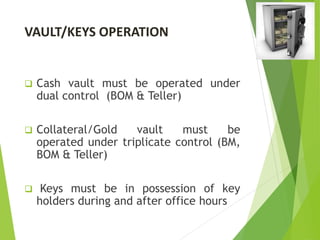
 Cash vault must be operated under
dual control (BOM & Teller)
 Collateral/Gold vault must be
operated under triplicate control (BM,
BOM & Teller)
 Keys must be in possession of key
holders during and after office hours
VAULT/KEYS OPERATION
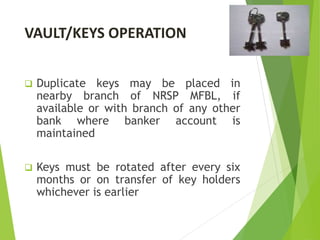
 Duplicate keys may be placed in
nearby branch of NRSP MFBL, if
available or with branch of any other
bank where banker account is
maintained
 Keys must be rotated after every six
months or on transfer of key holders
whichever is earlier
OPENING OF CASH
 Cash must be opened 10 minutes
prior to counter hours i,e @ 8:50 am
 Counter must be ready for customer
services at 9:00 am
 Cash must be withdrawn from vault
keeping in view “Average Daily Payment”
requirement
OPENING OF CASH
 Vault register must be maintained and kept in vault
 All stamps will be updated to reflect current date
 Security Alarm system will be by passed during
Banking hours (Main entrance)
 Cash counter door must be locked all the times during banking
hours
 Notice of “Authorized Persons Only” must be pasted on
entrance door
CASH RECEIPT
 Customer will deposit cash at counter
 Only Teller is allowed to receive cash at branch
 Teller will receive cash from customer along with
dully filled prescribed deposit slip or issue system
generated receipt after accepting & counting cash
 After physical count, Teller will verify the same
through counting machine
CASH RECEIPT
 Teller will mention denomination on deposit slip
 Teller will obtain depositor signature on deposit slip
 Teller will post deposit slip into system on real time
 After proper discharge (sign & stamp), Teller will
handover customer copy to customer, if with in Teller’s
limit
CASH RECEIPT
 If above Teller’s limit, receipt will be
forwarded to Authorizer for
authorization
 Teller will advise customer to get his/her
copy from the authorizer
 Authorizer will authorize it after basic
verification from customer and handover
customer’s copy
CASH PAYMENT
 Customer will come at counter and present
cheque for payment
 Teller will ensure that cheque is not crossed,
mutilated, torn, stale or post dated
 Teller will ensure amount in words and figures is
matched on cheque
 Teller will ensure there is no cutting/over writing
on cheque, if so it must be authenticated by the
drawer
CASH PAYMENT
 Teller will confirm genuineness of
instrument through IV marker
 Teller will verify drawer’s signature
through SS card into system, ensure
availability of balance, account status is
active, no stop payment instructions
against instrument
 Teller will post cheque into system and
cancel it by waving a line with Red pen
CASH PAYMENT
 Teller will obtain customer’s signature on back of
instrument and make payment, if within Teller’s limit
otherwise forward to authorizer for authorization
 Teller will affix “Cash Paid” stamp on cheque with his
signature
 Teller will mention denomination on back of instrument
 While making payment of photo account, Teller will
ensure self presence of account holder at counter.
LOAN PAYMENT
 Loan payment is restricted to borrowers with
biometric verification except MSME loan (for
customers having mature/firm signature)
 In case biometric is failed, BM/BOM will
authorize transaction with noting on back of
cheque that;
“ Customer is himself/herself present at
counter
for payment”.
ONLINE TRANSACTION
 Cash deposit or withdrawal by using different
branches of a bank using electronic means.
Transaction conducted by a walk in customer;
 `
 Copy of CNIC is required for cash transaction Rs. 0.500 M in a
single transaction or multiple transactions that appeared to be
linked
 Copy of CNIC is required for online transaction (regardless of
threshold), if transaction exceeds Rs. 100,000 name, CNIC and
purpose must be captured in system
UTILITY BILLS COLLECTION
 Customer will come over the counter for
payment of all type of post paid/prepaid
utility bills/ Top ups
 Teller will collect bill along with cash
 Teller will physically count the cash
 Teller will input consumer number into
eBPS to get details of bill to be paid
UTILITY BILLS COLLECTION
 Upon successful match of physical bill with system
details, Teller will pay bill into system, if
unmatched will be refused politely to customer
 Teller will affix “Utility Bill Paid” stamp on both
(customer & bank) copies with signature and
amount
 At closing, all bills copies will be reconciled &
attached with system report. Report will be jointly
signed by the BOM & Teller and stitch/seal with
daily vouchers
PAYMENT OF GOVT. TAXES & DUTIES
 Customer will come over the counter for
payment of all type of Govt. Taxes &
duties
 Teller will collect challan along with cash
 Teller will physically count the cash and
match it with the challan amount
 Teller will input reference number into
PAYMENT OF GOVT. TAXES
& DUTIES
 Upon successful match of Challan with
system details, Teller will pay Challan into
system, if unmatched will be refused
politely to customer
 Teller will affix “Cash Paid/Bank Paid”
stamp on both (customer & bank) copies
with signature and amount
 At closing, all Challan copies will be
reconciled & attached with system
CASH IN TRANSIT
 Utmost efforts will be made to hire
services of security company for
transportation of cash
 Cash will be handed over to security
company guards after verification of their
identity and sealed in presence of branch
staff
 In case of emergency or non-availability
of security service, branch can transport
CASH IN TRANSIT
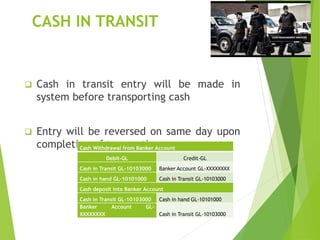
 Cash in transit entry will be made in
system before transporting cash
 Entry will be reversed on same day upon
completion of transaction
Cash Withdrawal from Banker Account
Debit-GL Credit-GL
Cash in Transit GL-10103000 Banker Account GL-XXXXXXXX
Cash in hand GL-10101000 Cash in Transit GL-10103000
Cash deposit into Banker Account
Cash in Transit GL-10103000 Cash in hand GL-10101000
Banker Account GL-
XXXXXXXX Cash in Transit GL-10103000
CASH CLOSING
 At closing, physical cash will be balanced
with Cash on hand system GL
 All cash will be sorted through sorting
machine
 Teller will prepare “Statement of cash
closing”. This statement will be jointly by the
cash custodians
 Teller will maintain Vault register for closing
CASH CLOSING
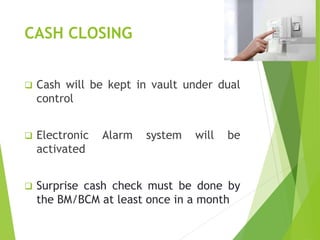
 Cash will be kept in vault under dual
control
 Electronic Alarm system will be
activated
 Surprise cash check must be done by
the BM/BCM at least once in a month
INSURANCE MANAGEMENT
 Cash must be maintained within allocated
insurance limit, during banking hours and at
closing
 Excess cash must be disposed off or arrange
insurance cover for the excess over limit cash
at closing
 Insurance cover for excess cash must be
arranged on same day
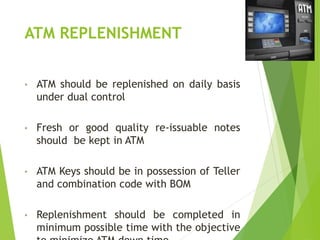
ATM REPLENISHMENT
• ATM should be replenished on daily basis
under dual control
• Fresh or good quality re-issuable notes
should be kept in ATM
• ATM Keys should be in possession of Teller
and combination code with BOM
• Replenishment should be completed in
minimum possible time with the objective
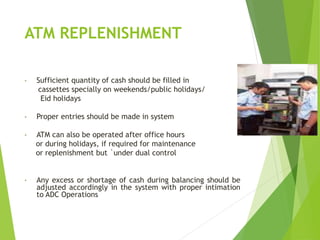
ATM REPLENISHMENT
• Sufficient quantity of cash should be filled in
cassettes specially on weekends/public holidays/
Eid holidays
• Proper entries should be made in system
• ATM can also be operated after office hours
or during holidays, if required for maintenance
or replenishment but `under dual control
• Any excess or shortage of cash during balancing should be
adjusted accordingly in the system with proper intimation
to ADC Operations
TYPE OF CHEQUES
 Bearer Cheque
 When the word "bearer" printed on the cheque is not
cancelled, the cheque is called as bearer cheque
 A bearer cheque is made payable to the to the person
who presents it to the bank for payment/encashment
TYPE OF CHEQUES
 Order Cheque
 When the word "bearer" printed on the
cheque is cancelled and the word ‘order’
may be written on the cheque, the
cheque is called an order cheque. An
order cheque is one which is payable to a
particular person.
TYPE OF CHEQUES
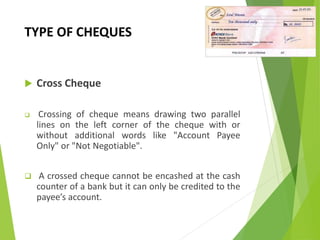
 Cross Cheque
 Crossing of cheque means drawing two parallel
lines on the left corner of the cheque with or
without additional words like "Account Payee
Only" or "Not Negotiable".
 A crossed cheque cannot be encashed at the cash
counter of a bank but it can only be credited to the
payee’s account.
TYPE OF CHEQUES
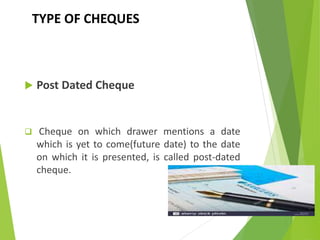
 Post Dated Cheque
 Cheque on which drawer mentions a date
which is yet to come(future date) to the date
on which it is presented, is called post-dated
cheque.
TYPE OF CHEQUES
 Stale Cheque
 If a cheque is presented for payment after six
months from the date of the cheque, it is
called stale cheque.
 Stale cheque cannot be paid without re-
validation by the drawer
TYPE OF CHEQUES
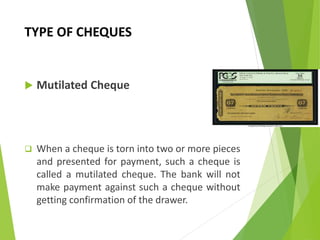
 Mutilated Cheque
 When a cheque is torn into two or more pieces
and presented for payment, such a cheque is
called a mutilated cheque. The bank will not
make payment against such a cheque without
getting confirmation of the drawer.
CROSSING OF CHEQUES
GENERAL CROSSING
When a cheque bears two transverse parallel
lines at the left hand of its top corner or stamped
as “A/C Payee Only” is called General Crossing
SPECIAL CROSSING
When the name of a particular bank is written
between two parallel lines the cheque is said to
be specially crossed
PARTIES TO CHEQUE
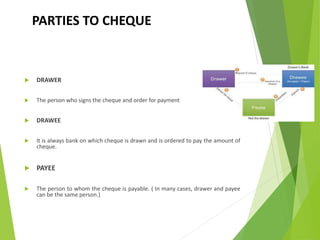
 DRAWER
 The person who signs the cheque and order for payment
 DRAWEE
 It is always bank on which cheque is drawn and is ordered to pay the amount of
cheque.
 PAYEE
 The person to whom the cheque is payable. ( In many cases, drawer and payee
can be the same person.)
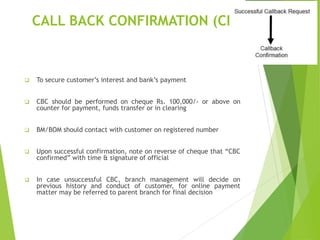
CALL BACK CONFIRMATION (CBC)
 To secure customer’s interest and bank’s payment
 CBC should be performed on cheque Rs. 100,000/- or above on
counter for payment, funds transfer or in clearing
 BM/BOM should contact with customer on registered number
 Upon successful confirmation, note on reverse of cheque that “CBC
confirmed” with time & signature of official
 In case unsuccessful CBC, branch management will decide on
previous history and conduct of customer, for online payment
matter may be referred to parent branch for final decision
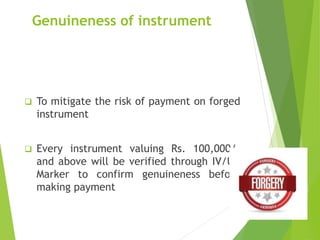
Genuineness of instrument
 To mitigate the risk of payment on forged
instrument
 Every instrument valuing Rs. 100,000/-
and above will be verified through IV/UV
Marker to confirm genuineness before
making payment
CLEAN NOTE POLICY
 1.Branches have been preparing and
maintaining the prescribed statement of
daily closing cash balances
CLEAN NOTE POLICY
2.Branches have been maintaining minimum One day’s
fresh / re-issuable balance in accordance with the
average daily cash payment requirements except of
the branches which are exempted from this condition
i. Branches making an average daily payment of less than Rs. 0.50 million
ii. Branches having immediate access to re-issuable good quality currency notes
such as withdrawal facility from the large branch of the same bank in the same city,
SBP BSC local Offices / NBP Chests
CLEAN NOTE POLICY
 3. Branches have been properly sorting
Bank Note packets / bundles into
issuable/ non-issuable as per SBP BSC
standards and no instances have been
observed where non-issuable notes /
packets are being put into circulation by
the branches
CLEAN NOTE POLICY
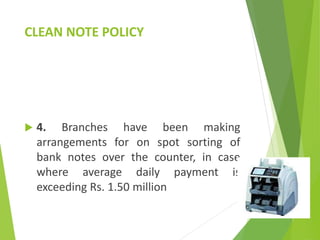
 4. Branches have been making
arrangements for on spot sorting of
bank notes over the counter, in case
where average daily payment is
exceeding Rs. 1.50 million
CLEAN NOTE POLICY
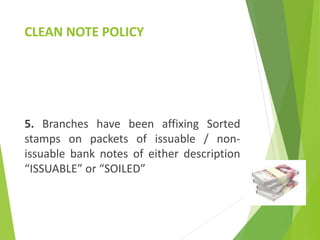
5. Branches have been affixing Sorted
stamps on packets of issuable / non-
issuable bank notes of either description
“ISSUABLE” or “SOILED”
CLEAN NOTE POLICY
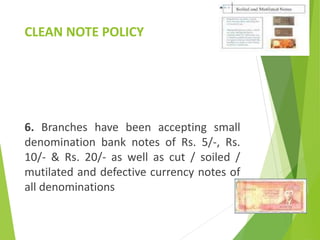
6. Branches have been accepting small
denomination bank notes of Rs. 5/-, Rs.
10/- & Rs. 20/- as well as cut / soiled /
mutilated and defective currency notes of
all denominations
CLEAN NOTE POLICY
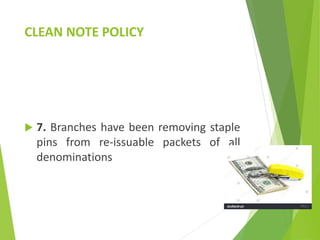
 7. Branches have been removing staple
pins from re-issuable packets of all
denominations
CLEAN NOTE POLICY
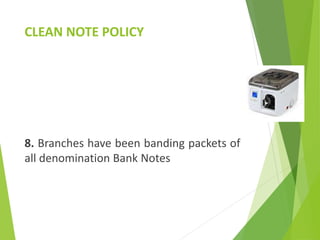
8. Branches have been banding packets of
all denomination Bank Notes
CLEAN NOTE POLICY
 9. Branches have been following the
procedure for issuance of fresh currency
to general public / stakeholders, as
issued by SBP BSC (Bank)
CLEAN NOTE POLICY
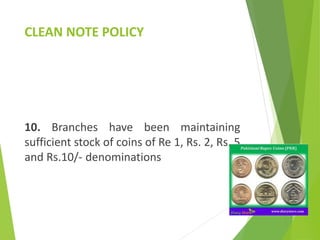
10. Branches have been maintaining
sufficient stock of coins of Re 1, Rs. 2, Rs. 5
and Rs.10/- denominations
CLEAN NOTE POLICY
11. Branches have been accepting coins
and are providing notes-coins exchange
facility
CLEAN NOTE POLICY
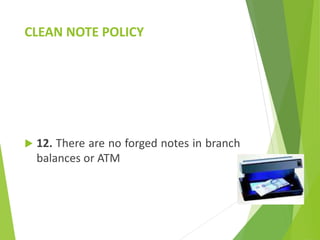
 12. There are no forged notes in branch
balances or ATM
CLEAN NOTE POLICY
 13. Branches have not been repeating
the irregularities pointed out in the
previous report
CLEAN NOTE POLICY
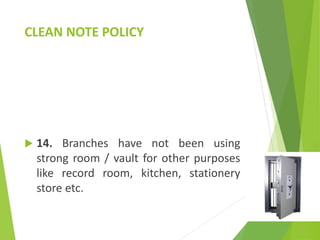
 14. Branches have not been using
strong room / vault for other purposes
like record room, kitchen, stationery
store etc.
CURRENCY MANAGEMENT STRATEGY- CMS
 State Bank of Pakistan announced salient features of its Currency
Management Strategy in currency conference held at Lahore in Feb
2015. The key features are;
 Automation of cash management function in
the banking industry
 Availability of machine authenticated good
quality notes to general public
CURRENCY MANAGEMENT
STRATEGY- CMS
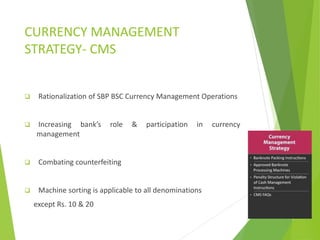
 Rationalization of SBP BSC Currency Management Operations
 Increasing bank’s role & participation in currency
management
 Combating counterfeiting
 Machine sorting is applicable to all denominations
except Rs. 10 & 20
CURRENCY MANAGEMENT STRATEGY (CMS)-
PENALTY STRUCTRE
NON COMPLIANCE
Issuance of
Unauthenticated and
Unprocessed
banknotes to public
PENALTY
Rs. 100,000/- per
instance
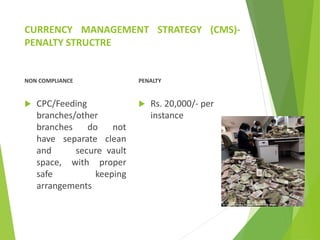
CURRENCY MANAGEMENT STRATEGY (CMS)-
PENALTY STRUCTRE
NON COMPLIANCE
 CPC/Feeding
branches/other
branches do not
have separate clean
and secure vault
space, with proper
safe keeping
arrangements
PENALTY
 Rs. 20,000/- per
instance
CURRENCY MANAGEMENT STRATEGY (CMS)-
PENALTY STRUCTRE
NON COMPLIANCE
 The vault does not have
insurance cover in line
with value of cash held
 The entire CPC / Sorting
area is not covered by
high resolution CCTV
cameras
PENALTY
 Rs. 10,000/- per
instance
 Rs. 20,000/- per
instance
CURRENCY MANAGEMENT STRATEGY (CMS)-
PENALTY STRUCTRE
NON COMPLIANCE
 Recording of CCTV
cameras is not available
for 60 days
 Banknotes sorting an
authentication machines
are not processing /
authenticating
banknotes as per SBP
standards as outlined in
Finance Department
circular No. 03/2015
PENALTY
 Rs. 10,000/- per day
Rs. 5000/- per machine
CURRENCY MANAGEMENT STRATEGY (CMS)-
PENALTY STRUCTRE
NON COMPLIANCE
 Police verification of all
employees deployed at
CPC/Feeding Branch is not
available
 Record of visitors is not
maintained
PENALTY
Rs. 5000/- per instance
 Rs. 5000/- per employee
 Rs. 5000/- per instance
CURRENCY MANAGEMENT STRATEGY (CMS)-
PENALTY STRUCTRE
NON COMPLIANCE
 No approval has been
obtained from SBP
Finance Department,
where deviations to
requisite capabilities
in cash
handling/packing
machines
PENALTY
Rs. 20,000/- per instance
CURRENCY MANAGEMENT STRATEGY (CMS)-
PENALTY STRUCTRE
NON COMPLIANCE
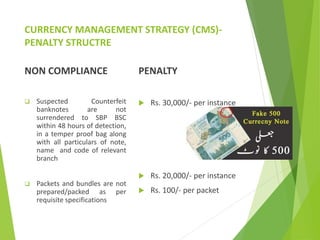
 Suspected Counterfeit
banknotes are not
surrendered to SBP BSC
within 48 hours of detection,
in a temper proof bag along
with all particulars of note,
name and code of relevant
branch
 Packets and bundles are not
prepared/packed as per
requisite specifications
PENALTY
 Rs. 30,000/- per instance
 Rs. 20,000/- per instance
 Rs. 100/- per packet
CURRENCY MANAGEMENT STRATEGY (CMS)- PENALTY
STRUCTRE
NON COMPLIANCE
 Cash offered in IEC or
deposit with SBP BSC are not
packed as per Packing
Instructions
 Any other non-compliance
and circumvention of
instructions issued from time
to time by SBP, relating to
CPC / Feeding Branch /
Standalone Branch
PENALTY
Rs. 20,000/- per instance
 Rs. 1000/- per bundle
Min. 5,000 to Max. 100,000
depending upon the severity
of instance
CURRENCY MANAGEMENT STRATEGY (CMS)-
PENALTY STRUCTRE ATMs
NON COMPLIANCE
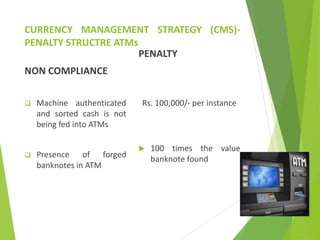
 Machine authenticated
and sorted cash is not
being fed into ATMs
 Presence of forged
banknotes in ATM
PENALTY
Rs. 100,000/- per instance
 100 times the value
banknote found
CURRENCY MANAGEMENT STRATEGY (CMS)-
PENALTY STRUCTRE ATMs
NON COMPLIANCE
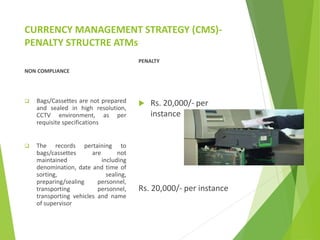
 Bags/Cassettes are not prepared
and sealed in high resolution,
CCTV environment, as per
requisite specifications
 The records pertaining to
bags/cassettes are not
maintained including
denomination, date and time of
sorting, sealing,
preparing/sealing personnel,
transporting personnel,
transporting vehicles and name
of supervisor
PENALTY
 Rs. 20,000/- per
instance
Rs. 20,000/- per instance
CURRENCY MANAGEMENT STRATEGY (CMS)-
PENALTY STRUCTRE ATMs
NON COMPLIANCE
 Separate bags /Trays are not
prepared for all attached
ATMs
 Bags / Cassettes are remitted
without receipt of written
acknowledgement from
feeding team/officials/armor
guards/CITs
 CCTV record of disputed
cases is not available
PENALTY
 Rs. 10,000/- per instance
 Rs. 5000/- per ATM
 Rs. 10,000/- per instance
 Rs. 20,000/- per instance
CURRENCY MANAGEMENT STRATEGY (CMS)-
PENALTY STRUCTRE ATMs
NON COMPLIANCE
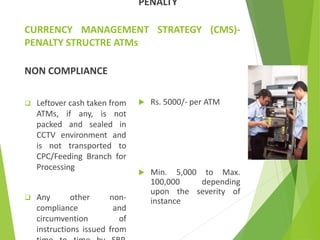
 Leftover cash taken from
ATMs, if any, is not
packed and sealed in
CCTV environment and
is not transported to
CPC/Feeding Branch for
Processing
 Any other non-
compliance and
circumvention of
instructions issued from
PENALTY
 Rs. 5000/- per ATM
 Min. 5,000 to Max.
100,000 depending
upon the severity of
instance
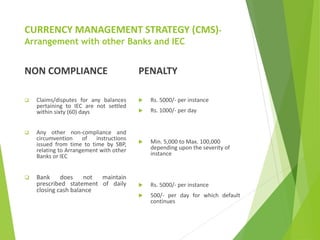
CURRENCY MANAGEMENT STRATEGY (CMS)-
Arrangement with other Banks and IEC
NON COMPLIANCE
 Claims/disputes for any balances
pertaining to IEC are not settled
within sixty (60) days
 Any other non-compliance and
circumvention of instructions
issued from time to time by SBP,
relating to Arrangement with other
Banks or IEC
 Bank does not maintain
prescribed statement of daily
closing cash balance
PENALTY
 Rs. 5000/- per instance
 Rs. 1000/- per day
 Min. 5,000 to Max. 100,000
depending upon the severity of
instance
 Rs. 5000/- per instance
 500/- per day for which default
continues
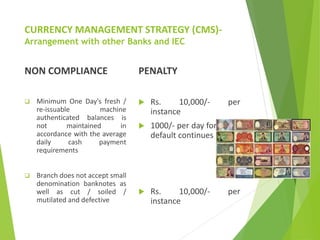
CURRENCY MANAGEMENT STRATEGY (CMS)-
Arrangement with other Banks and IEC
NON COMPLIANCE
 Minimum One Day's fresh /
re-issuable machine
authenticated balances is
not maintained in
accordance with the average
daily cash payment
requirements
 Branch does not accept small
denomination banknotes as
well as cut / soiled /
mutilated and defective
PENALTY
 Rs. 10,000/- per
instance
 1000/- per day for which
default continues
 Rs. 10,000/- per
instance
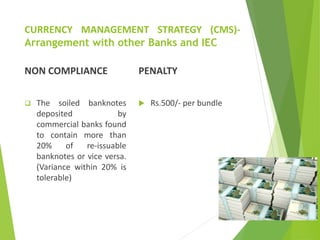
CURRENCY MANAGEMENT STRATEGY (CMS)-
Arrangement with other Banks and IEC
NON COMPLIANCE
 The soiled banknotes
deposited by
commercial banks found
to contain more than
20% of re-issuable
banknotes or vice versa.
(Variance within 20% is
tolerable)
PENALTY
 Rs.500/- per bundle
Cash Operations.pptx

Cash Operations.pptx

  • 1.
  • 3.
    CASH OPERATIONS  Vault/keysoperation  Opening of Cash  Cash Receipt/Recovery Receipt  Cash Payment/Loan Payment  Online Receipt/Payment  Utility Bills Collection  Collection of Govt. taxes/duties  Insurance Management
  • 4.
    CASH OPERATIONS  Cashin Transit  Sorting of cash  ATM Replenishment  Call Back Confirmation (CBC)  Genuineness on instrument through IV marker  Type of cheques & crossing of cheques  SBP Clean Note Policy  SBP Currency Management Strategy
  • 5.
    VAULT/KEYS OPERATION  Cashvault must be operated under dual control (BOM & Teller)  Collateral/Gold vault must be operated under triplicate control (BM, BOM & Teller)  Keys must be in possession of key holders during and after office hours
  • 6.
    VAULT/KEYS OPERATION  Duplicatekeys may be placed in nearby branch of NRSP MFBL, if available or with branch of any other bank where banker account is maintained  Keys must be rotated after every six months or on transfer of key holders whichever is earlier
  • 7.
    OPENING OF CASH Cash must be opened 10 minutes prior to counter hours i,e @ 8:50 am  Counter must be ready for customer services at 9:00 am  Cash must be withdrawn from vault keeping in view “Average Daily Payment” requirement
  • 8.
    OPENING OF CASH Vault register must be maintained and kept in vault  All stamps will be updated to reflect current date  Security Alarm system will be by passed during Banking hours (Main entrance)  Cash counter door must be locked all the times during banking hours  Notice of “Authorized Persons Only” must be pasted on entrance door
  • 9.
    CASH RECEIPT  Customerwill deposit cash at counter  Only Teller is allowed to receive cash at branch  Teller will receive cash from customer along with dully filled prescribed deposit slip or issue system generated receipt after accepting & counting cash  After physical count, Teller will verify the same through counting machine
  • 10.
    CASH RECEIPT  Tellerwill mention denomination on deposit slip  Teller will obtain depositor signature on deposit slip  Teller will post deposit slip into system on real time  After proper discharge (sign & stamp), Teller will handover customer copy to customer, if with in Teller’s limit
  • 11.
    CASH RECEIPT  Ifabove Teller’s limit, receipt will be forwarded to Authorizer for authorization  Teller will advise customer to get his/her copy from the authorizer  Authorizer will authorize it after basic verification from customer and handover customer’s copy
  • 12.
    CASH PAYMENT  Customerwill come at counter and present cheque for payment  Teller will ensure that cheque is not crossed, mutilated, torn, stale or post dated  Teller will ensure amount in words and figures is matched on cheque  Teller will ensure there is no cutting/over writing on cheque, if so it must be authenticated by the drawer
  • 13.
    CASH PAYMENT  Tellerwill confirm genuineness of instrument through IV marker  Teller will verify drawer’s signature through SS card into system, ensure availability of balance, account status is active, no stop payment instructions against instrument  Teller will post cheque into system and cancel it by waving a line with Red pen
  • 14.
    CASH PAYMENT  Tellerwill obtain customer’s signature on back of instrument and make payment, if within Teller’s limit otherwise forward to authorizer for authorization  Teller will affix “Cash Paid” stamp on cheque with his signature  Teller will mention denomination on back of instrument  While making payment of photo account, Teller will ensure self presence of account holder at counter.
  • 15.
    LOAN PAYMENT  Loanpayment is restricted to borrowers with biometric verification except MSME loan (for customers having mature/firm signature)  In case biometric is failed, BM/BOM will authorize transaction with noting on back of cheque that; “ Customer is himself/herself present at counter for payment”.
  • 16.
    ONLINE TRANSACTION  Cashdeposit or withdrawal by using different branches of a bank using electronic means. Transaction conducted by a walk in customer;  `  Copy of CNIC is required for cash transaction Rs. 0.500 M in a single transaction or multiple transactions that appeared to be linked  Copy of CNIC is required for online transaction (regardless of threshold), if transaction exceeds Rs. 100,000 name, CNIC and purpose must be captured in system
  • 17.
    UTILITY BILLS COLLECTION Customer will come over the counter for payment of all type of post paid/prepaid utility bills/ Top ups  Teller will collect bill along with cash  Teller will physically count the cash  Teller will input consumer number into eBPS to get details of bill to be paid
  • 18.
    UTILITY BILLS COLLECTION Upon successful match of physical bill with system details, Teller will pay bill into system, if unmatched will be refused politely to customer  Teller will affix “Utility Bill Paid” stamp on both (customer & bank) copies with signature and amount  At closing, all bills copies will be reconciled & attached with system report. Report will be jointly signed by the BOM & Teller and stitch/seal with daily vouchers
  • 19.
    PAYMENT OF GOVT.TAXES & DUTIES  Customer will come over the counter for payment of all type of Govt. Taxes & duties  Teller will collect challan along with cash  Teller will physically count the cash and match it with the challan amount  Teller will input reference number into
  • 20.
    PAYMENT OF GOVT.TAXES & DUTIES  Upon successful match of Challan with system details, Teller will pay Challan into system, if unmatched will be refused politely to customer  Teller will affix “Cash Paid/Bank Paid” stamp on both (customer & bank) copies with signature and amount  At closing, all Challan copies will be reconciled & attached with system
  • 21.
    CASH IN TRANSIT Utmost efforts will be made to hire services of security company for transportation of cash  Cash will be handed over to security company guards after verification of their identity and sealed in presence of branch staff  In case of emergency or non-availability of security service, branch can transport
  • 22.
    CASH IN TRANSIT Cash in transit entry will be made in system before transporting cash  Entry will be reversed on same day upon completion of transaction Cash Withdrawal from Banker Account Debit-GL Credit-GL Cash in Transit GL-10103000 Banker Account GL-XXXXXXXX Cash in hand GL-10101000 Cash in Transit GL-10103000 Cash deposit into Banker Account Cash in Transit GL-10103000 Cash in hand GL-10101000 Banker Account GL- XXXXXXXX Cash in Transit GL-10103000
  • 23.
    CASH CLOSING  Atclosing, physical cash will be balanced with Cash on hand system GL  All cash will be sorted through sorting machine  Teller will prepare “Statement of cash closing”. This statement will be jointly by the cash custodians  Teller will maintain Vault register for closing
  • 24.
    CASH CLOSING  Cashwill be kept in vault under dual control  Electronic Alarm system will be activated  Surprise cash check must be done by the BM/BCM at least once in a month
  • 25.
    INSURANCE MANAGEMENT  Cashmust be maintained within allocated insurance limit, during banking hours and at closing  Excess cash must be disposed off or arrange insurance cover for the excess over limit cash at closing  Insurance cover for excess cash must be arranged on same day
  • 26.
    ATM REPLENISHMENT • ATMshould be replenished on daily basis under dual control • Fresh or good quality re-issuable notes should be kept in ATM • ATM Keys should be in possession of Teller and combination code with BOM • Replenishment should be completed in minimum possible time with the objective
  • 27.
    ATM REPLENISHMENT • Sufficientquantity of cash should be filled in cassettes specially on weekends/public holidays/ Eid holidays • Proper entries should be made in system • ATM can also be operated after office hours or during holidays, if required for maintenance or replenishment but `under dual control • Any excess or shortage of cash during balancing should be adjusted accordingly in the system with proper intimation to ADC Operations
  • 28.
    TYPE OF CHEQUES Bearer Cheque  When the word "bearer" printed on the cheque is not cancelled, the cheque is called as bearer cheque  A bearer cheque is made payable to the to the person who presents it to the bank for payment/encashment
  • 29.
    TYPE OF CHEQUES Order Cheque  When the word "bearer" printed on the cheque is cancelled and the word ‘order’ may be written on the cheque, the cheque is called an order cheque. An order cheque is one which is payable to a particular person.
  • 30.
    TYPE OF CHEQUES Cross Cheque  Crossing of cheque means drawing two parallel lines on the left corner of the cheque with or without additional words like "Account Payee Only" or "Not Negotiable".  A crossed cheque cannot be encashed at the cash counter of a bank but it can only be credited to the payee’s account.
  • 31.
    TYPE OF CHEQUES Post Dated Cheque  Cheque on which drawer mentions a date which is yet to come(future date) to the date on which it is presented, is called post-dated cheque.
  • 32.
    TYPE OF CHEQUES Stale Cheque  If a cheque is presented for payment after six months from the date of the cheque, it is called stale cheque.  Stale cheque cannot be paid without re- validation by the drawer
  • 33.
    TYPE OF CHEQUES Mutilated Cheque  When a cheque is torn into two or more pieces and presented for payment, such a cheque is called a mutilated cheque. The bank will not make payment against such a cheque without getting confirmation of the drawer.
  • 34.
    CROSSING OF CHEQUES GENERALCROSSING When a cheque bears two transverse parallel lines at the left hand of its top corner or stamped as “A/C Payee Only” is called General Crossing SPECIAL CROSSING When the name of a particular bank is written between two parallel lines the cheque is said to be specially crossed
  • 35.
    PARTIES TO CHEQUE DRAWER  The person who signs the cheque and order for payment  DRAWEE  It is always bank on which cheque is drawn and is ordered to pay the amount of cheque.  PAYEE  The person to whom the cheque is payable. ( In many cases, drawer and payee can be the same person.)
  • 36.
    CALL BACK CONFIRMATION(CBC)  To secure customer’s interest and bank’s payment  CBC should be performed on cheque Rs. 100,000/- or above on counter for payment, funds transfer or in clearing  BM/BOM should contact with customer on registered number  Upon successful confirmation, note on reverse of cheque that “CBC confirmed” with time & signature of official  In case unsuccessful CBC, branch management will decide on previous history and conduct of customer, for online payment matter may be referred to parent branch for final decision
  • 37.
    Genuineness of instrument To mitigate the risk of payment on forged instrument  Every instrument valuing Rs. 100,000/- and above will be verified through IV/UV Marker to confirm genuineness before making payment
  • 38.
    CLEAN NOTE POLICY 1.Branches have been preparing and maintaining the prescribed statement of daily closing cash balances
  • 39.
    CLEAN NOTE POLICY 2.Brancheshave been maintaining minimum One day’s fresh / re-issuable balance in accordance with the average daily cash payment requirements except of the branches which are exempted from this condition i. Branches making an average daily payment of less than Rs. 0.50 million ii. Branches having immediate access to re-issuable good quality currency notes such as withdrawal facility from the large branch of the same bank in the same city, SBP BSC local Offices / NBP Chests
  • 40.
    CLEAN NOTE POLICY 3. Branches have been properly sorting Bank Note packets / bundles into issuable/ non-issuable as per SBP BSC standards and no instances have been observed where non-issuable notes / packets are being put into circulation by the branches
  • 41.
    CLEAN NOTE POLICY 4. Branches have been making arrangements for on spot sorting of bank notes over the counter, in case where average daily payment is exceeding Rs. 1.50 million
  • 42.
    CLEAN NOTE POLICY 5.Branches have been affixing Sorted stamps on packets of issuable / non- issuable bank notes of either description “ISSUABLE” or “SOILED”
  • 43.
    CLEAN NOTE POLICY 6.Branches have been accepting small denomination bank notes of Rs. 5/-, Rs. 10/- & Rs. 20/- as well as cut / soiled / mutilated and defective currency notes of all denominations
  • 44.
    CLEAN NOTE POLICY 7. Branches have been removing staple pins from re-issuable packets of all denominations
  • 45.
    CLEAN NOTE POLICY 8.Branches have been banding packets of all denomination Bank Notes
  • 46.
    CLEAN NOTE POLICY 9. Branches have been following the procedure for issuance of fresh currency to general public / stakeholders, as issued by SBP BSC (Bank)
  • 47.
    CLEAN NOTE POLICY 10.Branches have been maintaining sufficient stock of coins of Re 1, Rs. 2, Rs. 5 and Rs.10/- denominations
  • 48.
    CLEAN NOTE POLICY 11.Branches have been accepting coins and are providing notes-coins exchange facility
  • 49.
    CLEAN NOTE POLICY 12. There are no forged notes in branch balances or ATM
  • 50.
    CLEAN NOTE POLICY 13. Branches have not been repeating the irregularities pointed out in the previous report
  • 51.
    CLEAN NOTE POLICY 14. Branches have not been using strong room / vault for other purposes like record room, kitchen, stationery store etc.
  • 52.
    CURRENCY MANAGEMENT STRATEGY-CMS  State Bank of Pakistan announced salient features of its Currency Management Strategy in currency conference held at Lahore in Feb 2015. The key features are;  Automation of cash management function in the banking industry  Availability of machine authenticated good quality notes to general public
  • 53.
    CURRENCY MANAGEMENT STRATEGY- CMS Rationalization of SBP BSC Currency Management Operations  Increasing bank’s role & participation in currency management  Combating counterfeiting  Machine sorting is applicable to all denominations except Rs. 10 & 20
  • 54.
    CURRENCY MANAGEMENT STRATEGY(CMS)- PENALTY STRUCTRE NON COMPLIANCE Issuance of Unauthenticated and Unprocessed banknotes to public PENALTY Rs. 100,000/- per instance
  • 55.
    CURRENCY MANAGEMENT STRATEGY(CMS)- PENALTY STRUCTRE NON COMPLIANCE  CPC/Feeding branches/other branches do not have separate clean and secure vault space, with proper safe keeping arrangements PENALTY  Rs. 20,000/- per instance
  • 56.
    CURRENCY MANAGEMENT STRATEGY(CMS)- PENALTY STRUCTRE NON COMPLIANCE  The vault does not have insurance cover in line with value of cash held  The entire CPC / Sorting area is not covered by high resolution CCTV cameras PENALTY  Rs. 10,000/- per instance  Rs. 20,000/- per instance
  • 57.
    CURRENCY MANAGEMENT STRATEGY(CMS)- PENALTY STRUCTRE NON COMPLIANCE  Recording of CCTV cameras is not available for 60 days  Banknotes sorting an authentication machines are not processing / authenticating banknotes as per SBP standards as outlined in Finance Department circular No. 03/2015 PENALTY  Rs. 10,000/- per day Rs. 5000/- per machine
  • 58.
    CURRENCY MANAGEMENT STRATEGY(CMS)- PENALTY STRUCTRE NON COMPLIANCE  Police verification of all employees deployed at CPC/Feeding Branch is not available  Record of visitors is not maintained PENALTY Rs. 5000/- per instance  Rs. 5000/- per employee  Rs. 5000/- per instance
  • 59.
    CURRENCY MANAGEMENT STRATEGY(CMS)- PENALTY STRUCTRE NON COMPLIANCE  No approval has been obtained from SBP Finance Department, where deviations to requisite capabilities in cash handling/packing machines PENALTY Rs. 20,000/- per instance
  • 60.
    CURRENCY MANAGEMENT STRATEGY(CMS)- PENALTY STRUCTRE NON COMPLIANCE  Suspected Counterfeit banknotes are not surrendered to SBP BSC within 48 hours of detection, in a temper proof bag along with all particulars of note, name and code of relevant branch  Packets and bundles are not prepared/packed as per requisite specifications PENALTY  Rs. 30,000/- per instance  Rs. 20,000/- per instance  Rs. 100/- per packet
  • 61.
    CURRENCY MANAGEMENT STRATEGY(CMS)- PENALTY STRUCTRE NON COMPLIANCE  Cash offered in IEC or deposit with SBP BSC are not packed as per Packing Instructions  Any other non-compliance and circumvention of instructions issued from time to time by SBP, relating to CPC / Feeding Branch / Standalone Branch PENALTY Rs. 20,000/- per instance  Rs. 1000/- per bundle Min. 5,000 to Max. 100,000 depending upon the severity of instance
  • 62.
    CURRENCY MANAGEMENT STRATEGY(CMS)- PENALTY STRUCTRE ATMs NON COMPLIANCE  Machine authenticated and sorted cash is not being fed into ATMs  Presence of forged banknotes in ATM PENALTY Rs. 100,000/- per instance  100 times the value banknote found
  • 63.
    CURRENCY MANAGEMENT STRATEGY(CMS)- PENALTY STRUCTRE ATMs NON COMPLIANCE  Bags/Cassettes are not prepared and sealed in high resolution, CCTV environment, as per requisite specifications  The records pertaining to bags/cassettes are not maintained including denomination, date and time of sorting, sealing, preparing/sealing personnel, transporting personnel, transporting vehicles and name of supervisor PENALTY  Rs. 20,000/- per instance Rs. 20,000/- per instance
  • 64.
    CURRENCY MANAGEMENT STRATEGY(CMS)- PENALTY STRUCTRE ATMs NON COMPLIANCE  Separate bags /Trays are not prepared for all attached ATMs  Bags / Cassettes are remitted without receipt of written acknowledgement from feeding team/officials/armor guards/CITs  CCTV record of disputed cases is not available PENALTY  Rs. 10,000/- per instance  Rs. 5000/- per ATM  Rs. 10,000/- per instance  Rs. 20,000/- per instance
  • 65.
    CURRENCY MANAGEMENT STRATEGY(CMS)- PENALTY STRUCTRE ATMs NON COMPLIANCE  Leftover cash taken from ATMs, if any, is not packed and sealed in CCTV environment and is not transported to CPC/Feeding Branch for Processing  Any other non- compliance and circumvention of instructions issued from PENALTY  Rs. 5000/- per ATM  Min. 5,000 to Max. 100,000 depending upon the severity of instance
  • 66.
    CURRENCY MANAGEMENT STRATEGY(CMS)- Arrangement with other Banks and IEC NON COMPLIANCE  Claims/disputes for any balances pertaining to IEC are not settled within sixty (60) days  Any other non-compliance and circumvention of instructions issued from time to time by SBP, relating to Arrangement with other Banks or IEC  Bank does not maintain prescribed statement of daily closing cash balance PENALTY  Rs. 5000/- per instance  Rs. 1000/- per day  Min. 5,000 to Max. 100,000 depending upon the severity of instance  Rs. 5000/- per instance  500/- per day for which default continues
  • 67.
    CURRENCY MANAGEMENT STRATEGY(CMS)- Arrangement with other Banks and IEC NON COMPLIANCE  Minimum One Day's fresh / re-issuable machine authenticated balances is not maintained in accordance with the average daily cash payment requirements  Branch does not accept small denomination banknotes as well as cut / soiled / mutilated and defective PENALTY  Rs. 10,000/- per instance  1000/- per day for which default continues  Rs. 10,000/- per instance
  • 68.
    CURRENCY MANAGEMENT STRATEGY(CMS)- Arrangement with other Banks and IEC NON COMPLIANCE  The soiled banknotes deposited by commercial banks found to contain more than 20% of re-issuable banknotes or vice versa. (Variance within 20% is tolerable) PENALTY  Rs.500/- per bundle