


Presentation by CA Mehul R. Shah
10 Things about Financial
Accounting which Start-up Founders
should Understand.....
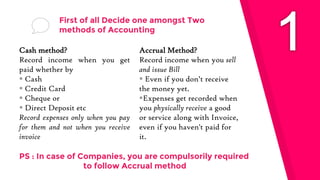
Cash method?
Record income when you get
paid whether by
 Cash
 Credit Card
 Cheque or
 Direct Deposit etc
Record expenses only when you pay
for them and not when you receive
invoice
First of all Decide one amongst Two
methods of Accounting
Accrual Method?
Record income when you sell
and issue Bill
 Even if you don’t receive
the money yet.
Expenses get recorded when
you physically receive a good
or service along with Invoice,
even if you haven't paid for
it.
PS : In case of Companies, you are compulsorily required
to follow Accrual method
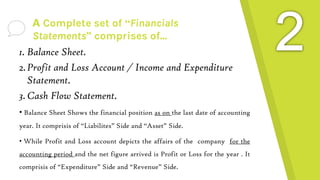
A Complete set of “Financials
Statements” comprises of...
1. Balance Sheet.
2.Profit and Loss Account / Income and Expenditure
Statement.
3.Cash Flow Statement.
• Balance Sheet Shows the financial position as on the last date of accounting
year. It comprisis of “Liabilites” Side and “Asset” Side.
• While Profit and Loss account depicts the affairs of the company for the
accounting period and the net figure arrived is Profit or Loss for the year . It
comprisis of “Expenditure” Side and “Revenue” Side.
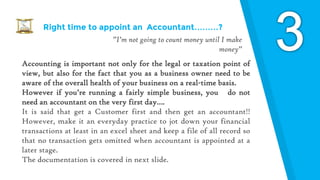
Right time to appoint an Accountant………?
”I’m not going to count money until I make
money”
Accounting is important not only for the legal or taxation point of
view, but also for the fact that you as a business owner need to be
aware of the overall health of your business on a real-time basis.
However if you’re running a fairly simple business, you do not
need an accountant on the very first day….
It is said that get a Customer first and then get an accountant!!
However, make it an everyday practice to jot down your financial
transactions at least in an excel sheet and keep a file of all record so
that no transaction gets omitted when accountant is appointed at a
later stage.
The documentation is covered in next slide.
Documentation
 Keep copies of all Sales invoices and all cash receipts
Purchase Invoices and voucher for all cash expenses
Create a payroll file sorted by payroll date and a bank
statement file sorted by month.
 Start a vendors file, sorted alphabetically, (Staples Ltd
under “S”, Costco Ltd under “C,”etc.) for easy access.
 You may maintain a Separate File for all Fixed Assets
purchased like Furniture, Fixtures, Computer etc
 Many accounting software systems let you scan paper
receipts and avoid physical files altogether.
Sample List of files to be maintained -Particularly in
case you are deferring appointment of accountant….
Capital Expenditure v/s. Revenue Expenditure
• A capital expenditure is an amount spent to acquire or improve a long-term
asset such as equipment or buildings. The cost (except for the cost of land)
will then be charged to depreciation expense over the useful life of the asset
• A revenue expenditure is an amount that is expensed immediately—thereby
being matched with revenues of the current accounting period. Routine day
to day expenses like Rent , Petrol , Factory overheads , Salaries , electricity ,
office expenses etc are Revenue expenditure.
• The classification is important because ideally long term finance would go
on to fund the capital expenditure where as you shall need working capital
finance to meet your revenue expenses.
Place your screenshot here
Check Cash Position
Since cash is the fuel for your
business, you never want to be
running near empty. Start your
day by checking how much cash
you have on hand. Knowing
how much you expect to receive
and how much you expect to pay
during the upcoming
week/month shall help
budgeting.
This is also important because in
accounting parlance your cash
balance should never go
negative.
Review Past-Due (“Aged”) Receivables
Be sure to include
an “aging” column
to separate “open
invoices” with the
number of days a
bill is past due.
This gives you a
quick view
of outstanding
customer
payments.
The beginning of
the month is a
good time to send
out overdue
reminder
statements to
customers, clients
and anyone else
who owes you
money.
At the end of
your fiscal year,
you will be
looking at this
account again to
determine what
receivables you
will need to send
to collections or
write off for a
deduction
OUR PROCESS IS
EASY
Cost of Goods Sold (COGS): These are the direct costs incurred
in producing products sold by a company. This includes both
materials and direct labour costs.
Gross Margin: This number represents the total sales revenue
that’s kept after the business incurs all direct costs to produce the
product or service.
Gross Margin (%) = (Revenue - COGS) / Revenue
Improving your
business’s gross
margin is the first
step towards earning
more income overall.
In order to calculate
gross margin, you
need to know the
costs incurred to
produce your product.
To understand this
better, let’s quickly
define both Cost of
Goods Sold (COGS)
and gross margin. The difference between how much you sell a product for, and how much the
business actually takes home at the end of the day is what truly determines
your ability to keep the doors open.
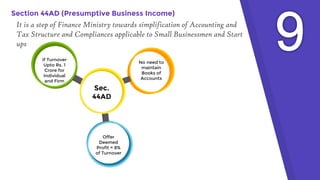
Section 44AD (Presumptive Business Income)
If Turnover
Upto Rs. 1
Crore for
Individual
and Firm
Sec.
44AD
Offer
Deemed
Profit = 8%
of Turnover
No need to
maintain
Books of
Accounts
It is a step of Finance Ministry towards simplification of Accounting and
Tax Structure and Compliances applicable to Small Businessmen and Start
ups
Analyze
Inventory Status
Even Inventory has some cost associated
with it and hence Japan follow the concept
of Just in time or “Zero Inventory”
If you have inventory, set aside time to
reorder products that sell quickly and
identify others that are moving slowly
and may have to be marked down or,
ultimately, written off.
By checking regularly (and comparing to
prior months’ numbers), it’s easier to
make estimate or arrive at EOQ so you
are neither short nor overloaded.
ABOUT THE AUTHOR
Author, Mr. Mehul Rasesh Shah is a member of the ICAI and
can be reached at mehul@raseshca.com. He has completed
certificate Course in International Taxation conducted by the
ICAI. He has also completed his Diploma in IFRS (ACCA,
London) and Advanced Diploma in Management Accounting
(CIMA, London). Currently he is handling many Appellate
proceedings including representation before the Tribunal and
Settlement Commission.
Disclaimer
These are just my opinion. Opinion are
like wrist watches. All show different times
but all think that their time is correct…
In case of query ,
Contact us at:
CA Mehul Shah
Mobile : 9723459572
E-mail : mehul@raseshca.com
Partner
14
| 15International Taxation : CA Mehul Shah

Accounting for Startups

  • 1.
    Presentation by CAMehul R. Shah 10 Things about Financial Accounting which Start-up Founders should Understand.....
  • 2.
    Cash method? Record incomewhen you get paid whether by  Cash  Credit Card  Cheque or  Direct Deposit etc Record expenses only when you pay for them and not when you receive invoice First of all Decide one amongst Two methods of Accounting Accrual Method? Record income when you sell and issue Bill  Even if you don’t receive the money yet. Expenses get recorded when you physically receive a good or service along with Invoice, even if you haven't paid for it. PS : In case of Companies, you are compulsorily required to follow Accrual method
  • 3.
    A Complete setof “Financials Statements” comprises of... 1. Balance Sheet. 2.Profit and Loss Account / Income and Expenditure Statement. 3.Cash Flow Statement. • Balance Sheet Shows the financial position as on the last date of accounting year. It comprisis of “Liabilites” Side and “Asset” Side. • While Profit and Loss account depicts the affairs of the company for the accounting period and the net figure arrived is Profit or Loss for the year . It comprisis of “Expenditure” Side and “Revenue” Side.
  • 4.
    Right time toappoint an Accountant………? ”I’m not going to count money until I make money” Accounting is important not only for the legal or taxation point of view, but also for the fact that you as a business owner need to be aware of the overall health of your business on a real-time basis. However if you’re running a fairly simple business, you do not need an accountant on the very first day…. It is said that get a Customer first and then get an accountant!! However, make it an everyday practice to jot down your financial transactions at least in an excel sheet and keep a file of all record so that no transaction gets omitted when accountant is appointed at a later stage. The documentation is covered in next slide.
  • 5.
    Documentation  Keep copiesof all Sales invoices and all cash receipts Purchase Invoices and voucher for all cash expenses Create a payroll file sorted by payroll date and a bank statement file sorted by month.  Start a vendors file, sorted alphabetically, (Staples Ltd under “S”, Costco Ltd under “C,”etc.) for easy access.  You may maintain a Separate File for all Fixed Assets purchased like Furniture, Fixtures, Computer etc  Many accounting software systems let you scan paper receipts and avoid physical files altogether. Sample List of files to be maintained -Particularly in case you are deferring appointment of accountant….
  • 6.
    Capital Expenditure v/s.Revenue Expenditure • A capital expenditure is an amount spent to acquire or improve a long-term asset such as equipment or buildings. The cost (except for the cost of land) will then be charged to depreciation expense over the useful life of the asset • A revenue expenditure is an amount that is expensed immediately—thereby being matched with revenues of the current accounting period. Routine day to day expenses like Rent , Petrol , Factory overheads , Salaries , electricity , office expenses etc are Revenue expenditure. • The classification is important because ideally long term finance would go on to fund the capital expenditure where as you shall need working capital finance to meet your revenue expenses.
  • 7.
    Place your screenshothere Check Cash Position Since cash is the fuel for your business, you never want to be running near empty. Start your day by checking how much cash you have on hand. Knowing how much you expect to receive and how much you expect to pay during the upcoming week/month shall help budgeting. This is also important because in accounting parlance your cash balance should never go negative.
  • 8.
    Review Past-Due (“Aged”)Receivables Be sure to include an “aging” column to separate “open invoices” with the number of days a bill is past due. This gives you a quick view of outstanding customer payments. The beginning of the month is a good time to send out overdue reminder statements to customers, clients and anyone else who owes you money. At the end of your fiscal year, you will be looking at this account again to determine what receivables you will need to send to collections or write off for a deduction
  • 9.
    OUR PROCESS IS EASY Costof Goods Sold (COGS): These are the direct costs incurred in producing products sold by a company. This includes both materials and direct labour costs. Gross Margin: This number represents the total sales revenue that’s kept after the business incurs all direct costs to produce the product or service. Gross Margin (%) = (Revenue - COGS) / Revenue Improving your business’s gross margin is the first step towards earning more income overall. In order to calculate gross margin, you need to know the costs incurred to produce your product. To understand this better, let’s quickly define both Cost of Goods Sold (COGS) and gross margin. The difference between how much you sell a product for, and how much the business actually takes home at the end of the day is what truly determines your ability to keep the doors open.
  • 10.
    Section 44AD (PresumptiveBusiness Income) If Turnover Upto Rs. 1 Crore for Individual and Firm Sec. 44AD Offer Deemed Profit = 8% of Turnover No need to maintain Books of Accounts It is a step of Finance Ministry towards simplification of Accounting and Tax Structure and Compliances applicable to Small Businessmen and Start ups
  • 11.
    Analyze Inventory Status Even Inventoryhas some cost associated with it and hence Japan follow the concept of Just in time or “Zero Inventory” If you have inventory, set aside time to reorder products that sell quickly and identify others that are moving slowly and may have to be marked down or, ultimately, written off. By checking regularly (and comparing to prior months’ numbers), it’s easier to make estimate or arrive at EOQ so you are neither short nor overloaded.
  • 12.
    ABOUT THE AUTHOR Author,Mr. Mehul Rasesh Shah is a member of the ICAI and can be reached at mehul@raseshca.com. He has completed certificate Course in International Taxation conducted by the ICAI. He has also completed his Diploma in IFRS (ACCA, London) and Advanced Diploma in Management Accounting (CIMA, London). Currently he is handling many Appellate proceedings including representation before the Tribunal and Settlement Commission.
  • 13.
    Disclaimer These are justmy opinion. Opinion are like wrist watches. All show different times but all think that their time is correct…
  • 14.
    In case ofquery , Contact us at: CA Mehul Shah Mobile : 9723459572 E-mail : mehul@raseshca.com Partner 14
  • 15.

Editor's Notes