A structured approach to
volunteer assignments, over
time and across different
levels of an organisation,
supports host organisations
to better serve their
communities.
The Australian Red Cross approach to
development focuses on people and
builds on the strengths that exist
within individuals, families, organisations
and communities. This approach,
applied to the Australian Volunteers
for International Development
program, involves working intensively
with a few key partner organisations
over several years.
Volunteer assignments in these
organisations are cumulative, each
building on the achievements of
the last. This may take the form of
successive volunteers in a single
small-to-medium sized organisation,
or multiple volunteers working across
different levels or branches of a
larger organisation. Because these
assignments are structured within an
overall capacity development plan,
they enable ideas, resources, systems
and tools to be introduced, tested,
shared and established over time. This
leads to sustainable improvements in
organisations’ capacity and ultimately,
their ability to serve their communities.
Example 1: Fiji
Fiji Red Cross is decentralising its
operations, enabling its branches
to become first responders to a
disaster with their own pre-positioned
relief supplies and trained response
teams. Fiji Red Cross Society is a
key AVID program partner, receiving
15 volunteers since the program’s
inception in 2011. As an auxiliary to
government in times of disaster, Fiji
Red Cross must respond anywhere it is
needed across the country, and relies
on a network of branches and trained,
active local volunteers to do so.
australianaidvolunteers.gov.au
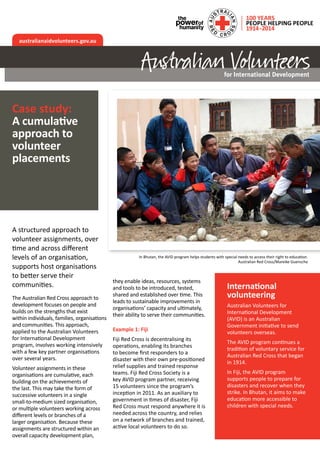
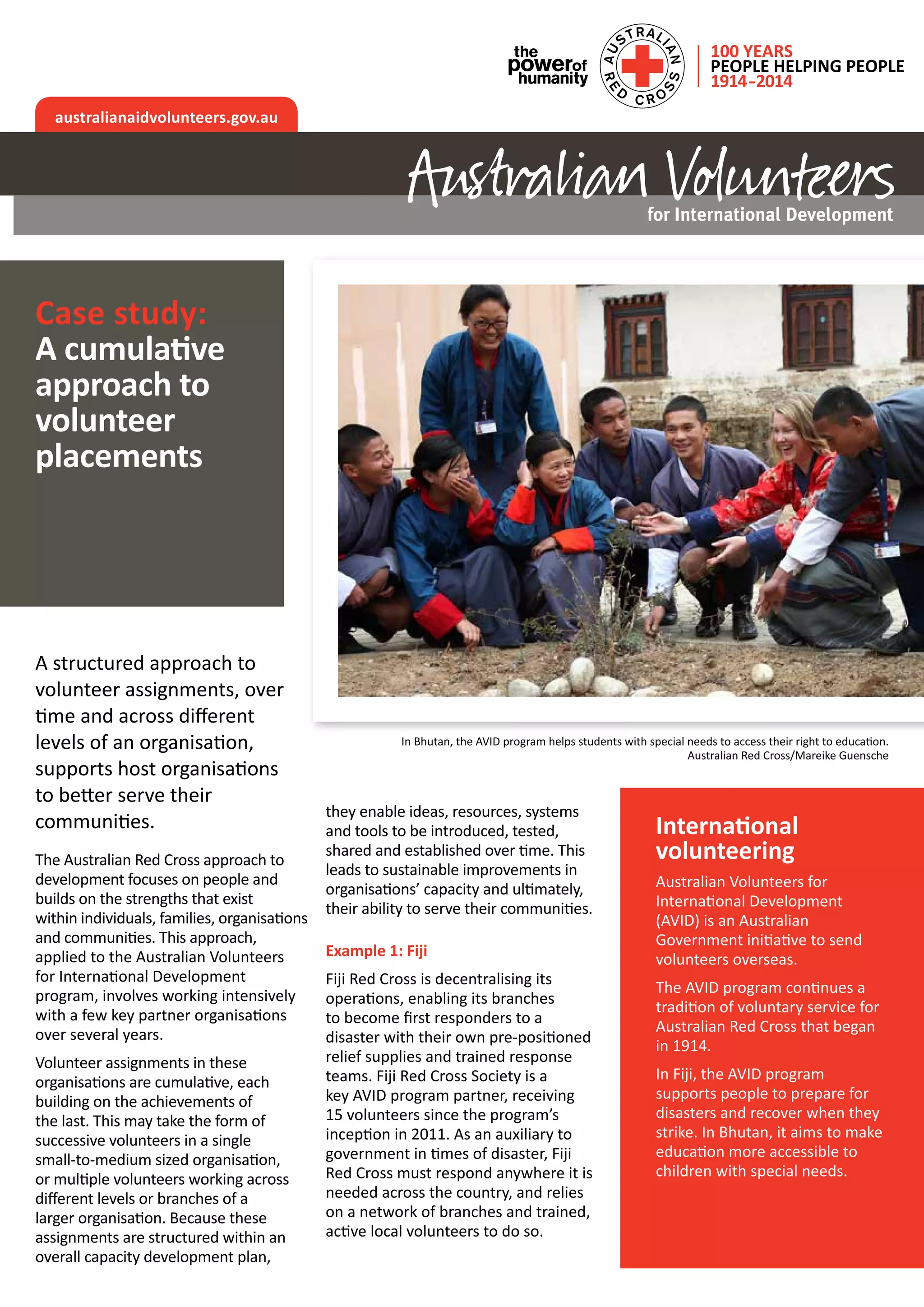
In Bhutan, the AVID program helps students with special needs to access their right to education.
Australian Red Cross/Mareike Guensche
Case study:
A cumulative
approach to
volunteer
placements
International
volunteering
Australian Volunteers for
International Development
(AVID) is an Australian
Government initiative to send
volunteers overseas.
The AVID program continues a
tradition of voluntary service for
Australian Red Cross that began
in 1914.
In Fiji, the AVID program
supports people to prepare for
disasters and recover when they
strike. In Bhutan, it aims to make
education more accessible to
children with special needs.
Australian Volunteers for International Development
is an Australian Government initiative.
Fiji Red Cross aimed to decentralise its
operations, enabling its branches to
become first responders to a disaster,
with their own pre-positioned relief
supplies and trained response teams.
Initial AVID assignments focussed on
strengthening links between national
disaster management teams and
branch offices, to ensure a more
efficient, targeted and well-resourced
response to future disasters.
Subsequent AVID volunteers, placed
across the national head office as
well as provincial branches, helped
strengthen networks with agencies like
the National Disaster Management
Office, thus improving coordination
and increasing resources. AVID
volunteers also redesigned training
programs for Fiji Red Cross local
volunteers, thus increasing their
capacity to assess a community’s
geographic and social vulnerabilities,
identify practical ways to reduce
risks, and conduct initial damage
assessments after a disaster.
Once branches reported increased
capacity to prepare for disasters, our
focus shifted to ensuring they had the
workforce to respond. The next round
of AVID assignments focussed on the
recruitment and retention of local
volunteers. An increase in volunteer
numbers not only enables a stronger
response to disasters, but also increases
the branches’ ability to be self-sufficient,
as volunteers drive fundraising initiatives.
As the Labasa Branch Coordinator
reports: “Since I joined the Fiji Red
Cross, the Labasa branch was one of
the poorest performing branches in Fiji.
Just two days [ago], I went to Suva to
attend a branches meeting and I made a
presentation on our branch, and for the
first time I felt that the branch has really
pulled up its socks and improved a lot.
So much that we can be counted as one
of the best performing branches in Fiji.
The [AVID] volunteer has helped us to
value the small things and to improve
our work by making small changes.”
Over three years, the cumulative
placement of AVID volunteers within
Fiji Red Cross has led to significant
improvements in capacity to deliver
disaster preparedness and response
services at a community level;
greater recruitment and retention
of local volunteers; and increased
community ownership of disaster
preparedness initiatives.
Disaster
management
in Fiji
•	 Coordination between national
and local Red Cross teams
•	 Networks between Red Cross
and government disaster
management agencies
•	 Increased recruitment and
retention of volunteers
•	 New training programs for
volunteers
Example 2: Bhutan
In Bhutan, the AVID program partners
with Drukgyel Lower Secondary School
and Changangkha Middle Secondary
School to make education accessible to
students with special needs.
Although highly committed to their
work, most special needs teachers in
Bhutan lack formal qualifications and few
opportunities exist for their professional
development. Therefore, an initial
focus for AVID assignments was to help
teachers increase their skills in engaging
with children with special needs, while
also adapting the school curriculum to
align with new requirements set by the
Ministry of Education.
An AVID assignment with Drukgyel
Lower Secondary led to the
development of the country’s first
Deaf Education Teacher’s Manual.
The manual collected strategies and
curriculum modifications introduced
during the course of the volunteer’s
assignment. The Deaf Unit staff now
use the manual to design lesson plans
appropriate to their students’ abilities.
The school principal reports that staff
are now more comfortable addressing
issues of disability.
Changangkha Middle Secondary
has limited access to professional
assistance in dealing with psychological
and behavioural issues for both
its mainstream and special needs
students. An AVID volunteer at this
school helped introduce individualised
education plans; through collaboration
with other AVID volunteers, these
plans are now standard in all special
education schools. Future assignments
at this school, including a school
psychologist and a speech therapist,
will build on these achievements and
increase capacity to recognise and
respond to children with special needs
at an earlier stage.
Accessible
education in
Bhutan
•	 Deaf education teacher’s
manual
•	 School curriculum modified to
support deaf students
•	 Individualised education plans
for students
•	 Staff more comfortable
addressing disability issues
The value of a cumulative approach
Through sustained engagement with
strategic partners, the AVID program
can make an impact that goes far
beyond the outcomes of a single
volunteer assignment. This can happen
in a planned way, with a clear pathway
for volunteers to work in different
departments or program areas; or in
an organic way, where each volunteer
assignment informs the one to follow.
The collaboration between volunteers
at different levels of an organisation
is itself a strong value add. This long-
term engagement enables partner
organisations to develop at their own
pace and in a sustainable way.
December 2014

Case_study--Cumulative_Approach

  • 1.
    A structured approachto volunteer assignments, over time and across different levels of an organisation, supports host organisations to better serve their communities. The Australian Red Cross approach to development focuses on people and builds on the strengths that exist within individuals, families, organisations and communities. This approach, applied to the Australian Volunteers for International Development program, involves working intensively with a few key partner organisations over several years. Volunteer assignments in these organisations are cumulative, each building on the achievements of the last. This may take the form of successive volunteers in a single small-to-medium sized organisation, or multiple volunteers working across different levels or branches of a larger organisation. Because these assignments are structured within an overall capacity development plan, they enable ideas, resources, systems and tools to be introduced, tested, shared and established over time. This leads to sustainable improvements in organisations’ capacity and ultimately, their ability to serve their communities. Example 1: Fiji Fiji Red Cross is decentralising its operations, enabling its branches to become first responders to a disaster with their own pre-positioned relief supplies and trained response teams. Fiji Red Cross Society is a key AVID program partner, receiving 15 volunteers since the program’s inception in 2011. As an auxiliary to government in times of disaster, Fiji Red Cross must respond anywhere it is needed across the country, and relies on a network of branches and trained, active local volunteers to do so. australianaidvolunteers.gov.au In Bhutan, the AVID program helps students with special needs to access their right to education. Australian Red Cross/Mareike Guensche Case study: A cumulative approach to volunteer placements International volunteering Australian Volunteers for International Development (AVID) is an Australian Government initiative to send volunteers overseas. The AVID program continues a tradition of voluntary service for Australian Red Cross that began in 1914. In Fiji, the AVID program supports people to prepare for disasters and recover when they strike. In Bhutan, it aims to make education more accessible to children with special needs.
  • 2.
    Australian Volunteers forInternational Development is an Australian Government initiative. Fiji Red Cross aimed to decentralise its operations, enabling its branches to become first responders to a disaster, with their own pre-positioned relief supplies and trained response teams. Initial AVID assignments focussed on strengthening links between national disaster management teams and branch offices, to ensure a more efficient, targeted and well-resourced response to future disasters. Subsequent AVID volunteers, placed across the national head office as well as provincial branches, helped strengthen networks with agencies like the National Disaster Management Office, thus improving coordination and increasing resources. AVID volunteers also redesigned training programs for Fiji Red Cross local volunteers, thus increasing their capacity to assess a community’s geographic and social vulnerabilities, identify practical ways to reduce risks, and conduct initial damage assessments after a disaster. Once branches reported increased capacity to prepare for disasters, our focus shifted to ensuring they had the workforce to respond. The next round of AVID assignments focussed on the recruitment and retention of local volunteers. An increase in volunteer numbers not only enables a stronger response to disasters, but also increases the branches’ ability to be self-sufficient, as volunteers drive fundraising initiatives. As the Labasa Branch Coordinator reports: “Since I joined the Fiji Red Cross, the Labasa branch was one of the poorest performing branches in Fiji. Just two days [ago], I went to Suva to attend a branches meeting and I made a presentation on our branch, and for the first time I felt that the branch has really pulled up its socks and improved a lot. So much that we can be counted as one of the best performing branches in Fiji. The [AVID] volunteer has helped us to value the small things and to improve our work by making small changes.” Over three years, the cumulative placement of AVID volunteers within Fiji Red Cross has led to significant improvements in capacity to deliver disaster preparedness and response services at a community level; greater recruitment and retention of local volunteers; and increased community ownership of disaster preparedness initiatives. Disaster management in Fiji • Coordination between national and local Red Cross teams • Networks between Red Cross and government disaster management agencies • Increased recruitment and retention of volunteers • New training programs for volunteers Example 2: Bhutan In Bhutan, the AVID program partners with Drukgyel Lower Secondary School and Changangkha Middle Secondary School to make education accessible to students with special needs. Although highly committed to their work, most special needs teachers in Bhutan lack formal qualifications and few opportunities exist for their professional development. Therefore, an initial focus for AVID assignments was to help teachers increase their skills in engaging with children with special needs, while also adapting the school curriculum to align with new requirements set by the Ministry of Education. An AVID assignment with Drukgyel Lower Secondary led to the development of the country’s first Deaf Education Teacher’s Manual. The manual collected strategies and curriculum modifications introduced during the course of the volunteer’s assignment. The Deaf Unit staff now use the manual to design lesson plans appropriate to their students’ abilities. The school principal reports that staff are now more comfortable addressing issues of disability. Changangkha Middle Secondary has limited access to professional assistance in dealing with psychological and behavioural issues for both its mainstream and special needs students. An AVID volunteer at this school helped introduce individualised education plans; through collaboration with other AVID volunteers, these plans are now standard in all special education schools. Future assignments at this school, including a school psychologist and a speech therapist, will build on these achievements and increase capacity to recognise and respond to children with special needs at an earlier stage. Accessible education in Bhutan • Deaf education teacher’s manual • School curriculum modified to support deaf students • Individualised education plans for students • Staff more comfortable addressing disability issues The value of a cumulative approach Through sustained engagement with strategic partners, the AVID program can make an impact that goes far beyond the outcomes of a single volunteer assignment. This can happen in a planned way, with a clear pathway for volunteers to work in different departments or program areas; or in an organic way, where each volunteer assignment informs the one to follow. The collaboration between volunteers at different levels of an organisation is itself a strong value add. This long- term engagement enables partner organisations to develop at their own pace and in a sustainable way. December 2014