How Individual Service Funds are
transforming commissioning
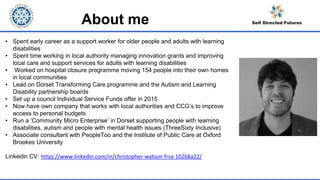
• Spent early career as a support worker for older people and adults with learning
disabilities
• Spent time working in local authority managing innovation grants and improving
local care and support services for adults with learning disabilities
• Worked on hospital closure programme moving 154 people into their own homes
in local communities
• Lead on Dorset Transforming Care programme and the Autism and Learning
Disability partnership boards
• Set up a council Individual Service Funds offer in 2015
• Now have own company that works with local authorities and CCG’s to improve
access to personal budgets
• Run a ‘Community Micro Enterprise’ in Dorset supporting people with learning
disabilities, autism and people with mental health issues (ThreeSixty Inclusive)
• Associate consultant with PeopleToo and the Institute of Public Care at Oxford
Brookes University
Linkedin CV: https://www.linkedin.com/in/christopher-watson-frsa-10268a22/
About me
Consultancy
The Centre provides practical assistance, training and
consultancy to a whole range of organisations including:
support providers, voluntary and community sector
organisations; clinical commissioning groups; local
authorities and others who aspire to make radical change
for the benefit of citizens.
The collective knowledge, skills and experience of the
Centre means that we are able to provide practical advice
and support on a whole range of issues.
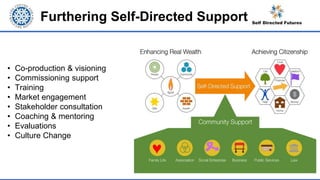
• Co-production & visioning
• Commissioning support
• Training
• Market engagement
• Stakeholder consultation
• Coaching & mentoring
• Evaluations
• Culture Change
Furthering Self-Directed Support
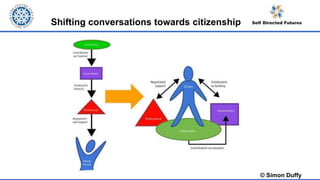
Shifting conversations towards citizenship
© Simon Duffy
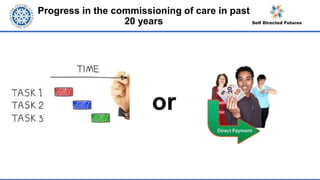
Progress in the commissioning of care in past
20 years
or
Social services setting up ‘support’ for 12
months+
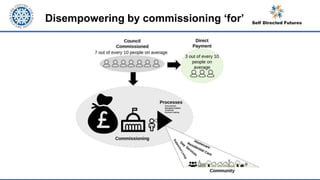
Disempowering by commissioning ‘for’
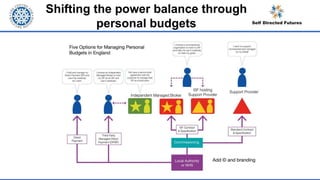
Shifting the power balance through
personal budgets
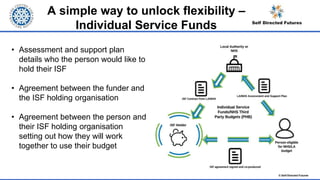
A simple way to unlock flexibility –
Individual Service Funds
• Assessment and support plan
details who the person would like to
hold their ISF
• Agreement between the funder and
the ISF holding organisation
• Agreement between the person and
their ISF holding organisation
setting out how they will work
together to use their budget
© Self-Directed Futures
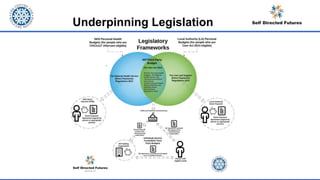
Underpinning Legislation
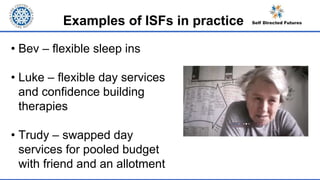
Examples of ISFs in practice
• Bev – flexible sleep ins
• Luke – flexible day services
and confidence building
therapies
• Trudy – swapped day
services for pooled budget
with friend and an allotment
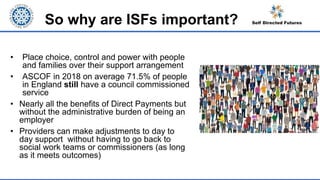
So why are ISFs important?
• Place choice, control and power with people
and families over their support arrangement
• ASCOF in 2018 on average 71.5% of people
in England still have a council commissioned
service
• Nearly all the benefits of Direct Payments but
without the administrative burden of being an
employer
• Providers can make adjustments to day to
day support without having to go back to
social work teams or commissioners (as long
as it meets outcomes)
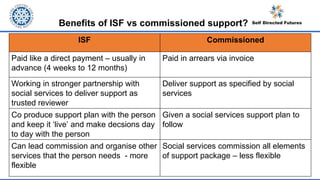
Benefits of ISF vs commissioned support?
ISF Commissioned
Paid like a direct payment – usually in
advance (4 weeks to 12 months)
Paid in arrears via invoice
Working in stronger partnership with
social services to deliver support as
trusted reviewer
Deliver support as specified by social
services
Co produce support plan with the person
and keep it ‘live’ and make decsions day
to day with the person
Given a social services support plan to
follow
Can lead commission and organise other
services that the person needs - more
flexible
Social services commission all elements
of support package – less flexible
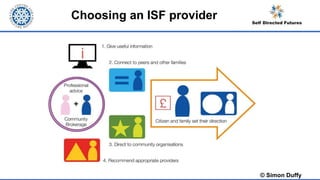
Choosing an ISF provider
© Simon Duffy
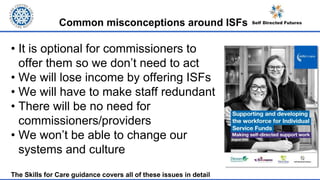
Common misconceptions around ISFs
• It is optional for commissioners to
offer them so we don’t need to act
• We will lose income by offering ISFs
• We will have to make staff redundant
• There will be no need for
commissioners/providers
• We won’t be able to change our
systems and culture
The Skills for Care guidance covers all of these issues in detail
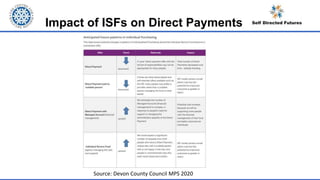
Impact of ISFs on Direct Payments
Source: Devon County Council MPS 2020
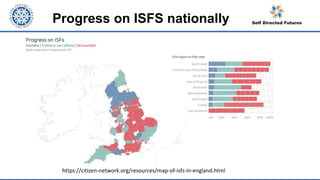
Progress on ISFS nationally
https://citizen-network.org/resources/map-of-isfs-in-england.html
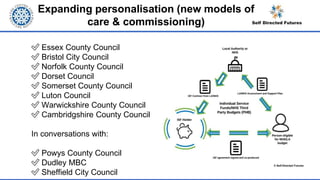
Expanding personalisation (new models of
care & commissioning)
✅ Essex County Council
✅ Bristol City Council
✅ Norfolk County Council
✅ Dorset Council
✅ Somerset County Council
✅ Luton Council
✅ Warwickshire County Council
✅ Cambridgshire County Council
In conversations with:
✅ Powys County Council
✅ Dudley MBC
✅ Sheffield City Council
© Self-Directed Futures
Q&A
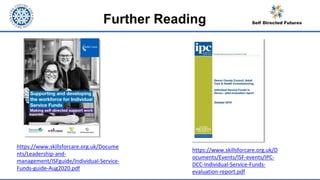
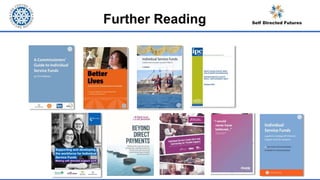
Further Reading
https://www.skillsforcare.org.uk/D
ocuments/Events/ISF-events/IPC-
DCC-Individual-Service-Funds-
evaluation-report.pdf
https://www.skillsforcare.org.uk/Docume
nts/Leadership-and-
management/ISFguide/Individual-Service-
Funds-guide-Aug2020.pdf
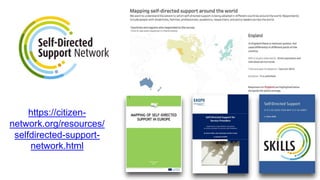
Further Reading
https://citizen-
network.org/resources/
selfdirected-support-
network.html
Contact Us
Chris Watson, Self-Directed Futures/Centre for
Welfare Reform
Chris.watson@selfdirectedfutures.co.uk

ISF Presentation for Skills for Care CEO network

  • 1.
    How Individual ServiceFunds are transforming commissioning
  • 2.
    • Spent earlycareer as a support worker for older people and adults with learning disabilities • Spent time working in local authority managing innovation grants and improving local care and support services for adults with learning disabilities • Worked on hospital closure programme moving 154 people into their own homes in local communities • Lead on Dorset Transforming Care programme and the Autism and Learning Disability partnership boards • Set up a council Individual Service Funds offer in 2015 • Now have own company that works with local authorities and CCG’s to improve access to personal budgets • Run a ‘Community Micro Enterprise’ in Dorset supporting people with learning disabilities, autism and people with mental health issues (ThreeSixty Inclusive) • Associate consultant with PeopleToo and the Institute of Public Care at Oxford Brookes University Linkedin CV: https://www.linkedin.com/in/christopher-watson-frsa-10268a22/ About me
  • 3.
    Consultancy The Centre providespractical assistance, training and consultancy to a whole range of organisations including: support providers, voluntary and community sector organisations; clinical commissioning groups; local authorities and others who aspire to make radical change for the benefit of citizens. The collective knowledge, skills and experience of the Centre means that we are able to provide practical advice and support on a whole range of issues.
  • 4.
    • Co-production &visioning • Commissioning support • Training • Market engagement • Stakeholder consultation • Coaching & mentoring • Evaluations • Culture Change Furthering Self-Directed Support
  • 5.
    Shifting conversations towardscitizenship © Simon Duffy
  • 6.
    Progress in thecommissioning of care in past 20 years or
  • 7.
    Social services settingup ‘support’ for 12 months+
  • 8.
  • 9.
    Shifting the powerbalance through personal budgets
  • 10.
    A simple wayto unlock flexibility – Individual Service Funds • Assessment and support plan details who the person would like to hold their ISF • Agreement between the funder and the ISF holding organisation • Agreement between the person and their ISF holding organisation setting out how they will work together to use their budget © Self-Directed Futures
  • 11.
  • 12.
    Examples of ISFsin practice • Bev – flexible sleep ins • Luke – flexible day services and confidence building therapies • Trudy – swapped day services for pooled budget with friend and an allotment
  • 13.
    So why areISFs important? • Place choice, control and power with people and families over their support arrangement • ASCOF in 2018 on average 71.5% of people in England still have a council commissioned service • Nearly all the benefits of Direct Payments but without the administrative burden of being an employer • Providers can make adjustments to day to day support without having to go back to social work teams or commissioners (as long as it meets outcomes)
  • 14.
    Benefits of ISFvs commissioned support? ISF Commissioned Paid like a direct payment – usually in advance (4 weeks to 12 months) Paid in arrears via invoice Working in stronger partnership with social services to deliver support as trusted reviewer Deliver support as specified by social services Co produce support plan with the person and keep it ‘live’ and make decsions day to day with the person Given a social services support plan to follow Can lead commission and organise other services that the person needs - more flexible Social services commission all elements of support package – less flexible
  • 15.
    Choosing an ISFprovider © Simon Duffy
  • 16.
    Common misconceptions aroundISFs • It is optional for commissioners to offer them so we don’t need to act • We will lose income by offering ISFs • We will have to make staff redundant • There will be no need for commissioners/providers • We won’t be able to change our systems and culture The Skills for Care guidance covers all of these issues in detail
  • 17.
    Impact of ISFson Direct Payments Source: Devon County Council MPS 2020
  • 18.
    Progress on ISFSnationally https://citizen-network.org/resources/map-of-isfs-in-england.html
  • 19.
    Expanding personalisation (newmodels of care & commissioning) ✅ Essex County Council ✅ Bristol City Council ✅ Norfolk County Council ✅ Dorset Council ✅ Somerset County Council ✅ Luton Council ✅ Warwickshire County Council ✅ Cambridgshire County Council In conversations with: ✅ Powys County Council ✅ Dudley MBC ✅ Sheffield City Council © Self-Directed Futures
  • 20.
  • 21.
  • 22.
  • 23.
  • 24.
    Contact Us Chris Watson,Self-Directed Futures/Centre for Welfare Reform Chris.watson@selfdirectedfutures.co.uk