CASE STUDY:
HAPPY ACADEMY
IfM ECS worked with Happy Academy, a creator of unique
children’s greeting cards, as part of the PrISMS programme to:
define the product concept
help the company to establish its ethos
define the business strategy
define the company’s branding and product differentiation
identify and evaluate different routes to market
prioritise products for the short-term and medium-term
provide mentoring and support throughout the process
Happy Academy is the brainchild of Sara
Hlin Halfdanardottir, an entrepreneur
and mother-of-three with a passion for
building companies that nurture positive
emotions and happiness in children.
Happy Academy’s mission is to deliver
meaningful products to children which
nurture their positive emotions, putting
into practise influences from evidence-
based studies of well-being and
happiness.
Based in Cambridge, the business
launched its first product line in 2015.
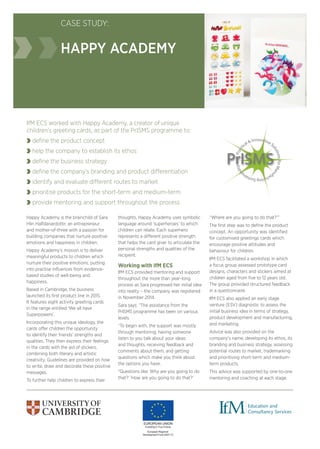
It features eight activity greeting cards
in the range entitled ‘We all have
Superpowers’.
Incorporating this unique ideology, the
cards offer children the opportunity
to identify their friends’ strengths and
qualities. They then express their feelings
in the cards with the aid of stickers,
combining both literary and artistic
creativity. Guidelines are provided on how
to write, draw and decorate these positive
messages.
To further help children to express their
thoughts, Happy Academy uses symbolic
language around ‘superheroes’ to which
children can relate. Each superhero
represents a different positive strength
that helps the card giver to articulate the
personal strengths and qualities of the
recipient.
Working with IfM ECS
IfM ECS provided mentoring and support
throughout the more than year-long
process as Sara progressed her initial idea
into reality – the company was registered
in November 2014.
Sara says: “The assistance from the
PrISMS programme has been on various
levels.
“To begin with, the support was mostly
through mentoring; having someone
listen to you talk about your ideas
and thoughts, receiving feedback and
comments about them, and getting
questions which make you think about
the options you have.
“Questions like: Why are you going to do
that?’ ‘How are you going to do that?’
‘‘Where are you going to do that?’”
The first step was to define the product
concept. An opportunity was identified
for customised greetings cards which
encourage positive attitudes and
behaviour for children.
IfM ECS facilitated a workshop in which
a focus group assessed prototype card
designs, characters and stickers aimed at
children aged from five to 12 years old.
The group provided structured feedback
in a questionnaire.
IfM ECS also applied an early stage
venture (ESV) diagnostic to assess the
initial business idea in terms of strategy,
product development and manufacturing,
and marketing.
Advice was also provided on the
company’s name, developing its ethos, its
branding and business strategy, assessing
potential routes to market, trademarking
and prioritising short-term and medium-
term products.
This advice was supported by one-to-one
mentoring and coaching at each stage.
Education and
Consultancy Services
IfM Education and Consultancy Services
Institute for Manufacturing, Charles Babbage Road, Cambridge CB3 0FS, United Kingdom
Tel: +44 (0)1223 766141 Email: ifm-enquiries@eng.cam.ac.uk Web: www.ifm.eng.cam.ac.uk Twitter: @IfMCambridge
From focus group to first product
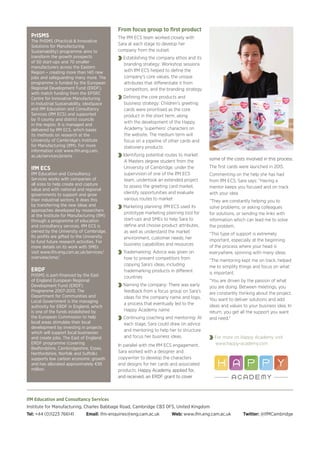
The IfM ECS team worked closely with
Sara at each stage to develop her
company from the outset.
Establishing the company ethos and its
branding strategy: Workshop sessions
with IfM ECS helped to define the
company’s core values, the unique
attributes that differentiate it from
competitors, and the branding strategy
Defining the core products and
business strategy: Children’s greeting
cards were prioritised as the core
product in the short term, along
with the development of the Happy
Academy ‘superhero’ characters on
the website. The medium term will
focus on a pipeline of other cards and
stationery products
Identifying potential routes to market:
A Masters degree student from the
University of Cambridge, under the
supervision of one of the IfM ECS
team, undertook an extended project
to assess the greeting card market,
identify opportunities and evaluate
various routes to market
Marketing planning: IfM ECS used its
prototype marketing planning tool for
start-ups and SMEs to help Sara to
define and choose product attributes,
as well as understand the market
environment, customer needs, her
business capabilities and resources
Trademarking: Advice was given on
how to prevent competitors from
copying Sara’s ideas, including
trademarking products in different
countries
Naming the company: There was early
feedback from a focus group on Sara’s
ideas for the company name and logo,
a process that eventually led to the
Happy Academy name
Continuing coaching and mentoring: At
each stage, Sara could draw on advice
and mentoring to help her to structure
and focus her business ideas.
In parallel with the IfM ECS engagement,
Sara worked with a designer and
copywriter to develop the characters
and designs for her cards and associated
products. Happy Academy applied for,
and received, an ERDF grant to cover
some of the costs involved in this process.
The first cards were launched in 2015.
Commenting on the help she has had
from IfM ECS, Sara says: “Having a
mentor keeps you focused and on track
with your idea.
“They are constantly helping you to
solve problems, or asking colleagues
for solutions, or sending me links with
information which can lead me to solve
the problem.
“This type of support is extremely
important, especially at the beginning
of the process where your head is
everywhere, spinning with many ideas.
“The mentoring kept me on track, helped
me to simplify things and focus on what
is important.
“You are driven by the passion of what
you are doing. Between meetings, you
are constantly thinking about the project.
You want to deliver solutions and add
ideas and values to your business idea. In
return, you get all the support you want
and need.”
For more on Happy Academy visit
www.happy-academy.com
PrISMS
The PrISMS (Practical & Innovative
Solutions for Manufacturing
Sustainability) programme aims to
transform the growth prospects
of 50 start-ups and 70 smaller
manufacturers across the Eastern
Region – creating more than 140 new
jobs and safeguarding many more. The
programme is funded by the European
Regional Development Fund (ERDF),
with match funding from the EPSRC
Centre for Innovative Manufacturing
in Industrial Sustainability, ideaSpace
and IfM Education and Consultancy
Services (IfM ECS) and supported
by 11 county and district councils
in the region. It is managed and
delivered by IfM ECS, which bases
its methods on research at the
University of Cambridge’s Institute
for Manufacturing (IfM). For more
information visit www.ifm.eng.cam.
ac.uk/services/prisms
IfM ECS
IfM Education and Consultancy
Services works with companies of
all sizes to help create and capture
value and with national and regional
governments to support and grow
their industrial sectors. It does this
by transferring the new ideas and
approaches developed by researchers
at the Institute for Manufacturing (IfM)
through a programme of education
and consultancy services. IfM ECS is
owned by the University of Cambridge.
Its profits are gifted to the University
to fund future research activities. For
more details on its work with SMEs
visit www.ifm.eng.cam.ac.uk/services/
overview/sme/
ERDF
PrISMS is part-financed by the East
of England European Regional
Development Fund (ERDF)
Programme 2007-2013. The
Department for Communities and
Local Government is the managing
authority for ERDF in England, which
is one of the funds established by
the European Commission to help
local areas stimulate their local
development by investing in projects
which will support local businesses
and create jobs. The East of England
ERDF programme (covering
Bedfordshire, Cambridgeshire, Essex,
Hertfordshire, Norfolk and Suffolk)
supports low carbon economic growth
and has allocated approximately €95
million.

CaseStudyAboutHappyAcademy

  • 1.
    CASE STUDY: HAPPY ACADEMY IfMECS worked with Happy Academy, a creator of unique children’s greeting cards, as part of the PrISMS programme to: define the product concept help the company to establish its ethos define the business strategy define the company’s branding and product differentiation identify and evaluate different routes to market prioritise products for the short-term and medium-term provide mentoring and support throughout the process Happy Academy is the brainchild of Sara Hlin Halfdanardottir, an entrepreneur and mother-of-three with a passion for building companies that nurture positive emotions and happiness in children. Happy Academy’s mission is to deliver meaningful products to children which nurture their positive emotions, putting into practise influences from evidence- based studies of well-being and happiness. Based in Cambridge, the business launched its first product line in 2015. It features eight activity greeting cards in the range entitled ‘We all have Superpowers’. Incorporating this unique ideology, the cards offer children the opportunity to identify their friends’ strengths and qualities. They then express their feelings in the cards with the aid of stickers, combining both literary and artistic creativity. Guidelines are provided on how to write, draw and decorate these positive messages. To further help children to express their thoughts, Happy Academy uses symbolic language around ‘superheroes’ to which children can relate. Each superhero represents a different positive strength that helps the card giver to articulate the personal strengths and qualities of the recipient. Working with IfM ECS IfM ECS provided mentoring and support throughout the more than year-long process as Sara progressed her initial idea into reality – the company was registered in November 2014. Sara says: “The assistance from the PrISMS programme has been on various levels. “To begin with, the support was mostly through mentoring; having someone listen to you talk about your ideas and thoughts, receiving feedback and comments about them, and getting questions which make you think about the options you have. “Questions like: Why are you going to do that?’ ‘How are you going to do that?’ ‘‘Where are you going to do that?’” The first step was to define the product concept. An opportunity was identified for customised greetings cards which encourage positive attitudes and behaviour for children. IfM ECS facilitated a workshop in which a focus group assessed prototype card designs, characters and stickers aimed at children aged from five to 12 years old. The group provided structured feedback in a questionnaire. IfM ECS also applied an early stage venture (ESV) diagnostic to assess the initial business idea in terms of strategy, product development and manufacturing, and marketing. Advice was also provided on the company’s name, developing its ethos, its branding and business strategy, assessing potential routes to market, trademarking and prioritising short-term and medium- term products. This advice was supported by one-to-one mentoring and coaching at each stage. Education and Consultancy Services
  • 2.
    IfM Education andConsultancy Services Institute for Manufacturing, Charles Babbage Road, Cambridge CB3 0FS, United Kingdom Tel: +44 (0)1223 766141 Email: ifm-enquiries@eng.cam.ac.uk Web: www.ifm.eng.cam.ac.uk Twitter: @IfMCambridge From focus group to first product The IfM ECS team worked closely with Sara at each stage to develop her company from the outset. Establishing the company ethos and its branding strategy: Workshop sessions with IfM ECS helped to define the company’s core values, the unique attributes that differentiate it from competitors, and the branding strategy Defining the core products and business strategy: Children’s greeting cards were prioritised as the core product in the short term, along with the development of the Happy Academy ‘superhero’ characters on the website. The medium term will focus on a pipeline of other cards and stationery products Identifying potential routes to market: A Masters degree student from the University of Cambridge, under the supervision of one of the IfM ECS team, undertook an extended project to assess the greeting card market, identify opportunities and evaluate various routes to market Marketing planning: IfM ECS used its prototype marketing planning tool for start-ups and SMEs to help Sara to define and choose product attributes, as well as understand the market environment, customer needs, her business capabilities and resources Trademarking: Advice was given on how to prevent competitors from copying Sara’s ideas, including trademarking products in different countries Naming the company: There was early feedback from a focus group on Sara’s ideas for the company name and logo, a process that eventually led to the Happy Academy name Continuing coaching and mentoring: At each stage, Sara could draw on advice and mentoring to help her to structure and focus her business ideas. In parallel with the IfM ECS engagement, Sara worked with a designer and copywriter to develop the characters and designs for her cards and associated products. Happy Academy applied for, and received, an ERDF grant to cover some of the costs involved in this process. The first cards were launched in 2015. Commenting on the help she has had from IfM ECS, Sara says: “Having a mentor keeps you focused and on track with your idea. “They are constantly helping you to solve problems, or asking colleagues for solutions, or sending me links with information which can lead me to solve the problem. “This type of support is extremely important, especially at the beginning of the process where your head is everywhere, spinning with many ideas. “The mentoring kept me on track, helped me to simplify things and focus on what is important. “You are driven by the passion of what you are doing. Between meetings, you are constantly thinking about the project. You want to deliver solutions and add ideas and values to your business idea. In return, you get all the support you want and need.” For more on Happy Academy visit www.happy-academy.com PrISMS The PrISMS (Practical & Innovative Solutions for Manufacturing Sustainability) programme aims to transform the growth prospects of 50 start-ups and 70 smaller manufacturers across the Eastern Region – creating more than 140 new jobs and safeguarding many more. The programme is funded by the European Regional Development Fund (ERDF), with match funding from the EPSRC Centre for Innovative Manufacturing in Industrial Sustainability, ideaSpace and IfM Education and Consultancy Services (IfM ECS) and supported by 11 county and district councils in the region. It is managed and delivered by IfM ECS, which bases its methods on research at the University of Cambridge’s Institute for Manufacturing (IfM). For more information visit www.ifm.eng.cam. ac.uk/services/prisms IfM ECS IfM Education and Consultancy Services works with companies of all sizes to help create and capture value and with national and regional governments to support and grow their industrial sectors. It does this by transferring the new ideas and approaches developed by researchers at the Institute for Manufacturing (IfM) through a programme of education and consultancy services. IfM ECS is owned by the University of Cambridge. Its profits are gifted to the University to fund future research activities. For more details on its work with SMEs visit www.ifm.eng.cam.ac.uk/services/ overview/sme/ ERDF PrISMS is part-financed by the East of England European Regional Development Fund (ERDF) Programme 2007-2013. The Department for Communities and Local Government is the managing authority for ERDF in England, which is one of the funds established by the European Commission to help local areas stimulate their local development by investing in projects which will support local businesses and create jobs. The East of England ERDF programme (covering Bedfordshire, Cambridgeshire, Essex, Hertfordshire, Norfolk and Suffolk) supports low carbon economic growth and has allocated approximately €95 million.