CASE CONTROL STUDIES
Drug information resources
Prepared by : Dr.Nada Essam
Under the supervision of : Dr/ Hesham Metwally
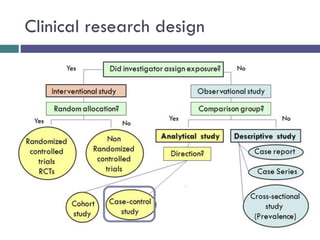
Clinical research design
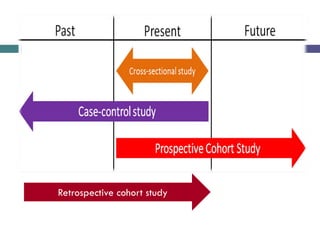
Retrospective cohort study
[A] Case-control studies
*A type of observational study commonly used to look
at factors associated with diseases or outcomes.
*Compare groups retrospectively.
*They are often used to generate hypotheses that can
then be studied via prospective cohort or other studies.
Case-control study
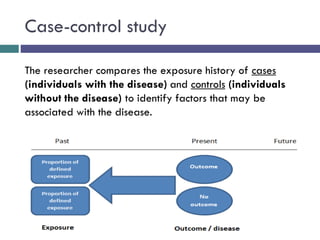
The researcher compares the exposure history of cases
(individuals with the disease) and controls (individuals
without the disease) to identify factors that may be
associated with the disease.
Case-control study
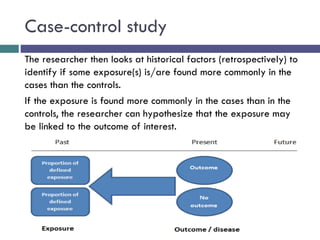
The researcher then looks at historical factors (retrospectively) to
identify if some exposure(s) is/are found more commonly in the
cases than the controls.
If the exposure is found more commonly in the cases than in the
controls, the researcher can hypothesize that the exposure may
be linked to the outcome of interest.
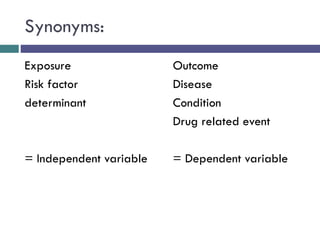
Synonyms:
Exposure
Risk factor
determinant
= Independent variable
Outcome
Disease
Condition
Drug related event
= Dependent variable
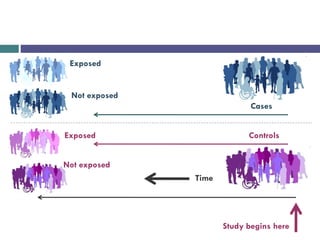
Study begins here
Controls
Cases
Time
Exposed
Exposed
Not exposed
Not exposed
Example:
Study begins here
Controls [No peptic ulcer]
Cases [Peptic ulcer]
Time
NSAIDs use
NSAIDs use
Not NSAIDs use
No NSAIDs use
[B] Bias & validity of case control study
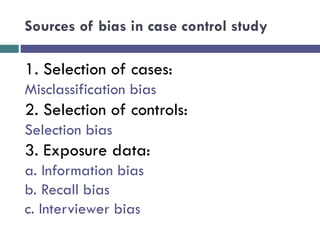
Sources of bias in case control study
1. Selection of cases:
Misclassification bias
2. Selection of controls:
Selection bias
3. Exposure data:
a. Information bias
b. Recall bias
c. Interviewer bias
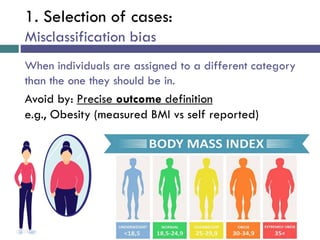
1. Selection of cases:
Misclassification bias
When individuals are assigned to a different category
than the one they should be in.
Avoid by: Precise outcome definition
e.g., Obesity (measured BMI vs self reported)
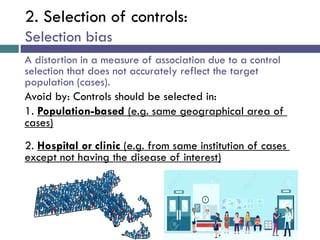
2. Selection of controls:
Selection bias
A distortion in a measure of association due to a control
selection that does not accurately reflect the target
population (cases).
Avoid by: Controls should be selected in:
1. Population-based (e.g. same geographical area of
cases)
2. Hospital or clinic (e.g. from same institution of cases
except not having the disease of interest)
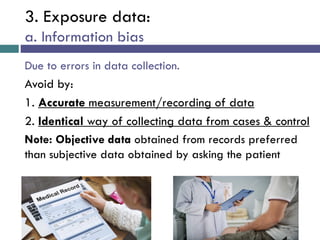
3. Exposure data:
a. Information bias
Due to errors in data collection.
Avoid by:
1. Accurate measurement/recording of data
2. Identical way of collecting data from cases & control
Note: Objective data obtained from records preferred
than subjective data obtained by asking the patient
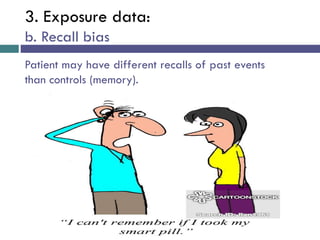
3. Exposure data:
b. Recall bias
Patient may have different recalls of past events
than controls (memory).
3. Exposure data:
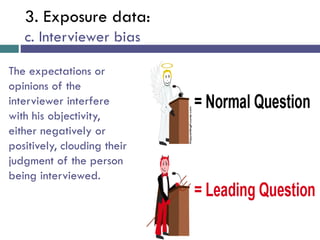
c. Interviewer bias
The expectations or
opinions of the
interviewer interfere
with his objectivity,
either negatively or
positively, clouding their
judgment of the person
being interviewed.
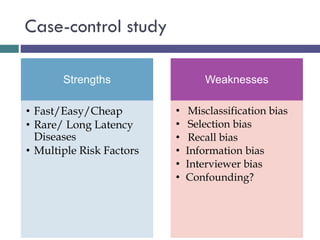
Case-control study
Strengths
• Fast/Easy/Cheap
• Rare/ Long Latency
Diseases
• Multiple Risk Factors
Weaknesses
• Misclassification bias
• Selection bias
• Recall bias
• Information bias
• Interviewer bias
• Confounding?
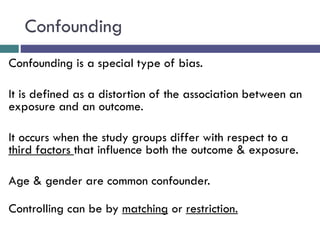
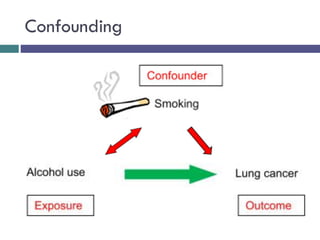
Confounding
Confounding is a special type of bias.
It is defined as a distortion of the association between an
exposure and an outcome.
It occurs when the study groups differ with respect to a
third factors that influence both the outcome & exposure.
Age & gender are common confounder.
Controlling can be by matching or restriction.
Confounding
[C] Odds Ratio (OR)
*The odds ratio is commonly used in case-control studies
*Where the odds of exposure are compared between
cases (individuals with the outcome) and controls
(individuals without the outcome)
*To estimate the strength of association between the
exposure and the outcome.
Odds Ratio (OR)
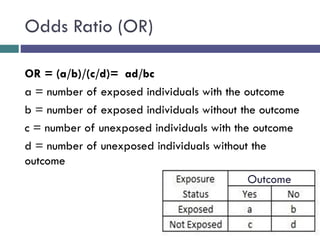
OR = (a/b)/(c/d)= ad/bc
a = number of exposed individuals with the outcome
b = number of exposed individuals without the outcome
c = number of unexposed individuals with the outcome
d = number of unexposed individuals without the
outcome
Outcome
Odds Ratio (OR)
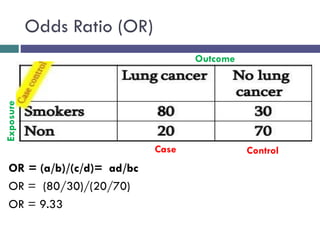
OR = (a/b)/(c/d)= ad/bc
OR = (80/30)/(20/70)
OR = 9.33
Outcome
Exposure
Control
Case
Interpretation of OR
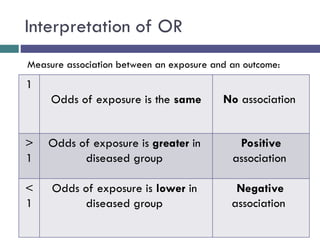
No association
Odds of exposure is the same
1
Positive
association
Odds of exposure is greater in
diseased group
>
1
Negative
association
Odds of exposure is lower in
diseased group
<
1
Measure association between an exposure and an outcome:
[D] Cases
Case 1: OR ratio
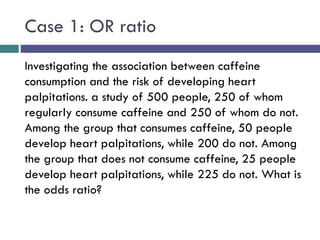
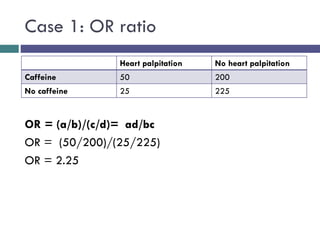
Investigating the association between caffeine
consumption and the risk of developing heart
palpitations. a study of 500 people, 250 of whom
regularly consume caffeine and 250 of whom do not.
Among the group that consumes caffeine, 50 people
develop heart palpitations, while 200 do not. Among
the group that does not consume caffeine, 25 people
develop heart palpitations, while 225 do not. What is
the odds ratio?
Case 1: OR ratio
Heart palpitation No heart palpitation
Caffeine 50 200
No caffeine 25 225
OR = (a/b)/(c/d)= ad/bc
OR = (50/200)/(25/225)
OR = 2.25
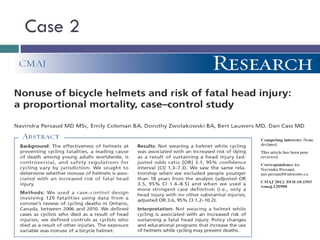
Case 2
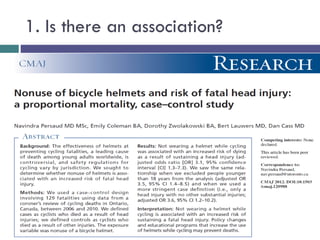
1. Is there an association?
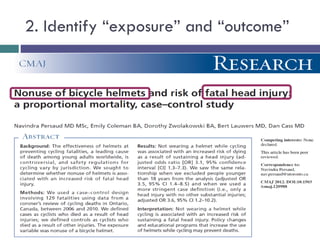
2. Identify “exposure” and “outcome”
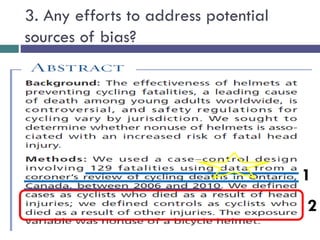
3. Any efforts to address potential
sources of bias?
1
2
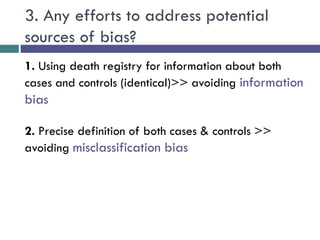
3. Any efforts to address potential
sources of bias?
1. Using death registry for information about both
cases and controls (identical)>> avoiding information
bias
2. Precise definition of both cases & controls >>
avoiding misclassification bias
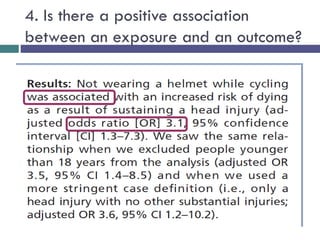
4. Is there a positive association
between an exposure and an outcome?
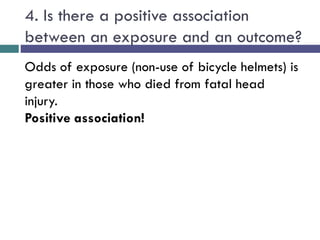
4. Is there a positive association
between an exposure and an outcome?
Odds of exposure (non-use of bicycle helmets) is
greater in those who died from fatal head
injury.
Positive association!
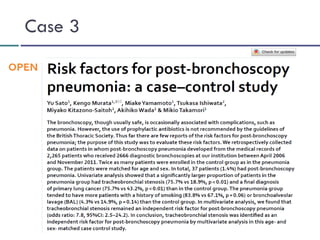
Case 3
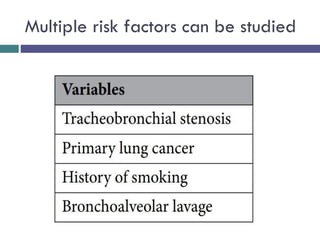
Multiple risk factors can be studied
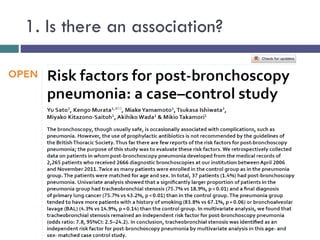
1. Is there an association?
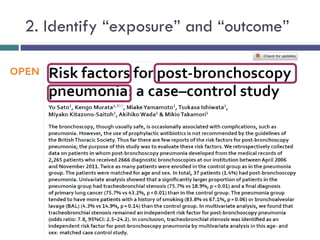
2. Identify “exposure” and “outcome”
3. Any efforts to address potential
sources of bias?
1
3
2
3. Any efforts to address potential
sources of bias?
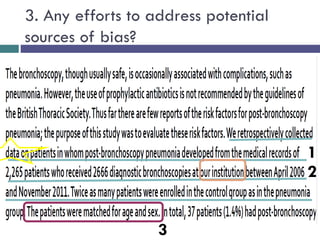
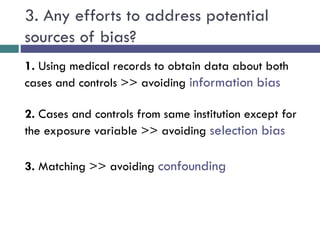
1. Using medical records to obtain data about both
cases and controls >> avoiding information bias
2. Cases and controls from same institution except for
the exposure variable >> avoiding selection bias
3. Matching >> avoiding confounding
4. Is there a positive association between a
Tracheobronchial stenosis and an outcome?
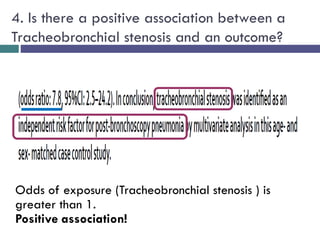
Odds of exposure (Tracheobronchial stenosis ) is
greater than 1.
Positive association!
THANK YOU!

Case-control studies drug information lec

  • 1.
    CASE CONTROL STUDIES Druginformation resources Prepared by : Dr.Nada Essam Under the supervision of : Dr/ Hesham Metwally
  • 2.
  • 3.
  • 4.
    [A] Case-control studies *Atype of observational study commonly used to look at factors associated with diseases or outcomes. *Compare groups retrospectively. *They are often used to generate hypotheses that can then be studied via prospective cohort or other studies.
  • 5.
    Case-control study The researchercompares the exposure history of cases (individuals with the disease) and controls (individuals without the disease) to identify factors that may be associated with the disease.
  • 6.
    Case-control study The researcherthen looks at historical factors (retrospectively) to identify if some exposure(s) is/are found more commonly in the cases than the controls. If the exposure is found more commonly in the cases than in the controls, the researcher can hypothesize that the exposure may be linked to the outcome of interest.
  • 7.
    Synonyms: Exposure Risk factor determinant = Independentvariable Outcome Disease Condition Drug related event = Dependent variable
  • 8.
  • 9.
    Example: Study begins here Controls[No peptic ulcer] Cases [Peptic ulcer] Time NSAIDs use NSAIDs use Not NSAIDs use No NSAIDs use
  • 10.
    [B] Bias &validity of case control study
  • 11.
    Sources of biasin case control study 1. Selection of cases: Misclassification bias 2. Selection of controls: Selection bias 3. Exposure data: a. Information bias b. Recall bias c. Interviewer bias
  • 12.
    1. Selection ofcases: Misclassification bias When individuals are assigned to a different category than the one they should be in. Avoid by: Precise outcome definition e.g., Obesity (measured BMI vs self reported)
  • 13.
    2. Selection ofcontrols: Selection bias A distortion in a measure of association due to a control selection that does not accurately reflect the target population (cases). Avoid by: Controls should be selected in: 1. Population-based (e.g. same geographical area of cases) 2. Hospital or clinic (e.g. from same institution of cases except not having the disease of interest)
  • 14.
    3. Exposure data: a.Information bias Due to errors in data collection. Avoid by: 1. Accurate measurement/recording of data 2. Identical way of collecting data from cases & control Note: Objective data obtained from records preferred than subjective data obtained by asking the patient
  • 15.
    3. Exposure data: b.Recall bias Patient may have different recalls of past events than controls (memory).
  • 16.
    3. Exposure data: c.Interviewer bias The expectations or opinions of the interviewer interfere with his objectivity, either negatively or positively, clouding their judgment of the person being interviewed.
  • 17.
    Case-control study Strengths • Fast/Easy/Cheap •Rare/ Long Latency Diseases • Multiple Risk Factors Weaknesses • Misclassification bias • Selection bias • Recall bias • Information bias • Interviewer bias • Confounding?
  • 18.
    Confounding Confounding is aspecial type of bias. It is defined as a distortion of the association between an exposure and an outcome. It occurs when the study groups differ with respect to a third factors that influence both the outcome & exposure. Age & gender are common confounder. Controlling can be by matching or restriction.
  • 19.
  • 20.
    [C] Odds Ratio(OR) *The odds ratio is commonly used in case-control studies *Where the odds of exposure are compared between cases (individuals with the outcome) and controls (individuals without the outcome) *To estimate the strength of association between the exposure and the outcome.
  • 21.
    Odds Ratio (OR) OR= (a/b)/(c/d)= ad/bc a = number of exposed individuals with the outcome b = number of exposed individuals without the outcome c = number of unexposed individuals with the outcome d = number of unexposed individuals without the outcome Outcome
  • 22.
    Odds Ratio (OR) OR= (a/b)/(c/d)= ad/bc OR = (80/30)/(20/70) OR = 9.33 Outcome Exposure Control Case
  • 23.
    Interpretation of OR Noassociation Odds of exposure is the same 1 Positive association Odds of exposure is greater in diseased group > 1 Negative association Odds of exposure is lower in diseased group < 1 Measure association between an exposure and an outcome:
  • 24.
  • 25.
    Case 1: ORratio Investigating the association between caffeine consumption and the risk of developing heart palpitations. a study of 500 people, 250 of whom regularly consume caffeine and 250 of whom do not. Among the group that consumes caffeine, 50 people develop heart palpitations, while 200 do not. Among the group that does not consume caffeine, 25 people develop heart palpitations, while 225 do not. What is the odds ratio?
  • 26.
    Case 1: ORratio Heart palpitation No heart palpitation Caffeine 50 200 No caffeine 25 225 OR = (a/b)/(c/d)= ad/bc OR = (50/200)/(25/225) OR = 2.25
  • 27.
  • 28.
    1. Is therean association?
  • 29.
    2. Identify “exposure”and “outcome”
  • 30.
    3. Any effortsto address potential sources of bias? 1 2
  • 31.
    3. Any effortsto address potential sources of bias? 1. Using death registry for information about both cases and controls (identical)>> avoiding information bias 2. Precise definition of both cases & controls >> avoiding misclassification bias
  • 32.
    4. Is therea positive association between an exposure and an outcome?
  • 33.
    4. Is therea positive association between an exposure and an outcome? Odds of exposure (non-use of bicycle helmets) is greater in those who died from fatal head injury. Positive association!
  • 34.
  • 35.
    Multiple risk factorscan be studied
  • 36.
    1. Is therean association?
  • 37.
    2. Identify “exposure”and “outcome”
  • 38.
    3. Any effortsto address potential sources of bias? 1 3 2
  • 39.
    3. Any effortsto address potential sources of bias? 1. Using medical records to obtain data about both cases and controls >> avoiding information bias 2. Cases and controls from same institution except for the exposure variable >> avoiding selection bias 3. Matching >> avoiding confounding
  • 40.
    4. Is therea positive association between a Tracheobronchial stenosis and an outcome? Odds of exposure (Tracheobronchial stenosis ) is greater than 1. Positive association!
  • 41.