What is aCase Study?
A case study is a detailed
analysis of a real or
hypothetical business scenario,
designed to stimulate strategic
thinking, problem-solving, and
decision-making. It involves
analysing the situation,
identifying the problems,
evaluating alternatives, and
proposing actionable solutions.
3.
How to effectivelyperform a Case
Study Presentation:
Step 1: Understand the Case Deeply
What to Do:
Read the case 2-3 times thoroughly.
Identify key facts: company background, timeline,
major events, people involved.
Pinpoint the core problem or main challenge.
Why It Matters:
Understanding the root problem helps you avoid
surface-level analysis.
Example:
In a case about Nokia, don’t just say “they failed.”
Discover why — like late adoption of Android,
poor marketing, leadership inertia, etc.
4.
Step 2: Definethe Problem Statement Clearly
What to Do:
Write 1–2 sentences summarizing the central issue.
Avoid being too broad or too narrow.
Focus on what’s going wrong and for whom.
Why It Matters:
This keeps the presentation focused and purposeful.
Example:
“Nokia failed to retain its market leadership due to its delayed response to the
smartphone revolution and poor software strategy.”
5.
Step 3: SetObjectives of Your Analysis
What to Do:
Define what your analysis will achieve.
Typically, 2–3 goals:
Understand the causes of the problem.
Evaluate possible alternatives.
Recommend a solution.
Why It Matters: It gives direction and helps
audience understand what to expect.
Example:
“This analysis aims to evaluate Nokia’s strategic
decisions from 2007–2013, identify causes of its
market downfall, and propose strategic recovery
measures.”
Click icon to add picture
6.
Step 4: PresentCase Facts Logically
What to Do:
Share relevant background in bullet or visual form:
Timeline of events
Key stakeholders
Financial/market data
Use visuals like charts, graphs, tables.
Why It Matters:
It builds context before jumping into analysis.
Example (for Maggi Crisis):
2015 – Banned due to alleged MSG.
Sales drop by 80% in 2 months.
Nestle re-launches with massive ad campaign.
7.
Step 5: ConductAnalytical Evaluation
What to Do:
Apply strategic frameworks to analyse
the situation:
SWOT Analysis
PESTLE Analysis
Porter’s Five Forces
Root Cause (Fishbone Diagram)
5 Whys Technique
Why It Matters:
Frameworks bring structure and depth
to your analysis.
Example (PESTLE for Maggi):
Political: Ban imposed by FSSAI
Economic: Loss of Rs. 500 crore
Social: Public trust broke
Legal: Lawsuit filed
Environmental: Waste from recalled
packets
Technological: Social media backlash
Click icon to add picture
8.
Step 6: Identifyand Evaluate Alternatives
What to Do:
Present 2–3 possible solutions.
Discuss pros and cons of each.
Consider factors like feasibility, cost, time, and impact.
Why It Matters:
Decision-making is strengthened when all options are considered.
Example:
Alternatives for Nokia:
Partner with Android
Popular OS (no)
Loss of OS control (yes)
Build own OS (as they did)
Brand control (yes)
Poor app support (no)
9.
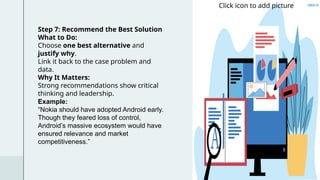
Step 7: Recommendthe Best Solution
What to Do:
Choose one best alternative and
justify why.
Link it back to the case problem and
data.
Why It Matters:
Strong recommendations show critical
thinking and leadership.
Example:
“Nokia should have adopted Android early.
Though they feared loss of control,
Android’s massive ecosystem would have
ensured relevance and market
competitiveness.”
Click icon to add picture
10.
Step 8: Providean Implementation Plan
What to Do:
Show how to implement the solution:
Steps or phases
Timeline (Gantt chart)
Resources needed (money, people, tech)
Risk mitigation strategies
Why It Matters:
Ideas are only useful if they’re practical.
Example (for Maggi):
Public apology – Month 1
Health certification from global labs – Month 2
Relaunch campaign – Month 3
Monitor public response – Month 4 onward
11.
Step 9: Concludewith Key
Takeaways
What to Do:
Summarize the key insights.
Restate the value of your
recommendation.
Highlight learning points.
Why It Matters:
Leaves a strong final impression.
Example:
“Nokia’s case proves that technology
firms must stay adaptable,
responsive to change, and open to
partnerships for survival.”
Click icon to add picture
12.
Step 10: Preparefor Q&A and Discussion
What to Do:
Anticipate 5–6 questions.
Prepare data points to back your answers.
Be honest if you don’t know – but offer to explore.
Why It Matters:
Q&A reflects how well the team knows their case and builds
credibility.
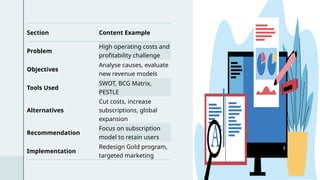
Case study outline – Zomato (next slide)
13.
Section Content Example
Problem
Highoperating costs and
profitability challenge
Objectives
Analyse causes, evaluate
new revenue models
Tools Used
SWOT, BCG Matrix,
PESTLE
Alternatives
Cut costs, increase
subscriptions, global
expansion
Recommendation
Focus on subscription
model to retain users
Implementation
Redesign Gold program,
targeted marketing
Click icon to add picture



![PRINTED BY Alireza Keshvari [email protected]. Printing is .docx](https://cdn.slidesharecdn.com/ss_thumbnails/printedbyalirezakeshvariemailprotected-221121032744-262ff464-thumbnail.jpg?width=640&height=640&fit=bounds)


