Case Study - NSR 2010

                       Colin McCall
                            All4 Inc.
NCASI 2010 Southern Regional Meeting
                      Charleston, SC

                       June 29, 2010
Agenda
       Overview of Project
       PSD Applicability Approach
       Review Process and U.S. EPA Involvement
       Mill Response and Project Impact
       Conclusions


2
The Project
       Modify recovery furnace:
        • DCE to NDCE
       Modify combination fuel boiler:
        • Upgrades for additional biomass/alternative fuels
        • Overfire air improvements
        • Steamside efficiency increases
       Install new steam turbine generator set and
        new cooling tower


3
Positive Environmental Aspects
       Recovery furnace modifications:
        • Low odor conversion
        • Eliminates BLOX
        • Predicted reductions in SO2, VOC, CO, PM,
          PM10, PM2.5, and TRS
       Combination fuel boiler modifications:
        • Projected decrease in fossil fuel
        • Improved combustion efficiency
        • Predicted reductions in NOX, CO


4
PSD Applicability
   Actual-to-projected actual applicability analysis
    • Projected actual emissions (PAE) for modified
      recovery furnace for all but NOX and PM, potential
      to emit (PTE) for NOX and PM
    • PAE developed for combination fuel boiler based on
      Mill business projections
    • PAE for combination fuel boiler excluded emissions
      that it could have accommodated during baseline
    • PTE for new cooling tower


5
PSD Applicability
       PSD Assessment:
        • Step 1 – Are project emissions increases
          greater than significance levels?
        • Step 2 – Are net emissions increases greater
          than significance levels?


6
PSD Applicability
       Step 1 results:
        • Project increases alone were significant for
          NOX, PM, TRS
       Step 2 results:
        • Net decreases from project eliminated TRS
        • Project was a PSD major modification for
          NOX, PM


7
PSD Application
       Key PSD application components:
        • BACT for NOX on recovery furnace
        • BACT for PM on recovery furnace,
          combination fuel boiler, cooling tower
        • Air quality modeling demonstration for NOX
          resulted in predicted annual impacts below
          significant impact level (SIL)


8
Application Review
       Application submitted late 2009
       State agency reviewed and forwarded to
        U.S. EPA
       Permit was anticipated by early May 2010
       U.S. EPA commented in early April


9
Application Review
        U.S. EPA comments:
         • If permit not issued by 4/12/10 application
           had to address new 1-hr NO2 standard
         • Concern w/excluded emissions that boiler
           could have accommodated


10
Mill Issues/Approach
        Project timing critical date - June 2010
        Develop immediate response to U.S. EPA
         concerns to expedite permit:
         • Determine implications of short-term NOX
           impacts
         • Revisit use of excludable emissions that the
           combination boiler could have accommodated


11
Mill Issues/Approach
        Short term 1-hour NO2 analysis;
         • No SIL, no U.S. EPA guidance
         • Short-term project NOX emissions increases
           modeled
         • Results <10% but >5% of new NAAQS
         • Time for full NAAQS study not acceptable


12
Mill Issues/Approach
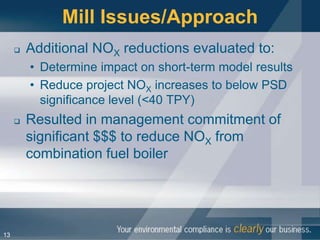
        Additional NOX reductions evaluated to:
         • Determine impact on short-term model results
         • Reduce project NOX increases to below PSD
           significance level (<40 TPY)
        Resulted in management commitment of
         significant $$$ to reduce NOX from
         combination fuel boiler


13
Mill Issues/Approach
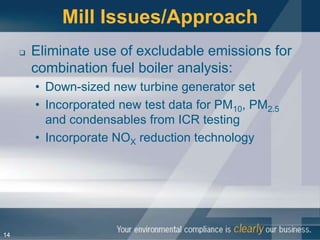
        Eliminate use of excludable emissions for
         combination fuel boiler analysis:
         • Down-sized new turbine generator set
         • Incorporated new test data for PM10, PM2.5
           and condensables from ICR testing
         • Incorporate NOX reduction technology


14
Project Status

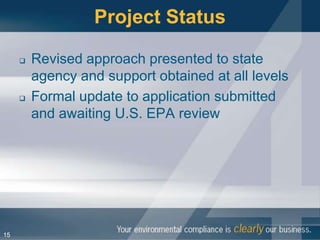
        Revised approach presented to state
         agency and support obtained at all levels
        Formal update to application submitted
         and awaiting U.S. EPA review


15
Project Conclusions
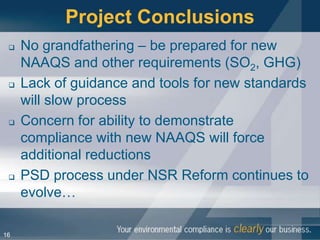
    No grandfathering – be prepared for new
     NAAQS and other requirements (SO2, GHG)
    Lack of guidance and tools for new standards
     will slow process
    Concern for ability to demonstrate
     compliance with new NAAQS will force
     additional reductions
    PSD process under NSR Reform continues to
     evolve…

16
Questions?


      cmccall@all4inc.com

            All4 Inc.
      2393 Kimberton Road
          P.O. Box 299
      Kimberton, PA 19442
        610.933.5246 x20

        www.all4inc.com


17

Case Study - NSR 2010

  • 1.
    Case Study -NSR 2010 Colin McCall All4 Inc. NCASI 2010 Southern Regional Meeting Charleston, SC June 29, 2010
  • 2.
    Agenda  Overview of Project  PSD Applicability Approach  Review Process and U.S. EPA Involvement  Mill Response and Project Impact  Conclusions 2
  • 3.
    The Project  Modify recovery furnace: • DCE to NDCE  Modify combination fuel boiler: • Upgrades for additional biomass/alternative fuels • Overfire air improvements • Steamside efficiency increases  Install new steam turbine generator set and new cooling tower 3
  • 4.
    Positive Environmental Aspects  Recovery furnace modifications: • Low odor conversion • Eliminates BLOX • Predicted reductions in SO2, VOC, CO, PM, PM10, PM2.5, and TRS  Combination fuel boiler modifications: • Projected decrease in fossil fuel • Improved combustion efficiency • Predicted reductions in NOX, CO 4
  • 5.
    PSD Applicability  Actual-to-projected actual applicability analysis • Projected actual emissions (PAE) for modified recovery furnace for all but NOX and PM, potential to emit (PTE) for NOX and PM • PAE developed for combination fuel boiler based on Mill business projections • PAE for combination fuel boiler excluded emissions that it could have accommodated during baseline • PTE for new cooling tower 5
  • 6.
    PSD Applicability  PSD Assessment: • Step 1 – Are project emissions increases greater than significance levels? • Step 2 – Are net emissions increases greater than significance levels? 6
  • 7.
    PSD Applicability  Step 1 results: • Project increases alone were significant for NOX, PM, TRS  Step 2 results: • Net decreases from project eliminated TRS • Project was a PSD major modification for NOX, PM 7
  • 8.
    PSD Application  Key PSD application components: • BACT for NOX on recovery furnace • BACT for PM on recovery furnace, combination fuel boiler, cooling tower • Air quality modeling demonstration for NOX resulted in predicted annual impacts below significant impact level (SIL) 8
  • 9.
    Application Review  Application submitted late 2009  State agency reviewed and forwarded to U.S. EPA  Permit was anticipated by early May 2010  U.S. EPA commented in early April 9
  • 10.
    Application Review  U.S. EPA comments: • If permit not issued by 4/12/10 application had to address new 1-hr NO2 standard • Concern w/excluded emissions that boiler could have accommodated 10
  • 11.
    Mill Issues/Approach  Project timing critical date - June 2010  Develop immediate response to U.S. EPA concerns to expedite permit: • Determine implications of short-term NOX impacts • Revisit use of excludable emissions that the combination boiler could have accommodated 11
  • 12.
    Mill Issues/Approach  Short term 1-hour NO2 analysis; • No SIL, no U.S. EPA guidance • Short-term project NOX emissions increases modeled • Results <10% but >5% of new NAAQS • Time for full NAAQS study not acceptable 12
  • 13.
    Mill Issues/Approach  Additional NOX reductions evaluated to: • Determine impact on short-term model results • Reduce project NOX increases to below PSD significance level (<40 TPY)  Resulted in management commitment of significant $$$ to reduce NOX from combination fuel boiler 13
  • 14.
    Mill Issues/Approach  Eliminate use of excludable emissions for combination fuel boiler analysis: • Down-sized new turbine generator set • Incorporated new test data for PM10, PM2.5 and condensables from ICR testing • Incorporate NOX reduction technology 14
  • 15.
    Project Status  Revised approach presented to state agency and support obtained at all levels  Formal update to application submitted and awaiting U.S. EPA review 15
  • 16.
    Project Conclusions  No grandfathering – be prepared for new NAAQS and other requirements (SO2, GHG)  Lack of guidance and tools for new standards will slow process  Concern for ability to demonstrate compliance with new NAAQS will force additional reductions  PSD process under NSR Reform continues to evolve… 16
  • 17.
    Questions? cmccall@all4inc.com All4 Inc. 2393 Kimberton Road P.O. Box 299 Kimberton, PA 19442 610.933.5246 x20 www.all4inc.com 17