GENTECH
Case Study
Agenda
1. Company Background
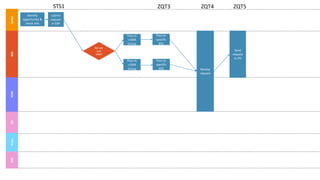
2. Business Situation (Define Measure Analyze)
3. Recommendations (Improve)
4. Implementation Roadmap (Improve)
5. Control Plan (Control)
Company Background
- Large multinational company
with an annual revenue of $60
Billion
- Present in a hundred countries
& employ over 150 thousand
employees and contractors
- Sell software, hardware, and
integrated business solutions
- Market leader for several years
(DMAIC)
Business Situation
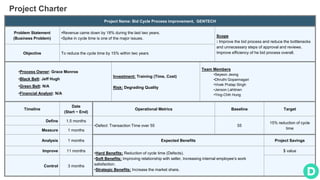
Project Name: Bid Cycle Process improvement, GENTECH
Problem Statement
(Business Problem)
•Revenue came down by 18% during the last two years.
•Spike in cycle time is one of the major issues.
Scope
: Improve the bid process and reduce the bottlenecks
and unnecessary steps of approval and reviews.
Improve efficiency of he bid process overall.
Objective To reduce the cycle time by 15% within two years
•Process Owner: Grace Monroe
•Black Belt: Jeff Hugh
•Green Belt: N/A
•Financial Analyst: N/A
Investment: Training (Time, Cost)
Risk: Degrading Quality
Team Members
•Seyeon Jeong
•Dhruthi Gopannagari
•Vivek Pratap Singh
•Jenson Lahtinen
•Ying-Chih Hung
Timeline
Date
(Start ~ End)
Operational Metrics Baseline Target
Define 1.5 months
•Defect: Transaction Time over 55 55
15% reduction of cycle
time
Measure 1 months
Analysis 1 months Expected Benefits Project Savings
Improve 11 months
•Hard Benefits: Reduction of cycle time (Defects).
•Soft Benefits: Improving relationship with seller, Increasing internal employee’s work
satisfaction.
•Strategic Benefits: Increase the market share.
$ value
Control 3 months
Project Charter
Dashboard - Summary of GENTECH
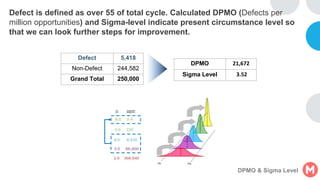
Defect 5,418
Non-Defect 244,582
Grand Total 250,000
DPMO 21,672
Sigma Level 3.52
Defect is defined as over 55 of total cycle. Calculated DPMO (Defects per
million opportunities) and Sigma-level indicate present circumstance level so
that we can look further steps for improvement.
DPMO & Sigma Level
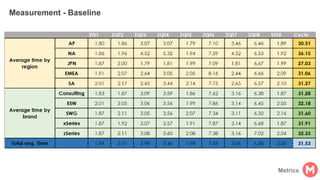
Measurement - Baseline
Metrics
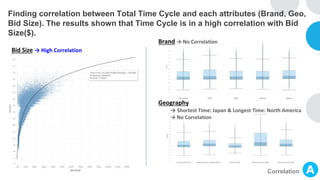
Finding correlation between Total Time Cycle and each attributes (Brand, Geo,
Bid Size). The results shown that Time Cycle is in a high correlation with Bid
Size($).
Bid Size → High Correlation
Brand → No Correlation
Correlation
Geography
→ Shortest Time: Japan & Longest Time: North America
→ No Correlation
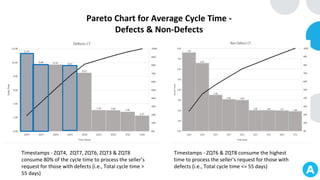
Pareto Chart for Average Cycle Time -
Defects & Non-Defects
Timestamps - ZQT4, ZQT7, ZQT6, ZQT3 & ZQT8
consume 80% of the cycle time to process the seller’s
request for those with defects (i.e., Total cycle time >
55 days)
Timestamps - ZQT6 & ZQT8 consume the highest
time to process the seller’s request for those with
defects (i.e., Total cycle time <= 55 days)
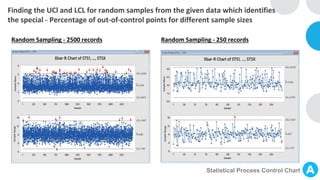
Finding the UCl and LCL for random samples from the given data which identifies
the special - Percentage of out-of-control points for different sample sizes
Random Sampling - 2500 records Random Sampling - 250 records
Statistical Process Control Chart
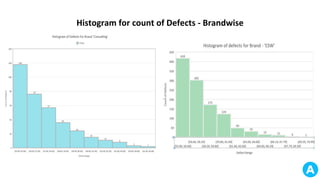
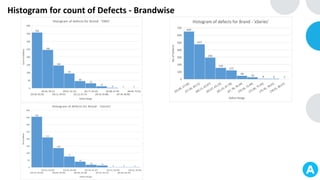
Histogram for count of Defects - Brandwise
To figure out the performance level of BSS (Bid Support Staff), using
average transaction time related with BSS work. We can define rank 10
(10%) Best & Worst Employee as below.
TOP 10 - BEST Performance BOTTOM 10 - WORST Performance
- Geography
: Japan, South America
- Seller
: 10 Best BSS work for 10 Seller
(1:1 matching)
- Geography
: EMEA, South America, North America
- Brand
: The most time consuming brand were
Consulting(30.64) and ESW(30.81)
- Seller
: 10 Worst BSS work for 15 Seller
(1:1.5 matching)
Investigation
Performance Level
※ Performance Level = Total time of BSS Transaction / Total Bid Size($)
Performance Evaluation for BSS
Performance Level
※ BSS related transaction = ([ZQT2]+[ZQT3]+[ZQT4]+[ZQT5]+[ZQT6]+[ZQT8])
Group1 - Bid Size < 100K
Group2 - Bid Size over 100K
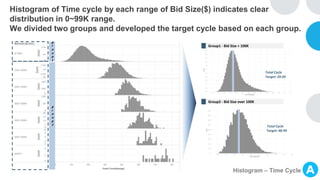
Histogram of Time cycle by each range of Bid Size($) indicates clear
distribution in 0~99K range.
We divided two groups and developed the target cycle based on each group.
Total Cycle
Target: 29.03
Total Cycle
Target: 48.94
Histogram – Time Cycle
g
r
o
u
p
1
g
r
o
u
p
2
Group 1 (bid < 100K)
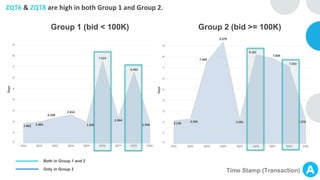
ZQT6 & ZQT8 are high in both Group 1 and Group 2.
Time Stamp (Transaction)
Group 2 (bid >= 100K)
Both in Group 1 and 2
Only in Group 2
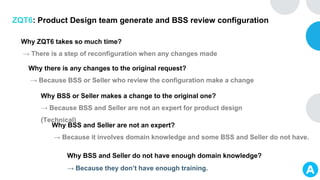
ZQT6: Product Design team generate and BSS review configuration
Why ZQT6 takes so much time?
→ There is a step of reconfiguration when any changes made
Why BSS and Seller do not have enough domain knowledge?
→ Because they don’t have enough training.
Why there is any changes to the original request?
→ Because BSS or Seller who review the configuration make a change
Why BSS and Seller are not an expert?
→ Because it involves domain knowledge and some BSS and Seller do not have.
Why BSS or Seller makes a change to the original one?
→ Because BSS and Seller are not an expert for product design
(Technical)
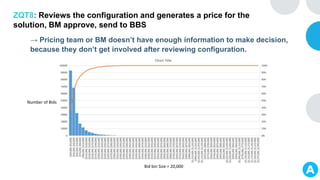
ZQT8: Reviews the configuration and generates a price for the
solution, BM approve, send to BBS
→ Pricing team or BM doesn’t have enough information to make decision,
because they don’t get involved after reviewing configuration.
Number of Bids
Bid bin Size = 20,000
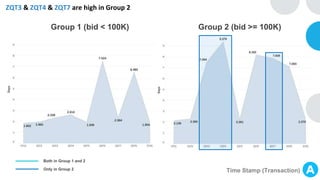
Group 1 (bid < 100K)
ZQT3 & ZQT4 & ZQT7 are high in Group 2
Time Stamp (Transaction)
Group 2 (bid >= 100K)
Both in Group 1 and 2
Only in Group 2
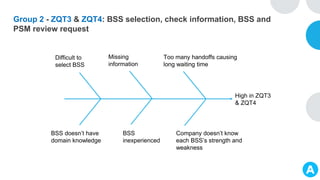
Group 2 - ZQT3 & ZQT4: BSS selection, check information, BSS and
PSM review request
High in ZQT3
& ZQT4
Difficult to
select BSS
BSS doesn’t have
domain knowledge
BSS
inexperienced
Missing
information
Too many handoffs causing
long waiting time
Company doesn’t know
each BSS’s strength and
weakness
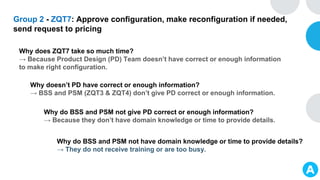
Group 2 - ZQT7: Approve configuration, make reconfiguration if needed,
send request to pricing
Why do BSS and PSM not give PD correct or enough information?
→ Because they don’t have domain knowledge or time to provide details.
Why does ZQT7 take so much time?
→ Because Product Design (PD) Team doesn’t have correct or enough information
to make right configuration.
Why doesn’t PD have correct or enough information?
→ BSS and PSM (ZQT3 & ZQT4) don’t give PD correct or enough information.
Why do BSS and PSM not have domain knowledge or time to provide details?
→ They do not receive training or are too busy.
(DMAIC)
Recommendations
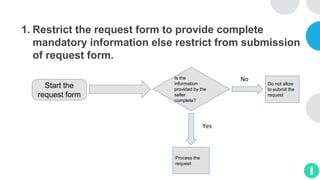
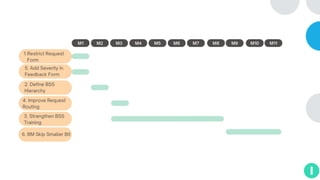
1. Restrict the request form to provide complete
mandatory information else restrict from submission
of request form.
Start the
request form
Is the
information
provided by the
seller
complete?
Process the
request
Do not allow
to submit the
request
No
Yes
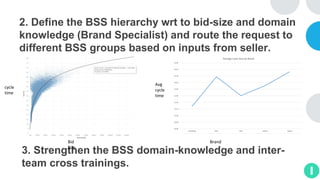
2. Define the BSS hierarchy wrt to bid-size and domain
knowledge (Brand Specialist) and route the request to
different BSS groups based on inputs from seller.
3. Strengthen the BSS domain-knowledge and inter-
team cross trainings.
cycle
time
Bid
Size
Brand
Avg
cycle
time
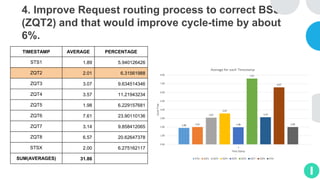
4. Improve Request routing process to correct BSS
(ZQT2) and that would improve cycle-time by about
6%.
TIMESTAMP AVERAGE PERCENTAGE
STS1 1.89 5.940126426
ZQT2 2.01 6.31561988
ZQT3 3.07 9.634514346
ZQT4 3.57 11.21943234
ZQT5 1.98 6.229157681
ZQT6 7.61 23.90110136
ZQT7 3.14 9.858412065
ZQT8 6.57 20.62647378
STSX 2.00 6.275162117
SUM(AVERAGES) 31.86
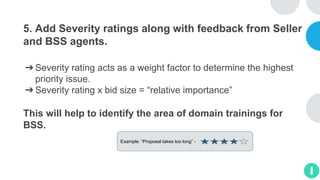
5. Add Severity ratings along with feedback from Seller
and BSS agents.
➔Severity rating acts as a weight factor to determine the highest
priority issue.
➔Severity rating x bid size = “relative importance”
This will help to identify the area of domain trainings for
BSS.
Example: “Proposal takes too long” -
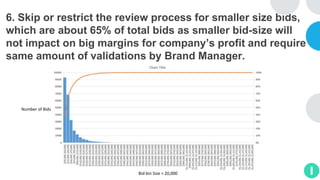
6. Skip or restrict the review process for smaller size bids,
which are about 65% of total bids as smaller bid-size will
not impact on big margins for company’s profit and require
same amount of validations by Brand Manager.
Number of Bids
Bid bin Size = 20,000
(DMAIC)
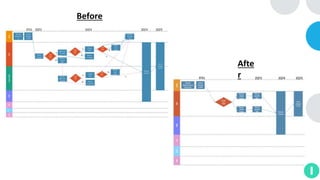
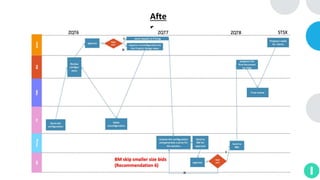
Implementation
Roadmap
Before
Afte
r
Afte
r
(DMAIC)
Control Plan
Control Plan
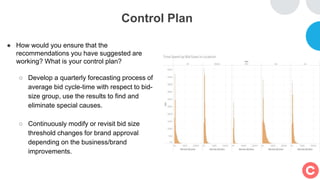
● How would you ensure that the
recommendations you have suggested are
working? What is your control plan?
○ Develop a quarterly forecasting process of
average bid cycle-time with respect to bid-
size group, use the results to find and
eliminate special causes.
○ Continuously modify or revisit bid size
threshold changes for brand approval
depending on the business/brand
improvements.
Thank you ☺
GENTECH
Appendices
PSM
Senior
BBS
BSS
Seller
P
D
Pri
ce
B
M
identify
opportuni
ty
submit
request
in ERP
access
request
Com
plicat
ed?
BBS tries
to solve
Route to
senior
BSS
Senior
BBS tries
to solve
Right
agen
t?
Right
agen
t?
Check
info
Check
info
Return
to queue
Return
to queue
Com
plete
?
Com
plete
?
Reach
out
seller
Reach
out
seller
Provide
missing
info
Review
request
Send
request
to PD
STS1 ZQT2 ZQT3 ZQT4 ZQT5
Y
N
Y
N
N
Y
N
N
Y
Y
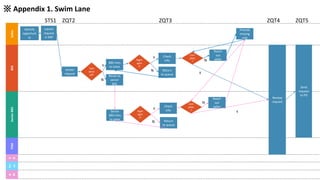
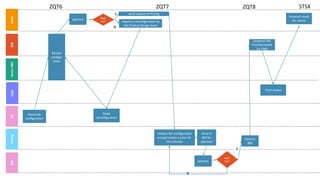
※ Appendix 1. Swim Lane
PSM
Senior
BBS
BSS
Seller
PD
Pricing
BM
Appr
ove?
Generate
configuration
approve
send request to Pricing
require a reconfiguration by
the Product Design team
Make
reconfiguration
reviews the configuration
and generates a price for
the solution
Send to
BM for
approval
approve
Appr
ove?
Send to
BBS
prepares the
final document
for PSM
Final review
Proposal ready
for clients
Review
configur
ation
ZQT6 ZQT7 ZQT8 STSX
Y
N
Y
N
PSM
BSS
Seller
PD
Price
BM
identify
opportunity &
check info
submit
request
in ERP
Bid size
over
100K?
Pass to
>100K
Group
Pass to
<100K
Group Review
request
Send
request
to PD
STS1 ZQT3 ZQT4 ZQT5
Pass to
specific
BSS
Pass to
specific
BSS
PSM
BSS
Seller
PD
Pricing
BM
Appr
ove?
Generate
configuration
approve
send request to Pricing
require a reconfiguration by
the Product Design team
Make
reconfiguration
reviews the configuration
and generates a price for
the solution
Send to
BM for
approval
approve
Appr
ove?
Send to
BBS
prepares the
final document
for PSM
Final review
Proposal ready
for clients
Review
configur
ation
ZQT6 ZQT7 ZQT8 STSX
Y
N
Y
N
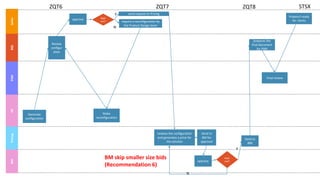
BM skip smaller size bids
(Recommendation 6)
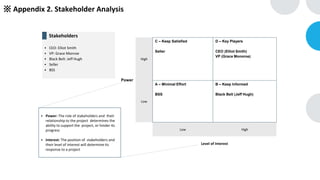
※ Appendix 2. Stakeholder Analysis
Power
High
C – Keep Satisfied
Seller
D – Key Players
CEO (Elliot Smith)
VP (Grace Monoroe)
Low
A – Minimal Effort
BSS
B – Keep Informed
Black Belt (Jeff Hugh)
Low High
Level of Interest
▪ Power: The role of stakeholders and their
relationship to the project determines the
ability to support the project, or hinder its
progress
▪ Interest: The position of stakeholders and
their level of interest will determine its
response to a project
▪ CEO: Elliot Smith
▪ VP: Grace Monroe
▪ Black Belt: Jeff Hugh
▪ Seller
▪ BSS
Stakeholders
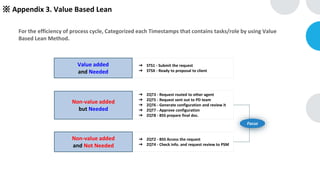
※ Appendix 3. Value Based Lean
➔ STS1 - Submit the request
➔ STSX - Ready to proposal to client
➔ ZQT3 - Request routed to other agent
➔ ZQT5 - Request sent out to PD team
➔ ZQT6 - Generate configuration and review it
➔ ZQT7 - Approve configuration
➔ ZQT8 - BSS prepare final doc.
➔ ZQT2 - BSS Access the request
➔ ZQT4 - Check info. and request review to PSM
Focus
Value added
and Needed
Non-value added
but Needed
Non-value added
and Not Needed
For the efficiency of process cycle, Categorized each Timestamps that contains tasks/role by using Value
Based Lean Method.

Case Study - Deficit Analysis

  • 1.
  • 2.
    Agenda 1. Company Background 2.Business Situation (Define Measure Analyze) 3. Recommendations (Improve) 4. Implementation Roadmap (Improve) 5. Control Plan (Control)
  • 3.
    Company Background - Largemultinational company with an annual revenue of $60 Billion - Present in a hundred countries & employ over 150 thousand employees and contractors - Sell software, hardware, and integrated business solutions - Market leader for several years
  • 4.
  • 5.
    Project Name: BidCycle Process improvement, GENTECH Problem Statement (Business Problem) •Revenue came down by 18% during the last two years. •Spike in cycle time is one of the major issues. Scope : Improve the bid process and reduce the bottlenecks and unnecessary steps of approval and reviews. Improve efficiency of he bid process overall. Objective To reduce the cycle time by 15% within two years •Process Owner: Grace Monroe •Black Belt: Jeff Hugh •Green Belt: N/A •Financial Analyst: N/A Investment: Training (Time, Cost) Risk: Degrading Quality Team Members •Seyeon Jeong •Dhruthi Gopannagari •Vivek Pratap Singh •Jenson Lahtinen •Ying-Chih Hung Timeline Date (Start ~ End) Operational Metrics Baseline Target Define 1.5 months •Defect: Transaction Time over 55 55 15% reduction of cycle time Measure 1 months Analysis 1 months Expected Benefits Project Savings Improve 11 months •Hard Benefits: Reduction of cycle time (Defects). •Soft Benefits: Improving relationship with seller, Increasing internal employee’s work satisfaction. •Strategic Benefits: Increase the market share. $ value Control 3 months Project Charter
  • 6.
  • 7.
    Defect 5,418 Non-Defect 244,582 GrandTotal 250,000 DPMO 21,672 Sigma Level 3.52 Defect is defined as over 55 of total cycle. Calculated DPMO (Defects per million opportunities) and Sigma-level indicate present circumstance level so that we can look further steps for improvement. DPMO & Sigma Level
  • 8.
  • 9.
    Finding correlation betweenTotal Time Cycle and each attributes (Brand, Geo, Bid Size). The results shown that Time Cycle is in a high correlation with Bid Size($). Bid Size → High Correlation Brand → No Correlation Correlation Geography → Shortest Time: Japan & Longest Time: North America → No Correlation
  • 10.
    Pareto Chart forAverage Cycle Time - Defects & Non-Defects Timestamps - ZQT4, ZQT7, ZQT6, ZQT3 & ZQT8 consume 80% of the cycle time to process the seller’s request for those with defects (i.e., Total cycle time > 55 days) Timestamps - ZQT6 & ZQT8 consume the highest time to process the seller’s request for those with defects (i.e., Total cycle time <= 55 days)
  • 11.
    Finding the UCland LCL for random samples from the given data which identifies the special - Percentage of out-of-control points for different sample sizes Random Sampling - 2500 records Random Sampling - 250 records Statistical Process Control Chart
  • 12.
    Histogram for countof Defects - Brandwise
  • 13.
    Histogram for countof Defects - Brandwise
  • 14.
    To figure outthe performance level of BSS (Bid Support Staff), using average transaction time related with BSS work. We can define rank 10 (10%) Best & Worst Employee as below. TOP 10 - BEST Performance BOTTOM 10 - WORST Performance - Geography : Japan, South America - Seller : 10 Best BSS work for 10 Seller (1:1 matching) - Geography : EMEA, South America, North America - Brand : The most time consuming brand were Consulting(30.64) and ESW(30.81) - Seller : 10 Worst BSS work for 15 Seller (1:1.5 matching) Investigation Performance Level ※ Performance Level = Total time of BSS Transaction / Total Bid Size($) Performance Evaluation for BSS Performance Level ※ BSS related transaction = ([ZQT2]+[ZQT3]+[ZQT4]+[ZQT5]+[ZQT6]+[ZQT8])
  • 15.
    Group1 - BidSize < 100K Group2 - Bid Size over 100K Histogram of Time cycle by each range of Bid Size($) indicates clear distribution in 0~99K range. We divided two groups and developed the target cycle based on each group. Total Cycle Target: 29.03 Total Cycle Target: 48.94 Histogram – Time Cycle g r o u p 1 g r o u p 2
  • 16.
    Group 1 (bid< 100K) ZQT6 & ZQT8 are high in both Group 1 and Group 2. Time Stamp (Transaction) Group 2 (bid >= 100K) Both in Group 1 and 2 Only in Group 2
  • 17.
    ZQT6: Product Designteam generate and BSS review configuration Why ZQT6 takes so much time? → There is a step of reconfiguration when any changes made Why BSS and Seller do not have enough domain knowledge? → Because they don’t have enough training. Why there is any changes to the original request? → Because BSS or Seller who review the configuration make a change Why BSS and Seller are not an expert? → Because it involves domain knowledge and some BSS and Seller do not have. Why BSS or Seller makes a change to the original one? → Because BSS and Seller are not an expert for product design (Technical)
  • 18.
    ZQT8: Reviews theconfiguration and generates a price for the solution, BM approve, send to BBS → Pricing team or BM doesn’t have enough information to make decision, because they don’t get involved after reviewing configuration. Number of Bids Bid bin Size = 20,000
  • 19.
    Group 1 (bid< 100K) ZQT3 & ZQT4 & ZQT7 are high in Group 2 Time Stamp (Transaction) Group 2 (bid >= 100K) Both in Group 1 and 2 Only in Group 2
  • 20.
    Group 2 -ZQT3 & ZQT4: BSS selection, check information, BSS and PSM review request High in ZQT3 & ZQT4 Difficult to select BSS BSS doesn’t have domain knowledge BSS inexperienced Missing information Too many handoffs causing long waiting time Company doesn’t know each BSS’s strength and weakness
  • 21.
    Group 2 -ZQT7: Approve configuration, make reconfiguration if needed, send request to pricing Why do BSS and PSM not give PD correct or enough information? → Because they don’t have domain knowledge or time to provide details. Why does ZQT7 take so much time? → Because Product Design (PD) Team doesn’t have correct or enough information to make right configuration. Why doesn’t PD have correct or enough information? → BSS and PSM (ZQT3 & ZQT4) don’t give PD correct or enough information. Why do BSS and PSM not have domain knowledge or time to provide details? → They do not receive training or are too busy.
  • 22.
  • 23.
    1. Restrict therequest form to provide complete mandatory information else restrict from submission of request form. Start the request form Is the information provided by the seller complete? Process the request Do not allow to submit the request No Yes
  • 24.
    2. Define theBSS hierarchy wrt to bid-size and domain knowledge (Brand Specialist) and route the request to different BSS groups based on inputs from seller. 3. Strengthen the BSS domain-knowledge and inter- team cross trainings. cycle time Bid Size Brand Avg cycle time
  • 25.
    4. Improve Requestrouting process to correct BSS (ZQT2) and that would improve cycle-time by about 6%. TIMESTAMP AVERAGE PERCENTAGE STS1 1.89 5.940126426 ZQT2 2.01 6.31561988 ZQT3 3.07 9.634514346 ZQT4 3.57 11.21943234 ZQT5 1.98 6.229157681 ZQT6 7.61 23.90110136 ZQT7 3.14 9.858412065 ZQT8 6.57 20.62647378 STSX 2.00 6.275162117 SUM(AVERAGES) 31.86
  • 26.
    5. Add Severityratings along with feedback from Seller and BSS agents. ➔Severity rating acts as a weight factor to determine the highest priority issue. ➔Severity rating x bid size = “relative importance” This will help to identify the area of domain trainings for BSS. Example: “Proposal takes too long” -
  • 27.
    6. Skip orrestrict the review process for smaller size bids, which are about 65% of total bids as smaller bid-size will not impact on big margins for company’s profit and require same amount of validations by Brand Manager. Number of Bids Bid bin Size = 20,000
  • 28.
  • 30.
  • 31.
  • 32.
  • 33.
    Control Plan ● Howwould you ensure that the recommendations you have suggested are working? What is your control plan? ○ Develop a quarterly forecasting process of average bid cycle-time with respect to bid- size group, use the results to find and eliminate special causes. ○ Continuously modify or revisit bid size threshold changes for brand approval depending on the business/brand improvements.
  • 34.
  • 35.
  • 36.
    PSM Senior BBS BSS Seller P D Pri ce B M identify opportuni ty submit request in ERP access request Com plicat ed? BBS tries tosolve Route to senior BSS Senior BBS tries to solve Right agen t? Right agen t? Check info Check info Return to queue Return to queue Com plete ? Com plete ? Reach out seller Reach out seller Provide missing info Review request Send request to PD STS1 ZQT2 ZQT3 ZQT4 ZQT5 Y N Y N N Y N N Y Y ※ Appendix 1. Swim Lane
  • 37.
    PSM Senior BBS BSS Seller PD Pricing BM Appr ove? Generate configuration approve send request toPricing require a reconfiguration by the Product Design team Make reconfiguration reviews the configuration and generates a price for the solution Send to BM for approval approve Appr ove? Send to BBS prepares the final document for PSM Final review Proposal ready for clients Review configur ation ZQT6 ZQT7 ZQT8 STSX Y N Y N
  • 38.
    PSM BSS Seller PD Price BM identify opportunity & check info submit request inERP Bid size over 100K? Pass to >100K Group Pass to <100K Group Review request Send request to PD STS1 ZQT3 ZQT4 ZQT5 Pass to specific BSS Pass to specific BSS
  • 39.
    PSM BSS Seller PD Pricing BM Appr ove? Generate configuration approve send request toPricing require a reconfiguration by the Product Design team Make reconfiguration reviews the configuration and generates a price for the solution Send to BM for approval approve Appr ove? Send to BBS prepares the final document for PSM Final review Proposal ready for clients Review configur ation ZQT6 ZQT7 ZQT8 STSX Y N Y N BM skip smaller size bids (Recommendation 6)
  • 40.
    ※ Appendix 2.Stakeholder Analysis Power High C – Keep Satisfied Seller D – Key Players CEO (Elliot Smith) VP (Grace Monoroe) Low A – Minimal Effort BSS B – Keep Informed Black Belt (Jeff Hugh) Low High Level of Interest ▪ Power: The role of stakeholders and their relationship to the project determines the ability to support the project, or hinder its progress ▪ Interest: The position of stakeholders and their level of interest will determine its response to a project ▪ CEO: Elliot Smith ▪ VP: Grace Monroe ▪ Black Belt: Jeff Hugh ▪ Seller ▪ BSS Stakeholders
  • 41.
    ※ Appendix 3.Value Based Lean ➔ STS1 - Submit the request ➔ STSX - Ready to proposal to client ➔ ZQT3 - Request routed to other agent ➔ ZQT5 - Request sent out to PD team ➔ ZQT6 - Generate configuration and review it ➔ ZQT7 - Approve configuration ➔ ZQT8 - BSS prepare final doc. ➔ ZQT2 - BSS Access the request ➔ ZQT4 - Check info. and request review to PSM Focus Value added and Needed Non-value added but Needed Non-value added and Not Needed For the efficiency of process cycle, Categorized each Timestamps that contains tasks/role by using Value Based Lean Method.