Case Study Approach
Qualitative Research - Gurshida Jabeen, Kehfa,
Anushka and Ajinkya
What is a Case Study Research..?
“A strategy of doing research which involves an empirical investigation of particular
contemporary phenomenon within its real life context using multiple sources of
evidence (Robson, 1993).”
● A case study is a social unit with deviant behaviour and may be & even problem, process ,activity,
program of social unit . A unit may be a person, family, central group, community even a entire society.
● So critical analysis reveal that case study is a method of minute and detail study of situation concerning
a social unit in an intensive and comprehensive manner in order to understand the personal as well as
hidden dimension of human life.
Characteristics of Case study
Combined Objectives
and subjective data
03
Research may combine objective and
subjective data, both data are regarded as
valid data for analysis
Narrowly Focus
02
Typically a case study offers a complete
and comprehensive description of all facts
of social unit,be it single individual or may
be social group
Descriptive Study
01
Data collected constitute Description of
Psychological process and events and of
the context in which they occur
04
Case study method enables the
researcher to explore and describe the
nature of processes,which occur over
time.
Process -oriented
Types of Case Study
Explanatory
Exploratory Descriptive
Multiple Case
Study
Individual
Case Study
Instrumental Collective
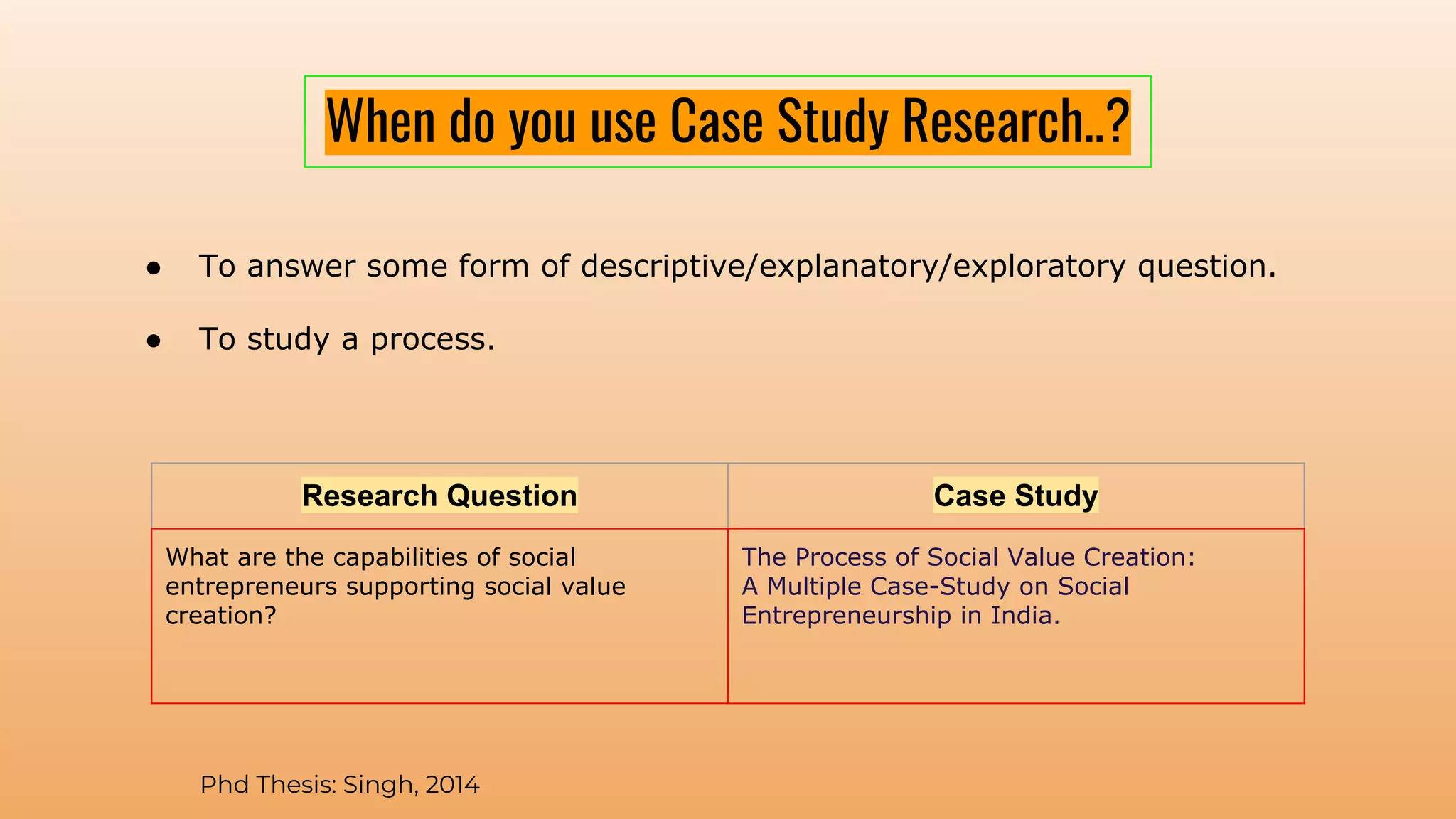
When do you use Case Study Research..?
● To answer some form of descriptive/explanatory/exploratory question.
● To study a process.
Research Question Case Study
What are the capabilities of social
entrepreneurs supporting social value
creation?
The Process of Social Value Creation:
A Multiple Case-Study on Social
Entrepreneurship in India.
Phd Thesis: Singh, 2014
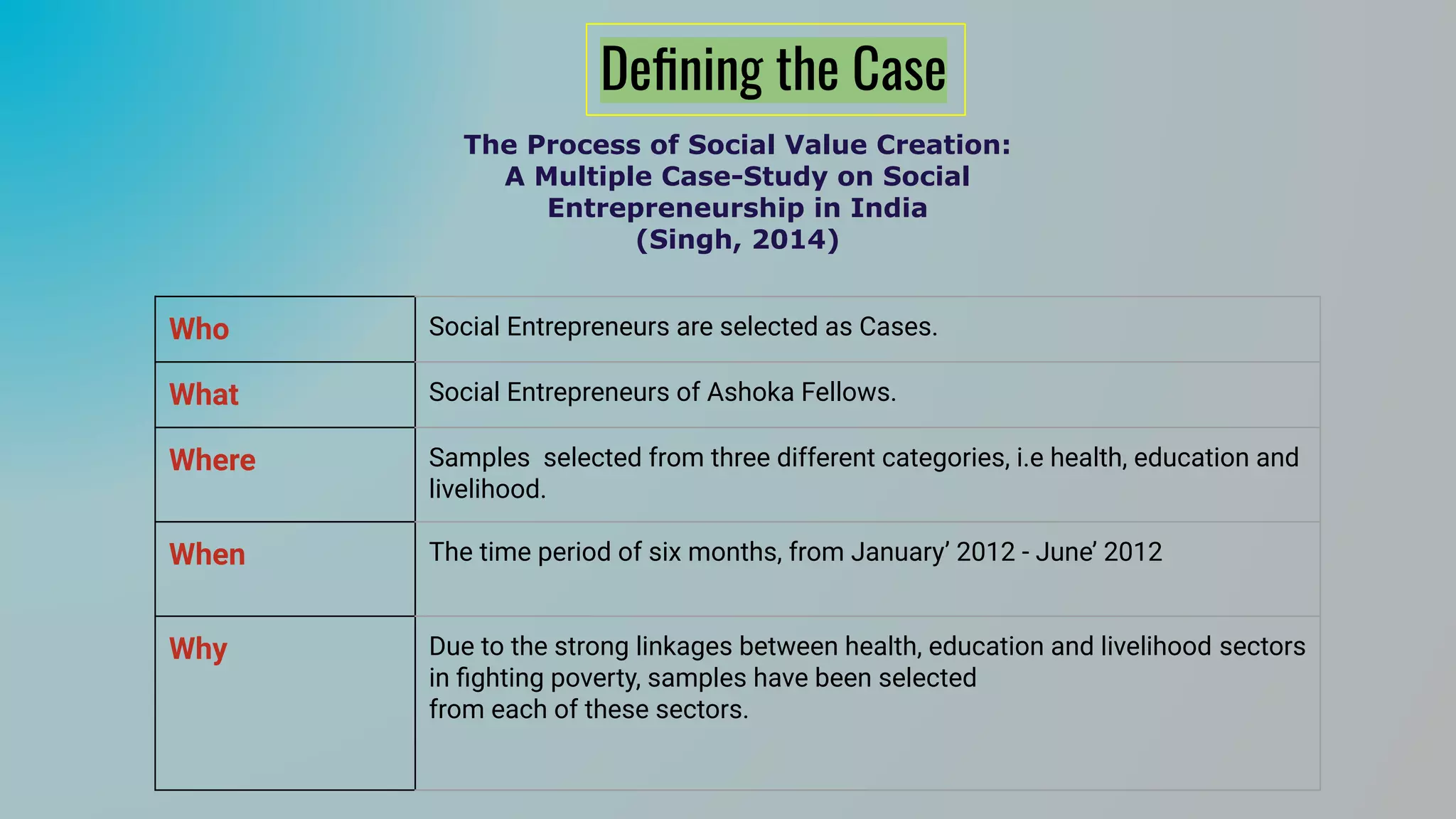
Defining the Case
Who Social Entrepreneurs are selected as Cases.
What Social Entrepreneurs of Ashoka Fellows.
Where Samples selected from three different categories, i.e health, education and
livelihood.
When The time period of six months, from January’ 2012 - June’ 2012
Why Due to the strong linkages between health, education and livelihood sectors
in fighting poverty, samples have been selected
from each of these sectors.
The Process of Social Value Creation:
A Multiple Case-Study on Social
Entrepreneurship in India
(Singh, 2014)
Steps in Case Study Planning..
Plan
Develop Instruments
Data Collection
Analyse Data
Disseminate Findings
Case Study Research Benefits
● Study a particular phenomenon arising from a particular entity, then a single-case
study is warranted and allow for a in-depth understanding of the single
phenomenon and would involve collecting several different types of data.
● Using a multiple-case research approach allows for a more in-depth understanding
of the cases as a unit, through a comparison of similarities and differences.
● Multiple case studies is often stronger and more reliable than from single case
studies. It allows for more comprehensive exploration of research questions and
theory development.
Case Study Research - Limitations
● Difficult to organise, data analyse and integration strategies need to be
carefully thought through.
● Reporting of findings from multiple case research studies is also challenging.
References
“Case Study Research in Software Engineering: Guidelines and Examples.” O’Reilly Online Learning. 2022.
http://localhost:8080/xmlui/handle/1/3909
“Case Study Method Definition, Characteristics, Stages & Sources | Study Lecture Notes.” Study Lecture Notes. Study
Lecture Notes. June 25, 2013.
Yin, R. (2003). Case study research: Design and methods (3rd ed.). Thousand Oaks, CA: Sage.
Yin, R. K. (1993). Applications of case study research. Applied social research methods series, Vol. 35. London: Sage
Publications.

Case Study Approach.pdf

  • 1.
    Case Study Approach QualitativeResearch - Gurshida Jabeen, Kehfa, Anushka and Ajinkya
  • 2.
    What is aCase Study Research..? “A strategy of doing research which involves an empirical investigation of particular contemporary phenomenon within its real life context using multiple sources of evidence (Robson, 1993).” ● A case study is a social unit with deviant behaviour and may be & even problem, process ,activity, program of social unit . A unit may be a person, family, central group, community even a entire society. ● So critical analysis reveal that case study is a method of minute and detail study of situation concerning a social unit in an intensive and comprehensive manner in order to understand the personal as well as hidden dimension of human life.
  • 3.
    Characteristics of Casestudy Combined Objectives and subjective data 03 Research may combine objective and subjective data, both data are regarded as valid data for analysis Narrowly Focus 02 Typically a case study offers a complete and comprehensive description of all facts of social unit,be it single individual or may be social group Descriptive Study 01 Data collected constitute Description of Psychological process and events and of the context in which they occur 04 Case study method enables the researcher to explore and describe the nature of processes,which occur over time. Process -oriented
  • 4.
    Types of CaseStudy Explanatory Exploratory Descriptive Multiple Case Study Individual Case Study Instrumental Collective
  • 5.
    When do youuse Case Study Research..? ● To answer some form of descriptive/explanatory/exploratory question. ● To study a process. Research Question Case Study What are the capabilities of social entrepreneurs supporting social value creation? The Process of Social Value Creation: A Multiple Case-Study on Social Entrepreneurship in India. Phd Thesis: Singh, 2014
  • 6.
    Defining the Case WhoSocial Entrepreneurs are selected as Cases. What Social Entrepreneurs of Ashoka Fellows. Where Samples selected from three different categories, i.e health, education and livelihood. When The time period of six months, from January’ 2012 - June’ 2012 Why Due to the strong linkages between health, education and livelihood sectors in fighting poverty, samples have been selected from each of these sectors. The Process of Social Value Creation: A Multiple Case-Study on Social Entrepreneurship in India (Singh, 2014)
  • 7.
    Steps in CaseStudy Planning.. Plan Develop Instruments Data Collection Analyse Data Disseminate Findings
  • 8.
    Case Study ResearchBenefits ● Study a particular phenomenon arising from a particular entity, then a single-case study is warranted and allow for a in-depth understanding of the single phenomenon and would involve collecting several different types of data. ● Using a multiple-case research approach allows for a more in-depth understanding of the cases as a unit, through a comparison of similarities and differences. ● Multiple case studies is often stronger and more reliable than from single case studies. It allows for more comprehensive exploration of research questions and theory development.
  • 9.
    Case Study Research- Limitations ● Difficult to organise, data analyse and integration strategies need to be carefully thought through. ● Reporting of findings from multiple case research studies is also challenging.
  • 10.
    References “Case Study Researchin Software Engineering: Guidelines and Examples.” O’Reilly Online Learning. 2022. http://localhost:8080/xmlui/handle/1/3909 “Case Study Method Definition, Characteristics, Stages & Sources | Study Lecture Notes.” Study Lecture Notes. Study Lecture Notes. June 25, 2013. Yin, R. (2003). Case study research: Design and methods (3rd ed.). Thousand Oaks, CA: Sage. Yin, R. K. (1993). Applications of case study research. Applied social research methods series, Vol. 35. London: Sage Publications.