USING CARTOONS
   TO TEACH
Why using cartoons
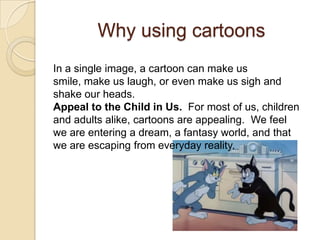
In a single image, a cartoon can make us
smile, make us laugh, or even make us sigh and
shake our heads.
Appeal to the Child in Us. For most of us, children
and adults alike, cartoons are appealing. We feel
we are entering a dream, a fantasy world, and that
we are escaping from everyday reality.
POSITIVE FEATURES

Cartoons are colorful and amusing. Therefore, if we
teachers want to use a cartoon or part of one as a
stimulus for some language activity in the
classroom, we already have the students' willing
attention.
Even with students whose native language is
English, using animated versions of well-known
stories can give the more unwilling students their
first exposure to literary classics and perhaps even
stimulate them to pick up the book.
Negative Features of
              Cartoons
No Clues from Visual Articulation. One way in
which video helps in comprehension is that it often
lets us see the speaker's mouth, from which we get
clues as to what sounds or sequences of sounds the
speaker is producing.
The characters' mouths are made to move in
imitation of real people, but the subtle movements of
lips, tongue, and jaw that help us identify speech
sounds even when we cannot hear them are
completely missing.
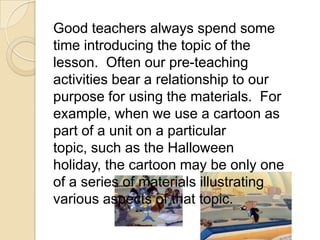
Good teachers always spend some
time introducing the topic of the
lesson. Often our pre-teaching
activities bear a relationship to our
purpose for using the materials. For
example, when we use a cartoon as
part of a unit on a particular
topic, such as the Halloween
holiday, the cartoon may be only one
of a series of materials illustrating
various aspects of that topic.
Activities
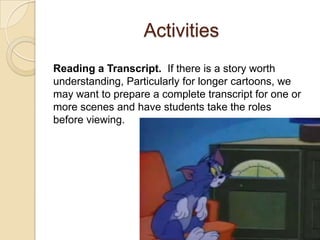
Reading a Transcript. If there is a story worth
understanding, Particularly for longer cartoons, we
may want to prepare a complete transcript for one or
more scenes and have students take the roles
before viewing.
Activities
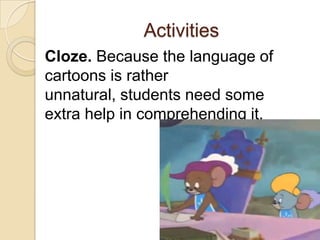
Cloze. Because the language of
cartoons is rather
unnatural, students need some
extra help in comprehending it.
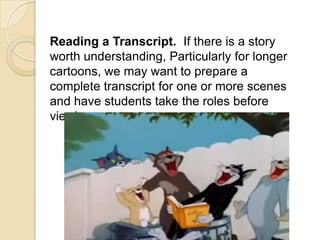
Reading a Transcript. If there is a story
worth understanding, Particularly for longer
cartoons, we may want to prepare a
complete transcript for one or more scenes
and have students take the roles before
viewing.
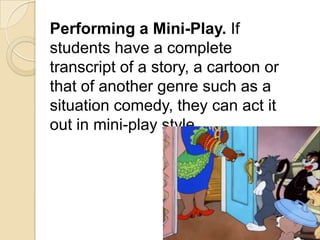
Performing a Mini-Play. If
students have a complete
transcript of a story, a cartoon or
that of another genre such as a
situation comedy, they can act it
out in mini-play style.

Cartoons2011

  • 1.
  • 2.
    Why using cartoons Ina single image, a cartoon can make us smile, make us laugh, or even make us sigh and shake our heads. Appeal to the Child in Us. For most of us, children and adults alike, cartoons are appealing. We feel we are entering a dream, a fantasy world, and that we are escaping from everyday reality.
  • 3.
    POSITIVE FEATURES Cartoons arecolorful and amusing. Therefore, if we teachers want to use a cartoon or part of one as a stimulus for some language activity in the classroom, we already have the students' willing attention. Even with students whose native language is English, using animated versions of well-known stories can give the more unwilling students their first exposure to literary classics and perhaps even stimulate them to pick up the book.
  • 4.
    Negative Features of Cartoons No Clues from Visual Articulation. One way in which video helps in comprehension is that it often lets us see the speaker's mouth, from which we get clues as to what sounds or sequences of sounds the speaker is producing. The characters' mouths are made to move in imitation of real people, but the subtle movements of lips, tongue, and jaw that help us identify speech sounds even when we cannot hear them are completely missing.
  • 5.
    Good teachers alwaysspend some time introducing the topic of the lesson. Often our pre-teaching activities bear a relationship to our purpose for using the materials. For example, when we use a cartoon as part of a unit on a particular topic, such as the Halloween holiday, the cartoon may be only one of a series of materials illustrating various aspects of that topic.
  • 6.
    Activities Reading a Transcript.If there is a story worth understanding, Particularly for longer cartoons, we may want to prepare a complete transcript for one or more scenes and have students take the roles before viewing.
  • 7.
    Activities Cloze. Because thelanguage of cartoons is rather unnatural, students need some extra help in comprehending it.
  • 8.
    Reading a Transcript.If there is a story worth understanding, Particularly for longer cartoons, we may want to prepare a complete transcript for one or more scenes and have students take the roles before viewing.
  • 9.
    Performing a Mini-Play.If students have a complete transcript of a story, a cartoon or that of another genre such as a situation comedy, they can act it out in mini-play style.