Megan Howell Sarah Kramer Takako Mato Linda Cruikshank
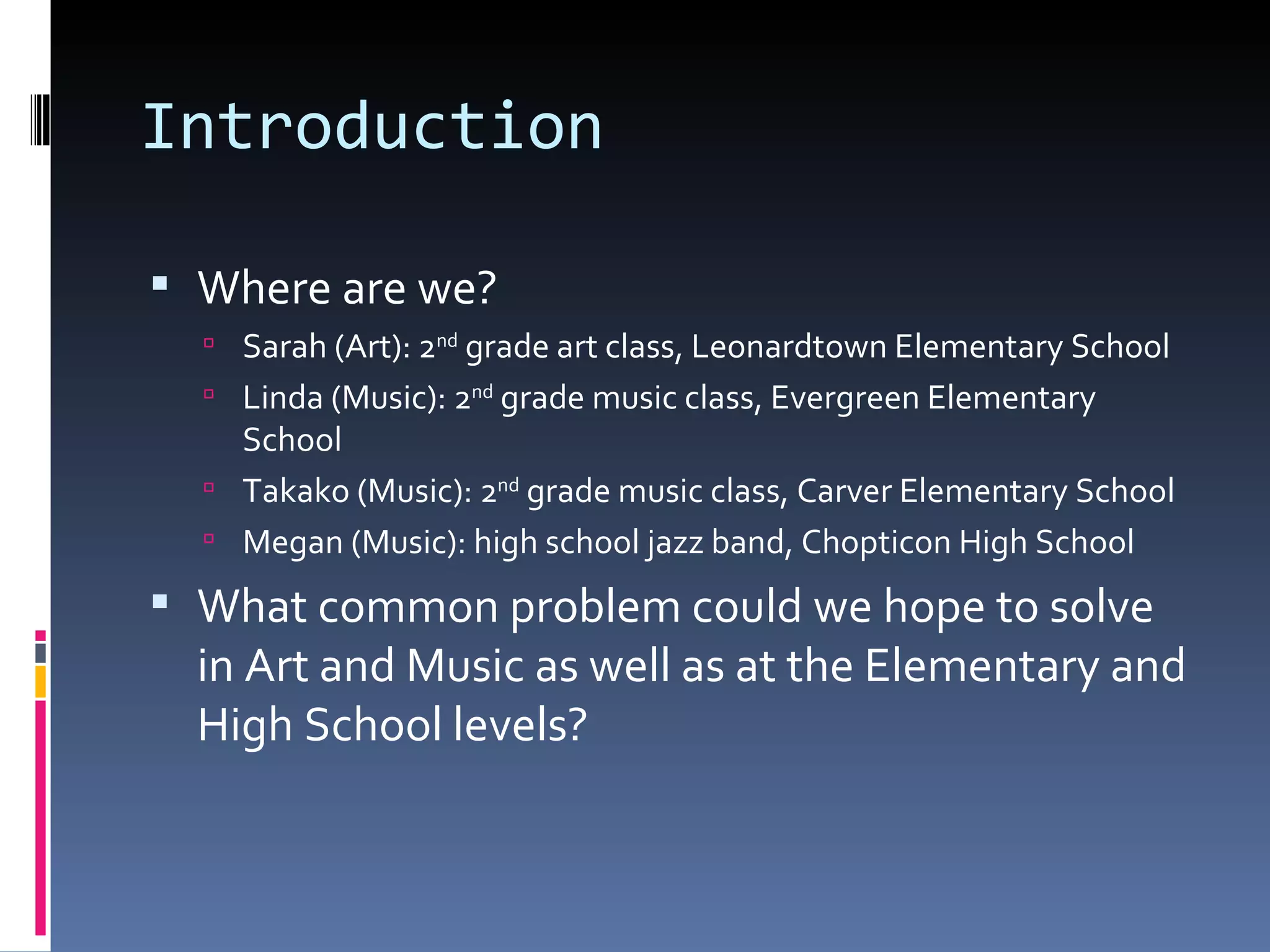
Introduction Where are we? Sarah (Art): 2 nd  grade art class, Leonardtown Elementary School Linda (Music): 2 nd  grade music class, Evergreen Elementary School Takako (Music): 2 nd  grade music class, Carver Elementary School Megan (Music): high school jazz band, Chopticon High School What common problem could we hope to solve in Art and Music as well as at the Elementary and High School levels?
Motivation! What evidence says there is lack of motivation in the arts? Because none of the School Improvement Plans for our schools reference the arts in any way, we needed to rely on our individual observations at our respective placements. In each of our placements, we have observed students who are disinterested, do not pay attention, or refuse to participate.
So What? Why does it matter if students are not motivated? Unmotivated students’ negative attitudes can affect the rest of class, impeding the opportunities for learning within the lesson.
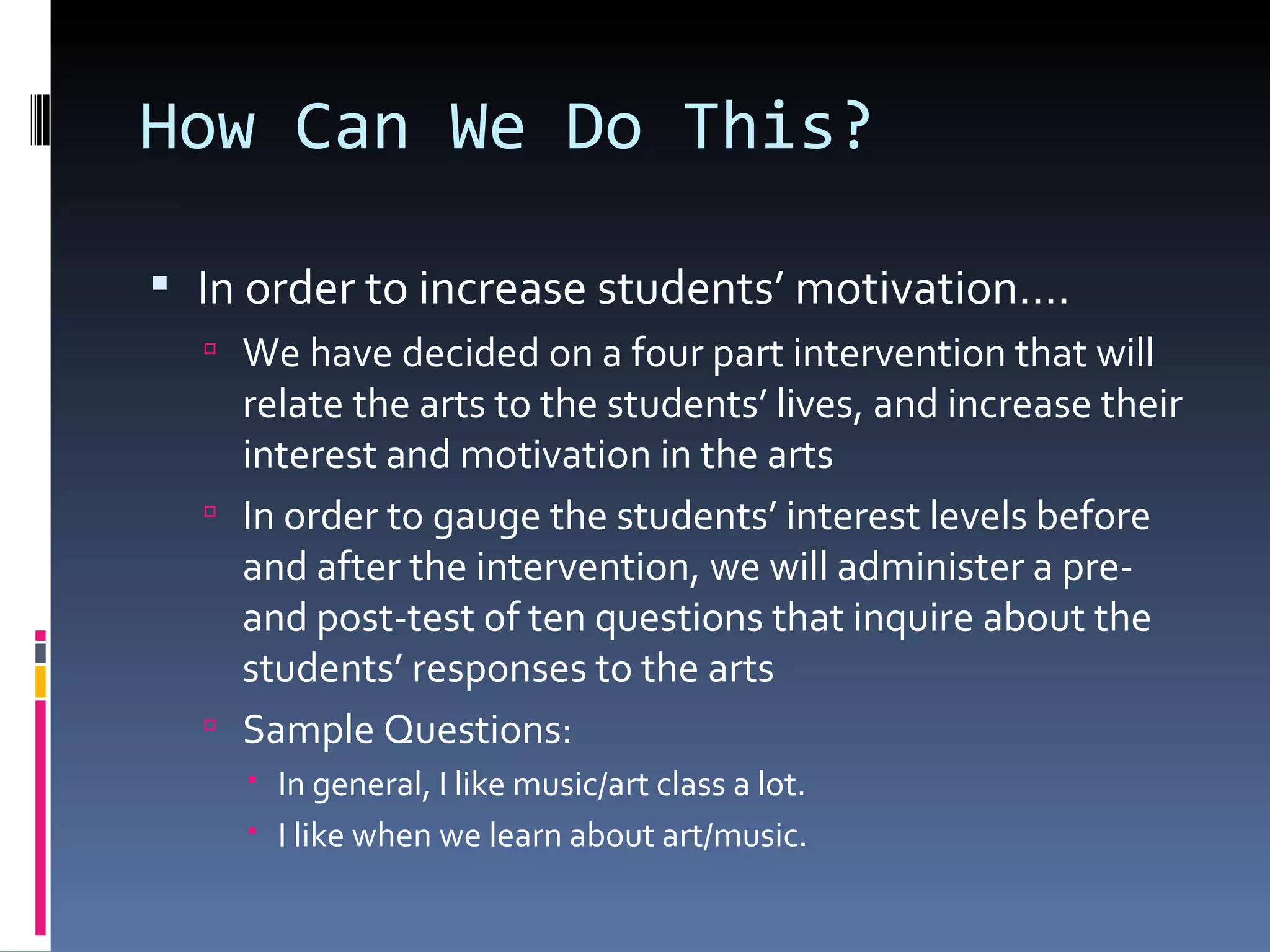
How Can We Do This? In order to increase students’ motivation…. We have decided on a four part intervention that will relate the arts to the students’ lives, and increase their interest and motivation in the arts In order to gauge the students’ interest levels before and after the intervention, we will administer a pre- and post-test of ten questions that inquire about the students’ responses to the arts Sample Questions: In general, I like music/art class a lot. I like when we learn about art/music.
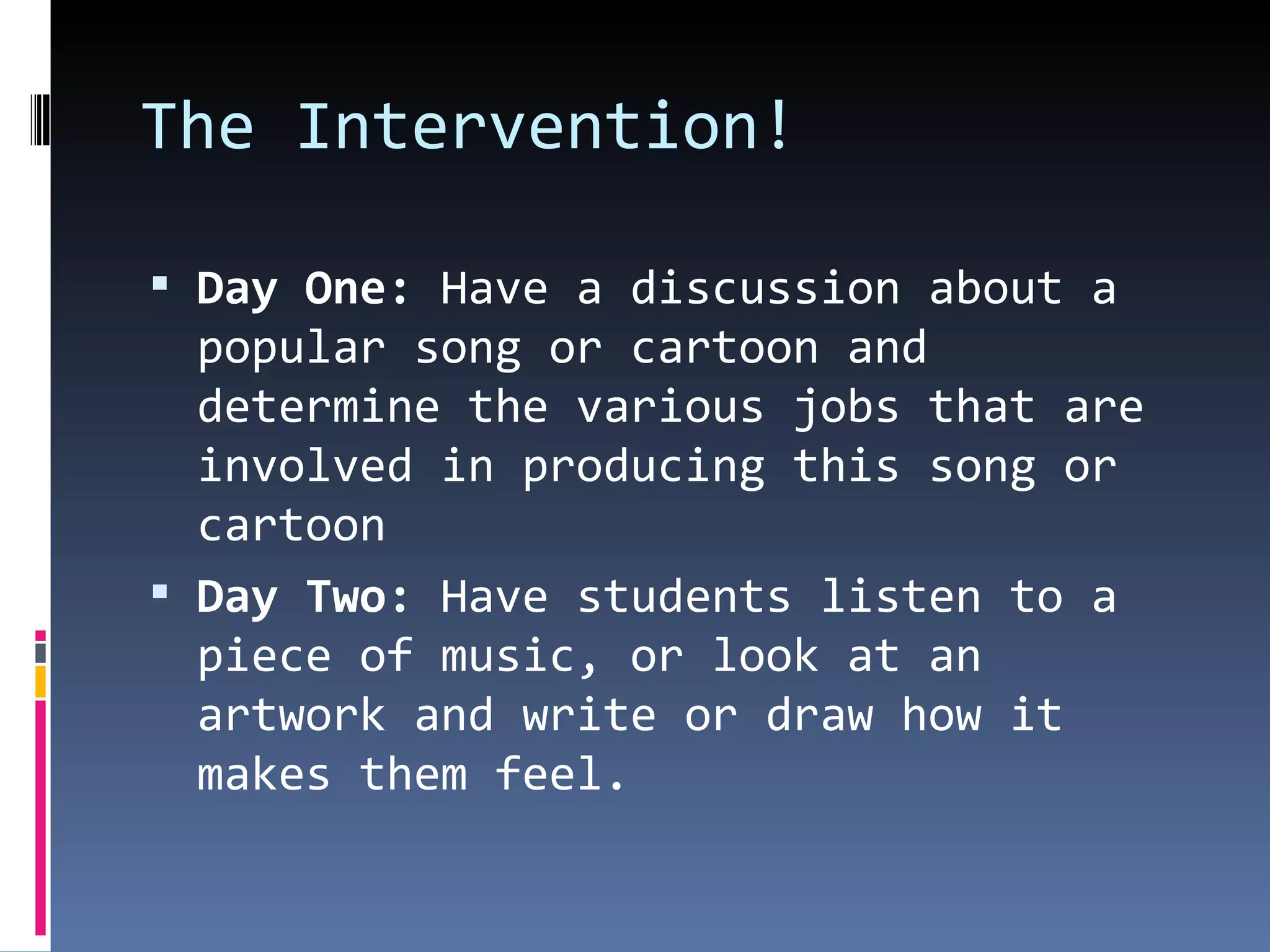
The Intervention! Day One:  Have a discussion about a popular song or cartoon and  determine the various jobs that are involved in producing this song or cartoon Day Two:  Have students listen to a piece of music, or look at an artwork and write or draw how it makes them feel.
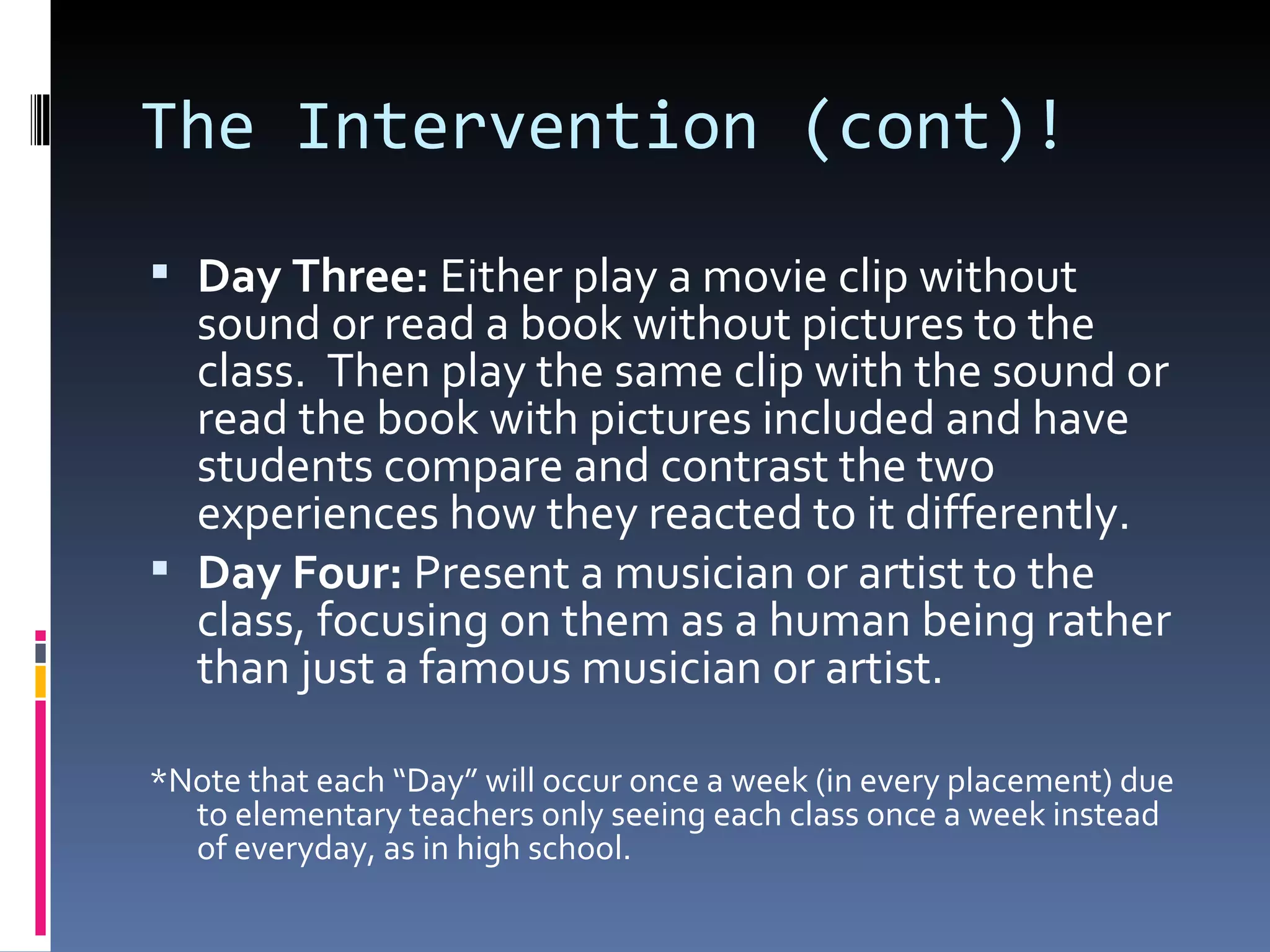
The Intervention (cont)! Day Three:  Either play a movie clip without sound or read a book without pictures to the class.  Then play the same clip with the sound or read the book with pictures included and have students compare and contrast the two experiences how they reacted to it differently. Day Four:  Present a musician or artist to the class, focusing on them as a human being rather than just a famous musician or artist. *Note that each “Day” will occur once a week (in every placement) due to elementary teachers only seeing each class once a week instead of everyday, as in high school.
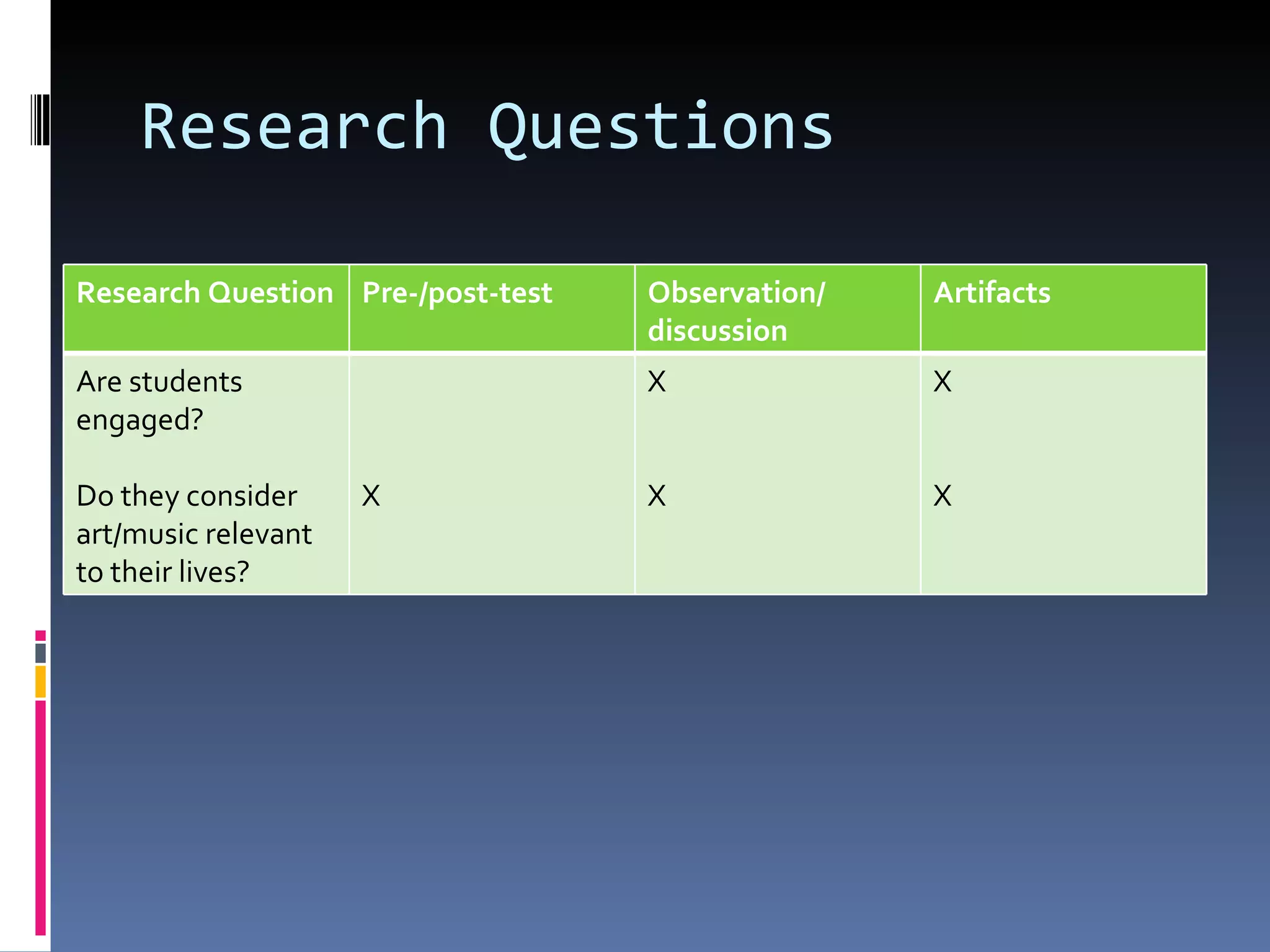
Research Questions Research Question Pre-/post-test Observation/ discussion Artifacts Are students engaged? Do they consider art/music relevant to their lives? X X X X X
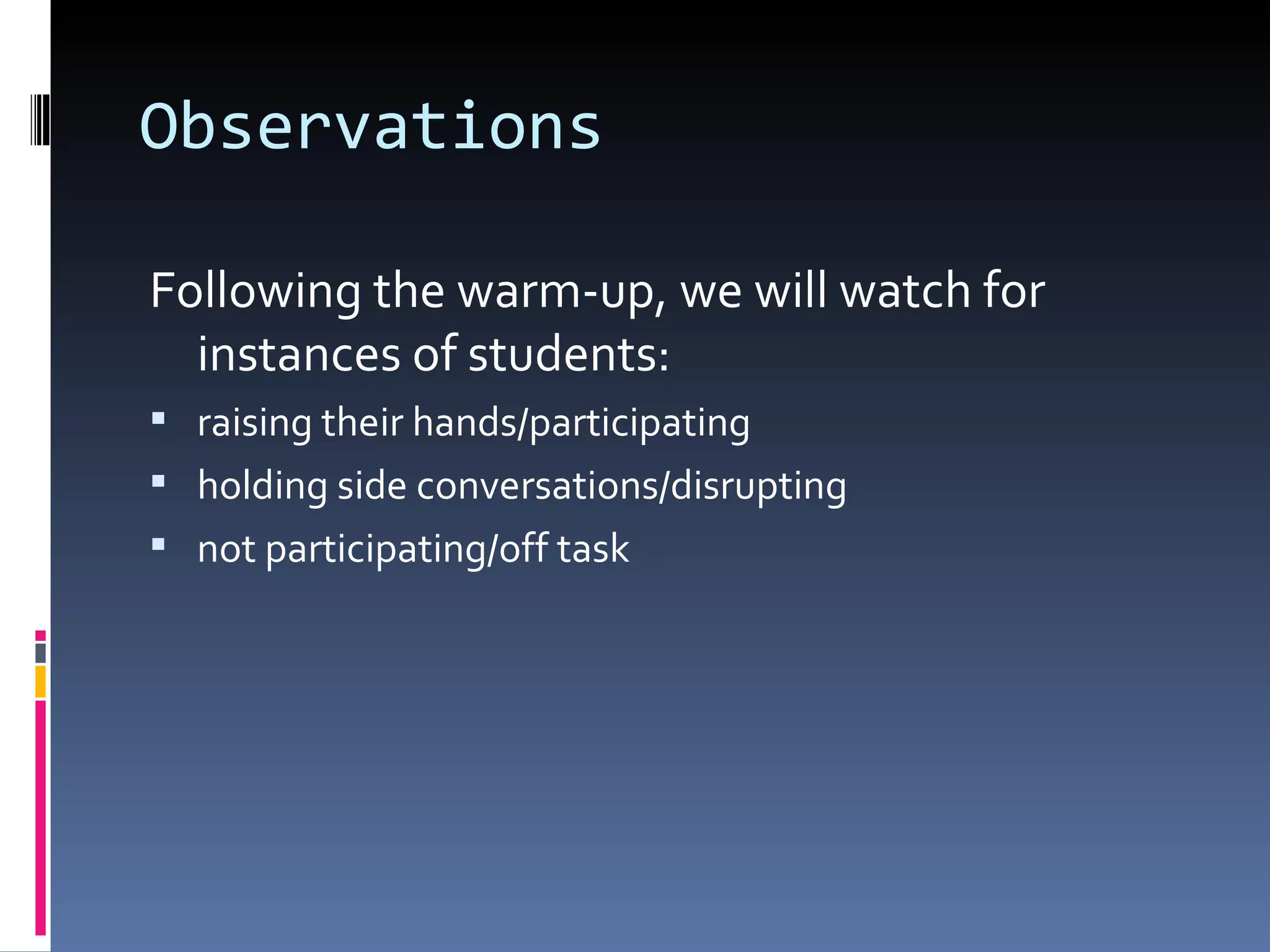
Observations Following the warm-up, we will watch for instances of students: raising their hands/participating holding side conversations/disrupting not participating/off task
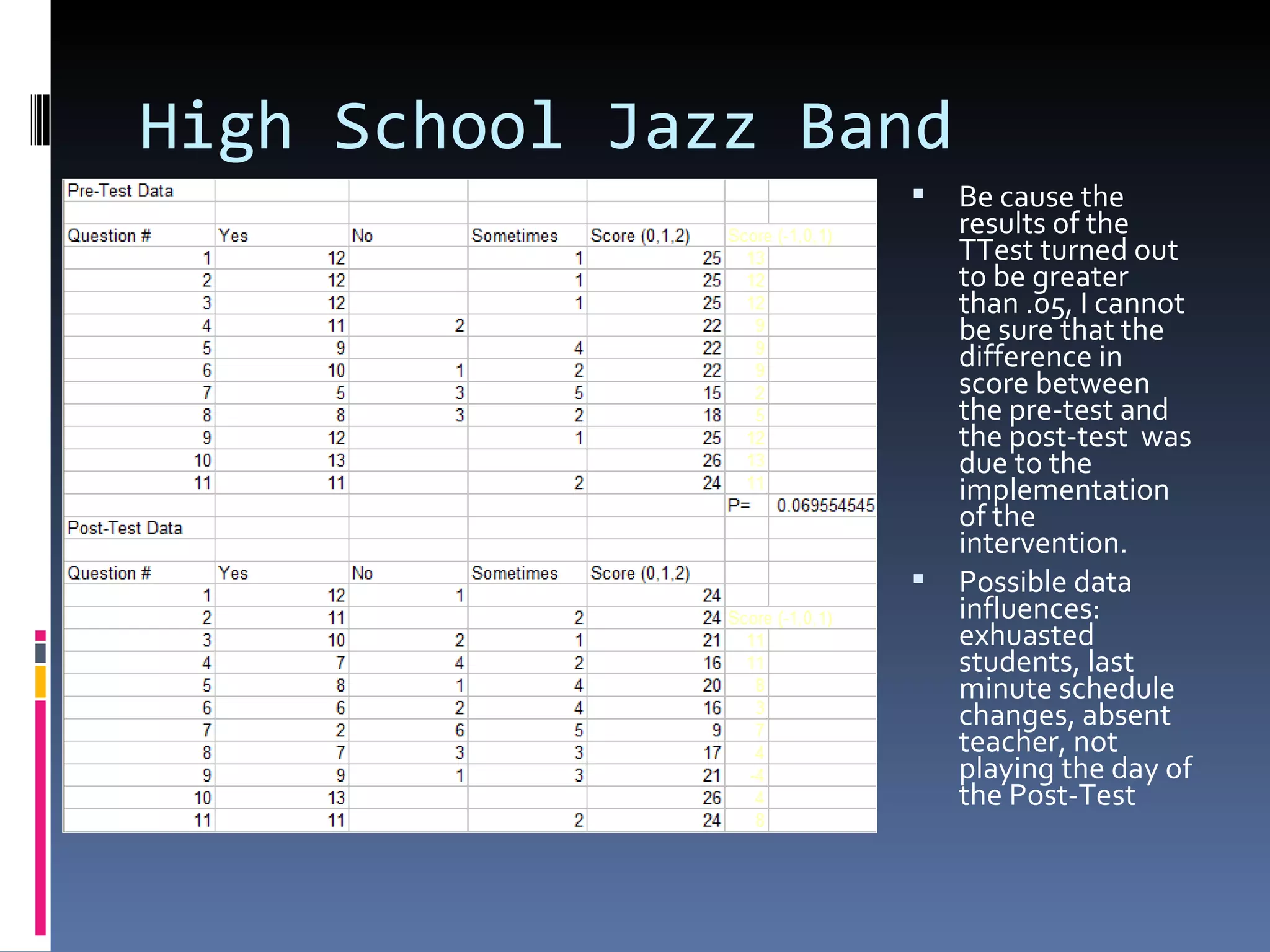
High School Jazz Band Be cause the results of the TTest turned out to be greater than .05, I cannot be sure that the difference in score between the pre-test and the post-test  was due to the implementation of the intervention. Possible data influences: exhuasted students, last minute schedule changes, absent teacher, not playing the day of the Post-Test
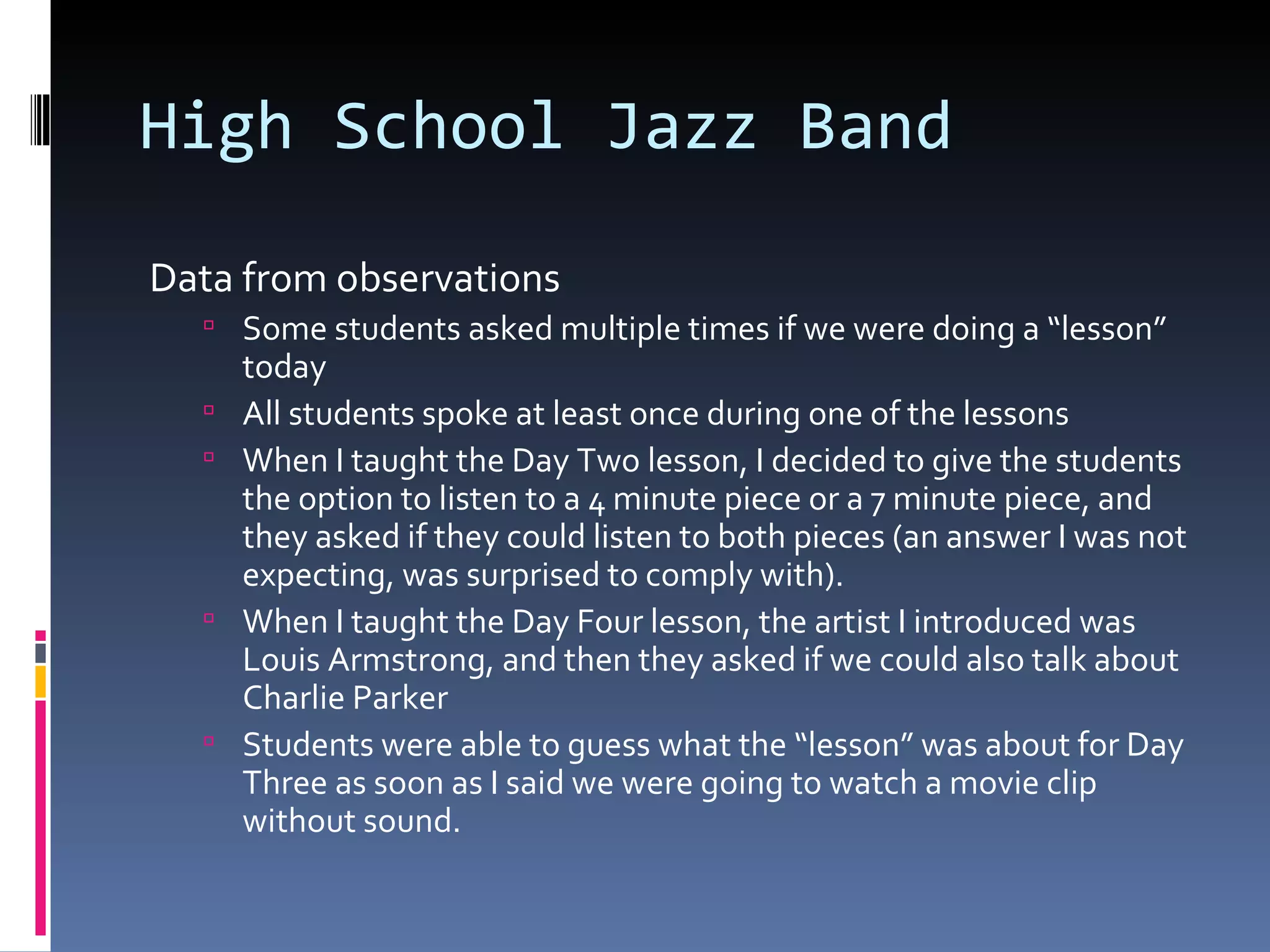
High School Jazz Band Data from observations Some students asked multiple times if we were doing a “lesson” today All students spoke at least once during one of the lessons When I taught the Day Two lesson, I decided to give the students the option to listen to a 4 minute piece or a 7 minute piece, and they asked if they could listen to both pieces (an answer I was not expecting, was surprised to comply with). When I taught the Day Four lesson, the artist I introduced was Louis Armstrong, and then they asked if we could also talk about Charlie Parker Students were able to guess what the “lesson” was about for Day Three as soon as I said we were going to watch a movie clip without sound.
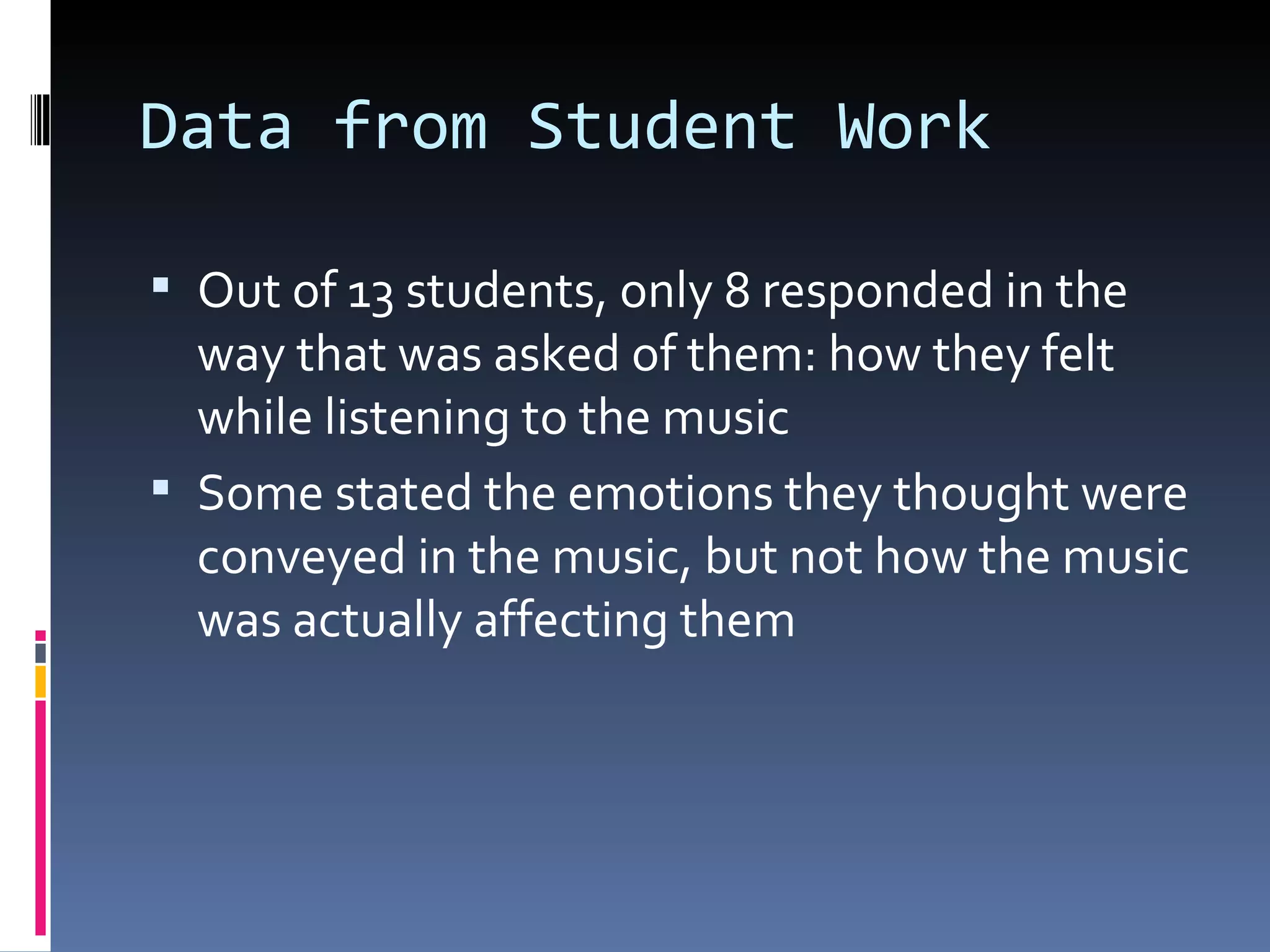
Data from Student Work Out of 13 students, only 8 responded in the way that was asked of them: how they felt while listening to the music Some stated the emotions they thought were conveyed in the music, but not how the music was actually affecting them
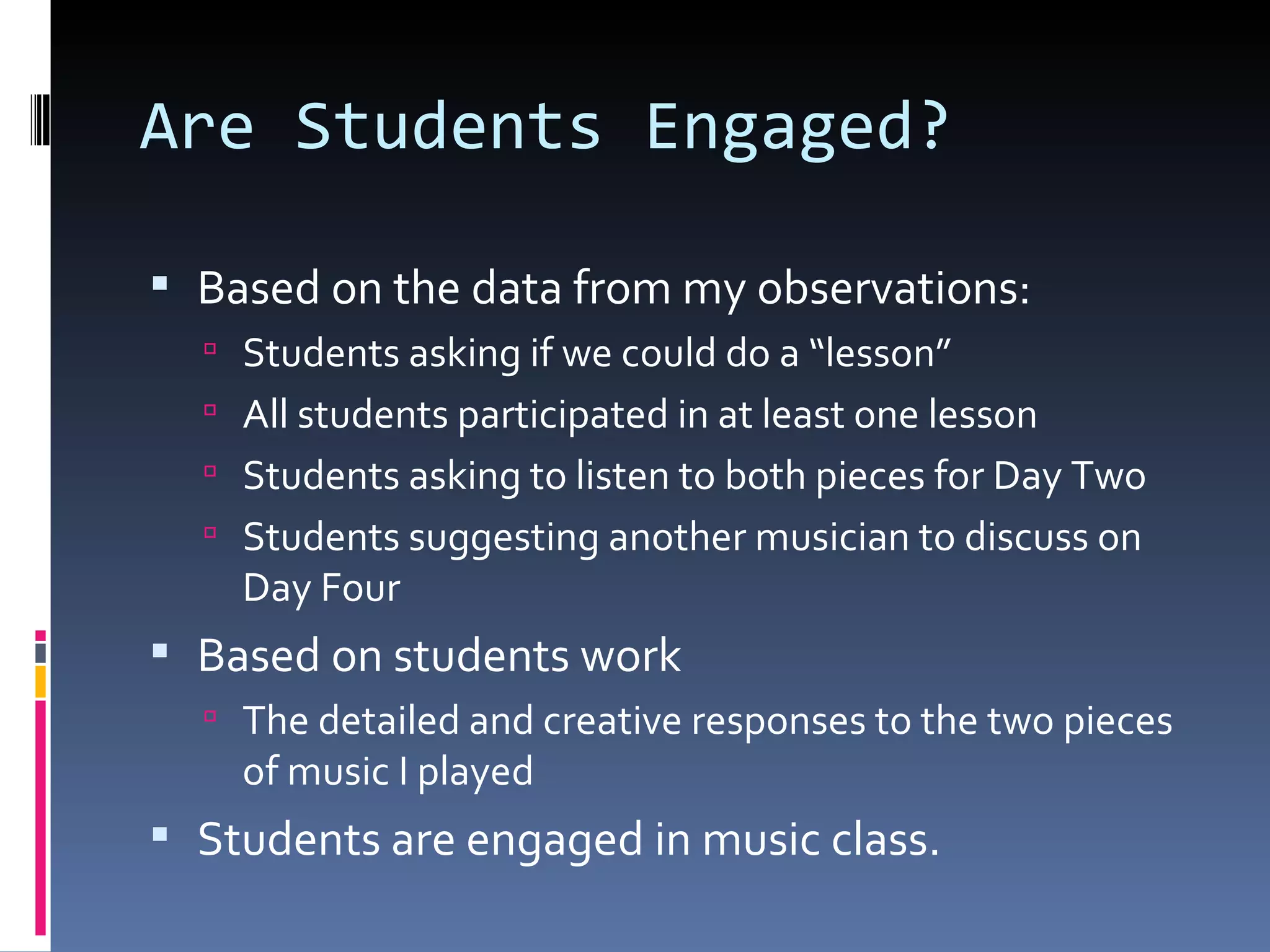
Are Students Engaged? Based on the data from my observations: Students asking if we could do a “lesson” All students participated in at least one lesson Students asking to listen to both pieces for Day Two Students suggesting another musician to discuss on Day Four Based on students work The detailed and creative responses to the two pieces of music I played Students are engaged in music class.
Do Students Consider Music Relevant to Their Lives? Based on individual answers to these questions (highest number of “yeses” on both Pre- and Post-Tests): Do you think about music outside of class? Do you listen to or make music outside of school? Do you enjoy music? Yes, most of the students do consider music relevant to their lives.
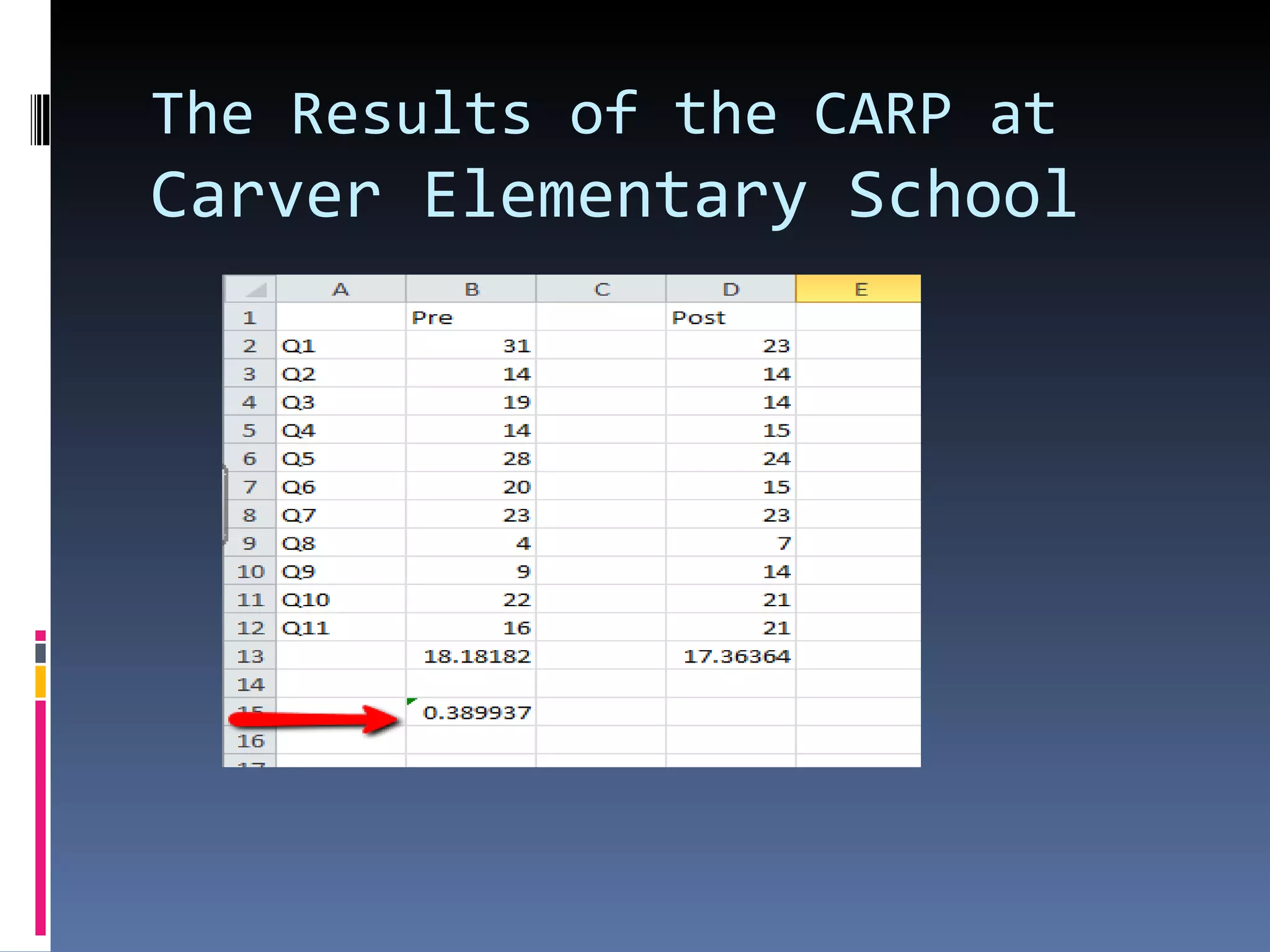
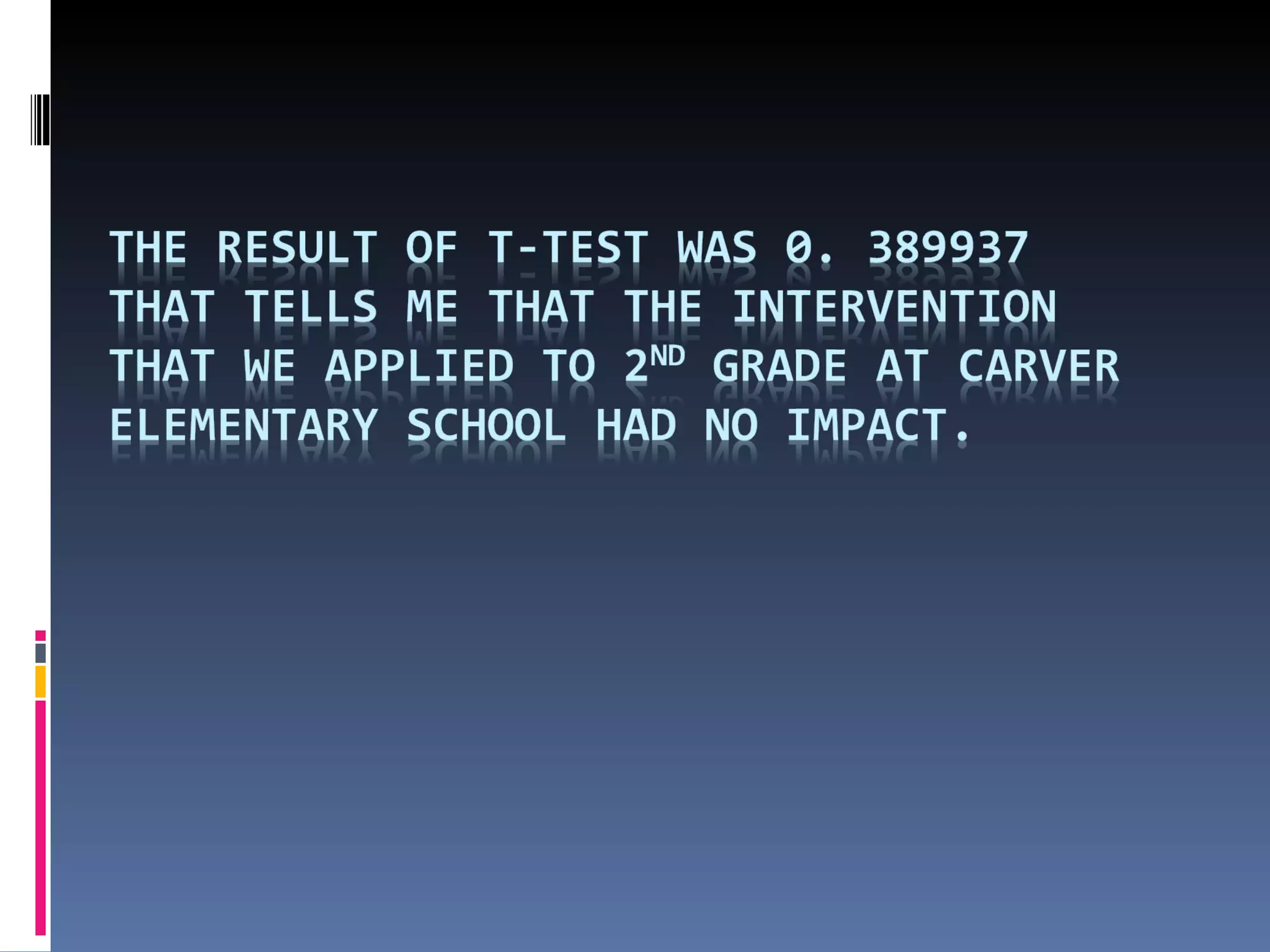
The Results of the CARP at  Carver Elementary School
 
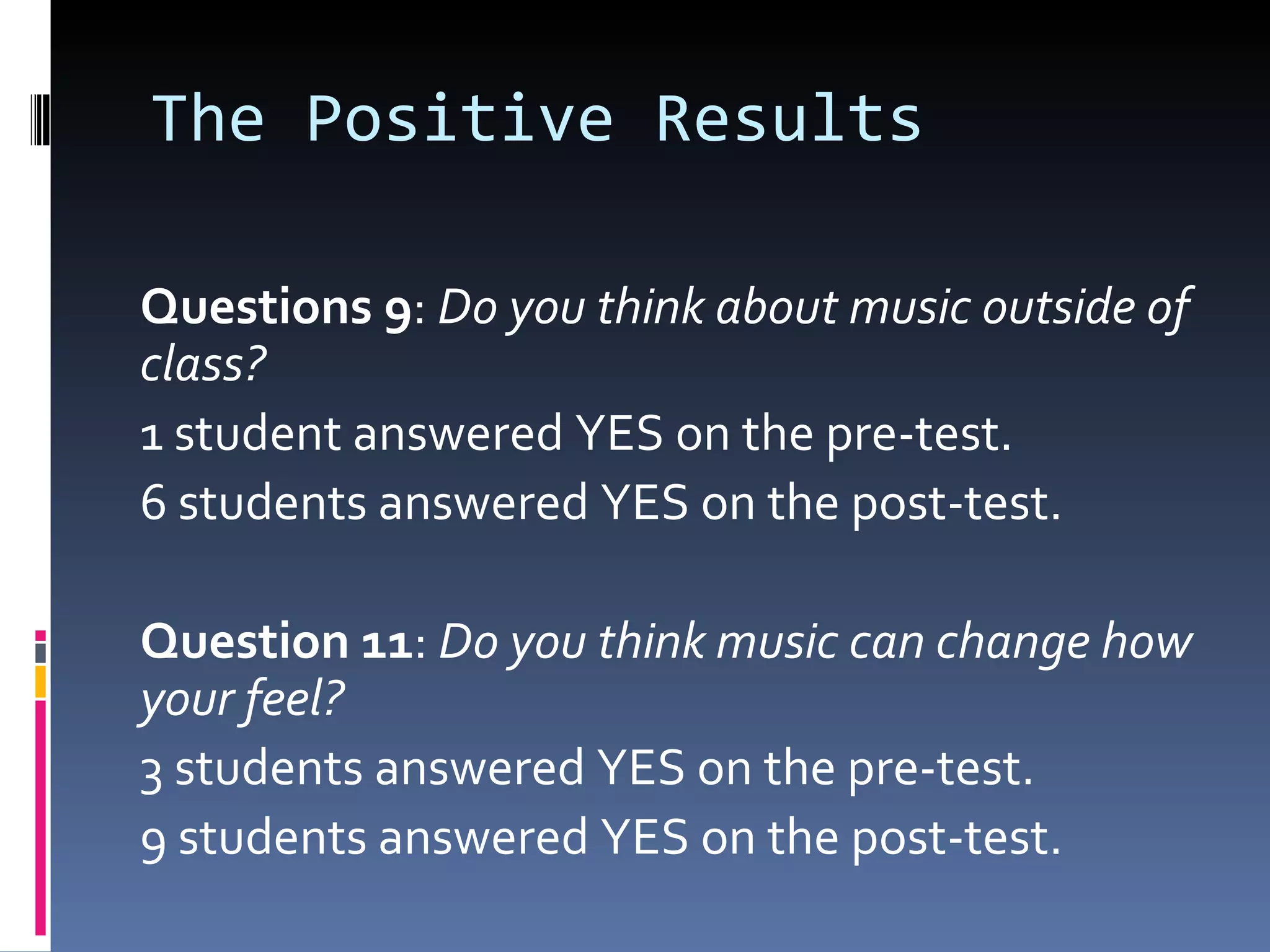
The Positive Results  Questions 9 :  Do you think about music outside of class? 1 student answered YES on the pre-test. 6 students answered YES on the post-test. Question 11 :  Do you think music can change how your feel? 3 students answered YES on the pre-test. 9 students answered YES on the post-test.
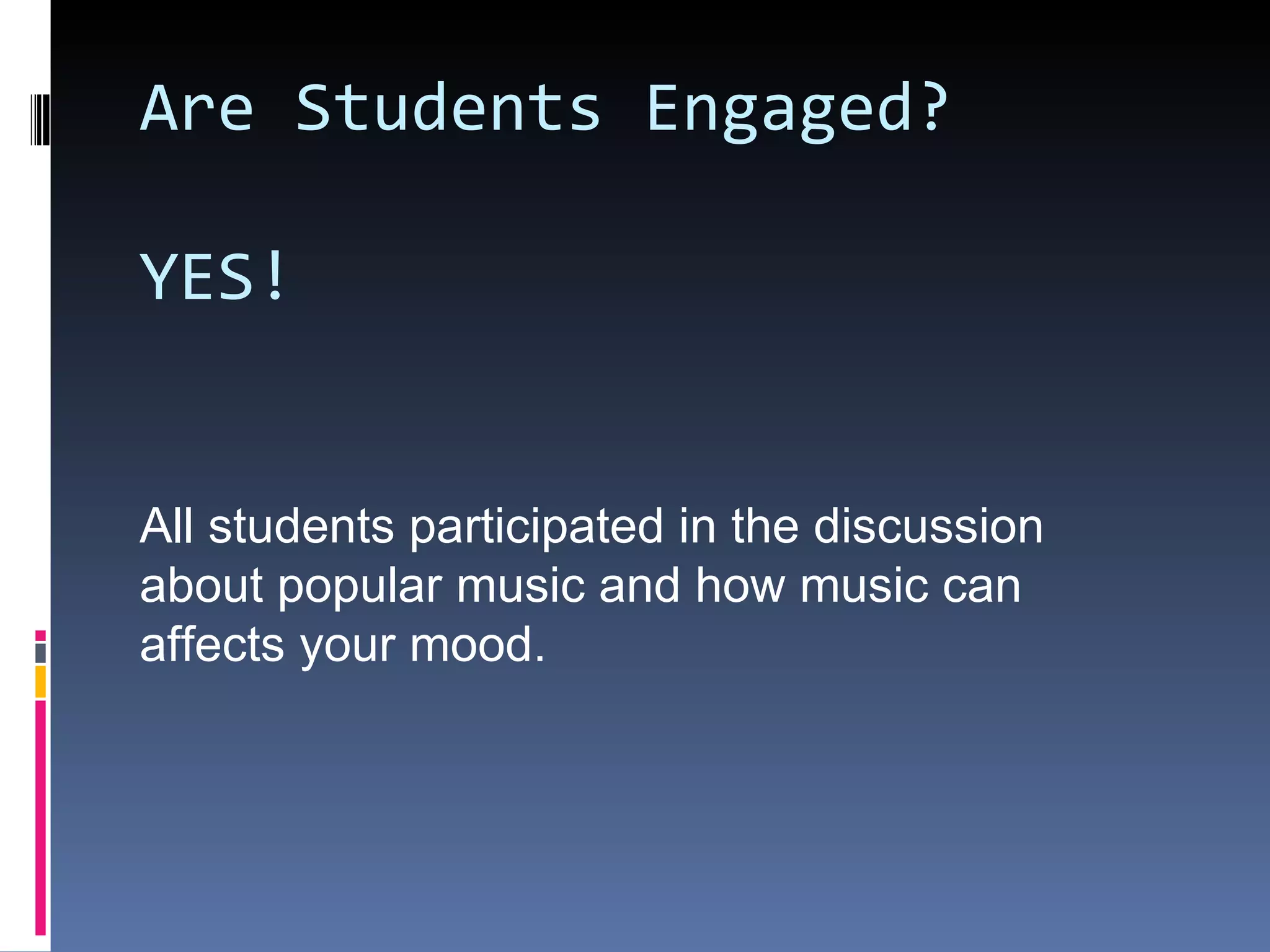
Are Students Engaged?  YES! All students participated in the discussion about popular music and how music can affects your mood.
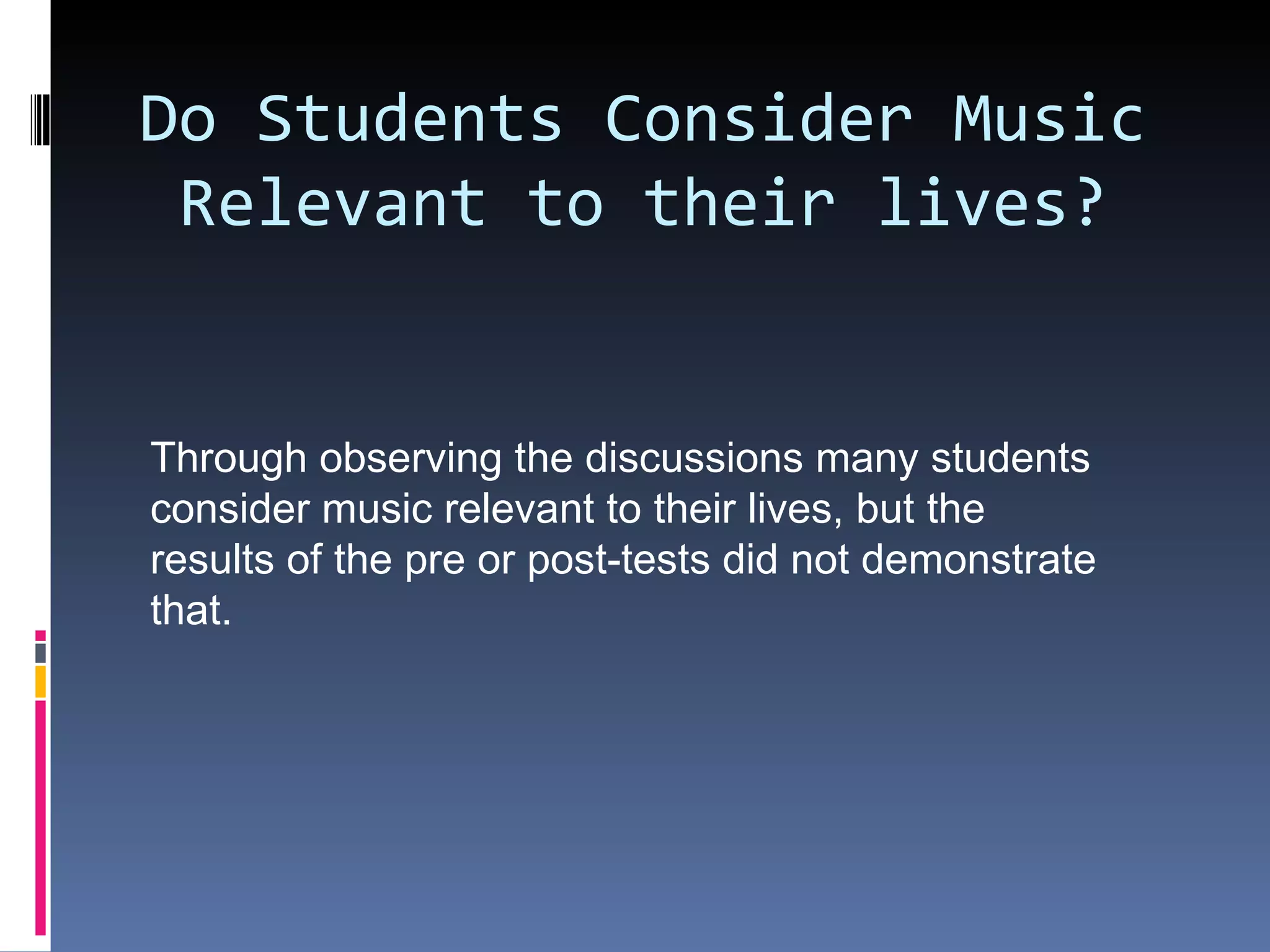
Do Students Consider Music   Relevant to their lives?  Through observing the discussions many students consider music relevant to their lives, but the results of the pre or post-tests did not demonstrate that.
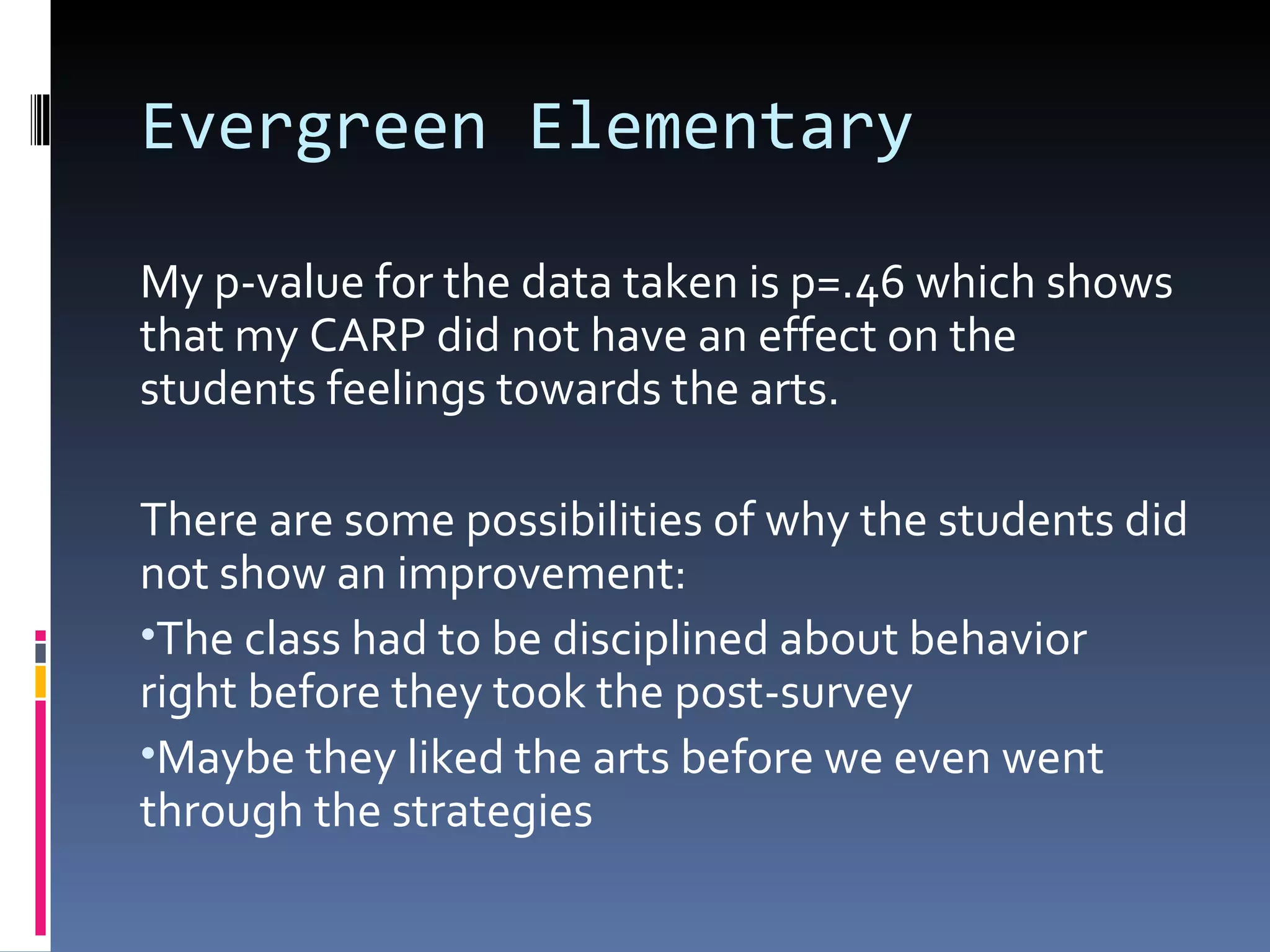
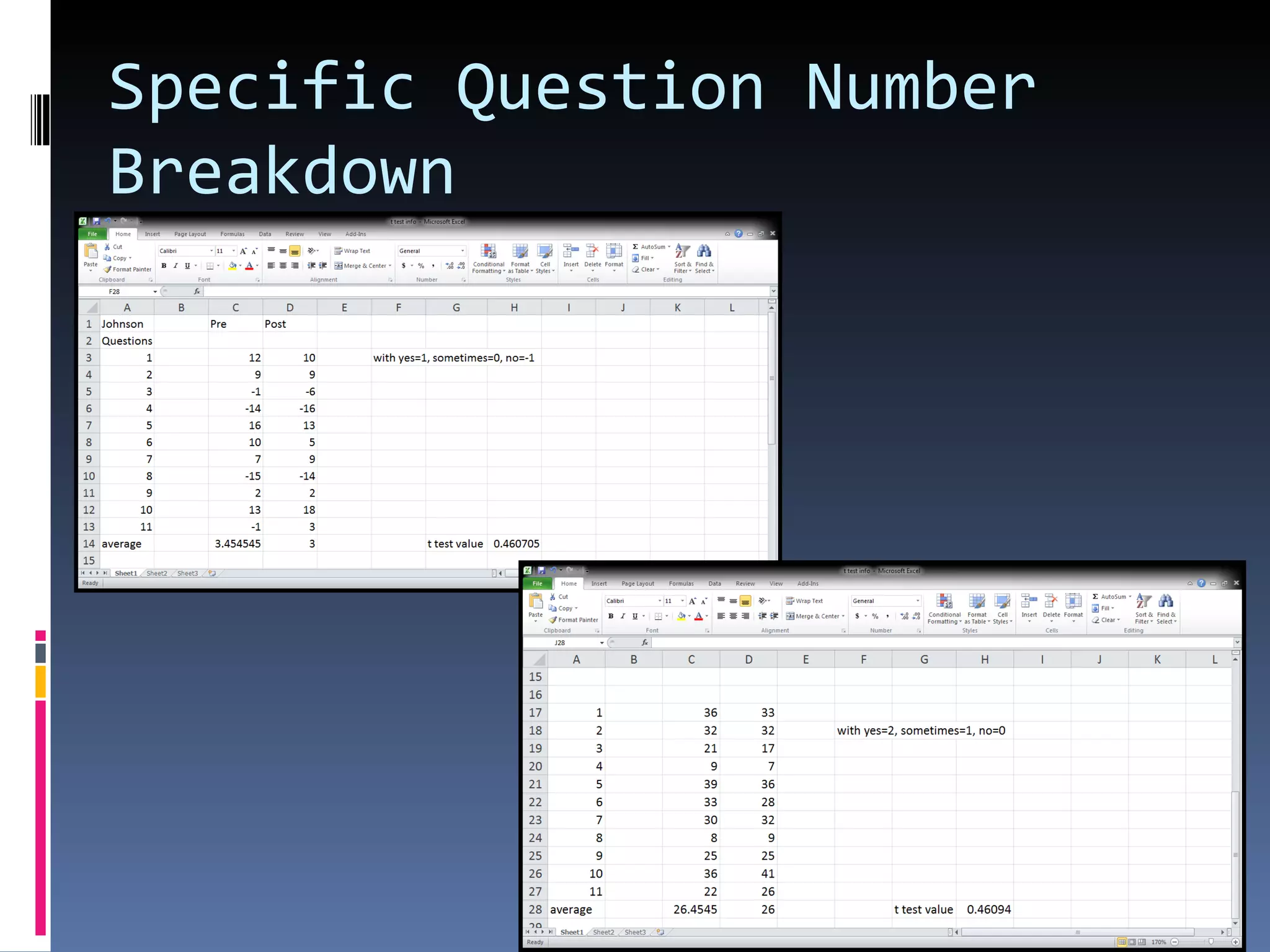
Evergreen Elementary My p-value for the data taken is p=.46 which shows that my CARP did not have an effect on the students feelings towards the arts. There are some possibilities of why the students did not show an improvement: The class had to be disciplined about behavior right before they took the post-survey Maybe they liked the arts before we even went through the strategies
Specific Question Number Breakdown
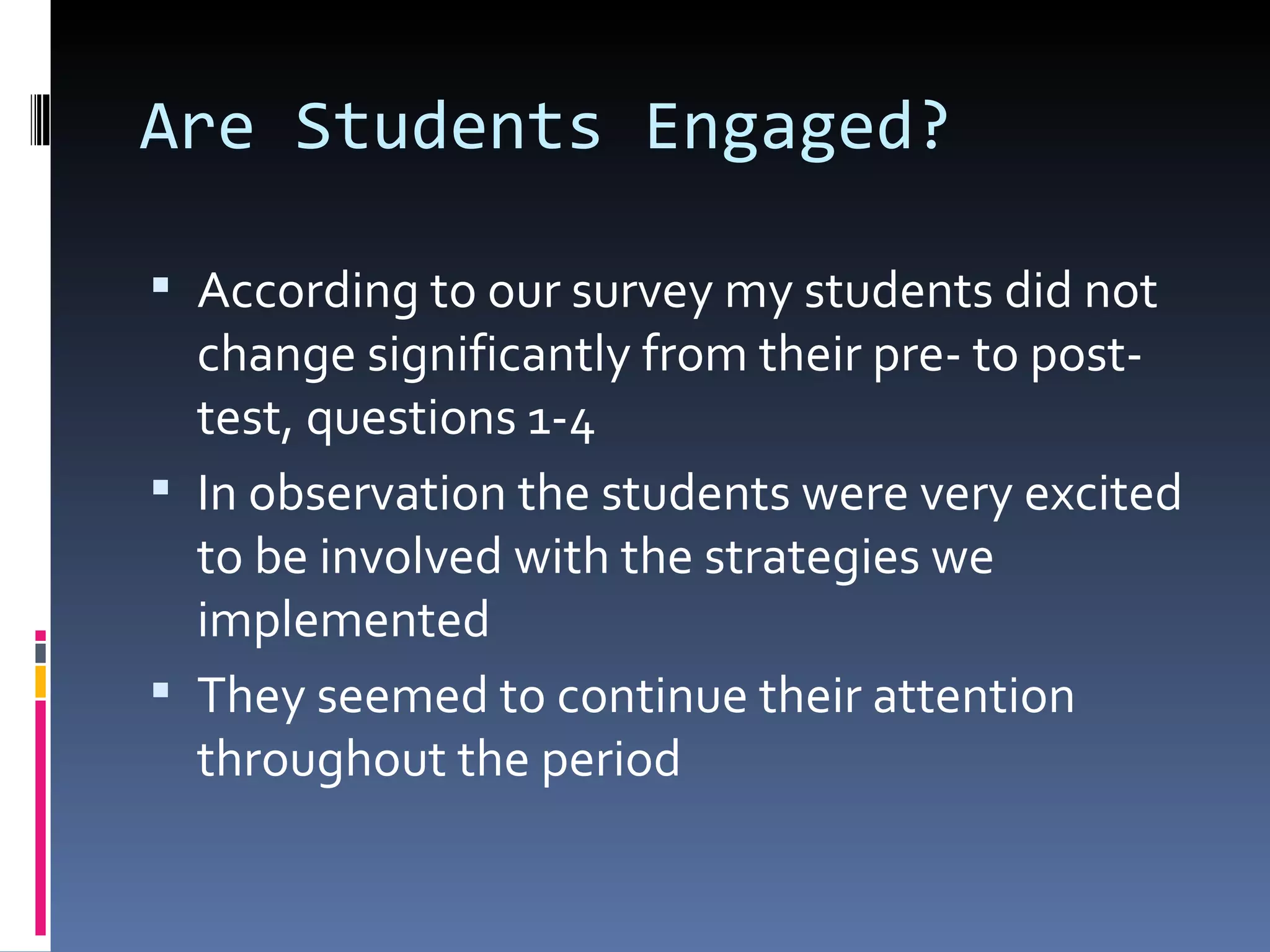
Are Students Engaged? According to our survey my students did not change significantly from their pre- to post-test, questions 1-4 In observation the students were very excited to be involved with the strategies we implemented  They seemed to continue their attention throughout the period
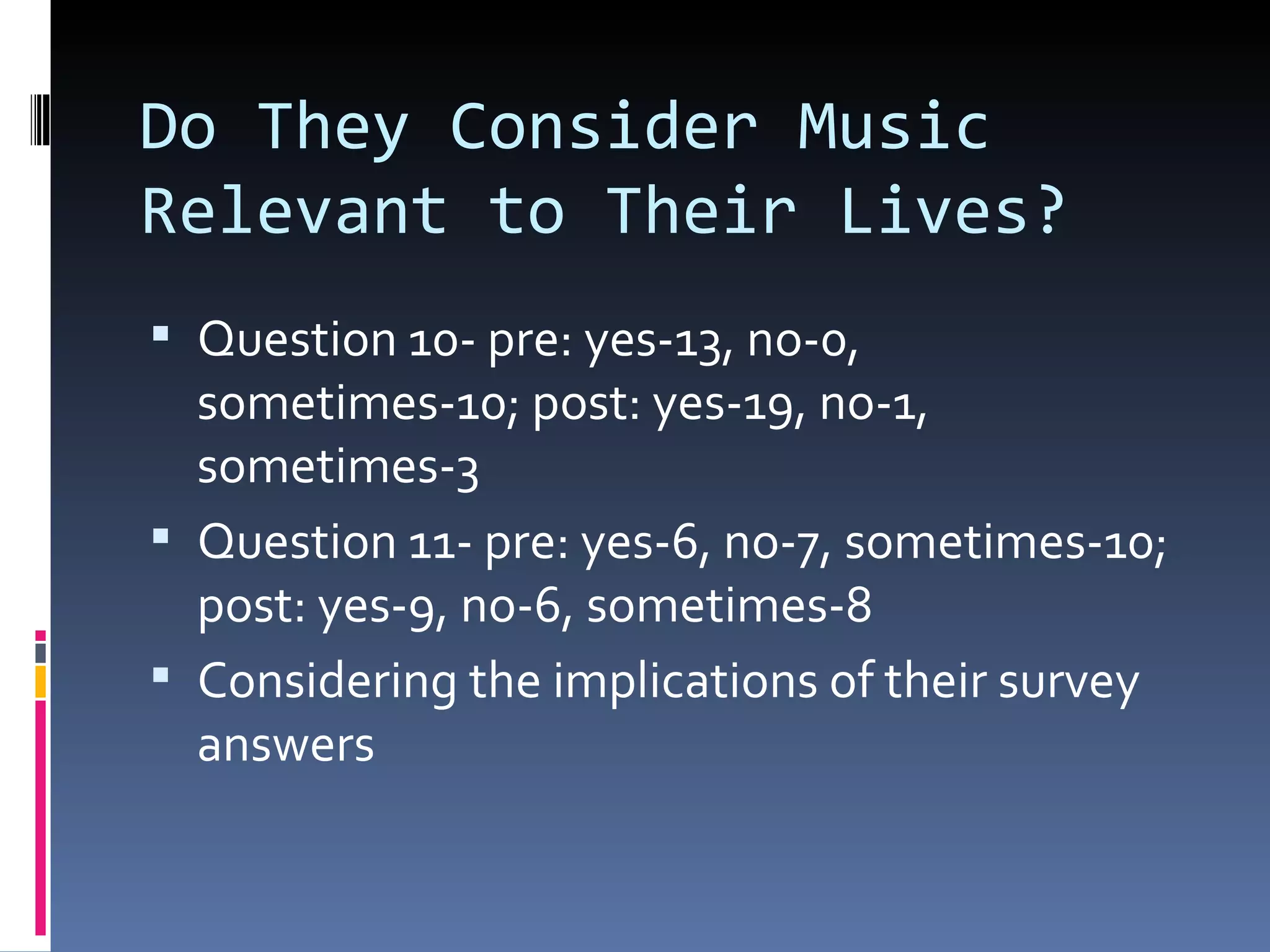
Do They Consider Music Relevant to Their Lives? Question 10- pre: yes-13, no-0, sometimes-10; post: yes-19, no-1, sometimes-3 Question 11- pre: yes-6, no-7, sometimes-10; post: yes-9, no-6, sometimes-8 Considering the implications of their survey answers
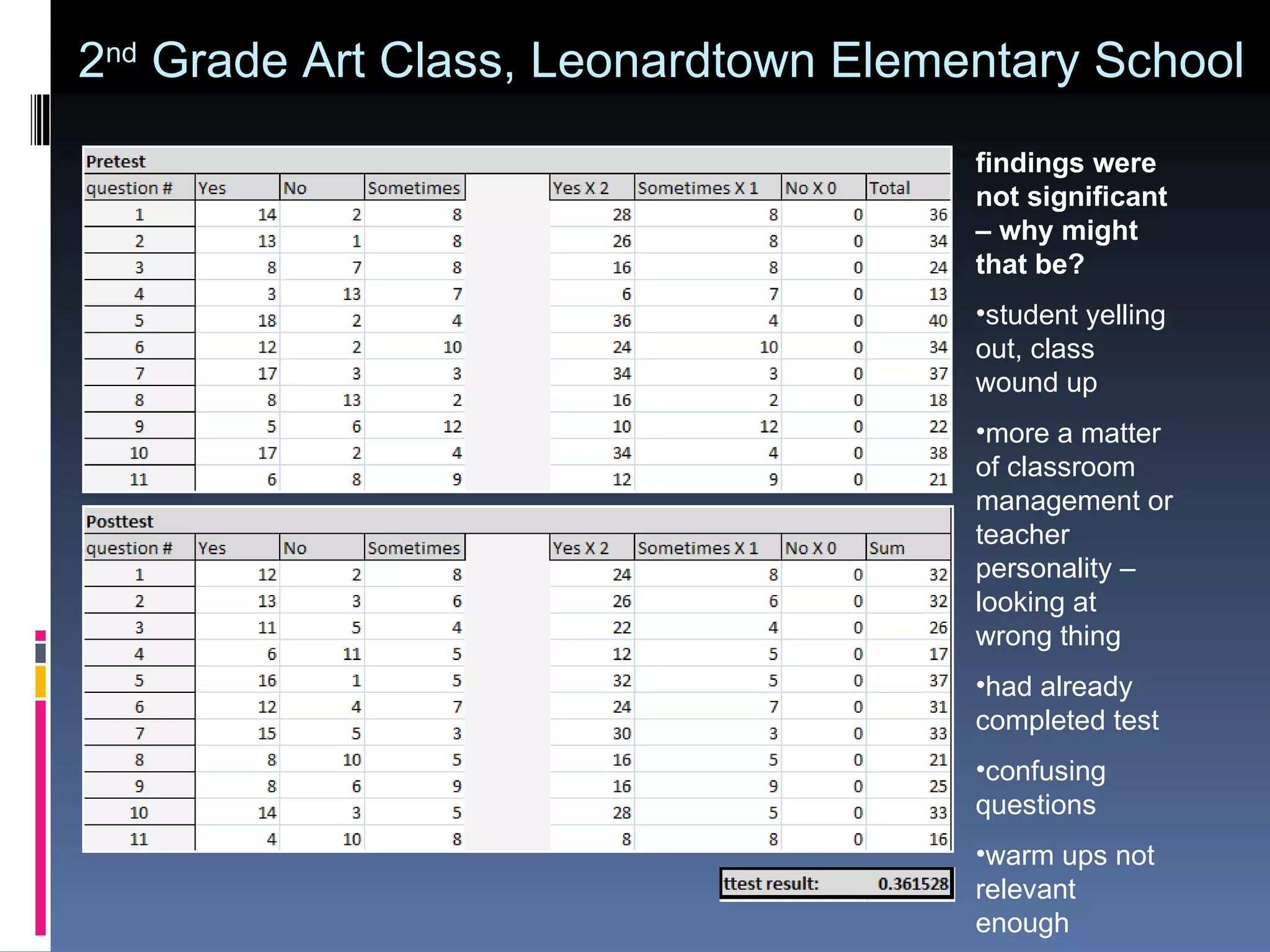
2 nd  Grade Art Class, Leonardtown Elementary School findings were not significant – why might that be? student yelling out, class wound up more a matter of classroom management or teacher personality – looking at wrong thing had already completed test confusing questions  warm ups not relevant enough
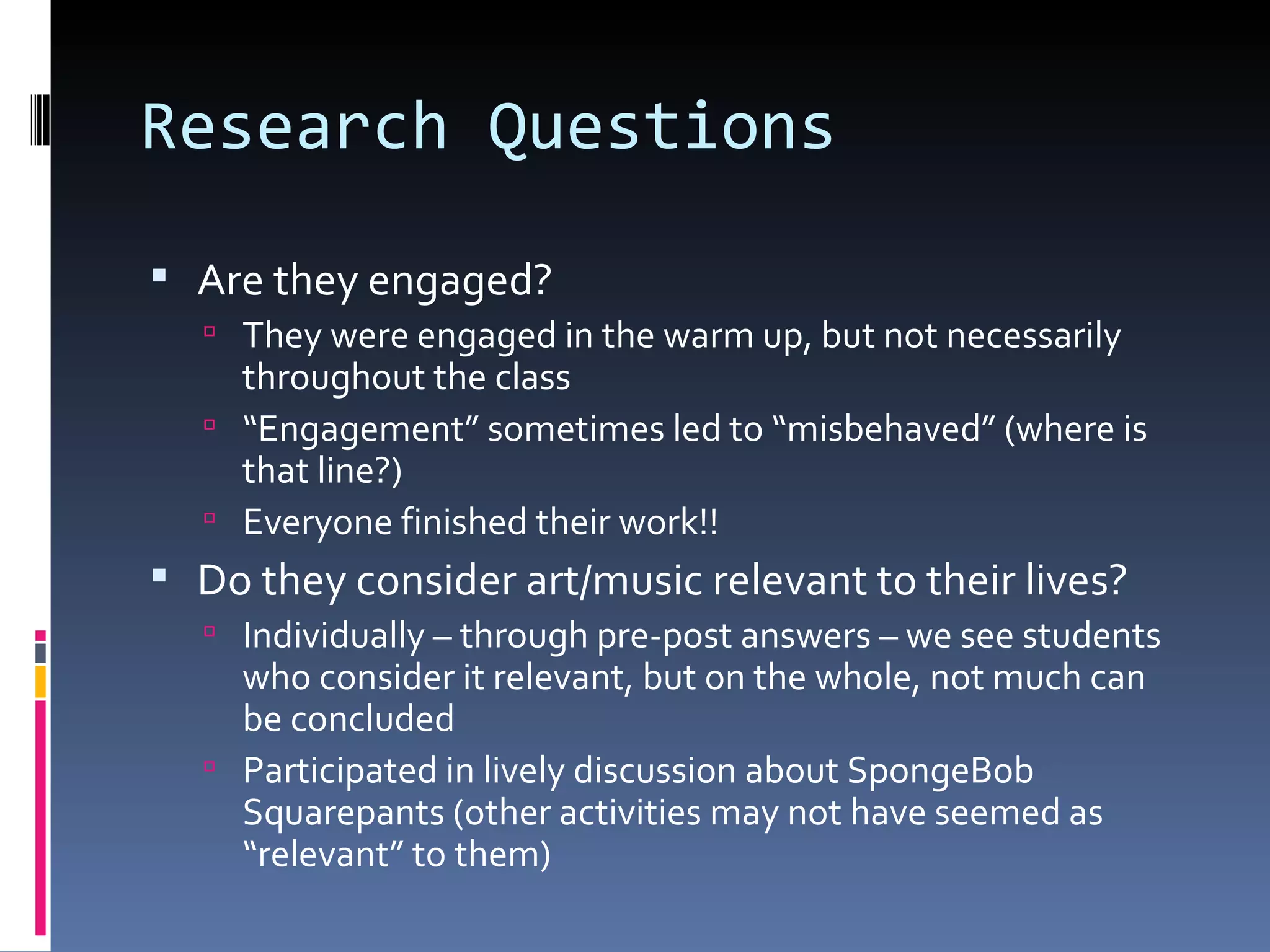
Research Questions Are they engaged? They were engaged in the warm up, but not necessarily throughout the class “ Engagement” sometimes led to “misbehaved” (where is that line?) Everyone finished their work!! Do they consider art/music relevant to their lives? Individually – through pre-post answers – we see students who consider it relevant, but on the whole, not much can be concluded Participated in lively discussion about SpongeBob Squarepants (other activities may not have seemed as “relevant” to them)
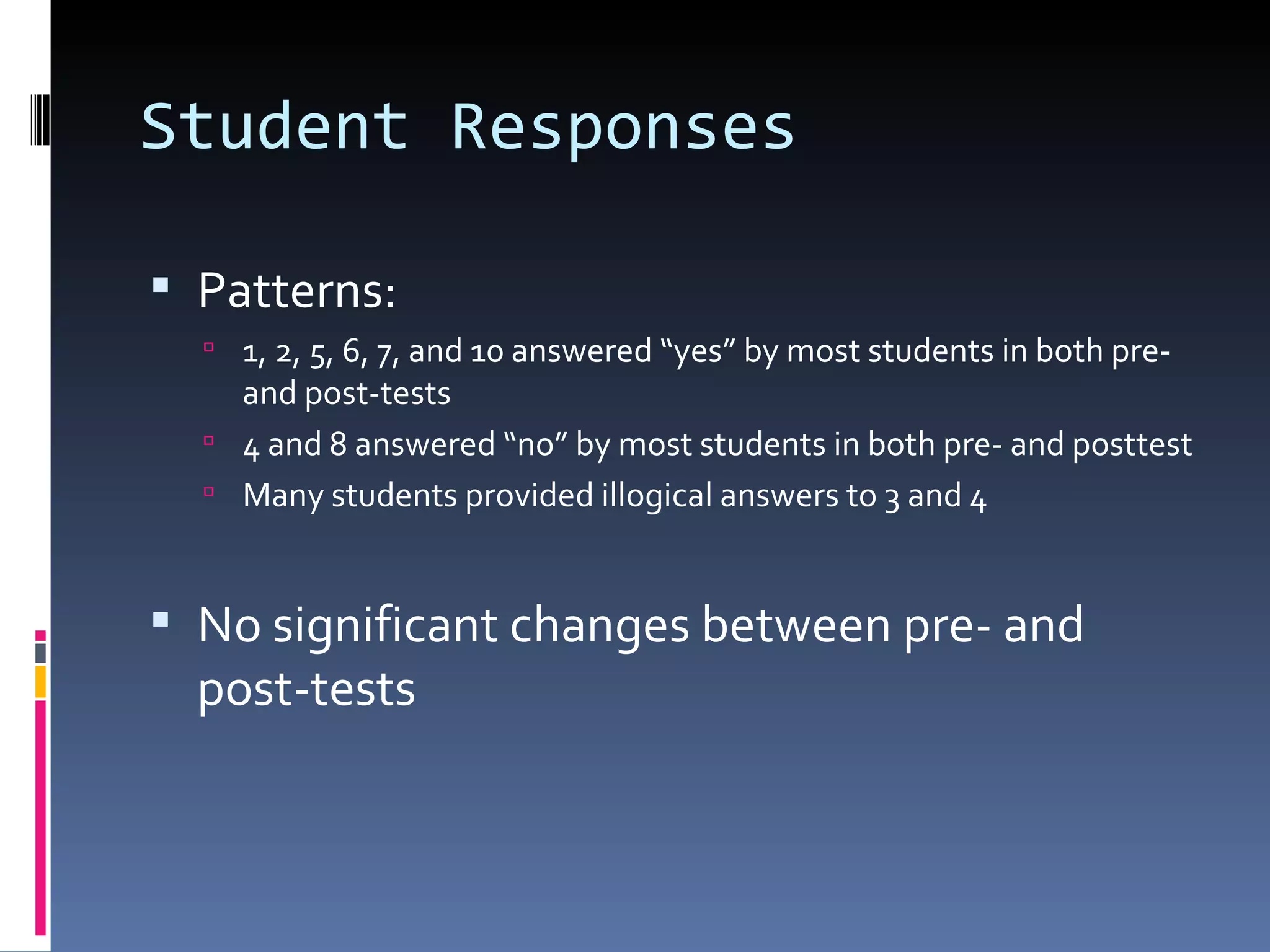
Student Responses Patterns: 1, 2, 5, 6, 7, and 10 answered “yes” by most students in both pre- and post-tests 4 and 8 answered “no” by most students in both pre- and posttest Many students provided illogical answers to 3 and 4 No significant changes between pre- and post-tests
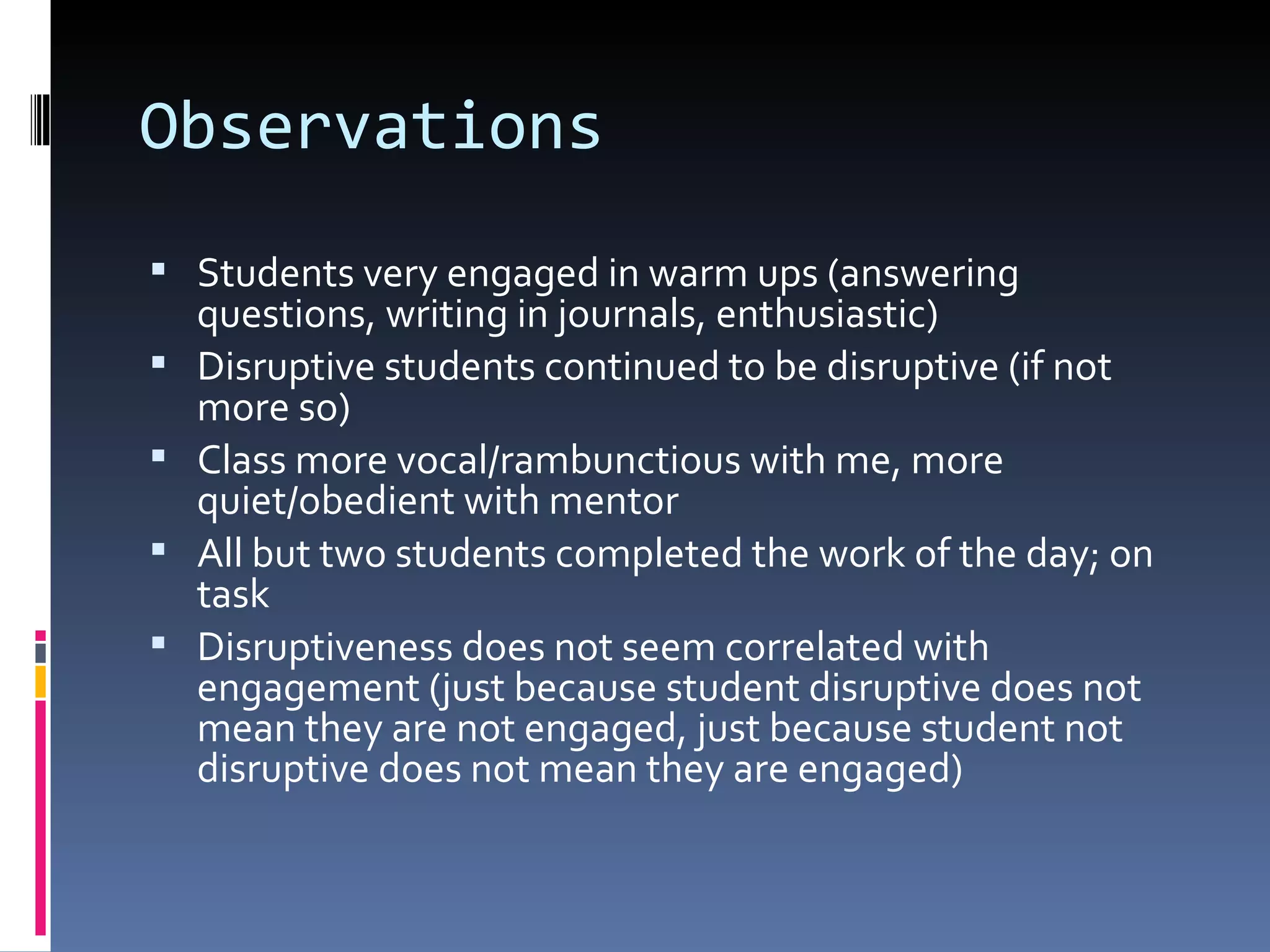
Observations Students very engaged in warm ups (answering questions, writing in journals, enthusiastic) Disruptive students continued to be disruptive (if not more so) Class more vocal/rambunctious with me, more quiet/obedient with mentor All but two students completed the work of the day; on task Disruptiveness does not seem correlated with engagement (just because student disruptive does not mean they are not engaged, just because student not disruptive does not mean they are engaged)
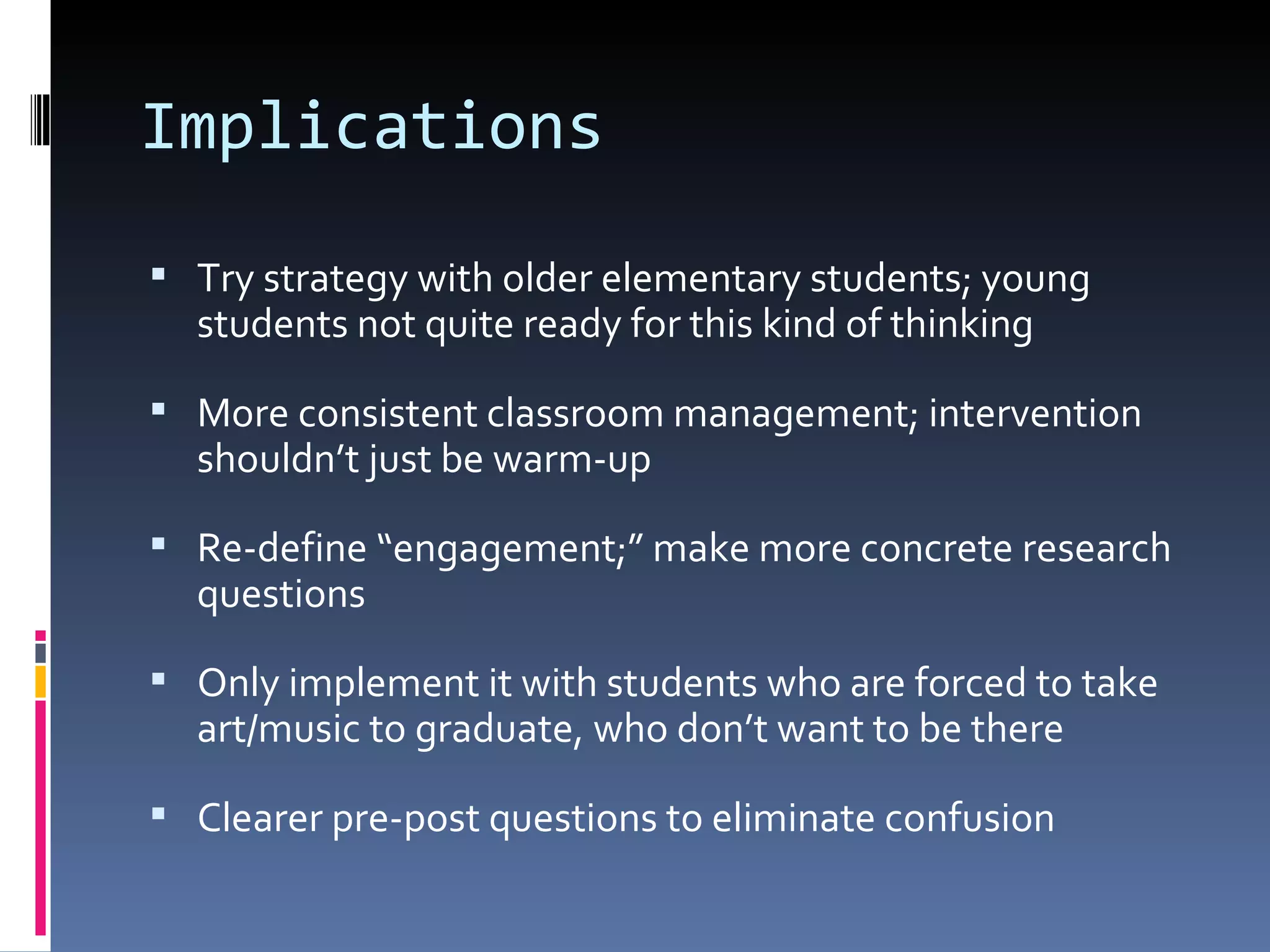
Implications Try strategy with older elementary students; young students not quite ready for this kind of thinking More consistent classroom management; intervention shouldn’t just be warm-up Re-define “engagement;” make more concrete research questions Only implement it with students who are forced to take art/music to graduate, who don’t want to be there Clearer pre-post questions to eliminate confusion
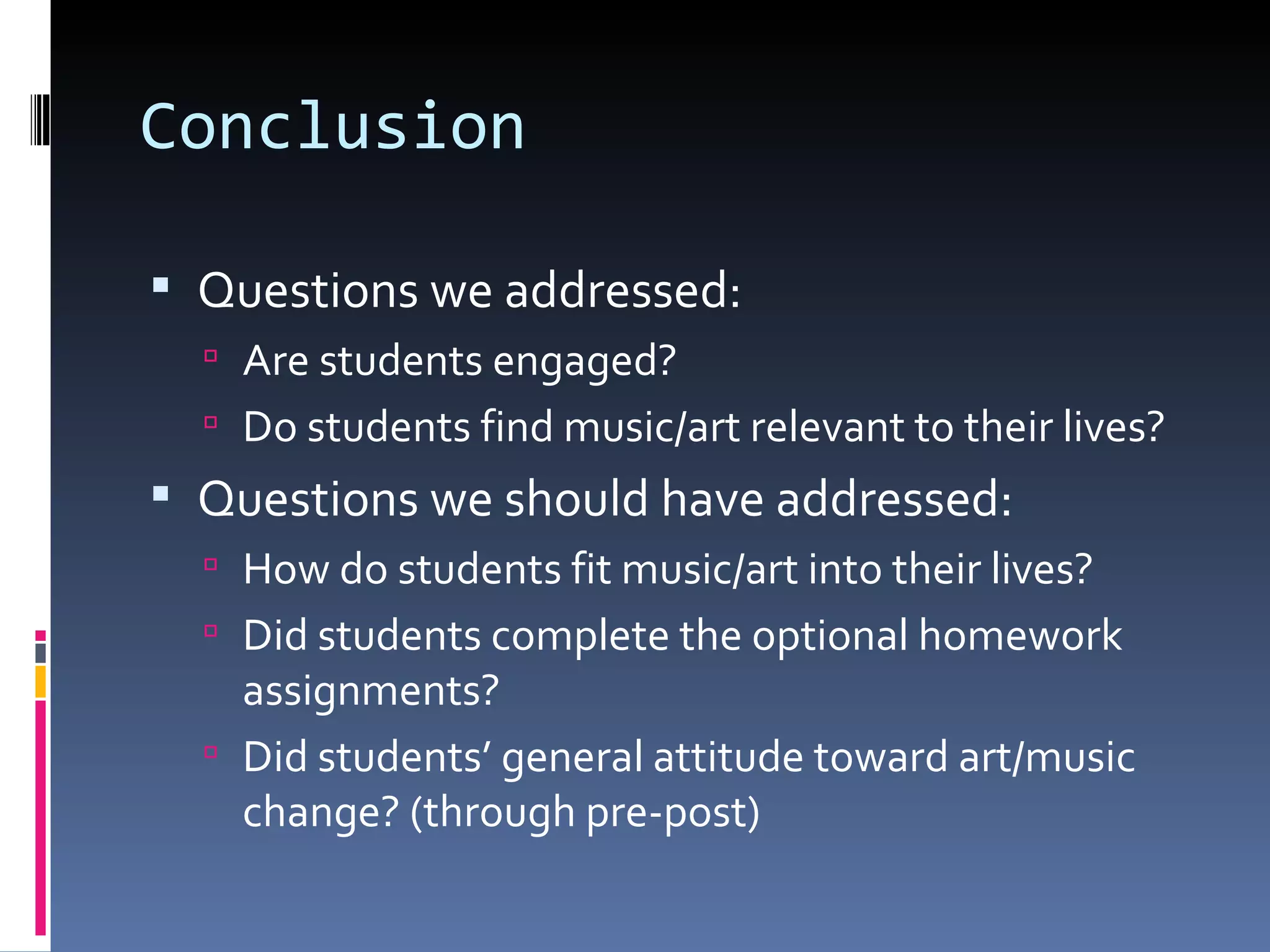
Conclusion Questions we addressed: Are students engaged? Do students find music/art relevant to their lives? Questions we should have addressed: How do students fit music/art into their lives? Did students complete the optional homework assignments? Did students’ general attitude toward art/music change? (through pre-post)

Carp final

  • 1.
    Megan Howell SarahKramer Takako Mato Linda Cruikshank
  • 2.
    Introduction Where arewe? Sarah (Art): 2 nd grade art class, Leonardtown Elementary School Linda (Music): 2 nd grade music class, Evergreen Elementary School Takako (Music): 2 nd grade music class, Carver Elementary School Megan (Music): high school jazz band, Chopticon High School What common problem could we hope to solve in Art and Music as well as at the Elementary and High School levels?
  • 3.
    Motivation! What evidencesays there is lack of motivation in the arts? Because none of the School Improvement Plans for our schools reference the arts in any way, we needed to rely on our individual observations at our respective placements. In each of our placements, we have observed students who are disinterested, do not pay attention, or refuse to participate.
  • 4.
    So What? Whydoes it matter if students are not motivated? Unmotivated students’ negative attitudes can affect the rest of class, impeding the opportunities for learning within the lesson.
  • 5.
    How Can WeDo This? In order to increase students’ motivation…. We have decided on a four part intervention that will relate the arts to the students’ lives, and increase their interest and motivation in the arts In order to gauge the students’ interest levels before and after the intervention, we will administer a pre- and post-test of ten questions that inquire about the students’ responses to the arts Sample Questions: In general, I like music/art class a lot. I like when we learn about art/music.
  • 6.
    The Intervention! DayOne: Have a discussion about a popular song or cartoon and determine the various jobs that are involved in producing this song or cartoon Day Two: Have students listen to a piece of music, or look at an artwork and write or draw how it makes them feel.
  • 7.
    The Intervention (cont)!Day Three: Either play a movie clip without sound or read a book without pictures to the class. Then play the same clip with the sound or read the book with pictures included and have students compare and contrast the two experiences how they reacted to it differently. Day Four: Present a musician or artist to the class, focusing on them as a human being rather than just a famous musician or artist. *Note that each “Day” will occur once a week (in every placement) due to elementary teachers only seeing each class once a week instead of everyday, as in high school.
  • 8.
    Research Questions ResearchQuestion Pre-/post-test Observation/ discussion Artifacts Are students engaged? Do they consider art/music relevant to their lives? X X X X X
  • 9.
    Observations Following thewarm-up, we will watch for instances of students: raising their hands/participating holding side conversations/disrupting not participating/off task
  • 10.
    High School JazzBand Be cause the results of the TTest turned out to be greater than .05, I cannot be sure that the difference in score between the pre-test and the post-test was due to the implementation of the intervention. Possible data influences: exhuasted students, last minute schedule changes, absent teacher, not playing the day of the Post-Test
  • 11.
    High School JazzBand Data from observations Some students asked multiple times if we were doing a “lesson” today All students spoke at least once during one of the lessons When I taught the Day Two lesson, I decided to give the students the option to listen to a 4 minute piece or a 7 minute piece, and they asked if they could listen to both pieces (an answer I was not expecting, was surprised to comply with). When I taught the Day Four lesson, the artist I introduced was Louis Armstrong, and then they asked if we could also talk about Charlie Parker Students were able to guess what the “lesson” was about for Day Three as soon as I said we were going to watch a movie clip without sound.
  • 12.
    Data from StudentWork Out of 13 students, only 8 responded in the way that was asked of them: how they felt while listening to the music Some stated the emotions they thought were conveyed in the music, but not how the music was actually affecting them
  • 13.
    Are Students Engaged?Based on the data from my observations: Students asking if we could do a “lesson” All students participated in at least one lesson Students asking to listen to both pieces for Day Two Students suggesting another musician to discuss on Day Four Based on students work The detailed and creative responses to the two pieces of music I played Students are engaged in music class.
  • 14.
    Do Students ConsiderMusic Relevant to Their Lives? Based on individual answers to these questions (highest number of “yeses” on both Pre- and Post-Tests): Do you think about music outside of class? Do you listen to or make music outside of school? Do you enjoy music? Yes, most of the students do consider music relevant to their lives.
  • 15.
    The Results ofthe CARP at Carver Elementary School
  • 16.
  • 17.
    The Positive Results Questions 9 : Do you think about music outside of class? 1 student answered YES on the pre-test. 6 students answered YES on the post-test. Question 11 : Do you think music can change how your feel? 3 students answered YES on the pre-test. 9 students answered YES on the post-test.
  • 18.
    Are Students Engaged? YES! All students participated in the discussion about popular music and how music can affects your mood.
  • 19.
    Do Students ConsiderMusic Relevant to their lives? Through observing the discussions many students consider music relevant to their lives, but the results of the pre or post-tests did not demonstrate that.
  • 20.
    Evergreen Elementary Myp-value for the data taken is p=.46 which shows that my CARP did not have an effect on the students feelings towards the arts. There are some possibilities of why the students did not show an improvement: The class had to be disciplined about behavior right before they took the post-survey Maybe they liked the arts before we even went through the strategies
  • 21.
  • 22.
    Are Students Engaged?According to our survey my students did not change significantly from their pre- to post-test, questions 1-4 In observation the students were very excited to be involved with the strategies we implemented They seemed to continue their attention throughout the period
  • 23.
    Do They ConsiderMusic Relevant to Their Lives? Question 10- pre: yes-13, no-0, sometimes-10; post: yes-19, no-1, sometimes-3 Question 11- pre: yes-6, no-7, sometimes-10; post: yes-9, no-6, sometimes-8 Considering the implications of their survey answers
  • 24.
    2 nd Grade Art Class, Leonardtown Elementary School findings were not significant – why might that be? student yelling out, class wound up more a matter of classroom management or teacher personality – looking at wrong thing had already completed test confusing questions warm ups not relevant enough
  • 25.
    Research Questions Arethey engaged? They were engaged in the warm up, but not necessarily throughout the class “ Engagement” sometimes led to “misbehaved” (where is that line?) Everyone finished their work!! Do they consider art/music relevant to their lives? Individually – through pre-post answers – we see students who consider it relevant, but on the whole, not much can be concluded Participated in lively discussion about SpongeBob Squarepants (other activities may not have seemed as “relevant” to them)
  • 26.
    Student Responses Patterns:1, 2, 5, 6, 7, and 10 answered “yes” by most students in both pre- and post-tests 4 and 8 answered “no” by most students in both pre- and posttest Many students provided illogical answers to 3 and 4 No significant changes between pre- and post-tests
  • 27.
    Observations Students veryengaged in warm ups (answering questions, writing in journals, enthusiastic) Disruptive students continued to be disruptive (if not more so) Class more vocal/rambunctious with me, more quiet/obedient with mentor All but two students completed the work of the day; on task Disruptiveness does not seem correlated with engagement (just because student disruptive does not mean they are not engaged, just because student not disruptive does not mean they are engaged)
  • 28.
    Implications Try strategywith older elementary students; young students not quite ready for this kind of thinking More consistent classroom management; intervention shouldn’t just be warm-up Re-define “engagement;” make more concrete research questions Only implement it with students who are forced to take art/music to graduate, who don’t want to be there Clearer pre-post questions to eliminate confusion
  • 29.
    Conclusion Questions weaddressed: Are students engaged? Do students find music/art relevant to their lives? Questions we should have addressed: How do students fit music/art into their lives? Did students complete the optional homework assignments? Did students’ general attitude toward art/music change? (through pre-post)