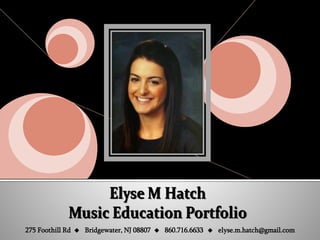
275 Foothill Rd ◆ Bridgewater, NJ 08807 ◆ 860.716.6633 ◆ elyse.m.hatch@gmail.com
Miami University, Oxford, OH
Bachelor of Music in Music Education, Flute
Cumulative GPA 3.79/4.0 Major GPA 3.87/4.0
Graduated May 7, 2011, Magna Cum Laude
Resident Educator License, Music pre-K through grade 12
Thematic Sequence: Developmental, Social and Educational
Patterns in Individuals With Exceptionalities
Objective: To obtain a teaching position where I can enrich
the lives of students through an appreciation for music.
Music is a unique medium that adds a new dimension to a student’s learning.
Benefits:
Music is an outlet for students to express themselves creatively.
Performing in front of others will increase confidence and self-esteem.
Participation in an ensemble will help students gain respect,
responsibility and leadership skills. Students must work together to create
a unified ensemble.
All students can learn to appreciate music.
Music is a fun, rewarding experience that will help students develop into
well-rounded individuals. Clearly, music is an essential component of any
complete school curriculum.
Philosophy of Music Education
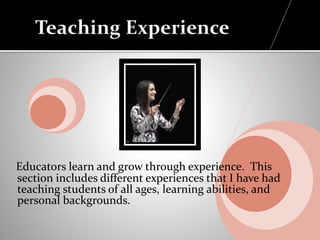
Educators learn and grow through experience. This
section includes different experiences that I have had
teaching students of all ages, learning abilities, and
personal backgrounds.
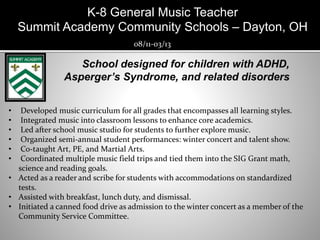
K-8 General Music Teacher
Summit Academy Community Schools – Dayton, OH
08/11-03/13
• Developed music curriculum for all grades that encompasses all learning styles.
• Integrated music into classroom lessons to enhance core academics.
• Led after school music studio for students to further explore music.
• Organized semi-annual student performances: winter concert and talent show.
• Co-taught Art, PE, and Martial Arts.
• Coordinated multiple music field trips and tied them into the SIG Grant math,
science and reading goals.
• Acted as a reader and scribe for students with accommodations on standardized
tests.
• Assisted with breakfast, lunch duty, and dismissal.
• Initiated a canned food drive as admission to the winter concert as a member of the
Community Service Committee.
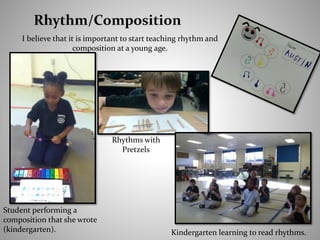
I believe that it is important to start teaching rhythm and
composition at a young age.
Rhythms with
Pretzels
Student performing a
composition that she wrote
(kindergarten). Kindergarten learning to read rhythms.
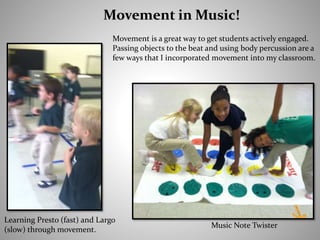
Movement is a great way to get students actively engaged.
Passing objects to the beat and using body percussion are a
few ways that I incorporated movement into my classroom.
Music Note Twister
Learning Presto (fast) and Largo
(slow) through movement.
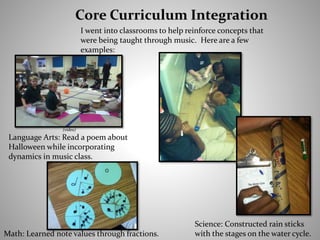
I went into classrooms to help reinforce concepts that
were being taught through music. Here are a few
examples:
(video)
Language Arts: Read a poem about
Halloween while incorporating
dynamics in music class.
Science: Constructed rain sticks
with the stages on the water cycle.Math: Learned note values through fractions.
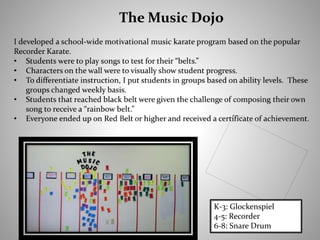
K-3: Glockenspiel
4-5: Recorder
6-8: Snare Drum
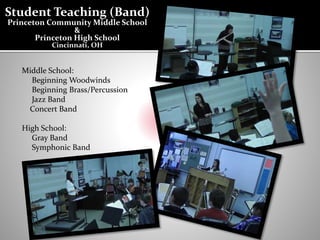
Middle School:
Beginning Woodwinds
Beginning Brass/Percussion
Jazz Band
Concert Band
High School:
Gray Band
Symphonic Band
Student Teaching (Band)
Princeton Community Middle School
&
Princeton High School
Cincinnati, OH
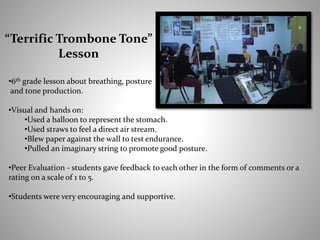
•6th grade lesson about breathing, posture
and tone production.
•Visual and hands on:
•Used a balloon to represent the stomach.
•Used straws to feel a direct air stream.
•Blew paper against the wall to test endurance.
•Pulled an imaginary string to promote good posture.
•Peer Evaluation - students gave feedback to each other in the form of comments or a
rating on a scale of 1 to 5.
•Students were very encouraging and supportive.
“Terrific Trombone Tone”
Lesson
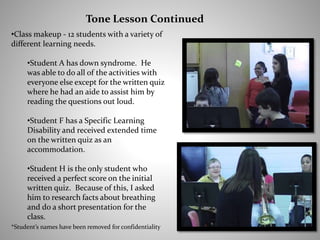
•Class makeup - 12 students with a variety of
different learning needs.
•Student A has down syndrome. He
was able to do all of the activities with
everyone else except for the written quiz
where he had an aide to assist him by
reading the questions out loud.
•Student F has a Specific Learning
Disability and received extended time
on the written quiz as an
accommodation.
•Student H is the only student who
received a perfect score on the initial
written quiz. Because of this, I asked
him to research facts about breathing
and do a short presentation for the
class.
Tone Lesson Continued
*Student’s names have been removed for confidentiality
0
1
2
3
4
5
A B C D E F G H I J K L
Pointsoutof5
Students
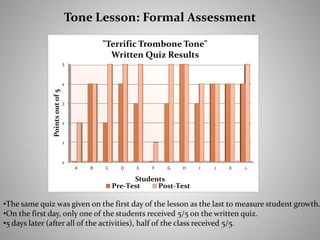
"Terrific Trombone Tone"
Written Quiz Results
Pre-Test Post-Test
Tone Lesson: Formal Assessment
•The same quiz was given on the first day of the lesson as the last to measure student growth.
•On the first day, only one of the students received 5/5 on the written quiz.
•5 days later (after all of the activities), half of the class received 5/5.
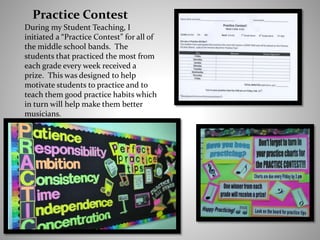
Practice Contest
During my Student Teaching, I
initiated a “Practice Contest” for all of
the middle school bands. The
students that practiced the most from
each grade every week received a
prize. This was designed to help
motivate students to practice and to
teach them good practice habits which
in turn will help make them better
musicians.
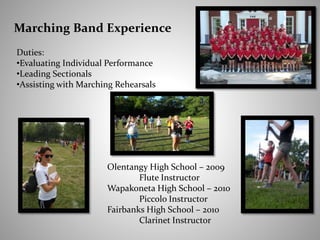
Marching Band Experience
Duties:
•Evaluating Individual Performance
•Leading Sectionals
•Assisting with Marching Rehearsals
Olentangy High School – 2009
Flute Instructor
Wapakoneta High School – 2010
Piccolo Instructor
Fairbanks High School – 2010
Clarinet Instructor
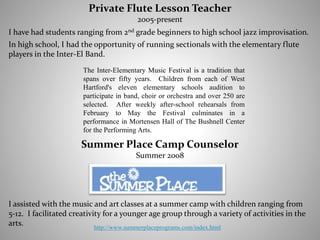
I assisted with the music and art classes at a summer camp with children ranging from
5-12. I facilitated creativity for a younger age group through a variety of activities in the
arts.
Summer Place Camp Counselor
Summer 2008
I have had students ranging from 2nd grade beginners to high school jazz improvisation.
In high school, I had the opportunity of running sectionals with the elementary flute
players in the Inter-El Band.
http://www.summerplaceprograms.com/index.html
The Inter-Elementary Music Festival is a tradition that
spans over fifty years. Children from each of West
Hartford's eleven elementary schools audition to
participate in band, choir or orchestra and over 250 are
selected. After weekly after-school rehearsals from
February to May the Festival culminates in a
performance in Mortensen Hall of The Bushnell Center
for the Performing Arts.
Private Flute Lesson Teacher
2005-present
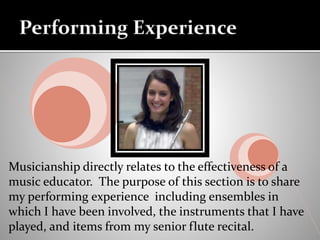
Musicianship directly relates to the effectiveness of a
music educator. The purpose of this section is to share
my performing experience including ensembles in
which I have been involved, the instruments that I have
played, and items from my senior flute recital.
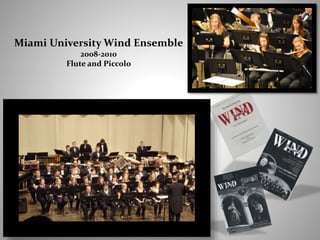
Miami University Wind Ensemble
2008-2010
Flute and Piccolo
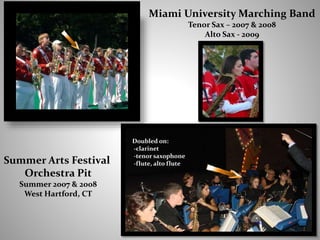
Doubled on:
-clarinet
-tenor saxophone
-flute, alto flute
Miami University Marching Band
Tenor Sax – 2007 & 2008
Alto Sax - 2009
Summer Arts Festival
Orchestra Pit
Summer 2007 & 2008
West Hartford, CT
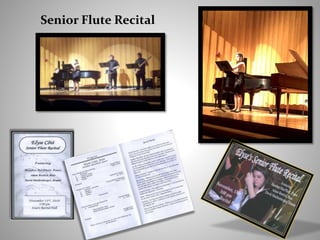
Senior Flute Recital
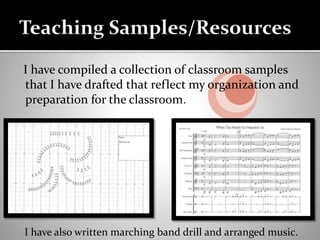
I have compiled a collection of classroom samples
that I have drafted that reflect my organization and
preparation for the classroom.
I have also written marching band drill and arranged music.
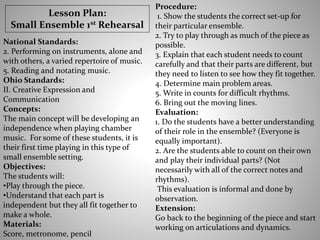
National Standards:
2. Performing on instruments, alone and
with others, a varied repertoire of music.
5. Reading and notating music.
Ohio Standards:
II. Creative Expression and
Communication
Concepts:
The main concept will be developing an
independence when playing chamber
music. For some of these students, it is
their first time playing in this type of
small ensemble setting.
Objectives:
The students will:
•Play through the piece.
•Understand that each part is
independent but they all fit together to
make a whole.
Materials:
Score, metronome, pencil
Procedure:
1. Show the students the correct set-up for
their particular ensemble.
2. Try to play through as much of the piece as
possible.
3. Explain that each student needs to count
carefully and that their parts are different, but
they need to listen to see how they fit together.
4. Determine main problem areas.
5. Write in counts for difficult rhythms.
6. Bring out the moving lines.
Evaluation:
1. Do the students have a better understanding
of their role in the ensemble? (Everyone is
equally important).
2. Are the students able to count on their own
and play their individual parts? (Not
necessarily with all of the correct notes and
rhythms).
This evaluation is informal and done by
observation.
Extension:
Go back to the beginning of the piece and start
working on articulations and dynamics.
Lesson Plan:
Small Ensemble 1st Rehearsal
1 2 3 4 5
Tone The tone quality
is not
characteristic of
the instrument.
The tone quality is
uncharacteristic at
times and lacks
support and focus.
The tone quality is
mostly
characteristic but
is slightly
unfocused and
tends to lack
support.
The tone quality is
characteristic of the
instrument and is
mostly focused.
The tone quality is
focused,
supported, and
characteristic of
the instrument.
Pitch
Accuracy
Four or more
incorrect pitches
are played.
Three incorrect
pitches are played.
Two incorrect
pitches are played.
One incorrect pitch
is played.
All correct pitches
are played.
Tempo The scale is
played well
below the
required tempo
and is not even
or consistent.
The scale is played
well below the
required tempo but
is played evenly.
OR
The scale is played
at an acceptable
tempo but is very
uneven.
The scale is played
slightly under
tempo and is
uneven at times.
The scale is played up
to tempo but is
slightly uneven.
OR
The scale is played
evenly but is slightly
under tempo.
The scale is played
up to tempo and is
steady
throughout.
Articulation
/
Technique
The articulation
is incorrect and
the fingers do
not move
together.
The articulation is
played incorrectly at
times and the
transitions between
notes are not clean.
The articulation
and technique is
muddy at times.
The articulation is
clear but there are
minor transitional
glitches.
The articulation is
clear and accurate
and there is a
clean transition
between notes.
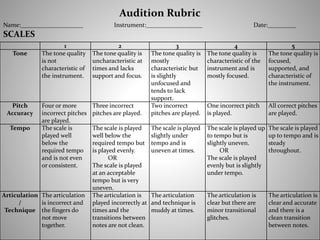
Audition Rubric
Name:____________________ Instrument:__________________ Date:_________
SCALES
HALL
HIGH
SCHOOL
BAND
HANDBOOK
2010-2011
Director, Elyse Cote
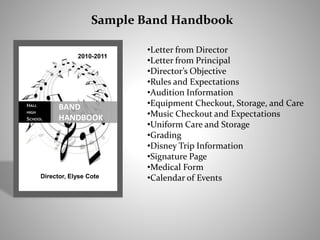
Sample Band Handbook
•Letter from Director
•Letter from Principal
•Director’s Objective
•Rules and Expectations
•Audition Information
•Equipment Checkout, Storage, and Care
•Music Checkout and Expectations
•Uniform Care and Storage
•Grading
•Disney Trip Information
•Signature Page
•Medical Form
•Calendar of Events
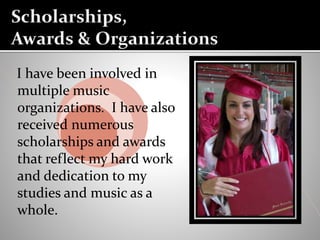
I have been involved in
multiple music
organizations. I have also
received numerous
scholarships and awards
that reflect my hard work
and dedication to my
studies and music as a
whole.
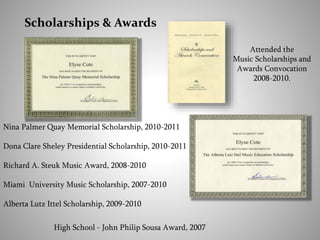
Scholarships & Awards
Attended the
Music Scholarships and
Awards Convocation
2008-2010.
Nina Palmer Quay Memorial Scholarship, 2010-2011
Dona Clare Sheley Presidential Scholarship, 2010-2011
Richard A. Steuk Music Award, 2008-2010
Miami University Music Scholarship, 2007-2010
Alberta Lutz Ittel Scholarship, 2009-2010
High School - John Philip Sousa Award, 2007
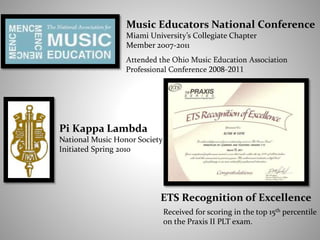
Music Educators National Conference
Miami University’s Collegiate Chapter
Member 2007-2011
Pi Kappa Lambda
National Music Honor Society
Initiated Spring 2010
Attended the Ohio Music Education Association
Professional Conference 2008-2011
ETS Recognition of Excellence
Received for scoring in the top 15th percentile
on the Praxis II PLT exam.
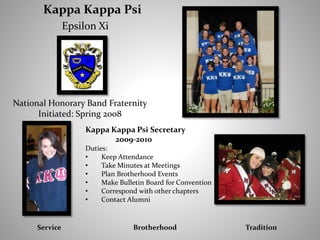
Kappa Kappa Psi
Epsilon Xi
Service Brotherhood Tradition
National Honorary Band Fraternity
Initiated: Spring 2008
Kappa Kappa Psi Secretary
2009-2010
Duties:
• Keep Attendance
• Take Minutes at Meetings
• Plan Brotherhood Events
• Make Bulletin Board for Convention
• Correspond with other chapters
• Contact Alumni
Documents available by request:
•Résumé
•References/Reference Letters
•Additional Teaching Samples
Elyse M Hatch
275 Foothill Rd.
Bridgewater, NJ 08807
(860)716-6633
elyse.m.hatch@gmail.com

Elyse Hatch Professional Portfolio

  • 1.
    275 Foothill Rd◆ Bridgewater, NJ 08807 ◆ 860.716.6633 ◆ elyse.m.hatch@gmail.com
  • 2.
    Miami University, Oxford,OH Bachelor of Music in Music Education, Flute Cumulative GPA 3.79/4.0 Major GPA 3.87/4.0 Graduated May 7, 2011, Magna Cum Laude Resident Educator License, Music pre-K through grade 12 Thematic Sequence: Developmental, Social and Educational Patterns in Individuals With Exceptionalities Objective: To obtain a teaching position where I can enrich the lives of students through an appreciation for music.
  • 3.
    Music is aunique medium that adds a new dimension to a student’s learning. Benefits: Music is an outlet for students to express themselves creatively. Performing in front of others will increase confidence and self-esteem. Participation in an ensemble will help students gain respect, responsibility and leadership skills. Students must work together to create a unified ensemble. All students can learn to appreciate music. Music is a fun, rewarding experience that will help students develop into well-rounded individuals. Clearly, music is an essential component of any complete school curriculum. Philosophy of Music Education
  • 4.
    Educators learn andgrow through experience. This section includes different experiences that I have had teaching students of all ages, learning abilities, and personal backgrounds.
  • 5.
    K-8 General MusicTeacher Summit Academy Community Schools – Dayton, OH 08/11-03/13 • Developed music curriculum for all grades that encompasses all learning styles. • Integrated music into classroom lessons to enhance core academics. • Led after school music studio for students to further explore music. • Organized semi-annual student performances: winter concert and talent show. • Co-taught Art, PE, and Martial Arts. • Coordinated multiple music field trips and tied them into the SIG Grant math, science and reading goals. • Acted as a reader and scribe for students with accommodations on standardized tests. • Assisted with breakfast, lunch duty, and dismissal. • Initiated a canned food drive as admission to the winter concert as a member of the Community Service Committee.
  • 6.
    I believe thatit is important to start teaching rhythm and composition at a young age. Rhythms with Pretzels Student performing a composition that she wrote (kindergarten). Kindergarten learning to read rhythms.
  • 7.
    Movement is agreat way to get students actively engaged. Passing objects to the beat and using body percussion are a few ways that I incorporated movement into my classroom. Music Note Twister Learning Presto (fast) and Largo (slow) through movement.
  • 8.
    I went intoclassrooms to help reinforce concepts that were being taught through music. Here are a few examples: (video) Language Arts: Read a poem about Halloween while incorporating dynamics in music class. Science: Constructed rain sticks with the stages on the water cycle.Math: Learned note values through fractions.
  • 9.
  • 10.
    Middle School: Beginning Woodwinds BeginningBrass/Percussion Jazz Band Concert Band High School: Gray Band Symphonic Band Student Teaching (Band) Princeton Community Middle School & Princeton High School Cincinnati, OH
  • 11.
    •6th grade lessonabout breathing, posture and tone production. •Visual and hands on: •Used a balloon to represent the stomach. •Used straws to feel a direct air stream. •Blew paper against the wall to test endurance. •Pulled an imaginary string to promote good posture. •Peer Evaluation - students gave feedback to each other in the form of comments or a rating on a scale of 1 to 5. •Students were very encouraging and supportive. “Terrific Trombone Tone” Lesson
  • 12.
    •Class makeup -12 students with a variety of different learning needs. •Student A has down syndrome. He was able to do all of the activities with everyone else except for the written quiz where he had an aide to assist him by reading the questions out loud. •Student F has a Specific Learning Disability and received extended time on the written quiz as an accommodation. •Student H is the only student who received a perfect score on the initial written quiz. Because of this, I asked him to research facts about breathing and do a short presentation for the class. Tone Lesson Continued *Student’s names have been removed for confidentiality
  • 13.
    0 1 2 3 4 5 A B CD E F G H I J K L Pointsoutof5 Students "Terrific Trombone Tone" Written Quiz Results Pre-Test Post-Test Tone Lesson: Formal Assessment •The same quiz was given on the first day of the lesson as the last to measure student growth. •On the first day, only one of the students received 5/5 on the written quiz. •5 days later (after all of the activities), half of the class received 5/5.
  • 14.
    Practice Contest During myStudent Teaching, I initiated a “Practice Contest” for all of the middle school bands. The students that practiced the most from each grade every week received a prize. This was designed to help motivate students to practice and to teach them good practice habits which in turn will help make them better musicians.
  • 15.
    Marching Band Experience Duties: •EvaluatingIndividual Performance •Leading Sectionals •Assisting with Marching Rehearsals Olentangy High School – 2009 Flute Instructor Wapakoneta High School – 2010 Piccolo Instructor Fairbanks High School – 2010 Clarinet Instructor
  • 16.
    I assisted withthe music and art classes at a summer camp with children ranging from 5-12. I facilitated creativity for a younger age group through a variety of activities in the arts. Summer Place Camp Counselor Summer 2008 I have had students ranging from 2nd grade beginners to high school jazz improvisation. In high school, I had the opportunity of running sectionals with the elementary flute players in the Inter-El Band. http://www.summerplaceprograms.com/index.html The Inter-Elementary Music Festival is a tradition that spans over fifty years. Children from each of West Hartford's eleven elementary schools audition to participate in band, choir or orchestra and over 250 are selected. After weekly after-school rehearsals from February to May the Festival culminates in a performance in Mortensen Hall of The Bushnell Center for the Performing Arts. Private Flute Lesson Teacher 2005-present
  • 17.
    Musicianship directly relatesto the effectiveness of a music educator. The purpose of this section is to share my performing experience including ensembles in which I have been involved, the instruments that I have played, and items from my senior flute recital.
  • 18.
    Miami University WindEnsemble 2008-2010 Flute and Piccolo
  • 19.
    Doubled on: -clarinet -tenor saxophone -flute,alto flute Miami University Marching Band Tenor Sax – 2007 & 2008 Alto Sax - 2009 Summer Arts Festival Orchestra Pit Summer 2007 & 2008 West Hartford, CT
  • 20.
  • 21.
    I have compileda collection of classroom samples that I have drafted that reflect my organization and preparation for the classroom. I have also written marching band drill and arranged music.
  • 22.
    National Standards: 2. Performingon instruments, alone and with others, a varied repertoire of music. 5. Reading and notating music. Ohio Standards: II. Creative Expression and Communication Concepts: The main concept will be developing an independence when playing chamber music. For some of these students, it is their first time playing in this type of small ensemble setting. Objectives: The students will: •Play through the piece. •Understand that each part is independent but they all fit together to make a whole. Materials: Score, metronome, pencil Procedure: 1. Show the students the correct set-up for their particular ensemble. 2. Try to play through as much of the piece as possible. 3. Explain that each student needs to count carefully and that their parts are different, but they need to listen to see how they fit together. 4. Determine main problem areas. 5. Write in counts for difficult rhythms. 6. Bring out the moving lines. Evaluation: 1. Do the students have a better understanding of their role in the ensemble? (Everyone is equally important). 2. Are the students able to count on their own and play their individual parts? (Not necessarily with all of the correct notes and rhythms). This evaluation is informal and done by observation. Extension: Go back to the beginning of the piece and start working on articulations and dynamics. Lesson Plan: Small Ensemble 1st Rehearsal
  • 23.
    1 2 34 5 Tone The tone quality is not characteristic of the instrument. The tone quality is uncharacteristic at times and lacks support and focus. The tone quality is mostly characteristic but is slightly unfocused and tends to lack support. The tone quality is characteristic of the instrument and is mostly focused. The tone quality is focused, supported, and characteristic of the instrument. Pitch Accuracy Four or more incorrect pitches are played. Three incorrect pitches are played. Two incorrect pitches are played. One incorrect pitch is played. All correct pitches are played. Tempo The scale is played well below the required tempo and is not even or consistent. The scale is played well below the required tempo but is played evenly. OR The scale is played at an acceptable tempo but is very uneven. The scale is played slightly under tempo and is uneven at times. The scale is played up to tempo but is slightly uneven. OR The scale is played evenly but is slightly under tempo. The scale is played up to tempo and is steady throughout. Articulation / Technique The articulation is incorrect and the fingers do not move together. The articulation is played incorrectly at times and the transitions between notes are not clean. The articulation and technique is muddy at times. The articulation is clear but there are minor transitional glitches. The articulation is clear and accurate and there is a clean transition between notes. Audition Rubric Name:____________________ Instrument:__________________ Date:_________ SCALES
  • 24.
    HALL HIGH SCHOOL BAND HANDBOOK 2010-2011 Director, Elyse Cote SampleBand Handbook •Letter from Director •Letter from Principal •Director’s Objective •Rules and Expectations •Audition Information •Equipment Checkout, Storage, and Care •Music Checkout and Expectations •Uniform Care and Storage •Grading •Disney Trip Information •Signature Page •Medical Form •Calendar of Events
  • 25.
    I have beeninvolved in multiple music organizations. I have also received numerous scholarships and awards that reflect my hard work and dedication to my studies and music as a whole.
  • 26.
    Scholarships & Awards Attendedthe Music Scholarships and Awards Convocation 2008-2010. Nina Palmer Quay Memorial Scholarship, 2010-2011 Dona Clare Sheley Presidential Scholarship, 2010-2011 Richard A. Steuk Music Award, 2008-2010 Miami University Music Scholarship, 2007-2010 Alberta Lutz Ittel Scholarship, 2009-2010 High School - John Philip Sousa Award, 2007
  • 27.
    Music Educators NationalConference Miami University’s Collegiate Chapter Member 2007-2011 Pi Kappa Lambda National Music Honor Society Initiated Spring 2010 Attended the Ohio Music Education Association Professional Conference 2008-2011 ETS Recognition of Excellence Received for scoring in the top 15th percentile on the Praxis II PLT exam.
  • 28.
    Kappa Kappa Psi EpsilonXi Service Brotherhood Tradition National Honorary Band Fraternity Initiated: Spring 2008 Kappa Kappa Psi Secretary 2009-2010 Duties: • Keep Attendance • Take Minutes at Meetings • Plan Brotherhood Events • Make Bulletin Board for Convention • Correspond with other chapters • Contact Alumni
  • 29.
    Documents available byrequest: •Résumé •References/Reference Letters •Additional Teaching Samples Elyse M Hatch 275 Foothill Rd. Bridgewater, NJ 08807 (860)716-6633 elyse.m.hatch@gmail.com