
Make sure volume is turned up then Click that right-facing green arrow below  to launch show. From then on, it runs itself. You don’t need to click. Click Icon  at right to  make show  full screen
Presented By Professor Emeritus Carl L. Johannessen, Biogeographer
Introduction What is for breakfast? Eggs, bacon with chili sauce and catsup  pancakes with syrup, or toast needing jam,  hash-browns cooked with corn oil and more chili coffee or tea, cotton napkin perhaps a smoke of tobacco 09/27/09 Atlantic Conference
Thesis Through following the route food has taken to get to our breakfast table, and the dates that they actually arrived on the shores of the countries, we discover the shallowness of Euro-ethnocentrism. We can see that peoples from the tropics contributed in a major way to our potential meal menu long before the Europeans began to travel. We start with fact that land plants and animals have one continent of origin as Steven J. Gould said.  This is especially true with the origin of domesticated organisms 09/27/09 Atlantic Conference
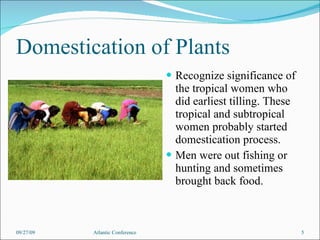
Domestication of Plants Recognize significance of the tropical women who did earliest tilling. These tropical and subtropical women probably started domestication process. Men were out fishing or hunting and sometimes brought back food. 09/27/09 Atlantic Conference
09/27/09 Atlantic Conference
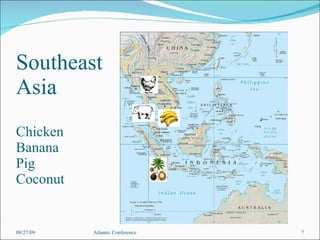
Southeast Asia Chicken Banana Pig Coconut 09/27/09 Atlantic Conference
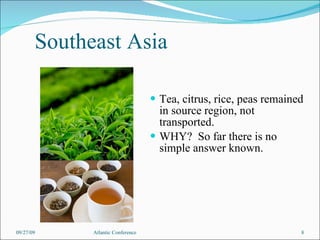
Southeast Asia Tea, citrus, rice, peas remained in source region, not transported. WHY?  So far there is no simple answer known. 09/27/09 Atlantic Conference
Southeast Asia Breakfast : Chicken’s eggs, (adult chickens were saved and not eaten usually.) from SE. Asia; they needed to crow in the morning to cause the sun to rise. Domestication process of chicken starts in Southeast Asia by taming jungle fowl.  Farmers moved chicken north to Xian by 6,000 years before present (YBP) and to the Mediterranean three thousand years ago where they were selected to flock and lay eggs in quantity.  Pig’s bacon or sausage came out of S.E. Asia Vegetatively reproduced plants were first method of planting. Banana, plantain, sugar cane probably started the process 8-10,000+ years ago 09/27/09 Atlantic Conference
Southeast Asia Sugarcane started here for sugar for syrup & jam Bananas & plantain Coconut were selected somehere around Indian Ocean. White yam (Dioscorea) All above transported to America from Southeast Asia before Columbus 09/27/09 Atlantic Conference
South Asia (Indian Peninsula) Barley for Beer Cinnamon 09/27/09 Atlantic Conference
South Asia (India) Barley for beer starts grain domestication, wheat is for bread-kind. Both grains self-pollinate.  So selection is effective to maintain any improved variety found. Oat and Rye weeds in harvest Peach did arrive in Georgia, U.S. and grape in Latin America before 1492. 09/27/09 Atlantic Conference
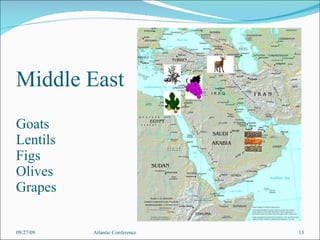
Middle East Goats Lentils Figs Olives Grapes 09/27/09 Atlantic Conference
Middle East Goats were first, then sheep, cattle, donkey, horse, camels in that order as towns grew, 6,000+ YBP. Down to 2,000 YBP 09/27/09 Atlantic Conference
Middle East Self-pollinating grains allowed our traditional village life to develop. Barleys and wheats continued to be improved by farmer’s selection; because improvements could be maintained and passed to their children. Domestication of animals started for religious reasons, not as food.  09/27/09 Atlantic Conference
Middle East “ Mediterranean fruits” e.g. figs, olives and grapes.  Only grapes  have record of movement across oceans to America. 09/27/09 Atlantic Conference
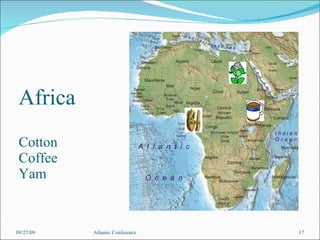
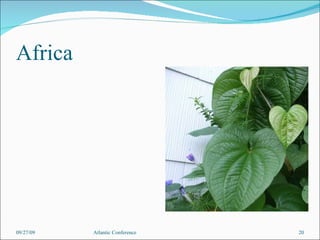
Africa Cotton Coffee Yam 09/27/09 Atlantic Conference
Africa Africa, in relation to our Breakfast, gave us cotton napkins and coffee. Coffee was not transported to America pre-1492. 09/27/09 Atlantic Conference
Africa First probably, cotton was used to make line for fishermen.  They selected and grew cotton where ever they landed in America. Chromosomes doubled to make tetraploids (4n) in South America 4n cotton provided longer, stronger thread. Seed was taken back across to oceanic islands and to Africa early. 09/27/09 Atlantic Conference
Africa 09/27/09 Atlantic Conference
Americas Corn (Maize) –Mexico and Peru – Ecuador Chili Tomato Sweet Potatoes 09/27/09 Atlantic Conference
Americas Corn (Maize), Beans and Squash dominate with tomato, chili, sunflowers & bixa as sauce. 09/27/09 Atlantic Conference
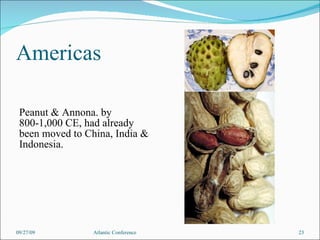
Americas Peanut & Annona. by 800-1,000 CE, had already been moved to China, India & Indonesia. 09/27/09 Atlantic Conference
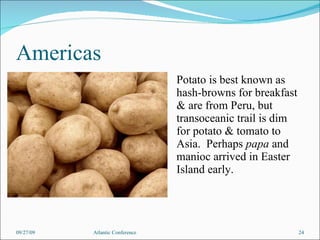
Americas Potato is best known as hash-browns for breakfast & are from Peru, but transoceanic trail is dim for potato & tomato to Asia.  Perhaps  papa  and manioc arrived in Easter Island early. 09/27/09 Atlantic Conference
Northwest Europe Rutabaga Tulip Daffodil Lettuce 09/27/09 Atlantic Conference
Northwest Europe Not much happened significantly to “Breakfast” by 3,000 YBP.  UK still in hunter - gatherer stage of culture, not farmers Tulips and rutabagas were cultivated eventually. Climate allowed oats and rye to self- domesticate themselves in the cold and wet of Europe.  Since they were out-crossing weed species in the wheat and barley fields, they could change fast enough to replace wheat & barley. Oats and rye modified themselves with tillage. 09/27/09 Atlantic Conference
09/27/09 Atlantic Conference
Proofs of Diffusion Shapes and uses of human artifacts can perhaps be duplicated when people of different, separated, cultures made them, but coastal people at least had contact across oceans. When species are domesticated, wild organisms are needed first (on its hemisphere); modified,  domesticated  plant or animal cannot be confused or claimed to have been made over again (replicated) by people across the sea.  Sailors do carry plants & animals for food, seed, drugs, company, trade, pleasure, etc. 09/27/09 Atlantic Conference
Proofs of Diffusion Salt water is not good for most seed; they tend to sink (Darwin’s observation). 1,000s of years ago ocean was highway for early sailors’ discovery, once they knew how to sail. Early sailing rafts were available of bamboo, bast-rushes, balsa logs. Most any logs served! 09/27/09 Atlantic Conference
Proofs of Diffusion Biologists recognize that a plant has one place of origin and only one origin from wild plant on continent. Variation in plants and animals under domestication is slow, but tremendous.  Selection activity in domestication was frequently carried out for religious reasons.  Rice, corn and sweet-potato were  GODs  to various people doing tilling. Ocean water is barrier to plant germination & dispersal without sailors . 09/27/09 Atlantic Conference
Products of Tropical Mariners Seeds, which were frequently transferred.  Most expensive material by bulk and weight are medicines, now called drugs. Maps & journals of routes of traders were unlikely.  Perhaps we can find them in stories you are telling, if stories came from trader’s ports of 4,000 years ago. Columbus had been to Norse ports in Iceland, Scotland, & Ireland.  From those mariner’s stories, he knew where to go for  Gold ! 09/27/09 Atlantic Conference
Paradigm Shift 09/27/09 Atlantic Conference
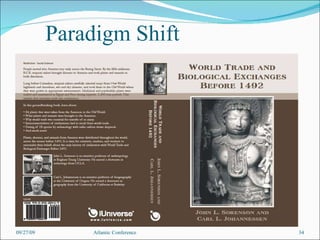
Paradigm Shift World Trade and Biological Exchanges before 1492.  (2009) Authors: John L. Sorenson, anthropologist and  Carl L. Johannessen, biogeographer Carries the detailed references to scientific literature for this lecture & more.  124 organisms were transported across oceans probably by sail before 1492 C.E. Provides primary tables of lists of biota:  97 plants, 19 diseases, & 8 animals were transported by ocean to another hemisphere. 09/27/09 Atlantic Conference
Paradigm Shift 09/27/09 Atlantic Conference
Sources PRECOLUMBIAN DIFFUSION OF CULTURES ACROSS THE OCEANS  is established by volume of species shown to have been in both hemispheres at contact.  Goodbye old paradigm of no contact. 09/27/09 Atlantic Conference
European Significance Europe’s cows, sheep, pigs, and their grains, olives, figs, pomegranates, apricots, apples, peaches, grapes, etc., are eaten now, often. All above are derived from domesticated products created by Semites, Iranians, Phoenicians, North Africans, etc., and absorbed by N.W. Europeans with long passage of time. N.W. Europeans wanted to ignore all by including only early Greeks & Romans in Europe, instead of earlier folk – in Middle East and beyond in their history.  They wanted isolation from those cultures.  WHY? 09/27/09 Atlantic Conference
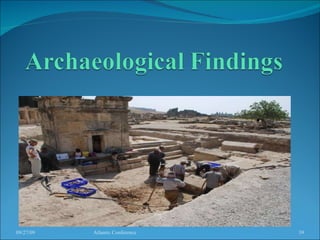
Great Tropical Civilizations Early sailors brought 19 parasites and diseases to the Americas before Columbus.  7,350+ YBP two species of hookworm have been found in Brazilian mummy’s intestines and dried fecal material. Hookworms had to have come from Southeast Asia. Hookworm not in N. America – They could not have passed through arctic cold screen, either. Archaeological findings cause paradigm shift. 09/27/09 Atlantic Conference
Summary Understanding and acceptance that 124 plants and animals dispersed across the oceans before 1492. This is  Pre-Columbian Transoceanic Diffusion of Culture . Tropical sailing shows worldwide contact by travelers, businessmen, colonists, missionaries, and others for thousands of years. More than just species were diffused during this contact: cultural traits, medical knowledge, and linguistic similarities. These have yet to be fully explored 09/27/09 Atlantic Conference
09/27/09 Atlantic Conference
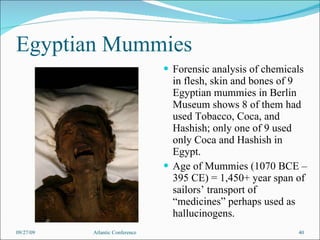
Egyptian Mummies Forensic analysis of chemicals in flesh, skin and bones of 9 Egyptian mummies in Berlin Museum shows 8 of them had used Tobacco, Coca, and Hashish; only one of 9 used only Coca and Hashish in Egypt.  Age of Mummies (1070 BCE – 395 CE) = 1,450+ year span of sailors’ transport of “medicines” perhaps used as hallucinogens. 09/27/09 Atlantic Conference
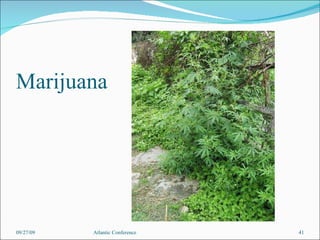
Marijuana 09/27/09 Atlantic Conference
Coca Plant 09/27/09 Atlantic Conference
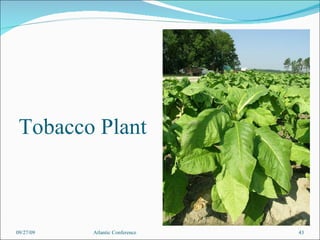
Tobacco Plant 09/27/09 Atlantic Conference
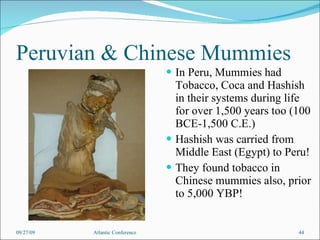
Peruvian & Chinese Mummies In Peru, Mummies had Tobacco, Coca and Hashish in their systems during life for over 1,500 years too (100 BCE-1,500 C.E.) Hashish was carried from Middle East (Egypt) to Peru! They found tobacco in Chinese mummies also, prior to 5,000 YBP! 09/27/09 Atlantic Conference
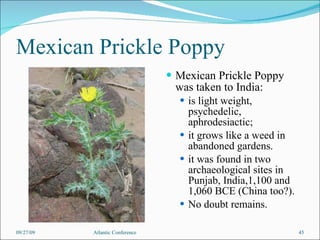
Mexican Prickle Poppy Mexican Prickle Poppy was taken to India: is light weight, psychedelic, aphrodesiactic; it grows like a weed in abandoned gardens. it was found in two archaeological sites in Punjab, India,1,100 and 1,060 BCE (China too?).  No doubt remains. 09/27/09 Atlantic Conference
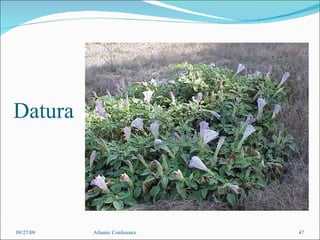
Datura 5 Daturas are all American species and now in India Two were present in India 1 st  to 3 rd  centuries C.E. (Not identified as to which species were involved) Five sp. present in India now, and all are used.  Extremely small doses are all that were needed.  Preparation tends to be concocted by women. If they were abused, husband’s drug trip was to eternity. 09/27/09 Atlantic Conference
Datura 09/27/09 Atlantic Conference
Corn 09/27/09 Atlantic Conference
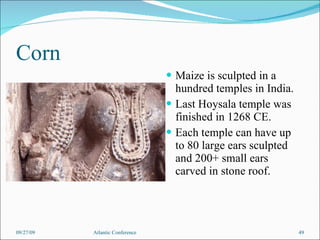
Corn Maize is sculpted in a hundred temples in India.  Last Hoysala temple was finished in 1268 CE. Each temple can have up to 80 large ears sculpted and 200+ small ears carved in stone roof.  09/27/09 Atlantic Conference
Corn 40+ variations on corn ears have been sculpted. Presence of corn was denied by some “scientists” in India who claimed silk purses with coins were represented. Corn breeders at university of Ohio’s Agriculture Laboratory, of USDA laughed at “supposed Scientists” rejection.  Corn  is their analysis from pictures!  World’s specialists count more than someone who could not accept reality. 09/27/09 Atlantic Conference
Corn “ Goddess” holds fat ear like Bolivian corn in Somnathpur, India  1268 C.E. Corn temples are dated by Indian Government’s Archeological Epigraphers who can read carvings on stone stela at Temples, which give their complete, dated history. 09/27/09 Atlantic Conference
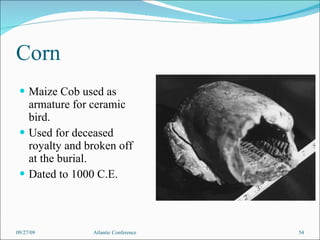
Corn Maize still supplies over half  the carbohydrate food of Hill Tribes of India.  China has an impression 1,000+YBP in ceramic dove of cob of corn that was an armature in the construction of an offertory dove for a “royal” near Zhengzhou, Henan. Head & tail broken off. 09/27/09 Atlantic Conference
Chilis Panels of sculpted maize and chili pepper (and sorghum) found in Java temple showing entire plants.  Sculpted panels are from ruins of temples still kept in garden of another temple. 09/27/09 Atlantic Conference
Corn Maize Cob used as armature for ceramic bird. Used for deceased royalty and broken off at the burial. Dated to 1000 C.E. 09/27/09 Atlantic Conference
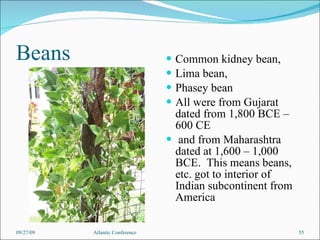
Beans Common kidney bean, Lima bean, Phasey bean  All were from Gujarat dated from 1,800 BCE – 600 CE and from Maharashtra dated at 1,600 – 1,000 BCE.  This means beans, etc. got to interior of Indian subcontinent from America 09/27/09 Atlantic Conference
Malabar Gourd Malabar gourd used to be thought of as Asian crop. Malabar gourd is in Asia from coastal China to Himalaya & on to South India. Then seeds was found in Peru dated earlier, so this  most privitive Cucurbita originated in America. Spaniards did not use the Malabar gourd. They are not likely to have carried it, and it was there before Portuguese or Spaniards. 09/27/09 Atlantic Conference
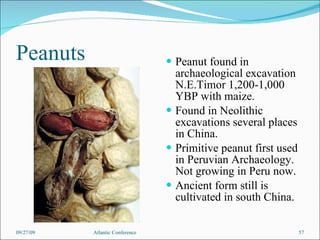
Peanuts Peanut found in archaeological excavation N.E.Timor 1,200-1,000 YBP with maize. Found in Neolithic excavations several places in China. Primitive peanut first used in Peruvian Archaeology.  Not growing in Peru now. Ancient form still is cultivated in south China. 09/27/09 Atlantic Conference
Annona and Other Fruits Annona found in Timor 1,000 YBP. and are Is found in archaeological site in Uttar Pradesh, India at 700 B.C.E.  Here are photos of two kinds in Indian Temple art.  Other fruits:  Guava ( Psidium guajava ), hog plum ( Spondias purpurea ), squashes of two more kinds and chili peppers helped to counteract scurvy on tropical sailors’ trips. Seeds of fruit probably spit on deck and cleaned off at future port in Asia. 09/27/09 Atlantic Conference
Annona and Other Fruits 09/27/09 Atlantic Conference
Cashews and Anti-Scurvy Fruits Other anti-scurvy fruits taken across ocean to Asia from America: Cashew Mango Black nightshade Papaya (arrived in Hawaii from America) Philadendron, Prickly pear (nopales) Pineapple Some of these could have been grown on deck of ship or raft. 09/27/09 Atlantic Conference
Cashews and Other Anti-Scurvy Fruits (Mangos and Papaya) 09/27/09 Atlantic Conference
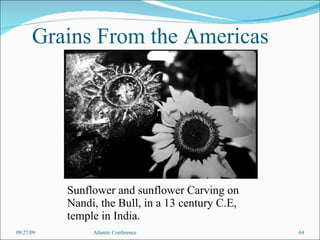
Grains From the Americas Large ears of corn, found in China & India. Amaranth small seed, outlawed by Spaniards in Mexico. Quinoa taken to Easter Island (maybe N. India). Sunflower (seed may fit in here too). Photo from 13 th  century temple, Karnataka. 50 plants that moved to India.  Many have Sanskrit record and that serves in part as evidence for acceptance here.  Photo of seed dry head associated with carved sunflower. Second photo was used as solar calendar of equinox and solstice dates on bull. 09/27/09 Atlantic Conference
Grains From the Americas 09/27/09 Atlantic Conference
Grains From the Americas Sunflower and sunflower Carving on Nandi, the Bull, in a 13 century C.E, temple in India. 09/27/09 Atlantic Conference
Grains from America Amaranth  Quinoa 09/27/09 Atlantic Conference
Chili, Bixa,  Marigold Chili and Bixa used in foods for flavor and red-orange color. American cultures had for thousands of years. Marigold used in similar function at funerary rites in both Mexico and India. 09/27/09 Atlantic Conference
Most Ancient Evidence Three intestinal parasites (hookworms and a roundworm) that originated in S.E. Asia and are shown archaeologically to have arrived in Brazil 7,350 YBP. One essential phase of life cycle needs warm sub-tropical and tropical soils. They are also not found in any North American archaeological sites. Therefore, could not have been transferred across the Bering Strait. How, besides sailing, could the parasites inside Asian sailor have been transferred? 09/27/09 Atlantic Conference
09/27/09 Atlantic Conference
Further Interest If we have created interest in this field, we hope that you will expand your knowledge of the  processes  of which we speak. Data in our book also relates to root crops, weeds, more fruits and flowers, fiber plants, diseases and animals to which we have found reference in published literature. An important further resource for information on early diffusion of other cultural traits is Professor Emeritus John L. Sorenson and Martin Raish’s book  Pre-Columbian Contact with the Americas across the Oceans, Second Edition, Revised  published in 1996 by Research Press. Paradigms shift with good hypotheses 09/27/09 Atlantic Conference
SIGNIFICANCE OF OUR BOOK Book by Sorenson and me and edited by Linda McElroy and Jerrid Wolflick is designed to assist education of all youths and societies to understand that: Species have one continent of origin. People need equality, with reduced prejudice and racism toward people of different genetics. The Tropical sailors were brave & knowledgable. Learn about origins of Euro-Anglo history so as not to be ethnocentric.  Our food came from others. Appreciate developmental contribution that tropical and subtropical sailors have provided.
Paradigm Shift 09/27/09 Atlantic Conference
Conclusion Europeans did not originate most of the food crops for which they take credit. Oats and Rye were likely self-domesticated. Other plants that they tried to grow were unsuited to the cold, damp climate of Northwest Europe. 09/27/09 Atlantic Conference
Conclusion No scientific basis for the European and North American assumption of superiority. Did a great deal of positive changes after Columbus. Does not make them intellectually superior to the tropical peoples and civilizations of the world. 09/27/09 Atlantic Conference
Conclusion We hope that John and my book will bring about a change in education for the youth of the world. We hope it creates: Values of equality, And end to racism. Respect between people. We hope to accomplish this through sharing the truth about the origins of European-Anglo history. 09/27/09 Atlantic Conference
Conclusion The recognition of the tremendous magnitude of the spread of plants and animals by the earliest mariners, who were crossing the oceans, is the burden that all of you now face in the rebuilding a new cultural appreciation for the important impact these (non-Caucasian) tropical sailors of  thousands of years ago have had on our world’s civilizations, histories and cultures.  All sciences have a need to reanalyze their former beliefs. 09/27/09 Atlantic Conference
 

Carl Johannessen

  • 1.
    Make sure volumeis turned up then Click that right-facing green arrow below to launch show. From then on, it runs itself. You don’t need to click. Click Icon at right to make show full screen
  • 2.
    Presented By ProfessorEmeritus Carl L. Johannessen, Biogeographer
  • 3.
    Introduction What isfor breakfast? Eggs, bacon with chili sauce and catsup pancakes with syrup, or toast needing jam, hash-browns cooked with corn oil and more chili coffee or tea, cotton napkin perhaps a smoke of tobacco 09/27/09 Atlantic Conference
  • 4.
    Thesis Through followingthe route food has taken to get to our breakfast table, and the dates that they actually arrived on the shores of the countries, we discover the shallowness of Euro-ethnocentrism. We can see that peoples from the tropics contributed in a major way to our potential meal menu long before the Europeans began to travel. We start with fact that land plants and animals have one continent of origin as Steven J. Gould said. This is especially true with the origin of domesticated organisms 09/27/09 Atlantic Conference
  • 5.
    Domestication of PlantsRecognize significance of the tropical women who did earliest tilling. These tropical and subtropical women probably started domestication process. Men were out fishing or hunting and sometimes brought back food. 09/27/09 Atlantic Conference
  • 6.
  • 7.
    Southeast Asia ChickenBanana Pig Coconut 09/27/09 Atlantic Conference
  • 8.
    Southeast Asia Tea,citrus, rice, peas remained in source region, not transported. WHY? So far there is no simple answer known. 09/27/09 Atlantic Conference
  • 9.
    Southeast Asia Breakfast: Chicken’s eggs, (adult chickens were saved and not eaten usually.) from SE. Asia; they needed to crow in the morning to cause the sun to rise. Domestication process of chicken starts in Southeast Asia by taming jungle fowl. Farmers moved chicken north to Xian by 6,000 years before present (YBP) and to the Mediterranean three thousand years ago where they were selected to flock and lay eggs in quantity. Pig’s bacon or sausage came out of S.E. Asia Vegetatively reproduced plants were first method of planting. Banana, plantain, sugar cane probably started the process 8-10,000+ years ago 09/27/09 Atlantic Conference
  • 10.
    Southeast Asia Sugarcanestarted here for sugar for syrup & jam Bananas & plantain Coconut were selected somehere around Indian Ocean. White yam (Dioscorea) All above transported to America from Southeast Asia before Columbus 09/27/09 Atlantic Conference
  • 11.
    South Asia (IndianPeninsula) Barley for Beer Cinnamon 09/27/09 Atlantic Conference
  • 12.
    South Asia (India)Barley for beer starts grain domestication, wheat is for bread-kind. Both grains self-pollinate. So selection is effective to maintain any improved variety found. Oat and Rye weeds in harvest Peach did arrive in Georgia, U.S. and grape in Latin America before 1492. 09/27/09 Atlantic Conference
  • 13.
    Middle East GoatsLentils Figs Olives Grapes 09/27/09 Atlantic Conference
  • 14.
    Middle East Goatswere first, then sheep, cattle, donkey, horse, camels in that order as towns grew, 6,000+ YBP. Down to 2,000 YBP 09/27/09 Atlantic Conference
  • 15.
    Middle East Self-pollinatinggrains allowed our traditional village life to develop. Barleys and wheats continued to be improved by farmer’s selection; because improvements could be maintained and passed to their children. Domestication of animals started for religious reasons, not as food. 09/27/09 Atlantic Conference
  • 16.
    Middle East “Mediterranean fruits” e.g. figs, olives and grapes. Only grapes have record of movement across oceans to America. 09/27/09 Atlantic Conference
  • 17.
    Africa Cotton CoffeeYam 09/27/09 Atlantic Conference
  • 18.
    Africa Africa, inrelation to our Breakfast, gave us cotton napkins and coffee. Coffee was not transported to America pre-1492. 09/27/09 Atlantic Conference
  • 19.
    Africa First probably,cotton was used to make line for fishermen. They selected and grew cotton where ever they landed in America. Chromosomes doubled to make tetraploids (4n) in South America 4n cotton provided longer, stronger thread. Seed was taken back across to oceanic islands and to Africa early. 09/27/09 Atlantic Conference
  • 20.
  • 21.
    Americas Corn (Maize)–Mexico and Peru – Ecuador Chili Tomato Sweet Potatoes 09/27/09 Atlantic Conference
  • 22.
    Americas Corn (Maize),Beans and Squash dominate with tomato, chili, sunflowers & bixa as sauce. 09/27/09 Atlantic Conference
  • 23.
    Americas Peanut &Annona. by 800-1,000 CE, had already been moved to China, India & Indonesia. 09/27/09 Atlantic Conference
  • 24.
    Americas Potato isbest known as hash-browns for breakfast & are from Peru, but transoceanic trail is dim for potato & tomato to Asia. Perhaps papa and manioc arrived in Easter Island early. 09/27/09 Atlantic Conference
  • 25.
    Northwest Europe RutabagaTulip Daffodil Lettuce 09/27/09 Atlantic Conference
  • 26.
    Northwest Europe Notmuch happened significantly to “Breakfast” by 3,000 YBP. UK still in hunter - gatherer stage of culture, not farmers Tulips and rutabagas were cultivated eventually. Climate allowed oats and rye to self- domesticate themselves in the cold and wet of Europe. Since they were out-crossing weed species in the wheat and barley fields, they could change fast enough to replace wheat & barley. Oats and rye modified themselves with tillage. 09/27/09 Atlantic Conference
  • 27.
  • 28.
    Proofs of DiffusionShapes and uses of human artifacts can perhaps be duplicated when people of different, separated, cultures made them, but coastal people at least had contact across oceans. When species are domesticated, wild organisms are needed first (on its hemisphere); modified, domesticated plant or animal cannot be confused or claimed to have been made over again (replicated) by people across the sea. Sailors do carry plants & animals for food, seed, drugs, company, trade, pleasure, etc. 09/27/09 Atlantic Conference
  • 29.
    Proofs of DiffusionSalt water is not good for most seed; they tend to sink (Darwin’s observation). 1,000s of years ago ocean was highway for early sailors’ discovery, once they knew how to sail. Early sailing rafts were available of bamboo, bast-rushes, balsa logs. Most any logs served! 09/27/09 Atlantic Conference
  • 30.
    Proofs of DiffusionBiologists recognize that a plant has one place of origin and only one origin from wild plant on continent. Variation in plants and animals under domestication is slow, but tremendous. Selection activity in domestication was frequently carried out for religious reasons. Rice, corn and sweet-potato were GODs to various people doing tilling. Ocean water is barrier to plant germination & dispersal without sailors . 09/27/09 Atlantic Conference
  • 31.
    Products of TropicalMariners Seeds, which were frequently transferred. Most expensive material by bulk and weight are medicines, now called drugs. Maps & journals of routes of traders were unlikely. Perhaps we can find them in stories you are telling, if stories came from trader’s ports of 4,000 years ago. Columbus had been to Norse ports in Iceland, Scotland, & Ireland. From those mariner’s stories, he knew where to go for Gold ! 09/27/09 Atlantic Conference
  • 32.
    Paradigm Shift 09/27/09Atlantic Conference
  • 33.
    Paradigm Shift WorldTrade and Biological Exchanges before 1492. (2009) Authors: John L. Sorenson, anthropologist and Carl L. Johannessen, biogeographer Carries the detailed references to scientific literature for this lecture & more. 124 organisms were transported across oceans probably by sail before 1492 C.E. Provides primary tables of lists of biota: 97 plants, 19 diseases, & 8 animals were transported by ocean to another hemisphere. 09/27/09 Atlantic Conference
  • 34.
    Paradigm Shift 09/27/09Atlantic Conference
  • 35.
    Sources PRECOLUMBIAN DIFFUSIONOF CULTURES ACROSS THE OCEANS is established by volume of species shown to have been in both hemispheres at contact. Goodbye old paradigm of no contact. 09/27/09 Atlantic Conference
  • 36.
    European Significance Europe’scows, sheep, pigs, and their grains, olives, figs, pomegranates, apricots, apples, peaches, grapes, etc., are eaten now, often. All above are derived from domesticated products created by Semites, Iranians, Phoenicians, North Africans, etc., and absorbed by N.W. Europeans with long passage of time. N.W. Europeans wanted to ignore all by including only early Greeks & Romans in Europe, instead of earlier folk – in Middle East and beyond in their history. They wanted isolation from those cultures. WHY? 09/27/09 Atlantic Conference
  • 37.
    Great Tropical CivilizationsEarly sailors brought 19 parasites and diseases to the Americas before Columbus. 7,350+ YBP two species of hookworm have been found in Brazilian mummy’s intestines and dried fecal material. Hookworms had to have come from Southeast Asia. Hookworm not in N. America – They could not have passed through arctic cold screen, either. Archaeological findings cause paradigm shift. 09/27/09 Atlantic Conference
  • 38.
    Summary Understanding andacceptance that 124 plants and animals dispersed across the oceans before 1492. This is Pre-Columbian Transoceanic Diffusion of Culture . Tropical sailing shows worldwide contact by travelers, businessmen, colonists, missionaries, and others for thousands of years. More than just species were diffused during this contact: cultural traits, medical knowledge, and linguistic similarities. These have yet to be fully explored 09/27/09 Atlantic Conference
  • 39.
  • 40.
    Egyptian Mummies Forensicanalysis of chemicals in flesh, skin and bones of 9 Egyptian mummies in Berlin Museum shows 8 of them had used Tobacco, Coca, and Hashish; only one of 9 used only Coca and Hashish in Egypt. Age of Mummies (1070 BCE – 395 CE) = 1,450+ year span of sailors’ transport of “medicines” perhaps used as hallucinogens. 09/27/09 Atlantic Conference
  • 41.
  • 42.
    Coca Plant 09/27/09Atlantic Conference
  • 43.
    Tobacco Plant 09/27/09Atlantic Conference
  • 44.
    Peruvian & ChineseMummies In Peru, Mummies had Tobacco, Coca and Hashish in their systems during life for over 1,500 years too (100 BCE-1,500 C.E.) Hashish was carried from Middle East (Egypt) to Peru! They found tobacco in Chinese mummies also, prior to 5,000 YBP! 09/27/09 Atlantic Conference
  • 45.
    Mexican Prickle PoppyMexican Prickle Poppy was taken to India: is light weight, psychedelic, aphrodesiactic; it grows like a weed in abandoned gardens. it was found in two archaeological sites in Punjab, India,1,100 and 1,060 BCE (China too?). No doubt remains. 09/27/09 Atlantic Conference
  • 46.
    Datura 5 Daturasare all American species and now in India Two were present in India 1 st to 3 rd centuries C.E. (Not identified as to which species were involved) Five sp. present in India now, and all are used. Extremely small doses are all that were needed. Preparation tends to be concocted by women. If they were abused, husband’s drug trip was to eternity. 09/27/09 Atlantic Conference
  • 47.
  • 48.
  • 49.
    Corn Maize issculpted in a hundred temples in India. Last Hoysala temple was finished in 1268 CE. Each temple can have up to 80 large ears sculpted and 200+ small ears carved in stone roof. 09/27/09 Atlantic Conference
  • 50.
    Corn 40+ variationson corn ears have been sculpted. Presence of corn was denied by some “scientists” in India who claimed silk purses with coins were represented. Corn breeders at university of Ohio’s Agriculture Laboratory, of USDA laughed at “supposed Scientists” rejection. Corn is their analysis from pictures! World’s specialists count more than someone who could not accept reality. 09/27/09 Atlantic Conference
  • 51.
    Corn “ Goddess”holds fat ear like Bolivian corn in Somnathpur, India 1268 C.E. Corn temples are dated by Indian Government’s Archeological Epigraphers who can read carvings on stone stela at Temples, which give their complete, dated history. 09/27/09 Atlantic Conference
  • 52.
    Corn Maize stillsupplies over half the carbohydrate food of Hill Tribes of India. China has an impression 1,000+YBP in ceramic dove of cob of corn that was an armature in the construction of an offertory dove for a “royal” near Zhengzhou, Henan. Head & tail broken off. 09/27/09 Atlantic Conference
  • 53.
    Chilis Panels ofsculpted maize and chili pepper (and sorghum) found in Java temple showing entire plants. Sculpted panels are from ruins of temples still kept in garden of another temple. 09/27/09 Atlantic Conference
  • 54.
    Corn Maize Cobused as armature for ceramic bird. Used for deceased royalty and broken off at the burial. Dated to 1000 C.E. 09/27/09 Atlantic Conference
  • 55.
    Beans Common kidneybean, Lima bean, Phasey bean All were from Gujarat dated from 1,800 BCE – 600 CE and from Maharashtra dated at 1,600 – 1,000 BCE. This means beans, etc. got to interior of Indian subcontinent from America 09/27/09 Atlantic Conference
  • 56.
    Malabar Gourd Malabargourd used to be thought of as Asian crop. Malabar gourd is in Asia from coastal China to Himalaya & on to South India. Then seeds was found in Peru dated earlier, so this most privitive Cucurbita originated in America. Spaniards did not use the Malabar gourd. They are not likely to have carried it, and it was there before Portuguese or Spaniards. 09/27/09 Atlantic Conference
  • 57.
    Peanuts Peanut foundin archaeological excavation N.E.Timor 1,200-1,000 YBP with maize. Found in Neolithic excavations several places in China. Primitive peanut first used in Peruvian Archaeology. Not growing in Peru now. Ancient form still is cultivated in south China. 09/27/09 Atlantic Conference
  • 58.
    Annona and OtherFruits Annona found in Timor 1,000 YBP. and are Is found in archaeological site in Uttar Pradesh, India at 700 B.C.E. Here are photos of two kinds in Indian Temple art. Other fruits: Guava ( Psidium guajava ), hog plum ( Spondias purpurea ), squashes of two more kinds and chili peppers helped to counteract scurvy on tropical sailors’ trips. Seeds of fruit probably spit on deck and cleaned off at future port in Asia. 09/27/09 Atlantic Conference
  • 59.
    Annona and OtherFruits 09/27/09 Atlantic Conference
  • 60.
    Cashews and Anti-ScurvyFruits Other anti-scurvy fruits taken across ocean to Asia from America: Cashew Mango Black nightshade Papaya (arrived in Hawaii from America) Philadendron, Prickly pear (nopales) Pineapple Some of these could have been grown on deck of ship or raft. 09/27/09 Atlantic Conference
  • 61.
    Cashews and OtherAnti-Scurvy Fruits (Mangos and Papaya) 09/27/09 Atlantic Conference
  • 62.
    Grains From theAmericas Large ears of corn, found in China & India. Amaranth small seed, outlawed by Spaniards in Mexico. Quinoa taken to Easter Island (maybe N. India). Sunflower (seed may fit in here too). Photo from 13 th century temple, Karnataka. 50 plants that moved to India. Many have Sanskrit record and that serves in part as evidence for acceptance here. Photo of seed dry head associated with carved sunflower. Second photo was used as solar calendar of equinox and solstice dates on bull. 09/27/09 Atlantic Conference
  • 63.
    Grains From theAmericas 09/27/09 Atlantic Conference
  • 64.
    Grains From theAmericas Sunflower and sunflower Carving on Nandi, the Bull, in a 13 century C.E, temple in India. 09/27/09 Atlantic Conference
  • 65.
    Grains from AmericaAmaranth Quinoa 09/27/09 Atlantic Conference
  • 66.
    Chili, Bixa, Marigold Chili and Bixa used in foods for flavor and red-orange color. American cultures had for thousands of years. Marigold used in similar function at funerary rites in both Mexico and India. 09/27/09 Atlantic Conference
  • 67.
    Most Ancient EvidenceThree intestinal parasites (hookworms and a roundworm) that originated in S.E. Asia and are shown archaeologically to have arrived in Brazil 7,350 YBP. One essential phase of life cycle needs warm sub-tropical and tropical soils. They are also not found in any North American archaeological sites. Therefore, could not have been transferred across the Bering Strait. How, besides sailing, could the parasites inside Asian sailor have been transferred? 09/27/09 Atlantic Conference
  • 68.
  • 69.
    Further Interest Ifwe have created interest in this field, we hope that you will expand your knowledge of the processes of which we speak. Data in our book also relates to root crops, weeds, more fruits and flowers, fiber plants, diseases and animals to which we have found reference in published literature. An important further resource for information on early diffusion of other cultural traits is Professor Emeritus John L. Sorenson and Martin Raish’s book Pre-Columbian Contact with the Americas across the Oceans, Second Edition, Revised published in 1996 by Research Press. Paradigms shift with good hypotheses 09/27/09 Atlantic Conference
  • 70.
    SIGNIFICANCE OF OURBOOK Book by Sorenson and me and edited by Linda McElroy and Jerrid Wolflick is designed to assist education of all youths and societies to understand that: Species have one continent of origin. People need equality, with reduced prejudice and racism toward people of different genetics. The Tropical sailors were brave & knowledgable. Learn about origins of Euro-Anglo history so as not to be ethnocentric. Our food came from others. Appreciate developmental contribution that tropical and subtropical sailors have provided.
  • 71.
    Paradigm Shift 09/27/09Atlantic Conference
  • 72.
    Conclusion Europeans didnot originate most of the food crops for which they take credit. Oats and Rye were likely self-domesticated. Other plants that they tried to grow were unsuited to the cold, damp climate of Northwest Europe. 09/27/09 Atlantic Conference
  • 73.
    Conclusion No scientificbasis for the European and North American assumption of superiority. Did a great deal of positive changes after Columbus. Does not make them intellectually superior to the tropical peoples and civilizations of the world. 09/27/09 Atlantic Conference
  • 74.
    Conclusion We hopethat John and my book will bring about a change in education for the youth of the world. We hope it creates: Values of equality, And end to racism. Respect between people. We hope to accomplish this through sharing the truth about the origins of European-Anglo history. 09/27/09 Atlantic Conference
  • 75.
    Conclusion The recognitionof the tremendous magnitude of the spread of plants and animals by the earliest mariners, who were crossing the oceans, is the burden that all of you now face in the rebuilding a new cultural appreciation for the important impact these (non-Caucasian) tropical sailors of thousands of years ago have had on our world’s civilizations, histories and cultures. All sciences have a need to reanalyze their former beliefs. 09/27/09 Atlantic Conference
  • 76.