Picture Credit | Customer Name, City, State/Country. Used with permission.
©2017SAPSEoranSAPaffiliatecompany.Allrightsreserved.
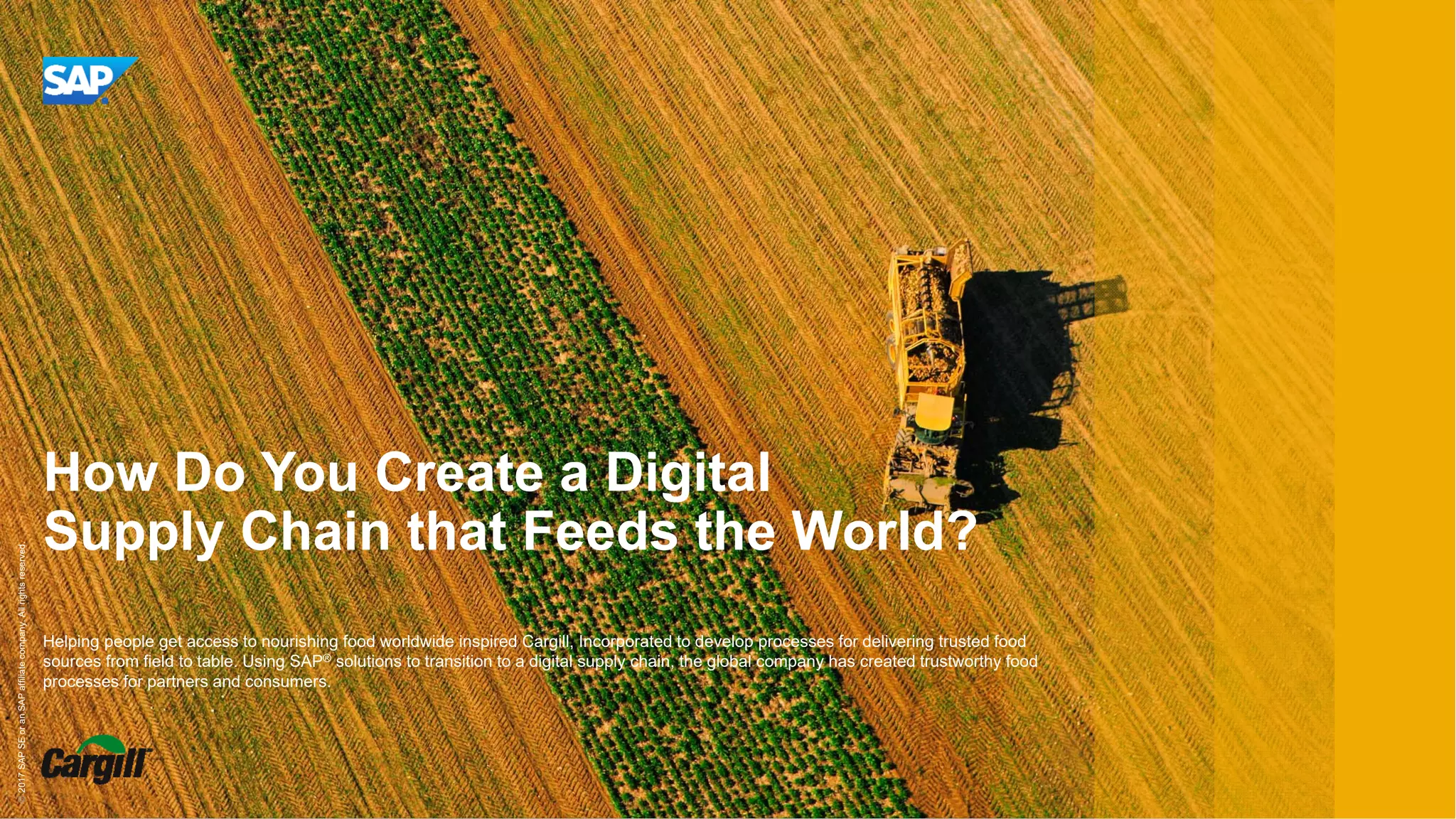
How Do You Create a Digital
Supply Chain that Feeds the World?
Helping people get access to nourishing food worldwide inspired Cargill, Incorporated to develop processes for delivering trusted food
sources from field to table. Using SAP® solutions to transition to a digital supply chain, the global company has created trustworthy food
processes for partners and consumers.
©2017SAPSEoranSAPaffiliatecompany.Allrightsreserved.
Studio SAP | 52145enUS (17/10) ǀ This content is approved by the customer and may not be altered under any circumstances.
©2017SAPSEoranSAPaffiliatecompany.Allrightsreserved.
Nourishing the World with Efficient Digital
Supply Chain and Transportation Processes
Cargill, Incorporated
Minnetonka, Minnesota,
United States
www.cargill.com
Industry
Wholesale distribution
Products and Services
Food, agriculture, financial,
and industrial segments,
including energy trading,
crop and livestock, food
and beverage, health and
pharmaceutical, financial risk
management, raw materials,
electricity, and gas
Employees
150,000
Revenue
US$107.2 billion (2016)
SAP® Solutions
SAP® for Manufacturing solution
portfolio, SAP Transportation
Management application, and
SAP Manufacturing Integration
and Intelligence application
“SAP helps us meet our commitments to our customers in food and agriculture
around the world. Better managing production and transportation directly
improves the performance of our supply chains, benefiting our customers
as well as our businesses.”
Tim Jordheim, Solution Architect, SAP Applications, Cargill, Incorporated
One of the largest privately held U.S. corporations, Cargill is responsible for 25% of all U.S. grain exports.
Using manufacturing and transportation management solutions from SAP, Cargill was able to develop a
digitalized supply chain that supports its commitment to helping the world thrive.
Before: Challenges and Opportunities
• Meet the complex needs of Cargill’s deep and broad agricultural and food supply chains
• Improve production and supply chain processes with regard to on-time service levels and order
fulfillment performance
• Streamline global business and supply chain processes across lines of business, teams, and locations
Why SAP
• Implement the SAP Manufacturing Integration and Intelligence application to standardize integration of plant
systems and enhance learning and use of SAP solutions
• Enable employees in production facilities to easily provide accurate, timely information for the SAP
software system
• Standardize, simplify, and centralize transportation activities – from planning through freight payment and
cost management – with the SAP Transportation Management application
• Manage global operations, transportation, and logistics more efficiently
After: Value-Driven Results
• Higher customer satisfaction thanks to better on-time delivery and order fulfillment performance
• Greater efficiency and effectiveness in planning and execution of transportation and logistics functions
• Easier access and monitoring of operations and business data relevant to logistics processes
• Significant cost reduction in integrating plant systems and training plant employees
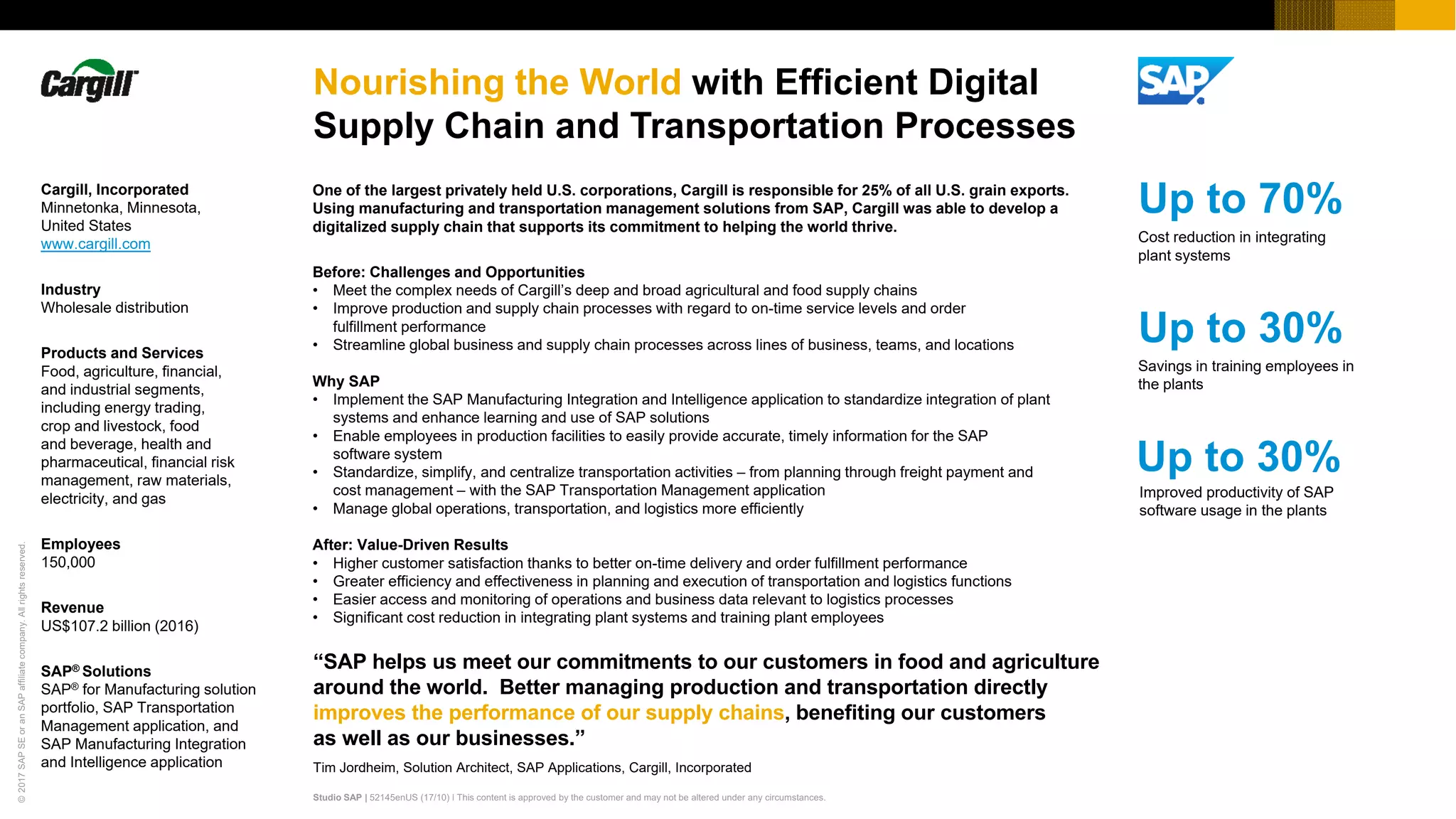
Up to 30%
Savings in training employees in
the plants
Up to 70%
Cost reduction in integrating
plant systems
Up to 30%
Improved productivity of SAP
software usage in the plants
No part of this publication may be reproduced or transmitted in any form or for any purpose without the express permission of SAP SE or an SAP affiliate company.
The information contained herein may be changed without prior notice. Some software products marketed by SAP SE and its distributors contain proprietary software components
of other software vendors. National product specifications may vary.
These materials are provided by SAP SE or an SAP affiliate company for informational purposes only, without representation or warranty of any kind, and SAP or its affiliated
companies shall not be liable for errors or omissions with respect to the materials. The only warranties for SAP or SAP affiliate company products and services are those that are
set forth in the express warranty statements accompanying such products and services, if any. Nothing herein should be construed as constituting an additional warranty.
In particular, SAP SE or its affiliated companies have no obligation to pursue any course of business outlined in this document or any related presentation, or to develop or release
any functionality mentioned therein. This document, or any related presentation, and SAP SE’s or its affiliated companies’ strategy and possible future developments, products,
and/or platform directions and functionality are all subject to change and may be changed by SAP SE or its affiliated companies at any time for any reason without notice. The
information in this document is not a commitment, promise, or legal obligation to deliver any material, code, or functionality. All forward-looking statements are subject to various
risks and uncertainties that could cause actual results to differ materially from expectations. Readers are cautioned not to place undue reliance on these forward-looking statements,
and they should not be relied upon in making purchasing decisions.
SAP and other SAP products and services mentioned herein as well as their respective logos are trademarks or registered trademarks of SAP SE (or an SAP affiliate company)
in Germany and other countries. All other product and service names mentioned are the trademarks of their respective companies.
See http://global.sap.com/corporate-en/legal/copyright/index.epx for additional trademark information and notices.
© 2017 SAP SE or an SAP affiliate company. All rights reserved.

Cargill - Creating a Digital Supply Chain that feeds the World

  • 1.
    Picture Credit |Customer Name, City, State/Country. Used with permission. ©2017SAPSEoranSAPaffiliatecompany.Allrightsreserved. How Do You Create a Digital Supply Chain that Feeds the World? Helping people get access to nourishing food worldwide inspired Cargill, Incorporated to develop processes for delivering trusted food sources from field to table. Using SAP® solutions to transition to a digital supply chain, the global company has created trustworthy food processes for partners and consumers. ©2017SAPSEoranSAPaffiliatecompany.Allrightsreserved.
  • 2.
    Studio SAP |52145enUS (17/10) ǀ This content is approved by the customer and may not be altered under any circumstances. ©2017SAPSEoranSAPaffiliatecompany.Allrightsreserved. Nourishing the World with Efficient Digital Supply Chain and Transportation Processes Cargill, Incorporated Minnetonka, Minnesota, United States www.cargill.com Industry Wholesale distribution Products and Services Food, agriculture, financial, and industrial segments, including energy trading, crop and livestock, food and beverage, health and pharmaceutical, financial risk management, raw materials, electricity, and gas Employees 150,000 Revenue US$107.2 billion (2016) SAP® Solutions SAP® for Manufacturing solution portfolio, SAP Transportation Management application, and SAP Manufacturing Integration and Intelligence application “SAP helps us meet our commitments to our customers in food and agriculture around the world. Better managing production and transportation directly improves the performance of our supply chains, benefiting our customers as well as our businesses.” Tim Jordheim, Solution Architect, SAP Applications, Cargill, Incorporated One of the largest privately held U.S. corporations, Cargill is responsible for 25% of all U.S. grain exports. Using manufacturing and transportation management solutions from SAP, Cargill was able to develop a digitalized supply chain that supports its commitment to helping the world thrive. Before: Challenges and Opportunities • Meet the complex needs of Cargill’s deep and broad agricultural and food supply chains • Improve production and supply chain processes with regard to on-time service levels and order fulfillment performance • Streamline global business and supply chain processes across lines of business, teams, and locations Why SAP • Implement the SAP Manufacturing Integration and Intelligence application to standardize integration of plant systems and enhance learning and use of SAP solutions • Enable employees in production facilities to easily provide accurate, timely information for the SAP software system • Standardize, simplify, and centralize transportation activities – from planning through freight payment and cost management – with the SAP Transportation Management application • Manage global operations, transportation, and logistics more efficiently After: Value-Driven Results • Higher customer satisfaction thanks to better on-time delivery and order fulfillment performance • Greater efficiency and effectiveness in planning and execution of transportation and logistics functions • Easier access and monitoring of operations and business data relevant to logistics processes • Significant cost reduction in integrating plant systems and training plant employees Up to 30% Savings in training employees in the plants Up to 70% Cost reduction in integrating plant systems Up to 30% Improved productivity of SAP software usage in the plants
  • 3.
    No part ofthis publication may be reproduced or transmitted in any form or for any purpose without the express permission of SAP SE or an SAP affiliate company. The information contained herein may be changed without prior notice. Some software products marketed by SAP SE and its distributors contain proprietary software components of other software vendors. National product specifications may vary. These materials are provided by SAP SE or an SAP affiliate company for informational purposes only, without representation or warranty of any kind, and SAP or its affiliated companies shall not be liable for errors or omissions with respect to the materials. The only warranties for SAP or SAP affiliate company products and services are those that are set forth in the express warranty statements accompanying such products and services, if any. Nothing herein should be construed as constituting an additional warranty. In particular, SAP SE or its affiliated companies have no obligation to pursue any course of business outlined in this document or any related presentation, or to develop or release any functionality mentioned therein. This document, or any related presentation, and SAP SE’s or its affiliated companies’ strategy and possible future developments, products, and/or platform directions and functionality are all subject to change and may be changed by SAP SE or its affiliated companies at any time for any reason without notice. The information in this document is not a commitment, promise, or legal obligation to deliver any material, code, or functionality. All forward-looking statements are subject to various risks and uncertainties that could cause actual results to differ materially from expectations. Readers are cautioned not to place undue reliance on these forward-looking statements, and they should not be relied upon in making purchasing decisions. SAP and other SAP products and services mentioned herein as well as their respective logos are trademarks or registered trademarks of SAP SE (or an SAP affiliate company) in Germany and other countries. All other product and service names mentioned are the trademarks of their respective companies. See http://global.sap.com/corporate-en/legal/copyright/index.epx for additional trademark information and notices. © 2017 SAP SE or an SAP affiliate company. All rights reserved.