OCCUPATIONAL
THERAPY
Hannah Johnson
Career Goal
 My career goal is to obtain a Master’s of Science
Degree in Occupational Therapy and work with
either special needs individuals or geriatric
patients. Inspiration for this career path came from
my mother who is a special needs elementary
teacher. My desire to be in the medical field and
my love for special needs children combine to
make occupational therapy a perfect career
choice for me. It is through classes that I have
taken at Clemson that my eyes have been opened
to the possibility of working with geriatric patients
in my career as well.
History of Occupational
Therapy
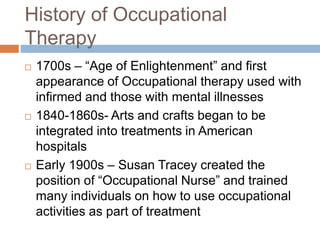
 1700s – “Age of Enlightenment” and first
appearance of Occupational therapy used with
infirmed and those with mental illnesses
 1840-1860s- Arts and crafts began to be
integrated into treatments in American
hospitals
 Early 1900s – Susan Tracey created the
position of “Occupational Nurse” and trained
many individuals on how to use occupational
activities as part of treatment
History Continued . . .
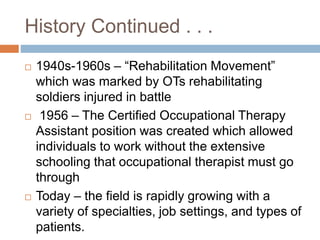
 1940s-1960s – “Rehabilitation Movement”
which was marked by OTs rehabilitating
soldiers injured in battle
 1956 – The Certified Occupational Therapy
Assistant position was created which allowed
individuals to work without the extensive
schooling that occupational therapist must go
through
 Today – the field is rapidly growing with a
variety of specialties, job settings, and types of
patients.
Occupational Therapist
 OTs may work with mentally or physically disabled
individuals as well as those suffering or recovering
from injuries or illnesses.
 They use everyday activities as a form of
rehabilitation to help patients gain, or regain, the
ability to partake in activities of daily living.
 Job settings and the prognosis of patients can
vary widely. A therapist has the potential to work
with a stroke victim in an inpatient rehabilitation
center, or with a child with Down’s syndrome in a
school. The possibilities are extensive.
Occupational Therapist
 Median Pay – $75,400/ year
 SC residents starting salary is mid-$50s
 Job outlook – 29% growth from 2012 to 2022
 Due to the increasing need for OTs as the baby
boomer generation ages and individuals live
longer lives
 Educational requirement: Masters Degree in
occupational therapy and a license by the
National Board of Certification in Occupational
Therapy
Monitoring
 According to O*Net, occupational therapists must
constantly monitor their own performance and the
performance of their patients so that adaptations
may be made if necessary.
 In my job as a Supplemental Instructor for
chemistry 101/102, I write an assessment for each
session. In my evaluation, I describe how the
session went and provide evidence that learning
took place through my instruction. In addition to
this assessment, I am constantly altering my
session plans to adapt to what the students need
and want to focus on.
Service Orientation
 One of the main skills involved in Occupational
therapy is service orientation. I have a strong
desire to help individuals who are often
disregarded, such as individuals with mental and
physical disabilities and older individuals.
 I have participated in many volunteer programs
and have had multiple work experiences in which I
have worked one-on-one with special needs
individuals. Currently, I am a teacher assistant for
the LIFE program here at Clemson, and this past
summer I was a caretaker for a young paraplegic
girl.
My Skills
 As the baby boomers age, there is an increasing
demand for occupational therapists to work with
senior citizens. Here at Clemson, I took Health
Promotion of the Aged in which I learned how to
communicate, motivate, and work with older
individuals.
 I have also been a part of a creative inquiry that
works with Alzheimer’s patients and their
caregivers to improve their quality of life.
 These two experiences have given me skills that
could be extremely beneficial to me in my career
and help me to stand out among other graduate
school applicants.
Medical University of South
Carolina
 Ranked #21 in the nation and is the only graduate
entry-level program in SC
 Admission Requirements:
 Minimum 3.0 GPA
 Minimum of 30 hours in occupational therapy
 GRE score of 50th percentile or higher to be
competitive
 Pre-requisites:
 Human anatomy, Human Physiology, Statistics, Lifespan
Human Development, Abnormal Psychology,
Social/Anthropology
 CPR certification
 In 2012, 100% of all attempting the National Board for
Certification in Occupational Therapy passed.
University of North Carolina at Chapel
Hill
 Ranked #10 in the Nation
 Admission requirements
 Prerequisites:
 2 courses in Anatomy and Physiology, Abnormal
Psychology, Statistics, Human Development, Social
Institutions and Systems, Modes of Reasoning
 Occupation Prerequisite – complete a learning experience
that results in a product or performance for the purpose of
understanding the value of learning a meaningful or important
occupation
 Minimum of 50th percentile for GRE scores
 A variety of in-depth OT observations; volunteer and work
experiences
 High quality essays that reflect an understanding of OT and
the UNC program philosophy
My Next Steps
 In order to reach my goal of becoming an
occupational therapist, I must work to enhance
the variety of my occupational therapy
experiences, showcase my skills and abilities
through my admission essays and resume,
and learn how to effectively showcase myself
in interviews. I know that I possess the
necessary skills and passion for this career. I
have a caring heart, a desire to help others
learn and grow, and the patience needed to
succeed as an occupational therapist.
References
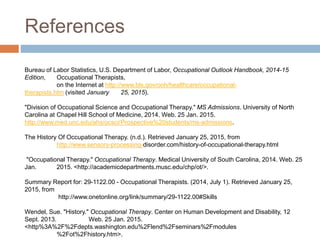
Bureau of Labor Statistics, U.S. Department of Labor, Occupational Outlook Handbook, 2014-15
Edition, Occupational Therapists,
on the Internet at http://www.bls.gov/ooh/healthcare/occupational-
therapists.htm (visited January 25, 2015).
"Division of Occupational Science and Occupational Therapy." MS Admissions. University of North
Carolina at Chapel Hill School of Medicine, 2014. Web. 25 Jan. 2015.
http://www.med.unc.edu/ahs/ocsci/Prospective%20students/ms-admissions.
The History Of Occupational Therapy. (n.d.). Retrieved January 25, 2015, from
http://www.sensory-processing-disorder.com/history-of-occupational-therapy.html
"Occupational Therapy." Occupational Therapy. Medical University of South Carolina, 2014. Web.
25 Jan. 2015. <http://academicdepartments.musc.edu/chp/ot/>.
Summary Report for: 29-1122.00 - Occupational Therapists. (2014, July 1). Retrieved January 25,
2015, from
http://www.onetonline.org/link/summary/29-1122.00#Skills
Wendel, Sue. "History." Occupational Therapy. Center on Human Development and Disability, 12
Sept. 2013. Web. 25 Jan. 2015.
<http%3A%2F%2Fdepts.washington.edu%2Flend%2Fseminars%2Fmodules
%2Fot%2Fhistory.htm>.

Occupational therapy presentation 2

  • 1.
  • 2.
    Career Goal  Mycareer goal is to obtain a Master’s of Science Degree in Occupational Therapy and work with either special needs individuals or geriatric patients. Inspiration for this career path came from my mother who is a special needs elementary teacher. My desire to be in the medical field and my love for special needs children combine to make occupational therapy a perfect career choice for me. It is through classes that I have taken at Clemson that my eyes have been opened to the possibility of working with geriatric patients in my career as well.
  • 3.
    History of Occupational Therapy 1700s – “Age of Enlightenment” and first appearance of Occupational therapy used with infirmed and those with mental illnesses  1840-1860s- Arts and crafts began to be integrated into treatments in American hospitals  Early 1900s – Susan Tracey created the position of “Occupational Nurse” and trained many individuals on how to use occupational activities as part of treatment
  • 4.
    History Continued .. .  1940s-1960s – “Rehabilitation Movement” which was marked by OTs rehabilitating soldiers injured in battle  1956 – The Certified Occupational Therapy Assistant position was created which allowed individuals to work without the extensive schooling that occupational therapist must go through  Today – the field is rapidly growing with a variety of specialties, job settings, and types of patients.
  • 5.
    Occupational Therapist  OTsmay work with mentally or physically disabled individuals as well as those suffering or recovering from injuries or illnesses.  They use everyday activities as a form of rehabilitation to help patients gain, or regain, the ability to partake in activities of daily living.  Job settings and the prognosis of patients can vary widely. A therapist has the potential to work with a stroke victim in an inpatient rehabilitation center, or with a child with Down’s syndrome in a school. The possibilities are extensive.
  • 6.
    Occupational Therapist  MedianPay – $75,400/ year  SC residents starting salary is mid-$50s  Job outlook – 29% growth from 2012 to 2022  Due to the increasing need for OTs as the baby boomer generation ages and individuals live longer lives  Educational requirement: Masters Degree in occupational therapy and a license by the National Board of Certification in Occupational Therapy
  • 7.
    Monitoring  According toO*Net, occupational therapists must constantly monitor their own performance and the performance of their patients so that adaptations may be made if necessary.  In my job as a Supplemental Instructor for chemistry 101/102, I write an assessment for each session. In my evaluation, I describe how the session went and provide evidence that learning took place through my instruction. In addition to this assessment, I am constantly altering my session plans to adapt to what the students need and want to focus on.
  • 8.
    Service Orientation  Oneof the main skills involved in Occupational therapy is service orientation. I have a strong desire to help individuals who are often disregarded, such as individuals with mental and physical disabilities and older individuals.  I have participated in many volunteer programs and have had multiple work experiences in which I have worked one-on-one with special needs individuals. Currently, I am a teacher assistant for the LIFE program here at Clemson, and this past summer I was a caretaker for a young paraplegic girl.
  • 9.
    My Skills  Asthe baby boomers age, there is an increasing demand for occupational therapists to work with senior citizens. Here at Clemson, I took Health Promotion of the Aged in which I learned how to communicate, motivate, and work with older individuals.  I have also been a part of a creative inquiry that works with Alzheimer’s patients and their caregivers to improve their quality of life.  These two experiences have given me skills that could be extremely beneficial to me in my career and help me to stand out among other graduate school applicants.
  • 10.
    Medical University ofSouth Carolina  Ranked #21 in the nation and is the only graduate entry-level program in SC  Admission Requirements:  Minimum 3.0 GPA  Minimum of 30 hours in occupational therapy  GRE score of 50th percentile or higher to be competitive  Pre-requisites:  Human anatomy, Human Physiology, Statistics, Lifespan Human Development, Abnormal Psychology, Social/Anthropology  CPR certification  In 2012, 100% of all attempting the National Board for Certification in Occupational Therapy passed.
  • 11.
    University of NorthCarolina at Chapel Hill  Ranked #10 in the Nation  Admission requirements  Prerequisites:  2 courses in Anatomy and Physiology, Abnormal Psychology, Statistics, Human Development, Social Institutions and Systems, Modes of Reasoning  Occupation Prerequisite – complete a learning experience that results in a product or performance for the purpose of understanding the value of learning a meaningful or important occupation  Minimum of 50th percentile for GRE scores  A variety of in-depth OT observations; volunteer and work experiences  High quality essays that reflect an understanding of OT and the UNC program philosophy
  • 12.
    My Next Steps In order to reach my goal of becoming an occupational therapist, I must work to enhance the variety of my occupational therapy experiences, showcase my skills and abilities through my admission essays and resume, and learn how to effectively showcase myself in interviews. I know that I possess the necessary skills and passion for this career. I have a caring heart, a desire to help others learn and grow, and the patience needed to succeed as an occupational therapist.
  • 13.
    References Bureau of LaborStatistics, U.S. Department of Labor, Occupational Outlook Handbook, 2014-15 Edition, Occupational Therapists, on the Internet at http://www.bls.gov/ooh/healthcare/occupational- therapists.htm (visited January 25, 2015). "Division of Occupational Science and Occupational Therapy." MS Admissions. University of North Carolina at Chapel Hill School of Medicine, 2014. Web. 25 Jan. 2015. http://www.med.unc.edu/ahs/ocsci/Prospective%20students/ms-admissions. The History Of Occupational Therapy. (n.d.). Retrieved January 25, 2015, from http://www.sensory-processing-disorder.com/history-of-occupational-therapy.html "Occupational Therapy." Occupational Therapy. Medical University of South Carolina, 2014. Web. 25 Jan. 2015. <http://academicdepartments.musc.edu/chp/ot/>. Summary Report for: 29-1122.00 - Occupational Therapists. (2014, July 1). Retrieved January 25, 2015, from http://www.onetonline.org/link/summary/29-1122.00#Skills Wendel, Sue. "History." Occupational Therapy. Center on Human Development and Disability, 12 Sept. 2013. Web. 25 Jan. 2015. <http%3A%2F%2Fdepts.washington.edu%2Flend%2Fseminars%2Fmodules %2Fot%2Fhistory.htm>.