
Aerospace Engineer
Career Presentation
PowerPoint
RICHARD D COOK
What is an Aerospace
Engineer?
• An aerospace engineer specializes in
designing aircraft, spacecraft,
satellites, and missiles.
• In addition, they test prototypes to
make sure that they function
according to design.
How much money does
an Aerospace Engineer
make?
• The median annual wage for
aerospace engineers was $109,650 as
of May 2016.
• For example, a general engineer’s
salary at Armstrong Flight Research
Center starts at $114,268.00 annually
and tops out at $148,550.00 plus
benefits and a competitive
retirement program.
How do I become an
Aerospace Engineer?
Education
Requirements
• The first step to becoming an Aerospace Engineer is to
complete an engineering degree program at the college
of your choice.
• While a degree in Aerospace Engineering is preferred,
most employers will accept a general, electrical or
mechanical engineering graduate.
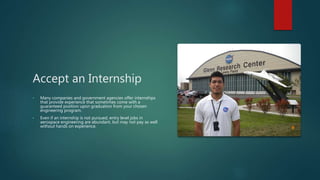
Accept an Internship
• Many companies and government agencies offer internships
that provide experience that sometimes come with a
guaranteed position upon graduation from your chosen
engineering program.
• Even if an internship is not pursued, entry level jobs in
aerospace engineering are abundant, but may not pay as well
without hands on experience.
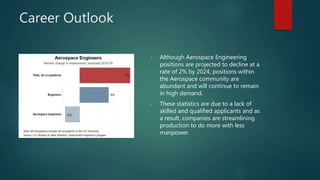
Career Outlook
• Although Aerospace Engineering
positions are projected to decline at a
rate of 2% by 2024, positions within
the Aerospace community are
abundant and will continue to remain
in high demand.
• These statistics are due to a lack of
skilled and qualified applicants and as
a result, companies are streamlining
production to do more with less
manpower.
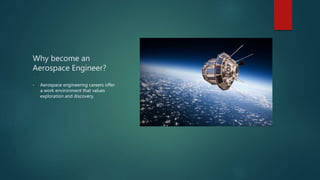
Why become an
Aerospace Engineer?
• Aerospace engineering careers offer
a work environment that values
exploration and discovery.
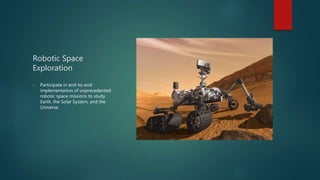
Robotic Space
Exploration
• Participate in end-to-end
implementation of unprecedented
robotic space missions to study
Earth, the Solar System, and the
Universe.
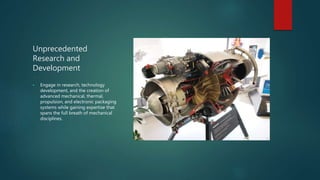
Unprecedented
Research and
Development
• Engage in research, technology
development, and the creation of
advanced mechanical, thermal,
propulsion, and electronic packaging
systems while gaining expertise that
spans the full breath of mechanical
disciplines.
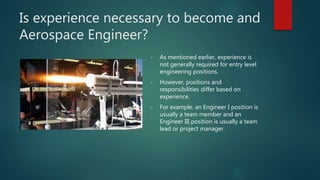
Is experience necessary to become and
Aerospace Engineer?
• As mentioned earlier, experience is
not generally required for entry level
engineering positions.
• However, positions and
responsibilities differ based on
experience.
• For example, an Engineer I position is
usually a team member and an
Engineer III position is usually a team
lead or project manager.
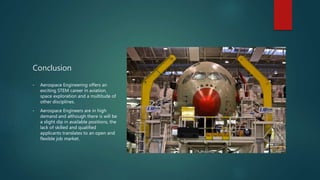
Conclusion
• Aerospace Engineering offers an
exciting STEM career in aviation,
space exploration and a multitude of
other disciplines.
• Aerospace Engineers are in high
demand and although there is will be
a slight dip in available positions, the
lack of skilled and qualified
applicants translates to an open and
flexible job market.
References
Edinger, Robert. “AAEAAQAAAAAAAAceAAAAJGJhNmJjYzllLTFmMmQtNDQzNy04OWVhLTU2YzQ5MGVkYjM3Yg.” Linked in, 20
Dec. 2015.
Getty, and Tom Searcy. “071912_First_Question_1725x810-PAN_18905.” Inc.com, 22 Aug. 2013.
“Info-img2.” ARDC, 23 Apr. 2017.
Kullman, Joe. “intern_Daniel_Oliden_GRC_web.” Arizona State University, 18 Sept. 2013.
Mason, Jerry. “A350.” Petermarsh.eu, 2014.
“mit6.” MIT, 23 Apr. 2017.
NASA. “MSL_NASA4X3-879x485.” SpaceNews, 7 Mar. 2013.
NASAJPL edu. “What does it mean to be a NASA JPL intern?” Education Office of NASA's Jet Propulsion Laboratory, 9 Feb. 2015.
“Occupational Outlook Handbook, 2016-17 Edition, Aerospace Engineers.” U.S. Bureau of Labor Statistics, U.S. Department of Labor,
2016, www.bls.gov/ooh/architecture-and-engineering/aerospace-engineers.htm#tab-6. Accessed 23 Apr. 2017.
“Salary-Negotiation-Tips-Medium.” Gig.com, 8 Jan. 2015.
“shutterstock_229816306.” Investopedia.com, 4 Sept. 2016.
“Student Employment.” Jet Propulsion Laboratory, NASA, 19 Apr. 2017, www.jpl.nasa.gov/opportunities/students/. Accessed 23
Apr. 2017.
Whitmore, Stephen. “Micro_Joe_Pulse.” Utah State University, 18 Apr. 2016.

Career Presentation on Aeronautical Engineering

  • 1.
  • 2.
    What is anAerospace Engineer? • An aerospace engineer specializes in designing aircraft, spacecraft, satellites, and missiles. • In addition, they test prototypes to make sure that they function according to design.
  • 3.
    How much moneydoes an Aerospace Engineer make? • The median annual wage for aerospace engineers was $109,650 as of May 2016. • For example, a general engineer’s salary at Armstrong Flight Research Center starts at $114,268.00 annually and tops out at $148,550.00 plus benefits and a competitive retirement program.
  • 4.
    How do Ibecome an Aerospace Engineer?
  • 5.
    Education Requirements • The firststep to becoming an Aerospace Engineer is to complete an engineering degree program at the college of your choice. • While a degree in Aerospace Engineering is preferred, most employers will accept a general, electrical or mechanical engineering graduate.
  • 6.
    Accept an Internship •Many companies and government agencies offer internships that provide experience that sometimes come with a guaranteed position upon graduation from your chosen engineering program. • Even if an internship is not pursued, entry level jobs in aerospace engineering are abundant, but may not pay as well without hands on experience.
  • 8.
    Career Outlook • AlthoughAerospace Engineering positions are projected to decline at a rate of 2% by 2024, positions within the Aerospace community are abundant and will continue to remain in high demand. • These statistics are due to a lack of skilled and qualified applicants and as a result, companies are streamlining production to do more with less manpower.
  • 9.
    Why become an AerospaceEngineer? • Aerospace engineering careers offer a work environment that values exploration and discovery.
  • 10.
    Robotic Space Exploration • Participatein end-to-end implementation of unprecedented robotic space missions to study Earth, the Solar System, and the Universe.
  • 11.
    Unprecedented Research and Development • Engagein research, technology development, and the creation of advanced mechanical, thermal, propulsion, and electronic packaging systems while gaining expertise that spans the full breath of mechanical disciplines.
  • 12.
    Is experience necessaryto become and Aerospace Engineer? • As mentioned earlier, experience is not generally required for entry level engineering positions. • However, positions and responsibilities differ based on experience. • For example, an Engineer I position is usually a team member and an Engineer III position is usually a team lead or project manager.
  • 13.
    Conclusion • Aerospace Engineeringoffers an exciting STEM career in aviation, space exploration and a multitude of other disciplines. • Aerospace Engineers are in high demand and although there is will be a slight dip in available positions, the lack of skilled and qualified applicants translates to an open and flexible job market.
  • 14.
    References Edinger, Robert. “AAEAAQAAAAAAAAceAAAAJGJhNmJjYzllLTFmMmQtNDQzNy04OWVhLTU2YzQ5MGVkYjM3Yg.”Linked in, 20 Dec. 2015. Getty, and Tom Searcy. “071912_First_Question_1725x810-PAN_18905.” Inc.com, 22 Aug. 2013. “Info-img2.” ARDC, 23 Apr. 2017. Kullman, Joe. “intern_Daniel_Oliden_GRC_web.” Arizona State University, 18 Sept. 2013. Mason, Jerry. “A350.” Petermarsh.eu, 2014. “mit6.” MIT, 23 Apr. 2017. NASA. “MSL_NASA4X3-879x485.” SpaceNews, 7 Mar. 2013. NASAJPL edu. “What does it mean to be a NASA JPL intern?” Education Office of NASA's Jet Propulsion Laboratory, 9 Feb. 2015. “Occupational Outlook Handbook, 2016-17 Edition, Aerospace Engineers.” U.S. Bureau of Labor Statistics, U.S. Department of Labor, 2016, www.bls.gov/ooh/architecture-and-engineering/aerospace-engineers.htm#tab-6. Accessed 23 Apr. 2017. “Salary-Negotiation-Tips-Medium.” Gig.com, 8 Jan. 2015. “shutterstock_229816306.” Investopedia.com, 4 Sept. 2016. “Student Employment.” Jet Propulsion Laboratory, NASA, 19 Apr. 2017, www.jpl.nasa.gov/opportunities/students/. Accessed 23 Apr. 2017. Whitmore, Stephen. “Micro_Joe_Pulse.” Utah State University, 18 Apr. 2016.