Package of
Practices for
Turmeric
Contents
1. Introduction
2. Climate and Soil
3. Varieties
4. Cultivation (From Land Preparation to
Harvesting)
5. Processing
6. Plant Protection
2/3/20XX 2
Introduction
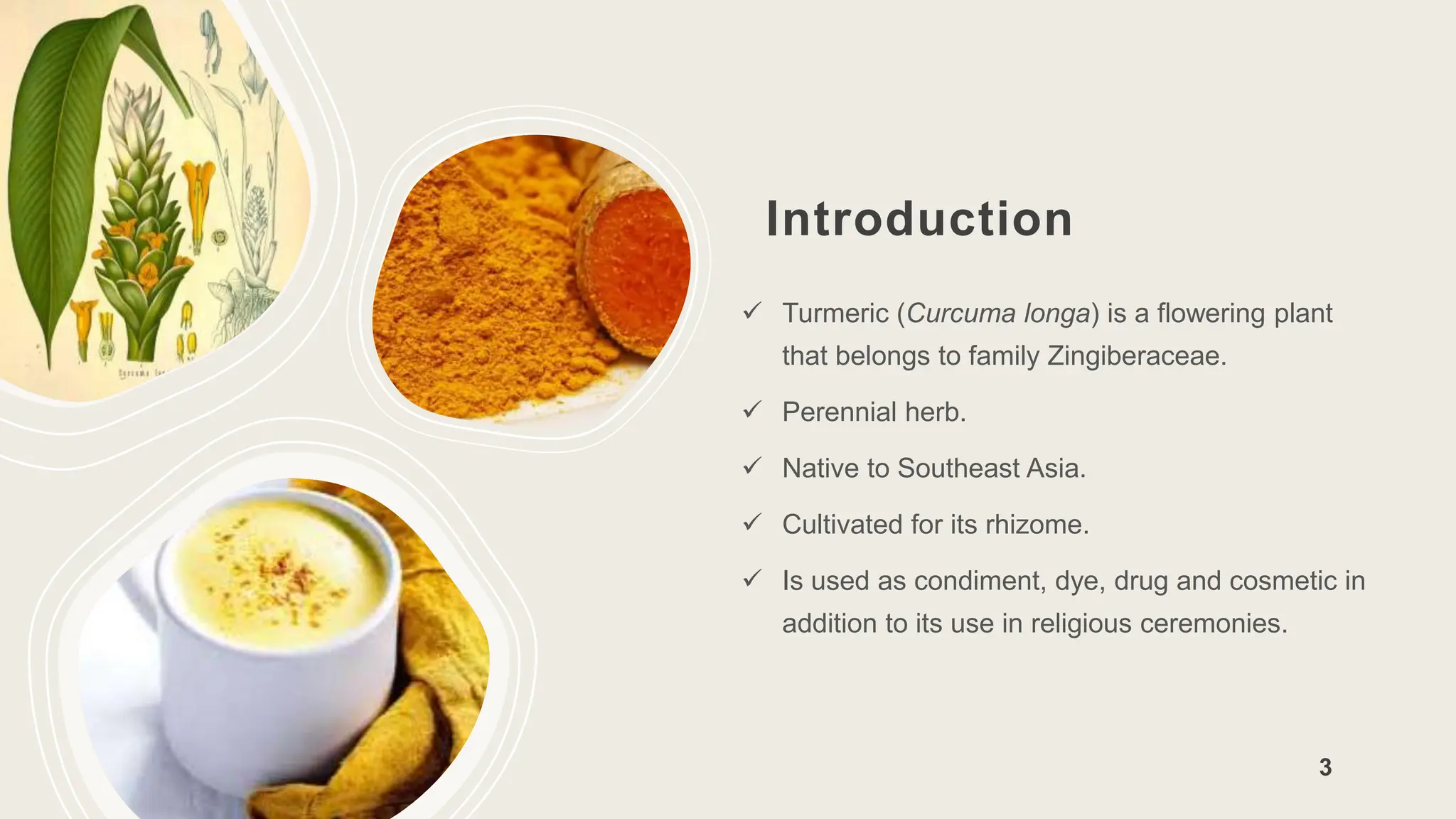
 Turmeric (Curcuma longa) is a flowering plant
that belongs to family Zingiberaceae.
 Perennial herb.
 Native to Southeast Asia.
 Cultivated for its rhizome.
 Is used as condiment, dye, drug and cosmetic in
addition to its use in religious ceremonies.
3
Climate and Soil
• Can be grown in tropical and sub-tropical conditions from
sea level to 1500 m above sea level,
• Temperature range of 20-35 Degree C with an annual
rainfall of 1500 mm or more, under rainfed or irrigated
conditions.
• Can be grown on different types of soils, but thrives best in
well-drained sandy or clay loam soils
• pH range of 4.5-7.5 with good organic matter.
Varieties
5
Several local varieties are cultivated in Nepal. The major exotic varieties are:
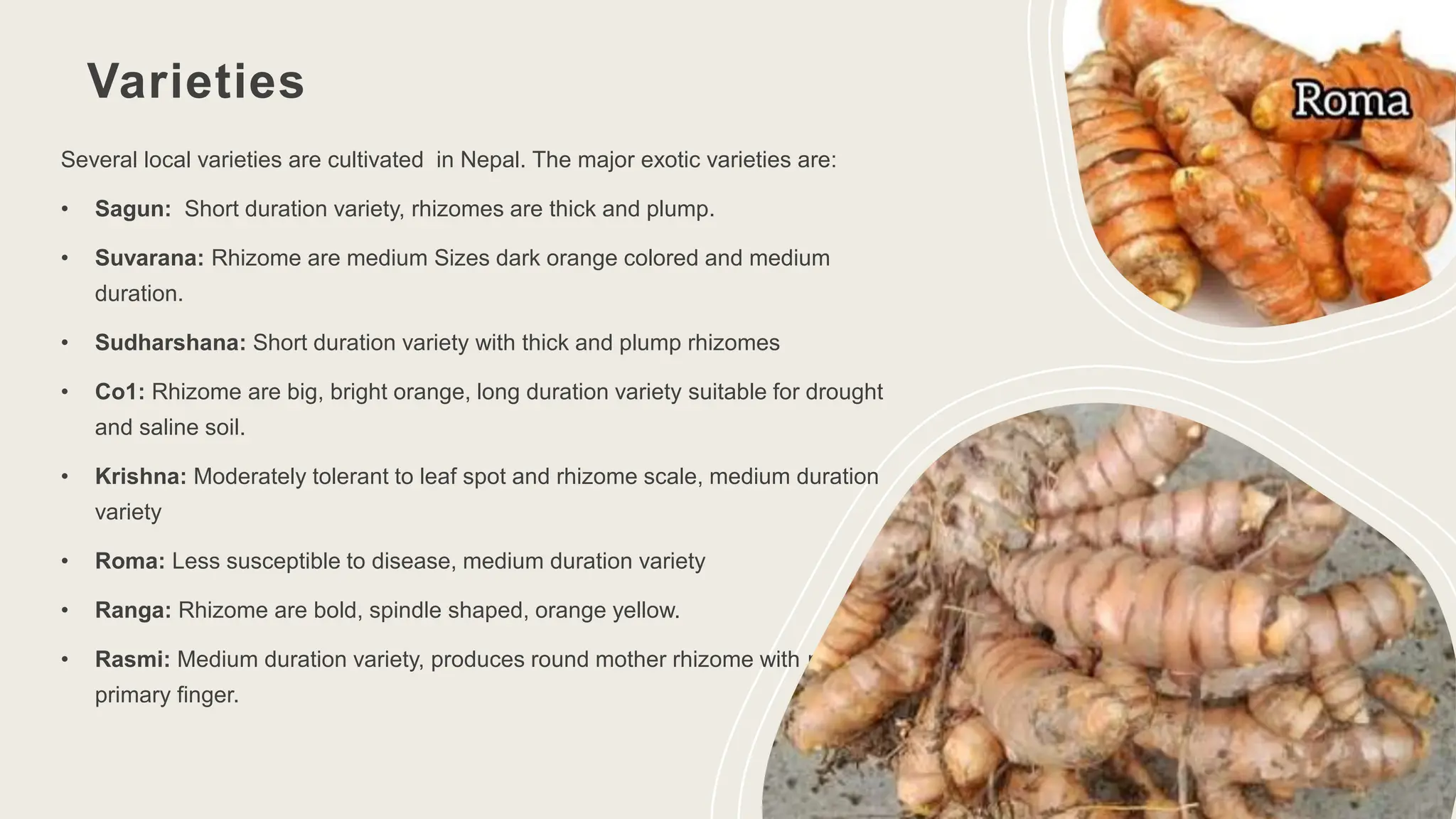
• Sagun: Short duration variety, rhizomes are thick and plump.
• Suvarana: Rhizome are medium Sizes dark orange colored and medium
duration.
• Sudharshana: Short duration variety with thick and plump rhizomes
• Co1: Rhizome are big, bright orange, long duration variety suitable for drought
and saline soil.
• Krishna: Moderately tolerant to leaf spot and rhizome scale, medium duration
variety
• Roma: Less susceptible to disease, medium duration variety
• Ranga: Rhizome are bold, spindle shaped, orange yellow.
• Rasmi: Medium duration variety, produces round mother rhizome with plumpy
primary finger.
Cultivation
6
Preparation of land
 Starts with early monsoon shower.
 The soil is brought to a fine tilth by giving about four deep ploughings.
 Immediately with the receipt of pre-monsoon showers, beds of 1.0 m width, 15
cm height and of convenient length are prepared with spacing of 50 cm
between beds.
 Planting is also done by forming ridges and furrows.
Planting
 The crop can be planted during April-May with the receipt of pre-monsoon
showers.
Cultivation
Seed material
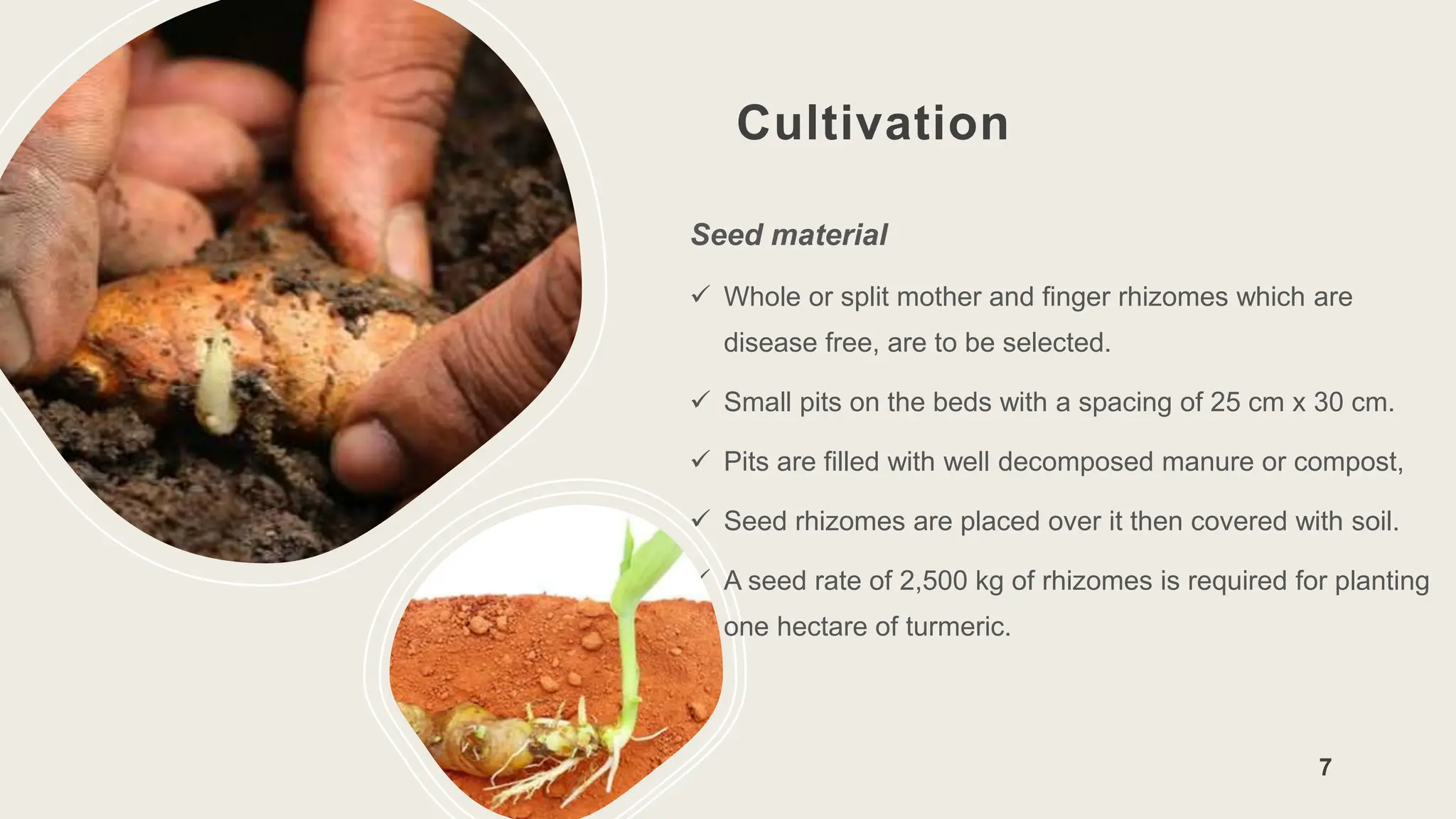
 Whole or split mother and finger rhizomes which are
disease free, are to be selected.
 Small pits on the beds with a spacing of 25 cm x 30 cm.
 Pits are filled with well decomposed manure or compost,
 Seed rhizomes are placed over it then covered with soil.
 A seed rate of 2,500 kg of rhizomes is required for planting
one hectare of turmeric.
7
Cultivation
Manuring and fertilizer application
 Farmyard manure (FYM) or compost @ 30-40 t/ha
 Applied by broadcasting and ploughed at the time of preparation of land or as basal
dressing by spreading over the beds or in to the pits at the time of planting.
 Fertilizers @ 60 kg N, 50 kg P2O5 and 120 kg K2O per hectare, applied in split doses.
 Zinc @ 5 kg/ha may also be applied at the time of planting and organic manures like oil
cakes can also be applied @ 2 t/ha. In such case, the dosage of FYM can be reduced.
Sample Footer Text 2/3/20XX 8
Cultivation
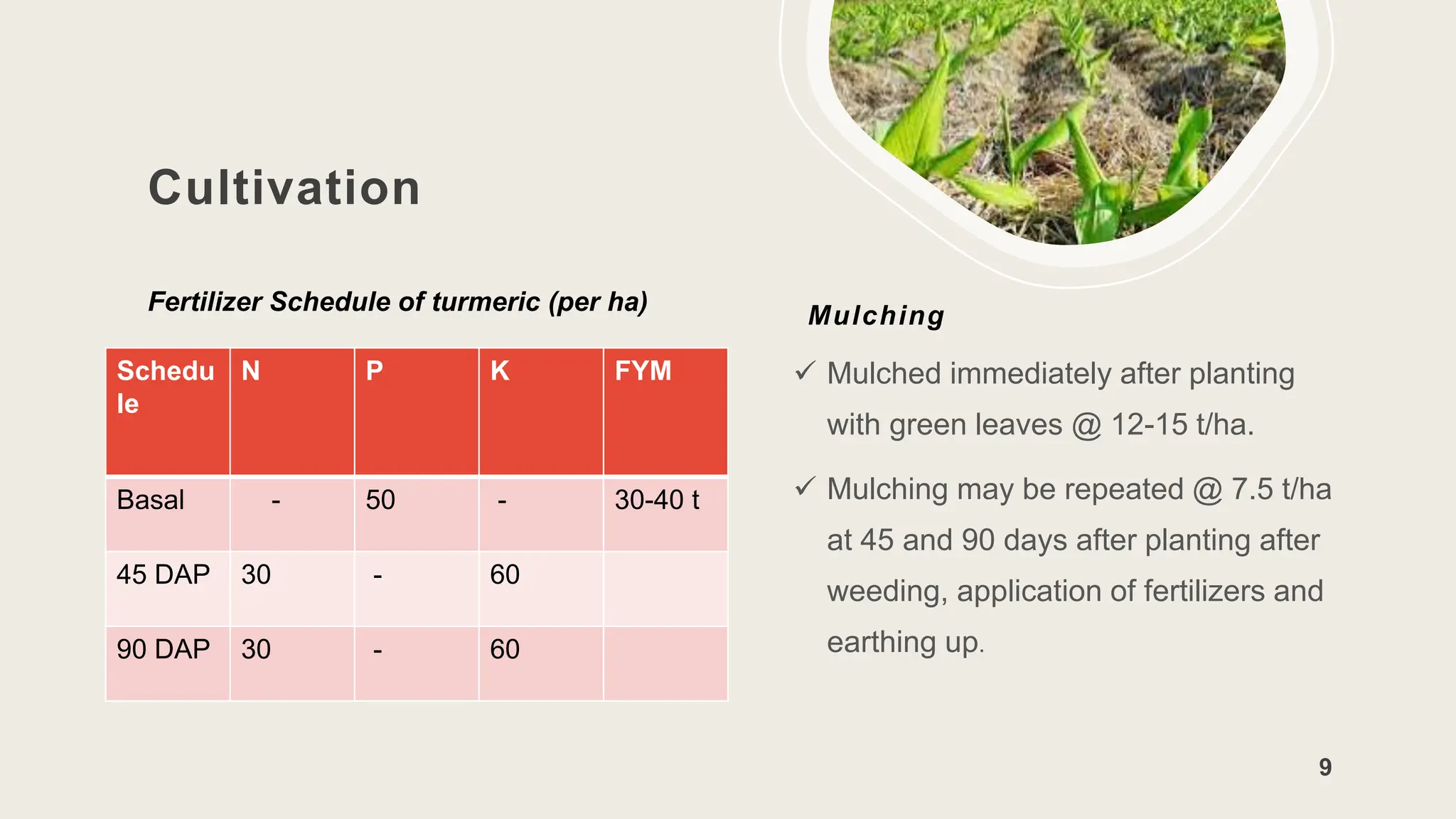
Fertilizer Schedule of turmeric (per ha)
Mulching
 Mulched immediately after planting
with green leaves @ 12-15 t/ha.
 Mulching may be repeated @ 7.5 t/ha
at 45 and 90 days after planting after
weeding, application of fertilizers and
earthing up.
9
Schedu
le
N P K FYM
Basal - 50 - 30-40 t
45 DAP 30 - 60
90 DAP 30 - 60
Cultivation
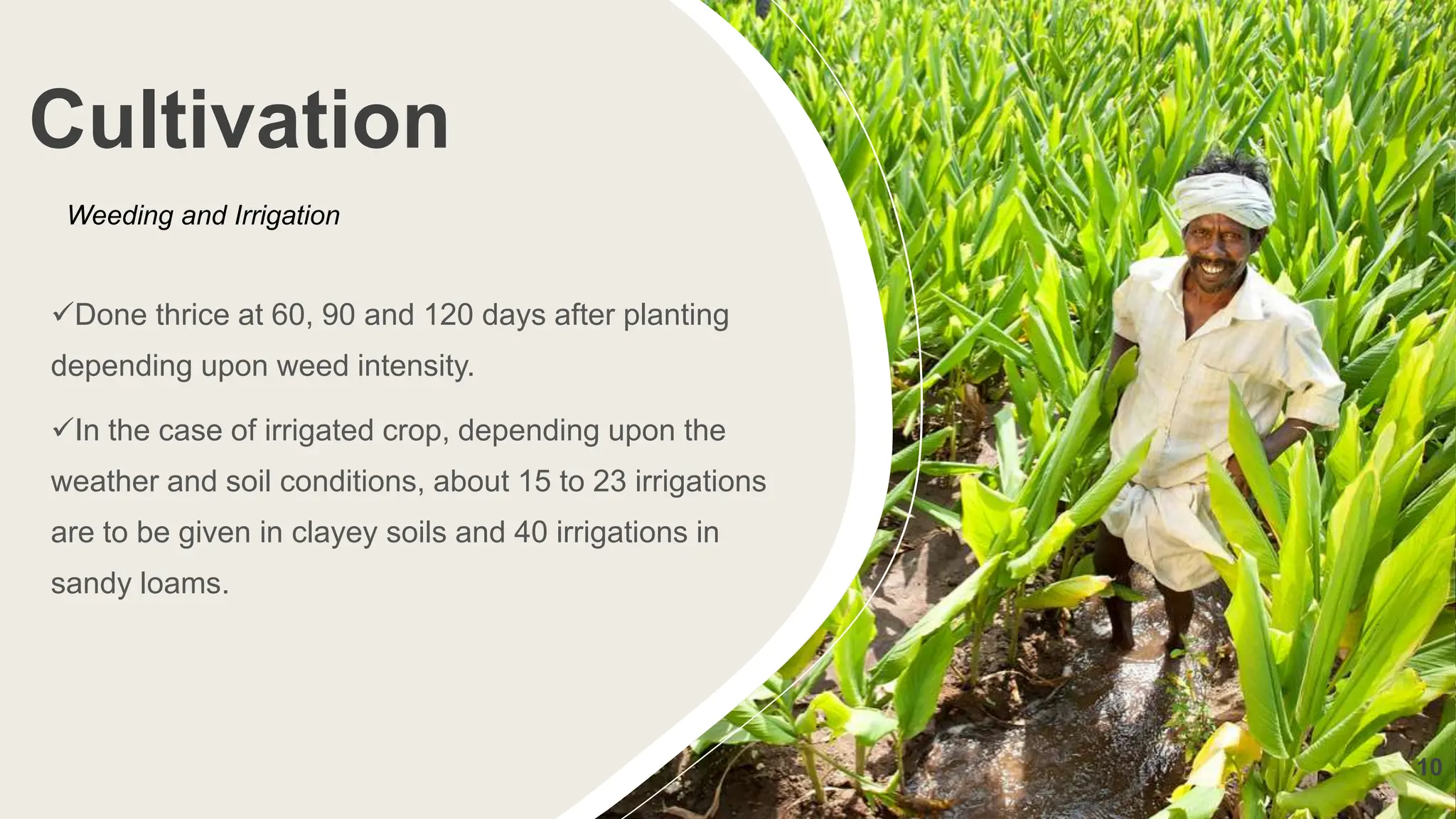
Done thrice at 60, 90 and 120 days after planting
depending upon weed intensity.
In the case of irrigated crop, depending upon the
weather and soil conditions, about 15 to 23 irrigations
are to be given in clayey soils and 40 irrigations in
sandy loams.
Weeding and Irrigation
10
Cultivation
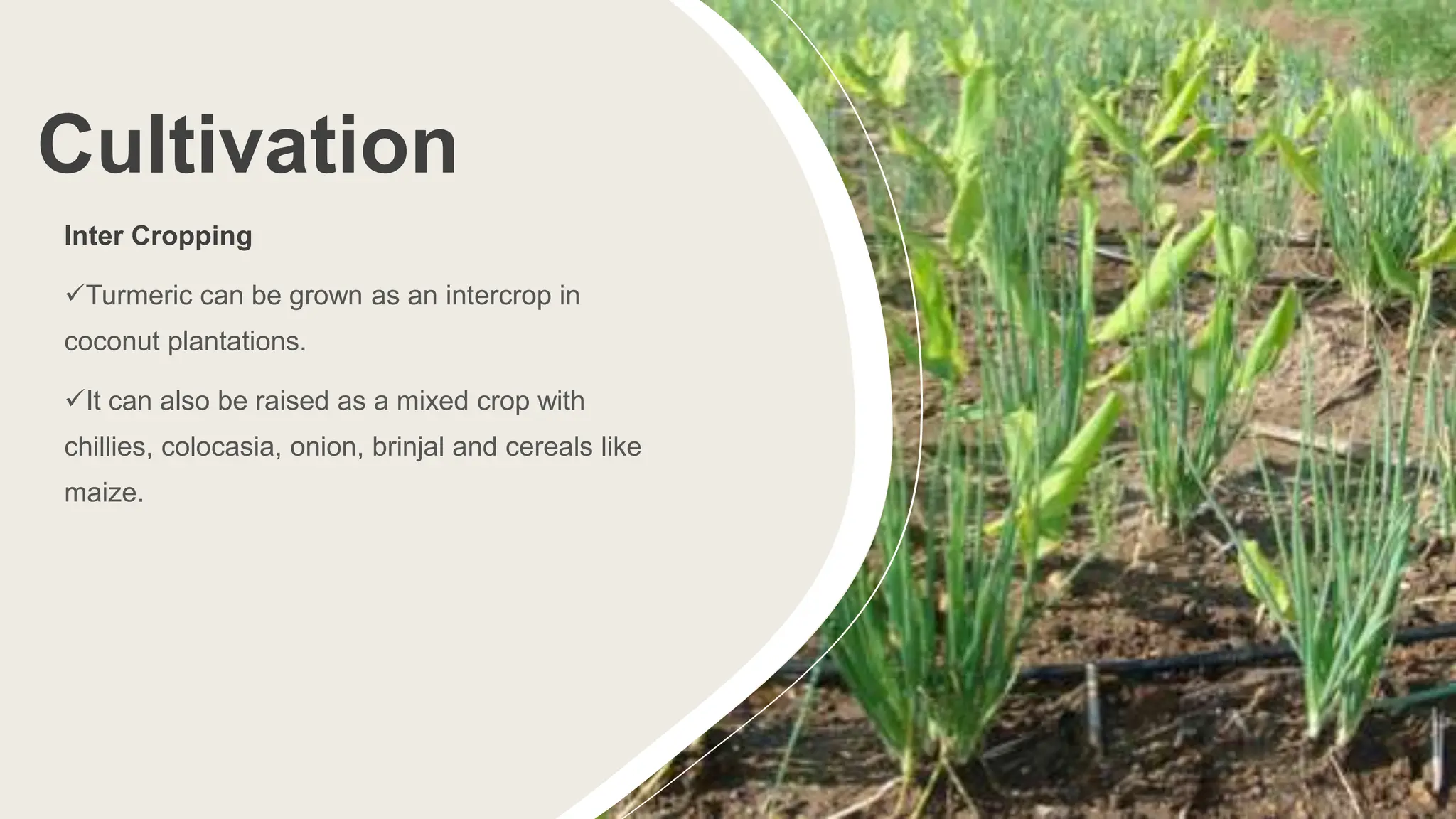
Inter Cropping
Turmeric can be grown as an intercrop in
coconut plantations.
It can also be raised as a mixed crop with
chillies, colocasia, onion, brinjal and cereals like
maize.
Harvesting
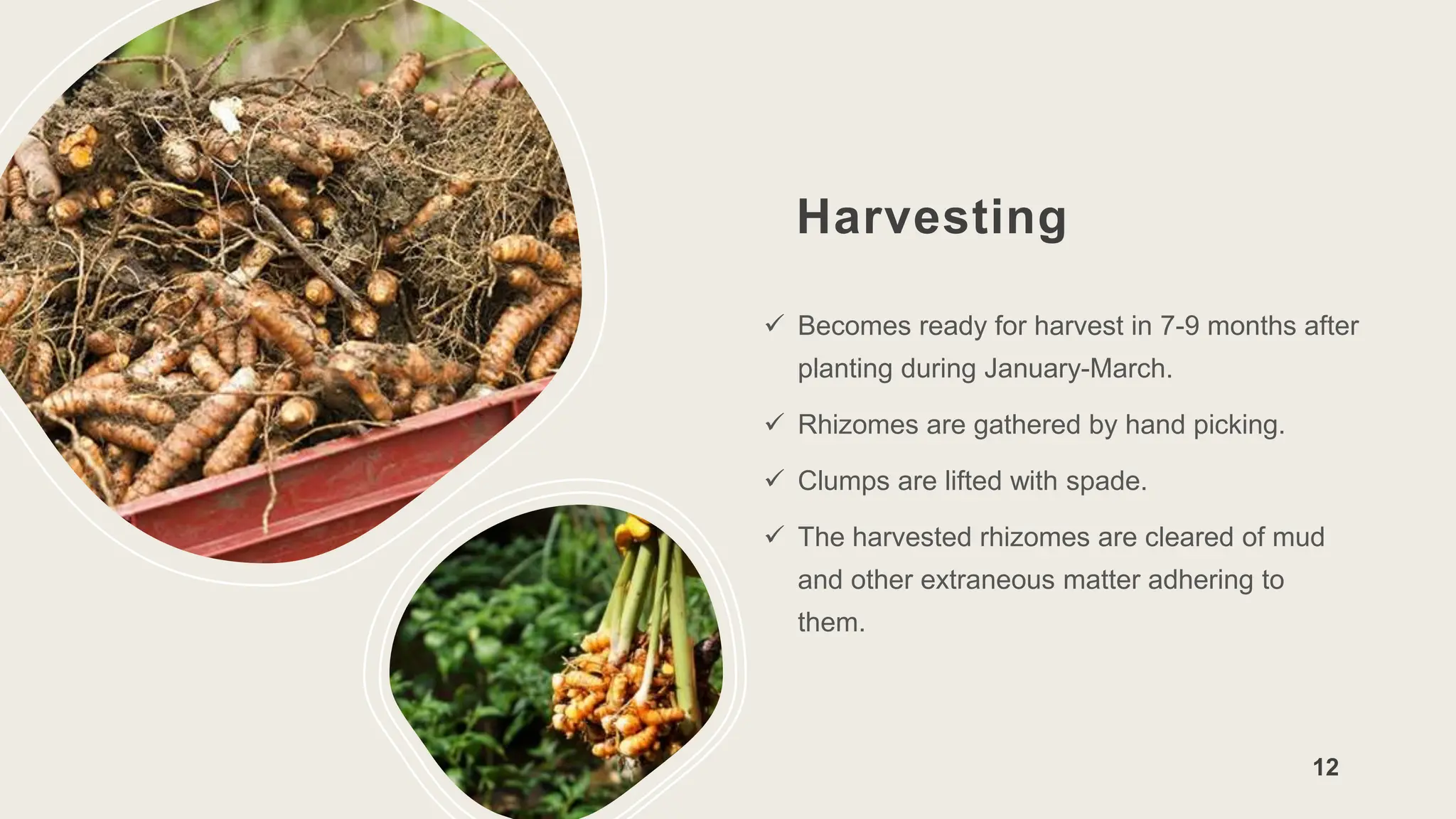
 Becomes ready for harvest in 7-9 months after
planting during January-March.
 Rhizomes are gathered by hand picking.
 Clumps are lifted with spade.
 The harvested rhizomes are cleared of mud
and other extraneous matter adhering to
them.
12
Processing
Curing
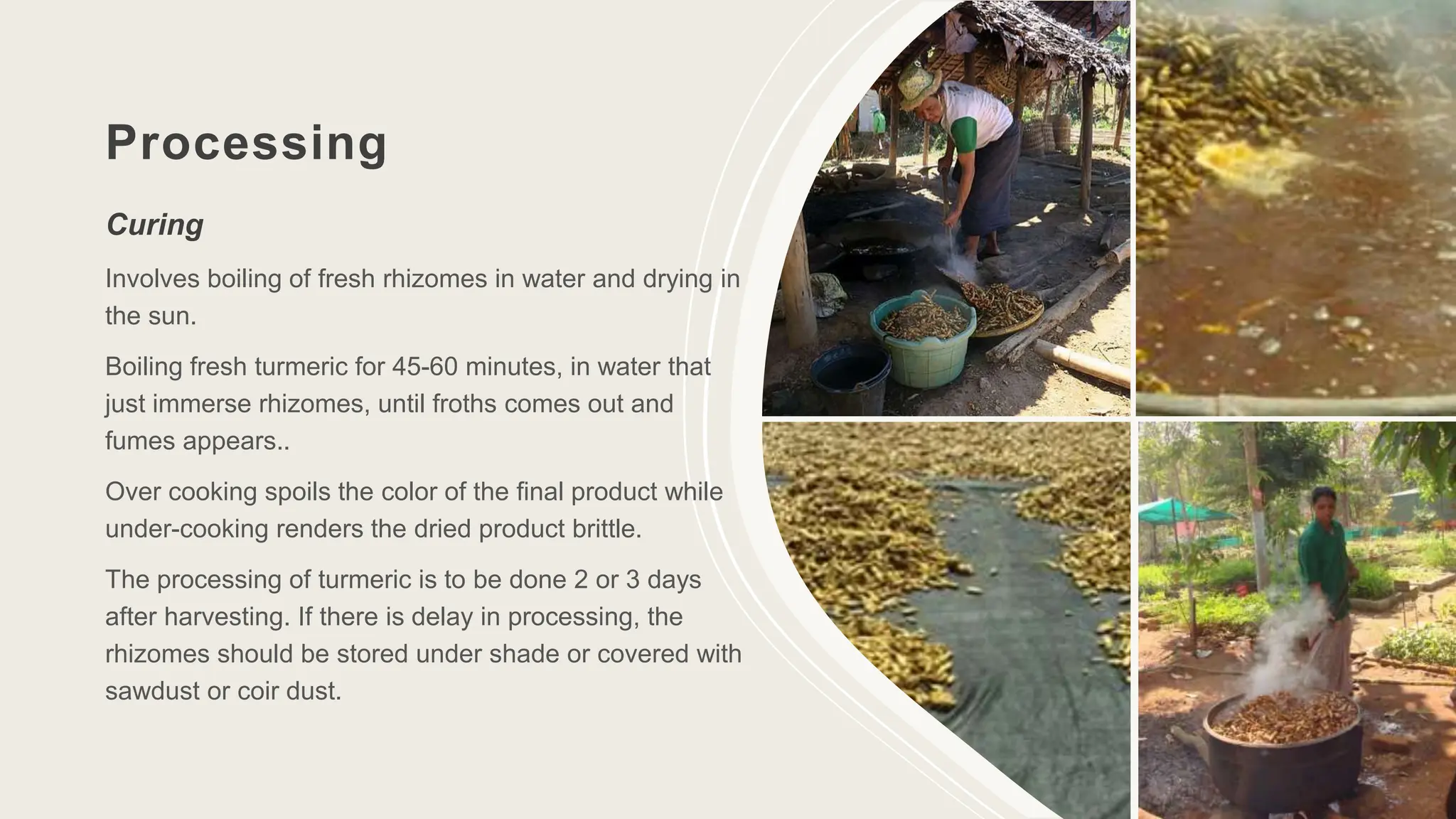
Involves boiling of fresh rhizomes in water and drying in
the sun.
Boiling fresh turmeric for 45-60 minutes, in water that
just immerse rhizomes, until froths comes out and
fumes appears..
Over cooking spoils the color of the final product while
under-cooking renders the dried product brittle.
The processing of turmeric is to be done 2 or 3 days
after harvesting. If there is delay in processing, the
rhizomes should be stored under shade or covered with
sawdust or coir dust.
13
Processing
Drying
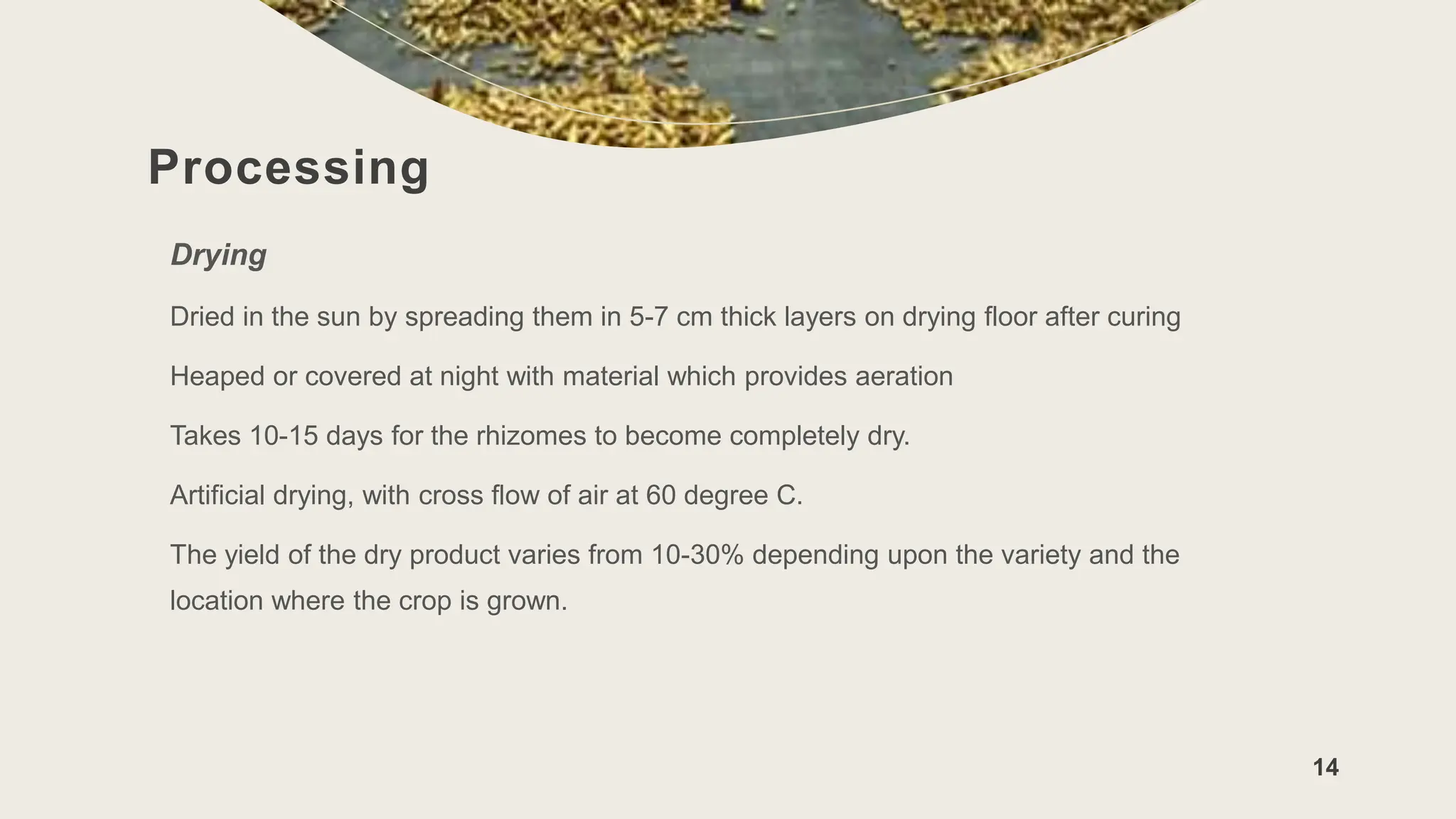
Dried in the sun by spreading them in 5-7 cm thick layers on drying floor after curing
Heaped or covered at night with material which provides aeration
Takes 10-15 days for the rhizomes to become completely dry.
Artificial drying, with cross flow of air at 60 degree C.
The yield of the dry product varies from 10-30% depending upon the variety and the
location where the crop is grown.
14
Processing
Polishing and Coloring
 Dried turmeric has a poor appearance and a rough dull outer surface
with scales and root bits.
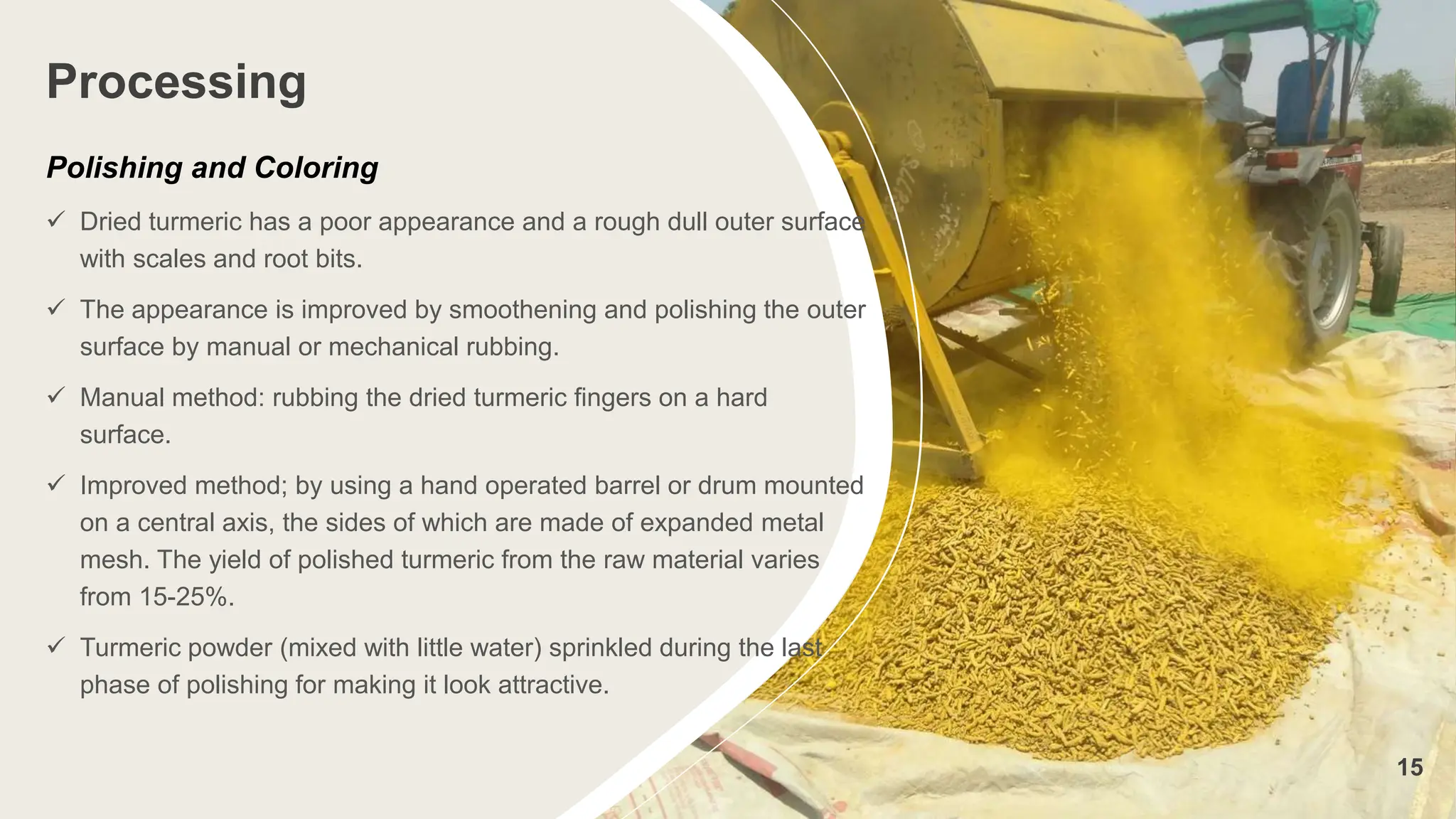
 The appearance is improved by smoothening and polishing the outer
surface by manual or mechanical rubbing.
 Manual method: rubbing the dried turmeric fingers on a hard
surface.
 Improved method; by using a hand operated barrel or drum mounted
on a central axis, the sides of which are made of expanded metal
mesh. The yield of polished turmeric from the raw material varies
from 15-25%.
 Turmeric powder (mixed with little water) sprinkled during the last
phase of polishing for making it look attractive.
15
Preservation of seed rhizomes
 Generally stored by heaping in well ventilated rooms and covered with turmeric
leaves.
 The seed rhizomes can also be stored in pits with saw dust.
 The pits are to be covered with wooden planks with one or two openings for
aeration.
 Rhizomes dipped in quinalphos (0.075%) solution for 15 minutes if scale infested
and in mancozeb (0.3%) to avoid storage losses due to fungi.
Plant
Protection(Diseases)
Leaf blotch
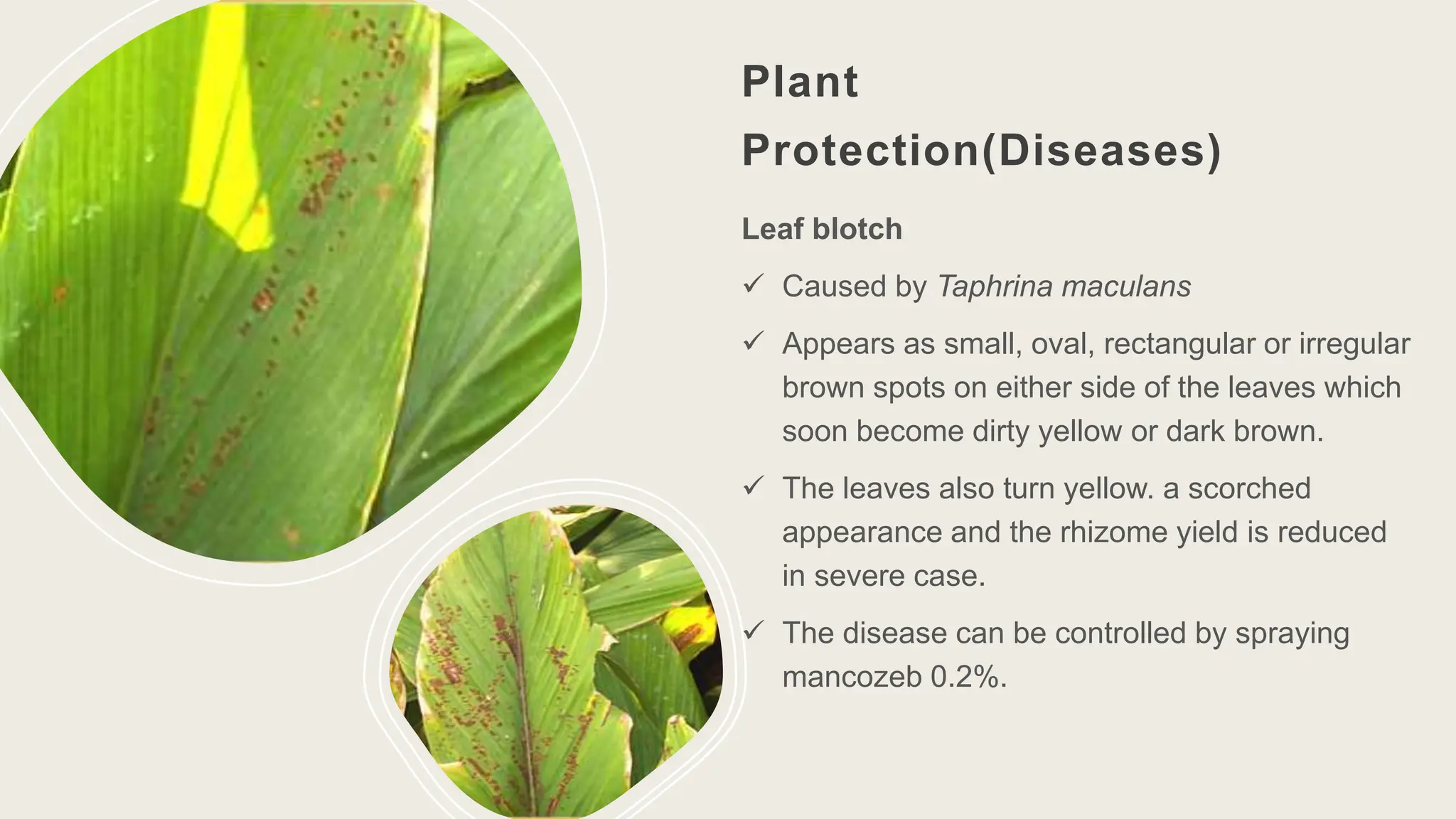
 Caused by Taphrina maculans
 Appears as small, oval, rectangular or irregular
brown spots on either side of the leaves which
soon become dirty yellow or dark brown.
 The leaves also turn yellow. a scorched
appearance and the rhizome yield is reduced
in severe case.
 The disease can be controlled by spraying
mancozeb 0.2%.
Plant Protection(Diseases)
Leaf spot
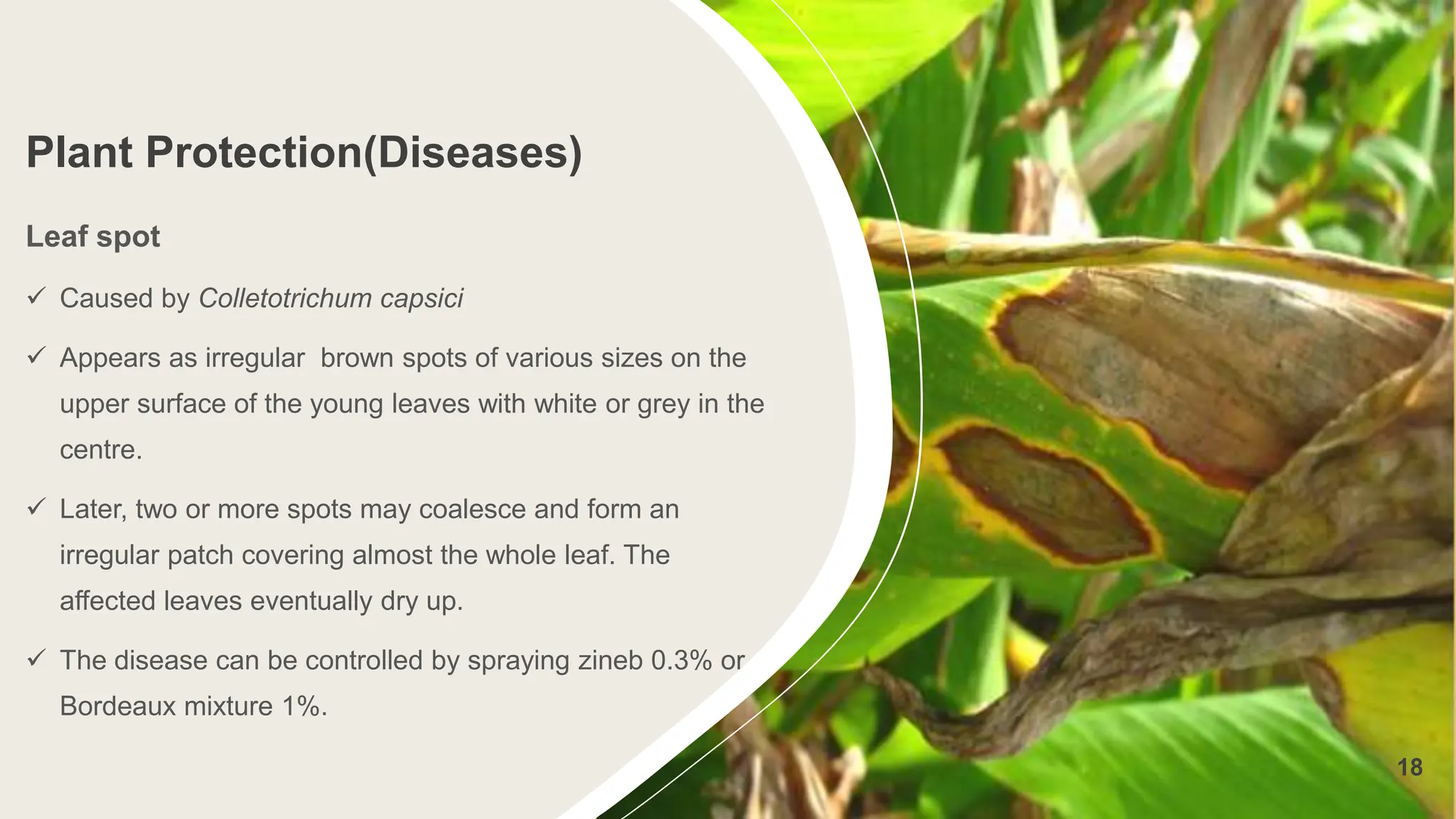
 Caused by Colletotrichum capsici
 Appears as irregular brown spots of various sizes on the
upper surface of the young leaves with white or grey in the
centre.
 Later, two or more spots may coalesce and form an
irregular patch covering almost the whole leaf. The
affected leaves eventually dry up.
 The disease can be controlled by spraying zineb 0.3% or
Bordeaux mixture 1%.
18
Plant
Protection(Diseases)
Rhizome rot
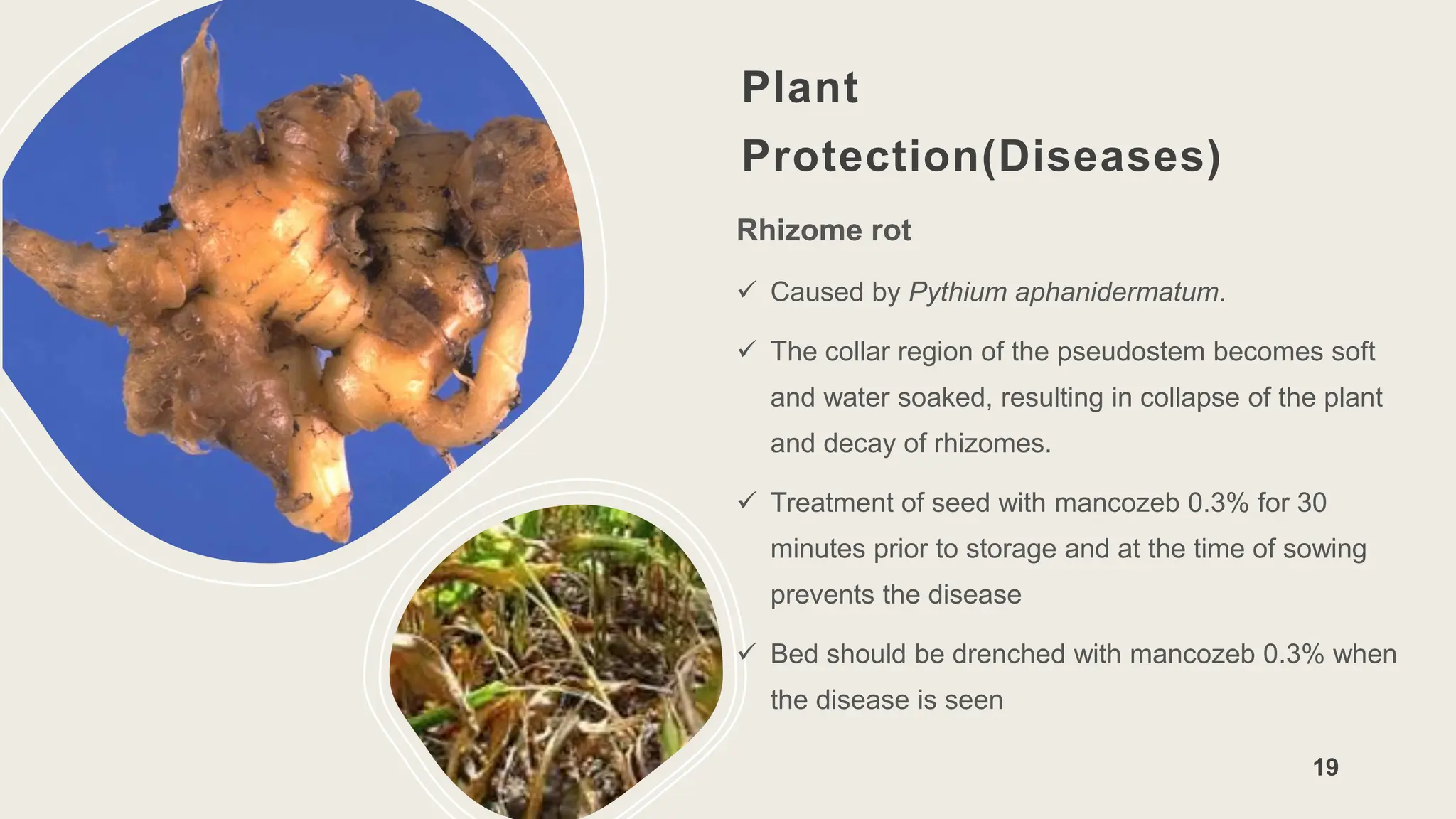
 Caused by Pythium aphanidermatum.
 The collar region of the pseudostem becomes soft
and water soaked, resulting in collapse of the plant
and decay of rhizomes.
 Treatment of seed with mancozeb 0.3% for 30
minutes prior to storage and at the time of sowing
prevents the disease
 Bed should be drenched with mancozeb 0.3% when
the disease is seen
19
Plant Protection(Insect Pest)
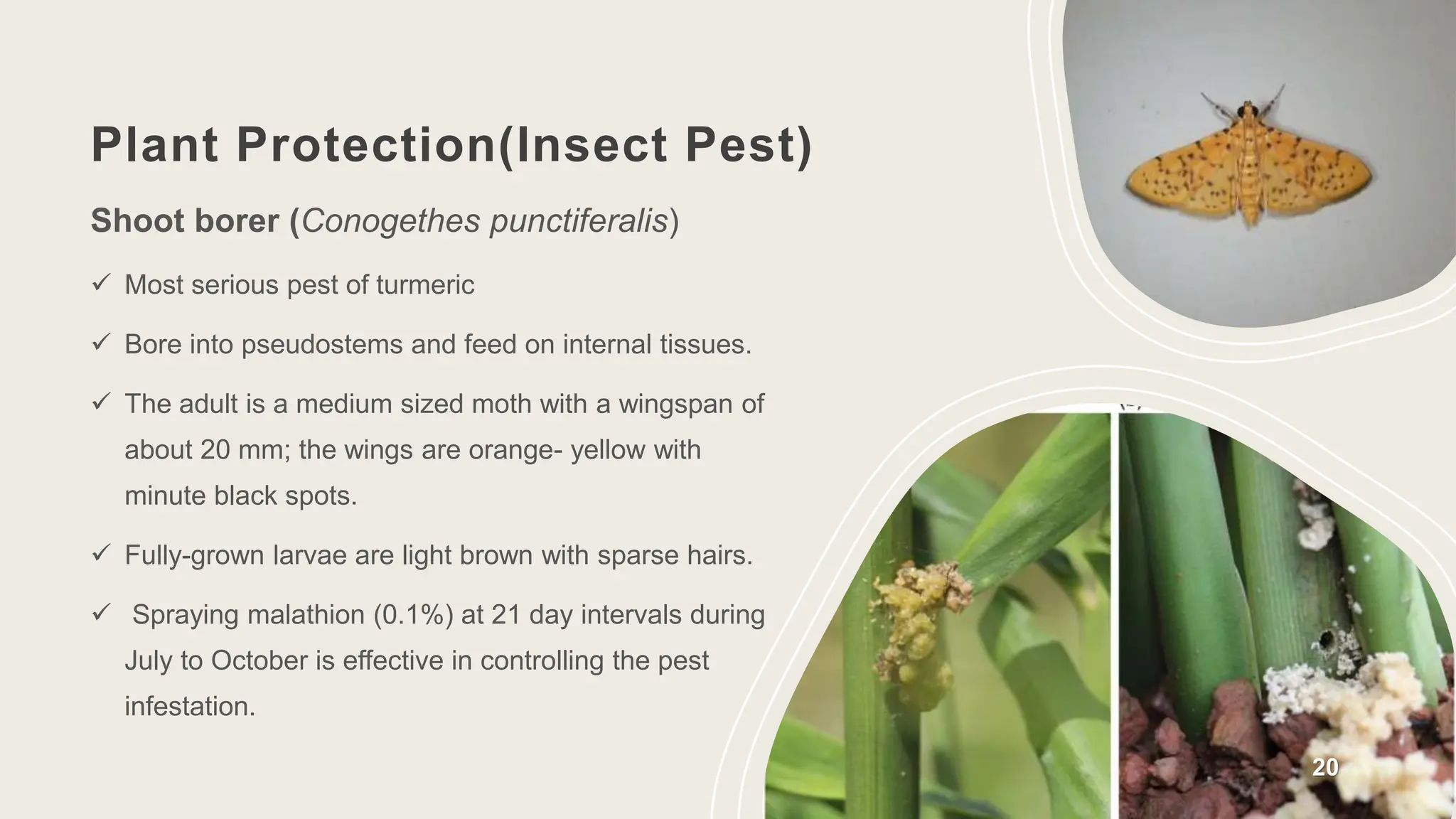
Shoot borer (Conogethes punctiferalis)
 Most serious pest of turmeric
 Bore into pseudostems and feed on internal tissues.
 The adult is a medium sized moth with a wingspan of
about 20 mm; the wings are orange- yellow with
minute black spots.
 Fully-grown larvae are light brown with sparse hairs.
 Spraying malathion (0.1%) at 21 day intervals during
July to October is effective in controlling the pest
infestation.
20
Plant Protection(Insect Pest)
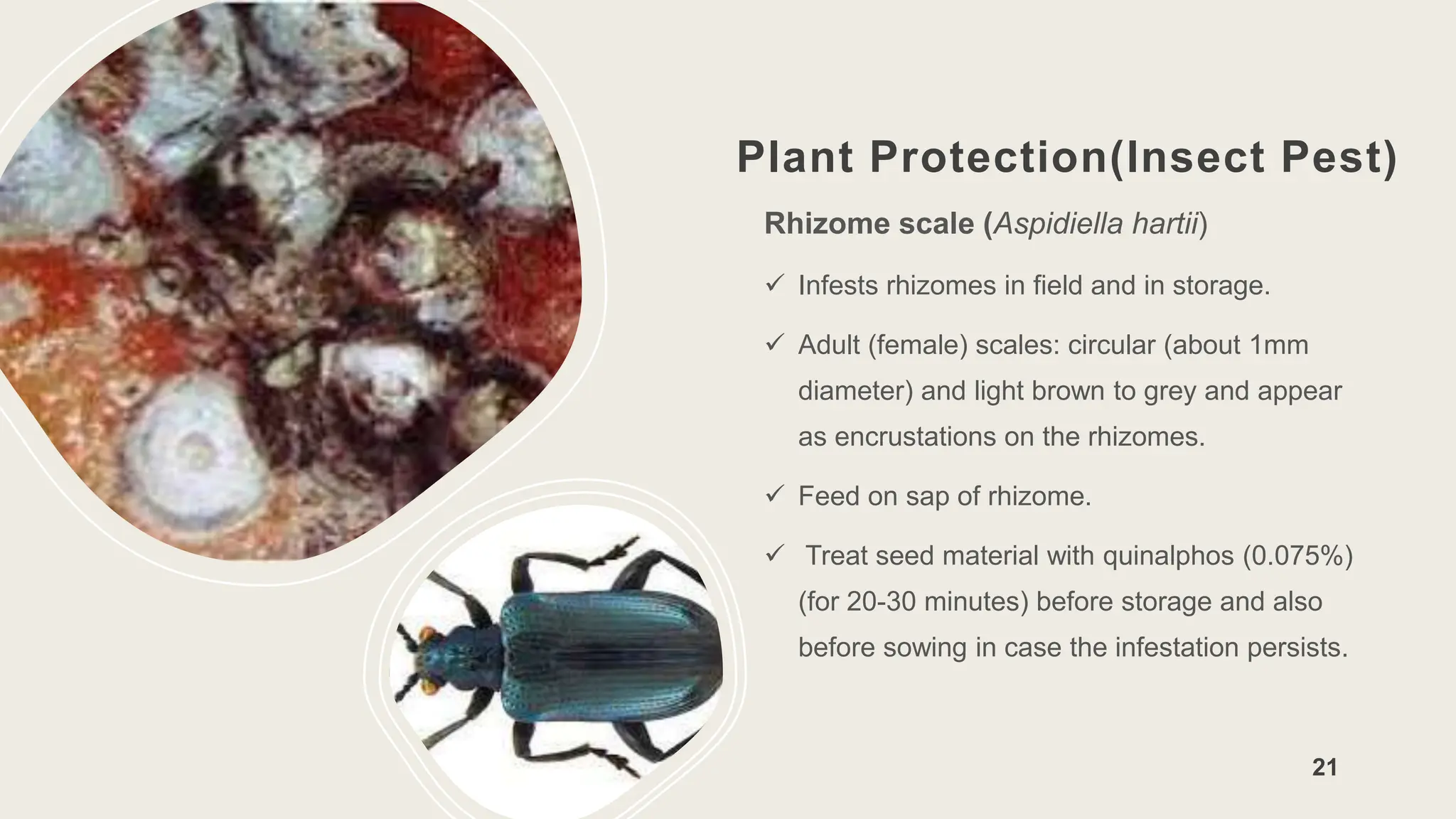
Rhizome scale (Aspidiella hartii)
 Infests rhizomes in field and in storage.
 Adult (female) scales: circular (about 1mm
diameter) and light brown to grey and appear
as encrustations on the rhizomes.
 Feed on sap of rhizome.
 Treat seed material with quinalphos (0.075%)
(for 20-30 minutes) before storage and also
before sowing in case the infestation persists.
21
Plant Protection(Insect Pest)
22
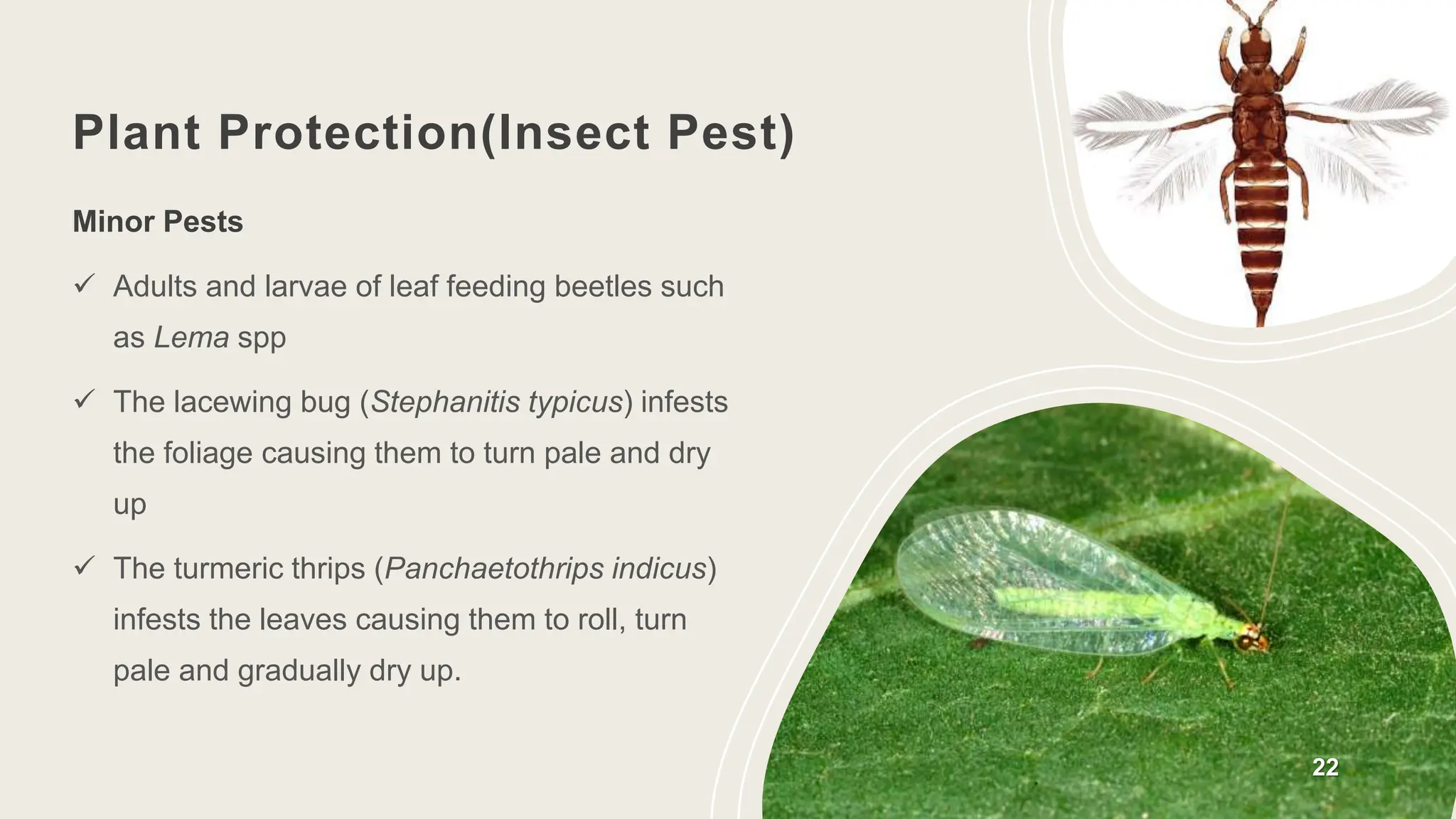
Minor Pests
 Adults and larvae of leaf feeding beetles such
as Lema spp
 The lacewing bug (Stephanitis typicus) infests
the foliage causing them to turn pale and dry
up
 The turmeric thrips (Panchaetothrips indicus)
infests the leaves causing them to roll, turn
pale and gradually dry up.
Thank You!
23

Package of Practices for Turmeric.pptx

  • 1.
  • 2.
    Contents 1. Introduction 2. Climateand Soil 3. Varieties 4. Cultivation (From Land Preparation to Harvesting) 5. Processing 6. Plant Protection 2/3/20XX 2
  • 3.
    Introduction  Turmeric (Curcumalonga) is a flowering plant that belongs to family Zingiberaceae.  Perennial herb.  Native to Southeast Asia.  Cultivated for its rhizome.  Is used as condiment, dye, drug and cosmetic in addition to its use in religious ceremonies. 3
  • 4.
    Climate and Soil •Can be grown in tropical and sub-tropical conditions from sea level to 1500 m above sea level, • Temperature range of 20-35 Degree C with an annual rainfall of 1500 mm or more, under rainfed or irrigated conditions. • Can be grown on different types of soils, but thrives best in well-drained sandy or clay loam soils • pH range of 4.5-7.5 with good organic matter.
  • 5.
    Varieties 5 Several local varietiesare cultivated in Nepal. The major exotic varieties are: • Sagun: Short duration variety, rhizomes are thick and plump. • Suvarana: Rhizome are medium Sizes dark orange colored and medium duration. • Sudharshana: Short duration variety with thick and plump rhizomes • Co1: Rhizome are big, bright orange, long duration variety suitable for drought and saline soil. • Krishna: Moderately tolerant to leaf spot and rhizome scale, medium duration variety • Roma: Less susceptible to disease, medium duration variety • Ranga: Rhizome are bold, spindle shaped, orange yellow. • Rasmi: Medium duration variety, produces round mother rhizome with plumpy primary finger.
  • 6.
    Cultivation 6 Preparation of land Starts with early monsoon shower.  The soil is brought to a fine tilth by giving about four deep ploughings.  Immediately with the receipt of pre-monsoon showers, beds of 1.0 m width, 15 cm height and of convenient length are prepared with spacing of 50 cm between beds.  Planting is also done by forming ridges and furrows. Planting  The crop can be planted during April-May with the receipt of pre-monsoon showers.
  • 7.
    Cultivation Seed material  Wholeor split mother and finger rhizomes which are disease free, are to be selected.  Small pits on the beds with a spacing of 25 cm x 30 cm.  Pits are filled with well decomposed manure or compost,  Seed rhizomes are placed over it then covered with soil.  A seed rate of 2,500 kg of rhizomes is required for planting one hectare of turmeric. 7
  • 8.
    Cultivation Manuring and fertilizerapplication  Farmyard manure (FYM) or compost @ 30-40 t/ha  Applied by broadcasting and ploughed at the time of preparation of land or as basal dressing by spreading over the beds or in to the pits at the time of planting.  Fertilizers @ 60 kg N, 50 kg P2O5 and 120 kg K2O per hectare, applied in split doses.  Zinc @ 5 kg/ha may also be applied at the time of planting and organic manures like oil cakes can also be applied @ 2 t/ha. In such case, the dosage of FYM can be reduced. Sample Footer Text 2/3/20XX 8
  • 9.
    Cultivation Fertilizer Schedule ofturmeric (per ha) Mulching  Mulched immediately after planting with green leaves @ 12-15 t/ha.  Mulching may be repeated @ 7.5 t/ha at 45 and 90 days after planting after weeding, application of fertilizers and earthing up. 9 Schedu le N P K FYM Basal - 50 - 30-40 t 45 DAP 30 - 60 90 DAP 30 - 60
  • 10.
    Cultivation Done thrice at60, 90 and 120 days after planting depending upon weed intensity. In the case of irrigated crop, depending upon the weather and soil conditions, about 15 to 23 irrigations are to be given in clayey soils and 40 irrigations in sandy loams. Weeding and Irrigation 10
  • 11.
    Cultivation Inter Cropping Turmeric canbe grown as an intercrop in coconut plantations. It can also be raised as a mixed crop with chillies, colocasia, onion, brinjal and cereals like maize.
  • 12.
    Harvesting  Becomes readyfor harvest in 7-9 months after planting during January-March.  Rhizomes are gathered by hand picking.  Clumps are lifted with spade.  The harvested rhizomes are cleared of mud and other extraneous matter adhering to them. 12
  • 13.
    Processing Curing Involves boiling offresh rhizomes in water and drying in the sun. Boiling fresh turmeric for 45-60 minutes, in water that just immerse rhizomes, until froths comes out and fumes appears.. Over cooking spoils the color of the final product while under-cooking renders the dried product brittle. The processing of turmeric is to be done 2 or 3 days after harvesting. If there is delay in processing, the rhizomes should be stored under shade or covered with sawdust or coir dust. 13
  • 14.
    Processing Drying Dried in thesun by spreading them in 5-7 cm thick layers on drying floor after curing Heaped or covered at night with material which provides aeration Takes 10-15 days for the rhizomes to become completely dry. Artificial drying, with cross flow of air at 60 degree C. The yield of the dry product varies from 10-30% depending upon the variety and the location where the crop is grown. 14
  • 15.
    Processing Polishing and Coloring Dried turmeric has a poor appearance and a rough dull outer surface with scales and root bits.  The appearance is improved by smoothening and polishing the outer surface by manual or mechanical rubbing.  Manual method: rubbing the dried turmeric fingers on a hard surface.  Improved method; by using a hand operated barrel or drum mounted on a central axis, the sides of which are made of expanded metal mesh. The yield of polished turmeric from the raw material varies from 15-25%.  Turmeric powder (mixed with little water) sprinkled during the last phase of polishing for making it look attractive. 15
  • 16.
    Preservation of seedrhizomes  Generally stored by heaping in well ventilated rooms and covered with turmeric leaves.  The seed rhizomes can also be stored in pits with saw dust.  The pits are to be covered with wooden planks with one or two openings for aeration.  Rhizomes dipped in quinalphos (0.075%) solution for 15 minutes if scale infested and in mancozeb (0.3%) to avoid storage losses due to fungi.
  • 17.
    Plant Protection(Diseases) Leaf blotch  Causedby Taphrina maculans  Appears as small, oval, rectangular or irregular brown spots on either side of the leaves which soon become dirty yellow or dark brown.  The leaves also turn yellow. a scorched appearance and the rhizome yield is reduced in severe case.  The disease can be controlled by spraying mancozeb 0.2%.
  • 18.
    Plant Protection(Diseases) Leaf spot Caused by Colletotrichum capsici  Appears as irregular brown spots of various sizes on the upper surface of the young leaves with white or grey in the centre.  Later, two or more spots may coalesce and form an irregular patch covering almost the whole leaf. The affected leaves eventually dry up.  The disease can be controlled by spraying zineb 0.3% or Bordeaux mixture 1%. 18
  • 19.
    Plant Protection(Diseases) Rhizome rot  Causedby Pythium aphanidermatum.  The collar region of the pseudostem becomes soft and water soaked, resulting in collapse of the plant and decay of rhizomes.  Treatment of seed with mancozeb 0.3% for 30 minutes prior to storage and at the time of sowing prevents the disease  Bed should be drenched with mancozeb 0.3% when the disease is seen 19
  • 20.
    Plant Protection(Insect Pest) Shootborer (Conogethes punctiferalis)  Most serious pest of turmeric  Bore into pseudostems and feed on internal tissues.  The adult is a medium sized moth with a wingspan of about 20 mm; the wings are orange- yellow with minute black spots.  Fully-grown larvae are light brown with sparse hairs.  Spraying malathion (0.1%) at 21 day intervals during July to October is effective in controlling the pest infestation. 20
  • 21.
    Plant Protection(Insect Pest) Rhizomescale (Aspidiella hartii)  Infests rhizomes in field and in storage.  Adult (female) scales: circular (about 1mm diameter) and light brown to grey and appear as encrustations on the rhizomes.  Feed on sap of rhizome.  Treat seed material with quinalphos (0.075%) (for 20-30 minutes) before storage and also before sowing in case the infestation persists. 21
  • 22.
    Plant Protection(Insect Pest) 22 MinorPests  Adults and larvae of leaf feeding beetles such as Lema spp  The lacewing bug (Stephanitis typicus) infests the foliage causing them to turn pale and dry up  The turmeric thrips (Panchaetothrips indicus) infests the leaves causing them to roll, turn pale and gradually dry up.
  • 23.