PESTS OF CARDAMOM
1.Cardamum Thrips: Sciothrips cardamomi
Thripidae: Thysanoptera
Activity: Activity throughout the year except during rainy
season, Serious pest, December-May.
Symptoms of damage:
• Both nymphs and adults feed on the plant sap from tender
blossoms and bunch of pods.
• Panicles become stunted, do not bear flower.
• Shedding of flowers and immature capsules thus reducing
the total number of capsules formed.
• Infestation causes formation of corky encrustations on pods
resulting in their malformed and shriveled condition.
• Such pods lack their fine aroma and the seeds within are
also poorly developed.
Identification:Life cycle
• Eggs kidney shaped lays singly in the tender part of the leaf sheath, racemes
• Adult: is minute, dark grayish brown with fringed wings, 1.2 to 1.5mm in
length
• Egg period: 9-12 days, Life cycle: 25-30days, Fecundity: 5-71 eggs
Management:
• Regulate shade in thickly shaded areas.
• Spraying of crop with pymetrozine 50 WG @ 0.6g/L or flonicamid 50 WG @
0.3g/L can be effective during March, April, May, August and September.
Note
• For effective thrips management precautions like trashing before insecticide
spray, avoiding spraying during heavy rain, using 250 to 500 ml spray fluid
depending on canopy growth and proper coverage to panicles and one third
portion, of plants from the base of plants are to be adhered strictly.
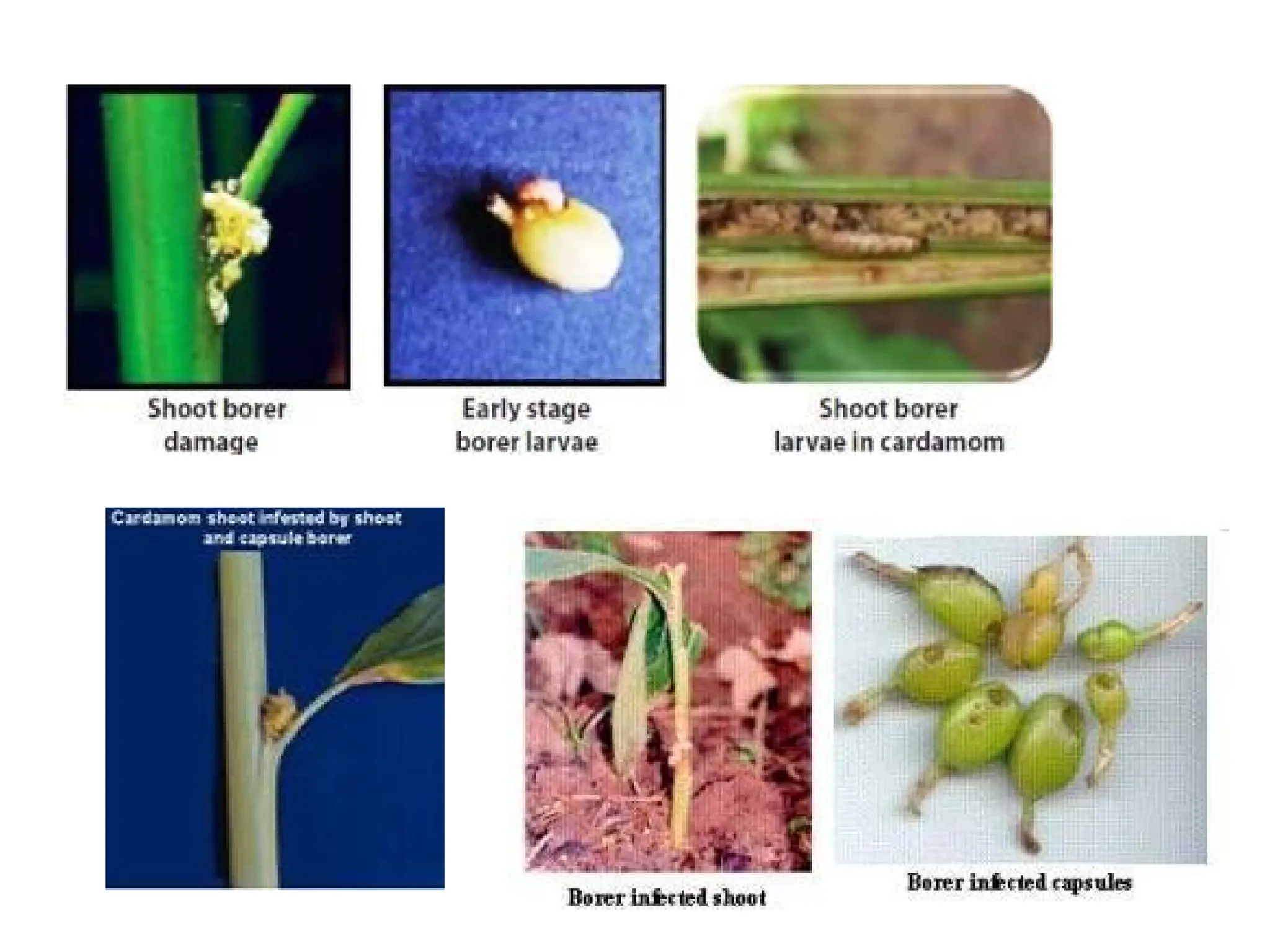
2. Shoot, panicle and capsule borer: Dichocrocis punctiferalis
(Crambidae: Lepidoptera)
Activity:
 The incidence of this pest is noticed throughout the year but they occur in
enormous number in four periods, December-January, March-April, May-June and
September-October
 Their abundance synchronizes with the panicle production, fruit formation and
new tiller production.
Symptoms of damage:
• Early stage of the larva bores the unopened leaf buds and feeds on the leaf tissue.
• They also bore the panicles leading to drying up of the portion from the affected
spot.
• Immature capsules and feed on the young seeds inside rendering the capsules
empty.
• Late stage larvae bore the pseudostem and feed the central core of the stem.
• Resulting in drying of the terminal leaf and thus produce characteristic 'dead heart'
symptom.
• Oozing out of frass material at the point of tunnelling is the indication for the
presence of larva inside the plant parts.
Dichocrocis punctiferalis
(Crambidae: Lepidoptera)
Identification of pest:
Egg: is pink, oval, flat and lays singly or in
group on the tender part of the plant.
• Larva: is long, pale greenish with a
pinkish was dorsally, head and pro-
thoracic shield brown in colour and body
covered with minute hairs arising on
wards.
• Pupa: Pupation takes place in lose silken
cocoon in larval tunnel.
• Adult: is a medium sized moth; the wings
are pale yellowish with black spots on
the wings.
Management:
• During day time adult moths rest on the lower surface of the
cardamom. They may be collected with insect net and killed.
• The practice of removing the tillers showing 'dead heart'
symptoms should be carried with due care.
• Tillers may be removed if the attack is fresh as indicated by
extrusion of frass.
• The infestation by early stages of larva of this pest in emerging
panicle, immature capsule and leaf bud can be controlled
effectively with insecticide application.
• Spraying chlorpyriphos/quinalphos @ 2ml/L is effective in
controlling this pest.
• Once the late larvae bore and go deep inside the pseudostem,
the chemical spray even in its higher dose becomes ineffective.
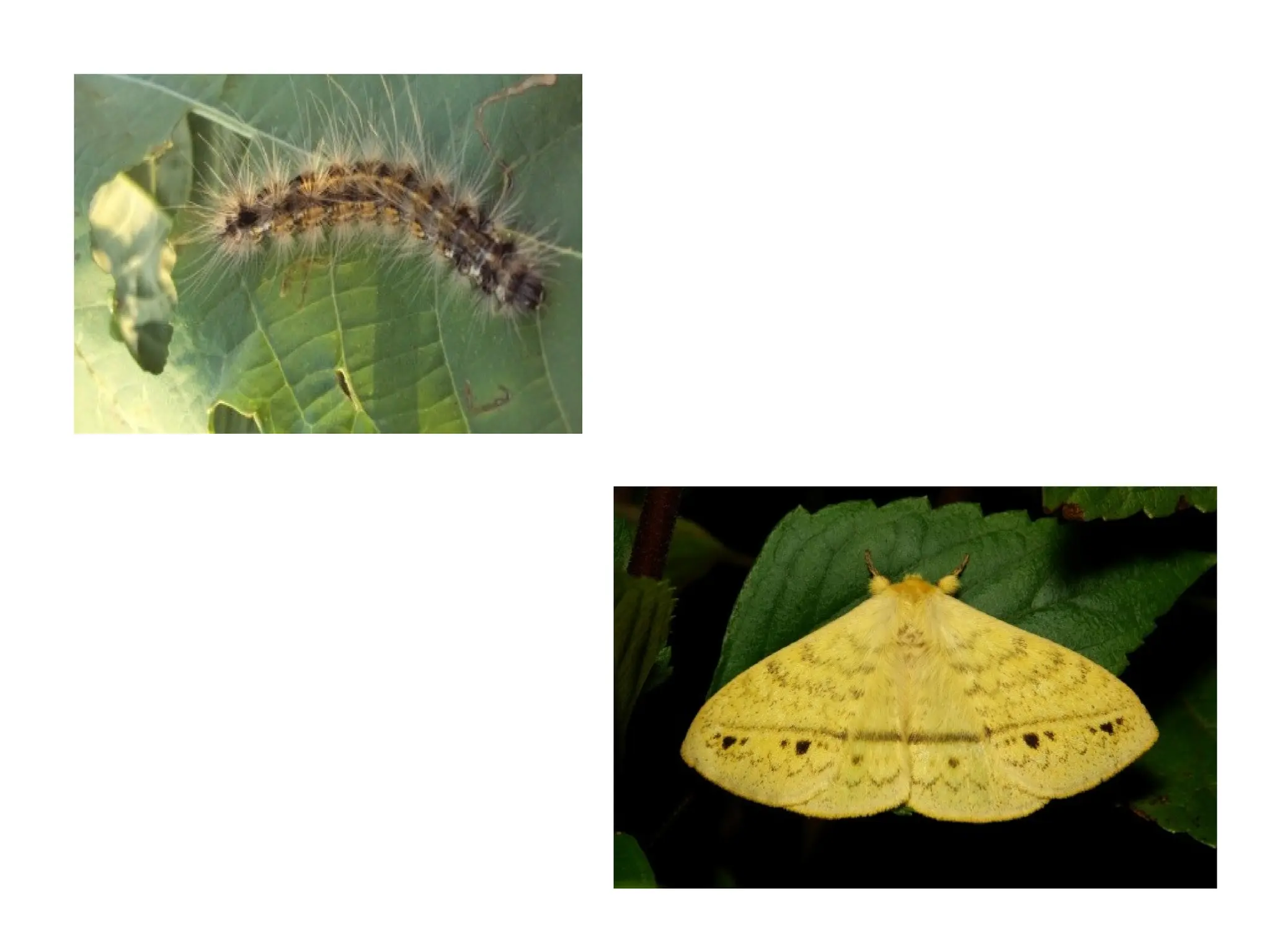
3. The cardamum hairy caterpillars
Hairy caterpillars: Eupterote cardamomi,
E. canarica,
E. fabia
(Eupterotidae: Lepidoptera)
Activity: Usually the damage is observed during October-December
Symptoms of damage:
• These appear sporadically in enormous populations at intervals of
several years and cause heavy damage to the foliage.
• Caterpillars are gregarious in habit and they congregate on the
trunks of shade trees during day time and drop down on the
cardamom plants during night time.
• They feed voraciously on leaves and defoliating the whole
cardamom plants.
• Only the pseudo stem and mid ribs remain uneaten.
Management:
• Hairy caterpillar incidence can be checked by burning
branches of shade trees in which eggs are laid.
• Gradual elimination of shade trees favoured for egg laying
will reduce the incidence.
• Caterpillars that congregate at the base of shade trees can
be collected and killed.
• Moths can be attracted to light during night and by
installing light traps, the moths can be collected and killed.
• Spray chlorpyriphos/quinalphos @2ml/L.
4. Capsule borers: Jamides sp.
(Lycaenidae:Lepidoptera)
Symptoms of damage:
• Caterpillars bore and feed on the inflorescence, flower buds, flowers
and capsules.
• Affected capsules become empty with a big circular hole, turn
yellowish – brown which decay and drop off in the rainy season.
Identification of pest:
• Eggs: Spherical, greenish white lay on the flower.
• Larva: Flat, covered with dense hairs covering all over the body.
• Pupa: Small and brownish in colour and pupates in the debris near
the panicle.
• Adult: The wings of moth are bluish with metallic lusture on the
upper surface and bordered with a white thin line and black shade.
5. Beetle borer: Onthophagus spp.
(Melolonthidae:Coleoptera)
Symptoms of damage:
• Larva makes the bore hole which is neat, circular tiny and at right angles to
the pericarp mostly on the ventral side.
• When attack is on young immature capsules, they put forth matured
appearance, decay and drop off.
• Adults beetle bores the flowers and feed on tissues.
Identification of pest:
Adult: small, dark brown, cylindrical beetle with short thick erect hairs covered
all over body.
• The elytra are hard and shiny.
Management:
• Judicious shade regulation.
• Spraying of contact insecticide viz., chlorpyriphos/quinalphos @2ml/L.
Beetle borer: Onthophagus spp.
6. Shoot fly: Formosina flavipes
Chloropidae: Diptera
Symptoms of damage:
• Larvae feed on the growing shoot of the young cardamom suckers.
• Dead heart or decay of the central spindle.
Identification of pest:
• Eggs: cigar shaped and white colour and is laid in between leaf
sheath and pseudostem on the whorl.
• Adult: Fly
Management:
• Remove the affected shoots at ground level and destroy them.
• Spray chlorpyriphos/quinalphos @2ml/L.
• Application of phorate grannule @ 1 ga.i/m2
7. White flies: Dialeurodes cardamomi
(Aleurodidae: Hemiptera)
Actvity: A serious pests in Kerala
Symptoms of damage:
• Nymphs and adults remain in colonies on lower leaf surface and suck the sap.
• Chlorotic patches appear on leaves.
• Gradual yellowing and get dried.
• Sooty mould development occurs due to honeydew secretion.
Identification of pest:
Nymphs: are pale greenish to greenish yellow in colour, elliptical.
Adult: Small, soft bodied insect, 2mm long, with two pairs of white wings.
Management:
• Set up yellow sticky trap.
• Nymphs are effcetively controlled by spraying of pymetrozine 50 WG @ 0.6g/L or
flonicamid 50 WG @ 0.3g/L.
8. Cardamom aphid: Pentalonia nigronervosa
(Aphidae: Homoptera)
Symptoms of damage:
• Nymphs and adults suck up plant sap.
• Colonies of aphids are seen under concealed
conditions inside leaf sheaths of the older
pseudo stems.
• The aphids act as a vector of the cardamum
mosaic or 'Katte' virus of cardamom.
Cardamom aphid: Pentalonia nigronervosa
Identification of pest:
• Wingless aphid is dark brown, pyriform/pear shaped.
• Winged aphids have wings having prominent black veins
LIFE CYCLE:
Adult longevity: 8-26(Avge-14days), 21-24generations.
Management:
• Removal of Colocasia and other hosts in the vicinity of
cardamom plantation is recommended.
• Remove partly dried and decayed pseudostems which
harbour the colonies of aphids to reduce aphid population.
• Spraying of plant with pymetrozine 50 WG @ 0.6g/L or
flonicamid 50 WG @ 0.3g/L at an interval of 2 weeks in
November and April gives adequate control.
9. Root grubs: Basilepta fulvicorne, Holotrichia serrata
(Scarabaediae: Coleoptera)
• Among the two species B. fulvicorne is found to cause
more damage in cardamom tracts.
Symptoms of damage:
• The grubs feed on the roots in the form of irregular
scraping.
• In advanced stages entire root system is found damaged
resulting in drying and rotting depending on the season
of attack.
• Yellowing of leaves.
• In the severely infested plants, leaves turn yellow and
dry.
Root grubs
Identification of pest:
• Grubs: Short, stout, 'C' shaped, pale white in colour.
• Adult: Beetles are shiny, metallic blue, bluish green, greenish
brown or brown.
Management:
• Collect the beetles using hand nets during peak period of
emergence i.e., during April-May and kill them.
• Beetles can be seen resting on the leaves during day time.
• The time of insecticide application is to be synchronized with the
emergence of adults and egg laying.
• Applying chlorpyriphos @2ml/L or phorate 2-4 g a.i./plant in May
and in September-October is effective in reducing the population
of grubs.
• Light raking of soil before the insecticide application is essential for
effective control of root grubs.
THANK YOU

Cardamom pests powerpoint presentation.pptx

  • 1.
  • 2.
    1.Cardamum Thrips: Sciothripscardamomi Thripidae: Thysanoptera Activity: Activity throughout the year except during rainy season, Serious pest, December-May. Symptoms of damage: • Both nymphs and adults feed on the plant sap from tender blossoms and bunch of pods. • Panicles become stunted, do not bear flower. • Shedding of flowers and immature capsules thus reducing the total number of capsules formed. • Infestation causes formation of corky encrustations on pods resulting in their malformed and shriveled condition. • Such pods lack their fine aroma and the seeds within are also poorly developed.
  • 4.
    Identification:Life cycle • Eggskidney shaped lays singly in the tender part of the leaf sheath, racemes • Adult: is minute, dark grayish brown with fringed wings, 1.2 to 1.5mm in length • Egg period: 9-12 days, Life cycle: 25-30days, Fecundity: 5-71 eggs Management: • Regulate shade in thickly shaded areas. • Spraying of crop with pymetrozine 50 WG @ 0.6g/L or flonicamid 50 WG @ 0.3g/L can be effective during March, April, May, August and September. Note • For effective thrips management precautions like trashing before insecticide spray, avoiding spraying during heavy rain, using 250 to 500 ml spray fluid depending on canopy growth and proper coverage to panicles and one third portion, of plants from the base of plants are to be adhered strictly.
  • 5.
    2. Shoot, panicleand capsule borer: Dichocrocis punctiferalis (Crambidae: Lepidoptera) Activity:  The incidence of this pest is noticed throughout the year but they occur in enormous number in four periods, December-January, March-April, May-June and September-October  Their abundance synchronizes with the panicle production, fruit formation and new tiller production. Symptoms of damage: • Early stage of the larva bores the unopened leaf buds and feeds on the leaf tissue. • They also bore the panicles leading to drying up of the portion from the affected spot. • Immature capsules and feed on the young seeds inside rendering the capsules empty. • Late stage larvae bore the pseudostem and feed the central core of the stem. • Resulting in drying of the terminal leaf and thus produce characteristic 'dead heart' symptom. • Oozing out of frass material at the point of tunnelling is the indication for the presence of larva inside the plant parts.
  • 7.
  • 8.
    Identification of pest: Egg:is pink, oval, flat and lays singly or in group on the tender part of the plant. • Larva: is long, pale greenish with a pinkish was dorsally, head and pro- thoracic shield brown in colour and body covered with minute hairs arising on wards. • Pupa: Pupation takes place in lose silken cocoon in larval tunnel. • Adult: is a medium sized moth; the wings are pale yellowish with black spots on the wings.
  • 9.
    Management: • During daytime adult moths rest on the lower surface of the cardamom. They may be collected with insect net and killed. • The practice of removing the tillers showing 'dead heart' symptoms should be carried with due care. • Tillers may be removed if the attack is fresh as indicated by extrusion of frass. • The infestation by early stages of larva of this pest in emerging panicle, immature capsule and leaf bud can be controlled effectively with insecticide application. • Spraying chlorpyriphos/quinalphos @ 2ml/L is effective in controlling this pest. • Once the late larvae bore and go deep inside the pseudostem, the chemical spray even in its higher dose becomes ineffective.
  • 10.
    3. The cardamumhairy caterpillars Hairy caterpillars: Eupterote cardamomi, E. canarica, E. fabia (Eupterotidae: Lepidoptera) Activity: Usually the damage is observed during October-December Symptoms of damage: • These appear sporadically in enormous populations at intervals of several years and cause heavy damage to the foliage. • Caterpillars are gregarious in habit and they congregate on the trunks of shade trees during day time and drop down on the cardamom plants during night time. • They feed voraciously on leaves and defoliating the whole cardamom plants. • Only the pseudo stem and mid ribs remain uneaten.
  • 12.
    Management: • Hairy caterpillarincidence can be checked by burning branches of shade trees in which eggs are laid. • Gradual elimination of shade trees favoured for egg laying will reduce the incidence. • Caterpillars that congregate at the base of shade trees can be collected and killed. • Moths can be attracted to light during night and by installing light traps, the moths can be collected and killed. • Spray chlorpyriphos/quinalphos @2ml/L.
  • 13.
    4. Capsule borers:Jamides sp. (Lycaenidae:Lepidoptera) Symptoms of damage: • Caterpillars bore and feed on the inflorescence, flower buds, flowers and capsules. • Affected capsules become empty with a big circular hole, turn yellowish – brown which decay and drop off in the rainy season. Identification of pest: • Eggs: Spherical, greenish white lay on the flower. • Larva: Flat, covered with dense hairs covering all over the body. • Pupa: Small and brownish in colour and pupates in the debris near the panicle. • Adult: The wings of moth are bluish with metallic lusture on the upper surface and bordered with a white thin line and black shade.
  • 14.
    5. Beetle borer:Onthophagus spp. (Melolonthidae:Coleoptera) Symptoms of damage: • Larva makes the bore hole which is neat, circular tiny and at right angles to the pericarp mostly on the ventral side. • When attack is on young immature capsules, they put forth matured appearance, decay and drop off. • Adults beetle bores the flowers and feed on tissues. Identification of pest: Adult: small, dark brown, cylindrical beetle with short thick erect hairs covered all over body. • The elytra are hard and shiny. Management: • Judicious shade regulation. • Spraying of contact insecticide viz., chlorpyriphos/quinalphos @2ml/L.
  • 15.
  • 16.
    6. Shoot fly:Formosina flavipes Chloropidae: Diptera Symptoms of damage: • Larvae feed on the growing shoot of the young cardamom suckers. • Dead heart or decay of the central spindle. Identification of pest: • Eggs: cigar shaped and white colour and is laid in between leaf sheath and pseudostem on the whorl. • Adult: Fly Management: • Remove the affected shoots at ground level and destroy them. • Spray chlorpyriphos/quinalphos @2ml/L. • Application of phorate grannule @ 1 ga.i/m2
  • 18.
    7. White flies:Dialeurodes cardamomi (Aleurodidae: Hemiptera) Actvity: A serious pests in Kerala Symptoms of damage: • Nymphs and adults remain in colonies on lower leaf surface and suck the sap. • Chlorotic patches appear on leaves. • Gradual yellowing and get dried. • Sooty mould development occurs due to honeydew secretion. Identification of pest: Nymphs: are pale greenish to greenish yellow in colour, elliptical. Adult: Small, soft bodied insect, 2mm long, with two pairs of white wings. Management: • Set up yellow sticky trap. • Nymphs are effcetively controlled by spraying of pymetrozine 50 WG @ 0.6g/L or flonicamid 50 WG @ 0.3g/L.
  • 19.
    8. Cardamom aphid:Pentalonia nigronervosa (Aphidae: Homoptera) Symptoms of damage: • Nymphs and adults suck up plant sap. • Colonies of aphids are seen under concealed conditions inside leaf sheaths of the older pseudo stems. • The aphids act as a vector of the cardamum mosaic or 'Katte' virus of cardamom.
  • 20.
  • 21.
    Identification of pest: •Wingless aphid is dark brown, pyriform/pear shaped. • Winged aphids have wings having prominent black veins LIFE CYCLE: Adult longevity: 8-26(Avge-14days), 21-24generations. Management: • Removal of Colocasia and other hosts in the vicinity of cardamom plantation is recommended. • Remove partly dried and decayed pseudostems which harbour the colonies of aphids to reduce aphid population. • Spraying of plant with pymetrozine 50 WG @ 0.6g/L or flonicamid 50 WG @ 0.3g/L at an interval of 2 weeks in November and April gives adequate control.
  • 22.
    9. Root grubs:Basilepta fulvicorne, Holotrichia serrata (Scarabaediae: Coleoptera) • Among the two species B. fulvicorne is found to cause more damage in cardamom tracts. Symptoms of damage: • The grubs feed on the roots in the form of irregular scraping. • In advanced stages entire root system is found damaged resulting in drying and rotting depending on the season of attack. • Yellowing of leaves. • In the severely infested plants, leaves turn yellow and dry.
  • 23.
  • 24.
    Identification of pest: •Grubs: Short, stout, 'C' shaped, pale white in colour. • Adult: Beetles are shiny, metallic blue, bluish green, greenish brown or brown. Management: • Collect the beetles using hand nets during peak period of emergence i.e., during April-May and kill them. • Beetles can be seen resting on the leaves during day time. • The time of insecticide application is to be synchronized with the emergence of adults and egg laying. • Applying chlorpyriphos @2ml/L or phorate 2-4 g a.i./plant in May and in September-October is effective in reducing the population of grubs. • Light raking of soil before the insecticide application is essential for effective control of root grubs.
  • 25.