Novel Strategies for Attacking the Epidermal
Growth Factor Receptor
David Carbone, MD PhD
Director, James Thoracic Center
The Ohio State University
Columbus, OH USA
Developmental Therapeutics—Clinical Pharmacology and
Experimental Therapeutics
• Board 225 - Preliminary results of TATTON, a multi-arm phase Ib trial of
AZD9291 combined with MEDI4736, AZD6094 or selumetinib in EGFR-
mutant lung cancer. (Abstract 2509) G. R. Oxnard, S. S. Ramalingam, M. Ahn,
S. Kim, H. A. Yu, H. Saka, L. Horn, K. Goto, Y. Ohe, M. Cantarini, P. Frewer, M.
Lahn, J. C. Yang
• Board 227 - Phase I expansion of S-222611, a reversible inhibitor of EGFR
and HER2, in advanced solid tumors, including patients with brain
metastases. (Abstract 2511) S. Deva, R. D. Baird, N. Cresti, J. Garcia-
Corbacho, L. Hogarth, E. P. Frenkel, K. Kawaguchi, A. Arimura, K. Donaldson, J.
Posner, D. Sarker, D. I. Jodrell, R. Plummer, J. F. Spicer
• Board 226 - ABT-414 in patients with advanced solid tumors likely to
overexpress the epidermal growth factor receptor (EGFR). (Abstract 2510)
G. D. Goss, E. E. Vokes, M. S. Gordon, L. Gandhi, K. P. Papadopoulos, D. W.
Rasco, M. Pedersen, J. S. Fischer, K. Chu, W. Ames, H. Xiong, H. Lee, J. Zeng,
L. Roberts-Rapp, P. Ansell, E. Reilly, K. D. Holen, A. W. Tolcher
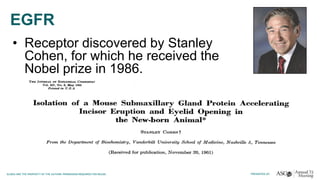
EGFR
• Receptor discovered by Stanley
Cohen, for which he received the
Nobel prize in 1986.
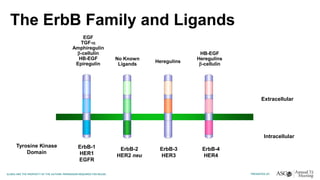
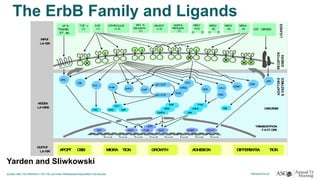
The ErbB Family and Ligands
EGF
TGF-α
Amphiregulin
β-cellulin
HB-EGF
Epiregulin Heregulins
HB-EGF
Heregulins
β-cellulin
Tyrosine Kinase
Domain
ErbB-1
HER1
EGFR
ErbB-2
HER2 neu
ErbB-3
HER3
ErbB-4
HER4
Extracellular
Intracellular
No Known
Ligands
The ErbB Family and Ligands
LIGANDS
RECEPTOR
DIMERS
ADAPTORS
&ENZYMES
p21-GDP
p21-GTP
INPUT
LAYER
HIDDEN
LAYERS
LIGANDS
RECEPTOR
DIMERS
1 1
1 4
4 4
3 4
3 3
NRG1
(3,4)
α β
NRG3
(4)
AMPHI-
REGULIN
(1)
HB-EGF
(1,4)
BET A-
CELLULIN
(1)
EPIREGULIN
(1,4)
TGF α
(1)
LP A
Thrombin
ET, etc.
CYT OKINES
NRG2
(4)
βα
SRC
CBL
PLC γ
PI3K SHP2 GAP NCK
GRB7
CRK
JAK
SHC
GRB2
SOS
ADAPTORS
&ENZYMES
CASCADES
TRANSCRIPTION
FACT ORS
AKT
S6KBAD
PAK
JNK
JNKK
RAF
MAPK
MEK ABL
PKC
SP1 EGR1MYC ELK STAT
JUN
FOS
OUTPUT
LAYER MIGRA TIONAPOPT OSIS GROWTH DIFFERENTIA TIONADHESION
3 22 2
1 2
1 3
EGF
(1)
NRG4
(4)
p21-GDP
p21-GTP
VAV
RAC
4 2
Yarden and Sliwkowski
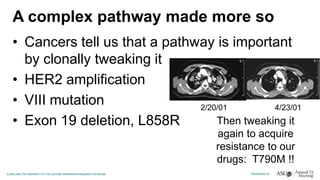
A complex pathway made more so
• Cancers tell us that a pathway is important
by clonally tweaking it
• HER2 amplification
• VIII mutation
• Exon 19 deletion, L858R
2/20/01 4/23/01
Then tweaking it
again to acquire
resistance to our
drugs: T790M !!
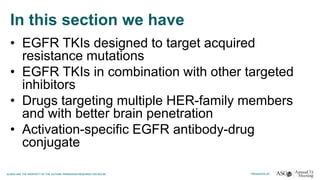
In this section we have
• EGFR TKIs designed to target acquired
resistance mutations
• EGFR TKIs in combination with other targeted
inhibitors
• Drugs targeting multiple HER-family members
and with better brain penetration
• Activation-specific EGFR antibody-drug
conjugate
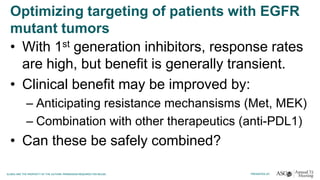
Optimizing targeting of patients with EGFR
mutant tumors
• With 1st generation inhibitors, response rates
are high, but benefit is generally transient.
• Clinical benefit may be improved by:
– Anticipating resistance mechansisms (Met, MEK)
– Combination with other therapeutics (anti-PDL1)
• Can these be safely combined?
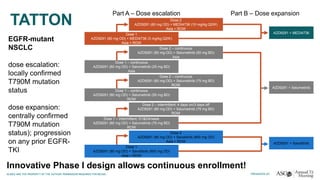
TATTON
AZD9291 + Selumetinib
AZD9291 + MEDI4736
AZD9291 + Savolitinib
Dose 2
AZD9291 (80 mg OD) + MEDI4736 (10 mg/kg Q2W)
Asia + ROW
Dose 1
AZD9291 (80 mg OD) + MEDI4736 (3 mg/kg Q2W)
Asia + ROW
Dose 2 – continuous
AZD9291 (80 mg OD) + Selumetinib (50 mg BD)
Asia
Dose 1 – continuous
AZD9291 (80 mg OD) + Selumetinib (25 mg BD)
Asia
Dose 2 – continuous
AZD9291 (80 mg OD) + Selumetinib (75 mg BD)
ROW
Dose 1 – continuous
AZD9291 (80 mg OD) + Selumetinib (50 mg BD)
ROW
Dose 2 – intermittent: 4 days on/3 days off
AZD9291 (80 mg OD) + Selumetinib (75 mg BD)
ROW
Dose 1 – intermittent: D1&D4/week
AZD9291 (80 mg OD) + Selumetinib (75 mg BD)
ROW
Dose 2
AZD9291 (80 mg OD) + Savolitinib (800 mg OD)
Asia + ROW
Dose 1
AZD9291 (80 mg OD) + Savolitinib (600 mg OD)
Asia + ROW
Part A – Dose escalation Part B – Dose expansion
EGFR-mutant
NSCLC
dose escalation:
locally confirmed
T790M mutation
status
dose expansion:
centrally confirmed
T790M mutation
status); progression
on any prior EGFR-
TKI
Innovative Phase I design allows continuous enrollment!
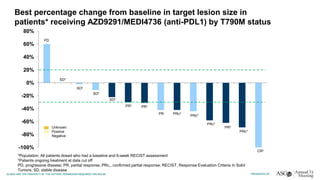
Best percentage change from baseline in target lesion size in
patients* receiving AZD9291/MEDI4736 (anti-PDL1) by T790M status
-100%
-80%
-60%
-40%
-20%
0%
20%
40%
60%
80%
Neg
Neg
Neg
Neg
Pos
Pos
Pos
Neg
Pos
Neg
Pos
Pos
Pos
Neg
*Population: All patients dosed who had a baseline and 6-week RECIST assessment
†Patients ongoing treatment at data cut off
PD, progressive disease; PR, partial response; PRc,, confirmed partial response; RECIST, Response Evaluation Criteria In Solid
Tumors; SD, stable disease
Unknown
Positive
Negative
PD
SD†
SD†
SD†
SD†
PR†
PR†
PR PRc†
PRc†
PRc†
PR†
PRc†
CR†
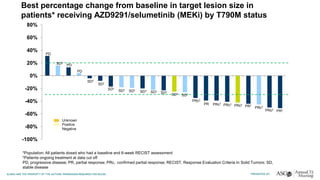
Best percentage change from baseline in target lesion size in
patients* receiving AZD9291/selumetinib (MEKi) by T790M status
-100%
-80%
-60%
-40%
-20%
0%
20%
40%
60%
80%
Pos
Neg
Pos
Neg
Pos
Pos
Pos
Neg
Neg
Pos
Neg
Pos
UKN
Neg
Pos
Pos
Pos
Pos
Neg
Pos
Neg
Pos
Pos
*Population: All patients dosed who had a baseline and 6-week RECIST assessment
†Patients ongoing treatment at data cut off
PD, progressive disease; PR, partial response; PRc,, confirmed partial response; RECIST, Response Evaluation Criteria In Solid Tumors; SD,
stable disease
Unknown
Positive
Negative
PD
SD†
PD
PD
SD†
SD†
SD†
SD†
SD†
SD†
SD†
SD†
SD†
SD†
PRc†
PR PRc†
PRc†
PRc†
PR†
PRc†
PRc†
PR†
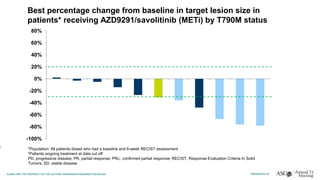
Best percentage change from baseline in target lesion size in
patients* receiving AZD9291/savolitinib (METi) by T790M status
-100%
-80%
-60%
-40%
-20%
0%
20%
40%
60%
80%
Pos
Neg
Pos
Pos
Neg
UK
Neg
Pos
Neg
Neg
Neg
*Population: All patients dosed who had a baseline and 6-week RECIST assessment
†Patients ongoing treatment at data cut off
PD, progressive disease; PR, partial response; PRc,, confirmed partial response; RECIST, Response Evaluation Criteria In Solid
Tumors; SD, stable disease
c
AZ9291 combinations
• Low intrinsic toxicity enables combinations
• These rational combinations all have tolerable
toxicity profiles
• High levels of activity observed
• Remains to be seen if clinical benefit is more
durable, if resistance mechanisms are altered,
and whether up-front combinations better than
“reactive” ones.
Phase I expansion of S-222611, a
reversible inhibitor of EGFR and HER2, in
advanced solid tumors, including patients
with brain metastases.
S Deva1, A Italiano2, R Baird3, N Cresti4, J Garcia Corbacho3, L Hogarth4, E Frenkel5, K Kawaguchi6,
A. Arimura6, K Donaldson6, J Posner6, D Sarker1, D Jodrell3, R Plummer4 & J Spicer1
1King’s College London, Guy’s Hospital, London, UK; 2Institute Bergonie, FR; 3University of
Cambridge, Department of Oncology, Cambridge, UK; 4Northern Centre for Cancer Care, Newcastle
upon Tyne, UK; 5University of Texas Southwestern Medical Center, Dallas, TX, USA; 6Shionogi & Co.
Ltd., Osaka, Japan
Abstract No. 2511
Summary
• S-222611 is a potent and selective reversible tyrosine
kinase inhibitor of EGFR and HER2.
• Greater potency of anti-tumor activity than lapatinib.
• Higher brain penetration.
• Maximum tolerated dose (MTD) was not established.
• 800 mg daily was selected as a dose for the expansion
phase.
• This study included patients with tumors often expressing
EGFR and/or overexpressing HER2.
Adverse drug reactions
Incidence (%) of all grades of ADRs in ≥10% subjects [N= 76]
No grade 4 or 5 ADRs
Events All grades Grade 3
Diarrhea 57 (75) 9 (12)
Rash 36 (47) 0
Nausea 27 (36) 2 (3)
Fatigue 23 (30) 2 (3)
Vomiting 22 (29) 1 (1)
Bilirubin ↑ 21 (28) 5 (7)
Appetite ↓ 20 (26) 1 (1)
Anemia 9 (12) 3 (4)
2 out of 76 patients (2.6%) withdrawn due to treatment-related AEs
 Blood bilirubin increased (G3)
 Nausea, Vomiting (G3)
Similar to
erlotinib/lapatinib
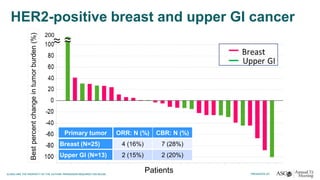
HER2-positive breast and upper GI cancer
Patients
~~~~
200
Primary tumor ORR: N (%) CBR: N (%)
Breast (N=25) 4 (16%) 7 (28%)
Upper GI (N=13) 2 (15%) 2 (20%)
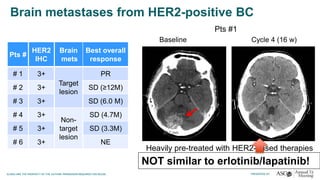
Brain metastases from HER2-positive BC
Baseline Cycle 4 (16 w)
Heavily pre-treated with HER2-based therapies
including lapatinib/capecitabine
Pts #
HER2
IHC
Brain
mets
Best overall
response
# 1 3+
Target
lesion
PR
# 2 3+ SD (≥12M)
# 3 3+ SD (6.0 M)
# 4 3+
Non-
target
lesion
SD (4.7M)
# 5 3+ SD (3.3M)
# 6 3+ NE
Pts #1
NOT similar to erlotinib/lapatinib!
Conclusions
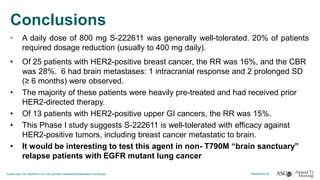
• A daily dose of 800 mg S-222611 was generally well-tolerated. 20% of patients
required dosage reduction (usually to 400 mg daily).
• Of 25 patients with HER2-positive breast cancer, the RR was 16%, and the CBR
was 28%. 6 had brain metastases: 1 intracranial response and 2 prolonged SD
(≥ 6 months) were observed.
• The majority of these patients were heavily pre-treated and had received prior
HER2-directed therapy.
• Of 13 patients with HER2-positive upper GI cancers, the RR was 15%.
• This Phase I study suggests S-222611 is well-tolerated with efficacy against
HER2-positive tumors, including breast cancer metastatic to brain.
• It would be interesting to test this agent in non- T790M “brain sanctuary”
relapse patients with EGFR mutant lung cancer
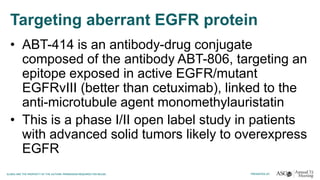
Targeting aberrant EGFR protein
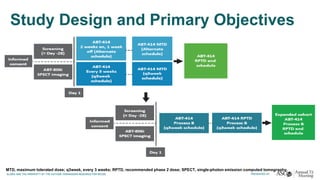
• ABT-414 is an antibody-drug conjugate
composed of the antibody ABT-806, targeting an
epitope exposed in active EGFR/mutant
EGFRvIII (better than cetuximab), linked to the
anti-microtubule agent monomethylauristatin
• This is a phase I/II open label study in patients
with advanced solid tumors likely to overexpress
EGFR
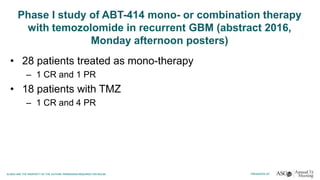
Phase I study of ABT-414 mono- or combination therapy
with temozolomide in recurrent GBM (abstract 2016,
Monday afternoon posters)
• 28 patients treated as mono-therapy
– 1 CR and 1 PR
• 18 patients with TMZ
– 1 CR and 4 PR
Study Design and Primary Objectives
MTD, maximum tolerated dose; q3week, every 3 weeks; RPTD, recommended phase 2 dose; SPECT, single-photon emission computed tomography.
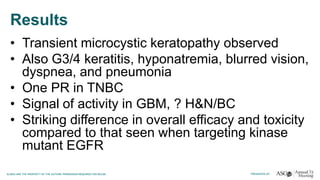
Results
• Transient microcystic keratopathy observed
• Also G3/4 keratitis, hyponatremia, blurred vision,
dyspnea, and pneumonia
• One PR in TNBC
• Signal of activity in GBM, ? H&N/BC
• Striking difference in overall efficacy and toxicity
compared to that seen when targeting kinase
mutant EGFR
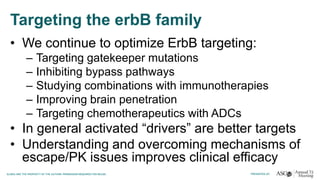
Targeting the erbB family
• We continue to optimize ErbB targeting:
– Targeting gatekeeper mutations
– Inhibiting bypass pathways
– Studying combinations with immunotherapies
– Improving brain penetration
– Targeting chemotherapeutics with ADCs
• In general activated “drivers” are better targets
• Understanding and overcoming mechanisms of
escape/PK issues improves clinical efficacy

Novel Strategies for Attacking the Epidermal Growth Factor Receptor

  • 1.
    Novel Strategies forAttacking the Epidermal Growth Factor Receptor David Carbone, MD PhD Director, James Thoracic Center The Ohio State University Columbus, OH USA
  • 2.
    Developmental Therapeutics—Clinical Pharmacologyand Experimental Therapeutics • Board 225 - Preliminary results of TATTON, a multi-arm phase Ib trial of AZD9291 combined with MEDI4736, AZD6094 or selumetinib in EGFR- mutant lung cancer. (Abstract 2509) G. R. Oxnard, S. S. Ramalingam, M. Ahn, S. Kim, H. A. Yu, H. Saka, L. Horn, K. Goto, Y. Ohe, M. Cantarini, P. Frewer, M. Lahn, J. C. Yang • Board 227 - Phase I expansion of S-222611, a reversible inhibitor of EGFR and HER2, in advanced solid tumors, including patients with brain metastases. (Abstract 2511) S. Deva, R. D. Baird, N. Cresti, J. Garcia- Corbacho, L. Hogarth, E. P. Frenkel, K. Kawaguchi, A. Arimura, K. Donaldson, J. Posner, D. Sarker, D. I. Jodrell, R. Plummer, J. F. Spicer • Board 226 - ABT-414 in patients with advanced solid tumors likely to overexpress the epidermal growth factor receptor (EGFR). (Abstract 2510) G. D. Goss, E. E. Vokes, M. S. Gordon, L. Gandhi, K. P. Papadopoulos, D. W. Rasco, M. Pedersen, J. S. Fischer, K. Chu, W. Ames, H. Xiong, H. Lee, J. Zeng, L. Roberts-Rapp, P. Ansell, E. Reilly, K. D. Holen, A. W. Tolcher
  • 3.
    EGFR • Receptor discoveredby Stanley Cohen, for which he received the Nobel prize in 1986.
  • 4.
    The ErbB Familyand Ligands EGF TGF-α Amphiregulin β-cellulin HB-EGF Epiregulin Heregulins HB-EGF Heregulins β-cellulin Tyrosine Kinase Domain ErbB-1 HER1 EGFR ErbB-2 HER2 neu ErbB-3 HER3 ErbB-4 HER4 Extracellular Intracellular No Known Ligands
  • 5.
    The ErbB Familyand Ligands LIGANDS RECEPTOR DIMERS ADAPTORS &ENZYMES p21-GDP p21-GTP INPUT LAYER HIDDEN LAYERS LIGANDS RECEPTOR DIMERS 1 1 1 4 4 4 3 4 3 3 NRG1 (3,4) α β NRG3 (4) AMPHI- REGULIN (1) HB-EGF (1,4) BET A- CELLULIN (1) EPIREGULIN (1,4) TGF α (1) LP A Thrombin ET, etc. CYT OKINES NRG2 (4) βα SRC CBL PLC γ PI3K SHP2 GAP NCK GRB7 CRK JAK SHC GRB2 SOS ADAPTORS &ENZYMES CASCADES TRANSCRIPTION FACT ORS AKT S6KBAD PAK JNK JNKK RAF MAPK MEK ABL PKC SP1 EGR1MYC ELK STAT JUN FOS OUTPUT LAYER MIGRA TIONAPOPT OSIS GROWTH DIFFERENTIA TIONADHESION 3 22 2 1 2 1 3 EGF (1) NRG4 (4) p21-GDP p21-GTP VAV RAC 4 2 Yarden and Sliwkowski
  • 6.
    A complex pathwaymade more so • Cancers tell us that a pathway is important by clonally tweaking it • HER2 amplification • VIII mutation • Exon 19 deletion, L858R 2/20/01 4/23/01 Then tweaking it again to acquire resistance to our drugs: T790M !!
  • 7.
    In this sectionwe have • EGFR TKIs designed to target acquired resistance mutations • EGFR TKIs in combination with other targeted inhibitors • Drugs targeting multiple HER-family members and with better brain penetration • Activation-specific EGFR antibody-drug conjugate
  • 8.
    Optimizing targeting ofpatients with EGFR mutant tumors • With 1st generation inhibitors, response rates are high, but benefit is generally transient. • Clinical benefit may be improved by: – Anticipating resistance mechansisms (Met, MEK) – Combination with other therapeutics (anti-PDL1) • Can these be safely combined?
  • 9.
    TATTON AZD9291 + Selumetinib AZD9291+ MEDI4736 AZD9291 + Savolitinib Dose 2 AZD9291 (80 mg OD) + MEDI4736 (10 mg/kg Q2W) Asia + ROW Dose 1 AZD9291 (80 mg OD) + MEDI4736 (3 mg/kg Q2W) Asia + ROW Dose 2 – continuous AZD9291 (80 mg OD) + Selumetinib (50 mg BD) Asia Dose 1 – continuous AZD9291 (80 mg OD) + Selumetinib (25 mg BD) Asia Dose 2 – continuous AZD9291 (80 mg OD) + Selumetinib (75 mg BD) ROW Dose 1 – continuous AZD9291 (80 mg OD) + Selumetinib (50 mg BD) ROW Dose 2 – intermittent: 4 days on/3 days off AZD9291 (80 mg OD) + Selumetinib (75 mg BD) ROW Dose 1 – intermittent: D1&D4/week AZD9291 (80 mg OD) + Selumetinib (75 mg BD) ROW Dose 2 AZD9291 (80 mg OD) + Savolitinib (800 mg OD) Asia + ROW Dose 1 AZD9291 (80 mg OD) + Savolitinib (600 mg OD) Asia + ROW Part A – Dose escalation Part B – Dose expansion EGFR-mutant NSCLC dose escalation: locally confirmed T790M mutation status dose expansion: centrally confirmed T790M mutation status); progression on any prior EGFR- TKI Innovative Phase I design allows continuous enrollment!
  • 10.
    Best percentage changefrom baseline in target lesion size in patients* receiving AZD9291/MEDI4736 (anti-PDL1) by T790M status -100% -80% -60% -40% -20% 0% 20% 40% 60% 80% Neg Neg Neg Neg Pos Pos Pos Neg Pos Neg Pos Pos Pos Neg *Population: All patients dosed who had a baseline and 6-week RECIST assessment †Patients ongoing treatment at data cut off PD, progressive disease; PR, partial response; PRc,, confirmed partial response; RECIST, Response Evaluation Criteria In Solid Tumors; SD, stable disease Unknown Positive Negative PD SD† SD† SD† SD† PR† PR† PR PRc† PRc† PRc† PR† PRc† CR†
  • 11.
    Best percentage changefrom baseline in target lesion size in patients* receiving AZD9291/selumetinib (MEKi) by T790M status -100% -80% -60% -40% -20% 0% 20% 40% 60% 80% Pos Neg Pos Neg Pos Pos Pos Neg Neg Pos Neg Pos UKN Neg Pos Pos Pos Pos Neg Pos Neg Pos Pos *Population: All patients dosed who had a baseline and 6-week RECIST assessment †Patients ongoing treatment at data cut off PD, progressive disease; PR, partial response; PRc,, confirmed partial response; RECIST, Response Evaluation Criteria In Solid Tumors; SD, stable disease Unknown Positive Negative PD SD† PD PD SD† SD† SD† SD† SD† SD† SD† SD† SD† SD† PRc† PR PRc† PRc† PRc† PR† PRc† PRc† PR†
  • 12.
    Best percentage changefrom baseline in target lesion size in patients* receiving AZD9291/savolitinib (METi) by T790M status -100% -80% -60% -40% -20% 0% 20% 40% 60% 80% Pos Neg Pos Pos Neg UK Neg Pos Neg Neg Neg *Population: All patients dosed who had a baseline and 6-week RECIST assessment †Patients ongoing treatment at data cut off PD, progressive disease; PR, partial response; PRc,, confirmed partial response; RECIST, Response Evaluation Criteria In Solid Tumors; SD, stable disease c
  • 13.
    AZ9291 combinations • Lowintrinsic toxicity enables combinations • These rational combinations all have tolerable toxicity profiles • High levels of activity observed • Remains to be seen if clinical benefit is more durable, if resistance mechanisms are altered, and whether up-front combinations better than “reactive” ones.
  • 14.
    Phase I expansionof S-222611, a reversible inhibitor of EGFR and HER2, in advanced solid tumors, including patients with brain metastases. S Deva1, A Italiano2, R Baird3, N Cresti4, J Garcia Corbacho3, L Hogarth4, E Frenkel5, K Kawaguchi6, A. Arimura6, K Donaldson6, J Posner6, D Sarker1, D Jodrell3, R Plummer4 & J Spicer1 1King’s College London, Guy’s Hospital, London, UK; 2Institute Bergonie, FR; 3University of Cambridge, Department of Oncology, Cambridge, UK; 4Northern Centre for Cancer Care, Newcastle upon Tyne, UK; 5University of Texas Southwestern Medical Center, Dallas, TX, USA; 6Shionogi & Co. Ltd., Osaka, Japan Abstract No. 2511
  • 15.
    Summary • S-222611 isa potent and selective reversible tyrosine kinase inhibitor of EGFR and HER2. • Greater potency of anti-tumor activity than lapatinib. • Higher brain penetration. • Maximum tolerated dose (MTD) was not established. • 800 mg daily was selected as a dose for the expansion phase. • This study included patients with tumors often expressing EGFR and/or overexpressing HER2.
  • 16.
    Adverse drug reactions Incidence(%) of all grades of ADRs in ≥10% subjects [N= 76] No grade 4 or 5 ADRs Events All grades Grade 3 Diarrhea 57 (75) 9 (12) Rash 36 (47) 0 Nausea 27 (36) 2 (3) Fatigue 23 (30) 2 (3) Vomiting 22 (29) 1 (1) Bilirubin ↑ 21 (28) 5 (7) Appetite ↓ 20 (26) 1 (1) Anemia 9 (12) 3 (4) 2 out of 76 patients (2.6%) withdrawn due to treatment-related AEs  Blood bilirubin increased (G3)  Nausea, Vomiting (G3) Similar to erlotinib/lapatinib
  • 17.
    HER2-positive breast andupper GI cancer Patients ~~~~ 200 Primary tumor ORR: N (%) CBR: N (%) Breast (N=25) 4 (16%) 7 (28%) Upper GI (N=13) 2 (15%) 2 (20%)
  • 18.
    Brain metastases fromHER2-positive BC Baseline Cycle 4 (16 w) Heavily pre-treated with HER2-based therapies including lapatinib/capecitabine Pts # HER2 IHC Brain mets Best overall response # 1 3+ Target lesion PR # 2 3+ SD (≥12M) # 3 3+ SD (6.0 M) # 4 3+ Non- target lesion SD (4.7M) # 5 3+ SD (3.3M) # 6 3+ NE Pts #1 NOT similar to erlotinib/lapatinib!
  • 19.
    Conclusions • A dailydose of 800 mg S-222611 was generally well-tolerated. 20% of patients required dosage reduction (usually to 400 mg daily). • Of 25 patients with HER2-positive breast cancer, the RR was 16%, and the CBR was 28%. 6 had brain metastases: 1 intracranial response and 2 prolonged SD (≥ 6 months) were observed. • The majority of these patients were heavily pre-treated and had received prior HER2-directed therapy. • Of 13 patients with HER2-positive upper GI cancers, the RR was 15%. • This Phase I study suggests S-222611 is well-tolerated with efficacy against HER2-positive tumors, including breast cancer metastatic to brain. • It would be interesting to test this agent in non- T790M “brain sanctuary” relapse patients with EGFR mutant lung cancer
  • 20.
    Targeting aberrant EGFRprotein • ABT-414 is an antibody-drug conjugate composed of the antibody ABT-806, targeting an epitope exposed in active EGFR/mutant EGFRvIII (better than cetuximab), linked to the anti-microtubule agent monomethylauristatin • This is a phase I/II open label study in patients with advanced solid tumors likely to overexpress EGFR
  • 21.
    Phase I studyof ABT-414 mono- or combination therapy with temozolomide in recurrent GBM (abstract 2016, Monday afternoon posters) • 28 patients treated as mono-therapy – 1 CR and 1 PR • 18 patients with TMZ – 1 CR and 4 PR
  • 22.
    Study Design andPrimary Objectives MTD, maximum tolerated dose; q3week, every 3 weeks; RPTD, recommended phase 2 dose; SPECT, single-photon emission computed tomography.
  • 23.
    Results • Transient microcystickeratopathy observed • Also G3/4 keratitis, hyponatremia, blurred vision, dyspnea, and pneumonia • One PR in TNBC • Signal of activity in GBM, ? H&N/BC • Striking difference in overall efficacy and toxicity compared to that seen when targeting kinase mutant EGFR
  • 24.
    Targeting the erbBfamily • We continue to optimize ErbB targeting: – Targeting gatekeeper mutations – Inhibiting bypass pathways – Studying combinations with immunotherapies – Improving brain penetration – Targeting chemotherapeutics with ADCs • In general activated “drivers” are better targets • Understanding and overcoming mechanisms of escape/PK issues improves clinical efficacy