CALCULATION
OF
CARBON FOOT PRINT
What is carbon foot print?
A Carbon foot print is basically the
total amount of Green House Gases
(GHG) that are generated by a person
or other entity in a year.
It is calculated in tons of CO2
GREEN HOUSE GASES
Green House Gases (GHG) are
the gases in the atmosphere
that produce “Green House
Effect” and contribute to
Global warming and
Climate Change.
GREEN HOUSE GASES
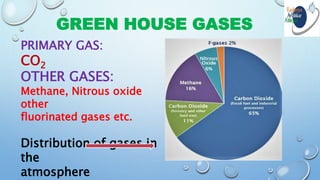
PRIMARY GAS:
CO2
OTHER GASES:
Methane, Nitrous oxide
other
fluorinated gases etc.
Distribution of gases in
the
atmosphere
GREEN HOUSE EFFECT
GREEN HOUSE GLOBAL WARMING
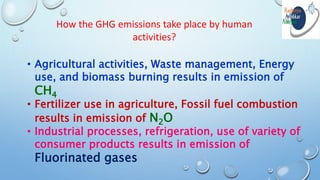
How the GHG emissions take place by human
activities?
• Agricultural activities, Waste management, Energy
use, and biomass burning results in emission of
CH4
• Fertilizer use in agriculture, Fossil fuel combustion
results in emission of N2O
• Industrial processes, refrigeration, use of variety of
consumer products results in emission of
Fluorinated gases
NEED OF CALCULATING CARBON FOOT PRINT
The carbon foot print is a very important way
to understand the impact of person’s
behaviour on global warming.
Do you want to stop global warming?
Then you keep the track of your personal
carbon foot print
TASK-1
Calculate your house hold
carbon foot print.
MAJOR AREAS
1.ELECTRICITY
2.FUEL (TRANSPORT)
3.COOKING (LPG)
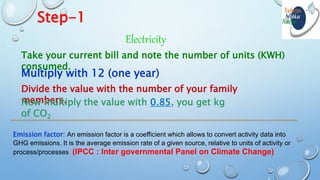
Step-1
Electricity
Take your current bill and note the number of units (KWH)
consumed.
Multiply with 12 (one year)
Divide the value with the number of your family
members.
Now multiply the value with 0.85, you get kg
of CO2
Emission factor: An emission factor is a coefficient which allows to convert activity data into
GHG emissions. It is the average emission rate of a given source, relative to units of activity or
process/processes. (IPCC : Inter governmental Panel on Climate Change)
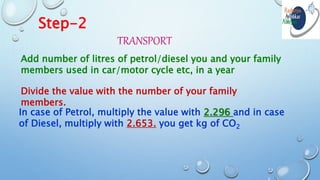
Step-2
TRANSPORT
Add number of litres of petrol/diesel you and your family
members used in car/motor cycle etc, in a year
Divide the value with the number of your family
members.
In case of Petrol, multiply the value with 2.296 and in case
of Diesel, multiply with 2.653. you get kg of CO2
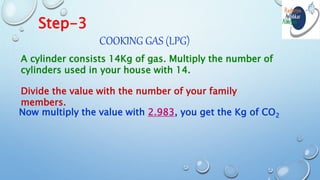
Step-3
COOKING GAS (LPG)
A cylinder consists 14Kg of gas. Multiply the number of
cylinders used in your house with 14.
Divide the value with the number of your family
members.
Now multiply the value with 2.983, you get the Kg of CO2
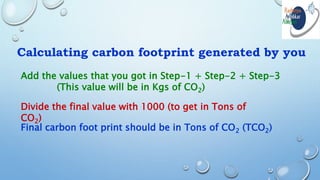
Calculating carbon footprint generated by you
Add the values that you got in Step-1 + Step-2 + Step-3
(This value will be in Kgs of CO2)
Divide the final value with 1000 (to get in Tons of
CO2)
Final carbon foot print should be in Tons of CO2 (TCO2)
TASK-2
Steps you usually follow to reduce
the carbon foot print in day-to-day
life
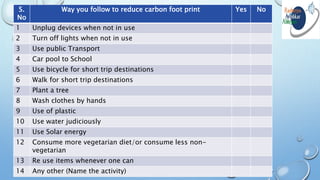
S.
No
Way you follow to reduce carbon foot print Yes No
1 Unplug devices when not in use
2 Turn off lights when not in use
3 Use public Transport
4 Car pool to School
5 Use bicycle for short trip destinations
6 Walk for short trip destinations
7 Plant a tree
8 Wash clothes by hands
9 Use of plastic
10 Use water judiciously
11 Use Solar energy
12 Consume more vegetarian diet/or consume less non-
vegetarian
13 Re use items whenever one can
14 Any other (Name the activity)
REPORTING THE RESULTS OF STUDY
https://bit.ly/2ZLe
CZS
If you click on this link or type this link in your browser, a
google form will be opened, then fill that form. A gmail id
is required.
carbon foot print.pptx

carbon foot print.pptx

  • 1.
  • 2.
    What is carbonfoot print?
  • 3.
    A Carbon footprint is basically the total amount of Green House Gases (GHG) that are generated by a person or other entity in a year. It is calculated in tons of CO2
  • 4.
    GREEN HOUSE GASES GreenHouse Gases (GHG) are the gases in the atmosphere that produce “Green House Effect” and contribute to Global warming and Climate Change.
  • 5.
    GREEN HOUSE GASES PRIMARYGAS: CO2 OTHER GASES: Methane, Nitrous oxide other fluorinated gases etc. Distribution of gases in the atmosphere
  • 6.
    GREEN HOUSE EFFECT GREENHOUSE GLOBAL WARMING
  • 7.
    How the GHGemissions take place by human activities? • Agricultural activities, Waste management, Energy use, and biomass burning results in emission of CH4 • Fertilizer use in agriculture, Fossil fuel combustion results in emission of N2O • Industrial processes, refrigeration, use of variety of consumer products results in emission of Fluorinated gases
  • 8.
    NEED OF CALCULATINGCARBON FOOT PRINT The carbon foot print is a very important way to understand the impact of person’s behaviour on global warming. Do you want to stop global warming? Then you keep the track of your personal carbon foot print
  • 9.
    TASK-1 Calculate your household carbon foot print.
  • 10.
  • 11.
    Step-1 Electricity Take your currentbill and note the number of units (KWH) consumed. Multiply with 12 (one year) Divide the value with the number of your family members. Now multiply the value with 0.85, you get kg of CO2 Emission factor: An emission factor is a coefficient which allows to convert activity data into GHG emissions. It is the average emission rate of a given source, relative to units of activity or process/processes. (IPCC : Inter governmental Panel on Climate Change)
  • 12.
    Step-2 TRANSPORT Add number oflitres of petrol/diesel you and your family members used in car/motor cycle etc, in a year Divide the value with the number of your family members. In case of Petrol, multiply the value with 2.296 and in case of Diesel, multiply with 2.653. you get kg of CO2
  • 13.
    Step-3 COOKING GAS (LPG) Acylinder consists 14Kg of gas. Multiply the number of cylinders used in your house with 14. Divide the value with the number of your family members. Now multiply the value with 2.983, you get the Kg of CO2
  • 14.
    Calculating carbon footprintgenerated by you Add the values that you got in Step-1 + Step-2 + Step-3 (This value will be in Kgs of CO2) Divide the final value with 1000 (to get in Tons of CO2) Final carbon foot print should be in Tons of CO2 (TCO2)
  • 15.
    TASK-2 Steps you usuallyfollow to reduce the carbon foot print in day-to-day life
  • 16.
    S. No Way you followto reduce carbon foot print Yes No 1 Unplug devices when not in use 2 Turn off lights when not in use 3 Use public Transport 4 Car pool to School 5 Use bicycle for short trip destinations 6 Walk for short trip destinations 7 Plant a tree 8 Wash clothes by hands 9 Use of plastic 10 Use water judiciously 11 Use Solar energy 12 Consume more vegetarian diet/or consume less non- vegetarian 13 Re use items whenever one can 14 Any other (Name the activity)
  • 17.
    REPORTING THE RESULTSOF STUDY https://bit.ly/2ZLe CZS If you click on this link or type this link in your browser, a google form will be opened, then fill that form. A gmail id is required.