ADOPTION UNDER
HINDU ADOPTION AND
MAINTENANCE ACT,
1956
Dr. Amit Kashyap
Assistant Professor of Law,
Army Law College,
Pune-412106.
Maharashtra
4/3/2023 1
Adoption
In simpleterminology, the term ‗adoption‘ meansacceptance of achild of other
parents to bethe sameasone‘s own child or the choosing and making that to
beone‘sown which originally was not so.In legal terminology, adoption enables
achildless person to make somebody else‘s child as his own.
Adoption under Hindu Law:
The main purpose of Adoption is to provide consolation and relief to achildless
person, andon the other hand,rescue the helpless,the unwanted, the destitute
or the orphan child by providing it with parents.
Currently,the adoption under Hindu Law is governed byThe HinduAdoption
and MaintenanceAct, 1956.
Requirements for a valid adoption
No adoption is valid unless :
•
•
•
•
The person adopting is lawfully capable of taking in adoption.
The person giving in adoption is lawfully capable of giving in adoption.
The person adopted is lawfully capable of being taken in adoption.
The adoption is completed by an actual giving and taking.
4/3/2023 2
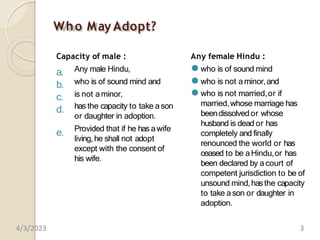
Who May Adopt?
Capacity of male :
a.
b.
c.
d.
e.
Any male Hindu,
who is of sound mind and
is not aminor,
has the capacity to take ason
or daughter in adoption.
Provided that if he has awife
living, he shall not adopt
except with the consent of
his wife.
Any female Hindu :
⚫ who is of sound mind
⚫ who is not a minor,and
⚫ who is not married,or if
married,whose marriage has
beendissolvedor whose
husband is dead or has
completely and finally
renounced the world or has
ceased to be aHindu,or has
been declared by a court of
competent jurisdiction to be of
unsound mind,hasthe capacity
to take ason or daughter in
adoption.
4/3/2023 3
Who may give in adoption
a.
b.
c.
d.
No person except the father or mother or guardianof the child
has the capacity to give the child in adoption.
The father alone,if he is alive,has the right to give in adoption,
with consent of wife.
The mother may give the child in adoption if the father is dead
or has completely and finally renounced the world or has ceased
to beaHindu, or hasbeendeclared byacourt of competent
jurisdiction to be of unsound mind.
Where both the father and mother are dead or have completely
and finally renounced the world the guardian of the child may
give the child in adoption with the previous permission of the
court.
The court while granting permission shallbesatisfied that the
adoption is for the welfare of the child and due consideration will be
givento the wishesof the child havingregard for the ageand
understanding of the child.
4/3/2023 4
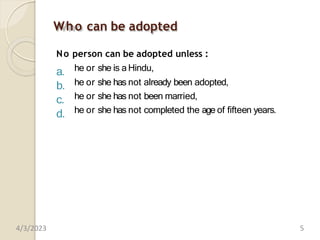
Who can be adopted
No person can be adopted unless :
a.
b.
c.
d.
he or she is a Hindu,
he or she has not already been adopted,
he or she has not been married,
he or she has not completed the age of fifteen years.
4/3/2023 5
Other conditions for a valid adoption
a.
b.
c.
d.
e.
if the adoption is of ason,the adoptive father or mother by whom the
adoption is made must not have a Hindu son, son‘s son or son‘s son‘s son
living at the time of adoption,
if the adoption is of a daughter, the adoptive father or mother by whom the
adoption is made must not have a Hindu daughter or son‘s daughter living at
the time of adoption,
if the adoption is by a male and the person to be adopted is a male, the
adoptive father is at least twenty one years older than the person to be
adopted,
if the adoption is by a female and the person to be adopted is a male, the
adoptive mother s at least twenty one years older than the person to be
adopted,
the same child may not be adopted simultaneously by two or more parents;
the child to be adopted must be actually given and taken in adoption with an
intent to transfer the child from the family of birth.
Personallawof Muslims,Christians, ParsisandJewsdoesnot recognisecomplete
adoption.As non- Hindus do not have an enabling law to adopt a child legally,those
desirous of adopting achild can only take the child in ‗guardianship‘ under the
provisions ofThe Guardian andWardsAct, 1890.This however does not provide to
the child the same status asachild born biologically to the family.
4/3/2023 6
Adoption under Muslim law:
⚫
Adoption isthe transplantation of asonfrom the family in which he is born, into
another family bygift madebyhisnatural parents to his adopting parents. Islam does
not recognise adoption. In MohammedAllahabad Khan v.Mohammad Ismail it was held
that there is nothing in the Mohammedan Law similar to adoption asrecognized in the
Hindu System.Acknowledgement of paternity under Muslim Lawis the nearest
approach to adoption. The material difference between the two canbestated that in
adoption, the adoptee isthe known sonof another person, while one of the essentials
of acknowledgement is that the acknowledgee must not be known son of another.
However an adoption can take place from an orphanage by obtaining permission from
the court under Guardians and wards act.
Adoption under Parsis and Christian laws:
The personal laws of these communities also do not recognize adoption and here
too an adoption can take place from an orphanage by obtaining permission from the
court under Guardians and wards act.
4/3/2023 7
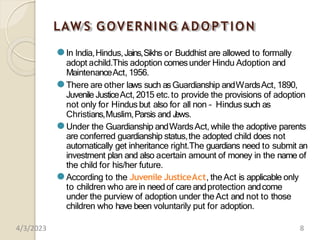
LAW S GOVERNING ADOPTION
⚫In India,Hindus,Jains,Sikhs or Buddhist are allowed to formally
adopt achild.This adoption comesunder Hindu Adoption and
MaintenanceAct, 1956.
⚫There are other laws such asGuardianship andWardsAct, 1890,
Juvenile JusticeAct, 2015 etc.to provide the provisions of adoption
not only for Hindus but also for all non – Hindus such as
Christians,Muslim,Parsis and J
ews.
⚫Under the Guardianship andWardsAct, while the adoptive parents
are conferred guardianship status,the adopted child does not
automatically get inheritance right.The guardians need to submit an
investment plan and also acertain amount of money in the name of
the child for his/her future.
⚫According to the Juvenile JusticeAct, theAct is applicable only
to children who arein needof care andprotection andcome
under the purview of adoption under theAct and not to those
children who have been voluntarily put for adoption.
4/3/2023 8
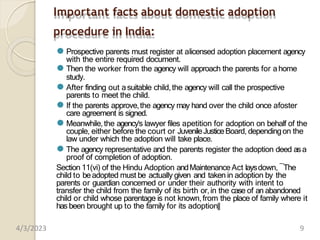
Important facts about domestic adoption
procedure in India:
⚫ Prospective parents must register at alicensed adoption placement agency
with the entire required document.
⚫ Then the worker from the agency will approach the parents for ahome
study.
⚫ After finding out asuitable child,the agency will call the prospective
parents to meet the child.
⚫ If the parents approve,the agency may hand over the child once afoster
care agreement is signed.
⚫ Meanwhile,the agency‘s lawyer files apetition for adoption on behalf of the
couple, either before the court or JuvenileJusticeBoard, dependingon the
law under which the adoption will take place.
⚫ The agency representative and the parents register the adoption deed asa
proof of completion of adoption.
Section 11(vi) of the Hindu Adoption andMaintenanceAct laysdown, ―The
child to beadopted must be actually given and taken in adoption by the
parents or guardian concerned or under their authority with intent to
transfer the child from the family of its birth or,in the case of an abandoned
child or child whose parentage is not known,from the place of family where it
has been brought up to the family for its adoption‖
4/3/2023 9
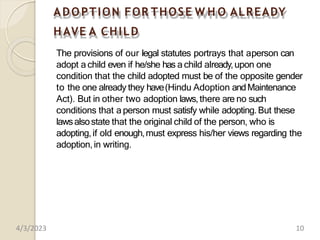
ADOPTION FOR THOSE W H O ALREADY
H AVE A CHILD
The provisions of our legal statutes portrays that aperson can
adopt a child even if he/she has a child already,upon one
condition that the child adopted must be of the opposite gender
to the one already they have(Hindu Adoption andMaintenance
Act). But in other two adoption laws,there are no such
conditions that a person must satisfy while adopting.But these
lawsalsostate that the original child of the person, who is
adopting,if old enough,must express his/her views regarding the
adoption,in writing.
4/3/2023 10
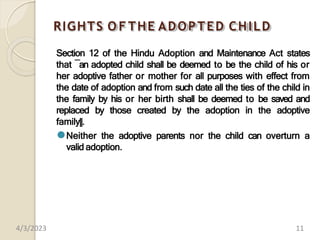
RIGHTS O F THE ADOPTED CHILD
Section 12 of the Hindu Adoption and Maintenance Act states
that ―an adopted child shall be deemed to be the child of his or
her adoptive father or mother for all purposes with effect from
the date of adoption and from such date all the ties of the child in
the family by his or her birth shall be deemed to be saved and
replaced by those created by the adoption in the adoptive
family‖.
⚫Neither the adoptive parents nor the child can overturn a
valid adoption.
4/3/2023 11
Guidelines Governing Adoption of Children,
2015
In pursuance of the powers conferred bysub-section (3) of
section 41 of the JuvenileJustice(Care andProtection of
Children) Act, 2000 (56 of 2000) andin supersessionof the
Guidelines Governing theAdoption of Children,2011,except as
respects things done or omitted to bedone before such
supersession,the Central Government hereby notifies the
following Guidelines issuedbythe Central Adoption Resource
Authority to provide for the regulation of adoption of orphan,
abandoned or surrendered children.
4/3/2023 12
Child eligible for adoption. -
Any orphan or abandoned or surrendered child,declared legally free for
adoption by the ChildWelfare Committee is eligible for adoption.
(a) The prospective adoptive parents should be physically,mentally and
emotionally stable;financially capable;motivated to adopt achild; and
should not have any life threatening medical condition;
(b) any prospective adoptive parent,irrespective of his marital status and
whether or not he has his own biological son or daughter,can adopt a
child;
(c) single female is eligible to adopt achild of any gender:
(d) single male person shall not be eligible to adopt agirl child;
(e) in case of acouple,the consent of both spouses shall be required;
(f) no child shall be given in adoption to acouple unless they have at least
two years of stable marital relationship;
(g) the age of prospective adoptive parents ason the date of registration shall
becounted for deciding the eligibility andthe eligibility of prospective
adoptive parents to applyfor children of different agegroupsshallbeas
under -
4/3/2023 13
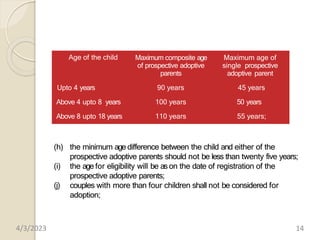
Age of the child Maximum composite age
of prospective adoptive
parents
Maximum age of
single prospective
adoptive parent
Upto 4 years 90 years 45 years
Above 4 upto 8 years 100 years 50 years
Above 8 upto 18 years 110 years 55 years;
(h) the minimum age difference between the child and either of the
prospective adoptive parents should not be less than twenty five years;
(i) the age for eligibility will be ason the date of registration of the
prospective adoptive parents;
(j) couples with more than four children shall not be considered for
adoption;
4/3/2023 14
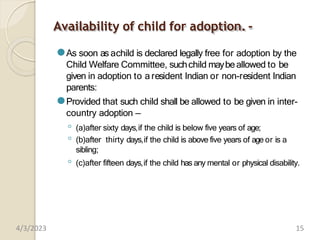
Availability of child for adoption. -
⚫As soon as achild is declared legally free for adoption by the
Child Welfare Committee, suchchild maybeallowed to be
given in adoption to a resident Indian or non-resident Indian
parents:
⚫Provided that such child shall be allowed to be given in inter-
country adoption —
◦ (a)after sixty days,if the child is below five years of age;
◦ (b)after thirty days,if the child is above five years of age or is a
sibling;
◦ (c)after fifteen days,if the child has any mental or physical disability.
4/3/2023 15
Legal Procedure.-
(1) The specialised adoption agencyshall file the adoption petition in the court, having
jurisdiction over the place where the specialised adoption agencyis located, within seven
daysfrom the date of acceptance by prospective adoptive parents for obtaining the
necessary adoption orders under the Act.
(2) In casethe child is from achildren‘s home which islocated in another district, the
specialised adoption agency shall file the adoption petition in the concerned court of that
district.
(3) The adoption petition shall contain all requisite documents as per Schedule- 8.
(4) The court will hold the adoption proceeding in-camera and dispose of the case within a
period of two months from the date of filing of the adoption petition by the specialised
adoption agency.
(5) The specialised adoption agencyshall obtain a certified copy of the adoption order from
the court andwill forward it to the prospective adoptive parents within ten days and it
shall also post acopy of suchorder in the Child Adoption Resource Information and
Guidance Systemandmakenecessary entries in Child Adoption Resource Information and
Guidance System.
(6) Registration of an adoption deed shall not be necessary.
(7) The specialised adoption agencyshall obtain the birth certificate of the child from the
birth certificate issuingauthority within ten daysfrom the date of issuanceof adoption
order, with the nameof adoptive parents, asparents, anddate of birth asrecorded in the
adoption order.
4/3/2023 16
Important definitions
⚫
⚫
⚫
⚫
⚫
⚫
⚫
⚫
⚫
⚫
―abandoned‖ meansanunaccompanied anddeserted child who is declared abandoned by the Child
Welfare Committee after due inquiry;
―authorised foreign adoption agency‖ meansaforeign social or child welfare agency that is
authorised by Central Adoption ResourceAuthority on the recommendation of the concerned
Central Authority or Government Department of that country for coordinating all matters relating
to adoption of an Indian child by acitizen of that country;
―Child Adoption Resource Information and Guidance System‖ meansan e-governance system for
facilitating and monitoring the adoption programme;
―child legally free for adoption‖ means an orphan, abandoned and surrendered child declared free for
adoption by the Child Welfare Committee;
―Home Study Report‖ means areport containing details of the adoptive parents, which include social
and economic status; family background; description of home; standard of living; compatibility
between spouses,and other family members; health status;
―in-country adoption‖ means adoption of a child by a citizen of India;
―inter-country adoption‖ meansadoption of achild by aoverseas citizen of India or aforeign
national;
―SpecialisedAdoption Agency‖ meansthe agencyrecognised by the State Government under sub-
section 4 of section 41 of the Act for the purpose of placing children in adoption;
―StateAdoption ResourceAgency‖ means the agency setup by the State Government under the
Integrated Child Protection Scheme;
―surrendered child‖ means a child, who in the opinion of the Child Welfare Committee, is
relinquished on account of physical,emotional and social factors beyond the control of the parent or
legal guardian;
4/3/2023 17
New online registration system
⚫
⚫
⚫
⚫
⚫
A new online registration systemis now in place called the Child Adoption Resource
Information and Guidance System (CARINGS), which is managed by the nodal body dealing
with adoption, the Central Adoption Resources Agency(CARA). As per the new guidelines
framed by the CARA, parents desiring to adopt must register with the online system by
uploading a list of documents.
Next, ahome study report isprepared within amonth by asocial worker basedin the state
where the prospective parents reside. The report is vetted by one of the specialised
adoption agencies— either declaring the parents eligible to adopt or rejecting their
application with reasons.
If declared eligible, the prospective parents are placed on awaiting list (called seniority list)
andwhen their turn comes, they are shown the photographs of six children, along with
background information and medical history.The parents must―reserve‖ one among the six
options within 48 hours, which meansthey let go of the remaining five, who are then
showed to the next prospective parent in line.
The specialised adoption agencyfrom the state where the child is then meets the
prospective parents to assess their suitability for the child.The prospective parents also
meet the child.This entire process of ―matching‖ is to be completed within 15 days.
If the parents decide to adopt the child that they reserved, then the agencyproceeds with
the legal work. If they do not, they are placed at the bottom of the waiting list and wait for
their chance to come up again.
4/3/2023 18

7.PPT on Adoption.pptx

  • 1.
    ADOPTION UNDER HINDU ADOPTIONAND MAINTENANCE ACT, 1956 Dr. Amit Kashyap Assistant Professor of Law, Army Law College, Pune-412106. Maharashtra 4/3/2023 1
  • 2.
    Adoption In simpleterminology, theterm ‗adoption‘ meansacceptance of achild of other parents to bethe sameasone‘s own child or the choosing and making that to beone‘sown which originally was not so.In legal terminology, adoption enables achildless person to make somebody else‘s child as his own. Adoption under Hindu Law: The main purpose of Adoption is to provide consolation and relief to achildless person, andon the other hand,rescue the helpless,the unwanted, the destitute or the orphan child by providing it with parents. Currently,the adoption under Hindu Law is governed byThe HinduAdoption and MaintenanceAct, 1956. Requirements for a valid adoption No adoption is valid unless : • • • • The person adopting is lawfully capable of taking in adoption. The person giving in adoption is lawfully capable of giving in adoption. The person adopted is lawfully capable of being taken in adoption. The adoption is completed by an actual giving and taking. 4/3/2023 2
  • 3.
    Who May Adopt? Capacityof male : a. b. c. d. e. Any male Hindu, who is of sound mind and is not aminor, has the capacity to take ason or daughter in adoption. Provided that if he has awife living, he shall not adopt except with the consent of his wife. Any female Hindu : ⚫ who is of sound mind ⚫ who is not a minor,and ⚫ who is not married,or if married,whose marriage has beendissolvedor whose husband is dead or has completely and finally renounced the world or has ceased to be aHindu,or has been declared by a court of competent jurisdiction to be of unsound mind,hasthe capacity to take ason or daughter in adoption. 4/3/2023 3
  • 4.
    Who may givein adoption a. b. c. d. No person except the father or mother or guardianof the child has the capacity to give the child in adoption. The father alone,if he is alive,has the right to give in adoption, with consent of wife. The mother may give the child in adoption if the father is dead or has completely and finally renounced the world or has ceased to beaHindu, or hasbeendeclared byacourt of competent jurisdiction to be of unsound mind. Where both the father and mother are dead or have completely and finally renounced the world the guardian of the child may give the child in adoption with the previous permission of the court. The court while granting permission shallbesatisfied that the adoption is for the welfare of the child and due consideration will be givento the wishesof the child havingregard for the ageand understanding of the child. 4/3/2023 4
  • 5.
    Who can beadopted No person can be adopted unless : a. b. c. d. he or she is a Hindu, he or she has not already been adopted, he or she has not been married, he or she has not completed the age of fifteen years. 4/3/2023 5
  • 6.
    Other conditions fora valid adoption a. b. c. d. e. if the adoption is of ason,the adoptive father or mother by whom the adoption is made must not have a Hindu son, son‘s son or son‘s son‘s son living at the time of adoption, if the adoption is of a daughter, the adoptive father or mother by whom the adoption is made must not have a Hindu daughter or son‘s daughter living at the time of adoption, if the adoption is by a male and the person to be adopted is a male, the adoptive father is at least twenty one years older than the person to be adopted, if the adoption is by a female and the person to be adopted is a male, the adoptive mother s at least twenty one years older than the person to be adopted, the same child may not be adopted simultaneously by two or more parents; the child to be adopted must be actually given and taken in adoption with an intent to transfer the child from the family of birth. Personallawof Muslims,Christians, ParsisandJewsdoesnot recognisecomplete adoption.As non- Hindus do not have an enabling law to adopt a child legally,those desirous of adopting achild can only take the child in ‗guardianship‘ under the provisions ofThe Guardian andWardsAct, 1890.This however does not provide to the child the same status asachild born biologically to the family. 4/3/2023 6
  • 7.
    Adoption under Muslimlaw: ⚫ Adoption isthe transplantation of asonfrom the family in which he is born, into another family bygift madebyhisnatural parents to his adopting parents. Islam does not recognise adoption. In MohammedAllahabad Khan v.Mohammad Ismail it was held that there is nothing in the Mohammedan Law similar to adoption asrecognized in the Hindu System.Acknowledgement of paternity under Muslim Lawis the nearest approach to adoption. The material difference between the two canbestated that in adoption, the adoptee isthe known sonof another person, while one of the essentials of acknowledgement is that the acknowledgee must not be known son of another. However an adoption can take place from an orphanage by obtaining permission from the court under Guardians and wards act. Adoption under Parsis and Christian laws: The personal laws of these communities also do not recognize adoption and here too an adoption can take place from an orphanage by obtaining permission from the court under Guardians and wards act. 4/3/2023 7
  • 8.
    LAW S GOVERNINGADOPTION ⚫In India,Hindus,Jains,Sikhs or Buddhist are allowed to formally adopt achild.This adoption comesunder Hindu Adoption and MaintenanceAct, 1956. ⚫There are other laws such asGuardianship andWardsAct, 1890, Juvenile JusticeAct, 2015 etc.to provide the provisions of adoption not only for Hindus but also for all non – Hindus such as Christians,Muslim,Parsis and J ews. ⚫Under the Guardianship andWardsAct, while the adoptive parents are conferred guardianship status,the adopted child does not automatically get inheritance right.The guardians need to submit an investment plan and also acertain amount of money in the name of the child for his/her future. ⚫According to the Juvenile JusticeAct, theAct is applicable only to children who arein needof care andprotection andcome under the purview of adoption under theAct and not to those children who have been voluntarily put for adoption. 4/3/2023 8
  • 9.
    Important facts aboutdomestic adoption procedure in India: ⚫ Prospective parents must register at alicensed adoption placement agency with the entire required document. ⚫ Then the worker from the agency will approach the parents for ahome study. ⚫ After finding out asuitable child,the agency will call the prospective parents to meet the child. ⚫ If the parents approve,the agency may hand over the child once afoster care agreement is signed. ⚫ Meanwhile,the agency‘s lawyer files apetition for adoption on behalf of the couple, either before the court or JuvenileJusticeBoard, dependingon the law under which the adoption will take place. ⚫ The agency representative and the parents register the adoption deed asa proof of completion of adoption. Section 11(vi) of the Hindu Adoption andMaintenanceAct laysdown, ―The child to beadopted must be actually given and taken in adoption by the parents or guardian concerned or under their authority with intent to transfer the child from the family of its birth or,in the case of an abandoned child or child whose parentage is not known,from the place of family where it has been brought up to the family for its adoption‖ 4/3/2023 9
  • 10.
    ADOPTION FOR THOSEW H O ALREADY H AVE A CHILD The provisions of our legal statutes portrays that aperson can adopt a child even if he/she has a child already,upon one condition that the child adopted must be of the opposite gender to the one already they have(Hindu Adoption andMaintenance Act). But in other two adoption laws,there are no such conditions that a person must satisfy while adopting.But these lawsalsostate that the original child of the person, who is adopting,if old enough,must express his/her views regarding the adoption,in writing. 4/3/2023 10
  • 11.
    RIGHTS O FTHE ADOPTED CHILD Section 12 of the Hindu Adoption and Maintenance Act states that ―an adopted child shall be deemed to be the child of his or her adoptive father or mother for all purposes with effect from the date of adoption and from such date all the ties of the child in the family by his or her birth shall be deemed to be saved and replaced by those created by the adoption in the adoptive family‖. ⚫Neither the adoptive parents nor the child can overturn a valid adoption. 4/3/2023 11
  • 12.
    Guidelines Governing Adoptionof Children, 2015 In pursuance of the powers conferred bysub-section (3) of section 41 of the JuvenileJustice(Care andProtection of Children) Act, 2000 (56 of 2000) andin supersessionof the Guidelines Governing theAdoption of Children,2011,except as respects things done or omitted to bedone before such supersession,the Central Government hereby notifies the following Guidelines issuedbythe Central Adoption Resource Authority to provide for the regulation of adoption of orphan, abandoned or surrendered children. 4/3/2023 12
  • 13.
    Child eligible foradoption. - Any orphan or abandoned or surrendered child,declared legally free for adoption by the ChildWelfare Committee is eligible for adoption. (a) The prospective adoptive parents should be physically,mentally and emotionally stable;financially capable;motivated to adopt achild; and should not have any life threatening medical condition; (b) any prospective adoptive parent,irrespective of his marital status and whether or not he has his own biological son or daughter,can adopt a child; (c) single female is eligible to adopt achild of any gender: (d) single male person shall not be eligible to adopt agirl child; (e) in case of acouple,the consent of both spouses shall be required; (f) no child shall be given in adoption to acouple unless they have at least two years of stable marital relationship; (g) the age of prospective adoptive parents ason the date of registration shall becounted for deciding the eligibility andthe eligibility of prospective adoptive parents to applyfor children of different agegroupsshallbeas under - 4/3/2023 13
  • 14.
    Age of thechild Maximum composite age of prospective adoptive parents Maximum age of single prospective adoptive parent Upto 4 years 90 years 45 years Above 4 upto 8 years 100 years 50 years Above 8 upto 18 years 110 years 55 years; (h) the minimum age difference between the child and either of the prospective adoptive parents should not be less than twenty five years; (i) the age for eligibility will be ason the date of registration of the prospective adoptive parents; (j) couples with more than four children shall not be considered for adoption; 4/3/2023 14
  • 15.
    Availability of childfor adoption. - ⚫As soon as achild is declared legally free for adoption by the Child Welfare Committee, suchchild maybeallowed to be given in adoption to a resident Indian or non-resident Indian parents: ⚫Provided that such child shall be allowed to be given in inter- country adoption — ◦ (a)after sixty days,if the child is below five years of age; ◦ (b)after thirty days,if the child is above five years of age or is a sibling; ◦ (c)after fifteen days,if the child has any mental or physical disability. 4/3/2023 15
  • 16.
    Legal Procedure.- (1) Thespecialised adoption agencyshall file the adoption petition in the court, having jurisdiction over the place where the specialised adoption agencyis located, within seven daysfrom the date of acceptance by prospective adoptive parents for obtaining the necessary adoption orders under the Act. (2) In casethe child is from achildren‘s home which islocated in another district, the specialised adoption agency shall file the adoption petition in the concerned court of that district. (3) The adoption petition shall contain all requisite documents as per Schedule- 8. (4) The court will hold the adoption proceeding in-camera and dispose of the case within a period of two months from the date of filing of the adoption petition by the specialised adoption agency. (5) The specialised adoption agencyshall obtain a certified copy of the adoption order from the court andwill forward it to the prospective adoptive parents within ten days and it shall also post acopy of suchorder in the Child Adoption Resource Information and Guidance Systemandmakenecessary entries in Child Adoption Resource Information and Guidance System. (6) Registration of an adoption deed shall not be necessary. (7) The specialised adoption agencyshall obtain the birth certificate of the child from the birth certificate issuingauthority within ten daysfrom the date of issuanceof adoption order, with the nameof adoptive parents, asparents, anddate of birth asrecorded in the adoption order. 4/3/2023 16
  • 17.
    Important definitions ⚫ ⚫ ⚫ ⚫ ⚫ ⚫ ⚫ ⚫ ⚫ ⚫ ―abandoned‖ meansanunaccompaniedanddeserted child who is declared abandoned by the Child Welfare Committee after due inquiry; ―authorised foreign adoption agency‖ meansaforeign social or child welfare agency that is authorised by Central Adoption ResourceAuthority on the recommendation of the concerned Central Authority or Government Department of that country for coordinating all matters relating to adoption of an Indian child by acitizen of that country; ―Child Adoption Resource Information and Guidance System‖ meansan e-governance system for facilitating and monitoring the adoption programme; ―child legally free for adoption‖ means an orphan, abandoned and surrendered child declared free for adoption by the Child Welfare Committee; ―Home Study Report‖ means areport containing details of the adoptive parents, which include social and economic status; family background; description of home; standard of living; compatibility between spouses,and other family members; health status; ―in-country adoption‖ means adoption of a child by a citizen of India; ―inter-country adoption‖ meansadoption of achild by aoverseas citizen of India or aforeign national; ―SpecialisedAdoption Agency‖ meansthe agencyrecognised by the State Government under sub- section 4 of section 41 of the Act for the purpose of placing children in adoption; ―StateAdoption ResourceAgency‖ means the agency setup by the State Government under the Integrated Child Protection Scheme; ―surrendered child‖ means a child, who in the opinion of the Child Welfare Committee, is relinquished on account of physical,emotional and social factors beyond the control of the parent or legal guardian; 4/3/2023 17
  • 18.
    New online registrationsystem ⚫ ⚫ ⚫ ⚫ ⚫ A new online registration systemis now in place called the Child Adoption Resource Information and Guidance System (CARINGS), which is managed by the nodal body dealing with adoption, the Central Adoption Resources Agency(CARA). As per the new guidelines framed by the CARA, parents desiring to adopt must register with the online system by uploading a list of documents. Next, ahome study report isprepared within amonth by asocial worker basedin the state where the prospective parents reside. The report is vetted by one of the specialised adoption agencies— either declaring the parents eligible to adopt or rejecting their application with reasons. If declared eligible, the prospective parents are placed on awaiting list (called seniority list) andwhen their turn comes, they are shown the photographs of six children, along with background information and medical history.The parents must―reserve‖ one among the six options within 48 hours, which meansthey let go of the remaining five, who are then showed to the next prospective parent in line. The specialised adoption agencyfrom the state where the child is then meets the prospective parents to assess their suitability for the child.The prospective parents also meet the child.This entire process of ―matching‖ is to be completed within 15 days. If the parents decide to adopt the child that they reserved, then the agencyproceeds with the legal work. If they do not, they are placed at the bottom of the waiting list and wait for their chance to come up again. 4/3/2023 18