A
                                                     ~     ~    t ePage 1of I
RECORD TYPE:    FEDERAL     (NOTES MAIL)

CREATOR:Toby Harshaw <toby(3nytimes.com> ( Toby Harshaw <toby~nytimes.com>[ UNKNOWN

CREATION DATE/TIME:       7-JUN-2002 19:00:44.00

SUBJECT::

TO:Samuel A. Thernstrom       C CN=Samuel A. Thernstroma/OUZCBQ/O=EOP@EOP [ CEQI
READ :UNKNOWN
TEXT:
samuel,
here is the (very lightly) edited version. please call me asap at (212)
556-3770.

- -th


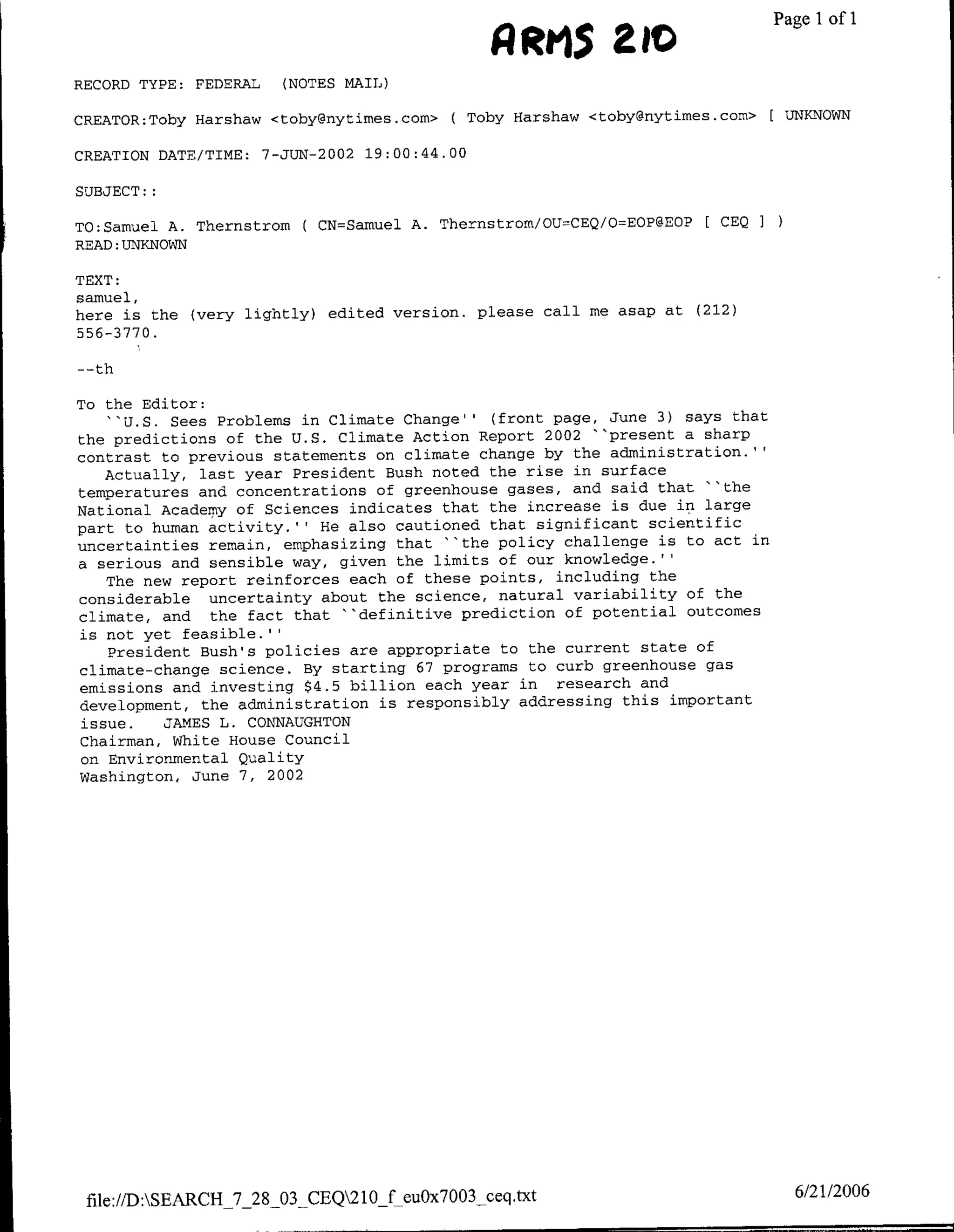
To the Editor:
    "'U.S. Sees Problems in Climate Change'' (front page, June 3) says that
the predictions of the U.S. Climate Action Report 2002 ''present a sharp
contrast to previous statements on climate change by the administration.''
   Actually, last year President Bush noted the rise in surface
temperatures and concentrations of greenhouse gases, and said that ''the
National Academy of Sciences indicates that the increase is due in large
part to human activity. '' He also cautioned that significant scientific
uncertainties remain, emphasizing that ''the policy challenge is to act in
a serious and sensible way, given the limits of our knowledge."
   The new report reinforces each of these points, including the
considerable uncertainty about the science, natural variability of the
climate, and the fact that ''definitive prediction of potential outcomes
is not yet feasible.,
    President Bush's policies are appropriate to the current state of
climate-change science. By starting 67 programs to curb greenhouse gas
emissions and investing $4.5 billion each year in research and
development, the administration is responsibly addressing this important
issue.    JAMES L. CONNAUGHTON
Chairman, White House Council
on Environmental Quality
Washington, June 7, 2002


  file:/D:SEARCH_7_28_03 CBQ210_f euOx7003 ceq.txt                               6/21/2006

CAR Email 6.7.02 (i)

  • 1.
    A ~ ~ t ePage 1of I RECORD TYPE: FEDERAL (NOTES MAIL) CREATOR:Toby Harshaw <toby(3nytimes.com> ( Toby Harshaw <toby~nytimes.com>[ UNKNOWN CREATION DATE/TIME: 7-JUN-2002 19:00:44.00 SUBJECT:: TO:Samuel A. Thernstrom C CN=Samuel A. Thernstroma/OUZCBQ/O=EOP@EOP [ CEQI READ :UNKNOWN TEXT: samuel, here is the (very lightly) edited version. please call me asap at (212) 556-3770. - -th To the Editor: "'U.S. Sees Problems in Climate Change'' (front page, June 3) says that the predictions of the U.S. Climate Action Report 2002 ''present a sharp contrast to previous statements on climate change by the administration.'' Actually, last year President Bush noted the rise in surface temperatures and concentrations of greenhouse gases, and said that ''the National Academy of Sciences indicates that the increase is due in large part to human activity. '' He also cautioned that significant scientific uncertainties remain, emphasizing that ''the policy challenge is to act in a serious and sensible way, given the limits of our knowledge." The new report reinforces each of these points, including the considerable uncertainty about the science, natural variability of the climate, and the fact that ''definitive prediction of potential outcomes is not yet feasible., President Bush's policies are appropriate to the current state of climate-change science. By starting 67 programs to curb greenhouse gas emissions and investing $4.5 billion each year in research and development, the administration is responsibly addressing this important issue. JAMES L. CONNAUGHTON Chairman, White House Council on Environmental Quality Washington, June 7, 2002 file:/D:SEARCH_7_28_03 CBQ210_f euOx7003 ceq.txt 6/21/2006