'4                                                            ~~~GP   59P.

 W"            Samuel A. Thernstrom
               0610102002 09:17:13 AM

Record Type:       Record


To:      See the distribution list at the bottom of this message
cc:
Subject: USCAR: NYT Saturday editorial & JLC letter to editor      M
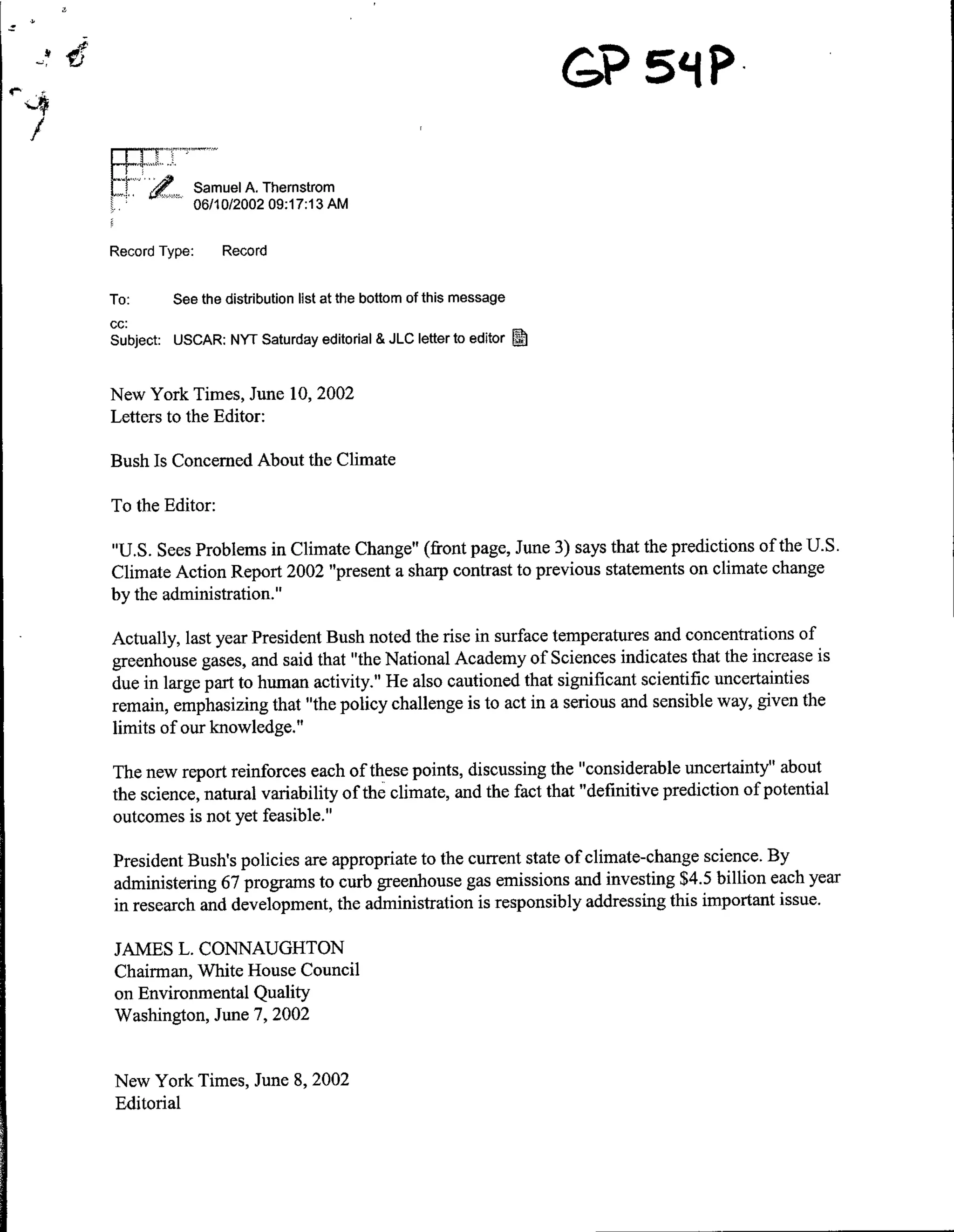
New York Times, June 10, 2002
Letters to the Editor:

Bush Is Concerned About the Climate

To the Editor:

'U.S. Sees Problems in Climate Change" (front page, June 3) says that the predictions of the U.S.
Climate Action Report 2002 "present a sharp contrast to previous statements on climate change
by the administration."

Actually, last year President Bush noted the rise in surface temperatures and concentrations of
greenhouse gases, and said that "the National Academy of Sciences indicates that the increase is
due in large part to human activity." He also cautioned that significant scientific uncertainties
remain, emphasizing that "the policy challenge is to act in a serious and sensible way, given the
limits of our knowledge."

The new report reinforces each of these points, discussing the "considerable uncertainty" about
the science, natural variability of the climate, and the fact that "definitive prediction of potential
outcomes is not yet feasible."

President Bush's policies are appropriate to the current state of climate-change science. By
administering 67 programs to curb greenhouse gas emissions and investing $4.5 billion each year
in research and development, the administration is responsibly addressing this important issue.

JAMES L. CONNAUGHTON
Chairman, White House Council
on Environmental Quality
Washington, June 7, 2002


New York Times, June 8, 2002
Editorial
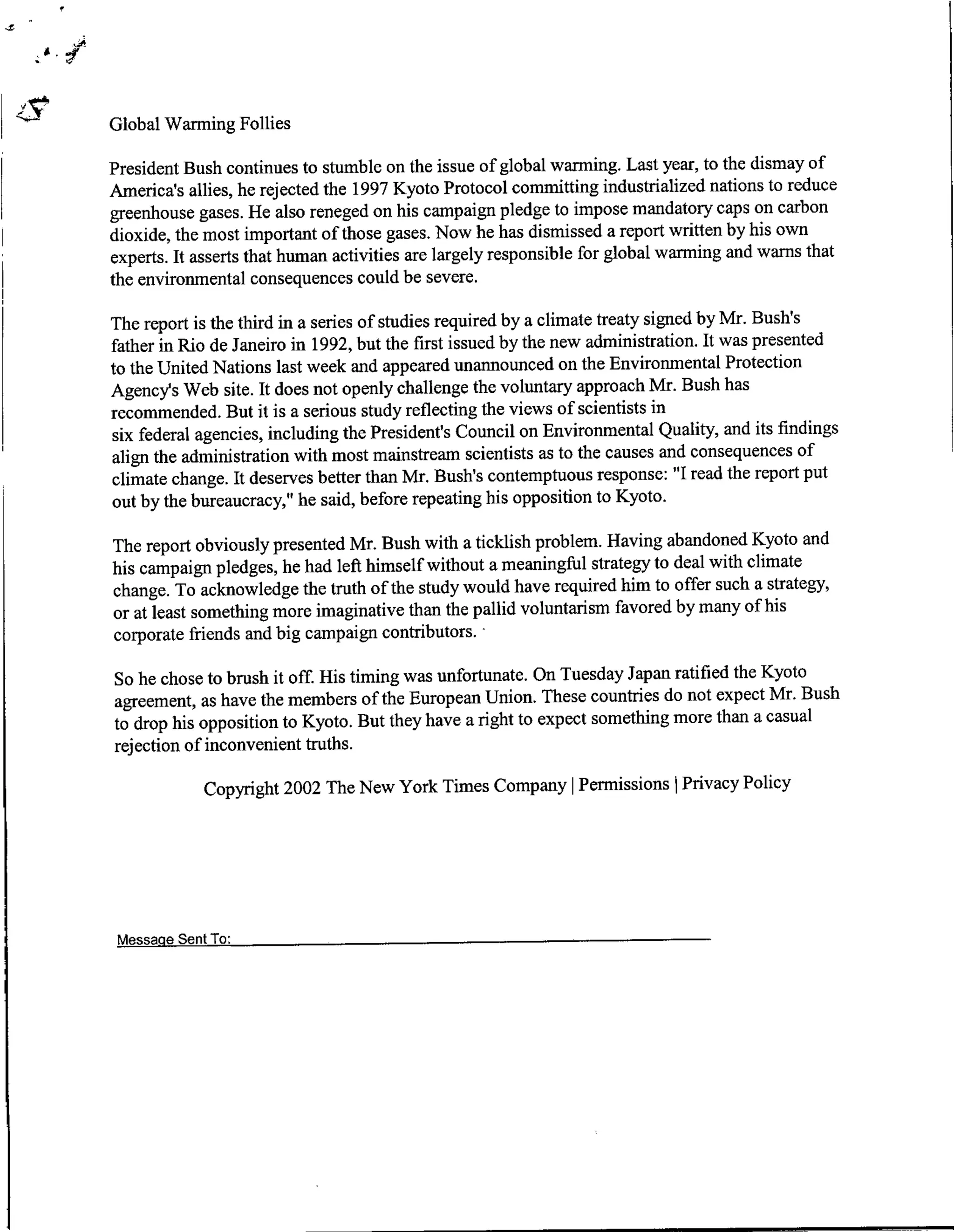
S   ~~Global Warming Follies

    President Bush continues to stumble on the issue of global warming. Last year, to the dismay of
    Americas allies, he rejected the 1997 Kyoto Protocol committing industrialized nations to reduce
    greenhouse gases. He also reneged on his campaign pledge to impose mandatory caps on carbon
    dioxide, the most important of those gases. Now he has dismissed a report written by his own
    experts. It asserts that human activities are largely responsible for global warming and warns that
    the environmental consequences could be severe.

     The report is the third in a series of studies required by a climate treaty signed by Mr. Bush's
     father in Rio de Janeiro in 1992, but the first issued by the new administration. It was presented
     to the United Nations last week and appeared unannounced on the Environmental Protection
     Agency's Web site. It does not openly challenge the voluntary approach Mr. Bush has
     recommended. But it is a serious study reflecting the views of scientists in
     six federal agencies, including the President's Council on Environmental Quality, and its findings
     align the administration with most mainstream scientists as to the causes and consequences of
     climate change. It deserves better than Mr. Bush's contemptuous response: "I read the report put
     out by the bureaucracy," he said, before repeating his opposition to Kyoto.

     The report obviously presented Mr. Bush with a ticklish problem. Having abandoned Kyoto and
     his campaign pledges, he had left himself without a meaningful strategy to deal with climate
     change. To acknowledge the truth of the study would have required him to offer such a strategy,
     or at least something more imaginative than the pallid voluntarism favored by many of his
     corporate friends and big campaign contributors.

     So he chose to brush it off. His timing was unfortunate. On Tuesday Japan ratified the Kyoto
     agreement, as have the members of the European Union. These countries do not expect Mr. Bush
     to drop his opposition to Kyoto. But they have a right to expect something more than a casual
     rejection of inconvenient truths.

                  Copyright 2002 The New York Times Company IPermissions IPrivacy Policy


      Message Sent To:
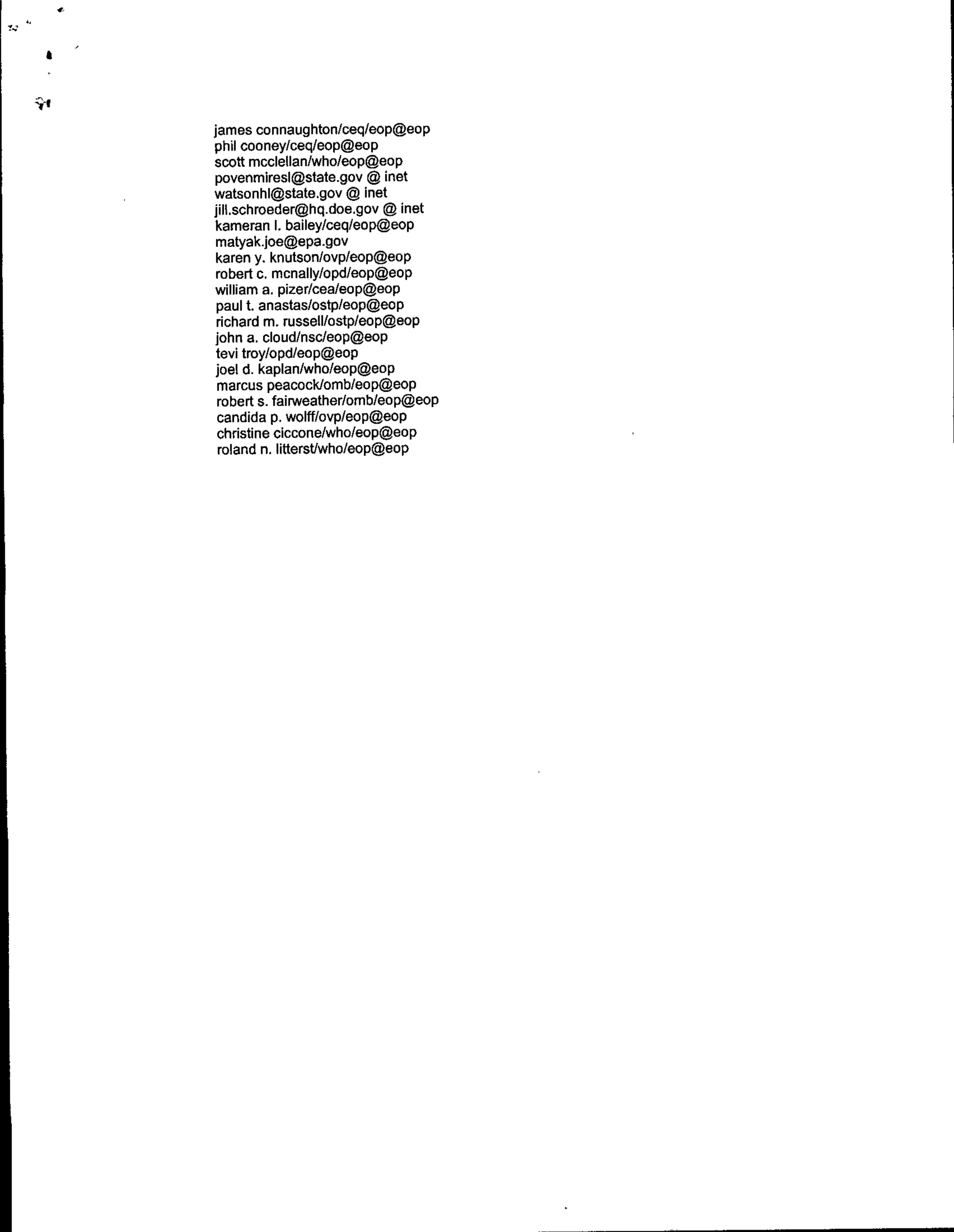
james connaughton/ceq/eop~eop
phil cooney/ceq/eop~eop
scott mcclellan/who/eop~eop
 povenmiresI~state.gov ~ inet
watsonhI~state.gov ~ net
jilltschroeder~hq.doe.gov ~ inet
 karneran I. bailey/ceq/eop~eop
 matyak.joe~epa.gov
 karen y. knutson/ovp/eop~eop
 robedt c. mcnally/opd/eop~eop
 williamn a. pizer/cea/eop@Aop
 paul t. anastas/ostp/eop@60p
 richard m. russell/ostp/eop~eop
 john a. cloud/nscleop~eop
 tevi troy/opd/eop~eop
 Joel di. kaplan/who/eop~eop
  marcUS peacocklomb/eop~eop
  robert s. fairweather/omb/eop~eop
  candida p. wolff/ovp/eop~eop
  christine ciccone/who/eop~eop
  roland n. litterstlwho/eop~eop

CAR Email 6.10.02 (a)

  • 1.
    '4 ~~~GP 59P. W" Samuel A. Thernstrom 0610102002 09:17:13 AM Record Type: Record To: See the distribution list at the bottom of this message cc: Subject: USCAR: NYT Saturday editorial & JLC letter to editor M New York Times, June 10, 2002 Letters to the Editor: Bush Is Concerned About the Climate To the Editor: 'U.S. Sees Problems in Climate Change" (front page, June 3) says that the predictions of the U.S. Climate Action Report 2002 "present a sharp contrast to previous statements on climate change by the administration." Actually, last year President Bush noted the rise in surface temperatures and concentrations of greenhouse gases, and said that "the National Academy of Sciences indicates that the increase is due in large part to human activity." He also cautioned that significant scientific uncertainties remain, emphasizing that "the policy challenge is to act in a serious and sensible way, given the limits of our knowledge." The new report reinforces each of these points, discussing the "considerable uncertainty" about the science, natural variability of the climate, and the fact that "definitive prediction of potential outcomes is not yet feasible." President Bush's policies are appropriate to the current state of climate-change science. By administering 67 programs to curb greenhouse gas emissions and investing $4.5 billion each year in research and development, the administration is responsibly addressing this important issue. JAMES L. CONNAUGHTON Chairman, White House Council on Environmental Quality Washington, June 7, 2002 New York Times, June 8, 2002 Editorial
  • 2.
    S ~~Global Warming Follies President Bush continues to stumble on the issue of global warming. Last year, to the dismay of Americas allies, he rejected the 1997 Kyoto Protocol committing industrialized nations to reduce greenhouse gases. He also reneged on his campaign pledge to impose mandatory caps on carbon dioxide, the most important of those gases. Now he has dismissed a report written by his own experts. It asserts that human activities are largely responsible for global warming and warns that the environmental consequences could be severe. The report is the third in a series of studies required by a climate treaty signed by Mr. Bush's father in Rio de Janeiro in 1992, but the first issued by the new administration. It was presented to the United Nations last week and appeared unannounced on the Environmental Protection Agency's Web site. It does not openly challenge the voluntary approach Mr. Bush has recommended. But it is a serious study reflecting the views of scientists in six federal agencies, including the President's Council on Environmental Quality, and its findings align the administration with most mainstream scientists as to the causes and consequences of climate change. It deserves better than Mr. Bush's contemptuous response: "I read the report put out by the bureaucracy," he said, before repeating his opposition to Kyoto. The report obviously presented Mr. Bush with a ticklish problem. Having abandoned Kyoto and his campaign pledges, he had left himself without a meaningful strategy to deal with climate change. To acknowledge the truth of the study would have required him to offer such a strategy, or at least something more imaginative than the pallid voluntarism favored by many of his corporate friends and big campaign contributors. So he chose to brush it off. His timing was unfortunate. On Tuesday Japan ratified the Kyoto agreement, as have the members of the European Union. These countries do not expect Mr. Bush to drop his opposition to Kyoto. But they have a right to expect something more than a casual rejection of inconvenient truths. Copyright 2002 The New York Times Company IPermissions IPrivacy Policy Message Sent To:
  • 3.
    james connaughton/ceq/eop~eop phil cooney/ceq/eop~eop scottmcclellan/who/eop~eop povenmiresI~state.gov ~ inet watsonhI~state.gov ~ net jilltschroeder~hq.doe.gov ~ inet karneran I. bailey/ceq/eop~eop matyak.joe~epa.gov karen y. knutson/ovp/eop~eop robedt c. mcnally/opd/eop~eop williamn a. pizer/cea/eop@Aop paul t. anastas/ostp/eop@60p richard m. russell/ostp/eop~eop john a. cloud/nscleop~eop tevi troy/opd/eop~eop Joel di. kaplan/who/eop~eop marcUS peacocklomb/eop~eop robert s. fairweather/omb/eop~eop candida p. wolff/ovp/eop~eop christine ciccone/who/eop~eop roland n. litterstlwho/eop~eop