A0 297
                                                           ~~~rIS           ~~~Page 1 4
                                                                                     of
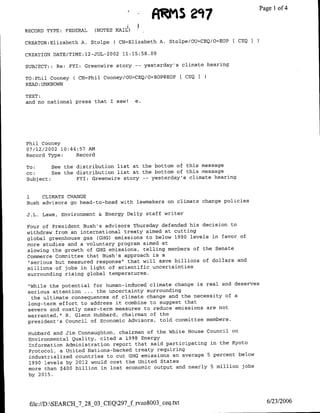
RECORD TYPE: FEDERAL     (NOTES MAIL!)

CREATOR:Elizabeth A. Stolpe C CN=Elizabeth A. Stolpe/OU=CEQ/O=EOP[ CEO I

CREATION DATE/TIME:12-JUL-2002 11:15:58.00

SUBJECT:: Re: FYI: Creenwire story       --   yesterday's climate hearing

TO:Phil Cooney C CN=Phil Cooney/OU=CEQ/O=EOP@EOP         [ CEQ I
READ :UNKNOW~N
TEXT:
and no national press that I saw!        e.


Phil Cooney
07/12/2002 10:44:57 AN
Record Type:    Record

To:      See the distribution list at the bottom of this message
CC:      See the distribution list at the bottom of this message
Subject:         FYI: Greenwire story -- yesterday's climate hearing

1       CLIMATE CHANGE
Bush advisors go head-to-head with lawmakers on climate change policies

J.L. Laws, Environment & Energy Daily staff writer

Four of President Bush's advisors Thursday defended his decision to
withdraw from an international treaty aimed at cutting
global greenhouse gas CGHG) emissions to below 1990 levels in favor of
more studies and a voluntary program aimed at
slowing the growth of GHG emissions, telling members of the Senate
Commerce Committee that Bush's approach is a
"serious but measured response' that will save billions of dollars and
millions of jobs in light of scientific uncertainties
surrounding rising global temperatures.

 "While the potential for human-induced climate change is real and deserves
 serious attention ... the uncertainty surrounding
  the ultimate consequences of climate change and the necessity of a
 long-term effort to address it combine to suggest that
 severe and costly near-term measures to reduce emissions are not
 warranted," R. Glenn Hubbard, chairman of the
 president's Council of Economic Advisors, told committee members.

 Hubbard and Jim Connaughton, chairman of the White House Council on
 Environmental Quality, cited a 1998 Energy
 information Administration report that said participating in the Kyoto
 Protocol, a United Nations-backed treaty requiring
 industrialized countries to cut GHGI emissions an average 5 percent below
 1990 levels by 2012 would cost the United States
 more than $400 billion in lost economic output and nearly 5 million jobs
 by 2015.


    file:/D:SEARCH_7_28_03 CEQ297_f_rvzo8003 ceq.txt                            6/23/2006
Page 2 of 4


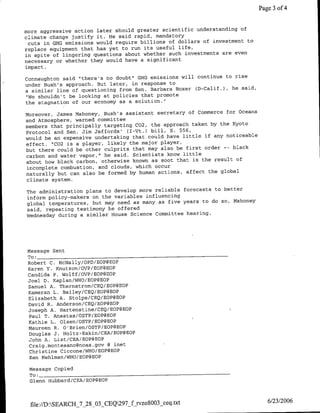
A short time after ETA issued that report, the Senate- unanimously approved
a resolution indicating it would not support the
Kyoto treaty in any form that could hurt the U.S. economy or failed to
require developing countries to share the burden. The
Clinton administration continued to try to negotiate a treaty more
favorable to the United States, but in spite of any strides it
made it seemed clear the Senate wouldn't ratify the agreement. Even so,
congressional Democrats continued trying to
 build support for measures capping GHG emissions from power plants and
passenger vehicles, but the efforts gained
little traction.

Everything changed in March 2001, however, when, shortly after taking
office, Bush turned his back on a campaign
promise to regulate carbon dioxide (C02) emissions from power plants. That
same month, he sparked a global outcry
by announcing he would not seek Senate ratification of the Kyoto
agreement, but didn't propose an alternative.

When Bush did publicize his proposals -- two new $40 million science and
technology initiatives announced in June 2001,
 followed in February by two major atmospheric initiatives, one a
voluntary program aimed at cutting CEG emissions 4.5
 percent by 2012, as well as a separate mandate requiring power plants to
cut emissions of mercury, nitrogen oxides (NOx)
 and sulfur dioxide (S02) by about 70 percent by 2018 -- critics
immediately assailed them, arguing the climate change
initiative was nothing more than a "business-as-usual", approach and that
his proposal would allow more power plant
 pollution than a competing Senate measure.

The Sept. 11 terrorist attacks on New York and Washington served to draw
attention away from Bush's controversial
climate change policies, but the White House reignited the controversy in
late May with its Climate Action 2002 Report
to the United Nations. The report, drafted by the Environmental Protection
Agency and other agencies and approved
 by Connaughton's office before the State Department submitted it, said
human actions, namely burning fossil fuels,
are largely to blame for rising global temperatures. Tt acknowledged
increasing temperatures would significantly alter
daily life and ecosystems in the United States over the next few decades.
But instead of offering new policies to
reverse the trend, the report suggested the United States would have to
adapt to the changes, and promoted Bush's plans
 to continue studying the issue and encourage voluntary CEO actions by
U.S. industries.

 Sen. John Kerry (0-Mass.), who presided over the hearing, argued the    'dire
 warnings" in the Climate Action Report justify
 more than voluntary programs to curb rising global temperatures.

 "The president says he recognizes the need to decrease emissions, but    [his
 policies] don't set a cap, there's no
 requirements, no market force," Merry said. "Why should Americans be
 satisfied that this is a reasonable response
  to this crisis -- this problem -- we face?"

 Hubbard argued the administration is proposing slowing the growth of CEO
 emissions in the short term, but hasn't ruled out


 file://D:SEARCH_'7_28_03_CEQ297_f rvzo8003 ceq.txt                            6/23/2006
Page 3 of 4


                                                                      of
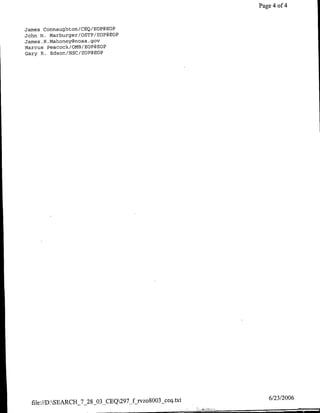
more aggressive action later Should greater scientific understanding
climate change justify it. He said rapid, mandatory
                                                                         to
 cuts in GH-G emissions would require billions of dollars of investment
replace equipment that has yet to run  its useful life,
                                                                    even
in spite of lingering questions about whether such investments are
necessary or whether  they would have a significant
impact.
                                                                    rise
Connaughton said "there's no doubt" GHG emissions will continue to
under Bush's approach. But later, in  response to
                                                                   he said,
a similar line of questioning from Sen. Barbara Boxer (D-Calif.),
 "We shouldn't be looking at policies that promote
the stagnation of our economy as a solution."~
                                                                     Oceans
Moreover, James Mahoney, Bush's assistant secretary of Commerce for
and Atmosphere, warned committee
members that principally targeting C02, the approach taken by the Kyoto
Protocol and Sen. Jim Jeffords' (I-Vt.) bill, S. 556,
would be an expensive undertaking that could have little if any noticeable
effect. "1C02 is a player, likely the major player,
but there could be other culprits that may also be first order -- black
carbon and water vapor,"' he said. Scientists know little
                                                                    of
about how black carbon, otherwise known as soot that is the result
 incomplete combustion, and clouds, which occur
naturally but can also be formed by human actions, affect the global
 climate system.

The administration plans to develop more reliable forecasts to better
inform policy-makers on the variables influencing
global temperatures, but may need as many as five years to do so, Mahoney
said, repeating testimony he offered
Wednesday during a similar House Science Committee hearing.


 Message Sent
 To: ________________________________
 Robert C. McNally/OPD/EOP@EOP
 Karen Y. Knutson/OVP/EOP@EOP
 Candida P. Wolf f/OVP/EOP@EOP
 Joel ID.Kaplan/WHO/EOP@EOP
 Samuel A. Thernstrom/CEQ/EOP@EOP
 1{ameran L. Bailey/CEQ/EOP@EOP
 Elizabeth A. Stolpe/CEQ/EOP@BOP
 David R. Anderson/CEQ/EOP@EOP
 Joseph A. Hartenstine/CEQ/EOPgEOP
  Paul T. Anastas/OSTP/EOP@EOP
  Kathie L. Olsen/CSTP/EOP@EOP
 Maureen R. O'Brien/OSTP/EOP@EOP
  Douglas J. Holtz-Eakin/CEA/EOP@EOP
  John A. List/CEA/EOP@EOP
  Craig.montesano~noaa.gov @ mnet
  Christine Ciccone/WHO/EOP@BOP
  Ken Mehlman/WHO/EOP@EOP

 Message Copied
 To: ________________________________
 Glenn Hubbard/CEA/EOP@EOP


  file://D:SEARCH_7_28_03_CEQ297_f rvzo8003_ceq~txt                            6/23/2006
Page 4 of 4


James Connaughton/CEQ/EOP@EOP
John H. Marburger/OSTP/EOP@EOP
JamesH.R.Mahoney~floaa .gay
Marcus PeacockiOMB/EOP@ECP
Gary R. Edson/NSC/EOP@EOP


                                                             6/23/2006
  file://D:SEARCH_'7_28 03-CEQ297-f rvzo8003_ceq.txt

CAR Email 7.12.02 (c)

  • 1.
    A0 297 ~~~rIS ~~~Page 1 4 of RECORD TYPE: FEDERAL (NOTES MAIL!) CREATOR:Elizabeth A. Stolpe C CN=Elizabeth A. Stolpe/OU=CEQ/O=EOP[ CEO I CREATION DATE/TIME:12-JUL-2002 11:15:58.00 SUBJECT:: Re: FYI: Creenwire story -- yesterday's climate hearing TO:Phil Cooney C CN=Phil Cooney/OU=CEQ/O=EOP@EOP [ CEQ I READ :UNKNOW~N TEXT: and no national press that I saw! e. Phil Cooney 07/12/2002 10:44:57 AN Record Type: Record To: See the distribution list at the bottom of this message CC: See the distribution list at the bottom of this message Subject: FYI: Greenwire story -- yesterday's climate hearing 1 CLIMATE CHANGE Bush advisors go head-to-head with lawmakers on climate change policies J.L. Laws, Environment & Energy Daily staff writer Four of President Bush's advisors Thursday defended his decision to withdraw from an international treaty aimed at cutting global greenhouse gas CGHG) emissions to below 1990 levels in favor of more studies and a voluntary program aimed at slowing the growth of GHG emissions, telling members of the Senate Commerce Committee that Bush's approach is a "serious but measured response' that will save billions of dollars and millions of jobs in light of scientific uncertainties surrounding rising global temperatures. "While the potential for human-induced climate change is real and deserves serious attention ... the uncertainty surrounding the ultimate consequences of climate change and the necessity of a long-term effort to address it combine to suggest that severe and costly near-term measures to reduce emissions are not warranted," R. Glenn Hubbard, chairman of the president's Council of Economic Advisors, told committee members. Hubbard and Jim Connaughton, chairman of the White House Council on Environmental Quality, cited a 1998 Energy information Administration report that said participating in the Kyoto Protocol, a United Nations-backed treaty requiring industrialized countries to cut GHGI emissions an average 5 percent below 1990 levels by 2012 would cost the United States more than $400 billion in lost economic output and nearly 5 million jobs by 2015. file:/D:SEARCH_7_28_03 CEQ297_f_rvzo8003 ceq.txt 6/23/2006
  • 2.
    Page 2 of4 A short time after ETA issued that report, the Senate- unanimously approved a resolution indicating it would not support the Kyoto treaty in any form that could hurt the U.S. economy or failed to require developing countries to share the burden. The Clinton administration continued to try to negotiate a treaty more favorable to the United States, but in spite of any strides it made it seemed clear the Senate wouldn't ratify the agreement. Even so, congressional Democrats continued trying to build support for measures capping GHG emissions from power plants and passenger vehicles, but the efforts gained little traction. Everything changed in March 2001, however, when, shortly after taking office, Bush turned his back on a campaign promise to regulate carbon dioxide (C02) emissions from power plants. That same month, he sparked a global outcry by announcing he would not seek Senate ratification of the Kyoto agreement, but didn't propose an alternative. When Bush did publicize his proposals -- two new $40 million science and technology initiatives announced in June 2001, followed in February by two major atmospheric initiatives, one a voluntary program aimed at cutting CEG emissions 4.5 percent by 2012, as well as a separate mandate requiring power plants to cut emissions of mercury, nitrogen oxides (NOx) and sulfur dioxide (S02) by about 70 percent by 2018 -- critics immediately assailed them, arguing the climate change initiative was nothing more than a "business-as-usual", approach and that his proposal would allow more power plant pollution than a competing Senate measure. The Sept. 11 terrorist attacks on New York and Washington served to draw attention away from Bush's controversial climate change policies, but the White House reignited the controversy in late May with its Climate Action 2002 Report to the United Nations. The report, drafted by the Environmental Protection Agency and other agencies and approved by Connaughton's office before the State Department submitted it, said human actions, namely burning fossil fuels, are largely to blame for rising global temperatures. Tt acknowledged increasing temperatures would significantly alter daily life and ecosystems in the United States over the next few decades. But instead of offering new policies to reverse the trend, the report suggested the United States would have to adapt to the changes, and promoted Bush's plans to continue studying the issue and encourage voluntary CEO actions by U.S. industries. Sen. John Kerry (0-Mass.), who presided over the hearing, argued the 'dire warnings" in the Climate Action Report justify more than voluntary programs to curb rising global temperatures. "The president says he recognizes the need to decrease emissions, but [his policies] don't set a cap, there's no requirements, no market force," Merry said. "Why should Americans be satisfied that this is a reasonable response to this crisis -- this problem -- we face?" Hubbard argued the administration is proposing slowing the growth of CEO emissions in the short term, but hasn't ruled out file://D:SEARCH_'7_28_03_CEQ297_f rvzo8003 ceq.txt 6/23/2006
  • 3.
    Page 3 of4 of more aggressive action later Should greater scientific understanding climate change justify it. He said rapid, mandatory to cuts in GH-G emissions would require billions of dollars of investment replace equipment that has yet to run its useful life, even in spite of lingering questions about whether such investments are necessary or whether they would have a significant impact. rise Connaughton said "there's no doubt" GHG emissions will continue to under Bush's approach. But later, in response to he said, a similar line of questioning from Sen. Barbara Boxer (D-Calif.), "We shouldn't be looking at policies that promote the stagnation of our economy as a solution."~ Oceans Moreover, James Mahoney, Bush's assistant secretary of Commerce for and Atmosphere, warned committee members that principally targeting C02, the approach taken by the Kyoto Protocol and Sen. Jim Jeffords' (I-Vt.) bill, S. 556, would be an expensive undertaking that could have little if any noticeable effect. "1C02 is a player, likely the major player, but there could be other culprits that may also be first order -- black carbon and water vapor,"' he said. Scientists know little of about how black carbon, otherwise known as soot that is the result incomplete combustion, and clouds, which occur naturally but can also be formed by human actions, affect the global climate system. The administration plans to develop more reliable forecasts to better inform policy-makers on the variables influencing global temperatures, but may need as many as five years to do so, Mahoney said, repeating testimony he offered Wednesday during a similar House Science Committee hearing. Message Sent To: ________________________________ Robert C. McNally/OPD/EOP@EOP Karen Y. Knutson/OVP/EOP@EOP Candida P. Wolf f/OVP/EOP@EOP Joel ID.Kaplan/WHO/EOP@EOP Samuel A. Thernstrom/CEQ/EOP@EOP 1{ameran L. Bailey/CEQ/EOP@EOP Elizabeth A. Stolpe/CEQ/EOP@BOP David R. Anderson/CEQ/EOP@EOP Joseph A. Hartenstine/CEQ/EOPgEOP Paul T. Anastas/OSTP/EOP@EOP Kathie L. Olsen/CSTP/EOP@EOP Maureen R. O'Brien/OSTP/EOP@EOP Douglas J. Holtz-Eakin/CEA/EOP@EOP John A. List/CEA/EOP@EOP Craig.montesano~noaa.gov @ mnet Christine Ciccone/WHO/EOP@BOP Ken Mehlman/WHO/EOP@EOP Message Copied To: ________________________________ Glenn Hubbard/CEA/EOP@EOP file://D:SEARCH_7_28_03_CEQ297_f rvzo8003_ceq~txt 6/23/2006
  • 4.
    Page 4 of4 James Connaughton/CEQ/EOP@EOP John H. Marburger/OSTP/EOP@EOP JamesH.R.Mahoney~floaa .gay Marcus PeacockiOMB/EOP@ECP Gary R. Edson/NSC/EOP@EOP 6/23/2006 file://D:SEARCH_'7_28 03-CEQ297-f rvzo8003_ceq.txt