8/26/2015 The Official CAPTCHA Site
http://www.captcha.net/ 1/4
 
CAPTCHA: Telling Humans and Computers Apart Automatically
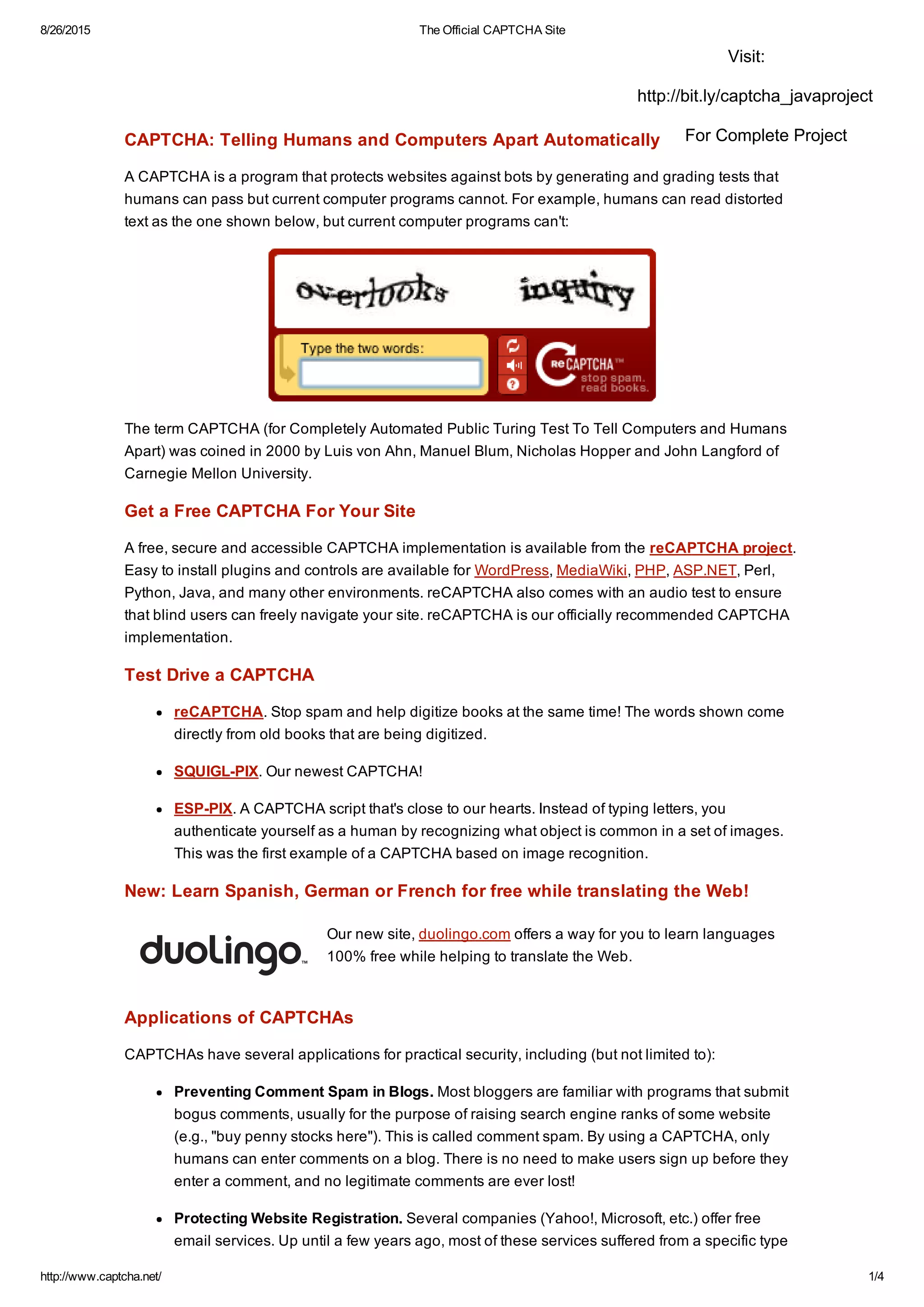
A CAPTCHA is a program that protects websites against bots by generating and grading tests that
humans can pass but current computer programs cannot. For example, humans can read distorted
text as the one shown below, but current computer programs can't:
The term CAPTCHA (for Completely Automated Public Turing Test To Tell Computers and Humans
Apart) was coined in 2000 by Luis von Ahn, Manuel Blum, Nicholas Hopper and John Langford of
Carnegie Mellon University.
Get a Free CAPTCHA For Your Site
A free, secure and accessible CAPTCHA implementation is available from the reCAPTCHA project.
Easy to install plugins and controls are available for WordPress, MediaWiki, PHP, ASP.NET, Perl,
Python, Java, and many other environments. reCAPTCHA also comes with an audio test to ensure
that blind users can freely navigate your site. reCAPTCHA is our officially recommended CAPTCHA
implementation.
Test Drive a CAPTCHA
reCAPTCHA. Stop spam and help digitize books at the same time! The words shown come
directly from old books that are being digitized.
SQUIGL­PIX. Our newest CAPTCHA!
ESP­PIX. A CAPTCHA script that's close to our hearts. Instead of typing letters, you
authenticate yourself as a human by recognizing what object is common in a set of images.
This was the first example of a CAPTCHA based on image recognition.
New: Learn Spanish, German or French for free while translating the Web!
Our new site, duolingo.com offers a way for you to learn languages
100% free while helping to translate the Web.
Applications of CAPTCHAs
CAPTCHAs have several applications for practical security, including (but not limited to):
Preventing Comment Spam in Blogs. Most bloggers are familiar with programs that submit
bogus comments, usually for the purpose of raising search engine ranks of some website
(e.g., "buy penny stocks here"). This is called comment spam. By using a CAPTCHA, only
humans can enter comments on a blog. There is no need to make users sign up before they
enter a comment, and no legitimate comments are ever lost!
Protecting Website Registration. Several companies (Yahoo!, Microsoft, etc.) offer free
email services. Up until a few years ago, most of these services suffered from a specific type
Visit:
http://bit.ly/captcha_javaproject
For Complete Project
8/26/2015 The Official CAPTCHA Site
http://www.captcha.net/ 2/4
 
of attack: "bots" that would sign up for thousands of email accounts every minute. The
solution to this problem was to use CAPTCHAs to ensure that only humans obtain free
accounts. In general, free services should be protected with a CAPTCHA in order to prevent
abuse by automated scripts.
Protecting Email Addresses From Scrapers. Spammers crawl the Web in search of email
addresses posted in clear text. CAPTCHAs provide an effective mechanism to hide your
email address from Web scrapers. The idea is to require users to solve a CAPTCHA before
showing your email address. A free and secure implementation that uses CAPTCHAs to
obfuscate an email address can be found at reCAPTCHA MailHide.
Online Polls. In November 1999, http://www.slashdot.org released an online poll asking
which was the best graduate school in computer science (a dangerous question to ask over
the web!). As is the case with most online polls, IP addresses of voters were recorded in order
to prevent single users from voting more than once. However, students at Carnegie Mellon
found a way to stuff the ballots using programs that voted for CMU thousands of times. CMU's
score started growing rapidly. The next day, students at MIT wrote their own program and the
poll became a contest between voting "bots." MIT finished with 21,156 votes, Carnegie
Mellon with 21,032 and every other school with less than 1,000. Can the result of any online
poll be trusted? Not unless the poll ensures that only humans can vote.
Preventing Dictionary Attacks. CAPTCHAs can also be used to prevent dictionary attacks
in password systems. The idea is simple: prevent a computer from being able to iterate
through the entire space of passwords by requiring it to solve a CAPTCHA after a certain
number of unsuccessful logins. This is better than the classic approach of locking an account
after a sequence of unsuccessful logins, since doing so allows an attacker to lock accounts at
will.
Search Engine Bots. It is sometimes desirable to keep webpages unindexed to prevent
others from finding them easily. There is an html tag to prevent search engine bots from
reading web pages. The tag, however, doesn't guarantee that bots won't read a web page; it
only serves to say "no bots, please." Search engine bots, since they usually belong to large
companies, respect web pages that don't want to allow them in. However, in order to truly
guarantee that bots won't enter a web site, CAPTCHAs are needed.
Worms and Spam. CAPTCHAs also offer a plausible solution against email worms and
spam: "I will only accept an email if I know there is a human behind the other computer." A
few companies are already marketing this idea.
Guidelines
If your website needs protection from abuse, it is recommended that you use a CAPTCHA. There are
many CAPTCHA implementations, some better than others. The following guidelines are strongly
recommended for any CAPTCHA code:
Accessibility. CAPTCHAs must be accessible. CAPTCHAs based solely on reading text —
or other visual­perception tasks — prevent visually impaired users from accessing the
protected resource. Such CAPTCHAs may make a site incompatible with Section 508 in the
United States. Any implementation of a CAPTCHA should allow blind users to get around the
barrier, for example, by permitting users to opt for an audio or sound CAPTCHA.
Image Security. CAPTCHA images of text should be distorted randomly before being
presented to the user. Many implementations of CAPTCHAs use undistorted text, or text with
only minor distortions. These implementations are vulnerable to simple automated attacks.
Script Security. Building a secure CAPTCHA code is not easy. In addition to making the
images unreadable by computers, the system should ensure that there are no easy ways
 
8/26/2015 The Official CAPTCHA Site
http://www.captcha.net/ 3/4
around it at the script level. Common examples of insecurities in this respect include: (1)
Systems that pass the answer to the CAPTCHA in plain text as part of the web form. (2)
Systems where a solution to the same CAPTCHA can be used multiple times (this makes the
CAPTCHA vulnerable to so­called "replay attacks"). Most CAPTCHA scripts found freely on
the Web are vulnerable to these types of attacks.
Security Even After Wide­Spread Adoption. There are various "CAPTCHAs" that would be
insecure if a significant number of sites started using them. An example of such a puzzle is
asking text­based questions, such as a mathematical question ("what is 1+1"). Since a parser
could easily be written that would allow bots to bypass this test, such "CAPTCHAs" rely on the
fact that few sites use them, and thus that a bot author has no incentive to program their bot to
solve that challenge. True CAPTCHAs should be secure even after a significant number of
websites adopt them.
Should I Make My Own CAPTCHA? In general, making your own CAPTCHA script (e.g.,
using PHP, Perl or .Net) is a bad idea, as there are many failure modes. We recommend that
you use a well­tested implementation such as reCAPTCHA.
The "Pornography Attack" is Not a Concern
It is sometimes rumored that spammers are using pornographic sites to solve CAPTCHAs: the
CAPTCHA images are sent to a porn site, and the porn site users are asked to solve the CAPTCHA
before being able to see a pornographic image. This is not a security concern for CAPTCHAs.
While it might be the case that some spammers use porn sites to attack CAPTCHAs, the amount of
damage this can inflict is tiny (so tiny that we haven't even noticed a dent!). Whereas it is trivial to
write a bot that abuses an unprotected site millions of times a day, redirecting CAPTCHAs to be
solved by humans viewing pornography would only allow spammers to abuse systems a few
thousand times per day. The economics of this attack just don't add up: every time a porn site shows
a CAPTCHA before a porn image, they risk losing a customer to another site that doesn't do this.
Advancing Artificial Intelligence
CAPTCHA tests are based on open problems in artificial intelligence (AI): decoding images of
distorted text, for instance, is well beyond the capabilities of modern computers. Therefore,
CAPTCHAs also offer well­defined challenges for the AI community, and induce security
researchers, as well as otherwise malicious programmers, to work on advancing the field of AI.
CAPTCHAs are thus a win­win situation: either a CAPTCHA is not broken and there is a way to
differentiate humans from computers, or the CAPTCHA is broken and an AI problem is solved.
Academic Publications and Presentations
Luis von Ahn, Ben Maurer, Colin McMillen, David Abraham and Manuel Blum. reCAPTCHA:
Human­Based Character Recognition via Web Security Measures. In Science.
Jennifer Tam, Jiri Simsa, Sean Hyde, and Luis von Ahn. Breaking Audio CAPTCHAs. In
Advances in Neural Information Processing Systems (NIPS).
Luis von Ahn, Manuel Blum and John Langford. Telling Humans and Computers Apart
Automatically. In Communications of the ACM.
Luis von Ahn, Manuel Blum, Nicholas Hopper, and John Langford. CAPTCHA: Using Hard AI
Problems for Security. In Eurocrypt.
Kumar Chellapilla and Patrice Y. Simard. Using Machine Learning to Break Human
Interaction Proofs (HIPs). In NIPS. (Explains how to break the simple CAPTCHAs for which
character segmentation is easy.)
Greg Mori and Jitendra Malik. Recognizing Objects in Adversarial Clutter: Breaking a Visual
8/26/2015 The Official CAPTCHA Site
http://www.captcha.net/ 4/4
CAPTCHA. In CVPR. (Explains how to break a simple CAPTCHA.)
Google Tech Talk about CAPTCHAs and Human Computation.
Selected Popular Press Pieces
Human or Computer? Take This Test, The New York Times.
reCAPTCHA ­ Stop Spam, Read Books, O'Reilly Radar.
For Certain Tasks, the Cortex Still Beats the CPU, Wired Magazine.
© 2000­2010 Carnegie Mellon University, all rights reserved.

Captcha making and solving java project