RUNNING HEAD: Leadershipin the Public Sector v. Competing Organizations
The Dynamics of Leadership in Public Administration v. Competing Organizations
Capstone: Applied Project
Kevin F. Skope
January 12, 2015
Leadership in the Public Sector v. Competing Organizations
2
Abstract
Leadership is as much an art as human government. In fact, in many ways it is a form of
government on a smaller scale. An untold number of books, periodicals, manuals, doctrines, and
canons have been written about it and no wonder. The subject is exceptionally complicated as
with any subject dealing with human beings.
This research explored the predominant leadership styles, their advantages and
disadvantages. In order to have given a broad panorama of the subject as it related to the field of
Public Administration it compared the research to that of private and nonprofit organizations to
determine any relative similarities or differences and what they may have been.
It examined literature on the subject and focused on the qualitative benefits with a
concentration on the coaching style. A quantitative analysis was not presented because it was
reviewed as more of an art than a science or a statistical approach. The vast majority of the
information was gleaned from the texts used in the course of the master’s degree program and
supplemented by literary review of scholarly articles, interviews with local leaders, conclusions
and recommendations of the researcher.
It was reported that there were perceptions of public and private employees and the data
was examined to determine if any of these were, indeed, true. Interviews were conducted with
three manage/leaders who all had long histories in the public sector, both as military and civil
service employees.
The research determined that there were various factors that determined the environment
in which people chose to work for both labor and management. People gravitated to
employment they believe they were most suited for so the motivations were virtually built in.
Leadership in the Public Sector v. Competing Organizations
3
That did not preclude or hold harmless the leaders that those people worked for. Humans need
proper motivation, care, concern, and structure and it was the leader’s responsibility to achieve
that while simultaneously achieving the goal of the organization.
No matter which work center people chose, the styles and tenets of leadership had to be
of great variety for the leader and properly wielded to give the work force the greatest efficiency
and success to excel.
Leadership in the Public Sector v. Competing Organizations
4
Table of Contents
Title page ……………………………………………………………………………….…. 1
Abstract ……………………………………………………………………………………. 2
Table of Contents ………………………………………………………………………….. 4
Introduction ………………………………………………………………………………... 5
Review of Literature ……………………………………………………...……………….. 7
Research Methodology ……………………………………………………………………16
Findings …………………………………………………………………………………...17
Conclusions ………………………………………………………………………………..27
Recommendations …………………………………………………………………………30
References ………………………………………………………..………………………..31
Leadership in the Public Sector v. Competing Organizations
5
Introduction
In the public sector, as in the private and nonprofit sectors, many ways to conduct
business have always been understood by all who entered these realms and the vastness of
opportunity was only ever matched, even outweighed, by how those opportunities and goals
were achieved. That is to say that the measure of achievement was always the leadership,
management, and vision of those who endeavored to make a concept a reality.
If a public entity needed to be successful, it had to operate with efficiency since it
operated with other people’s money. By the same measure, a business also required efficiency
but with an eye to the profitable result, arguably, also efficiency, but far more unfettered by
budgetary constraints. Was it feasible, based on the literature that was presented, to believe what
the researcher concluded or did the reader arrive at a different conclusion based on the same
information? Scholars have always disagreed on the likenesses and disparities amongst the
different administrations but in truth the similarities and differences were always rather obvious.
Organizations of all persuasions have needed managers who possessed organizational
skills, interpersonal skills, and the vision to see the broad panorama of minutest details within an
operation. They always had to have multiple skills and debate has always raged as to what
defined the best corporate or government heads. The questions have historically been should a
good manager be a leader as well? Should a leader be a good manager? Are leaders born or made
or both? Has there ever been a perfect formula for leadership in the public sector and has that
leadership ever extended to the private and nonprofit sectors or have they always been mutually
exclusive as completely different philosophies?
Leadership in the Public Sector v. Competing Organizations
6
This research was dedicated to the idea that there have always existed as many forms of
leadership styles as there were leaders. Leadership styles had to be eclectic and cross-over. A
leader could not be one way at all times because times and situations have been historical
evolutions. A general on the battlefield needed to be alert to the ever changing face of the
combat scenario with the ability to adjust at a moment’s notice.
Having said that, the researcher was primarily concerned with the six leadership styles
included in the text. The lion’s share of this work was devoted to a more detailed analysis of the
coaching style of leadership, its attributes and inefficiencies. It also included the opinions of
three present day leaders and their experiences with the real world use of this style. The purpose
of this writing was to inform rather than persuade the reader of the strengths of coaching and the
appropriateness of its usage in the world of leadership. It went on to compare and contrast the
leadership and management styles and, based on literary data, and concluded whether or not
there was any correlation between them or was there no apparent relationship as evidenced by
scholarly writings. The last remaining question was “Did it matter if the objective of the
organization was fulfilled regardless of public, private, or nonprofit in persuasion?”
This research was a presentation of facts, philosophies, and styles with an eye to the
literary and qualitative perspective in an effort to inform the reader. What it was not was an
attempt to persuade the reader to agree or believe that one idea was better than another. It has
been historically better to present facts and theories and allow a scholarly analysis of one’s work
than to attempt to steer an academic probe to an avenue that may have not been agreed with by
the reader.
Leadership in the Public Sector v. Competing Organizations
7
Review of Literature
The public sector
To present a proper preference for a particular style it would only be right to deliver a
landscape of all styles. First there is the Visionary Leader. This is the one who can influence
and motivate people to sign on to the mission at hand. Generally more gregarious and
charismatic, they have the ability to inspire people to achieve with an eye to the mission of the
organization (Goleman et al, 2002, pp. 54-59).
Next is the Coaching Leader. Possessing high energy and charisma the coach is more
forceful in their style but have the ability to make people want to achieve (Perkins, Holtman,
Kessler, & McCarthy, 2000). Coaching is obviously ideal in organized sports, hence the name,
but is also a style that is at home in sales, marketing, military operations, and organizations that
do charity or community work like Habitat for Humanity’s (Goleman, et al, 2002, pp. 59-.63).
The Affiliative style of leadership is slightly different due to its collaborative efforts
(Perkins, et al, 2000). Like in the coaching method, affilliative leaders spend a great deal of time
pursuing harmony and friendly interaction with employees to achieve great production
(Goleman, et al, 2002, pp 63-66).
Democratic Leaders do well with highly skilled work forces capable of possessing vision
beyond their scope of responsibility. Democratic sharing is virtually an across the board
decision making body that arrives at conclusions together where all who have a stake in the game
have an input to the process (Goleman, et al, pp. 66-69).
Leadership in the Public Sector v. Competing Organizations
8
Pacesetting Leadership is more directive and is appropriate with organizations in need of
repair. In this fashion, leaders set deadlines, policies and procedures, and spend less time
collaborating with subordinates generally due to the need to fix things expeditiously (Goleman,
et al, pp. 72-75).
Commanding Leadership is a top down “my way or the highway” style often considered
synonymous with micromanaging. It is precisely as it seems – I will make the rules and you will
carry them out. This style is usually found in public organizations such as government or
military where the hierarchy and mission is highly chiseled and not prone to flexibility
(Goleman, et al, pp. 75-80).
The various leadership styles are all appropriate and effective when used properly.
Although nobody seeks to dictate a leadership or management style, it should be noted that the
Pacesetting or Commanding styles are advised to be used with caution and sparingly as they are
widely considered to be dissonant in nature and do not possess the collective harmony of the
other styles. (Goleman, et al, pp. 72-80).
The Coaching Style of leadership creates a wide view for the leader to function within but
doesn’t exclude the leader’s ability to focus their vision where they think it is most needed. A
coach tends to help associates identify their strengths and weakness but, unlike the commander, a
coach emphasizes their strengths and doesn’t focus on their weaknesses. They allow people to
connect emotionally with their task but to stay true to the overall mission of the organization.
Under this type of leadership people experience the energy of their leader and have a greater
ability to focus on their vision for themselves (Goleman, et al, pp. 75-80).
Leadership in the Public Sector v. Competing Organizations
9
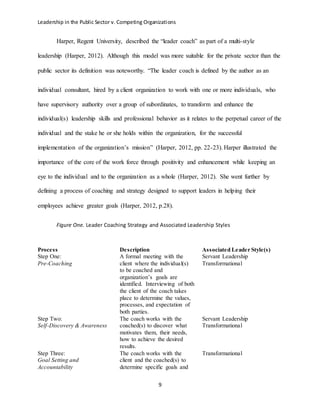
Harper, Regent University, described the “leader coach” as part of a multi-style
leadership (Harper, 2012). Although this model was more suitable for the private sector than the
public sector its definition was noteworthy. “The leader coach is defined by the author as an
individual consultant, hired by a client organization to work with one or more individuals, who
have supervisory authority over a group of subordinates, to transform and enhance the
individual(s) leadership skills and professional behavior as it relates to the perpetual career of the
individual and the stake he or she holds within the organization, for the successful
implementation of the organization’s mission” (Harper, 2012, pp. 22-23). Harper illustrated the
importance of the core of the work force through positivity and enhancement while keeping an
eye to the individual and to the organization as a whole (Harper, 2012). She went further by
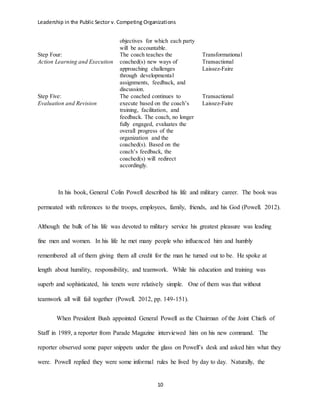
defining a process of coaching and strategy designed to support leaders in helping their
employees achieve greater goals (Harper, 2012, p.28).
Figure One. Leader Coaching Strategy and Associated Leadership Styles
Process Description Associated Leader Style(s)
Step One:
Pre-Coaching
A formal meeting with the
client where the individual(s)
to be coached and
organization’s goals are
identified. Interviewing of both
the client of the coach takes
place to determine the values,
processes, and expectation of
both parties.
Servant Leadership
Transformational
Step Two:
Self-Discovery & Awareness
The coach works with the
coached(s) to discover what
motivates them, their needs,
how to achieve the desired
results.
Servant Leadership
Transformational
Step Three:
Goal Setting and
Accountability
The coach works with the
client and the coached(s) to
determine specific goals and
Transformational
Leadership in the Public Sector v. Competing Organizations
10
objectives for which each party
will be accountable.
Step Four:
Action Learning and Execution
The coach teaches the
coached(s) new ways of
approaching challenges
through developmental
assignments, feedback, and
discussion.
Transformational
Transactional
Laissez-Faire
Step Five:
Evaluation and Revision
The coached continues to
execute based on the coach’s
training, facilitation, and
feedback. The coach, no longer
fully engaged, evaluates the
overall progress of the
organization and the
coached(s). Based on the
coach’s feedback, the
coached(s) will redirect
accordingly.
Transactional
Laissez-Faire
In his book, General Colin Powell described his life and military career. The book was
permeated with references to the troops, employees, family, friends, and his God (Powell. 2012).
Although the bulk of his life was devoted to military service his greatest pleasure was leading
fine men and women. In his life he met many people who influenced him and humbly
remembered all of them giving them all credit for the man he turned out to be. He spoke at
length about humility, responsibility, and teamwork. While his education and training was
superb and sophisticated, his tenets were relatively simple. One of them was that without
teamwork all will fail together (Powell. 2012, pp. 149-151).
When President Bush appointed General Powell as the Chairman of the Joint Chiefs of
Staff in 1989, a reporter from Parade Magazine interviewed him on his new command. The
reporter observed some paper snippets under the glass on Powell’s desk and asked him what they
were. Powell replied they were some informal rules he lived by day to day. Naturally, the
Leadership in the Public Sector v. Competing Organizations
11
discussion focused on the “rules” and eventually they were published in the magazine. They
were so profound and gave such a great insight into the mind of the great leader they took flight
throughout the Army and have been Power Pointed to death many times over (Powell. 2012, pp.
3-4).
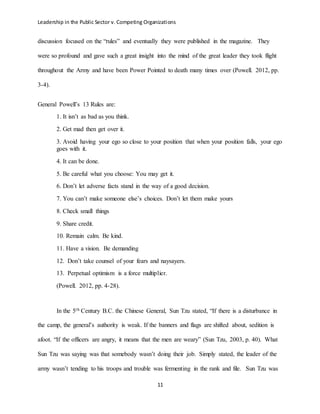
General Powell’s 13 Rules are:
1. It isn’t as bad as you think.
2. Get mad then get over it.
3. Avoid having your ego so close to your position that when your position falls, your ego
goes with it.
4. It can be done.
5. Be careful what you choose: You may get it.
6. Don’t let adverse facts stand in the way of a good decision.
7. You can’t make someone else’s choices. Don’t let them make yours
8. Check small things
9. Share credit.
10. Remain calm. Be kind.
11. Have a vision. Be demanding
12. Don’t take counsel of your fears and naysayers.
13. Perpetual optimism is a force multiplier.
(Powell. 2012, pp. 4-28).
In the 5th Century B.C. the Chinese General, Sun Tzu stated, “If there is a disturbance in
the camp, the general’s authority is weak. If the banners and flags are shifted about, sedition is
afoot. “If the officers are angry, it means that the men are weary” (Sun Tzu, 2003, p. 40). What
Sun Tzu was saying was that somebody wasn’t doing their job. Simply stated, the leader of the
army wasn’t tending to his troops and trouble was fermenting in the rank and file. Sun Tzu was
Leadership in the Public Sector v. Competing Organizations
12
aware that for an army to be effective the soldiers had to be cared for and if leadership wasn’t
strong, the army would be defeated. This observation and philosophy was translated into
military, clerical, and business theory ever since it was written. It was apparent that taking care
of the foot soldiers was the key to victory. Just like General Powell, Sun Tzu recognized the
importance of the individual (Sun Tzu, 2003). .
Pope Francis is the leader of the Roman Catholic Church with a reported congregation of
over 1.2 billion members worldwide. He is definitively a leader of many people. As a religious
leader he must have the management precepts of any organizational leader not only that of
“father”. The Pope, like any chief executive rose through the ranks of the church much like a
young executive rises through the ranks of a major corporation. This means that he had to
acquire not only religious knowledge and skills but he had to develop incredible people skills as
well (Krames, 2015).
Our current Pope is a very different type of leader than his predecessors. The Church, a
historically governmental type of institution, has long prided itself on history, doctrine, and
ceremony. Many non-Catholics consider the pageantry that is synonymous with the old Roman
style of doing business is lofty and imperialistic. While the Catholic Church does great work in
charity, education, ministry, and other subjects, it is often criticized for the opulence of the
Vatican and the great wealth the Church possesses while people around the world are poor and
starving. Pope Francis unlike many of his predecessors started his reign with the word
“humility” at the forefront. He shunned the pompousness he saw and wanted to be viewed as a
servant of Christ the same as his followers (Krames, 2015).
Leadership in the Public Sector v. Competing Organizations
13
His tents were relatively straightforward. To lead through humility was what he went
forward with but he extended his influence to the church leaders first. H rejected the opulent
papal quarters in favor of a smaller apartment at the Vatican. He encouraged his Cardinals to do
so as well. His doctrine included such issues as “smell like your flock”, a reference to
immersing oneself in the group one leads rather than holding oneself above people (Krames,
2015, p. 15). The Pope demanded the Church leadership remove the walls between themselves,
their employees, and their faithful. He showed himself a great advocate for considering all
points of view and making decisions in consultation rather than snap judgments. He also
engages Church leadership by reinventing things rather than simply changing them. This, he
demonstrated by beginning with the Church leadership. He believed that accentuating the
positive attributes of the hierarchy was far more motivating than trying to change the negatives
(Krames, 2015).
The private sector
In his research, Jedwab asserted that there was little distinction between public and
private industries (Jedwab, 2011). There were actually three major distinctions between them: 1)
affected interests; 2) access to resources and information); 3) agency – that is when an agency
acted alone or on behalf of a community (Ben and Gauss, 1983). Rainey (2009) pointed out that
while business types or shareholders define private ownership, public agencies are owned by
their respective communities (Rainey 2009).
He went on to point out that in private business, the end result or profitability is directly
linked to customer satisfaction and that customer satisfaction is more or less a direct result or
byproduct of employee satisfaction (Jedwab, 2011). Therefore, it seemed logical to him that
Leadership in the Public Sector v. Competing Organizations
14
internal customers (employees) that were empowered to make decisions and given the proper
skills to serve the customer with would have made for a harmonious and energized work place.
This would have translated into higher employee satisfaction and loyalty, increasing their
customer service output, and having a positive impact on profits (Jedwab, 2011).
When he examined motivational factors he discovered that general societal opinion of
public workers as opposed to private workers was that they were less motivated, lazy, and not as
productive when, in fact, there was little data to support it. He stated that work motivation was a
major factor and not all people were motivated by profit. For instance, some people were drawn
to public service and were less concerned with wages. They might have been drawn to public or
private service more for the type of leadership or reward that either culture provided (Frank &
Lewis, 2004).
Public leadership has been defined by such issues as overt strategic planning, decision-
making constraints, interdependence of action, work-family conflict, and other factors. Not that
private industry ever had that to deal with but that they have always been more a part of public
sector culture. Public leaders, having constrained by abundant rules and little monetary incentive
to offer their employees have had to use other leadership styles to motivate their employees.
Private leaders, by comparison often had monetary gains to offer employees in return for
exemplary performance and generally had greater decision-making freedom to lead how they
saw fit (Jedwab, 2011).
Nonprofit organizations have not been either government or wholly private organisms by
their very design. Since they have historically received much, if not most of their funding from
the government they have had to create compliance standards in order to having maintained their
Leadership in the Public Sector v. Competing Organizations
15
tax exemption and solvency. They have, however, likely had the loosest internal organization
and management. Those who have gravitated toward these businesses have often been driven by
neither profitability nor government attraction but by moral or value-based factors. That gave
room for different types of leadership styles to be employed that may not have been successful in
government where total compliance was considered “rule of law” or private industry where
profit was the focus (Jedwab, 2011).
Gaps in knowledge have always existed regarding the correlation between leadership
styles and their influence on employees (Jedwab, 2011). Little data has ever existed that defined
differences in leadership or motivation in the public or private sectors (Hooijberg & Choi, 2001).
Leadership in the Public Sector v. Competing Organizations
16
Research Methodology
This research project was the pursuit of an understanding of leadership styles and how
they compared as presented laterally when analyzed in the public, private, and nonprofit sectors.
Although the researcher’s preferred style was coaching, a qualitative and literary analysis of
various entities was considered.
The text books as they applied to the courses of the Masters of Public Administration
Program were the primary sources used as a foundation for the data to be considered.
Additionally, data was gleaned from books by world leaders who described their leadership
experiences, successes, failures, and lessons learned. This information built on three personal
interviews conducted with local leaders long experienced in the art of human leadership and
government as well as scholarly and journal articles.
Leadership in the Public Sector v. Competing Organizations
17
Findings
The nature of leadership is more of a fluid and shifting philosophy than a practice. Although it
has certain tenets, precepts, and characteristics, it is more an art than a science. It cannot be
measured in quantity even though its results can often be. The reason as described by all the
interviewees, writers, and contributors to this is because it deals with the human mind and spirit
where there are no rules. All those who contributed to this effort agreed that the individual is the
basic unit of leadership and its success.
In the course of conducting research for this topic, several interviews with local leaders
were conducted. All were senior administrators with long histories of leadership and
management in the public sector. Two of the three interviewees were career military officers
both of whom had achieved the rank of Lieutenant Colonel (Lt Col) in the U.S. Air Force. Each
of them retired honorably with a combined service history of sixty years. The third interviewee
was a Sheriff’s Office Corporal (Cpl) in the State of Florida with over twenty five years of
distinguished service that began with a tour in the U.S. Marine Corps.
Interview #1:
In performing as a leader there are various styles for one to utilize. My favorite
leadership style is coaching. What is your general opinion of this style and how did it serve you
in your Air Force career? How did your focus on leadership styles and principles serve you?
“The first thing to establish when discussing leadership/management styles is to clarify
the true leaders use several styles of leadership when confronted with different types of problems
or supervisory issues. Managers tend to be less dynamic and develop a single management style
that fits most of the time or their personality or comfort zone. True leaders tend to realize that
Leadership in the Public Sector v. Competing Organizations
18
differing situations require different approaches and different supervision issues require different
leadership approaches. Management styles tend to deal with hardware, assets, functions and
other tangible issues before people. Leadership styles tend to deal with people in the context of
the using hardware, assets, functions, etc.” (Lt Col R. Kibbey, personal communication,
September 4, 2014).
“Having said that, coaching leadership style works when you have young impressionable
and eager people in your section. It’s a leadership by example and develops teamwork through
building trust, admiration, and respect. It also assumes the leader takes a vesting interest in
developing the subordinate’s skills and concentrates on improving strengths, identifying
weaknesses and working to improve, compensate or mitigate on the shortfall skill. I also think
the coaching style looks at the list of skills it takes to accomplish the job at hand and places the
strongest person with that skill in charge of accomplishing the task associated with that
skill. And as with good coaching, you also build up people with back up skills if they are needed
to fill a primary persons place” (Lt Col R. Kibbey, personal communication, September 4, 2014).
“I'm not an advocate of being just a manager or just a leader. You have to do both and
you have to be good at employing different skills to accomplish different objectives.
Management is the style you use to do or accomplish physical things. Leadership is what you do
with people in the way of motivating and teaching them to accomplish the job and developing
skills and preparing people to be in charge of and/or run things in the future” (Lt Col R. Kibbey,
personal communication, September 4, 2014).
“I could go on about this in detail but the paragraphs above are my thoughts in a
nutshell. I like the coaching style because I like to watch people grow and take pride in the
Leadership in the Public Sector v. Competing Organizations
19
accomplishments of the team. Usually if you get everyone working together, the job takes care
of itself” (Lt Col R. Kibbey, personal communication, September 4, 2014).
Lt Col Kibbey put it right out front that a leader is one who uses all the leadership tools in
their arsenal, not just the one they favor because it works for them. He defined the major
difference between a leader and a manager but stressed that both skill sets are necessary to be
effective when dealing with employees. His description of the coaching style didn’t only
illustrate when it would be appropriate – it accentuated the importance of the human at the
receiving end of the action saying that a positive communication would likely produce a positive
employee who would become a strong leader in the future thus ensuring the evolution of the
organization.
Interview #2:
Can you give me a brief of your career and how you viewed your leadership throughout? Did
any leadership styles serve you better than others and which might you describe as your
favorite? I chose to write this paper on the coaching style as my focus. How would you have used
this style and did it serve you? Can you give an example?
“I have served in the United States Air Force for more than 33 years as an enlisted member, an
officer, and as a Department of the Air Force civilian. I have been assigned to 13 different bases
within 7 different major commands, all with different mission objectives. The majority of this
time was spent in various supervisory and leadership positions, ranging from the leader of a two-
person response team to the commander of a 450+ person unit. In my experience, I have found
that there is not one leadership style that will ensure success. Rather, success is possible only by
adjusting leadership styles based on an understanding of the unit's needs, its personnel, and the
Leadership in the Public Sector v. Competing Organizations
20
mission objectives, as well as an understanding of supervisory responsibilities. For example, my
leadership style as a first-line supervisor may differ greatly from the leadership style I would use
as a commander because of differences in my span of control, personal interactions, and
competing priorities for time” (Lt Col W. Cannon, personal communication, September 3, 2014).
“With that said, I've found that the coaching style of leadership has been effective approach
across the entire leadership spectrum, particularly where performance improvement is
needed. The key is to have a common understanding of the goal or objectives, seek input and
suggestions from subordinates, clearly define roles and responsibilities of all parties, and ensure
open lines of communication. In a one-on-one situation, I was able to use coaching with a
subordinate who had a track record of failed physical fitness tests with a corresponding negative
effect on his career, to include a deferred promotion. We met to discuss the required standards
and established his goal as a successful fitness test with a 90-day preparation period. We then
conducted an initial assessment of his fitness level as a baseline from which to work together to
establish appropriate nutritional and exercise programs, to include interim assessments to track
his progress. We incorporated his exercise plan into the existing unit program, but I exercised
with him personally at least twice per week to help ensure motivation and effort towards our
goal. We would have post-exercise discussions on a weekly basis to get his thoughts on how he
was doing and to allow me to praise or challenge him, depending on his performance. This
approach proved more beneficial than disciplinary action and deferred promotions and he was
able to successfully pass the test, obtain his promotion, and continue his career” (Lt Col W.
Cannon, personal communication, September 3, 2014).
“I also successfully used coaching leadership in a small-team environment where we had
a six-person team involved in police competition consisting of a tactical marksmanship course
Leadership in the Public Sector v. Competing Organizations
21
for two weapons, a tactical operations scenario, and an obstacle course/endurance run. Everyone
on the team had a proven track record of performance with regard to marksmanship, police
tactics, and fitness, and we all understood the requirements for success in each event, as most
had participated in similar events in the past. Clearly, each team member had the initiative and a
desire to win the competition so the challenge to coaching was to ensure that we capitalized on
individual strengths within the team to offset the individual weaknesses, and to ensure that we
assigned roles and responsibilities accordingly. We trained as a team, challenging each other to
continually improve and retain the level of motivation required for success. Ultimately, the team
placed first in combat rifle, first in combat tactics, and fourth overall out of 42 highly-
competitive teams from around the world, not as a result of my leadership skill but because each
member felt he was part of the team, with the strengths and attributes needed for success” (Lt
Col W. Cannon, personal communication, September 3, 2014).
“My last example is of coaching is on a larger scale; preparing a 140-person security
forces flight for a major inspection. We knew the standards for compliance and knew from local
assessments where we needed improvement. I brought together my subordinate leaders, similar
to assistant coaches on a sports team, to ensure we had a common understanding of what was
required, where we were as a team, and where we needed to be for the inspection. We shared
thoughts on how to improve and set some milestones for interim testing along the way, and then
brought the entire team together to explain the situation and to obtain their buy-in since our
success was reliant on their efforts. We then incorporated their suggestions where appropriate
and initiated the training and evaluation plan at the flight level. Our flight was successful and
received an “Outstanding” rating during the inspection because of the shared goals, clear
understanding of roles and responsibilities, and putting the strongest "players" in the key
Leadership in the Public Sector v. Competing Organizations
22
positions” (Lt Col W. Cannon, personal communication, September 3, 2014).
“I have a book entitled, The Lombardi Rules, 26 Lessons from Vince Lombardi, The
World's Greatest Coach, in my leadership library and refer to it often as new challenges present
themselves. Among the more salient points is the need to be completely committed to the goal,
work harder than anyone else to achieve desired results, and to lead with integrity. However, I
think the most important lesson is to build a team spirit because, as Coach Lombardi said, "Build
for your team a feeling of oneness, of dependence on one another, and of strength to be derived
from unit." (Lt Col W. Cannon, personal communication, September 3, 2014).
Lt Col Cannon spoke a great deal about the coaching style but, like Lt Col Kibbey, he
pointed out that one of a leader’s greatest strengths is the ability to adopt their leadership style to
the situation at hand. While the primary concern would be the situation the primary focus would
be on the employee or employees who are charged with carrying it out. As for his quote by
Coach Vince Lombardi, it’s of little wonder that the great coach stressed the teamwork concept.
That placed the focus on the individuals but the endless possibilities for the group as a whole
epitomizing the core of the coaching style (Lombardi, 2004).
Interview #3:
How did your use of leadership styles affect your career as a deputy sheriff and what do you see
as the future for leadership styles? Given the overt nature of public administration management
would you say that leadership styles are evolving in the right direction?
In order to stay relevant, modern law enforcement will have to become more adaptive. In
an increasingly complex environment, it is frequently the case that no single person, or even
senior management group, has all the information or expertise necessary to respond in an
Leadership in the Public Sector v. Competing Organizations
23
appropriate and timely way, let alone an innovative way. Ongoing expectations for community
engagement, counterterrorism responsibilities, generational and cultural differences, police
unionism, technological innovation, workforce retention, and perpetual change are multifaceted
challenges that continue to pressure police organizations. Shared leadership cuts across all these
issues by seeking to engage a highly sophisticated workforce in empowered problem solving
(Cpl. W. Cox, personal communication, August 25, 2014).
If in the past our ideas about leadership tended to revolve around the solitary heroic
figure, the leadership of our future will be defined by inspired teamwork. Leaders have overseen
organizations that were flatter, with fewer levels of management and fewer clear distinctions
between them. As the lines of demarcation between leader and follower continued to blur,
empowering strategies and inclusive decision-making styles will not just be recommended
management practices; they will be essential competencies of police leadership (Cpl W. Cox,
personal communication, August 25, 2014).
Here, Cpl. Cox took a different approach. In his interview he took a more “broad brush”
approach to leadership in general. He didn’t mention any one type of leadership but, like the
previous interviewees, he emphasized the flexibility of the leader and the ability to adjust to
whatever the situation dictated. While he generalized his answers he spoke about the future. In
his words he similarly described that an effective leader would not only mentor an individual
employee but would also create a synergy with the group of employees with an emphasis on the
whole group working toward the common goal. He also pointed out that the old models of
simply following orders was giving way to a more cooperative form of management geared
toward the future.
Leadership in the Public Sector v. Competing Organizations
24
Motivational factors
Since the public sector was always funded by the sale of public goods or services, a
strong argument might have been made that private (industry) workers might have been better
workers. By contrast the perception always existed that public or nonprofit workers were less
motivated, talented, or dedicated to their careers than those that were employed in private
industry. There has never been any empirical data to support either claim but the opinions
remained (Frank & Lewis, 2004).
Private company managers have historically been empowered to reward the superior
performance of their employees in monetary ways such as bonuses, stock options, privileges, etc.
Public managers have rarely been able to although in the Federal Civil Service System there
were options of rewarding performance bonuses for exceptional annual performance evaluations.
While there were extrinsic rewards for performance with both types of organizations such as
increased pay, workers who recognized the effect between performance and reward in either
sector tended to perform well or better (Frank & Lewis, 2004).
While private business may have been better structured to link external motivators to
productive work that didn’t necessarily mean that public or nonprofit workers didn’t perform
well or were unhappy in their jobs. It was determined that those employees were motivated by
different factors other than profitability. They possessed such motivators as loyalty, job security,
or attraction to public service which could be the extension of a family or military history in that
realm (Frank & Lewis, 2004).
Public sector organizations – having been funded by taxpayers – were regimented by not
only public input but by politicians and bureaucrats that were beholden to those citizens who
Leadership in the Public Sector v. Competing Organizations
25
placed them in charge of the public trust. Since public managers served a wide variety of
interests their decision-making ability was never of the capacity as that of the private business
manager. The same task embarked on by a business manager would likely have been completed
in less time and arguably with greater efficiency since he was not encumbered with bureaucratic
rigidity. For that reason public leadership and management have been driven by different forces
than their private counterparts who were far less constrained by policy and far more empowered
by greater resources and relatively little interdependence beyond that which were forged for
profitability (Bozeman & Kingsley, 1998).
Therefore, while public, private, and nonprofit managers have always had the same
leadership and management tenets available to them they have often exercised different styles as
a result of the culture in which they operated (Bumgarner & Newswander, 2009).
Regardless of the sector discussed, employee engagement had a direct correlation to
appropriate leadership in the workplace. Employee engagement was also a product of
appropriate leadership (Pritchard, 2008). Public sector work centers devoted more effort to
things like the work/child care relationship, equitable opportunity, and the possibility of
promotion. Private industry focused more on profitability, harmony in the work place,
progressive leadership, and reward. It also utilized more collaborative decision-making or
“transactional” processes. The public office generally employed a strict, hierarchal, “top-down”
style although both styles showed decidedly higher indicators of employee engagement when
more employee involvement was evident (Jedwab, 2011).
Leadership in the Public Sector v. Competing Organizations
26
Although he previously stated that there was no empirical data to support the common
belief that public workers were lazy or unproductive he did state there was a negative correlation
between laissez-faire leadership and positive employee engagement. (Jedwab, 2011).
No data was evident throughout this research to suggest any difference in employee
engagement or responsiveness and that they appeared to be relatively the same for public and
private employees.
Leadership in the Public Sector v. Competing Organizations
27
Conclusions
Leadership has always been a complicated art because the human being has been.
Leadership has many theories, practices, and premises, but none work in any two situations.
Leaders are those who have a passion for their mission but place the greatest value on those who
execute their wishes and demands. How they deal with those people means the difference
between success and failure.
All management and leadership styles are quantifiable but to know when to use what
style is the mark of a caring, compassionate, and task- oriented leader who understands how to
motivate individuals in order to help them grow professionally while strengthening the group as
a whole so that great things can be achieved. Trial and error are part of a leader’s lot and learning
is an ongoing process for leader and subordinate alike. The one who is not afraid to learn by
doing will be the greatest asset to their employees who will, in turn, make great leaders and be an
asset to the organization long after their mentor is gone solidifying forever their true contribution
to the individual and the organization.
Judging by the rules Colin Powell set for himself one can see the mind of this
accomplished leader. He had a great capacity for inclusion that is to say, he wanted his people to
own the Army rather than just be a part of it. He insisted on excellence but provided the troops
the wherewithal to achieve it by motivating them and believing in them. General Powell
understood what it took to coach a team that had to be prepared for war. The stakes were high
and he knew that strength, optimism, and determination on his part would translate into a
fighting force that would respond to those attributes and challenge themselves to do great things.
Leadership in the Public Sector v. Competing Organizations
28
All that having been said, it should have been noted by the reader that all these precepts,
while not exclusively the property of, most certainly were studies, ideologies, and customs of the
public sector. They describe some of those available leadership and managerial tenets that
public figures were most likely to employ.
According to the research, which was based on a significant amount of research
conducted on a larger level and at a greater breadth, there was little difference between the public
and private employees although there were different cultural styles in leading them. Public
employees have responsibilities, deadlines, and obligations but private leaders do not, generally
speaking, employ the regimented styles that public leaders do.
The strict inflexible forms of leadership and management are wholly appropriate for the
military – their mission and culture demand it. Many civilians working for governments follow
suit which may or may not be appropriate. Since the public employees are beholden to the
citizenry, and many rules and procedures were created for the purpose of satisfying the wants of
society as a whole, it would appear that a stiff, layered hierarchy may seem more suitable.
Private employees have more freedom to make decisions likely because their leaders and
managers have the same privileges and responsibilities.
Going back to the Pope and his style, it would seem that an organization like the Catholic
Church which is a form of government in itself, although it is a unique form of government,
would appear more stringent. In truth, the Vatican has one of the largest libraries in the world a
good portion of which is devoted to canon law and procedure. Pope Francis certainly doesn’t
represent himself as the Emperor of Rome but as caretaker of his followers. So there went a
unique form of leadership= bishop and manager= shepherd of souls and manager of a large
Leadership in the Public Sector v. Competing Organizations
29
organization. He uses a variety of styles in his governance of the church but it would likely not
be argued that his followers, especially those closest to him were highly motivated.
Situational leadership creates a flexible set of choices for any leader and, as the interviews
suggested in the Findings Section, a manager may be fixated on a single style but reality dictates
that a strong leader has an entire arsenal of styles and the wisdom to know when which one is
appropriate.
Leadership in the Public Sector v. Competing Organizations
30
Recommendations
The greatest way for a leader to be effective is to listen, learn, and practice what those
that went before them have learned by their trials and errors. If one is a leader they should
inspire those for whom they are responsible so that they will pass on their expertise to the next
generation. Keep an eye to the mission but always take care of the people because they will take
care of you. If you let your subordinates down and don’t take care of them they will most
certainly return the favor.
Whether in the public, private, or nonprofit sector, a manager can manage based on the
mission with an eye to either victory, success, or the bottom line. Whichever area that person is
in it would be a strong recommendation to employ whatever style, tenet, or mechanic that would
get the job done. It really comes down to this: the foot soldier is the basic unit of an infantry
battalion and an employee is the same for their corporation. Policies, procedures, plans,
programs, or cool management philosophies (most of which are faddish at best) cannot overlook
the importance of those who light the fires and make the machine move. These are not just cool,
poetic words that read nicely. They are tried and true principles that have been learned,
recognized, and employed successfully by men much better than me.
Whatever leadership style fits an individual’s scenario they should execute that style
without fear and hold themselves responsible for the success and failure of the group but hold
people accountable as well. The greatest gift a leader can give a subordinate is the gift of their
time and to listen. I have experienced the greatest consternation in my professional life when a
subordinate told me I didn’t listen to their concerns. That means that I failed to connect with
them and likely lost their respect, therefore, I failed them… Leaders listen.
Leadership in the Public Sector v. Competing Organizations
31
References
Benn, S.I. & Gauss, G. (1983). Public and Private in Social Life. New York: St Martin’s Press.
Bozeman, b. & Kingsley, G. (1998). Risk Culture in Public and Private Organizations. Public
Administration Review, 58(2), 109-18.
Bumgarner, J. and Newswander, C. (2009). The Irony of NPM: The Inevitable Extension of the
role of the Administrative State. The American Review of Public Administration, 39,189-
207.
Cannon, W., personal communication, September 3, 2014.
Cox W., personal communication, August 25, 2014.
Frank, S. & Lewis,G. (2004) Government Employees: Working Hard or Hardly Working? The
American Review of Public Administration 34(36)
Goleman, Daniel, Boyatzis, Richard and McKee, Annie (2002) Primal Leadership: Realizing the
Power of Emotional Intelligence. Cambridge, MA: Harvard Business School Press.
Harper, Shanta (2012). The Leader Coach: A Model of the Multi-Style Leadership. Retrieved
from Journal of Practical Consulting, Vol. 4 Iss. 1 Fall/Winter 2012, pp 22-31. Regent
University School of Business and Leadership, Virginia Beach, VA.
www.regent.edu/acad/.../JPC_Vol4Iss1_Harper.pdf
Hoijberg, r., & Choi, J. (2001). The Impact of Organizational Characteristics on Leadership
Effectiveness Model: An Examination of Leadership in a Private and a Public Sector
Organization. Administration & Society, 33(4), 403-431.
Leadership in the Public Sector v. Competing Organizations
32
Jedwab, N. (2011). An Investigation of Managerial Practices Leadership Styles and Issues in
Public, Private, and Nonprofit Organizations. (University Of Pennsylvania) Retrieved
from ProQuest Dissertations and Theses. (UMI 1499730)
Kibbey, R., personal communication, September 4, 2014.
Krames, Jeffrey A. (2015). Lead with Humility: 12 Leadership Lessons from Pope Francis.
Library of Congress
Lombardi Jr., Vince (2004) The Lombardi Rules: 26 Lessons from Vince Lombardi—the World’s
Greatest Coach. McGraw-Hill.
Perkins, Dennis, NT, Holtman, Margaret P., Kessler, Paul R. and McCarthy, Catherine (2000).
Leading at the Edge. Amacon, New York
Powell, Colin (2012) It Worked for Me in Life and Leadership. Harper Collins Publishers
Pritchard, K. (2008). Employee Engagement in the UK: Meeting the Challenge in the Public
Sector. Developing and Learning in Organizations, 22(6), 15-17. doi:
10.1108/14777280810910302
Rainey, H. (2009). Understanding and Managing Public Organizations. John Wiley and Sons.
Sun Tzu (2003) The Art of War. (Edited by Dallas Galvin. Translated from Chinese by Lionel
Giles). Barnes and Noble Books, New York, New York.

CapstoneProject

  • 1.
    RUNNING HEAD: Leadershipinthe Public Sector v. Competing Organizations The Dynamics of Leadership in Public Administration v. Competing Organizations Capstone: Applied Project Kevin F. Skope January 12, 2015
  • 2.
    Leadership in thePublic Sector v. Competing Organizations 2 Abstract Leadership is as much an art as human government. In fact, in many ways it is a form of government on a smaller scale. An untold number of books, periodicals, manuals, doctrines, and canons have been written about it and no wonder. The subject is exceptionally complicated as with any subject dealing with human beings. This research explored the predominant leadership styles, their advantages and disadvantages. In order to have given a broad panorama of the subject as it related to the field of Public Administration it compared the research to that of private and nonprofit organizations to determine any relative similarities or differences and what they may have been. It examined literature on the subject and focused on the qualitative benefits with a concentration on the coaching style. A quantitative analysis was not presented because it was reviewed as more of an art than a science or a statistical approach. The vast majority of the information was gleaned from the texts used in the course of the master’s degree program and supplemented by literary review of scholarly articles, interviews with local leaders, conclusions and recommendations of the researcher. It was reported that there were perceptions of public and private employees and the data was examined to determine if any of these were, indeed, true. Interviews were conducted with three manage/leaders who all had long histories in the public sector, both as military and civil service employees. The research determined that there were various factors that determined the environment in which people chose to work for both labor and management. People gravitated to employment they believe they were most suited for so the motivations were virtually built in.
  • 3.
    Leadership in thePublic Sector v. Competing Organizations 3 That did not preclude or hold harmless the leaders that those people worked for. Humans need proper motivation, care, concern, and structure and it was the leader’s responsibility to achieve that while simultaneously achieving the goal of the organization. No matter which work center people chose, the styles and tenets of leadership had to be of great variety for the leader and properly wielded to give the work force the greatest efficiency and success to excel.
  • 4.
    Leadership in thePublic Sector v. Competing Organizations 4 Table of Contents Title page ……………………………………………………………………………….…. 1 Abstract ……………………………………………………………………………………. 2 Table of Contents ………………………………………………………………………….. 4 Introduction ………………………………………………………………………………... 5 Review of Literature ……………………………………………………...……………….. 7 Research Methodology ……………………………………………………………………16 Findings …………………………………………………………………………………...17 Conclusions ………………………………………………………………………………..27 Recommendations …………………………………………………………………………30 References ………………………………………………………..………………………..31
  • 5.
    Leadership in thePublic Sector v. Competing Organizations 5 Introduction In the public sector, as in the private and nonprofit sectors, many ways to conduct business have always been understood by all who entered these realms and the vastness of opportunity was only ever matched, even outweighed, by how those opportunities and goals were achieved. That is to say that the measure of achievement was always the leadership, management, and vision of those who endeavored to make a concept a reality. If a public entity needed to be successful, it had to operate with efficiency since it operated with other people’s money. By the same measure, a business also required efficiency but with an eye to the profitable result, arguably, also efficiency, but far more unfettered by budgetary constraints. Was it feasible, based on the literature that was presented, to believe what the researcher concluded or did the reader arrive at a different conclusion based on the same information? Scholars have always disagreed on the likenesses and disparities amongst the different administrations but in truth the similarities and differences were always rather obvious. Organizations of all persuasions have needed managers who possessed organizational skills, interpersonal skills, and the vision to see the broad panorama of minutest details within an operation. They always had to have multiple skills and debate has always raged as to what defined the best corporate or government heads. The questions have historically been should a good manager be a leader as well? Should a leader be a good manager? Are leaders born or made or both? Has there ever been a perfect formula for leadership in the public sector and has that leadership ever extended to the private and nonprofit sectors or have they always been mutually exclusive as completely different philosophies?
  • 6.
    Leadership in thePublic Sector v. Competing Organizations 6 This research was dedicated to the idea that there have always existed as many forms of leadership styles as there were leaders. Leadership styles had to be eclectic and cross-over. A leader could not be one way at all times because times and situations have been historical evolutions. A general on the battlefield needed to be alert to the ever changing face of the combat scenario with the ability to adjust at a moment’s notice. Having said that, the researcher was primarily concerned with the six leadership styles included in the text. The lion’s share of this work was devoted to a more detailed analysis of the coaching style of leadership, its attributes and inefficiencies. It also included the opinions of three present day leaders and their experiences with the real world use of this style. The purpose of this writing was to inform rather than persuade the reader of the strengths of coaching and the appropriateness of its usage in the world of leadership. It went on to compare and contrast the leadership and management styles and, based on literary data, and concluded whether or not there was any correlation between them or was there no apparent relationship as evidenced by scholarly writings. The last remaining question was “Did it matter if the objective of the organization was fulfilled regardless of public, private, or nonprofit in persuasion?” This research was a presentation of facts, philosophies, and styles with an eye to the literary and qualitative perspective in an effort to inform the reader. What it was not was an attempt to persuade the reader to agree or believe that one idea was better than another. It has been historically better to present facts and theories and allow a scholarly analysis of one’s work than to attempt to steer an academic probe to an avenue that may have not been agreed with by the reader.
  • 7.
    Leadership in thePublic Sector v. Competing Organizations 7 Review of Literature The public sector To present a proper preference for a particular style it would only be right to deliver a landscape of all styles. First there is the Visionary Leader. This is the one who can influence and motivate people to sign on to the mission at hand. Generally more gregarious and charismatic, they have the ability to inspire people to achieve with an eye to the mission of the organization (Goleman et al, 2002, pp. 54-59). Next is the Coaching Leader. Possessing high energy and charisma the coach is more forceful in their style but have the ability to make people want to achieve (Perkins, Holtman, Kessler, & McCarthy, 2000). Coaching is obviously ideal in organized sports, hence the name, but is also a style that is at home in sales, marketing, military operations, and organizations that do charity or community work like Habitat for Humanity’s (Goleman, et al, 2002, pp. 59-.63). The Affiliative style of leadership is slightly different due to its collaborative efforts (Perkins, et al, 2000). Like in the coaching method, affilliative leaders spend a great deal of time pursuing harmony and friendly interaction with employees to achieve great production (Goleman, et al, 2002, pp 63-66). Democratic Leaders do well with highly skilled work forces capable of possessing vision beyond their scope of responsibility. Democratic sharing is virtually an across the board decision making body that arrives at conclusions together where all who have a stake in the game have an input to the process (Goleman, et al, pp. 66-69).
  • 8.
    Leadership in thePublic Sector v. Competing Organizations 8 Pacesetting Leadership is more directive and is appropriate with organizations in need of repair. In this fashion, leaders set deadlines, policies and procedures, and spend less time collaborating with subordinates generally due to the need to fix things expeditiously (Goleman, et al, pp. 72-75). Commanding Leadership is a top down “my way or the highway” style often considered synonymous with micromanaging. It is precisely as it seems – I will make the rules and you will carry them out. This style is usually found in public organizations such as government or military where the hierarchy and mission is highly chiseled and not prone to flexibility (Goleman, et al, pp. 75-80). The various leadership styles are all appropriate and effective when used properly. Although nobody seeks to dictate a leadership or management style, it should be noted that the Pacesetting or Commanding styles are advised to be used with caution and sparingly as they are widely considered to be dissonant in nature and do not possess the collective harmony of the other styles. (Goleman, et al, pp. 72-80). The Coaching Style of leadership creates a wide view for the leader to function within but doesn’t exclude the leader’s ability to focus their vision where they think it is most needed. A coach tends to help associates identify their strengths and weakness but, unlike the commander, a coach emphasizes their strengths and doesn’t focus on their weaknesses. They allow people to connect emotionally with their task but to stay true to the overall mission of the organization. Under this type of leadership people experience the energy of their leader and have a greater ability to focus on their vision for themselves (Goleman, et al, pp. 75-80).
  • 9.
    Leadership in thePublic Sector v. Competing Organizations 9 Harper, Regent University, described the “leader coach” as part of a multi-style leadership (Harper, 2012). Although this model was more suitable for the private sector than the public sector its definition was noteworthy. “The leader coach is defined by the author as an individual consultant, hired by a client organization to work with one or more individuals, who have supervisory authority over a group of subordinates, to transform and enhance the individual(s) leadership skills and professional behavior as it relates to the perpetual career of the individual and the stake he or she holds within the organization, for the successful implementation of the organization’s mission” (Harper, 2012, pp. 22-23). Harper illustrated the importance of the core of the work force through positivity and enhancement while keeping an eye to the individual and to the organization as a whole (Harper, 2012). She went further by defining a process of coaching and strategy designed to support leaders in helping their employees achieve greater goals (Harper, 2012, p.28). Figure One. Leader Coaching Strategy and Associated Leadership Styles Process Description Associated Leader Style(s) Step One: Pre-Coaching A formal meeting with the client where the individual(s) to be coached and organization’s goals are identified. Interviewing of both the client of the coach takes place to determine the values, processes, and expectation of both parties. Servant Leadership Transformational Step Two: Self-Discovery & Awareness The coach works with the coached(s) to discover what motivates them, their needs, how to achieve the desired results. Servant Leadership Transformational Step Three: Goal Setting and Accountability The coach works with the client and the coached(s) to determine specific goals and Transformational
  • 10.
    Leadership in thePublic Sector v. Competing Organizations 10 objectives for which each party will be accountable. Step Four: Action Learning and Execution The coach teaches the coached(s) new ways of approaching challenges through developmental assignments, feedback, and discussion. Transformational Transactional Laissez-Faire Step Five: Evaluation and Revision The coached continues to execute based on the coach’s training, facilitation, and feedback. The coach, no longer fully engaged, evaluates the overall progress of the organization and the coached(s). Based on the coach’s feedback, the coached(s) will redirect accordingly. Transactional Laissez-Faire In his book, General Colin Powell described his life and military career. The book was permeated with references to the troops, employees, family, friends, and his God (Powell. 2012). Although the bulk of his life was devoted to military service his greatest pleasure was leading fine men and women. In his life he met many people who influenced him and humbly remembered all of them giving them all credit for the man he turned out to be. He spoke at length about humility, responsibility, and teamwork. While his education and training was superb and sophisticated, his tenets were relatively simple. One of them was that without teamwork all will fail together (Powell. 2012, pp. 149-151). When President Bush appointed General Powell as the Chairman of the Joint Chiefs of Staff in 1989, a reporter from Parade Magazine interviewed him on his new command. The reporter observed some paper snippets under the glass on Powell’s desk and asked him what they were. Powell replied they were some informal rules he lived by day to day. Naturally, the
  • 11.
    Leadership in thePublic Sector v. Competing Organizations 11 discussion focused on the “rules” and eventually they were published in the magazine. They were so profound and gave such a great insight into the mind of the great leader they took flight throughout the Army and have been Power Pointed to death many times over (Powell. 2012, pp. 3-4). General Powell’s 13 Rules are: 1. It isn’t as bad as you think. 2. Get mad then get over it. 3. Avoid having your ego so close to your position that when your position falls, your ego goes with it. 4. It can be done. 5. Be careful what you choose: You may get it. 6. Don’t let adverse facts stand in the way of a good decision. 7. You can’t make someone else’s choices. Don’t let them make yours 8. Check small things 9. Share credit. 10. Remain calm. Be kind. 11. Have a vision. Be demanding 12. Don’t take counsel of your fears and naysayers. 13. Perpetual optimism is a force multiplier. (Powell. 2012, pp. 4-28). In the 5th Century B.C. the Chinese General, Sun Tzu stated, “If there is a disturbance in the camp, the general’s authority is weak. If the banners and flags are shifted about, sedition is afoot. “If the officers are angry, it means that the men are weary” (Sun Tzu, 2003, p. 40). What Sun Tzu was saying was that somebody wasn’t doing their job. Simply stated, the leader of the army wasn’t tending to his troops and trouble was fermenting in the rank and file. Sun Tzu was
  • 12.
    Leadership in thePublic Sector v. Competing Organizations 12 aware that for an army to be effective the soldiers had to be cared for and if leadership wasn’t strong, the army would be defeated. This observation and philosophy was translated into military, clerical, and business theory ever since it was written. It was apparent that taking care of the foot soldiers was the key to victory. Just like General Powell, Sun Tzu recognized the importance of the individual (Sun Tzu, 2003). . Pope Francis is the leader of the Roman Catholic Church with a reported congregation of over 1.2 billion members worldwide. He is definitively a leader of many people. As a religious leader he must have the management precepts of any organizational leader not only that of “father”. The Pope, like any chief executive rose through the ranks of the church much like a young executive rises through the ranks of a major corporation. This means that he had to acquire not only religious knowledge and skills but he had to develop incredible people skills as well (Krames, 2015). Our current Pope is a very different type of leader than his predecessors. The Church, a historically governmental type of institution, has long prided itself on history, doctrine, and ceremony. Many non-Catholics consider the pageantry that is synonymous with the old Roman style of doing business is lofty and imperialistic. While the Catholic Church does great work in charity, education, ministry, and other subjects, it is often criticized for the opulence of the Vatican and the great wealth the Church possesses while people around the world are poor and starving. Pope Francis unlike many of his predecessors started his reign with the word “humility” at the forefront. He shunned the pompousness he saw and wanted to be viewed as a servant of Christ the same as his followers (Krames, 2015).
  • 13.
    Leadership in thePublic Sector v. Competing Organizations 13 His tents were relatively straightforward. To lead through humility was what he went forward with but he extended his influence to the church leaders first. H rejected the opulent papal quarters in favor of a smaller apartment at the Vatican. He encouraged his Cardinals to do so as well. His doctrine included such issues as “smell like your flock”, a reference to immersing oneself in the group one leads rather than holding oneself above people (Krames, 2015, p. 15). The Pope demanded the Church leadership remove the walls between themselves, their employees, and their faithful. He showed himself a great advocate for considering all points of view and making decisions in consultation rather than snap judgments. He also engages Church leadership by reinventing things rather than simply changing them. This, he demonstrated by beginning with the Church leadership. He believed that accentuating the positive attributes of the hierarchy was far more motivating than trying to change the negatives (Krames, 2015). The private sector In his research, Jedwab asserted that there was little distinction between public and private industries (Jedwab, 2011). There were actually three major distinctions between them: 1) affected interests; 2) access to resources and information); 3) agency – that is when an agency acted alone or on behalf of a community (Ben and Gauss, 1983). Rainey (2009) pointed out that while business types or shareholders define private ownership, public agencies are owned by their respective communities (Rainey 2009). He went on to point out that in private business, the end result or profitability is directly linked to customer satisfaction and that customer satisfaction is more or less a direct result or byproduct of employee satisfaction (Jedwab, 2011). Therefore, it seemed logical to him that
  • 14.
    Leadership in thePublic Sector v. Competing Organizations 14 internal customers (employees) that were empowered to make decisions and given the proper skills to serve the customer with would have made for a harmonious and energized work place. This would have translated into higher employee satisfaction and loyalty, increasing their customer service output, and having a positive impact on profits (Jedwab, 2011). When he examined motivational factors he discovered that general societal opinion of public workers as opposed to private workers was that they were less motivated, lazy, and not as productive when, in fact, there was little data to support it. He stated that work motivation was a major factor and not all people were motivated by profit. For instance, some people were drawn to public service and were less concerned with wages. They might have been drawn to public or private service more for the type of leadership or reward that either culture provided (Frank & Lewis, 2004). Public leadership has been defined by such issues as overt strategic planning, decision- making constraints, interdependence of action, work-family conflict, and other factors. Not that private industry ever had that to deal with but that they have always been more a part of public sector culture. Public leaders, having constrained by abundant rules and little monetary incentive to offer their employees have had to use other leadership styles to motivate their employees. Private leaders, by comparison often had monetary gains to offer employees in return for exemplary performance and generally had greater decision-making freedom to lead how they saw fit (Jedwab, 2011). Nonprofit organizations have not been either government or wholly private organisms by their very design. Since they have historically received much, if not most of their funding from the government they have had to create compliance standards in order to having maintained their
  • 15.
    Leadership in thePublic Sector v. Competing Organizations 15 tax exemption and solvency. They have, however, likely had the loosest internal organization and management. Those who have gravitated toward these businesses have often been driven by neither profitability nor government attraction but by moral or value-based factors. That gave room for different types of leadership styles to be employed that may not have been successful in government where total compliance was considered “rule of law” or private industry where profit was the focus (Jedwab, 2011). Gaps in knowledge have always existed regarding the correlation between leadership styles and their influence on employees (Jedwab, 2011). Little data has ever existed that defined differences in leadership or motivation in the public or private sectors (Hooijberg & Choi, 2001).
  • 16.
    Leadership in thePublic Sector v. Competing Organizations 16 Research Methodology This research project was the pursuit of an understanding of leadership styles and how they compared as presented laterally when analyzed in the public, private, and nonprofit sectors. Although the researcher’s preferred style was coaching, a qualitative and literary analysis of various entities was considered. The text books as they applied to the courses of the Masters of Public Administration Program were the primary sources used as a foundation for the data to be considered. Additionally, data was gleaned from books by world leaders who described their leadership experiences, successes, failures, and lessons learned. This information built on three personal interviews conducted with local leaders long experienced in the art of human leadership and government as well as scholarly and journal articles.
  • 17.
    Leadership in thePublic Sector v. Competing Organizations 17 Findings The nature of leadership is more of a fluid and shifting philosophy than a practice. Although it has certain tenets, precepts, and characteristics, it is more an art than a science. It cannot be measured in quantity even though its results can often be. The reason as described by all the interviewees, writers, and contributors to this is because it deals with the human mind and spirit where there are no rules. All those who contributed to this effort agreed that the individual is the basic unit of leadership and its success. In the course of conducting research for this topic, several interviews with local leaders were conducted. All were senior administrators with long histories of leadership and management in the public sector. Two of the three interviewees were career military officers both of whom had achieved the rank of Lieutenant Colonel (Lt Col) in the U.S. Air Force. Each of them retired honorably with a combined service history of sixty years. The third interviewee was a Sheriff’s Office Corporal (Cpl) in the State of Florida with over twenty five years of distinguished service that began with a tour in the U.S. Marine Corps. Interview #1: In performing as a leader there are various styles for one to utilize. My favorite leadership style is coaching. What is your general opinion of this style and how did it serve you in your Air Force career? How did your focus on leadership styles and principles serve you? “The first thing to establish when discussing leadership/management styles is to clarify the true leaders use several styles of leadership when confronted with different types of problems or supervisory issues. Managers tend to be less dynamic and develop a single management style that fits most of the time or their personality or comfort zone. True leaders tend to realize that
  • 18.
    Leadership in thePublic Sector v. Competing Organizations 18 differing situations require different approaches and different supervision issues require different leadership approaches. Management styles tend to deal with hardware, assets, functions and other tangible issues before people. Leadership styles tend to deal with people in the context of the using hardware, assets, functions, etc.” (Lt Col R. Kibbey, personal communication, September 4, 2014). “Having said that, coaching leadership style works when you have young impressionable and eager people in your section. It’s a leadership by example and develops teamwork through building trust, admiration, and respect. It also assumes the leader takes a vesting interest in developing the subordinate’s skills and concentrates on improving strengths, identifying weaknesses and working to improve, compensate or mitigate on the shortfall skill. I also think the coaching style looks at the list of skills it takes to accomplish the job at hand and places the strongest person with that skill in charge of accomplishing the task associated with that skill. And as with good coaching, you also build up people with back up skills if they are needed to fill a primary persons place” (Lt Col R. Kibbey, personal communication, September 4, 2014). “I'm not an advocate of being just a manager or just a leader. You have to do both and you have to be good at employing different skills to accomplish different objectives. Management is the style you use to do or accomplish physical things. Leadership is what you do with people in the way of motivating and teaching them to accomplish the job and developing skills and preparing people to be in charge of and/or run things in the future” (Lt Col R. Kibbey, personal communication, September 4, 2014). “I could go on about this in detail but the paragraphs above are my thoughts in a nutshell. I like the coaching style because I like to watch people grow and take pride in the
  • 19.
    Leadership in thePublic Sector v. Competing Organizations 19 accomplishments of the team. Usually if you get everyone working together, the job takes care of itself” (Lt Col R. Kibbey, personal communication, September 4, 2014). Lt Col Kibbey put it right out front that a leader is one who uses all the leadership tools in their arsenal, not just the one they favor because it works for them. He defined the major difference between a leader and a manager but stressed that both skill sets are necessary to be effective when dealing with employees. His description of the coaching style didn’t only illustrate when it would be appropriate – it accentuated the importance of the human at the receiving end of the action saying that a positive communication would likely produce a positive employee who would become a strong leader in the future thus ensuring the evolution of the organization. Interview #2: Can you give me a brief of your career and how you viewed your leadership throughout? Did any leadership styles serve you better than others and which might you describe as your favorite? I chose to write this paper on the coaching style as my focus. How would you have used this style and did it serve you? Can you give an example? “I have served in the United States Air Force for more than 33 years as an enlisted member, an officer, and as a Department of the Air Force civilian. I have been assigned to 13 different bases within 7 different major commands, all with different mission objectives. The majority of this time was spent in various supervisory and leadership positions, ranging from the leader of a two- person response team to the commander of a 450+ person unit. In my experience, I have found that there is not one leadership style that will ensure success. Rather, success is possible only by adjusting leadership styles based on an understanding of the unit's needs, its personnel, and the
  • 20.
    Leadership in thePublic Sector v. Competing Organizations 20 mission objectives, as well as an understanding of supervisory responsibilities. For example, my leadership style as a first-line supervisor may differ greatly from the leadership style I would use as a commander because of differences in my span of control, personal interactions, and competing priorities for time” (Lt Col W. Cannon, personal communication, September 3, 2014). “With that said, I've found that the coaching style of leadership has been effective approach across the entire leadership spectrum, particularly where performance improvement is needed. The key is to have a common understanding of the goal or objectives, seek input and suggestions from subordinates, clearly define roles and responsibilities of all parties, and ensure open lines of communication. In a one-on-one situation, I was able to use coaching with a subordinate who had a track record of failed physical fitness tests with a corresponding negative effect on his career, to include a deferred promotion. We met to discuss the required standards and established his goal as a successful fitness test with a 90-day preparation period. We then conducted an initial assessment of his fitness level as a baseline from which to work together to establish appropriate nutritional and exercise programs, to include interim assessments to track his progress. We incorporated his exercise plan into the existing unit program, but I exercised with him personally at least twice per week to help ensure motivation and effort towards our goal. We would have post-exercise discussions on a weekly basis to get his thoughts on how he was doing and to allow me to praise or challenge him, depending on his performance. This approach proved more beneficial than disciplinary action and deferred promotions and he was able to successfully pass the test, obtain his promotion, and continue his career” (Lt Col W. Cannon, personal communication, September 3, 2014). “I also successfully used coaching leadership in a small-team environment where we had a six-person team involved in police competition consisting of a tactical marksmanship course
  • 21.
    Leadership in thePublic Sector v. Competing Organizations 21 for two weapons, a tactical operations scenario, and an obstacle course/endurance run. Everyone on the team had a proven track record of performance with regard to marksmanship, police tactics, and fitness, and we all understood the requirements for success in each event, as most had participated in similar events in the past. Clearly, each team member had the initiative and a desire to win the competition so the challenge to coaching was to ensure that we capitalized on individual strengths within the team to offset the individual weaknesses, and to ensure that we assigned roles and responsibilities accordingly. We trained as a team, challenging each other to continually improve and retain the level of motivation required for success. Ultimately, the team placed first in combat rifle, first in combat tactics, and fourth overall out of 42 highly- competitive teams from around the world, not as a result of my leadership skill but because each member felt he was part of the team, with the strengths and attributes needed for success” (Lt Col W. Cannon, personal communication, September 3, 2014). “My last example is of coaching is on a larger scale; preparing a 140-person security forces flight for a major inspection. We knew the standards for compliance and knew from local assessments where we needed improvement. I brought together my subordinate leaders, similar to assistant coaches on a sports team, to ensure we had a common understanding of what was required, where we were as a team, and where we needed to be for the inspection. We shared thoughts on how to improve and set some milestones for interim testing along the way, and then brought the entire team together to explain the situation and to obtain their buy-in since our success was reliant on their efforts. We then incorporated their suggestions where appropriate and initiated the training and evaluation plan at the flight level. Our flight was successful and received an “Outstanding” rating during the inspection because of the shared goals, clear understanding of roles and responsibilities, and putting the strongest "players" in the key
  • 22.
    Leadership in thePublic Sector v. Competing Organizations 22 positions” (Lt Col W. Cannon, personal communication, September 3, 2014). “I have a book entitled, The Lombardi Rules, 26 Lessons from Vince Lombardi, The World's Greatest Coach, in my leadership library and refer to it often as new challenges present themselves. Among the more salient points is the need to be completely committed to the goal, work harder than anyone else to achieve desired results, and to lead with integrity. However, I think the most important lesson is to build a team spirit because, as Coach Lombardi said, "Build for your team a feeling of oneness, of dependence on one another, and of strength to be derived from unit." (Lt Col W. Cannon, personal communication, September 3, 2014). Lt Col Cannon spoke a great deal about the coaching style but, like Lt Col Kibbey, he pointed out that one of a leader’s greatest strengths is the ability to adopt their leadership style to the situation at hand. While the primary concern would be the situation the primary focus would be on the employee or employees who are charged with carrying it out. As for his quote by Coach Vince Lombardi, it’s of little wonder that the great coach stressed the teamwork concept. That placed the focus on the individuals but the endless possibilities for the group as a whole epitomizing the core of the coaching style (Lombardi, 2004). Interview #3: How did your use of leadership styles affect your career as a deputy sheriff and what do you see as the future for leadership styles? Given the overt nature of public administration management would you say that leadership styles are evolving in the right direction? In order to stay relevant, modern law enforcement will have to become more adaptive. In an increasingly complex environment, it is frequently the case that no single person, or even senior management group, has all the information or expertise necessary to respond in an
  • 23.
    Leadership in thePublic Sector v. Competing Organizations 23 appropriate and timely way, let alone an innovative way. Ongoing expectations for community engagement, counterterrorism responsibilities, generational and cultural differences, police unionism, technological innovation, workforce retention, and perpetual change are multifaceted challenges that continue to pressure police organizations. Shared leadership cuts across all these issues by seeking to engage a highly sophisticated workforce in empowered problem solving (Cpl. W. Cox, personal communication, August 25, 2014). If in the past our ideas about leadership tended to revolve around the solitary heroic figure, the leadership of our future will be defined by inspired teamwork. Leaders have overseen organizations that were flatter, with fewer levels of management and fewer clear distinctions between them. As the lines of demarcation between leader and follower continued to blur, empowering strategies and inclusive decision-making styles will not just be recommended management practices; they will be essential competencies of police leadership (Cpl W. Cox, personal communication, August 25, 2014). Here, Cpl. Cox took a different approach. In his interview he took a more “broad brush” approach to leadership in general. He didn’t mention any one type of leadership but, like the previous interviewees, he emphasized the flexibility of the leader and the ability to adjust to whatever the situation dictated. While he generalized his answers he spoke about the future. In his words he similarly described that an effective leader would not only mentor an individual employee but would also create a synergy with the group of employees with an emphasis on the whole group working toward the common goal. He also pointed out that the old models of simply following orders was giving way to a more cooperative form of management geared toward the future.
  • 24.
    Leadership in thePublic Sector v. Competing Organizations 24 Motivational factors Since the public sector was always funded by the sale of public goods or services, a strong argument might have been made that private (industry) workers might have been better workers. By contrast the perception always existed that public or nonprofit workers were less motivated, talented, or dedicated to their careers than those that were employed in private industry. There has never been any empirical data to support either claim but the opinions remained (Frank & Lewis, 2004). Private company managers have historically been empowered to reward the superior performance of their employees in monetary ways such as bonuses, stock options, privileges, etc. Public managers have rarely been able to although in the Federal Civil Service System there were options of rewarding performance bonuses for exceptional annual performance evaluations. While there were extrinsic rewards for performance with both types of organizations such as increased pay, workers who recognized the effect between performance and reward in either sector tended to perform well or better (Frank & Lewis, 2004). While private business may have been better structured to link external motivators to productive work that didn’t necessarily mean that public or nonprofit workers didn’t perform well or were unhappy in their jobs. It was determined that those employees were motivated by different factors other than profitability. They possessed such motivators as loyalty, job security, or attraction to public service which could be the extension of a family or military history in that realm (Frank & Lewis, 2004). Public sector organizations – having been funded by taxpayers – were regimented by not only public input but by politicians and bureaucrats that were beholden to those citizens who
  • 25.
    Leadership in thePublic Sector v. Competing Organizations 25 placed them in charge of the public trust. Since public managers served a wide variety of interests their decision-making ability was never of the capacity as that of the private business manager. The same task embarked on by a business manager would likely have been completed in less time and arguably with greater efficiency since he was not encumbered with bureaucratic rigidity. For that reason public leadership and management have been driven by different forces than their private counterparts who were far less constrained by policy and far more empowered by greater resources and relatively little interdependence beyond that which were forged for profitability (Bozeman & Kingsley, 1998). Therefore, while public, private, and nonprofit managers have always had the same leadership and management tenets available to them they have often exercised different styles as a result of the culture in which they operated (Bumgarner & Newswander, 2009). Regardless of the sector discussed, employee engagement had a direct correlation to appropriate leadership in the workplace. Employee engagement was also a product of appropriate leadership (Pritchard, 2008). Public sector work centers devoted more effort to things like the work/child care relationship, equitable opportunity, and the possibility of promotion. Private industry focused more on profitability, harmony in the work place, progressive leadership, and reward. It also utilized more collaborative decision-making or “transactional” processes. The public office generally employed a strict, hierarchal, “top-down” style although both styles showed decidedly higher indicators of employee engagement when more employee involvement was evident (Jedwab, 2011).
  • 26.
    Leadership in thePublic Sector v. Competing Organizations 26 Although he previously stated that there was no empirical data to support the common belief that public workers were lazy or unproductive he did state there was a negative correlation between laissez-faire leadership and positive employee engagement. (Jedwab, 2011). No data was evident throughout this research to suggest any difference in employee engagement or responsiveness and that they appeared to be relatively the same for public and private employees.
  • 27.
    Leadership in thePublic Sector v. Competing Organizations 27 Conclusions Leadership has always been a complicated art because the human being has been. Leadership has many theories, practices, and premises, but none work in any two situations. Leaders are those who have a passion for their mission but place the greatest value on those who execute their wishes and demands. How they deal with those people means the difference between success and failure. All management and leadership styles are quantifiable but to know when to use what style is the mark of a caring, compassionate, and task- oriented leader who understands how to motivate individuals in order to help them grow professionally while strengthening the group as a whole so that great things can be achieved. Trial and error are part of a leader’s lot and learning is an ongoing process for leader and subordinate alike. The one who is not afraid to learn by doing will be the greatest asset to their employees who will, in turn, make great leaders and be an asset to the organization long after their mentor is gone solidifying forever their true contribution to the individual and the organization. Judging by the rules Colin Powell set for himself one can see the mind of this accomplished leader. He had a great capacity for inclusion that is to say, he wanted his people to own the Army rather than just be a part of it. He insisted on excellence but provided the troops the wherewithal to achieve it by motivating them and believing in them. General Powell understood what it took to coach a team that had to be prepared for war. The stakes were high and he knew that strength, optimism, and determination on his part would translate into a fighting force that would respond to those attributes and challenge themselves to do great things.
  • 28.
    Leadership in thePublic Sector v. Competing Organizations 28 All that having been said, it should have been noted by the reader that all these precepts, while not exclusively the property of, most certainly were studies, ideologies, and customs of the public sector. They describe some of those available leadership and managerial tenets that public figures were most likely to employ. According to the research, which was based on a significant amount of research conducted on a larger level and at a greater breadth, there was little difference between the public and private employees although there were different cultural styles in leading them. Public employees have responsibilities, deadlines, and obligations but private leaders do not, generally speaking, employ the regimented styles that public leaders do. The strict inflexible forms of leadership and management are wholly appropriate for the military – their mission and culture demand it. Many civilians working for governments follow suit which may or may not be appropriate. Since the public employees are beholden to the citizenry, and many rules and procedures were created for the purpose of satisfying the wants of society as a whole, it would appear that a stiff, layered hierarchy may seem more suitable. Private employees have more freedom to make decisions likely because their leaders and managers have the same privileges and responsibilities. Going back to the Pope and his style, it would seem that an organization like the Catholic Church which is a form of government in itself, although it is a unique form of government, would appear more stringent. In truth, the Vatican has one of the largest libraries in the world a good portion of which is devoted to canon law and procedure. Pope Francis certainly doesn’t represent himself as the Emperor of Rome but as caretaker of his followers. So there went a unique form of leadership= bishop and manager= shepherd of souls and manager of a large
  • 29.
    Leadership in thePublic Sector v. Competing Organizations 29 organization. He uses a variety of styles in his governance of the church but it would likely not be argued that his followers, especially those closest to him were highly motivated. Situational leadership creates a flexible set of choices for any leader and, as the interviews suggested in the Findings Section, a manager may be fixated on a single style but reality dictates that a strong leader has an entire arsenal of styles and the wisdom to know when which one is appropriate.
  • 30.
    Leadership in thePublic Sector v. Competing Organizations 30 Recommendations The greatest way for a leader to be effective is to listen, learn, and practice what those that went before them have learned by their trials and errors. If one is a leader they should inspire those for whom they are responsible so that they will pass on their expertise to the next generation. Keep an eye to the mission but always take care of the people because they will take care of you. If you let your subordinates down and don’t take care of them they will most certainly return the favor. Whether in the public, private, or nonprofit sector, a manager can manage based on the mission with an eye to either victory, success, or the bottom line. Whichever area that person is in it would be a strong recommendation to employ whatever style, tenet, or mechanic that would get the job done. It really comes down to this: the foot soldier is the basic unit of an infantry battalion and an employee is the same for their corporation. Policies, procedures, plans, programs, or cool management philosophies (most of which are faddish at best) cannot overlook the importance of those who light the fires and make the machine move. These are not just cool, poetic words that read nicely. They are tried and true principles that have been learned, recognized, and employed successfully by men much better than me. Whatever leadership style fits an individual’s scenario they should execute that style without fear and hold themselves responsible for the success and failure of the group but hold people accountable as well. The greatest gift a leader can give a subordinate is the gift of their time and to listen. I have experienced the greatest consternation in my professional life when a subordinate told me I didn’t listen to their concerns. That means that I failed to connect with them and likely lost their respect, therefore, I failed them… Leaders listen.
  • 31.
    Leadership in thePublic Sector v. Competing Organizations 31 References Benn, S.I. & Gauss, G. (1983). Public and Private in Social Life. New York: St Martin’s Press. Bozeman, b. & Kingsley, G. (1998). Risk Culture in Public and Private Organizations. Public Administration Review, 58(2), 109-18. Bumgarner, J. and Newswander, C. (2009). The Irony of NPM: The Inevitable Extension of the role of the Administrative State. The American Review of Public Administration, 39,189- 207. Cannon, W., personal communication, September 3, 2014. Cox W., personal communication, August 25, 2014. Frank, S. & Lewis,G. (2004) Government Employees: Working Hard or Hardly Working? The American Review of Public Administration 34(36) Goleman, Daniel, Boyatzis, Richard and McKee, Annie (2002) Primal Leadership: Realizing the Power of Emotional Intelligence. Cambridge, MA: Harvard Business School Press. Harper, Shanta (2012). The Leader Coach: A Model of the Multi-Style Leadership. Retrieved from Journal of Practical Consulting, Vol. 4 Iss. 1 Fall/Winter 2012, pp 22-31. Regent University School of Business and Leadership, Virginia Beach, VA. www.regent.edu/acad/.../JPC_Vol4Iss1_Harper.pdf Hoijberg, r., & Choi, J. (2001). The Impact of Organizational Characteristics on Leadership Effectiveness Model: An Examination of Leadership in a Private and a Public Sector Organization. Administration & Society, 33(4), 403-431.
  • 32.
    Leadership in thePublic Sector v. Competing Organizations 32 Jedwab, N. (2011). An Investigation of Managerial Practices Leadership Styles and Issues in Public, Private, and Nonprofit Organizations. (University Of Pennsylvania) Retrieved from ProQuest Dissertations and Theses. (UMI 1499730) Kibbey, R., personal communication, September 4, 2014. Krames, Jeffrey A. (2015). Lead with Humility: 12 Leadership Lessons from Pope Francis. Library of Congress Lombardi Jr., Vince (2004) The Lombardi Rules: 26 Lessons from Vince Lombardi—the World’s Greatest Coach. McGraw-Hill. Perkins, Dennis, NT, Holtman, Margaret P., Kessler, Paul R. and McCarthy, Catherine (2000). Leading at the Edge. Amacon, New York Powell, Colin (2012) It Worked for Me in Life and Leadership. Harper Collins Publishers Pritchard, K. (2008). Employee Engagement in the UK: Meeting the Challenge in the Public Sector. Developing and Learning in Organizations, 22(6), 15-17. doi: 10.1108/14777280810910302 Rainey, H. (2009). Understanding and Managing Public Organizations. John Wiley and Sons. Sun Tzu (2003) The Art of War. (Edited by Dallas Galvin. Translated from Chinese by Lionel Giles). Barnes and Noble Books, New York, New York.