CAPITAL THINKING | ISSUE 4 | FEBRUARY 2015 1
What exactly is asset-based lending (ABL)?
ABL is a form of secured lending where
a loan is advanced against specific
assets of the borrower. In practice, the
main focus of asset-based lending is
on current assets, primarily accounts
receivable and inventory.
However, asset-based lending often
includes fixed assets, particularly plant
and equipment and, to a lesser extent,
real estate. These latter categories tend to
be used in addition to, and in support of
working capital facilities rather than on
a stand-alone basis, as specialist lenders
may be able to structure more favourable
financing for fixed assets.
Indicative of the new funding
landscape in which mid-market CFOs
now operate is the increasing use of
ABL, particularly by financial sponsors.
The mid-market and especially non-
sponsor backed firms should understand
the power and possibilities offered by
ABL, either as an alternative to current
sources of financing or as part of a wider
financing package.
ABL is very attractive and can
be suitable across a wide number of
situations. It can be an important tool in
your capital structure. At the same time,
mid-market borrowers must carefully
navigate ABL, appreciating the approach
of ABL providers and how ABL differs
from traditional cash-flow lending.
In this edition of Capital Thinking,
we look at five areas:
1 Asset-based lending vs cash flow
lending
2 Favourable features of asset-based
lending
3 Use of asset-based lending in
transactions
4 Types of asset-based lending
financing
5 Asset-based lending and unitranche
structures
First though, it is useful to understand
the background of asset-based lending.
This type of lending originated in
the US in the 1980s and has been a
well-established part of the financing
landscape for many years. In the
US, according to Thomson Reuters,
reported volumes of asset-based lending
were $83 billion in 2013, although this
was lower than the historic peak of
$101 billion in 2011.
ABL has been making steady inroads
in the UK/Europe and, according to
the Asset Based Finance Association
(ABFA), the supply of asset-based
finance hit a record high in the UK with
£19.3 billion of funding provided to
businesses as at 30 September 2014.
Just about every lender now has an asset-based financing product, sometimes labelled as structured finance. Why? Cost of
capital. A bank’s cost of capital to be precise. The regulatory framework in 2015 sees ABL products carrying a lower cost
of capital for a bank, as the loan is directly collateralised. All good for the banks and lenders. Good for corporates too? It
certainly can be. Borrowers benefit from a lender’s lower cost of capital in the form of a cheaper margin. ABL products are
very flexible and grow with your business. And they go way beyond basic invoice discounting. For CFOs though, buyer
beware. The level of funding available goes down, as well as up, with changes in working capital. If you release a one off
cash benefit from a new or uprated ABL facility, will your return on that cash be value creating for shareholders? Could
you ever afford to not use ABL once you have started?
ISSUE 4 FEBRUARY 2015
Capital Thinking
Cheap, flexible and in fashion: CFOs are increasingly being
offered asset-based lending solutions by both specialists and
mainstream banks. Why wouldn’t you use it? We discuss the
positives and negatives of ABL.
Asset-backed lending
Asset-backed lending usually involves some
form of securitisation, in which a number of
small, individual illiquid assets are sold by
their originators (usually a financial institution)
to an SPV, which in-turn issues fixed-rate
securities to investors. These asset-backed
securities (ABS) are serviced by the cash
flow from the assets pooled in the SPV,
which also serve as collateral for the ABS.
The types of assets which lend themselves
to these structures are very broad but the
most common examples are receivables
from credit cards, motor vehicle leases and
residential and commercial mortgages.
Asset finance
Asset finance often refers to leasing and
similar structures where the asset is owned
by the lessor and leased to the lessee/
borrower. In many cases, this technique is
used for big-ticket items such as aircraft,
ships and railway equipment, although
leasing is also widely used for a wide range
of much smaller value assets, with motor
vehicles being an obvious example. Some
asset financed deals may also be structured
using a more traditional loan structure.
Much of this growth has been driven
by private equity firms, which have
increasingly recognised the benefits
of ABL. In contrast, many corporates
seem less aware of the benefits. A recent
report from Lloyds Bank noted that
UK SMEs have £770 billion of untapped
assets that could be used to fund growth.
2 CAPITAL THINKING | ISSUE 4 | FEBRUARY 2015
Three factors may explain this
conundrum: first, a lack of familiarity, if
not confusion, with the ABL offering;
second, reluctance on the part of
borrowers to abandon their traditional
bank lenders; and last, an outdated
perception on terms such as price.
Although ABL is unregulated in
the UK, it is regulated in some EU
countries, notably Germany and France.
In addition, in an effort to promote
best practice, ABFA introduced a self-
regulatory framework in the UK and
Republic of Ireland on 1 July 2013.
Asset-based lending is often confused
with other forms of finance, particularly
asset-backed lending and asset finance.
However, as we discuss, these are
significantly different from true asset-
based lending, which focuses on working
capital items on balance sheet.
For true ABL, advances against
working capital are structured on a
revolving basis, whilst loans against
hard assets are frequently provided as
term loans (usually as a ‘top-up’ loan).
In general, where asset-based lenders
are providing a one-stop-shop financing
package for working capital and other
fixed assets, the working capital portion
should comprise at least 60% of the
total funding, and other assets usually
30% to 40%.
Asset-based lending rests on three,
inter-connected pillars:
1 the ‘borrowing base’: comprises the
eligible assets, which are available
to the lender as collateral and
excludes ineligible assets such as
inter-company receivables and aged
receivables
2 the ‘advance rate’: the maximum
percentage of the current borrowing
base that the lender is prepared to
advance to the borrower. Whilst the
advance rate generally remains fixed,
the size of the loan will fluctuate
in line with underlying changes in
the current assets included in the
borrowing base
3 ‘headroom’: the difference between
the maximum amount of the advance
(or the facility limit, if lower) and the
actual amount drawn.
Borrowing base, the advance
and headroom
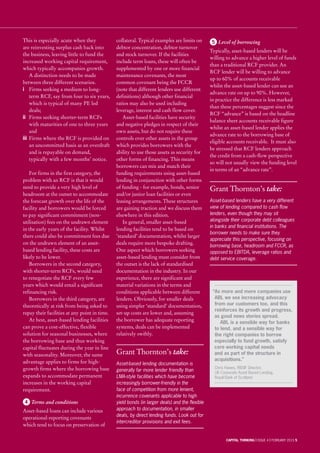
Set out in the table opposite is a simplified
calculation of the eligible assets, the advance
rate, the borrowing base and the headroom.
Borrowers should be aware that the maximum
advance may not always be available for
drawing as lenders may sometimes place an
availability block (suppressed availability)
of 10% to possibly 15% on the facility,
particularly in the absence of a Fixed Charge
Coverage Ratio (FCCR). Some lenders use
the borrowing base to describe the maximum
amount the lender is willing to advance.
Many ABL providers would expect working capital to comprise the
majority of the facilities, with 60% being a good rule of thumb.
Grant Thornton’s take:
ABL is very much a mainstream funding
option in today’s market place. Borrowers and
financial sponsors are becoming increasingly
aware of ABL as a straightforward way to
unlock monetary value and boost liquidity
from the balance sheet that is suitable in a
wide range of scenarios.
The borrowing base, the advance and headroom
£’000
Balance
sheet
Eligible
amount
Advance rate
Maximum
advance
Accounts receivable 50,000 45,000 90% 40,500
Inventory 35,000 20,000 55% 11,000
Plant and equipment 20,000 20,000 60% 12,000
Real estate 25,000 25,000 50% 12,500
Borrowing base 110,000 76,000
Amount drawn 60,000
Headroom 16,000
Calculating the advance: the effective rate	
The amount advanced is a function of
two factors: the advance (or headline)
rate, and the eligible assets to which
that headline rate is applied to arrive at
the effective rate.
In the example of accounts
receivable, the advance rate is the
maximum percentage the lender
is prepared to advance against the
eligible accounts receivable and
typically ranges from as low as 60%
to as much as 95%.
One rule of thumb used in the
industry to gauge the advance rate is
based on the following formula:
1-[2D + 5%] where ‘D’ is dilution
To arrive at the eligible accounts
receivable, the balance sheet figure is
adjusted by deducting excluded debts
and ineligible debts.
The terms ‘dilution’ and
‘ineligible amounts’ are often used
interchangeably however, perhaps a
more correct view is that the former
refer to credits arising against the
receivables ledger (eg credit notes,
damaged or wrong goods delivered)
and therefore take place over a period
of time. In contrast, ineligibles are
immediate deductions made to the
gross balance sheet receivables to
arrive at the eligible amount against
which the advance rate is applied;
these typically include exports or
amounts invoiced in advance.
CAPITAL THINKING | ISSUE 4 | FEBRUARY 2015 3
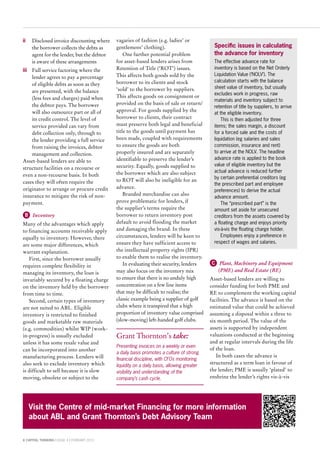
Aspect Asset-based lending Cash flow based lending
Products
Confidential Invoice Discounting (CID), advances against inventory,
Plant, Machinery and Equipment (PME) and Real Estate (RE)
Revolving Credit Facilities (RCF), term loans, unitranche
Leverage Effectively based on advance rate against assets
Based on net debt/EBITDA; ‘leveraged’ transactions
typically begin at 3.0x
Security Fixed and floating charge on all relevant assets
Fixed and floating charge determined by guarantor
coverage (c. 85% of group EBITDA)
Financial covenants
Fixed charge coverage ratio (FCCR) or liquidity (based on
headroom); can also use cash-flow loan financial covenants
Leverage, interest cover, cash flow cover, capex limits
(leveraged loans); incurrence covenants for bonds
Cov-lite deals
‘Springing’ covenant usually based on minimum headroom
(eg  80%)
'Springing' covenant usually based on RCF
utilisation  25%
Information covenants
and reporting
Cash collection (daily), Sales  CNs (weekly), Financials
(monthly), stock  debtor valuations/reconciliations (quarterly),
real estate and PME (annual)
Monthly management accounts, quarterly compliance
certificates, annual financials
Permitted investments/
MA/dividends/capex
Typically no restrictions provided forecast covenant compliance
Negative covenants; incurrence-ratio based (bonds) or
hard-caps (LMA loans), grower baskets (Yankee loans)
Documentation
Wide variation between lenders in respect of both terminology
and commercial issues but documentation far more lender-
friendly than Loan Market Association (LMA) precedents
Medium-sized deals based on LMA precedents whilst
large syndicated deals increasingly mimic high yield
bond terms
1. Asset-based lending vs. cash flow based lending
The corporate lending market falls
into two distinct groups: investment
grade and sub-investment grade.
Asset-based lending is part of the latter,
since it is secured lending in contrast
to investment grade loans, which are
unsecured.
In practice, the credit markets adopt
two approaches to a credit decision: a
cash flow based approach and an asset-
based approach.
Typically, the former is based on the
borrower’s expected (forecast) profits
and cash flow over the life of the loan.
Debt capacity is based on a variety
of financial ratios, primarily leverage
(where debt is calculated as a multiple
of EBITDA), cash flow cover and
interest cover. This approach to lending
is more appropriate for firms which
have few hard assets, but high margins
that can support cash flow based loans.
Conversely, asset-based lending is
based on the value and quality of the
relevant asset relative to the amount
borrowed. The underlying rationale is
that certain assets retain their value over
the business and economic cycle and
can avoid impairment, even if the firm’s
profits are low or declining.
Where both ABL and cash flow
lending exist, each is documented
separately, with separate collateral
pools, different covenants and
asymmetric reporting requirements.Quick comparison
Grant Thornton’s take:
Asset-based lenders have a different
credit focus from cash flow lenders. Given
the availability of both asset-based and
cash flow lending structures, borrowers
should consider both forms of financing
techniques to ensure they obtain the most
competitive and optimal funding packages
available. It’s common to see both asset-
based loans and cash flow based loans in
a capital structure.
Grant Thornton’s take:
If the asset-based lending facilities are solely used for working capital purposes then the company will experience the full benefits this form
of financing offers. Conversely, if they are used for extraneous purposes, the company can find itself in a liquidity trap and it can become
difficult to refinance or replace the facility. Used the right way, ABL is a powerful tool. Not used the right way, then small operational
problems can be significantly amplified.
Liquidity trap?
ABL is predominantly used to help fund working capital, providing liquidity. This liquidity
can be very welcome. It is relatively easy to use and instant. But it can become
permanent – and troublesome if used for the wrong purpose. ABL facilities are not
designed to invest in long-term capital projects, be used for amortisation of term debt
or to fund losses. But the instant liquidity can make it very tempting for companies to
use ABL for non-working capital purposes.
Cash availability under an ABL facility can go down as well as up. The borrowing
base is constantly changing; it is, after all, a revolving facility. On a frequent basis, the
CFO recalculates the borrowing base. If the borrowing base has increased, more can
be drawn down from the facility. If the borrowing base has decreased – a low point in
the working capital cycle – then the CFO may have to repay some of the facility. The
CFO has to make sure the funds are available. If cash receipts have been used for
another purpose, this creates a problem. Borrowing short to fund long is the cause of
many a corporate crisis.
4 CAPITAL THINKING | ISSUE 4 | FEBRUARY 2015
2. Favourable features of ABL
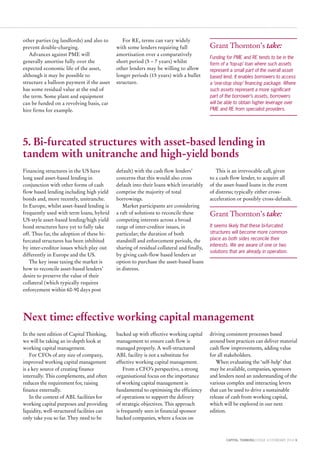
1 Lower funding costs and
lower cost of capital
Currently, asset-based lending
facilities attract lower margins and
non-utilisation fees than comparable
cash-flow based loans. This offers two
significant advantages. First, in funding
the seasonal peaks of the business
(typically funded by a RCF), and
second, in respect of the cost of capital
attributable to the core, or normalised,
working capital (see diagram below).
With respect to the former, the
applicable margin for sub-investment
grade RCFs range from 300bps to 450
bps compared to 200bps to 250bps for
asset-based lending facilities although
this may vary by 50bps at either end
of the range. Similarly non-utilisation
fees for RCFs are usually 40% to
50% of the drawn margin compared
with c. 75bps for asset-based facilities.
However, these fees are generally
charged only where a significant
portion of the facility is expected to
remain undrawn for lengthy periods
and the fees are often calculated on the
difference between the amount drawn
and either the facility limit or a lower,
capped figure.
Where firms have a material investment
in core working capital, the pricing
advantage is much greater if asset-based
lending is used to finance most of the core
working capital.
Since asset-based lenders are often
able to advance a high percentage
against working capital, particularly
debtors, financing a significant
proportion of the core working capital
with asset-based lending could reduce
the cost of capital significantly. This
advantage would be magnified for firms
with high levels of core working capital.
2 Releases cash for investment
and dividends
Whilst most asset-based lending is a
cost-effective method of funding peaks
in the working capital cycle, its primary
benefit is in financing core, or normalised,
working capital. In this respect, ABL
has two significant advantages: first, the
ability to release cash for dividends or to
fund other activities; and second, lower
funding costs. These benefits are best
explained through an example.
A target is acquired which has
normalised accounts receivable of
£20 million. Post-acquisition, the target
refinances the accounts receivable with
an ABL line, which is based on an
advance rate of 85% on eligible accounts
receivable of £18 million.
This releases a cash sum of
c. £15 million (£18 million x 85%)
which the target can use for various
purposes, including funding for further
growth or to repay existing (and more
expensive) long-term loans used to fund
the acquisition. We have often seen this
technique used following the acquisition
of a distressed business to fund
restructuring costs in a turnaround.
3 Built-in growth, seasonality and
continuity of funding
Businesses which are expected to
exhibit strong growth in the medium
term present particular challenges to
funding growth in working capital.
“At their best, ABL facilities provide
flexible funding, with relatively
low cash outflows for debt service,
which in turn frees up cash for
management teams to invest in
growing the business”
Steve Websdale, Managing Director,
ABN Amro Commercial Finance
Grant Thornton’s take:
The availability on an ABL facility will
increase and decrease with changes in
the borrowing base. This can be useful
in businesses with seasonality. However,
it can create difficulties if the borrowing
base suddenly contracts due to an
unforeseen event (insolvency of a major
customer) as liquidity would immediately
contract. A key advantage of a traditional
RCF, from a borrower’s perspective, is
that it is not linked to the borrowing base
and so provides more flexibility in this
regard.
700
760
820
880
940
1000
Dec '15
Nov '15
Oct '15
Sept '15
Aug '15
Jul '15
Jun '15
May '15
Apr '15
Mar '15
Feb '15
Jan '15
800
820 820 820
920
990
930
820 820 820 820 820
Working capital: reduced cost of capital
1. ABL can reduce the funding cost for seasonal peaks
2. ABL also reduces the cost of the core working capital so lower WACC
3. RCFs charge non-utlisation fees on unused commitment
3. Undrawn
commitments
1. Seasonal peak
funded by RCF?
2. Core
(normalised)
working
capital
Note: the average working capital based on monthly figures is 850
Total RCF
CAPITAL THINKING | ISSUE 4 | FEBRUARY 2015 5
This is especially acute when they
are reinvesting surplus cash back into
the business, leaving little to fund the
increased working capital requirement,
which typically accompanies growth.
A distinction needs to be made
between three different scenarios.
i	Firms seeking a medium to long-
term RCF, say from four to six years,
which is typical of many PE led
deals;
ii	Firms seeking shorter-term RCFs
with maturities of one to three years
and
iii	Firms where the RCF is provided on
an uncommitted basis as an overdraft
and is repayable on demand,
typically with a few months’ notice.
For firms in the first category, the
problem with an RCF is that it would
need to provide a very high level of
headroom at the outset to accommodate
the forecast growth over the life of the
facility and borrowers would be forced
to pay significant commitment (non-
utilisation) fees on the undrawn element
in the early years of the facility. Whilst
there could also be commitment fees due
on the undrawn element of an asset-
based lending facility, these costs are
likely to be lower.
Borrowers in the second category,
with shorter-term RCFs, would need
to renegotiate the RCF every few
years which would entail a significant
refinancing risk.
Borrowers in the third category, are
theoretically at risk from being asked to
repay their facilities at any point in time.
At best, asset-based lending facilities
can prove a cost-effective, flexible
solution for seasonal businesses, where
the borrowing base and thus working
capital fluctuates during the year in line
with seasonality. Moreover, the same
advantage applies to firms for high-
growth firms where the borrowing base
expands to accommodate permanent
increases in the working capital
requirement.
4 Terms and conditions
Asset-based loans can include various
operational-reporting covenants
which tend to focus on preservation of
collateral. Typical examples are limits on
debtor concentration, debtor turnover
and stock turnover. If the facilities
include term loans, these will often be
supplemented by one or more financial
maintenance covenants, the most
common covenant being the FCCR
(note that different lenders use different
definitions) although other financial
ratios may also be used including
leverage, interest and cash flow cover.
Asset-based facilities have security
and negative pledges in respect of their
own assets, but do not require these
controls over other assets in the group
which provides borrowers with the
ability to use those assets as security for
other forms of financing. This means
borrowers can mix and match their
funding requirements using asset-based
lending in conjunction with other forms
of funding - for example, bonds, senior
and/or junior loan facilities or even
leasing arrangements. These structures
are gaining traction and we discuss them
elsewhere in this edition.
In general, smaller asset-based
lending facilities tend to be based on
‘standard’ documentation, whilst larger
deals require more bespoke drafting.
One aspect which borrowers seeking
asset-based lending must consider from
the outset is the lack of standardised
documentation in the industry. In our
experience, there are significant and
material variations in the terms and
conditions applicable between different
lenders. Obviously, for smaller deals
using simpler ‘standard’ documentation,
set-up costs are lower and, assuming
the borrower has adequate reporting
systems, deals can be implemented
relatively swiftly.
Grant Thornton’s take:
Asset-based lending documentation is
generally far more lender friendly than
LMA-style facilities which have become
increasingly borrower-friendly in the
face of competition from more lenient,
incurrence covenants applicable to high
yield bonds (in larger deals) and the flexible
approach to documentation, in smaller
deals, by direct lending funds. Look out for
intercreditor provisions and exit fees.
5 Level of borrowing
Typically, asset-based lenders will be
willing to advance a higher level of funds
than a traditional RCF provider. An
RCF lender will be willing to advance
up to 60% of accounts receivable
whilst the asset-based lender can use an
advance rate on up to 90%. However,
in practice the difference is less marked
than these percentages suggest since the
RCF “advance” is based on the headline
balance sheet accounts receivable figure
whilst an asset-based lender applies the
advance rate to the borrowing base of
eligible accounts receivable. It must also
be stressed that RCF lenders approach
the credit from a cash-flow perspective
so will not usually view the funding level
in terms of an “advance rate”.
Grant Thornton’s take:
Asset-based lenders have a very different
view of lending compared to cash flow
lenders, even though they may sit
alongside their corporate debt colleagues
in banks and financial institutions. The
borrower needs to make sure they
appreciate this perspective, focusing on
borrowing base, headroom and FCCR, as
opposed to EBITDA, leverage ratios and
debt service coverage.
“As more and more companies use
ABL we see increasing advocacy
from our customers too, and this
reinforces its growth and progress,
as good news stories spread.
ABL is a sensible way for banks
to lend, and a sensible way for
the right companies to borrow
especially to fund growth, satisfy
core working capital needs
and as part of the structure in
acquisitions.”
Chris Hawes, RBSIF Director,
UK Corporate Asset Based Lending,
Royal Bank of Scotland
6 CAPITAL THINKING | ISSUE 4 | FEBRUARY 2015
3. Use of ABL in transactions
A Acquisitions
The nature of asset-based lending, with
its focus on specific assets, means that
it can be used to fund working capital
alongside other forms of lending,
typically senior and junior debt.
One of the emerging trends,
particularly in private equity led deals, is
the increasing use of asset-based lending
to fund working capital. The main driver
for sponsors is the lower all-in costs of
asset-based lending although the other
advantages discussed earlier are also
important.
In some cases the asset-based lender
can provide a composite, one-stop-
shop package against all of the target’s
eligible current and fixed assets. Whilst
the level of advance against fixed
assets may be lower than other lenders
could provide, the structure offers
the advantages of speed of execution
and simplicity, together with the
other benefits described above. This
structure would be well-suited to firms
with low margins, but solid balance
sheets, with a bias towards working
capital. Many acquisitions experience
unforeseen problems in the initial period
immediately post completion and
asset-based lenders’ focus on assets and
headroom means they may be better able
to accommodate temporary problems.
One issue which borrowers need to
consider is the logistics of using asset-
based lending to finance the deal. The
key issue here is whether the buyer has
sufficient early access to the target to
enable the lender to perform its due
diligence/valuation of the collateral,
conduct its credit process, negotiate the
legal documentation and, in the case of
large deals, arrange syndication. This
could take anything from a month for a
relatively straightforward deal to as long
as ten weeks for a complex, syndicated
transaction.
B  Disposals
Asset-based lending can also play a role
in the disposal process. Many mid-to-
larger auctions use stapled financing (ie
a pre-negotiated term sheet, arranged
by the vendor, which is ‘stapled’ to the
Information Memorandum and offered
to all potential buyers, especially
private equity). A stapled financing
package, which may be provided on
a hard (underwritten terms) or soft
(indicative terms) can offer buyers
(and thus the seller) important benefits
compared to a buyer-originated funding
solution. First, higher leverage, second,
more borrower-friendly terms and
third, accelerated deal execution.
In this context, sellers contemplating
using stapled finance for appropriate
targets should consider that including
asset-based lending as another financing
option. In any event, buyers should also
revisit the target’s asset values to ascertain
whether asset-based lending may be a
better option than a cash flow based
loan as the former could release cash
and reduce debt service by eliminating
amortisation and offering lower margins
on the working capital facilities.
C Refinancings, recapitalisations
and dividends
Traditional banks are usually
understandably wary of recapitalising a
business to allow a dividend to be paid.
In contrast, because asset-based lenders
focus on asset values, provided they
are satisfied that they have adequate
headroom and the business retains
sufficient liquidity, they will be prepared
to recapitalise the business with a higher
level of debt. This includes to refinance
existing, more expensive debt, release
equity to pay a dividend, or to reinvest
in another part of the group.
D Restructurings and turnarounds
Asset-based lending is well suited to
turnaround situations. Where a firm has
experienced distress accompanied by a
sharp decline in profits, the contraction
in EBITDA and the multiple at which a
bank may be willing to lend may leave
the business heavily over-leveraged
on a cash flow basis. This leaves the
borrower exposed either to a financial-
maintenance covenant or, in extremis, a
payment breach either of which could
lead to a loss of control by the owners.
The risk to the borrower will be
magnified if all, or even part, of the loan
is acquired in the secondary market by a
distressed debt fund as they may seek to
use the default to accelerate and enforce
their collateral and acquire control of
the business. Nor is this risk purely
academic (as shown by the recent case of
Ideal Standard).
In contrast, since asset-based lending
is predicated on the value of the assets,
rather than leverage, these lenders’
problems will not arise provided the
borrower’s assets maintain their value
through the economic or business
cycle and provided the business has
sufficient cash to avoid any payment
defaults. In addition, since asset-based
lending facilities include a significant
portion of working capital, the lender’s
exposure should reduce in line with any
contraction in working capital.
Against this background, an asset-
based lending package may prove a
preferable option for an appropriate
borrower with eligible current and fixed
assets, as it could support a much higher
level of leverage.
“Increasingly, there is evidence in multi-
tiered capital structures of ABL sitting
alongside a combination of high yield,
mezzanine and/or bifurcated facilities
including term loan elements provided
by institutional debt funds.”
Adam Johnson, Managing Director,
Corporate Structured Finance, GE Capital
CAPITAL THINKING | ISSUE 4 | FEBRUARY 2015 7
4. Main types of ABL financing
A Accounts receivable (trade debtors)
The financing of accounts receivable
is invariably at the heart of any asset-
based lending package. It is unusual for
an asset-based lending package to be
structured without accounts receivable,
although common exceptions would
apply to businesses which have high
levels of inventory such as retailers.
Advances are structured on a
revolving basis, which is a function of
the advance rate based on the eligible
accounts receivable. The frequency with
which invoices are presented depends
on the nature of the business, but is
either daily or weekly (with monthly
being usually too infrequent). Advance
rates vary, but the headline advance
rate can be as high as 95%. However,
borrowers should focus on the effective
rate, after taking account of ineligible
and aged invoices.
Two main structures have evolved
for funding trade receivables; a loan
structure or a debt purchase structure.
Under the loan structure, to state
the obvious, the asset-based lender
advances a loan to the borrower (who
has originated the receivables) which
is secured against present and future
receivables. The loan is structured on a
revolving basis which fluctuates daily as
new invoices are raised and as payments
are collected from the borrowers’
customers. Market practice is for the
proceeds to be paid into a ‘blocked’
account under the control of the lender.
This is vital as it ensures the lender
will benefit from a fixed, rather than a
floating, charge over the receivables.
Under English law, the holder of
a fixed charge gets paid out of the
proceeds of the sale of their collateral
before all other creditors including
preferential creditors if the originator is
declared insolvent.
The alternative, debt purchase
structure requires an outright sale of
the receivables to the funder/lender, and
can be achieved in the following ways:-
i	Confidential invoice discounting
(CID) where the borrower collects
the debts as agent for the lender
and the debtor is unaware of these
arrangements unless there is default
and subsequent enforcement
Recourse vs. Non-recourse
Borrowers may prefer to structure their
receivables financing on a non-recourse
basis as the cash from sale of the
accounts receivable will reduce debt
either by being used to actually repay
any loans or will reduce ‘Total Net Debt’
(as defined in the loan) by being netted
off against any outstanding debts. To
qualify as a true sale the company
must ensure strict compliance with
GAAP or IFRS, but must also be mindful
that the transaction is not in breach of
any other existing loan obligations.
Non-recourse structures typically
take two forms; non-recourse backed
by credit insurance paid for by the
borrower and non-recourse where
the receivables are purchased at
a discount with no recourse to the
borrower or credit insurance. The latter
is usually reserved for larger firms with
well-established customers.
Who uses ABL?
Preferred sectors
Asset-based lending is best suited to
firms with large asset-rich balance
sheets where at least half the assets
comprise working capital (accounts
receivable and inventory). Many of
these firms will have low margins
and/or fluctuating EBITDA which is
insufficient to support an appropriate
level of borrowing, for their working
capital, on a cash flow basis. Typical
sectors well suited to asset-based
lending are shown in the table below.
The position in the more developed
US market indicates that services,
leasing and the retail sector account
for roughly half of asset-based
lending deal-flow, although oil and
gas together with metals and mining
together account for more than 20%.
Deal size
ABL can accommodate a very wide
range of deal sizes. Traditionally,
smaller corporates were more likely
to make use of asset-based lending,
with providers more comfortable
knowing their loans to smaller,
riskier firms had full collateral
backing.
However, in today’s market
asset-based lending is being widely
used by varying sizes of firms in a
range of circumstances. Very large
deals are syndicated, whilst small
deals are provided on a bilateral
basis. Deals falling in the middle
are usually clubbed between a small
number of providers.
UK Borrowers by sector Q3 Q2014*
Services
Retail
Distribution
Other
Manufacturing
Construction
Transport
29%
24.6%
4%
29.5%
4.6%
7.2%
1.1%
Source: ABFA, October 2014
8 CAPITAL THINKING | ISSUE 4 | FEBRUARY 2015
ii	Disclosed invoice discounting where
the borrower collects the debts as
agent for the lender, but the debtor
is aware of these arrangements
iii	Full service factoring where the
lender agrees to pay a percentage
of eligible debts as soon as they
are presented, with the balance
(less fees and charges) paid when
the debtor pays. The borrower
will also outsource part or all of
its credit control. The level of
service provided can vary from
debt collection only, through to
the lender providing a full service
from raising the invoices, debtor
management and collection.
Asset-based lenders are able to
structure facilities on a recourse or
even a non-recourse basis. In both
cases they will often require the
originator to arrange or procure credit
insurance to mitigate the risk of non-
payment.
B  Inventory
Many of the advantages which apply
to financing accounts receivable apply
equally to inventory. However, there
are some major differences, which
warrant explanation.
First, since the borrower usually
requires complete flexibility in
managing its inventory, the loan is
invariably secured by a floating charge
on the inventory held by the borrower
from time to time.
Second, certain types of inventory
are not suited to ABL. Eligible
inventory is restricted to finished
goods and marketable raw materials
(e.g. commodities) whilst WIP (work-
in-progress) is usually excluded
unless it has some resale value and
can be incorporated into another
manufacturing process. Lenders will
also seek to exclude inventory which
is difficult to sell because it is slow
moving, obsolete or subject to the
vagaries of fashion (e.g. ladies’ or
gentlemens’ clothing).
One further potential problem
for asset-based lenders arises from
Retention of Title (‘ROT’) issues.
This affects both goods sold by the
borrower to its clients and stock
‘sold’ to the borrower by suppliers.
This affects goods on consignment or
provided on the basis of sale or return/
approval. For goods supplied by the
borrower to clients, their contract
must preserve both legal and beneficial
title to the goods until payment has
been made, coupled with requirements
to ensure the goods are both
properly insured and are separately
identifiable to preserve the lender’s
security. Equally, goods supplied to
the borrower which are also subject
to ROT will also be ineligible for an
advance.
Branded merchandise can also
prove problematic for lenders, if
the supplier’s terms require the
borrower to return inventory post
default to avoid flooding the market
and damaging the brand. In these
circumstances, lenders will be keen to
ensure they have sufficient access to
the intellectual property rights (IPR)
to enable them to realise the inventory.
In evaluating their security, lenders
may also focus on the inventory mix
to ensure that there is no unduly high
concentration on a few line items
that may be difficult to realise; the
classic example being a supplier of golf
clubs where it transpired that a high
proportion of inventory value comprised
(slow-moving) left-handed golf clubs.
Grant Thornton’s take:
Presenting invoices on a weekly or even
a daily basis promotes a culture of strong
financial discipline, with CFOs monitoring
liquidity on a daily basis, allowing greater
visibility and understanding of the
company’s cash cycle.
C  Plant, Machinery and Equipment
(PME) and Real Estate (RE)
Asset-based lenders are willing to
consider funding for both PME and
RE to complement the working capital
facilities. The advance is based on the
estimated value that could be achieved
assuming a disposal within a three to
six month period. The value of the
assets is supported by independent
valuations conducted at the beginning
and at regular intervals during the life
of the loan.
In both cases the advance is
structured as a term loan in favour of
the lender; PME is usually ‘plated’ to
enshrine the lender’s rights vis-à-vis
Specific issues in calculating
the advance for inventory
The effective advance rate for
inventory is based on the Net Orderly
Liquidation Value (‘NOLV’). The
calculation starts with the balance
sheet value of inventory, but usually
excludes work in progress, raw
materials and inventory subject to
retention of title by suppliers, to arrive
at the eligible inventory.
This is then adjusted for three
items; the sales margin, a discount
for a forced sale and the costs of
liquidation (eg salaries and sales
commission, insurance and rent)
to arrive at the NOLV. The headline
advance rate is applied to the book
value of eligible inventory but the
actual advance is reduced further
by certain preferential creditors (eg
the prescribed part and employee
preferences) to derive the actual
advance amount.
The “prescribed part” is the
amount set aside for unsecured
creditors from the assets covered by
a floating charge and enjoys priority
vis-à-vis the floating charge holder.
Employees enjoy a preference in
respect of wages and salaries.
Visit the Centre of mid-market Financing for more information
about ABL and Grant Thornton’s Debt Advisory Team
CAPITAL THINKING | ISSUE 4 | FEBRUARY 2014 9
Next time: effective working capital management
In the next edition of Capital Thinking,
we will be taking an in-depth look at
working capital management.
For CFOs of any size of company,
improved working capital management
is a key source of creating finance
internally. This complements, and often
reduces the requirement for, raising
finance externally.
In the context of ABL facilities for
working capital purposes and providing
liquidity, well-structured facilities can
only take you so far. They need to be
backed up with effective working capital
management to ensure cash flow is
managed properly. A well-structured
ABL facility is not a substitute for
effective working capital management.
From a CFO’s perspective, a strong
organisational focus on the importance
of working capital management is
fundamental to optimising the efficiency
of operations to support the delivery
of strategic objectives. This approach
is frequently seen in financial sponsor
backed companies, where a focus on
driving consistent processes based
around best practices can deliver material
cash flow improvements, adding value
for all stakeholders.
When evaluating the ‘self-help’ that
may be available, companies, sponsors
and lenders need an understanding of the
various complex and interacting levers
that can be used to drive a sustainable
release of cash from working capital,
which will be explored in our next
edition.
5. Bi-furcated structures with asset-based lending in
tandem with unitranche and high-yield bonds
Financing structures in the US have
long used asset-based lending in
conjunction with other forms of cash
flow based lending including high yield
bonds and, more recently, unitranche.
In Europe, whilst asset-based lending is
frequently used with term loans, hybrid
US-style asset-based lending/high yield
bond structures have yet to fully take
off. Thus far, the adoption of these bi-
furcated structures has been inhibited
by inter-creditor issues which play out
differently in Europe and the US.
The key issue taxing the market is
how to reconcile asset-based lenders’
desire to preserve the value of their
collateral (which typically requires
enforcement within 60-90 days post
default) with the cash flow lenders’
concerns that this would also cross
default into their loans which invariably
comprise the majority of total
borrowings.
Market participants are considering
a raft of solutions to reconcile these
competing interests across a broad
range of inter-creditor issues, in
particular; the duration of both
standstill and enforcement periods, the
sharing of residual collateral and finally,
by giving cash-flow based lenders an
option to purchase the asset-based loans
in distress.
This is an irrevocable call, given
to a cash flow lender, to acquire all
of the asset-based loans in the event
of distress; typically either cross-
acceleration or possibly cross-default.
Grant Thornton’s take:
It seems likely that these bi-furcated
structures will become more common-
place as both sides reconcile their
interests. We are aware of one or two
solutions that are already in operation.
other parties (eg landlords) and also to
prevent double-charging.
Advances against PME will
generally amortise fully over the
expected economic life of the asset,
although it may be possible to
structure a balloon payment if the asset
has some residual value at the end of
the term. Some plant and equipment
can be funded on a revolving basis, car
hire firms for example.
For RE, terms can vary widely
with some lenders requiring full
amortisation over a comparatively
short period (5 – 7 years) whilst
other lenders may be willing to allow
longer periods (15 years) with a bullet
structure.
Grant Thornton’s take:
Funding for PME and RE tends to be in the
form of a ‘top-up’ loan where such assets
represent a small part of the overall asset-
based lend. It enables borrowers to access
a ‘one-stop shop’ financing package. Where
such assets represent a more significant
part of the borrower’s assets, borrowers
will be able to obtain higher leverage over
PME and RE from specialist providers.
10 CAPITAL THINKING | ISSUE 4 | FEBRUARY 2015
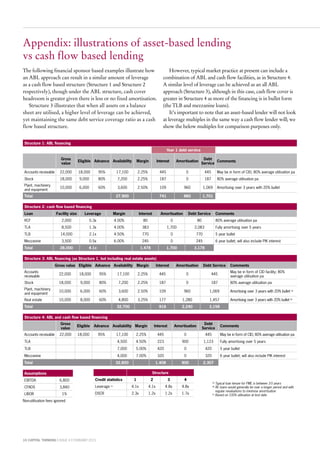
Appendix: illustrations of asset-based lending
vs cash flow based lending
The following financial sponsor based examples illustrate how
an ABL approach can result in a similar amount of leverage
as a cash flow based structure (Structure 1 and Structure 2
respectively), though under the ABL structure, cash cover
headroom is greater given there is less or no fixed amortisation.
Structure 3 illustrates that when all assets on a balance
sheet are utilised, a higher level of leverage can be achieved,
yet maintaining the same debt service coverage ratio as a cash
flow based structure.
However, typical market practice at present can include a
combination of ABL and cash flow facilities, as in Structure 4.
A similar level of leverage can be achieved as an all ABL
approach (Structure 3), although in this case, cash flow cover is
greater in Structure 4 as more of the financing is in bullet form
(the TLB and mezzanine loans).
It’s important to note that an asset-based lender will not look
at leverage multiples in the same way a cash flow lender will; we
show the below multiples for comparison purposes only.
Structure 1: ABL financing
Year 1 debt service
Gross
value
Eligible Advance Availability Margin Interest Amortisation
Debt
Service
Comments
Accounts receivable 22,000 18,000 95% 17,100 2.25% 445 0 445 May be in form of CID; 80% average utilisation pa
Stock 18,000 9,000 80% 7,200 2.25% 187 0 187 80% average utilisation pa
Plant, machinery
and equipment
10,000 6,000 60% 3,600 2.50% 109 960 1,069 Amortising over 3 years with 20% bullet
Total 27,900 741 960 1,701
Structure 2: cash flow based financing
Loan Facility size Leverage Margin Interest Amortisation Debt Service Comments
RCF 2,000 0.3x 4.00% 80 0 80 80% average utilisation pa
TLA 8,500 1.3x 4.00% 383 1,700 2,083 Fully amortising over 5 years
TLB 14,000 2.1x 4.50% 770 0 770 5 year bullet
Mezzanine 3,500 0.5x 6.00% 245 0 245 6 year bullet; will also include PIK interest
Total 28,000 4.1x 1,478 1,700 3,178
Structure 3: ABL financing (as Structure 1, but including real estate assets)
Gross value Eligible Advance Availability Margin Interest Amortisation Debt Service Comments
Accounts
receivable
22,000 18,000 95% 17,100 2.25% 445 0 445
May be in form of CID facility; 80%
average utilisation pa
Stock 18,000 9,000 80% 7,200 2.25% 187 0 187 80% average utilisation pa
Plant, machinery
and equipment
10,000 6,000 60% 3,600 2.50% 109 960 1,069 Amortising over 3 years with 20% bullet (a)
Real estate 10,000 8,000 60% 4,800 3.25% 177 1,280 1,457 Amortising over 3 years with 20% bullet (b)
Total 32,700 918 2,240 3,158
Structure 4: ABL and cash flow based financing
Gross
value
Eligible Advance Availability Margin Interest Amortisation
Debt
Service
Comments
Accounts receivable 22,000 18,000 95% 17,100 2.25% 445 0 445 May be in form of CID; 80% average utilisation pa
TLA 4,500 4.50% 223 900 1,123 Fully amortising over 5 years
TLB 7,000 5.00% 420 0 420 5 year bullet
Mezzanine 4,000 7.00% 320 0 320 6 year bullet; will also include PIK interest
Total 32,600 1,408 900 2,307
Assumptions
EBITDA 6,800
CFADS 3,840
LIBOR 1%
Non-utilisation fees ignored
Structure
Credit statistics 1 2 3 4
Leverage (c)
4.1x 4.1x 4.8x 4.8x
DSCR 2.3x 1.2x 1.2x 1.7x
(a)
Typical loan tenure for PME is between 3-5 years
(b)
RE loans would generally be over a longer period and with
regular revaluations to minimise amortisation
(c)
Based on 100% utilisation at test date
CAPITAL THINKING | ISSUE 4 | FEBRUARY 2015 11
Debt Advisory
London
David Ascott
Partner
T +44 (0)20 7728 2315
M +44 (0)7966 165 585
E david.p.ascott@uk.gt.com
Ven Balakrishnan
Partner
T +44 (0)20 7865 2695
M +44 (0)7771 837 809
E ven.balakrishnan@uk.gt.com
Catherine Barnett
Manager
T +44 (0)20 7728 3278
M +44 (0)7980 870 523
E catherine.barnett@uk.gt.com
Michael Dance
Senior Consultant
T +44 (0)20 7865 2583
M +44 (0)7525 352 760
E michael.dance@uk.gt.com
David Dunckley
Partner
T +44 (0)20 7728 2408
M +44 (0)7977 586 324
E david.dunckley@uk.gt.com
Kathryn Hiddelston
Partner, Head of
Tax Restructuring
T +44 (0)20 7728 2618
M +44 (0)7976 994 321
E kathryn.v.hiddleston@uk.gt.com
William Jeens
Associate Director
T +44 (0)20 7865 2546
M +44 (0)7808 478 783
E william.jeens@uk.gt.com
Christopher McLean
Associate Director
T +44 (0)20 7865 2133
M +44 (0)7825 865 811
E christopher.mclean@uk.gt.com
Tarun Mistry
Partner
T +44 (0)20 7728 2404
M +44 (0)7966 432 299
E tarun.mistry@uk.gt.com
Jonathan Mitra
Associate Director
T +44 (0)20 7865 2407
M +44 (0)7815 144 280
E jonathan.mitra@uk.gt.com
Shaun O’Callaghan
Partner, Head of
Debt Advisory
T +44 (0)20 7865 2887
M +44 (0)7545 301 486
E shaun.m.ocallaghan@uk.gt.com
Mark O’Sullivan
Partner
T +44 (0)20 7728 3014
M +44 (0)7795 491 094
E mark.osullivan@uk.gt.com
Christian Roelofs
Director
T +44 (0)20 7865 2193
M +44 (0)7890 743 786
E christian.d.roelofs@uk.gt.com
Catherine Saunderson
Associate Director
T +44 (0)20 7728 3065
M +44 (0)7827 872 461
E catherine.saunderson@uk.gt.com
Jeremy Toone
Partner
T +44 (0)20 7865 2314
M +44 (0)7970 982 999
E jeremy.m.toone@uk.gt.com
Midlands
and North
Matthew Bryden-Smith
Director
Manchester
T +44(0)161 953 6333
M +44 (0)7760 174 499
E matthew.g.bryden-smith@uk.gt.com
James Bulloss
Associate Director
Leeds/Newcastle
T +44 (0)113 200 1516
M +44 (0)7866 360 241
E james.bulloss@uk.gt.com
Claire Davis
Associate Director
Sheffield
T +44 (0)114 262 9728
M +44 (0)7789 076 601
E claire.e.davis@uk.gt.com
Joe Dyke
Associate Director
Birmingham
T +44 (0)121 232 5210
M +44 (0)7557 012 636
E joe.dyke@uk.gt.com
Richard Goldsack
Director
Leeds
T +44 (0)113 200 2653
M +44 (0)7736 329 722
E richard.goldsack@uk.gt.com
Raj Mittal
Director
Birmingham
T +44 (0)121 232 5177
M +44 (0)7974 026 177
E raj.k.mittal@uk.gt.com
Philip Stephenson
Associate Director
Leeds/Newcastle
T +44 (0)191 203 7791
M +44 (0)7974 379 719
E philip.stephenson@uk.gt.com
Ali Sharifi
Partner, Head of
Corporate Finance Advisory
Manchester
T +44 (0)161 953 6350
M +44 (0)7967 484 182
E ali.sharifi@uk.gt.com
South and
South-West
Nigel Morrison
Partner
Bristol
T +44 (0)117 305 7811
M +44 (0)7976 854 440
E nigel.morrison@uk.gt.com
Jon Nash
Manager
Southampton
T +44 (0)23 8038 1184
M +44 (0)7969 651 108
E jonathan.a.nash@uk.gt.com
Alistair Wardell
Partner
Cardiff
T +44 (0)29 2034 7520
M +44 (0)781 506 2698
E alistair.g.wardell@uk.gt.com
South-East
Richard Lewis
Director
Reading
T +44 ((0)118 983 9651
M +44 (0)7538 551 468
E richard.lewis@uk.gt.com
Phil Sharpe
Director
Cambridge
T +44 (0)1223 225 609
M +44 (0)7798 662 609
E phil.j.sharpe@uk.gt.com
Simon Woodcock
Associate Director
Gatwick
T +44 (0)1293 554 092
M +44 (0)7912 888 669
E simon.woodcock@uk.gt.com
Scotland
Rob Caven
Partner
Glasgow
T +44 (0)141 223 0629
M +44 (0)7774 191 272
E rob.caven@uk.gt.com
John Montague
Director
Edinburgh
T +44 (0)131 659 8530
M +44 (0)7711 137 263
E john.montague@uk.gt.com
CAPITAL THINKING | ISSUE 4 | FEBRUARY 2015 12
Scan to find out more
V24537
© 2015 Grant Thornton UK LLP. All rights reserved.
‘Grant Thornton’ refers to the brand under which the Grant Thornton
member firms provide assurance, tax and advisory services to their
clients and/or refers to one or more member firms, as the context requires.
Grant Thornton UK LLP is a member firm of Grant Thornton International Ltd (GTIL).
GTIL and the member firms are not a worldwide partnership. GTIL and each
member firm is a separate legal entity. Services are delivered by the member
firms. GTIL does not provide services to clients. GTIL and its member firms
are not agents of, and do not obligate, one another and are not liable for one
another’s acts or omissions.
This publication has been prepared only as a guide. No responsibility can be
accepted by us for loss occasioned to any person acting or refraining from
acting as a result of any material in this publication.
grant-thornton.co.uk

Capital Thinking no 4

  • 1.
    CAPITAL THINKING |ISSUE 4 | FEBRUARY 2015 1 What exactly is asset-based lending (ABL)? ABL is a form of secured lending where a loan is advanced against specific assets of the borrower. In practice, the main focus of asset-based lending is on current assets, primarily accounts receivable and inventory. However, asset-based lending often includes fixed assets, particularly plant and equipment and, to a lesser extent, real estate. These latter categories tend to be used in addition to, and in support of working capital facilities rather than on a stand-alone basis, as specialist lenders may be able to structure more favourable financing for fixed assets. Indicative of the new funding landscape in which mid-market CFOs now operate is the increasing use of ABL, particularly by financial sponsors. The mid-market and especially non- sponsor backed firms should understand the power and possibilities offered by ABL, either as an alternative to current sources of financing or as part of a wider financing package. ABL is very attractive and can be suitable across a wide number of situations. It can be an important tool in your capital structure. At the same time, mid-market borrowers must carefully navigate ABL, appreciating the approach of ABL providers and how ABL differs from traditional cash-flow lending. In this edition of Capital Thinking, we look at five areas: 1 Asset-based lending vs cash flow lending 2 Favourable features of asset-based lending 3 Use of asset-based lending in transactions 4 Types of asset-based lending financing 5 Asset-based lending and unitranche structures First though, it is useful to understand the background of asset-based lending. This type of lending originated in the US in the 1980s and has been a well-established part of the financing landscape for many years. In the US, according to Thomson Reuters, reported volumes of asset-based lending were $83 billion in 2013, although this was lower than the historic peak of $101 billion in 2011. ABL has been making steady inroads in the UK/Europe and, according to the Asset Based Finance Association (ABFA), the supply of asset-based finance hit a record high in the UK with £19.3 billion of funding provided to businesses as at 30 September 2014. Just about every lender now has an asset-based financing product, sometimes labelled as structured finance. Why? Cost of capital. A bank’s cost of capital to be precise. The regulatory framework in 2015 sees ABL products carrying a lower cost of capital for a bank, as the loan is directly collateralised. All good for the banks and lenders. Good for corporates too? It certainly can be. Borrowers benefit from a lender’s lower cost of capital in the form of a cheaper margin. ABL products are very flexible and grow with your business. And they go way beyond basic invoice discounting. For CFOs though, buyer beware. The level of funding available goes down, as well as up, with changes in working capital. If you release a one off cash benefit from a new or uprated ABL facility, will your return on that cash be value creating for shareholders? Could you ever afford to not use ABL once you have started? ISSUE 4 FEBRUARY 2015 Capital Thinking Cheap, flexible and in fashion: CFOs are increasingly being offered asset-based lending solutions by both specialists and mainstream banks. Why wouldn’t you use it? We discuss the positives and negatives of ABL. Asset-backed lending Asset-backed lending usually involves some form of securitisation, in which a number of small, individual illiquid assets are sold by their originators (usually a financial institution) to an SPV, which in-turn issues fixed-rate securities to investors. These asset-backed securities (ABS) are serviced by the cash flow from the assets pooled in the SPV, which also serve as collateral for the ABS. The types of assets which lend themselves to these structures are very broad but the most common examples are receivables from credit cards, motor vehicle leases and residential and commercial mortgages. Asset finance Asset finance often refers to leasing and similar structures where the asset is owned by the lessor and leased to the lessee/ borrower. In many cases, this technique is used for big-ticket items such as aircraft, ships and railway equipment, although leasing is also widely used for a wide range of much smaller value assets, with motor vehicles being an obvious example. Some asset financed deals may also be structured using a more traditional loan structure. Much of this growth has been driven by private equity firms, which have increasingly recognised the benefits of ABL. In contrast, many corporates seem less aware of the benefits. A recent report from Lloyds Bank noted that UK SMEs have £770 billion of untapped assets that could be used to fund growth.
  • 2.
    2 CAPITAL THINKING| ISSUE 4 | FEBRUARY 2015 Three factors may explain this conundrum: first, a lack of familiarity, if not confusion, with the ABL offering; second, reluctance on the part of borrowers to abandon their traditional bank lenders; and last, an outdated perception on terms such as price. Although ABL is unregulated in the UK, it is regulated in some EU countries, notably Germany and France. In addition, in an effort to promote best practice, ABFA introduced a self- regulatory framework in the UK and Republic of Ireland on 1 July 2013. Asset-based lending is often confused with other forms of finance, particularly asset-backed lending and asset finance. However, as we discuss, these are significantly different from true asset- based lending, which focuses on working capital items on balance sheet. For true ABL, advances against working capital are structured on a revolving basis, whilst loans against hard assets are frequently provided as term loans (usually as a ‘top-up’ loan). In general, where asset-based lenders are providing a one-stop-shop financing package for working capital and other fixed assets, the working capital portion should comprise at least 60% of the total funding, and other assets usually 30% to 40%. Asset-based lending rests on three, inter-connected pillars: 1 the ‘borrowing base’: comprises the eligible assets, which are available to the lender as collateral and excludes ineligible assets such as inter-company receivables and aged receivables 2 the ‘advance rate’: the maximum percentage of the current borrowing base that the lender is prepared to advance to the borrower. Whilst the advance rate generally remains fixed, the size of the loan will fluctuate in line with underlying changes in the current assets included in the borrowing base 3 ‘headroom’: the difference between the maximum amount of the advance (or the facility limit, if lower) and the actual amount drawn. Borrowing base, the advance and headroom Set out in the table opposite is a simplified calculation of the eligible assets, the advance rate, the borrowing base and the headroom. Borrowers should be aware that the maximum advance may not always be available for drawing as lenders may sometimes place an availability block (suppressed availability) of 10% to possibly 15% on the facility, particularly in the absence of a Fixed Charge Coverage Ratio (FCCR). Some lenders use the borrowing base to describe the maximum amount the lender is willing to advance. Many ABL providers would expect working capital to comprise the majority of the facilities, with 60% being a good rule of thumb. Grant Thornton’s take: ABL is very much a mainstream funding option in today’s market place. Borrowers and financial sponsors are becoming increasingly aware of ABL as a straightforward way to unlock monetary value and boost liquidity from the balance sheet that is suitable in a wide range of scenarios. The borrowing base, the advance and headroom £’000 Balance sheet Eligible amount Advance rate Maximum advance Accounts receivable 50,000 45,000 90% 40,500 Inventory 35,000 20,000 55% 11,000 Plant and equipment 20,000 20,000 60% 12,000 Real estate 25,000 25,000 50% 12,500 Borrowing base 110,000 76,000 Amount drawn 60,000 Headroom 16,000 Calculating the advance: the effective rate The amount advanced is a function of two factors: the advance (or headline) rate, and the eligible assets to which that headline rate is applied to arrive at the effective rate. In the example of accounts receivable, the advance rate is the maximum percentage the lender is prepared to advance against the eligible accounts receivable and typically ranges from as low as 60% to as much as 95%. One rule of thumb used in the industry to gauge the advance rate is based on the following formula: 1-[2D + 5%] where ‘D’ is dilution To arrive at the eligible accounts receivable, the balance sheet figure is adjusted by deducting excluded debts and ineligible debts. The terms ‘dilution’ and ‘ineligible amounts’ are often used interchangeably however, perhaps a more correct view is that the former refer to credits arising against the receivables ledger (eg credit notes, damaged or wrong goods delivered) and therefore take place over a period of time. In contrast, ineligibles are immediate deductions made to the gross balance sheet receivables to arrive at the eligible amount against which the advance rate is applied; these typically include exports or amounts invoiced in advance.
  • 3.
    CAPITAL THINKING |ISSUE 4 | FEBRUARY 2015 3 Aspect Asset-based lending Cash flow based lending Products Confidential Invoice Discounting (CID), advances against inventory, Plant, Machinery and Equipment (PME) and Real Estate (RE) Revolving Credit Facilities (RCF), term loans, unitranche Leverage Effectively based on advance rate against assets Based on net debt/EBITDA; ‘leveraged’ transactions typically begin at 3.0x Security Fixed and floating charge on all relevant assets Fixed and floating charge determined by guarantor coverage (c. 85% of group EBITDA) Financial covenants Fixed charge coverage ratio (FCCR) or liquidity (based on headroom); can also use cash-flow loan financial covenants Leverage, interest cover, cash flow cover, capex limits (leveraged loans); incurrence covenants for bonds Cov-lite deals ‘Springing’ covenant usually based on minimum headroom (eg 80%) 'Springing' covenant usually based on RCF utilisation 25% Information covenants and reporting Cash collection (daily), Sales CNs (weekly), Financials (monthly), stock debtor valuations/reconciliations (quarterly), real estate and PME (annual) Monthly management accounts, quarterly compliance certificates, annual financials Permitted investments/ MA/dividends/capex Typically no restrictions provided forecast covenant compliance Negative covenants; incurrence-ratio based (bonds) or hard-caps (LMA loans), grower baskets (Yankee loans) Documentation Wide variation between lenders in respect of both terminology and commercial issues but documentation far more lender- friendly than Loan Market Association (LMA) precedents Medium-sized deals based on LMA precedents whilst large syndicated deals increasingly mimic high yield bond terms 1. Asset-based lending vs. cash flow based lending The corporate lending market falls into two distinct groups: investment grade and sub-investment grade. Asset-based lending is part of the latter, since it is secured lending in contrast to investment grade loans, which are unsecured. In practice, the credit markets adopt two approaches to a credit decision: a cash flow based approach and an asset- based approach. Typically, the former is based on the borrower’s expected (forecast) profits and cash flow over the life of the loan. Debt capacity is based on a variety of financial ratios, primarily leverage (where debt is calculated as a multiple of EBITDA), cash flow cover and interest cover. This approach to lending is more appropriate for firms which have few hard assets, but high margins that can support cash flow based loans. Conversely, asset-based lending is based on the value and quality of the relevant asset relative to the amount borrowed. The underlying rationale is that certain assets retain their value over the business and economic cycle and can avoid impairment, even if the firm’s profits are low or declining. Where both ABL and cash flow lending exist, each is documented separately, with separate collateral pools, different covenants and asymmetric reporting requirements.Quick comparison Grant Thornton’s take: Asset-based lenders have a different credit focus from cash flow lenders. Given the availability of both asset-based and cash flow lending structures, borrowers should consider both forms of financing techniques to ensure they obtain the most competitive and optimal funding packages available. It’s common to see both asset- based loans and cash flow based loans in a capital structure. Grant Thornton’s take: If the asset-based lending facilities are solely used for working capital purposes then the company will experience the full benefits this form of financing offers. Conversely, if they are used for extraneous purposes, the company can find itself in a liquidity trap and it can become difficult to refinance or replace the facility. Used the right way, ABL is a powerful tool. Not used the right way, then small operational problems can be significantly amplified. Liquidity trap? ABL is predominantly used to help fund working capital, providing liquidity. This liquidity can be very welcome. It is relatively easy to use and instant. But it can become permanent – and troublesome if used for the wrong purpose. ABL facilities are not designed to invest in long-term capital projects, be used for amortisation of term debt or to fund losses. But the instant liquidity can make it very tempting for companies to use ABL for non-working capital purposes. Cash availability under an ABL facility can go down as well as up. The borrowing base is constantly changing; it is, after all, a revolving facility. On a frequent basis, the CFO recalculates the borrowing base. If the borrowing base has increased, more can be drawn down from the facility. If the borrowing base has decreased – a low point in the working capital cycle – then the CFO may have to repay some of the facility. The CFO has to make sure the funds are available. If cash receipts have been used for another purpose, this creates a problem. Borrowing short to fund long is the cause of many a corporate crisis.
  • 4.
    4 CAPITAL THINKING| ISSUE 4 | FEBRUARY 2015 2. Favourable features of ABL 1 Lower funding costs and lower cost of capital Currently, asset-based lending facilities attract lower margins and non-utilisation fees than comparable cash-flow based loans. This offers two significant advantages. First, in funding the seasonal peaks of the business (typically funded by a RCF), and second, in respect of the cost of capital attributable to the core, or normalised, working capital (see diagram below). With respect to the former, the applicable margin for sub-investment grade RCFs range from 300bps to 450 bps compared to 200bps to 250bps for asset-based lending facilities although this may vary by 50bps at either end of the range. Similarly non-utilisation fees for RCFs are usually 40% to 50% of the drawn margin compared with c. 75bps for asset-based facilities. However, these fees are generally charged only where a significant portion of the facility is expected to remain undrawn for lengthy periods and the fees are often calculated on the difference between the amount drawn and either the facility limit or a lower, capped figure. Where firms have a material investment in core working capital, the pricing advantage is much greater if asset-based lending is used to finance most of the core working capital. Since asset-based lenders are often able to advance a high percentage against working capital, particularly debtors, financing a significant proportion of the core working capital with asset-based lending could reduce the cost of capital significantly. This advantage would be magnified for firms with high levels of core working capital. 2 Releases cash for investment and dividends Whilst most asset-based lending is a cost-effective method of funding peaks in the working capital cycle, its primary benefit is in financing core, or normalised, working capital. In this respect, ABL has two significant advantages: first, the ability to release cash for dividends or to fund other activities; and second, lower funding costs. These benefits are best explained through an example. A target is acquired which has normalised accounts receivable of £20 million. Post-acquisition, the target refinances the accounts receivable with an ABL line, which is based on an advance rate of 85% on eligible accounts receivable of £18 million. This releases a cash sum of c. £15 million (£18 million x 85%) which the target can use for various purposes, including funding for further growth or to repay existing (and more expensive) long-term loans used to fund the acquisition. We have often seen this technique used following the acquisition of a distressed business to fund restructuring costs in a turnaround. 3 Built-in growth, seasonality and continuity of funding Businesses which are expected to exhibit strong growth in the medium term present particular challenges to funding growth in working capital. “At their best, ABL facilities provide flexible funding, with relatively low cash outflows for debt service, which in turn frees up cash for management teams to invest in growing the business” Steve Websdale, Managing Director, ABN Amro Commercial Finance Grant Thornton’s take: The availability on an ABL facility will increase and decrease with changes in the borrowing base. This can be useful in businesses with seasonality. However, it can create difficulties if the borrowing base suddenly contracts due to an unforeseen event (insolvency of a major customer) as liquidity would immediately contract. A key advantage of a traditional RCF, from a borrower’s perspective, is that it is not linked to the borrowing base and so provides more flexibility in this regard. 700 760 820 880 940 1000 Dec '15 Nov '15 Oct '15 Sept '15 Aug '15 Jul '15 Jun '15 May '15 Apr '15 Mar '15 Feb '15 Jan '15 800 820 820 820 920 990 930 820 820 820 820 820 Working capital: reduced cost of capital 1. ABL can reduce the funding cost for seasonal peaks 2. ABL also reduces the cost of the core working capital so lower WACC 3. RCFs charge non-utlisation fees on unused commitment 3. Undrawn commitments 1. Seasonal peak funded by RCF? 2. Core (normalised) working capital Note: the average working capital based on monthly figures is 850 Total RCF
  • 5.
    CAPITAL THINKING |ISSUE 4 | FEBRUARY 2015 5 This is especially acute when they are reinvesting surplus cash back into the business, leaving little to fund the increased working capital requirement, which typically accompanies growth. A distinction needs to be made between three different scenarios. i Firms seeking a medium to long- term RCF, say from four to six years, which is typical of many PE led deals; ii Firms seeking shorter-term RCFs with maturities of one to three years and iii Firms where the RCF is provided on an uncommitted basis as an overdraft and is repayable on demand, typically with a few months’ notice. For firms in the first category, the problem with an RCF is that it would need to provide a very high level of headroom at the outset to accommodate the forecast growth over the life of the facility and borrowers would be forced to pay significant commitment (non- utilisation) fees on the undrawn element in the early years of the facility. Whilst there could also be commitment fees due on the undrawn element of an asset- based lending facility, these costs are likely to be lower. Borrowers in the second category, with shorter-term RCFs, would need to renegotiate the RCF every few years which would entail a significant refinancing risk. Borrowers in the third category, are theoretically at risk from being asked to repay their facilities at any point in time. At best, asset-based lending facilities can prove a cost-effective, flexible solution for seasonal businesses, where the borrowing base and thus working capital fluctuates during the year in line with seasonality. Moreover, the same advantage applies to firms for high- growth firms where the borrowing base expands to accommodate permanent increases in the working capital requirement. 4 Terms and conditions Asset-based loans can include various operational-reporting covenants which tend to focus on preservation of collateral. Typical examples are limits on debtor concentration, debtor turnover and stock turnover. If the facilities include term loans, these will often be supplemented by one or more financial maintenance covenants, the most common covenant being the FCCR (note that different lenders use different definitions) although other financial ratios may also be used including leverage, interest and cash flow cover. Asset-based facilities have security and negative pledges in respect of their own assets, but do not require these controls over other assets in the group which provides borrowers with the ability to use those assets as security for other forms of financing. This means borrowers can mix and match their funding requirements using asset-based lending in conjunction with other forms of funding - for example, bonds, senior and/or junior loan facilities or even leasing arrangements. These structures are gaining traction and we discuss them elsewhere in this edition. In general, smaller asset-based lending facilities tend to be based on ‘standard’ documentation, whilst larger deals require more bespoke drafting. One aspect which borrowers seeking asset-based lending must consider from the outset is the lack of standardised documentation in the industry. In our experience, there are significant and material variations in the terms and conditions applicable between different lenders. Obviously, for smaller deals using simpler ‘standard’ documentation, set-up costs are lower and, assuming the borrower has adequate reporting systems, deals can be implemented relatively swiftly. Grant Thornton’s take: Asset-based lending documentation is generally far more lender friendly than LMA-style facilities which have become increasingly borrower-friendly in the face of competition from more lenient, incurrence covenants applicable to high yield bonds (in larger deals) and the flexible approach to documentation, in smaller deals, by direct lending funds. Look out for intercreditor provisions and exit fees. 5 Level of borrowing Typically, asset-based lenders will be willing to advance a higher level of funds than a traditional RCF provider. An RCF lender will be willing to advance up to 60% of accounts receivable whilst the asset-based lender can use an advance rate on up to 90%. However, in practice the difference is less marked than these percentages suggest since the RCF “advance” is based on the headline balance sheet accounts receivable figure whilst an asset-based lender applies the advance rate to the borrowing base of eligible accounts receivable. It must also be stressed that RCF lenders approach the credit from a cash-flow perspective so will not usually view the funding level in terms of an “advance rate”. Grant Thornton’s take: Asset-based lenders have a very different view of lending compared to cash flow lenders, even though they may sit alongside their corporate debt colleagues in banks and financial institutions. The borrower needs to make sure they appreciate this perspective, focusing on borrowing base, headroom and FCCR, as opposed to EBITDA, leverage ratios and debt service coverage. “As more and more companies use ABL we see increasing advocacy from our customers too, and this reinforces its growth and progress, as good news stories spread. ABL is a sensible way for banks to lend, and a sensible way for the right companies to borrow especially to fund growth, satisfy core working capital needs and as part of the structure in acquisitions.” Chris Hawes, RBSIF Director, UK Corporate Asset Based Lending, Royal Bank of Scotland
  • 6.
    6 CAPITAL THINKING| ISSUE 4 | FEBRUARY 2015 3. Use of ABL in transactions A Acquisitions The nature of asset-based lending, with its focus on specific assets, means that it can be used to fund working capital alongside other forms of lending, typically senior and junior debt. One of the emerging trends, particularly in private equity led deals, is the increasing use of asset-based lending to fund working capital. The main driver for sponsors is the lower all-in costs of asset-based lending although the other advantages discussed earlier are also important. In some cases the asset-based lender can provide a composite, one-stop- shop package against all of the target’s eligible current and fixed assets. Whilst the level of advance against fixed assets may be lower than other lenders could provide, the structure offers the advantages of speed of execution and simplicity, together with the other benefits described above. This structure would be well-suited to firms with low margins, but solid balance sheets, with a bias towards working capital. Many acquisitions experience unforeseen problems in the initial period immediately post completion and asset-based lenders’ focus on assets and headroom means they may be better able to accommodate temporary problems. One issue which borrowers need to consider is the logistics of using asset- based lending to finance the deal. The key issue here is whether the buyer has sufficient early access to the target to enable the lender to perform its due diligence/valuation of the collateral, conduct its credit process, negotiate the legal documentation and, in the case of large deals, arrange syndication. This could take anything from a month for a relatively straightforward deal to as long as ten weeks for a complex, syndicated transaction. B Disposals Asset-based lending can also play a role in the disposal process. Many mid-to- larger auctions use stapled financing (ie a pre-negotiated term sheet, arranged by the vendor, which is ‘stapled’ to the Information Memorandum and offered to all potential buyers, especially private equity). A stapled financing package, which may be provided on a hard (underwritten terms) or soft (indicative terms) can offer buyers (and thus the seller) important benefits compared to a buyer-originated funding solution. First, higher leverage, second, more borrower-friendly terms and third, accelerated deal execution. In this context, sellers contemplating using stapled finance for appropriate targets should consider that including asset-based lending as another financing option. In any event, buyers should also revisit the target’s asset values to ascertain whether asset-based lending may be a better option than a cash flow based loan as the former could release cash and reduce debt service by eliminating amortisation and offering lower margins on the working capital facilities. C Refinancings, recapitalisations and dividends Traditional banks are usually understandably wary of recapitalising a business to allow a dividend to be paid. In contrast, because asset-based lenders focus on asset values, provided they are satisfied that they have adequate headroom and the business retains sufficient liquidity, they will be prepared to recapitalise the business with a higher level of debt. This includes to refinance existing, more expensive debt, release equity to pay a dividend, or to reinvest in another part of the group. D Restructurings and turnarounds Asset-based lending is well suited to turnaround situations. Where a firm has experienced distress accompanied by a sharp decline in profits, the contraction in EBITDA and the multiple at which a bank may be willing to lend may leave the business heavily over-leveraged on a cash flow basis. This leaves the borrower exposed either to a financial- maintenance covenant or, in extremis, a payment breach either of which could lead to a loss of control by the owners. The risk to the borrower will be magnified if all, or even part, of the loan is acquired in the secondary market by a distressed debt fund as they may seek to use the default to accelerate and enforce their collateral and acquire control of the business. Nor is this risk purely academic (as shown by the recent case of Ideal Standard). In contrast, since asset-based lending is predicated on the value of the assets, rather than leverage, these lenders’ problems will not arise provided the borrower’s assets maintain their value through the economic or business cycle and provided the business has sufficient cash to avoid any payment defaults. In addition, since asset-based lending facilities include a significant portion of working capital, the lender’s exposure should reduce in line with any contraction in working capital. Against this background, an asset- based lending package may prove a preferable option for an appropriate borrower with eligible current and fixed assets, as it could support a much higher level of leverage. “Increasingly, there is evidence in multi- tiered capital structures of ABL sitting alongside a combination of high yield, mezzanine and/or bifurcated facilities including term loan elements provided by institutional debt funds.” Adam Johnson, Managing Director, Corporate Structured Finance, GE Capital
  • 7.
    CAPITAL THINKING |ISSUE 4 | FEBRUARY 2015 7 4. Main types of ABL financing A Accounts receivable (trade debtors) The financing of accounts receivable is invariably at the heart of any asset- based lending package. It is unusual for an asset-based lending package to be structured without accounts receivable, although common exceptions would apply to businesses which have high levels of inventory such as retailers. Advances are structured on a revolving basis, which is a function of the advance rate based on the eligible accounts receivable. The frequency with which invoices are presented depends on the nature of the business, but is either daily or weekly (with monthly being usually too infrequent). Advance rates vary, but the headline advance rate can be as high as 95%. However, borrowers should focus on the effective rate, after taking account of ineligible and aged invoices. Two main structures have evolved for funding trade receivables; a loan structure or a debt purchase structure. Under the loan structure, to state the obvious, the asset-based lender advances a loan to the borrower (who has originated the receivables) which is secured against present and future receivables. The loan is structured on a revolving basis which fluctuates daily as new invoices are raised and as payments are collected from the borrowers’ customers. Market practice is for the proceeds to be paid into a ‘blocked’ account under the control of the lender. This is vital as it ensures the lender will benefit from a fixed, rather than a floating, charge over the receivables. Under English law, the holder of a fixed charge gets paid out of the proceeds of the sale of their collateral before all other creditors including preferential creditors if the originator is declared insolvent. The alternative, debt purchase structure requires an outright sale of the receivables to the funder/lender, and can be achieved in the following ways:- i Confidential invoice discounting (CID) where the borrower collects the debts as agent for the lender and the debtor is unaware of these arrangements unless there is default and subsequent enforcement Recourse vs. Non-recourse Borrowers may prefer to structure their receivables financing on a non-recourse basis as the cash from sale of the accounts receivable will reduce debt either by being used to actually repay any loans or will reduce ‘Total Net Debt’ (as defined in the loan) by being netted off against any outstanding debts. To qualify as a true sale the company must ensure strict compliance with GAAP or IFRS, but must also be mindful that the transaction is not in breach of any other existing loan obligations. Non-recourse structures typically take two forms; non-recourse backed by credit insurance paid for by the borrower and non-recourse where the receivables are purchased at a discount with no recourse to the borrower or credit insurance. The latter is usually reserved for larger firms with well-established customers. Who uses ABL? Preferred sectors Asset-based lending is best suited to firms with large asset-rich balance sheets where at least half the assets comprise working capital (accounts receivable and inventory). Many of these firms will have low margins and/or fluctuating EBITDA which is insufficient to support an appropriate level of borrowing, for their working capital, on a cash flow basis. Typical sectors well suited to asset-based lending are shown in the table below. The position in the more developed US market indicates that services, leasing and the retail sector account for roughly half of asset-based lending deal-flow, although oil and gas together with metals and mining together account for more than 20%. Deal size ABL can accommodate a very wide range of deal sizes. Traditionally, smaller corporates were more likely to make use of asset-based lending, with providers more comfortable knowing their loans to smaller, riskier firms had full collateral backing. However, in today’s market asset-based lending is being widely used by varying sizes of firms in a range of circumstances. Very large deals are syndicated, whilst small deals are provided on a bilateral basis. Deals falling in the middle are usually clubbed between a small number of providers. UK Borrowers by sector Q3 Q2014* Services Retail Distribution Other Manufacturing Construction Transport 29% 24.6% 4% 29.5% 4.6% 7.2% 1.1% Source: ABFA, October 2014
  • 8.
    8 CAPITAL THINKING| ISSUE 4 | FEBRUARY 2015 ii Disclosed invoice discounting where the borrower collects the debts as agent for the lender, but the debtor is aware of these arrangements iii Full service factoring where the lender agrees to pay a percentage of eligible debts as soon as they are presented, with the balance (less fees and charges) paid when the debtor pays. The borrower will also outsource part or all of its credit control. The level of service provided can vary from debt collection only, through to the lender providing a full service from raising the invoices, debtor management and collection. Asset-based lenders are able to structure facilities on a recourse or even a non-recourse basis. In both cases they will often require the originator to arrange or procure credit insurance to mitigate the risk of non- payment. B Inventory Many of the advantages which apply to financing accounts receivable apply equally to inventory. However, there are some major differences, which warrant explanation. First, since the borrower usually requires complete flexibility in managing its inventory, the loan is invariably secured by a floating charge on the inventory held by the borrower from time to time. Second, certain types of inventory are not suited to ABL. Eligible inventory is restricted to finished goods and marketable raw materials (e.g. commodities) whilst WIP (work- in-progress) is usually excluded unless it has some resale value and can be incorporated into another manufacturing process. Lenders will also seek to exclude inventory which is difficult to sell because it is slow moving, obsolete or subject to the vagaries of fashion (e.g. ladies’ or gentlemens’ clothing). One further potential problem for asset-based lenders arises from Retention of Title (‘ROT’) issues. This affects both goods sold by the borrower to its clients and stock ‘sold’ to the borrower by suppliers. This affects goods on consignment or provided on the basis of sale or return/ approval. For goods supplied by the borrower to clients, their contract must preserve both legal and beneficial title to the goods until payment has been made, coupled with requirements to ensure the goods are both properly insured and are separately identifiable to preserve the lender’s security. Equally, goods supplied to the borrower which are also subject to ROT will also be ineligible for an advance. Branded merchandise can also prove problematic for lenders, if the supplier’s terms require the borrower to return inventory post default to avoid flooding the market and damaging the brand. In these circumstances, lenders will be keen to ensure they have sufficient access to the intellectual property rights (IPR) to enable them to realise the inventory. In evaluating their security, lenders may also focus on the inventory mix to ensure that there is no unduly high concentration on a few line items that may be difficult to realise; the classic example being a supplier of golf clubs where it transpired that a high proportion of inventory value comprised (slow-moving) left-handed golf clubs. Grant Thornton’s take: Presenting invoices on a weekly or even a daily basis promotes a culture of strong financial discipline, with CFOs monitoring liquidity on a daily basis, allowing greater visibility and understanding of the company’s cash cycle. C Plant, Machinery and Equipment (PME) and Real Estate (RE) Asset-based lenders are willing to consider funding for both PME and RE to complement the working capital facilities. The advance is based on the estimated value that could be achieved assuming a disposal within a three to six month period. The value of the assets is supported by independent valuations conducted at the beginning and at regular intervals during the life of the loan. In both cases the advance is structured as a term loan in favour of the lender; PME is usually ‘plated’ to enshrine the lender’s rights vis-à-vis Specific issues in calculating the advance for inventory The effective advance rate for inventory is based on the Net Orderly Liquidation Value (‘NOLV’). The calculation starts with the balance sheet value of inventory, but usually excludes work in progress, raw materials and inventory subject to retention of title by suppliers, to arrive at the eligible inventory. This is then adjusted for three items; the sales margin, a discount for a forced sale and the costs of liquidation (eg salaries and sales commission, insurance and rent) to arrive at the NOLV. The headline advance rate is applied to the book value of eligible inventory but the actual advance is reduced further by certain preferential creditors (eg the prescribed part and employee preferences) to derive the actual advance amount. The “prescribed part” is the amount set aside for unsecured creditors from the assets covered by a floating charge and enjoys priority vis-à-vis the floating charge holder. Employees enjoy a preference in respect of wages and salaries. Visit the Centre of mid-market Financing for more information about ABL and Grant Thornton’s Debt Advisory Team
  • 9.
    CAPITAL THINKING |ISSUE 4 | FEBRUARY 2014 9 Next time: effective working capital management In the next edition of Capital Thinking, we will be taking an in-depth look at working capital management. For CFOs of any size of company, improved working capital management is a key source of creating finance internally. This complements, and often reduces the requirement for, raising finance externally. In the context of ABL facilities for working capital purposes and providing liquidity, well-structured facilities can only take you so far. They need to be backed up with effective working capital management to ensure cash flow is managed properly. A well-structured ABL facility is not a substitute for effective working capital management. From a CFO’s perspective, a strong organisational focus on the importance of working capital management is fundamental to optimising the efficiency of operations to support the delivery of strategic objectives. This approach is frequently seen in financial sponsor backed companies, where a focus on driving consistent processes based around best practices can deliver material cash flow improvements, adding value for all stakeholders. When evaluating the ‘self-help’ that may be available, companies, sponsors and lenders need an understanding of the various complex and interacting levers that can be used to drive a sustainable release of cash from working capital, which will be explored in our next edition. 5. Bi-furcated structures with asset-based lending in tandem with unitranche and high-yield bonds Financing structures in the US have long used asset-based lending in conjunction with other forms of cash flow based lending including high yield bonds and, more recently, unitranche. In Europe, whilst asset-based lending is frequently used with term loans, hybrid US-style asset-based lending/high yield bond structures have yet to fully take off. Thus far, the adoption of these bi- furcated structures has been inhibited by inter-creditor issues which play out differently in Europe and the US. The key issue taxing the market is how to reconcile asset-based lenders’ desire to preserve the value of their collateral (which typically requires enforcement within 60-90 days post default) with the cash flow lenders’ concerns that this would also cross default into their loans which invariably comprise the majority of total borrowings. Market participants are considering a raft of solutions to reconcile these competing interests across a broad range of inter-creditor issues, in particular; the duration of both standstill and enforcement periods, the sharing of residual collateral and finally, by giving cash-flow based lenders an option to purchase the asset-based loans in distress. This is an irrevocable call, given to a cash flow lender, to acquire all of the asset-based loans in the event of distress; typically either cross- acceleration or possibly cross-default. Grant Thornton’s take: It seems likely that these bi-furcated structures will become more common- place as both sides reconcile their interests. We are aware of one or two solutions that are already in operation. other parties (eg landlords) and also to prevent double-charging. Advances against PME will generally amortise fully over the expected economic life of the asset, although it may be possible to structure a balloon payment if the asset has some residual value at the end of the term. Some plant and equipment can be funded on a revolving basis, car hire firms for example. For RE, terms can vary widely with some lenders requiring full amortisation over a comparatively short period (5 – 7 years) whilst other lenders may be willing to allow longer periods (15 years) with a bullet structure. Grant Thornton’s take: Funding for PME and RE tends to be in the form of a ‘top-up’ loan where such assets represent a small part of the overall asset- based lend. It enables borrowers to access a ‘one-stop shop’ financing package. Where such assets represent a more significant part of the borrower’s assets, borrowers will be able to obtain higher leverage over PME and RE from specialist providers.
  • 10.
    10 CAPITAL THINKING| ISSUE 4 | FEBRUARY 2015 Appendix: illustrations of asset-based lending vs cash flow based lending The following financial sponsor based examples illustrate how an ABL approach can result in a similar amount of leverage as a cash flow based structure (Structure 1 and Structure 2 respectively), though under the ABL structure, cash cover headroom is greater given there is less or no fixed amortisation. Structure 3 illustrates that when all assets on a balance sheet are utilised, a higher level of leverage can be achieved, yet maintaining the same debt service coverage ratio as a cash flow based structure. However, typical market practice at present can include a combination of ABL and cash flow facilities, as in Structure 4. A similar level of leverage can be achieved as an all ABL approach (Structure 3), although in this case, cash flow cover is greater in Structure 4 as more of the financing is in bullet form (the TLB and mezzanine loans). It’s important to note that an asset-based lender will not look at leverage multiples in the same way a cash flow lender will; we show the below multiples for comparison purposes only. Structure 1: ABL financing Year 1 debt service Gross value Eligible Advance Availability Margin Interest Amortisation Debt Service Comments Accounts receivable 22,000 18,000 95% 17,100 2.25% 445 0 445 May be in form of CID; 80% average utilisation pa Stock 18,000 9,000 80% 7,200 2.25% 187 0 187 80% average utilisation pa Plant, machinery and equipment 10,000 6,000 60% 3,600 2.50% 109 960 1,069 Amortising over 3 years with 20% bullet Total 27,900 741 960 1,701 Structure 2: cash flow based financing Loan Facility size Leverage Margin Interest Amortisation Debt Service Comments RCF 2,000 0.3x 4.00% 80 0 80 80% average utilisation pa TLA 8,500 1.3x 4.00% 383 1,700 2,083 Fully amortising over 5 years TLB 14,000 2.1x 4.50% 770 0 770 5 year bullet Mezzanine 3,500 0.5x 6.00% 245 0 245 6 year bullet; will also include PIK interest Total 28,000 4.1x 1,478 1,700 3,178 Structure 3: ABL financing (as Structure 1, but including real estate assets) Gross value Eligible Advance Availability Margin Interest Amortisation Debt Service Comments Accounts receivable 22,000 18,000 95% 17,100 2.25% 445 0 445 May be in form of CID facility; 80% average utilisation pa Stock 18,000 9,000 80% 7,200 2.25% 187 0 187 80% average utilisation pa Plant, machinery and equipment 10,000 6,000 60% 3,600 2.50% 109 960 1,069 Amortising over 3 years with 20% bullet (a) Real estate 10,000 8,000 60% 4,800 3.25% 177 1,280 1,457 Amortising over 3 years with 20% bullet (b) Total 32,700 918 2,240 3,158 Structure 4: ABL and cash flow based financing Gross value Eligible Advance Availability Margin Interest Amortisation Debt Service Comments Accounts receivable 22,000 18,000 95% 17,100 2.25% 445 0 445 May be in form of CID; 80% average utilisation pa TLA 4,500 4.50% 223 900 1,123 Fully amortising over 5 years TLB 7,000 5.00% 420 0 420 5 year bullet Mezzanine 4,000 7.00% 320 0 320 6 year bullet; will also include PIK interest Total 32,600 1,408 900 2,307 Assumptions EBITDA 6,800 CFADS 3,840 LIBOR 1% Non-utilisation fees ignored Structure Credit statistics 1 2 3 4 Leverage (c) 4.1x 4.1x 4.8x 4.8x DSCR 2.3x 1.2x 1.2x 1.7x (a) Typical loan tenure for PME is between 3-5 years (b) RE loans would generally be over a longer period and with regular revaluations to minimise amortisation (c) Based on 100% utilisation at test date
  • 11.
    CAPITAL THINKING |ISSUE 4 | FEBRUARY 2015 11 Debt Advisory London David Ascott Partner T +44 (0)20 7728 2315 M +44 (0)7966 165 585 E david.p.ascott@uk.gt.com Ven Balakrishnan Partner T +44 (0)20 7865 2695 M +44 (0)7771 837 809 E ven.balakrishnan@uk.gt.com Catherine Barnett Manager T +44 (0)20 7728 3278 M +44 (0)7980 870 523 E catherine.barnett@uk.gt.com Michael Dance Senior Consultant T +44 (0)20 7865 2583 M +44 (0)7525 352 760 E michael.dance@uk.gt.com David Dunckley Partner T +44 (0)20 7728 2408 M +44 (0)7977 586 324 E david.dunckley@uk.gt.com Kathryn Hiddelston Partner, Head of Tax Restructuring T +44 (0)20 7728 2618 M +44 (0)7976 994 321 E kathryn.v.hiddleston@uk.gt.com William Jeens Associate Director T +44 (0)20 7865 2546 M +44 (0)7808 478 783 E william.jeens@uk.gt.com Christopher McLean Associate Director T +44 (0)20 7865 2133 M +44 (0)7825 865 811 E christopher.mclean@uk.gt.com Tarun Mistry Partner T +44 (0)20 7728 2404 M +44 (0)7966 432 299 E tarun.mistry@uk.gt.com Jonathan Mitra Associate Director T +44 (0)20 7865 2407 M +44 (0)7815 144 280 E jonathan.mitra@uk.gt.com Shaun O’Callaghan Partner, Head of Debt Advisory T +44 (0)20 7865 2887 M +44 (0)7545 301 486 E shaun.m.ocallaghan@uk.gt.com Mark O’Sullivan Partner T +44 (0)20 7728 3014 M +44 (0)7795 491 094 E mark.osullivan@uk.gt.com Christian Roelofs Director T +44 (0)20 7865 2193 M +44 (0)7890 743 786 E christian.d.roelofs@uk.gt.com Catherine Saunderson Associate Director T +44 (0)20 7728 3065 M +44 (0)7827 872 461 E catherine.saunderson@uk.gt.com Jeremy Toone Partner T +44 (0)20 7865 2314 M +44 (0)7970 982 999 E jeremy.m.toone@uk.gt.com Midlands and North Matthew Bryden-Smith Director Manchester T +44(0)161 953 6333 M +44 (0)7760 174 499 E matthew.g.bryden-smith@uk.gt.com James Bulloss Associate Director Leeds/Newcastle T +44 (0)113 200 1516 M +44 (0)7866 360 241 E james.bulloss@uk.gt.com Claire Davis Associate Director Sheffield T +44 (0)114 262 9728 M +44 (0)7789 076 601 E claire.e.davis@uk.gt.com Joe Dyke Associate Director Birmingham T +44 (0)121 232 5210 M +44 (0)7557 012 636 E joe.dyke@uk.gt.com Richard Goldsack Director Leeds T +44 (0)113 200 2653 M +44 (0)7736 329 722 E richard.goldsack@uk.gt.com Raj Mittal Director Birmingham T +44 (0)121 232 5177 M +44 (0)7974 026 177 E raj.k.mittal@uk.gt.com Philip Stephenson Associate Director Leeds/Newcastle T +44 (0)191 203 7791 M +44 (0)7974 379 719 E philip.stephenson@uk.gt.com Ali Sharifi Partner, Head of Corporate Finance Advisory Manchester T +44 (0)161 953 6350 M +44 (0)7967 484 182 E ali.sharifi@uk.gt.com South and South-West Nigel Morrison Partner Bristol T +44 (0)117 305 7811 M +44 (0)7976 854 440 E nigel.morrison@uk.gt.com Jon Nash Manager Southampton T +44 (0)23 8038 1184 M +44 (0)7969 651 108 E jonathan.a.nash@uk.gt.com Alistair Wardell Partner Cardiff T +44 (0)29 2034 7520 M +44 (0)781 506 2698 E alistair.g.wardell@uk.gt.com South-East Richard Lewis Director Reading T +44 ((0)118 983 9651 M +44 (0)7538 551 468 E richard.lewis@uk.gt.com Phil Sharpe Director Cambridge T +44 (0)1223 225 609 M +44 (0)7798 662 609 E phil.j.sharpe@uk.gt.com Simon Woodcock Associate Director Gatwick T +44 (0)1293 554 092 M +44 (0)7912 888 669 E simon.woodcock@uk.gt.com Scotland Rob Caven Partner Glasgow T +44 (0)141 223 0629 M +44 (0)7774 191 272 E rob.caven@uk.gt.com John Montague Director Edinburgh T +44 (0)131 659 8530 M +44 (0)7711 137 263 E john.montague@uk.gt.com
  • 12.
    CAPITAL THINKING |ISSUE 4 | FEBRUARY 2015 12 Scan to find out more V24537 © 2015 Grant Thornton UK LLP. All rights reserved. ‘Grant Thornton’ refers to the brand under which the Grant Thornton member firms provide assurance, tax and advisory services to their clients and/or refers to one or more member firms, as the context requires. Grant Thornton UK LLP is a member firm of Grant Thornton International Ltd (GTIL). GTIL and the member firms are not a worldwide partnership. GTIL and each member firm is a separate legal entity. Services are delivered by the member firms. GTIL does not provide services to clients. GTIL and its member firms are not agents of, and do not obligate, one another and are not liable for one another’s acts or omissions. This publication has been prepared only as a guide. No responsibility can be accepted by us for loss occasioned to any person acting or refraining from acting as a result of any material in this publication. grant-thornton.co.uk