

Alternative Financing
Instruments
Part 13
MSME Financing - Key Issues and Solutions
Alternative Financing Instruments
Asset-based finance
Asset-based finance, which includes asset-based lending, factoring, purchase-
order finance, warehouse receipts and leasing, differs from traditional debt
finance, as a firm obtains funding based on the value of specific assets, rather
than on its own credit standing. Working capital and term loans are thus
secured by assets such as trade accounts receivable, inventory, machinery,
equipment and real estate. The key advantage of asset-based finance is that
firms can access cash faster and under more flexible terms than they could
have obtained from a conventional bank loan, regardless of their balance
sheet position and future cash flow prospects.
Alternative Financing Instruments
Furthermore, with asset-based finance, firms that lack credit history, face
temporarily shortfalls or losses, or that need to accelerate cash flow to seize
growth opportunities, can access working capital in a relatively short time. In
addition, asset-based financiers do not generally require any personal
guarantee from the entrepreneur, nor that s/he give up equity. On the other
hand, the costs incurred and/or the complexity of procedures may be
substantially higher that those associated with conventional bank loans,
including asset appraisal, auditing, monitoring and up-front legal costs, which
may reduce the firm’s levels of profits. Also, funding limits are often lower
than in the case of traditional debt.
Alternative Financing Instruments
Across OECD countries, and increasingly also in emerging economies, asset-
based finance is widely used by SMEs, for their working capital needs, to
support domestic and international trade, and, partly, for investment
purposes. In Europe especially, the prevalence of these instruments for SMEs
is on par with conventional bank lending, and the specific financial segment
has grown steadily over the last decade, in spite of repercussions of the global
financial crisis on the supply side. Through asset-based finance, firms obtain
funding based on the value of specific assets, including accounts receivables,
inventory, machinery, equipment and real estate, rather than on their own
credit standing.
Alternative Financing Instruments
In this way, it can serve the needs of young and small firms that have
difficulties in accessing traditional lending. Asset-based lending, which
provides more flexible terms than collateralised traditional lending, has also
been expanding in recent years, in countries with sophisticated and efficient
legal systems and advanced financial expertise and services.
Alternative Financing Instruments
While asset-based finance is a widely used tool in the SME financing
landscape, alternative forms of debt have had only limited usage by the SME
sector, even within the larger size segment which would be suited for
structured finance and could benefit from accessing capital markets, to invest
and seize growth opportunities. In fact, alternative debt differs from
traditional lending in that investors in the capital market, rather than banks,
provide the financing for SMEs. To foster the development of a corporate
bond market for SMEs, mainly mid-caps, policy makers have especially
targeted transparency and protection rules for investors, to favour greater
participation and liquidity
Alternative Financing Instruments
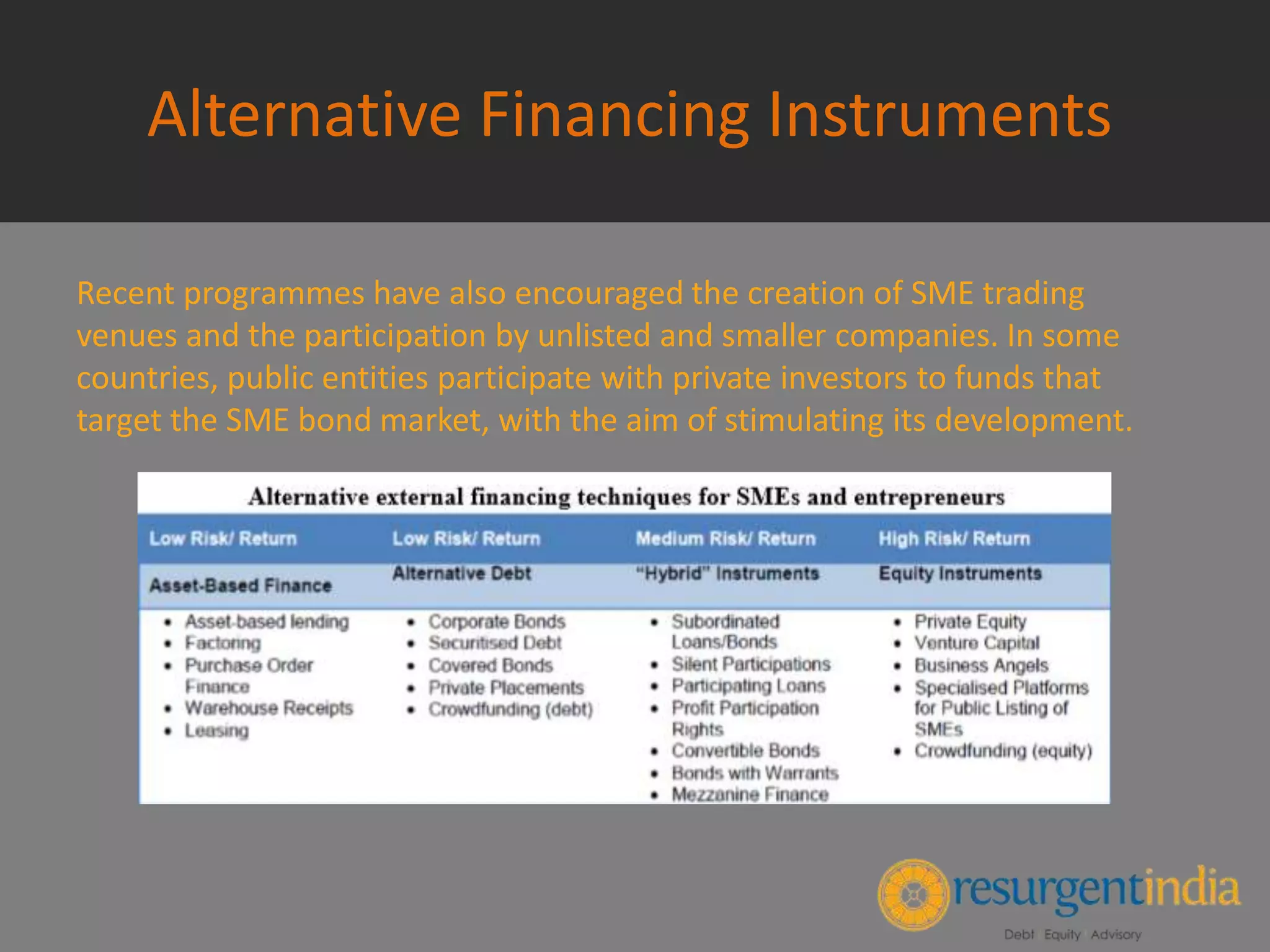
Recent programmes have also encouraged the creation of SME trading
venues and the participation by unlisted and smaller companies. In some
countries, public entities participate with private investors to funds that
target the SME bond market, with the aim of stimulating its development.
Alternative Financing Instruments
Trade Credit
Trade credit is also an important source of finance for many SMEs and start-
ups, which can substitute or supplement short-term bank lending. This mainly
consists of the extension of traditional credit instruments and credit-
mitigation tools, such as loans and guarantees, to sustain import and export
activities. Guarantees can take the form of letters of credit (L/C), which
represent a bank obligation to pay, thereby reducing an export's payment risk
on an importer/buyer.
Alternative Financing Instruments
Hybrid Instrument
The market for hybrid instruments, which combine debt and equity features
into a single financing vehicle, has developed unevenly in OECD countries, but
has recently attracted interest of policy makers across the board. These
techniques represent an appealing form of finance for firms that are
approaching a turning point in their life cycle, when the risks and
opportunities of the business are increasing, a capital injection is needed, but
they have limited or no access to debt financing or equity, or the owners do
not want the dilution of control that would accompany equity finance. This
can be the case of young high-growth companies, established firms with
emerging growth opportunities, companies undergoing transitions or
restructuring, as well as companies seeking to strengthen their capital
structures.
Alternative Financing Instruments
At the same time, these techniques are not well-suited for many SMEs, as
they require a well-established and stable earning power and market
position, and demand a certain level of financial skills. In recent years, with
the support of public programmes, it has become increasingly possible to
offer hybrid tools to SMEs with lower credit ratings and smaller funding needs
than what would be the practice in private capital markets. Governments and
international organisations mainly intervene through: i) participation in the
commercial market with investment funds that award mandates to private
investments specialists; ii) direct public financing to SMEs under programmes
managed by public financial institutions; iii) guarantees to private institutions
that offer SMEs the financial facility and; iv) funding of private investment
companies at highly attractive terms.
Alternative Financing Instruments
Equity Finance
Equity finance is key for companies that seek long-term corporate investment,
to sustain innovation, value creation and growth. Equity financing is especially
relevant for companies that have a high risk-return profile, such as new,
innovative and high growth firms. Seed and early stage equity finance can
boost firm creation and development, whereas other equity instruments,
such as specialised platforms for SME public listing, can provide financial
resources for growth- oriented and innovative SMEs.
Alternative Financing Instruments
Factoring
Factoring is a supplier short-term financing mechanism, whereby a firm
(‘seller’) receives cash from a specialised institution (‘factor’), in exchange for
its accounts receivable, which result from the sales of goods or provision of
services to customers (‘buyers’). In other terms, the factor buys the right to
collect a firm’s invoices from its customers, by paying the firm the face value
of these invoices, less a discount. The factor then proceeds to collect payment
from the firm’s customers at the due date of the invoices. The difference
between the face value of invoices and the amount advanced by the factor
constitute the “reserve account”. This is paid to the seller when the
receivables are paid to the factor, less interest and service fees.
Alternative Financing Instruments
Typically, the interest ranges from 1.5% to 3% over base rate and service fees
range from 0.2% to 0.5% of the turnover. Factoring is thus a transactions
funding technology, based on ‘hard’ data, similar to asset-based lending, as
the financing depends on the value of an underlying asset, rather than on the
creditworthiness of the firm. However, it is different from asset-based lending
in the following aspects: i) it involves exclusively the financing of accounts
receivable, rather than a broader range of assets; ii) the underlying asset is
sold to the factor at a discount, rather than collateralised; iii) it is a bundle of
three financial services, i.e. a financing component, a credit component, and
a collections component, as in most cases the borrower outsources to the
factor its credit and collection activities.
THANK YOU
Email: jyoti.gadia@resurgentindia.com Call Us: +91 124 4754550
www.resurgentindia.com
Read full report on: http://blog.resurgentindia.com/msme-financing-key-issues-and-
solutions/

MSME Financing - Alternative Financing Instruments - Part - 14

  • 1.
    Alternative Financing Instruments Part 13 MSMEFinancing - Key Issues and Solutions
  • 2.
    Alternative Financing Instruments Asset-basedfinance Asset-based finance, which includes asset-based lending, factoring, purchase- order finance, warehouse receipts and leasing, differs from traditional debt finance, as a firm obtains funding based on the value of specific assets, rather than on its own credit standing. Working capital and term loans are thus secured by assets such as trade accounts receivable, inventory, machinery, equipment and real estate. The key advantage of asset-based finance is that firms can access cash faster and under more flexible terms than they could have obtained from a conventional bank loan, regardless of their balance sheet position and future cash flow prospects.
  • 3.
    Alternative Financing Instruments Furthermore,with asset-based finance, firms that lack credit history, face temporarily shortfalls or losses, or that need to accelerate cash flow to seize growth opportunities, can access working capital in a relatively short time. In addition, asset-based financiers do not generally require any personal guarantee from the entrepreneur, nor that s/he give up equity. On the other hand, the costs incurred and/or the complexity of procedures may be substantially higher that those associated with conventional bank loans, including asset appraisal, auditing, monitoring and up-front legal costs, which may reduce the firm’s levels of profits. Also, funding limits are often lower than in the case of traditional debt.
  • 4.
    Alternative Financing Instruments AcrossOECD countries, and increasingly also in emerging economies, asset- based finance is widely used by SMEs, for their working capital needs, to support domestic and international trade, and, partly, for investment purposes. In Europe especially, the prevalence of these instruments for SMEs is on par with conventional bank lending, and the specific financial segment has grown steadily over the last decade, in spite of repercussions of the global financial crisis on the supply side. Through asset-based finance, firms obtain funding based on the value of specific assets, including accounts receivables, inventory, machinery, equipment and real estate, rather than on their own credit standing.
  • 5.
    Alternative Financing Instruments Inthis way, it can serve the needs of young and small firms that have difficulties in accessing traditional lending. Asset-based lending, which provides more flexible terms than collateralised traditional lending, has also been expanding in recent years, in countries with sophisticated and efficient legal systems and advanced financial expertise and services.
  • 6.
    Alternative Financing Instruments Whileasset-based finance is a widely used tool in the SME financing landscape, alternative forms of debt have had only limited usage by the SME sector, even within the larger size segment which would be suited for structured finance and could benefit from accessing capital markets, to invest and seize growth opportunities. In fact, alternative debt differs from traditional lending in that investors in the capital market, rather than banks, provide the financing for SMEs. To foster the development of a corporate bond market for SMEs, mainly mid-caps, policy makers have especially targeted transparency and protection rules for investors, to favour greater participation and liquidity
  • 7.
    Alternative Financing Instruments Recentprogrammes have also encouraged the creation of SME trading venues and the participation by unlisted and smaller companies. In some countries, public entities participate with private investors to funds that target the SME bond market, with the aim of stimulating its development.
  • 8.
    Alternative Financing Instruments TradeCredit Trade credit is also an important source of finance for many SMEs and start- ups, which can substitute or supplement short-term bank lending. This mainly consists of the extension of traditional credit instruments and credit- mitigation tools, such as loans and guarantees, to sustain import and export activities. Guarantees can take the form of letters of credit (L/C), which represent a bank obligation to pay, thereby reducing an export's payment risk on an importer/buyer.
  • 9.
    Alternative Financing Instruments HybridInstrument The market for hybrid instruments, which combine debt and equity features into a single financing vehicle, has developed unevenly in OECD countries, but has recently attracted interest of policy makers across the board. These techniques represent an appealing form of finance for firms that are approaching a turning point in their life cycle, when the risks and opportunities of the business are increasing, a capital injection is needed, but they have limited or no access to debt financing or equity, or the owners do not want the dilution of control that would accompany equity finance. This can be the case of young high-growth companies, established firms with emerging growth opportunities, companies undergoing transitions or restructuring, as well as companies seeking to strengthen their capital structures.
  • 10.
    Alternative Financing Instruments Atthe same time, these techniques are not well-suited for many SMEs, as they require a well-established and stable earning power and market position, and demand a certain level of financial skills. In recent years, with the support of public programmes, it has become increasingly possible to offer hybrid tools to SMEs with lower credit ratings and smaller funding needs than what would be the practice in private capital markets. Governments and international organisations mainly intervene through: i) participation in the commercial market with investment funds that award mandates to private investments specialists; ii) direct public financing to SMEs under programmes managed by public financial institutions; iii) guarantees to private institutions that offer SMEs the financial facility and; iv) funding of private investment companies at highly attractive terms.
  • 11.
    Alternative Financing Instruments EquityFinance Equity finance is key for companies that seek long-term corporate investment, to sustain innovation, value creation and growth. Equity financing is especially relevant for companies that have a high risk-return profile, such as new, innovative and high growth firms. Seed and early stage equity finance can boost firm creation and development, whereas other equity instruments, such as specialised platforms for SME public listing, can provide financial resources for growth- oriented and innovative SMEs.
  • 12.
    Alternative Financing Instruments Factoring Factoringis a supplier short-term financing mechanism, whereby a firm (‘seller’) receives cash from a specialised institution (‘factor’), in exchange for its accounts receivable, which result from the sales of goods or provision of services to customers (‘buyers’). In other terms, the factor buys the right to collect a firm’s invoices from its customers, by paying the firm the face value of these invoices, less a discount. The factor then proceeds to collect payment from the firm’s customers at the due date of the invoices. The difference between the face value of invoices and the amount advanced by the factor constitute the “reserve account”. This is paid to the seller when the receivables are paid to the factor, less interest and service fees.
  • 13.
    Alternative Financing Instruments Typically,the interest ranges from 1.5% to 3% over base rate and service fees range from 0.2% to 0.5% of the turnover. Factoring is thus a transactions funding technology, based on ‘hard’ data, similar to asset-based lending, as the financing depends on the value of an underlying asset, rather than on the creditworthiness of the firm. However, it is different from asset-based lending in the following aspects: i) it involves exclusively the financing of accounts receivable, rather than a broader range of assets; ii) the underlying asset is sold to the factor at a discount, rather than collateralised; iii) it is a bundle of three financial services, i.e. a financing component, a credit component, and a collections component, as in most cases the borrower outsources to the factor its credit and collection activities.
  • 14.
    THANK YOU Email: jyoti.gadia@resurgentindia.comCall Us: +91 124 4754550 www.resurgentindia.com Read full report on: http://blog.resurgentindia.com/msme-financing-key-issues-and- solutions/