12/10/2020
Successful Capella Landing on a
CNES Operational Use-Case
#CapellaDays
Jonathan Lasalle
Artal Technologies
MBSE Department Head
@LinkedIn
1 rue Ariane – 31520 Ramonville-Saint-Agne, France – 05 61 00 39 30 – artal@artal.frJonathan Lasalle - ARTAL Technologies
Successful Capella landing on a CNES operational use-case
Artal
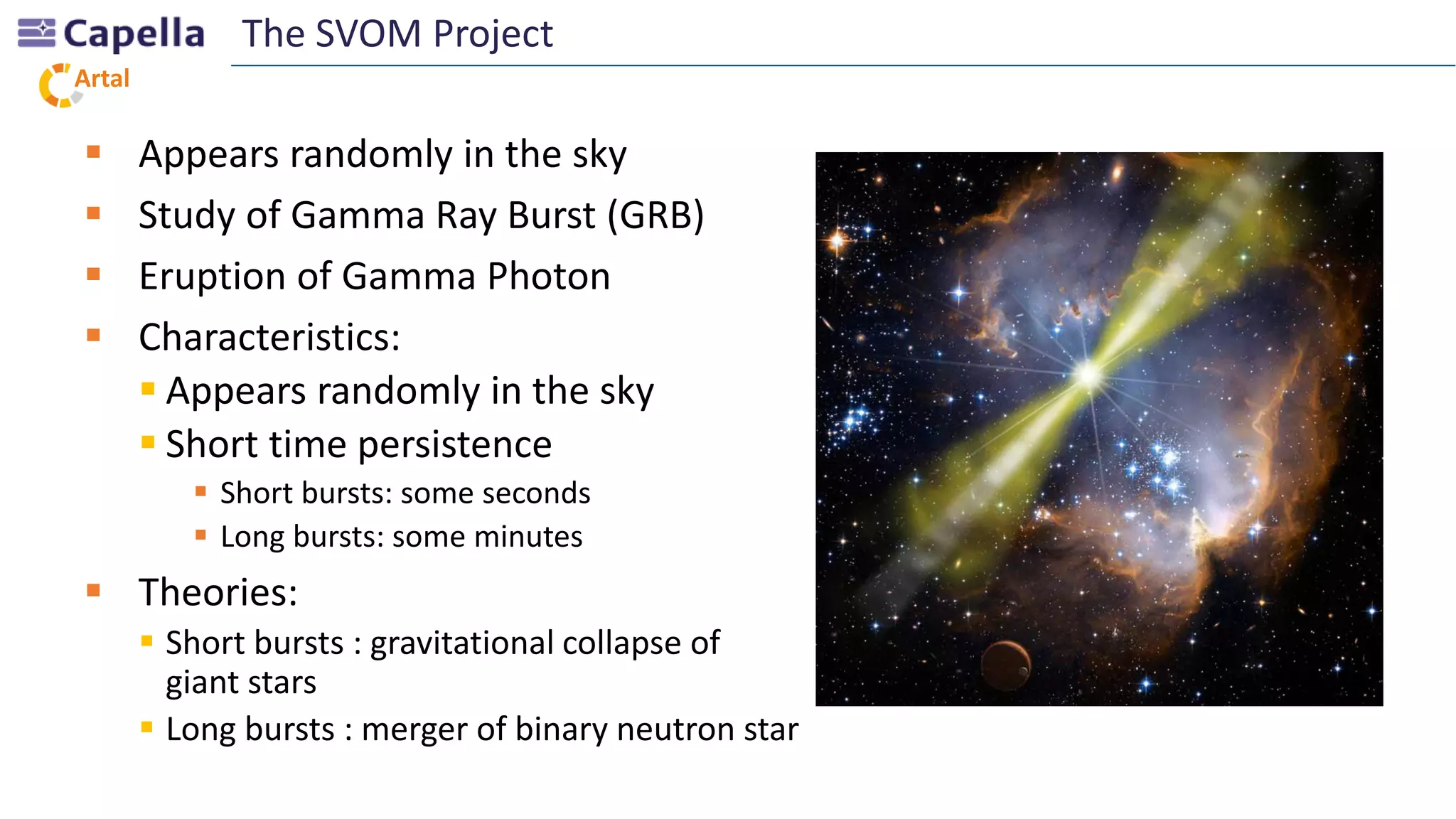
 Appears randomly in the sky
 Study of Gamma Ray Burst (GRB)
 Eruption of Gamma Photon
 Characteristics:
 Appears randomly in the sky
 Short time persistence
 Short bursts: some seconds
 Long bursts: some minutes
 Theories:
 Short bursts : gravitational collapse of
giant stars
 Long bursts : merger of binary neutron star
The SVOM Project
Artal
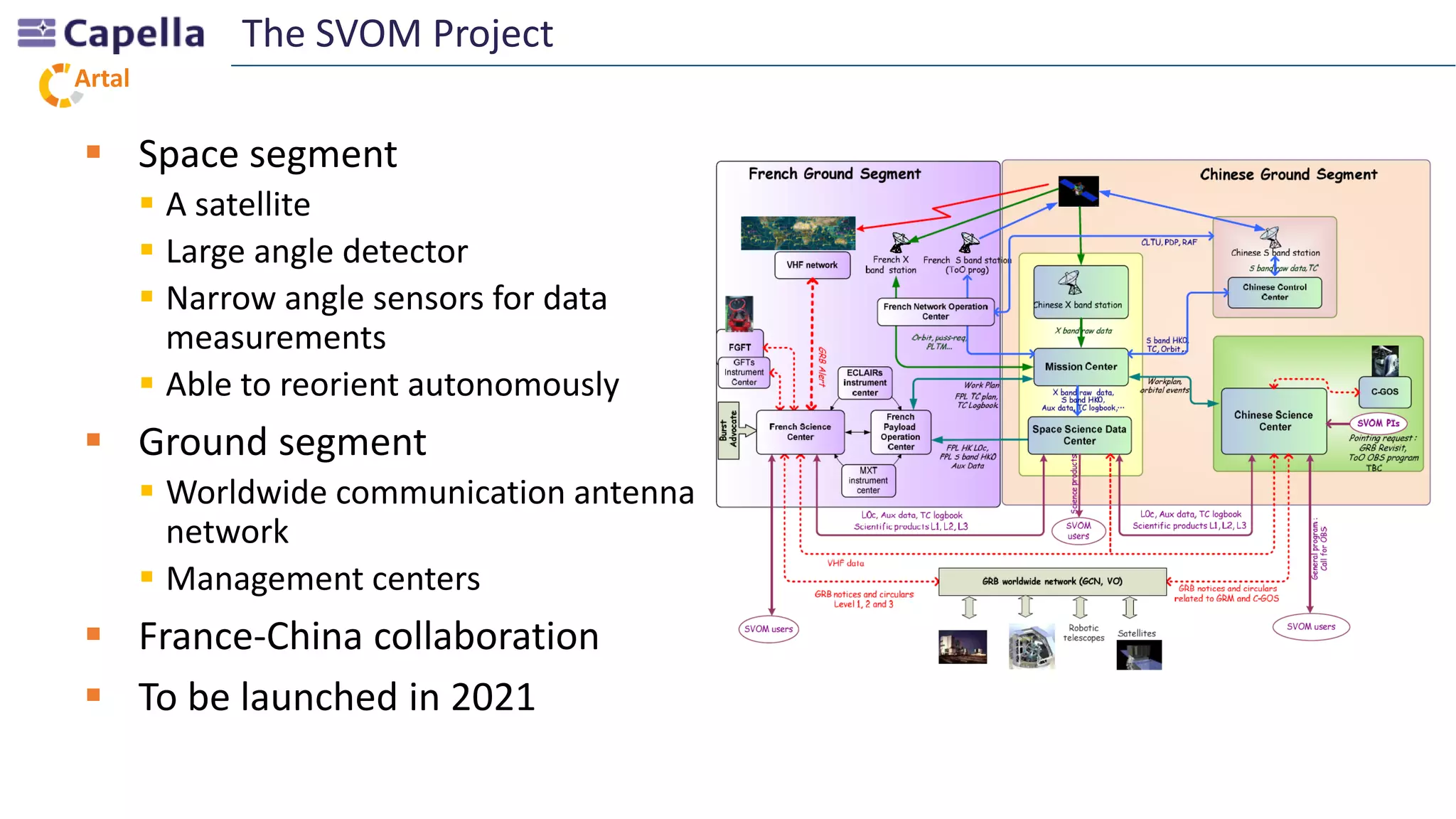
 Space segment
 A satellite
 Large angle detector
 Narrow angle sensors for data
measurements
 Able to reorient autonomously
 Ground segment
 Worldwide communication antenna
network
 Management centers
 France-China collaboration
 To be launched in 2021
The SVOM Project
Artal
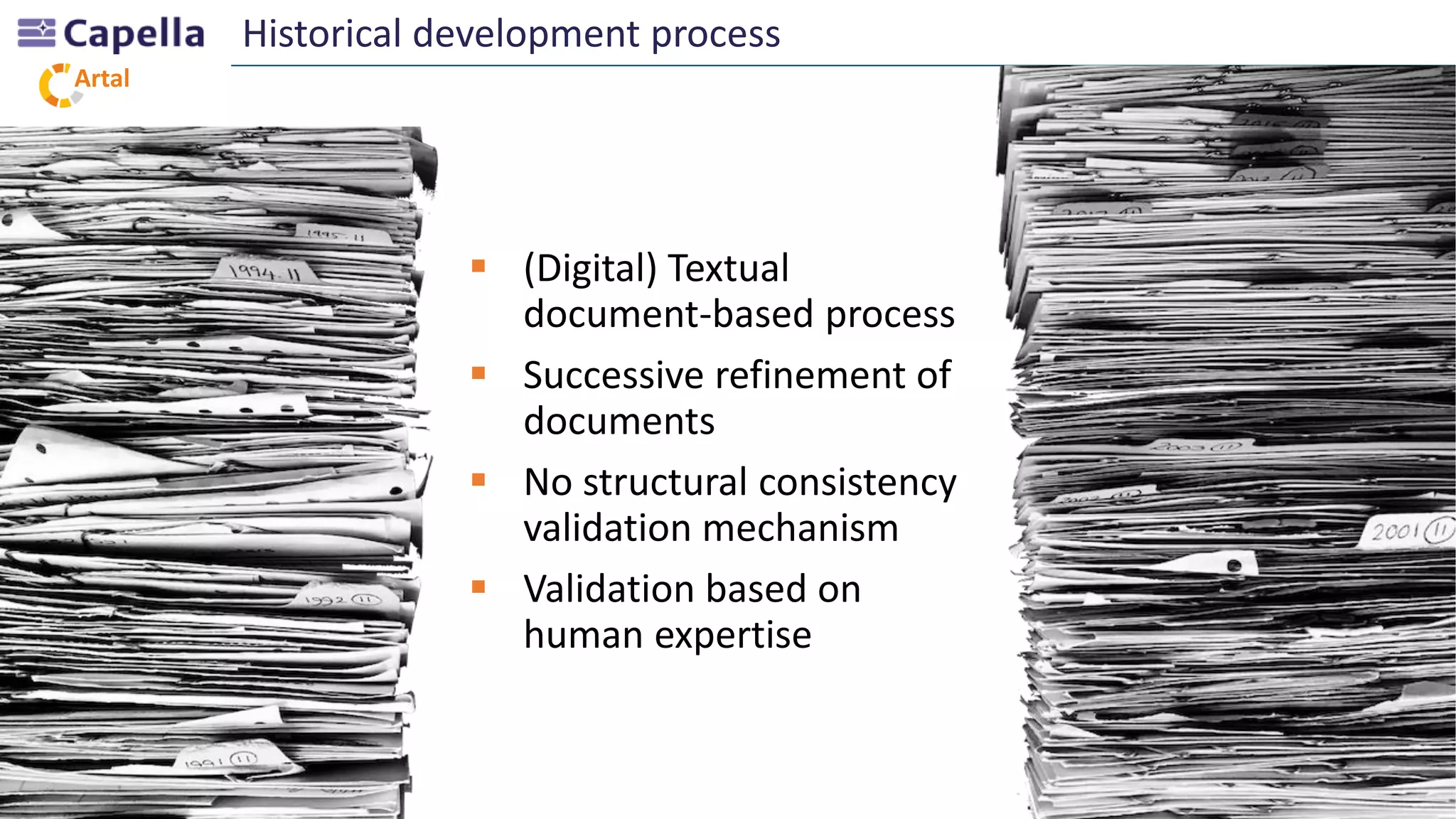
 (Digital) Textual
document-based process
 Successive refinement of
documents
 No structural consistency
validation mechanism
 Validation based on
human expertise
Historical development process
Artal
Why using models instead of regular documents to describe the system ?
MBSE Experimentation
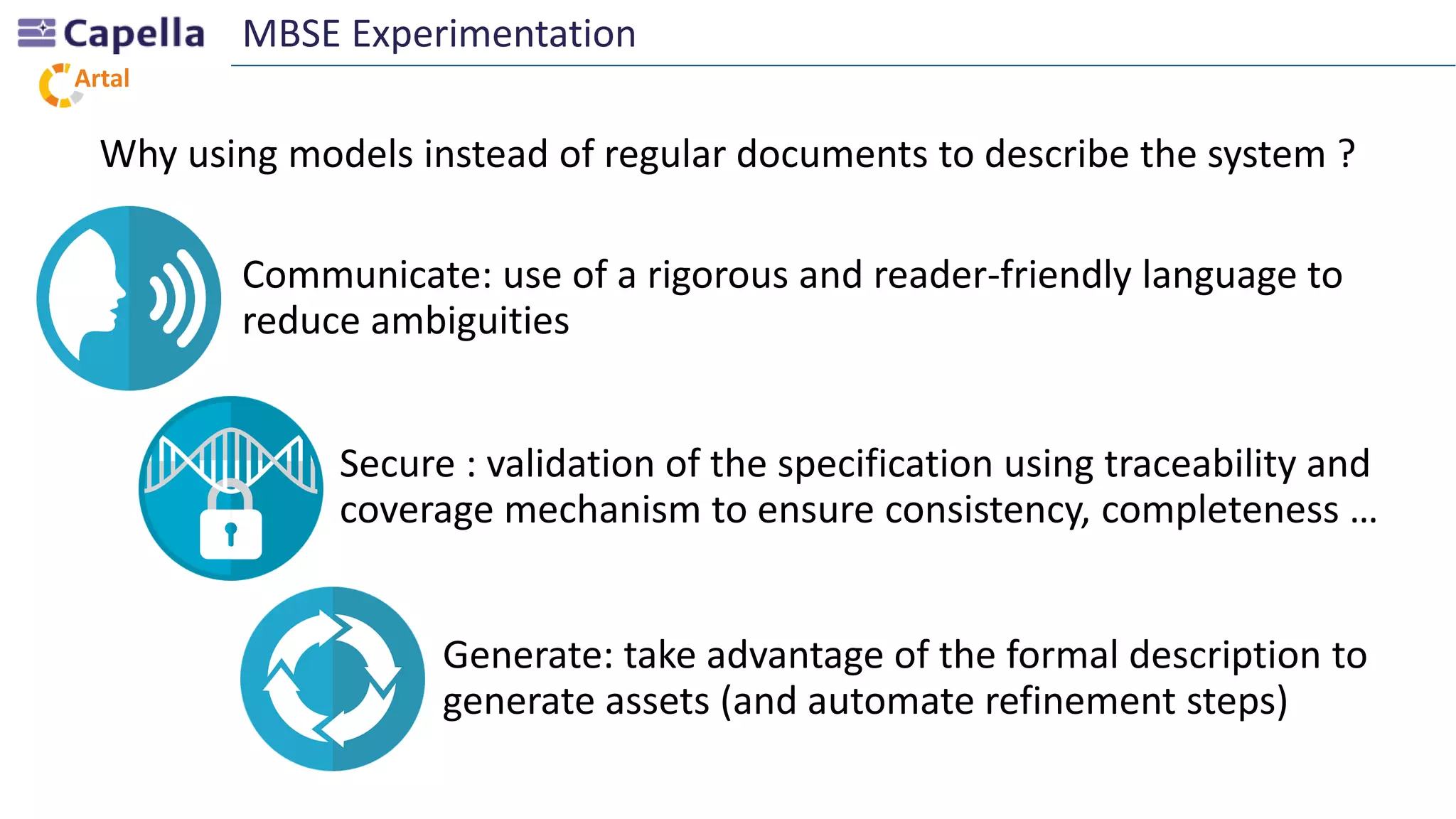
Communicate: use of a rigorous and reader-friendly language to
reduce ambiguities
Secure : validation of the specification using traceability and
coverage mechanism to ensure consistency, completeness …
Generate: take advantage of the formal description to
generate assets (and automate refinement steps)
Artal
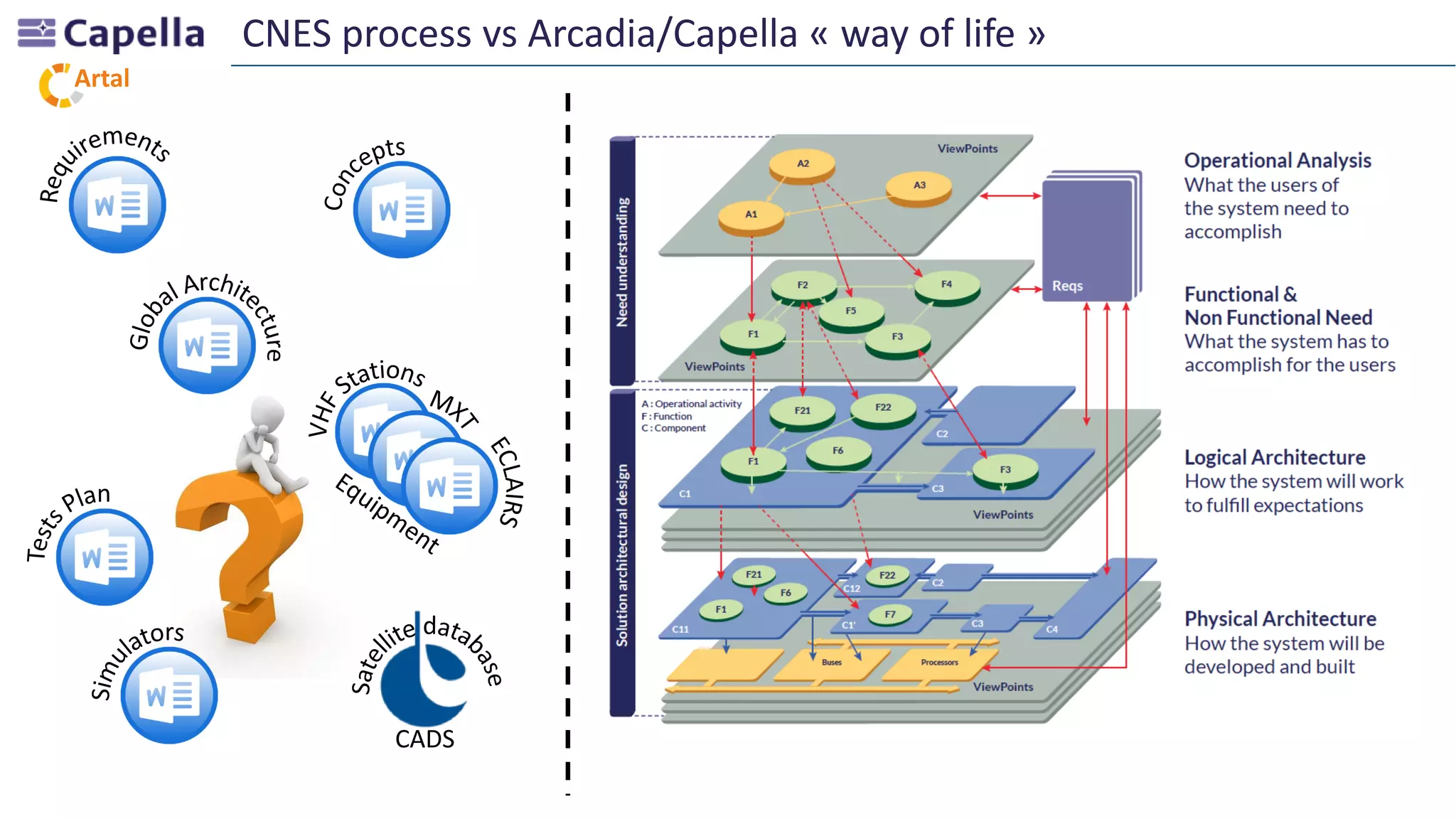
CNES process vs Arcadia/Capella « way of life »
CADS
Artal
CNES process vs Arcadia/Capella « way of life »
CADS
[1] Interface engineering
[2] V&V: Validation and Verification
[3] Requirements management
[4] Database generation
Artal
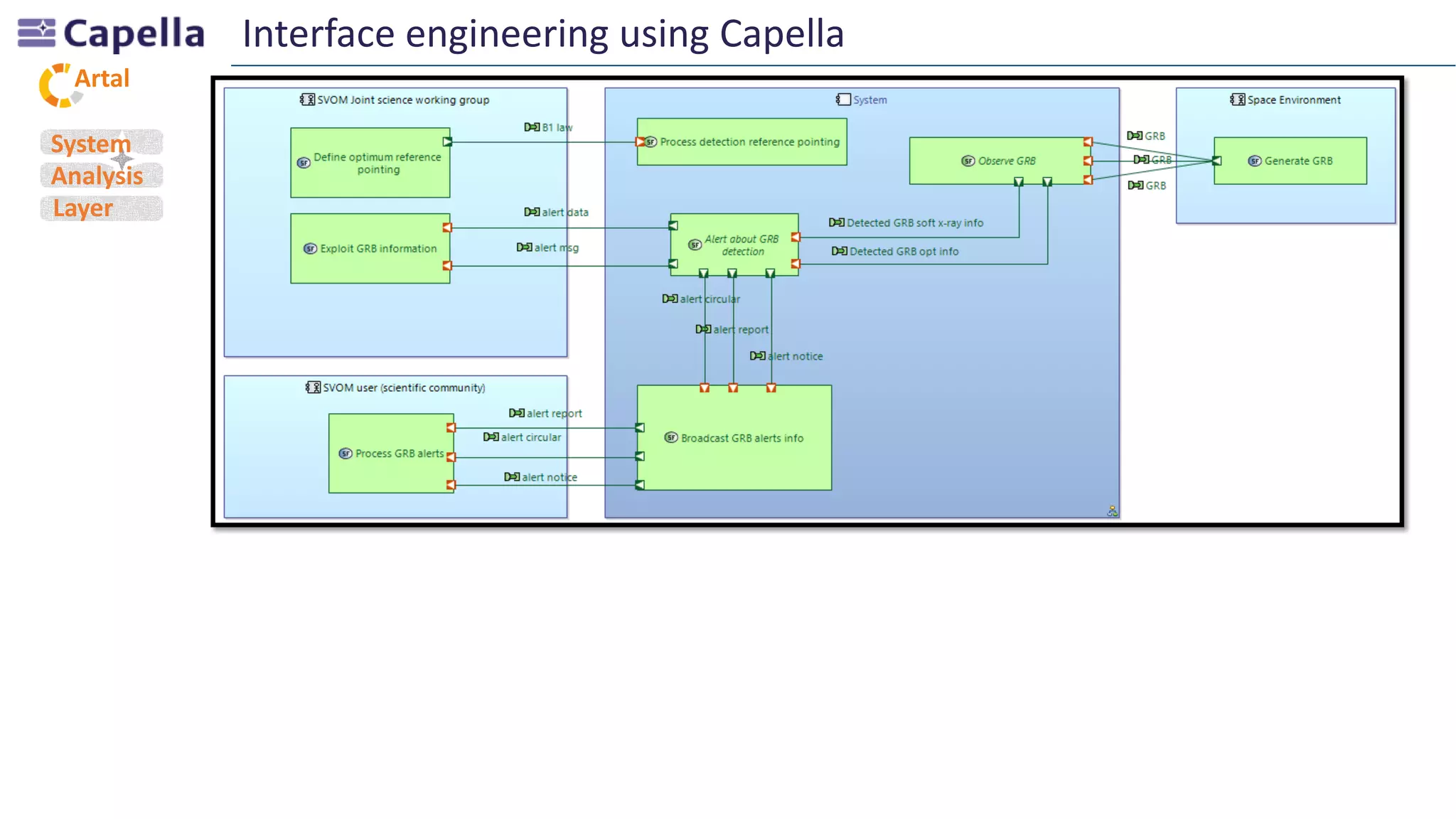
Interface engineering using Capella
System
Analysis
Layer
Artal
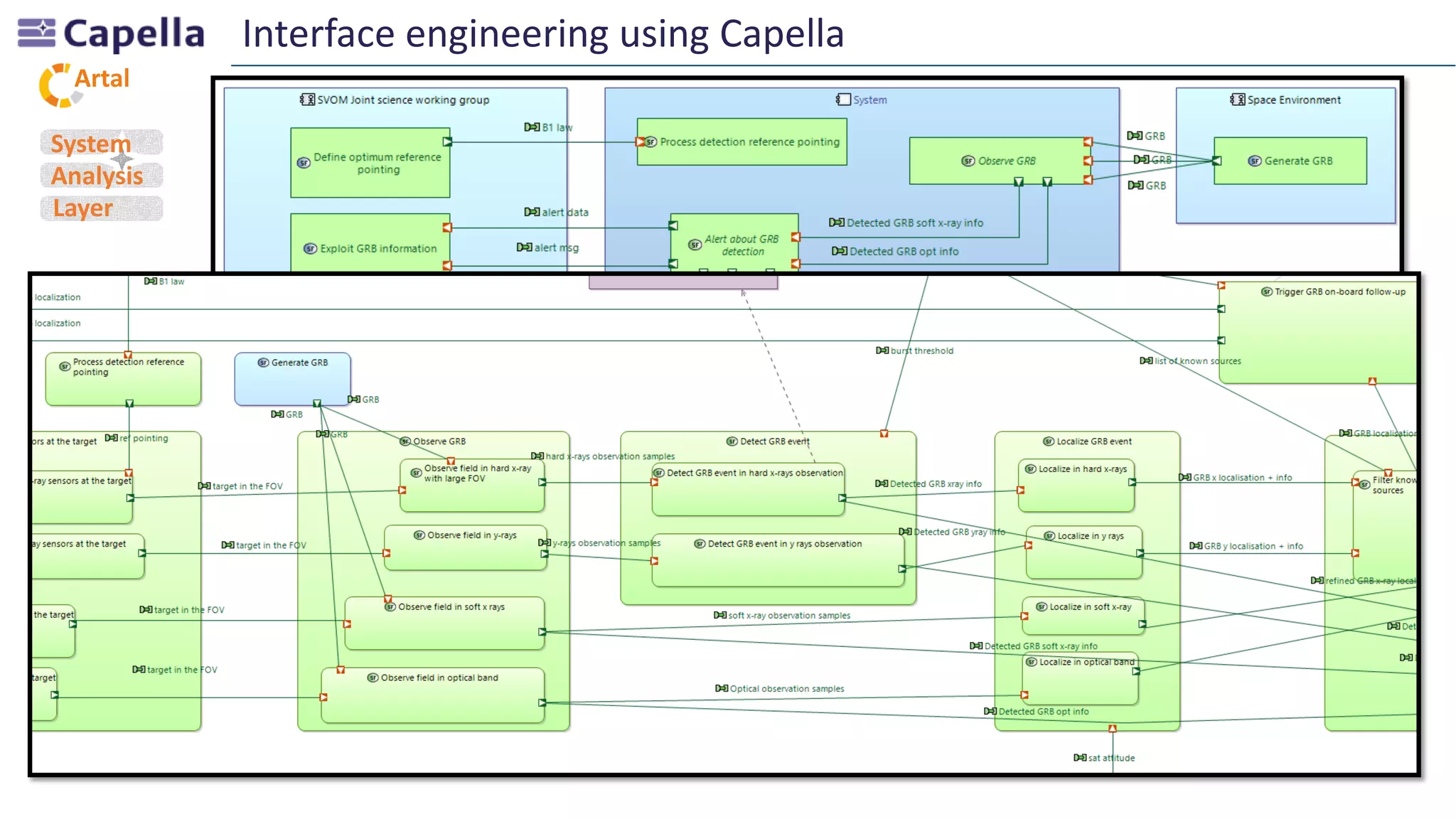
Interface engineering using Capella
System
Analysis
Layer
Artal
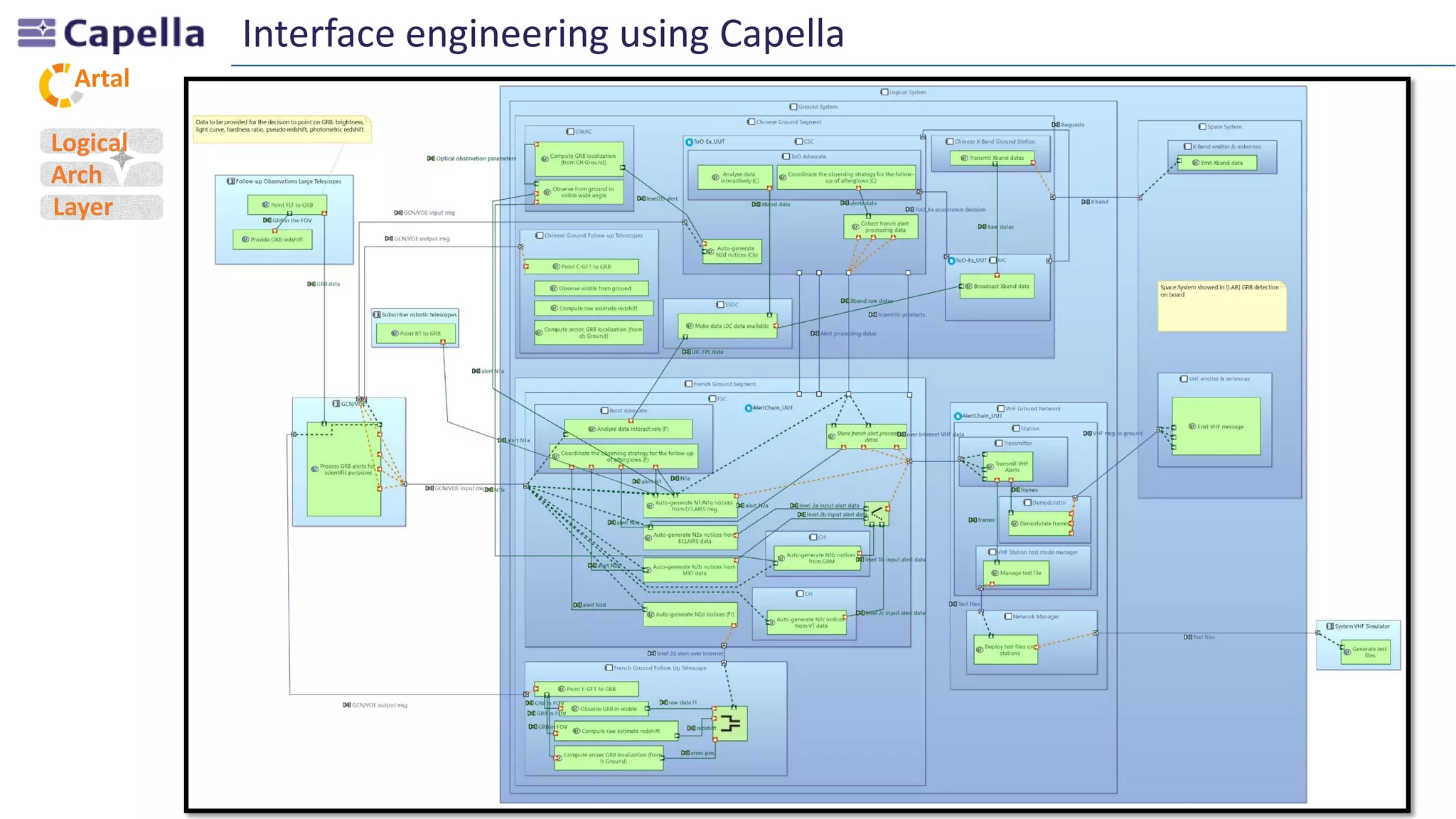
Interface engineering using Capella
Logical
Arch
Layer
Artal
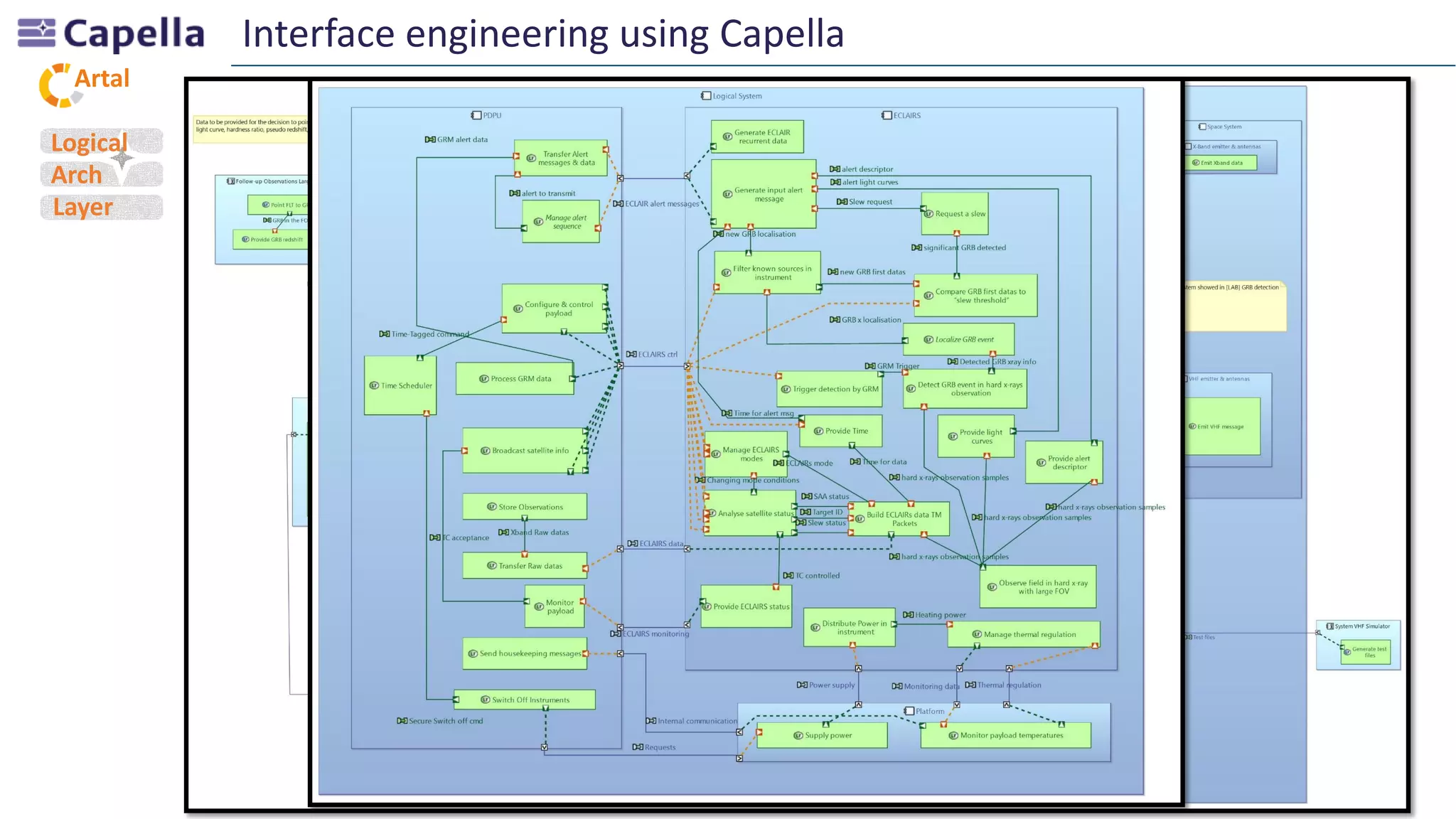
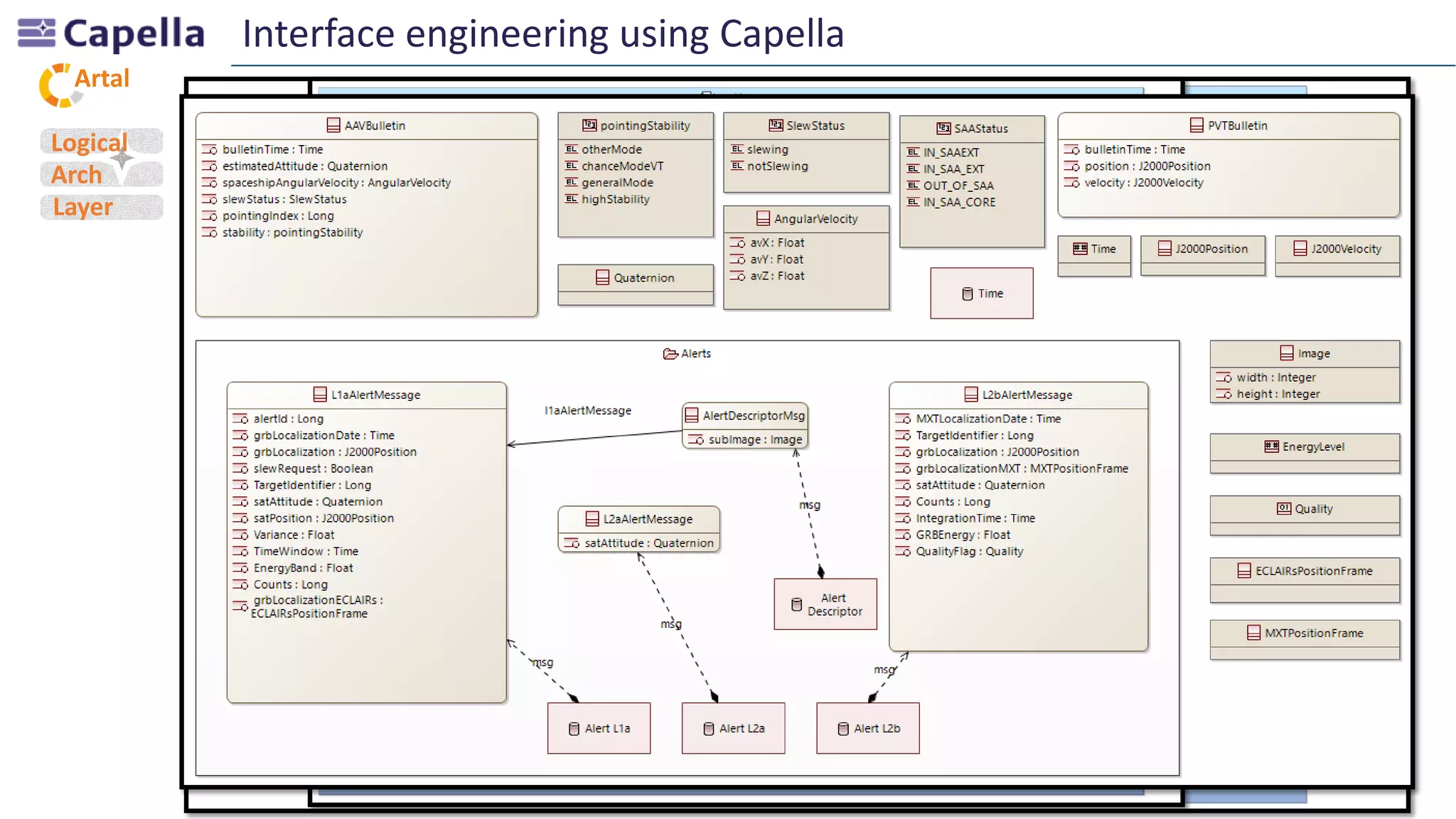
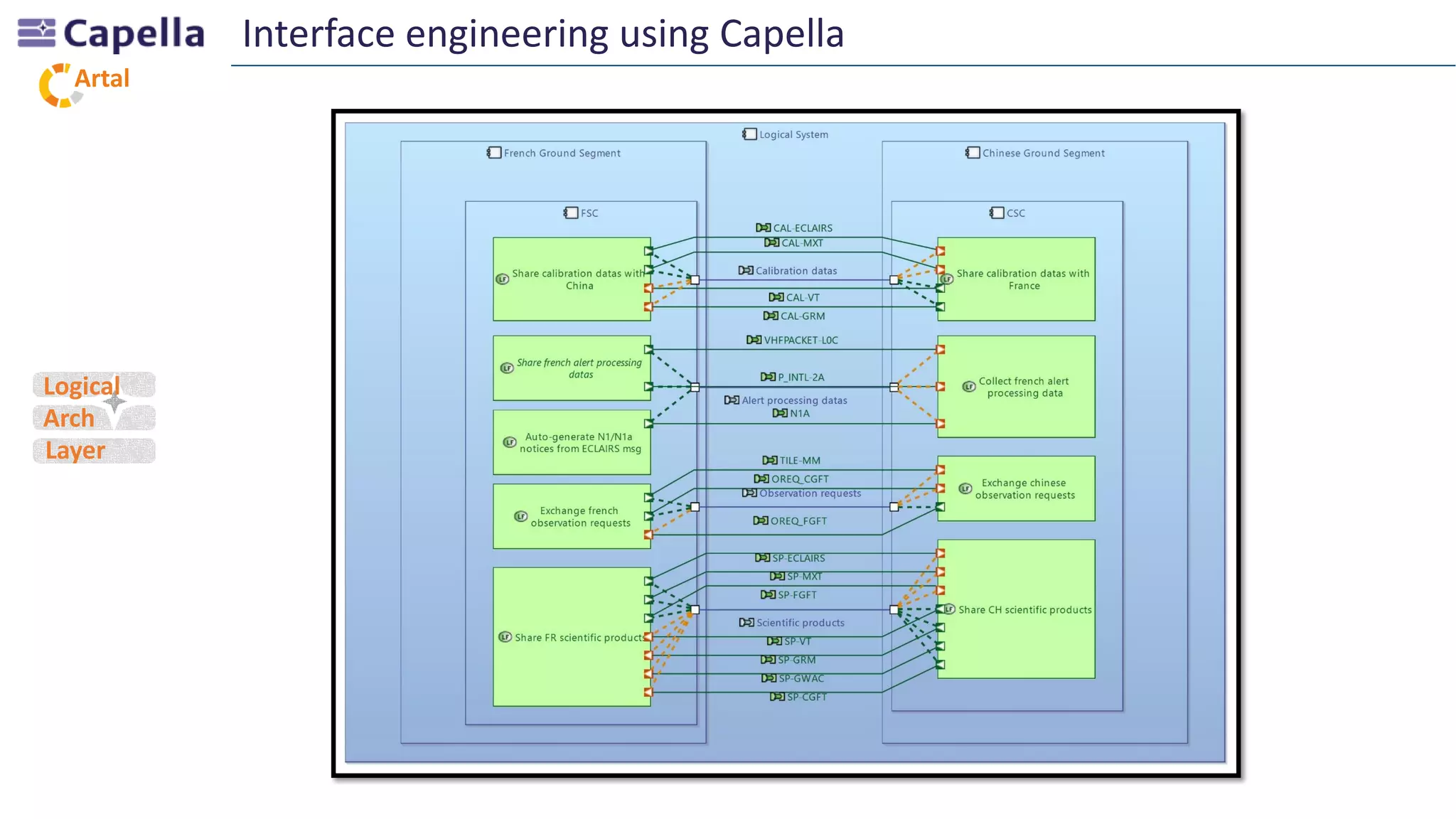
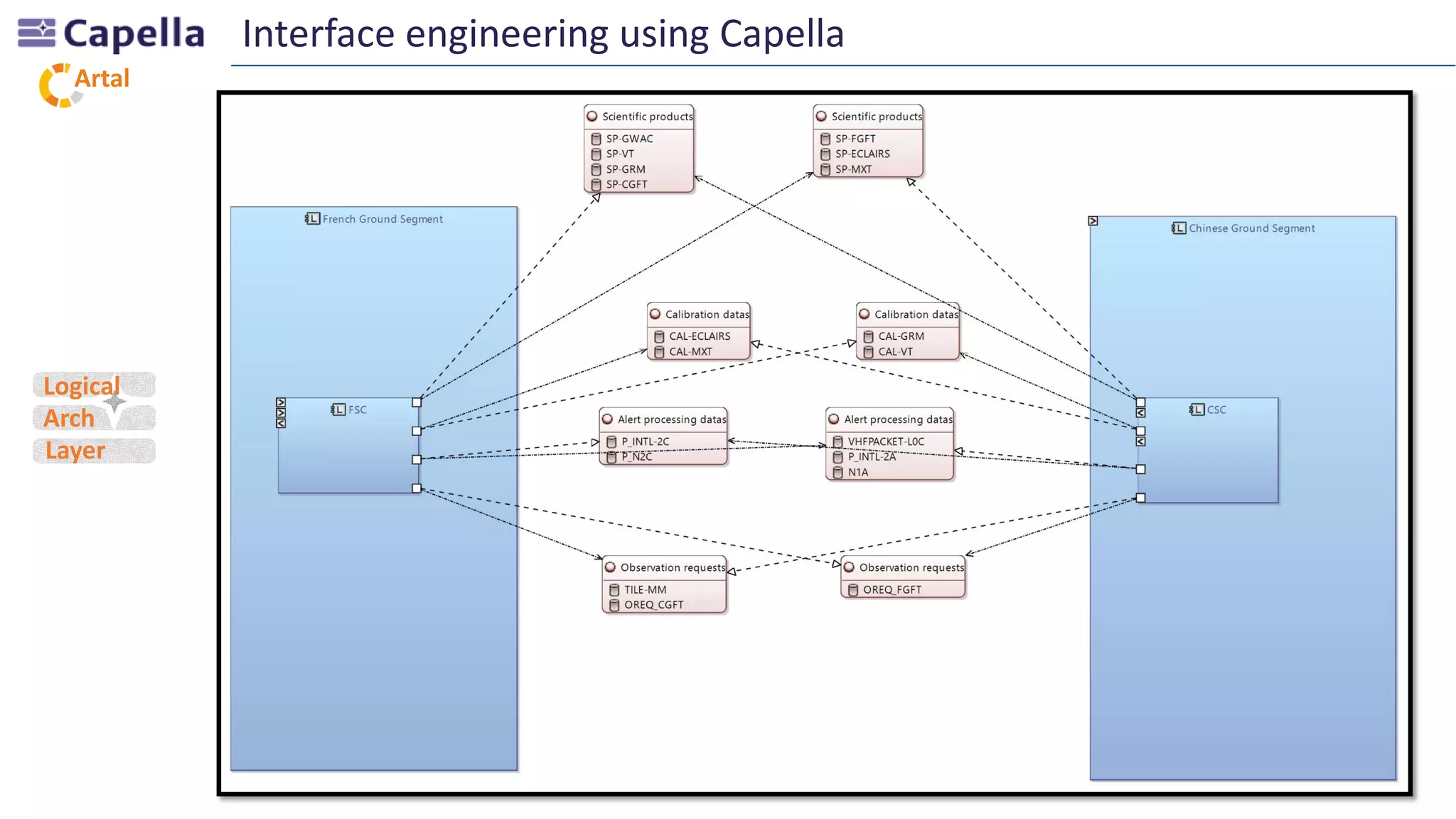
Interface engineering using Capella
Logical
Arch
Layer
Artal
Interface engineering using Capella
Logical
Arch
Layer
Artal
Interface engineering using Capella
Logical
Arch
Layer
Artal
Interface engineering using Capella
Logical
Arch
Layer
Artal
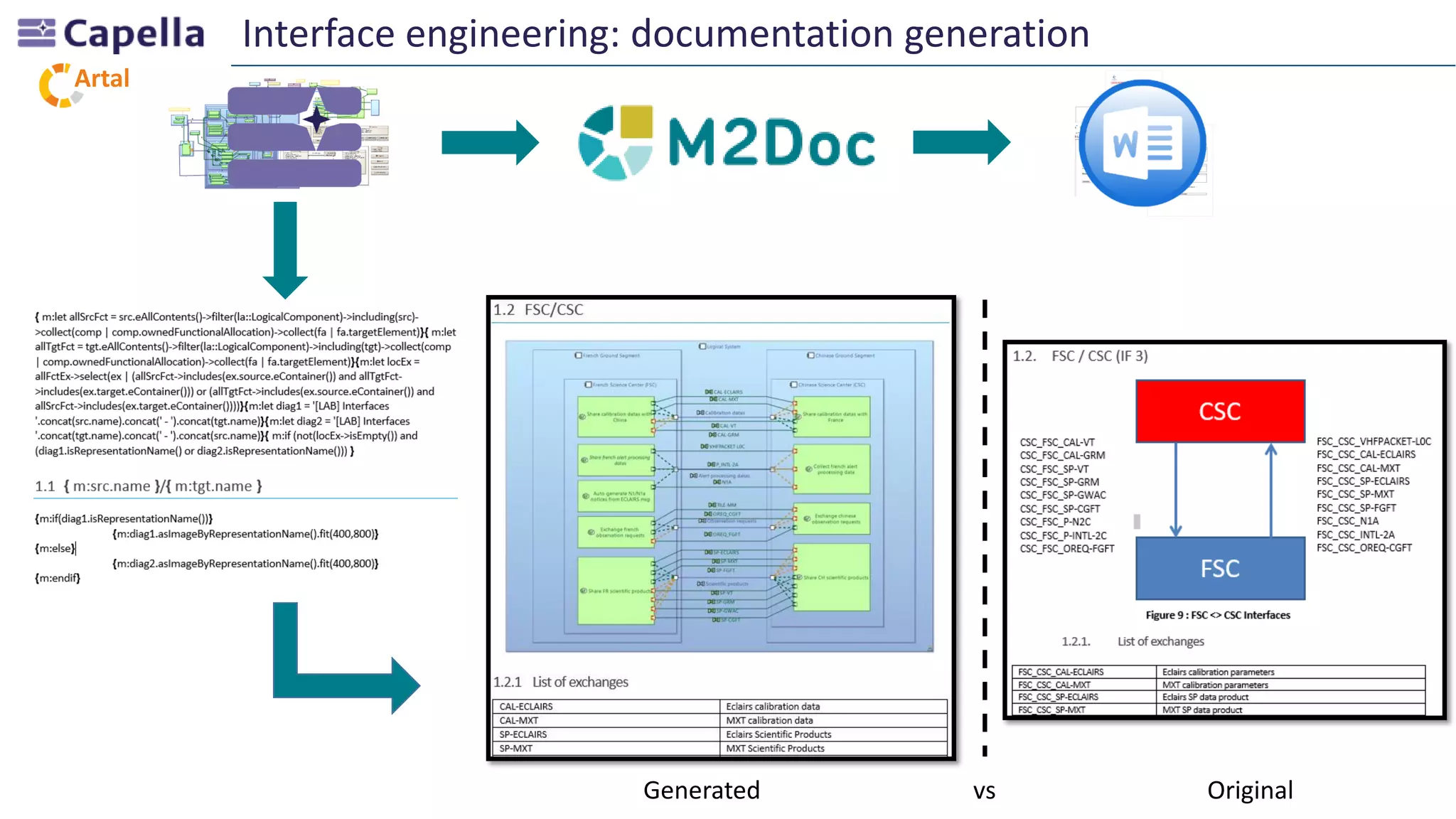
Interface engineering: documentation generation
Generated vs Original
Artal
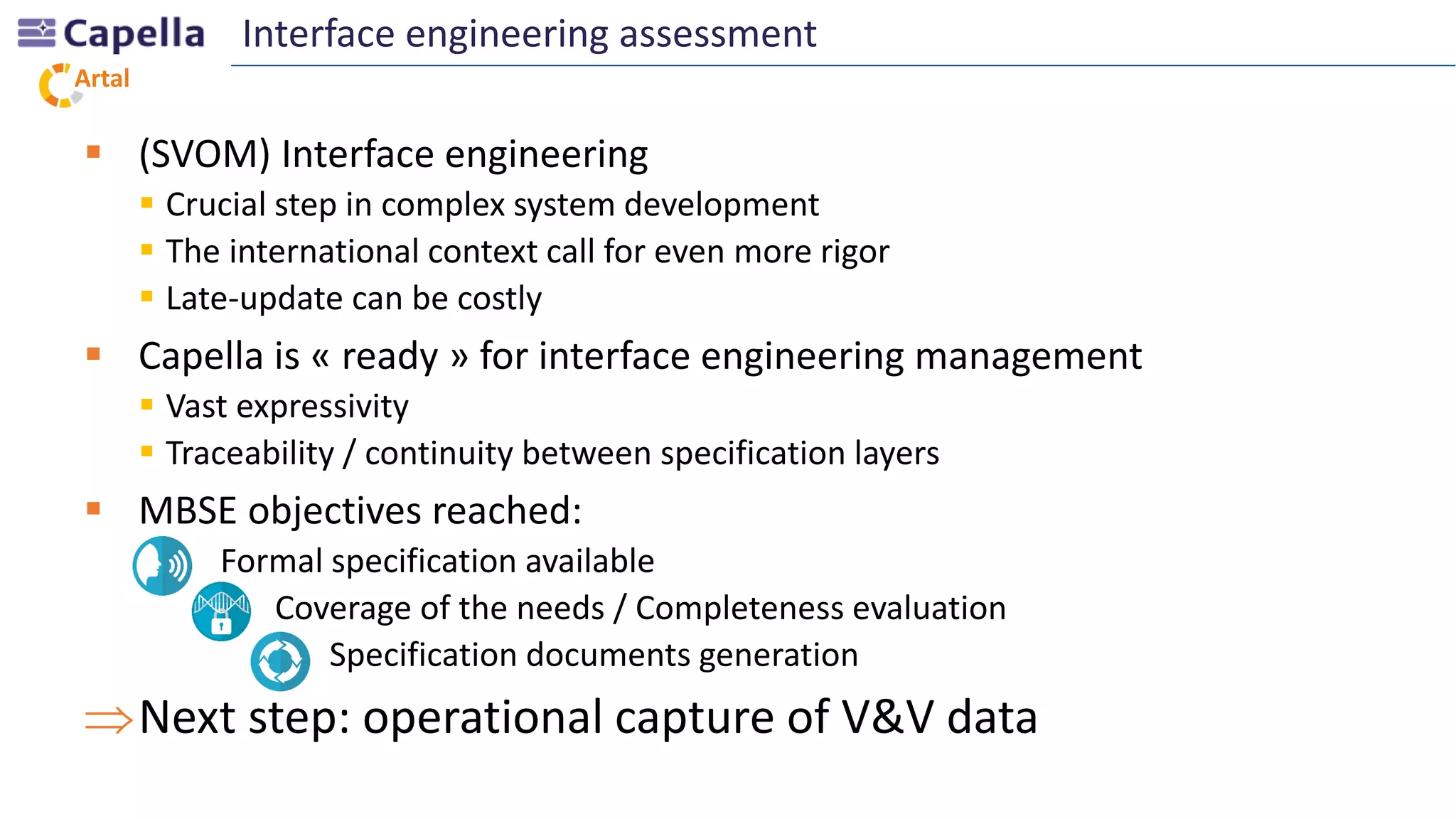
 (SVOM) Interface engineering
 Crucial step in complex system development
 The international context call for even more rigor
 Late-update can be costly
 Capella is « ready » for interface engineering management
 Vast expressivity
 Traceability / continuity between specification layers
 MBSE objectives reached:
- Formal specification available
- Coverage of the needs / Completeness evaluation
- Specification documents generation
Next step: operational capture of V&V data
Interface engineering assessment
Artal
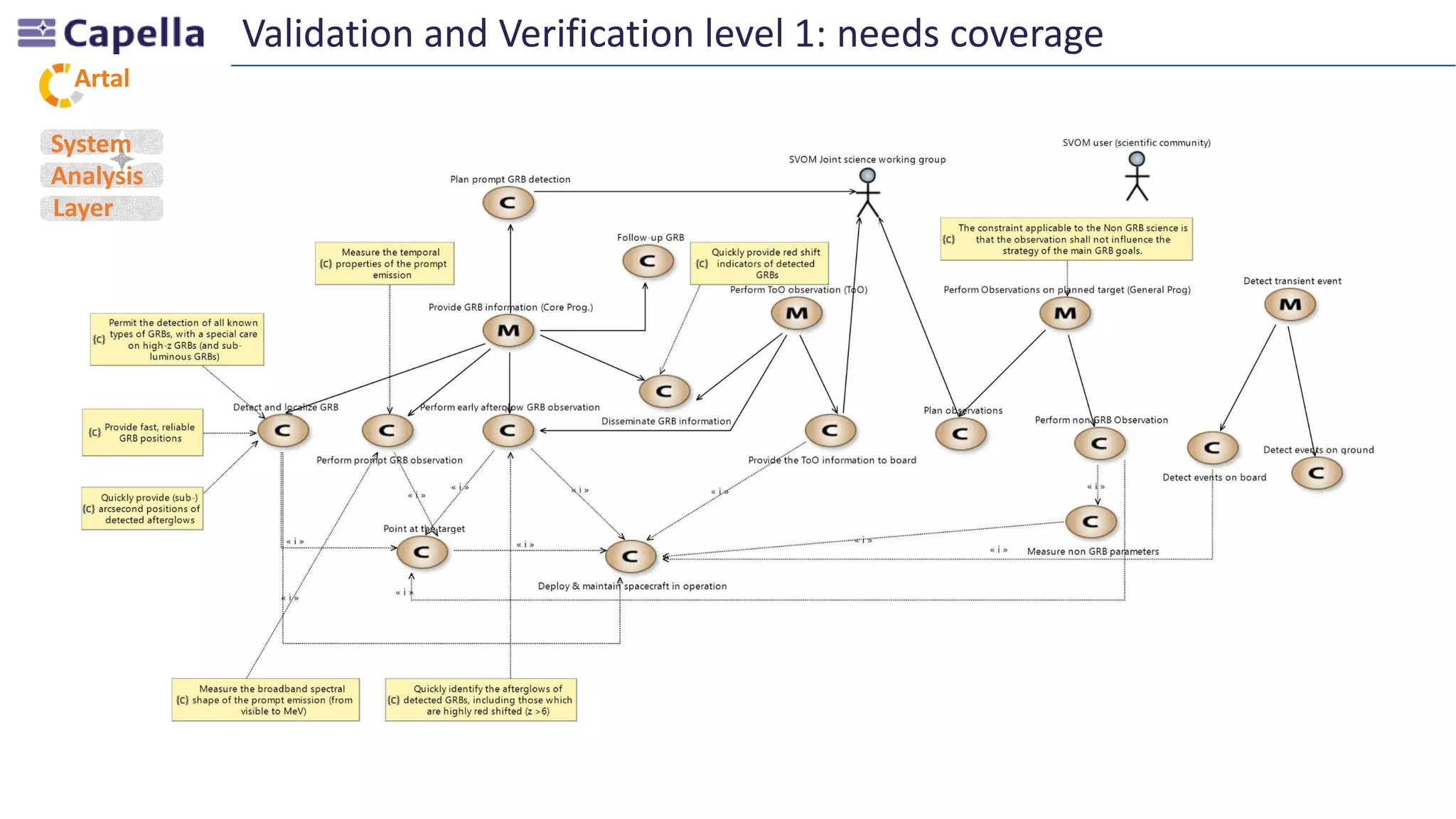
Validation and Verification level 1: needs coverage
System
Analysis
Layer
Artal
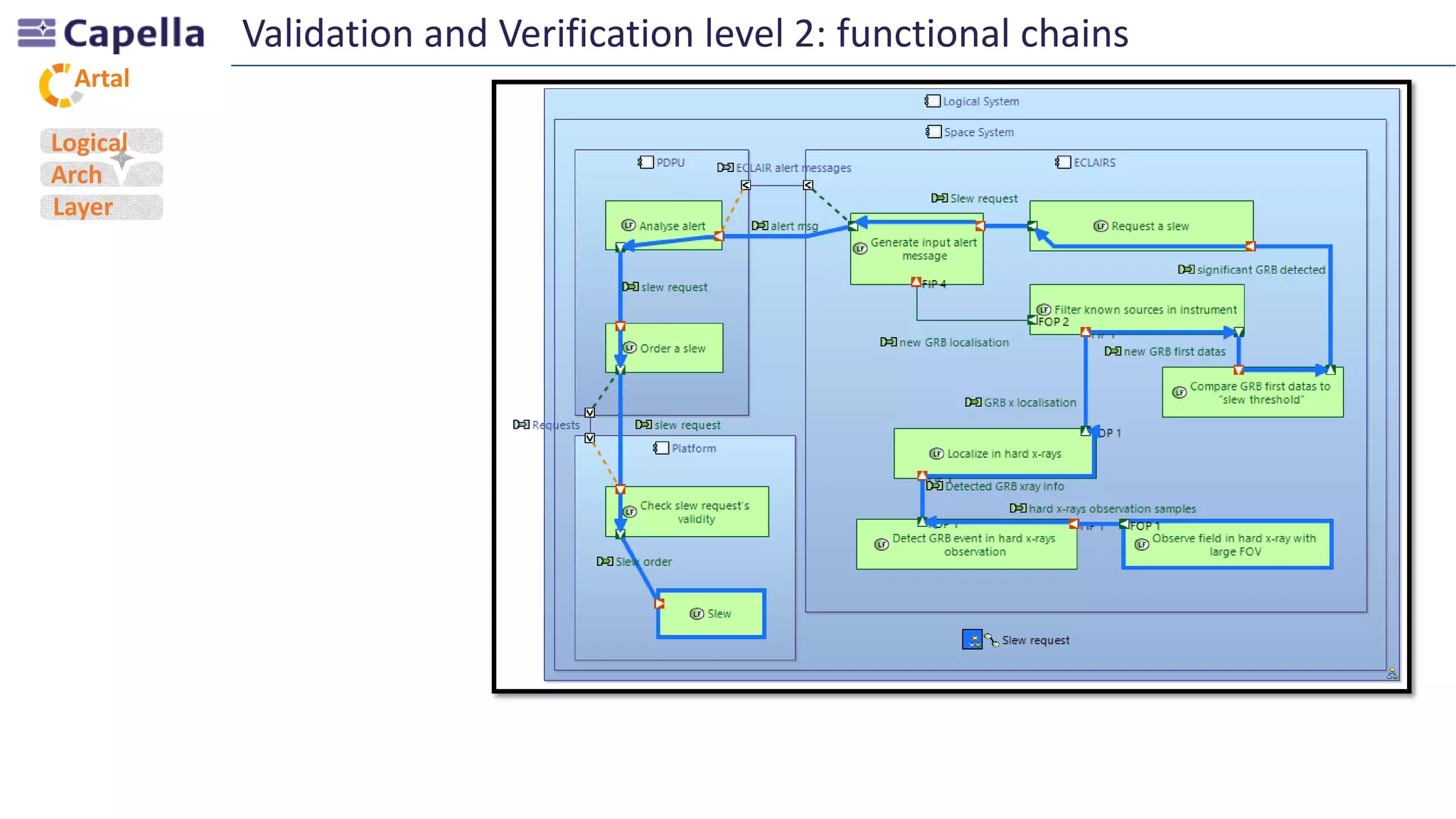
Validation and Verification level 2: functional chains
Logical
Arch
Layer
Artal
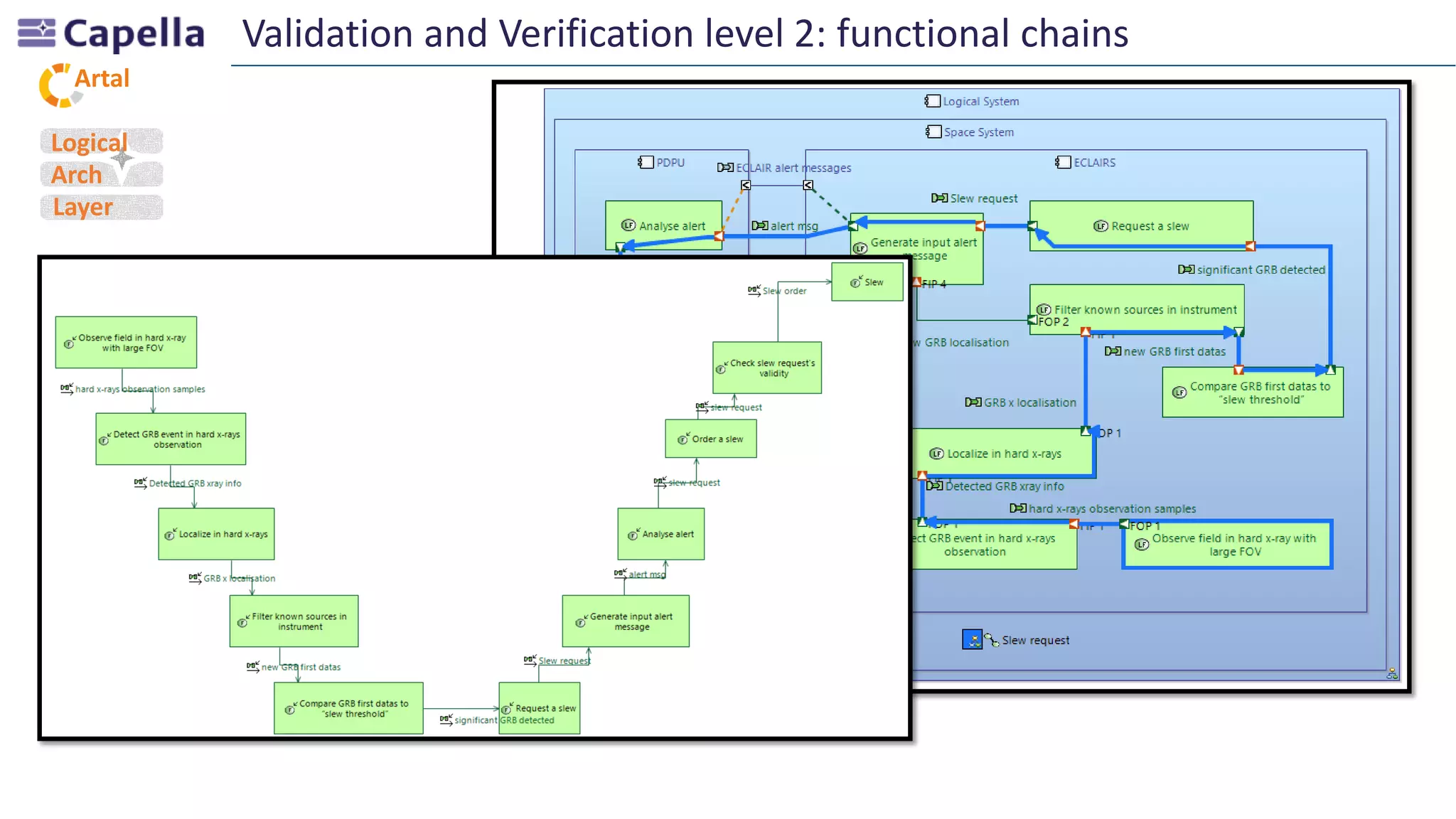
Validation and Verification level 2: functional chains
Logical
Arch
Layer
Artal
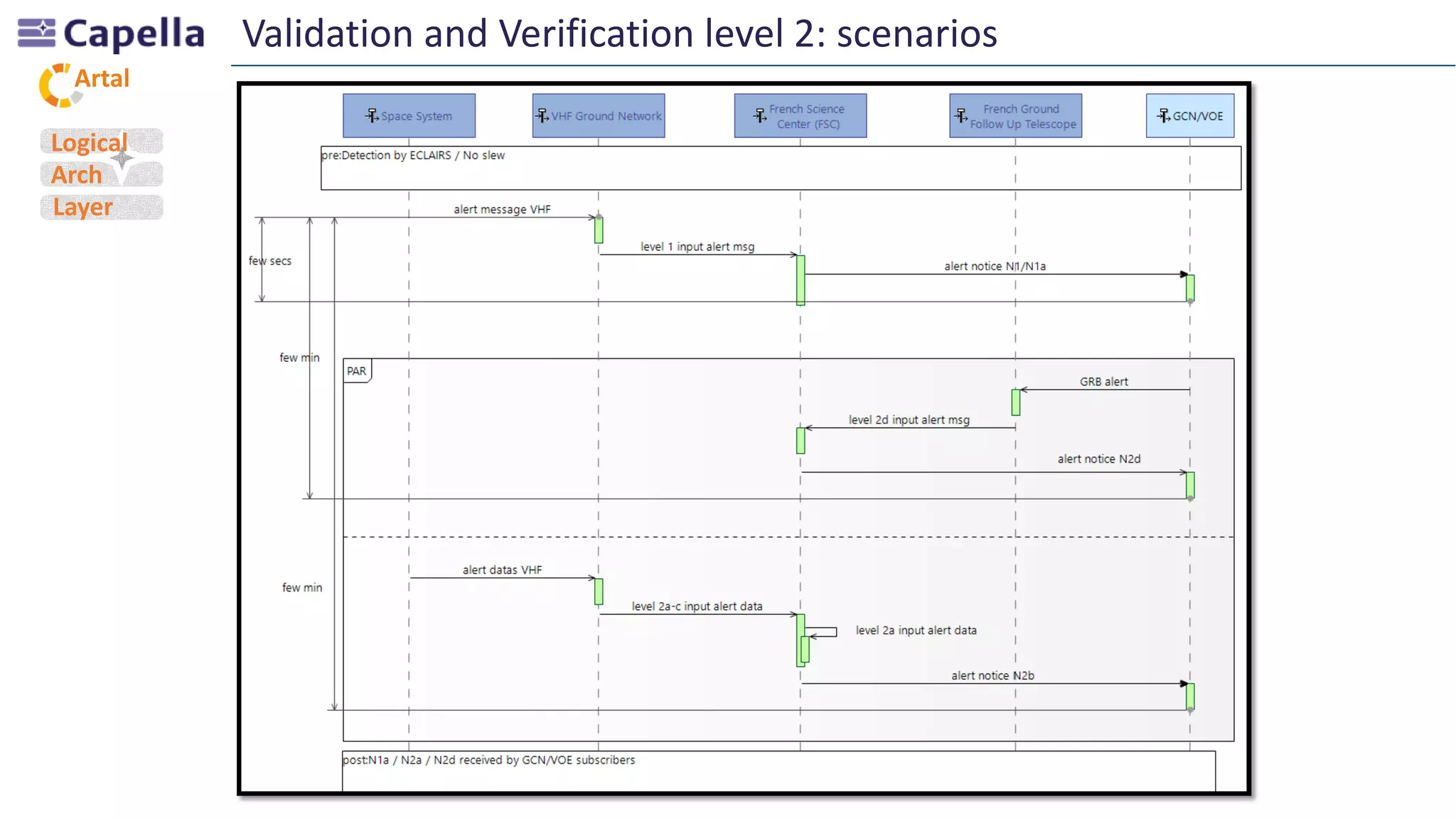
Validation and Verification level 2: scenarios
Logical
Arch
Layer
Artal
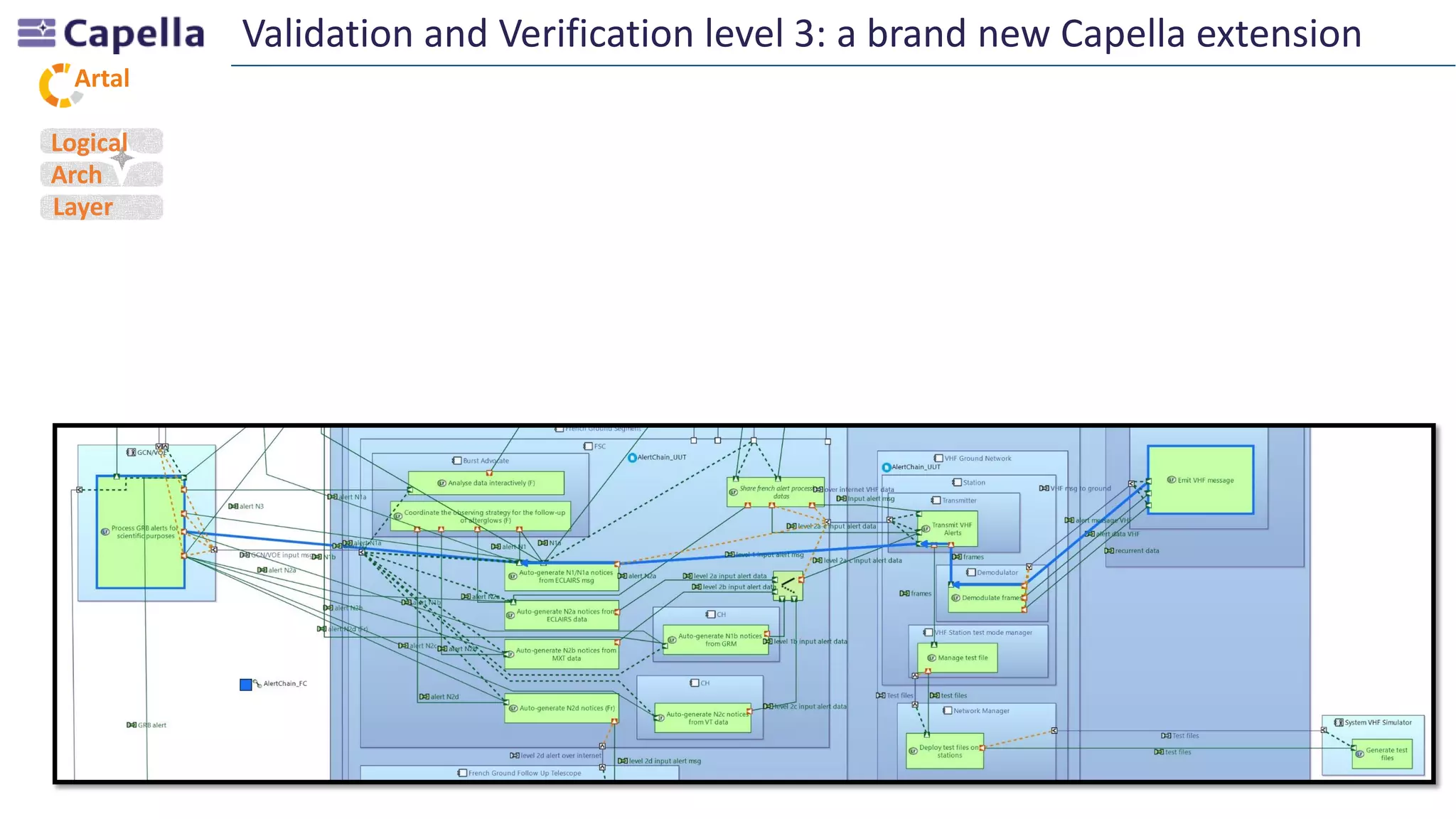
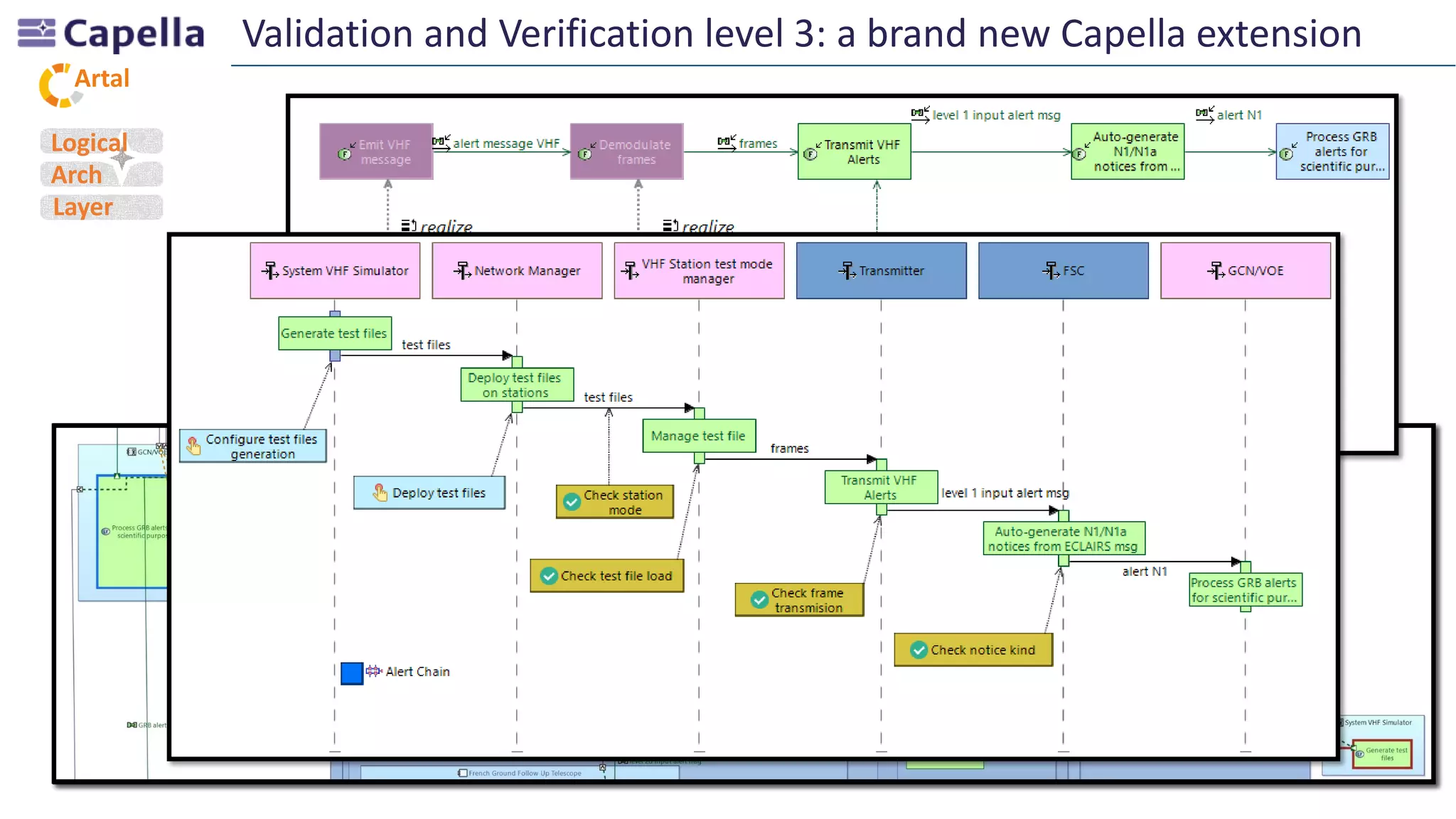
Validation and Verification level 3: a brand new Capella extension
Logical
Arch
Layer
Artal
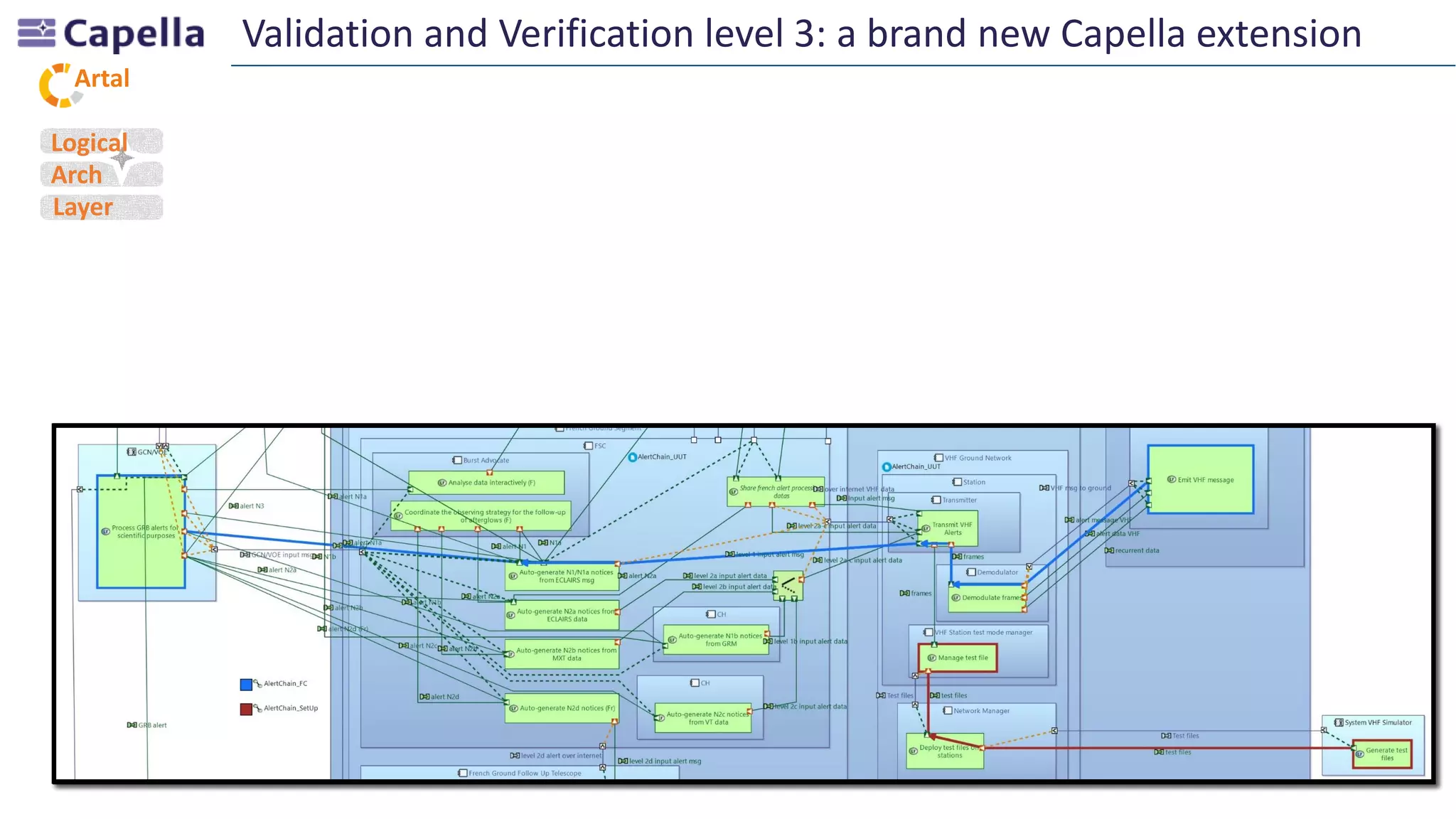
Validation and Verification level 3: a brand new Capella extension
Logical
Arch
Layer
Artal
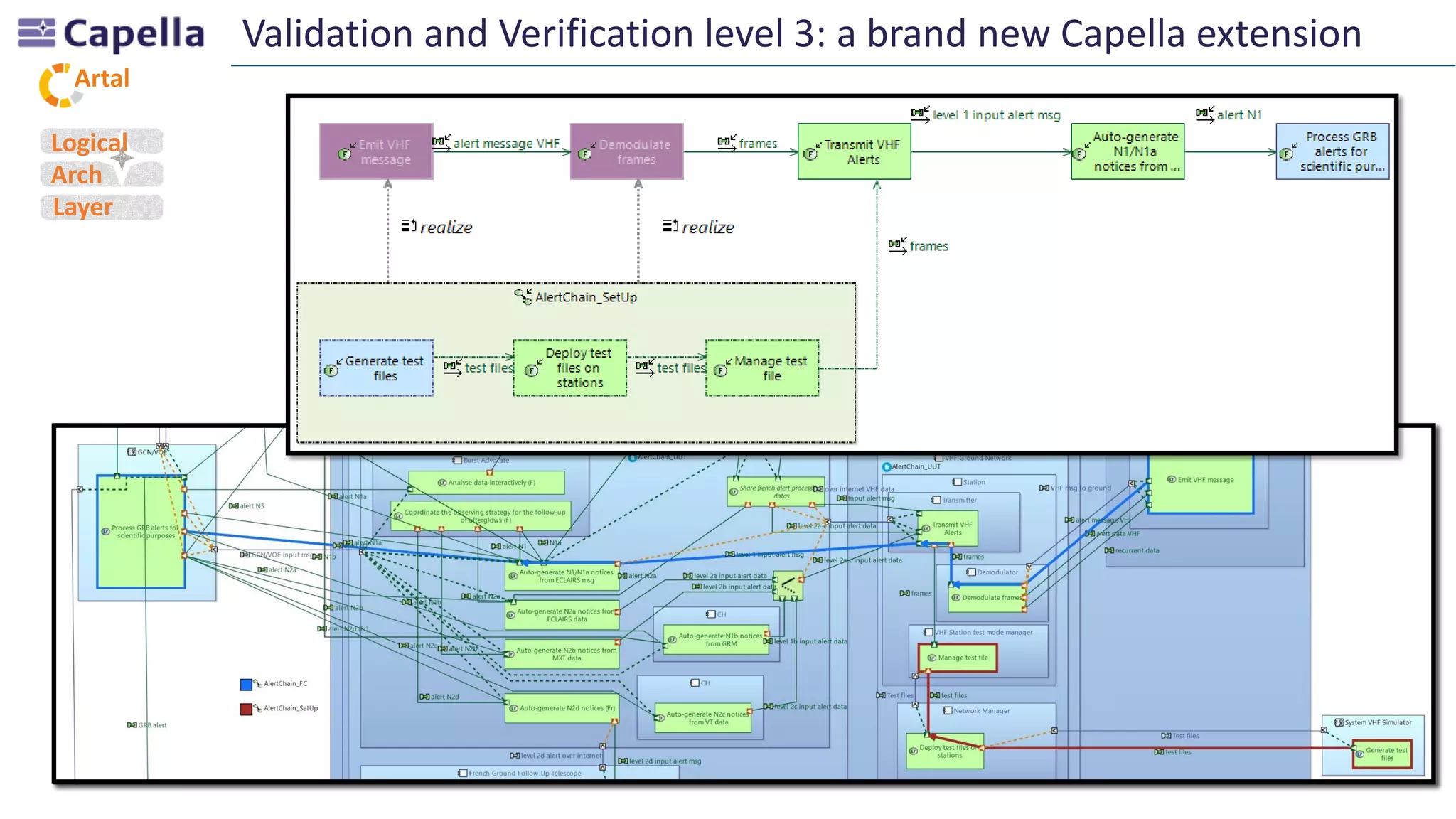
Validation and Verification level 3: a brand new Capella extension
Logical
Arch
Layer
Artal
Validation and Verification level 3: a brand new Capella extension
Logical
Arch
Layer
Artal
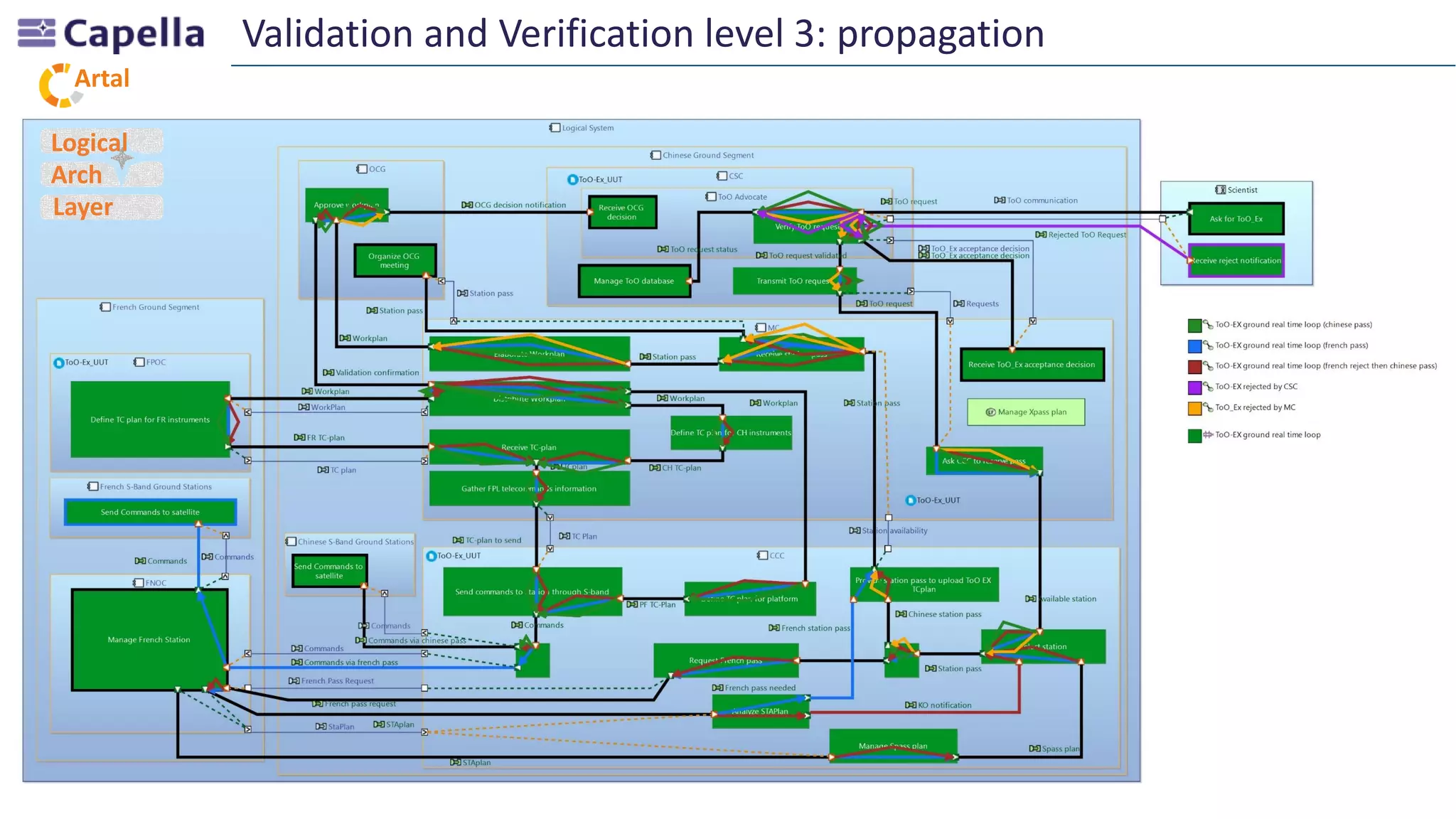
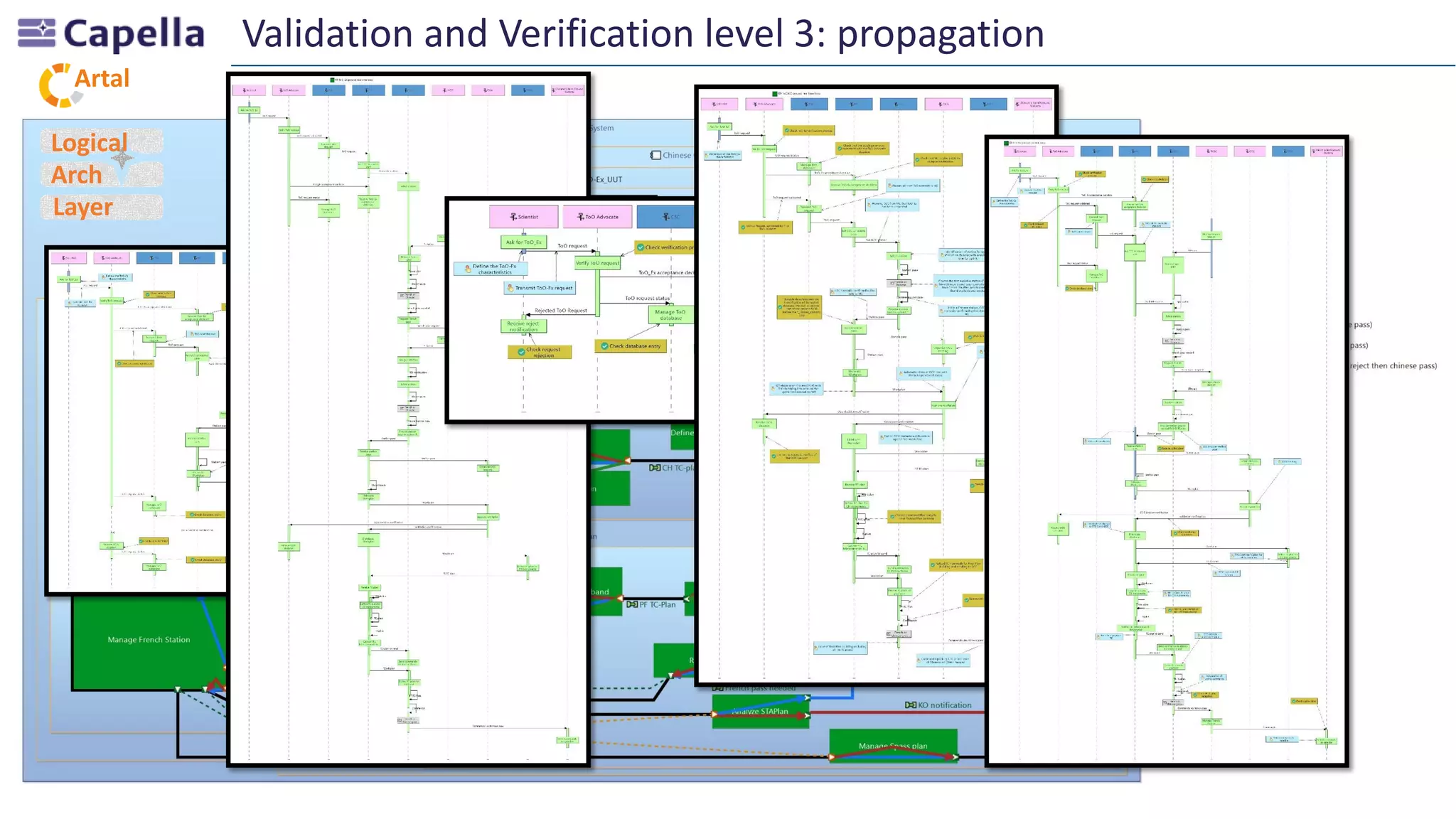
Validation and Verification level 3: propagation
Logical
Arch
Layer
Artal
Validation and Verification level 3: propagation
Logical
Arch
Layer
Artal
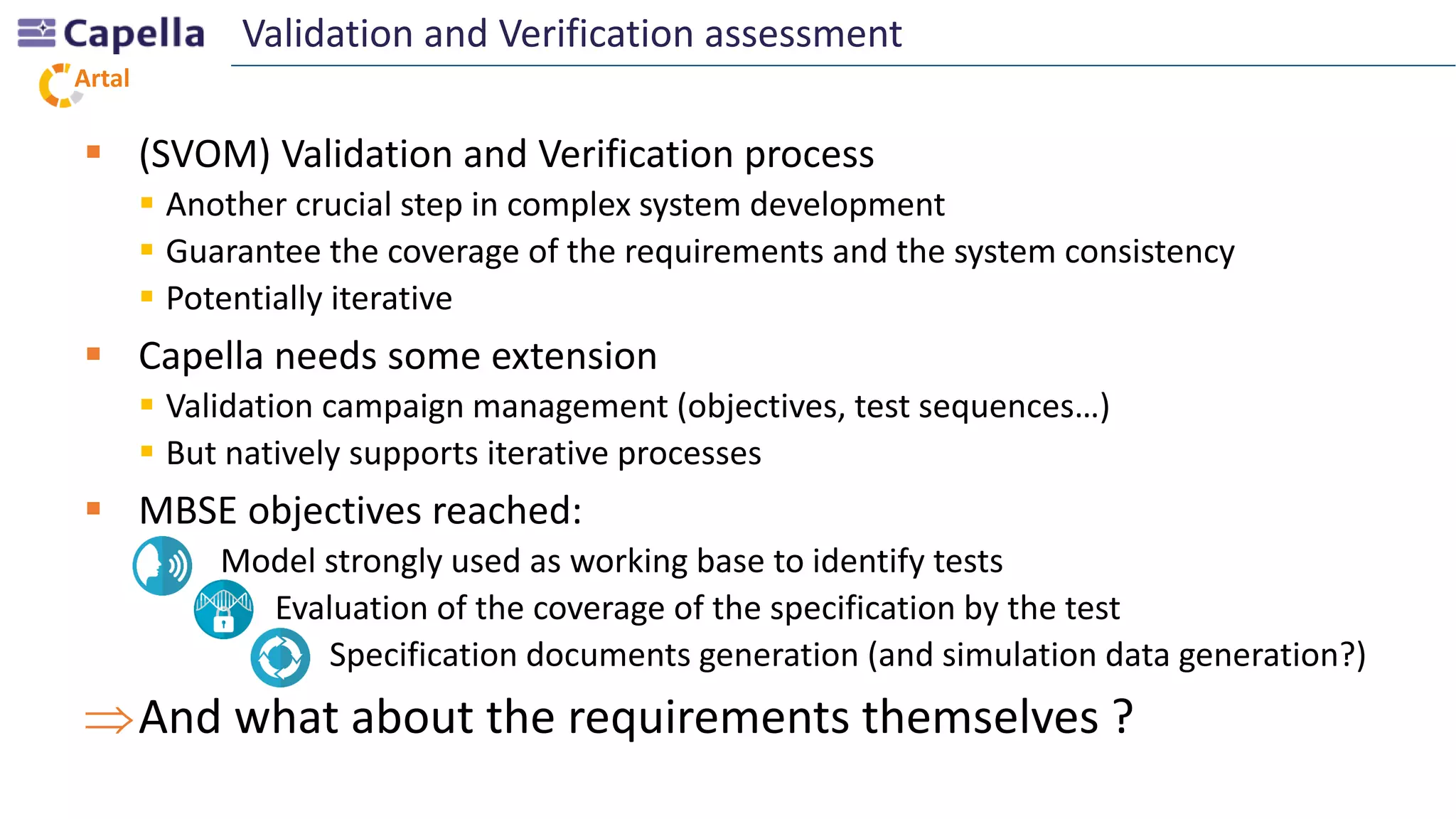
 (SVOM) Validation and Verification process
 Another crucial step in complex system development
 Guarantee the coverage of the requirements and the system consistency
 Potentially iterative
 Capella needs some extension
 Validation campaign management (objectives, test sequences…)
 But natively supports iterative processes
 MBSE objectives reached:
- Model strongly used as working base to identify tests
- Evaluation of the coverage of the specification by the test
- Specification documents generation (and simulation data generation?)
And what about the requirements themselves ?
Validation and Verification assessment
Artal
 Challenges:
- Organize requirements (allowing several reading paths)
- Traceability between requirements and system specification (coverage)
- Document generation including requirements and model items
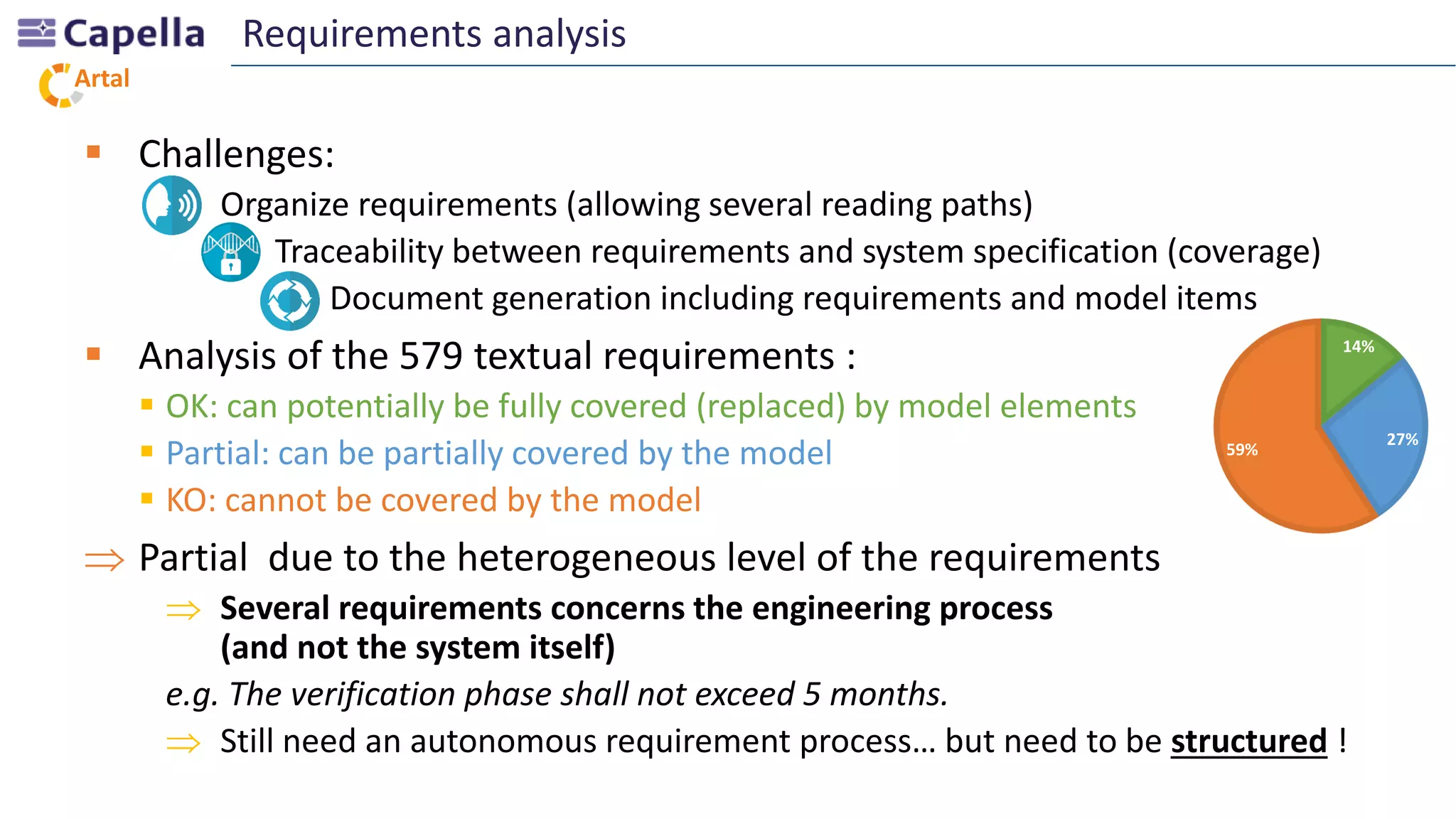
 Analysis of the 579 textual requirements :
 OK: can potentially be fully covered (replaced) by model elements
 Partial: can be partially covered by the model
 KO: cannot be covered by the model
 Partial due to the heterogeneous level of the requirements
 Several requirements concerns the engineering process
(and not the system itself)
e.g. The verification phase shall not exceed 5 months.
 Still need an autonomous requirement process… but need to be structured !
Requirements analysis
14%
27%
59%
Artal
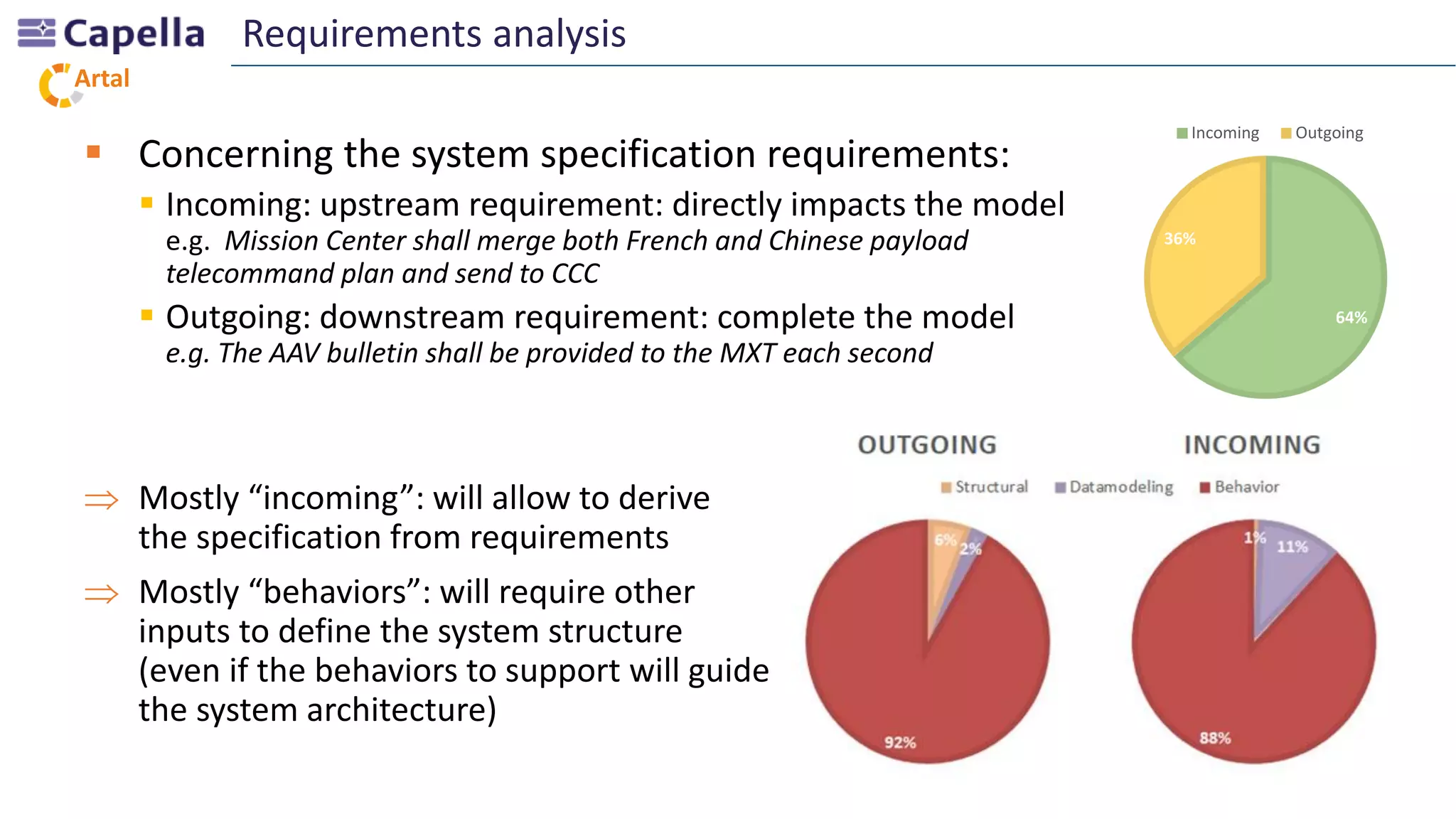
 Concerning the system specification requirements:
 Incoming: upstream requirement: directly impacts the model
e.g. Mission Center shall merge both French and Chinese payload
telecommand plan and send to CCC
 Outgoing: downstream requirement: complete the model
e.g. The AAV bulletin shall be provided to the MXT each second
 Mostly “incoming”: will allow to derive
the specification from requirements
 Mostly “behaviors”: will require other
inputs to define the system structure
(even if the behaviors to support will guide
the system architecture)
Requirements analysis
64%
36%
Incoming Outgoing
Artal
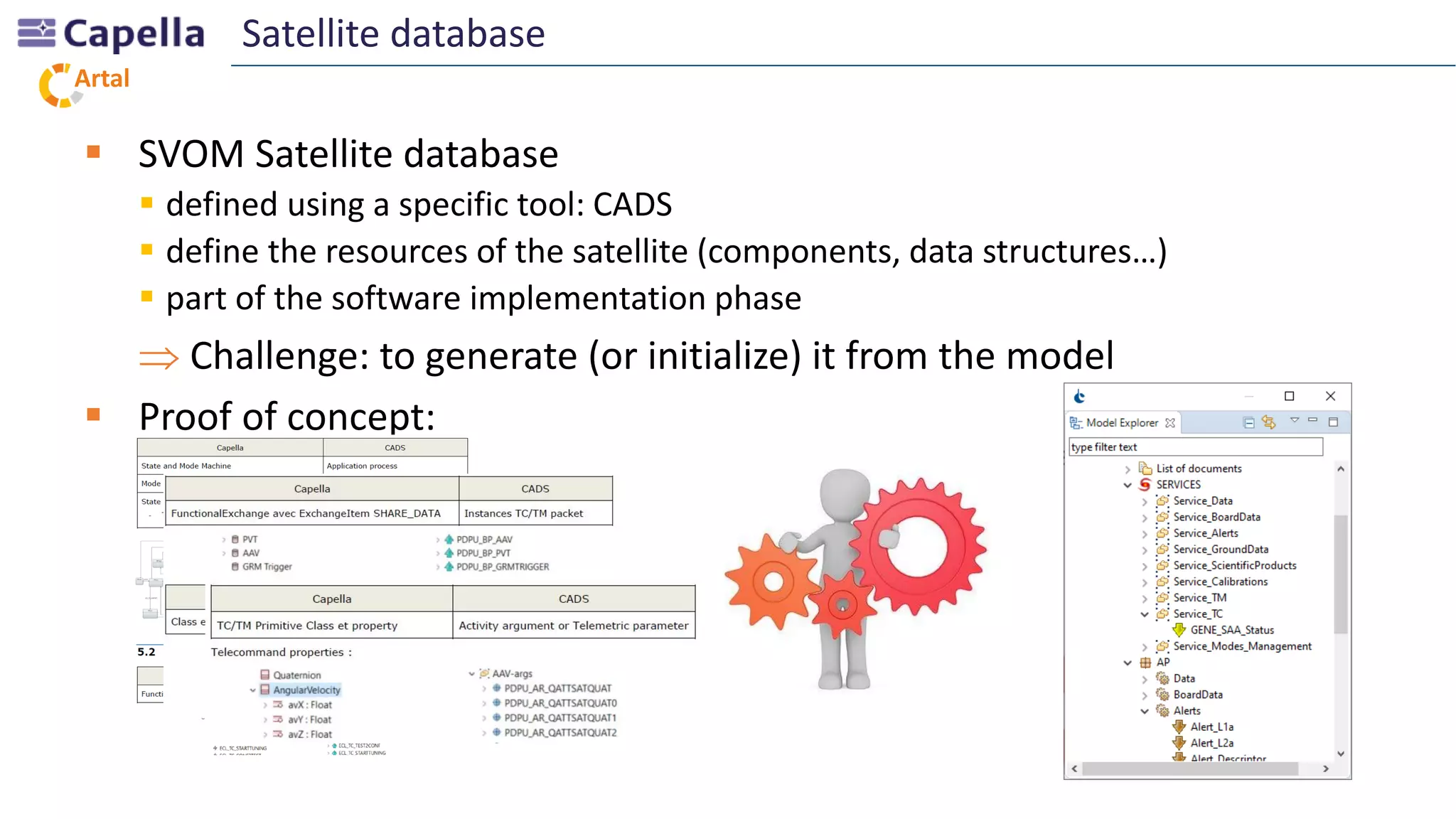
 SVOM Satellite database
 defined using a specific tool: CADS
 define the resources of the satellite (components, data structures…)
 part of the software implementation phase
 Challenge: to generate (or initialize) it from the model
 Proof of concept:
Satellite database
Artal
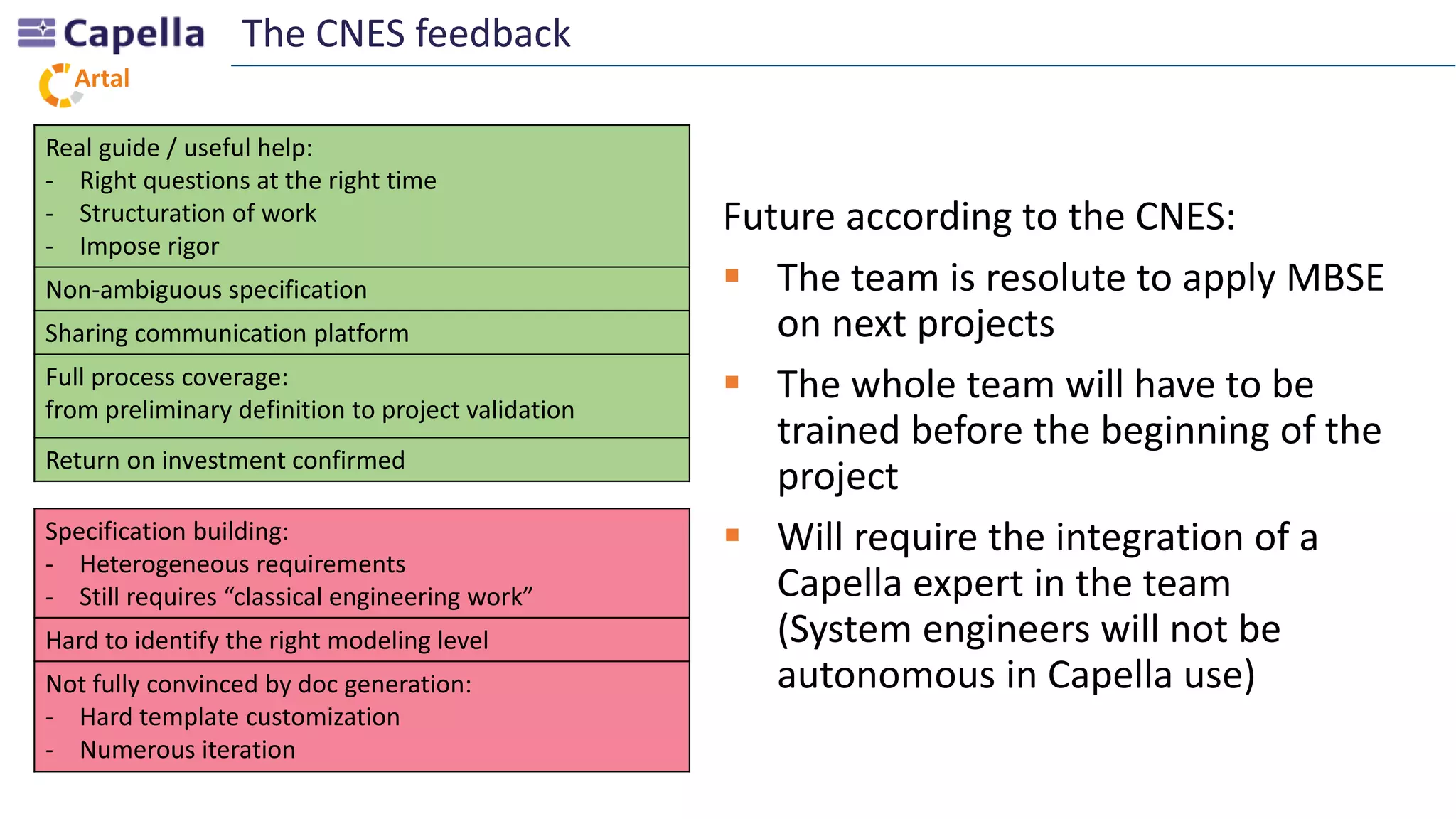
Real guide / useful help:
- Right questions at the right time
- Structuration of work
- Impose rigor
Non-ambiguous specification
Sharing communication platform
Full process coverage:
from preliminary definition to project validation
Return on investment confirmed
The CNES feedback
Specification building:
- Heterogeneous requirements
- Still requires “classical engineering work”
Hard to identify the right modeling level
Not fully convinced by doc generation:
- Hard template customization
- Numerous iteration
Future according to the CNES:
 The team is resolute to apply MBSE
on next projects
 The whole team will have to be
trained before the beginning of the
project
 Will require the integration of a
Capella expert in the team
(System engineers will not be
autonomous in Capella use)
More information on
http://capella.artal-group.com
#CapellaDays
Thanks for watching
For any other questions, join our discussion group on LinkedIn.
Over 30 Industry leaders trust Capella, so you can too.
We regularly organise Capella related events, so see you then !

[Capella Days 2020] Successful Capella landing on a CNES operational use case

  • 1.
    12/10/2020 Successful Capella Landingon a CNES Operational Use-Case #CapellaDays Jonathan Lasalle Artal Technologies MBSE Department Head @LinkedIn
  • 2.
    1 rue Ariane– 31520 Ramonville-Saint-Agne, France – 05 61 00 39 30 – artal@artal.frJonathan Lasalle - ARTAL Technologies Successful Capella landing on a CNES operational use-case
  • 3.
    Artal  Appears randomlyin the sky  Study of Gamma Ray Burst (GRB)  Eruption of Gamma Photon  Characteristics:  Appears randomly in the sky  Short time persistence  Short bursts: some seconds  Long bursts: some minutes  Theories:  Short bursts : gravitational collapse of giant stars  Long bursts : merger of binary neutron star The SVOM Project
  • 4.
    Artal  Space segment A satellite  Large angle detector  Narrow angle sensors for data measurements  Able to reorient autonomously  Ground segment  Worldwide communication antenna network  Management centers  France-China collaboration  To be launched in 2021 The SVOM Project
  • 5.
    Artal  (Digital) Textual document-basedprocess  Successive refinement of documents  No structural consistency validation mechanism  Validation based on human expertise Historical development process
  • 6.
    Artal Why using modelsinstead of regular documents to describe the system ? MBSE Experimentation Communicate: use of a rigorous and reader-friendly language to reduce ambiguities Secure : validation of the specification using traceability and coverage mechanism to ensure consistency, completeness … Generate: take advantage of the formal description to generate assets (and automate refinement steps)
  • 7.
    Artal CNES process vsArcadia/Capella « way of life » CADS
  • 8.
    Artal CNES process vsArcadia/Capella « way of life » CADS [1] Interface engineering [2] V&V: Validation and Verification [3] Requirements management [4] Database generation
  • 9.
    Artal Interface engineering usingCapella System Analysis Layer
  • 10.
    Artal Interface engineering usingCapella System Analysis Layer
  • 11.
    Artal Interface engineering usingCapella Logical Arch Layer
  • 12.
    Artal Interface engineering usingCapella Logical Arch Layer
  • 13.
    Artal Interface engineering usingCapella Logical Arch Layer
  • 14.
    Artal Interface engineering usingCapella Logical Arch Layer
  • 15.
    Artal Interface engineering usingCapella Logical Arch Layer
  • 16.
    Artal Interface engineering: documentationgeneration Generated vs Original
  • 17.
    Artal  (SVOM) Interfaceengineering  Crucial step in complex system development  The international context call for even more rigor  Late-update can be costly  Capella is « ready » for interface engineering management  Vast expressivity  Traceability / continuity between specification layers  MBSE objectives reached: - Formal specification available - Coverage of the needs / Completeness evaluation - Specification documents generation Next step: operational capture of V&V data Interface engineering assessment
  • 18.
    Artal Validation and Verificationlevel 1: needs coverage System Analysis Layer
  • 19.
    Artal Validation and Verificationlevel 2: functional chains Logical Arch Layer
  • 20.
    Artal Validation and Verificationlevel 2: functional chains Logical Arch Layer
  • 21.
    Artal Validation and Verificationlevel 2: scenarios Logical Arch Layer
  • 22.
    Artal Validation and Verificationlevel 3: a brand new Capella extension Logical Arch Layer
  • 23.
    Artal Validation and Verificationlevel 3: a brand new Capella extension Logical Arch Layer
  • 24.
    Artal Validation and Verificationlevel 3: a brand new Capella extension Logical Arch Layer
  • 25.
    Artal Validation and Verificationlevel 3: a brand new Capella extension Logical Arch Layer
  • 26.
    Artal Validation and Verificationlevel 3: propagation Logical Arch Layer
  • 27.
    Artal Validation and Verificationlevel 3: propagation Logical Arch Layer
  • 28.
    Artal  (SVOM) Validationand Verification process  Another crucial step in complex system development  Guarantee the coverage of the requirements and the system consistency  Potentially iterative  Capella needs some extension  Validation campaign management (objectives, test sequences…)  But natively supports iterative processes  MBSE objectives reached: - Model strongly used as working base to identify tests - Evaluation of the coverage of the specification by the test - Specification documents generation (and simulation data generation?) And what about the requirements themselves ? Validation and Verification assessment
  • 29.
    Artal  Challenges: - Organizerequirements (allowing several reading paths) - Traceability between requirements and system specification (coverage) - Document generation including requirements and model items  Analysis of the 579 textual requirements :  OK: can potentially be fully covered (replaced) by model elements  Partial: can be partially covered by the model  KO: cannot be covered by the model  Partial due to the heterogeneous level of the requirements  Several requirements concerns the engineering process (and not the system itself) e.g. The verification phase shall not exceed 5 months.  Still need an autonomous requirement process… but need to be structured ! Requirements analysis 14% 27% 59%
  • 30.
    Artal  Concerning thesystem specification requirements:  Incoming: upstream requirement: directly impacts the model e.g. Mission Center shall merge both French and Chinese payload telecommand plan and send to CCC  Outgoing: downstream requirement: complete the model e.g. The AAV bulletin shall be provided to the MXT each second  Mostly “incoming”: will allow to derive the specification from requirements  Mostly “behaviors”: will require other inputs to define the system structure (even if the behaviors to support will guide the system architecture) Requirements analysis 64% 36% Incoming Outgoing
  • 31.
    Artal  SVOM Satellitedatabase  defined using a specific tool: CADS  define the resources of the satellite (components, data structures…)  part of the software implementation phase  Challenge: to generate (or initialize) it from the model  Proof of concept: Satellite database
  • 32.
    Artal Real guide /useful help: - Right questions at the right time - Structuration of work - Impose rigor Non-ambiguous specification Sharing communication platform Full process coverage: from preliminary definition to project validation Return on investment confirmed The CNES feedback Specification building: - Heterogeneous requirements - Still requires “classical engineering work” Hard to identify the right modeling level Not fully convinced by doc generation: - Hard template customization - Numerous iteration Future according to the CNES:  The team is resolute to apply MBSE on next projects  The whole team will have to be trained before the beginning of the project  Will require the integration of a Capella expert in the team (System engineers will not be autonomous in Capella use)
  • 33.
  • 34.
    #CapellaDays Thanks for watching Forany other questions, join our discussion group on LinkedIn. Over 30 Industry leaders trust Capella, so you can too. We regularly organise Capella related events, so see you then !