Copyright © 2017 by MBSE Training and Consulting Ltd. Published and used by INCOSE UK Ltd and INCOSE with permission.
“hear and I forget. I
see and I remember.
I do and I understand”
(Confucius)
www.executablembse.com
Tailoring the Harmony/SE
MBSE Process for Automotive Sector
Fraser Chadburn (fraser.chadburn@mbsetraining.com)
MBSE Training and Consulting Ltd, Kenilworth, UK
INCOSE UK Annual Systems Engineering Conference 2017
www.mbsetraining.com
INCOSE UK ASEC 2017 “Pushing the Boundaries of Systems Engineering”
Objectives of Presentation
• Why Model-based Systems Engineering (MBSE) is important for automotive?
• What is concept-of-operations modelling + “Classic” Harmony/SE process?
• Provide an appreciation where the quick wins are
• How is automotive different from aerospace/defence?
• Lessons/experiences of adapting MBSE/SysML/Harmony for automotive
feature development
2
Caveat: Represents authors own opinions
not those of any of his employers
INCOSE UK ASEC 2017 “Pushing the Boundaries of Systems Engineering”
Building a solid foundation
3
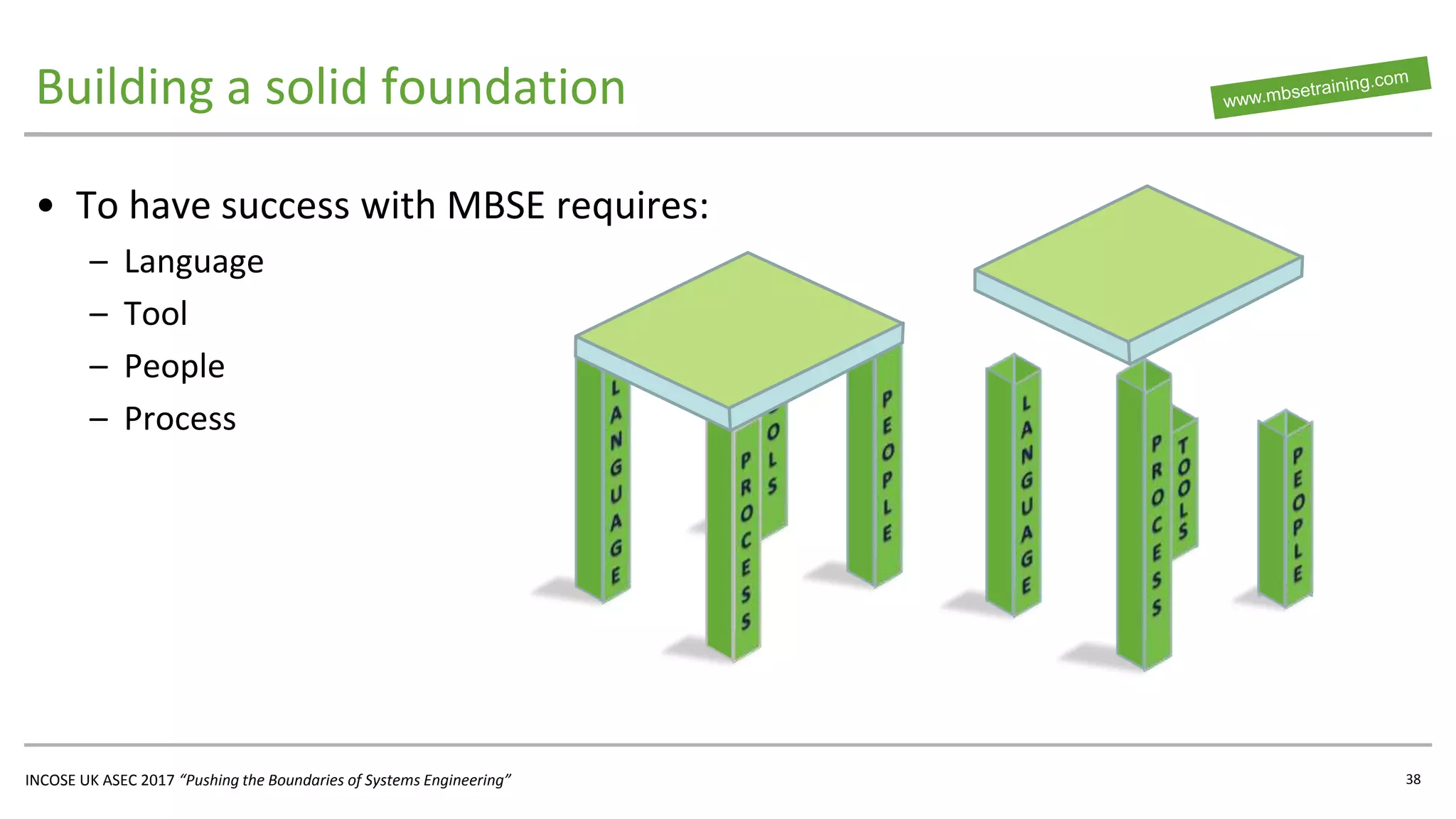
• To have success with MBSE requires:
– Language
– Tool
– People
– Process
INCOSE UK ASEC 2017 “Pushing the Boundaries of Systems Engineering”
Yester-year…
4
INCOSE UK ASEC 2017 “Pushing the Boundaries of Systems Engineering”
Tomorrow’s world / today …
5
INCOSE UK ASEC 2017 “Pushing the Boundaries of Systems Engineering”
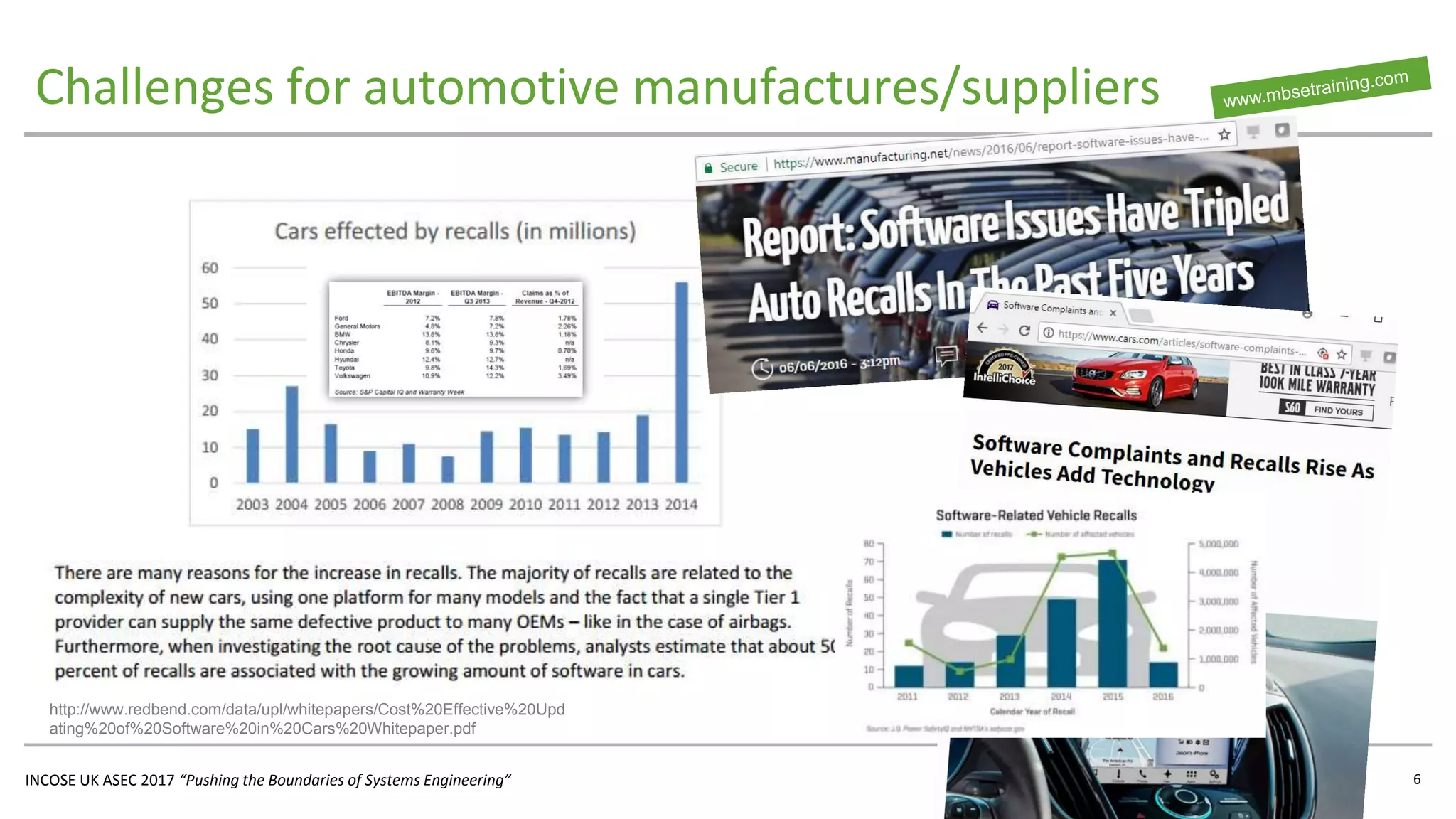
Challenges for automotive manufactures/suppliers
6
http://www.redbend.com/data/upl/whitepapers/Cost%20Effective%20Upd
ating%20of%20Software%20in%20Cars%20Whitepaper.pdf
INCOSE UK ASEC 2017 “Pushing the Boundaries of Systems Engineering”
Challenges for automotive manufactures/suppliers
• "Road vehicles – Functional safety", ISO 26262
is an international standard for functional
safety of electrical and/or electronic systems in
production automobiles defined by the
International Organization for Standardization
(ISO) in 2011.
7
INCOSE UK ASEC 2017 “Pushing the Boundaries of Systems Engineering”
Mastering MBSE with Rhapsody
9
• Model-based systems
engineering (MBSE) is a systems
engineering methodology which
focuses on creating and
exploiting models as the primary
means of information exchange
between engineers, rather than on
document-based information
exchange
https://en.wikipedia.org/wiki/Model-
based_systems_engineering
INCOSE kicked off an MBSE Initiative in January 2007. Goals
included increased productivity, by minimizing unnecessary
manual transcription of concepts when coordinating the
work of large teams.
INCOSE UK ASEC 2017 “Pushing the Boundaries of Systems Engineering”
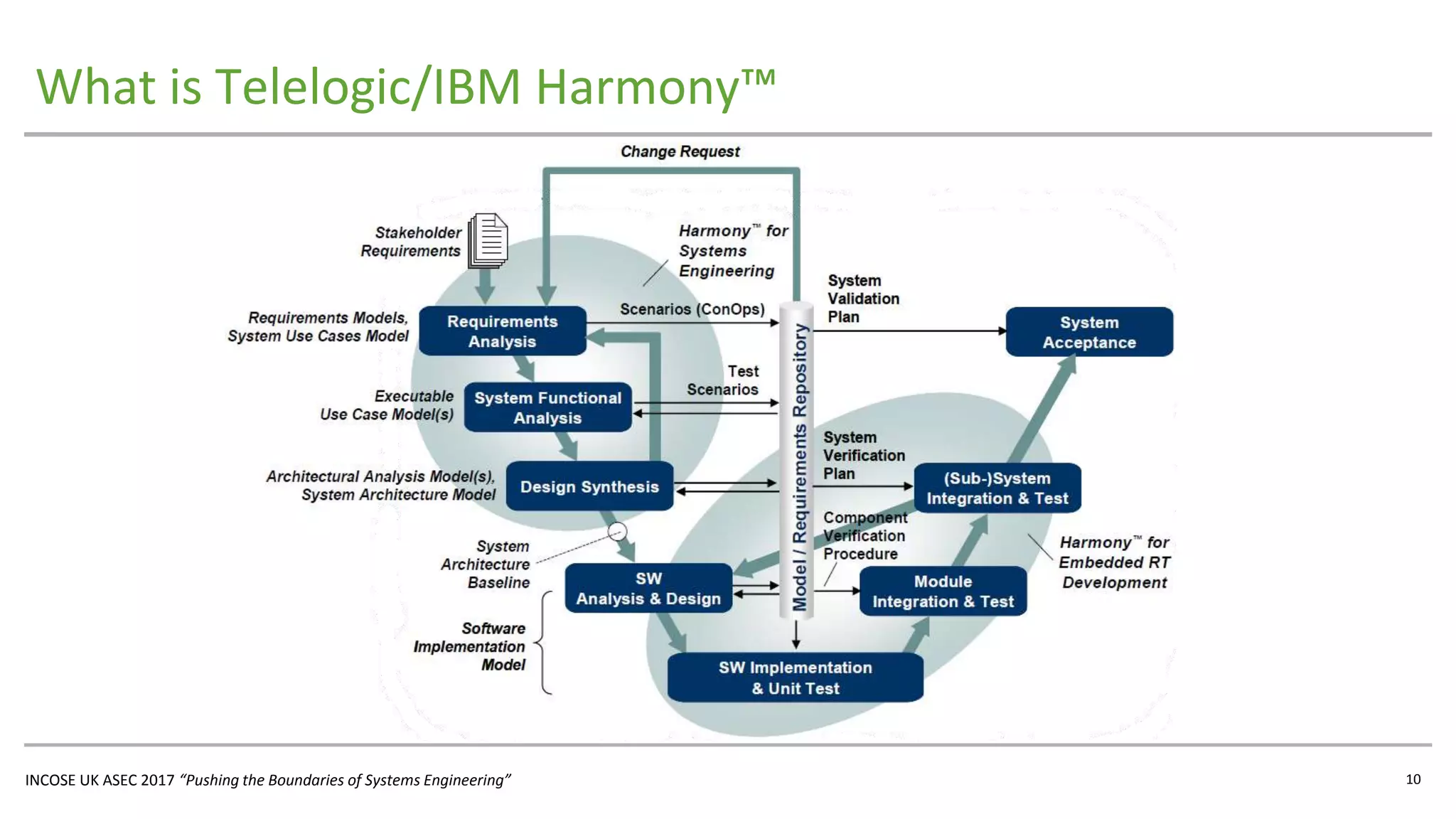
What is Telelogic/IBM Harmony™
10
INCOSE UK ASEC 2017 “Pushing the Boundaries of Systems Engineering”
“Classic” Harmony™/SE
11
INCOSE UK ASEC 2017 “Pushing the Boundaries of Systems Engineering”
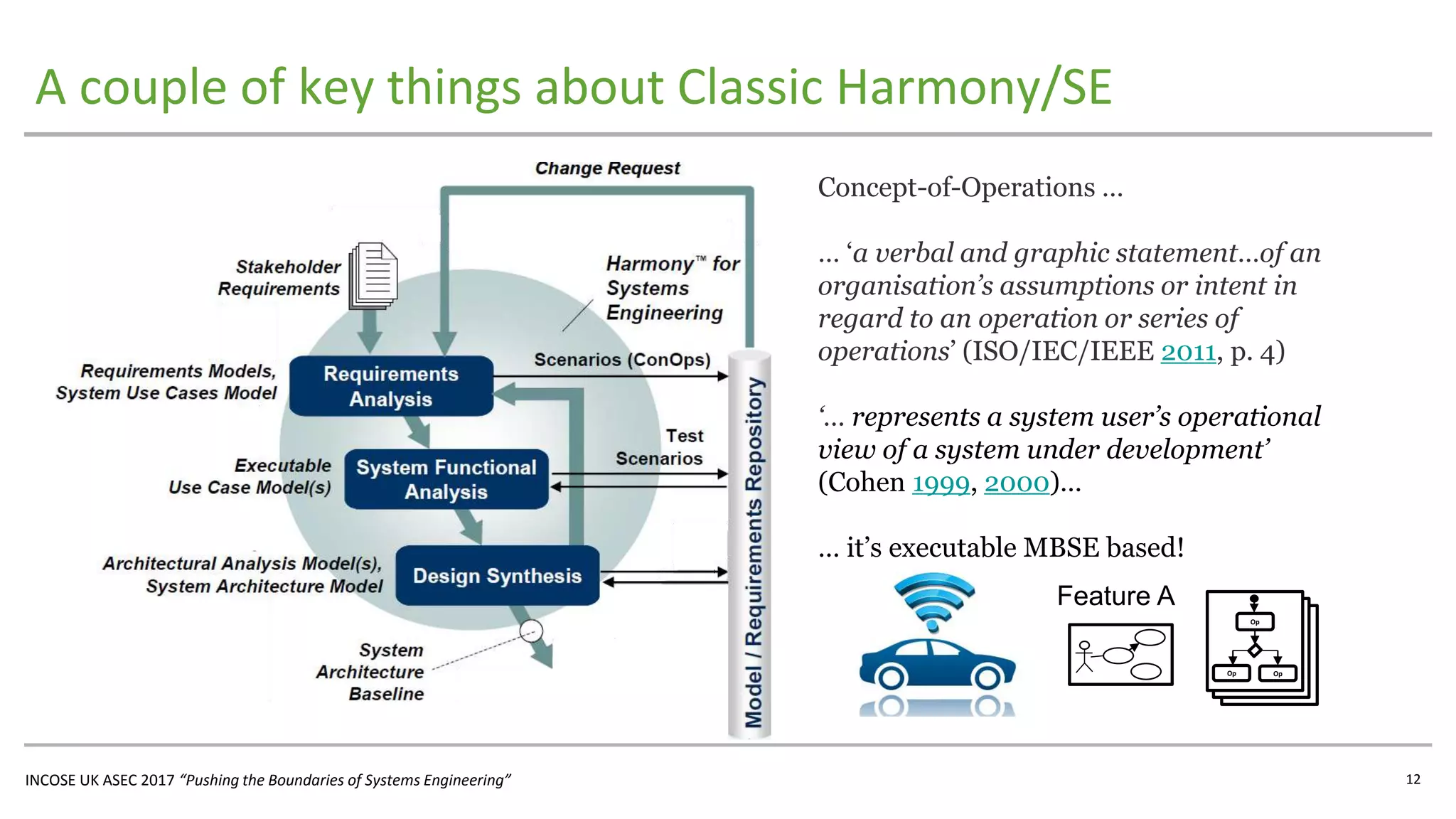
A couple of key things about Classic Harmony/SE
12
Concept-of-Operations …
… ‘a verbal and graphic statement…of an
organisation’s assumptions or intent in
regard to an operation or series of
operations’ (ISO/IEC/IEEE 2011, p. 4)
‘… represents a system user’s operational
view of a system under development’
(Cohen 1999, 2000)…
… it’s executable MBSE based!
Op
Op Op
Feature A
INCOSE UK ASEC 2017 “Pushing the Boundaries of Systems Engineering”
Some of the real-life challenges
• Product schedules are fixed
• Foundations are already built
• Use cases and requirements already in use
• Features are of interest
• Time for training
• Deploying tools
• …
13
Copyright: https://www.123rf.com
INCOSE UK ASEC 2017 “Pushing the Boundaries of Systems Engineering”
How do we make MBSE and Harmony/SE fit?
14
Copyright: https://www.123rf.com/profile_trueffelpix
INCOSE UK ASEC 2017 “Pushing the Boundaries of Systems Engineering”
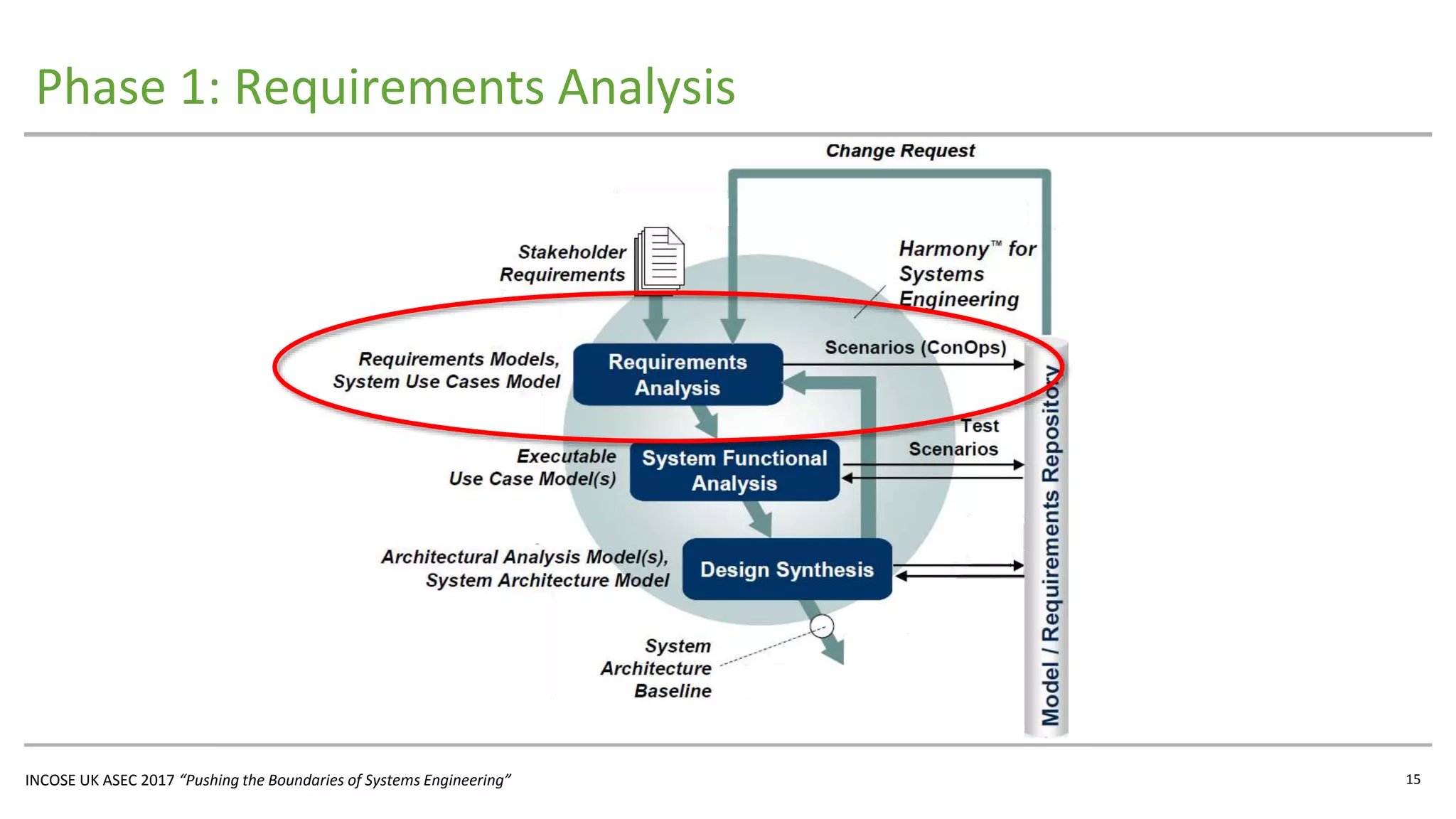
Phase 1: Requirements Analysis
15
INCOSE UK ASEC 2017 “Pushing the Boundaries of Systems Engineering”
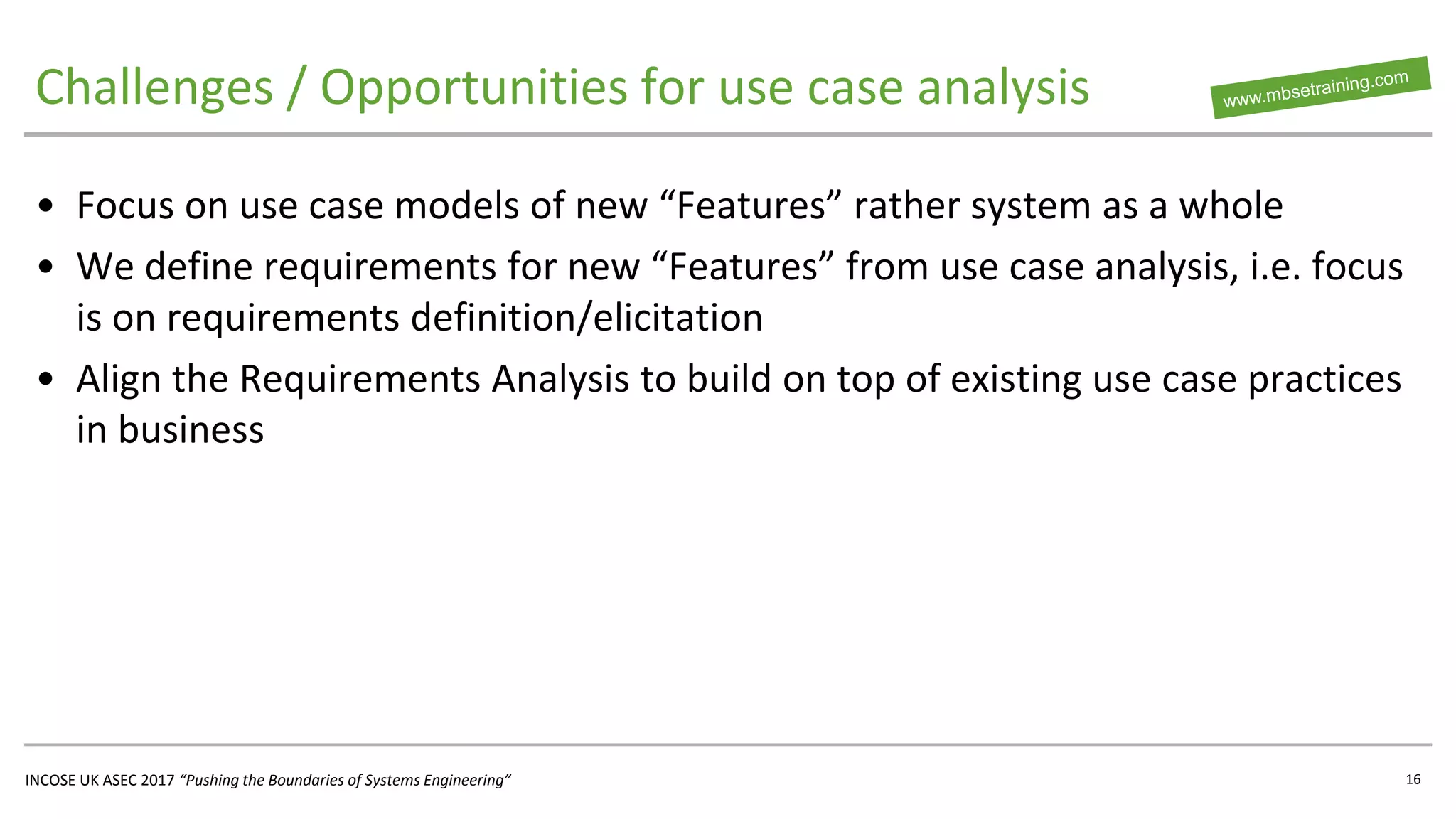
Challenges / Opportunities for use case analysis
• Focus on use case models of new “Features” rather system as a whole
• We define requirements for new “Features” from use case analysis, i.e. focus
is on requirements definition/elicitation
• Align the Requirements Analysis to build on top of existing use case practices
in business
16
INCOSE UK ASEC 2017 “Pushing the Boundaries of Systems Engineering”
What are Features?
17
Range Rover Velar_ Safety and Driver Assistance - Land
Rover Australia
https://www.youtube.com/watch?v=8lIn9KvAPJk
INCOSE UK ASEC 2017 “Pushing the Boundaries of Systems Engineering”
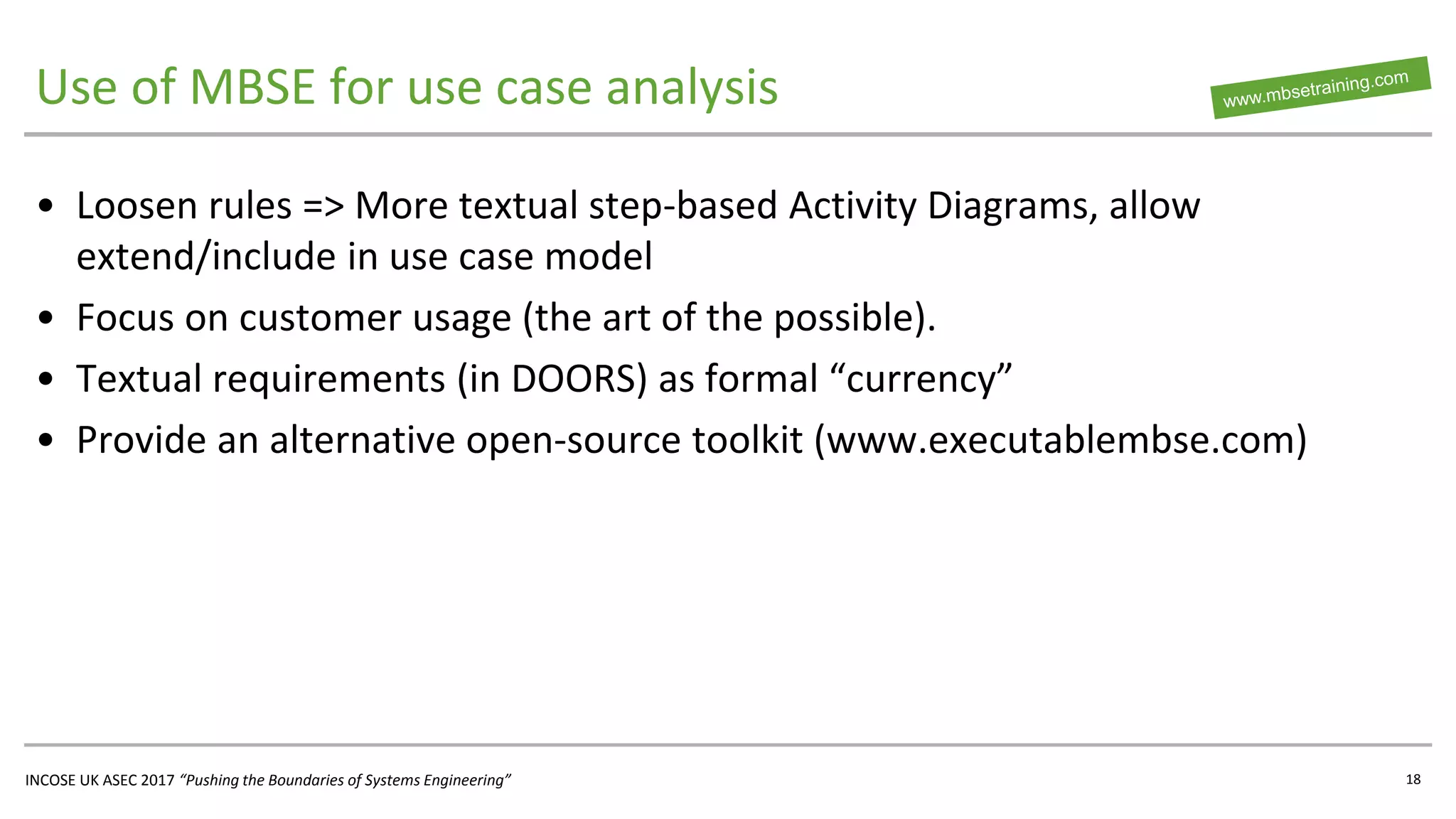
Use of MBSE for use case analysis
• Loosen rules => More textual step-based Activity Diagrams, allow
extend/include in use case model
• Focus on customer usage (the art of the possible).
• Textual requirements (in DOORS) as formal “currency”
• Provide an alternative open-source toolkit (www.executablembse.com)
18
INCOSE UK ASEC 2017 “Pushing the Boundaries of Systems Engineering”
Use Activity Model to model customer usage
19
INCOSE UK ASEC 2017 “Pushing the Boundaries of Systems Engineering”
Textual vs function-based activity diagrams
20
INCOSE UK ASEC 2017 “Pushing the Boundaries of Systems Engineering”
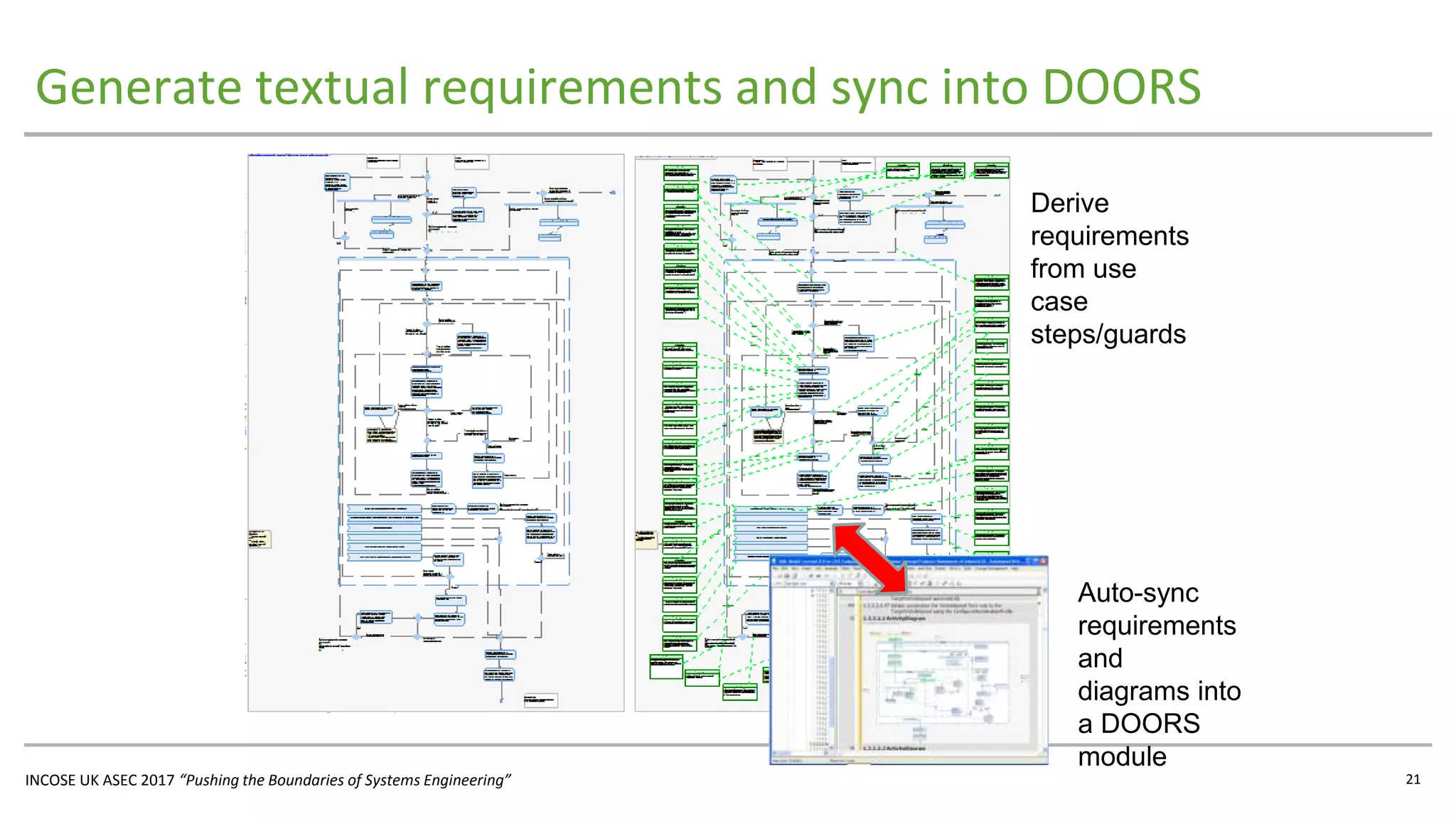
Generate textual requirements and sync into DOORS
21
Derive
requirements
from use
case
steps/guards
Auto-sync
requirements
and
diagrams into
a DOORS
module
INCOSE UK ASEC 2017 “Pushing the Boundaries of Systems Engineering”
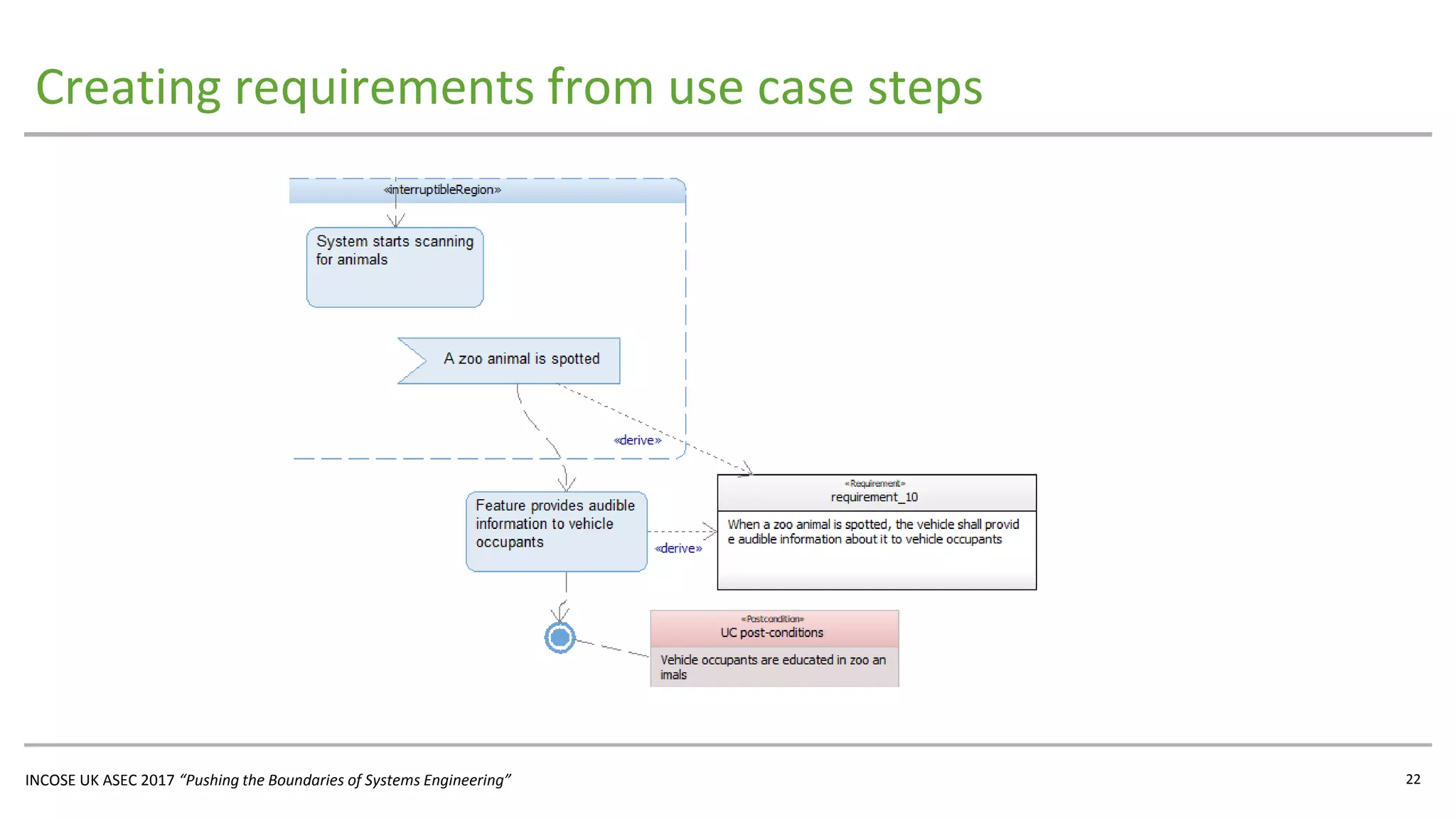
Creating requirements from use case steps
22
INCOSE UK ASEC 2017 “Pushing the Boundaries of Systems Engineering”
Benefits of simplified Act approach
• Light-weight, i.e. can be deployed with minimal training
• Can be deployed alongside existing text-based use case analysis as output
currency is the same
• Improves requirement
elicitation / stakeholder
communication
• Aligns with new DOORS
NG “external reqts”
approaches/OSLC
23
Copyright: https://www.123rf.com/profile_maxxyustas
Copyright: https://www.123rf.com
Stock image
INCOSE UK ASEC 2017 “Pushing the Boundaries of Systems Engineering”
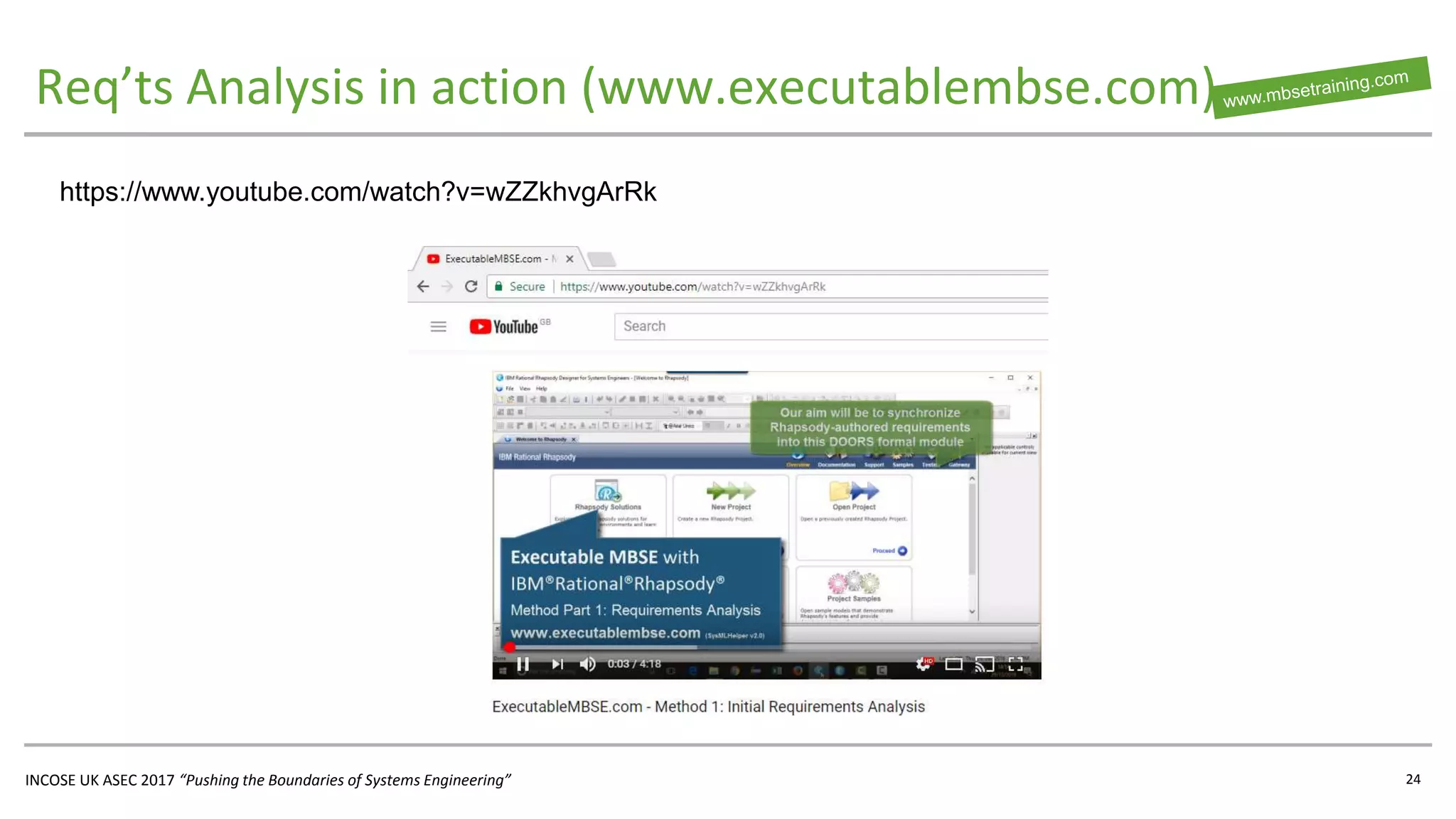
Req’ts Analysis in action (www.executablembse.com)
24
https://www.youtube.com/watch?v=wZZkhvgArRk
INCOSE UK ASEC 2017 “Pushing the Boundaries of Systems Engineering”
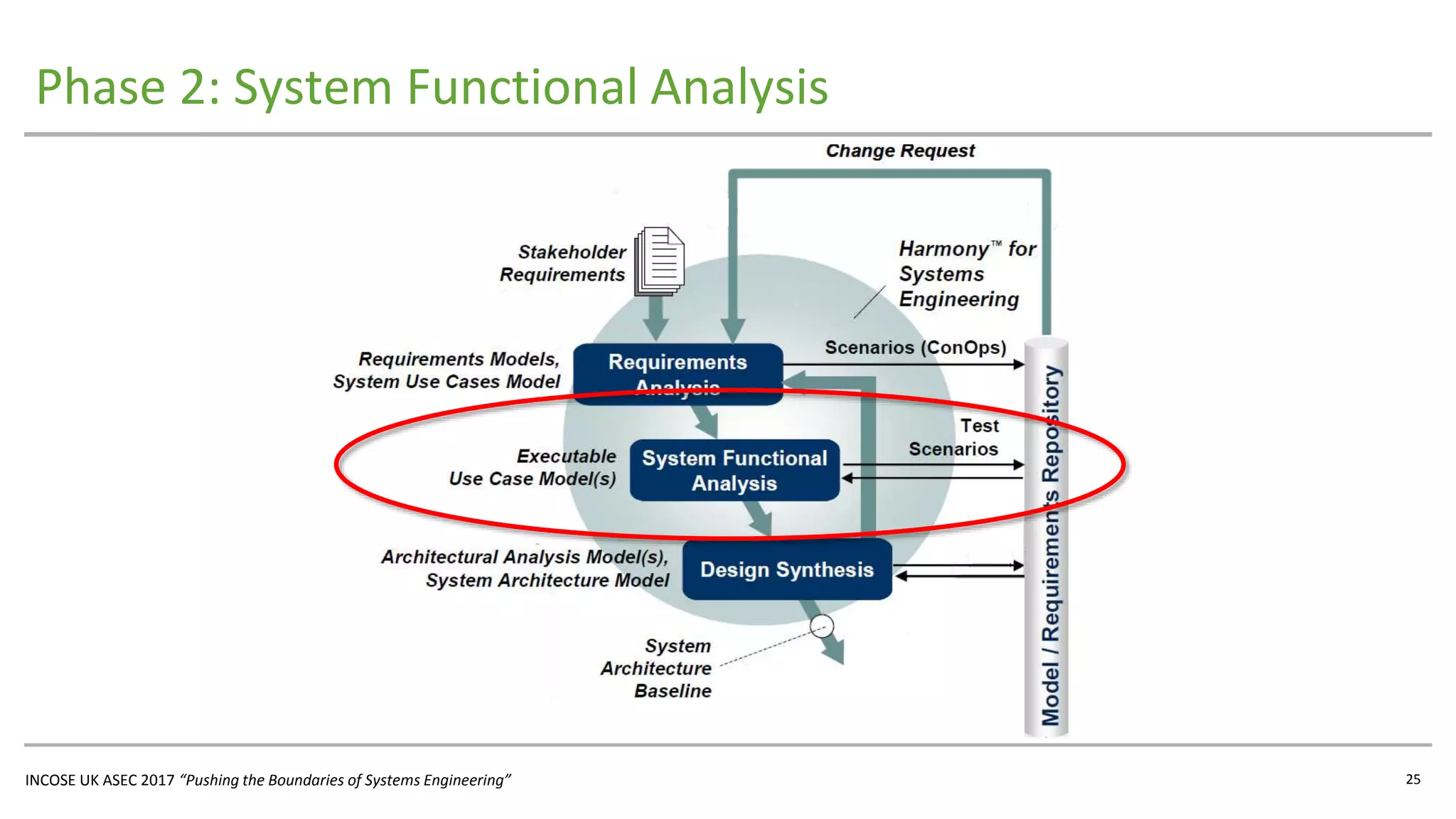
Phase 2: System Functional Analysis
25
INCOSE UK ASEC 2017 “Pushing the Boundaries of Systems Engineering”
System Functional Analysis
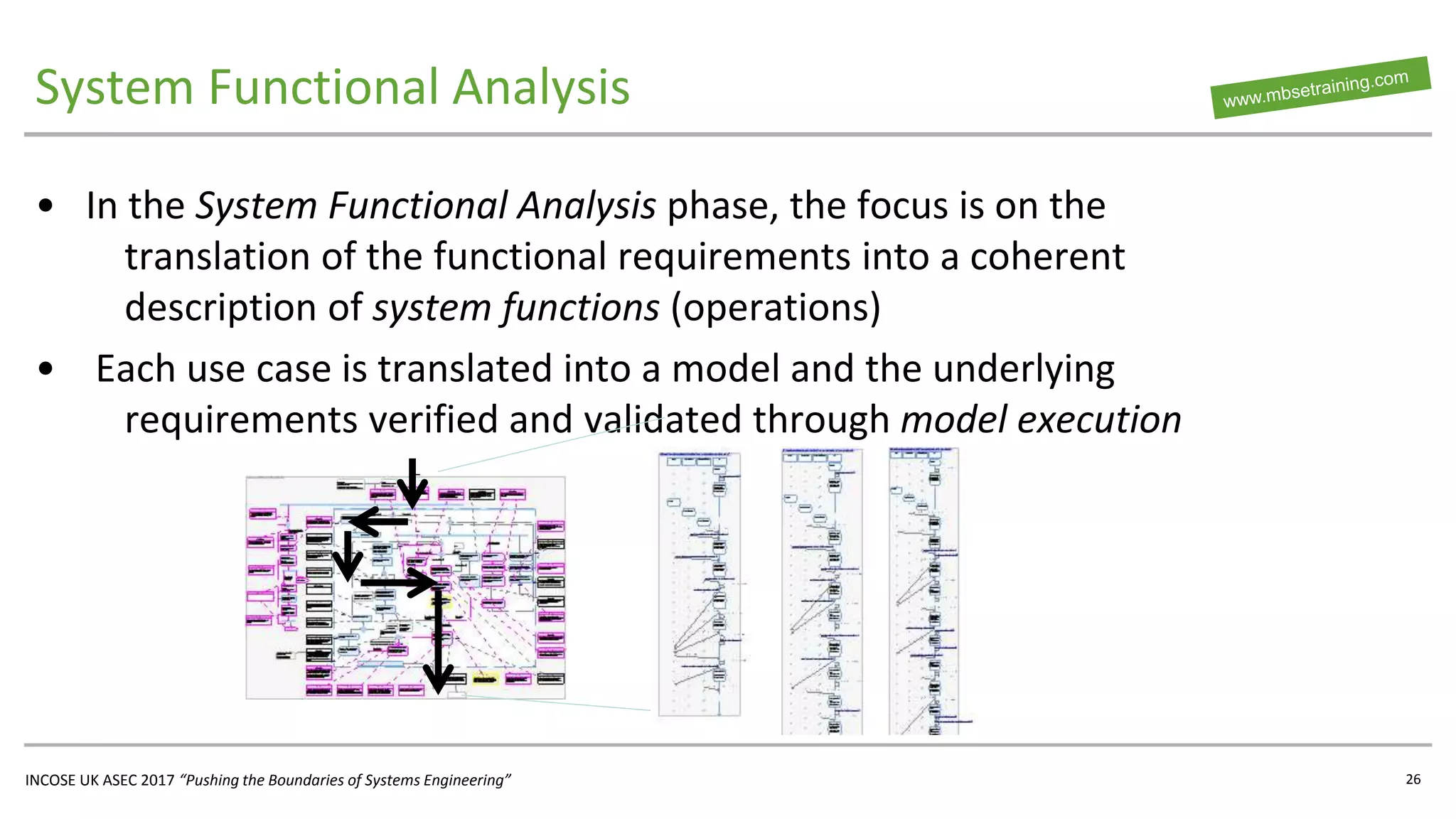
• In the System Functional Analysis phase, the focus is on the
translation of the functional requirements into a coherent
description of system functions (operations)
• Each use case is translated into a model and the underlying
requirements verified and validated through model execution
26
INCOSE UK ASEC 2017 “Pushing the Boundaries of Systems Engineering”
Constraining behaviour using an executable STM
27
INCOSE UK ASEC 2017 “Pushing the Boundaries of Systems Engineering”
Method is Harmony/SE…
28
Build Executable Model of Use Case
[Alternative 1]
[Alternative 3]
Define Use Case Model Context
( UC Internal Block Diagram )
[Alternative 2]
Define UC Functional Flow
( UC Black-Box Activity Diagram )
Derive UC Scenarios
from UC Functional Flow
( UC Black-Box Sequence Diagrams )
Derive UC Functional Flow
from UC Scenarios
( UC Black-Box Activity Diagram )
Define UC Scenarios
( UC Black-Box Sequence Diagrams )
Define Ports And Interfaces
( UC Internal Block Diagram )
Define UC State-Based Behavior
( UC Statechart Diagram )
Derive UC Scenarios
from UC Statechart Diagram
( UC Black-Box Sequence Diagram )
Verify / Validate UC Model
trough Model Execution
Define Ports and Interfaces
( UC Internal Block Diagram )
Derive UC State-Based Behavior
from UC BB-AD and BB-SD’s
( UC Statechart Diagram )
Link
UC Block Properties to Reqs
… but not as you know it
INCOSE UK ASEC 2017 “Pushing the Boundaries of Systems Engineering”
Considerations
29
I already have activity
diagrams/requirements,
can I use these to create
traced operations?
When I create
operations can I put it
straight into the state-
machine to generate the
SD test scenarios?
Will my state-machine
be too complex if I do it
for a whole feature,
rather than just a use
case?
Can people build
executable models
without deep
tool/method training?
INCOSE UK ASEC 2017 “Pushing the Boundaries of Systems Engineering”
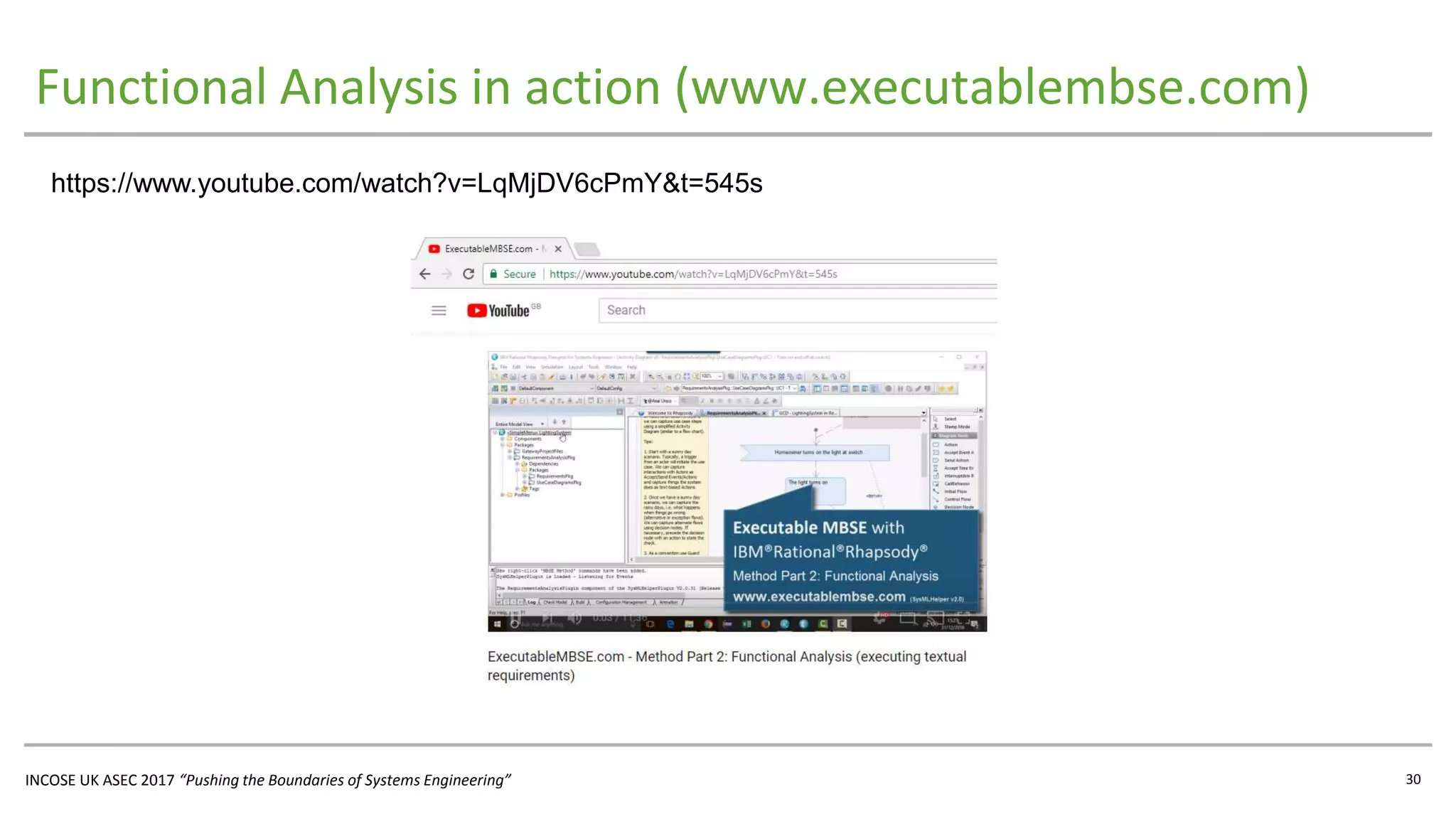
Functional Analysis in action (www.executablembse.com)
30
https://www.youtube.com/watch?v=LqMjDV6cPmY&t=545s
INCOSE UK ASEC 2017 “Pushing the Boundaries of Systems Engineering”
Some conclusions…
• A systematic approach is possible. However, Functional Analysis requires
deeper knowledge
• Tool automation is essential
• “Wing Person” approach
• Process is a bit like unit testing. It finds duplicate, ambiguous, and missing
requirements
• Method generates strawman test cases traced to req’ts
• Automotive engineers gravitate towards a “flavour” of SysML
• Challenges arise where Features are dependent on each others
31
INCOSE UK ASEC 2017 “Pushing the Boundaries of Systems Engineering”
Strategies for dealing with complexities
32
Fig 1 - Using
object-orientated
inheritance to
manage
complexity
Fig 2 – Using straight-to-white
box simulation to manage
complexity
Copyright : rf123.com Andreas Mann
INCOSE UK ASEC 2017 “Pushing the Boundaries of Systems Engineering”
Phase 3: Design Synthesis
33
INCOSE UK ASEC 2017 “Pushing the Boundaries of Systems Engineering”
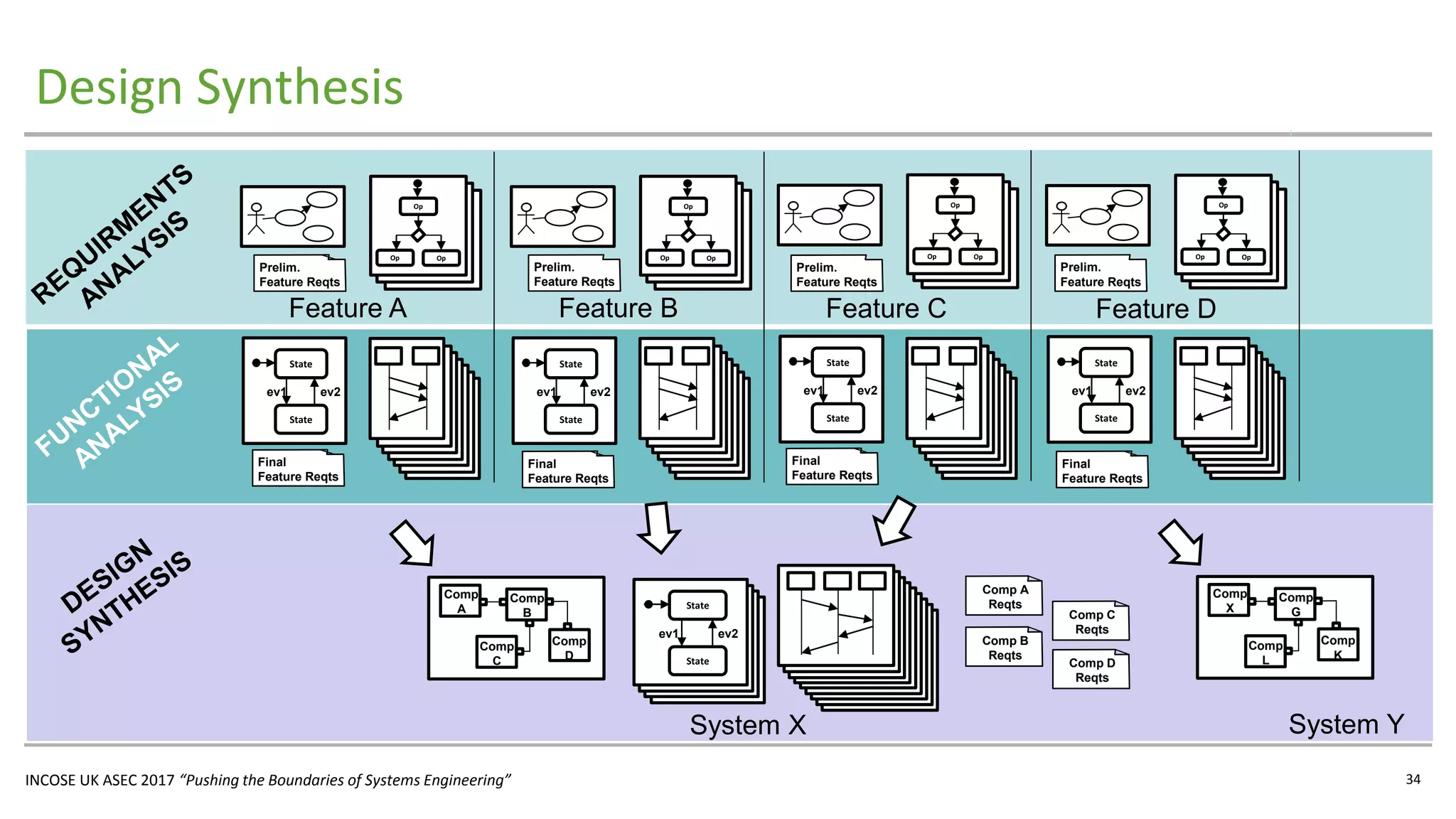
Design Synthesis
34
Op
Op Op
Feature A
Prelim.
Feature Reqts
System Y
Comp
X
Comp
G
Comp
L
Comp
K
Op
Op Op
Feature B
Prelim.
Feature Reqts
Op
Op Op
Feature C
Prelim.
Feature Reqts
Op
Op Op
Feature D
Prelim.
Feature Reqts
State
State
ev1 ev2
Final
Feature Reqts
State
State
ev1 ev2
Final
Feature Reqts
State
State
ev1 ev2
Final
Feature Reqts
State
State
ev1 ev2
Final
Feature Reqts
System X
State
State
ev1 ev2
Comp
A
Comp
B
Comp
C
Comp
D
Comp A
Reqts
Comp B
Reqts
Comp D
Reqts
Comp C
Reqts
INCOSE UK ASEC 2017 “Pushing the Boundaries of Systems Engineering”
Lessons learnt in moving to white-box simulation
• Architectures tend towards data-centric / broadcast architecture
• Flow-ports and more continuous-orientated simulations
• Undesirable emergent behavior becomes readily apparent
• Complexity of model is increased but complexity of state machines is reduced
• State machines become more aligned/understood by component owners
• It’s a good point to add real/simulated-HMI
35
INCOSE UK ASEC 2017 “Pushing the Boundaries of Systems Engineering”
Overall Summary
• The work here is new and represents first impressions
• High-potential for executable MBSE of certain types of systems
• Pull rather than push, from engineers, for executable MBSE
• Challenges similar to requirements management concepts, e.g., abstraction
• Tailoring/limiting the language was really found to help
• Tailoring the tool was found to really help initial deployment
36
INCOSE UK ASEC 2017 “Pushing the Boundaries of Systems Engineering”
Summary 2/2
• Full “integrated feature” executable MBSE at a large scale, requires high-level
orchestration
• Light-weight techniques surprisingly high value/low cost… the approach to
the “people-process” side is fundamental
37
Copyright Iakov Filimonov (rf123 stockimage)
INCOSE UK ASEC 2017 “Pushing the Boundaries of Systems Engineering”
Building a solid foundation
38
• To have success with MBSE requires:
– Language
– Tool
– People
– Process
INCOSE UK ASEC 2017 “Pushing the Boundaries of Systems Engineering”
Contact Info
• 20 years of modelling experience
(UML/SysML)
– 3 ¾ years in automotive industry using SysML
– 7 ½ years as an IBM Rational Rhapsody/ Jazz
specialist for IBM/Telelogic
– 3 ½ years as product manager for Artisan
Studio UML/SysML tool
– 4 ½ years prior to Artisan using UML
(software), Xerox, WWG/Acterna, DS&S
• Other points: PGCE (Cambridge)
• Live in Kenilworth, Warwickshire
UML4SysML
39
Fraser Chadburn B.Sc (Hons)
fraser.Chadburn@mbsetraining.com
www.executablembse.comwww.mbsetraining.com
INCOSE UK ASEC 2017 “Pushing the Boundaries of Systems Engineering”
Training
• For paid training, I deliver open-training
on Mastering MBSE with SysML and IBM
Rational Rhapsody in conjunction with
HORIBA MIRA Ltd, Warwickshire, CV10
0TU, UK
• The next course is: 5-7th December 2017
https://www.horiba-mira.com/our-
services/capabilities/model-based-
systems-engineering
UML4SysML
40
www.executablembse.comwww.mbsetraining.com
• Free tutorial on “Making Executable MBSE
Simple” is tomorrow!
• I’ll take you through developing a feature
from a blank idea

Tailoring Harmony/SE for Automotive V3

  • 1.
    Copyright © 2017by MBSE Training and Consulting Ltd. Published and used by INCOSE UK Ltd and INCOSE with permission. “hear and I forget. I see and I remember. I do and I understand” (Confucius) www.executablembse.com Tailoring the Harmony/SE MBSE Process for Automotive Sector Fraser Chadburn (fraser.chadburn@mbsetraining.com) MBSE Training and Consulting Ltd, Kenilworth, UK INCOSE UK Annual Systems Engineering Conference 2017 www.mbsetraining.com INCOSE UK ASEC 2017 “Pushing the Boundaries of Systems Engineering”
  • 2.
    INCOSE UK ASEC2017 “Pushing the Boundaries of Systems Engineering” Objectives of Presentation • Why Model-based Systems Engineering (MBSE) is important for automotive? • What is concept-of-operations modelling + “Classic” Harmony/SE process? • Provide an appreciation where the quick wins are • How is automotive different from aerospace/defence? • Lessons/experiences of adapting MBSE/SysML/Harmony for automotive feature development 2 Caveat: Represents authors own opinions not those of any of his employers
  • 3.
    INCOSE UK ASEC2017 “Pushing the Boundaries of Systems Engineering” Building a solid foundation 3 • To have success with MBSE requires: – Language – Tool – People – Process
  • 4.
    INCOSE UK ASEC2017 “Pushing the Boundaries of Systems Engineering” Yester-year… 4
  • 5.
    INCOSE UK ASEC2017 “Pushing the Boundaries of Systems Engineering” Tomorrow’s world / today … 5
  • 6.
    INCOSE UK ASEC2017 “Pushing the Boundaries of Systems Engineering” Challenges for automotive manufactures/suppliers 6 http://www.redbend.com/data/upl/whitepapers/Cost%20Effective%20Upd ating%20of%20Software%20in%20Cars%20Whitepaper.pdf
  • 7.
    INCOSE UK ASEC2017 “Pushing the Boundaries of Systems Engineering” Challenges for automotive manufactures/suppliers • "Road vehicles – Functional safety", ISO 26262 is an international standard for functional safety of electrical and/or electronic systems in production automobiles defined by the International Organization for Standardization (ISO) in 2011. 7
  • 8.
    INCOSE UK ASEC2017 “Pushing the Boundaries of Systems Engineering” Mastering MBSE with Rhapsody 9 • Model-based systems engineering (MBSE) is a systems engineering methodology which focuses on creating and exploiting models as the primary means of information exchange between engineers, rather than on document-based information exchange https://en.wikipedia.org/wiki/Model- based_systems_engineering INCOSE kicked off an MBSE Initiative in January 2007. Goals included increased productivity, by minimizing unnecessary manual transcription of concepts when coordinating the work of large teams.
  • 9.
    INCOSE UK ASEC2017 “Pushing the Boundaries of Systems Engineering” What is Telelogic/IBM Harmony™ 10
  • 10.
    INCOSE UK ASEC2017 “Pushing the Boundaries of Systems Engineering” “Classic” Harmony™/SE 11
  • 11.
    INCOSE UK ASEC2017 “Pushing the Boundaries of Systems Engineering” A couple of key things about Classic Harmony/SE 12 Concept-of-Operations … … ‘a verbal and graphic statement…of an organisation’s assumptions or intent in regard to an operation or series of operations’ (ISO/IEC/IEEE 2011, p. 4) ‘… represents a system user’s operational view of a system under development’ (Cohen 1999, 2000)… … it’s executable MBSE based! Op Op Op Feature A
  • 12.
    INCOSE UK ASEC2017 “Pushing the Boundaries of Systems Engineering” Some of the real-life challenges • Product schedules are fixed • Foundations are already built • Use cases and requirements already in use • Features are of interest • Time for training • Deploying tools • … 13 Copyright: https://www.123rf.com
  • 13.
    INCOSE UK ASEC2017 “Pushing the Boundaries of Systems Engineering” How do we make MBSE and Harmony/SE fit? 14 Copyright: https://www.123rf.com/profile_trueffelpix
  • 14.
    INCOSE UK ASEC2017 “Pushing the Boundaries of Systems Engineering” Phase 1: Requirements Analysis 15
  • 15.
    INCOSE UK ASEC2017 “Pushing the Boundaries of Systems Engineering” Challenges / Opportunities for use case analysis • Focus on use case models of new “Features” rather system as a whole • We define requirements for new “Features” from use case analysis, i.e. focus is on requirements definition/elicitation • Align the Requirements Analysis to build on top of existing use case practices in business 16
  • 16.
    INCOSE UK ASEC2017 “Pushing the Boundaries of Systems Engineering” What are Features? 17 Range Rover Velar_ Safety and Driver Assistance - Land Rover Australia https://www.youtube.com/watch?v=8lIn9KvAPJk
  • 17.
    INCOSE UK ASEC2017 “Pushing the Boundaries of Systems Engineering” Use of MBSE for use case analysis • Loosen rules => More textual step-based Activity Diagrams, allow extend/include in use case model • Focus on customer usage (the art of the possible). • Textual requirements (in DOORS) as formal “currency” • Provide an alternative open-source toolkit (www.executablembse.com) 18
  • 18.
    INCOSE UK ASEC2017 “Pushing the Boundaries of Systems Engineering” Use Activity Model to model customer usage 19
  • 19.
    INCOSE UK ASEC2017 “Pushing the Boundaries of Systems Engineering” Textual vs function-based activity diagrams 20
  • 20.
    INCOSE UK ASEC2017 “Pushing the Boundaries of Systems Engineering” Generate textual requirements and sync into DOORS 21 Derive requirements from use case steps/guards Auto-sync requirements and diagrams into a DOORS module
  • 21.
    INCOSE UK ASEC2017 “Pushing the Boundaries of Systems Engineering” Creating requirements from use case steps 22
  • 22.
    INCOSE UK ASEC2017 “Pushing the Boundaries of Systems Engineering” Benefits of simplified Act approach • Light-weight, i.e. can be deployed with minimal training • Can be deployed alongside existing text-based use case analysis as output currency is the same • Improves requirement elicitation / stakeholder communication • Aligns with new DOORS NG “external reqts” approaches/OSLC 23 Copyright: https://www.123rf.com/profile_maxxyustas Copyright: https://www.123rf.com Stock image
  • 23.
    INCOSE UK ASEC2017 “Pushing the Boundaries of Systems Engineering” Req’ts Analysis in action (www.executablembse.com) 24 https://www.youtube.com/watch?v=wZZkhvgArRk
  • 24.
    INCOSE UK ASEC2017 “Pushing the Boundaries of Systems Engineering” Phase 2: System Functional Analysis 25
  • 25.
    INCOSE UK ASEC2017 “Pushing the Boundaries of Systems Engineering” System Functional Analysis • In the System Functional Analysis phase, the focus is on the translation of the functional requirements into a coherent description of system functions (operations) • Each use case is translated into a model and the underlying requirements verified and validated through model execution 26
  • 26.
    INCOSE UK ASEC2017 “Pushing the Boundaries of Systems Engineering” Constraining behaviour using an executable STM 27
  • 27.
    INCOSE UK ASEC2017 “Pushing the Boundaries of Systems Engineering” Method is Harmony/SE… 28 Build Executable Model of Use Case [Alternative 1] [Alternative 3] Define Use Case Model Context ( UC Internal Block Diagram ) [Alternative 2] Define UC Functional Flow ( UC Black-Box Activity Diagram ) Derive UC Scenarios from UC Functional Flow ( UC Black-Box Sequence Diagrams ) Derive UC Functional Flow from UC Scenarios ( UC Black-Box Activity Diagram ) Define UC Scenarios ( UC Black-Box Sequence Diagrams ) Define Ports And Interfaces ( UC Internal Block Diagram ) Define UC State-Based Behavior ( UC Statechart Diagram ) Derive UC Scenarios from UC Statechart Diagram ( UC Black-Box Sequence Diagram ) Verify / Validate UC Model trough Model Execution Define Ports and Interfaces ( UC Internal Block Diagram ) Derive UC State-Based Behavior from UC BB-AD and BB-SD’s ( UC Statechart Diagram ) Link UC Block Properties to Reqs … but not as you know it
  • 28.
    INCOSE UK ASEC2017 “Pushing the Boundaries of Systems Engineering” Considerations 29 I already have activity diagrams/requirements, can I use these to create traced operations? When I create operations can I put it straight into the state- machine to generate the SD test scenarios? Will my state-machine be too complex if I do it for a whole feature, rather than just a use case? Can people build executable models without deep tool/method training?
  • 29.
    INCOSE UK ASEC2017 “Pushing the Boundaries of Systems Engineering” Functional Analysis in action (www.executablembse.com) 30 https://www.youtube.com/watch?v=LqMjDV6cPmY&t=545s
  • 30.
    INCOSE UK ASEC2017 “Pushing the Boundaries of Systems Engineering” Some conclusions… • A systematic approach is possible. However, Functional Analysis requires deeper knowledge • Tool automation is essential • “Wing Person” approach • Process is a bit like unit testing. It finds duplicate, ambiguous, and missing requirements • Method generates strawman test cases traced to req’ts • Automotive engineers gravitate towards a “flavour” of SysML • Challenges arise where Features are dependent on each others 31
  • 31.
    INCOSE UK ASEC2017 “Pushing the Boundaries of Systems Engineering” Strategies for dealing with complexities 32 Fig 1 - Using object-orientated inheritance to manage complexity Fig 2 – Using straight-to-white box simulation to manage complexity Copyright : rf123.com Andreas Mann
  • 32.
    INCOSE UK ASEC2017 “Pushing the Boundaries of Systems Engineering” Phase 3: Design Synthesis 33
  • 33.
    INCOSE UK ASEC2017 “Pushing the Boundaries of Systems Engineering” Design Synthesis 34 Op Op Op Feature A Prelim. Feature Reqts System Y Comp X Comp G Comp L Comp K Op Op Op Feature B Prelim. Feature Reqts Op Op Op Feature C Prelim. Feature Reqts Op Op Op Feature D Prelim. Feature Reqts State State ev1 ev2 Final Feature Reqts State State ev1 ev2 Final Feature Reqts State State ev1 ev2 Final Feature Reqts State State ev1 ev2 Final Feature Reqts System X State State ev1 ev2 Comp A Comp B Comp C Comp D Comp A Reqts Comp B Reqts Comp D Reqts Comp C Reqts
  • 34.
    INCOSE UK ASEC2017 “Pushing the Boundaries of Systems Engineering” Lessons learnt in moving to white-box simulation • Architectures tend towards data-centric / broadcast architecture • Flow-ports and more continuous-orientated simulations • Undesirable emergent behavior becomes readily apparent • Complexity of model is increased but complexity of state machines is reduced • State machines become more aligned/understood by component owners • It’s a good point to add real/simulated-HMI 35
  • 35.
    INCOSE UK ASEC2017 “Pushing the Boundaries of Systems Engineering” Overall Summary • The work here is new and represents first impressions • High-potential for executable MBSE of certain types of systems • Pull rather than push, from engineers, for executable MBSE • Challenges similar to requirements management concepts, e.g., abstraction • Tailoring/limiting the language was really found to help • Tailoring the tool was found to really help initial deployment 36
  • 36.
    INCOSE UK ASEC2017 “Pushing the Boundaries of Systems Engineering” Summary 2/2 • Full “integrated feature” executable MBSE at a large scale, requires high-level orchestration • Light-weight techniques surprisingly high value/low cost… the approach to the “people-process” side is fundamental 37 Copyright Iakov Filimonov (rf123 stockimage)
  • 37.
    INCOSE UK ASEC2017 “Pushing the Boundaries of Systems Engineering” Building a solid foundation 38 • To have success with MBSE requires: – Language – Tool – People – Process
  • 38.
    INCOSE UK ASEC2017 “Pushing the Boundaries of Systems Engineering” Contact Info • 20 years of modelling experience (UML/SysML) – 3 ¾ years in automotive industry using SysML – 7 ½ years as an IBM Rational Rhapsody/ Jazz specialist for IBM/Telelogic – 3 ½ years as product manager for Artisan Studio UML/SysML tool – 4 ½ years prior to Artisan using UML (software), Xerox, WWG/Acterna, DS&S • Other points: PGCE (Cambridge) • Live in Kenilworth, Warwickshire UML4SysML 39 Fraser Chadburn B.Sc (Hons) fraser.Chadburn@mbsetraining.com www.executablembse.comwww.mbsetraining.com
  • 39.
    INCOSE UK ASEC2017 “Pushing the Boundaries of Systems Engineering” Training • For paid training, I deliver open-training on Mastering MBSE with SysML and IBM Rational Rhapsody in conjunction with HORIBA MIRA Ltd, Warwickshire, CV10 0TU, UK • The next course is: 5-7th December 2017 https://www.horiba-mira.com/our- services/capabilities/model-based- systems-engineering UML4SysML 40 www.executablembse.comwww.mbsetraining.com • Free tutorial on “Making Executable MBSE Simple” is tomorrow! • I’ll take you through developing a feature from a blank idea