Developing a
New Tool of DSL
for Context-
aware Mobile
Applications
Agenda
 Background related to Context-Aware Mobile Applications
 Taxonomy of factors that should be considered by context-
aware mobile application building approaches
 Construction of DSL with Obeo Designer
 Discussion
 Conclusions y Future Works
ContextAware
➢ Who?
➢ What?
➢ Where?
➢ When?
Background related to Context-Aware Mobile Applications
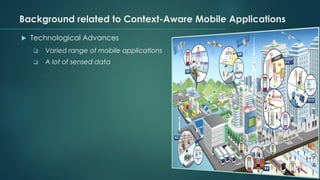
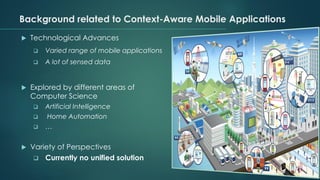
 Technological Advances
❑ Varied range of mobile applications
❑ A lot of sensed data
Background related to Context-Aware Mobile Applications
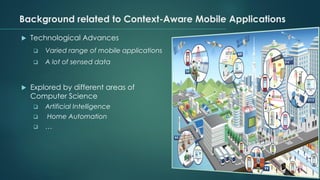
 Technological Advances
❑ Varied range of mobile applications
❑ A lot of sensed data
 Explored by different areas of
Computer Science
❑ Artificial Intelligence
❑ Home Automation
❑ …
Background related to Context-Aware Mobile Applications
 Technological Advances
❑ Varied range of mobile applications
❑ A lot of sensed data
 Explored by different areas of
Computer Science
❑ Artificial Intelligence
❑ Home Automation
❑ …
 Variety of Perspectives
❑ Currently no unified solution
Background related to Context-Aware Mobile Applications
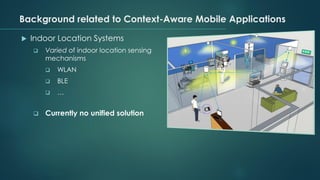
 Indoor Location Systems
❑ Varied of indoor location sensing
mechanisms
❑ WLAN
❑ BLE
❑ …
❑ Currently no unified solution
Background related to Context-Aware Mobile Applications
Development of context-aware mobile applications
is a complex task
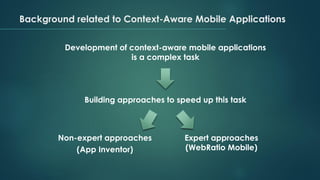
Background related to Context-Aware Mobile Applications
Development of context-aware mobile applications
is a complex task
Building approaches to speed up this task
Non-expert approaches
(App Inventor)
Background related to Context-Aware Mobile Applications
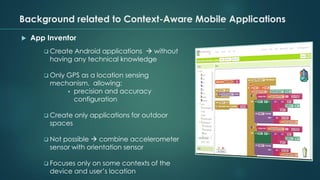
 App Inventor
❑ Create Android applications → without
having any technical knowledge
❑ Only GPS as a location sensing
mechanism, allowing:
▪ precision and accuracy
configuration
❑ Create only applications for outdoor
spaces
❑ Not possible → combine accelerometer
sensor with orientation sensor
❑ Focuses only on some contexts of the
device and user’s location
Background related to Context-Aware Mobile Applications
Development of context-aware mobile applications
is a complex task
Building approaches to speed up this task
Non-expert approaches
(App Inventor)
Expert approaches
(WebRatio Mobile)
Background related to Context-Aware Mobile Applications
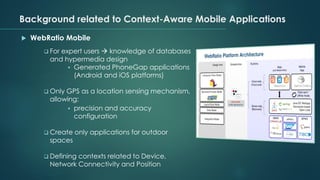
 WebRatio Mobile
❑ For expert users → knowledge of databases
and hypermedia design
▪ Generated PhoneGap applications
(Android and iOS platforms)
❑ Only GPS as a location sensing mechanism,
allowing:
▪ precision and accuracy
configuration
❑ Create only applications for outdoor
spaces
❑ Defining contexts related to Device,
Network Connectivity and Position
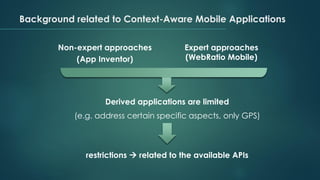
Background related to Context-Aware Mobile Applications
Non-expert approaches
(App Inventor)
Expert approaches
(WebRatio Mobile)
Derived applications are limited
(e.g. address certain specific aspects, only GPS)
restrictions → related to the available APIs
Background related to Context-Aware Mobile Applications
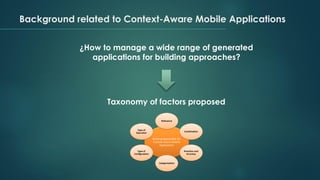
¿How to manage a wide range of generated
applications for building approaches?
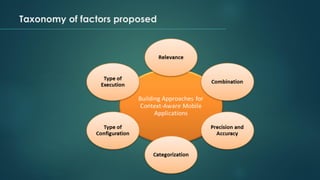
Taxonomy of factors proposed
Construction of DSL
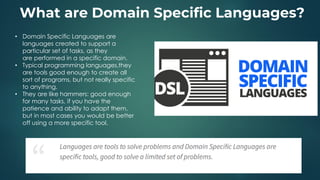
What are Domain Specific Languages?
• Domain Specific Languages are
languages created to support a
particular set of tasks, as they
are performed in a specific domain.
• Typical programming languages,they
are tools good enough to create all
sort of programs, but not really specific
to anything.
• They are like hammers: good enough
for many tasks, if you have the
patience and ability to adapt them,
but in most cases you would be better
off using a more specific tool.
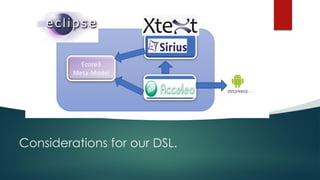
Considerations for our DSL.
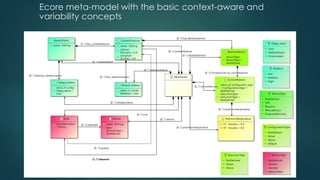
Ecore meta-model with the basic context-aware and
variability concepts
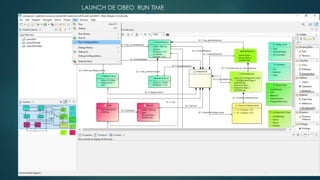
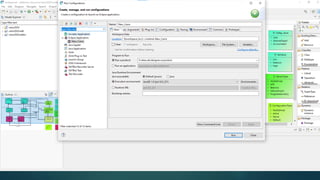
LAUNCH DE OBEO RUN TIME
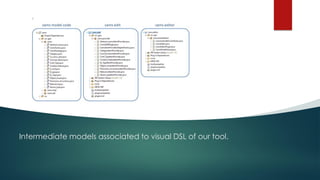
Intermediate models associated to visual DSL of our tool.
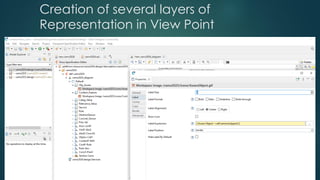
Creation of several layers of
Representation in View Point
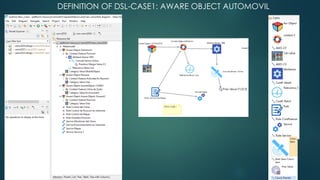
DEFINITION OF DSL-CASE1: AWARE OBJECT AUTOMOVIL
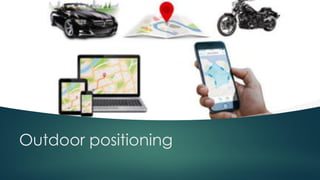
Outdoor positioning
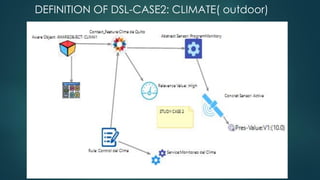
DEFINITION OF DSL-CASE2: CLIMATE( outdoor)
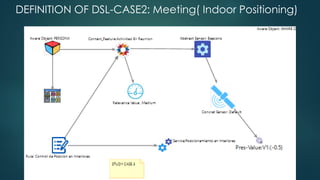
indoor positioning
DEFINITION OF DSL-CASE2: Meeting( Indoor Positioning)
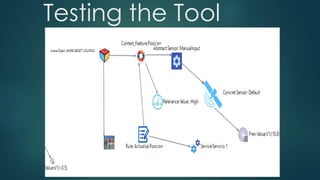
Testing the Tool
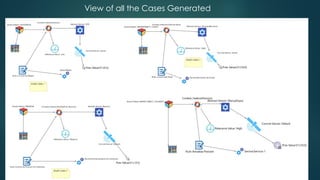
View of all the Cases Generated
Discussion
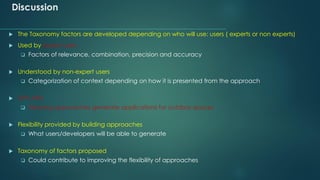
 The Taxonomy factors are developed depending on who will use: users ( experts or non experts)
 Used by expert users
❑ Factors of relevance, combination, precision and accuracy
 Understood by non-expert users
❑ Categorization of context depending on how it is presented from the approach
 GPS APIs
❑ Allowing approaches generate applications for outdoor spaces
 Flexibility provided by building approaches
❑ What users/developers will be able to generate
 Taxonomy of factors proposed
❑ Could contribute to improving the flexibility of approaches
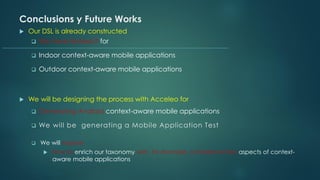
Conclusions y Future Works
 Our DSL is already constructed
❑ We have testesd it for
❑ Indoor context-aware mobile applications
❑ Outdoor context-aware mobile applications
 We will be designing the process with Acceleo for
❑ Generating Android context-aware mobile applications
❑ We will be generating a Mobile Application Test
❑ We will explore
 How to enrich our taxonomy with, for example, complementary aspects of context-
aware mobile applications
Contacts
Estevan R. Gómez-Torres,
Cecilia Challiol, Silvia E. Gordillo
ergomez@espe.edu.ec,
{ceciliac,gordillo}@lifia.info.unlp.e
du.ar
[1] U. Alegre, J. Augusto, and T. Clark, "Engineering context-aware systems and applications :
A survey," Journal of Systems and Software, vol. 117, pp. 55-83, July 2016.
[2] A. Dey, "Understanding and Using Context," Personal and Ubiquitous Computing, vol. 5, no
1, pp. 4-7, Feb. 2001.
[3] B. Schilit, "Context-Aware Computing Applications," Proc. of the First Workshop on Mobile
Computing (WMCSA 1994.), IEEE, Dec. 1994, pp. 85-90.
[4] J. Augusto, A. Aztiria, D. Kramer, and U. Alegre, "A Survey on the Evolution of the Notion of
Context-Awareness," Applied Artificial Intelligence, vol. 31, no. 7-8, pp. 613-642, Feb. 2018.
[5] C. Bauer and A. Novotny, "A consolidated view of context for intelligent system," Journal of
Ambient Intelligence and Smart Environments, vol. 9, no 4, pp. 377-393, Jun. 2017.
[6] C. Bauer and A.K Dey, "Considering context in the design of intelligent systems: Current
practices and suggestions for improvement," Systems and Software, vol. 112, pp. 26-47, Feb.
2016.
[7] U. Alegre-Ibarra, J.C. Augusto, and E. Carl, "Perspectives on engineering more usable
context aware systems," Journal of Ambient Intelligence and Humanized Computing , pp. 1-
17, May 2018.
References
[8] D. Wolber, "App Inventor and Real-World Motivation," Proc. of the 42nd ACM technical
symposium on Computer science education, ACM, March. 2011, pp. 601-606.
[9] M. Brambilla and P. Fraternalli, "Interaction flow modeling language: Model-driven UI
engineering of web and mobile apps with IFML," Morgan Kaufmann, 2015.
[10] P. Davidson, and R. Piché, “A survey of selected indoor positioning methods for
smartphones,” IEEE Communications Surveys & Tutorials, vol. 9, no. 2, pp. 1347-1370, 2017.
[11] A. Basiri, E.S. Lohan, T. Moore, A. Winstanley, P. Peltola, C. Hill, and P.F. Silva, "Indoor
Location Based Services Challenges, Requirements and Usability of Current Solutions,"
Computer Science Review, vol. 24 , pp. 1-12, May 2017.
[12] R.F. Brena, J.P García-Vázquez, C.E Galván-Tejada, D. Muñoz-Rodriguez, C. Vargas-
Rosales, and J. Fangmeyer, “Evolution of Indoor Positioning Technologies: A Survey,” Journal of
Sensors, vol. 2017, article ID 2630413, Mar. 2017.
[13] A. Fortier, G. Rossi, S.E. Gordillo, and C. Challiol, "Dealing with variability in context-aware
mobile software," Journal of Systems and Software, vol. 83, no. 6, Jun. 2010, pp. 915-936.
References
[14] M. Nieke, G. Engel, and C. Seidl, "DarwinSPL: an integrated tool suite for modeling evolving
context-aware software product lines," Proc. of the Eleventh International Workshop on
Variability Modelling of Software-intensive Systems, ACM, Feb. 2017, pp. 92-99.
[15] J. Joo-Nagata, F.M. Abad, J.G.B Giner, AND F.J García-Peñalvo, “Augmented reality and
pedestrian navigation through its implementation in m-learning and e-learning: Evaluation of
an educational program in Chile”, Computers & Education, vol. 111, pp. 1-17, Aug. 2017.
[16] K., Mens, R. Capilla, N. Cardozo, and B. Dumas, "A taxonomy of context-aware software
variability approaches," Proc. of the 15th International Conference on Modularity, ACM, Mar.
2016, pp. 119-124
References

Development of DSL for Context-Aware Mobile Applications

  • 1.
    Developing a New Toolof DSL for Context- aware Mobile Applications
  • 2.
    Agenda  Background relatedto Context-Aware Mobile Applications  Taxonomy of factors that should be considered by context- aware mobile application building approaches  Construction of DSL with Obeo Designer  Discussion  Conclusions y Future Works
  • 3.
  • 4.
    Background related toContext-Aware Mobile Applications  Technological Advances ❑ Varied range of mobile applications ❑ A lot of sensed data
  • 5.
    Background related toContext-Aware Mobile Applications  Technological Advances ❑ Varied range of mobile applications ❑ A lot of sensed data  Explored by different areas of Computer Science ❑ Artificial Intelligence ❑ Home Automation ❑ …
  • 6.
    Background related toContext-Aware Mobile Applications  Technological Advances ❑ Varied range of mobile applications ❑ A lot of sensed data  Explored by different areas of Computer Science ❑ Artificial Intelligence ❑ Home Automation ❑ …  Variety of Perspectives ❑ Currently no unified solution
  • 7.
    Background related toContext-Aware Mobile Applications  Indoor Location Systems ❑ Varied of indoor location sensing mechanisms ❑ WLAN ❑ BLE ❑ … ❑ Currently no unified solution
  • 8.
    Background related toContext-Aware Mobile Applications Development of context-aware mobile applications is a complex task
  • 9.
    Background related toContext-Aware Mobile Applications Development of context-aware mobile applications is a complex task Building approaches to speed up this task Non-expert approaches (App Inventor)
  • 10.
    Background related toContext-Aware Mobile Applications  App Inventor ❑ Create Android applications → without having any technical knowledge ❑ Only GPS as a location sensing mechanism, allowing: ▪ precision and accuracy configuration ❑ Create only applications for outdoor spaces ❑ Not possible → combine accelerometer sensor with orientation sensor ❑ Focuses only on some contexts of the device and user’s location
  • 11.
    Background related toContext-Aware Mobile Applications Development of context-aware mobile applications is a complex task Building approaches to speed up this task Non-expert approaches (App Inventor) Expert approaches (WebRatio Mobile)
  • 12.
    Background related toContext-Aware Mobile Applications  WebRatio Mobile ❑ For expert users → knowledge of databases and hypermedia design ▪ Generated PhoneGap applications (Android and iOS platforms) ❑ Only GPS as a location sensing mechanism, allowing: ▪ precision and accuracy configuration ❑ Create only applications for outdoor spaces ❑ Defining contexts related to Device, Network Connectivity and Position
  • 13.
    Background related toContext-Aware Mobile Applications Non-expert approaches (App Inventor) Expert approaches (WebRatio Mobile) Derived applications are limited (e.g. address certain specific aspects, only GPS) restrictions → related to the available APIs
  • 14.
    Background related toContext-Aware Mobile Applications ¿How to manage a wide range of generated applications for building approaches? Taxonomy of factors proposed
  • 15.
  • 16.
  • 17.
    What are DomainSpecific Languages? • Domain Specific Languages are languages created to support a particular set of tasks, as they are performed in a specific domain. • Typical programming languages,they are tools good enough to create all sort of programs, but not really specific to anything. • They are like hammers: good enough for many tasks, if you have the patience and ability to adapt them, but in most cases you would be better off using a more specific tool.
  • 18.
  • 19.
    Ecore meta-model withthe basic context-aware and variability concepts
  • 20.
  • 21.
    Intermediate models associatedto visual DSL of our tool.
  • 23.
    Creation of severallayers of Representation in View Point
  • 24.
    DEFINITION OF DSL-CASE1:AWARE OBJECT AUTOMOVIL
  • 25.
  • 26.
    DEFINITION OF DSL-CASE2:CLIMATE( outdoor)
  • 27.
  • 28.
    DEFINITION OF DSL-CASE2:Meeting( Indoor Positioning)
  • 29.
  • 30.
    View of allthe Cases Generated
  • 31.
    Discussion  The Taxonomyfactors are developed depending on who will use: users ( experts or non experts)  Used by expert users ❑ Factors of relevance, combination, precision and accuracy  Understood by non-expert users ❑ Categorization of context depending on how it is presented from the approach  GPS APIs ❑ Allowing approaches generate applications for outdoor spaces  Flexibility provided by building approaches ❑ What users/developers will be able to generate  Taxonomy of factors proposed ❑ Could contribute to improving the flexibility of approaches
  • 32.
    Conclusions y FutureWorks  Our DSL is already constructed ❑ We have testesd it for ❑ Indoor context-aware mobile applications ❑ Outdoor context-aware mobile applications  We will be designing the process with Acceleo for ❑ Generating Android context-aware mobile applications ❑ We will be generating a Mobile Application Test ❑ We will explore  How to enrich our taxonomy with, for example, complementary aspects of context- aware mobile applications
  • 34.
    Contacts Estevan R. Gómez-Torres, CeciliaChalliol, Silvia E. Gordillo ergomez@espe.edu.ec, {ceciliac,gordillo}@lifia.info.unlp.e du.ar
  • 35.
    [1] U. Alegre,J. Augusto, and T. Clark, "Engineering context-aware systems and applications : A survey," Journal of Systems and Software, vol. 117, pp. 55-83, July 2016. [2] A. Dey, "Understanding and Using Context," Personal and Ubiquitous Computing, vol. 5, no 1, pp. 4-7, Feb. 2001. [3] B. Schilit, "Context-Aware Computing Applications," Proc. of the First Workshop on Mobile Computing (WMCSA 1994.), IEEE, Dec. 1994, pp. 85-90. [4] J. Augusto, A. Aztiria, D. Kramer, and U. Alegre, "A Survey on the Evolution of the Notion of Context-Awareness," Applied Artificial Intelligence, vol. 31, no. 7-8, pp. 613-642, Feb. 2018. [5] C. Bauer and A. Novotny, "A consolidated view of context for intelligent system," Journal of Ambient Intelligence and Smart Environments, vol. 9, no 4, pp. 377-393, Jun. 2017. [6] C. Bauer and A.K Dey, "Considering context in the design of intelligent systems: Current practices and suggestions for improvement," Systems and Software, vol. 112, pp. 26-47, Feb. 2016. [7] U. Alegre-Ibarra, J.C. Augusto, and E. Carl, "Perspectives on engineering more usable context aware systems," Journal of Ambient Intelligence and Humanized Computing , pp. 1- 17, May 2018. References
  • 36.
    [8] D. Wolber,"App Inventor and Real-World Motivation," Proc. of the 42nd ACM technical symposium on Computer science education, ACM, March. 2011, pp. 601-606. [9] M. Brambilla and P. Fraternalli, "Interaction flow modeling language: Model-driven UI engineering of web and mobile apps with IFML," Morgan Kaufmann, 2015. [10] P. Davidson, and R. Piché, “A survey of selected indoor positioning methods for smartphones,” IEEE Communications Surveys & Tutorials, vol. 9, no. 2, pp. 1347-1370, 2017. [11] A. Basiri, E.S. Lohan, T. Moore, A. Winstanley, P. Peltola, C. Hill, and P.F. Silva, "Indoor Location Based Services Challenges, Requirements and Usability of Current Solutions," Computer Science Review, vol. 24 , pp. 1-12, May 2017. [12] R.F. Brena, J.P García-Vázquez, C.E Galván-Tejada, D. Muñoz-Rodriguez, C. Vargas- Rosales, and J. Fangmeyer, “Evolution of Indoor Positioning Technologies: A Survey,” Journal of Sensors, vol. 2017, article ID 2630413, Mar. 2017. [13] A. Fortier, G. Rossi, S.E. Gordillo, and C. Challiol, "Dealing with variability in context-aware mobile software," Journal of Systems and Software, vol. 83, no. 6, Jun. 2010, pp. 915-936. References
  • 37.
    [14] M. Nieke,G. Engel, and C. Seidl, "DarwinSPL: an integrated tool suite for modeling evolving context-aware software product lines," Proc. of the Eleventh International Workshop on Variability Modelling of Software-intensive Systems, ACM, Feb. 2017, pp. 92-99. [15] J. Joo-Nagata, F.M. Abad, J.G.B Giner, AND F.J García-Peñalvo, “Augmented reality and pedestrian navigation through its implementation in m-learning and e-learning: Evaluation of an educational program in Chile”, Computers & Education, vol. 111, pp. 1-17, Aug. 2017. [16] K., Mens, R. Capilla, N. Cardozo, and B. Dumas, "A taxonomy of context-aware software variability approaches," Proc. of the 15th International Conference on Modularity, ACM, Mar. 2016, pp. 119-124 References