CAPACITIVE
TRANSDUCERS
Capacitive Transducer
Capacitance transducers are a type of sensor that measures changes in capacitance (the
ability of a material to store electric charge) to detect physical parameters such as:
1. Displacement (position, movement)
2. Pressure
3. Force
4. Acceleration
5. Vibration
6. Humidity
7. Liquid level
Working principle
 The working principle of a capacitive transducer is variable capacitance. As per its
structure, these are having two parallel metal pates which are maintaining the distance
between them. In between them, dielectric medium (such as air) can be filled. So, the
distance between these two metal plates and positions of the plates can change the
capacitance. So, variable capacitance is the principle of these transducers. The basic
difference between the normal capacitors and capacitive transducers is, the
capacitor plates are constant in normal capacitors wherein these transducers, capacitor
plates are the movable condition.
Types of Capacitive Transducer
According to the structure of the capacitive transducer, they are four types which are
discussed below. They are
Parallel plate capacitance with rectangular plates.
Cylindrical capacitor transducer.
Semi circular parallel plates.
Change in dielectric between parallel plates.
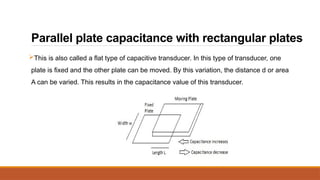
Parallel plate capacitance with rectangular plates
This is also called a flat type of capacitive transducer. In this type of transducer, one
plate is fixed and the other plate can be moved. By this variation, the distance d or area
A can be varied. This results in the capacitance value of this transducer.
Semi Circular Capacitive Transducer
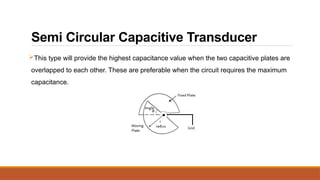
This type will provide the highest capacitance value when the two capacitive plates are
overlapped to each other. These are preferable when the circuit requires the maximum
capacitance.
Cylindrical Capacitive Transducer
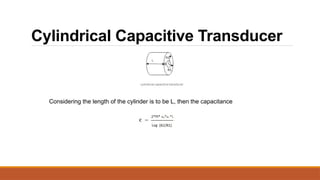
Considering the length of the cylinder is to be L, then the capacitance
Change in Dielectric Medium between
Parallel Plates
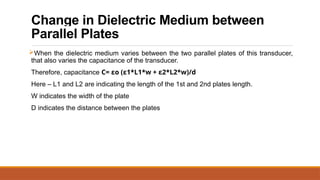
When the dielectric medium varies between the two parallel plates of this transducer,
that also varies the capacitance of the transducer.
Therefore, capacitance C= εo (ε1*L1*w + ε2*L2*w)/d
Here – L1 and L2 are indicating the length of the 1st and 2nd plates length.
W indicates the width of the plate
D indicates the distance between the plates
Advantages of Capacitive Transducer
The capacitive transducer advantages are discussed below. They are
1. High sensitivity
2. Low power consumption
3. Compact size
4. Non-contact measurement
5. High accuracy.
Disadvantages of Capacitive Transducer
There are a few disadvantages of a capacitive transducer are listed below. They
are
1. Sensitivity to temperature
2. Humidity effects
3. Noise susceptibility
4. High frequency limitations
5. Expensive
Applications of Capacitive Transducer
The Applications of the capacitive transducer are
1. Industrial automation
2. Aerospace engineering
3. Medical devices
4. Automotive systems
5. Consumer electronics

CAPACITIVE TRANSDUCERS powerpoint presentation

  • 1.
  • 2.
    Capacitive Transducer Capacitance transducersare a type of sensor that measures changes in capacitance (the ability of a material to store electric charge) to detect physical parameters such as: 1. Displacement (position, movement) 2. Pressure 3. Force 4. Acceleration 5. Vibration 6. Humidity 7. Liquid level
  • 3.
    Working principle  Theworking principle of a capacitive transducer is variable capacitance. As per its structure, these are having two parallel metal pates which are maintaining the distance between them. In between them, dielectric medium (such as air) can be filled. So, the distance between these two metal plates and positions of the plates can change the capacitance. So, variable capacitance is the principle of these transducers. The basic difference between the normal capacitors and capacitive transducers is, the capacitor plates are constant in normal capacitors wherein these transducers, capacitor plates are the movable condition.
  • 4.
    Types of CapacitiveTransducer According to the structure of the capacitive transducer, they are four types which are discussed below. They are Parallel plate capacitance with rectangular plates. Cylindrical capacitor transducer. Semi circular parallel plates. Change in dielectric between parallel plates.
  • 5.
    Parallel plate capacitancewith rectangular plates This is also called a flat type of capacitive transducer. In this type of transducer, one plate is fixed and the other plate can be moved. By this variation, the distance d or area A can be varied. This results in the capacitance value of this transducer.
  • 6.
    Semi Circular CapacitiveTransducer This type will provide the highest capacitance value when the two capacitive plates are overlapped to each other. These are preferable when the circuit requires the maximum capacitance.
  • 7.
    Cylindrical Capacitive Transducer Consideringthe length of the cylinder is to be L, then the capacitance
  • 8.
    Change in DielectricMedium between Parallel Plates When the dielectric medium varies between the two parallel plates of this transducer, that also varies the capacitance of the transducer. Therefore, capacitance C= εo (ε1*L1*w + ε2*L2*w)/d Here – L1 and L2 are indicating the length of the 1st and 2nd plates length. W indicates the width of the plate D indicates the distance between the plates
  • 9.
    Advantages of CapacitiveTransducer The capacitive transducer advantages are discussed below. They are 1. High sensitivity 2. Low power consumption 3. Compact size 4. Non-contact measurement 5. High accuracy.
  • 10.
    Disadvantages of CapacitiveTransducer There are a few disadvantages of a capacitive transducer are listed below. They are 1. Sensitivity to temperature 2. Humidity effects 3. Noise susceptibility 4. High frequency limitations 5. Expensive
  • 11.
    Applications of CapacitiveTransducer The Applications of the capacitive transducer are 1. Industrial automation 2. Aerospace engineering 3. Medical devices 4. Automotive systems 5. Consumer electronics